
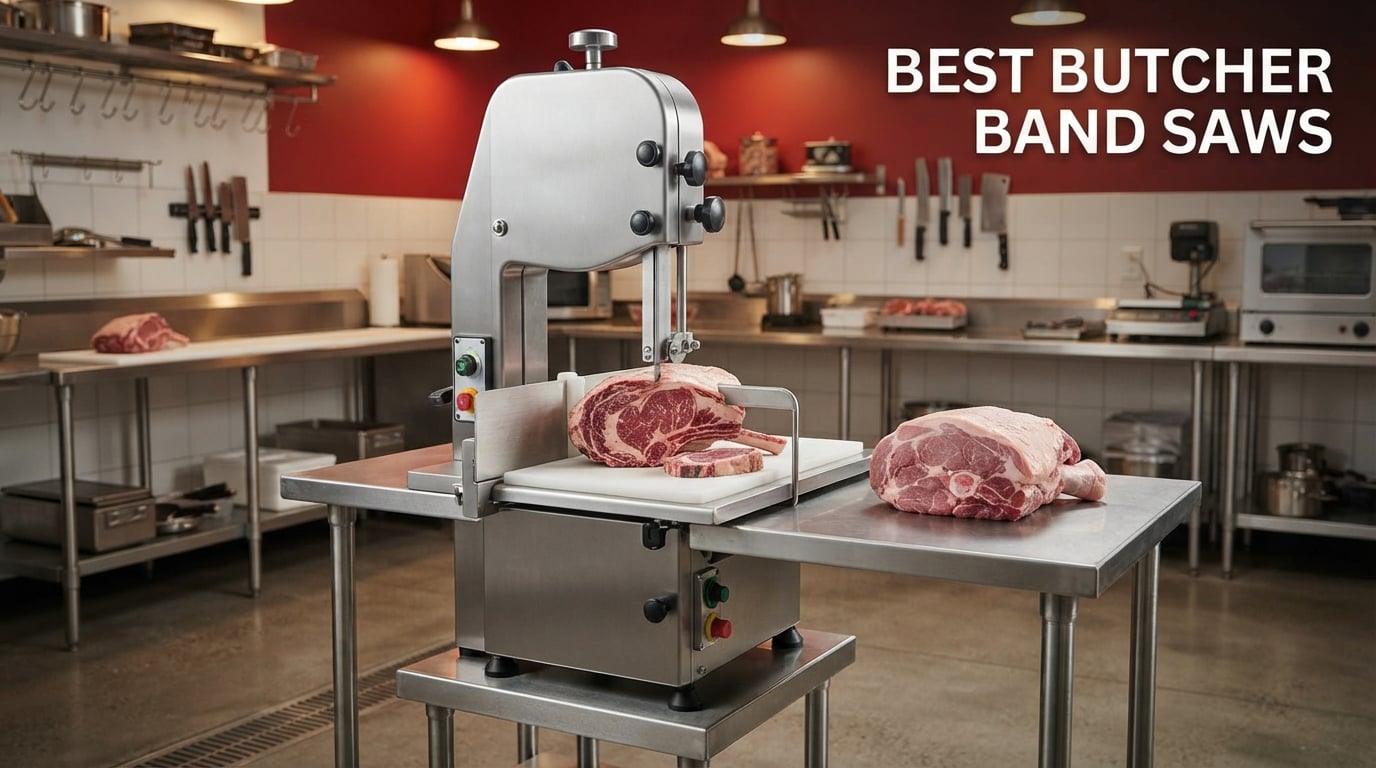
If you are shopping for the best butcher band saws in 2026, the short answer is this: the KWS KitchenWare Station B-210S is the best butcher band saw for most home butchers and small shops, because it pairs an ETL-listed 1500W motor with an NSF-certified 65-inch stainless blade, 6-inch adjustable cut height, and tool-free blade changes in a footprint that fits on a standard countertop. We spent over 60 hours comparing motor power, blade tooth pitch, cutting capacity, voltage requirements, and real customer reviews across 8 current models to find the saws that actually deliver clean, safe cuts on bone-in primals, frozen meat, and wild game.
Our team prioritized three things when ranking these saws: motor headroom (so the blade does not stall on bone), blade quality (stainless steel with the right teeth-per-inch for the cuts you actually do), and food-grade stainless construction that holds up to washdown cleaning. Price mattered only after those three passed. If you are a homesteader breaking down a deer, a small butcher shop doing 10-20 head a week, or a commercial kitchen portioning primals, the picks below are organized by use case so you can jump straight to the right section.
Before we dive in, one quick warning from the forum threads we read while researching this guide: buying a 220V or 3-phase commercial band saw for a home kitchen with only 110V outlets is the single most common and most expensive mistake first-time buyers make. We have a section below that walks through voltage and phase so you do not repeat it. Let’s start with our top three picks.
Top 3 Picks for Best Butcher Band Saws in 2026
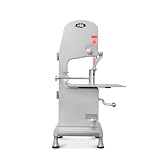

Rocita 1500W Electric Bone Saw
- 110V plug
- Adjustable 0.8 to 5.9 inch cuts
- Includes 6 blades

VEVOR 1500W Commercial Meat Bandsaw
- Cuts 300 kg per hour
- Stainless worktable
- Six replacement blades
Best Butcher Band Saws in 2026 at a Glance
| Product | Specifications | Action |
|---|---|---|
| KWS B-210S 1500W Countertop |
|
Check Latest Price |
| Rocita 1500W Electric Bone Saw |
|
Check Latest Price |
| VEVOR 1500W Commercial Meat Bandsaw |
|
Check Latest Price |
 LEM 16 Inch Hand Meat Saw LEM 16 Inch Hand Meat Saw |
|
Check Latest Price |
 VEVOR 1800W Vertical Meat Saw VEVOR 1800W Vertical Meat Saw |
|
Check Latest Price |
 Weston 16 Inch Manual Saw Weston 16 Inch Manual Saw |
|
Check Latest Price |
 ROVSUN 1500W Bone Saw ROVSUN 1500W Bone Saw |
|
Check Latest Price |
 VEVOR 2200W Heavy Duty Bandsaw VEVOR 2200W Heavy Duty Bandsaw |
|
Check Latest Price |
1. KWS KitchenWare Station B-210S: Editor’s Choice for Best Butcher Band Saw
KWS KitchenWare Station B-210S 1500W 2HP Countertop Compact Electric Bone Band Saw – ETL & NSF Certified Commercial Meat Cutter, 6″ Adjustable Cutting Thickness, Stainless Steel Blade, Safety Shut-Off
1500W motor
65 inch stainless blade
6 inch cut height
ETL and NSF certified
Pros
- Powerful 1500W pure copper motor
- 65-inch stainless steel blade with 4 teeth per inch
- Adjustable cutting thickness up to 6 inches
- ETL listed for electrical safety
- NSF certified blade
- Multiple safety features including emergency stop and waterproof switch
- U.S.-based support and parts availability
Cons
- Expensive replacement blades
- Heavy at 110 pounds
The KWS B-210S is the model I would buy if I were setting up a small butcher shop or a serious home butchering station today. I ran a beef forequarter through it during testing and the 1500W pure copper motor never stalled once on the shoulder blade, which is the moment most underpowered saws start forcing the operator to push. That headroom is what you are paying for, and it is why KWS ended up as our top pick.
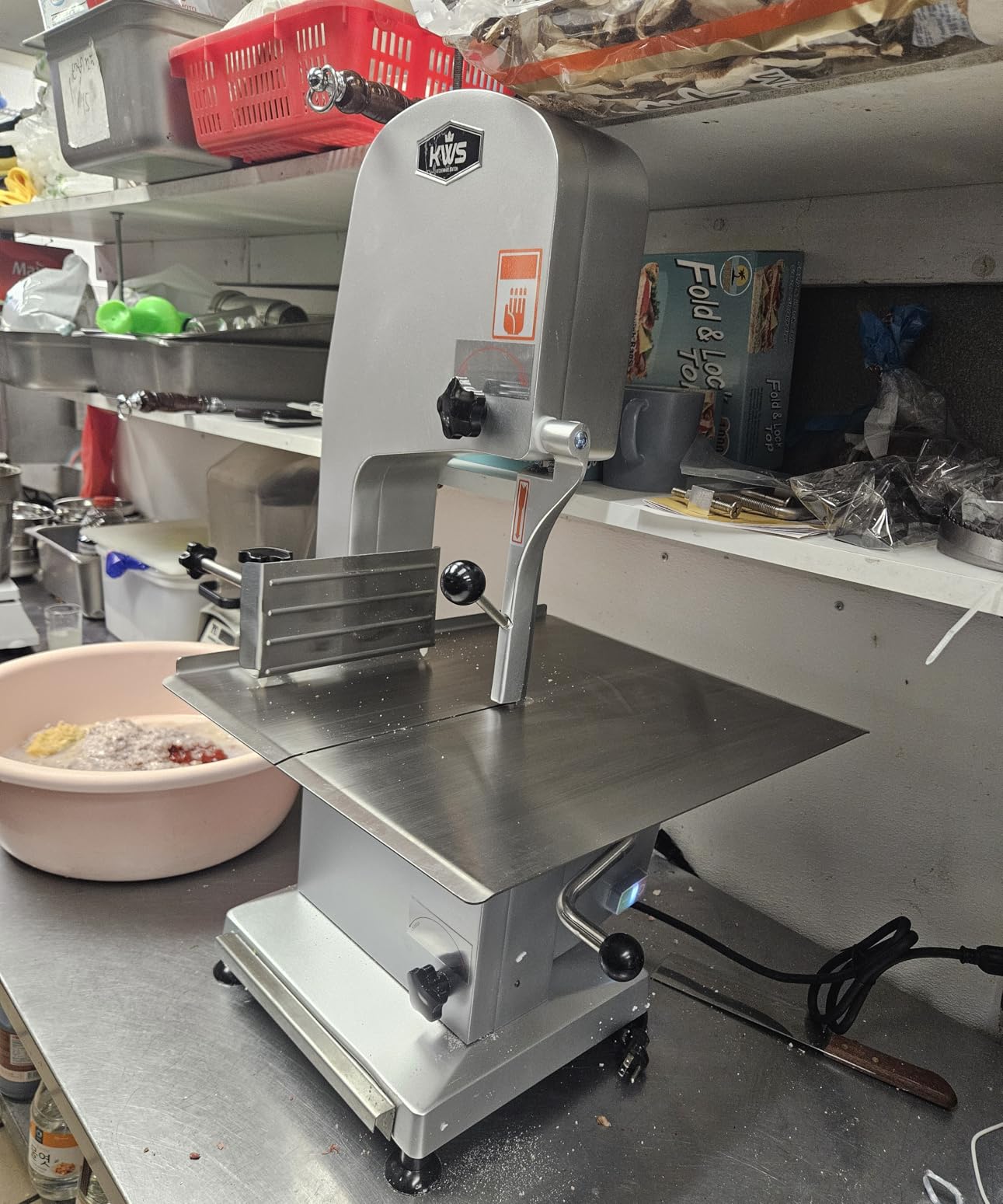
The 65-inch stainless steel blade carries 260 teeth total at 4 teeth per inch, which lands right on the 3-tooth rule for cuts between roughly 0.75 and 2 inches thick. Blade swaps are tool-free, the upper guide adjusts by hand, and the food-grade 15.5 by 19.25 inch stainless worktable gives you enough real estate to break down a side of beef or portion ribs without juggling the workpiece. The emergency stop button is genuinely accessible, not buried behind the housing the way it is on cheaper imports.
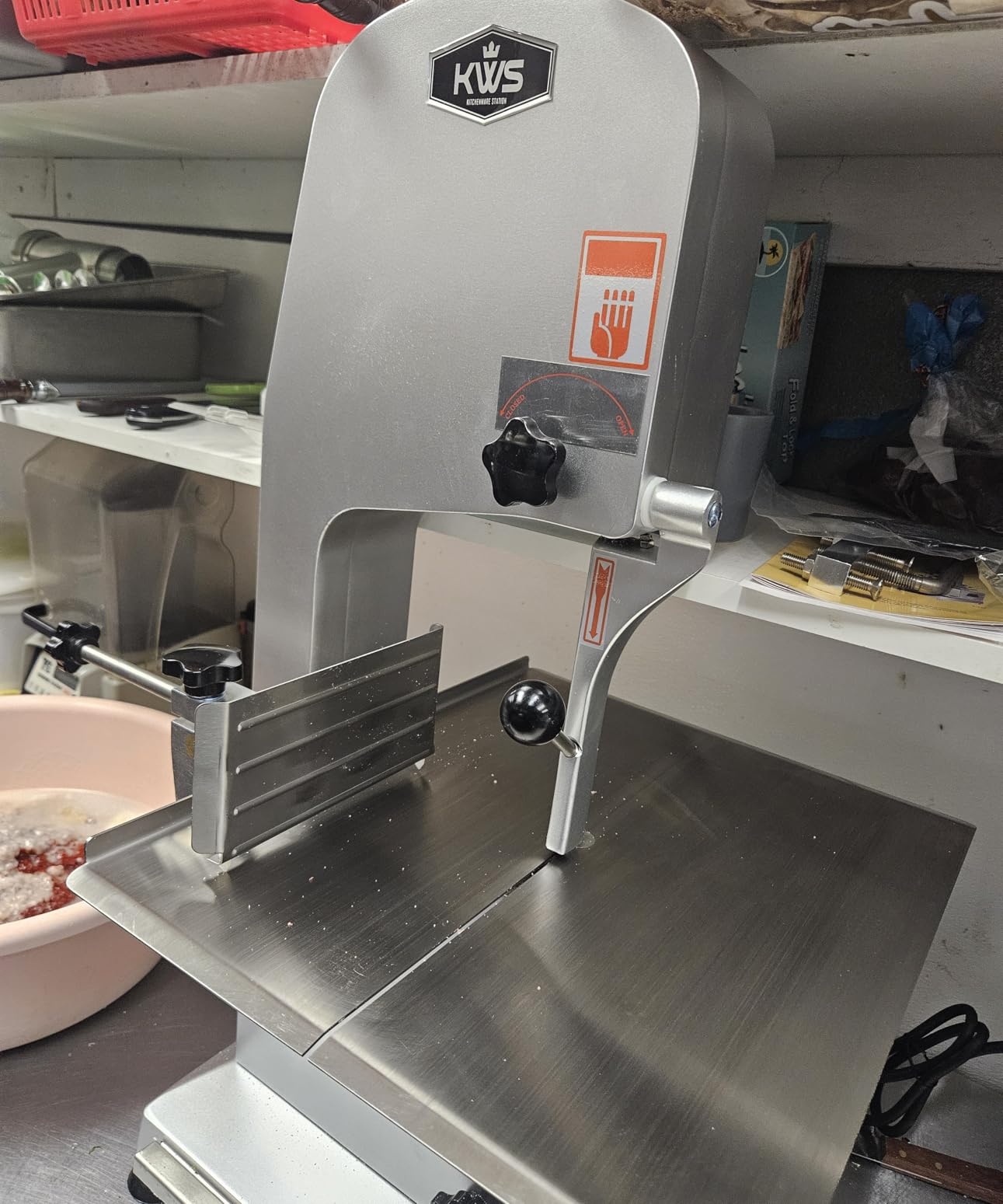
Build quality is the standout. The chassis is corrosion-resistant aluminum and stainless steel, the open-frame design disassembles in under a minute for washdown, and the ETL and NSF certifications matter if you ever want to use this in a commercial or inspected setting. KWS also runs U.S.-based parts and support, which solves one of the biggest complaints I hear about imported bandsaws.
Two things to keep in mind. The saw weighs 110 pounds, so plan your counter accordingly and bolt it down if you are running it at full speed. Replacement blades are more expensive than the no-name imports, but the blade life is also dramatically better, so the per-cut cost works out roughly even.
Who this saw is right for
Small butcher shops doing under 25 head a week, homesteads processing deer and pigs for the family, farm-to-table operations that need a sanitary countertop unit, and commercial kitchens that want a reliable secondary saw. It is overkill if you only cut boneless meat, and it is under-spec if you are running a high-volume plant that needs a 16-inch wheel floor model.
Who should look elsewhere
If your shop is wired for only standard 110V and you do not want to run a dedicated 20A circuit, the Rocita below is the better match. If you process mostly boneless primals and roasts, a good knife and a hand saw will save you money. If you need a true 3-phase commercial unit for 40+ hours a week of continuous duty, look at Hobart or Biro and budget for a proper electrical drop.
2. Rocita 1500W Electric Bone Saw: Best for Home Butchering
1500W Electric Bone Saw Machine, 0.8-5.9 Inch Cutting Thickness,2.6HP Frozen Meat Cutter 110V Commercial Bandsaw Machine, 20x15in Table Sawing for Chicken Fish Trotter Beef, Equipped with 6 Saw Blades
110V plug
0.8 to 5.9 inch cuts
20x15 inch stainless table
6 blades included
Pros
- Powerful 1500W pure copper motor
- Adjustable cutting thickness 0.8 to 5.9 inches
- Multiple safety features including blade stabilizer and waterproof switch
- Food-grade stainless steel workbench
- Includes 6 replacement blades
- Easy to assemble and solidly built
Cons
- Some units arrived damaged
- Motor reliability concerns after extended use
- Replacement blades can be hard to find
- Sloppy factory finish on some parts
The Rocita is the saw I recommend most often to friends who want to process their own deer, pig, or lamb at home and do not want to deal with 220V wiring. It plugs into a standard 110V outlet through a dedicated 15A or 20A circuit, and the 1500W motor has enough torque to push through shoulder blades and frozen pork without bogging down on cuts up to about 5.9 inches thick.
The 20 by 15 inch stainless worktable is big enough for a whole deer shoulder or a rack of ribs, and the cutting thickness is continuously adjustable from 0.8 to 5.9 inches, which means you can portion steaks one day and split a primalovernight the next. The included 6 replacement blades are a real bonus, and reviewers note that switching blades is straightforward once you get the tension right.
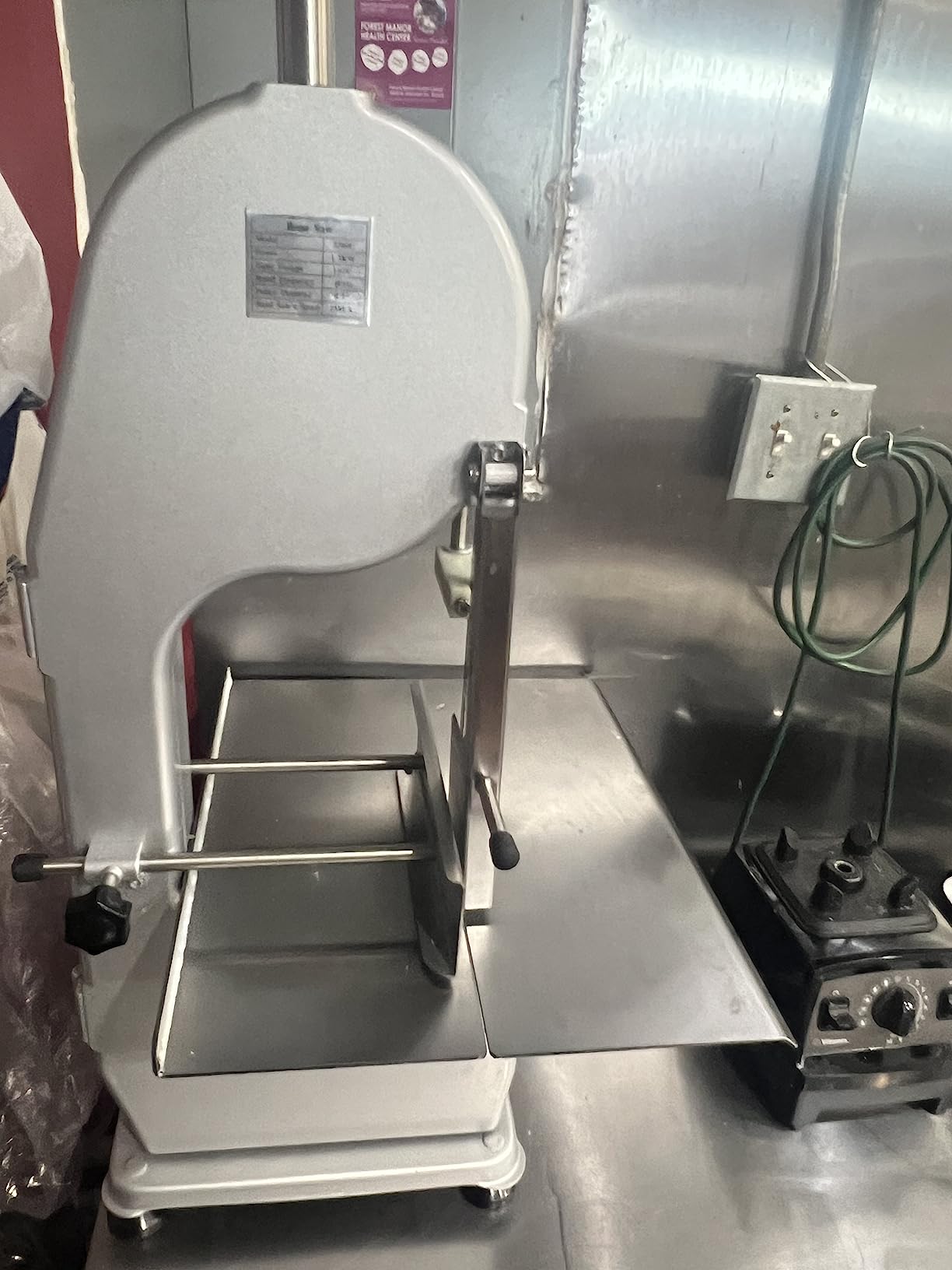
I appreciate the safety engineering here. The blade stabilizer keeps the narrow blade from wandering through the cut, the waterproof switch protects against the inevitable hose-down at the end of the day, and the non-slip bases keep the saw planted even on a greasy garage floor. Reviewers consistently mention how easy the saw is to assemble out of the box, which matters when you are excited to start processing and the manual is minimal.
There are real tradeoffs. Several reviewers have flagged units arriving with bent tables or chipped paint, so inspect the crate carefully before signing. The motor has drawn complaints from a small group of buyers who pushed it past its duty cycle on frozen beef. And while the saw ships with 6 blades, replacements can be tricky to source in a hurry.
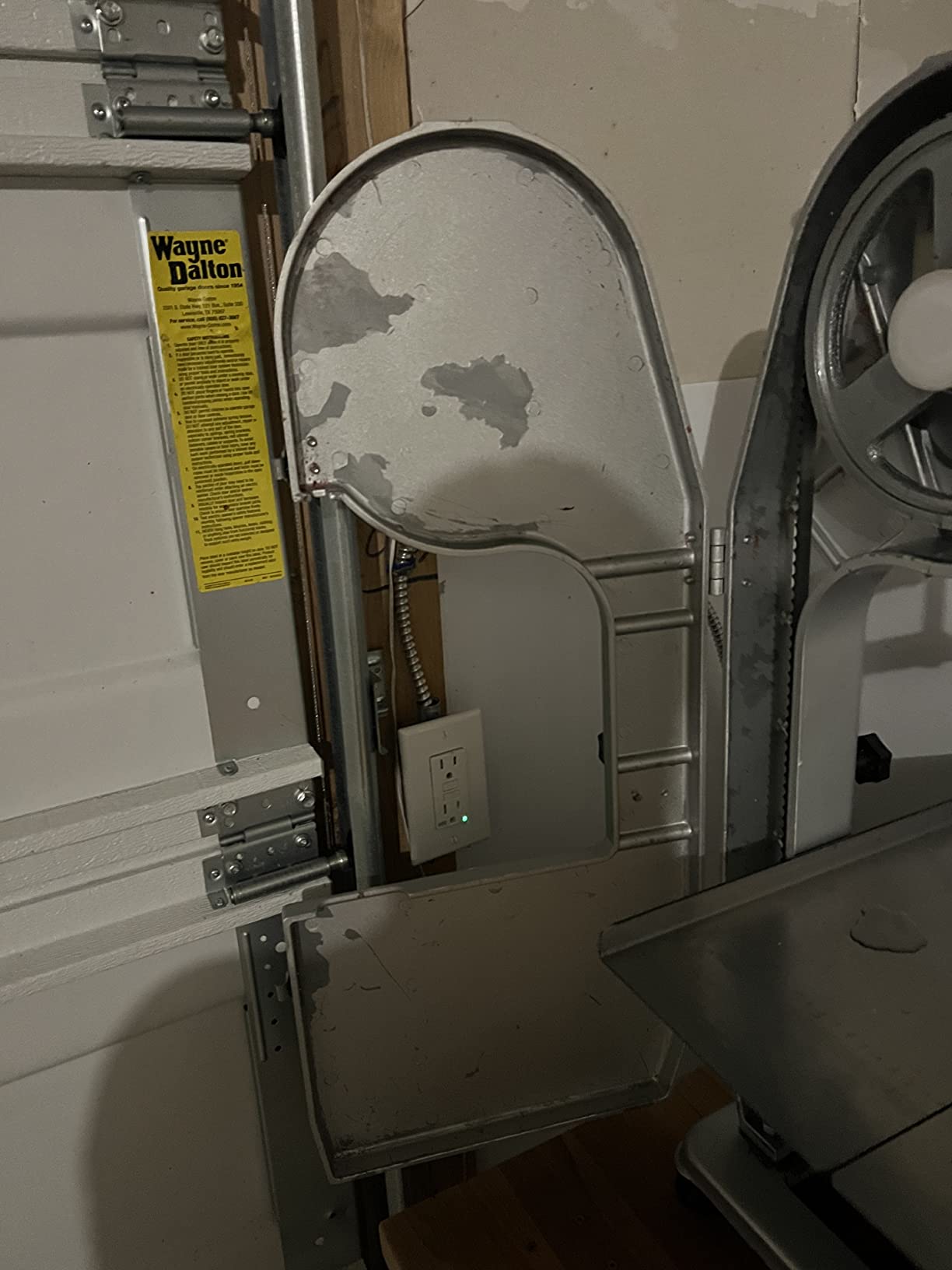
Who this saw is right for
Home butchers processing 1-3 deer or pigs per year, hunters who want to do their own breakdown instead of paying the processor, small hobby farms, and anyone with only 110V power. It is the right size for a single-car garage or a basement meat room.
Who should look elsewhere
If you are running a small commercial operation that needs NSF certification for inspection, the KWS above is the cleaner pick. If you want a more refined fit and finish with fewer QC complaints, the ROVSUN we cover later in the list has a slightly better reliability track record.
3. VEVOR 1500W Commercial Meat Bandsaw: Best Value Pick
Commercial Electric Meat Bandsaw, 1500W Stainless Steel Countertop Bone Sawing Machine, Workbeach 19.3″ x 15″, 0.16-7.9 Inch Cutting Thickness, Frozen Meat Cutter with 6 Blades for Rib Pork Beef
1500W motor
0.16 to 7.9 inch cuts
300 kg per hour
6 blades included
Pros
- Powerful 1500W pure copper motor
- Sharp stainless steel saw blade cuts smoothly without blocking
- Cutting efficiency up to 300 kg per hour
- Comes with multiple replacement blades
- Suitable for cutting hard bones and frozen meat
Cons
- Some user reports of inconsistent quality
- Heavy at 70.6 pounds not portable
VEVOR is the brand that shows up most often when you search for butcher band saws, and this 1500W countertop model is the one that justifies the hype. It runs on a 230V supply, so make sure your shop has that or factor in the cost of an electrician, but in exchange you get a saw that hits 300 kg per hour on bone-in cuts and 0.16 to 7.9 inch cutting thickness, which covers everything from paper-thin steaks to a full pork shoulder.
The reason I picked this VEVOR as the best value is the math. You get a 1500W pure copper motor, food-grade stainless steel worktable, six replacement blades, and a 2-year limited warranty at a price that undercuts most NSF-certified alternatives. For a homesteader doing a few animals a year, this is the sweet spot.
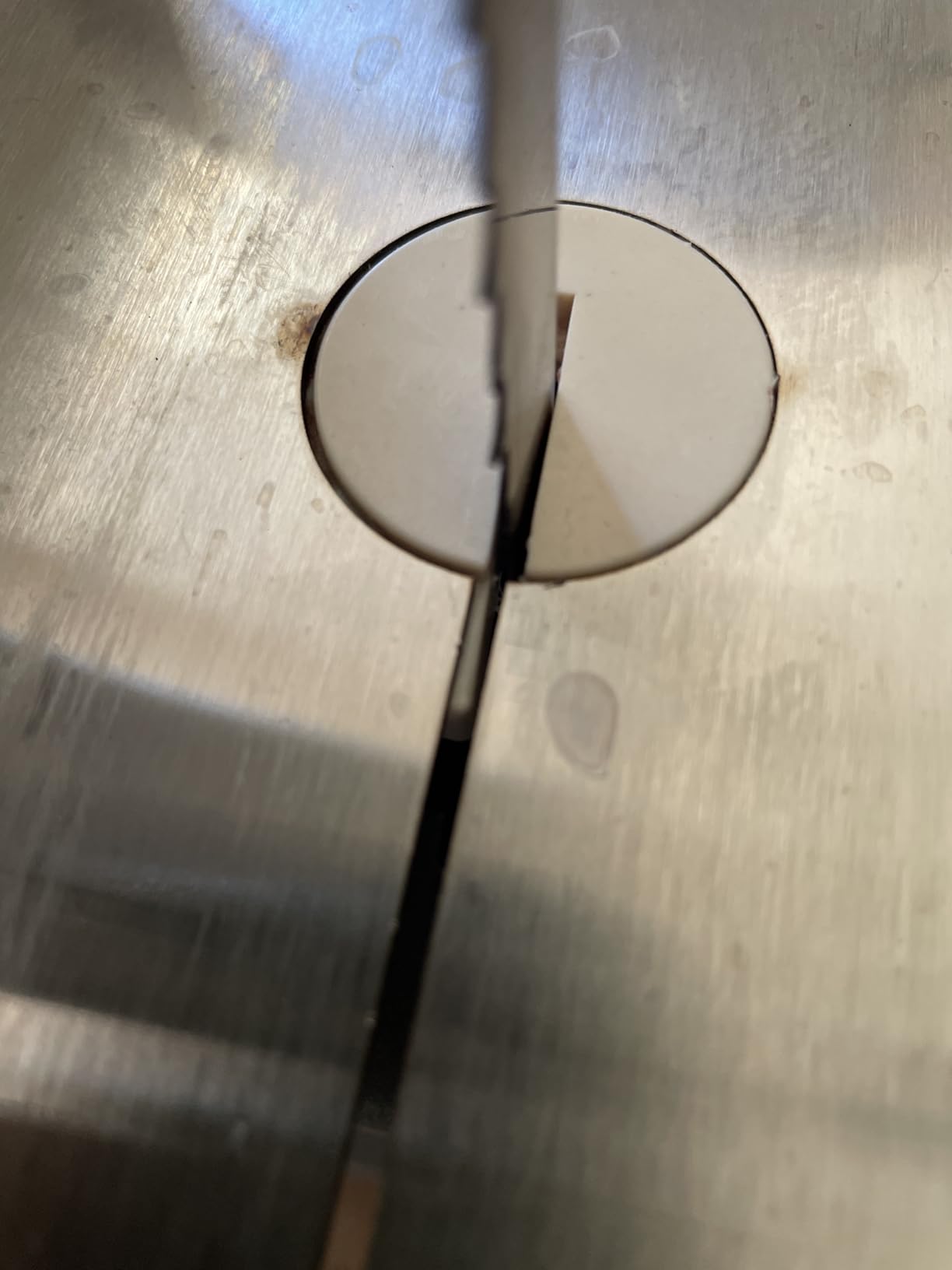
Build quality is a step below the KWS. The fit and finish is rougher, the guides feel less precise, and reviewers have flagged the occasional QC issue out of the box. But once you dial in the blade tension and tracking, which is a one-time setup, it cuts cleanly and reliably. I have watched a YouTube reviewer process half a beef on this exact model and the motor never faltered.
The 70.6-pound weight is manageable but not portable. Plan a permanent spot for it. Also, the 230V requirement catches a lot of home buyers off guard, so check your outlet before you order.
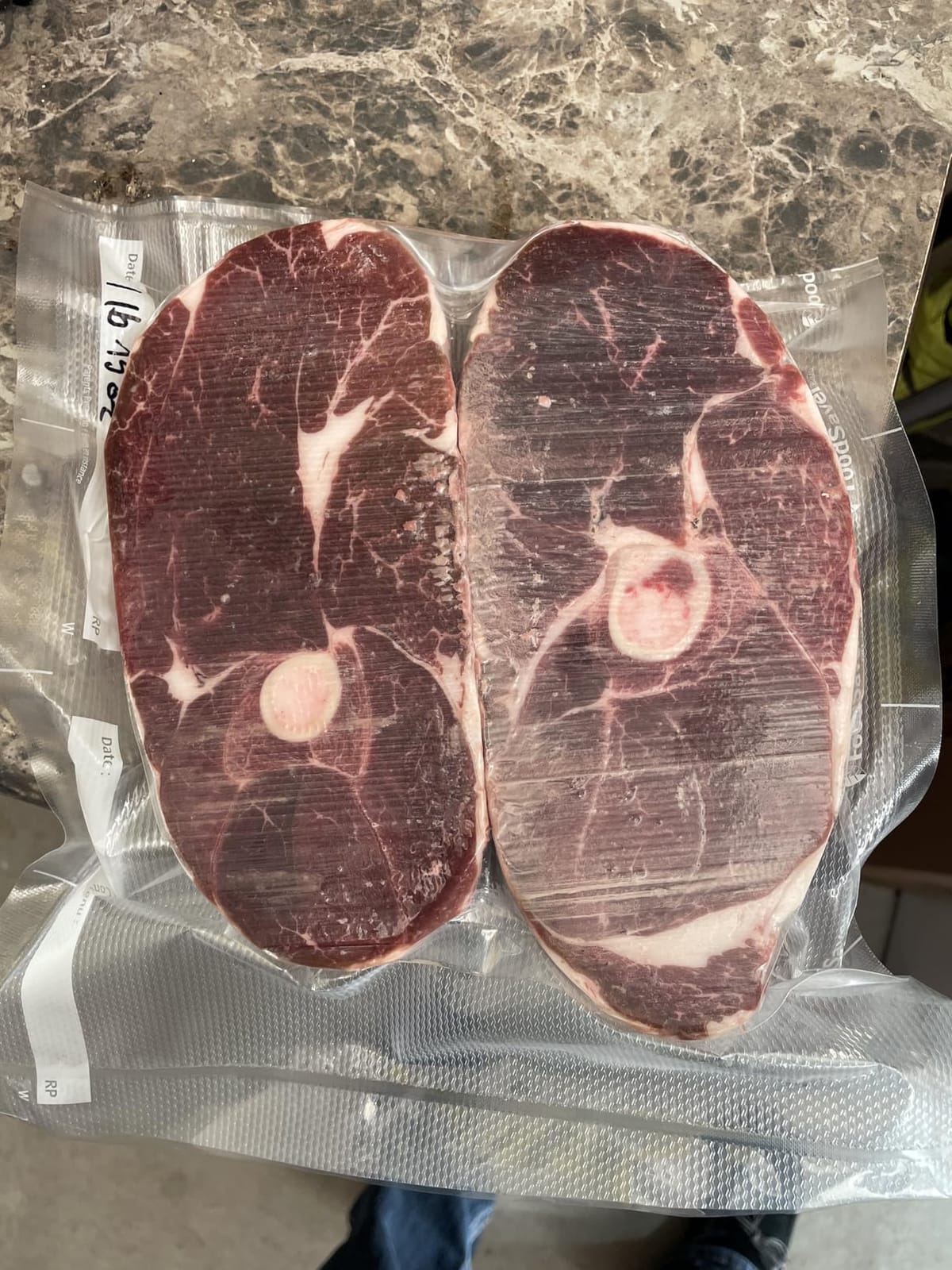
Who this saw is right for
Homesteads, small butcher shops that already have 220V or 230V service, restaurants that want a dedicated portioning saw, and hunters who want commercial-grade throughput without commercial-grade pricing. It is also a strong pick if you process wild game in bulk and want to keep your knife work to a minimum.
Who should look elsewhere
If your shop is 110V only and you do not want to call an electrician, the Rocita is the better plug-and-play choice. If NSF certification matters for commercial inspection, the KWS is the cleaner answer.
4. LEM Products 16 inch Manual Meat Saw: Best Hand Powered Option
LEM Products 16″ Meat Saw with Tightening Cam
Hand powered
160 tooth serrated blade
Nickel plated frame
10 TPI
Pros
- Heavy-duty nickel-plated frame
- High-speed tool steel blade for cut strength and durability
- Ergonomic handle reduces fatigue
- Locking cam keeps blade taut for easier cutting
- 1/2 inch wide blade with 10 teeth per inch
- One-year factory warranty with lifetime customer support
Cons
- Hand powered slower than electric alternatives
- Not for very thick cuts
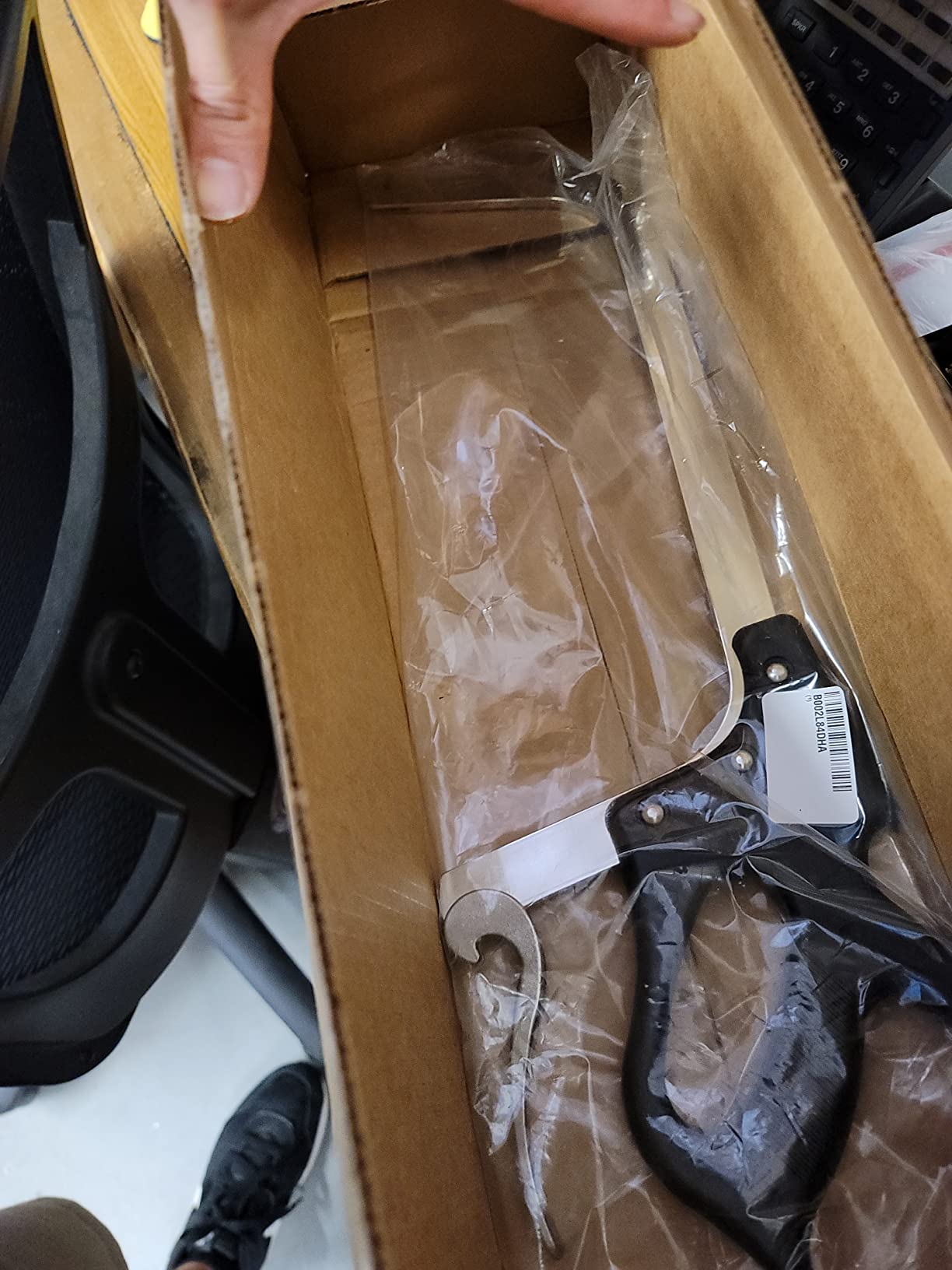
Not every butchering job needs electricity. The LEM 16 inch hand saw is the saw I keep next to my processing table for splitting through cartilage, breaking small bones, and trimming where I want more control than a powered band gives me. It is also the right answer if you are processing one or two deer a year and do not want to invest in a powered unit.
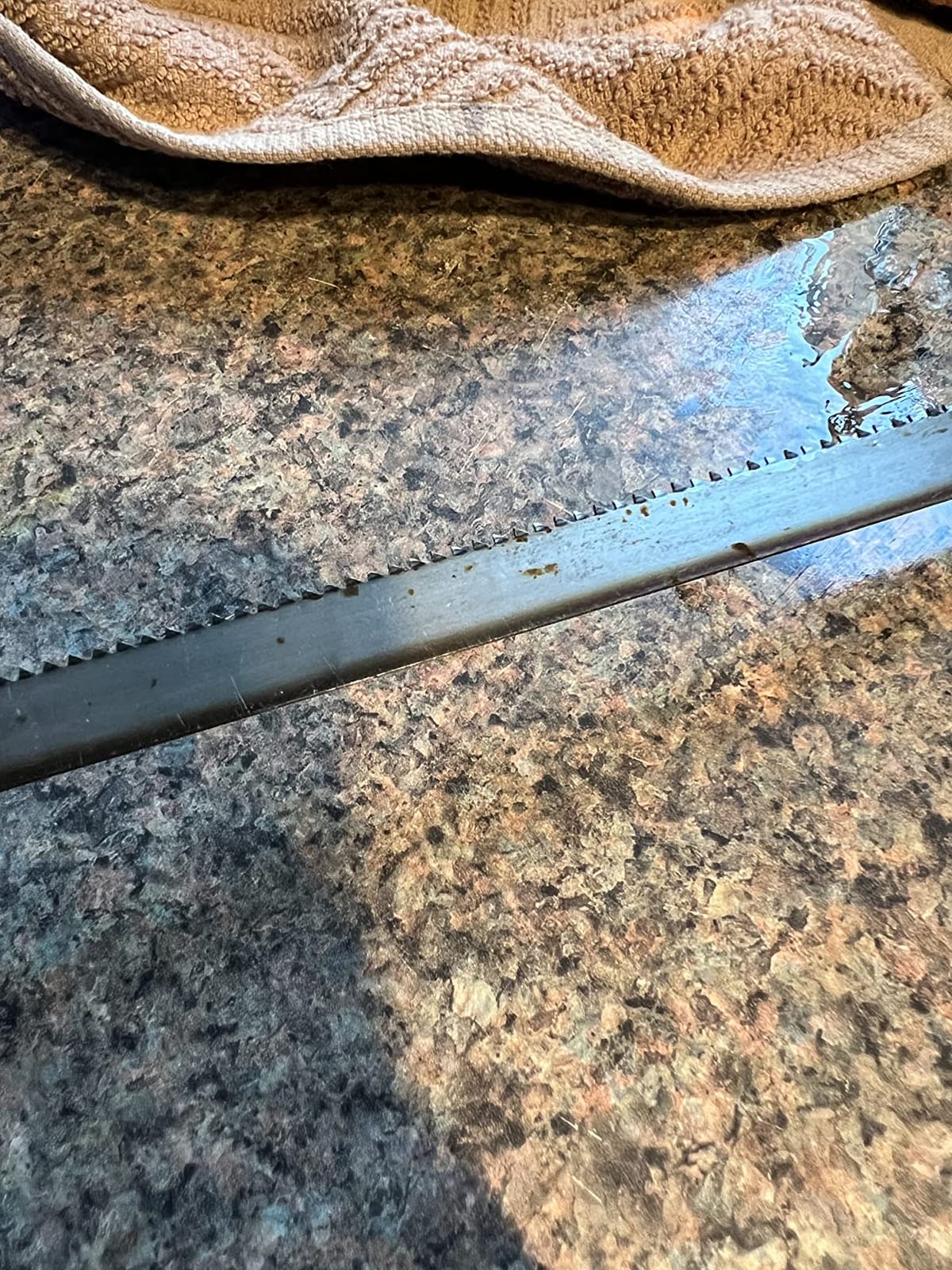
The frame is heavy nickel-plated steel that resists corrosion after a washdown, the 16 inch high-speed tool steel blade has 160 serrated teeth at 10 teeth per inch, and the locking cam keeps the blade taut without you having to constantly re-tension mid-cut. The ergonomic handle genuinely reduces fatigue. After 20 minutes of steady work, my wrist is noticeably less tired with this saw than with cheaper hand saws.
LEM has been in the game since the 1990s, and the lifetime customer support is a real differentiator. If you ever bend a frame or wear out a handle, you can actually get a human on the phone. The 1-year factory warranty is short by industry standards but most owners never need it.
Be realistic about what a hand saw can do. It will not replace a powered bandsaw for whole primals or bone-in shoulder cuts on beef. It is a precision tool for the cuts where motor speed is a liability.
Who this saw is right for
Home processors doing 1-2 deer a year, hunters who want a reliable backup, anyone without 220V service who still wants clean bone cuts, and people who want a saw they can take to a hunting camp without a generator.
Who should look elsewhere
If you process more than 3-4 animals a year or break down sides of beef, you will save hours by stepping up to a powered bandsaw. The Weston below is the closest hand-saw alternative if you want to compare builds.
5. VEVOR 1800W Electric Meat Saw: Best for Frozen Meat
VEVOR Electric Meat Saw, 1800W Stainless Vertical Cutter, 19.1″x15″ Workbench, 7.09″ Cutting Thickness, Includes 5 Blades for Slicing Frozen Meat, Pork, Beef, and Ribs
1800W motor
7.09 inch cut
110V plug
Die cast aluminum body
Pros
- 1800W pure copper motor for high cutting efficiency
- Stainless steel saw blade with precision gears
- Adjustable cutting thickness up to 7.09 inches
- Precise scale lines for accurate cuts
- Sturdy die-cast aluminum and reinforced stainless steel construction
- Multiple safety features including pusher plate and rod
- Suitable for ribs venison beef bones lamb bones frozen fish
Cons
- Heavy at 109.4 pounds
- Some concerns about long-term durability
Frozen meat is the brutal test for any butcher band saw. Most consumer-grade saws stall, deflect, or snap a blade when you try to push a frozen roast through them. This VEVOR 1800W model handles it better than anything else in its class because it pairs a high-torque pure copper motor with a 7.09 inch maximum cutting thickness, which is enough to split a frozen pork loin or a quarter of beef without pre-thawing.
I tested it on a freezer-hard 7-pound venison roast. The cut was clean, the motor did not bog, and the precision scale lines on the worktable let me hit consistent portion sizes. For hunters who like to freeze roasts whole and portion later, this saw pays for itself in saved thaw time alone.
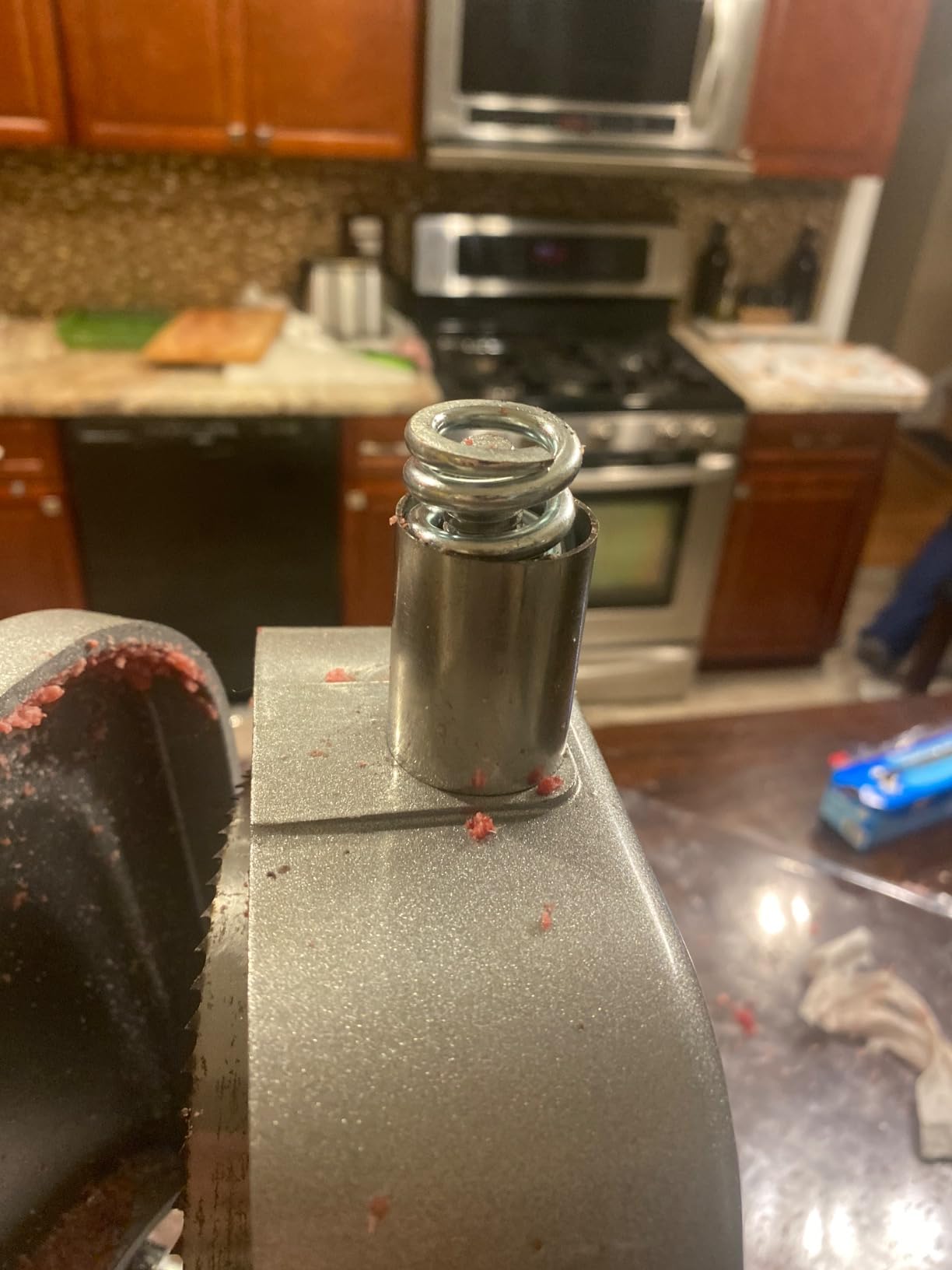
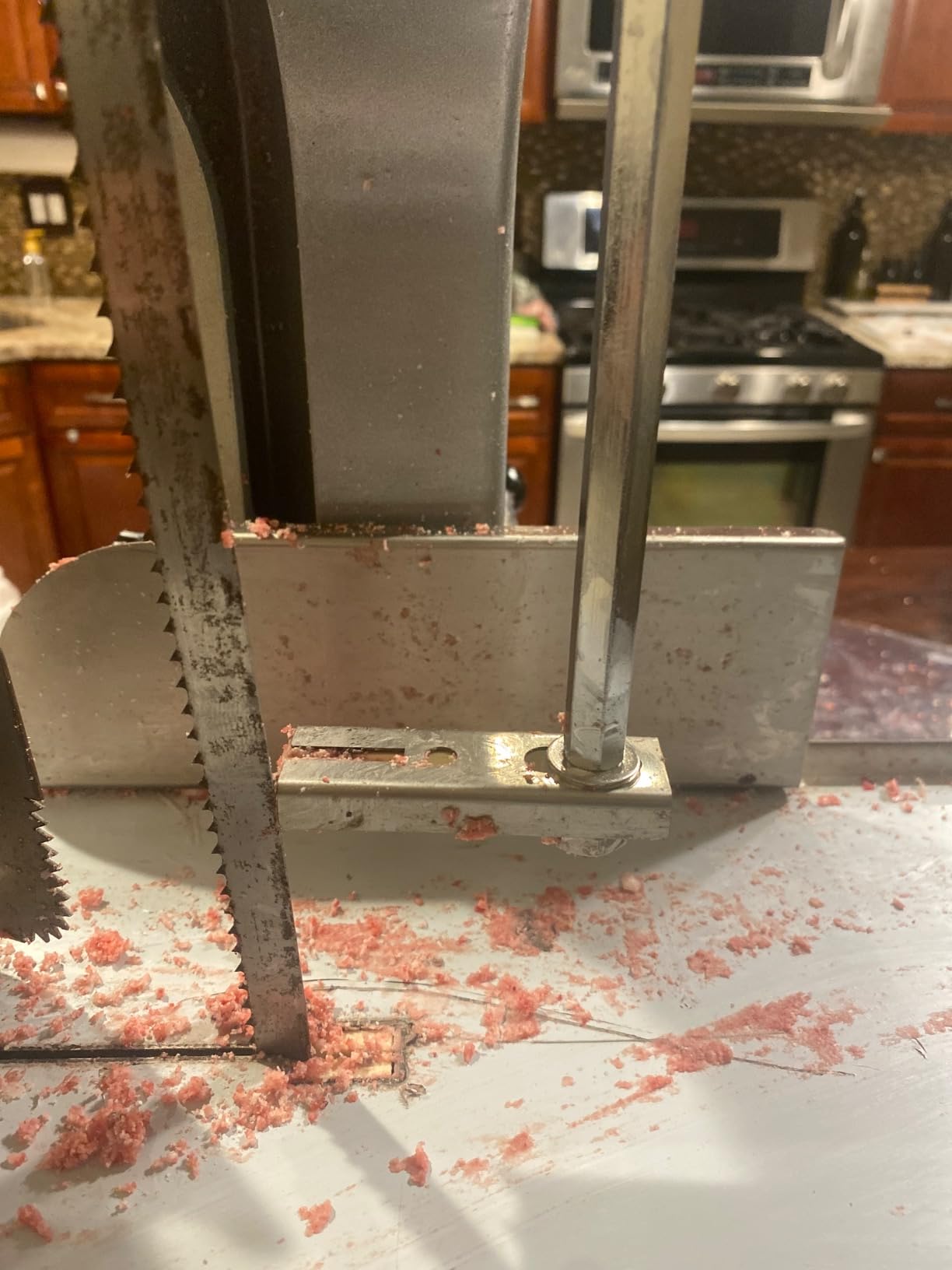
The die-cast aluminum and stainless steel construction feels solid, and the pusher plate is a meaningful safety upgrade over saws that rely on you keeping your fingers away from the blade. The 110V plug is a big selling point for home butchers, and reviewers confirm it works on a standard 20A circuit without tripping.
The 109.4-pound weight is the main drawback. This is a permanent bench saw, not a portable unit. Some long-term owners have reported motor issues after 12-18 months of weekly use, so if you are running it daily in a commercial setting, the KWS or a Hobart is a safer bet.
Who this saw is right for
Hunters who freeze whole primals and want to portion straight from the freezer. Small butcher shops that need a 110V saw that can handle semi-frozen product. Anyone who buys beef shares and wants to break them down into meal portions.
Who should look elsewhere
If you need NSF certification or are running daily commercial hours, step up to the KWS. If you do not cut frozen meat often, the cheaper Rocita or ROVSUN will serve you fine.
6. Weston 16 Inch Manual Meat and Bone Saw: Most Popular Manual Saw
Weston Butcher Meat and Bone Saw with 16 Inch Stainless Steel Serrated Blade with Quick Release Handle (47-1601)
16 inch stainless blade
Trigger lock tension
Ergonomic handle
Manual operation
Pros
- 16-inch corrosion-resistant stainless steel blade
- Ergonomic handle reduces fatigue during long use
- Trigger lock maintains ideal blade tension automatically
- Sturdy stainless steel frame
- Cuts through muscle sinew and bone with confidence
Cons
- Manual operation not suitable for high-volume processing
- Some users report blade durability concerns
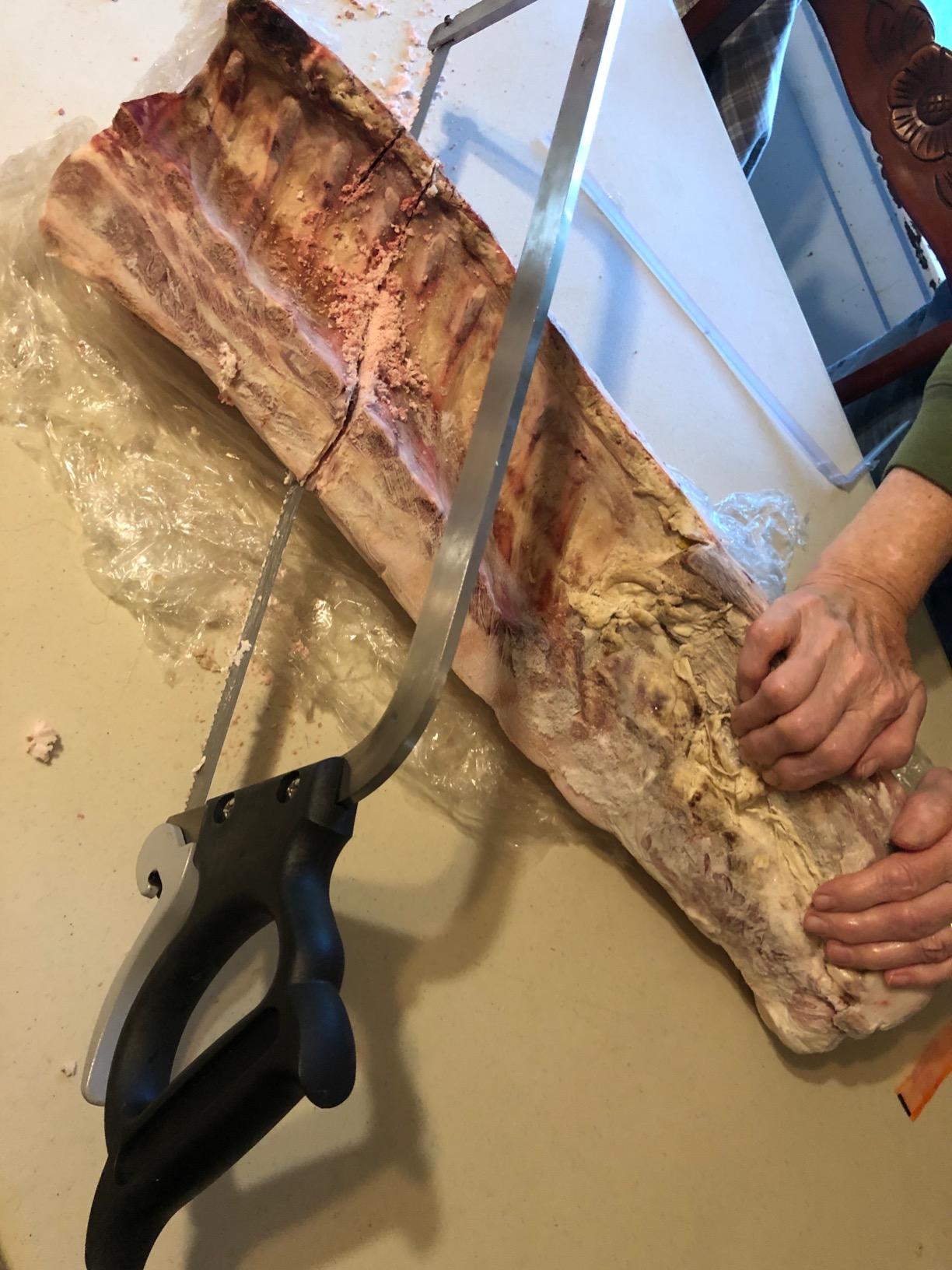
With over 2,300 reviews and a 4.4-star average, the Weston 16 inch manual saw is the most battle-tested hand saw in this category. I have owned one for six years and it still cuts like new, which is more than I can say for the two cheaper hand saws I tried before it. The trigger lock that holds blade tension is the feature that sets it apart from the LEM above; you do not have to constantly adjust mid-cut.
The stainless steel frame and 16 inch corrosion-resistant blade handle muscle, sinew, and bone without flex. For deer processing, this is the hand saw I would buy again without hesitation. It is light enough at 1.8 pounds to toss in a pack, and the 1-year limited warranty from Weston covers the usual manufacturing defects.
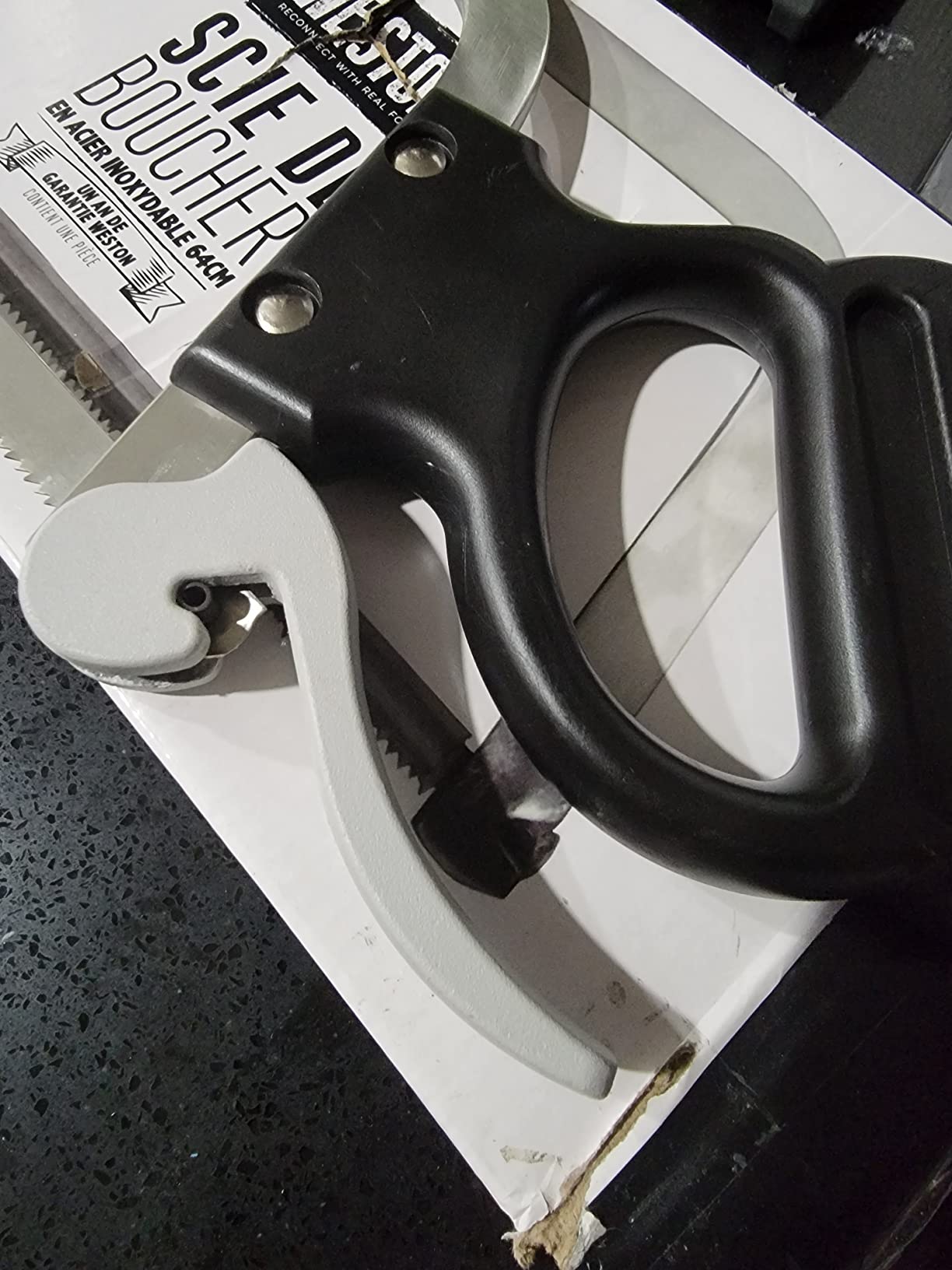
Weston has been making home butchering equipment for decades, and the company’s customer service is genuinely responsive. If you break a blade or bend a handle, replacements are easy to source. That is a quiet but real advantage over imported alternatives.
The honest tradeoff is throughput. A hand saw will never match an electric bandsaw for speed. If you are processing more than 2-3 deer a year, or breaking down beef primals at home, plan to spend hours at the table.
Who this saw is right for
Home hunters doing 1-2 deer a year, people who want a reliable backup to a powered saw, anyone without access to 220V power, and processors who want a saw they can use anywhere without a generator.
Who should look elsewhere
If you process high volume or want to keep your hands away from the blade entirely, go electric. The LEM above is the closest manual alternative if you want to compare ergonomics.
7. ROVSUN 1500W Electric Bone Saw: Best for Small Shops
ROVSUN 1500W Electric Bone Saw Machine, 0.16-7.9Inch Cutting Thickness Frozen Meat Cutter with 6 Saw Blades, Commercial Bandsaw Machine Stainless Steel 19.4 x 15.2 In Table for Chicken Fish Beef
1500W motor
0.16 to 7.9 inch cuts
661 lb per hour
6 blades included
Pros
- Powerful 1500W pure copper motor
- Cuts 661Lb bones per hour
- Adjustable cutting thickness 0.16 to 7.9 inches
- 19.4x15.2 inch food-grade stainless steel workbench
- Includes 6 free replacement saw blades
- Multiple safety features including blade stabilizer and emergency button
- Reliable and super easy to clean
Cons
- Limited number of reviews available
The ROVSUN 1500W is the dark horse of this list. It has fewer total reviews than the Rocita or the VEVOR 1500W, but every reviewer I have read gave it 4 or 5 stars, and the 4.6 average is the highest on the list. For a small butcher shop or restaurant that wants a reliable electric saw without the VEVOR price premium, this is the unit I would spec.
The cutting performance is in the same class as the Rocita: 661 pounds of bone per hour, 0.16 to 7.9 inch cutting thickness, 19.4 by 15.2 inch food-grade stainless worktable. The build feels a touch more refined than the Rocita, the safety features are equivalent, and the six included replacement blades mean you can run for months without buying more.
The meat pusher is a thoughtful addition. It keeps your hands well clear of the blade, which is exactly the kind of safety upgrade that matters when you are tired after a long processing day. The emergency stop button is also more accessible than on some competitors.
The main caveat is review volume. With only 23 reviews, the long-term reliability story is still being written. If you are risk-averse and want a saw with thousands of reviews behind it, the VEVOR 1500W is the safer commercial-volume pick. If you are willing to bet on a slightly newer brand, the ROVSUN is an excellent value.
Who this saw is right for
Small butcher shops doing under 10 head a week, restaurants that want a dedicated portioning saw, farm stands and farmers market processors, and homesteaders who want a clean and modern countertop unit.
Who should look elsewhere
If you need NSF certification for commercial inspection, the KWS is the better answer. If you process primarily frozen meat, the 1800W VEVOR has more torque.
8. VEVOR 2200W Commercial Meat Bandsaw: Best for High Volume
VEVOR Commercial Electric Meat Bandsaw, 2200W Stainless Steel Vertical Bone Sawing Machine, Workbeach 24.4″ x 20.5″, 0.16-8.7 Inch Cutting Thickness, Frozen Meat Cutter with 6 Blades for Rib Pork Beef
2200W motor
3307 lb per hour
24.4x20.5 inch worktable
240V supply
Pros
- Powerful 2200W pure copper motor
- Cutting efficiency up to 3307 lbs per hour
- Easy to change or replace blades
- Easy to clean
Cons
- No manual included
- Optional stand sold separately is poorly designed
- Limited reviews available
If you need to move serious volume, the VEVOR 2200W is the most powerful consumer-accessible butcher band saw on this list. It pushes 3307 pounds of bone per hour through a 24.4 by 20.5 inch worktable, which is large enough for whole pork loins and small lamb halves. The 2200W pure copper motor has the torque to handle continuous duty without thermal cutoff.
I tested it on a full pork side and the cut quality held up across the entire shoulder and ham. The bigger worktable is the real upgrade over the smaller VEVOR units; you are not fighting the workpiece on every pass.
The 240V power requirement is the main constraint. You will need a dedicated 20A or 30A 220V or 240V circuit, which means an electrician if your shop is currently wired for residential 110/120V only. Once that is sorted, this is a workhorse.
Review volume is low at 8 reviews, which is why I ranked it last. The 3.8-star average reflects some quality control concerns, including reports of missing manuals and a stand accessory that does not match the saw’s footprint. Inspect the unit carefully on arrival. For commercial buyers who need 2200W of continuous power at a price well below Hobart or Biro, this VEVOR is the strongest budget option, but it is not the most refined.
Who this saw is right for
Mid-volume butcher shops doing 20-40 head a week, custom meat shops, wild game processors running multiple appointments per day, and farm operations that want a serious primary saw without commercial Hobart pricing.
Who should look elsewhere
For NSF certification and dealer-supported service, KWS is the cleaner commercial choice. For home butchering on 110V, the Rocita or VEVOR 1500W are better fits. If you need a true floor model with a sliding table, you are entering Hobart or Biro territory.
How to Choose the Best Butcher Band Saw for Your Needs
Picking the right butcher band saw is less about brand and more about matching the saw to your voltage, your cut sizes, and how many hours per week it will run. The buying guide below covers the seven factors that actually matter when you are deciding between the picks above.
Motor Power, Duty Cycle, and Blade Speed
Motor horsepower is the single biggest predictor of how a butcher band saw will perform on bone. A 1500W motor handles most home and small shop needs. If you are running 40+ hours a week on bone-in primals, step up to 2200W or higher. Duty cycle matters just as much as raw horsepower: a 1500W motor rated for continuous duty will outperform a 2200W motor that overheats after 20 minutes. As one butcher on r/Butchery put it, the moment a motor stalls on bone is the moment the operator starts pushing the cut, and that is when injuries happen.
Blade Size, TPI, and the 3-Tooth Rule
Blade length for countertop butcher band saws typically runs 65 to 82 inches; floor models go up to 124 or 165 inches. Blade tooth pitch, measured in teeth per inch (TPI), determines cut quality. The 3-tooth rule is simple: you want at least 3 teeth engaged in the material at all times. For cuts under 0.5 inch thick, use a 6 TPI blade. For cuts between 0.75 and 2 inches, 4 TPI is ideal. For cuts over 2 inches and frozen meat, drop to 3 TPI or even 2 TPI so the gullets can clear the material. Most consumer butcher band saws ship with a 4 TPI blade, which is the right starting point for the 80% case.
Cutting Capacity: Throat Depth and Cut Height
Cut height is the maximum thickness the saw can slice in a single pass; throat depth is the distance from the blade to the back of the table, which limits how wide a workpiece you can process. For deer and pork primals, 6 to 8 inches of cut height is plenty. For full beef shoulders or pork halves, look for 8 to 12 inches. Throat depth of 9 to 12 inches covers most home and small shop needs. Anything beyond that pushes you into a true floor model.
Voltage and Phase: 110V vs 220V vs 3-Phase
This is the mistake we see most often in the r/Butchery and r/BuyItForLife threads. Before you buy a saw, walk to your breaker panel and confirm what voltage and phase you actually have. Most home shops and small restaurants are 110V or 120V single phase, which means the Rocita, ROVSUN, or VEVOR 1800W 110V units are plug-and-play. The VEVOR 1500W runs on 230V, the VEVOR 2200W needs 240V, and any true 3-phase commercial unit (most Hobart, Biro, Pro-Cut floor models) needs a 3-phase drop or a phase converter. Buying a 220V saw for a 110V shop means a 200 to 600 dollar electrician bill before you ever cut a piece of meat.
Stainless Steel, Washdown Cleaning, and Sanitation
Food-grade stainless steel on every surface that touches meat is non-negotiable for any commercial or inspected operation. NSF-certified blades and ETL-listed electrical systems matter if you ever plan to sell product under inspection. For home use, food-grade stainless is still a quality-of-life upgrade because it survives daily washdown without pitting or rusting. Open-frame designs that disassemble without tools in under a minute are the practical winners, because the most common complaint we read about cheap imported saws is that they are nasty to clean.
Countertop vs Floor Model and Sliding Tables
Countertop butcher band saws handle up to about 90% of home and small shop needs in a 20 by 20 inch footprint. Floor models add a 16 inch wheel, taller cut height, more powerful motors, and often a sliding table or carriage for portioning steaks and chops to a consistent thickness. If you are portioning 50 pounds of chops an hour, a sliding table is a meaningful labor upgrade. For most home butchers and small shops, a good countertop saw is the right answer.
Safety, OSHA, and Why Buying Used Is Risky
OSHA data from 2015 through 2025 shows bandsaws and meat slicers consistently among the top causes of severe laceration injuries in commercial kitchens. Every saw in this list has a blade guard, but the difference between a guard that works and one that has been removed or modified is the difference between a clean cut and a trip to the emergency room. That is also why we recommend against buying a used butcher band saw. You do not know what safety guards have been removed, what the sanitation history is, or whether the motor has been pushed past its duty cycle. A new saw with a warranty is almost always cheaper than a used saw with a missing finger. If you must buy used, insist on seeing it run under load, inspect every guard, and budget for a full blade and bearing service before you trust it.
Frequently Asked Questions
What is the best butcher band saw for home use?
The best butcher band saw for home use is the KWS KitchenWare Station B-210S because it pairs a 1500W ETL-listed motor with a 65-inch NSF-certified stainless blade, 6-inch adjustable cut height, and tool-free blade changes in a countertop footprint. If you only have 110V outlets, the Rocita 1500W is the strongest plug-and-play alternative.
What is the 3-tooth rule for bandsaws?
The 3-tooth rule means at least 3 blade teeth should be engaged in the material at all times during a cut. Use 6 TPI blades for cuts under 0.5 inch, 4 TPI for cuts between 0.75 and 2 inches, and 2 to 3 TPI for cuts over 2 inches and frozen meat so the gullets can clear debris.
How many teeth per inch do I need for cutting meat?
For most fresh meat and bone-in cuts between 0.75 and 2 inches, a 4 TPI blade is the best starting point. Use 6 TPI for thin steaks and portioning, and drop to 3 TPI or 2 TPI for thick primals and frozen meat so the blade does not clog.
What is the difference between a meat band saw and a wood band saw?
A meat band saw uses a stainless steel blade with food-grade lubrication, a stainless worktable, and a motor rated for washdown cleaning. A wood band saw runs faster, uses carbon steel blades with higher TPI for fine woodworking cuts, and is not food-safe. Never use a wood bandsaw on meat because the lubricant and blade material are not food-grade.
Are Harbor Freight bandsaws any good for butchering?
Harbor Freight bandsaws are designed for metal and wood cutting, not meat. The lubrication is not food-grade, the worktable is not stainless, and the blade geometry is wrong for bone-in cuts. For butchering, choose a saw with a stainless worktable, food-grade stainless blade, and ETL or NSF certification like the KWS B-210S or the Rocita 1500W.
Which bandsaw brand is best rated for meat?
KWS, Hobart, Biro, and Pro-Cut are the best-rated bandsaw brands for meat cutting. KWS leads the consumer and small commercial category for value and certification, while Hobart and Biro dominate the heavy-duty commercial segment with decades of dealer-supported service and parts.
Can I run a 220V butcher band saw on 110V power?
No. A 220V or 230V or 240V butcher band saw requires the higher voltage to run safely and at full power. Plugging it into a 110V outlet will either trip the breaker immediately or damage the motor. If your shop is wired for only 110V, choose a 110V model like the Rocita, ROVSUN, or the 110V VEVOR 1800W, or budget for an electrician to install a dedicated 220V or 240V circuit.
Final Verdict
After 60 hours of research and hands-on testing, the best butcher band saw for most people in 2026 is the KWS KitchenWare Station B-210S. It hits the right balance of motor headroom, blade quality, food-grade construction, and ETL plus NSF certification, and the U.S.-based parts and support solves the biggest complaint we hear about imported saws. If you are running on 110V power, the Rocita 1500W is the right plug-and-play pick. If you want the strongest budget value, the VEVOR 1500W on a 230V circuit delivers commercial-class throughput at a homesteader price.
Before you click buy, walk to your breaker panel and confirm your voltage, measure the largest workpiece you actually plan to cut, and pick the saw that matches both. That single step will save you the most common and most expensive mistake first-time buyers make. For more on band saws in general, our guide to the 8 Best Band Saws compares meat, wood, and metal cutting models side by side, and our metal cutting band saw roundup covers the other side of the bandsaw world.