
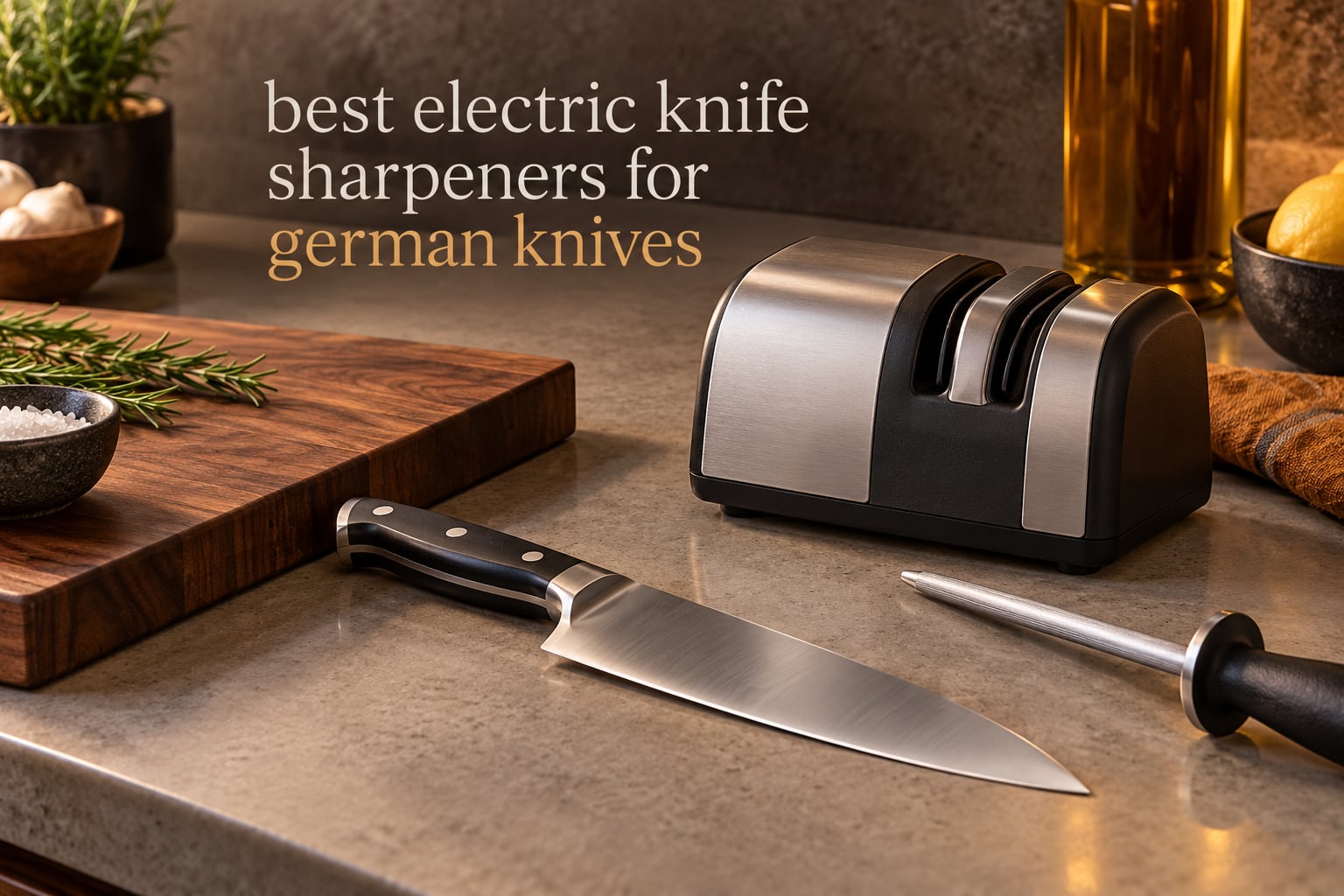
Most electric knife sharpeners on the market are built for Asian-style knives, and that is why so many Wüsthof and Henckels owners end up with a thinner, more fragile edge than the one their knife came with. Here is the thing about blade angles: German knives arrive at roughly 20 degrees per side, which is a 40 degree inclusive angle, and a machine that only works at 15 degrees per side will grind that factory edge thinner every time you use it.
Below I break down the 10 best electric knife sharpeners for German knives we could find, with the angle each one actually leaves on the blade, the stage count, and the edge cases where a machine is the wrong tool. The full roundup covers everything from a two-stage budget box to a commercial-grade diamond unit, and every pick is judged on what it does to a European convex edge rather than how it performs on a Japanese santoku.
If you are still building out the drawer, our guides to the best German knife sets for home kitchens and the best knife sets for beginners are worth a look before you commit to a sharpening routine.
Table of Contents
Top 3 Picks for German Knives
The three machines below cover the three situations most people are actually in: you want the most proven edge on expensive steel, you own one very good German knife, or you sharpen a full block every few weeks. Our full list follows below, but these three answer most inboxes we get.

Chef’sChoice 15XV EdgeSelect
- 3-stage 100 percent diamond system
- Flexible spring guides for repeatable angle
- Straight edge and serrated knives
- 3-year warranty
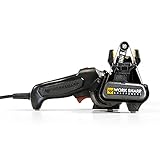
Work Sharp Mk.2
- Adjustable angle guide to the tip
- Two-speed motor
- Sharpens knives scissors and tools
- 3-year warranty
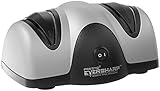
Presto 08800 EverSharp
- Two-stage Sapphirite system
- Precision blade guides
- Suction-cup base
- Compact and quiet
10 Best Electric Knife Sharpeners for German Knives in 2026
Every pick below is scored on the same four things: whether the guide holds a consistent angle on a full-length German blade, whether the abrasive can remove damage rather than just polish it, whether it handles a European convex edge without gouging, and whether the maker will replace the consumable parts. Ratings and review counts are the current figures listed on the product pages.
| Product | Specifications | Action |
|---|---|---|
| Chef’sChoice 15XV EdgeSelect |
|
Check Latest Price |
| Work Sharp Mk.2 Electric Sharpener |
|
Check Latest Price |
| Presto 08800 EverSharp |
|
Check Latest Price |
 Work Sharp Ken Onion Sharpener Work Sharp Ken Onion Sharpener |
|
Check Latest Price |
 SHARPAL 198H 3-Stage Sharpener SHARPAL 198H 3-Stage Sharpener |
|
Check Latest Price |
 Enutogo 2-Stage Diamond Sharpener Enutogo 2-Stage Diamond Sharpener |
|
Check Latest Price |
 Homly 3-Stage Diamond Sharpener Homly 3-Stage Diamond Sharpener |
|
Check Latest Price |
 Secura WT-28D-1 2-Stage Secura WT-28D-1 2-Stage |
|
Check Latest Price |
 Narcissus QN-M866 2-Stage Narcissus QN-M866 2-Stage |
|
Check Latest Price |
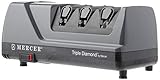 Mercer Culinary M10000 Triple Diamond Mercer Culinary M10000 Triple Diamond |
|
Check Latest Price |
1. Chef’sChoice 15XV EdgeSelect: the Most Proven Diamond Edge
Chef’sChoice 15XV EdgeSelect Professional Electric Knife Sharpener with 100-Percent Diamond Abrasives and Precision Angle Guides for Straight Edge and Serrated Knives, 3-Stage, Gray
3-stage diamond system
Flexible spring guides
Straight edge and serrated
3-year warranty
Pros
- Converts 20 degree factory edges to a finer Trizor XV edge
- Roughly one minute for a first-time sharpening
- Flexible spring guides hold the angle consistently
- Stage 3 polishes serrated blades
Cons
- Fixed 15 degree guide thins a thicker German bevel
- Larger countertop footprint than compact two-slot sharpeners
- No slot for scissors or tools
This is the unit I keep reaching for when a German blade needs real work rather than a touch-up. The 15XV carries 14,366 ratings averaging 4.6 stars, and that combination of owner history and repeatable output is why it earns the top slot.
The machine is built around flexible spring guides that hold the blade in position as you draw it through, so the angle stays put even on a blade with a thick heel. Stages one and two run 100 percent diamond abrasives, and stage three is a flexible abrasive system that handles serrated blades without chewing the scallops flat.
The honest drawback is the angle. Out of the box this machine works at 15 degrees per side, and the listing itself says it is designed for converting traditional 20 degree factory edges into Trizor XV 15 degree edges. That is a deliberate reprofiling, and on a Henckels or ZWILLING it produces a keener edge than the one the blade came with.
I find that result excellent on a Wüsthof chef’s knife used for vegetables and fish, and less ideal on the same knife used daily against a glass or stone board. Over a year of repeated 15 degree passes the bevel is thinner than factory and a little more fragile.
Does the 15 degree edge suit a German knife?
It depends on what you do with the knife. A thinner edge slices tomatoes and onions with almost no resistance and is a genuine upgrade for a keen edge on soft produce. On a Wüsthof or Henckels used for everyday prep on an end-grain board, the factory 20 degree edge holds up longer between sharpenings.
If your knives already sit at 20 degrees and you want to keep them there, this is not the machine for that job. If you want the sharpest possible edge and are willing to resharpen more often, the diamond system and the guide consistency make it the best-performing unit here.
Is it worth it for a single expensive German knife?
Yes, and the 3-year warranty plus the enormous owner base make it the low-risk choice. It sharpens only knives, so if you also own poultry shears and kitchen scissors you will still want a second tool, but for a block of Wüsthof or Henckels blades this is the one I recommend most often.
Reviewers report paper-cut results on knives that had been dull for years, and the 78 percent five-star share reflects how repeatable the output is once you learn to pull the blade until a full burr forms. Reading the manual first matters more here than with a two-stage box.
2. Work Sharp Mk.2: the Highest Rated Belt Sharpener
Work Sharp MK2 Electric Knife Sharpener – Adjustable 2-Speed Knife Sharpening System for Kitchen Knives, Pocket Knives, Scissors, Axes & Garden Tools
Adjustable angle guide
Two-speed motor
Flexible abrasive belts
3-year warranty
Pros
- Highest average rating in this group at 4.7 stars
- Adjustable guide supports the blade to the tip
- Two speeds cover knives and heavy garden tools
- Also sharpens scissors and serrated blades
Cons
- Belts need periodic tracking and tensioning
- No dedicated polishing stage
- Belts wear and need replacing over time
The Mk.2 carries the highest average rating of any sharpener in this roundup at 4.7 stars from 8,097 ratings, and for a German knife collection it is arguably the more complete answer than the machine above. The adjustable angle guide is the reason. You can dial it toward the European side and hold a thicker edge rather than reprofiling the blade every time.
The edge guide supports the blade all the way to the tip, which matters on a long German chef’s knife because many fixed slots cannot reach the last inch and leave a dull nose. The two-speed motor gives you a slower setting for finishing and a faster one when metal has to move.
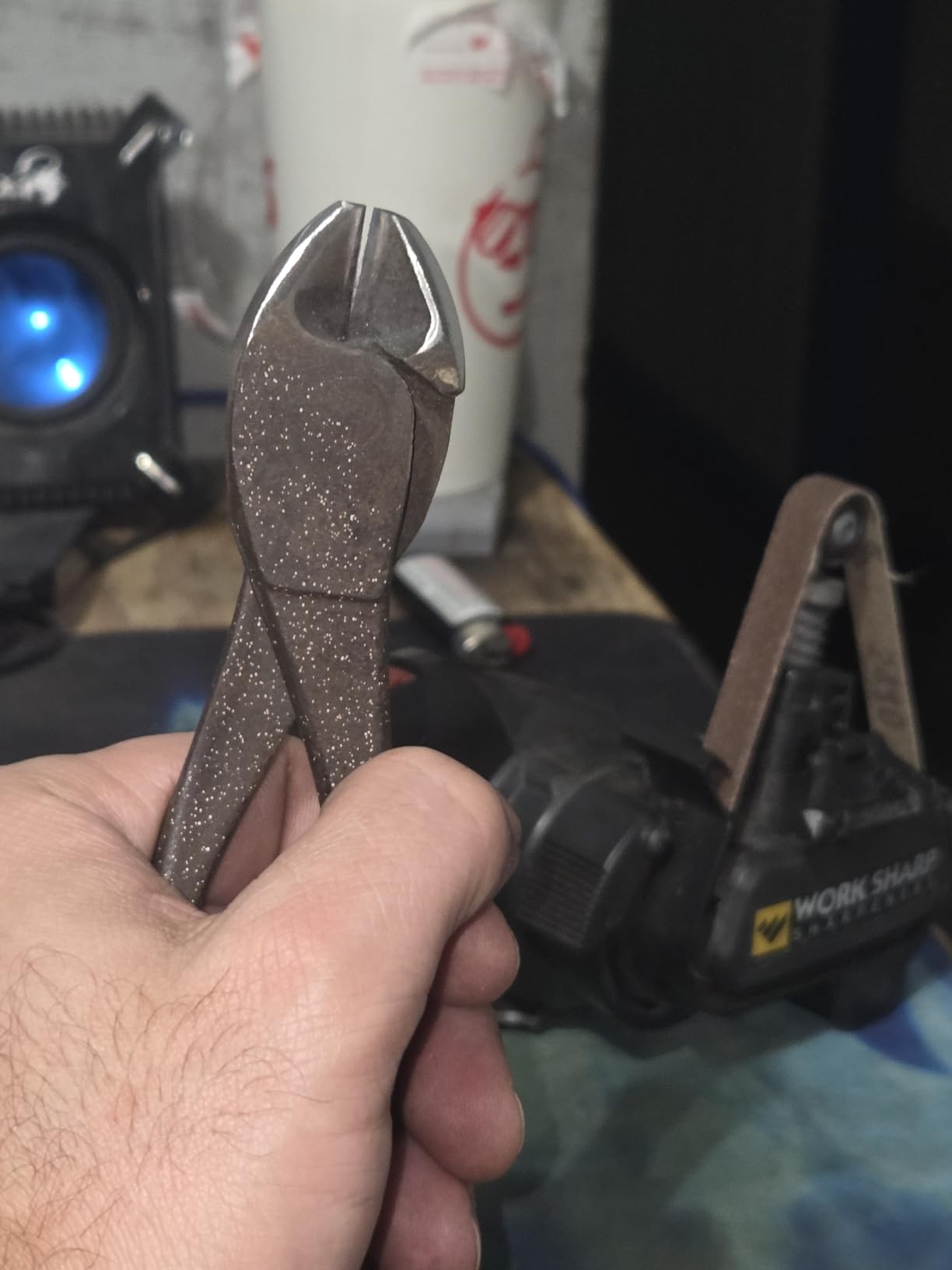
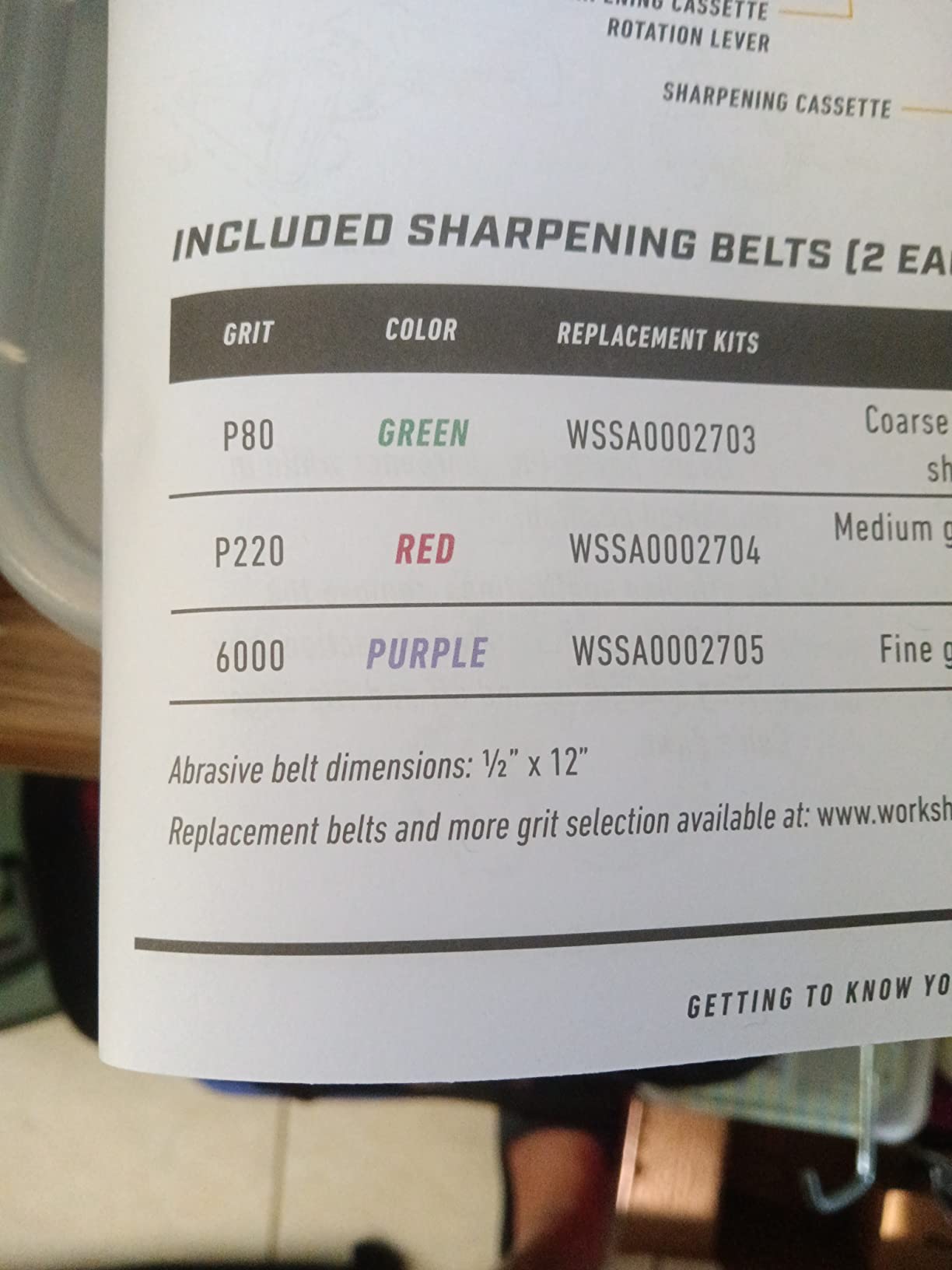
These are flexible abrasive belts rather than solid discs, so they wrap around the edge and follow the curve of the blade. That is a gentler contact geometry on a convex European grind, and it is why belt machines tend to be more forgiving with factory edges that are already in good shape.
The trade is belt maintenance. Belts wear, they can walk out of alignment, and the occasional tracking adjustment is part of owning this design. Replaceable abrasive belts also matter for anyone who cares about waste, since a belt swap is far less material than replacing a glued wheel.
Will it keep a factory 20 degree edge?
That adjustable guide is the whole argument for this machine on a Wüsthof or Henckels set. Set the guide to the European position and the belt system refines the existing bevel instead of cutting a new one away, which is the opposite of what the fixed-angle boxes do.
A second bonus is scope. The Mk.2 takes serrated blades, scissors, axes and garden tools, so one machine covers the knife block and the tool drawer rather than splitting the job across two sharpeners.
What are the drawbacks for a kitchen-only user?
If you only own kitchen knives, a lot of this machine goes unused. There is also no dedicated polishing stage, so the final edge is coarser than a three-stage diamond unit and benefits from a pass with a honing rod.
The 3-year warranty and the 81 percent five-star share are reassuring. Most gripes we see concern belt upkeep rather than results, and at 7.02 by 2.26 inches it stores easily on a small counter.
3. Presto 08800 EverSharp: the Long-Lasting Budget Standard
Presto 08800 EverSharp Electric Knife Sharpener
Two-stage system
Sapphirite wheels
Precision blade guides
Suction-cup feet
Pros
- Owners report four to nine years of reliable service
- Sapphirite wheels hold a steady angle without whetstone skill
- Simple two-slot layout with clear guides
- Suction-cup feet keep the base steady
Cons
- Two stages leave the edge ready for a honing rod
- A few owners report uneven wear on one wheel face
- Supplied with a 120-volt cord only
The EverSharp has the largest review base in this roundup at 18,851 ratings averaging 4.5 stars, and the pattern in those reviews is durability. Multiple owners describe four to nine years of continuous service before replacing a wheel, which is unusual for a two-stage machine at this level.
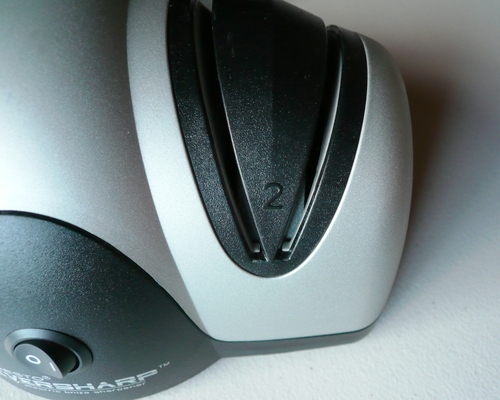
Sapphirite wheels grind a precisely angled edge and then hone and polish it in the second slot, and the precision blade guides hold the knife at a fixed angle through both. On a German chef’s knife that produces a factory-style edge without any technique to learn.
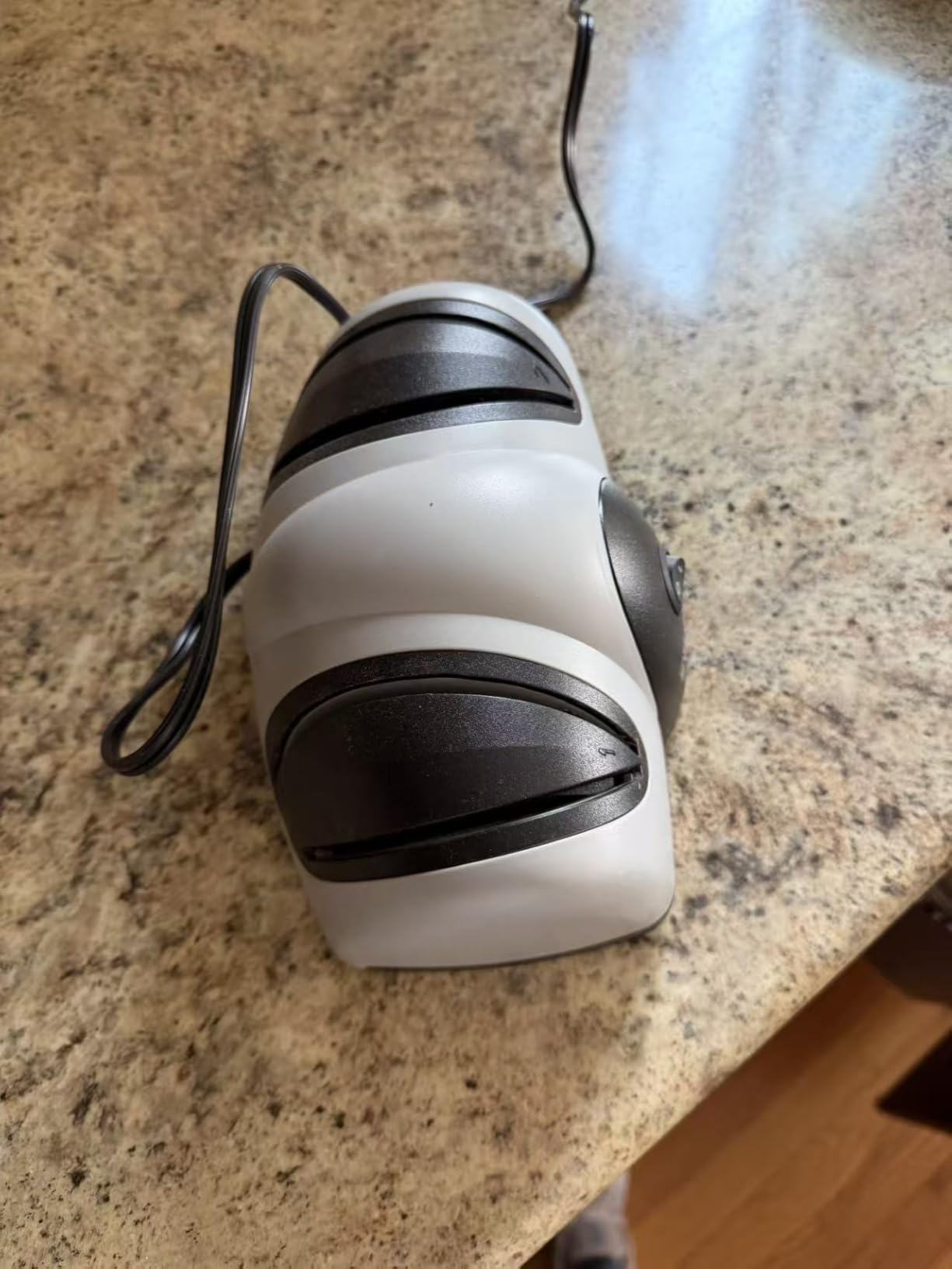
It is also one of the quietest and more portable machines here, weighing 3 pounds, which matters if the counter is small or the kitchen is next to a bedroom. Suction-cup feet stop it walking during a pass, a problem we have seen with lighter plastic boxes.
Two limitations are worth knowing. With only two stages there is no dedicated stropping step, so the edge leaves the machine needing a honing rod to feel finished, and a minority of owners report one wheel face running uneven enough to leave a faint grooving pattern.
Is two stages enough for a German blade?
For maintenance sharpening on a knife that already has a factory 20 degree edge, yes. The wheels remove the rolled-over metal and reset the bevel in a single grind and hone pass, which is the whole job for a blade that dulls through dishwasher damage or board work rather than actual nicks.
For a badly damaged edge, or for the very finest finish, you will want a third stage or a separate strop. Several owners report needing several repeated passes on very dull blades before the paper test passes, so give it patience.
What should you check before buying outside North America?
This is a 120-volt North American unit with its own cord, so it will not run directly on 220-volt mains. That is a meaningful limit for readers elsewhere, and it is the main reason I would point overseas buyers at a universal-voltage machine instead.
The 70 percent five-star share reflects an honest machine rather than a remarkable one. Nothing about it is enthusiast grade, and owners with whetstone experience describe it as a very good maintenance tool that never tries to be more than that.
4. Work Sharp Ken Onion Sharpener: Precision Belts with Adjustable Guides
Work Sharp Ken Onion Knife Sharpener Tool – Adjustable Knife Sharpening System – For Knives, Scissors, Serrated Blades, & Tools
Ken Onion precision guides
Electronic speed control
Flexible belts
Stainless steel
Pros
- Precision guides deliver repeatable angles
- Speed control switches between sharpening and grinding load
- Handles scissors serrated blades and tools
- Stainless steel build with a 3-year warranty
Cons
- Costs more than household three-slot sharpeners
- Belt system needs occasional re-tensioning
- Angle guide needs setting before results are consistent
This is the enthusiast step up from the Mk.2, developed with knife maker Ken Onion for people who care about the number on the edge. The angle guides are more precise, the frame is stainless steel rather than plastic, and the electronic speed control lets you dial the motor for a light finishing pass or heavier stock removal.
For a Wüsthof or Henckels owner who already chases edge geometry, that precision is the reason to spend here. You can set the guide for the European side and get the same repeatable result on every knife in the block rather than relying on feel.
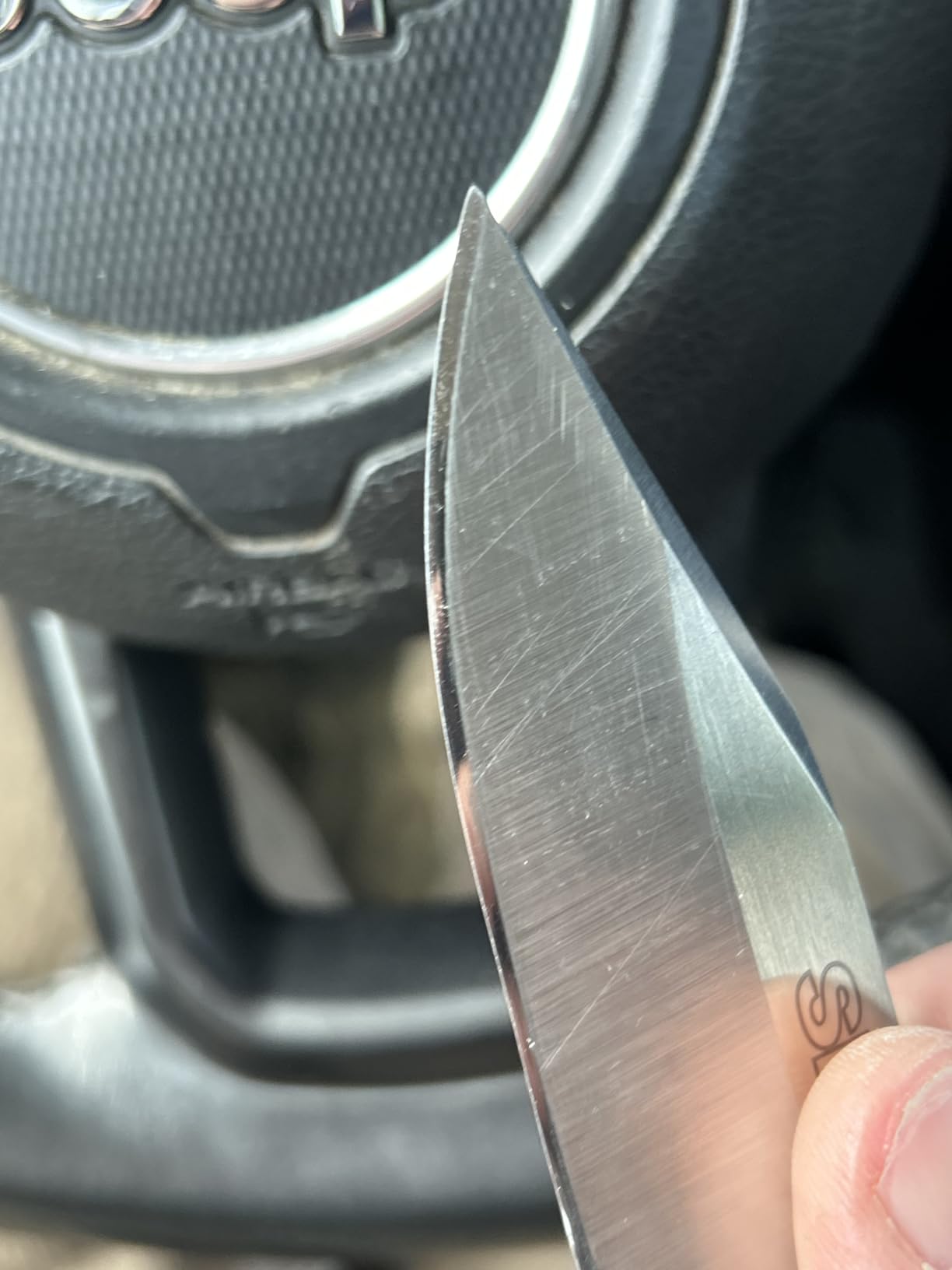
The flexible belts and precision sharpening guides cover knives, scissors, serrated blades and tools, and the 3-year warranty is backed by a design and calibration process in Oregon. Owners consistently rate it for repeatable angles and solid construction.
The catch is that this is not the machine for heavy grinding work like mower blades, and the belt system still needs re-tensioning as belts wear. There is also a learning curve on the angle guide that takes a few knives before results become predictable.
Is it better than the Mk.2 for a home German collection?
Only if your sharpening is a hobby rather than a chore. For most cooks the Mk.2 does the same job at a lower cost, and the practical difference between the two is smaller than the price gap suggests.
Where the Ken Onion design earns its place is with very long blades and thin profiles, because the guide and belt geometry stay stable where lighter machines flex. It is the choice for someone sharpening several German knives regularly to an exact angle.
What should buyers know before spending here?
The review base is small at 620 ratings, so there is less long-term history behind this model than behind the machines above. That is the main reason it does not carry a premium pick badge despite the 4.6 rating.
Two pounds of stainless steel and a 3-year warranty suggest a durable machine, and owners who have had theirs report it as a bench tool rather than an appliance. Treat it as a considered purchase rather than a first sharpener.
5. SHARPAL 198H: the Fixed 20 Degree Match for European Edges
SHARPAL 198H Electric Knife Sharpener 3 Stage with Diamond Wheels
Preset 20 degree angle
Three slots including serrated
Under 65 dB
Overheat protection
Pros
- Fixed 20 degree angle matches European factory edges
- Quiet running with magnetic filing collection
- Overheat protection guards blade temper
- One-handed use sharpens both bevels at once
Cons
- Preset angle cannot be adjusted thinner
- Some owners report scuffing near the tip
- Very small pocket knives only partly fit
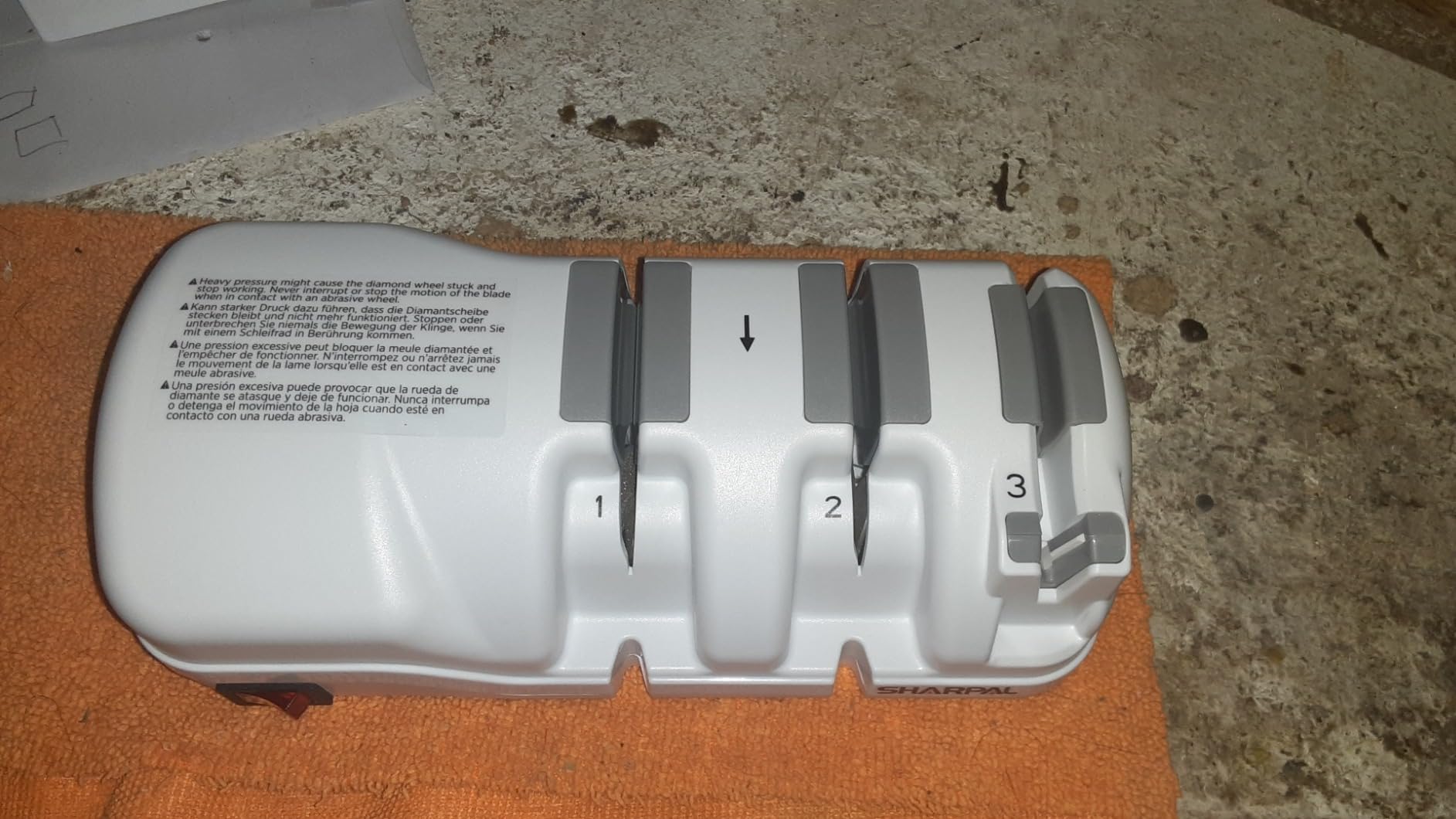
If your single biggest concern is that a machine will grind away the factory bevel on an expensive German knife, this is the one to look at. The grinding wheel angle is preset to 20 degrees, which the listing describes as matching standard European factory edges, so it refines what is already there instead of reprofiling.
It also has three slots, so straight edges and serrated blades are both handled, and the unit sharpens both bevels at once in a one-handed motion. That halves the time a session takes, which makes weekly maintenance realistic rather than aspirational.
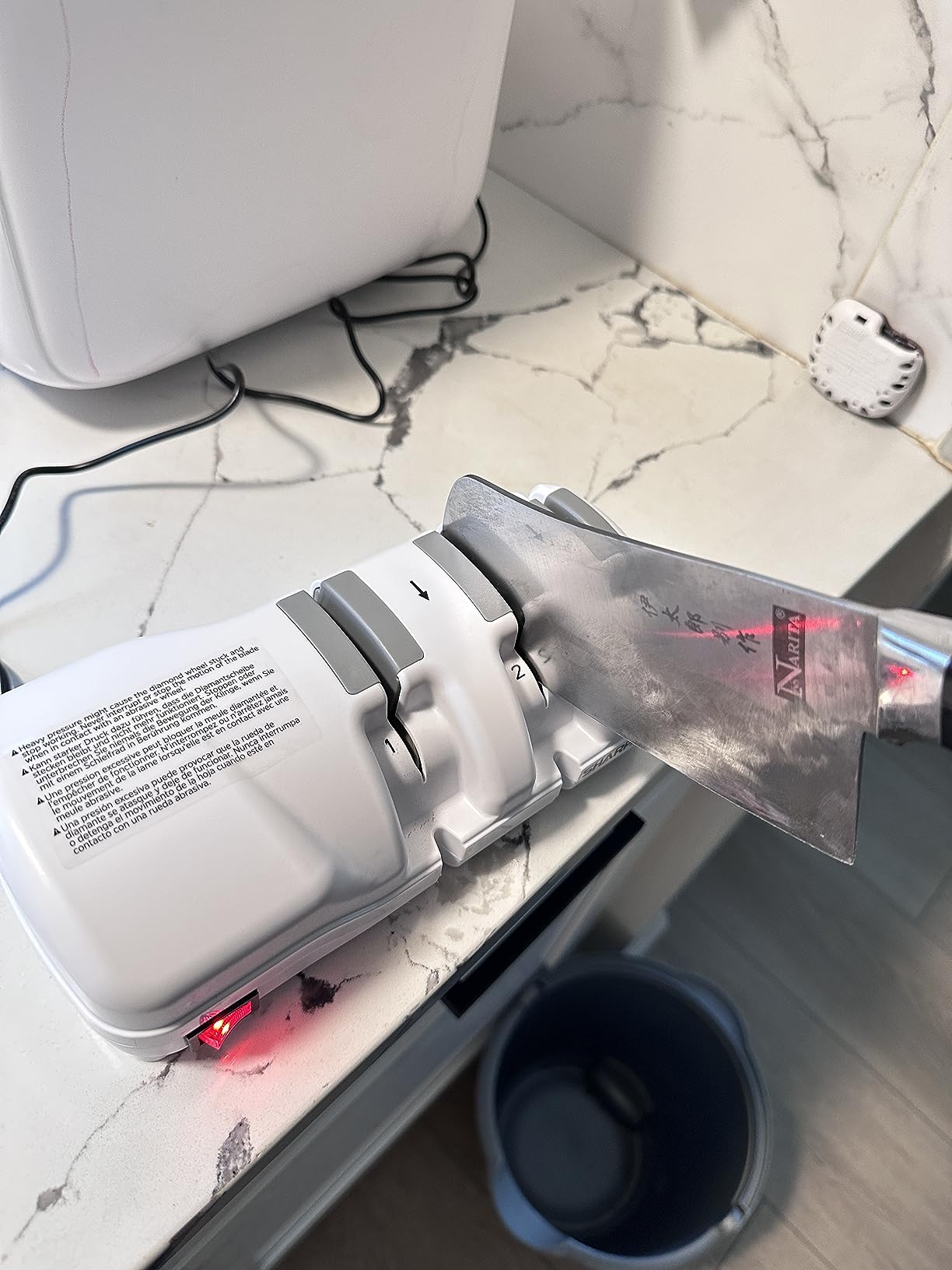
Two design details make it pleasant in a kitchen. Operation stays under 65 dB, quieter than most motorised sharpeners, and iron filings collect in removable magnetic receptacles rather than spraying across the worktop.
Overheat protection is the feature that matters most for protecting expensive steel. Overheating is what de-tempers a blade and ruins edge retention permanently, and a built-in cutoff is cheap insurance on a Wüsthof or a Mercer.
Why is a fixed 20 degree guide the right call here?
Because a 20 degree bevel is what the knife already has. Holding that angle means the coarse stage removes only the rolled metal and the dulled apex, which is the smallest possible cut and the safest option for a hollow or thin German blade.
The downside is that the preset cannot be adjusted. If you also own Japanese knives that you have sharpened to 15 degrees, this machine cannot hold that angle, so you would need a second tool or an adjustable guide machine.
What do owners report as problems?
The recurring complaint in reviews is cosmetic. Some users report scuffing or light nicking near the tip when the blade is pulled awkwardly, so technique matters more here than on a guided two-stage box.
Very small folding knives only fit partway into the slot, and a small number of owners report motor failure inside the first year. At 4.4 stars from 2,283 ratings it sits comfortably in the middle of this group rather than at either end.
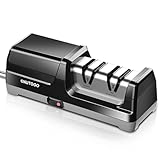
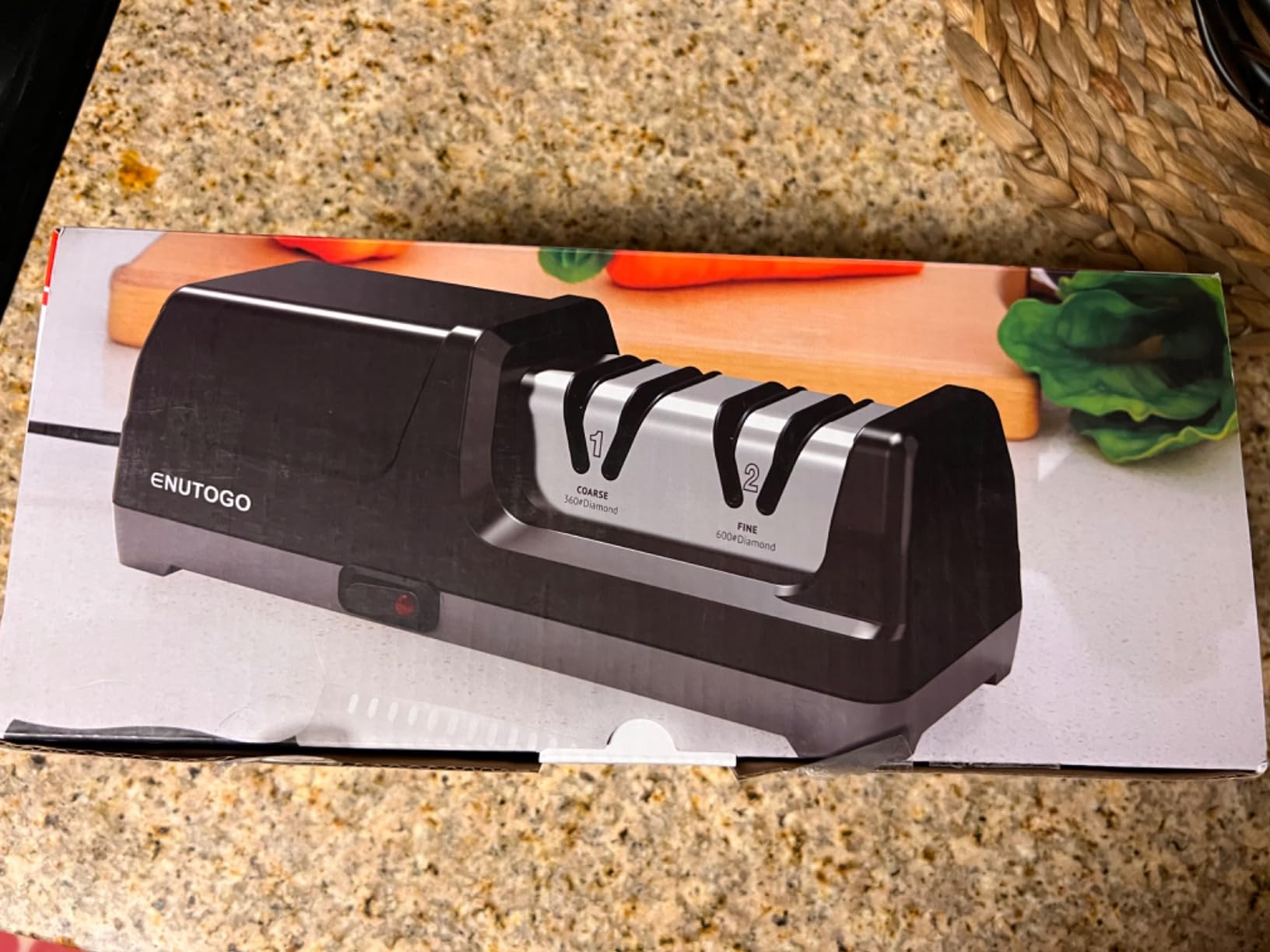
6. Enutogo 2-Stage Diamond: a Compact 20 Degree Two-Stage
Enutogo Knife Sharpener, Professional 2-Stages Eleltric Knife Sharpeners with Diamond Abrasives for 20-Degree Straight Edge, Knife Sharpener for Kitchen Knives with Sharpening and Polishing
Two-stage system
100 percent diamond wheels
20 degree angle guide
Vertical design
Pros
- 20 degree angle guide matches standard German edges
- Diamond wheels outlast corundum abrasives
- Compact vertical footprint for a two-stage machine
- Simple on and off switch with a short learning curve
Cons
- Two stages need an extra stropping step
- Limited serrated knife capability
- Review base of roughly 370 ratings
This is the compact answer for anyone who wants a 20 degree guide and diamond abrasives without a large machine. The angle guide holds a 20 degree edge along the whole blade, which is exactly the European factory geometry, and the 100 percent diamond wheels cut faster and last longer than the corundum wheels used in most cheap two-stage boxes.
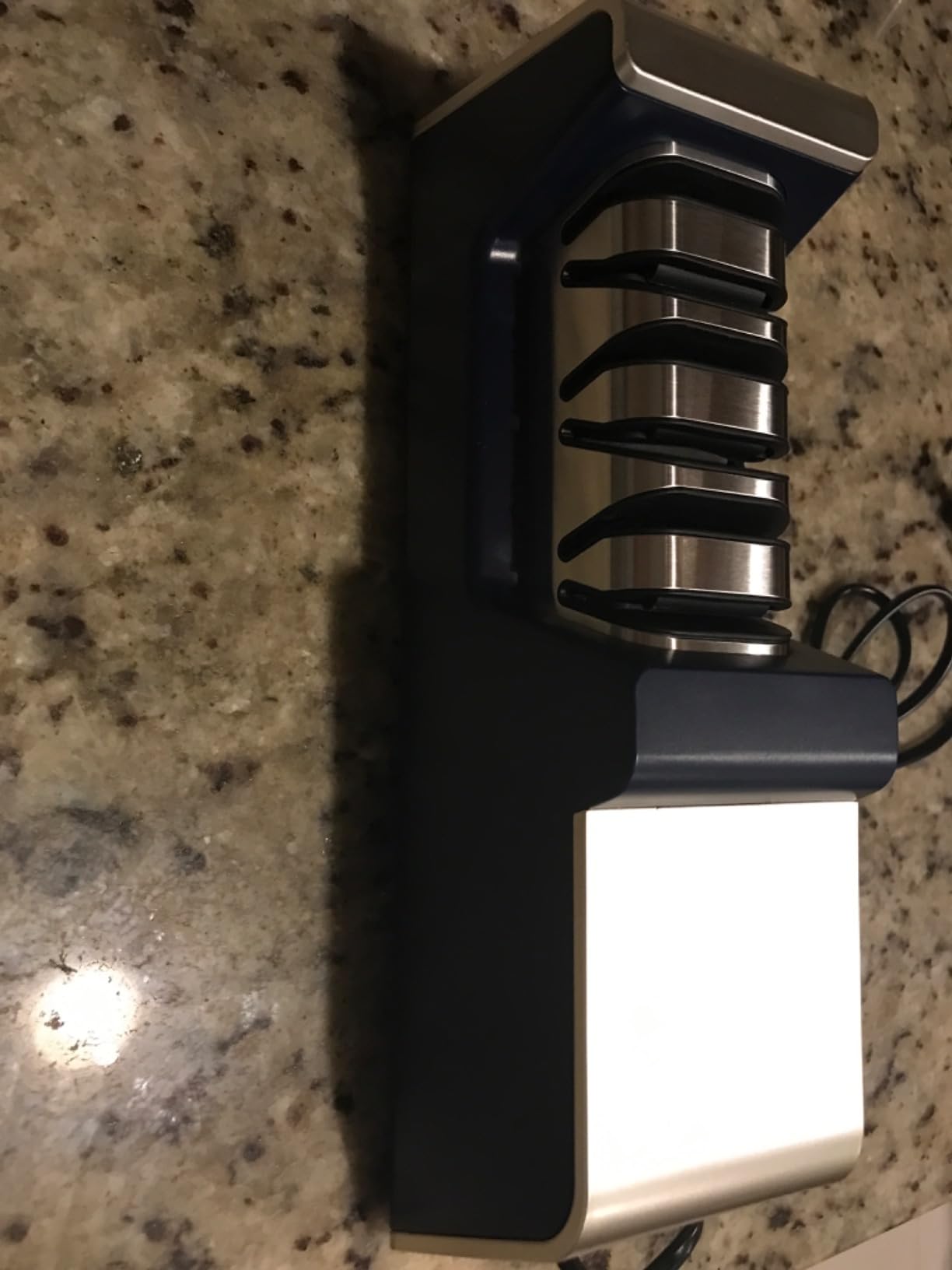
The vertical footprint is the sleeper feature. It measures 4.2 by 3.7 inches at the base, so it disappears into a corner of the counter or a deep drawer in a way the wide horizontal machines cannot.
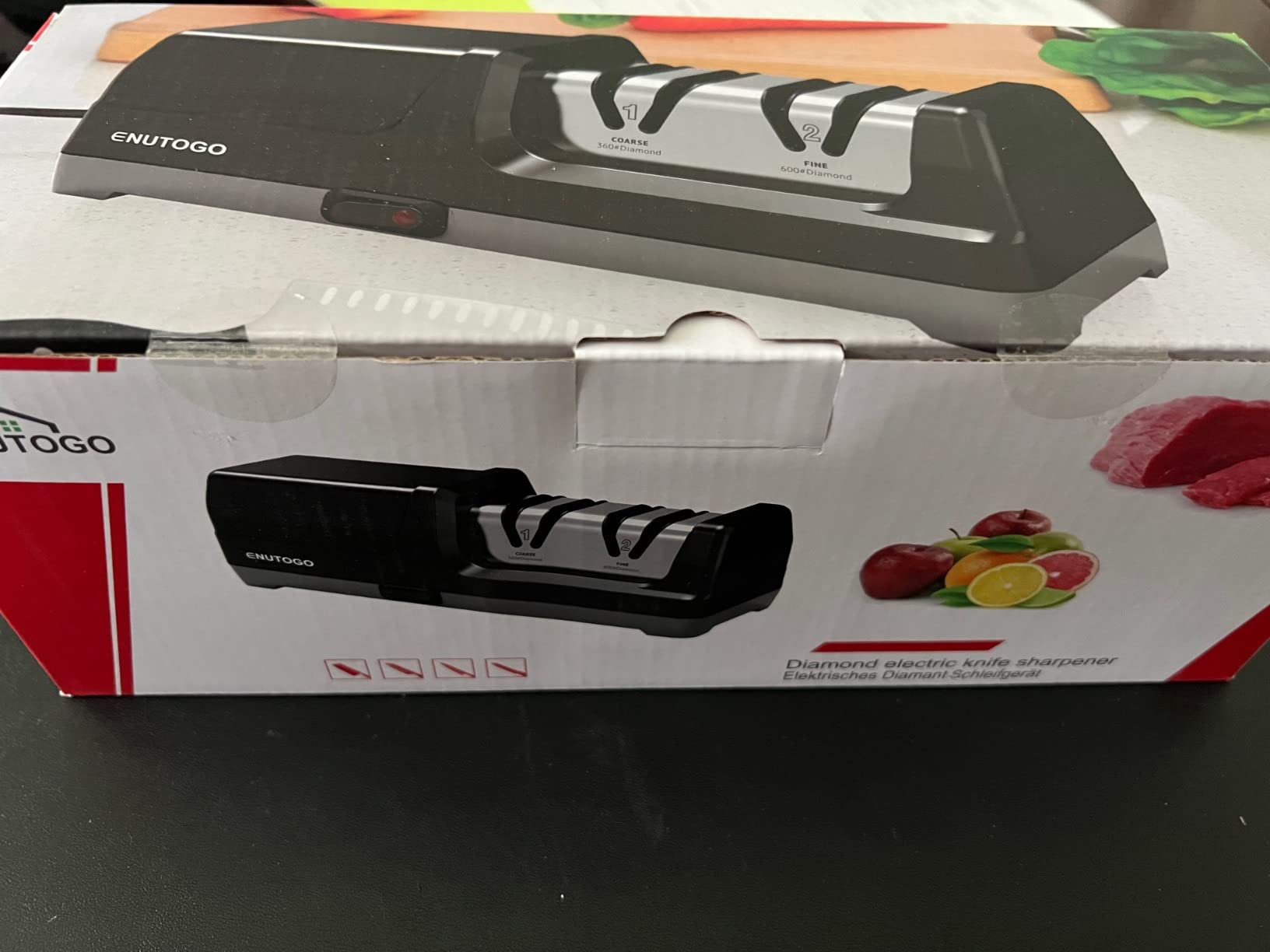
Suitability is broad for its size. The listing covers chef, slicing, santoku, paring and ceramic blades, and three to six pulls per slot is enough to restore sharpness on a knife that has lost its bite.
Two-stage construction does mean the edge leaves slightly rougher than a three-stage unit, and there is no dedicated serrated capability. Most owners pair it with a honing rod, which is the sensible setup for routine maintenance.
Is this a good first sharpener for a Wüsthof?
It is a reasonable first machine, with one caution. Because the guide is fixed at 20 degrees and cannot be opened up, it suits a knife still close to factory geometry better than one already thinned by years of repeated sharpening.
Check the edge on your knife before your first pass. If the bevel is already noticeably thinner than factory, step up to the three-stage SHARPAL or an adjustable Work Sharp rather than compounding the thinning.
What are the honest drawbacks?
The review history is short at 371 ratings, so there is not the same decade of owner reports behind this machine as behind the Presto or the Chef’s Choice. Budget machines with thin evidence are exactly where the overheating complaints cluster, and we would still practise on a cheap knife first.
Warranty terms are also less clearly documented than on the machines with three-year coverage. For a single knife owner it is a low-risk way to get 20 degree diamond sharpening on a small footprint.
7. Homly 3-Stage Diamond: Three Stages at a Mid-Level Footprint
Homly Professional Electric Knife Sharpeners for Kitchen Knives with Diamond Abrasives and Precision Angle Guides, Multifunctional 3-Stage Slots, Applicable to Straight Knife and Ceramic Knife
Three-stage diamond system
Spring guide rod
Works with ceramic blades
2-year warranty
Pros
- Three stages refine the edge further than two-stage models
- Spring guide rod holds a consistent arch edge
- Works with both steel and ceramic blades
- Owners report it matching costlier sharpeners
Cons
- Pressing hard near the handle can dent the blade
- Fixed guide rather than adjustable angle
- Some knives sharpen less evenly than others
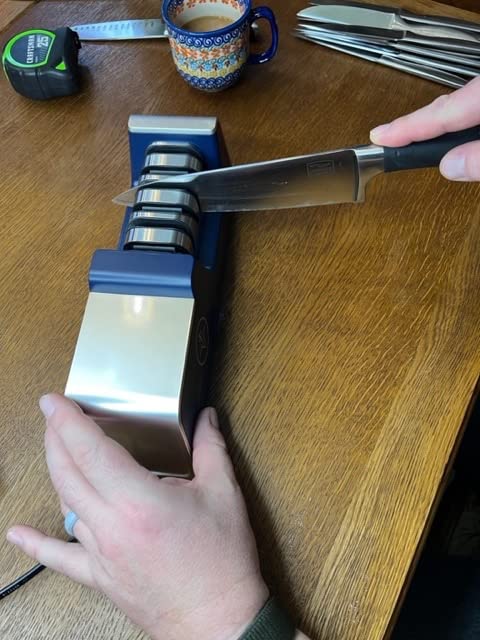
The Homly does three things that matter for a German knife. Stages one and two use 100 percent diamond abrasives to sharpen and hone, stage three polishes and finishes, and a flexible spring guide rod holds the blade at a consistent angle along its whole length to build what the maker calls an arch edge.
That third stage is the difference from a two-stage unit. A polishing pass aligns the apex and leaves an edge that feels noticeably better on produce, which is the finishing step most budget boxes leave to a honing rod.
It is also unusually broad about what it will sharpen, covering chef, slicing, ham, santoku, fruit, boneless, butcher, fish, bait, straight, sports and pocket knives, plus ceramic blades. For a drawer with mixed equipment, that removes the need for a second tool.
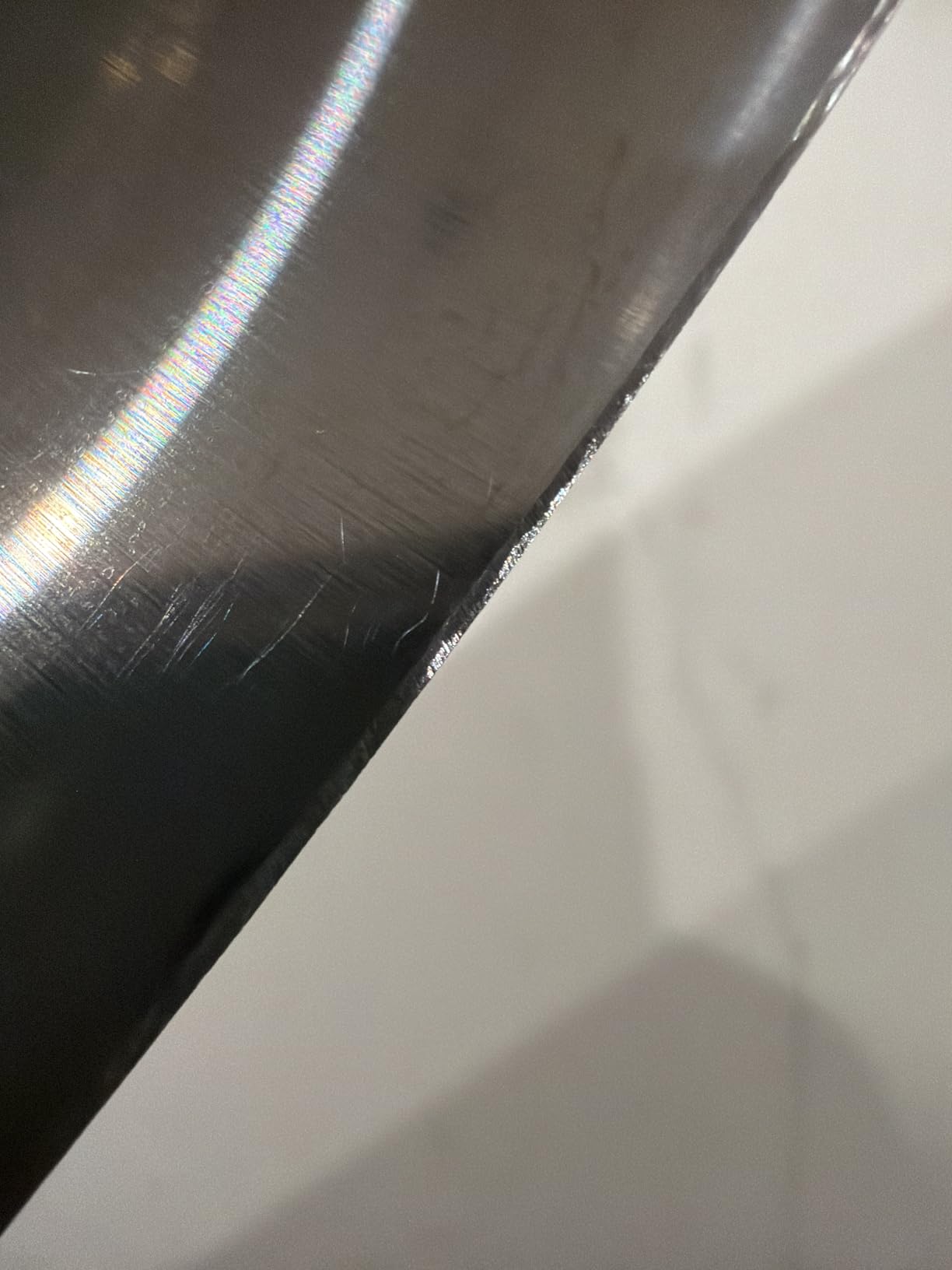
The technique warning is the one to take seriously. Pressing too hard or moving too slowly can dent the blade near the handle, so owners are advised to practise on an old knife before touching a Wüsthof.
Is three stages worth it over a two-stage unit?
Yes, if you want a finished edge without a separate honing rod, and no, if you already own a steel and do that job well. The polishing stage removes the need for one step rather than producing a fundamentally different bevel.
For German steel specifically the diamond abrasives are the bigger win, because softer European steel at 54 to 58 HRC dulls faster and needs faster metal removal to catch up.
What should you watch out for?
The guide is fixed rather than adjustable, so this machine is built for standard European and Asian straight edges and not for custom geometry. A small number of owners also report that knives do not sharpen as evenly as others, and one report of a unit failing to power on.
At 12.2 inches wide it is one of the larger footprints here, so measure the counter before ordering. The 2-year warranty and lifetime customer service are solid by the standards of this bracket.
8. Secura WT-28D-1: an Entry Diamond Two-Stage
Secura 2-Stage Electric Knife Sharpener with Diamond Abrasives and Precision Angle Guides, Professional Sharpening Tool for Kitchen Straight Edge and Ceramic Knife, Black
Two-stage system
Diamond abrasive wheels
Precision angle guides
2-year warranty
Pros
- Precision guide can thin a 20 degree edge to 15 degrees
- Suction-cup feet hold the machine steady
- Quiet and compact enough for a small kitchen
- Genuine diamond abrasives in a light-duty body
Cons
- Not suitable for serrated knives
- Isolated reports of grooves forming in blades
- Some owners report the wheels dull after heavy use
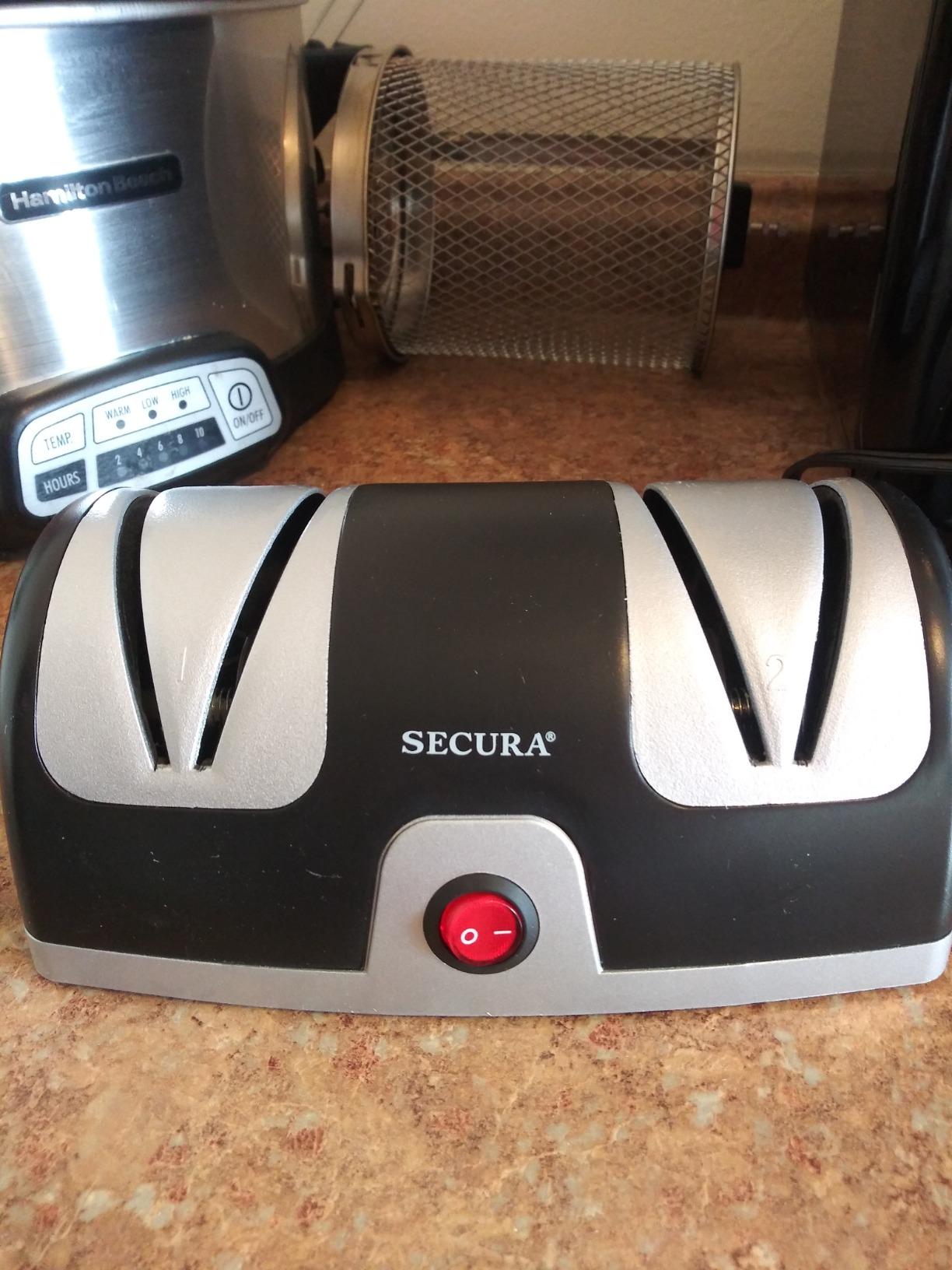
The Secura is the most straightforward way into a machine with genuine diamond abrasives, and its precision guides can do something useful for German knives: take a standard 20 degree edge and convert it to a finer 15 degree edge when you want a keener cut on soft produce.
Stage one restores and reshapes the angle and stage two sharpens and polishes, and the whole thing is quiet and compact at 7.87 by 5.31 inches. Suction-cup feet hold it firmly during a pass, which is the detail that separates this from the flimsier budget boxes.
It is ETL approved and carries a 2-year limited warranty, which is better coverage than most machines in this bracket. In practice it suits a home cook with one or two straight-edge knives who wants a result without learning anything.
It cannot sharpen serrated knives at all, which rules out the bread knife in most German blocks. If your set includes one, keep a tapered rod for it and use this machine for the straight edges.
Is it safe on a good German knife?
Within its light-duty envelope, yes. Two diamond stages on a straight edge will not overheat or gouge if you keep the blade moving and use light pressure, and a small machine like this removes less metal per pass than a three-stage unit.
The 4.2 rating is the lowest in this roundup and reflects specific complaints. A minority of owners report grooves forming in the blade after repeated use, which points to the light-duty wheels wearing out of round rather than to any fault in technique.
Who should buy it and who should not?
Buy it if you want to try electric sharpening without a large commitment, if your knives are straight-edged, and if you will replace it once the wheels wear. Several owners report units dulling after roughly six months of frequent use.
Skip it if you own a serrated bread knife you care about, if you sharpen daily, or if the idea of grooves in a Wüsthof blade worries you. The 15 percent four-star and 6 percent one-star shares are the widest spread in this group.
9. Narcissus QN-M866: Universal Voltage with a Scissors Slot
Narcissus Knife Sharpener, Professional 2 Stage Electric Knife Sharpener for Quick Sharpening & Polishing, with Scissors Sharpener and Metal Dust Collection Box, Stainless Steel, Silver
Two-stage system
Scissors slot
Magnetic dust box
100-240V universal voltage
Pros
- 100-240V design works without a converter
- Side slot sharpens scissors as well as knives
- Magnetic box keeps metal chips contained
- 30-watt motor runs a full set without overheating
Cons
- Carborundum wheels wear faster than diamond models
- Angle is not user-adjustable
- Straight blades only
This is the one to shortlist if you are outside North America. The 100 to 240 volt design means it runs on mains voltage almost anywhere without a converter, which rules out the 120-volt units further up this list and removes the single most common complaint we see about them.
The second stage is a fine polish that takes the edge to burr-free, and the 30-watt DC motor runs continuously for over an hour without overheating. That matters on a German block, because it means you can sharpen the whole set in one session rather than two.
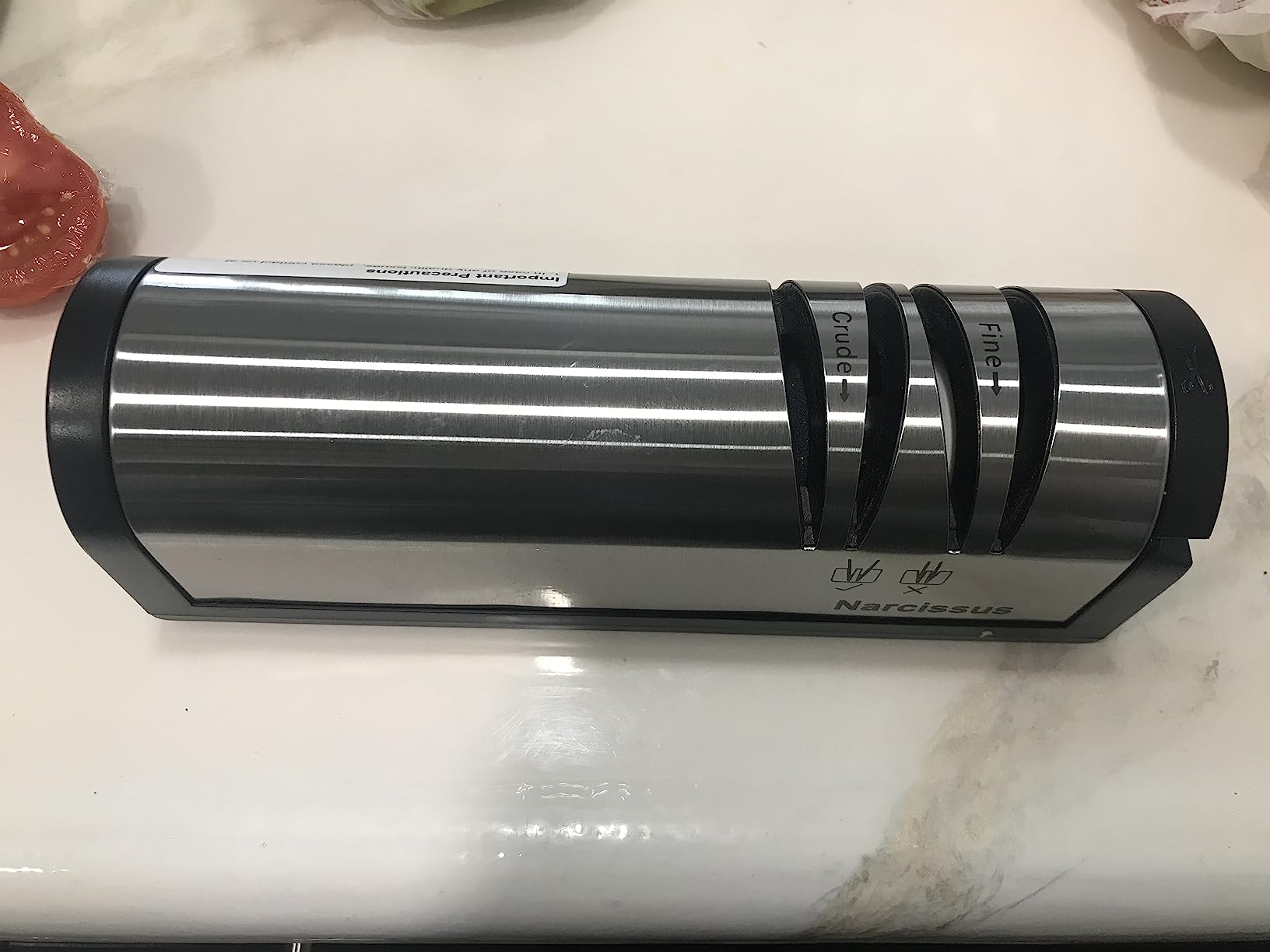
It is a genuine 3-in-1 tool with a side scissors slot, so kitchen shears and poultry shears go through the same machine. The magnetic dust collection box on the base catches chips, which is a small quality-of-life detail that matters more in a real kitchen than it sounds.
The body is stainless steel, it weighs 1.6 pounds and it includes a 12-month replacement policy with 24 months of after-sales service. That combination of voltage range and support is rare in this bracket.
How does carborundum compare with diamond?
Carborundum is an aluminium oxide abrasive, the same family as a common whetstone. It cuts more slowly than diamond and wears faster, so on a soft German steel that dulls every few weeks the wheels will need replacing sooner than a diamond unit would.
In exchange, the wheels are cheaper and the whole machine costs less. For occasional maintenance of a couple of knives, the difference in wheel life is not the deciding factor; for weekly sharpening it is.
What are the limits worth knowing?
The angle is fixed and not user-adjustable, and the machine is aimed at straight blades such as chef, slicing and santoku knives. If your German set is full of serrated bread knives, this is not the machine for it.
Owners also note the manual recommends watching the product video before first use. At 3,513 ratings and a 4.4 average this has one of the healthier owner bases of the smaller machines here.
10. Mercer Culinary M10000: the Commercial Grade Diamond Unit
Mercer Culinary Triple Diamond 3 Stage Electric Knife Sharpener
Three-stage diamond system
Ultra-fine stropping stage
Handles serrated knives
12 inch wide base
Pros
- Full diamond system with a dedicated stropping stage
- Heavy stable base that does not move during use
- Handles straight-edge and serrated knives
- Popular with professional and resort kitchen teams
Cons
- Largest unit in the group for a basic three-stage layout
- Sheds metal shavings across the work area
- Bulky footprint and disputed warranty terms
The Mercer is built for a working kitchen rather than a domestic counter. It runs 100 percent diamond abrasives through the first two stages and an ultra-fine stropping stage at the end, driven by a high-speed motor with precision guides that handle both straight-edge and serrated knives.
What owners consistently mention is how long a session on a full knife block takes. A three-stage diamond sequence with a dedicated polishing stage is the fastest complete edge here, and several professional and resort kitchen teams use it to keep high volumes of cutlery serviceable in-house.
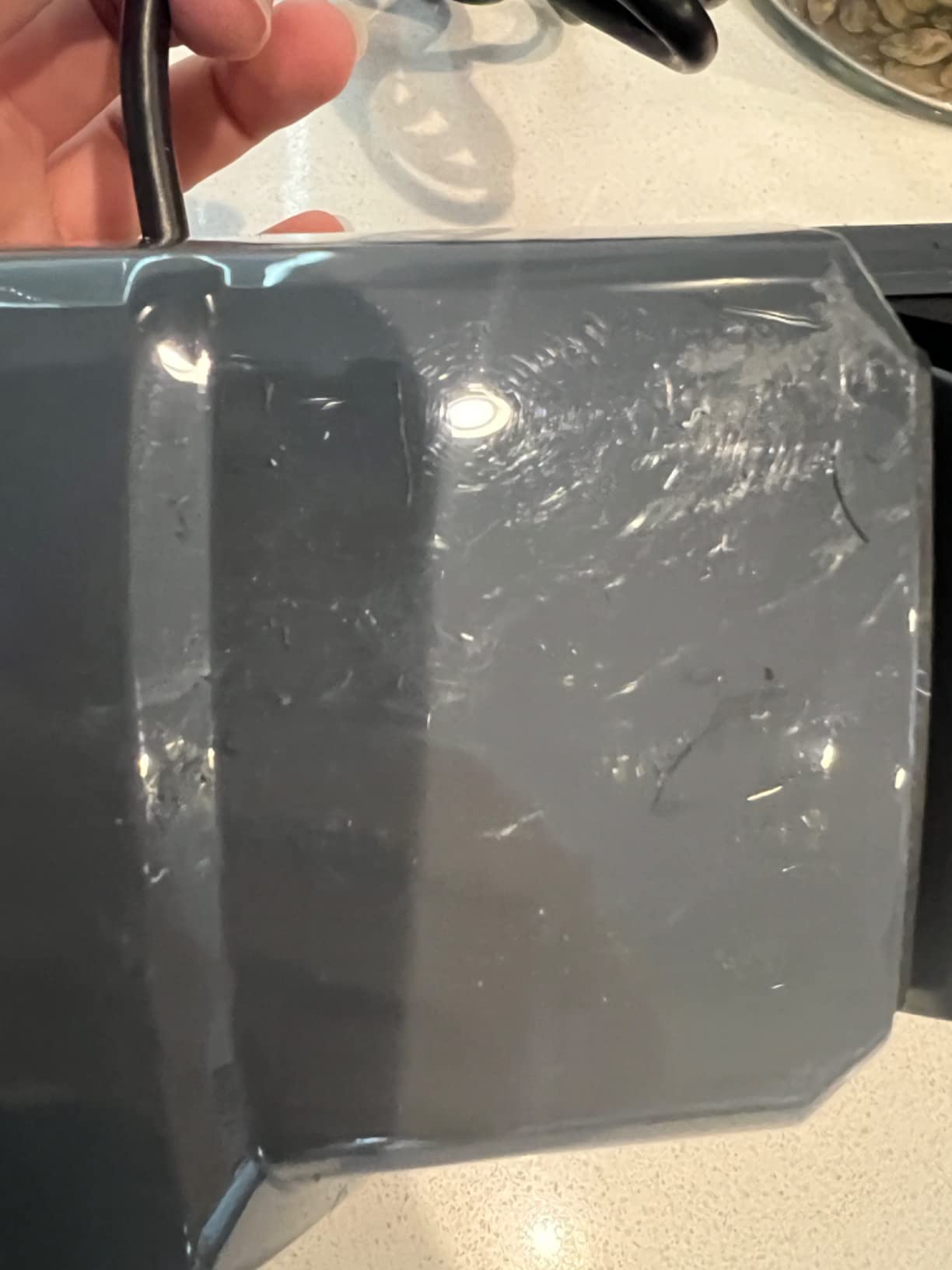
The 4.6 pound weight and 12 inch by 6.25 inch base make it a stationary object rather than a countertop gadget. Nothing about it needs to be moved or stored, which is both its strength and, in a small kitchen, its problem.
It also leaves metal shavings around the work area. That is a real consideration if you keep the machine in a home kitchen, and several owners suggest a basement, garage or utility space as a more sensible home for it.
Is it worth it for a home German collection?
Only if you sharpen a lot of knives or share the machine. For one or two blades the same edge is available from a three-stage machine a fraction of the size, and the added bulk buys speed rather than a better angle.
The layout itself is not exotic. It is a straightforward three-stage diamond system, so you are paying for the motor, the frame and the throughput rather than for a different kind of sharpening.
What should buyers weigh before choosing?
The warranty terms have been disputed by some buyers, and at 113 ratings this has the thinnest owner evidence in the roundup. That combination argues for buying only with a clear returns policy and testing it on a spare knife first.
For a professional kitchen the calculus changes completely. Teams that used to send knives out for sharpening report keeping service in-house with this unit, which is the strongest argument anyone in this roundup makes for owning one.
How to Sharpen a German Knife on an Electric Sharpener
Most damage comes from technique rather than from the machine. Five steps, and the whole thing takes under two minutes per blade.
Clean the blade. Dried food and wax hide the true edge and defeat the guide. Wipe with a damp cloth before you start.
Pick the right stage. Coarse for a dull or nicked edge, fine or stropping for a knife that only needs a refresh.
Make three to four passes per side. Pull steadily with light pressure and keep the blade in contact from heel to tip.
Check the result. Do not judge by eye. Use the paper or onion skin test below.
Finish with a honing rod. Even a three-stage machine benefits from a light rod pass to realign the apex.
Three tests that tell you the edge is genuinely there
The paper test is the fastest check. Hold a sheet of printer paper in one hand and pull the blade down and away from you. A sharp edge bites into the sheet and cuts it cleanly; a dull edge folds and tears it.
The onion skin test is the one that removes doubt. Peel an onion and try to shave the papery skin off with a single downward stroke. A properly sharpened 20 degree German edge shaves it off in ribbons with almost no pressure.
The tomato test is the informal version. A dull knife crushes and skins the tomato while a sharp one sinks in and cuts a clean surface with no splash. Use all three before you decide a machine failed you.
Will an Electric Sharpener Ruin an Expensive German Knife?
Not if you pick the angle correctly and keep the machine moving. The honest risks are overheating on cheap multi-stage wheels, dragging a fixed 15 degree guide across a 20 degree bevel, and applying enough pressure to dent the steel near the handle.
Overheating is the only one of those that causes permanent damage. A blade that gets hot enough to change colour at the edge has been de-tempered and will never hold an edge properly again, which is why the SHARPAL’s overheat protection and the Narcissus motor’s overheat resistance matter on an expensive knife.
The other two are recoverable. A thinner bevel is thinner, not broken, and a press-and-lift scuff near the heel is cosmetic. The failure mode to fear is a dull machine driven hard on a valuable blade, not the machine itself.
Users on sharpening forums consistently report that electric units are fine for routine maintenance while keeping stones for reprofiling and geometry work. That is the same line we draw here: use the machine to maintain a factory edge, and leave serious reshaping to a sharpener who does it by hand.
What Not to Sharpen Electrically
Serrated knives need a tapered rod, not a wheel. Forum consensus and the manufacturer instructions agree: an electric unit can refresh the scallops at best, and forcing scalloped teeth between abrasive surfaces can alter the tooth geometry. Several of the machines above, including the Chef’s Choice 15XV and the SHARPAL, include a dedicated serrated stage that is gentler than the straight-edge slots, and it is still a touch-up tool.
Single-bevel Japanese knives should not go through a two-bevel slot at all. The machine grinds the flat back as if it were a bevel and ruins the geometry. If you own both German and Japanese knives, the adjustable guide machine is the safer single purchase.
Ceramic blades are named by the Homly and the Secura as supported, but treat that as manufacturer tolerance rather than encouragement. Full-width ceramic blanks chip rather than flex, and no abrasive stage fixes a chip once it exists.
Scissors and shears depend entirely on the machine. If you want them in the same tool, look for an integrated slot or a belt design that wraps around the blade rather than a two-stage wheel unit.
Electric Sharpener, Whetstone or Honing Steel?
For a Wüsthof or Henckels used every day, an electric unit wins on speed and repeatability. Two minutes per blade beats learning a 1000 grit stone, and the angle guides remove the variable that causes most beginners to stop.
A whetstone still wins on geometry control. Reprofiling a damaged edge, matching a factory convex grind, or holding a specific angle to the half degree are all things a stone does and a guided machine does not.
A honing steel belongs in between. It realigns an edge without removing metal, so it should run several times between sharpening sessions on German steel that dulls quickly. Pull-through sharpeners are the option to avoid here, since owners on r/sharpening describe them as a reliable way to chip a good edge.
For cutting boards, an end-grain wood board does more for a 20 degree edge than any sharpener. Glass, stone and marble boards are what flatten factory edges in the first place, and no amount of sharpening reverses the damage they do over a year.
Buying Guide: How to Choose an Electric Knife Sharpener
Stages. Two stages sharpen and hone, which is enough for routine maintenance. Three stages add a polishing pass that removes the need for a separate strop and leaves a cleaner apex. More stages are not automatically better, because each pass removes a little more steel.
Abrasives. Diamond cuts fastest and lasts longest, carborundum and aluminium oxide are cheaper and wear faster, and ceramic is reserved for very hard steel. On German steel at 54 to 58 HRC, diamond is the sensible default because the metal is soft enough that a harder abrasive keeps its edge longest.
Angle. This is the decision that matters for German knives. A fixed 20 degree guide refines the factory edge, an adjustable guide can do either, and a fixed 15 degree guide reprofiles toward a keener edge every time you use it.
Guide width. Narrow slots that cannot reach the heel of a thick European blade leave a dull section near the handle. A guide that supports the blade all the way to the tip, as the Work Sharp design does, avoids this entirely.
Dust and cleanup. Magnetic receptacles and enclosed housings keep filings off the counter. The Mercer throws shavings across the work area, which matters in a kitchen but not in a utility room.
Consumables and warranty. Replaceable belts are better for the environment and for long-term cost than glued abrasive wheels, and a three-year warranty is now common on machines at the serious end. Note the warranty length on smaller brands, where terms are often thinner.
Voltage. If you are outside North America, a 100 to 240 volt design saves you from a converter entirely. Several otherwise excellent machines here come with a 120-volt cord only.
Frequently Asked Questions
Are Wusthof knives 15 or 20 degrees?
Both answers exist because Wusthof has made both. Older Western lines were built at roughly 14 degrees per side, while modern Western chef’s knives are made at about 20 degrees per side, which is a 40 degree inclusive angle. The older 14 degree PEtec-style knives suit a 15 degree sharpener, and modern lines suit a 20 degree machine. Check how the blade looks and matches your machine guide before your first pass.
Do electric sharpeners ruin knives?
A good electric sharpener will not ruin a knife, but a cheap multi-stage unit can. The real risks are overheating, which permanently de-tempers steel and permanently wrecks edge retention, and applying a fixed 15 degree guide to a knife that already sits at 20 degrees, which thins the bevel every time. Keep the blade moving, use light pressure, practise on an old knife first, and choose a machine with overheat protection.
Which is better, a diamond or a ceramic knife sharpener?
For German steel, diamond is the better abrasive. German knives usually sit between 54 and 58 Rockwell C, softer than Japanese steel, and diamond cuts faster and wears more slowly than the aluminium oxide wheels used in most ceramic-style two-stage units. Ceramic honing rods are still useful for light realignment between sharpening sessions, but they remove almost no metal.
How do I sharpen my Henckels knives?
Start with a clean blade and pick the coarsest stage your edge needs. Three to four light passes per side is usually enough, then check with the paper or onion skin test and finish with a honing rod. A Henckels or ZWILLING knife normally arrives at about 20 degrees per side, so a machine with a 20 degree or adjustable guide is the right choice, and a fixed 15 degree guide will thin the factory bevel.
What is the best sharpener for Global knives?
Global knives have a curved profile and a narrow, straight-edged blade that needs a special channel or guided system rather than a two-slot wheel unit. A tapered rod or a knife-specific guided sharpener that matches the Global profile is the usual recommendation, because a standard electric slot cannot follow the pronounced curve of the blade.
Our Final Verdict on Electric Knife Sharpeners for German Knives
The Chef’s Choice 15XV takes the top spot for the strongest combination of owner history, diamond abrasives and repeatable guides, and the Work Sharp Mk.2 is the runner-up with the highest rating and an adjustable angle that keeps a German factory edge intact. If you own one good knife and want minimal fuss, the Presto 08800 has the longest service life in this group.
If keeping the 20 degree bevel matters more than getting the sharpest possible edge, the SHARPAL 198H is the pick, because its preset 20 degree guide and overheat protection do less to an expensive blade than anything else here. Whichever you choose, read the manual, practise on a spare knife, and verify the result with the onion skin test rather than trusting the machine’s reputation.
Whatever you buy, store the finished blades safely. Our guides to the best knife sheaths for chef knives and the best knife display cases cover protecting an edge you have just paid to sharpen.