
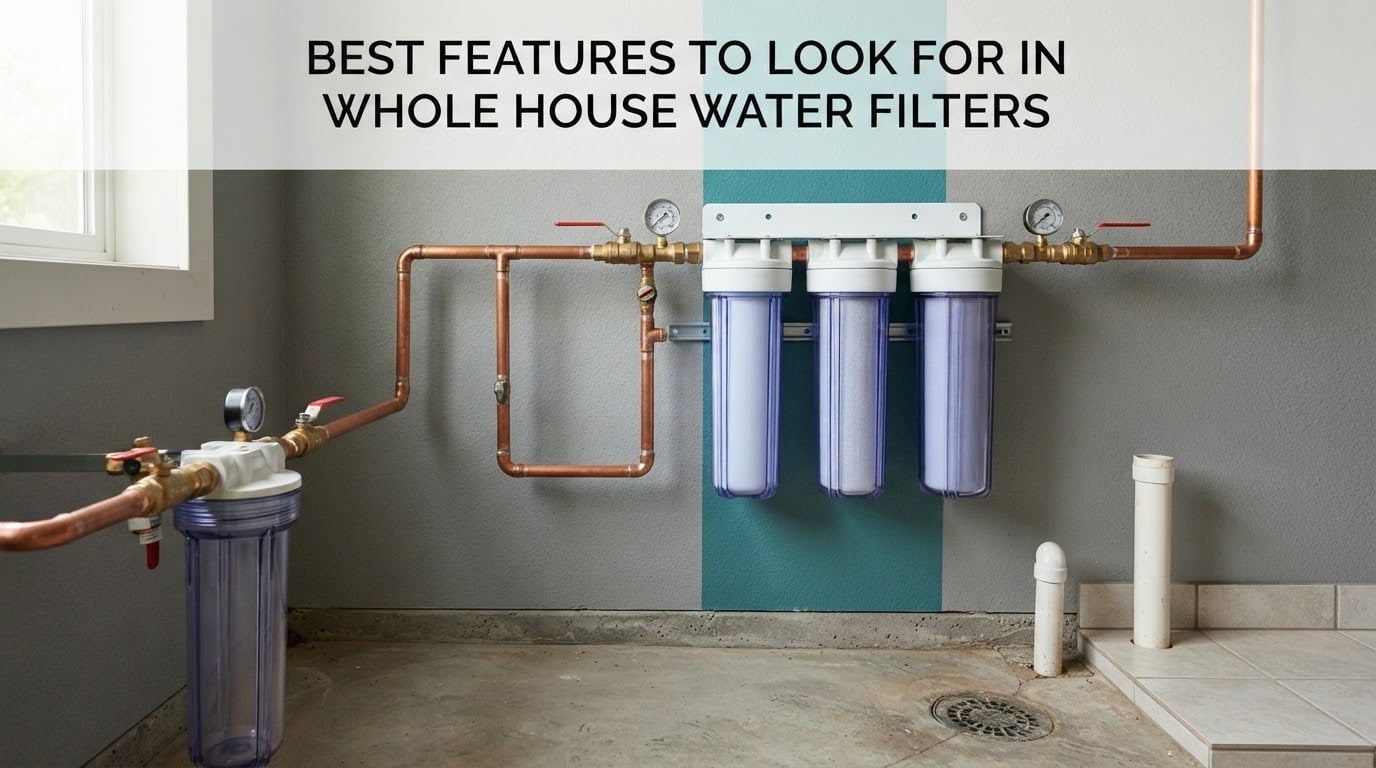
When shopping for a whole house water filter, look for four things above everything else: verified NSF/ANSI certification, filter media matched to the contaminant you actually have, a rated flow rate (GPM) that covers your household, and a published gallon capacity with a realistic replacement interval. Add a bypass valve, a warranty you can read, and a port size that fits your plumbing, and you have covered the features that separate a system that works from a system that disappoints.
I have spent the last few months reading spec sheets, install manuals and thousands of owner reviews for every point-of-entry system in this guide, then sorting them by the features that actually decide whether a purchase is right for a given home. The list runs from a two-stage cartridge unit to a spin-down prefilter and a certified single-tank carbon system.
What struck me most is how many listings lead with a contaminant claim instead of a certification. A seller saying a filter “reduces up to 99% chlorine” tells you almost nothing, while an NSF/ANSI 42 or 372 certification number tells you an independent lab verified both the claim and the material safety of the housing. That distinction runs through every section below, and it is the single fastest way to sort good products from hopeful ones.
Updated for 2026, this guide walks the nine features that matter most, then applies them to ten systems so you can see which ones actually deliver on their spec sheet.
Top 3 Whole House Water Filter Features (October 2026)
iSpring WGB21B 2-Stage Filter
- 5 micron sediment plus CTO carbon block
- 50000 gallon capacity
- 15 gpm flow
- 1 inch ports

iSpring WSP-50 Spin Down Prefilter
- 50 micron reusable stainless mesh
- Flushable by hose
- Lead-free brass head
- 1 to 2 year mesh life

Express Water 3-Stage System
- Sediment carbon and anti-scale stages
- Heavy metal reduction
- 100000 gallon capacity
- 17 gpm with gauges
The three above are the systems I keep coming back to when a homeowner asks for one recommendation. The WGB21B has the broadest install base, the WSP-50 costs almost nothing to add and saves every downstream stage, and the Express Water stack is the one with the widest contaminant coverage in a single box.
Quick Spec Comparison of Every System in This Guide
| Product | Specifications | Action |
|---|---|---|
| iSpring WGB21B 2-Stage Filter |
|
Check Latest Price |
| iSpring WSP-50 Spin Down Prefilter |
|
Check Latest Price |
| Express Water 3-Stage System |
|
Check Latest Price |
 iSpring WGB32B Commercial Grade iSpring WGB32B Commercial Grade |
|
Check Latest Price |
 A. O. Smith 600K Gallon Filter A. O. Smith 600K Gallon Filter |
|
Check Latest Price |
 Waterdrop WHF21-PG 2-Stage Waterdrop WHF21-PG 2-Stage |
|
Check Latest Price |
 GE GXWH40L Filter Housing GE GXWH40L Filter Housing |
|
Check Latest Price |
 SimPure DB10C-2 Clear Housings SimPure DB10C-2 Clear Housings |
|
Check Latest Price |
 3M Aqua-Pure AP904 3M Aqua-Pure AP904 |
|
Check Latest Price |
 Waterdrop BG102 Mega Spin Down Waterdrop BG102 Mega Spin Down |
|
Check Latest Price |
1. iSpring WGB21B 2-Stage Filter: The Best All-Round Starting Point
iSpring WGB21B 2-Stage Whole House Water Filtration System, 50000 Gallons
5 micron PP sediment plus CTO carbon block
50000 gallon capacity
15 gpm flow
1 inch ports
Pros
- Removes chlorine sediment rust and improves taste
- Thick-walled housings that feel well built
- Pre-assembled bracket and pressure release valve included
- Filter flow direction is reversible on the bracket
Cons
- Threaded NPT fittings can be leak-prone
- Over-tightening can crack the plastic housing
- 1-year warranty unless registered
This is the system I recommend first for municipal water in a home up to about four people. It runs a 5 micron polypropylene sediment stage ahead of a chloramine taste and odor carbon block, so the sediment stage catches rust and sand before the carbon can foul.
Owners consistently report the same two things: water that tastes and smells markedly cleaner, and fewer spots on dishes and glassware. Nobody in the reviews I read is claiming reverse osmosis level purification, which is exactly the point, because this unit leaves dissolved minerals in place and the TDS reading stays flat.
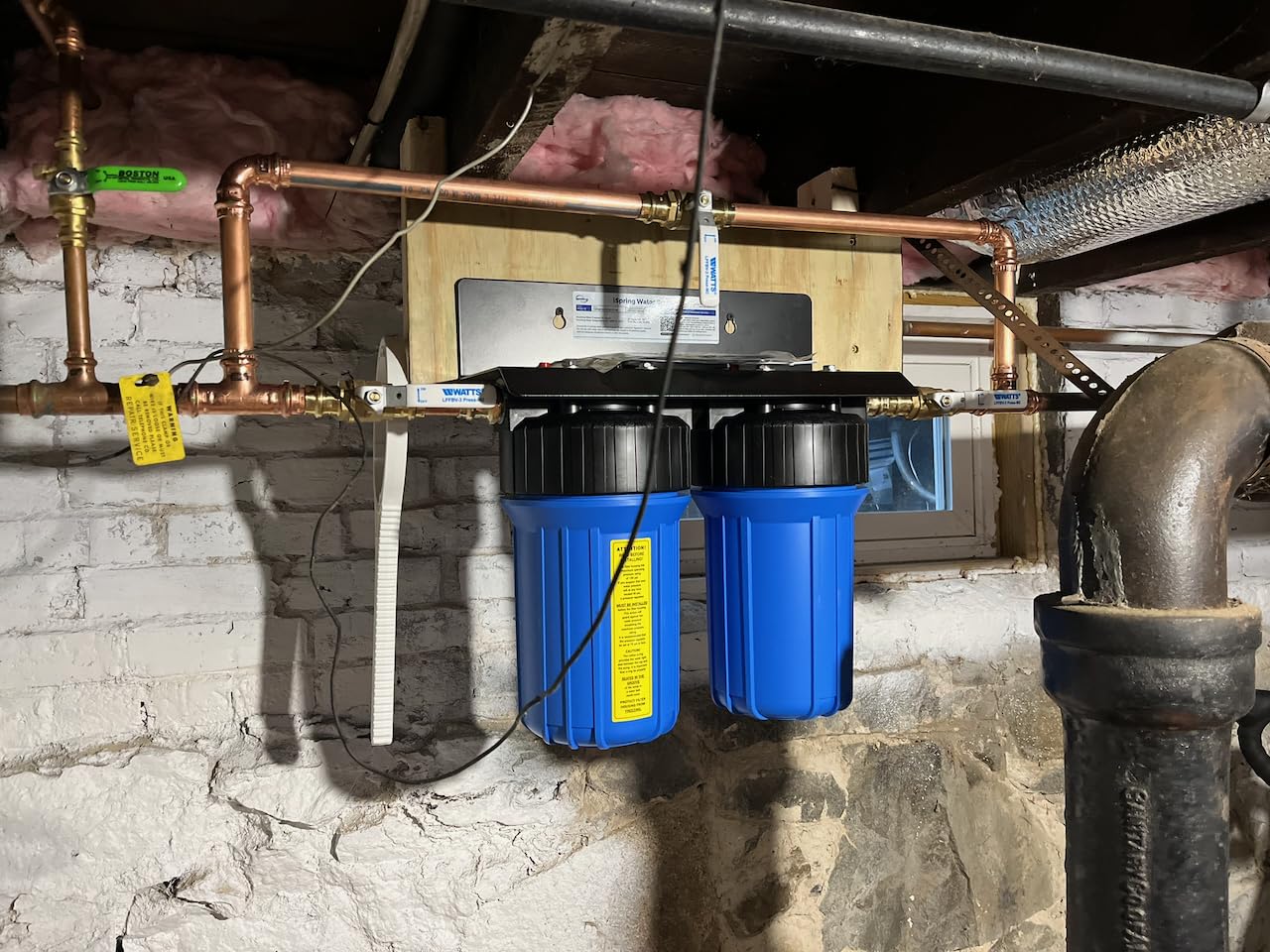
The listed capacity is 50000 gallons, which the manufacturer frames as roughly a year for a family of four, and the rated maximum flow is 15 gpm. Those are honest numbers on paper: 15 gpm covers a three bathroom house with two fixtures running, which is the scenario most buyers are actually in.
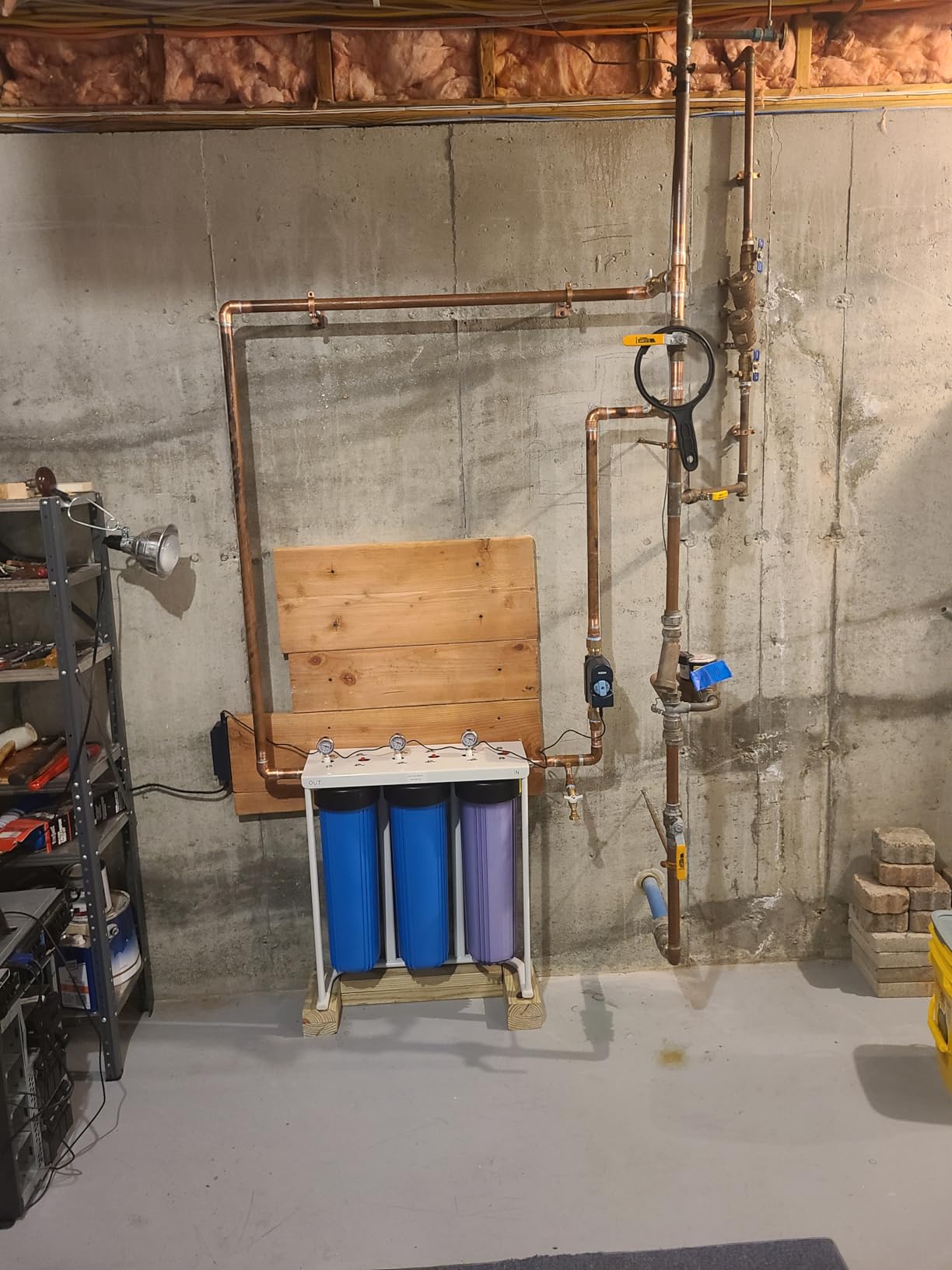
One thing that catches people out is that the two 10 inch by 4.5 inch housings need roughly 26 inches of length, 19 inches of width and 11 inches of depth of clear space, plus room to pull a full cartridge out sideways. Measure the wall before the box arrives, because the commonest install-day surprise is not plumbing, it is space.
Everything runs on water pressure with no electrical requirement, and the operating pressure is rated at 80 psi with a 40 to 100 degree Fahrenheit range. That makes it a clean fit for a typical municipal supply.
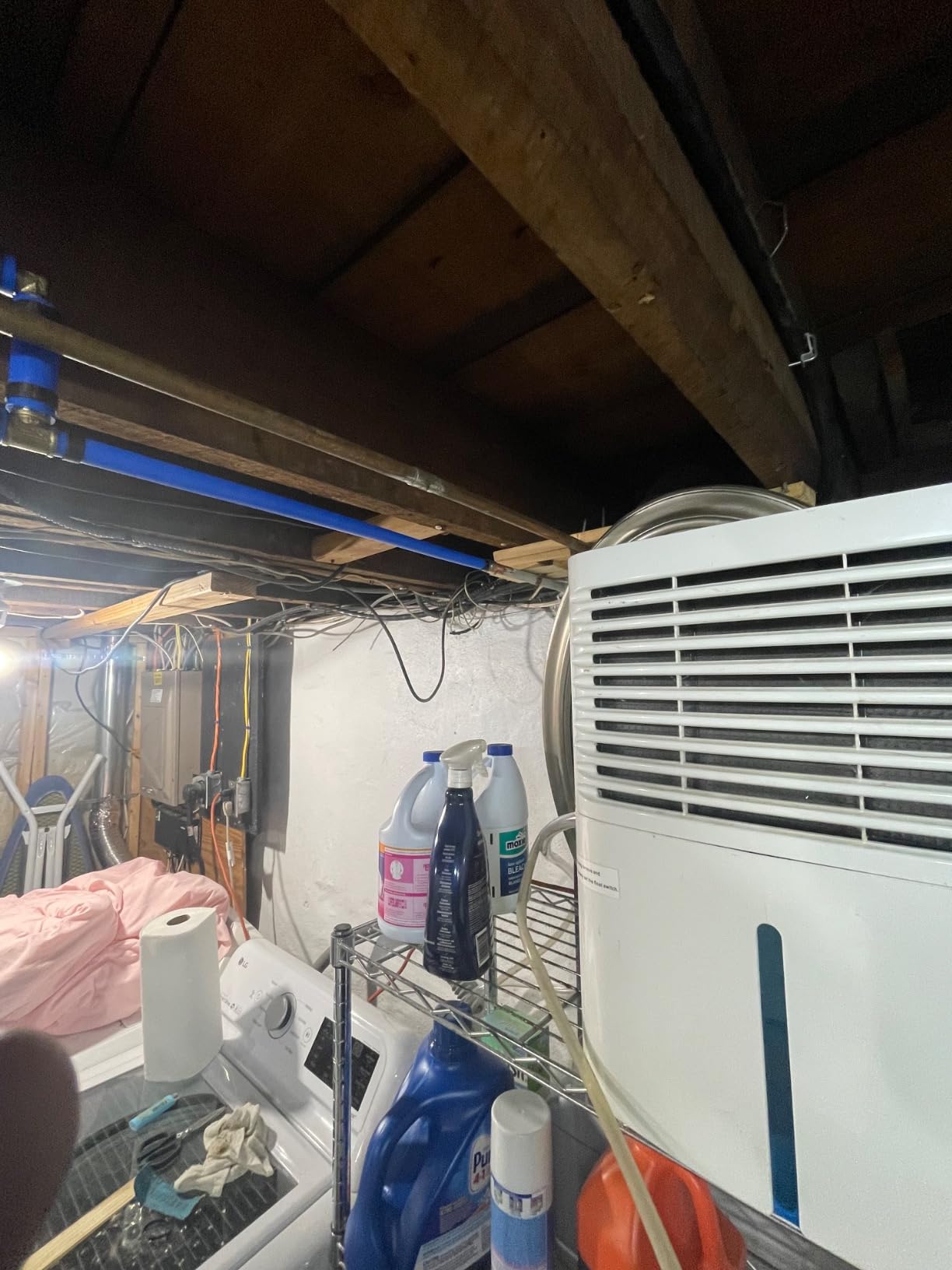
Who this filter fits best?
It fits households on chlorinated municipal water where the goal is taste, odor and sediment control plus general appliance protection. If you have never tested your water and your complaint is a chlorine smell at the kitchen tap, this solves it.
It also works as the second stage behind a spin-down prefilter, which is how I would install it on anything other than clean tap water. Several reviewers pair it that way and report longer cartridge life on the carbon.
Where the weak points show up?
The consistent complaint is sealing at the threaded housing ports. Buyers describe needing several wraps of thread tape, some add O-ring grease, and a few note that overtightening can crack the housing rather than fix the leak. Budget fifteen minutes and a wrench set for the install.
The warranty is one year by default and longer only when you register the unit, and the cartridges are standard 10 inch by 4.5 inch, which is a real advantage because you can source replacements from any seller. What it will not do is reduce hardness, sulfur, iron or dissolved solids.
2. iSpring WSP-50 Spin Down Prefilter: The Budget Pick Add-On
iSpring WSP-50 Spin Down Sediment Filter, Whole House Prefilter, 50 Micron
50 micron reusable stainless mesh
Flushable with a hose
Lead-free brass head
15 to 115 psi
Pros
- Flushable and reusable
- Protects downstream filters and softeners
- Clear housing for visual monitoring
- Multiple micron options in the same housing
Cons
- 50 micron clogs fast on silty well water
- Needs frequent flushing on dirty wells
- Short housing height means more maintenance
- Not certified by an external testing body
This is not a filter that improves water on its own. It is the cheapest insurance in this whole guide, because it catches sand, rust flakes and sediment before they reach the carbon stage or the softener resin.
That is exactly how most owners use it. The 50 micron stainless steel mesh screen is reusable, you clean it with a hose, and everything downstream gets a longer service life. On a system that already handles a lot of sediment, the cartridges come out visibly dirty and stay that way until you swap them.
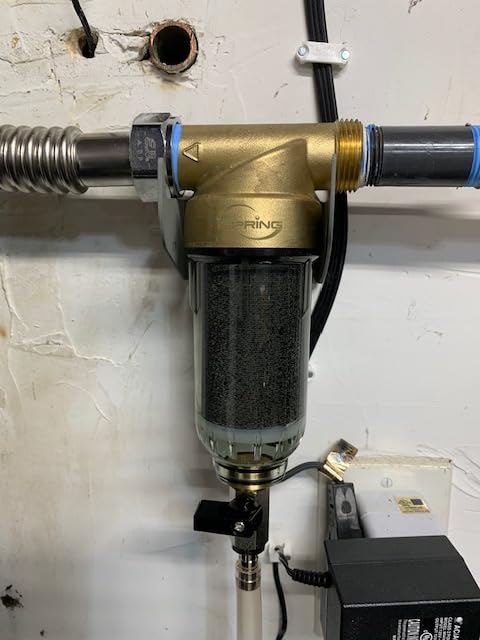
The body is stainless steel with a solid lead-free brass machine head, rated from 40 to 100 degrees Fahrenheit and 15 to 115 psi, and it weighs just 16 ounces at under nine inches tall. Threading is 1 inch male and 3/4 inch female on both ends, so it adapts to more plumbing than a fixed-port housing.
Micron choice is the whole lesson here, and it comes straight from the reviews. Buyers on silty wells report that 50 micron clogged within weeks, while 200 micron let grit through to the next stage. Around 100 micron is the compromise most owners settle on, and iSpring reportedly swaps in other micron screens at no charge.
The clear housing means you can see the screen darken without pulling anything apart, which turns maintenance from guesswork into a two-second check. Listed mesh life runs one to two years on municipal water, and considerably less on a dirty well.
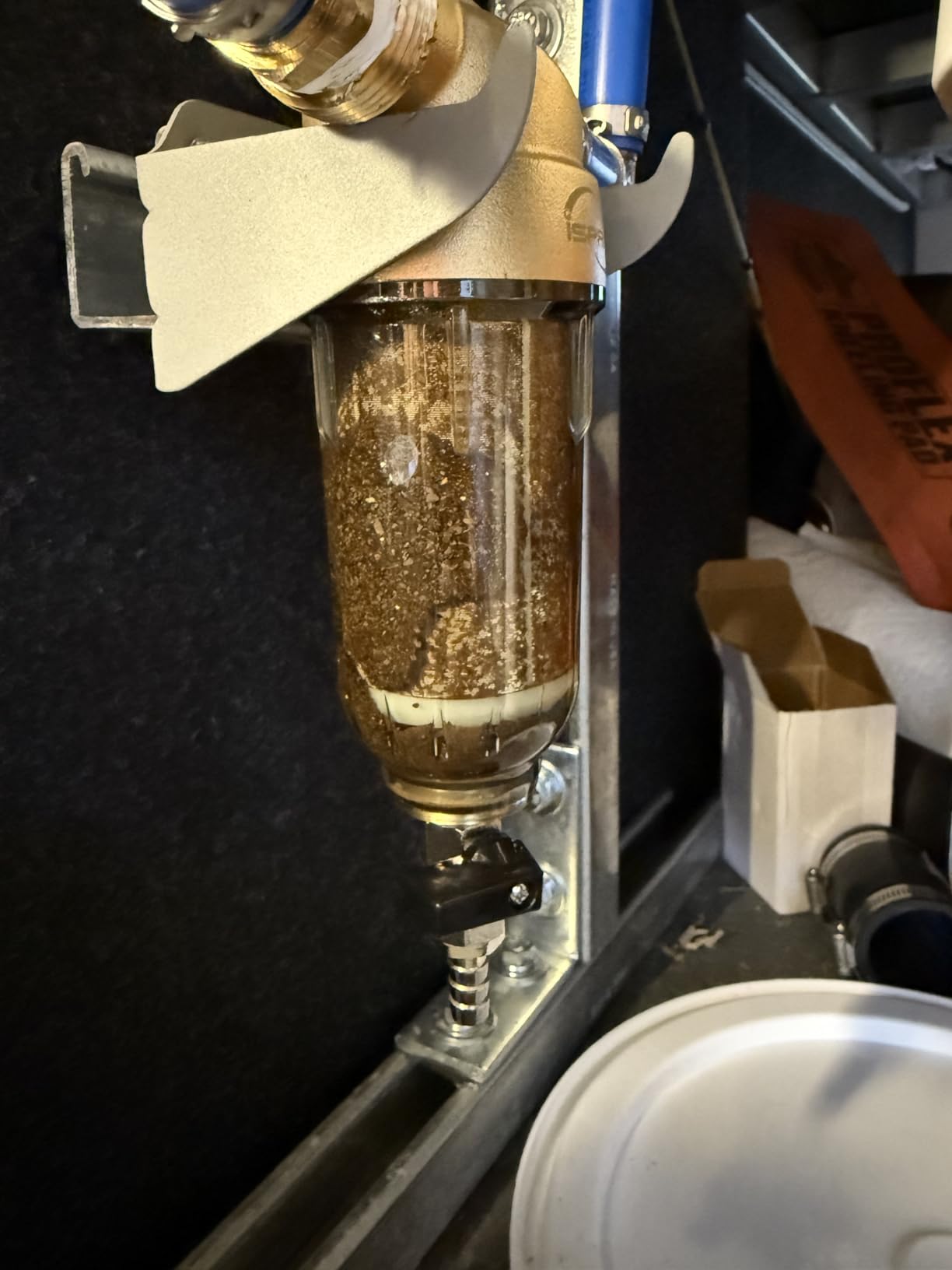
Why this belongs in any buying plan?
It is the only item in this list that pays for itself by protecting something else. If you install a carbon system or a softener without a sediment stage upstream, you are shortening the life of a more expensive component to save a small upfront cost.
For well owners, it is more central than that. The recurring advice in forums from private well users is to flush a spin-down on a schedule rather than react to a pressure drop, and the two-way style of spinning means a few turns clears most of the load.
What to watch for?
On high-sediment well water the 50 micron screen clogs quickly, and owners report flushing weekly or even twice weekly. That maintenance rhythm is the real cost of this product, and it is worth factoring in if your well produces silty water.
It also carries no external certification, so treat it purely as mechanical protection. And the housing is short, which means more frequent cleaning than a jumbo spin-down would demand.
3. Express Water 3-Stage System: The Best Heavy Metal Coverage
Express Water Whole House Water Filter System, Ultimate Protection, 3-Stage
Three stages with anti-scale
100000 gallon capacity
17 gpm flow
Stainless steel stand and gauges
Pros
- Targets chlorine heavy metals and scale in one unit
- Free-standing stainless frame adds rigidity
- Pressure gauges and release buttons included
- Owners report a measurable drop in chlorine
Cons
- Does not reduce TDS or hardness
- Free-standing frame is bulky
- Cartridges replaced every 6 to 12 months
- Only a 1-year manufacturer warranty
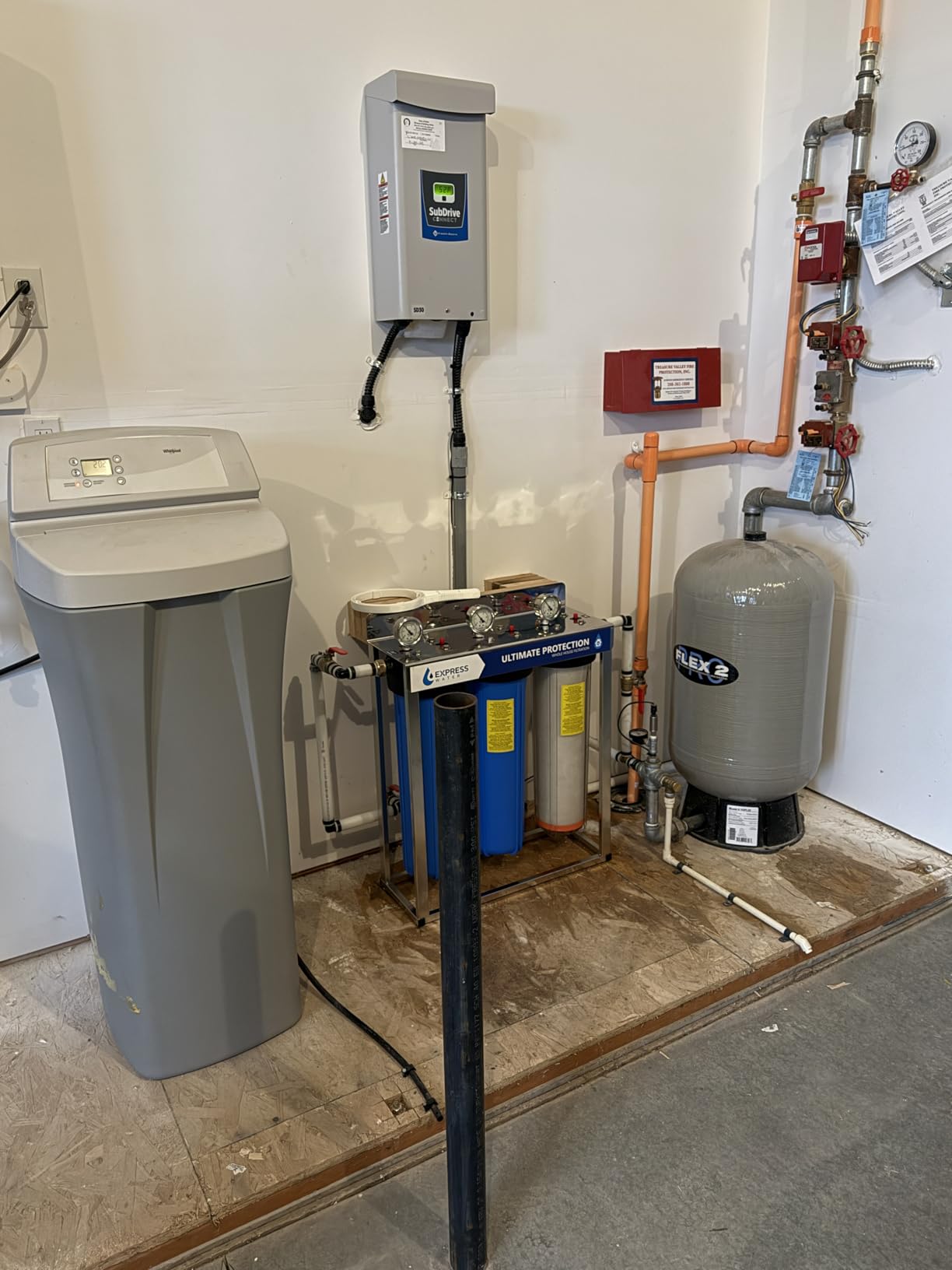
Most two-stage units treat sediment and chlorine. This one adds a third stage of laboratory packed polyphosphate aimed at scale, and it is the only system in this group that makes a stated reduction claim for lead, arsenic, chromium, cadmium and mercury.
That claim is the reason to look closely. No NSF/ANSI certification number is listed here, so treat the metals coverage as a manufacturer statement rather than a verified one. If metals are your primary concern, get a lab test first and then decide whether this coverage is enough for what you actually have.
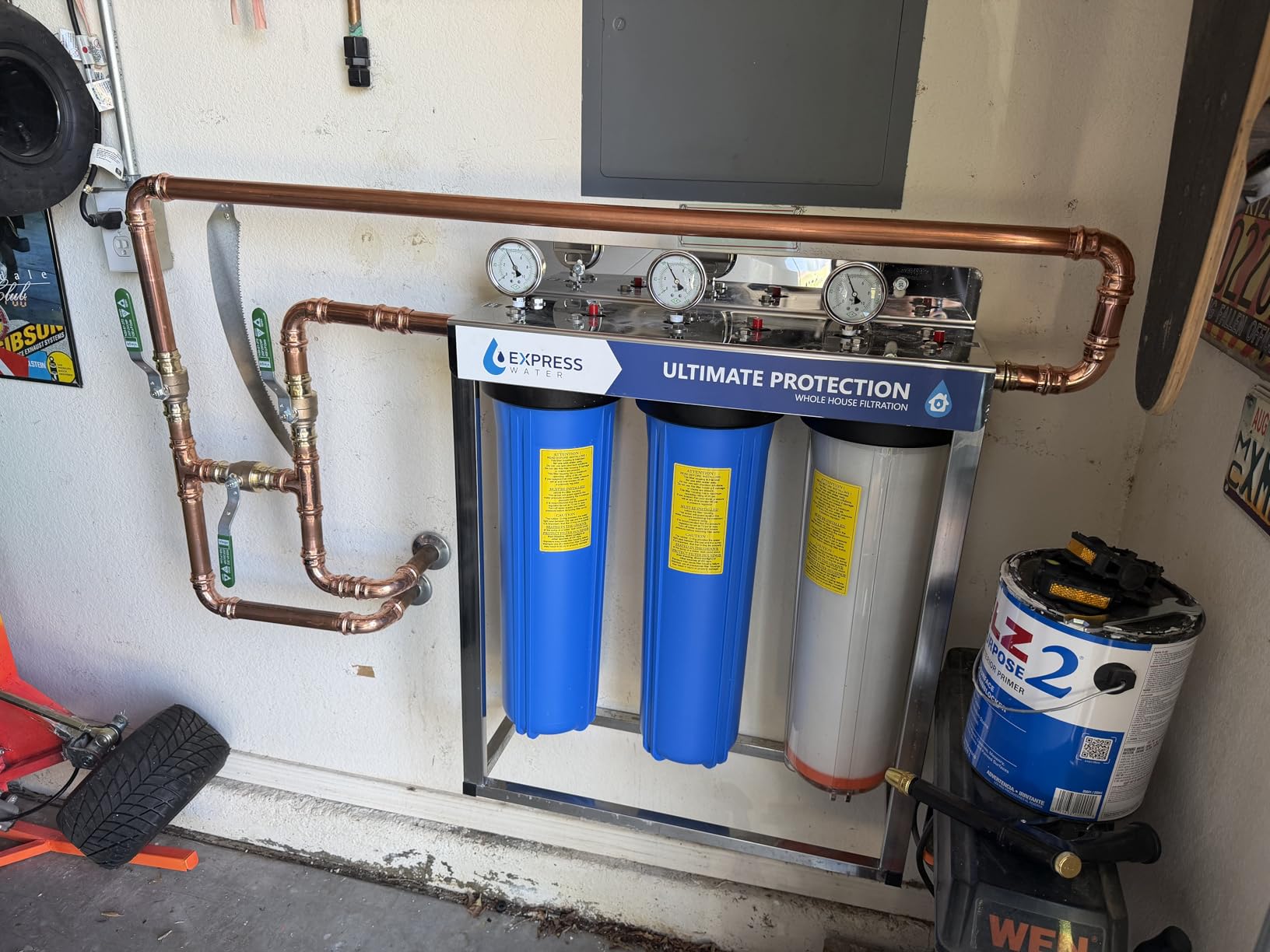
Capacity is 100000 gallons with a 6 to 12 month replacement interval, and the maximum flow rate of 17 gpm is the second highest in this roundup. Operating pressure is rated 20 to 80 psi, connections are 1 inch, and the maximum supported TDS is 800 ppm.
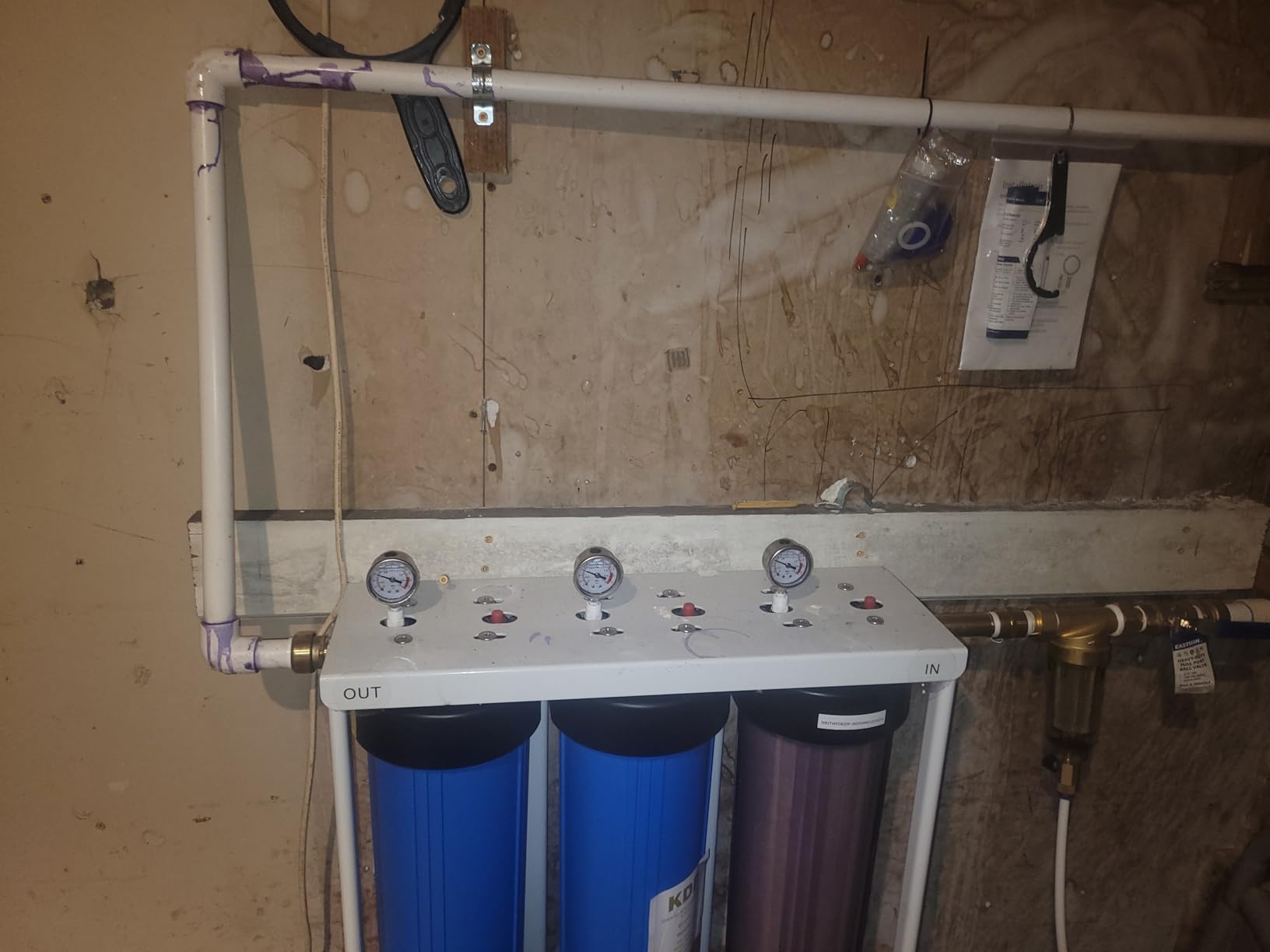
Three pressure gauges and three pressure release buttons ship in the box, and that detail matters more than it sounds. Gauges let you see when a stage is loading up, and release buttons mean you can depressurize a housing without wrestling the fitting. It runs on water pressure alone with no power required.
The stainless steel stand is freestanding, which makes it simple to mount on a floor or a shelf instead of a wall, and the whole unit weighs 63 pounds. Plan the footprint at roughly 29 inches long by 8.5 inches wide by 30 inches tall.
Who should buy this one?
It suits a household that wants one box to solve several problems instead of stacking separate components. If your water is chlorinated, shows some staining, and you want scale protection on the water heater and dishwasher, this covers all three in a single footprint.
Owners report running the system for ten minutes or more after installation to flush carbon fines, and many verified a real drop in chlorine with test strips afterward. That flushing step is normal for any carbon-based system and is not a defect.
Where the limits show?
It does not reduce TDS, so it will not soften water or address dissolved solids, and the 800 ppm TDS ceiling is lower than some competing units. The free-standing frame is genuinely bulky for a tight utility space, and at 63 pounds it needs a floor or a solid shelf rather than drywall anchors.
Transit damage to canisters and missing frame covers show up in reviews often enough to mention, though the seller resolves them. The warranty is one year, which is the shortest tier in this guide.
4. iSpring WGB32B Commercial Grade: The Best High-Capacity Cartridge Stack
iSpring WGB32B Commercial-Grade Whole House Water Filter System
Three 20 inch Big Blue housings
100000 gallon capacity
15 gpm flow
NSF tested carbon stages
Pros
- Highest rated system in the group
- Three large housings give long filter life
- Handles sediment-heavy city water and well water
- Retains minerals so RO is not needed
Cons
- Threaded manifold ports need heavy tape and sealant
- About 45 pounds empty so mount into studs
- Housings are heavy when full
- Pressure release buttons may not fully depressurize
This is the highest rated product in the group, and the rating holds up when you read the reviews. Buyers describe dramatic before and after results on discolored city water and sediment-heavy wells, and they post pictures of visibly dirty spent cartridges as proof the media is doing work.
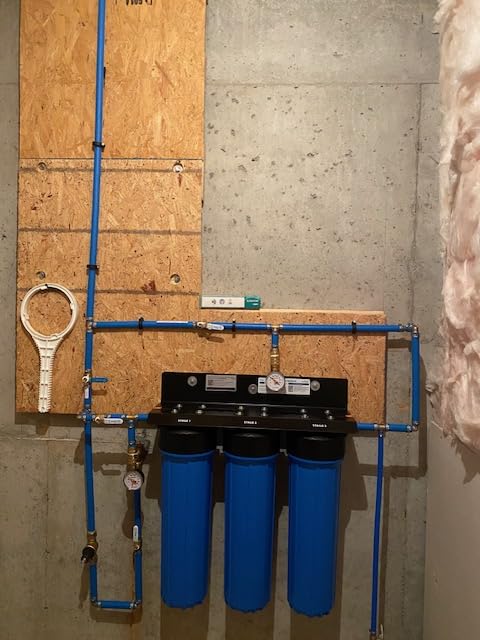
What separates it from the WGB21B is scale of hardware. The three stages use 20 inch by 4.5 inch industrial standard housings, roughly double the media volume of a 10 inch housing, which is where the 100000 gallon capacity and one-year life come from.
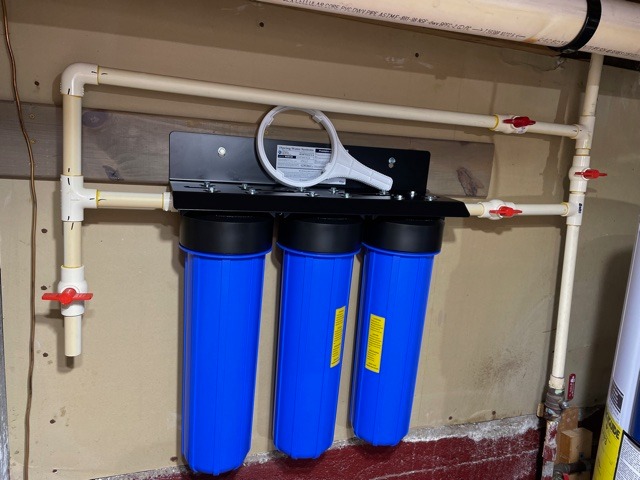
Stage one is a 5 micron sediment filter, and stages two and three are coconut shell carbon block cartridges that are third-party NSF/ANSI tested. The listing states removal of up to 99% chlorine plus sediment, rust, taste, odor and herbicides, and maximum flow is 15 gpm through 1 inch NPT ports.
Like the rest of the cartridge systems here, it retains dissolved minerals and does not reduce TDS, with a listed maximum supported TDS of 300 ppm. Installation is DIY with a manual, video guides and a filter wrench in the box.
Plan for a 24.5 by 8 by 28 inch footprint and 45 pounds empty. Those housings are heavy when full, and owners say to use two wrenches and a bucket rather than trying to catch a full cartridge one-handed.
Why it earns the top rating?
The combination of capacity, media volume and owner satisfaction is what stands out. People running it on well water report it handling iron reduction alongside sediment, which most cartridge-only systems at this capacity will not do.
Support is a genuine differentiator. Multiple reviewers describe receiving replacement manifolds and canisters at no charge, including past the warranty period, which softens what would otherwise be the biggest weakness in a DIY install.
The install is where it gets tricky
Threaded plastic manifold ports are a known leak point and need generous amounts of thread tape plus sealant. Over-tightening can crack the manifold, and a few owners report the pressure release buttons on some manifolds not fully depressurizing the housing.
Because it weighs about 45 pounds empty, mount it into studs rather than drywall anchors. And unwrap each cartridge before you install it, which the packaging explicitly calls out and a surprising number of owners skipped.
5. A. O. Smith 600K Gallon Filter: The Best Set and Forget Option
A. O. Smith Whole House Water Filter System | 600K Gal | AO-WH-Filter
600000 gallon capacity, 6 year life
7 gpm max flow
NSF/ANSI 42 certified
3/4 inch ports
Pros
- Longest filter life in the guide
- No backflushing drainage or water waste
- 6-year limited warranty
- Install kit includes shut-off valve and hose adapter
Cons
- 7 gpm is the lowest flow in the roundup
- Carbon only so no sediment iron sulfur or hardness coverage
- 3/4 inch ports
- Proprietary replacement cartridges
If your only problem is taste and odor, this single-tank system removes more thinking from your life than anything else here. It is rated for 600000 gallons or six years of service, and it requires no drainage, no backflushing and no water waste to plan your plumbing around.
That last point deserves more attention than it gets. Every backwashing media system needs a drain line and a floor that can handle it, and not every utility space has one. This is a pressure-fed carbon unit that just sits on the pipe.
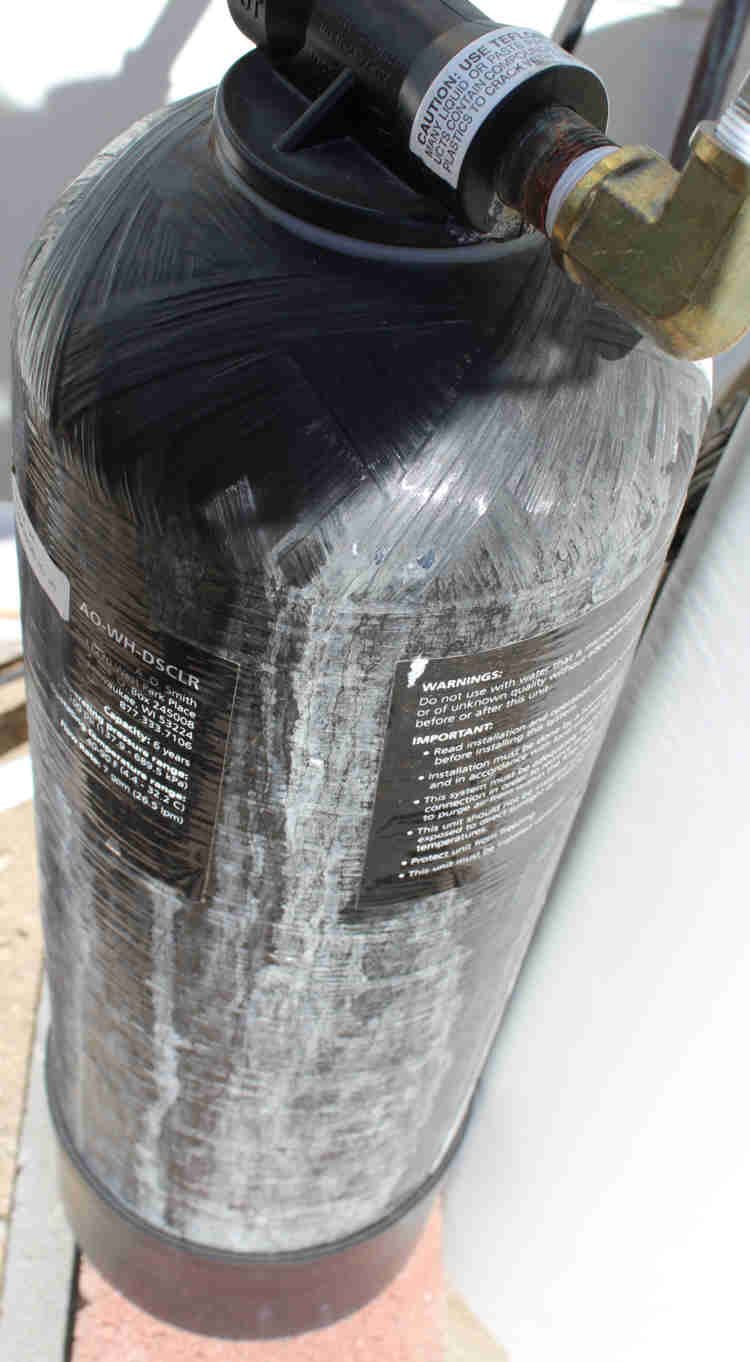
The reduction claim is specific and modest: 96.9% of chlorine taste and odor, and it carries NSF/ANSI 42 certification for that claim, which puts it ahead of anything certified in this group. Operating pressure is 20 to 100 psi and the housing is fiberglass at 30.2 by 9.5 by 9.4 inches.
It is rated for households of four or more, and the manual explicitly states it does not reduce TDS, sulfur or iron, and is not a water softener. That honesty in the spec sheet is the reason it fits comfortably in this guide.
The install kit includes a central water filter, shut-off valve, nipple and hose adapter, so the fittings you are most likely to be missing are in the box.
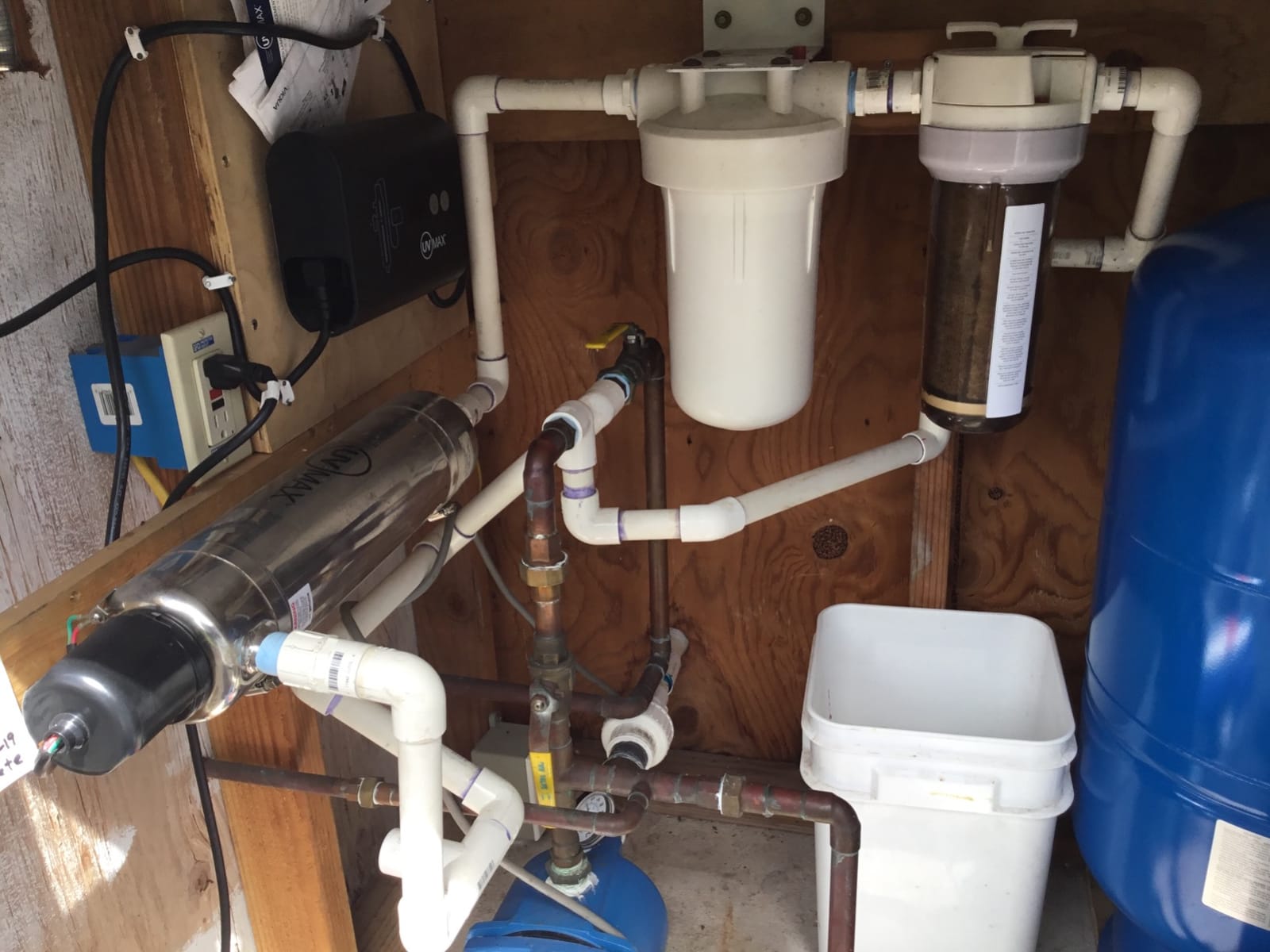
Where this system fits?
It fits mid-size homes on municipal water that want chlorine and odor handled for years without thinking about it. Owners describe the experience as set and forget, and the 6-year limited warranty is the longest warranty in this roundup by a wide margin.
It also works well as the polish stage after a sediment prefilter, since carbon media last longer when it is not catching rust. If you have hard water, you will still need a softener, and our whole house water softener guide covers that side of the decision.
Where it runs out of road?
At 7 gpm this has the lowest rated flow in the group, which can show as a pressure drop in a larger home running multiple fixtures at once. The 3/4 inch inlet and outlet also limit compatibility with 1 inch whole house plumbing, so measure your line first.
Replacement cartridges are proprietary, and the unit does nothing about sediment, iron, sulfur, hardness or dissolved solids. Size it as a taste and odor solution, not a general purifier.
6. Waterdrop WHF21-PG 2-Stage: The Best Compact Two-Stage Unit
Waterdrop WHF21-PG 2-Stage Whole House Water Filter System, 5 Micron
5 micron PP plus coconut shell GAC
50000 gallon capacity
15 gpm flow
Housings tested to 90 psi
Pros
- Compact two-stage design for tight spaces
- Food-grade housings tested for water hammer
- Includes wrench and expansion screws
- Handles rust and sediment protection
Cons
- PP cartridge needs changing every 3 to 6 months
- No bypass valve or pressure gauges included
- Best on municipal water
- Not certified at the system level
This is the answer when the constraint is space rather than capacity. At 14.37 by 7.48 by 15.55 inches it takes up a fraction of the footprint of a three-stage Big Blue stack, and it still delivers a 5 micron sediment stage ahead of coconut shell granular activated carbon.
The listed capacity is 50000 gallons with a six month life, and the manufacturer asks you to change the carbon every six months and the polypropylene cartridge every three to six months. That PP interval is the shortest replacement cycle on any system here.
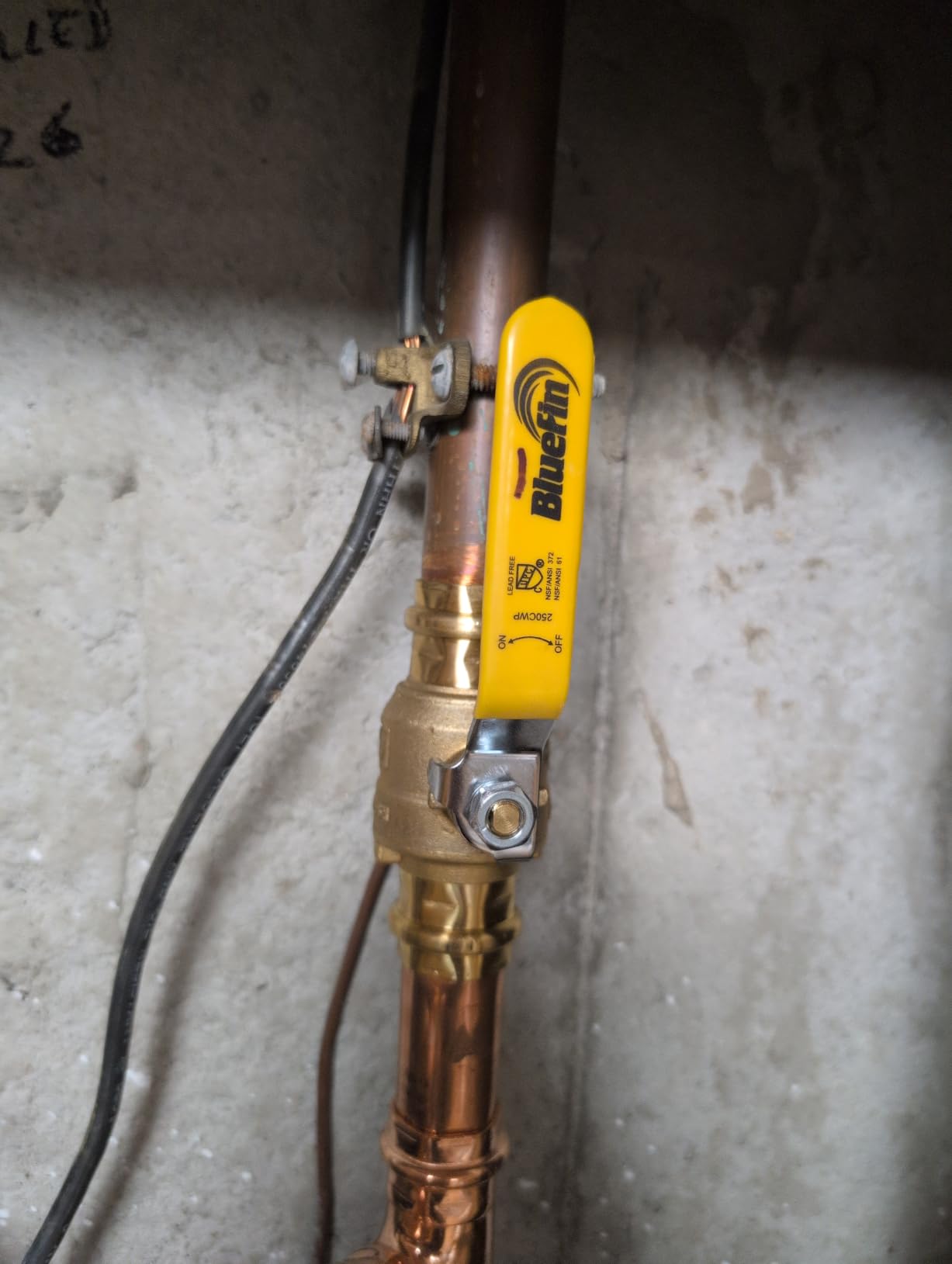
Flow is rated up to 15 gpm through 1 inch inlet and outlet connections, and the housings are tested from 25 to 90 psi and for more than 100000 water hammer cycles. That pressure cycling test is unusual to see published and it tells you something about how the housing holds up.
Material is listed as NSF/ANSI approved components, though the system itself is not independently certified, so read that as a component statement rather than a verified performance claim. The technical data cites reduction of sediment plus chlorine, lead, benzene and mercury at 5 microns.
A filter wrench and expansion screws are included, which covers the two things people forget to buy. Budget extra time for cartridge changes given the three to six month PP cycle, and plan on adding a bypass if you want to isolate the unit while working on it.
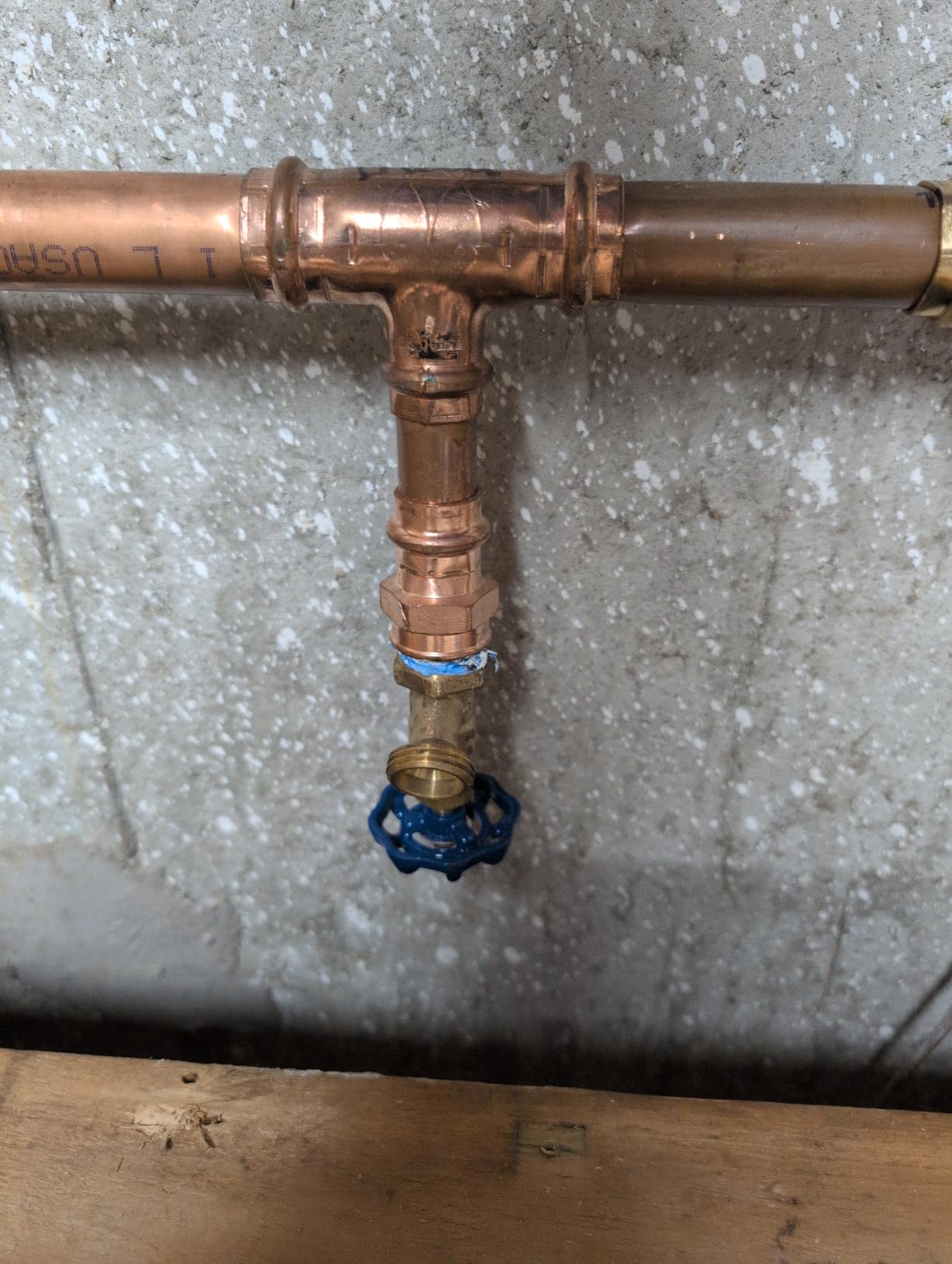
Who it suits?
It suits a home with municipal water, modest sediment and a utility space that cannot host a larger stack. Owners treat it as a straightforward two-stage that handles chlorine taste and odor plus sediment protection for pipes and appliances.
It is also a sensible second unit in a larger home, or a rental or addition where you want whole house treatment without dedicating wall space to a big frame.
What you give up for the smaller footprint?
No bypass valve and no pressure gauges are included, which means you cannot isolate the unit for service without shutting off the house, and you cannot see pressure drop coming. That is a real loss for anyone who wants to monitor performance over time.
Lifespan shortens noticeably on untreated or well water, and the cartridge cost recurs more often than on a 10 inch or 20 inch housing system. If your water is untreated, step up to a larger media volume instead.
7. GE GXWH40L Housing: The Best Sediment and Resin Catcher
GE Whole House Water Filtration System, Reduces Sediment, Rust & More, Install Kit & Accessories Included, Replace Filters (FXHTC, FXHSC) Every 3 Months, GXWH40L
Sediment and scale housing
4 gpm flow
Clear sump with bypass
FXHTC or FXHSC cartridges
Pros
- Affordable entry point for sediment and rust
- Clear sump shows filter condition
- Can double as a softener resin bead catcher
- Bypass lever and relief valve included
Cons
- Cartridges not included and replaced every 3 months
- 4 gpm is the lowest flow here
- Sediment only with no carbon stage
- Horizontal installation only
This one is a housing rather than a complete filtering package, and that is the point. You get a well-made whole house filter body for sediment, scale, dirt and rust, and you supply FXHTC or FXHSC cartridges separately, replaced on a three month cycle.
The most common use I found in reviews is not drinking water filtration at all. Owners put this ahead of a softener to act as a resin bead catcher, which is genuinely useful because a softener can shed resin that ends up in your appliances and plumbing.
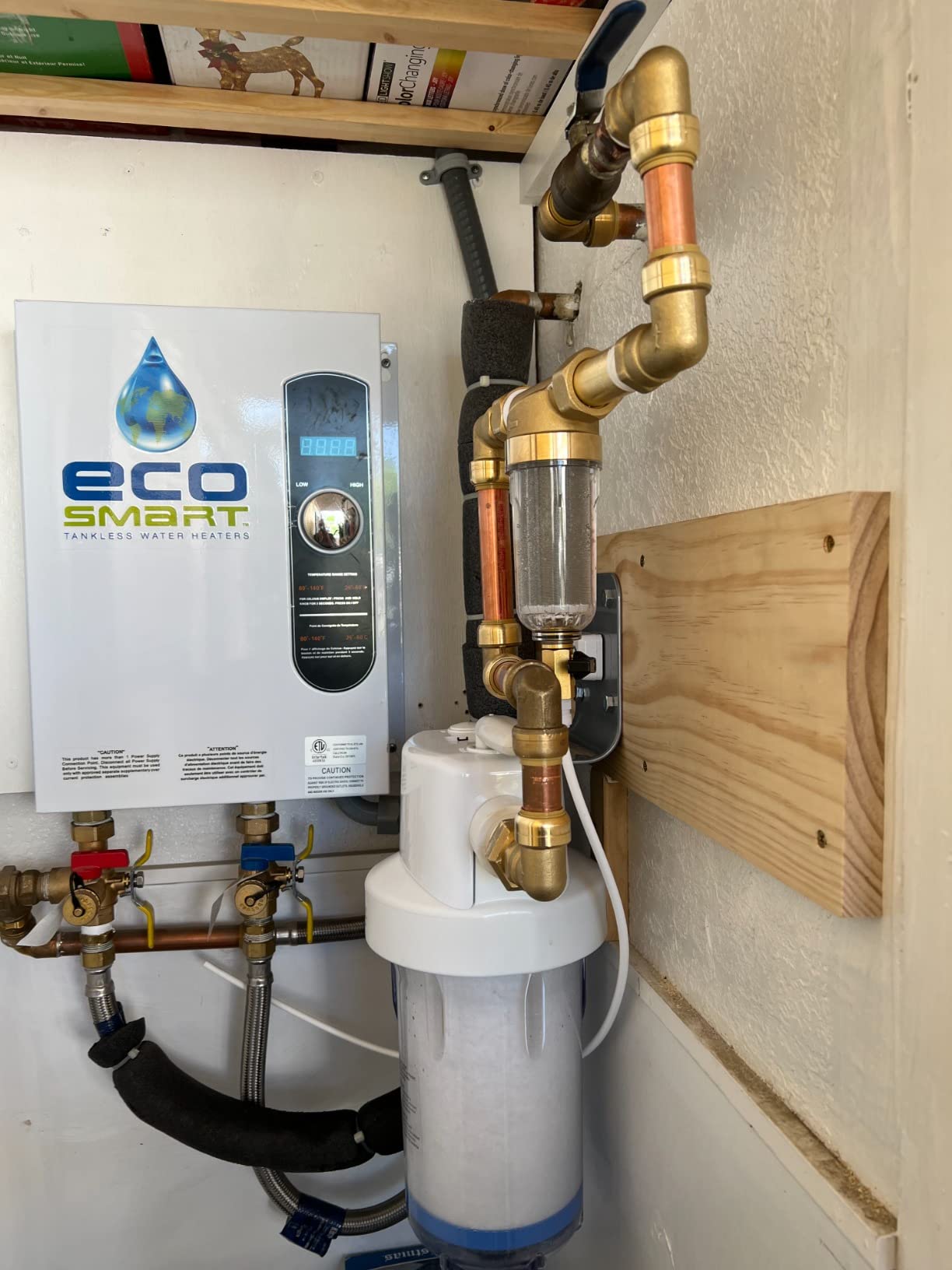
At 4 gpm rated flow, this is the lowest capacity unit in the guide, and that is the main reason it works as a pre-stage rather than as your only whole house filter. Maximum supported TDS is 300 ppm and purification method is sedimentation, so it does not touch chlorine or dissolved solids.
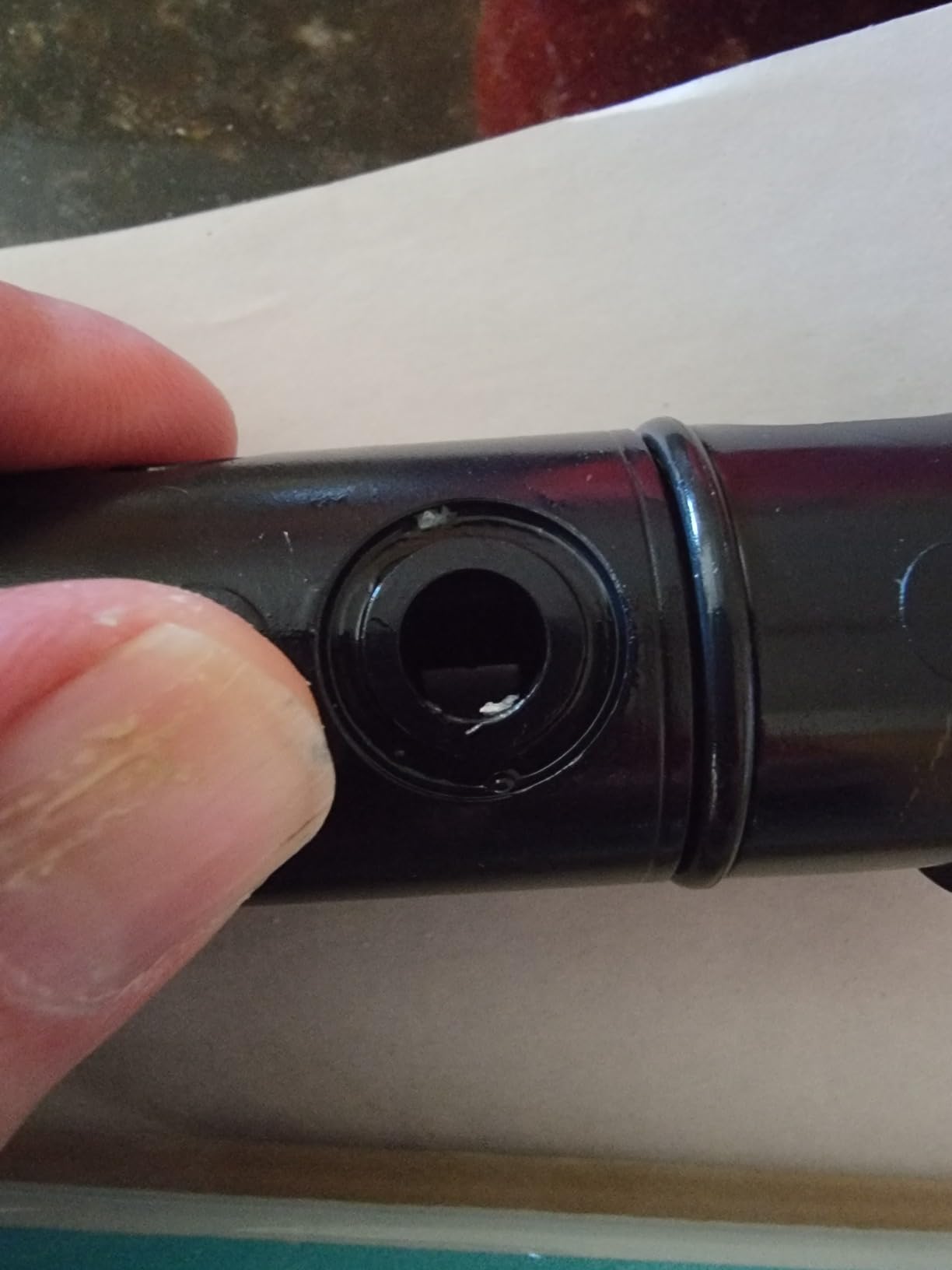
The hardware is good. It includes a pressure relief valve, a bypass lever, a mounting bracket and a remote filter change reminder light, and the clear sump lets you see the cartridge without disassembly. Connections are 1 inch and the inlet and outlet are reversible.
One limitation catches buyers: it installs horizontally only, so a vertical wall won’t work without rework. It measures 15.75 by 9 by 7.75 inches and weighs 8.2 pounds, which is a friendly size for a small cabinet.
Where it earns its place?
It fits homes with modest sediment and rust issues, and it is a sensible companion piece to a softener in a tight space. The bypass lever makes cartridge changes fast once you get the hang of the horizontal orientation.
If you are pairing systems, sequence matters: sediment stage first, then whatever treats the water chemistry, then the softener. If you want the full picture on filter plus softener layouts, our whole house filtration systems guide walks through the order.
What to be careful about?
The cartridge is not included, and the three month replacement interval is the shortest cycle of any system here, so the ongoing cost adds up faster than with a 10 inch carbon unit. Budget for that in your five year math.
At 4 gpm it will choke a household running several fixtures at once, and the threaded connections leak easily without several wraps of tape. Some buyers also report the top and canister arriving over-tightened, which means check the assembly before you pressurize it.
8. SimPure DB10C-2 Clear Housings: The Best Visibility and Sealing
SimPure Whole House Water Filter System, 2 Stages Clear 10″ x 4.5″
Two clear 10 inch by 4.5 inch housings
60000 gallons
15 gpm flow
Brass ports, dual O-rings
Pros
- Clear housings show cartridge condition at a glance
- Dual O-ring and brass ports resist leaks
- Plumbers rate build quality above the price
- Rotatable housings allow either side inlet
Cons
- Bracket does not match standard 16 inch stud spacing
- Weak drywall anchors
- Very heavy when full
- Cartridges fit easily upside down
If you have ever wondered whether a cartridge is actually loaded, this is the system that answers the question. Both 10 inch by 4.5 inch housings are clear, so you can see the media darken and know when to change it rather than guessing on a schedule.
The hardware story is what sets it apart. Ports are 1 inch NPT brass rather than plastic, and the sealing uses a dual O-ring design, which is a direct response to the leak complaints that dominate reviews of plastic-housed systems.
Filtration is a sediment stage followed by a CTO carbon block, with 60000 gallons of listed capacity. Carbon life is 3 to 6 months and sediment life 6 to 12 months, at 15 gpm maximum flow and a 25 to 90 psi operating range.
Cartridges are standard 10 inch by 4.5 inch, so replacement media is widely available. Maximum supported TDS is 1000 ppm, the highest in this group, and housings are rotatable for left or right side inlet, which helps in a cramped utility space.
Installers describe build quality as comparable to more expensive name brands, which is a strong signal in a segment where build quality is usually the first thing sacrificed.
Why well owners like it?
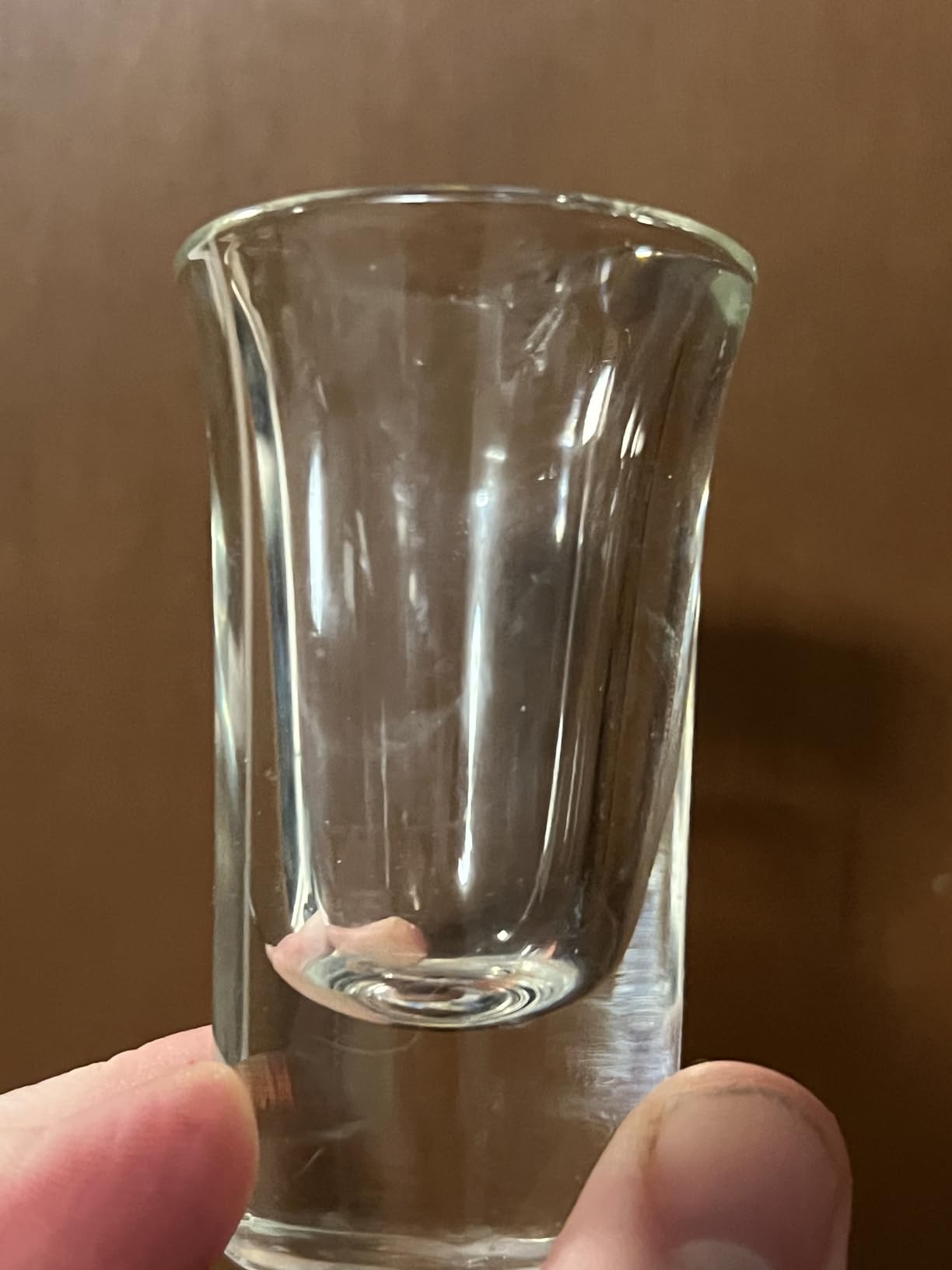
Owners report it handling both well and city water including iron discoloration, which is unusual for a cartridge-only system without a dedicated oxidation stage. If you are on a well, pair it with a spin-down prefilter upstream, since raw well water is hard on any cartridge.
It also works as a softener pre-stage in the same way the GE housing does, and the clearer sight glass makes resin fouling visible. For a full breakdown of well-specific setups, see our whole house water filter guide for well water.
Where the criticism lands?
Almost all of it is mounting hardware rather than filtration. The bracket is not on standard 16 inch stud spacing and the included drywall anchors are weak, and at 18.25 pounds empty the unit is far heavier when the housings are full.
Documentation is thin in places, especially around installing pressure gauges on some variants. And the UP marking on the cartridge is nearly invisible, so cartridges can go in backwards, which owners report as a confusing early failure.
9. 3M Aqua-Pure AP904: The Best Wrench-Free Cartridge System
3M Aqua-Pure AP900 Series Whole House Water Filtration System AP904
Sanitary Quick Change cartridge
100000 gallon carbon
20 gpm flow
NSF 42 and 372 certified
Pros
- Wrench-free cartridge swaps
- 42 and 372 certified so material safety is verified
- 20 gpm suits homes with three or more bathrooms
- 304 stainless steel head built for durability
Cons
- Proprietary 3M AP-series cartridges only
- Higher cost than cartridge rivals
- Scale inhibition is not removal of solids
- Single stage so metals need more treatment
The Sanitary Quick Change head is the reason to shortlist this one. The cartridge twists on and off by hand with no filter wrench and no mess, which matters a lot when you are changing media every six months for the next ten years.
It is also the only system in this guide certified to both NSF Standard 42 for chlorine reduction and NSF Standard 372 for lead-free material safety. Two certifications together is a stronger signal than a marketing sentence, and it is the number to look up before you buy.
Capacity is 100000 gallons of activated carbon and flow goes up to 20 gpm, the highest rated here, through 1 inch inlet and outlet connections. The head is 304 stainless steel and the cartridge uses an activated carbon block with non-woven pleat media.
At 4.5 by 4.5 by 25 inches and 10.4 pounds, it is a narrow vertical unit, which makes it easy to tuck beside a softener. The AP917HD-S cartridge is included along with the mounting bracket and manual.
Owners consistently value the combination of easy maintenance, verified certification and a flow rate appropriate to larger homes with three or more bathrooms. That is a rare set of attributes in a single product.
Who it fits?
It fits larger homes and anyone who dreads plumbing work. The 20 gpm rating covers multiple simultaneous fixtures, and the certification pair gives you documented chlorine reduction plus material safety.
It is also stated as suited to both chlorinated municipal water and non-chlorinated well water, which broadens where you can put it. Just remember it is single stage, so pair it upstream with sediment protection.
What the lock-in costs you?
Cartridges are proprietary to the 3M AP900 series, so you cannot substitute third-party carbon media. That means higher replacement cost over a five year horizon and fewer options if a different media suits your water better.
It also inhibits scale rather than removing dissolved solids, and single stage means heavy metals need separate treatment. Weigh the convenience against the recurring cost before you commit.
10. Waterdrop BG102 Mega Spin Down: The Best High-Flow Prefilter
Waterdrop BG102 Mega Spin Down Sediment Filter, 50 + 100 Micron Filter
50 and 100 micron reusable mesh
25 gpm maximum flow
Forged brass head
360 degree two-way flush
Pros
- Very high 25 gpm with minimal pressure drop
- Large chamber suits municipal tap water
- Forged brass head and stainless screens
- Reverse flushing clears the outer mesh fast
Cons
- Backwash only cleans the outer mesh
- Bracket supports but does not hold the unit
- Off setting does not isolate backflow
- Non-standard inner cartridge in limited micron sizes
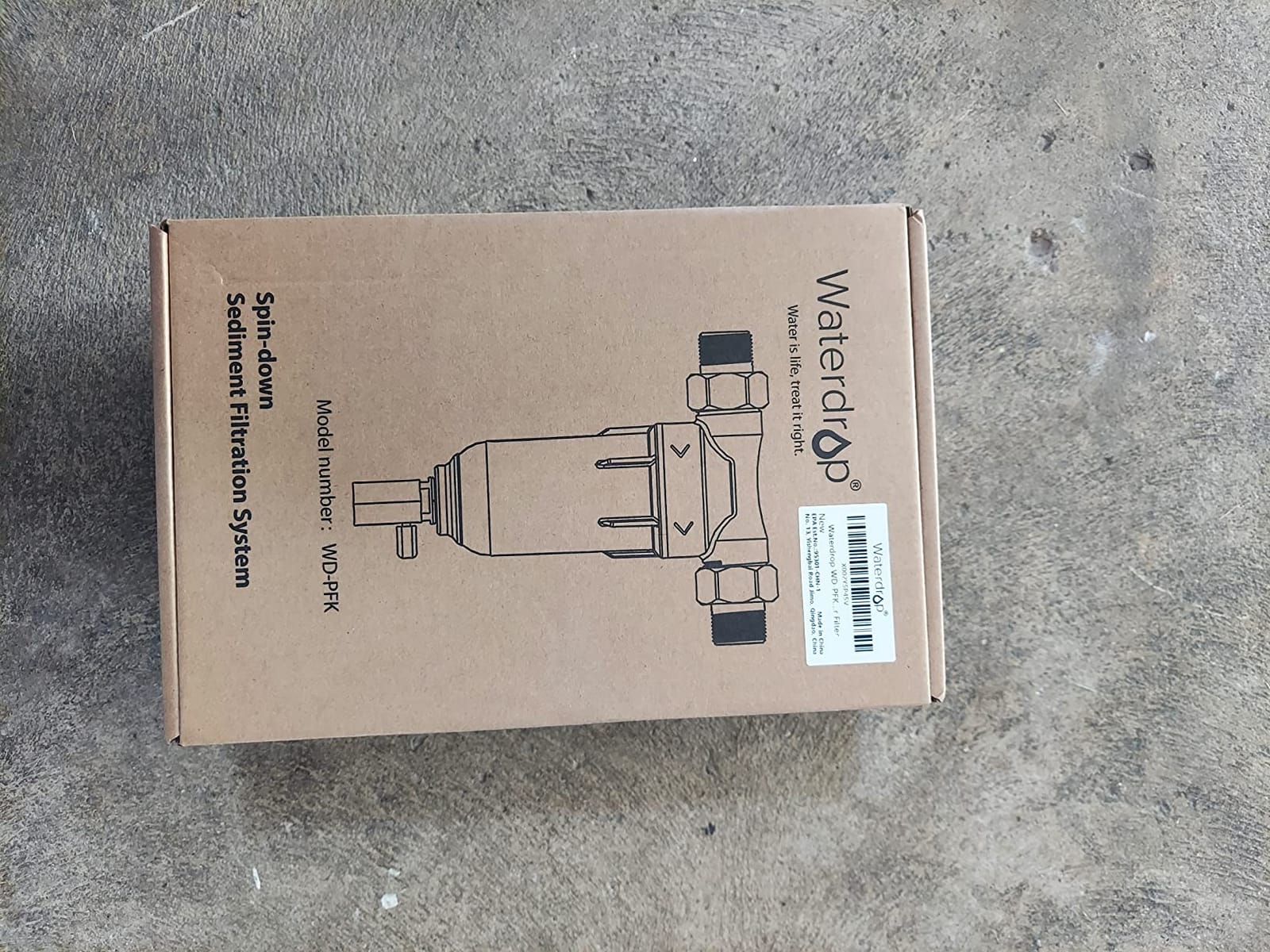
Where the WSP-50 is a small serviceable prefilter, this is the larger high-flow version. It runs 25 gpm, the highest flow rating of any prefilter here, with a chamber described as 20 times larger than standard and mesh screens sized well above typical.
The mesh comes in 50 and 100 micron, and the outer screen is reported at 7 times larger and the inner at 4.2 times larger than a standard unit. That capacity is why owners report barely any measurable pressure drop even at full flow.
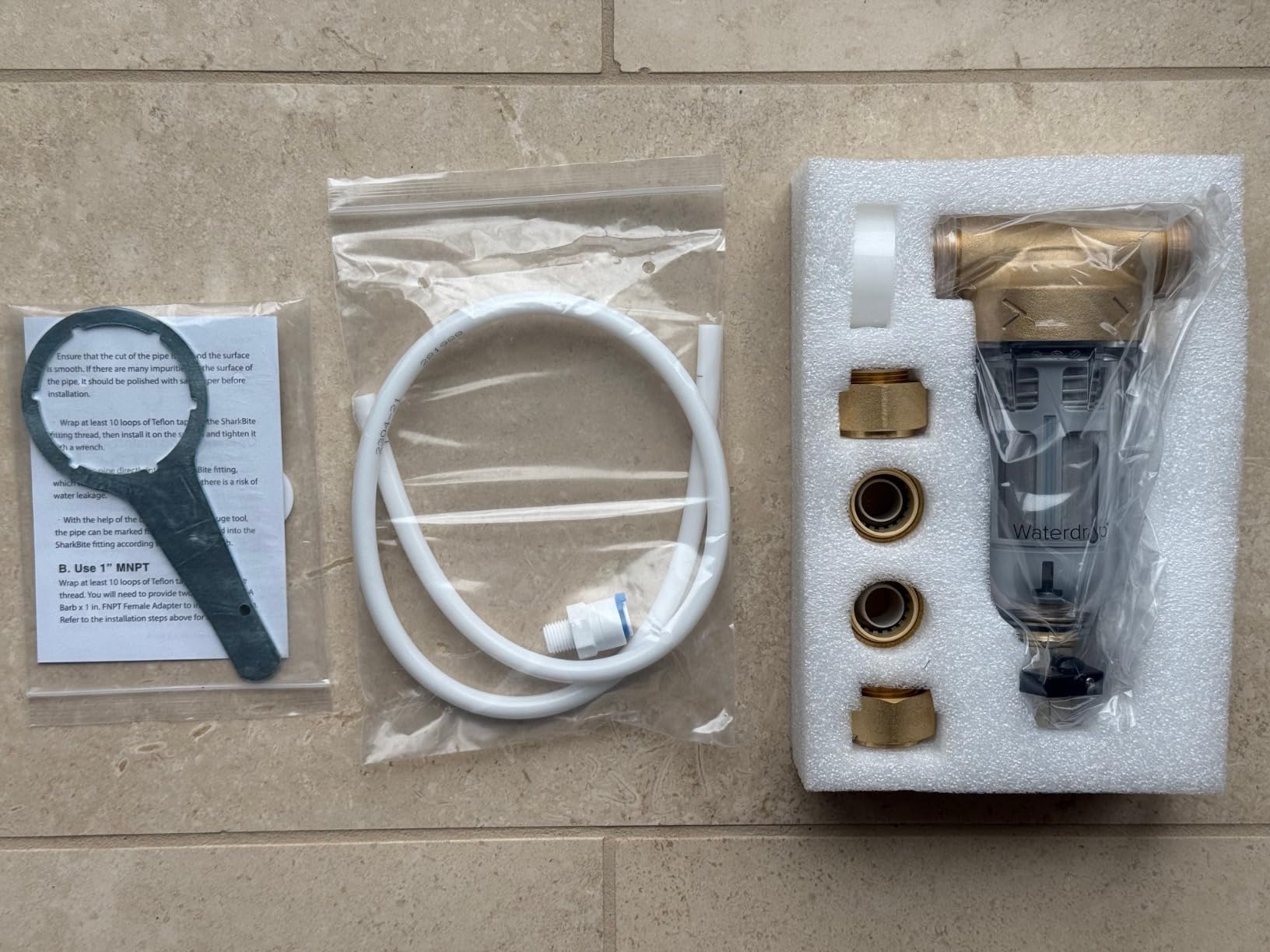
The head is a 3.2 pound forged brass piece with a nano-coating, tested to 200000 water hammer cycles, 6.0 MPa pressure and minus 22 degrees Fahrenheit freezing. It also carries a magnetic scale prevention feature targeting ferrous particles.
The two-way bypass valve supports 360 degree power flushing in both forward and reverse, and reverse flushing is what clears the outer mesh quickly on city water. The maintenance guidance is to clean every two weeks and deep clean monthly.
Maximum supported TDS is 500 ppm and it measures 7.48 by 7.48 by 16.54 inches at 7.1 pounds, so it is compact relative to its flow capacity.
Where it beats the smaller spin-down?
It beats the WSP-50 on municipal tap water with high flow demand, on chamber volume and on the reverse flush. If you have a large home on treated water and want sediment protection without a pressure hit, this is the stronger pick.
Owners also praise the build quality of the forged brass head and stainless screens, and use it to extend the life of downstream carbon and softener stages. As a first stage before a softener, it is a solid guard.
What to know before you buy?
Backwashing cleans the outer mesh only. The inner cartridge still needs manual replacement, and it is non-standard and only offered in limited micron sizes, which is a genuine problem on silt-heavy well water where owners report clogging within weeks.
The supplied bracket supports the unit but does not hold it in place, and the Off setting on the top valve does not isolate backflow from the outlet side. Plan a proper mount and know what the valve position actually stops.
Step Zero: Test Your Water Before You Choose a Single Feature
Every feature in the list below is conditional on what is in your water. On municipal water, your utility publishes an annual Consumer Confidence Report that lists the contaminants they test for, and that document is free and usually covers everything a household filter is sold to address.
On a private well, none of that exists. You need a lab test, and a home test kit is not the same thing: owners on forums repeatedly ask whether their strip results are trustworthy enough to size a system, and the honest answer is that strips are a screening tool, not a basis for buying media.
Two numbers from a lab report matter most for this decision. Hardness in grains per gallon tells you whether you need a softener at all, and any metals result tells you whether a carbon stage alone is enough or whether you need dedicated treatment.
One more piece of context before the feature list: if your home is on city water with no complaints beyond taste and odor, you are choosing between carbon systems. If you are on a well, the feature list runs in a completely different order.
The 9 Features That Matter Most in a Whole House Water Filter
1. Verified NSF/ANSI certification, not a removal percentage
Certification is the only claim an independent lab has checked. NSF/ANSI 42 covers aesthetic effects like chlorine taste and odor, 53 covers health effects including lead and cryptosporidium, 58 covers reverse osmosis, 401 covers emerging contaminants, and 372 covers lead-free material safety.
2. Rated flow rate matched to your fixture count
Gallons per minute is the number that decides whether you notice a pressure drop. The rule of thumb that finally made sizing make sense to me: a two bathroom home running two fixtures at once needs about 5 to 8 gpm, three bathrooms pushes toward 8 to 12 gpm, and four or more bathrooms plus a lawn or main line irrigation wants 15 gpm or more.
3. Media type matched to the contaminant
Sediment filters catch sand, silt and rust. Granular and block activated carbon handle chlorine taste and odor. Catalytic carbon adds iron and manganese reduction. KDF media targets iron and heavy metals. Ion exchange is what actually softens, UV disinfects, and air injection oxidation is the well water answer to iron and sulfur.
4. Published gallon capacity and replacement interval
Capacity and interval are the same number expressed two ways, and the pair is the best honesty test on a listing. Check the math against your own use: 50000 gallons per year is roughly a family of four on municipal water, and it is far too optimistic on a well.
5. A bypass valve and a serviceable design
A bypass lets you isolate the unit for a cartridge change without shutting off the house. Pressure release buttons and visible housings matter just as much, because a sealed opaque housing is what turns a ten minute job into an emergency call.
6. Port size and plumbing compatibility
Check the inlet and outlet thread size before you order, and count how many fixtures you will run at once. The 3/4 inch ports on some central units and the double threading on spin-downs exist for a reason, and mismatches show up on install day.
7. Warranty length and money-back guarantee window
Look for both, and read the fine print. A one-year warranty that extends only on registration is a different product from a six-year warranty, and a 30 to 180 day money-back window tells you how confident the seller is in the water you just gave them.
8. Footprint, clearance and drain requirements
Measure the clear space, not the printed dimensions. Add room to pull a full cartridge out sideways, and if the unit backflushes, confirm you have a drain line and a floor that can handle the water.
9. Total cost of ownership over five years
Multiply the replacement media cost by the number of changes in five years and add any service parts. A cheap unit with a three month cartridge cycle often costs more over five years than a larger housing with annual media, which is the calculation most listings hope you skip.
City Water vs. Well Water: The Feature Priorities Flip
On municipal water the priority order is carbon first, sediment second, flow rate third, and hardness treatment only if a test shows you need it. Chlorine, chloramine, taste and odor, and sediment from aging mains are the problems you are solving.
On a private well the order reverses. Sediment prefiltration comes first because everything downstream depends on it, then iron and sulfur treatment, then disinfection if coliform testing calls for it. Nobody on a well is buying a system for chlorine taste, because there is no chlorine.
That single difference changes which product on this list is right for you, and it is why the same household with a private well and a household on city water should never buy the same system.
Total Cost of Ownership Over Five Years
Run the math this way: divide your household’s annual water use into the listed capacity to get the number of cartridge changes, then multiply by the cost of one set of media. Add in the initial unit cost and any water or service charges.
On that basis, a 3 month cartridge housing like the GE looks expensive and a 6 year carbon tank like the A. O. Smith looks like the cheapest option in the guide, which is the opposite of what the sticker suggests. Big media volume buys long intervals, and long intervals dominate five year cost.
The other line people forget is water. Backwashing media systems discharge water on a schedule, and a system on city water also carries a brine discharge if you add a salt-based softener. Units like the A. O. Smith need no drain at all, which is both a plumbing and an environmental argument.
Red Flags: 5 Claims to Distrust on Any Filter Listing
First, any removal percentage with no certification number attached. “Reduces up to 99% chlorine” means nothing on its own, because the qualifier does the work. Ask which standard, and look the number up yourself.
Second, a tank sized below what your flow requires. A housing quoted at 15 gpm with a 3/4 inch connection cannot deliver 15 gpm in practice, and undersizing is the single most common reason buyers report a pressure drop.
Third, missing or vague capacity figures. If the listing does not state gallons and an interval, assume the number was chosen to look good rather than to be useful.
Fourth, a contaminant list with no mechanism behind it. Fluoride, PFAS and dissolved metals are not addressed by a standard carbon block, and a listing that claims otherwise is either confused or misleading.
Fifth, a warranty that appears only if you register the product within a short window. That is not a warranty, it is a marketing line, and it should factor into your comparison exactly like the sticker price does.
What to Ask a Plumber Before You Order?
Ask what size your main line is and whether the run has room for the unit plus service clearance. Ask whether there is a drain available nearby, because backwashing media needs one and a cartridge system does not.
Ask what your average static pressure is, since every rating here assumes a pressure you should confirm. And ask what they have seen in similar homes in your neighborhood, because local pipe material and water chemistry will tell you more than any spec sheet.
Frequently Asked Questions
What should I look for when buying a whole house water filter?
Look for verified NSF/ANSI certification, filter media matched to the contaminant you actually have, a rated flow rate in GPM that covers your household, and a published gallon capacity with a realistic replacement interval. A bypass valve, a readable warranty and a port size that matches your plumbing complete the picture.
What features should I look for in a water purifier?
The core features are certified contaminant reduction, media chosen for your water, adequate flow rate, serviceable housings with a bypass, and clear maintenance intervals. Beyond those, check port size, warranty length, footprint with service clearance, and whether the unit needs a drain line.
What are the disadvantages of a whole house water filter?
The main drawbacks are a measurable pressure drop if the unit is undersized, the space it takes up plus clearance for cartridge changes, recurring media cost that adds up over five years, and the fact that most filters do not reduce hardness, dissolved solids, sulfur or iron. Backwashing media also wastes water through the drain.
Are whole house water filters worth the money?
They are worth it when you have a specific problem such as chlorine taste, sediment, iron staining or appliance scale that a faucet filter cannot reach. Value comes from protecting every tap, shower and appliance at once, and from longer appliance life, so the honest test is the cost of media over five years against what you are currently buying in bottled water and scale damage.
Do whole house water filters remove fluoride?
Most do not. Standard sediment and carbon systems are not designed to reduce fluoride, and a listing claiming otherwise without a certification number should be treated with suspicion. Fluoride removal generally requires dedicated media such as activated alumina or reverse osmosis, which is a different purchase than a standard whole house filter.
Will a whole house filter reduce my water pressure?
It can, and the fix is sizing rather than avoiding filtration. Every filter adds some pressure drop, and undersized units show it badly when several fixtures run at once. As a rule, a two bathroom home wants 5 to 8 gpm, three bathrooms want 8 to 12 gpm, and larger homes want 15 gpm or more.
The Verdict on Whole House Water Filter Features
If you take one thing from this guide, take the feature list rather than the product list. Verified certification, contaminant-matched media, honest flow rating, published capacity with a real replacement interval, a bypass, a readable warranty, correct port size, workable footprint and a five year cost you have actually calculated will keep you out of trouble regardless of what you end up buying.
Within that framework, the iSpring WGB21B is the system I recommend first for most municipal households, the iSpring WSP-50 is the cheapest way to protect whatever comes after it, and the 3M Aqua-Pure AP904 is the pick when you want certified performance and near-effortless maintenance in a larger home.
Test your water first, match the media to the result, and size the flow to your fixture count. Updated for 2026, that approach works for any brand on the shelf.