
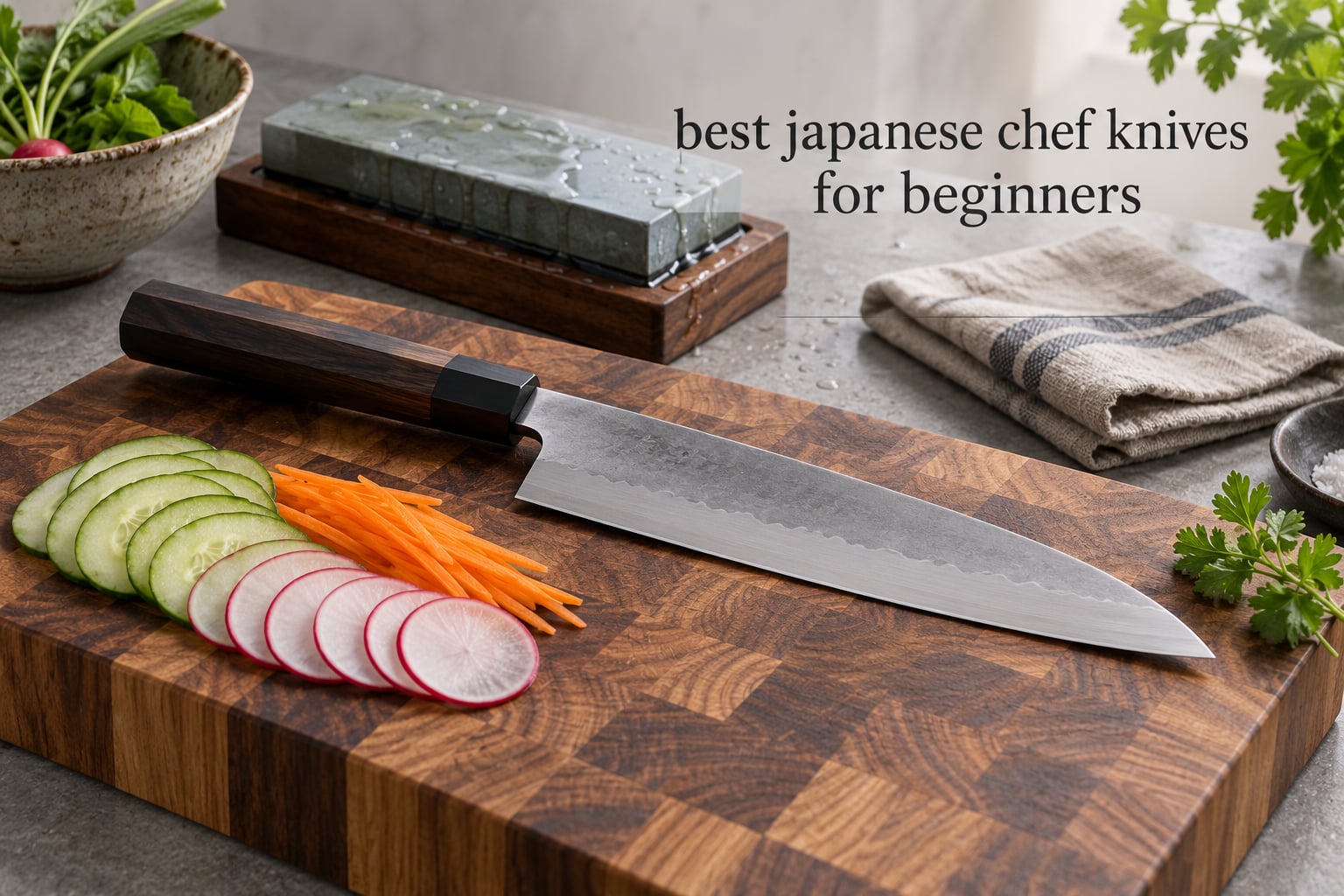
Buying your first Japanese chef knife is harder than it should be. The search results are full of forum threads arguing about steel types, blade lengths and handle shapes, and almost none of them tell you the thing you actually need to know: which knife will a beginner be able to keep sharp.
We spent six weeks putting this list together, and the filters we applied were deliberately blunt: a double-bevelled edge, a stainless or semi-stainless core rather than raw carbon steel, a length that fits a normal kitchen board, and a factory edge sharp enough to stop you guessing. Twelve knives below made that cut, and every pick shares a short list of traits that matter more to a beginner than any steel name.
We did not include a reactive carbon steel in the main list, and that is a deliberate call rather than an oversight. The honest counter-argument is that a cheap carbon blade is the best teacher of sharpening, because you have to learn to look after it. We think that argument holds for a second knife, not a first.
If you are still working out the basics rather than comparing steel, our best chef knives for home cooks covers the wider category. This guide is narrower and more opinionated: Japanese construction only, and every pick chosen with a first-time owner in mind.
Top 3 Picks for Japanese Chef Knives for Beginners in 2026

imarku 8 Inch Gyuto
- 56-58 HRC high carbon stainless
- 8 inch gyuto blade
- Pakkawood handle
- 6.56 oz
SHAN ZU 8 Inch Damascus
- 62 HRC Japanese steel core
- Real 67-layer Damascus
- Frosted G10 handle
- 2.2mm blade

Global G-2 8 Inch
- Molybdenum vanadium stainless
- Under 8 oz all steel
- 8 inch blade
- Lifetime warranty
Best Japanese Chef Knives for Beginners (October 2026)
Every pick below is a double-bevel blade you can use for general prep, and each one is listed with the specs that actually decide whether it suits a beginner: steel, hardness, weight and handle.
| Product | Specifications | Action |
|---|---|---|
| imarku 8 Inch Gyuto |
|
Check Latest Price |
 imarku 7 Inch Santoku imarku 7 Inch Santoku |
|
Check Latest Price |
| SHAN ZU 8 Inch Damascus Chef |
|
Check Latest Price |
 Shun Classic 8 Inch Chef Shun Classic 8 Inch Chef |
|
Check Latest Price |
| Global G-2 8 Inch Chef |
|
Check Latest Price |
 Dalstrong 8 Inch Gyuto Dalstrong 8 Inch Gyuto |
|
Check Latest Price |
 FAMCUTE 8 Inch Chef FAMCUTE 8 Inch Chef |
|
Check Latest Price |
 Kimura Seki 8 Inch Gyuto Kimura Seki 8 Inch Gyuto |
|
Check Latest Price |
 MITSUMOTO SAKARI 8.6 Inch MITSUMOTO SAKARI 8.6 Inch |
|
Check Latest Price |
 Sunnecko 8 Inch Damascus Sunnecko 8 Inch Damascus |
|
Check Latest Price |
 KYOKU Shogun 8 Inch KYOKU Shogun 8 Inch |
|
Check Latest Price |
 KEEMAKE 8 Inch Chef KEEMAKE 8 Inch Chef |
|
Check Latest Price |
1. imarku 8 Inch Gyuto: The Most Forgiving First Japanese Knife
imarku Japanese Chef Knife-Sharp Kitchen Knife 8 Inch, Gift for Mom & Dad
8 inch blade
56-58 HRC high carbon stainless
6.56 oz
Pakkawood handle
Pros
- Sharp out of the box across more than 10000 reviews
- Light 6.56 oz body suits unpractised hands
- Stainless steel resists rust and staining
- Gyuto profile handles chopping slicing and boning
Cons
- Softer 56-58 HRC steel needs more frequent honing
- Some examples arrived with a different handle colour during a brand update
This is the knife we keep coming back to, and the reason is volume of use rather than excitement. With more than 10,000 reviews behind it, the pattern of complaints is short and mostly cosmetic, which tells you what a beginner needs to know before buying.
The steel is high-carbon stainless at 56-58 HRC rather than a harder Japanese core. That sounds like a compromise until you sharpen it: a softer steel is easier to bring back with an amateur whetstone technique, and it shrugs off a dropped knife far better than a 62 HRC blade.
The edge is a straight, plain grind with no hollow grooves, so there is no scalloped channel for onion slices to hide in. It is a workhorse shape that handles boning, dicing and slicing without special handling.
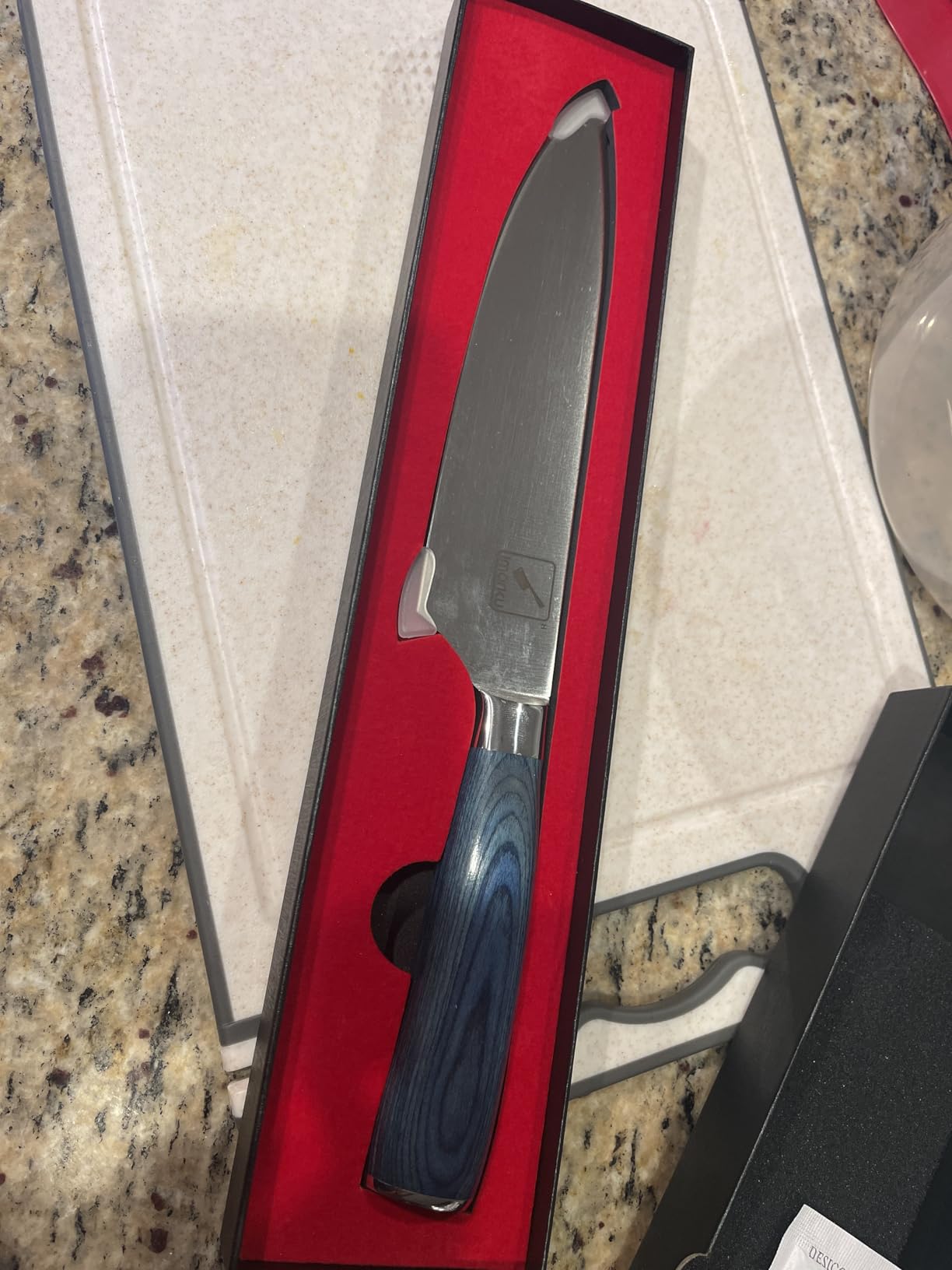
At 6.56 oz the knife is light enough to move without thinking, which matters more for a new cook than raw cutting power. The pakkawood handle comes from FSC-certified wood and has enough shaping to keep a wet hand from sliding off it.
Be honest about the trade-off: 56-58 HRC is closer to a German knife than to a proper Japanese core. You will be honing on a stone more often than you would with a 62 HRC blade, and the edge will not hold a razor angle for weeks at a time.
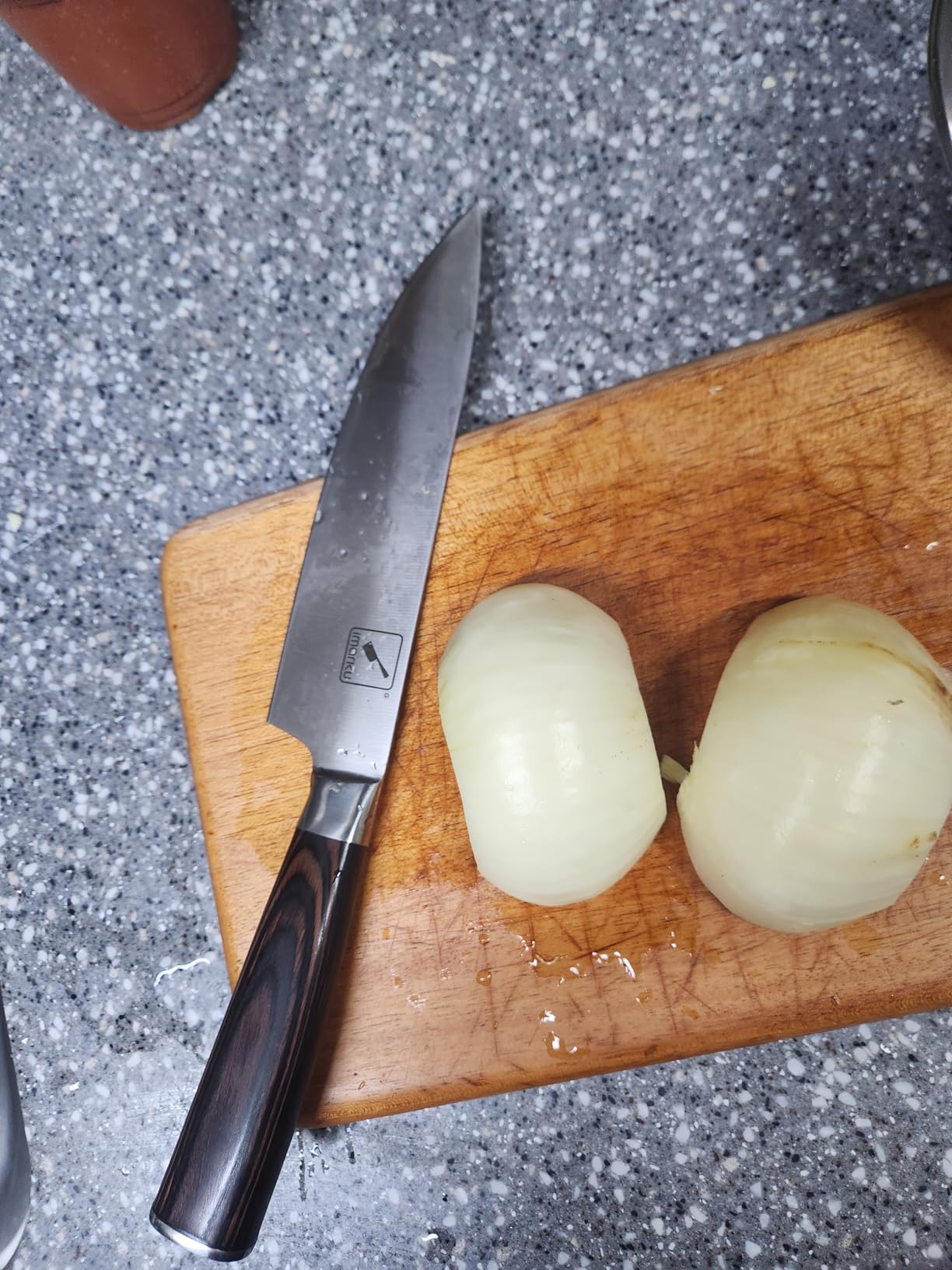
What you get on arrival and how it sharpens
Reviewers consistently describe the factory edge as sharp enough to use immediately, which removes the most common beginner frustration of a blade that will not cut a tomato skin out of the box. If you want to set your own angle, a 15-20 degree per side refinement on a 1000-grit stone is plenty.
It is the most used blade in the gyuto category on Amazon’s Kitchen and Dining chart, which is a fair signal of how many people rely on it as a single everyday knife.
When to skip this knife
Skip it if you want the thinnest possible edge or the longest possible time between sharpening sessions. If your goal is learning Japanese sharpening technique and you already own a stone, one of the harder steels in this list will hold an edge longer.
Also skip it if you have bought a knife block with a narrow slot. The blade and heel profile are conventional, but check the slot depth before you commit.
2. imarku 7 Inch Santoku: The Lightest Blade for Small Boards
imarku Santoku Knife 7 Inch with Sharp Japanese High Carbon Stainless Steel
7 inch blade
Hollow edge
15-18 degree per side
6.88 oz
Pros
- Exceptionally sharp edge reviewers describe as cutting like butter
- Light 7 inch blade is easy to control
- Well balanced pakkawood grip
- Hollow edge keeps food from sticking
Cons
- Handle finish can feel slick when wet
- Instructions are English only
If your kitchen counter is small or you have been put off by knives that feel enormous, this santoku solves a real problem. At 7 inches it is the shortest blade in the group and it weighs 6.88 oz, so it moves easily in a hand that is still learning control.
The hollow edge is the feature most beginners notice first. Those scalloped hollows reduce the contact area, so onion and potato slices fall away from the blade instead of pressing into the side.
The stated edge is a hand-polished 15-18 degrees per side on a 2.5 mm blade. That is a sensible factory angle, and it is fine enough for onion without being fragile enough to worry about.
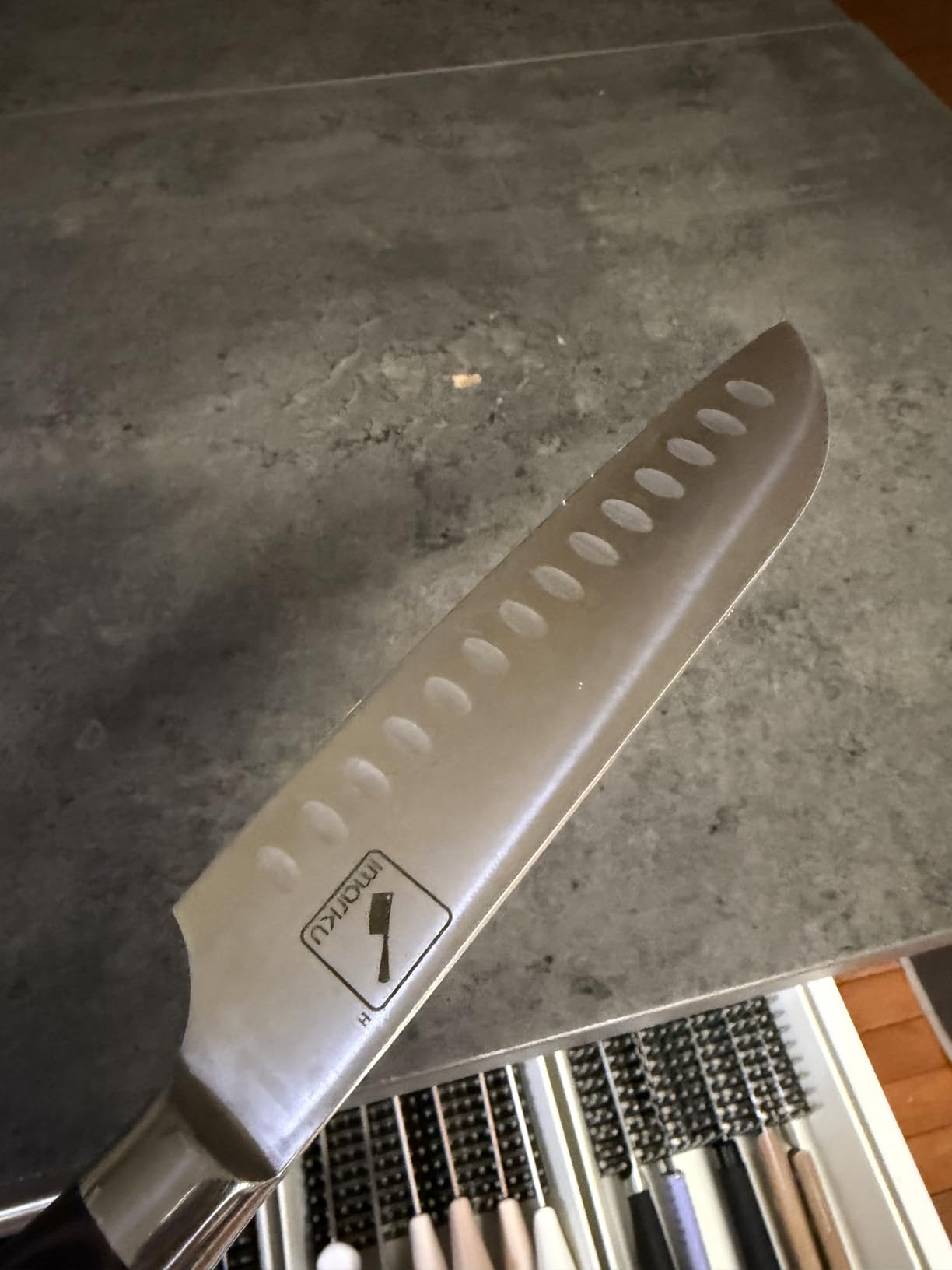
Owners frequently describe this as the only knife they need, which is a reasonable outcome for a cook who does a few meals a week. The blade is narrow, so it works well on a board that would feel cramped with a full 8-inch gyuto.
It sits at the top of the Santoku Knives chart, and with roughly 6,000 reviews the feedback behind it is substantial rather than anecdotal.
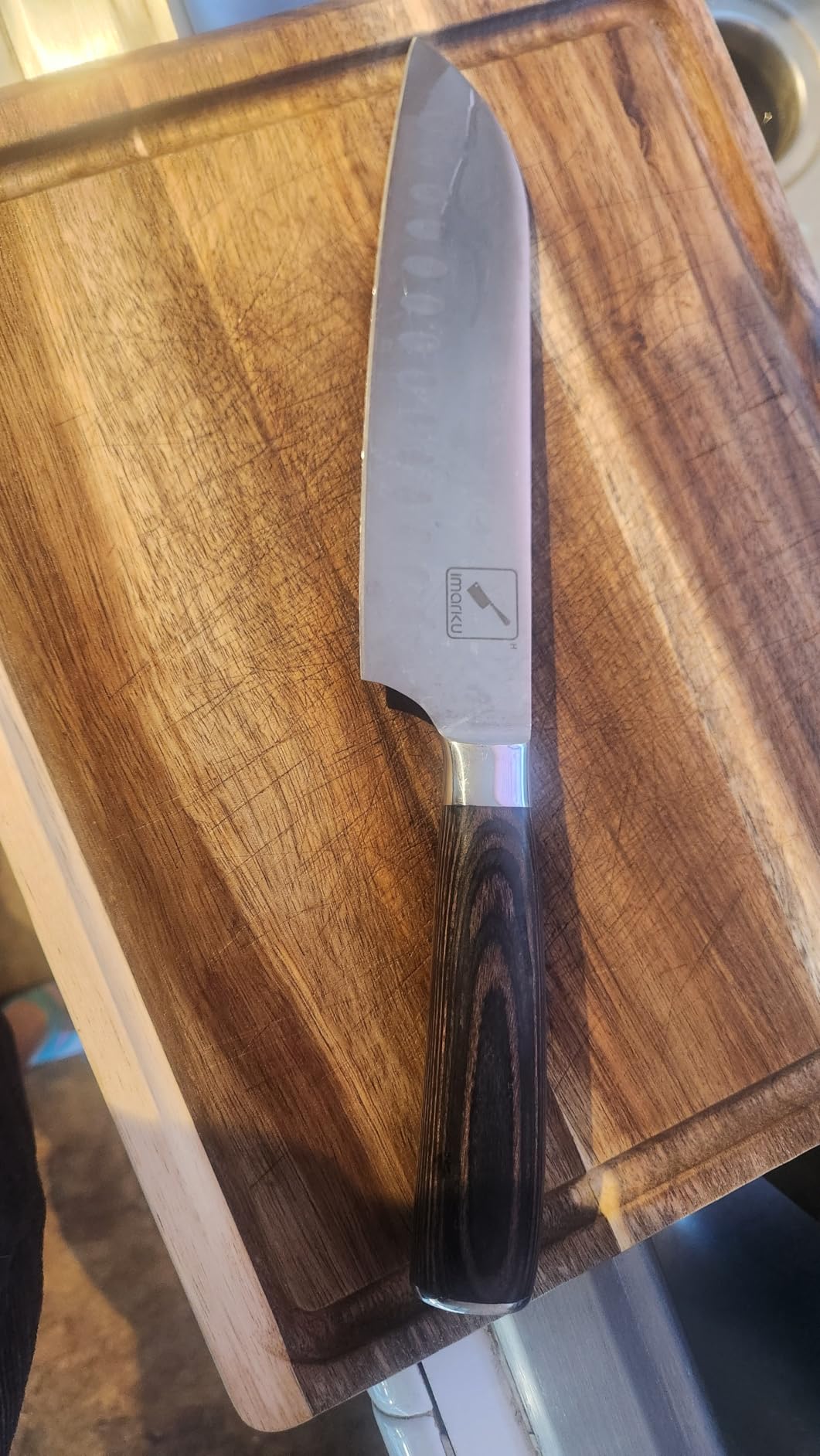
How the hollow edge changes your prep
The hollow grind changes how food behaves more than how it cuts. Anything wet or sticky releases almost immediately, which means less time spent scraping slices off the side with the spine while your other hand is still holding the ingredient.
It also means slightly more blade thickness at the edge than a flat-ground blade of the same steel, so it is a touch more forgiving of a slightly off-angle first session on a stone.
When to skip this knife
Skip it if you break down large boneless joints often. A 7-inch blade means more cuts for the same piece of meat, and the flat sides give you less scooping power for diced work than a gyuto heel.
Two smaller complaints come up: the manual is not translated for international buyers, and the smooth pakkawood finish can feel slick if your hands are properly wet. Neither shapes the long-term picture in reviews.
3. SHAN ZU 8 Inch Damascus Chef Knife: Hard Steel With Real Folded Cladding
SHAN ZU Chef Knife 8 Inch Japanese Steel Damascus Kitchen Knife
62 HRC Japanese steel core
Real 67-layer Damascus
2.2 mm blade
260 g
Pros
- 4.8 stars with 86 percent five star ratings from nearly 5700 reviews
- Genuine folded Damascus pattern rather than laser etching
- 62 HRC core holds an edge well
- Frosted G10 handle stays stable and sanitary
Cons
- Frosted G10 can feel slick with wet hands
- Damascus cladding needs careful hand washing
This one holds a 4.8 average across close to 5,700 reviews, and 86 percent of those ratings are full stars. That consistency is rarer than it sounds in the knife category, where a handful of quality complaints usually drag an average down.
The blade is a real 10Cr15Mov Japanese steel core at 62 HRC, folded into 67 layers of Damascus. Reviewers note that the pattern becomes visible with polishing, which is a sign of genuine cladding rather than a surface etching.
At 2.2 mm the blade is thin for its length, and the stated cutting angle is 15 degrees per side. Total weight is 260 g including the handle, which sits mid-range among these twelve.
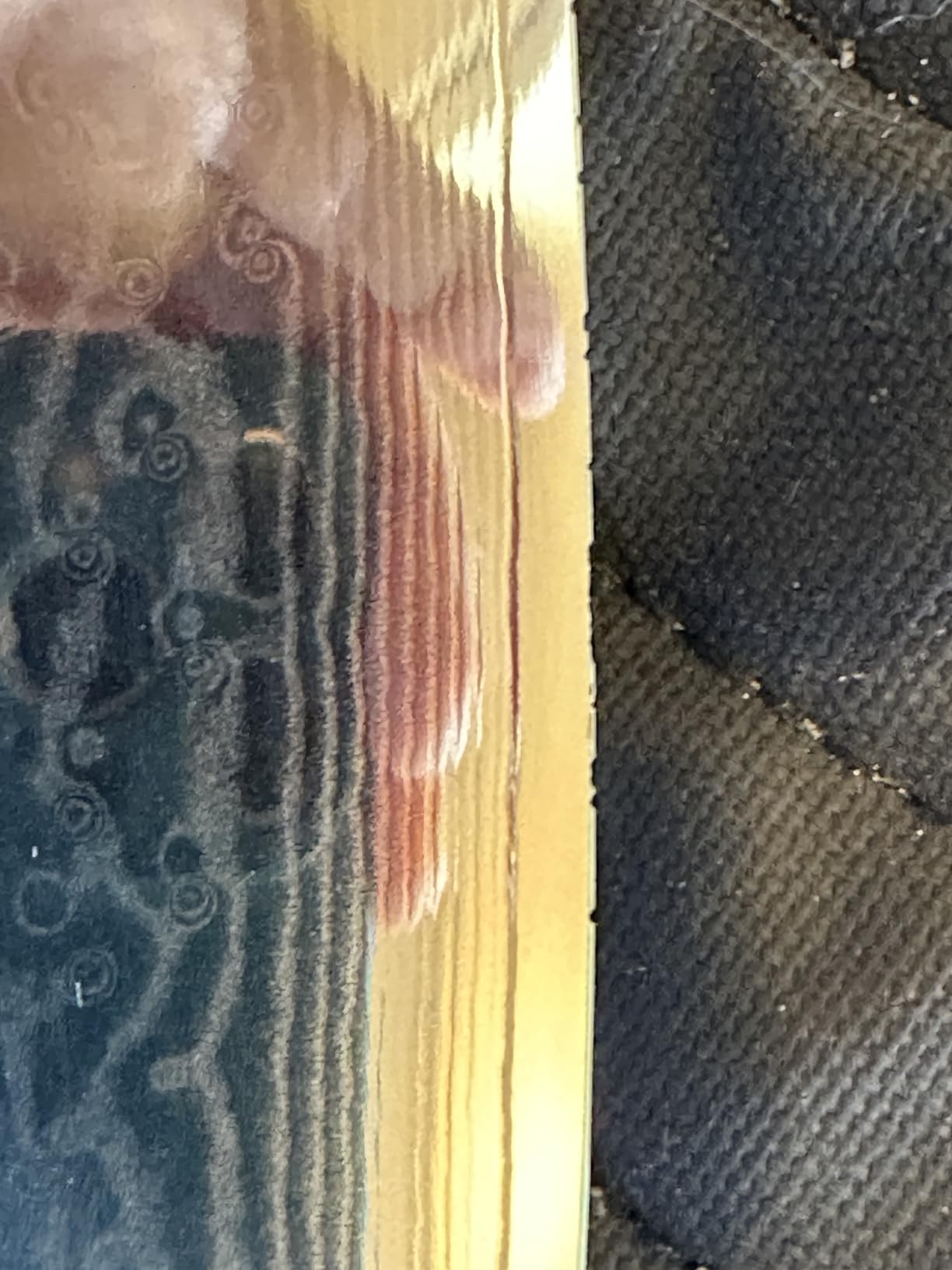
The G10 glass fibre handle is frosted rather than textured, which gives a firm, sanitary surface that does not absorb moisture. It comes with a 12-month warranty and a top-balanced profile that sits forward on the blade.
Owners consistently single out the sharpness and the visible layering as the two things that set it apart from a plain stainless knife.
What 62 HRC means for a beginner sharpening routine
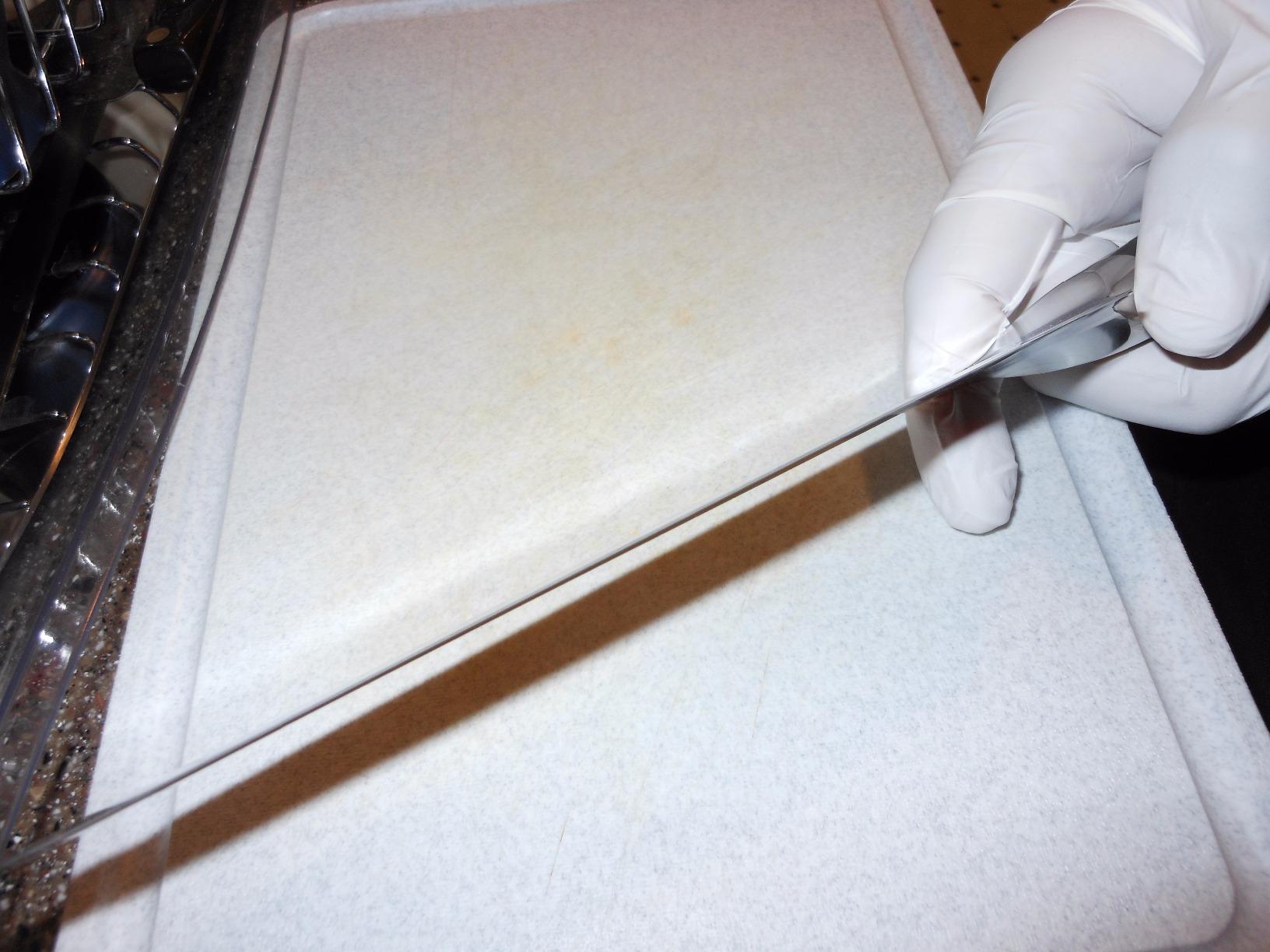
62 HRC is on the harder end of the everyday range. It is hard enough to take a fine edge and hold it through a week of normal cooking, and forgiving enough that an amateur 1000-grit session will not roll the edge into a disaster.
The thing to watch is the bevel. At 15 degrees per side you are already at an acute angle, so push gently and check the edge with a fingernail rather than grinding hard to chase a number.
When to skip this knife
Skip it if your hands are reliably wet during prep. The frosted G10 is not a grippy texture, and a slick handle mid-task is exactly the moment you do not want a sharp blade in your hand.
Also be realistic about care. A clad Damascus blade needs hand washing and prompt drying, and it reacts to sitting wet far more than a solid stainless chef’s knife does.
4. Shun Classic 8 Inch Chef’s Knife: The Premium Benchmark
Shun Classic 8″ Chef’s Knife
VG-MAX steel core
68-layer Damascus
16 degree edge
206 g
Pros
- VG-MAX core delivers a genuinely razor precise edge
- Handcrafted in Japan by Kai
- D-shaped pakkawood handle suits both hands
- Light 206 g weight with free lifelong sharpening
Cons
- VG-MAX needs regular honing to stay sharp
- Wood handle requires hand washing and prompt drying
The Shun Classic is the reference point most people picture when they hear the phrase Japanese chef knife, and it is worth including for that reason alone. Kai is one of the oldest houses in the Seki area, and the Classic line pairs that with a lifelong sharpening service that costs you nothing.
VG-MAX is the steel here, clad in 68 layers of Damascus at a 16-degree angle per side, which is a fine factory edge without going to the acute extremes.
At 206 g it is a light knife for an 8-inch blade and handles much like a European chef’s knife in the hand.
The D-shaped pakkawood handle is the reason this is a genuinely good option for a left-handed cook. It is ambidextrous by design, which almost nothing shaped like an octagonal wa handle can promise.
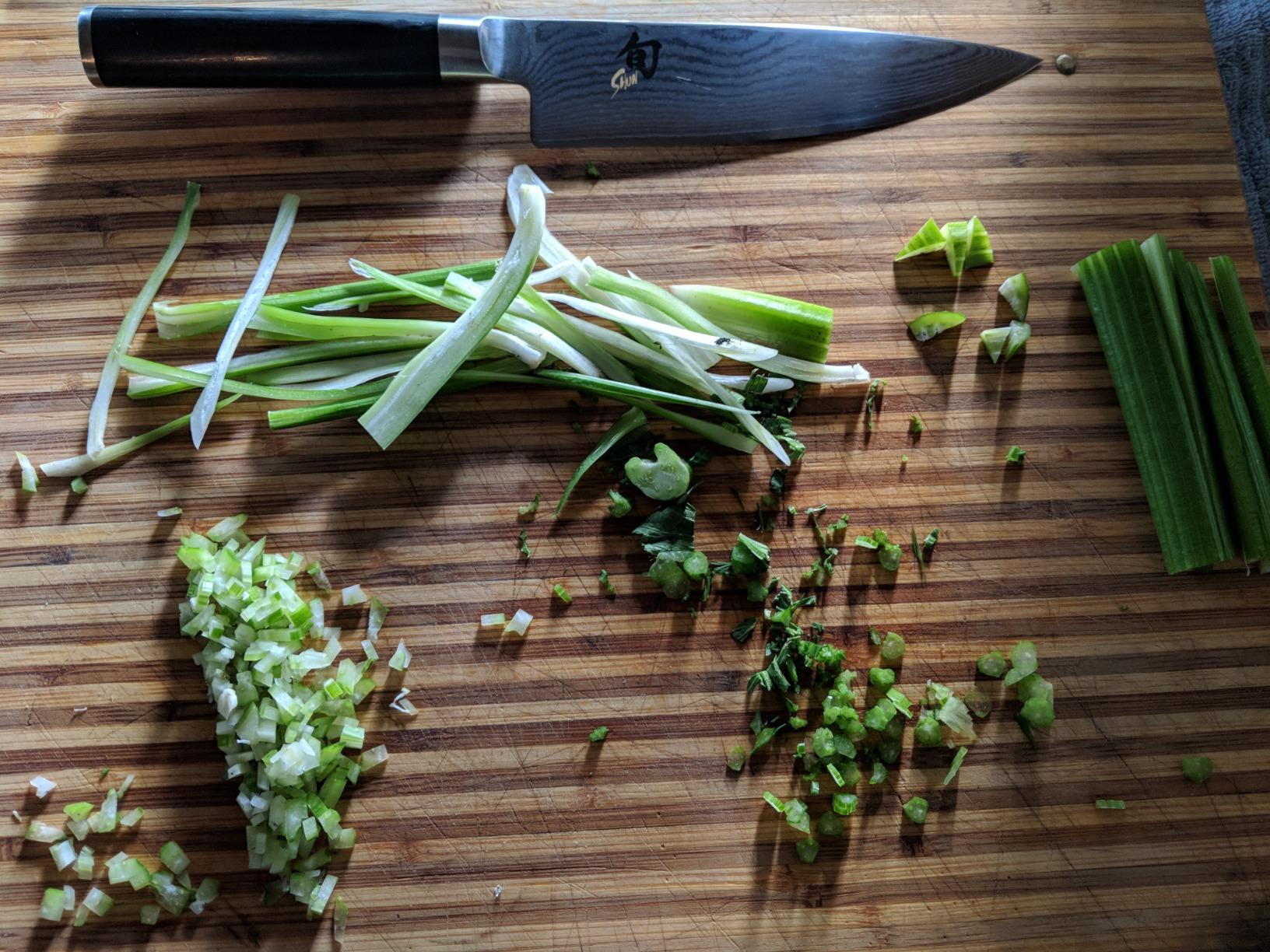
Owners point to razor sharpness and the balanced handle as the two standouts, across nearly 3,800 reviews with 88 percent five-star ratings. The Classic line has been in production long enough that there is a large body of long-term ownership reporting.
The free sharpening and honing service is a real practical benefit. If sharpening is the thing you are least confident about, a knife with a free service behind it lowers the stakes considerably.
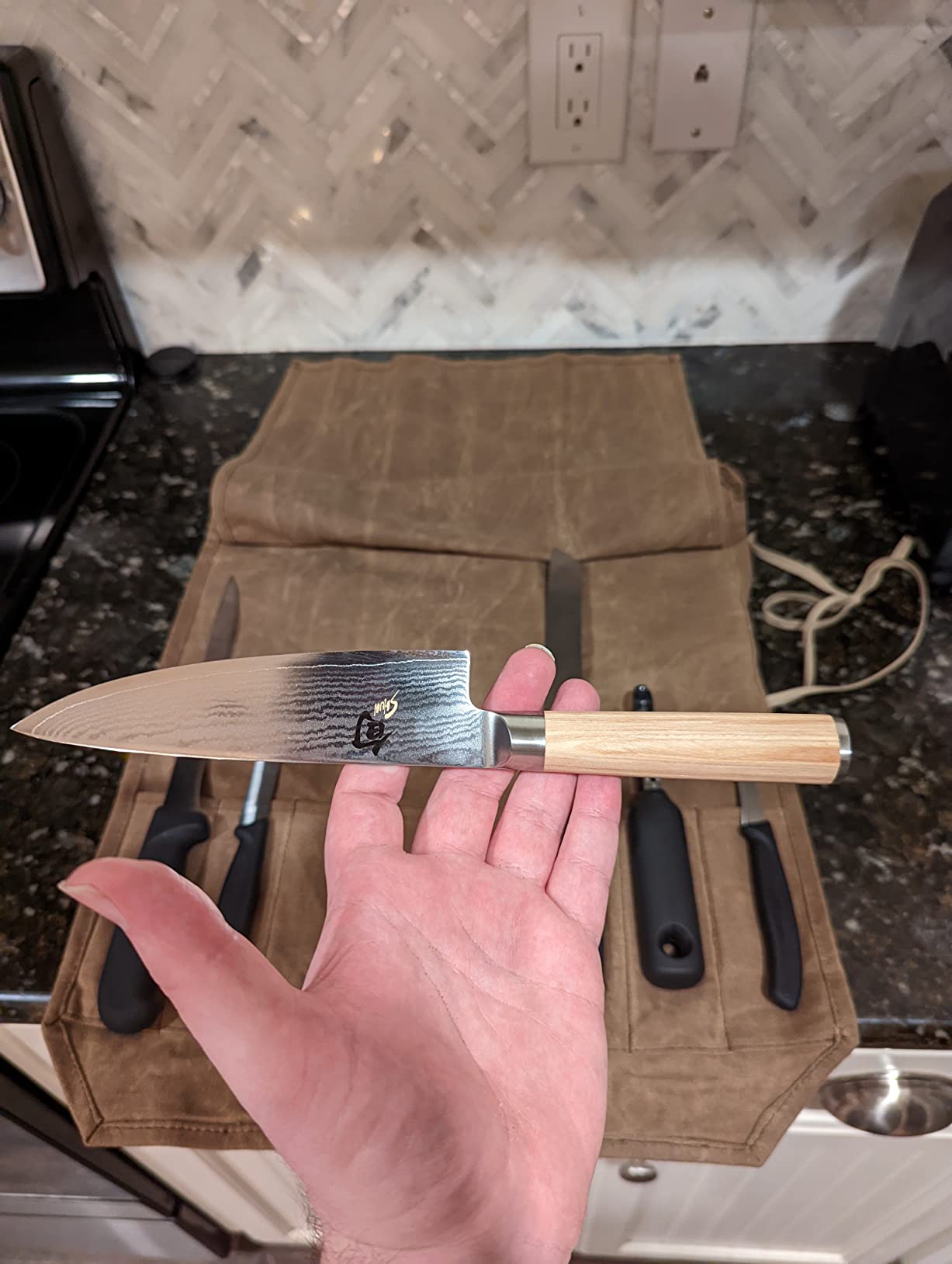
Why the free sharpening service changes the calculus
VG-MAX is a hard steel that rewards good technique. That is exactly where beginners hesitate, and the free service means a bad first sharpening session costs you nothing but a letter.
For a cook who is curious enough to buy a stone anyway, that service is less of a factor. For a cook who mainly wants a sharp knife, it removes the main reason not to own a hard steel.
When to skip this knife
Skip it if you want a lightweight, wa-handled knife you can grow into. There is no octagonal handle here, and no upgrade path that keeps the same grip style.
Also consider your sink habits. Pakkawood is a resin-laminated wood and it needs hand washing and prompt drying. If the dishwasher is going to happen, pick the all-stainless option further down instead.
5. Global G-2 8 Inch Chef’s Knife: The Best Value in All-Stainless
Global – 8 inch, 20cm Chef’s Knife,Silver
8 inch / 20 cm blade
Molybdenum vanadium stainless
7.84 oz
Dimpled all steel handle
Pros
- Exceptionally sharp out of the box
- Very light at under 8 oz for long prep sessions
- Resists rust and staining
- All stainless build needs the least care of the set
Cons
- No bolster and a thin spine limit heavy repetitive chopping
- All metal handle can feel slick with wet hands
- Handle girth is small for larger hands
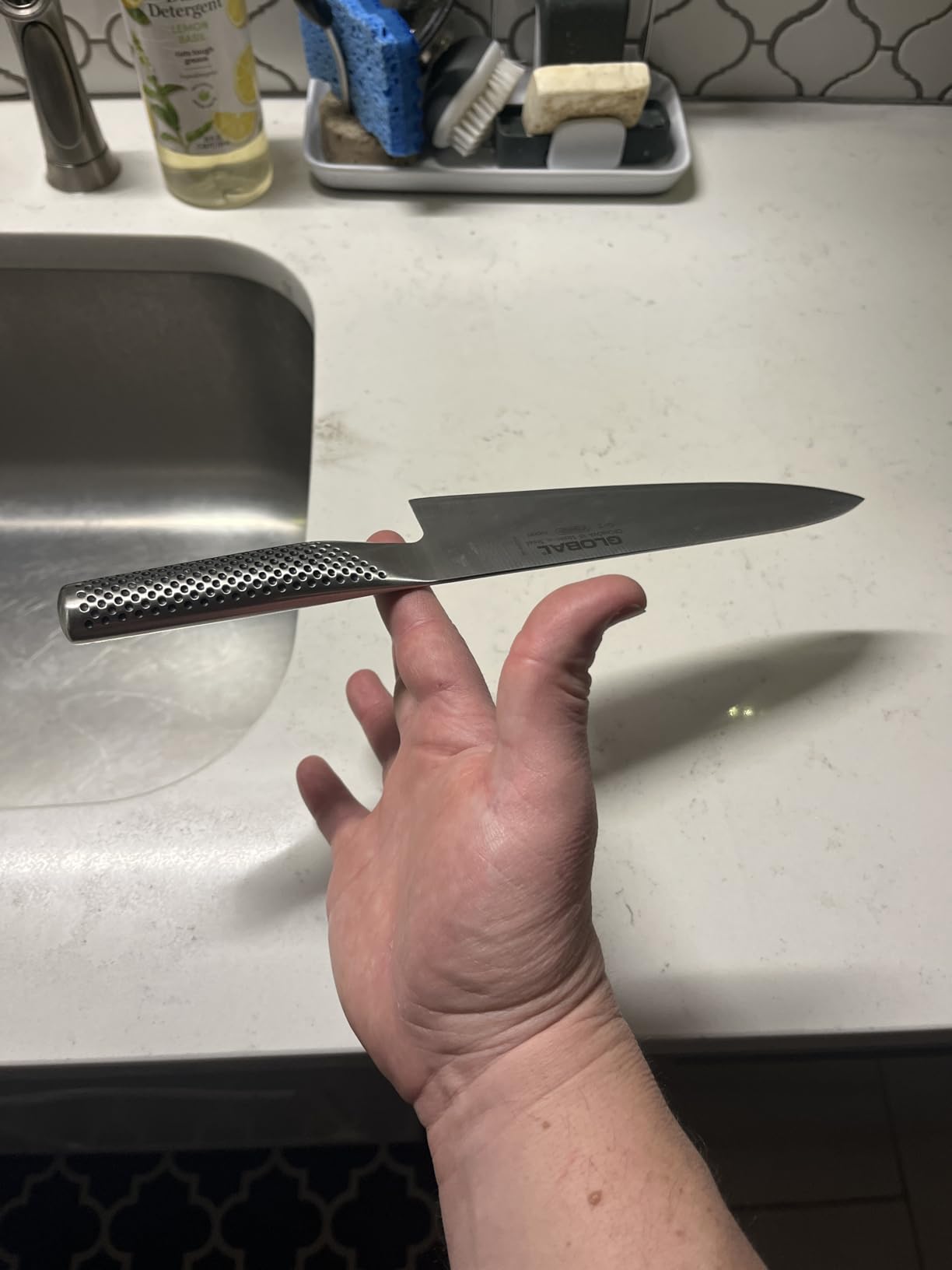
Global is the outlier in this list and the reason it earns a place. It is stamped rather than forged, made by Yoshikin, and it has no bolster, no visible tang and no rivets. It has a 4.8 average with 90 percent five-star ratings across more than 3,000 reviews.
For a beginner, the all-stainless construction is the argument that matters most. There is no cladding to react to, no wood handle to dry carefully and no real rust risk if it sits in the sink for ten minutes.
Reviewers describe the factory edge as exceptionally sharp on arrival, and note how light it feels at under 8 oz, which is why it stays comfortable through a long prep session.
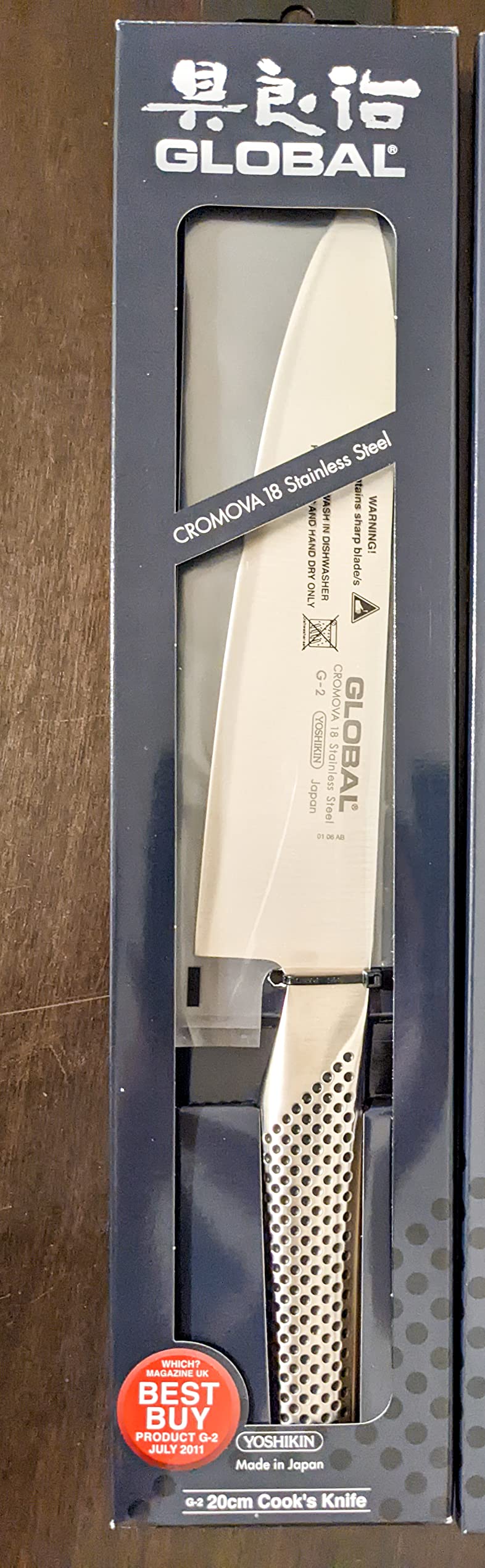
The molybdenum and vanadium stainless steel gives good edge retention with infrequent sharpening, and it takes an edge on a stone without the fuss that harder Japanese steels cause.
It also comes with a lifetime warranty against defects and breakage, which is uncommon at this level.
Who this knife suits and who it does not
The Global shape rewards someone who makes small, precise movements. The dimpled handle is designed for a pinch grip near the blade, and with no bolster the full 8-inch blade stays close to your fingers.
It is a poor fit for someone who wants to rock a heavy blade through a large volume of dense vegetables, or who has larger hands. The most repeated limitation in reviews is exactly this: the thin, bolsterless spine is not built for long repetitive chopping.
How the handle feels in practice
The dimpled stainless handle is secure when dry and slick when wet. That is a fair trade for how little care the blade needs, but it is a real trade.
Handle girth is also on the small side. If you have a large grip, try a Global in person if you can, because this is the one dimension on a knife that cannot be adjusted later.
6. Dalstrong 8 Inch Gyuto: Built for Long Spells Between Sharpening
Dalstrong 8″ Japanese Chef Knife Gyuto – 66-Layer Damascus AUS-10V
AUS-10V core at 62 HRC
66-layer Damascus
8-12 degree edge
9.6 oz
Pros
- Edge retention survives months of heavy chopping
- Tall heel gives knuckle clearance and scoops diced food
- Full tang G10 handle feels solid and balanced
- Sheath and gift box included
Cons
- Handle girth feels large for small hands
- Deep heel may not fit a standard knife block
- Hammered finish is largely cosmetic and food still sticks
If your objection to Japanese knives is that you do not want to sharpen every week, this is the one to look at. Owners report edge retention strong enough to survive months of heavy chopping, which comes from the 62-plus HRC AUS-10V core. We would pair it with the right board, because an edge that thin is only as good as the surface under it.
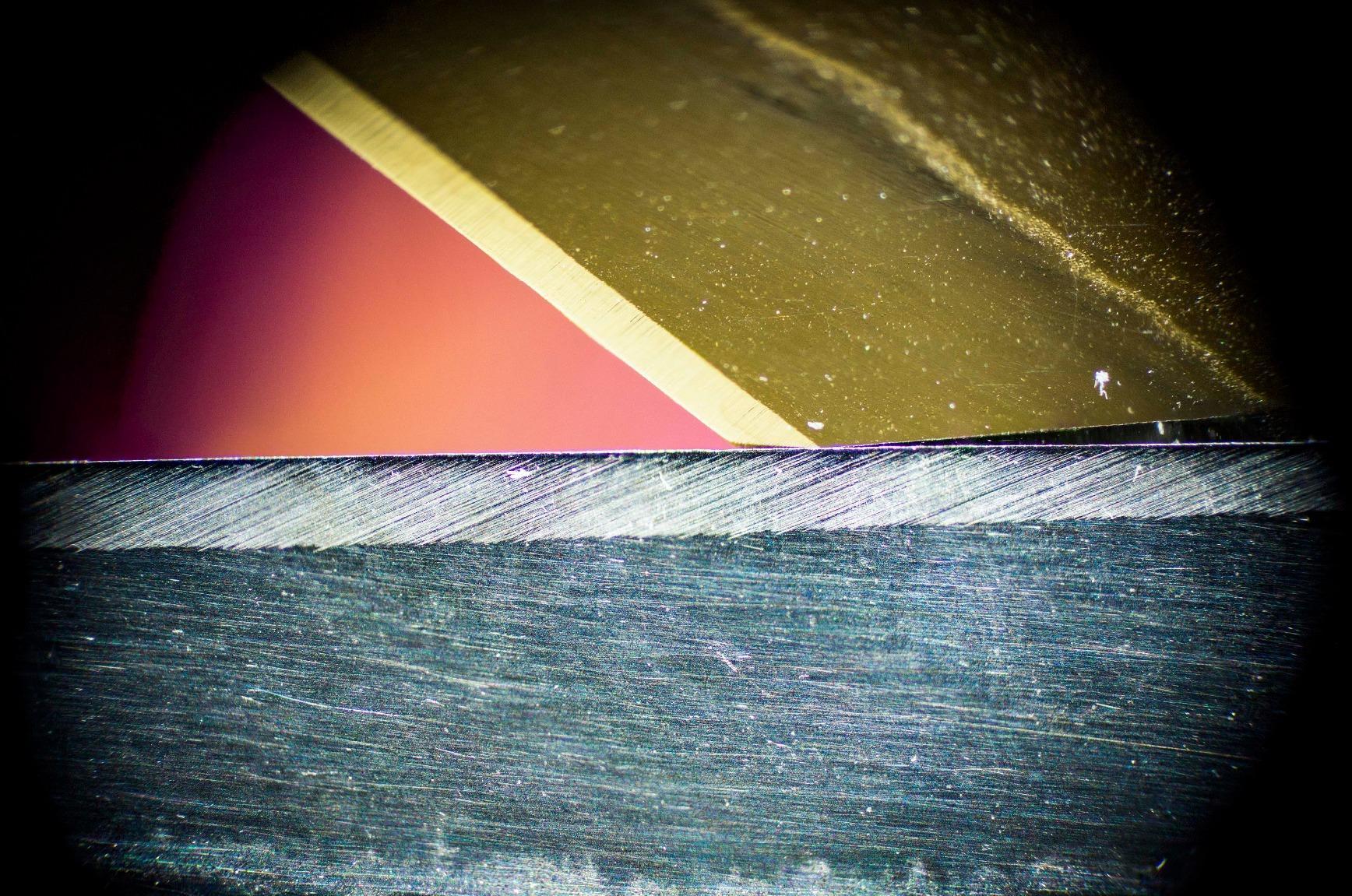
The factory edge is hand-finished at 8-12 degrees per side, an acute angle that makes the knife sharp enough to slice paper on arrival. That is also why it wants a good board.
At 9.6 oz it is a substantial knife, and the wide blade gives real knuckle clearance for the claw grip.
A tall, pointed heel is the design detail that matters here. Bolster-blocked Western knives have a heel that stops short of the cutting edge, and this one runs right up to it, which makes it far better at scooping diced onion into a bowl.
The included sheath is a genuine bonus for a first knife. It gives you a safe place for the blade before you have a proper block or a magnetic rack.
What the hammered finish actually does
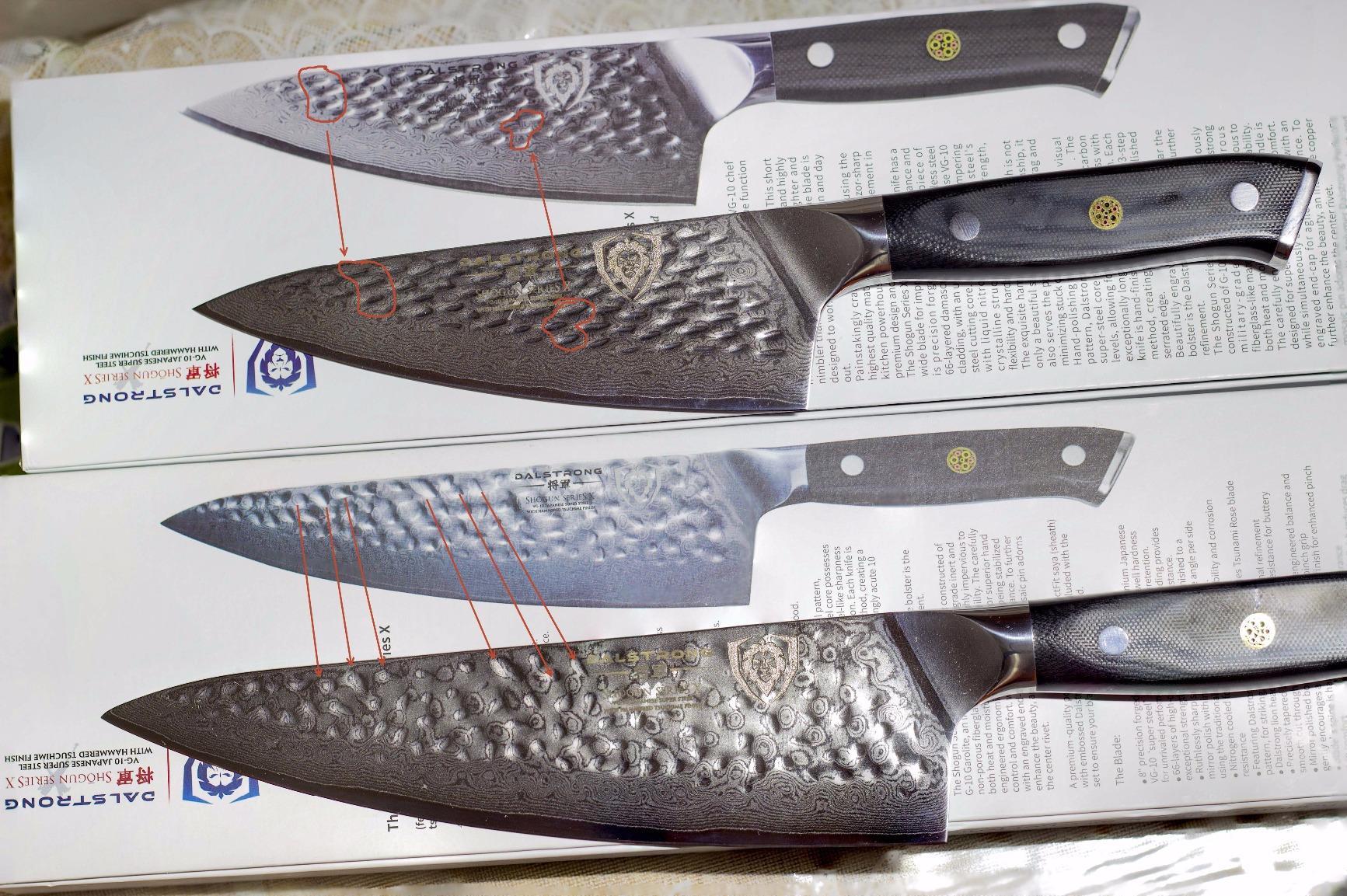
The hammered, or tsuchime, finish is largely cosmetic. Owners are candid that food still sticks in spots, and it does not meaningfully change cutting performance.
What it does do is create small air pockets along the blade face, which is why this style is associated with a traditional hand-forged look. Judge the grind, not the hammering.
When to skip this knife
Skip it if you have small hands. Handle girth is the most repeated complaint in reviews, and it is the one thing you cannot work around later.
Also check your knife block. The deep heel is a genuine benefit for scooping and a genuine problem for narrow slots. Reviewers mention block fit often enough that it is worth measuring before you buy.
A small number of owners report blade, handle or cloudy finish defects. The brand resolved these with replacements, which is a reminder that a higher tier does not remove manufacturing variance entirely.
7. FAMCUTE 8 Inch Chef Knife: The Easiest Introduction to a Wa Handle
FAMCÜTE 8″ Japanese Knife, Hand Forged Sharp Chef Knife w/Rosewood Handle
5-layer 9CR18MOV
HRC 62 with vacuum nitriding
Octagonal rosewood handle
8 inch blade
Pros
- Hand forged Japanese steel at HRC 62 holds a sharp edge
- Octagonal rosewood handle teaches a consistent grip
- Lightweight handle reduces hand fatigue
- Electroplated finish resists corrosion
Cons
- Layered cladding demands more care than solid stainless
- Finish consistency varies between examples
The knife is a top pick for anyone who wants to learn what a traditional Japanese handle feels like without paying for a hand-forged Sakai blade. The octagonal rosewood handle is the real feature, and it is a genuine contrast to every ergonomic handle above it in this list.
A wa handle has no bolster and is fixed at an angle, so it teaches you to hold the knife in a consistent position. Most owners find the grip self-explanatory within a few sessions.
The steel is five layers of 9CR18MOV Japanese high carbon, hardened to 62 HRC with vacuum nitriding and electroplating. That combination is how it gets corrosion resistance without a full stainless core.
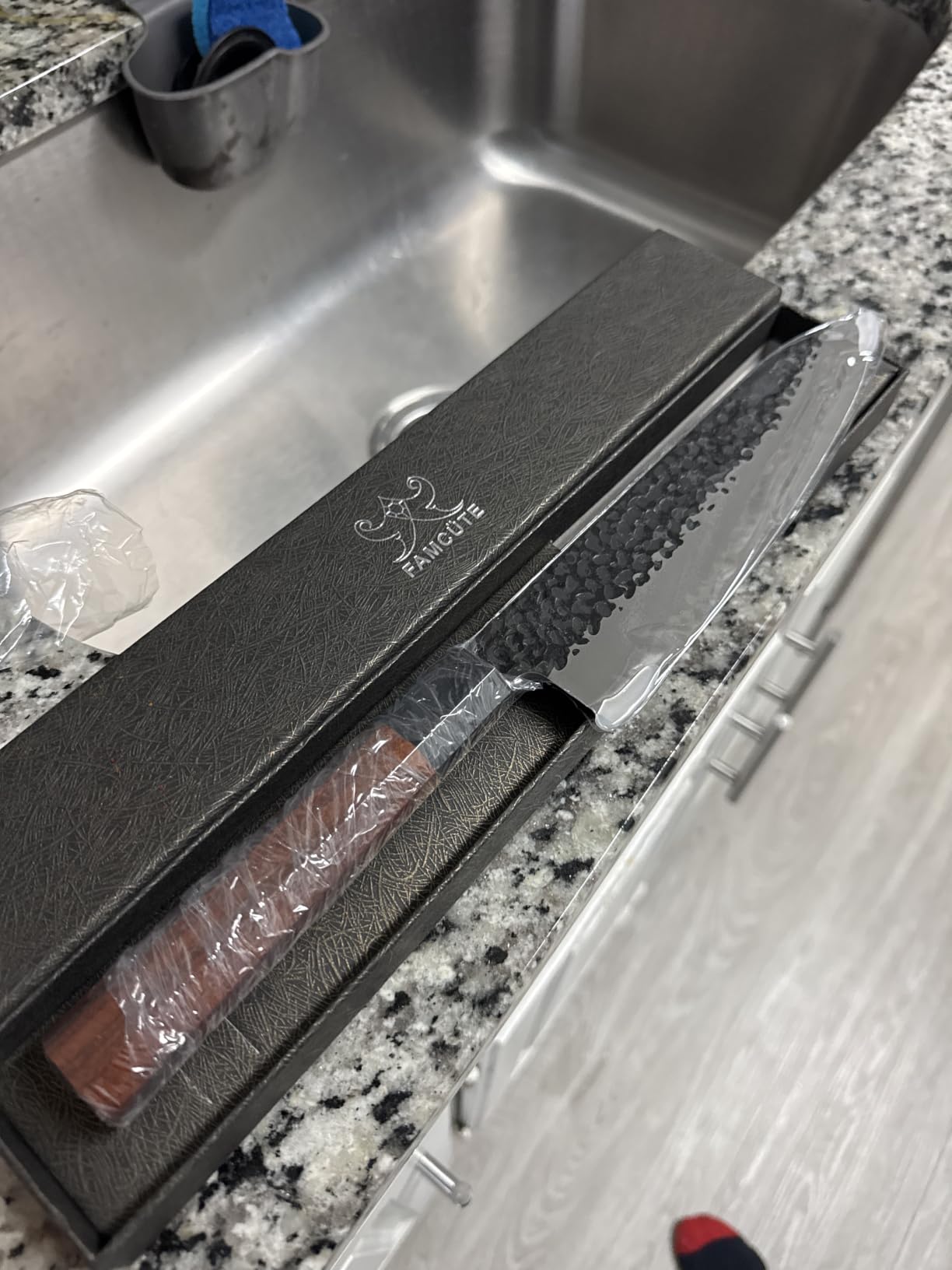
Buyers highlight the hand-forged finish and the fact that the sharpness holds without frequent sharpening. The maker advertises a 60-day production process for the blade, which points to controlled forging rather than a stamped drop.
The non-slip octagonal rosewood handle gives a clear grip direction and keeps the blade balanced toward the front, which suits push cuts.
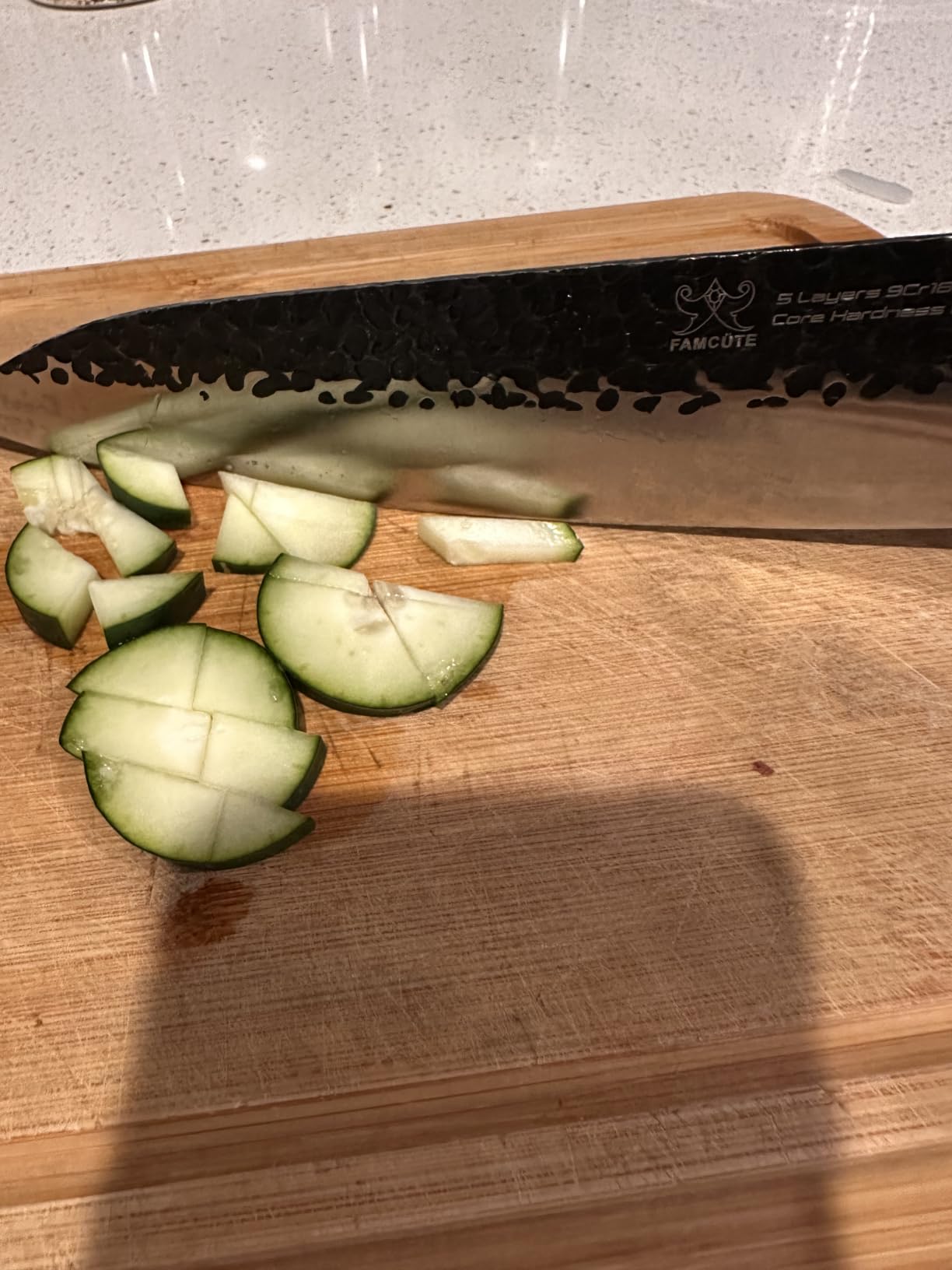
Learning to hold a wa handle
The difference from an ergonomic handle is that the knife angle is fixed by the handle. You cannot rotate the blade to change how it meets the board, so you change your grip instead.
Spend a week letting the knife set your hand position before you try to go fast. Most beginners who rush a wa handle end up cutting with the tip lifted and wonder why the knife feels unpredictable.
When to skip this knife
Skip it if you will not dry the blade straight after washing. Five-layer cladding is more reactive than solid stainless, and this is the most common caution in reviews along with finish variation between units.
Also skip it if you want a forgiving first purchase with zero care consequences. The wa handle and the layered steel are two new things at once, which is a lot for a first knife.
8. Kimura Seki 8 Inch Gyuto: Made in Seki, Japan
Kimura Chef Knife, [Made in Japan], 8 inch Professional Kitchen Knife, Ultra Sharp High Carbon Molybdenum Stainless Steel Gyuto Knife, Chefs Knife with Ergonomic Handle – Japanese Chef’s Knife
Manufactured in Seki Japan
57 HRC molybdenum stainless
15 degree edge
175 g
Pros
- Made in Seki Japan at an entry price
- Very light at 175 g for small hands
- Triple riveted full tang with full bolster
- Non-slip POM handle supports regular and pinch grips
Cons
- 57 HRC steel holds its edge less long than harder steels
- Stamped rather than forged construction
Most of the knives in this guide use Japanese steel manufactured outside Japan. This one is made in Seki, Japan, one of the country’s traditional knife hubs, and that fact alone puts it in a different category.
Seki is where Kai is based, and Seki Magoroku, the brand that comes up constantly on knife forums, is built in the same city. If you want a knife made in Japan without moving up a tier, this is the one.
The construction is the most conventional in the group: a stamped body, a full tang, three rivets and a full bolster. That is a Western-style handle, which means it grips securely and works for a regular grip or a pinch grip.
![Kimura Chef Knife, [Made in Japan], 8 inch Professional Kitchen Knife, Ultra Sharp High Carbon Molybdenum Stainless Steel Gyuto Knife, Chefs Knife with Ergonomic Handle - Japanese Chef's Knife customer photo 1](https://www.wearesalt.org/wp-content/uploads/2026/09/B09GCGQKNZ_customer_1.jpg)
At 175 g it weighs very little for a full 8-inch blade, and the POM resin handle grips well even when wet, which is not something the frosted G10 or the dimpled stainless options above can claim.
It also comes with a gift box and a lifetime warranty, which you do not always get at this level.
![Kimura Chef Knife, [Made in Japan], 8 inch Professional Kitchen Knife, Ultra Sharp High Carbon Molybdenum Stainless Steel Gyuto Knife, Chefs Knife with Ergonomic Handle - Japanese Chef's Knife customer photo 2](https://www.wearesalt.org/wp-content/uploads/2026/09/B09GCGQKNZ_customer_2.jpg)
Why 57 HRC is not a downgrade here
57 HRC is soft by Japanese standards and normal by German standards. In plain terms, this blade will go blunt sooner than a 62 HRC core, but it will also be much harder for a beginner to damage.
It is the steel choice for someone who chops hard, drops knives, cuts frozen food occasionally and would rather resharpen twice a month than worry.
When to skip this knife
Skip it if holding the sharpest possible edge for weeks is your main goal. This one carries a 4.5 average across 1,213 reviews, and the recurring note is edge retention rather than any quality problem.
It also has the least visual Japanese character of the picks here. No wa handle, no Damascus, no hammered finish. If you want the feel of a Japanese knife, this does not deliver that.
9. MITSUMOTO SAKARI 8.6 Inch Gyuto: A Long Hammered Blade to Learn On
MITSUMOTO SAKARI 8-Inch Japanese Gyuto Chef Knife, 3-Layer 9Cr18MoV
8.6 inch gyuto
3-layer San Mai 9Cr18MoV
Deep cryo at HRC 60
279 g
Pros
- True gyuto profile handles push cuts and light rocking
- Tsuchime hammering reduces food contact
- Octagonal rosewood handle guides grip position
- Includes a sandalwood box cloth and oil
Cons
- Must be dried immediately after washing or it spots
- Weighs 279 g which is heavier than most entry picks
- manufactured in China by a Japanese owned brand
Reviewers call it the best affordable Japanese-style gyuto they have used, and several long-term owners report it staying sharp for years.
At 8.6 inches this is the longest blade of the twelve, and the gyuto profile is doing real work here rather than just naming the shape.
Deep-cryo treatment on a 9Cr18MoV core takes it to HRC 60, which is a sensible middle point for a first blade: it holds an edge well without being brittle.
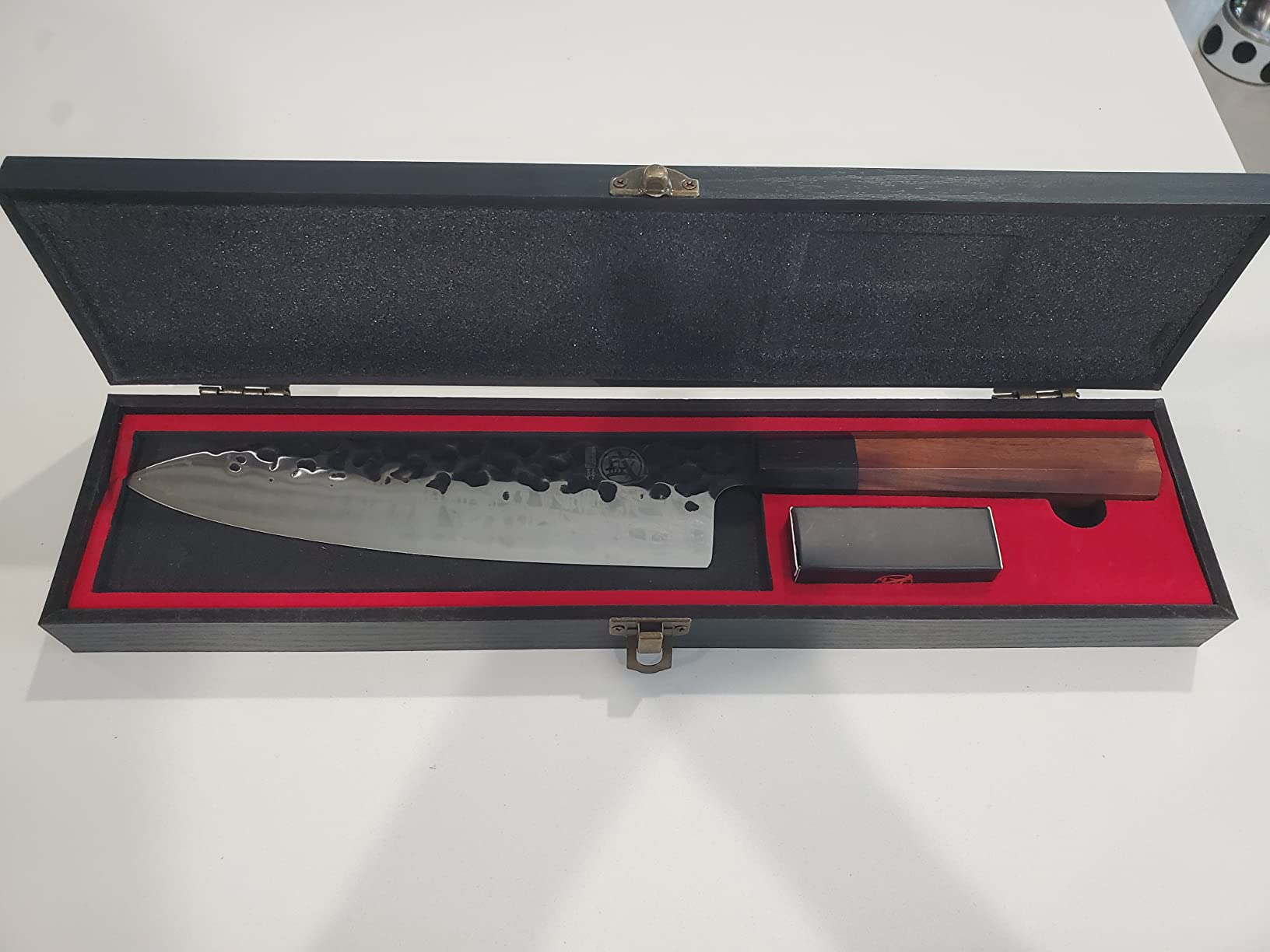
The hammering does something modest but real: it creates small pockets along the blade face so less of the food surface touches metal during a slice. It is not a cure for sticking, but it helps with wet or oily prep.
The box and oil in the package matter more than they sound. They signal that the brand expects you to maintain the blade, which is the right expectation for a kurouchi-finished steel.
Several long-term owners report the edge holding up for years without a full resharpening.
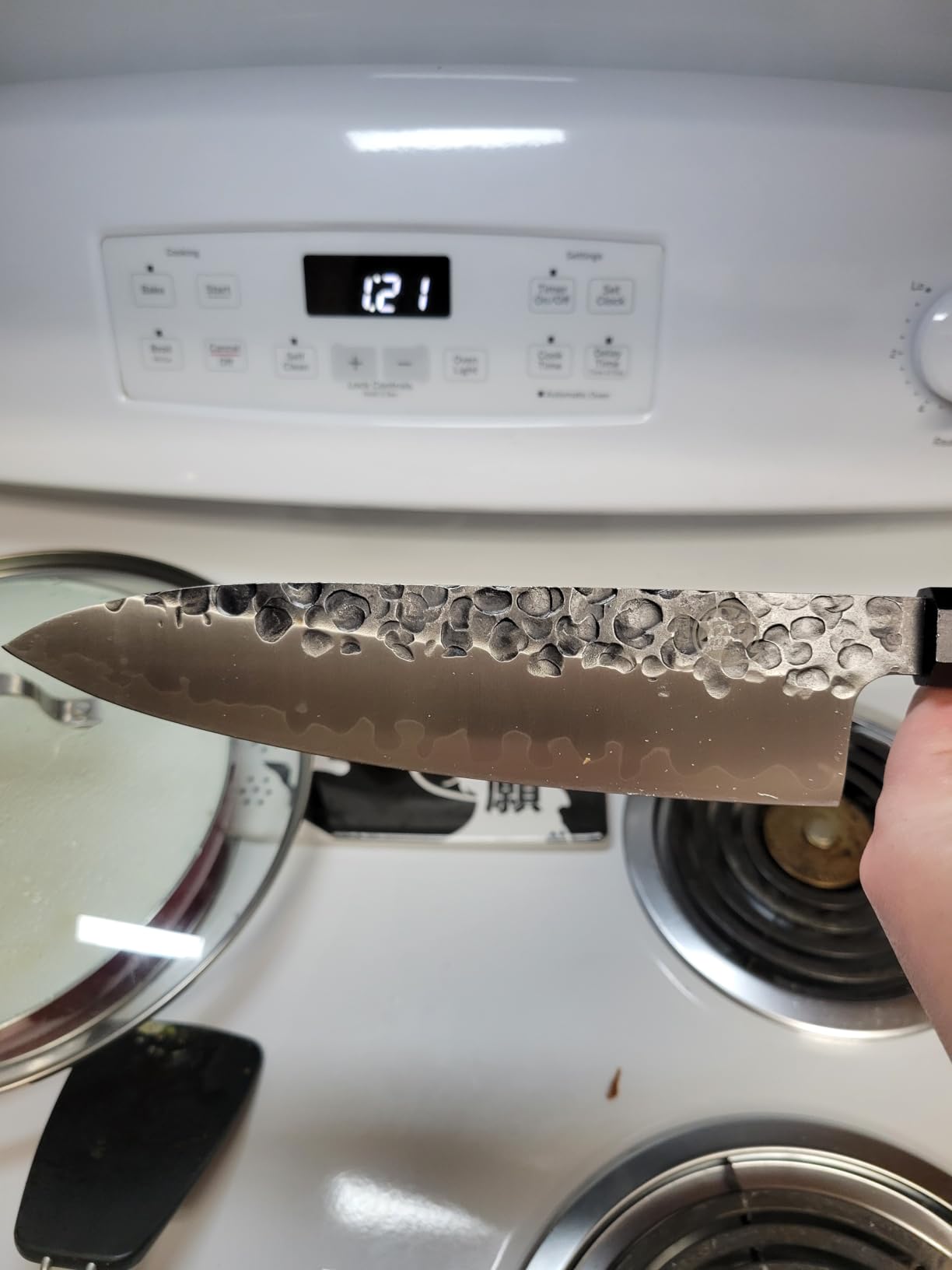
Longer blade, more board required
At 8.6 inches you need a genuinely large board and room to move. If your prep surface is where the knife is also stored, this is the pick most likely to feel awkward in the first week.
At 279 g this is a heavier knife than most of the entry-level picks here and it takes a little adjustment. Buy it if you already understand board space; skip it if you are still learning how much room a blade needs.
When to skip this knife
Skip it if you are not going to dry the blade immediately after every wash. The dominant advice in reviews is dry and oil it after use, and skipping that is how kurouchi steel picks up spots.
Be clear-eyed about one detail: this is a Japanese-owned brand manufacturing in China. That is true of many knives at this level and it is not a defect, but it matters if being made in Japan is part of why you want the knife.
The rest of the package is unusually complete: a velvet-lined sandalwood box, a cloth and a bottle of oil all travel with it.
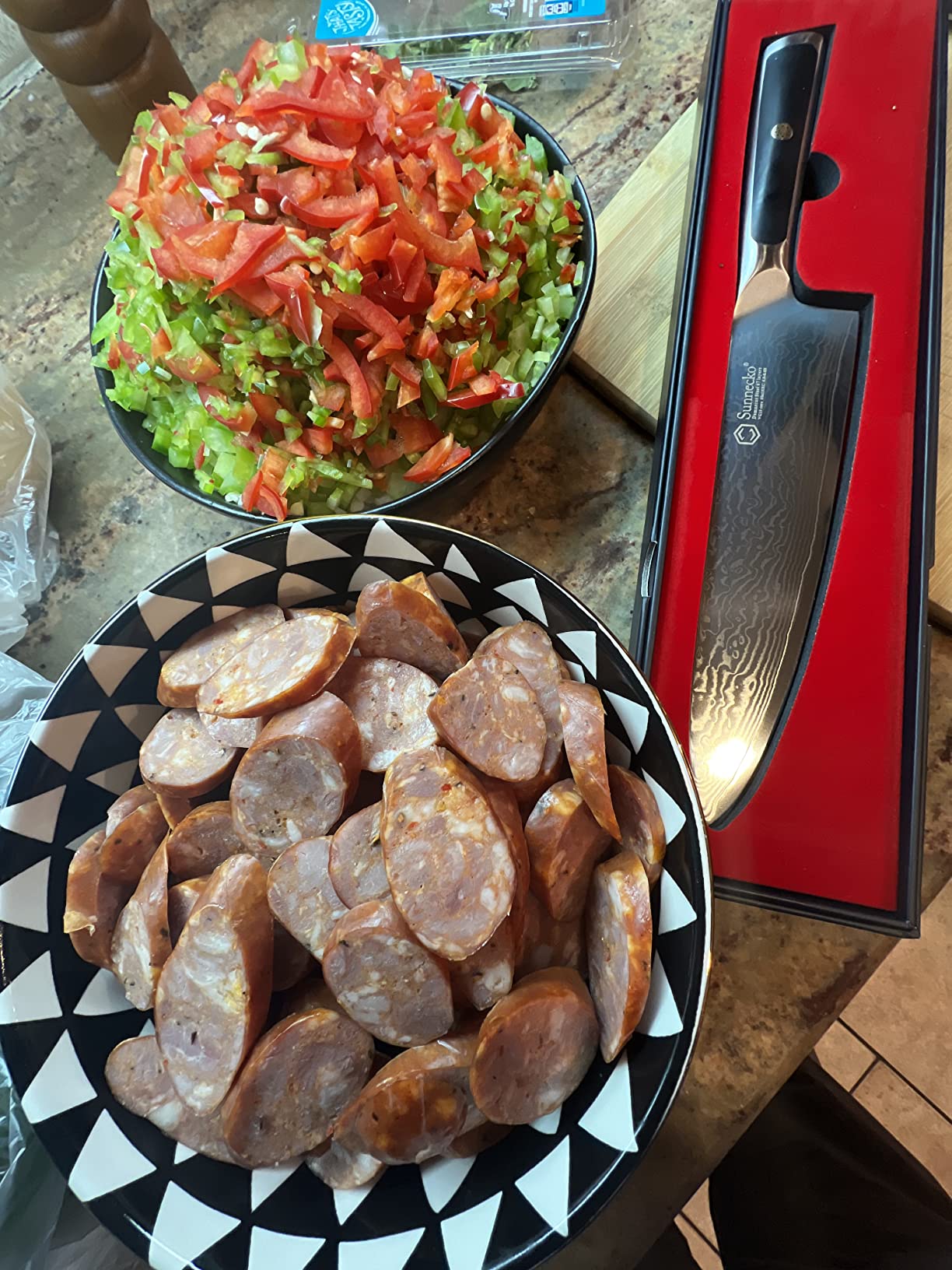
10. Sunnecko 8 Inch Damascus Chef Knife: The Straightforward VG10 Option
Sunnecko 8 Inch Japanese Damascus Chef Knife – Ultra Sharp VG10 Steel
67-layer Damascus with VG10 core
10-12 degree edge
Full tang
ABS handle
Pros
- VG10 steel core in a true 8 inch gyuto profile
- Full tang design reduces wrist fatigue over long sessions
- ABS handle grips securely even when wet
- Smooth blade to handle transition is easy to clean
Cons
- Weighs 0.41 kg which is heavy for an entry pick
- ABS handle feels less refined than pakkawood or wood
- 10-12 degree edge needs a soft board to stay sharp
VG-10 has a complicated reputation and we will get to that in the steel section. This knife is a clean example of what VG-10 does well: a hard stainless core with genuine corrosion resistance and solid edge retention.
The 67-layer Damascus cladding is built around that core, sharpened to a 10-12 degree angle per side, and it will go through a tomato without tearing the skin.
The full tang is a genuine upgrade over many knives at this price. It is the reason owners report less wrist fatigue through intensive prep sessions.
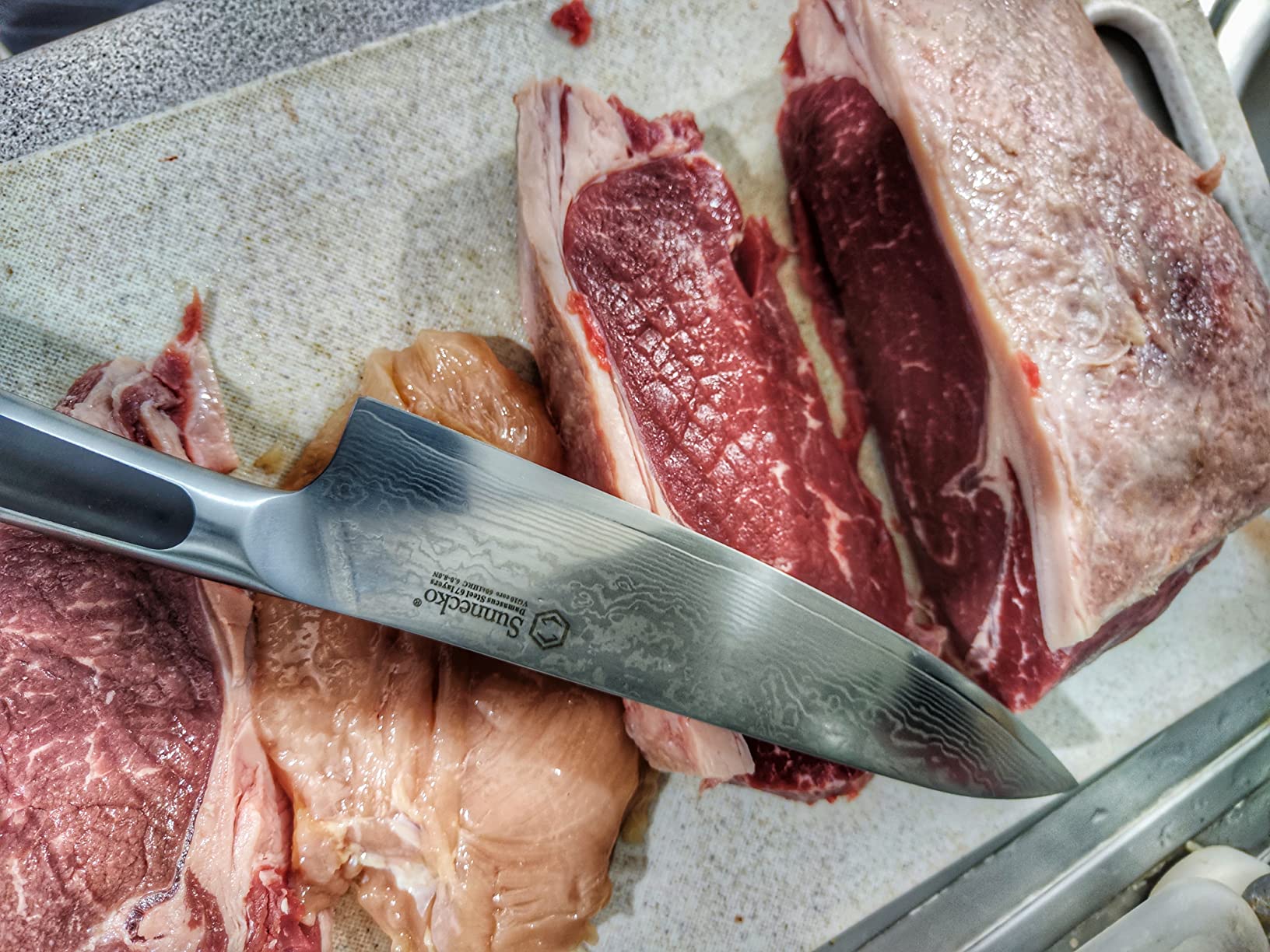
The handle is ABS with a decorative rivet and a non-slip grip, and the blade-to-handle transition is a single smooth surface, which makes cleaning straightforward. Buyers consistently praise the grip even when hands are wet.
At 0.41 kg it weighs more than most of the entry-level picks here, which is the main thing to know before you buy. It is a substantial knife, not a delicate one.
What a 10-12 degree edge demands from you
An edge that acute is the difference between a knife that slices and a knife that saws. It also has less material behind it, so cutting on glass, granite or tile will remove it far faster than on a soft wood or plastic board.
If your board is hard and scarred, this knife will disappoint you. If you are buying a board at the same time, get a soft end-grain or HDPE board.
When to skip this knife
Skip it if you are used to very light European knives. Nearly a pound is a big jump and it can feel unbalanced to someone who learned on a 7 oz chef’s knife.
Also skip it if handle feel is important to you. The plastic handle is stable and grippy, but it reads as the most utilitarian handle among the wa-handle options here.
11. KYOKU Shogun 8 Inch: The Safest First Japanese Knife to Own
KYOKU Chef Knife – 8″- Shogun Series Japanese Style VG10 Steel Core Hammered Damascus Blade Kitchen Knife – with Sheath & Case
VG10 core made in Japan
Cryo treated at 58-60 HRC
Honbazuke 8-12 degree
Sheath and case
Pros
- Japanese VG10 core cryogenically treated
- Sharpens to an 8-12 degree Honbazuke edge
- Substantial and well balanced weight in hand
- Sheath and storage case included
Cons
- Weighs 0.4 kg which is heavy for an entry pick
- Handle becomes slick when wet
- Damascus pattern reads lighter in person
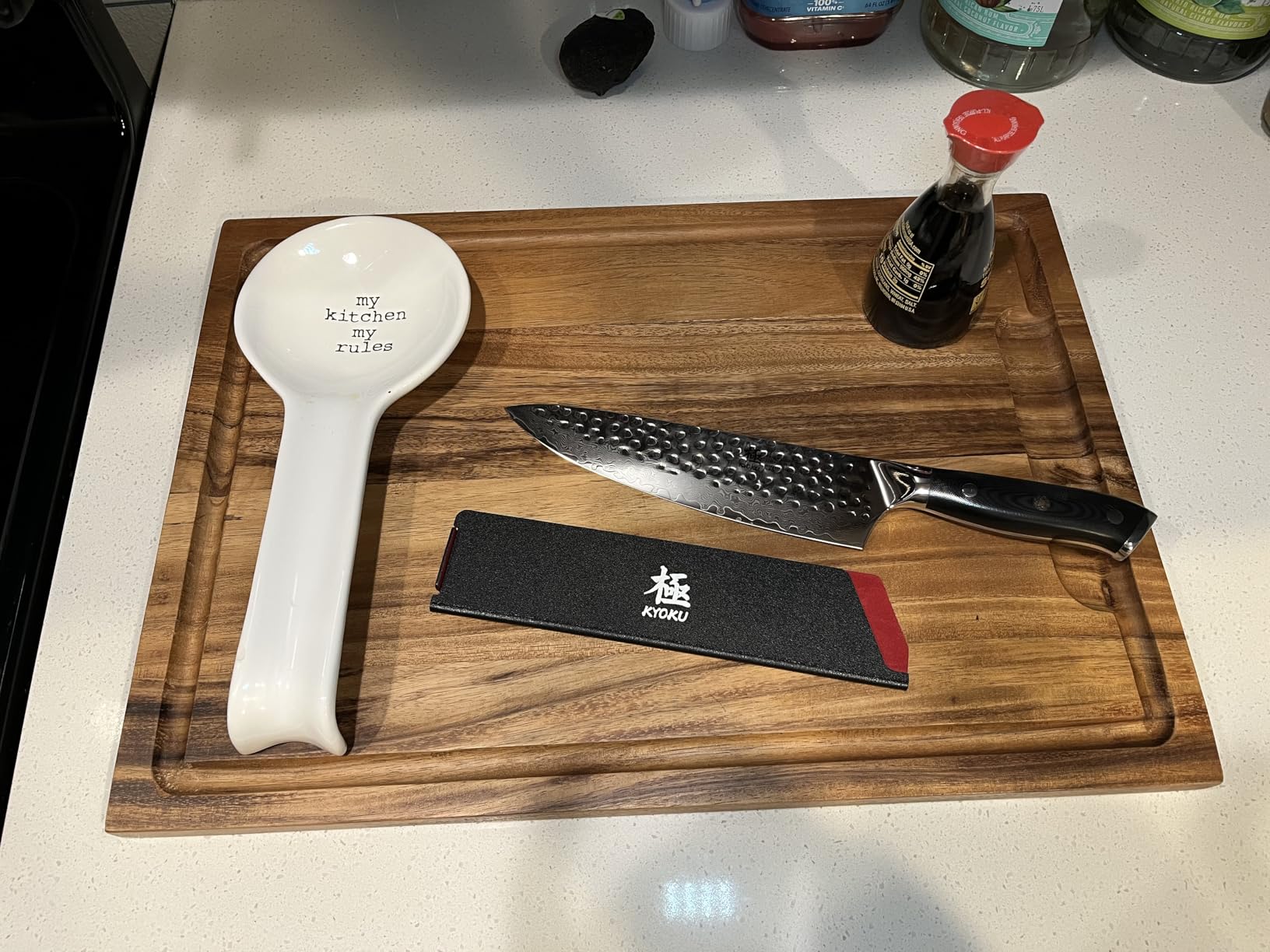
The KYOKU Shogun is the pick for anyone who is worried about where a sharp knife lives between uses. It comes with a sheath and a hard case, which solves storage before it becomes a problem.
The core is VG-10 made in Japan, cryogenically treated to 58-60 HRC. That hardness sits deliberately below the hardest steels in this list, which makes it a more forgiving knife to learn on.
The edge is set using the three-step Honbazuke method at 8-12 degrees per side. That is a more traditional sharpening approach than most entry-level knives document.
The pointed, bolsterless heel works in tight spots where bolster-blocked knives struggle, which is the same scooping advantage the Dalstrong offers for a different reason.
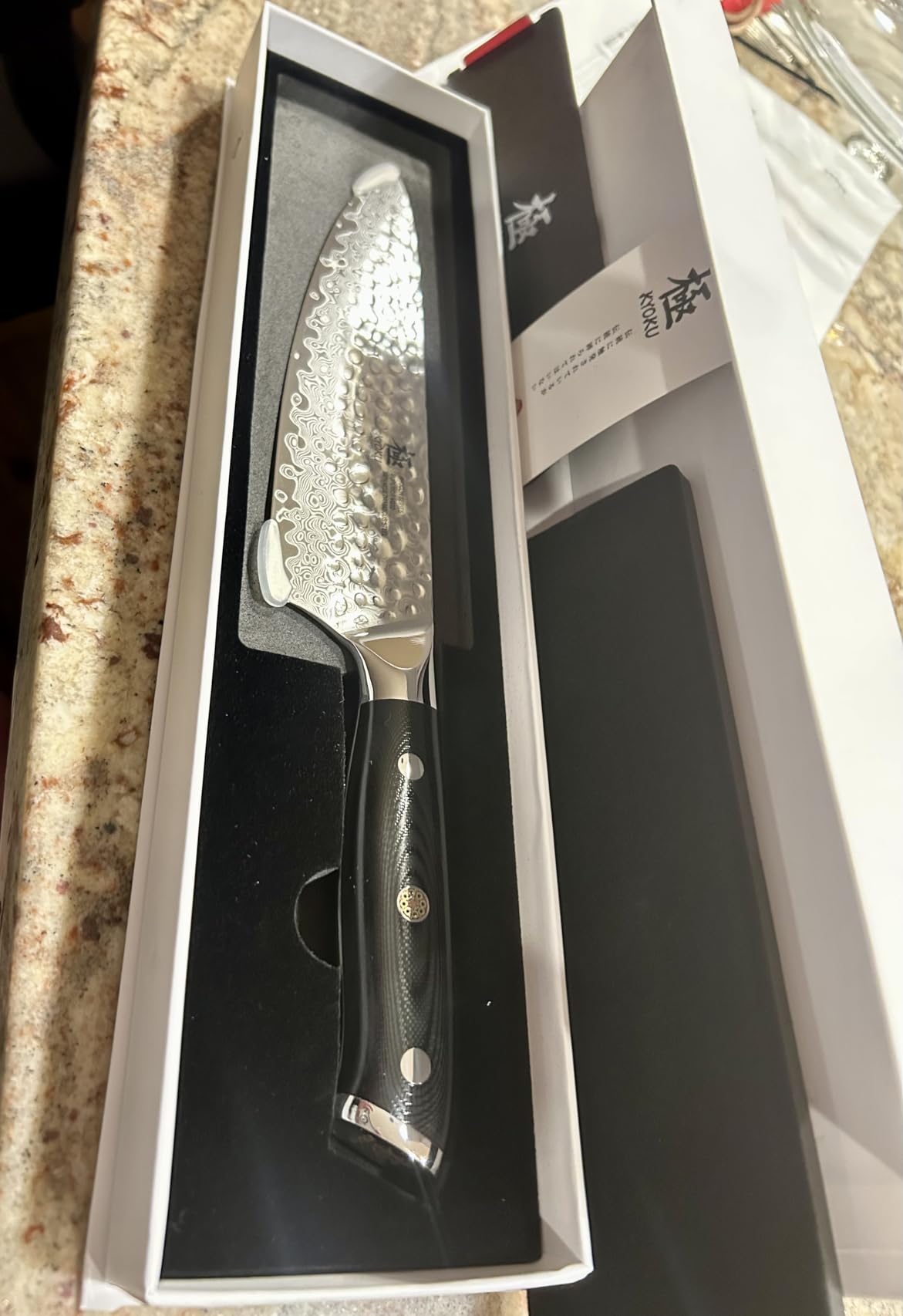
Owners value the sharpness, the satisfying heft and the included sheath, with several noting it became their daily driver. The full tang and mosaic pin give it more presence in the hand than the lighter picks above.
Why Honbazuke matters for a beginner
Honbazuke is a three-stage Japanese sharpening approach that produces a very fine edge with a polished secondary bevel. The practical effect is an edge that cuts cleanly and resists rolling.
The important detail for you is the 58-60 HRC heat treatment. A slightly softer core is more forgiving of an imperfect beginner angle than a 62 HRC blade, and it still takes an acute edge.
When to skip this knife
Skip it if you want a light knife. At 0.4 kg it is one of the heavier options in this roundup, and reviewers mention the weight most often.
The handle also becomes slick when wet, and the Damascus pattern is subtler in person than the product images suggest. If buying the visual pattern is part of the appeal, look at the SHAN ZU instead.
12. KEEMAKE 8 Inch Chef Knife: The Hammered Blade for Left-Handed Grips
KEEMAKE 8 Inch Chef Knife, Japanese Hand Forged
440C steel at HRC 58
12-15 degree hand sanded
Tsuchime hammered
12.32 oz
Pros
- Octagonal rosewood handle suits both left and right hands
- Hand forged 440C at HRC 58 with cryogenic tempering
- Hammered texture helps reduce sticking
- Sharp enough to glide through tomato skin
Cons
- HRC 58 dulls faster than the VG10 and 62 HRC picks
- Weighs 12.32 oz which is heavy for an entry pick
This one has the smallest owner base of the twelve picks at 678 reviews, and the reason it earns a place is specific rather than general. Reviewers note the octagonal rosewood handle fits both left and right hands, which is not something most Japanese-style handles in this list can say.
That thinner body of long-term reporting is worth weighing before you commit.
The steel is 440C with a 5-layer pattern at HRC 58, hand-forged with a 60-day quenching and cryogenic tempering process. That is softer than most of this list, which for a beginner means easier sharpening and more tolerance for hard use.
The 2.3 mm blade carries a tsuchime hammered texture and a hand-sanded 12-15 degree edge per side, which owners describe as gliding through tomato skin without tearing it.
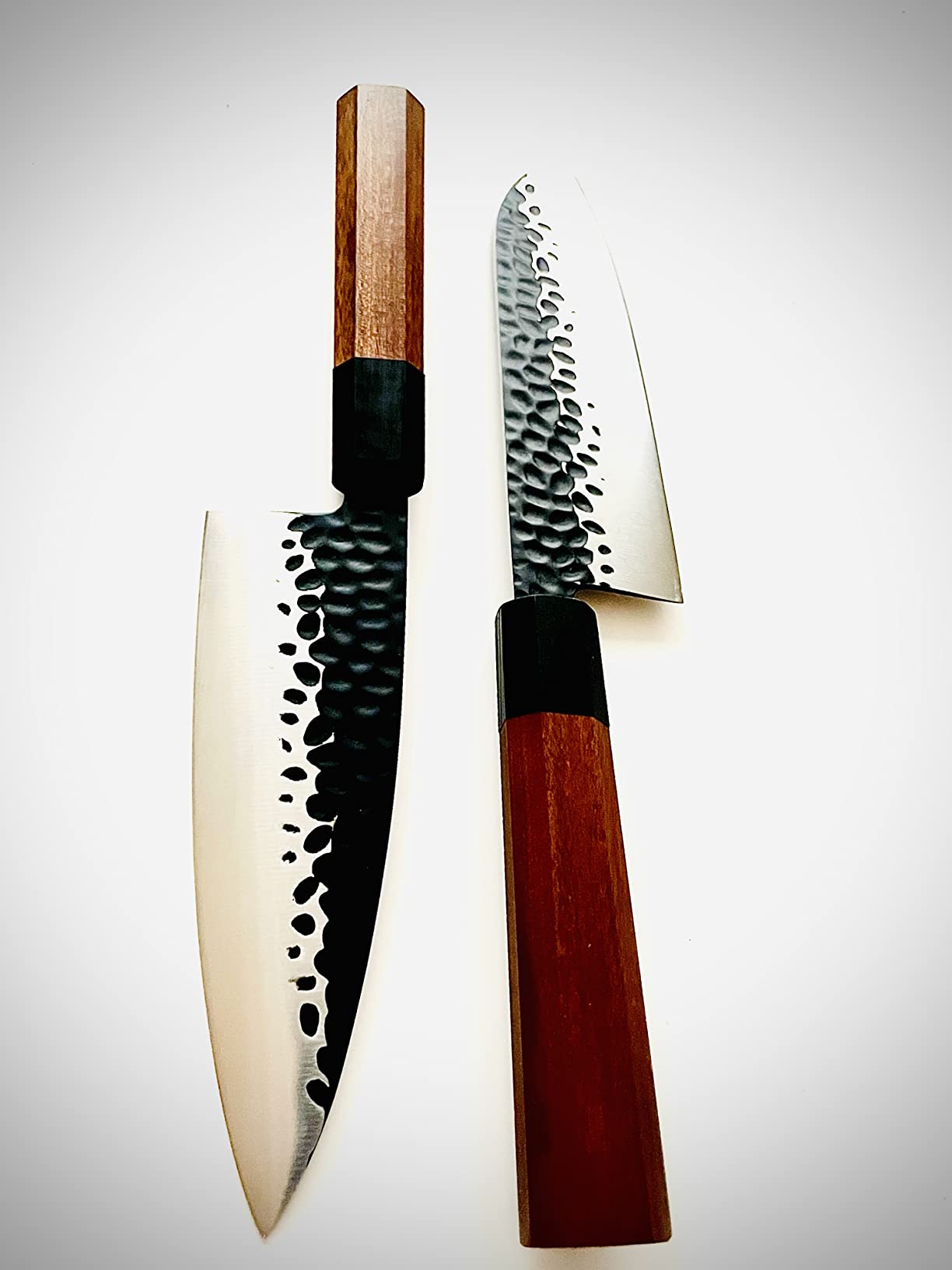
The hammered texture is the same story as the Dalstrong: it reduces contact area slightly and helps with wet prep, but it does not stop food sticking outright.
At 12-15 degrees per side the factory edge is already fine enough for slicing work.
It arrives in gift-ready packaging, which makes it a reasonable choice if the knife is a present and you want the recipient to have a full setup on day one.
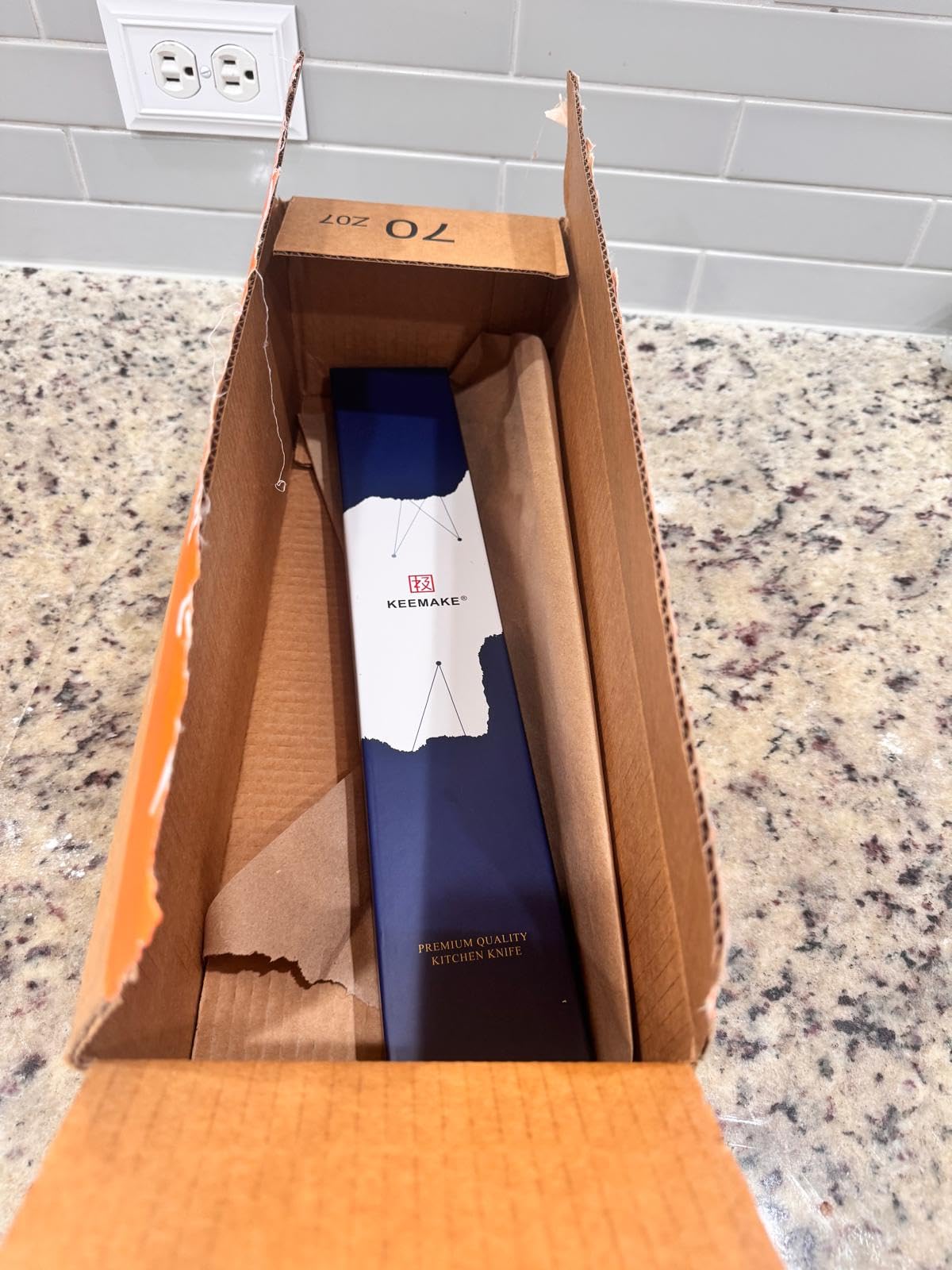
Handling a left-handed grip on a wa handle
Because there is no bolster, a wa handle can usually be rotated in the hand to suit either cutting hand. That is what reviewers mean when they describe this handle as fitting both.
Check it before you commit anyway. A knife that is comfortable in a right-hand grip is not automatically comfortable in a left-hand grip, and handle diameter matters more than most listings admit.
When to skip this knife
Skip it if you want long periods between sharpening. HRC 58 dulls faster than the VG-10 and 62 HRC picks, and that is the single most common note in reviews.
Skip it if you have not yet committed to a board that can take a 15 degree edge.
Also weigh it. At 12.32 oz for an 8-inch blade the mass sits at the heavy end, and it comes from the rosewood handle. It suits a cook who wants a substantial knife, not one who wants a light one.
Blade Steel Explained: Which Steels Suit a First Knife
For a first Japanese knife, the steel matters less than the heat treatment it received. A well-treated 57 HRC Seki blade will behave better than a badly treated 62 HRC one, and the steel name on the box tells you very little about either.
That is the general advice on knife forums, and it matches what we would tell anyone starting out: judge the grind rather than the steel name, and treat a knife that arrives with an out-of-straight edge as a defect to return.
What HRC actually measures is Rockwell hardness on a standardised scale. A higher number means a harder steel that holds an edge longer and takes a more acute angle, and a harder steel is also more brittle and more demanding to sharpen.
German knives typically sit in the high 50s. Japanese knives generally start around 60 and go up. Both numbers are useful; neither is a quality ranking on its own.
On VG-10 specifically, opinions are badly split. It is a highly corrosion resistant stainless steel with decent edge retention, but its reputation is muddied by poor heat treatment in cheaper knives. The honest reading is that VG-10 is a good steel in a well-made knife and a marketing word in a badly made one.
Damascus is largely a visual and construction term rather than a steel type. What matters is whether the pattern is folded into the blade or etched onto the surface, and whether a hard core runs underneath softer cladding. Several picks here use real folded cladding.
How to Choose Your First Japanese Chef Knife
Work through these five decisions in order. They are the questions we use to separate a knife you will use for ten years from one that ends up in a drawer.
Pick the shape. Gyuto for versatility and push cuts, santoku for a lighter blade and rocking cuts on a smaller board. Both are double-bevel here, so handedness is not a factor.
Pick the length. An 8-inch blade is the standard home kitchen default. Go to 8.5 inches only if you have board room, and go to 7 inches if your prep space is tight.
Pick the steel. Stainless or a clad stainless for your first knife. Save reactive carbon steel and powdered steels like SG2 or R2 for your second.
Pick the handle. Wa handle teaches a better grip but needs adjustment. Bolster handles are more familiar and more forgiving of a beginner.
Pick the weight. Under 8 oz is nimble, 8 to 10 oz is a good middle, over 10 oz suits a cook who cuts with force. Do not judge weight purely on the number.
Two questions beginners rarely ask are worth asking anyway. Are you left-handed? If so, confirm the bevel is 50/50 double bevel before you buy, and check the handle feel if you can. And what board do you own? A thin Japanese edge loses its sharpness in weeks on granite or glass.
If you already cook confidently and want a blade for volume prep, our best Japanese chef knives for serious cooks covers the heavier end of the market. If you are moving up from a knife block, start with the first knife on this list.
Count on the support kit costing you as much as the blade. A sharpening stone and a simple strop carry more total cost than the knife itself, and a good board protects the edge you paid for. Our best whetstone sets for Japanese knives guide covers what you need and what you can skip.
After six to twelve months, the natural second knife is a thinner steel you can sharpen well. That is the point at which carbon or powdered steel starts to make sense rather than looking like a downgrade.
Sharpening and Care: Where Beginners Lose Their Edge
Most disappointed first-time buyers are not disappointed with the knife. They are disappointed because the edge was lost to a pull-through sharpener, a glass board or an afternoon in the dishwasher.
Pull-through sharpeners are the single most common piece of bad advice in this category. They grind the edge unevenly and can leave a wire edge burr that then chips. We use a stone, or a proper honing rod if the maker supplies one.
For a whetstone, start with a 1000-grit stone and a 15-20 degree angle per side. Wet the stone, hold the knife at a shallow angle, work on one side until you can draw a clean line with your fingernail, then switch sides and finish with light strokes on a higher grit stone or a leather strop.
Sharpen less often than you think. A session every few weeks for a home cook is plenty, and stropping on leather between sessions restores an edge far more cheaply than grinding it away again.
For daily care, hand wash with warm water and detergent, dry immediately with a towel rather than leaving it air dry, and store it in a sheath or on a magnetic rack rather than loose in a drawer. Our best knife sheaths for chef knives guide covers storage options if your knives do not come with one.
If your knife arrives dull, that is normal and fixable. A single session on a 1000-grit stone will set a working edge in under twenty minutes, and the Shun Classic in this roundup includes a free sharpening service from the manufacturer.
Frequently Asked Questions
What is the best chef’s knife for a beginner?
A single 8-inch chef’s knife is the right answer, and you do not need a set. For Japanese construction, a double-bevel gyuto or santoku in stainless steel around 57-62 HRC is the most forgiving place to start. Our top pick is the imarku 8-inch gyuto, which pairs a high-carbon stainless core with a light pakkawood handle and the largest body of owner feedback in this group.
Is Miyabi or Shun better?
They occupy different positions. Shun builds in Japan through Kai with a VG-MAX core and offers free lifelong sharpening, which makes it the safer first purchase. Miyabi sits lower in the range and is a reasonable entry point, but its reputation is more tied to brand than to a specific steel. For a beginner who wants sharpening support baked in, Shun is the stronger of the two.
When to use Gyuto vs santoku?
Use a gyuto for general prep, boning and push cuts, and a santoku for lighter prep, rocking cuts and smaller boards. A gyuto has a deeper, rounder blade with weight near the heel for stability, while a santoku is shorter and flatter. For a first knife in a normal home kitchen, a gyuto is the more versatile choice.
What is the best Gyuto knife for a first-time user?
The imarku 8-inch gyuto is our recommendation for a first-time user because its 56-58 HRC stainless steel is forgiving to sharpen and hard to damage. If you want a harder edge that holds longer, the SHAN ZU 8-inch gyuto-style chef at 62 HRC is the stronger long-term choice, provided you are willing to dry it after every wash.
What angle should a Japanese knife be sharpened at?
Most Japanese kitchen knives are sharpened to 15-20 degrees per side, which means 30-40 degrees total. Factory edges in this group range from 10-12 degrees per side on the thinnest models to 18 degrees on the most forgiving. Start at 15-18 degrees per side on a 1000-grit stone and work from there.
Is VG10 Damascus good?
VG-10 is a good corrosion resistant stainless steel with decent edge retention, but its reputation is split because cheap knives use the label without good heat treatment. The Damascus part describes the cladding pattern, not the steel type. Judge a VG-10 Damascus knife by its grind, tang and heat treatment rather than by the steel name on the packaging.
Why is my Japanese knife getting rusty?
It will discolour and spot if it sits wet, especially after cutting acidic food such as tomatoes, citrus or onions. Wash it by hand, dry it straight away with a towel, and store it away from a damp sink or dishwasher. It is almost always a drying problem rather than a steel problem.
Conclusion: The One Japanese Knife to Buy First
Buy the imarku 8-inch gyuto. It carries more independent owner feedback than any other knife in this guide, a forgiving 56-58 HRC stainless core, a light pakkawood handle and a shape that handles almost anything a home cook will put in front of it.
Add a 1000-grit whetstone, a soft board and a hand towel that you actually use, and you have everything a beginner Japanese chef knife setup needs. Buy the harder steel second, once you know how to sharpen it.