
The best laser level for hanging cabinets is the DEWALT DW088K, a self-leveling red cross-line laser rated accurate to about 1/8 inch at 30 feet with an integrated magnetic bracket. If you want a single unit to project a full horizontal plane around the room, the Huepar LS04CG covers four 360-degree planes from one setup.
Here is the problem this tool solves. A 4-foot bubble level and a second pair of hands is the traditional way to hang a run of upper cabinets, and over a 12-foot run the accumulated drift means every box after the first needs shimming before the face frames will line up. Installers describe exactly that frustration on r/cabinetry and ContractorTalk, along with the fix: one true reference line, marked once, and a ledger board screwed to the studs along it.
A laser holds that single line across the whole wall without being moved or reset, and it means you can set out a full kitchen run alone. That is why the best laser levels for hanging cabinets are the top of our list below. We compared 12 self-leveling line and cross-line lasers on the specs that actually decide whether a cabinet run comes out straight: stated accuracy at a stated distance, beam color, self-leveling range, mounting options, and whether the pendulum survives a trip in the truck.
Two terms before the list. A cross-line laser projects one horizontal and one vertical line from a fixed front face. A 360-degree laser projects a full horizontal plane around the room, which is what you want when cabinets wrap a corner or continue into an adjoining room. Self-leveling means an internal pendulum corrects for tilt within a set range, usually 3 to 4 degrees, and warns you by blinking when it is beyond that.
We also use the tool’s own vocabulary consistently below. Every accuracy figure is quoted at the distance the manufacturer states, because an accuracy number without a distance is meaningless, and a line that looks accurate at 10 feet can be off by a quarter inch at 30.
Top 3 Best Laser Levels for Hanging Cabinets (October 2026)

DEWALT DW088K Cross Line
- Self-leveling cross line
- 1/8 inch at 30 ft
- Integrated magnetic bracket

CIGMAN CM-701 3×360 Green
- 12 green lines
- Self-levels within 4 degrees
- 4000mAh rechargeable battery

Huepar LS04CG 4×360 Green
- Four 360 degree planes
- Two rechargeable batteries
- 1/9 inch at 33 ft
Quick Comparison of All 12 Laser Levels
| Product | Specifications | Action |
|---|---|---|
| DEWALT DW088K Cross Line Laser |
|
Check Latest Price |
| CIGMAN CM-701 3×360 Green |
|
Check Latest Price |
| Huepar LS04CG 4×360 Green |
|
Check Latest Price |
 Huepar B03CG 3×360 Green Huepar B03CG 3×360 Green |
|
Check Latest Price |
 SKIL LL932201 Red 360 Cross Line SKIL LL932201 Red 360 Cross Line |
|
Check Latest Price |
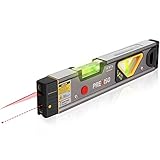 PREXISO P1P20 Laser and Spirit Level PREXISO P1P20 Laser and Spirit Level |
|
Check Latest Price |
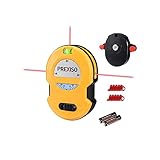 PREXISO Multi Surface Cross Line PREXISO Multi Surface Cross Line |
|
Check Latest Price |
 Lusweimi Green Cross Line with Tripod Lusweimi Green Cross Line with Tripod |
|
Check Latest Price |
 Motovera LL-T2 Green Cross Line Motovera LL-T2 Green Cross Line |
|
Check Latest Price |
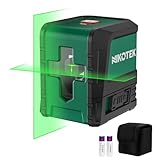 Nikotek NK01G Green Cross Line Nikotek NK01G Green Cross Line |
|
Check Latest Price |
 IKOVWUK B1-12 12 Green Lines IKOVWUK B1-12 12 Green Lines |
|
Check Latest Price |
 BLACK+DECKER BDL220S Wall Mount BLACK+DECKER BDL220S Wall Mount |
|
Check Latest Price |
1. DEWALT DW088K Cross Line Laser – the pro standard for cabinet rails
DEWALT Line Laser, Self-Leveling, Cross Line, Red Beam (DW088K)
Red cross line
1/8 inch at 30 ft accuracy
IP54 rated
Integrated magnetic bracket
Pros
- Self-levels in one to two seconds and holds accuracy over long spans
- Integrated magnetic bracket attaches to metal studs and corner bead
- Compact body mounts to a standard camera tripod
- Over-moulded housing carries a 1 metre drop rating
- Hard storage case included
Cons
- Red beam washes out outdoors in daylight without a detector
- Magnetic clip grips thin sheet metal but not a 2x4
- No pendulum lock for transport
This is the one we set on the counter first when a job starts. It is a plain red cross-line laser, nothing exotic, and that is exactly why it has become the default recommendation on r/cabinetry and in finish carpentry circles. It self-levels in a second or two and the line stays where you put it.
The stated accuracy is approximately 1/8 inch at 30 feet, which for a 10 to 14 foot run of upper cabinets works out to a tiny fraction of an inch of drift across the entire wall. That is well inside the slack a face frame and a scribe allowance can absorb, which is the whole reason a laser works where a 4-foot level does not.
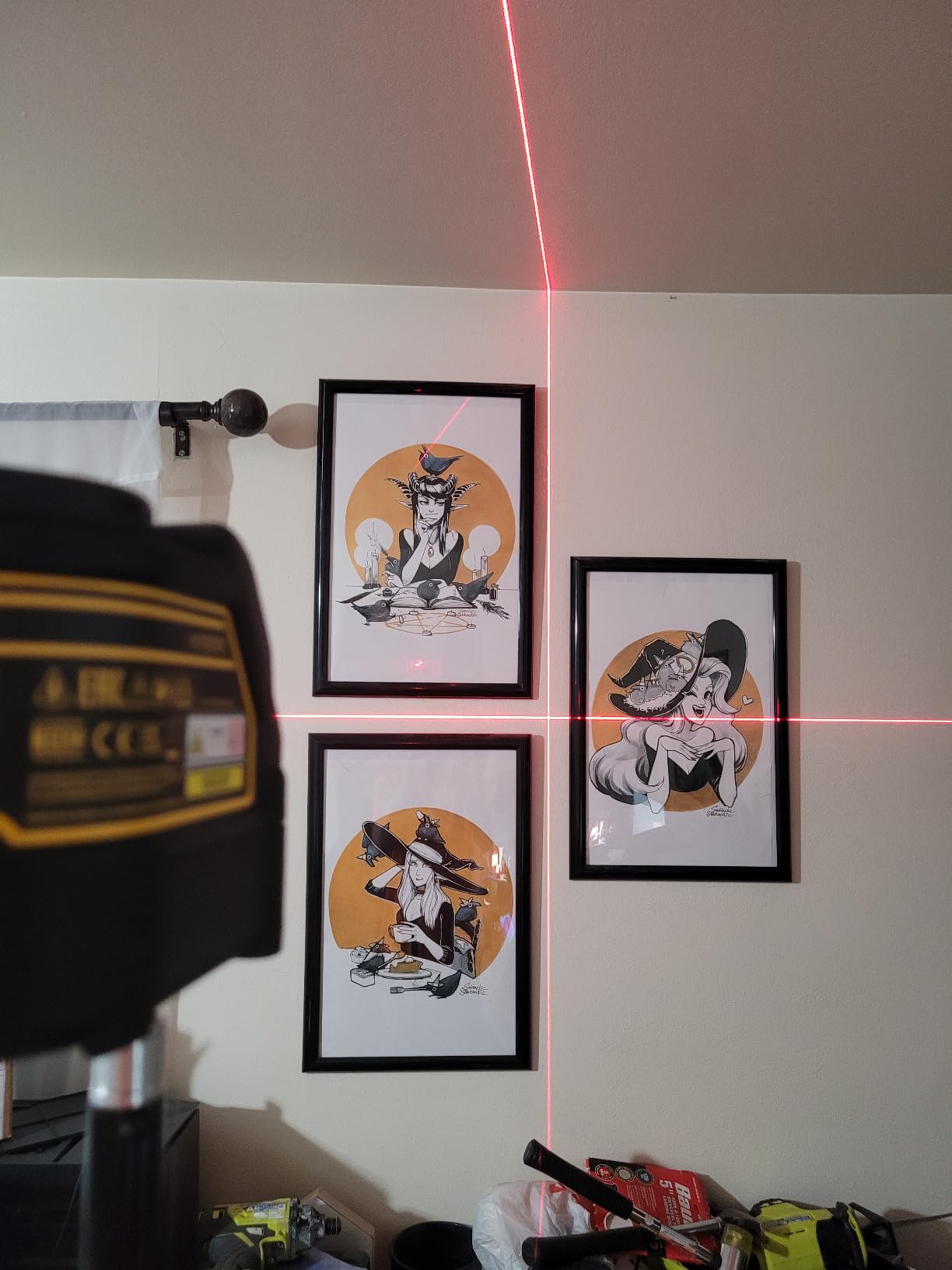
The integrated magnetic bracket is the detail that gets missed in spec sheets. It clamps the tool to a metal stud, a piece of corner bead or a Simpson plate so the beam stays at cabinet-bottom height with both hands free for marking. It will not hold on a dimensional 2×4, so plan on a tripod or a magnetic surface. The 1/4-20 thread underneath takes a standard camera tripod, which is a simple fix for getting the beam to height.
The rubber over-moulded housing carries a 1 metre drop rating and an IP54 water and debris rating, so a dusty garage install or a splash from the sink does not end the job. It is Class 2 at under 1.3 mW, and a three-year limited warranty comes with it.
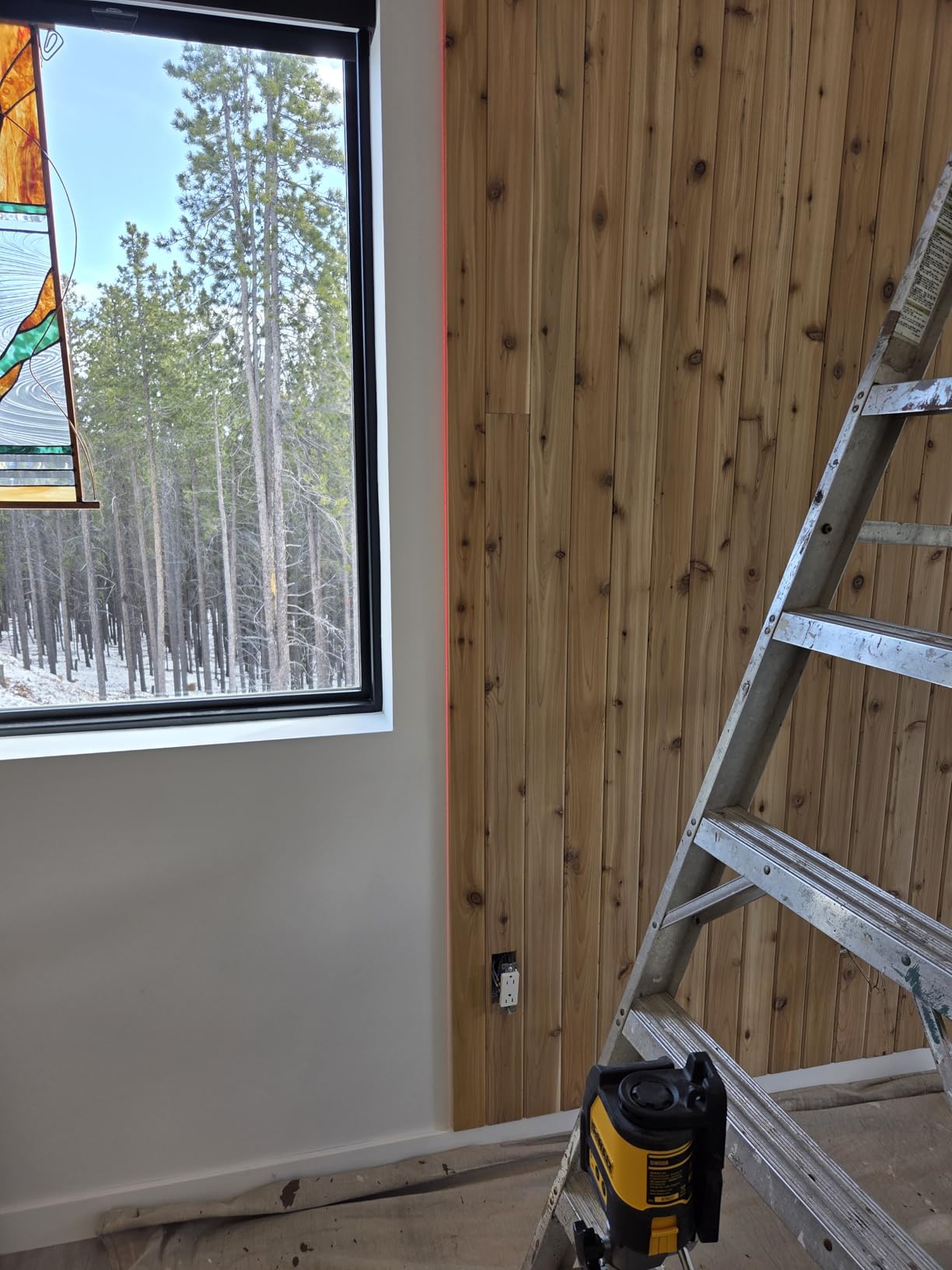
What to check before you buy
Look at how you will set the beam height. For a standard run of upper cabinets the reference line goes at the bottom edge of the lowest cabinet, and the tool has to reach that height without you holding it. A camera tripod is enough; the bracket alone is only enough if a metal surface is already at the right height.
Then check the room you will be marking. Indoors with the blinds half down, a red line is fine. If any part of that wall is in direct sun through a window, step up to a green beam, because red lines become hard to see somewhere around 10 to 15 feet in bright light.
Where it is the wrong tool
It is the wrong choice for a run that wraps a corner or continues into a second room, since a cross-line laser only throws its horizontal line in front of itself. A 360-degree model projects around you, which is what a kitchen that turns into a dining room actually needs.
It is also the wrong tool outdoors. The optional detector extends the usable range considerably, but if you cannot buy the detector, a green unit will serve you better in daylight.
2. CIGMAN CM-701 3×360 Green – best value three-plane green laser
CIGMAN Laser Level Self Leveling 3×360° for Picture Hanging & Construction
12 green lines in 3 planes
Self-leveling within 4 degrees
4000mAh rechargeable
IP54
Pros
- Three-plane green layout covers the room from one position
- Green beam holds up far better in ambient light than red
- Remotely adjustable brightness across four steps
- 4000mAh battery with Type-C fast charging
- Foam-lined hard case and compact body
Cons
- Lines are thick at roughly 3-5mm with occasional breaks
- Internal cage casts four shadow lines per beam
- Bundled mini tripod is borderline for precise positioning
This is the model we recommend when the person buying the tool is doing the install alone in a bright kitchen. Twelve green lines across one horizontal and two vertical planes mean the reference line runs in every direction from a single position, so you can mark a run that turns a corner without moving the tool.
Self-leveling engages within plus or minus 4 degrees, with manual and pulse modes alongside it. Pulse mode extends the working distance from 30 metres to 50 metres when paired with a laser receiver, which is worth having if your run is longer than one room.
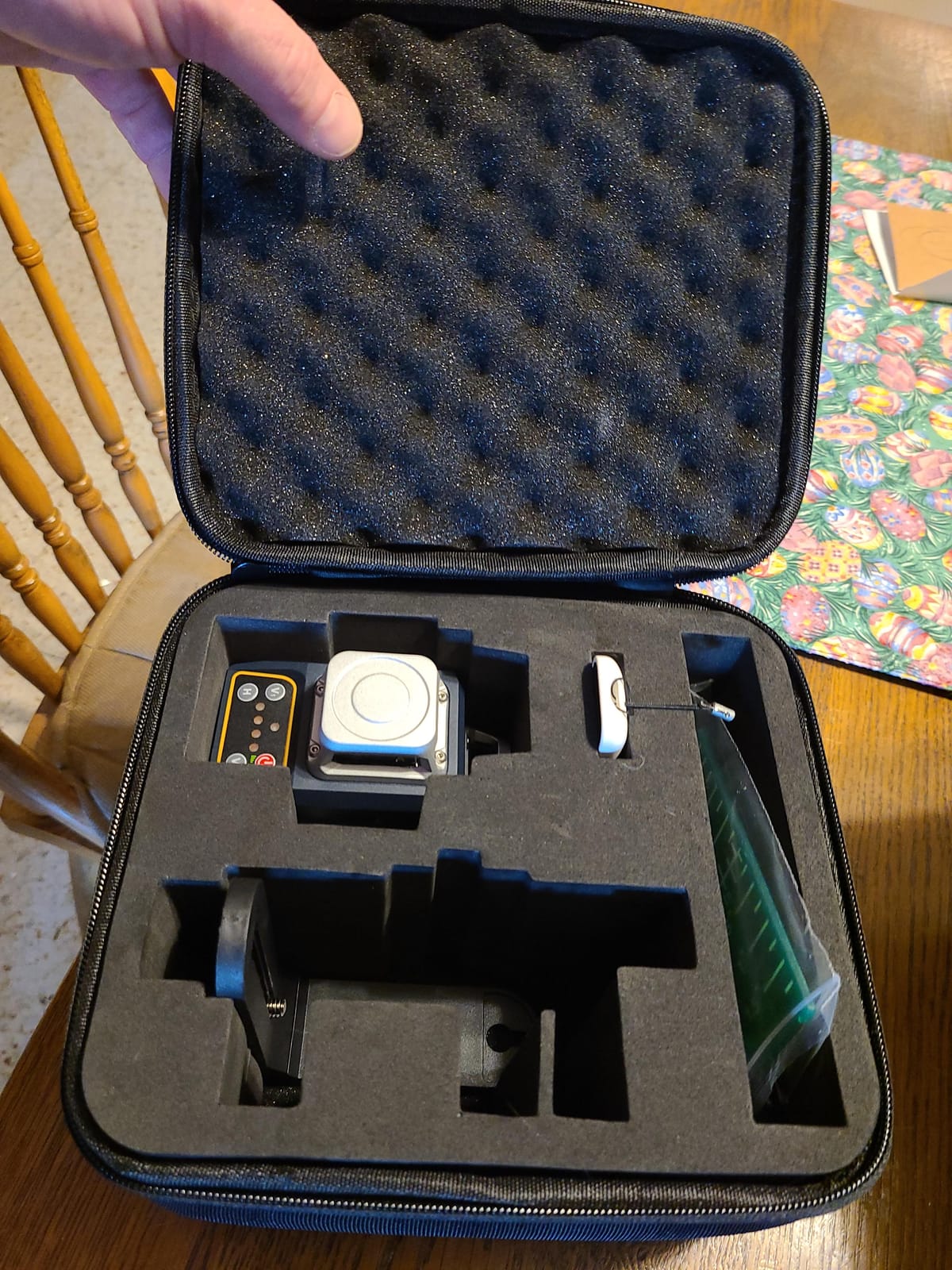
Owners installing base cabinets report checking the line against a machinist level and finding them in agreement, which is the test that matters when the reveal between boxes has to stay even. The 4000mAh battery charges over Type-C and carries a full working day, so battery spares are not part of the job.
The honest weakness is the line itself. At roughly 3 to 5mm the lines are thicker than a finish carpenter wants, and the internal cage casts four shadow lines per beam, so on a glossy surface you will see the main line plus a fan of faint ones. On painted drywall that is invisible. It matters only if you are working against tile.
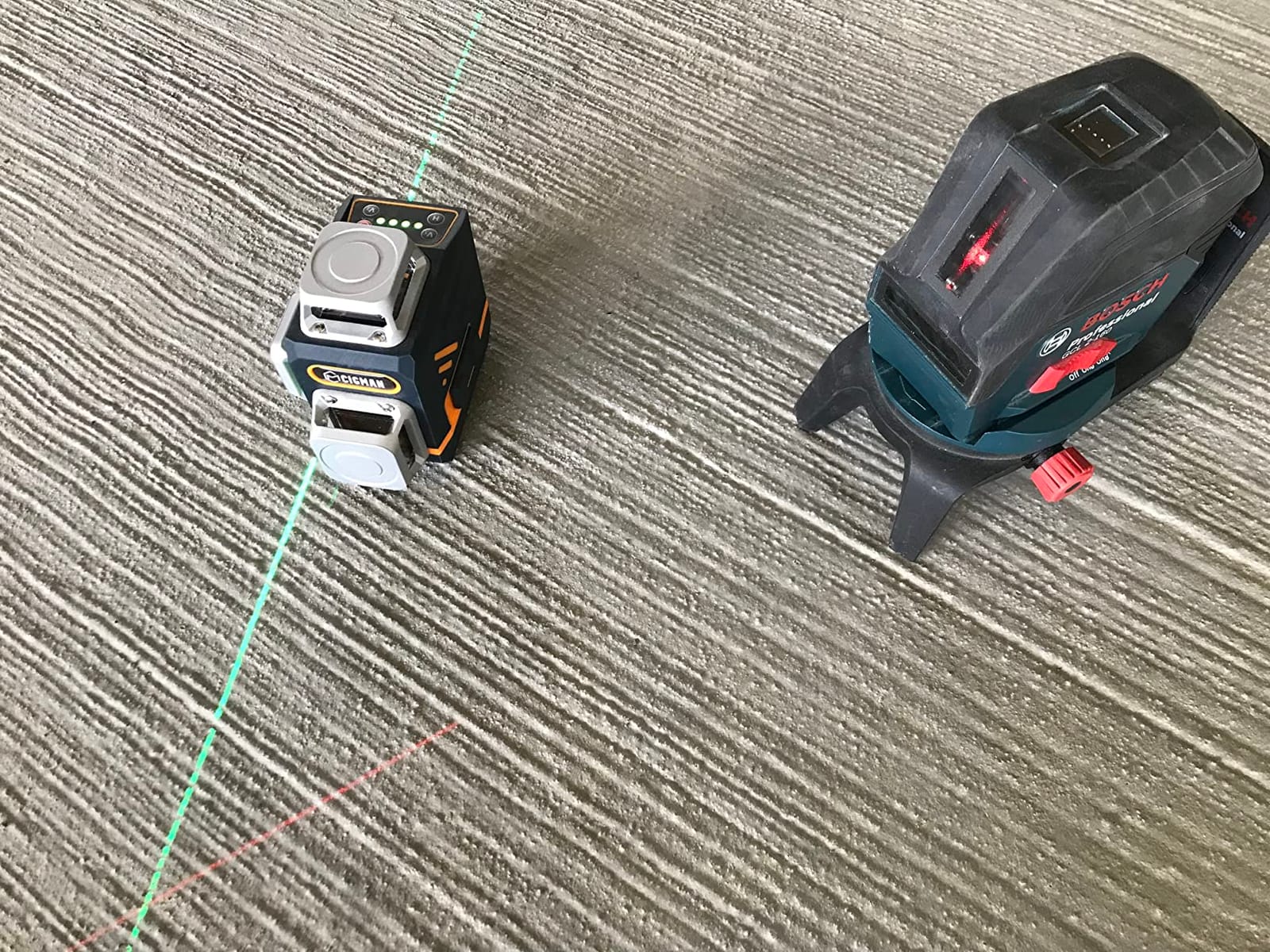
What to check before you buy
Treat the mini tripod as part of the box rather than a mounting solution. Its top height is not enough for cabinet-bottom reference work on a 54-inch standard install, so budget for a real tripod or a magnetic L bracket on a stud.
Check the battery situation. It is a built-in rechargeable rather than a removable cell, so once it stops holding a full day you have no swap-in option. For most single-day kitchen installs that never comes up, which is why we still rate it as the value pick.
Where it is the wrong tool
It is the wrong tool for a finish installer who needs a hairline to mark a face frame scribe line, because the beam width is too coarse for that job. A thinner line laser exists for that specific task, and none of the three-plane green models here will match it.
It is also the wrong tool outdoors in direct sun. Green is far better than red but it is not a receiver-grade beam, and the same brightness limitation applies here as to every other unit in this group.
3. Huepar LS04CG 4×360 Green – four planes from one setup
Huepar Laser Level 360 Self Leveling, Rechargeable Green Laser 4×360° Cross Line Lazer Leveler 4D Level Laser Tool for Construction with Two Li-ion Batteries, Magnetic Bracket &Hard Carry Case -LS04CG
Four 360 degree planes
1/9 inch at 33 ft accuracy
Two rechargeable batteries
IP54
Pros
- Four full planes project cabinet rails ceiling lines and floor lines from one setup
- Lifting base raises the floor line to clear uneven substrate
- Two rechargeable batteries charge separately over Type-C
- Magnetic bracket with 1/4-20 and 5/8-11 threads
- Five-year device warranty
Cons
- Heaviest and priciest build in this group
- Direct sun still needs a receiver for usable range
- Full four-plane brightness needs lowering near the operator
Four planes is the difference between covering your work and covering the room. On top of the standard three, this adds a top ceiling line and a bottom floor line, so the same setup that gives you a cabinet reference line also gives you the ceiling grid line and a floor reference without you climbing anything.
Stated accuracy is plus or minus 1/9 inch at 33 feet, which is comfortably tight for a 10 to 14 foot run. Two rechargeable batteries with four charge indicators mean you can work all day while the second one charges, and each has its own Type-C cable.
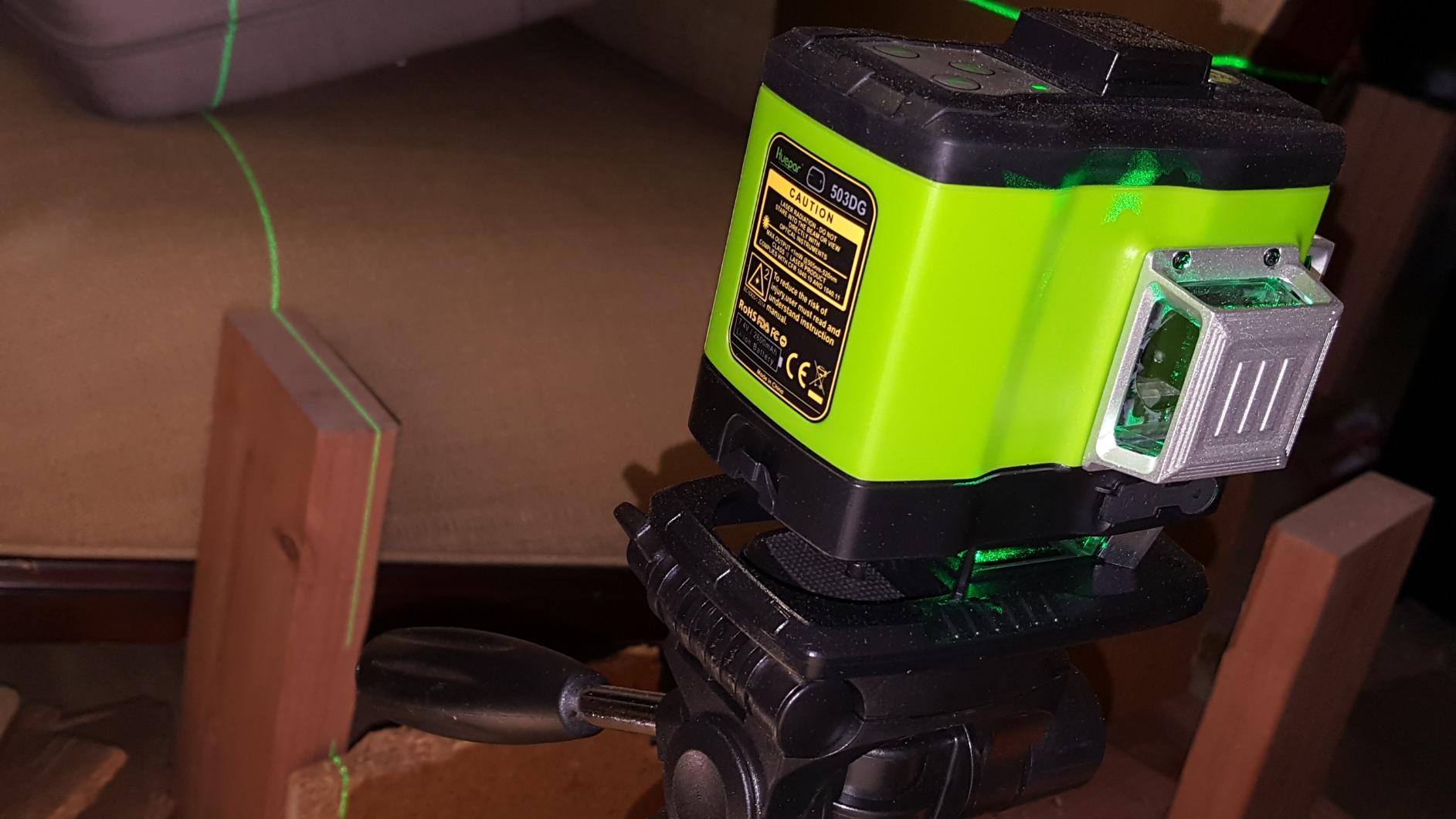
The lifting base is the feature most people skip past and then wish they had. It raises the floor line between 1 and 3.54 inches so a continuous tiling line clears thresholds and uneven substrate, which is the difference between a laser you use for cabinets only and one you keep in the van.
Mounting is thorough: a strong magnetic bracket plus 1/4-20 and 5/8-11 threads, so it fits nearly any tripod or pole. The laser window is replaceable, IP54 rated, and backed by a five-year device warranty with a two-year battery warranty.
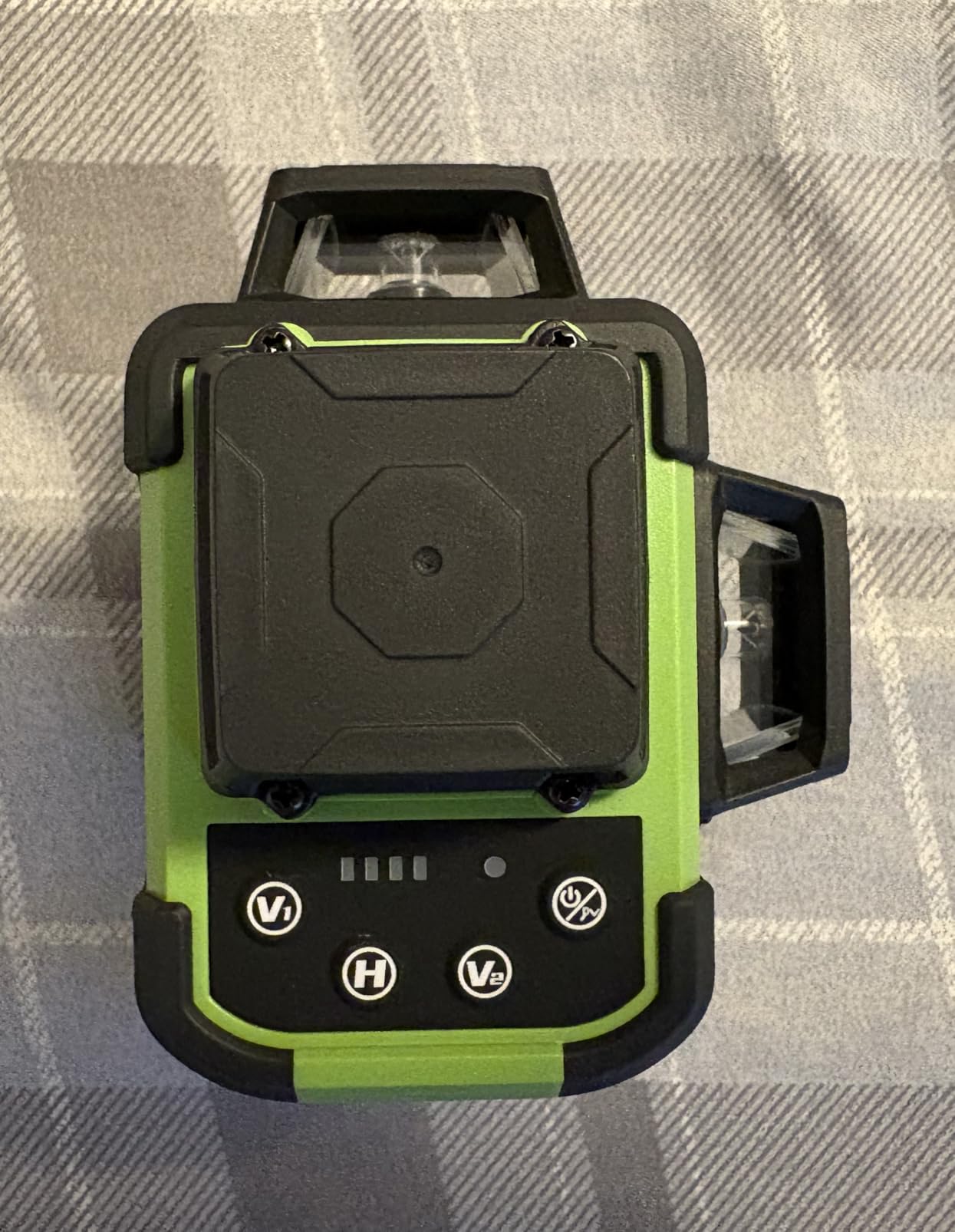
What to check before you buy
Check the weight. At 4.8 pounds this is the heaviest tool in the group, and on a ladder or a lift you will feel it. If your install is a single wall of uppers at counter height, a lighter three-plane unit does the same job with less fatigue.
Also confirm you have somewhere to put it. The magnetic bracket and hard case are included, which matters more than it sounds, because a four-plane tool gets knocked off a counter constantly if it has no base to sit on.
Where it is the wrong tool
It is the wrong tool for a single bathroom vanity or a garage shelf, where the extra planes and the second battery are capacity you will not use. There is no cost argument for buying four-plane coverage to mark a 4-foot line.
It is also the wrong tool for direct outdoor work without a Huepar receiver, since pulse mode extends range to 200 feet but only with the receiver paired to it.
4. Huepar B03CG 3×360 Green – three green planes and tight stated accuracy
HUEPAR Laser Level 360 Self Leveling, 3×360° Best Green Line Laser Leveler
Three 360 degree planes
1/16 inch at 16.4 ft accuracy
5200mAh rechargeable
IP54
Pros
- One horizontal and two vertical 360 degree planes with five selectable combinations
- Stated accuracy of 1/16 inch at 16.4 ft is the tightest here
- 5200mAh battery with up to 8 hours runtime
- USB-C charging from a supply device or direct source
- Soft rubber overmould with 51-inch drop protection
Cons
- Heavier body than compact cross-line models
- Manual mode disables levelling so angles are eyeballed
- Green beam washes out outdoors without a receiver
This is the one we would pick if the accuracy figure is the deciding factor. Its stated plus or minus 1/16 inch at 16.4 feet is the tightest specification in this group, and on a long run that precision is what keeps face frames from stacking a visible reveal error.
Layout is one 360-degree horizontal plane and two 360-degree vertical planes, with five selectable combinations so you can run just the horizon, add one vertical for a plumb reference at the cabinet ends, or all three. Two brightness levels plus pulse mode handle bright interiors, and the standard range is 85 feet, rising to 200 feet with a Huepar receiver.
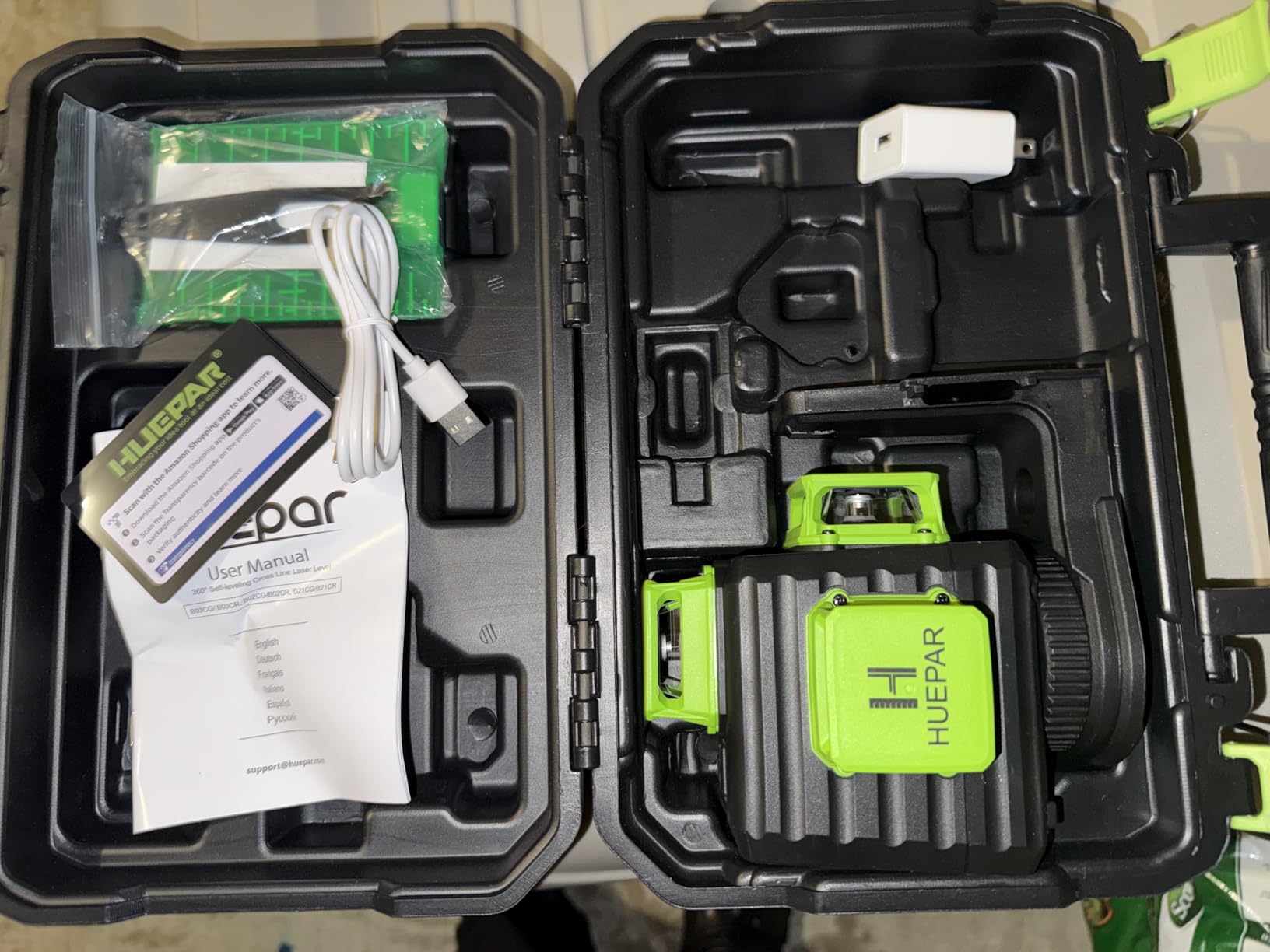
The 5200mAh battery runs up to 8 hours and charges over USB-C three different ways, which removes the charging brick from the equation entirely. A magnetic pivoting base, a target plate and a hard carry case are in the box, and the warranty is five years of product support with lifetime technical support behind it.
It is rated IP54 for water and dust and carries 51-inch drop protection over a TPR soft rubber overmould, so it takes the abuse of a van or a garage floor without complaint. The Class 2 rating at under 1mW puts it in the everyday-safe category.
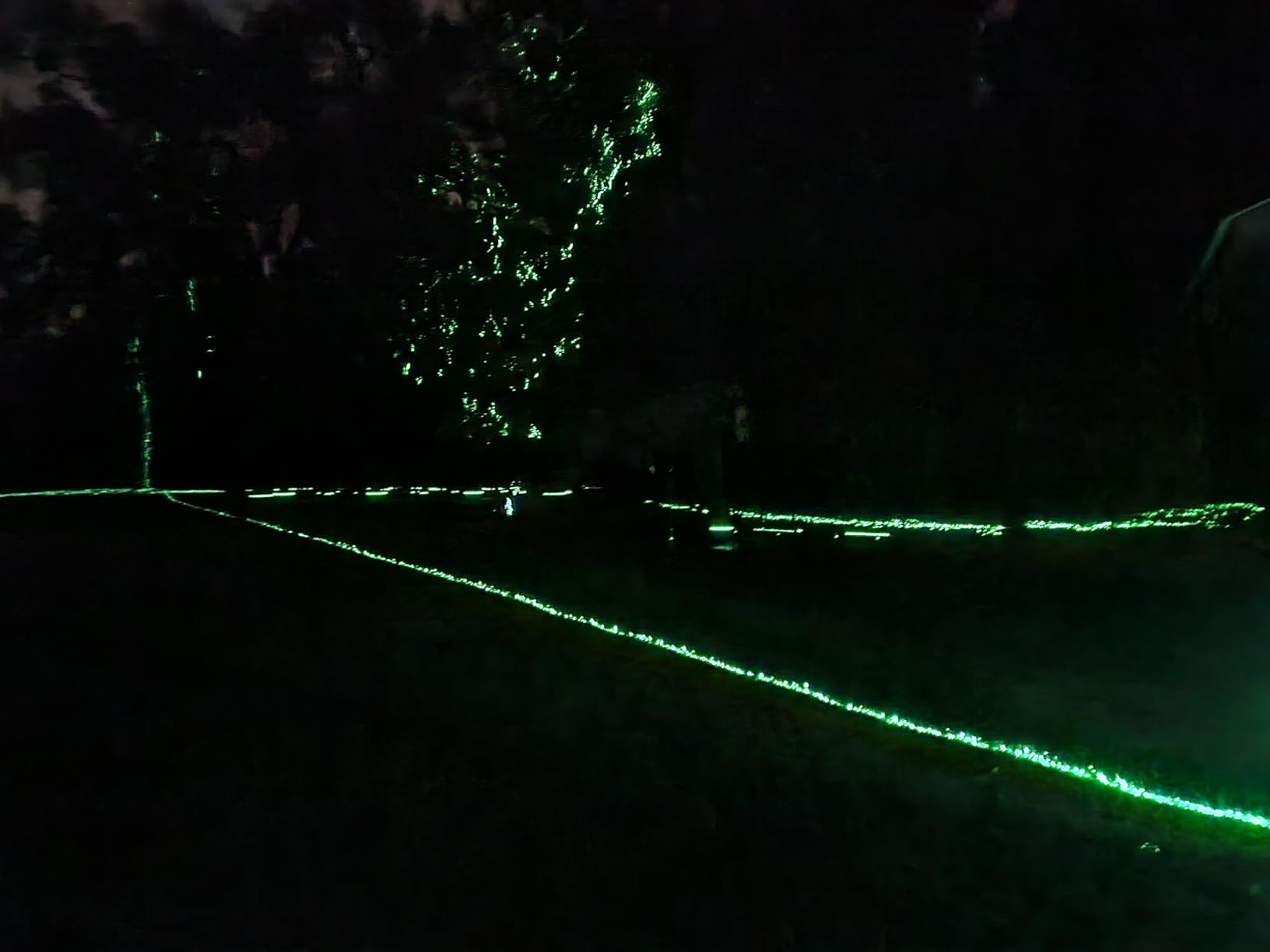
What to check before you buy
Look at the five plane combinations and pick the one you will actually use. Most people need the horizontal plus one vertical and never touch the rest, which means the extra lines are just extra brightness you may have to turn down near eye level.
Also plan where it sits. The magnetic pivoting base handles most drywall and stud situations, but for a cabinet run you will want a tripod at the correct height as a backup, and the 1/4-20 thread underneath is what makes that possible.
Where it is the wrong tool
It is the wrong tool when space and weight matter, such as on a step ladder for a single wall cabinet. A compact cross-line at half the weight is easier to place accurately at that height, and you lose nothing on a short run.
Manual mode is worth understanding before you buy. It disables levelling so you can lock lines at any angle for a diagonal backsplash, but it means the angle is your eyes, not the pendulum.
5. SKIL LL932201 Red 360 Cross Line – a full-room horizontal line with a tripod in the box
SKIL 65ft. 360° Red Self-Leveling Cross Line Laser Level with Horizontal and Vertical Lines Rechargeable Lithium Battery USB Charging Port, Compact Tripod & Carry Bag Included – LL932201
Red 360 line to 65 ft
Self-leveling and locking mode
Rechargeable lithium-ion
Pros
- Continuous red horizontal line up to 65 ft around the room
- Locking mode projects lines at any angle for diagonal layouts
- Rechargeable lithium-ion battery with charge indicators
- Adjustable tripod and soft carry bag included
- Backed by a five year warranty
Cons
- Red beam is dimmer and harder to read than green in bright rooms
- Bundled tripod is short at 3-1/2 ft for counter height work
- No vertical through-plane option beyond the standard cross line
This is the easiest first laser to own, and the reason is the box. You get the level, a tripod and a soft bag in one purchase, which removes the two things that most often stop someone from buying a laser at all: a separate tripod bill and a wondering what to carry it in.
The horizontal line runs continuously up to 65 feet around the room, so a single setup covers a whole kitchen wall. Self-leveling takes care of accuracy, and locking mode lets you throw the line at a chosen angle when you need a diagonal reference for a backsplash rather than a true level line.
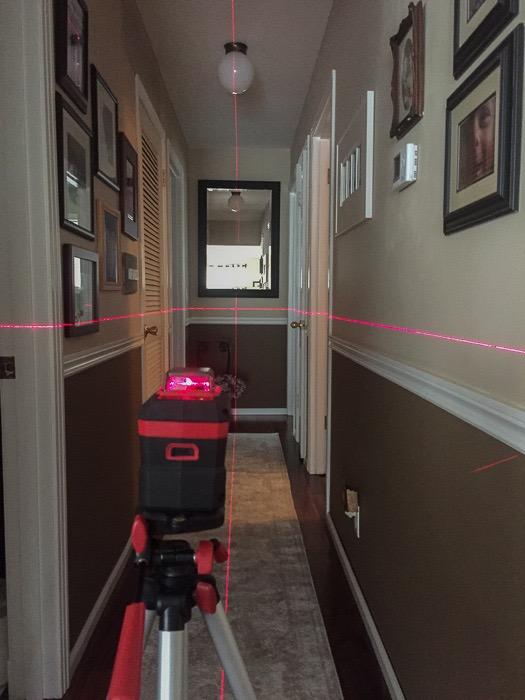
The rechargeable lithium-ion battery with a micro-USB port and charge indicators means you are not swapping cells mid-run, which is the failure mode that catches people on AA-powered tools during a long install. The five-year warranty is the longest on this list.
The tripod is the weak point. At a maximum height of 3-1/2 ft it gets you to counter height and no further, so for a 54-inch cabinet-bottom reference you will still want a taller tripod. Treat the included one as a floor-level and base-cabinet tool.
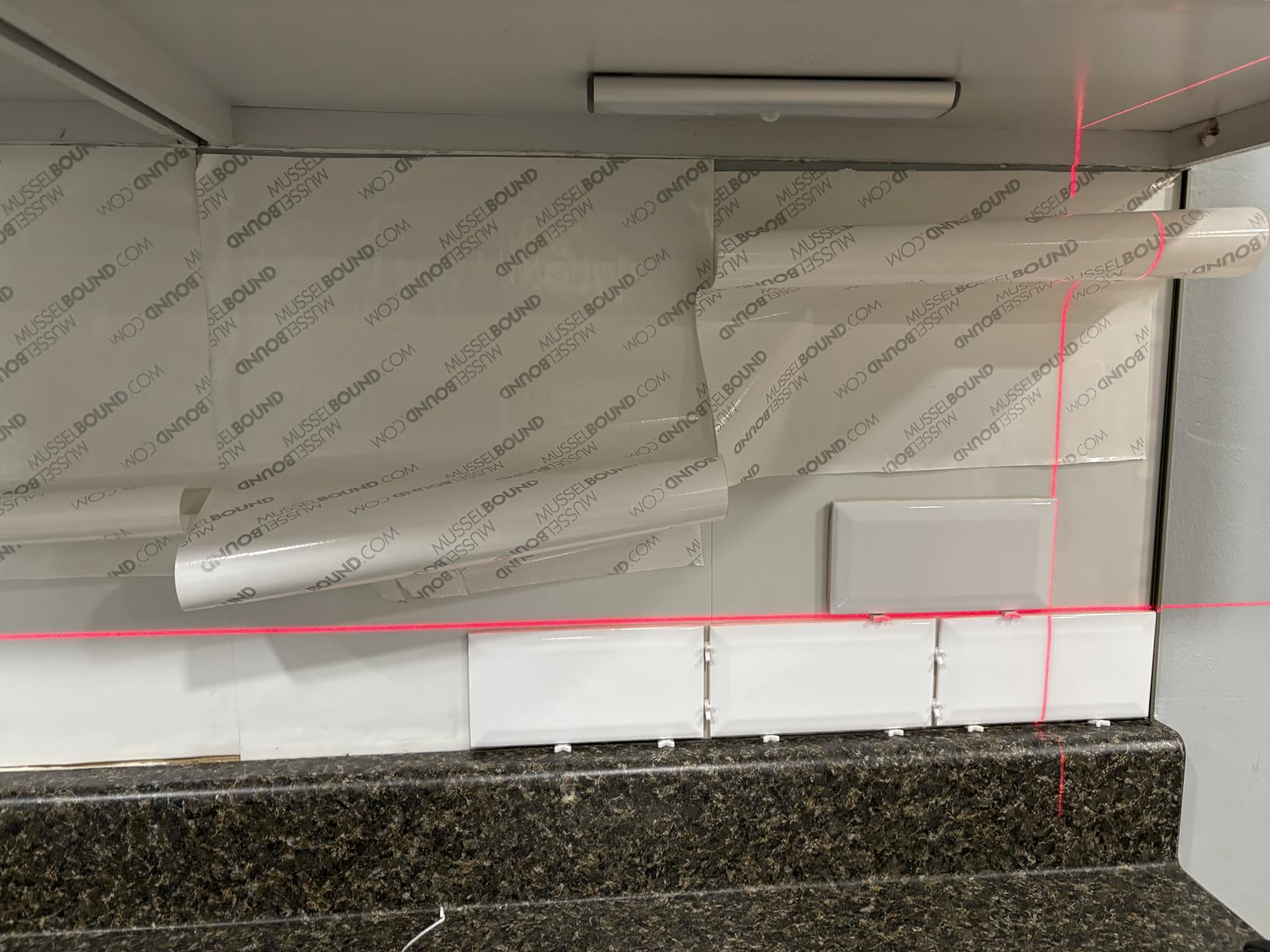
What to check before you buy
Decide honestly whether you will work in bright conditions. A red line is fine in normal interior light and poor in a sunlit kitchen, and this is the single most common complaint about the model. If your wall gets direct sun through a window while you work, a green unit will save you time.
Check the runtime against your install length. The rechargeable battery is convenient, but a full kitchen with two people marking and hanging will still benefit from charging it overnight rather than assuming an all-day charge.
Where it is the wrong tool
It is the wrong tool for a run that needs a plumb reference on a vertical plane for cabinet end panels, because the vertical coverage is limited to the standard cross line. For that, a three-plane 360 model is the correct shape of tool.
It is also the wrong tool if you already own a tripod. The included one is the reason this kit is attractive, and if you have a 1/4-20 tripod in the van that consideration disappears.
6. PREXISO P1P20 – a laser and a spirit level in one tool
PREXISO 2-in-1 Laser Level 100Ft/30Ft, 12″ Magnetic Spirit Level with Light
12 inch magnetic spirit level with laser
30 ft laser line
Dual milled magnetic faces
Pros
- Combines a machinist-style magnetic spirit level and a laser line in one tool
- Two milled magnetic faces stick to steel studs and cabinets hands-free
- Bubble vial LEDs make the vials readable in dim basements
- Lightweight aluminum frame reduces hand fatigue on long installs
- V-shaped groove on the measuring surface for pipe work
Cons
- Does not measure distance despite the laser reference points
- Red laser line is short at 30 ft compared with cross-line lasers
- Manual vial leveling means the tool must sit true before the line is trusted
This is not a full laser level and we want to be clear about that. It is a 12-inch machinist-style spirit level with milled magnetic faces that also projects a 100-foot alignment point and a 30-foot horizontal line, which is a genuinely different tool from anything else in this roundup.
Where it earns its place is short-run and hand-held work. The dual milled magnetic faces stick to a steel stud or a cabinet side and the vials confirm level, which is exactly what you need when you are fitting a single wall cabinet or a microwave bracket rather than laying out a run.
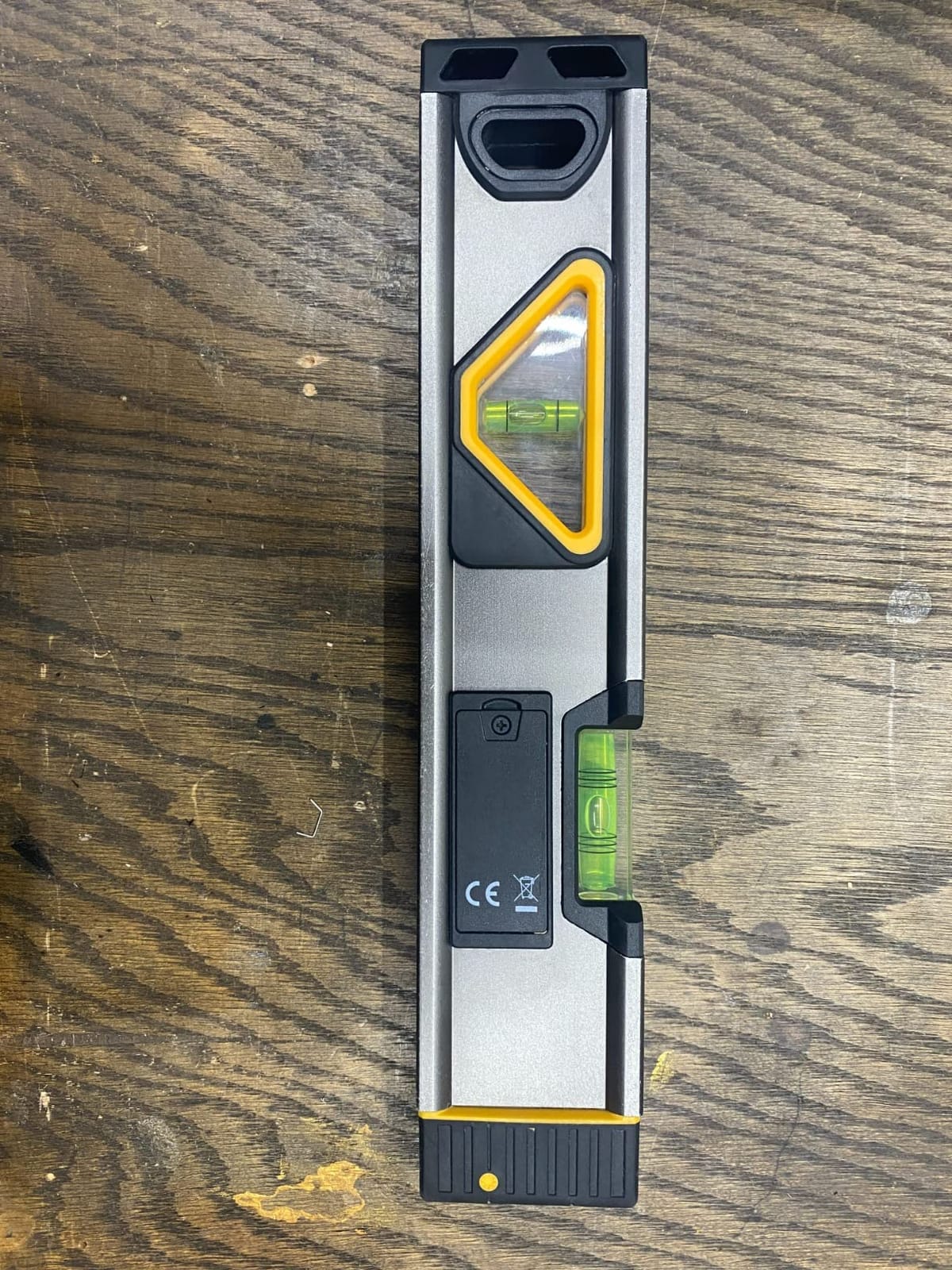
The 180-degree and triangular bubble vials have their own LED lights, which matters more than it sounds when you are checking level inside a cabinet carcass or in an unlit basement. Over-moulded rubber end caps take the shock of a drop onto a concrete floor.
The V-shaped groove on the measuring surface handles pipe work, and the Class II output under 1mW is the everyday-safe category. All of that in an aluminum frame light enough to hold for a full install without fatigue.
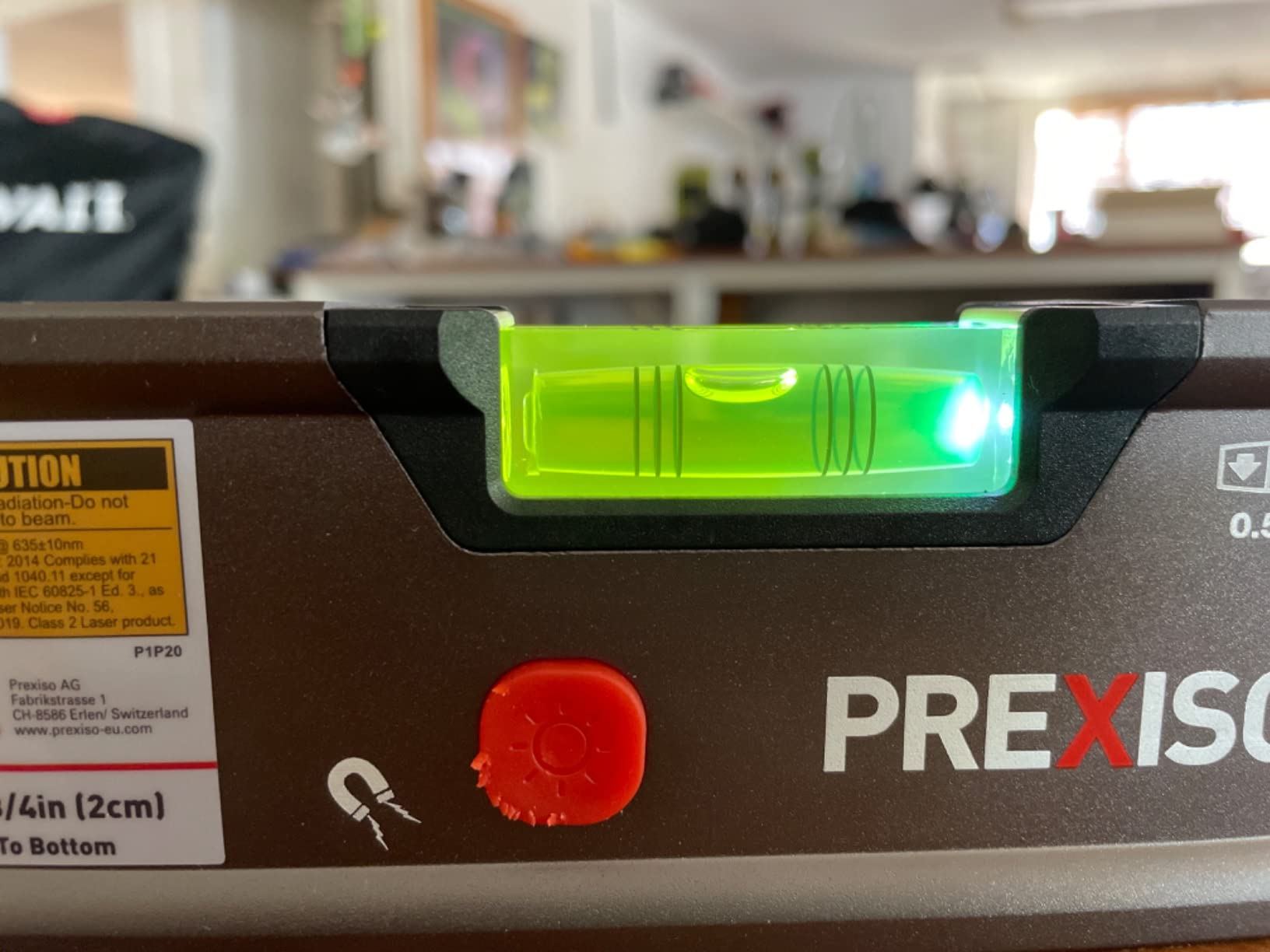
What to check before you buy
Check the distance you need. The 30-foot horizontal line is short next to the cross-line lasers here, and the tool has no distance measurement despite the reference points. For a 14-foot wall of uppers it is workable; for a garage run it is not.
Check the levelling method. This is manual vial leveling, not electronic self-leveling, so the line is only as true as how the tool is sitting. On a magnetically mounted surface that is fine; on an unlevel surface it will not correct itself.
Where it is the wrong tool
It is the wrong tool as your primary cabinet laser. A self-leveling cross-line holds one line across a long run while you walk the wall, and this one does not do that job, so treat it as a companion rather than a replacement.
It is also the wrong tool if you already own a good 4-foot level. The overlap is large in that case, and the value of this tool is the combination rather than either half on its own.
7. PREXISO Multi Surface – a wall mount base that frees both hands
PREXISO Multi Surface Laser Level LED Light Vial, Cross Line Laser
Three lines from one switch
30 ft horizontal and vertical
Angle dial 15-75 degrees
Pros
- Projects both horizontal and vertical lines so rails and frames align without repositioning
- Wall mount base frees both hands for marking
- Single-switch operation makes it approachable for first-time users
- Angle dial and bubble vials cover stairs shelving and molding
- Compact body is comfortable to hold
Cons
- Limited to a 30 ft surface line range
- Small integrated bubble vial is hard to read precisely
- Self-adhesive strips and pins can damage the wall surface
The wall mount is what separates this one, and it solves a problem every other tool here leaves to you. Screw or stick the base to the wall at cabinet-bottom height, and the tool stays put while you have both hands free to snap a chalk line and mark stud positions.
One switch projects three lines, giving horizontal and vertical references at an exact 90 degrees out to 30 feet. The angle dial adjusts from 15 to 75 degrees with an LED-lit reference for stair stringers and raking lines, and built-in bubble vials give a manual check when the surface is awkward.
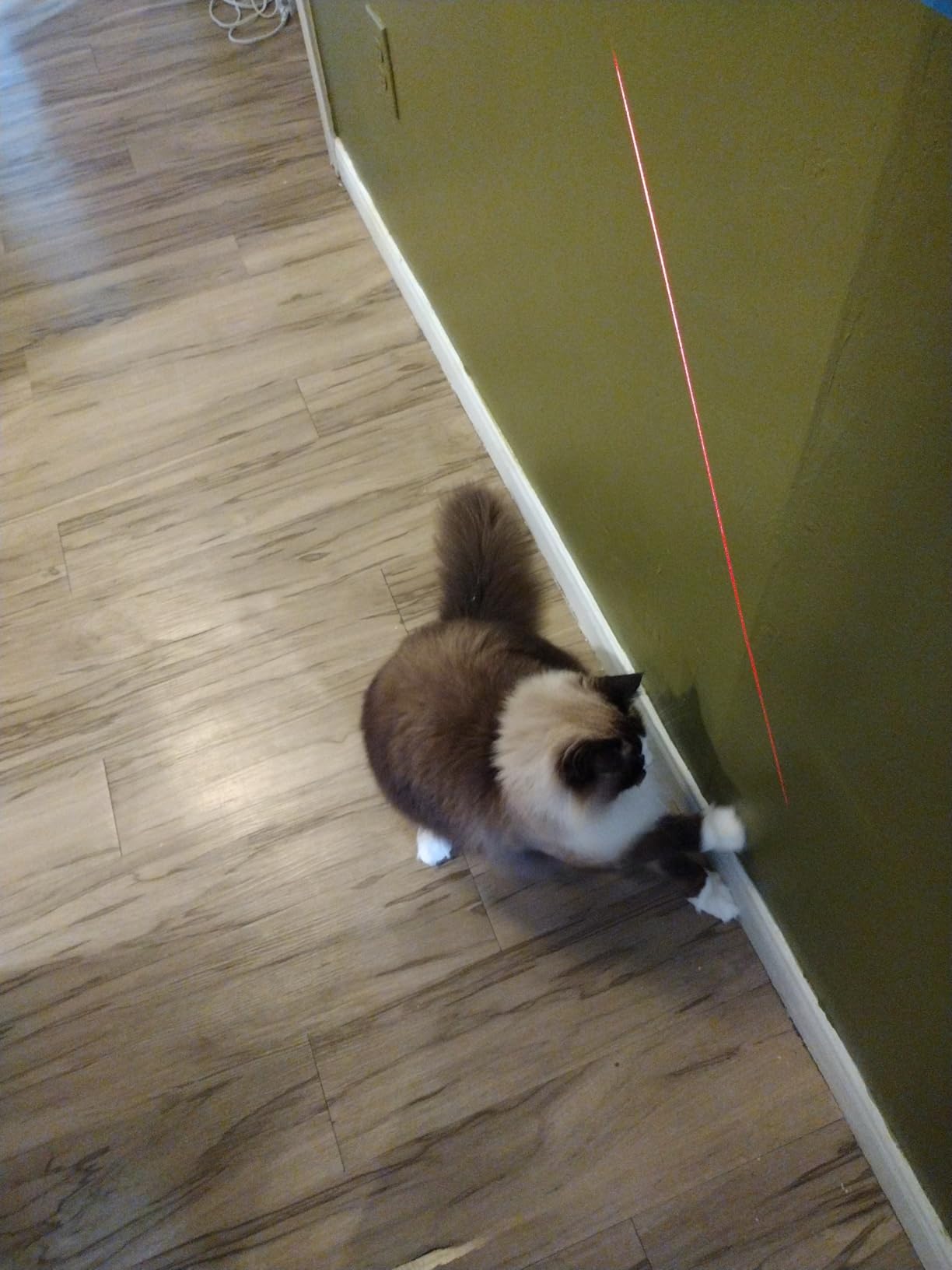
The base handles three wall conditions: two pins for rough surfaces, ten self-adhesive strips for smooth ones, and pin holes for anything else. That flexibility is the reason it suits a rental wall or a freshly taped drywall joint where a magnetic mount has nothing to grab.
Two AA batteries are included and the laser is Class II at under 1mW. It is rated number one in Line Lasers in its price band, which reflects how many buyers use it as a first tool rather than a dedicated pro unit.
What to check before you buy
Look at your wall surface before committing to the adhesive strips. They can pull paint or leave a mark, and on a finished wall that is a repair you will be making. The two pins are the safer option on drywall, and the pin holes take a nail anywhere.
Check the 30-foot range against your longest run. It is adequate for one wall of a kitchen and not adequate for a wall that continues into a second space without repositioning the tool.
Where it is the wrong tool
It is the wrong tool for a professional install where the wall condition varies room to room. The mount works brilliantly on one surface and becomes a liability on the next, and a tripod-based laser simply travels between setups.
It is also the wrong tool when you need accuracy at distance. The 30-foot line and a small integrated vial give you a working reference, not the tolerance headroom a self-leveling electronic unit provides on a long run.
8. Lusweimi Green Cross Line with a 50 inch tripod
Laser Level with 50” Tripod, 360° Self Leveling Cross Line Laser Level, Green Beam Horizontal and Vertical Line leveler Tool for Hanging Pictures, Home Renovation with 4 AA Batteries & Carry Pouch
Green cross line
1/9 inch at 33 ft accuracy
Self-leveling within 4 degrees
50 inch tripod included
Pros
- Bright green cross lines stay visible for aligning cabinet rails and frames
- Self-leveling settles quickly against manual measuring
- 50 inch tripod is tall enough for most wall-height work and has a bubble level
- Compact 0.17 kg body with a carry pouch
- Self-leveling and manual modes cover level and angled layouts
Cons
- Bundled tripod is light and flimsy for overhead work above roughly 5 ft
- Short battery life at high brightness means swapping AA batteries
- Manual mode disables levelling so the angle is judged by eye
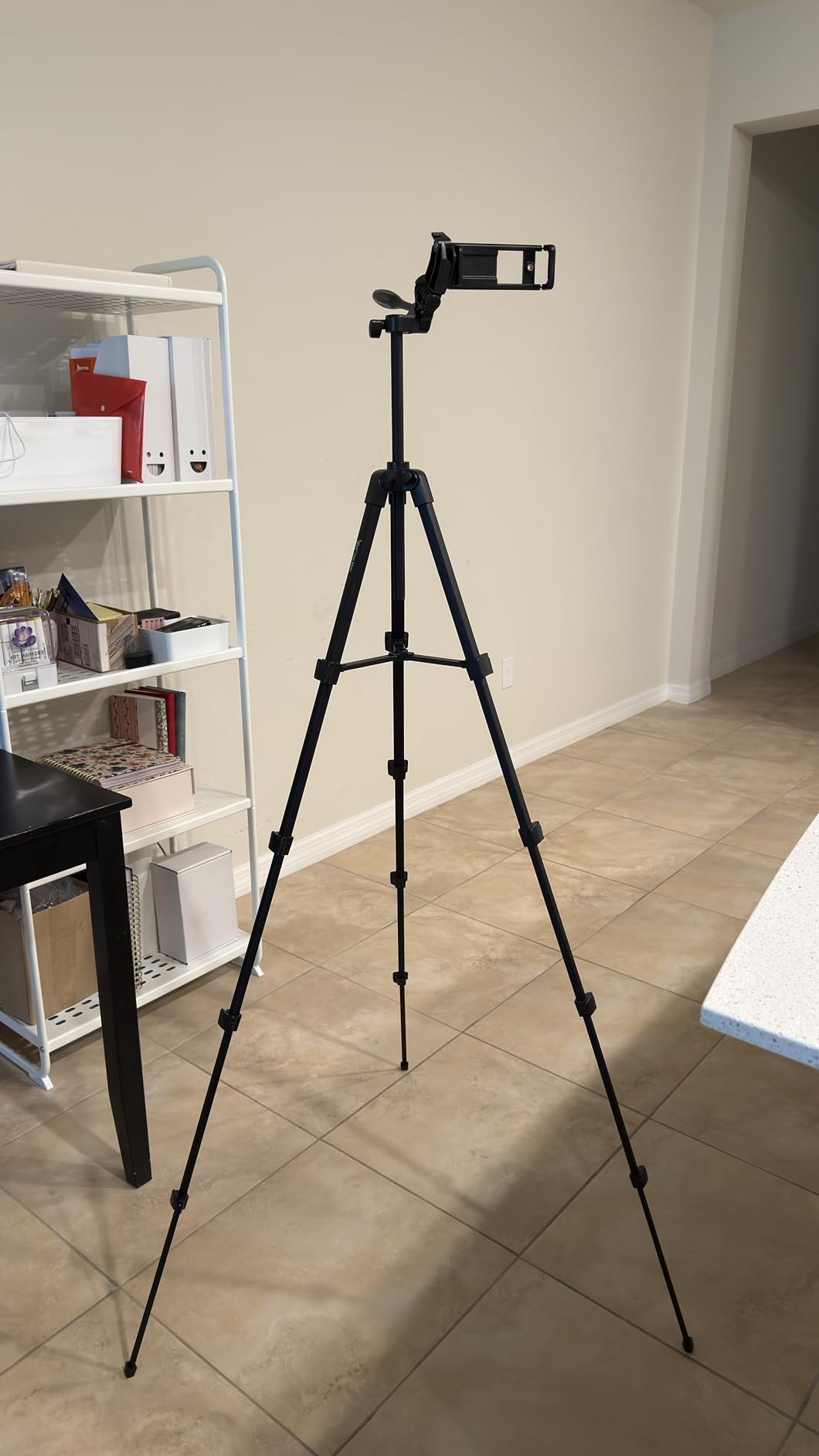
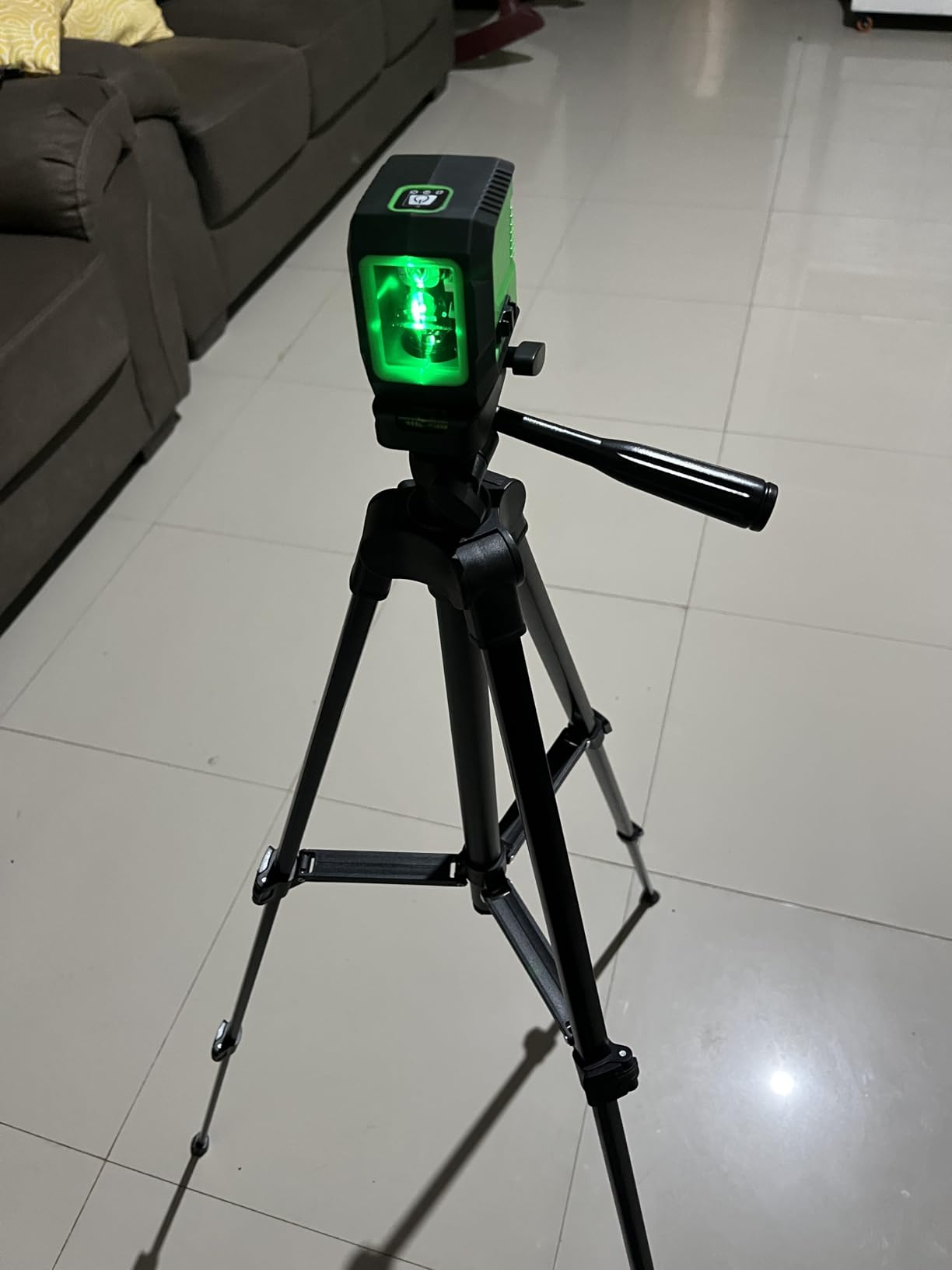
A green cross line plus a tripod that actually reaches working height, in one box, is the combination most homeowners are actually looking for. The 50-inch tripod with its own bubble level and universal 1/4-20 mount gets the beam to a cabinet-bottom reference without a second purchase.
Stated accuracy is plus or minus 1/9 inch at 33 feet, and the beam is rated at roughly twice the brightness of an equivalent red source, which is the number that matters in a room with a window. Self-leveling works within plus or minus 4 degrees with a flashing out-of-level warning, and manual mode locks the cross at any angle.
The body is small at 49 by 65 by 65 mm and 0.17 kg, which is genuinely pocketable and easy to keep in a tool bag between jobs. IP54 covers shock, water and dust, and four AA batteries are included.
Two things to plan around. The tripod is light, so above roughly 5 feet of height it will move when you bump the wall, and battery life at maximum brightness is short enough that you will be swapping AA cells during a long install. Both are acceptable if you plan for them.
What to check before you buy
Check the tripod against your ceiling height rather than your cabinet height. It is right for a standard install and short for a vaulted room or a tall two-tier cabinet run, and a bent tripod at full extension is a wasted line.
Check whether you will run all three planes. This is a cross-line, so a run that wraps a corner will need you to move and reset it, which is the whole reason the 360 models exist.
Where it is the wrong tool
It is the wrong tool for a professional all-day install. AA batteries and a light tripod are the two things that get replaced first once you are hanging cabinets every week, and neither is a reason to buy twice if that is you.
It is also the wrong tool for a very long run where even a cross line at 33 feet of stated accuracy starts to matter, or for a wall in direct sun where you would be reaching for pulse mode constantly.
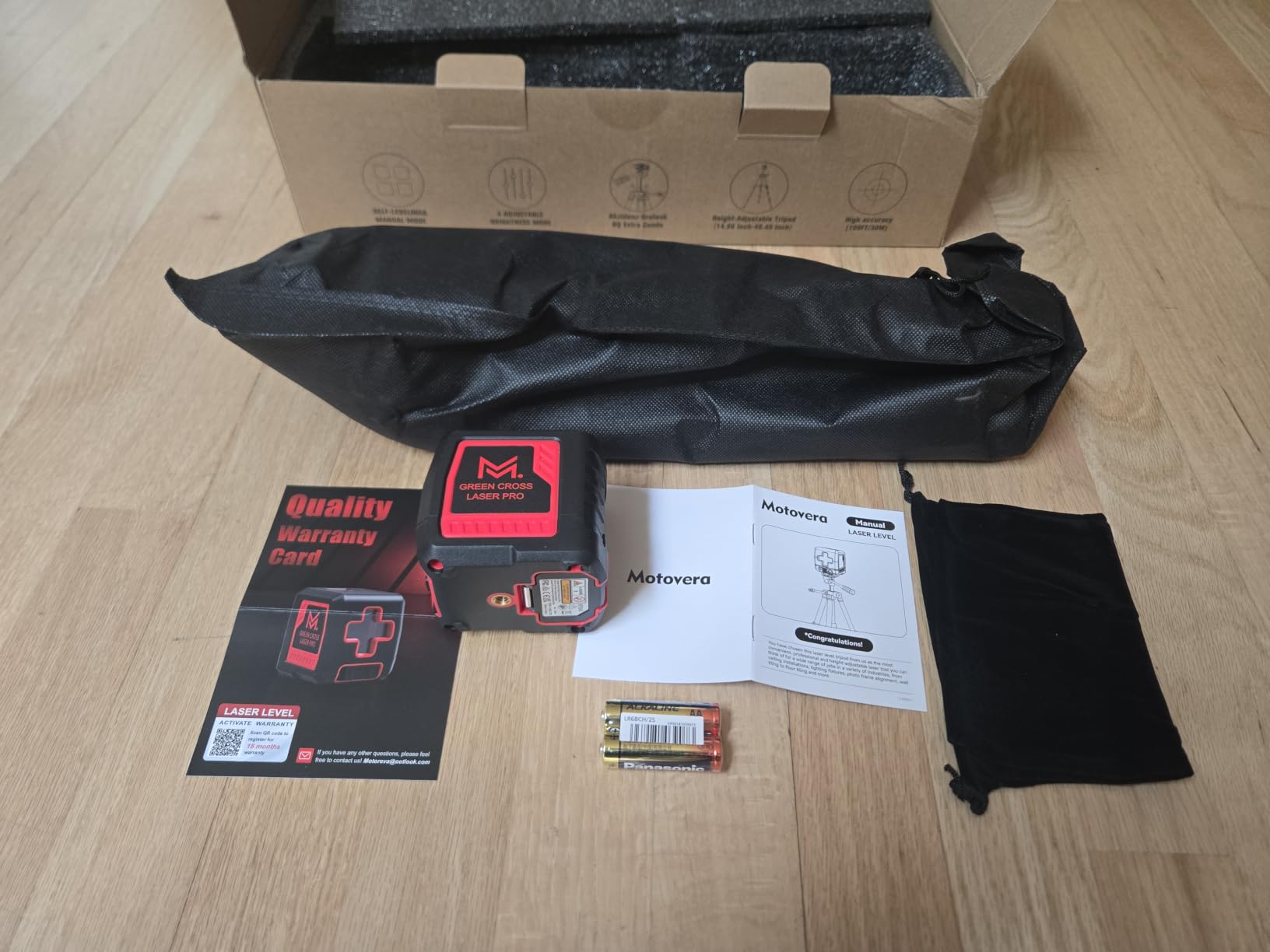
9. Motovera LL-T2 – four brightness modes and a pulse function
Motovera Self Leveling Laser Level 100ft, Green Cross Line with Tripod, 4 Brightness Modes & Pulse Function, Manual & Self-Leveling Modes, IP54 Waterproof for Picture Hanging, Tile, DIY Construction
Green cross line to 100 ft indoors
1/9 inch at 33 ft accuracy
Four brightness modes plus pulse
IP54
Pros
- Bright green cross lines stay visible across a full room in well-lit conditions
- Four brightness settings plus a pulse function adapt to changing light
- Self-levels within seconds with manual mode for angled references
- Bundled tripod adjusts across a solid height range and swivels
- Complete kit with batteries and carry bag under a 24-month warranty
Cons
- Self-leveling range is limited to 4 degrees and needs a near-level start
- Bundled tripod is described as flimsy and the power button needs battery removal
- Mode switching is not obvious from the controls
The four brightness modes are the feature that makes this one interesting in a kitchen that changes through the day. A dim setting for a dim evening install, a high setting for a sunlit wall, and a pulse function for when you are working with a receiver or trying to keep the line readable against a busy background.
Stated accuracy is plus or minus 1/9 inch at 33 feet, with a 110-degree projection angle, and the green cross line is rated visible indoors up to 100 feet. That indoor rating is a real number rather than a marketing one, and it is honest for a tool at this level.
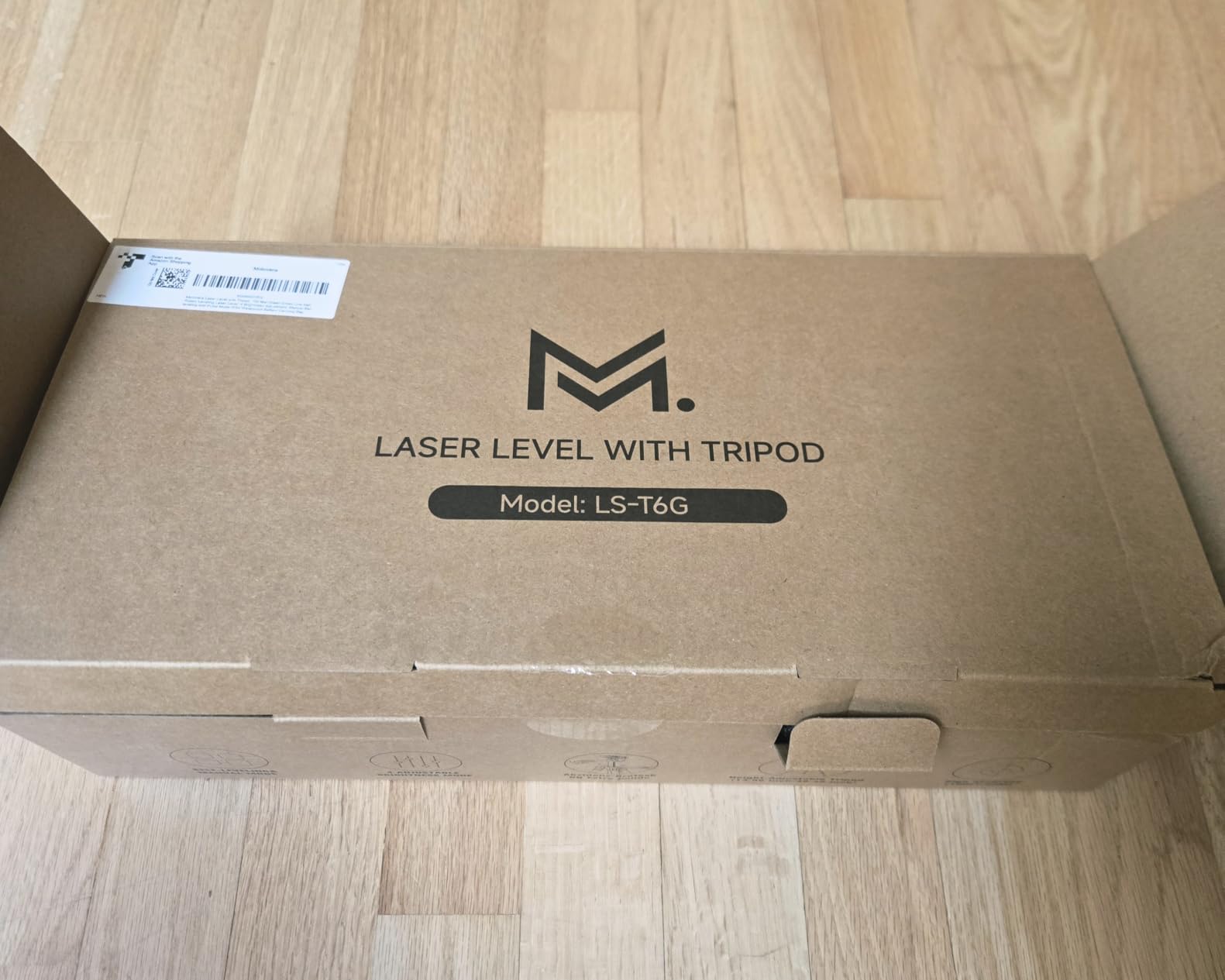
It is IP54 rated for dust and water and drop tested to 30 inches, which is a reasonable figure for a tool that lives in a garage. An adjustable tripod, two AA batteries, a manual and a carry bag are all in the box, with a 24-month warranty behind it.
The rating sits lower than the rest of this list for a specific reason, and it is worth reading before you buy. The pendulum has a 4-degree range and the unit needs to be roughly level before it settles, the bundled tripod is light, and the power button requires removing the batteries to fully switch off.
What to check before you buy
Check the mode controls in a shop or from a photo before purchase. Ambiguous mode switching is an annoyance on the first job and a real problem when you are marking in a dark cabinet cavity with gloves on.
Check the pendulum behaviour too. A tool that needs a near-level start is more forgiving on a tripod at cabinet height than one set on an uneven surface, so plan the mount accordingly.
Where it is the wrong tool
It is the wrong tool for repeat professional work, where the battery-removal power switch and the AA cells become an irritation rather than a detail. A rechargeable unit is a better long-term purchase at that point.
It is also the wrong tool for a wrap-around run. This is a cross-line with a 110-degree projection cone, so the line does not follow you around a corner the way a 360 model does.
10. Nikotek NK01G – a low-cost green cross line for one-time jobs
Nikotek Laser Level, Self-leveling Green Line Laser With Horizontal and Vertical Lines for Construction and Picture Hanging, Battery Included (NK01G)
Green cross line, 110-degree cone
Self-leveling within 3.5 degrees
Flashing out-of-level alert
Pros
- Bright green cross line makes horizontal and vertical references easy to mark
- Self-levels within about 3.5 degrees so the line does not depend on hand placement
- Flashing alert makes an out-of-level condition obvious
- Low cost entry point for a one-time cabinet or shelf hanging job
Cons
- Narrow 3.5 degree self-leveling range is tighter than most competing models
- 110-degree projection cone limits the usable span on wide runs
- Few reported details on battery type runtime or mounting options
If you are hanging four wall cabinets once and you will never touch a laser again, this is the tool that does the job. The green cross line is bright enough to mark from comfortably, and automatic self-leveling within a 3.5-degree range means the line does not depend on how carefully you set it down.
The flashing alert when the surface tilts beyond the self-leveling range is a genuinely good feature at this end of the market, because a wrong line looks exactly like a right one. A blinking tool tells you to reset it.
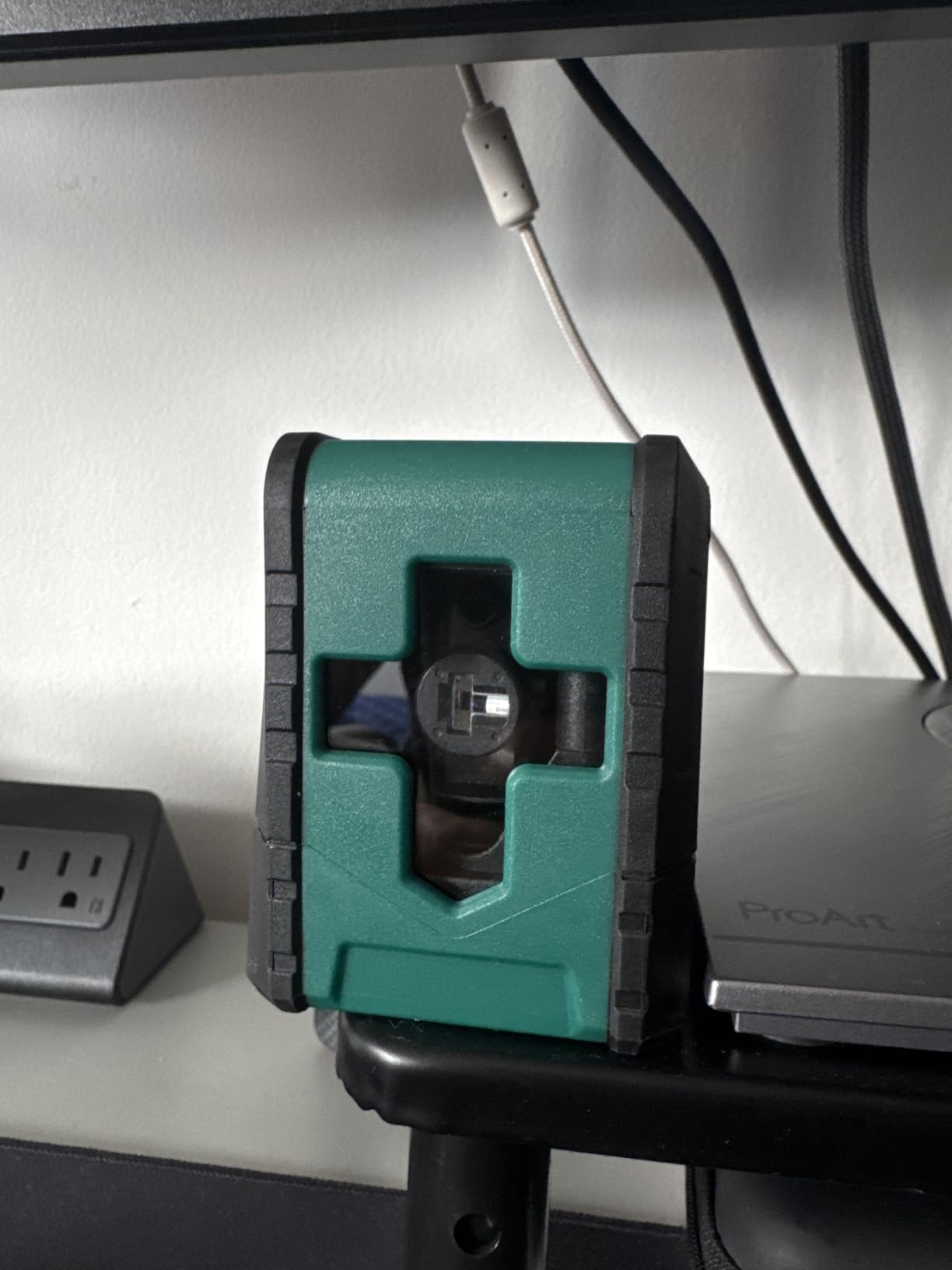
A battery is included, and the metal and plastic body is the simplest construction in this roundup with nothing to fail. For a single set of uppers, or for marking shelf positions in a closet, that simplicity is an advantage rather than a compromise.
Two limits are worth stating plainly. The 3.5-degree self-leveling range is tighter than the 4-degree figures on most competing models, and the 110-degree projection cone narrows the span you can cover in one setup on a wide run.
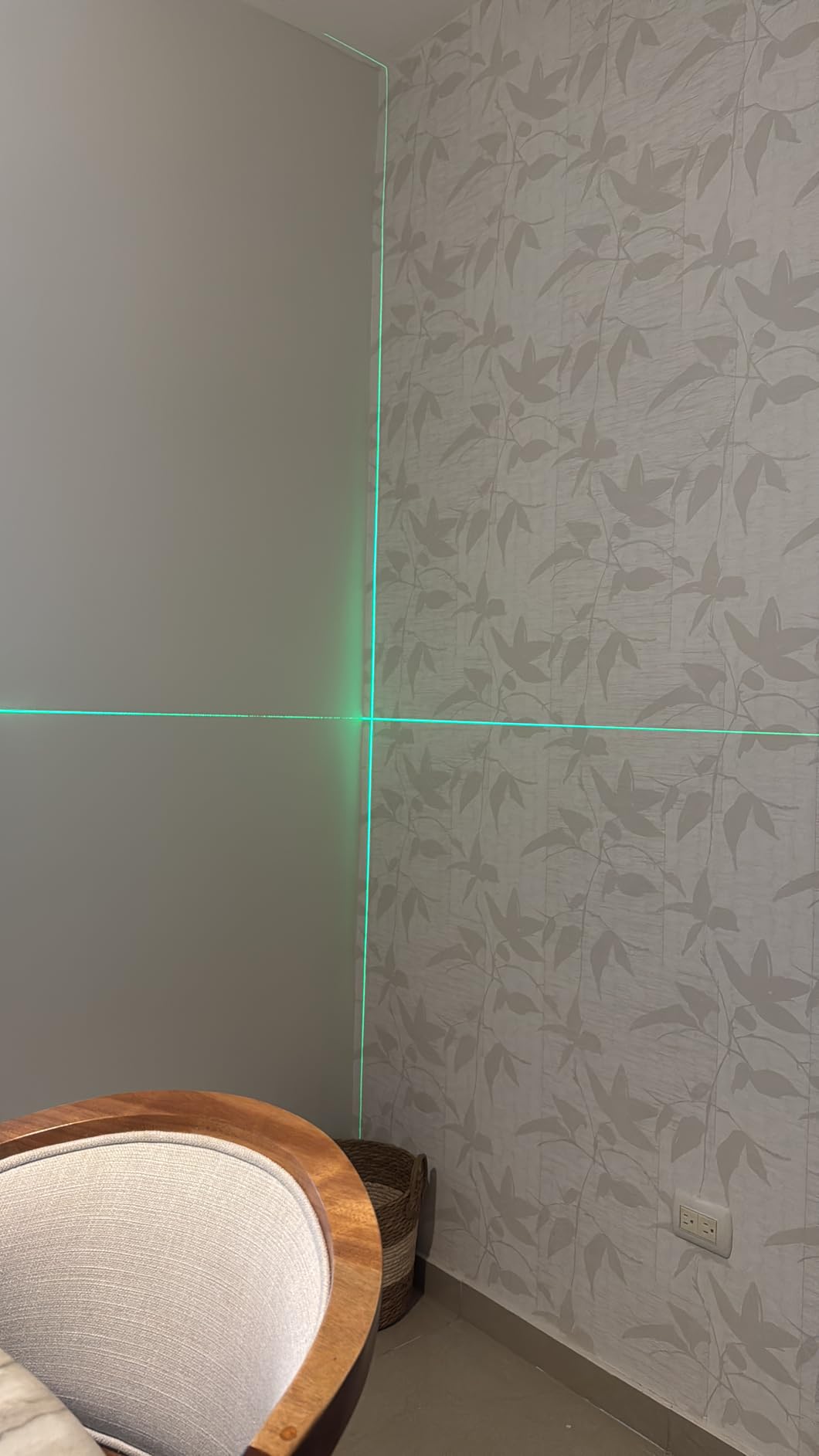
What to check before you buy
Check the mounting story, because that is where the published detail thins out. Battery type, runtime and mounting options are not clearly reported, so confirm what comes in the box before you plan a tripod-free install.
Check the surface you are marking. A narrow self-leveling range needs a reasonably steady setup, and a tripod with a bubble vial is a better foundation than a shelf or a counter.
Where it is the wrong tool
It is the wrong tool for a long run. A 110-degree cone and a 3.5-degree levelling range are workable for a short wall and frustrating across a full kitchen, where you will be repositioning the tool more than once.
It is also the wrong tool for anyone who will own a second laser later. If a bright green cross line taught you that you want 360 coverage, this is a stepping stone rather than a destination.
11. IKOVWUK B1-12 – 12 green lines with a working remote control
IKOVWUK Laser Level with 12 Green Lines, Built-in 5200 mAh Li-ion Battery
12 green lines in 3x360 layout
65 ft line projection
Remote works through walls
5200mAh battery
Pros
- Twelve green lines give full 360 degree coverage from one spot
- Remote control changes lines without walking back to the unit
- 5200mAh battery easily lasts a working day
- Included L-shaped magnetic bracket holds well for wall-hung cabinets
- Good brightness for indoor work with no constant beep
Cons
- Only charges from the supplied AC adapter block despite the USB-C style connection
- Lines wash out in bright light so pulse mode is the practical answer
- Self-leveling range of 3 degrees is the narrowest in this group
The remote is the reason to look at this one. It reaches up to 16 feet and works through walls, which means you can change which planes are on from the far end of the room instead of walking back to the unit every time you need a different reference.
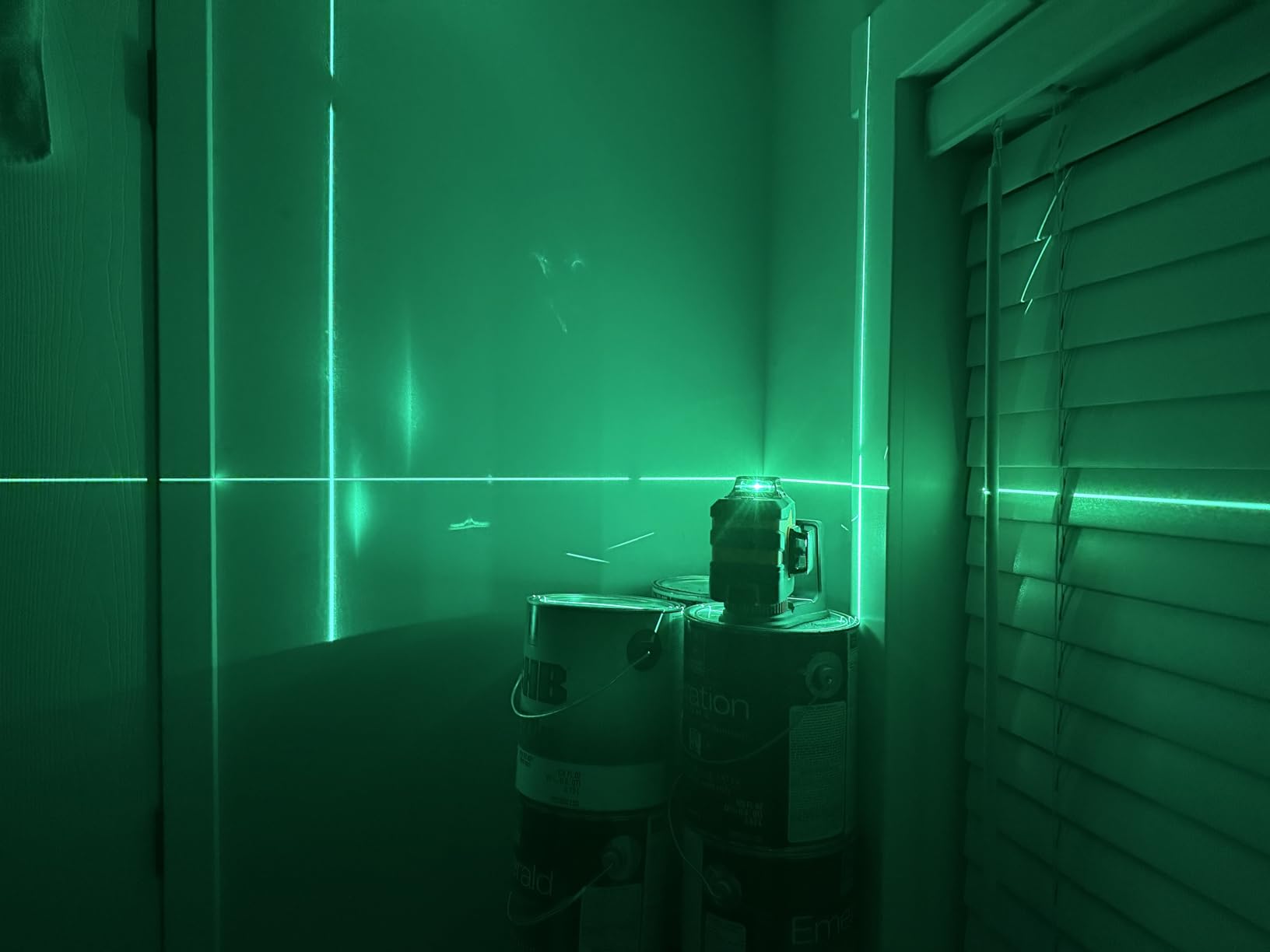
Layout is 3×360: one horizontal and two vertical 360-degree planes, twelve green lines in total, with line projection up to 65 feet. Self-leveling works within 3 degrees with a flashing out-of-range alarm, manual mode handles angled lines, and pulse mode plus adjustable brightness cover bright interiors and outdoor work.
The built-in 5200mAh lithium-ion battery runs up to 8 hours with the charger included, and an L-shaped magnetic bracket plus a metal plate are in the box. The magnetic bracket is the part that matters for hanging cabinets, because it holds the unit against a wall or a stud at height while you mark.
Reported drawbacks cluster around charging, visibility and levelling. It only charges from the supplied AC adapter block despite the USB-C style connection, the lines wash out in bright light so pulse mode becomes the practical answer, and the 3-degree self-leveling range is the narrowest of the 360 models here.
What to check before you buy
Check the charging arrangement before committing. If you travel between jobs and rely on a USB-C port on a power bank to top up, this unit will not do that, and that is a real difference in how you work.
Check that 3-degree range against your setup. It is enough when the unit is on a bracket at cabinet-bottom height, and marginal when you are placing it by hand on an uneven surface.
Where it is the wrong tool
It is the wrong tool for direct outdoor layout, since the lines wash out in bright light and pulse mode is only a partial answer without a receiver. It is a strong indoor tool and a compromised field tool.
It is also the wrong tool if you need a fourth plane. Once you are paying for a full 360 body, the four-plane model with two batteries is the more complete purchase for mixed cabinet and tile work.
12. BLACK+DECKER BDL220S – a rotating wall attachment for single shelves
BLACK+DECKER Laser Level, Self-Leveling, 360 Degree Wall Attachment, AA Batteries Included (BDL220S), 7.25 x 7 x 2.5 inches
Rotating 360 degree wall attachment
Two backlit bubble vials
AA batteries included
2 year warranty
Pros
- Rotating wall attachment projects the laser line at any angle for wall-mounted items
- Backlit oversized bubble vials make reference points easy to read
- Simple and purpose-built for pictures mirrors shelves and curtain rods
- Includes AA batteries and the wall mount in the box
- Very long review history from repeat buyers
Cons
- Manual bubble-vial leveling rather than electronic self-leveling
- Single rotating line with no vertical cross reference
- Compact size limits projection range versus cross-line models
This one is not a cabinet laser and it is listed here because a lot of people reach for one anyway. It is a wall-mount laser with a rotating attachment that projects a line at any angle, built for hanging pictures, mirrors, shelves and curtain rods, and it has one of the longest review records in this roundup.
The rotating wall attachment is the whole idea. You mount it on the wall at the height you want, the line comes off at whatever angle you twist it to, and the two extra-large backlit bubble vials confirm the angle is right in low light. The backlight improves visibility of the reference points specifically.
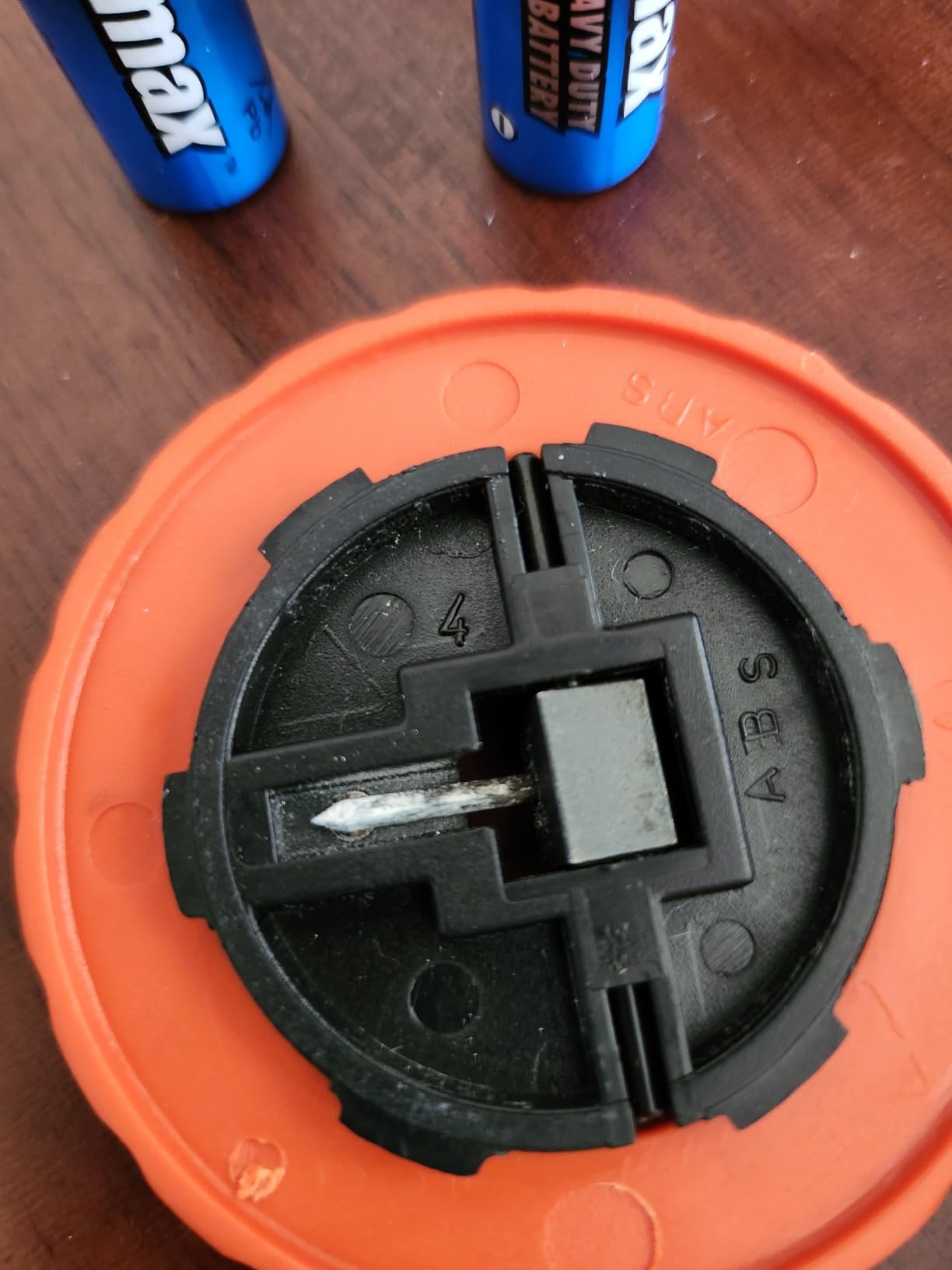
AA batteries and the wall attachment are both in the box, the body is plastic at 7.25 by 7 by 2.5 inches and 0.2 kg, and there is a two-year limited warranty behind it. It is classified as a Class 3R product at 5mW or less, which is a higher power class than the Class II tools elsewhere in this list, so the usual advice about never looking into the beam applies with more force.
The limitation that decides it for cabinet work is the leveling method. It uses manual bubble vials, so the line is only as accurate as the vial reading, and there is a single rotating line rather than a horizontal-vertical cross. That is fine for one shelf and not fine for a run.
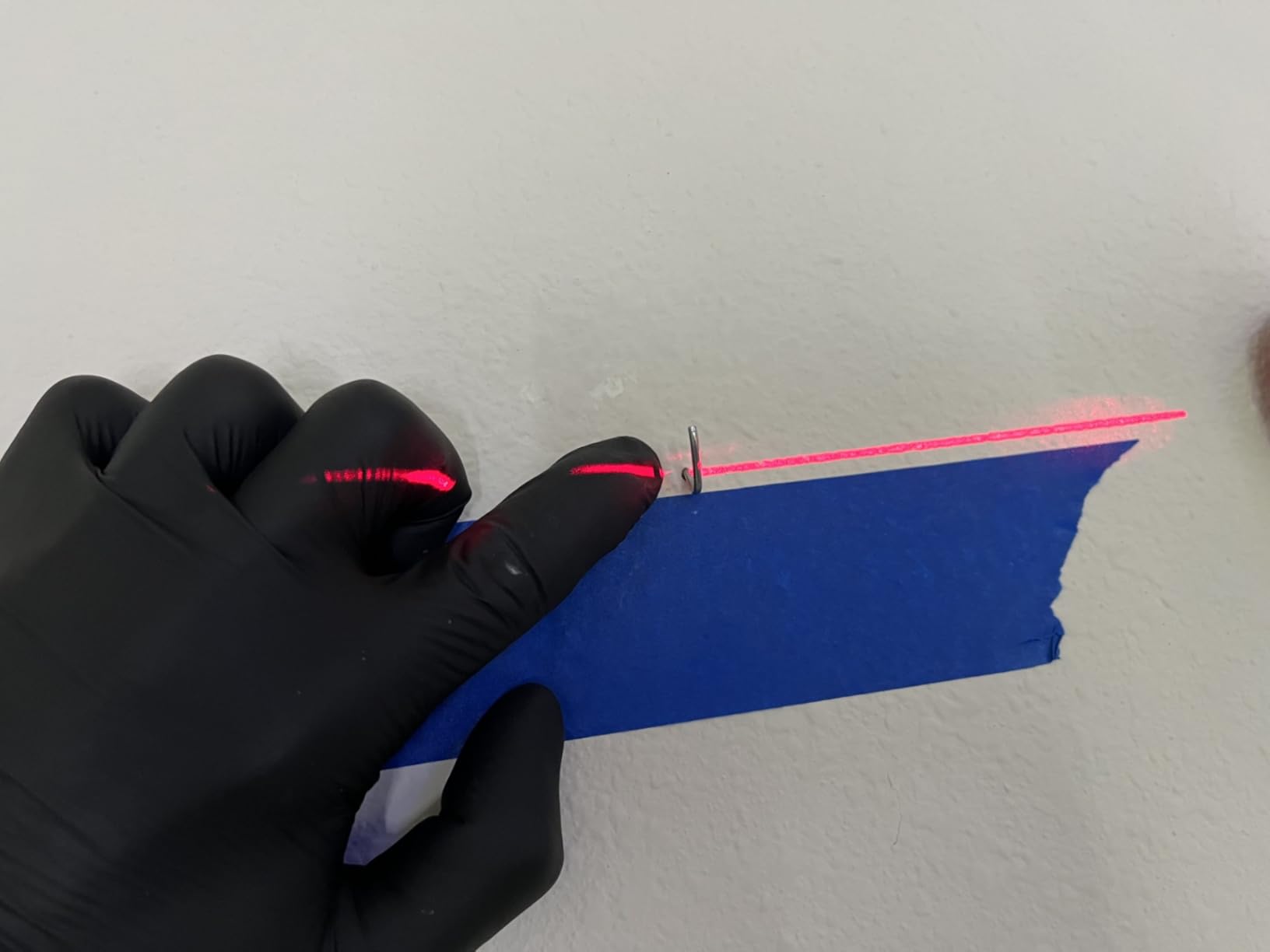
What to check before you buy
Check how many items you are hanging. One shelf, a mirror, a curtain rod and a gallery wall is exactly the brief, and for that the rotating attachment is more convenient than a tripod and a self-leveling unit.
Check the beam class. At Class 3R and up to 5mW this is a more powerful laser than the Class II units in this roundup, so keep it out of the reach of children and never sight along the line to check whether it is on.
Where it is the wrong tool
It is the wrong tool for upper cabinets, without much ambiguity. A manual vial, a single line and a short projection range will not hold a level reference across a wall, which is the one job the laser is meant to do.
It is also the wrong tool for a face frame or reveal. Those need a horizontal reference measured at the same height as the cabinet bottom across a run, and a single angled line will not give you that.
How to Use a Laser Level for Hanging Cabinets
The tool matters less than the sequence. This is the workflow that trades describe on ContractorTalk and Lumberjocks, and it is what turns a laser line into cabinets that actually hang straight.
Step 1: Set the height at the bottom of the lowest cabinet
Standard upper cabinets mount with their bottom edge 54 inches above the finished floor, so that is where the reference line goes. Set the laser to that height and mark it before anything else, because every mark made from a line at the wrong height is a mark you will rediscover later.
Step 2: Set the tool up so it cannot move
Mount on a tripod, a magnetic bracket or a wall mount at the height you just marked. Let the pendulum settle, confirm the out-of-level indicator has stopped blinking, and only then start marking. A tool that gets bumped mid-run is the reason for the tape trick below.
Step 3: Mark the line and find the studs
Snap a chalk line along the beam across the entire run, and mark stud positions along it. A short piece of painter’s tape on the wall at each cabinet position is the trick experienced installers use, because a tape mark survives the laser being knocked off the wall and re-set.
Step 4: Install the ledger board
Screw a straight board along the chalk line into every stud it crosses. That ledger carries the cabinet weight while you position each box, which is what makes a one-person install possible. Without it you are supporting a 30-pound cabinet with one hand and a driver with the other.
Step 5: Hang, verify, and let the laser catch the rest
With the ledger in place, set each cabinet, check it against the line, and drive the screws. The laser line remains your reference for every subsequent box, and a vertical plane also gives you a plumb reference for the cabinet ends.
When the wall is out of plane, scribe instead of shim
A bowed or out-of-plumb wall defeats even the best laser, because the laser gives you one true horizontal line while the wall runs away from it. Over a 14-foot wall a wall that bows an inch will make a dead-level cabinet run gapped at one end and tight at the other.
Shimming every box to force level is the slow fix. Scribing is the correct one: let the cabinets follow the true level line, then scribe the back panel of the end cabinets to the wall so the face frames stay parallel and the reveals stay even. Shims then handle the reveal gap at the low end, which is a small adjustment rather than a fight with every box.
Why the line doubles on a glossy backsplash
A polished surface splits the beam and you see a second faint line, which sends people hunting for a fault that is not there. The main line is the true one, and the doubled line is a reflection off the tile, mirror or polished granite behind it.
Work on the drywall beside the backsplash rather than across the tile, or dim the beam brightness so the reflected line falls below the visible threshold. Pulse mode also helps by making the useful line easier to pick out.
Buying Guide: How to Choose a Laser Level for Cabinets
Green beats red once the room gets bright
Green light is around 520 nanometers and the human eye is most sensitive in that range, which is why a green line looks several times brighter than red at the same output. The practical difference for cabinet work is distance: a red line becomes hard to read somewhere around 10 to 15 feet in a bright room, while a green line is still readable well past 25 feet.
For a normal interior kitchen with a wall under about 10 feet, red is genuinely sufficient and cheaper. For a long run, a sunlit room, or a kitchen that is being worked on during the day, green is the better buy.
Accuracy needs a distance, and 1/8 inch at 30 feet is enough
An accuracy spec without a distance is meaningless, so read the stated figure carefully. For a 12-foot run at 1/8 inch per 30 feet, the drift works out to roughly 1/16 inch across the whole wall, which is well under a typical scribe allowance and usually invisible once the cabinets are trimmed.
Accuracy far beyond that buys you nothing on cabinets and costs you money. A spec of 1/9 inch at 33 feet or 1/16 inch at 16.4 feet, as several of the units here claim, is more than sufficient for a standard install.
Self-leveling range of 3 to 4 degrees covers real setups
Self-leveling corrects for tilt automatically within a stated range, usually plus or minus 3 to 4 degrees, and warns you by blinking or beeping beyond it. A wider range is more forgiving of an awkward mount, so 4 degrees is preferable to 3 where the two are otherwise comparable.
Check for a pendulum lock as well. Without one the pendulum swings freely in transit and can be damaged in the truck, which is a common complaint on budget models and a reason many buyers move up a tier after a first purchase.
360 degrees versus cross-line for a cabinet run
A cross-line laser is correct when the run is one flat wall and nothing else. A 360-degree laser is correct when cabinets wrap a corner, continue into a dining room, or you also need a plumb reference on a vertical plane for cabinet ends.
For floors and large single-surface layout, a rotary laser is the usual answer rather than a line laser, and it is a different category of tool entirely. Nothing in this roundup is designed to level a floor over a large area.
Mounting decides whether you can work alone
An integrated magnetic bracket that grips a steel stud, a wall mount base that screws to the wall, and a 1/4-20 tripod thread are the three options that matter here. The thread is the most universal, since almost any camera tripod fits, and it is what gets the beam to cabinet-bottom height reliably.
Watch for magnetic mounts sold without a metal surface to attach to. A magnet that only grips thin sheet metal is useless on a stud wall, and it is the most common disappointment in this category.
IP ratings and drop ratings are cheap insurance
IP54 means protection against dust and splashing water, which is enough for an indoor install and a garage. IP55 adds a higher water ingress threshold, which matters only if you are working somewhere genuinely wet.
A drop rating of 1 metre, 30 inches or 51 inches all appear in this group and all mean the same thing in practice: the tool survives being knocked off a counter. Cabinet work involves a lot of tools on ledges, so a housing with a rubber overmould is worth a small premium.
Battery choice changes the shape of the day
Rechargeable lithium-ion with USB-C charging is the most convenient option and carries an all-day runtime on the units here. AA batteries are cheaper to start with and become a mid-job cost on a long install, particularly at high brightness.
Watch for non-replaceable built-in batteries. They are fine for a single day of work, and they are a genuine limitation once the tool no longer holds a full charge and you have no swap-in option.
Laser class and eye safety
Class II lasers put out under 1mW and are the everyday-safe category that most of the units here use. Never look into the beam, and never sight along it to check whether the tool is on, because the eye’s pupil focuses the beam onto the retina.
The BLACK+DECKER in this roundup is a Class 3R unit at up to 5mW, which is a higher power class. Keep it out of reach of children and follow the same no-looking rule with more care.
Frequently Asked Questions
What is better, a green or red laser level?
Green is roughly four times brighter to the human eye because the eye peaks near 520 nanometers, so it stays readable well past 25 feet while red washes out around 10 to 15 feet in a bright room. For a short run in a normally lit kitchen, red is sufficient. For a long wall, a sunlit space, or a full-day install, green is worth the difference.
How accurate does a laser level need to be for cabinet installation?
One-eighth inch at 30 feet is the practical threshold, and most units here meet or beat it. Over a 12-foot run that works out to roughly 1/16 inch of drift across the whole wall, well inside a normal scribe allowance. Always check the stated distance on the spec, because an accuracy figure without one cannot be compared.
Do I need a 360 degree laser level for kitchen cabinets?
Only if the run wraps a corner, continues into another room, or you need a vertical plane as a plumb reference at the cabinet ends. For a single flat wall of uppers, a cross-line laser is the correct and cheaper shape of tool. A 360 model earns its place when one setup needs to cover the whole room without repositioning.
Do I need a tripod for a laser level?
For upper cabinets, yes. The reference line sits at 54 inches, so the tool has to reach that height hands-free, and a tripod with a 1/4-20 thread is the cheapest way to do it. Magnetic brackets work on metal studs and corner bead but will not grip a dimensional 2×4, and bundled mini tripods are usually too short for cabinet height.
Can laser levels damage your eyes?
Yes, if you look into the beam. Class II units output under 1mW and are the everyday-safe category, but the eye’s pupil focuses the beam onto the retina, so never sight along a line to check whether the tool is on. Some higher-class models output more, so keep any laser out of reach of children and treat the no-looking rule as absolute.
How high should I set the laser when hanging upper cabinets?
Set the beam at the bottom edge of the lowest cabinet, which is 54 inches above the finished floor for a standard install. Mark that height first, then mount the tool at exactly that line and let the pendulum settle before marking anything. Every mark taken from a reference line at the wrong height is a mark you will rediscover once the cabinets are up.
Final Verdict
The DEWALT DW088K is the best laser level for hanging cabinets, and the reason is durability and accuracy rather than clever features. It self-levels in a second or two, holds about 1/8 inch at 30 feet, carries an integrated magnetic bracket and a 1 metre drop rating, and it is the tool other people on r/cabinetry and ContractorTalk name when they ask the same question.
If your kitchen is bright or the run is long, the CIGMAN CM-701 is the better value. Twelve green lines across three planes cover a whole room from one position, the 4000mAh battery charges over Type-C, and the price sits well below the four-plane premium tier. For a run that wraps a corner or continues into a dining room, the Huepar LS04CG is the complete answer, with four 360-degree planes and two rechargeable batteries.
At the entry end, the Nikotek NK01G and the Lusweimi green cross line with its 50-inch tripod will both get a single wall of cabinets hung straight, and the latter includes the tripod you would otherwise buy separately. For a one-time shelf or gallery wall job, the hot shoe bubble levels we recommend cover a similar need without a beam.
Whatever you choose, the sequence matters more than the model. Set the line at cabinet-bottom height, let the pendulum settle, snap a chalk line, screw a ledger board into the studs, and hang to that. It is the reason a single person can do a job that used to need a helper holding a 4-foot level at the far end of the wall. We keep updating this roundup through 2026 as new models appear, and you can see our other tested picks in the hanging pot racks guide and the closet organizers guide.