
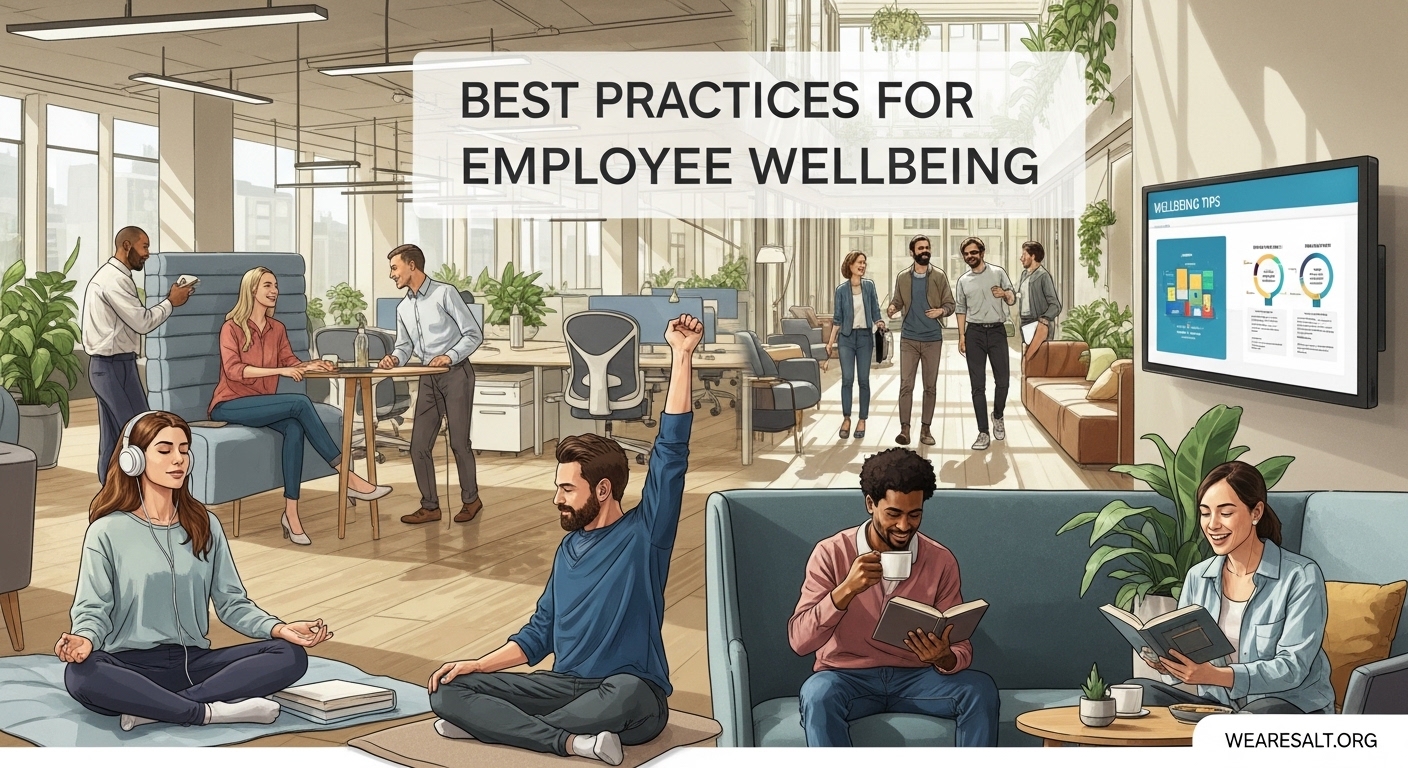
Employee wellbeing has become one of the most critical priorities for organizations in 2026. When your team’s mental health suffers, productivity drops, turnover rises, and your bottom line takes a hit. I have spent years researching workplace wellness initiatives, and the data consistently shows one truth: companies that invest in genuine wellbeing practices outperform those that merely pay lip service.
This guide covers the best practices for employee wellbeing that actually work. You will learn the five pillars of holistic wellbeing, practical management strategies to prevent burnout, and how to measure success without falling into tokenistic initiatives that employees see right through. Whether you are a manager looking to support your team or an HR leader building a comprehensive strategy, these evidence-based approaches will help you create a workplace where people thrive.
Drawing from workplace wellbeing insights and extensive research from organizations like Gallup and Harvard, I have distilled what truly moves the needle on employee wellbeing.
Table of Contents
What is Employee Wellbeing?
Employee wellbeing is a holistic approach to supporting workers that encompasses mental health, physical health, social connections, financial wellness, and career satisfaction. Unlike traditional wellness programs that often focus narrowly on physical health perks like gym memberships, true wellbeing addresses the complete picture of what employees need to thrive both at work and in life.
The research consistently points to five core pillars of employee wellbeing. These are not arbitrary categories but interconnected elements that, when supported together, create lasting positive change.
The Five Pillars of Employee Wellbeing
Career wellbeing sits at the foundation. Employees need to feel that their work matters, that they have opportunities to use their strengths, and that they can see a path for growth. Without this, other wellbeing initiatives fall flat.
Social wellbeing comes from having strong relationships and a sense of belonging at work. This includes connections with managers, peers, and the broader organizational community. Remote and hybrid work arrangements make this pillar more challenging but also more essential.
Financial wellbeing means employees feel secure about their financial situation and can manage their economic lives effectively. Financial stress is one of the biggest drains on mental health and workplace focus.
Physical wellbeing encompasses having the energy and health to get things done daily. This includes sleep, nutrition, exercise, and access to healthcare resources.
Community wellbeing reflects the sense of engagement employees have with the area where they live. Companies that support community involvement often see stronger loyalty and connection from their workforce.
Why Employee Wellbeing Matters: The Business Case
Poor employee wellbeing costs organizations billions annually. According to Gallup research, employees who are struggling or suffering in their wellbeing are significantly more likely to experience burnout, take sick days, and leave their jobs. The financial impact extends far beyond turnover costs to include lost productivity, increased healthcare expenses, and damage to employer brand.
When wellbeing thrives, the numbers flip dramatically. Organizations with strong wellbeing cultures report higher engagement scores, better customer ratings, and improved financial performance. One study found that companies with highly engaged workforces outperform their peers by 147% in earnings per share.
The cost of doing nothing is staggering. Burnout alone costs an estimated $322 billion annually in lost productivity globally. Employees experiencing burnout are 63% more likely to take a sick day and 23% more likely to visit the emergency room. These are not abstract statistics; they represent real financial losses that directly impact profitability.
What I have observed from forum discussions confirms this data. Employees consistently report that when companies ignore workload management while offering surface-level perks, cynicism grows. The disconnect between culture messaging and reality often becomes a bigger problem than offering no wellbeing support at all.
Best Practices for Employee Wellbeing
These evidence-based practices have been tested across industries and company sizes. The key is implementing them with genuine commitment rather than checking boxes.
Support Open Communication About Mental Health
Mental health stigma in the workplace remains one of the biggest barriers to employee wellbeing. Managers must take active steps to normalize conversations about mental health without overstepping boundaries.
Start by sharing your own experiences when appropriate. When leaders openly discuss taking mental health days or managing stress, it signals to employees that the topic is safe to discuss. Train managers to recognize signs of distress and respond with empathy rather than judgment.
Provide clear pathways to resources. Employee Assistance Programs are valuable only if employees know how to access them confidentially. Consider bringing in mental health professionals for workshops that destigmatize seeking help. Walking meetings and meditation breaks are practical interventions that employees consistently cite as genuinely helpful.
Shift Perspectives on Performance Reviews
Traditional performance reviews often create anxiety and damage wellbeing. The annual evaluation model tends to trigger fear responses and focuses disproportionately on criticism rather than growth.
Move toward continuous feedback models. Weekly or bi-weekly check-ins between managers and employees reduce the stress of annual reviews and provide more opportunities for course correction. Focus these conversations on development rather than judgment.
Frame feedback through a growth mindset lens. Instead of rating employees against each other, discuss what skills they are building and what support they need. This approach improves performance while protecting psychological safety.
Implement Flexible Work Arrangements
Flexibility has become non-negotiable for many workers. The post-pandemic workforce expects autonomy over when and where work gets done. Companies that force rigid return-to-office policies often see morale and retention suffer.
Design flexible arrangements based on trust. Focus on outcomes rather than hours logged. Research shows that employees with autonomy over their schedules report higher wellbeing and often accomplish more, not less.
Hybrid models work best when they offer genuine choice rather than mandated office days. Consider compressed workweeks, flexible start times, and remote options as standard offerings. The companies winning the talent war in 2026 are those treating flexibility as a permanent feature, not a temporary accommodation.
Create Recognition and Feedback Systems
Recognition is a fundamental human need, yet many employees report feeling invisible at work. Effective recognition systems go beyond annual awards to create daily moments of appreciation.
Train managers to give specific, timely feedback. Generic praise feels hollow. Instead of “great job,” try “the way you handled that client situation demonstrated excellent problem-solving under pressure.” Specificity shows you are paying attention and makes recognition more meaningful.
Encourage peer recognition alongside manager recognition. Tools that allow colleagues to acknowledge each other’s contributions build stronger team bonds. Recognition should also flow upward; employees should feel comfortable sharing when leaders are supporting their wellbeing effectively.
Manage Workload and Prevent Burnout
This is where many wellbeing programs fail. You cannot yoga-mat your way out of unsustainable workloads. Employees consistently report that respect and realistic expectations matter more than ping pong tables or free snacks.
Audit workload distribution regularly. Are expectations reasonable given available resources? Are top performers being overloaded while others have capacity? Address imbalances before they become burnout triggers.
Normalize mental health days as distinct from sick days. When employees feel they can take time for mental restoration without needing to fabricate physical illness, stress levels decrease. Model this behavior at leadership levels; if executives never take time off, employees will not either.
Set clear boundaries around after-hours communication. The expectation that employees respond to emails at 10 PM destroys wellbeing regardless of other perks offered. Establish and enforce communication norms that respect personal time.
Provide Professional Development Opportunities
Career wellbeing depends on seeing a future with your organization. When employees feel stuck, engagement drops and turnover rises. Investment in professional development signals that you value their long-term growth.
Offer learning budgets that employees can direct toward their interests. Provide stretch assignments that build new skills. Create mentorship programs that connect junior staff with senior leaders. These investments pay dividends in retention and performance.
Manager training deserves special attention. The single biggest factor in employee wellbeing is often their direct manager. Investing in leadership development specifically focused on wellbeing support creates cascading benefits throughout the organization.
Build a Culture of Psychological Safety
Psychological safety is the belief that you will not be punished or humiliated for speaking up with ideas, questions, concerns, or mistakes. It is the foundation of team effectiveness and individual wellbeing.
Create environments where failure is treated as learning rather than grounds for punishment. When employees hide mistakes, problems fester. When they feel safe admitting errors, issues get resolved faster and innovation increases.
Include diverse voices in decision-making. Exclusion damages belonging and wellbeing. Actively solicit input from quieter team members and create forums where all perspectives can be heard. This requires intentional effort, as default meeting dynamics often favor the loudest voices.
Address toxic behavior immediately. One toxic team member can destroy psychological safety for everyone. Leaders who tolerate bullying or incivility for the sake of results signal that wellbeing is not actually a priority.
Signs of Burnout to Watch For
Burnout does not happen overnight. It builds gradually, and early intervention is far more effective than waiting for crisis. Managers should watch for these warning signs.
Behavioral changes often signal distress first. An engaged employee who becomes withdrawn, a reliable performer who starts missing deadlines, or a collaborative team member who becomes irritable may be experiencing burnout. Trust your observations and address them compassionately.
Physical symptoms include exhaustion that rest does not resolve, frequent illness, headaches, and sleep disturbances. Emotional signs include cynicism about work, feelings of ineffectiveness, and detachment from colleagues.
When you observe these signs, respond with curiosity rather than criticism. Ask open-ended questions about how the person is doing. Offer specific support options. Sometimes simply being seen and acknowledged makes a significant difference.
Measuring Employee Wellbeing Success
You cannot improve what you do not measure. Effective wellbeing strategies include systematic approaches to tracking progress and identifying areas needing attention.
Gallup’s Net Thriving metric provides a simple framework. Employees are categorized as thriving, struggling, or suffering based on their current and future life situation ratings. Organizations can track the percentage of employees in each category over time.
Regular pulse surveys offer more granular insights. Ask specific questions about workload, manager support, psychological safety, and access to resources. Keep surveys anonymous to encourage honest responses. Share aggregated results with teams and commit to action based on feedback.
Track leading indicators alongside lagging ones. Retention and absenteeism show you where problems already exist. Engagement scores, participation in wellbeing programs, and utilization of mental health resources help predict issues before they become crises.
One of the biggest gaps I see in wellbeing programs is failure to close the feedback loop. Employees quickly learn whether surveys lead to action or are performative exercises. Only ask questions if you are prepared to respond to what you learn.
Best Practices for Employee Wellbeing FAQ
What are the 5 pillars of employee wellbeing?
The 5 pillars of employee wellbeing are: 1) Career wellbeing – feeling that work matters and having growth opportunities, 2) Social wellbeing – having strong relationships and a sense of belonging at work, 3) Financial wellbeing – feeling secure about financial situation, 4) Physical wellbeing – having energy and health to get things done, and 5) Community wellbeing – feeling engaged with the area where one lives. These five elements, based on Gallup research, provide a holistic framework for supporting employee wellbeing.
What are the 4 pillars of wellbeing in the workplace?
The 4 pillars of wellbeing in the workplace are often defined as: 1) Physical health – fitness, nutrition, sleep, and medical care, 2) Mental/emotional health – stress management, resilience, and psychological safety, 3) Social wellbeing – relationships with colleagues and sense of belonging, and 4) Financial wellbeing – security and ability to manage economic life. While similar to the 5-pillar model, this framework sometimes combines career and community aspects into broader categories.
What are unfavorable working conditions?
Unfavorable working conditions include: excessive workload and unrealistic expectations, lack of autonomy or control over work, poor management support, unclear or conflicting job responsibilities, inadequate resources to perform tasks, toxic workplace culture or bullying, lack of recognition or appreciation, unsafe physical environments, inflexible schedules that prevent work-life balance, and limited opportunities for growth or advancement. These conditions contribute to stress, burnout, and poor employee wellbeing.
How to improve employee wellbeing?
To improve employee wellbeing, organizations should: implement flexible work arrangements, provide mental health resources and reduce stigma, ensure realistic workloads, offer professional development opportunities, create recognition systems, train managers in wellbeing support, build psychological safety, and measure progress through regular surveys. The most effective approaches address root causes like workload and management practices rather than just adding superficial perks.
What causes employee burnout?
Employee burnout is caused by chronic workplace stress that has not been successfully managed. Key contributors include: unsustainable workload, lack of control over work decisions, insufficient rewards or recognition, breakdown of community or social support, absence of fairness or equity, and mismatches between values and job demands. Personal factors like perfectionism and poor boundaries can amplify these workplace conditions.
Conclusion
Best practices for employee wellbeing are not complicated, but they require genuine commitment. The organizations seeing real results focus on fundamentals: manageable workloads, supportive managers, psychological safety, and meaningful work. They measure progress and adjust based on feedback. They recognize that actions speak louder than policy documents.
Start with an honest assessment of where your organization stands today. Survey employees about their current experience. Identify which of the five pillars need the most attention. Choose one or two high-impact practices to implement first rather than trying to change everything at once.
The return on wellbeing investment is well-documented. Companies that get this right retain top talent, see higher productivity, and build cultures where people genuinely want to work. In 2026‘s competitive talent market, that advantage is worth the effort. For more insights on building effective employee wellbeing programs, explore additional resources that can guide your journey toward a thriving workplace.
Your employees’ wellbeing is not a nice-to-have perk. It is foundational to sustainable business success. The time to act is now.