
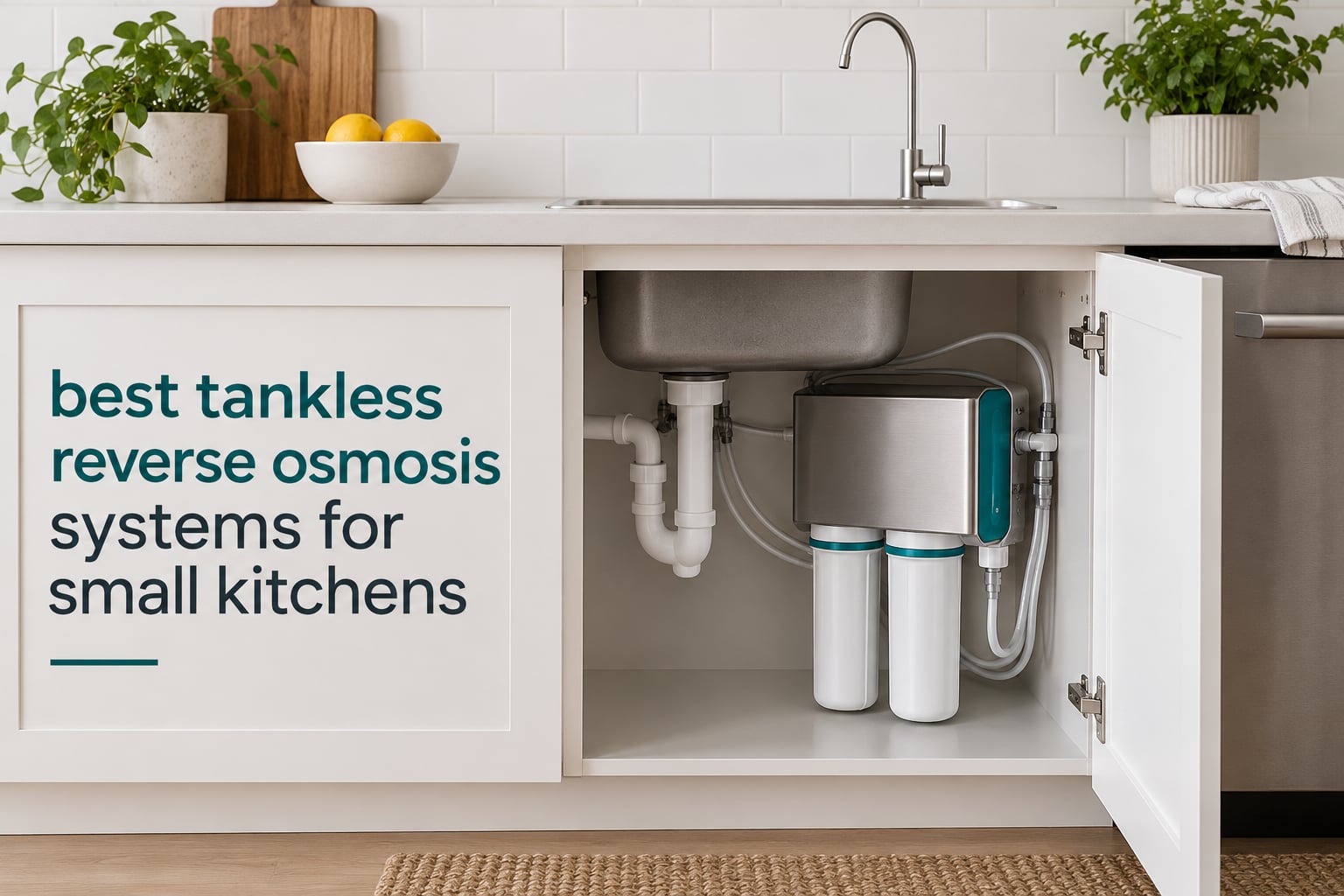
Most tankless reverse osmosis systems win in a small kitchen for one reason: there is no pressurized storage tank sitting on the cabinet floor. That single omission frees roughly 10 to 16 inches of cabinet width and 12 to 16 inches of height, which in a galley kitchen or an apartment cabinet is the difference between installing an RO system and not installing one at all. After putting eight of them side by side on footprint, rated flow, certified contaminant reduction and what the filters cost to keep running, these are the best tankless reverse osmosis systems for small kitchens in 2026.
Tankless does not mean maintenance-free, and it is not automatically the better choice everywhere. It means the purified water is produced on demand and sent straight to a dedicated faucet instead of being held under pressure.
The trade is a unit that needs a live electrical outlet under the sink, replacement cartridges that only come from one brand, and a booster pump you can hear while water runs. Buyers who weighed those three costs and still chose tankless got better cabinet space, faster cup fills and no tank to refill or leak.
Filtration performance, for what it is worth, is not where tankless and tank-based systems differ. Both push feed water through a sediment stage, a carbon block and a 0.0001 micron RO membrane, and the membrane does the same work either way. What changes is the plumbing around it, and that is exactly what we measured for this roundup.
If you want the wider picture first, our guide to the best tankless reverse osmosis systems covers the category without the size constraint, and our reverse osmosis systems for drinking water guide handles the tank-based side.
Table of Contents
Top 3 Best Reverse Osmosis Systems for Small Kitchens
Three units pulled ahead on the things that actually decide a small-kitchen purchase: a footprint you can slide into a shallow cabinet, certified contaminant reduction, and replacement filters you can buy without hunting.
The Waterdrop G3P800 takes the top spot on throughput and review depth, the Waterdrop G3P600 pairs a smart faucet with a 2:1 drain ratio, and the Frizzlife PD600-TAM3 is the smallest of the 600 GPD group by a clear margin.

Waterdrop G3P800 800 GPD
- 800 GPD with a 5-second cup fill
- 3:1 pure-to-drain ratio
- IAPMO R&T certified to NSF/ANSI 58/42/53/372
- Smart LED faucet showing TDS and filter status

Waterdrop G3P600 600 GPD
- 600 GPD at 0.42 gpm
- 2:1 pure-to-drain ratio
- 8-stage SGS tested filtration
- Front-facing filter changes in 3 seconds

Frizzlife PD600-TAM3 600 GPD
- Smallest 600 GPD footprint at 14.7 inch deep
- Alkaline remineralization above pH 7.5
- 2:1 pure-to-drain ratio
- Smart LED TDS and filter life panel
All 8 Tankless RO Systems at a Glance
Every system below is a genuine reverse osmosis design with no storage tank. Dimensions are the published figures, and the depth number is the one that decides whether it fits your cabinet.
| Product | Specifications | Action |
|---|---|---|
| Waterdrop G3P800 Tankless RO 800 GPD |
|
Check Latest Price |
| Waterdrop G3P600 Tankless RO 600 GPD |
|
Check Latest Price |
| Frizzlife PD600-TAM3 Tankless RO 600 GPD |
|
Check Latest Price |
 Waterdrop G2P600 Under-Sink RO 600 GPD Waterdrop G2P600 Under-Sink RO 600 GPD |
|
Check Latest Price |
 iSpring RO500AK Alkaline RO 500 GPD iSpring RO500AK Alkaline RO 500 GPD |
|
Check Latest Price |
 SimPure T1-400ALK Tankless RO 400 GPD SimPure T1-400ALK Tankless RO 400 GPD |
|
Check Latest Price |
 Glacier Fresh GFU03 Electric-Free RO 800 GPD Glacier Fresh GFU03 Electric-Free RO 800 GPD |
|
Check Latest Price |
 iSpring RCS5T Commercial Tankless RO 500 GPD iSpring RCS5T Commercial Tankless RO 500 GPD |
|
Check Latest Price |
1. Waterdrop G3P800 Tankless Reverse Osmosis Water Filter System, 800 GPD
Waterdrop G3P800 Tankless Reverse Osmosis Water Filter System, 800 GPD
800 GPD
3:1 pure-to-drain
18.12 inch deep
10-stage filtration
Electric
Pros
- 5-second cup fill at 800 GPD rated capacity
- IAPMO R&T certified to NSF/ANSI 58/42/53/372
- Very quiet pump even while dispensing
- Plumbs well to a refrigerator ice maker
- Strong support including full unit replacement
Cons
- Highest purchase price of the group
- Costly replacement cartridges over the life of the unit
- Long 18.12 inch body needs cabinet measuring
- Needs an always-hot outlet under the sink
The Waterdrop G3P800 is the one I would put in a small kitchen with no hesitation, and the reason is throughput rather than footprint. At 800 GPD it fills a cup in about five seconds and plumbs to a refrigerator line, which matters if your ice maker is the reason you wanted filtered water in the first place.
It also carries the deepest review base of any system in this roundup, with more than 5200 ratings, so the failure patterns are well documented instead of anecdotal.
The certification is the strongest on paper in the group. It is certified by IAPMO R and T to NSF/ANSI 58, 42, 53 and 372, and the 10-stage stack was tested by SGS for PFAS, fluoride, lead, chromium, iron, nitrates, chloride, radium and vinyl chloride.
That 58 listing matters more than any feature on the faucet, because 58 is the standard that certifies actual contaminant reduction rather than just material safety. It is the listing to look up first if you want a number you can point to.
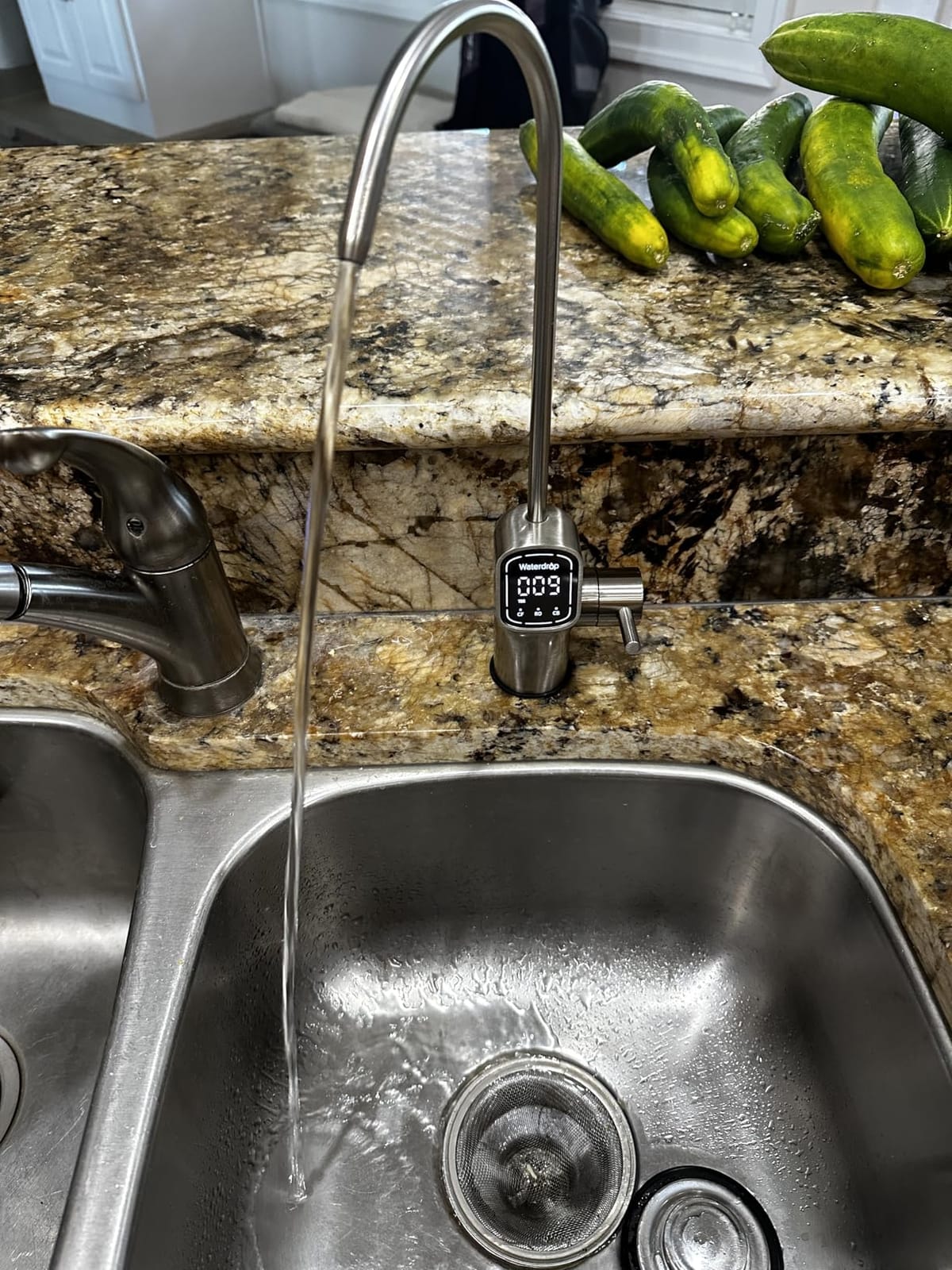
The 3:1 pure-to-drain ratio is the second reason this one ranks first. Every gallon of purified water sends roughly three gallons down the drain, which is a meaningful improvement on older tank systems that pushed four gallons for every one produced. Owners upgrading from a conventional system mention the 3:1 ratio and near-silent pumping as the two changes they notice on day one.
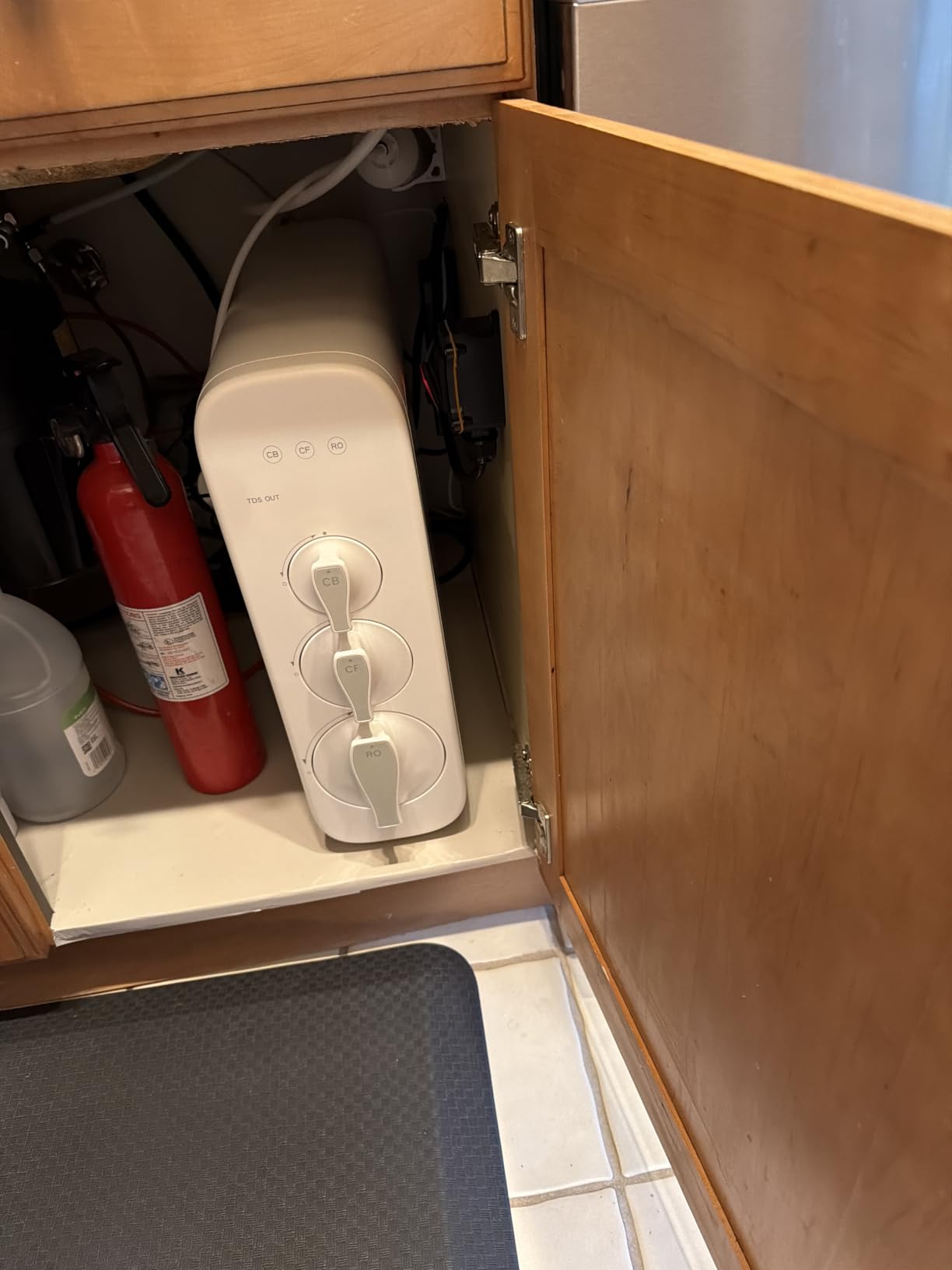
The compromises are physical and financial. The body is 18.12 inches long, 5.67 inches wide and 17.72 inches tall, which is the longest cabinet footprint in this roundup and the reason it will not fit every small kitchen.
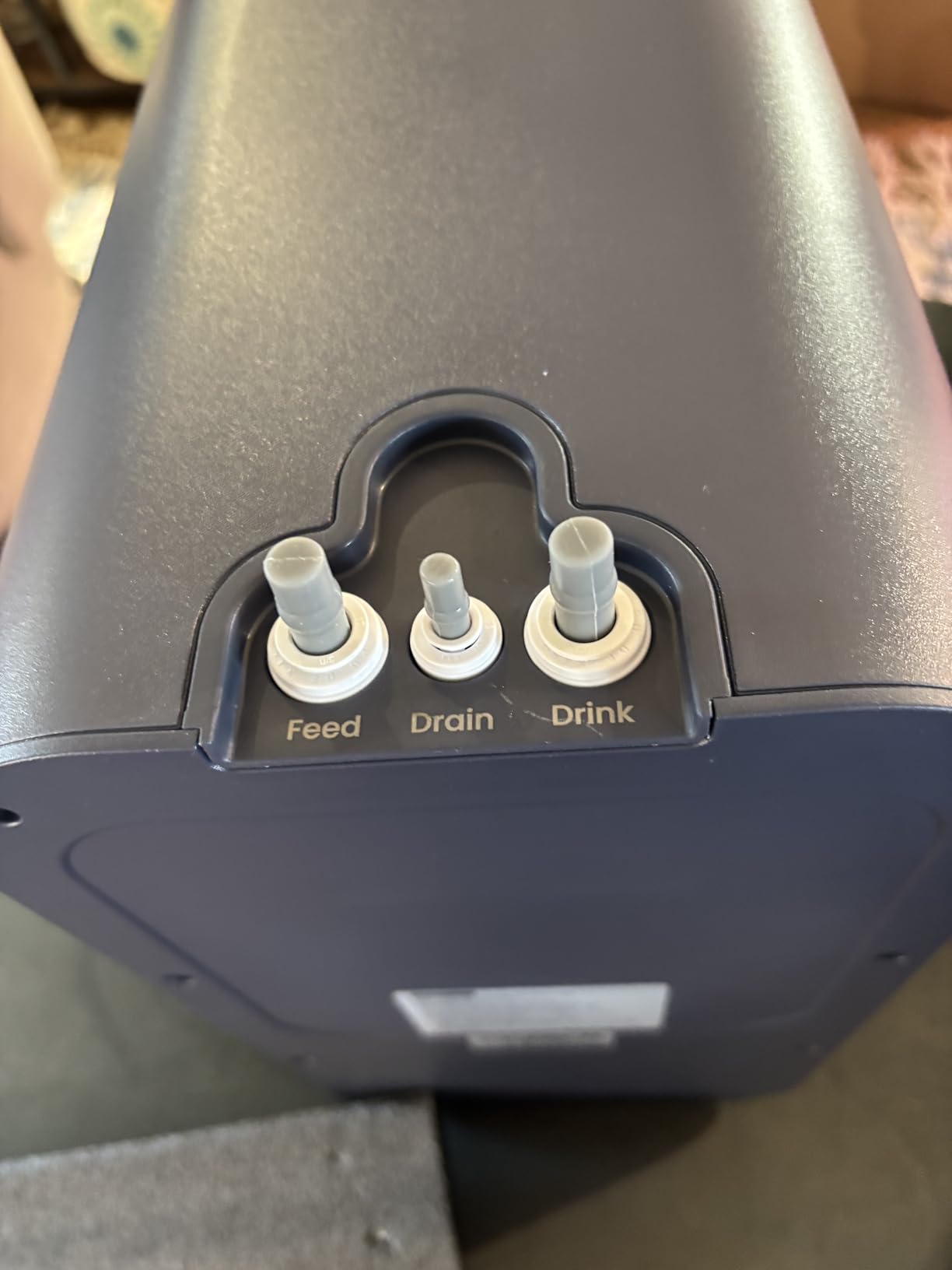
Money is the other compromise. Multi-year owners report that the carbon and pre-filter pack plus the RO filter add up quickly, which is a real running cost to weigh before committing. Installation has one slow moment too: the smart faucet wants a larger mounting hole than a standard RO faucet, and enlarging thick stainless steel is fiddly work.
A minority of buyers report the wastewater pump continuing to run after a filter change until the system is reset, though support resolved these with replacements. Waterdrop draws repeated questions on r/WaterTreatment about certification legitimacy, and that is why we checked the IAPMO R and T listing rather than trusting the box.
When the G3P800 is the right call
Choose this if your household is three people or more, or if a refrigerator ice maker and water dispenser are in the plan. A 3:1 ratio and a five-second fill mean nobody is waiting by the sink while a pitcher fills, which is the difference between an RO system people use daily and one they stop using.
It also suits kitchens where the cabinet has depth to spare. If your cabinet measures 18 inches or more front to back, the footprint here disappears as a concern and you are choosing purely on capacity and certification.
When to pick something else
Skip it if your cabinet is shallow. At 18.12 inches long, this is the longest body here and a common under-sink cabinet in a small kitchen simply does not offer that. Measure before you fall for the capacity number.
Also weigh the filter running cost over several years. Owners who switched from a lower-cost brand report the cartridge spend as the main reason they hesitate, and that cost does not shrink if you only drink a few glasses a day. The budget pick further down is a better fit for light use, and the value pick a couple of sections below costs less to keep stocked.
2. Waterdrop G3P600 Tankless Reverse Osmosis Water Filter System, 600 GPD
Waterdrop G3P600 Tankless Reverse Osmosis Water Filter System, 600 GPD
600 GPD at 0.42 gpm
2:1 pure-to-drain
Smart display faucet
18.12 inch deep
Electric
Pros
- Live TDS reading and filter status on the faucet
- Filter changes in about 3 seconds without tools
- 2:1 drain ratio keeps waste in check
- Handles feed water up to 1500 ppm TDS
- Certified to NSF/ANSI 42/53/58/372
Cons
- Needs a live electrical outlet under the sink
- Replacement filters cost more over the life of the unit
- First water after idle needs 30 to 40 seconds of flushing
- Slower purified flow than a standard faucet
The G3P600 is the same idea as the system above with a slightly lower capacity figure and a much longer track record, sitting at more than 4100 ratings. For most small kitchens it is the more realistic purchase, because 600 GPD is already more than a household of two drinks in a year and you give up nothing practical.
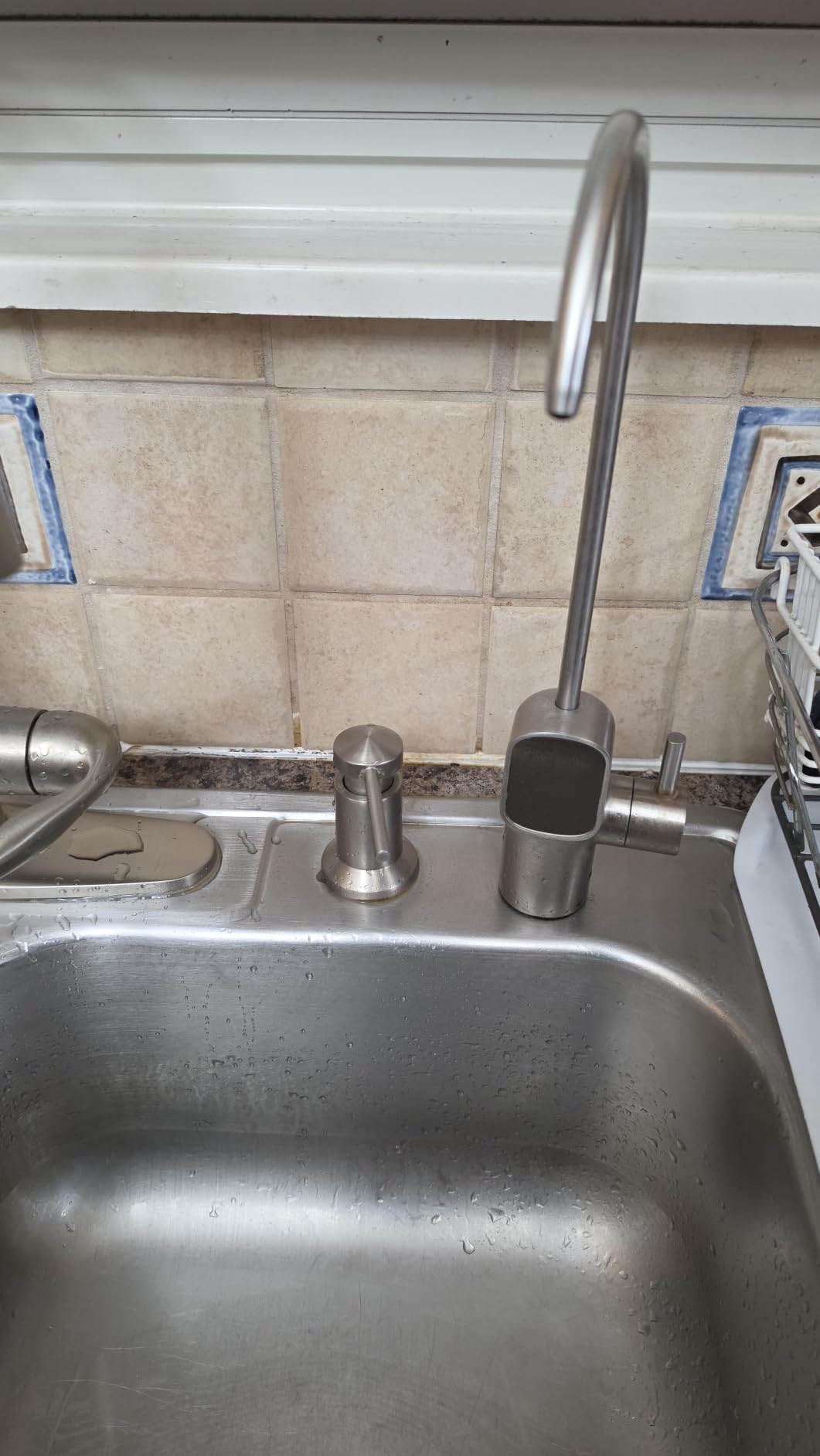
The smart display faucet is the feature people mention most, showing live TDS and per-filter status on a color-coded LED ring.
It carries NSF/ANSI 42, 53, 58 and 372 certification plus FCC, EU and UKCA safety standards, and SGS testing covering PFAS, radium, fluoride, arsenic and chromium. The listed operating pressure of 87 psi is unusually high for a residential unit, and the maximum feed TDS of 1500 ppm means it handles harder municipal water than most competitors in this roundup tolerate.
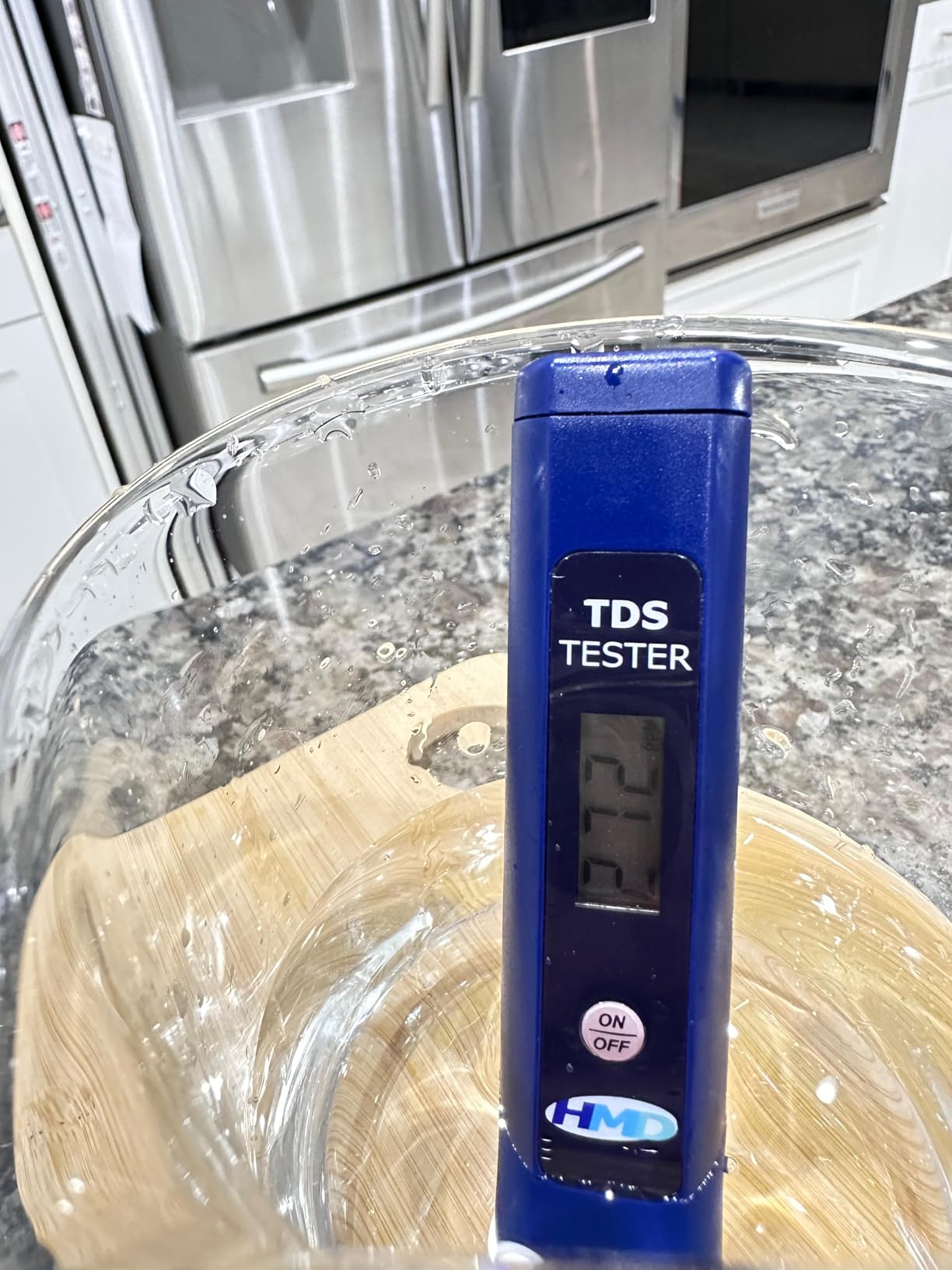
Owners measuring with independent meters report reductions from around 99 ppm down to 5 to 12 ppm, and the same reviews describe better coffee and clearer ice once the system is in place. The tankless layout also removes the bacterial risk of a holding tank sitting warm under the sink for weeks at a time, which is a real argument in warm climates.
Two behaviors catch new owners out. The first is TDS creep: after the system sits unused, the leading water reads higher and needs roughly 30 to 40 seconds of flushing before it settles, and some owners swap filters unnecessarily when that happens.
The second is that the built-in TDS display can read high right after a cartridge change if the system is not flushed first. Neither is a defect, but both look like one if you were not expecting them. On r/WaterTreatment, Waterdrop is the brand most often praised for troubleshooting smart-faucet error codes, which is worth something when a display starts blinking.
When the G3P600 makes sense
This is the pick for a household of one to four who drinks and cooks with the water and does not need to feed a refrigerator. The 2:1 drain ratio and front-facing filters make it low-effort day to day, and the display removes the guesswork about when to change a cartridge.
It also suits harder feed water than the cheaper systems handle, since the maximum listed TDS input is 1500 ppm. If your municipal supply tests high, that single number can decide the purchase.
What to weigh first
The cabinet. This body is 18.12 inches long and 17.72 inches tall, matching the larger system above, so it needs a deep cabinet just as much. The 2:1 ratio is also less efficient than the 3:1 units, which matters if you fill a lot of bottles.
Then look at cartridge pricing over a five-year horizon. Multi-year owners on r/WaterTreatment note the carbon and RO cartridges cost noticeably more than some competing brands, and that gap grows every year. If filter cost is your main worry, the best value pick further down is the more sensible route.
3. Frizzlife Reverse Osmosis Water Filter, PD600-TAM3, 600 GPD
Frizzlife Reverse Osmosis Water Filter – Alkaline Mineral pH+, NSF/ANSI 58&53&42&372 Standard, 600GPD Tankless RO Reverse Osmosis System, Under Sink, 2:1 Pure to Drain, Reduce FPAS/PFOA, PD600-TAM3
600 GPD at 0.41 gpm
14.7 inch deep
Alkaline remineralization
2:1 pure-to-drain
Electric
Pros
- Shortest depth among the 600 GPD systems
- Integrated alkaline cartridge above pH 7.5
- Fills a 330 ml cup in about 10 seconds
- 2:1 drain ratio saves water versus conventional RO
- Smart panel shows TDS and filter life
Cons
- Remineralization lifts output TDS above near-zero
- Needs under-sink power for pump and display
- Replacement filters are brand-specific
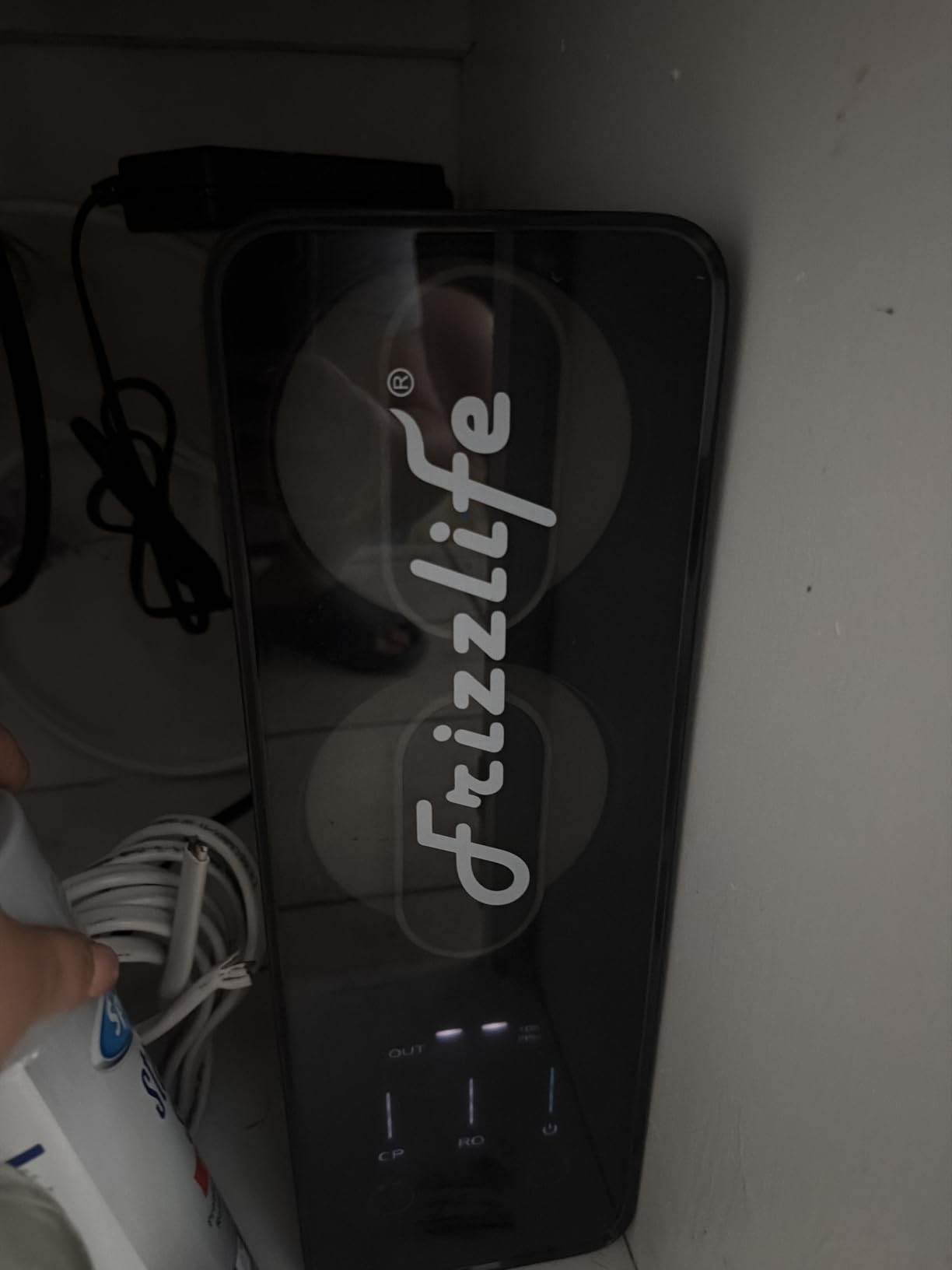
The Frizzlife PD600-TAM3 is the one I recommend when cabinet depth is the binding constraint and capacity still needs to be respectable. At 14.7 inches long, 5.3 inches wide and 15.5 inches tall, it is the shortest 600 GPD system in this roundup, which translates directly into more usable cabinet space for cleaning supplies and a recycling bin in a small kitchen.
The third stage is an alkaline remineralization cartridge that adds minerals back after the membrane and lifts pH above 7.5. That is the difference between water that tastes flat and something people drink happily on its own. Users on r/WaterTreatment describe plain RO output as flat and acidic often enough that a built-in mineral stage has become close to a requirement rather than a luxury.
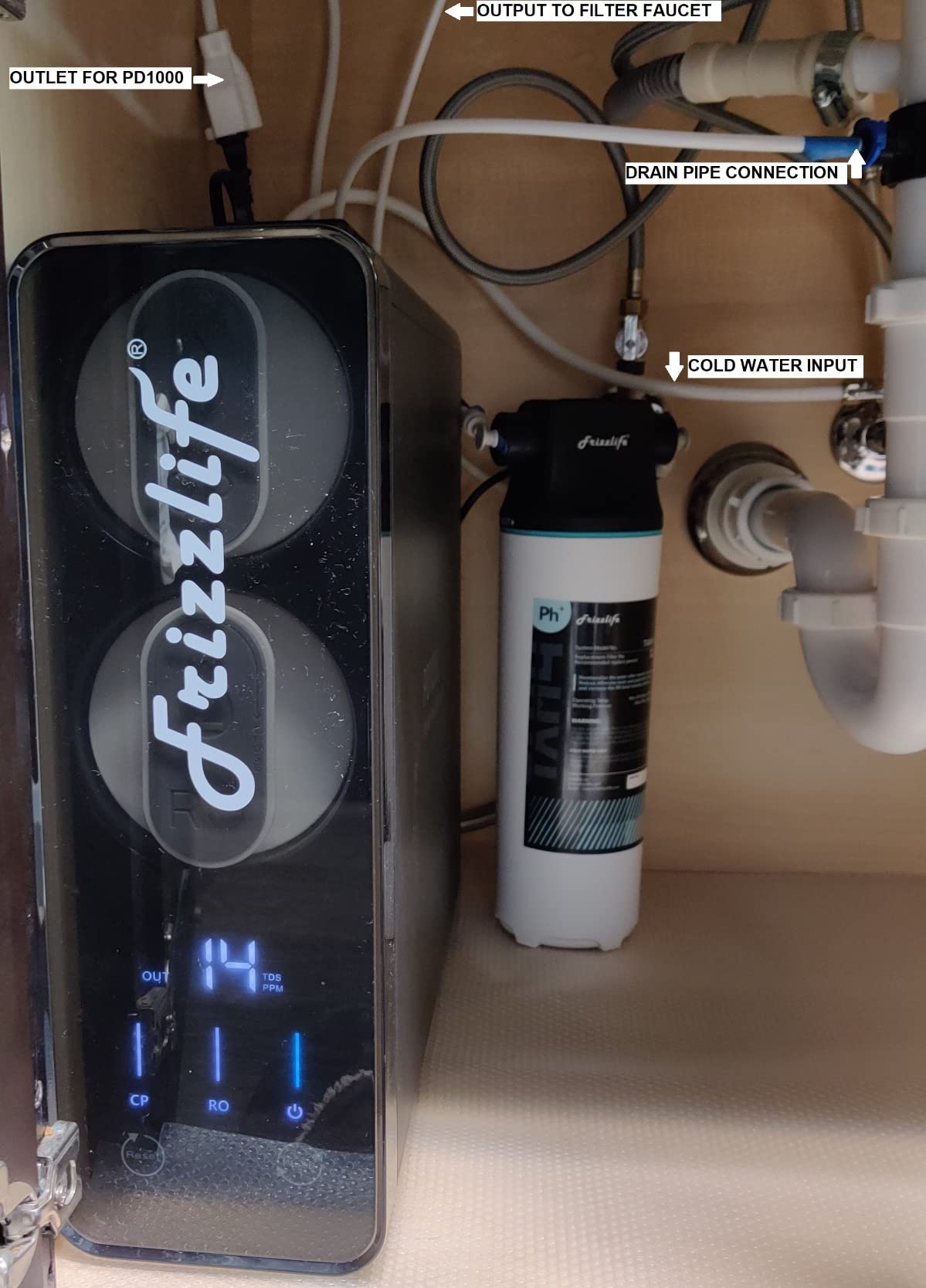
Flow is 0.41 gpm, which fills a 330 ml cup in roughly 10 seconds, and the 2:1 drain ratio saves up to 450 percent water compared with conventional RO systems according to the manufacturer. The smart LED panel tracks output TDS and remaining filter life per cartridge with color-coded change reminders, so you are not counting months in a calendar.
The honest trade is the TDS reading. Because minerals are added back on purpose, output TDS will never read near zero the way a barebones membrane system can, and buyers who bought this expecting a single-digit number report it as a disappointment. In practice the reading reflects minerals you wanted in the water, not contaminants you failed to remove. The unit still needs an outlet for its pump and display, and the replacement cartridges are brand-specific.
Why the compact footprint is the deciding factor
At 14.7 inches this leaves room behind the unit for the cold water line, the drain saddle and a bottle of something else, which is exactly the space a tank system would have occupied entirely.
For an apartment, a condo or a galley kitchen where the cabinet is shallower than 18 inches, this is the 600 GPD option that physically goes in. The three units before it all need deeper cabinets.
Where it falls short
If your goal is the lowest possible TDS reading on a meter, the alkaline stage works against you and you should look at a system without remineralization. Some buyers also find the added minerals leave a faint taste and sediment in a glass that others prefer.
Filter supply is the other consideration. Cartridges must come from the manufacturer rather than a hardware shelf of generic parts, so check the replacement interval and cost before ordering.
The stated rating of 4.6 across more than 2400 reviews is among the strongest in this group, which suggests the consistency holds up.
4. Waterdrop G2P600 Under-Sink RO System, 600 GPD
Waterdrop G2P600 Under-Sink RO System, 600 GPD Tankless Water Filtration
600 GPD
2:1 pure-to-drain
17.3 inch deep
7-stage filtration
Electric
Pros
- Seven-stage filtration at the entry point of the range
- Fills a 200 ml cup in about 8 seconds
- Filter changes in 3 seconds with life indicators
- 2:1 ratio saves about 60 percent more water
- Self-installs in roughly 30 minutes
Cons
- Input TDS ceiling listed at 500 ppm
- Temperature rating stops at 87 F
- Cartridges are specific to the G2P600 family
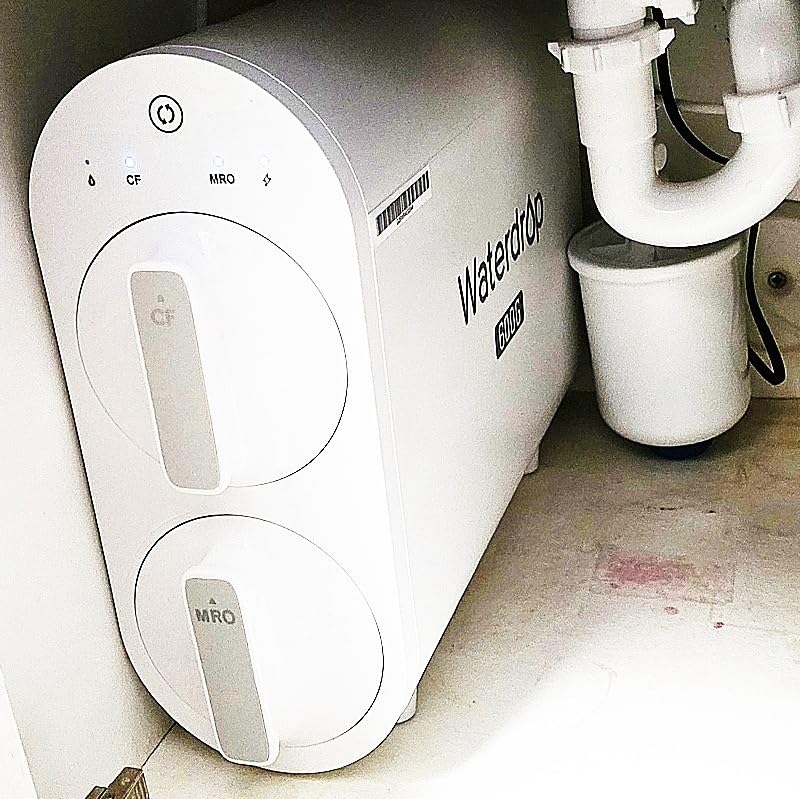
The G2P600 is the value entry point into Waterdrop’s tankless line, and it keeps the two features buyers care about most: 600 GPD throughput and a 2:1 pure-to-drain ratio. At more than 1700 ratings it holds a 4.6 average with 81 percent five-star reviews, a consistency record that holds up well at its tier.
Filtration runs seven stages rather than the eight or ten on the G3 models, and the listed certification is NSF/ANSI 372, which covers lead-free materials. That is worth understanding clearly: 372 confirms the materials the system is built from do not leach lead, and it does not certify contaminant reduction the way an NSF/ANSI 58 listing does. If contaminant reduction claims matter to you, the two G3 systems are the better-matched products in this brand.
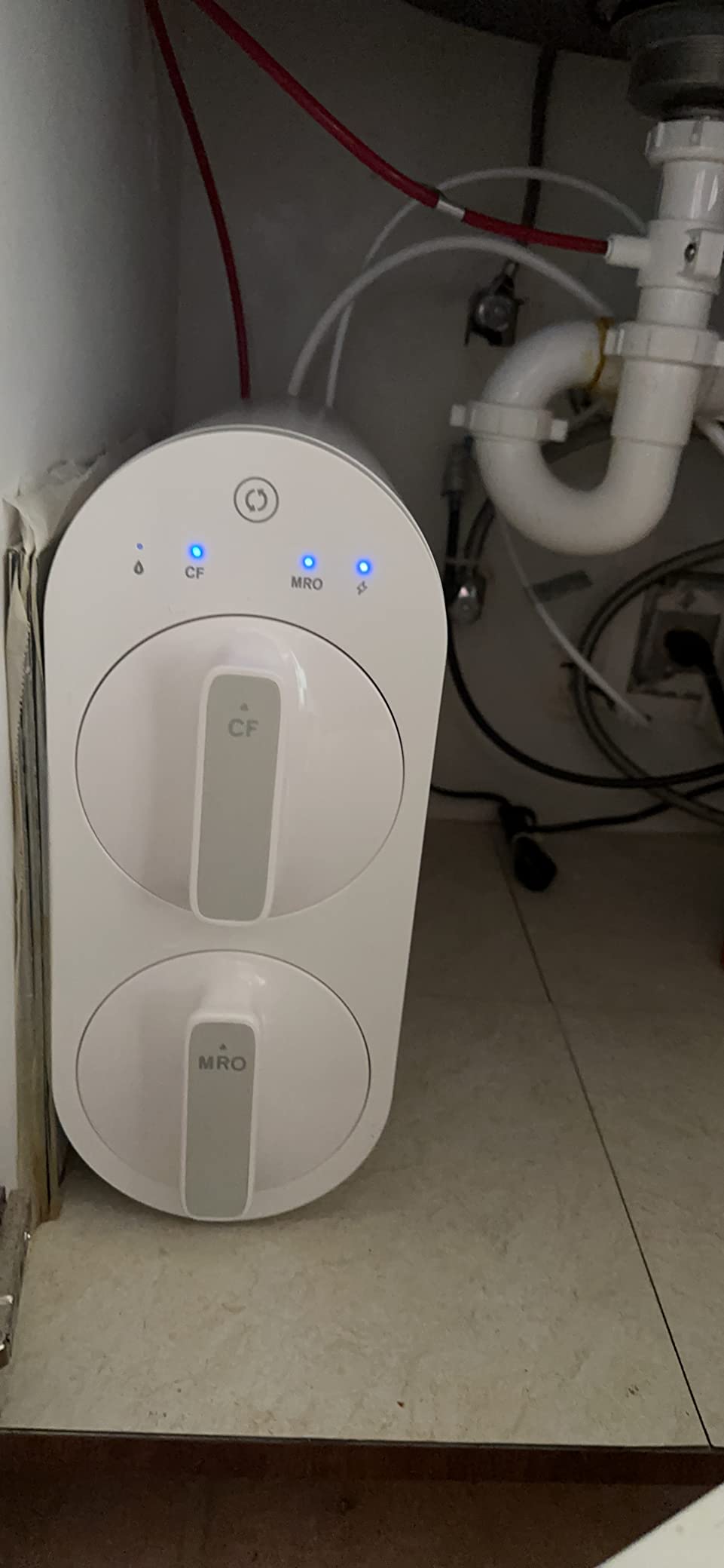
Day-to-day handling is good. Twist-and-pull cartridges change in about 3 seconds, indicator lights flag when a cartridge is due, and a 200 ml cup fills in around 8 seconds. Buyers moving up from a traditional tank system consistently mention the freed cabinet space and the end of the wait while a tank refills.
Two specifications limit where it works. The maximum input TDS is listed at 500 ppm, which is lower than several competitors here and could be a problem on a well or on very hard municipal water.
The upper temperature rating stops at 87 F, so it is not the system for a hot feed line in a garage utility sink. Cartridges are model-specific to the G2P600 family, so plan the replacement schedule with that in mind rather than assuming any similar-looking filter will fit.
When it is enough and when it is not
It is enough for a household of one to three on municipal water with moderate TDS. The 600 GPD rating gives you real headroom for cooking and coffee, and the fast filter swaps mean you are not dreading maintenance.
It is not enough if your feed water tests above 500 ppm or comes off a well. In that case the ceiling is a hard stop rather than a preference, and you should look at a unit rated for higher feed TDS instead.
Deciding between the two Waterdrop tankless lines
The step up to the G3 models buys additional stages, full NSF/ANSI 58 and 53 certification, a display faucet with a TDS meter and a higher feed TDS ceiling. You also take on a larger body and costlier cartridges.
For a normal apartment on municipal water that never gets near 500 ppm, the G2P600 covers the requirement at a lower entry outlay and the same 600 GPD capacity. For anyone who wants the certification paper to match the claims, the upgrade is the one that makes sense.
5. iSpring RO500AK Alkaline Reverse Osmosis System, 500 GPD
iSpring RO500AK Alkaline Reverse Osmosis System, NSF 58 Certified, 500 GPD
500 GPD at 0.4 gpm
17.5 inch deep
Auto-flush after 24 hours
2:1 drain ratio
Electric
Pros
- NSF/ANSI 58 covers the complete system rather than parts
- Auto-flush after 24 hours protects the membrane
- Lights plus buzzer identify the cartridge due
- Alkaline stage restores minerals and improves taste
- Quick-connect fittings accept two line sizes
Cons
- Needs electricity under the sink for pump and panel
- Higher purchase price than most 500 GPD tankless models
- Alkaline stage means TDS never reads near zero
The RO500AK is the pick when certification is the thing you refuse to compromise on. It holds an NSF/ANSI 58 listing on the complete system rather than on individual components, which answers the complaint that shows up most on r/WaterTreatment about tankless brands looking impressive on a faucet display while the filtration itself is self-tested.
The 0.0001 micron membrane is certified to reduce lead, PFAS, TDS, chromium, radium, fluoride, arsenic and chlorine. Rated capacity is 500 GPD and feed TDS is handled up to 1000 ppm, with an operating range of 15 to 70 psi.
It runs at 0.4 GPM, filling an 8 oz cup in about 10 seconds with no tank wait, on a 2:1 drain ratio that saves up to 400 percent water versus traditional RO.
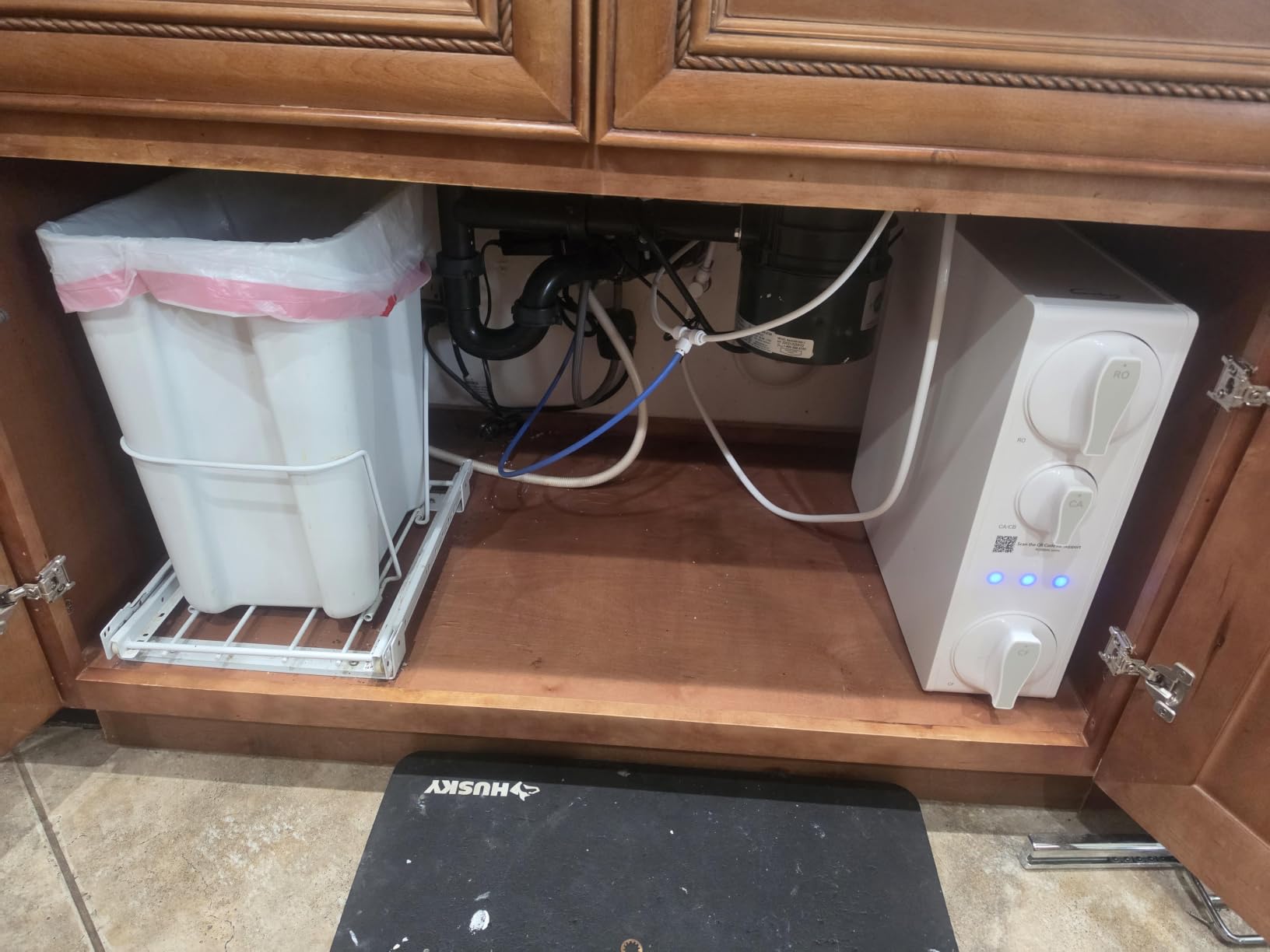
The auto-flush cycle is the feature owners mention most after the certification. After 24 hours without use the system flushes the membrane automatically, which limits TDS creep and protects membrane life without you remembering to do anything. On the maintenance side, front-panel lights plus an audible buzzer identify exactly which cartridge is due, which removes the calendar guessing that causes people to change filters either too early or too late.
The alkaline remineralization filter adds minerals back and balances pH, and owners consistently say the water tastes smoother than plain RO output. The catch is that TDS will not read near zero, and buyers chasing a single-digit meter number should know that before ordering.
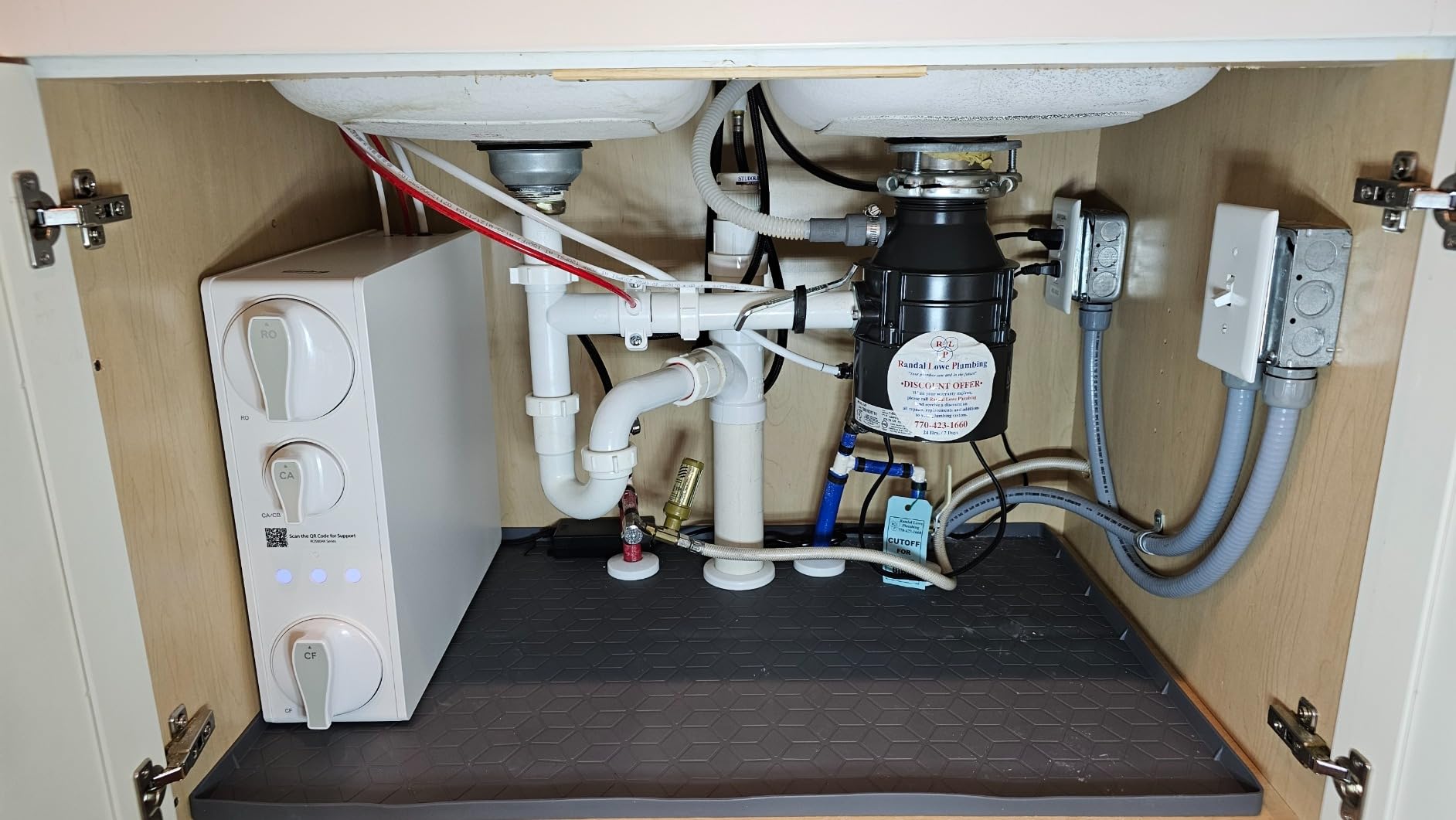
iSpring also publishes named replacement cartridges rather than generic codes: FCF500 up to 6 months, FCA500 up to 12 months and MRO500 up to 24 months, or the F7-RO500AK two-year pack. The body measures 17.5 inches long, 5.2 inches wide and 16.25 inches tall at 21 pounds.
Why the certification detail is worth paying for
An NSF/ANSI 58 listing means a third party tested the assembled system for the reduction claims on its performance data sheet. Marketing language like removes 99 percent of contaminants is worth very little without a listing you can look up, and this is the difference between the two.
It also protects you later. When a cartridge is due, you can confirm the replacement matches a certified component rather than a look-alike that fits the housing and does not perform. Forum buyers repeatedly praise iSpring for having verifiable listings and for filters that sit on ordinary retail shelves.
Where the cost sits
The purchase price sits at the top of the 500 GPD category, and that is the main reason to skip it. If your budget is fixed, the two systems before this one deliver similar capacity for a lower entry outlay.
What you get for that money is a spec sheet that will survive scrutiny and support that answers technical questions rather than shipping forms. If you intend to keep a system for five years or more, that reliability has value. If you are renting and expect to move in two years, it does not.
6. SimPure T1-400ALK Tankless Alkaline Reverse Osmosis Water Filter, 400 GPD
SimPure T1-400ALK Tankless Alkaline Reverse Osmosis Water Filter 400 GPD
400 GPD at 0.4 gpm
1.5:1 pure-to-drain
15.6 inch deep
UV stage on flow
Electric
Pros
- UV sanitizing stage most rivals in this range omit
- 1.5:1 drain ratio wastes less than 2:1 systems
- Compact 15.6 inch deep tankless body
- Quick-change twist cartridges
- Built-in booster pump included
Cons
- Lowest rating in the set with a wider spread of experiences
- Smallest capacity here at 400 GPD
- Alkaline stage keeps TDS well above zero
- Temperature limits are not clearly documented
The SimPure T1-400ALK is the budget-leaning pick with one feature no other system in this roundup has at this level of money: a UV purification stage that activates automatically based on flow pressure. Sanitizing treatment is normally found well above this tier, and it is a genuine addition to a membrane that already handles dissolved solids.
Water efficiency is the other argument. Its 1.5:1 pure-to-drain ratio wastes less water than the 2:1 systems it competes with, which is a real difference over a year of daily drinking and cooking. Rated capacity is 400 GPD with a 0.4 gpm flow rate, feed TDS is handled up to 500 ppm, and the alkaline filter restores calcium, magnesium and potassium.
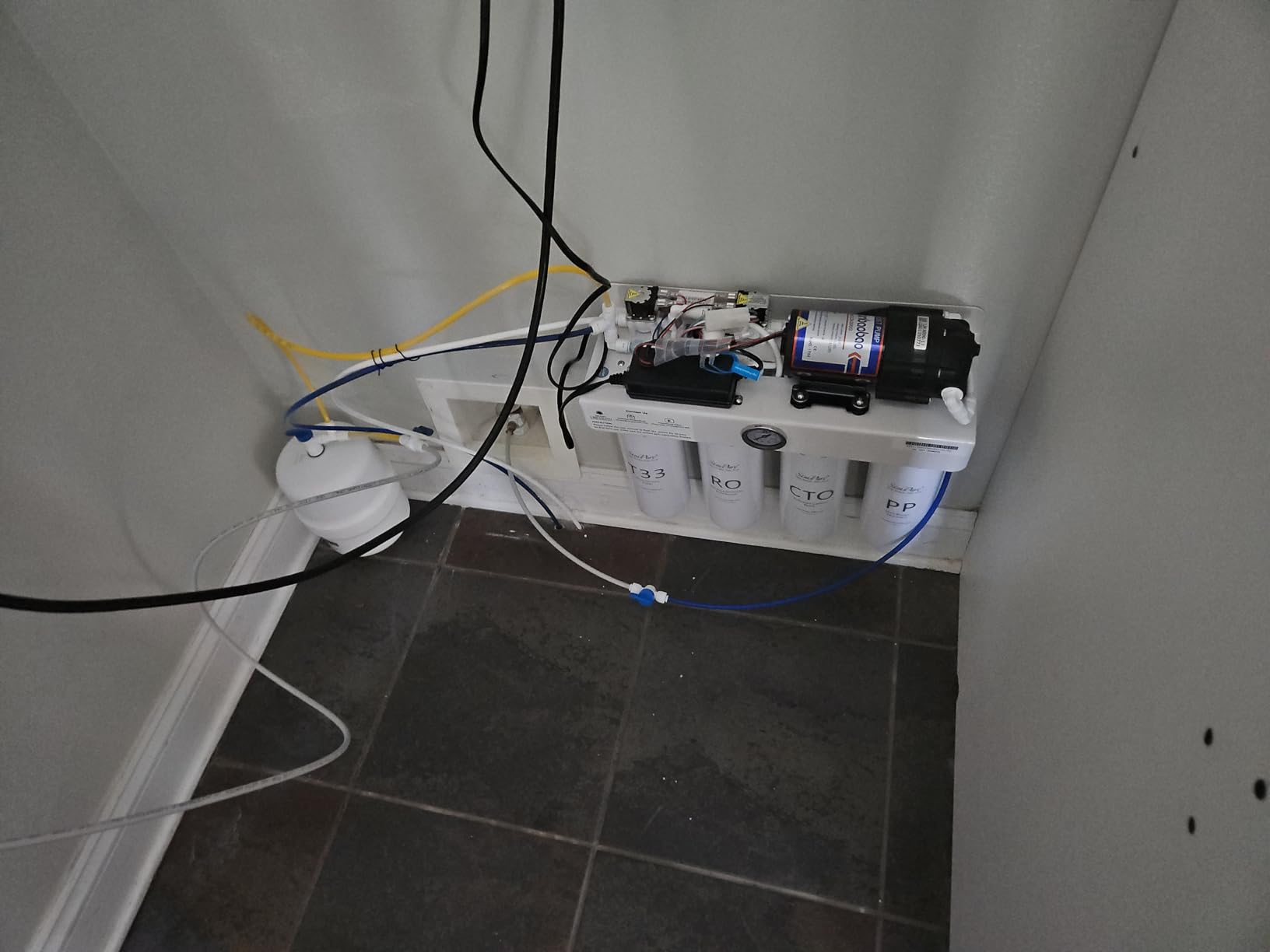
The twist cartridges deliver about 1057 gallons of purified water per set, roughly 8000 bottles, and the tankless body measures 15.6 inches long, 5.3 inches wide and 15.7 inches tall, so it fits cabinets that will not take an 18 inch body.
The system was independently tested by SGS against the NSF/ANSI 58 standard, which is a lab test against that standard rather than a certification listing you can verify in a certifier database. That distinction matters if certification is your priority.
Be clear-eyed about the review spread. The average rating is 4.2 across more than 1400 ratings with 12 percent one-star reviews, the widest spread of any system here, and buyers report more inconsistent experiences than the premium units deliver.
Maximum input TDS is 500 ppm, and the listed upper temperature of 9 F is plainly a documentation error rather than a real limit, which is exactly the kind of ambiguity that makes a product harder to trust on paper.
Where it beats the alternatives
If you want the most water-efficient ratio available without stepping up in size, the 1.5:1 figure sits in the top band on this list alongside the commercial RCS5T. If a UV stage matters for your reasons, nothing else at this capacity level offers one.
It also suits a one or two person household comfortably. Four hundred gallons per day is ample for drinking, tea, coffee and cooking water when nobody is filling bottles all day.
Where it does not
Skip it for a household of four or more, for anyone filling large bottles daily, and for feed water above 500 ppm. Larger households will feel the 400 GPD ceiling within weeks.
Also weigh the documentation gap before buying. A misprinted temperature rating and an SGS test against a standard rather than a certification listing are small signals, but they matter if you plan to rely on this system for drinking water for a decade. If you want the certification to be checkable, the iSpring above is the same money band with a listing you can verify.
7. Glacier Fresh GFU03 Electric-Free Reverse Osmosis Water Filter, 800 GPD
GLACIER FRESH GFU03 Electric-Free Reverse Osmosis Water Filter 800 GPD
800 GPD
3:1 pure-to-drain
No electricity
13.58 inch deep
Pressure gauge
Pros
- No electrical outlet needed at all
- 800 GPD rated capacity
- 3:1 drain ratio among the most efficient here
- Tool-free cartridge swaps in about 3 seconds
- Near-silent operation with no pump motor
Cons
- Flow depends entirely on incoming line pressure
- Flow tapers after roughly a quart
- Body is 8.27 inch wide so it eats cabinet shelf
- Included hole saw may not suit every sink
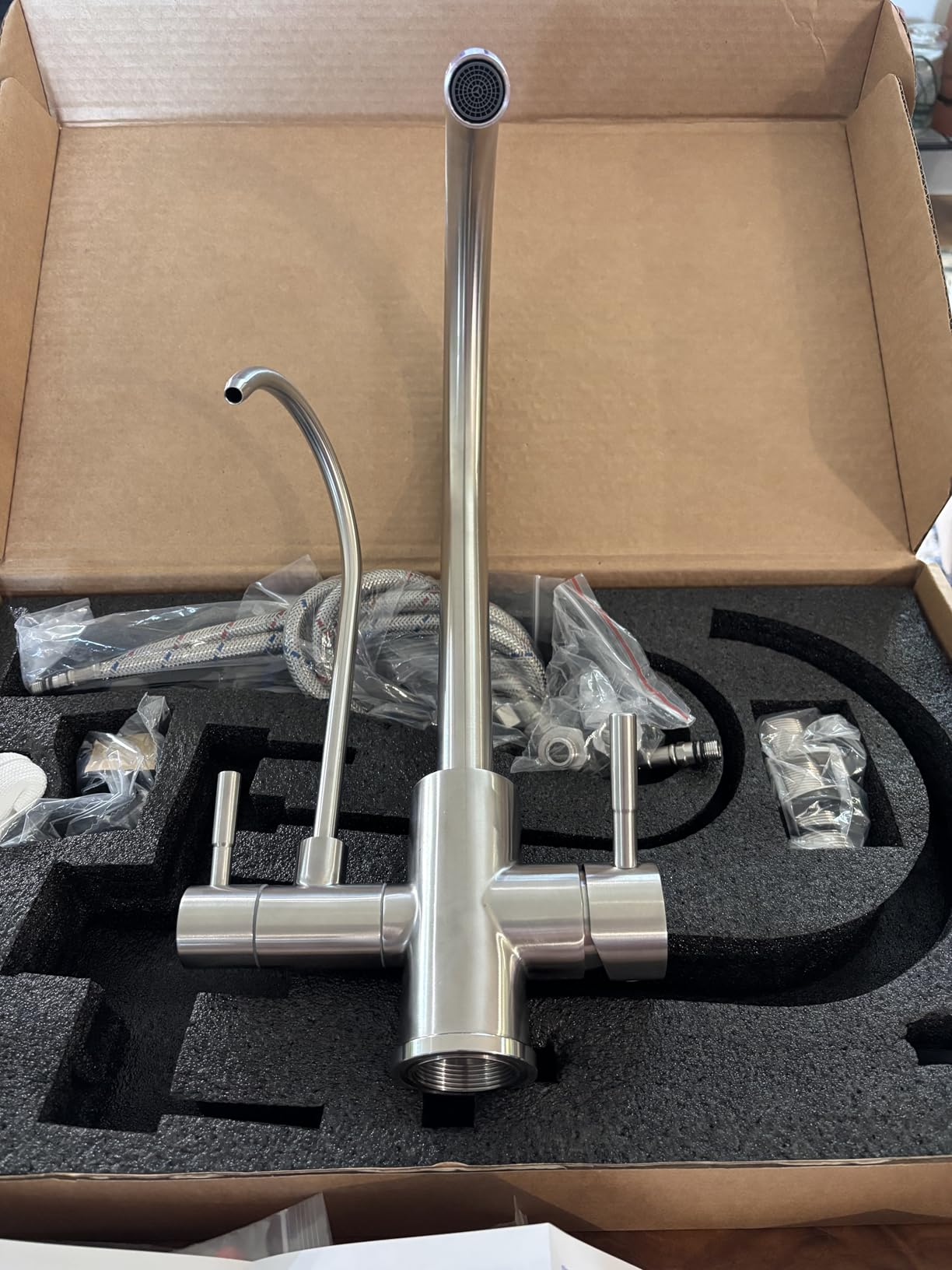
The Glacier Fresh GFU03 solves the two problems that stop people from buying tankless RO at all, and it solves them completely. It needs no electricity, which means no outlet conflict, no cord under the sink and no pump noise in an open-plan kitchen.
At 800 GPD it also carries one of the two 800 GPD ratings in this roundup while sitting at the entry end of the range.
How it works without power is a water-driven pressure mechanism that uses the incoming line pressure to push water through the membrane, with a built-in real-time pressure gauge so you can see what you are working with. It meets NSF/ANSI 58, 372 and 401 and uses a 0.0001 micron membrane across five stages covering PFOA, PFOS, chlorine, lead, fluoride and heavy metals.
The efficiency is the standout. A 3:1 pure-to-drain ratio beats the 2:1 systems above, and users report very low TDS with independent meters, including readings dropping from 365 ppm tap water to 16 ppm.
Installation is often reported at 30 minutes or less, and the pull-out cartridge design swaps the filter in about 3 seconds without shutting off a valve.
The limitation is flow, and it is not a small one. Output depends entirely on incoming pressure, and below roughly 40 PSI the flow drops noticeably. Flow also tapers after about a quart, so filling a coffee pot or a large bottle takes longer than the rated 0.6 gpm suggests.
Some users report flow improving noticeably after the first few days of operation as the lines settle. The body is 13.58 inches long but 8.27 inches wide, so it consumes more shelf width than the narrow cartridges elsewhere in this list, and the included hole saw can be too wide for some sinks.
Why no electricity changes the decision
Renters and older apartments frequently have no free under-sink outlet, and where an outlet does exist it is often already occupied by a garbage disposal. A system with no electrical requirement sidesteps that entirely, and there is no pump noise in a kitchen where every sound carries.
For anyone who has considered drilling an outlet or moving the disposal outlet, this is the honest answer. The 3:1 ratio ties it with the Waterdrop G3P800 for the most efficient band on this list.
Where the flow rating is misleading
Read the 800 GPD figure as a capacity number, not a speed number. The real constraint is your line pressure, and the pressure gauge is there so you can check it rather than guess. If your kitchen is far from the main shutoff, expect less.
The width is the other thing to measure. At 8.27 inches across, this is a wide, shallow unit, and it works best in a cabinet with a wide floor and a low shelf. It also needs a drilled hole for the faucet, which is worth checking against your landlord before ordering. For cabinet layout ideas, our picks for small kitchen sinks cover the same tight-footprint thinking.
8. iSpring RCS5T Commercial Tankless Reverse Osmosis System, 500 GPD
iSpring RCS5T Commercial Tankless Reverse Osmosis RO Water Filter System with 1.5:1 Pure to Drain Ratio, Pressure Gauge
500 GPD
1.5:1 pure-to-drain
14 by 11 by 18 inch
Stainless steel
Booster pump
Pros
- 1.5:1 drain ratio saves about 60 percent of water
- Built-in booster pump handles low line pressure
- Five stages covering PFAS including PFOA and PFOS
- Pressure gauge and see-through first housing
- Automatic membrane flush extends membrane life
Cons
- Widest body here at 14 by 11 by 18 inch
- Flush cycle wastes about 10 seconds per tap opening
- Weak instruction manual with wrong units
- Only a 30-day warranty
The RCS5T is the odd one out in this roundup, and it earns its place for specific situations. It is a stainless steel commercial-grade system rated at 500 GPD, and the 1.5:1 pure-to-drain ratio is among the most efficient figures here.
If you run a small cafe, a salon, a lab or a home office where people drink water all day, the throughput and the stainless housings are the point.
Filtration runs five stages, with stages one to three removing PFAS including PFOA and PFOS along with rust, sand, chlorine and disinfection byproducts. An RO membrane stage handles heavy metals and pesticides, and a final polishing stage covers chlorine and taste.
The built-in booster pump compensates for low incoming pressure, which is the usual failure mode of non-boosted residential systems.
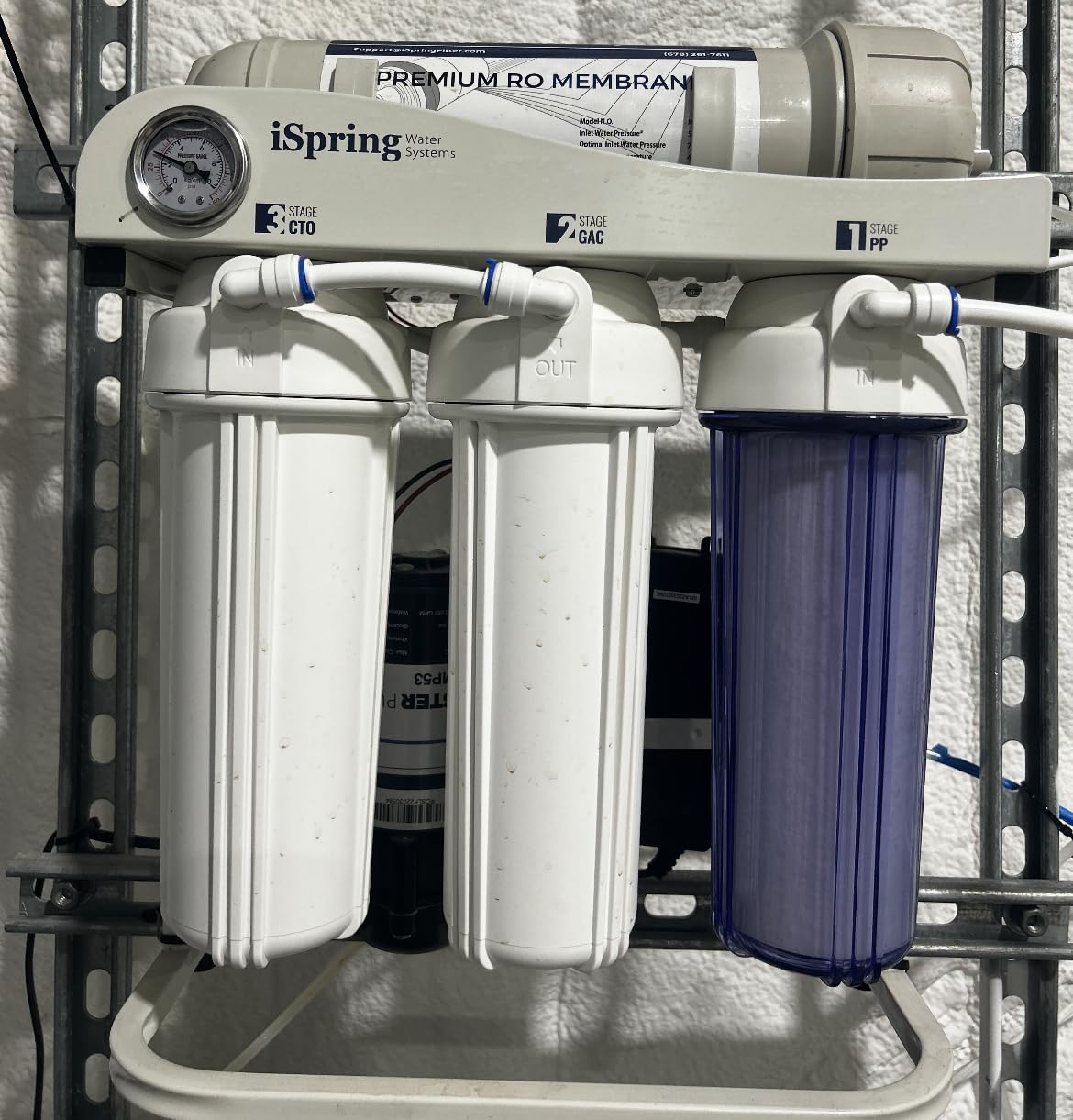
The details are aimed at someone who will maintain it. There is an easy-to-read water pressure gauge, a see-through first-stage housing so a filter check takes seconds, an automatic membrane flush that extends membrane life without intervention, and a silver chrome faucet with a 360 degree swivel.
For a small kitchen, the reasons to pass are concrete. At 14 by 11 by 18 inches it is by far the widest body here, consuming almost double the floor area of the narrowest models.
The automatic flush wastes about 10 seconds of water every time the tap is opened, and it restarts if you close and reopen quickly, which kitchen-only buyers describe as the most annoying trait of the unit.
The manual mixes MPa and PSI and states an incorrect voltage, tubing transitions from 3/8 inch to 1/4 inch OD so reducers are often needed, and the warranty runs 30 days against manufacturer defects.
Who this is actually for
Businesses and shared spaces where the system runs for hours a day rather than minutes. Under that duty cycle the automatic flush and the booster pump pay for themselves, and the stainless housings tolerate the treatment that plastic ones do not.
People on well water with pressure problems also benefit from the booster pump, provided a whole-property solution is what you actually need. On r/WaterTreatment, owners running RO behind a softener or an iron prefilter report strong results and good technical support from this brand.
Why a home kitchen should skip it
Cabinet volume is the dealbreaker. In a small kitchen, spending 14 by 11 by 18 inches on a system that flushes on every tap opening trades away the exact benefit you bought tankless for.
The 30-day warranty and the documented manual errors also point in one direction. For daily household drinking water, one of the narrower residential units above is the better-proven purchase, and the five-star reviews here cluster around commercial owners rather than families.
Will It Actually Fit? A Cabinet Space Checklist
This is the section most tankless RO roundups skip, and it is the one that decides whether you end up happy. A tankless system can save 10 to 16 inches of cabinet width, but it still needs a real footprint plus room to work on.
Start by measuring the clear width of your cabinet floor, back wall to front door, and the height from the shelf to the underside of the counter with the door open.
Three numbers decide the outcome. Depth is the first filter: four of the eight systems here need 17 inches or more of depth, and only the Frizzlife at 14.7 inches, the SimPure at 15.6 inches and the Glacier Fresh at 13.58 inches fit a genuinely shallow cabinet.
Width decides shelf logistics, and the Glacier Fresh is the outlier at 8.27 inches across, which works in a wide shallow cabinet and fails in a narrow tall one.
The third number is vertical clearance, and it is the one people forget. Every cartridge in this roundup is designed to be pulled straight out and replaced, which means you need clear height equal to the cartridge length plus your hand, above and in front of the housing.
A system that fits perfectly and cannot have its filters changed is a system that gets returned. If your cabinet has a shelf directly above the unit, plan for the unit to sit beside that shelf rather than under it.
Here is the decision path. Measure your depth, and if it is 18 inches or more, every system in this roundup fits on depth alone. Between 16 and 18 inches narrows the field to the Waterdrop G2P600 and the iSpring RO500AK. Under 16 inches, look at the Frizzlife, the SimPure and the Glacier Fresh.
If you cannot clear the vertical pull height, do not buy a tall system and hope; pick a model whose cartridges pull horizontally, or reconsider a countertop unit if drilling is not allowed. Finally, confirm the drain saddle has somewhere to attach and that the cold water shutoff is reachable from the front.
Buying Guide: How to Choose a Tankless RO System for a Small Kitchen
Start with certification, not features
NSF/ANSI 42 certifies aesthetic claims such as chlorine reduction, taste and odor. NSF/ANSI 53 certifies specific health-related contaminant reduction including lead and Cryptosporidium. NSF/ANSI 58 is the standard for reverse osmosis systems and certifies actual reduction claims such as TDS.
NSF/ANSI 372 is different in kind from all three: it is a low-lead materials standard that confirms the materials in contact with water, and it does not certify contaminant reduction. AI summaries and marketing pages routinely blur 372 into a filtration claim, so treat a 372-only listing as what it is.
You can verify a claim yourself in a few minutes. Go to the certifier database, search the model number, and check the listing name, the standard and the company.
If a brand sells you a system whose only evidence is a self-run lab test, that is a marketing claim rather than a certification. Several of the systems in this roundup are SGS-tested against a standard without holding a listing, which is useful information but not the same thing.
Size capacity to your household, not to the marketing
For one to three people drinking, cooking and making coffee, 400 to 600 GPD is generous. Step up to 800 GPD when you are feeding a refrigerator ice maker and dispenser, filling several large bottles a day, or running a household of four or more.
Numbers above that serve light commercial use, which is what the iSpring RCS5T is built for.
Also read the real flow figure in gallons per minute rather than the GPD headline, because GPD is a daily capacity and GPM is what you experience at the tap. A 600 GPD system at 0.4 to 0.42 gpm fills an 8 to 12 oz cup in roughly 10 seconds, which feels instant.
Lab capacity assumes feed water pressure and temperature that many apartment buildings do not deliver, so expect a real-world shortfall and pick the next capacity step up if your line pressure is low.
Read the pure-to-drain ratio as a water bill item
The pure-to-drain ratio tells you how much wastewater each gallon of purified water produces. A 3:1 system sends three gallons down the drain for every gallon you drink, a 2:1 sends two and a 1.5:1 sends one and a half.
Older tank-based systems commonly ran at 3:1 to 4:1, so modern tankless units are an improvement even when the number sounds poor.
Doing the arithmetic makes the decision concrete. A household drinking two gallons a day on a 2:1 unit puts 58 gallons of wastewater down the drain monthly. Moving to a 3:1 unit brings that to 39 gallons, and on a 1.5:1 unit it is 29 gallons.
Over a year the gap between the best and worst ratio here is several hundred gallons, which is why it belongs in the purchase decision rather than the spec sheet.
Solve the electrical outlet problem before you buy
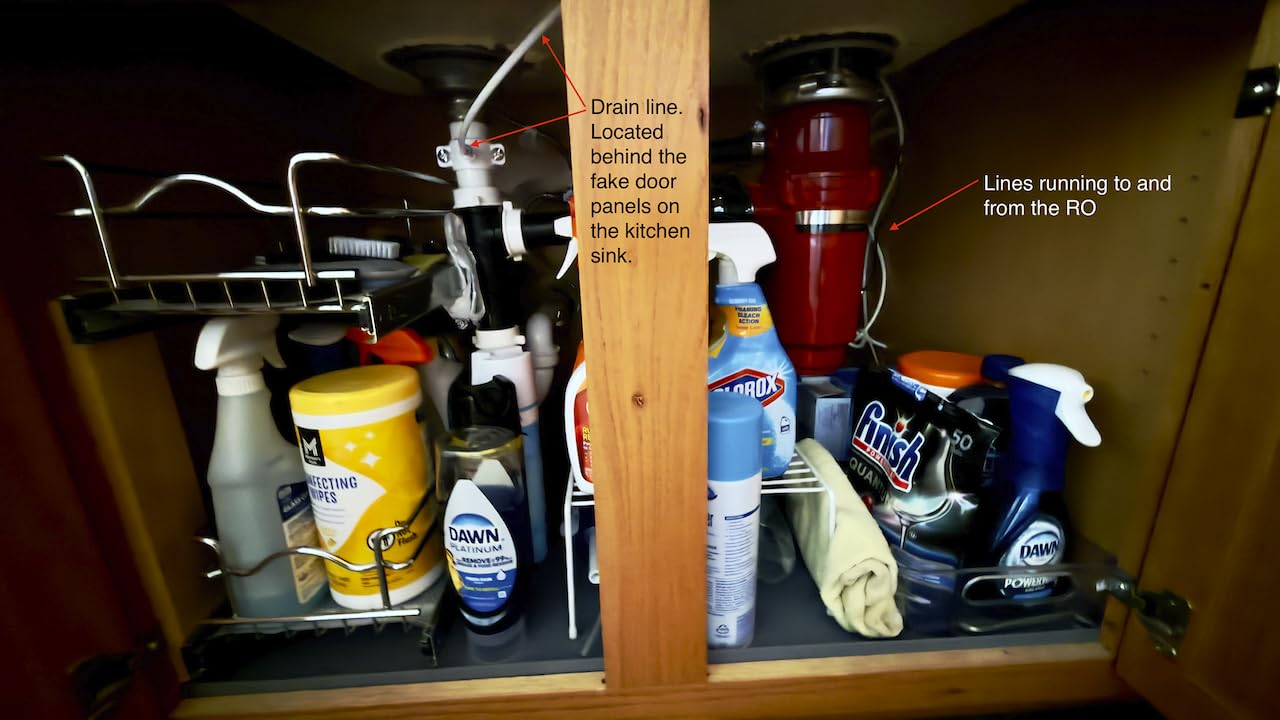
Most tankless RO systems need a live outlet under the sink, because the booster pump needs power. Seven of the eight units in this roundup are electric, and the Glacier Fresh is the exception. This is the most common install blocker in real user reports, and the failure mode is mundane: the only outlet in the cabinet is already taken by the garbage disposal.
Adding an outlet means an electrician in most places, so check before you order rather than after.
If you cannot get an outlet, the honest options are a non-electric water-driven system like the Glacier Fresh above, or a compact tank-based unit. A tank-based system needs no power at all, which is why it survives in cabinets that cannot host tankless.
What you lose is the space savings and the faster cup fill, so it is a real trade rather than a consolation prize.
Decide whether you want remineralization
Reverse osmosis strips dissolved minerals along with the contaminants, and the result is flat water with a slightly acidic taste. A major downside of RO water is exactly that: it tastes flat because the membrane removes the minerals that give water its character. A remineralization cartridge adds calcium and magnesium back and lifts pH toward neutral, which most people prefer and almost nobody misses once they have had it.
The cost of choosing it is a TDS reading that will never approach zero. If you are buying a system purely to watch a meter fall from 300 ppm to 5 ppm, skip the alkaline stage. If you are buying water to drink, keep it. Five of the eight systems here include remineralization.
Budget for cartridges, not just the unit
Replacement filters are the number one complaint about tankless RO on forums, and the reason is proprietary supply chains. Users cannot drop standard 10 inch inline cartridges into these housings, so every change comes from one manufacturer at whatever that manufacturer charges.
Two questions settle it. Are the replacement cartridges sold through ordinary retail channels rather than a brand-exclusive storefront, and does the brand publish prices you can check before you buy? Both make the running cost predictable.
Also look for filter life indicators, whether that is a light, a buzzer or an app, because replacing cartridges too early is pure waste.
Do not forget TDS creep and first-draw water
When a membrane sits unused, the water that comes out first reads higher on a TDS meter. This is normal and it settles within seconds. First-draw readings also drift lower over the first weeks as a new membrane breaks in, so a system that measures 92 percent reduction in month one may measure better by month three. Owners who replace filters unnecessarily in month one are reacting to a measurement artifact rather than a fault.
Check noise if the kitchen is open-plan
Small kitchens amplify sound. A booster pump running for ten seconds at a time is audible in an open-plan space, which bothers some people and not others. The only genuinely silent option in this roundup is the Glacier Fresh, which has no motor at all, and the systems that generate the least complaint are the ones with larger pumps running at lower pressure.
Plan for a refrigerator or ice maker
If you are feeding a refrigerator, check the pressure requirement before you choose. Most manufacturers want at least 40 PSI at the feed line, and a system plumbed to an ice maker needs to fill fast enough to keep up or the cubes come out hollow and undersized. This is where the 800 GPD capacity of the two highest-rated systems earns its cost, and where the automatic flush and low flow of smaller units cause trouble.
Avoid a saddle connection that reduces your tubing to 1/4 inch OD, which starves the flow. Quick-connect fittings that accept both 1/2 inch and 3/8 inch lines, as the iSpring RO500AK does, make this simpler than it sounds.
Frequently Asked Questions
Who makes the best tankless reverse osmosis system?
For most small kitchens we recommend the Waterdrop G3P800 for its 800 GPD capacity, 3:1 pure-to-drain ratio and IAPMO R and T certification to NSF/ANSI 58, 42, 53 and 372. The Waterdrop G3P600 is the stronger choice when a live TDS display matters, and the Frizzlife PD600-TAM3 fits the shallowest cabinets of any 600 GPD unit.
Are tankless reverse osmosis systems any good?
Yes. Filtration performance in a tankless system is equivalent to a tank-based system because the RO membrane does identical work. The differences are space savings and faster cup fills on one side, and an electrical requirement, brand-specific cartridges and pump noise on the other. Buyers who want that trade usually enjoy the results; buyers without a free under-sink outlet usually regret it.
What is a major downside of reverse osmosis water?
The main downside is taste. Reverse osmosis strips dissolved minerals along with contaminants, leaving water that tastes flat and slightly acidic. A remineralization cartridge adds calcium and magnesium back and lifts pH toward neutral, which fixes the taste. The second downside is that output TDS will never read near zero on a system with that stage added.
Do all tankless RO systems require electricity?
Most do, because the booster pump needs power, but not all. Water-driven designs such as the Glacier Fresh GFU03 run on incoming line pressure alone and need no outlet at all, which also means no pump noise. If your only under-sink outlet is already taken by a garbage disposal, either add an outlet or choose a non-electric model or a compact tank-based system.
What certifications should a tankless RO system have?
Look for NSF/ANSI 58 for the complete reverse osmosis system, since that certifies actual contaminant reduction. NSF/ANSI 53 covers specific health contaminants and NSF/ANSI 42 covers taste, odor and chlorine. NSF/ANSI 372 is only a low-lead materials standard and does not certify contaminant reduction, so a 372-only listing tells you very little about filtration performance.
How much cabinet space does a tankless RO system need?
A workable cabinet is about 15 inches wide by 18 inches deep by 20 inches tall, and you need extra clearance above the housing to pull a cartridge straight out for replacement. Depth is the binding constraint: most 600 GPD units need 17 to 18 inches, so shallow cabinets should look at a 14.7 inch unit such as the Frizzlife PD600-TAM3 or a 13.58 inch model like the Glacier Fresh.
Do tankless RO systems waste less water?
It depends on the ratio, not the tankless design. A 3:1 system produces one gallon of purified water for every three gallons sent to drain, a 2:1 system doubles that output, and a 1.5:1 system is better still. All of those beat older tank systems that commonly ran at 3:1 to 4:1, so compare the printed ratio rather than the tankless label.
Conclusion: The Small-Kitchen Decision Rule
Three checks decide nearly every purchase here. Match capacity to your household, 400 to 600 GPD for one to three people and 800 GPD if a refrigerator is involved.
Verify the certification, which means finding an NSF/ANSI 58 listing in a certifier database rather than trusting a box. Then measure the cabinet and confirm the outlet before you order, because those two facts eliminate more candidates than any feature ever will.
With that framework, the Waterdrop G3P800 is our pick for the best tankless reverse osmosis systems for small kitchens in 2026, offering the capacity, efficiency and certification depth that most households need. Deep cabinets with a refrigerator line can take it. Shallow cabinets should go with the Frizzlife PD600-TAM3. No free outlet under the sink means the Glacier Fresh is the only one of the eight that solves it outright.