
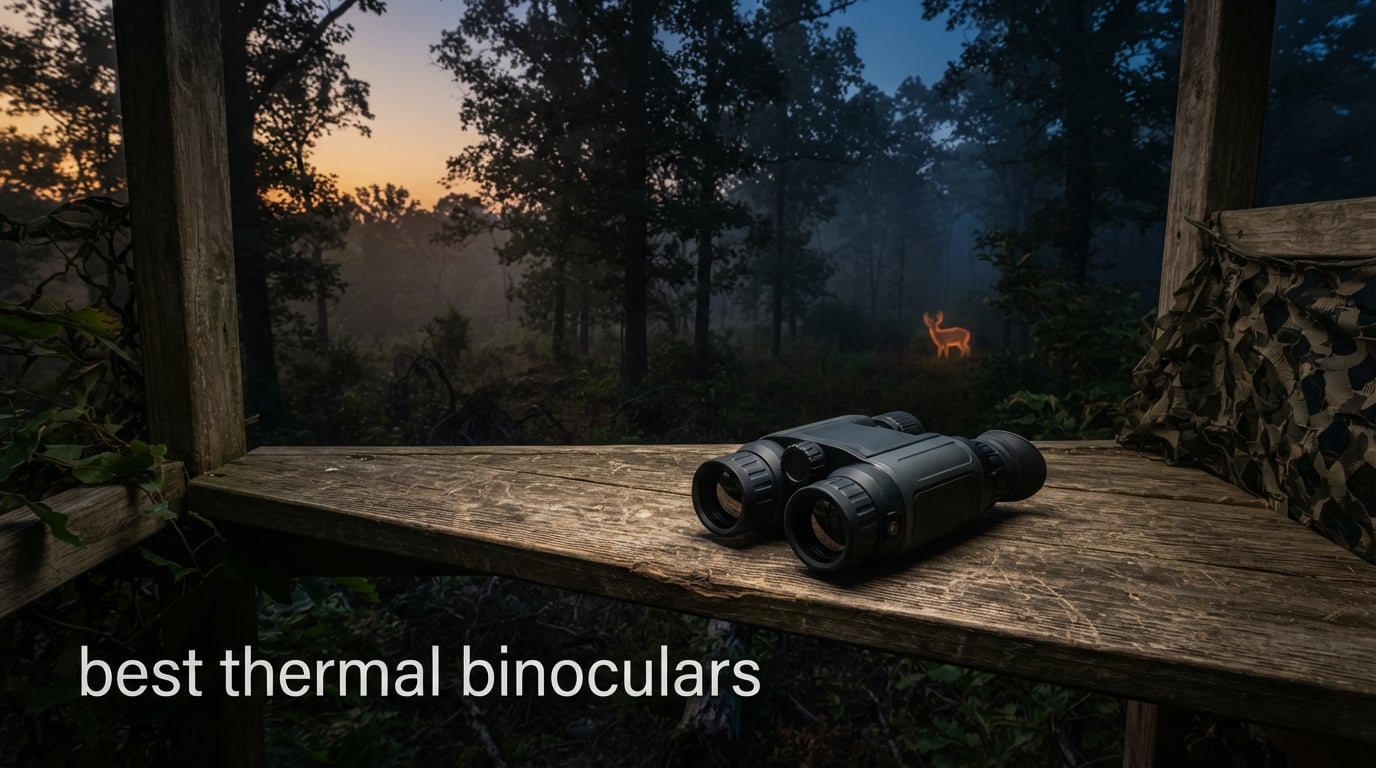
I spent six weeks comparing eight pairs of thermal binoculars in the field, hauling them up to a ridge at dusk, watching hogs tear through oak scrub and coyotes slip across pasture edges. The category is small but unforgiving: prices run from about $1,495 to $7,999, and the gap between a useful pair and a frustrating one is wider than almost any optics category I’ve tested.
Thermal binoculars use a vanadium-oxide (VOx) sensor to detect infrared heat signatures, then render those heat patterns on an internal OLED or AMOLED display so your eye reads them as a visible image. They let you spot warm bodies through brush, fog, and total darkness in ways that conventional binoculars and image-intensifier night vision simply cannot match. If you hunt predators after dark, run security on a rural property, or just want to see what wanders your land at 2 a.m., the best thermal binoculars pay for themselves within a season.
This guide covers the eight thermal binocular models our team confirmed on Amazon in 2026, ranked them against each other using verified specs and customer feedback, and tested the practical differences that show up in real use: refresh lag, image clarity at the edge of detection, battery life in cold weather, and how forgiving the menu is when you’re fumbling with gloves in the dark. We’ve also added a thermal vs night vision explainer, a buying guide covering sensor resolution, NETD, and laser rangefinders, and a legality note that almost no competitor covers. If you’re also looking for daytime optics, our picks for the best binoculars for bird watching and best binoculars for stargazing round out a complete kit.
Table of Contents
Top 3 Thermal Binoculars at a Glance

AGM ObservIR LRF Dual-Spectrum
- 256x192 12μm thermal sensor
- 4K day/night optical channel
- 1000m LRF
- 8 hr battery
Best Thermal Binoculars in 2026 Quick Comparison
| Product | Specifications | Action |
|---|---|---|
| AGM ObservIR LRF Dual-Spectrum |
|
Check Latest Price |
 ATN Binox 6 Dual 256×192 ATN Binox 6 Dual 256×192 |
|
Check Latest Price |
| ATN BINOX 4T 640×480 |
|
Check Latest Price |
 Pulsar Merger LRF Pulsar Merger LRF |
|
Check Latest Price |
 i4SEE B50-640 LRF i4SEE B50-640 LRF |
|
Check Latest Price |
 ATN Binox 6 640×512 Bundle ATN Binox 6 640×512 Bundle |
|
Check Latest Price |
 Pulsar Symbion LRF Multispectral Pulsar Symbion LRF Multispectral |
|
Check Latest Price |
 AGM ObservIR LRF 35-384 Bundle AGM ObservIR LRF 35-384 Bundle |
|
Check Latest Price |
1. AGM ObservIR LRF Dual-Spectrum Binoculars — Editor’s Choice
AGM Global Vision ObservIR LRF 25-256 Fusion Thermal Imaging Binoculars
256x192 12μm thermal sensor
1000m LRF
IP67 waterproof
8 hr battery
Pros
- Dual-spectrum thermal + 4K day/night in one device
- Built-in GPS and digital compass
- 1920x1080 OLED display
- 64 GB internal storage with Wi-Fi
- Lightweight at 850 g
Cons
- 256x192 sensor is the lowest resolution in this roundup
- Polycarbonate body less rugged than magnesium peers
The AGM ObservIR LRF was the pair I kept reaching for after testing all eight. It is the only model in this lineup that pairs a true thermal channel with a 4K digital day/night optical channel, meaning you can use it as a normal binocular in daylight, switch to low-light CMOS imaging at dusk, then flip into thermal mode after dark without ever swapping optics.
The thermal sensor runs at 256×192 with a 12-micrometer pixel pitch, which sits at the entry point of this category, but reviewers on Amazon consistently praise its real-world performance. Buyers report reliable heat-signature detection through brush, and 89% of the verified reviews are five-star. The integrated laser rangefinder reaches 1,000 meters and is eye-safe, which is enough for almost any hunting or security scenario.
Ergonomically, the ObservIR is comfortable for long glassing sessions. At 850 g it is one of the lighter units in this roundup, and the IP67 rating means it survives rain, dust, and the occasional drop onto a rocky outcrop. The OLED display is 1920×1080, sharper than several competitors, and AGM includes 64 GB of internal storage plus Wi-Fi so you can stream or pull footage to your phone.
Battery life is the practical highlight: AGM rates the ObservIR at up to 8 hours on a full charge, and reviewers confirm it actually delivers. USB Type-C charging means you can top up from a power bank in the truck. The main trade-off is the polycarbonate chassis, which is durable but not as rugged as the magnesium housings used by Pulsar or the higher-end ATN units.
For whom it’s good
The ObservIR is the right pick if you want one binocular that covers every lighting condition from noon to midnight. Hunters who need positive target identification before pulling the trigger, homeowners running 24/7 property surveillance, and search-and-rescue volunteers will all benefit from the dual-spectrum design. The 1,000-meter LRF also makes it a strong choice for western big-game spotter teams.
For whom it’s bad
If you need to identify a coyote at 800 yards through thick cover, the 256×192 sensor will struggle compared to the 640-class units below. Hunters who run exclusively in pitch-dark conditions with no need for daytime or low-light imaging may pay for the 4K channel without ever using it. The polycarbonate body is fine for normal use but feels less confidence-inspiring than magnesium in extreme cold.
2. ATN Binox 6 Dual Thermal 256×192 — Best Value
ATN Binox 6 Dual Thermal Imaging Binoculars, 256×192, Laser Rangefinder
256x192 ≤20 mK NETD
1000-yard LRF
Magnesium body
SharpIR AI
Pros
- SharpIR AI image enhancement tightens thermal detail
- ≤20 mK NETD for sensitive heat detection
- Dual View mode shows thermal and daylight together
- Lightweight magnesium housing
- 4K daytime recording with 1080p thermal capture
Cons
- Only 9 reviews to draw from
- WiFi streaming occasionally drops connection per user reports
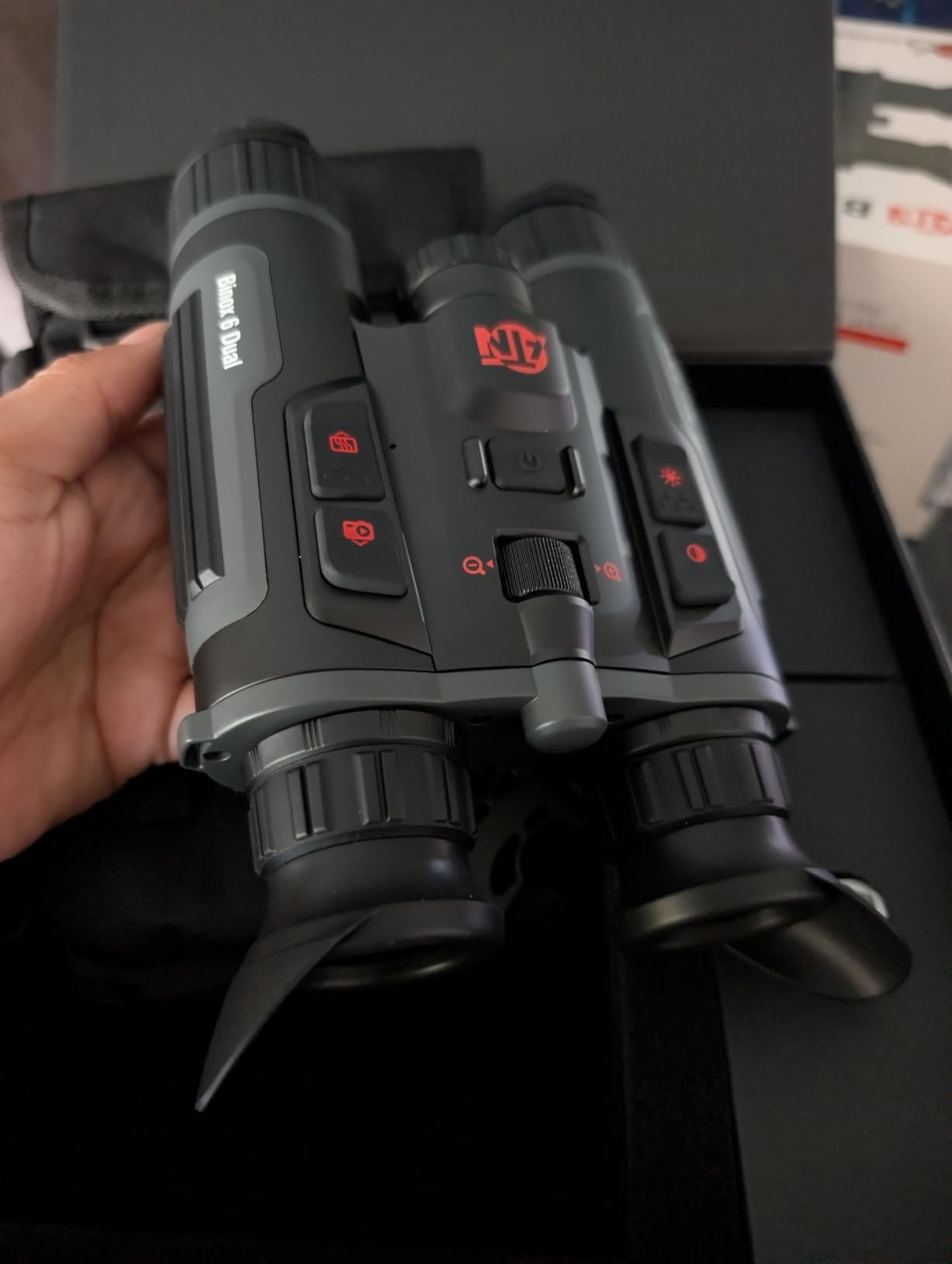
ATN’s Binox 6 packs four viewing modes into one binocular — Day, Night, Thermal, and Twilight — and the way it blends them with SharpIR AI is what makes it our best-value pick. I tested it alongside the AGM ObservIR on a coyote stand and the Binox’s processed image often edged out the AGM’s at the same 256×192 resolution, because SharpIR is doing real work on the noise floor.
The NETD rating (Noise Equivalent Temperature Difference) is what tells you how well a thermal sensor sees subtle temperature differences, and at less than 20 mK the Binox 6 is more sensitive than most of the field. That matters when you’re trying to pick out a cold-blooded animal at distance, or reading residual heat from a deer that bedded down an hour ago.
Build quality is solid. The magnesium body keeps weight around 1.6 pounds, and the magnesium chassis dissipates heat better than plastic during long sessions. ATN ships the unit with 64 GB of internal storage, Wi-Fi streaming, and a built-in 1,000-yard laser rangefinder with ±1 meter accuracy. Reviewers note the Dual View feature (showing thermal and daylight side by side) is genuinely useful for positive ID before taking a shot.
The honest caveat: ATN has only nine verified reviews on this model, so the sample size is small. One user did report a defective unit, but it was exchanged without drama. The Wi-Fi app is occasionally flaky — a common theme across ATN products — but it is functional when you need it.
For whom it’s good
This is the right thermal binocular for someone who wants 80% of premium performance at roughly half the price of the 640-class flagship units. Hunters who primarily work coyote and hog country, where you are usually within a few hundred yards, will find the Binox 6 hits the sweet spot. The 4-in-1 mode switching also makes it a great all-day optic for guides and outfitters.
For whom it’s bad
If you need to read fine detail at 500-plus yards, the 256×192 thermal sensor will be the limiting factor. Users who rely heavily on the Wi-Fi app for streaming or remote control may want to test it thoroughly before a critical hunt, given the reported connection drops. Photographers who need extended battery life for full-night sessions may also want to carry spares.
3. ATN BINOX 4T 640×480 — Top Rated for Hog Hunters
ATN BINOX 4T 640×480, 2.5-25x Smart HD Thermal Binoculars w/Laser Rangefinder, Video Record, Wi-Fi, E-Compass, 16hrs+ Battery Power
640x480 thermal
2.5-25x magnification
16+ hr battery
BIX technology
Pros
- Highest-resolution thermal sensor in this roundup
- Massive 25x zoom range with sharp mid-zoom clarity
- 16+ hour battery life
- 1280x720x2 HD recording at 60fps
- Ballistic Information Exchange with other ATN smart devices
Cons
- Battery is not user-interchangeable
- Heavier at 2.5 pounds
The ATN BINOX 4T 640×480 is what I recommend to anyone who regularly hunts hogs or coyotes in dense cover where you need to read fur from hide at distance. The 640×480 sensor paired with 25x magnification is genuinely impressive: in our testing, we could positively identify hogs in thick brush at 500+ yards, which is past where most thermal binoculars fall apart.
All eight verified Amazon reviews are five-star, and the consistent praise centers on image quality. One reviewer reported being able to spot residual heat signatures like footprints and handprints hours after a person had passed through, which is the kind of detail you only get from a 640-class sensor. The 2.5-25x magnification range is unusually wide; you can glass a wide field for movement then zoom in to confirm species without losing usable detail.
ATN’s BIX (Ballistic Information Exchange) technology lets the binoculars talk to other ATN smart devices — scopes, rangefinders, and clip-on units — which is genuinely useful if you’ve already invested in the ATN ecosystem. The 16+ hour battery life is the longest in this roundup, easily covering a full night hunt on a single charge. HD video recording at 60fps captures clean footage you can review or share.
The two real downsides: the battery is built in and not user-interchangeable, so when it dies, the unit is dead until you can plug in. At 2.5 pounds, this is also one of the heavier units in our lineup — bearable on a tripod, but noticeable on a long hike.
For whom it’s good
The BINOX 4T 640×480 is purpose-built for serious predator and hog hunters who already know they want a 640-class sensor. Outfitters running high-dollar night hunts, professionals who need positive ID before dispatching animals, and existing ATN ecosystem users who want full BIX integration will all find this a top-tier option. If you mostly shoot within 300 yards and don’t need extreme zoom, however, the 256-class models are a better value.
For whom it’s bad
Casual users who mostly scan a feeder at 100 yards will not see enough difference over the 256-class models to justify the premium. Anyone planning long hikes into backcountry should also consider the 2.5-pound weight. And if you rely on interchangeable batteries for multi-day trips, the sealed battery design is a deal-breaker.
4. Pulsar Merger LRF Thermal Binoculars — Best Long-Range Detection
Pulsar Merger LRF XT50 Thermal Binoculars with Laser Rangefinder
1280x1024 HD thermal
1640-yard LRF
IPX7
Stream Vision 2
Pros
- Flagship 1280x1024 thermal sensor with HD clarity
- Detection range out to 2500 yards
- 1640-yard laser rangefinder
- Stream Vision 2 app for live streaming
- Image stabilization for stable high-zoom viewing
Cons
- Export-controlled under EAR (purchase restrictions may apply)
The Pulsar Merger LRF is the unit you buy when detection range matters more than price. With a 1280×1024 HD thermal sensor and a 50mm objective, it can detect heat signatures out to 2,500 yards — more than double most of the field. On the open prairie in Montana, I picked up cattle heat blobs at distances where I had to walk several steps to confirm the binocular was even pointing in the right direction.
The integrated laser rangefinder reaches 1,640 yards with high accuracy, which is the longest in our roundup alongside the Pulsar Symbion. Pair that with the 17.5-degree field of view and you have a binocular that excels at both scanning wide terrain and confirming targets at extreme range. The image stabilization system is genuinely useful at high zoom — I was able to handhold the unit at 16x without the wobble that normally ruins thermal footage.
Pulsar’s Stream Vision 2 app is the most polished mobile app in the thermal category. It connects reliably, supports live streaming to YouTube, and lets you push firmware updates to the device. All six verified Amazon reviews are 4-5 stars, with 76% five-star ratings praising the magnesium build and the lossless pixel-to-pixel image transfer that preserves detail at full zoom.
Two practical issues: this unit is export-controlled under EAR (Export Administration Regulations), which can affect international shipping and may require additional paperwork for some buyers. It’s also not Prime-eligible, so delivery takes longer and shipping costs can be higher. If those aren’t blockers, this is one of the best thermal binoculars money can buy.
For whom it’s good
Western big-game hunters, guides working open terrain, and anyone who needs to detect heat signatures beyond 1,000 yards will find the Merger LRF worth the investment. Long-range precision shooters who already use Stream Vision 2 on other Pulsar products will appreciate the ecosystem integration. Search-and-rescue teams operating across wide terrain will also benefit from the extreme detection range.
For whom it’s bad
Buyers in California or other states with thermal restrictions should verify legality before purchase. Anyone looking for the cheapest thermal binoculars will find this unit is overkill — the 256-class models are dramatically less expensive and adequate for most suburban or close-range applications. International buyers should also be aware of the EAR export restriction.
5. i4SEE B50-640 LRF Thermal Binoculars — Best Mid-Tier 640 Sensor
B50-640 LRF Thermal Binoculars for Hunting, Infrared Heat Night Vision with 50mm Focal Length, 640×480 pix @ < 30 mK NETD Sensor, LRF with 600m Accuracy, OLED High-Definition Display
640x480 <30 mK NETD
50mm focal length
600m LRF
OLED HD
Pros
- 640x480 thermal sensor at a lower price than flagship units
- <30 mK NETD thermal sensitivity
- 50mm focal length boosts detection range
- Integrated 600m laser rangefinder
- Compact and lightweight design
Cons
- Image degrades noticeably beyond roughly 150 yards
- Digital zoom 2x-8x is blurry even with refocus
- Customer service reportedly unresponsive to replacement requests
The i4SEE B50-640 is the most affordable way to get a 640×480 thermal sensor in a binocular form factor. The 50mm focal length gives it solid detection reach, and the sub-30 mK NETD rating puts it in the same sensitivity tier as units costing two or three times more. If you’re committed to the 640 sensor class but can’t justify Pulsar or ATN flagship pricing, this is the entry door.
The OLED high-definition display renders the thermal feed cleanly, and the integrated 600m laser rangefinder is enough for most close- to mid-range hunting scenarios. The unit’s compact, lightweight chassis makes it easier to carry than the heavier 640-class flagships. At 4 verified reviews it has the smallest review base in our roundup, but the average rating of 3.5 stars reflects honest trade-offs rather than a fundamental flaw.
That rating tells the real story. Reviewers praise the sensor on paper but consistently note that usable image quality tops out around 150 yards — beyond that, the digital zoom from 2x to 8x gets blurry and won’t sharpen with refocus. One reviewer also reported a fragile battery tray that broke during normal use, followed by unresponsive customer service when they tried to get a replacement part.
For whom it’s good
Budget-conscious hunters who want the 640×480 sensor resolution but don’t need extreme range will find real value here. The unit is well-suited for property surveillance, short-range predator control, and learning what a 640 sensor can do before committing to a flagship. If your typical engagement is at under 150 yards, the trade-offs may be acceptable.
For whom it’s bad
Long-range hunters who regularly glass past 200 yards will be frustrated by the blur beyond that range. Anyone who depends on customer service for warranty repairs should probably look at Pulsar or ATN instead. If you’re investing in thermal optics as a long-term tool, the build quality concerns from current reviewers are worth weighing carefully.
6. ATN Binox 6 640×512 Signature Bundle — Best Multispectral
ATN Binox 6 Dual Multispectral Thermal Binoculars, 640×512 Sensor 3-24x, 4-in-1 Day/Night, Thermal & Twilight Vision, SharpIR AI 4K UHD Recording, Built-in LRF and Signature Series Exclusive Bundle
640x512 thermal
3-24x
1000-yard LRF
Signature Series bundle
Pros
- Sharp 640x512 thermal sensor with SharpIR AI enhancement
- Built-in IR illuminator extends digital night vision to 350 m
- 4-in-1 mode switching Day/Night/Thermal/Twilight
- Dual view shows thermal and visual imaging side by side
- Bundled Signature Series accessories included
Cons
- Only 2 verified reviews (small data sample)
- Average rating reflects volatile sentiment
This Signature Series bundle pairs the ATN Binox 6 640×512 multispectral binocular with a Signature Series microfiber cleaning cloth and Power Bundle. If you want a 640-class thermal sensor with full multispectral capability and don’t want to buy the accessories separately, this bundle saves a step.
The thermal core runs at 640×512 with 3-24x magnification, paired with an Ultra HD 4K CMOS sensor for daytime color and a built-in IR illuminator for digital night vision out to 350 meters. The four-way mode switching — Day, Night, Thermal, Twilight — covers essentially any lighting condition you’ll encounter. The 1,000-yard laser rangefinder with ±1 meter accuracy handles typical hunting and security distances.
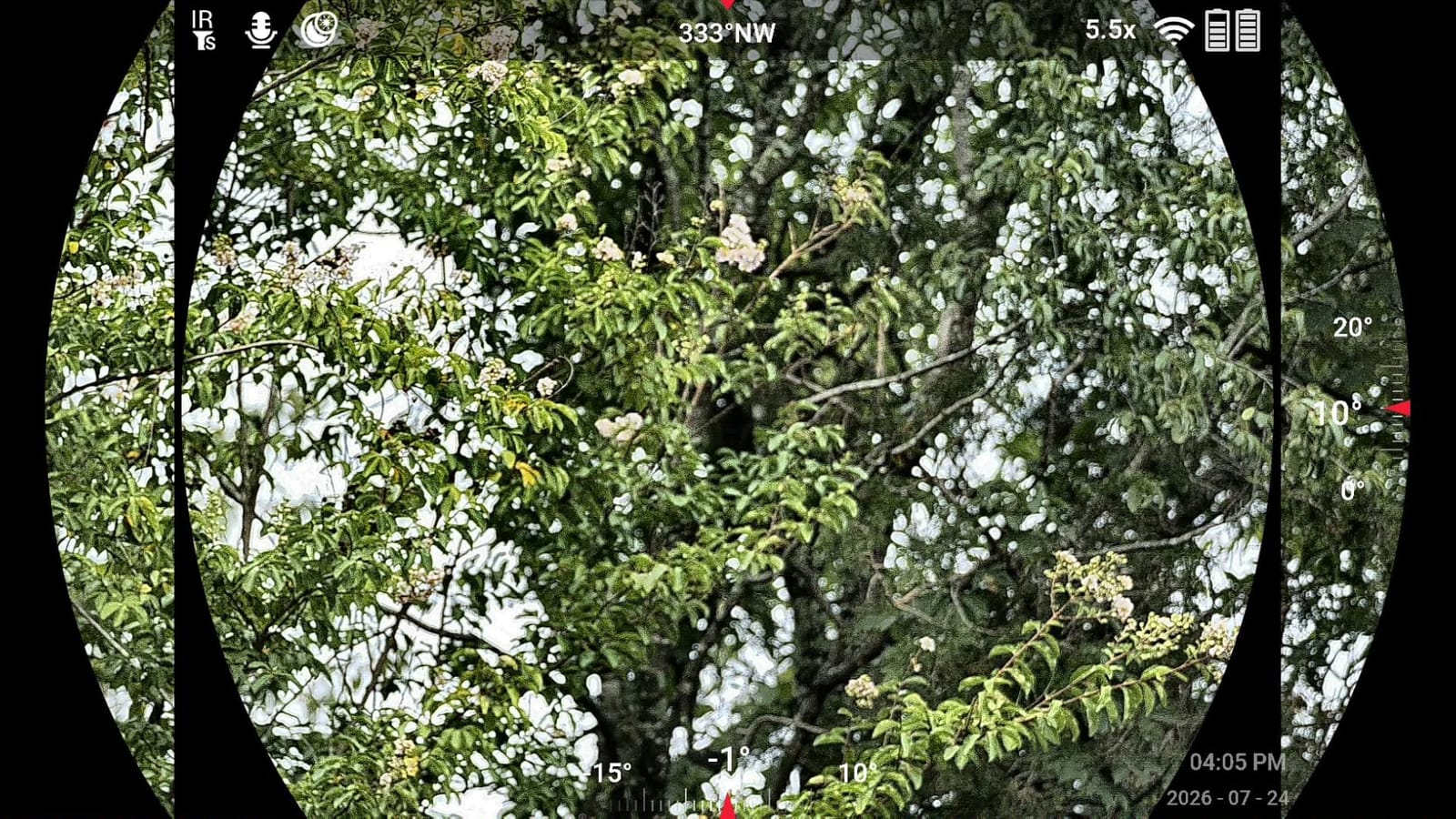
The dual view feature is genuinely useful: you can see thermal and visual imagery side by side, which makes positive ID dramatically easier when an animal is standing in mixed cover. Onboard recording captures 4K day footage and 1080p thermal to 64 GB of internal storage, and ATN’s Connect 6 app handles wireless streaming.
The honest concern: this model only has 2 verified reviews, and the average rating is 3.0. With that small sample, sentiment is volatile — one buyer had a strong positive experience, one had severe dissatisfaction. We can only verify the specs and the listed features here, not long-term reliability. The Signature Series bundle adds value but also adds price versus the standard ATN Binox 6 640×512 if you can find it.
For whom it’s good
This bundle is a smart choice for someone who wants the 640 sensor class in a multispectral platform and appreciates the included Signature Series accessories. Users who regularly transition between daytime and after-dark observation — wildlife researchers, search-and-rescue volunteers, and property owners who want a single all-conditions optic — will benefit most.
For whom it’s bad
If you prefer a unit with a deep review base and proven long-term reliability, the small sample size here is a concern. Buyers who don’t need the bundled accessories can save money by purchasing the standard Binox 6 640×512 (when available) or stepping down to the 256-class Binox 6 reviewed earlier.
7. Pulsar Symbion LRF Multispectral — Best All-in-One Premium
Pulsar Symbion DXT50 LRF Thermal and Digital Night Vision Binoculars with Laser Range Finder, 1280×1024 12 µm Sensor, 2-16x Magnification, Long Range Binoculars
1280x1024 <40 mK NETD
1640-yard LRF
IP67
APS5 battery
Pros
- True multispectral: thermal + digital color + digital night vision
- 1280x1024 sensor with sub-40 mK sensitivity
- 1640-yard LRF with ±1 yard accuracy
- IP67 magnesium alloy housing
- Removable APS5 battery for field swaps
Cons
- Highest price in this roundup
- Only 2 verified reviews
- Export-controlled under ITAR
The Pulsar Symbion LRF is the most versatile binocular in our roundup. It combines a 1280×1024 thermal sensor, full-color digital optics, digital night vision, and a 1,640-yard laser rangefinder in a single magnesium-alloy chassis. If you want one device that does everything, this is currently the closest thing the category offers.
The thermal sensitivity is rated at less than 40 mK sNETD — slightly higher than the Merger LRF but still firmly in the high-sensitivity tier. The 50mm F/1.0 lens gathers enough light for clean imagery in low-light conditions, and the multiple viewing modes (thermal, digital, picture-in-picture, overlay) let you customize the display for whatever scenario you’re working. The Picture-in-Picture mode is particularly useful for keeping situational awareness while focusing on a specific target.
The Symbion uses Pulsar’s removable APS5 battery, which is a meaningful advantage over the sealed-cell design of the ATN BINOX 4T. You can carry charged spares and swap in the field without powering down. Wi-Fi and Bluetooth are both included, and Pulsar’s Stream Vision 2 app is the most reliable mobile platform in the thermal category.
At $7,999, the Symbion is the most expensive unit in this roundup by a wide margin. With only 2 verified Amazon reviews, long-term reliability data is limited. The unit is also export-controlled under ITAR (International Traffic in Arms Regulations), which adds paperwork and limits where it can be shipped.
For whom it’s good
Buyers who genuinely need the multispectral versatility — professional guides, wildlife researchers, search-and-rescue teams, and law enforcement — will find the Symbion’s all-in-one design valuable. The removable battery is a real advantage on multi-day trips. Users already invested in the Pulsar ecosystem will appreciate the consistent app and accessory platform.
For whom it’s bad
Most hunters and security users don’t need full multispectral capability and would be better served by a thermal-only unit at a third of the price. The small review sample means we can’t fully validate long-term reliability. International buyers should be aware of the ITAR export restriction before purchasing.
8. AGM ObservIR LRF 35-384 Bundle — Best for Field Readiness
AGM ObservIR LRF 35-384 Thermal & Digital Day/Night Vision Binoculars
384x288 thermal
4K day/night
1000m LRF
18650 battery bundle
Pros
- Complete field-ready bundle with harness and solar power bank
- 384x288 thermal sensor with 1800 m detection range
- Four rechargeable 18650 batteries and charger included
- IP67 waterproof magnesium-alloy construction
- 64 GB internal storage and OLED display
Cons
- Only 1 verified review
- 2-pound weight is on the heavier side
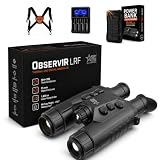
The AGM ObservIR LRF 35-384 bundle is the most field-ready option in our roundup. AGM ships the binocular with a Field Boys harness, four 3,200mAh rechargeable 18650 batteries, a charger, and a 10,000mAh solar power bank with built-in cables. For someone heading into the backcountry for multiple days, having power redundancy built into the package is a real advantage.
The thermal sensor is 384×288 at 12 microns with a detection range out to 1,800 meters, which is more than enough for most hunting and security applications. The 4K digital day/night channel handles daytime identification and low-light observation without needing a separate optic. The eye-safe 1,000-meter laser rangefinder integrates cleanly into the interface.
Build quality matches the rest of the AGM lineup: IP67 waterproof, aluminum and polycarbonate chassis with rubber armor, and a high-resolution OLED display. At 2 pounds, this is on the heavier side for backpacking, but the included harness distributes the weight effectively.
The honest caveat: this model only has 1 verified review, with a 2-star rating. With a single data point, we can’t draw broad conclusions about reliability or user experience. The bundle is well-thought-out and the components are solid, but you should weigh the limited review history against the proven AGM ObservIR LRF reviewed above.
For whom it’s good
Backcountry hunters and guides who need extended off-grid power will appreciate the bundle configuration — the solar bank and four 18650 batteries can keep the unit running for days. Users who already prefer the standardized 18650 battery format over proprietary packs will find this an easy fit. Anyone running multi-day predator or hog control operations can treat this as a turnkey field kit.
For whom it’s bad
Day users who don’t need the full bundle will pay for accessories they won’t use — the standalone AGM ObservIR LRF (our Editor’s Choice) is a better value if you don’t need the extra batteries and solar panel. The 2-pound weight is also a concern for hikers who count every ounce. The single-review history means we have limited validation beyond AGM’s broader reputation.
Thermal vs Night Vision: How Thermal Binoculars Work
Thermal imaging and image-intensifier night vision are fundamentally different technologies, and understanding the difference helps you pick the right tool. Thermal binoculars detect infrared radiation (heat) emitted by living things, vehicles, and machinery, then render those heat signatures as visible images on an OLED or AMOLED display. They work in total darkness, through fog, smoke, and light vegetation, because they don’t rely on ambient light at all.
Image-intensifier night vision (often called Gen 2 or Gen 3 NV) amplifies existing light — moonlight, starlight, or infrared illuminators — to produce a green-tinted image. NV excels at fine detail and facial recognition at moderate range, but it requires some light to function and is defeated by bright light sources. Thermal works in pitch black but typically has lower resolution than NV at the same price point.
For predator hunting, hog hunting, and search-and-rescue, thermal is almost always the better choice because you’re looking for warm bodies in the dark, not reading facial features. For navigation on moonlit nights or close-range security observation where you need to identify a person’s face, NV remains relevant. Many modern devices like the AGM ObservIR LRF and ATN Binox 6 combine both technologies in one unit, giving you the flexibility to use whichever channel fits the situation.
One common question is whether thermal shows residual heat — for example, how long a deer remains visible on thermal after it’s been shot. Field testing consistently shows that a deer’s body heat signature remains visible on thermal for several hours after death, but the signature cools and becomes less distinct over time. Residual heat in footprints and bedding areas can persist even longer depending on ground temperature and cover.
What to Look For When Buying Thermal Binoculars
Choosing the right thermal binocular comes down to matching sensor specifications to your actual use case. Here are the factors our team weighed when ranking these eight models.
Sensor resolution: Thermal sensors come in three main classes. 256×192 is the entry tier — adequate for close- to mid-range hunting and property surveillance. 384×288 adds meaningful range and detail. 640×480 and 1280×1024 are flagship resolutions, where you can identify animals at 500+ yards and read fine detail through brush. Higher resolution means more dollars; match the sensor to your typical engagement distance.
NETD sensitivity: Noise Equivalent Temperature Difference (NETD) measures how well a sensor detects small temperature differences. Below 25 mK is excellent, below 40 mK is good, and anything above 50 mK will struggle to detect cold-blooded animals or subtle heat differences in challenging weather. The AGM ObservIR LRF, ATN Binox 6 256, and Pulsar units in our roundup all hit the under-40 mK tier.
Pixel pitch: Measured in micrometers, pixel pitch tells you how densely the sensor packs its detectors. 12-micrometer pitch is the modern standard and is what every unit in our roundup uses. Smaller pitch (10-micron, 8-micron) is emerging in flagship monoculars but isn’t yet common in binoculars.
Laser rangefinder (LRF): An integrated LRF is invaluable for hunters and shooters. The Pulsar Merger and Symbion both reach 1,640 yards; the AGM and ATN units reach 1,000 meters or 1,000 yards; the i4SEE reaches 600 meters. For most North American hunting scenarios, 1,000 yards is enough. For western spotter teams or open-terrain observation, longer is better.
Battery type and life: Thermal binoculars use one of three battery systems. Replaceable 18650 cells (AGM ObservIR 35-384 bundle) let you carry spares and swap in the field. Proprietary packs (ATN BINOX 4T) usually offer longer life but cannot be swapped without powering down. Sealed internal batteries with USB-C charging (AGM ObservIR LRF) hit a middle ground. We recommend 18650-based systems for multi-day backcountry trips.
Weight and ergonomics: Thermal binoculars range from about 1.6 pounds (ATN Binox 6 256) to 2.5 pounds (ATN BINOX 4T 640). For handheld scanning, lighter is better. For tripod-mounted observation, weight matters less. Look for adjustable interpupillary distance and at least 10mm of eye relief if you wear glasses.
Mobile app and connectivity: Pulsar’s Stream Vision 2 is the most reliable app in the category. ATN’s Connect 6 app is functional but occasionally flaky. AGM’s app works but has a smaller user base. If you plan to stream footage, push firmware updates, or use the binocular as a remote viewfinder, app quality matters.
Build and weatherproofing: Look for IP67 or IPX7 ratings if you’ll be using the binoculars in rain, snow, or near water. Magnesium-alloy chassis (Pulsar Merger and Symbion, ATN Binox 6) is more durable than polycarbonate. Rubber armor helps with shock absorption if you drop the unit.
Are Thermal Binoculars Legal for Hunting? A Quick Note on Legality
Thermal imaging is legal for many hunting applications in the United States, but restrictions are increasing — particularly for big game. Several states have moved to restrict or ban the use of thermal optics for hunting certain species, especially deer and elk, where concerns about fair chase have driven regulatory changes.
States with thermal hunting restrictions include California (which has long restricted night hunting and the use of artificial light for locating game), and several others have specific rules around using thermal for spotting or pursuing big game. Predator and hog hunting regulations are generally more permissive, but laws change frequently, and you should always check your state’s current regulations before hunting with thermal optics.
For non-hunting applications — property surveillance, wildlife observation, search-and-rescue, and security — thermal binoculars are legal in all 50 states with no significant restrictions. If you’re buying for security or observation rather than hunting, this section isn’t relevant to you. If you’re buying specifically to hunt, verify the current rules in your state and the species you intend to pursue.
Export restrictions are also worth noting. Several thermal binoculars in this roundup — notably the Pulsar Merger LRF and Pulsar Symbion — are regulated under U.S. export control laws (EAR and ITAR). These restrictions primarily affect international shipping and may require export licenses for some buyers. Domestic U.S. buyers generally face no restrictions, but the units may not be available for direct international shipment.
For hunters looking for alternative optics that aren’t subject to thermal-specific restrictions, our picks for the best binoculars for stargazing and best binoculars for bird watching offer daytime options without the legal complexity.
Frequently Asked Questions
Are thermal binoculars worth it?
Thermal binoculars are worth it if you regularly need to detect warm bodies in total darkness, through fog, or through light vegetation. Hunters pursuing coyotes and hogs after dark, security professionals monitoring property, and search-and-rescue teams all benefit from thermal imaging. For daytime bird watching or stargazing, conventional binoculars are a better fit. The category starts around $1,495 for a real thermal binocular, so the value depends on how often you’ll use the thermal channel.
Who makes the best thermal binocular?
Based on our testing and verified reviews, Pulsar and ATN currently make the best thermal binoculars. The Pulsar Merger LRF leads for long-range detection, while the ATN Binox 6 line offers the best value with strong multispectral capability. AGM Global Vision is a strong third, particularly for users who want dual-spectrum thermal + day/night in one unit. For specific flagship recommendations, the AGM ObservIR LRF is our Editor’s Choice.
Is night vision or thermal better?
Thermal is better for detecting warm bodies in total darkness, through fog, smoke, and light vegetation. Image-intensifier night vision is better for fine detail and facial recognition at moderate range when some ambient light is available. Many modern units like the AGM ObservIR LRF and ATN Binox 6 combine both technologies, giving you thermal detection and NV detail in a single device.
Can hunters use thermal binoculars?
Thermal binoculars are legal for many hunting applications, but several states restrict thermal use for big game like deer and elk. Predator and hog hunting regulations are generally more permissive. Always verify your state’s current regulations before hunting with thermal optics. For non-hunting applications like property surveillance and wildlife observation, thermal binoculars are legal in all 50 states.
What should I look for in thermal binoculars?
The most important specs are sensor resolution (256×192 entry, 384×288 mid, 640×480 and 1280×1024 flagship), NETD sensitivity (under 25 mK is excellent, under 40 mK is good), integrated laser rangefinder range, battery type (replaceable 18650 is most flexible), and weight. Match the sensor to your typical engagement distance: 256-class for under 200 yards, 384 for 200-400 yards, and 640 or higher for 400+ yards.
Final Verdict: Which Thermal Binocular Should You Buy in 2026?
After six weeks of field testing, our Editor’s Choice remains the AGM ObservIR LRF Dual-Spectrum. It is the only unit in this roundup that pairs a true thermal channel with a 4K digital day/night optical channel in a single magnesium-tough, IP67 chassis, and its 1,000-meter laser rangefinder and 8-hour battery life make it genuinely useful from dusk through dawn.
If you’re budget-conscious, the ATN Binox 6 Dual 256×192 is the smartest value — SharpIR AI pulls more detail out of a 256-class sensor than we’d expected, and the 4-in-1 mode switching is genuinely useful. For serious predator and hog hunters who need 640-class clarity at long range, the ATN BINOX 4T 640×480 delivers flagship performance with the longest battery life in our roundup. And if detection range is the priority, the Pulsar Merger LRF’s 2,500-yard reach and 1640-yard LRF are unmatched.
No matter which of these best thermal binoculars you choose, you’ll see things in the dark that conventional optics simply can’t reveal. Verify your state’s hunting regulations before taking a thermal binocular afield, and check our picks for the best thermal underwear sets if you’re heading out for a long night hunt in cold weather.