
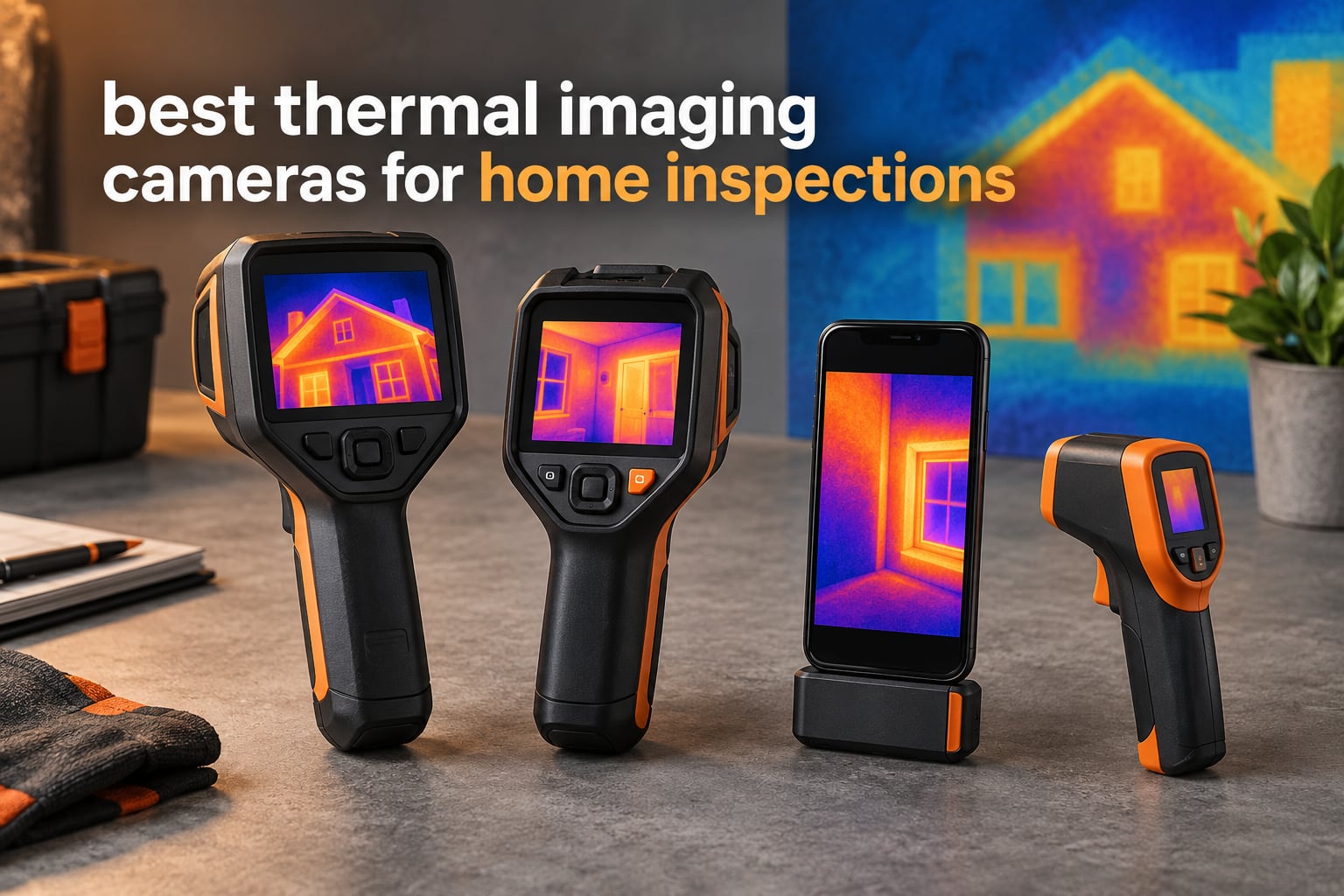
If you only read one line: the best thermal imaging camera for home inspections right now is the FLIR C5, because it is the only camera in this group that uploads a scan straight to cloud software and returns it as a finished client document. Professional inspectors who need more detail per pixel pair it with a higher-resolution handheld, and homeowners who want to spend nothing on a subscription model start with a phone-plug imager.
We put ten cameras through the same filter: detector resolution, thermal sensitivity, temperature accuracy, how fast the sensor refreshes while you pan a wall, and what happens to the image after the job is over. Everything here is aimed at one job, finding what a visual inspection cannot see. That means wet insulation, missing batt, thermal bridging at the framing, leaking supply and return ductwork, and hot spots at electrical connections.
There is no cheap answer that suits everybody, so the list below splits by persona. If you carry a camera for a living, read the first four sections closely. If you own the house and just want to find the cold spot behind the couch, jump to the last three.
Top 3 Best Thermal Imaging Cameras for Home Inspections (October 2026)
These three cover the decisions most people actually face: a complete cloud report workflow, the strongest standalone value, and the highest-rated imager with the largest review base behind it.
FLIR C5 Compact Thermal Camera
- 160x120 with MSX embossing
- Built-in Wi-Fi to FLIR Ignite for reports
- 190 g pocketable body
- -4°F to 752°F range

TOPDON TC004 Thermal Camera
- 256x192 native
- 512x384 via TISR
- 64GB onboard storage
- Laser pointer and LED

TOPDON TC001 for Android
- 256x192 upscaled to 512x384
- Phone supplies all the power
- Point and line analysis with nine readings
All 10 Thermal Imaging Cameras Compared Side by Side
The single most useful comparison number is the native detector resolution, not the advertised output. Several cameras in this list upscale their image in software, and the difference is obvious when you try to isolate one circuit breaker or one stud bay.
| Product | Specifications | Action |
|---|---|---|
| FLIR C5 Compact Thermal Imaging Camera |
|
Check Latest Price |
| TOPDON TC004 Thermal Imaging Camera |
|
Check Latest Price |
 FLIR TG165-X Thermal Imaging Camera FLIR TG165-X Thermal Imaging Camera |
|
Check Latest Price |
| TOPDON TC001 Thermal Camera for Android |
|
Check Latest Price |
 MILESEEY TR10 Thermal Imaging Camera MILESEEY TR10 Thermal Imaging Camera |
|
Check Latest Price |
 Thermal Master Thor002 Handheld Camera Thermal Master Thor002 Handheld Camera |
|
Check Latest Price |
 FOXWELL RT280 Thermal Imaging Camera FOXWELL RT280 Thermal Imaging Camera |
|
Check Latest Price |
 AccuMEMS GT14S Thermal Imaging Camera AccuMEMS GT14S Thermal Imaging Camera |
|
Check Latest Price |
 Flagfront 240×240 TISR Thermal Camera Flagfront 240×240 TISR Thermal Camera |
|
Check Latest Price |
 GOYOJO 192×192 USB-C Thermal Camera GOYOJO 192×192 USB-C Thermal Camera |
|
Check Latest Price |
1. FLIR C5 Compact Thermal Imaging Camera – the one that writes the report for you
Flir C5 Compact Thermal Imaging Camera, WiFi, 160×120 MSX, Ignite
160x120 with MSX embossing
3.5-inch screen
190 g body
Wi-Fi to FLIR Ignite
-4°F to 752°F range
Pros
- MSX embossing puts visible scene detail onto the thermal image
- Built-in Wi-Fi uploads straight to FLIR Ignite for client reports
- 190 g body fits a pocket and carries through an attic or crawlspace
- -4°F to 752°F range covers both attic cold and HVAC hot spots
- Two-year parts and labor warranty with ten years on the detector
Cons
- 160x120 sensor is thin on detail for small anomalies
- Blended MSX and picture-in-picture views need a compatible phone or tablet
The C5 is the camera I recommend to inspectors who are still building a report workflow rather than a diagnostic reputation. You scan a wall, pull the hot spot, and upload it to FLIR Ignite from the camera itself, where it becomes an annotated image inside a client document. Reviewers consistently name that Ignite workflow, alongside MSX image clarity and the 190 g body, as the three reasons they stayed with it.
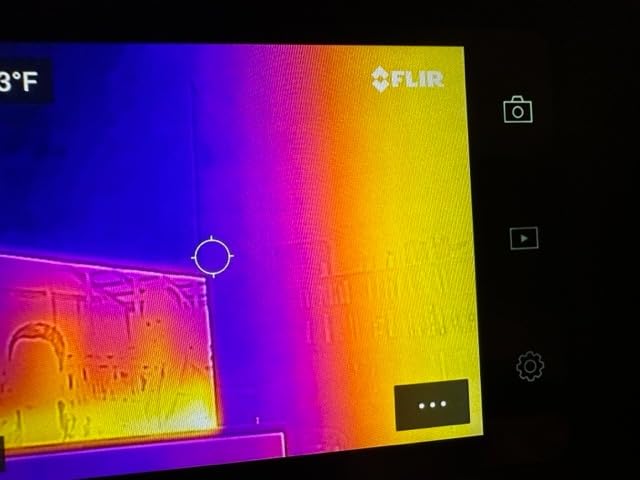
On the inspection itself, the C5 handles the attic and exterior scan better than its raw pixel count suggests. MSX embosses the roof sheathing and the framing lines onto the thermal image, so you can tell a genuine insulation void from a shadow created by the rafter itself.
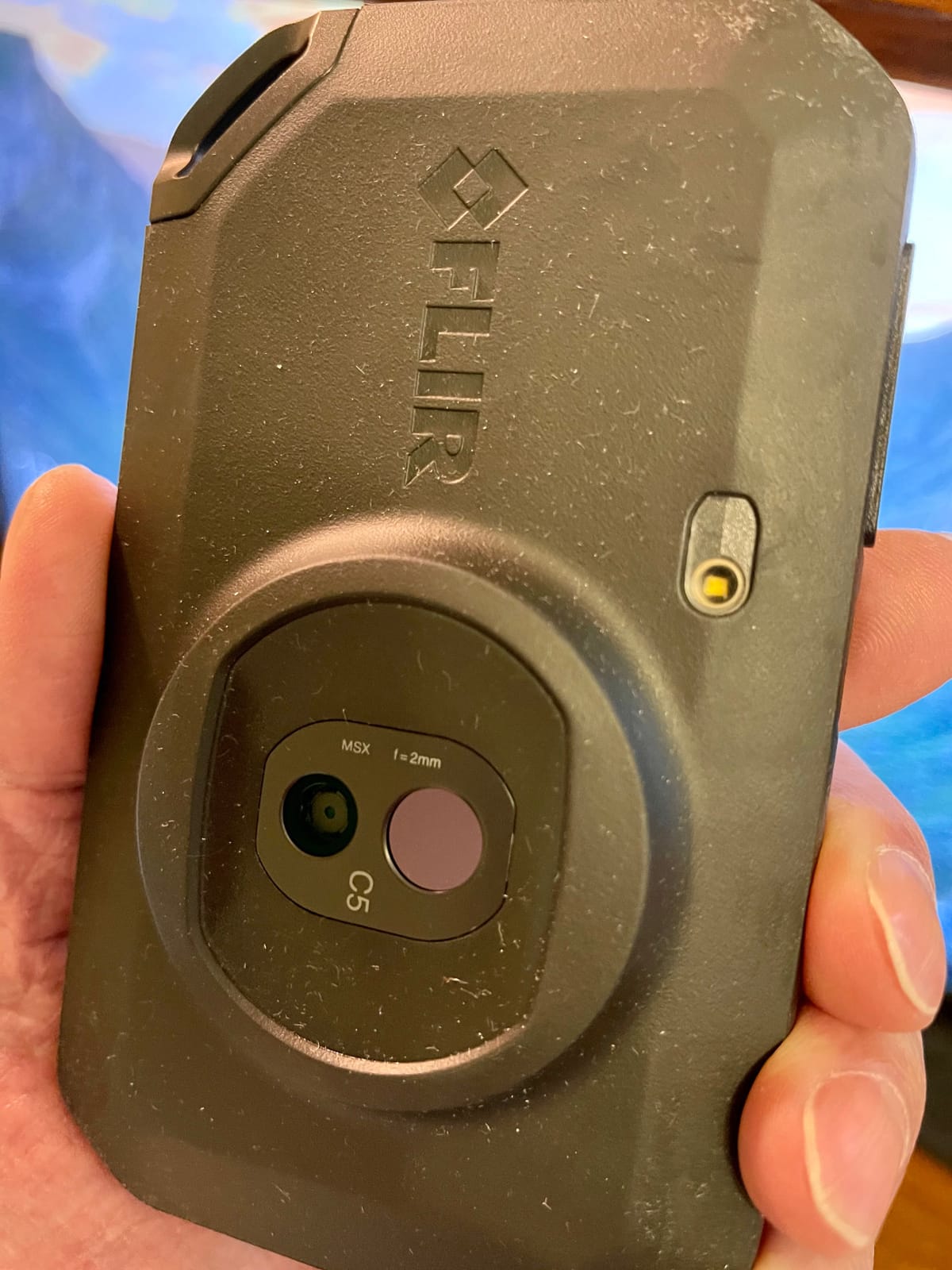
Where it struggles is small electrical work. At 160 by 120 with 19,200 pixels, isolating one lug inside a crowded panel is a matter of luck, and reviewers report the same limit when they try to pick out a single hot breaker behind a dead front.
The 3-second response time and the -4°F to 752°F span cover the working range of a residential inspection comfortably. What the C5 will not do is resolve moisture signatures you need to defend in a report, which is why it sits at number one for workflow and not for raw detail.
Who the FLIR C5 suits
An inspector running three or four homes a day who wants images in the client’s inbox the same evening. The camera fits a chest pocket, starts instantly, and charges over USB-C between jobs.
A seller doing a pre-listing walkthrough who wants branded, professional-looking evidence without opening desktop software. Ignite handles the report formatting for you.
Who the FLIR C5 does not suit
Anyone who has to document small electrical anomalies at panel level, or who needs to separate a moisture trace from a shading artifact at close range. Buy more resolution or change jobs, because the sensor will not grow.
Users who refuse to carry a phone into the attic. The MSX and picture-in-picture blended views depend on a compatible phone or tablet, and the camera is less useful on its own than the specification sheet suggests.
2. TOPDON TC004 Thermal Imaging Camera – the strongest standalone value
TOPDON TC004 3.5″ Thermal Imaging Camera, -4°F~1022°F Temp Range
256x192 native, 512x384 via TISR
3.5-inch display
64GB storage
Laser pointer
-4°F to 1022°F
Pros
- 256x192 native resolution with TISR upscaling to 512x384
- 3.5-inch display gives a wide comfortable view of a room or attic bay
- 64GB built-in storage holds a full job of images and video
- Built-in red laser pointer ties the reading to a real target
- IP54 sealing and 2 meter drop rating
Cons
- Standalone unit needs its own battery charging
- Deep image analysis still requires the companion app on a phone or tablet
The TC004 is the camera I hand to an inspector who wants more pixels than the FLIR C5 and does not want a cloud subscription to finish a report. The 3.5-inch screen is large enough to scan a ceiling bay without squinting, and 80% of its 860 reviewers gave it five stars.
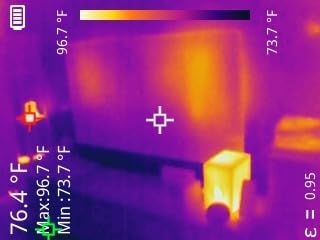
The native 256 by 192 sensor is a real step up from the 160 by 120 class. When you are looking for a compressed insulation stripe or a cold duct run behind a return grille, the extra detail is the difference between a suspicion and a photograph you can attach.
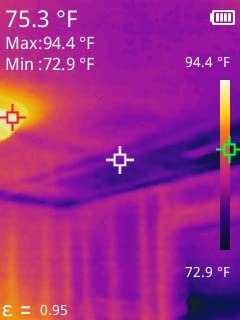
The 64GB of internal storage is a real convenience on a full inspection day. You can shoot an entire attic and crawlspace sequence without shuttling files, and the red laser pointer lets you tell the client exactly which stud bay you are talking about.
Reviewers report consistently that owners use it to find hot spots in walls, attics and HVAC equipment, and that the simple menu layout means no time lost learning the camera in the field. The trade-off is that it is a standalone battery-powered unit, so it lives or dies on its own charge.
Who the TOPDON TC004 suits
Working inspectors who need better resolution than an entry FLIR and a large screen, and who document findings on removable storage rather than a cloud account. The laser pointer makes client conversations concrete.
HVAC technicians tracing duct runs and registers. The 1022°F ceiling leaves room for mechanical and electrical work well beyond a home inspection.
Who the TOPDON TC004 does not suit
Anyone who wants zero charging logistics. It is a battery-powered handheld, unlike the phone-plug models that borrow power from a device already in your pocket.
People who refuse to open an app at all. Deeper point, line and area analysis happens in the TopInfrared mobile software, so the camera alone will not produce the annotated report.
3. FLIR TG165-X Thermal Imaging Camera – a pocket check for outlets and vents
Flir TG165-X Thermal Imaging Camera with Bullseye Laser, Spot IR
4,800 pixel IR sensor
MSX embossing
Bullseye laser spot indicator
13.92 oz
IP54 drop-tested
Pros
- MSX processing keeps small thermal details readable at close range
- Bullseye laser shows the size of the measurement area
- 13.92 oz body with carry pouch and wrist strap
- IP54 drop-tested enclosure for dusty and oily environments
- Two-year parts and labor with ten-year detector coverage
Cons
- 4800 pixel sensor is low for pinpointing very small anomalies
- No screen-based report workflow beyond photo capture and USB export
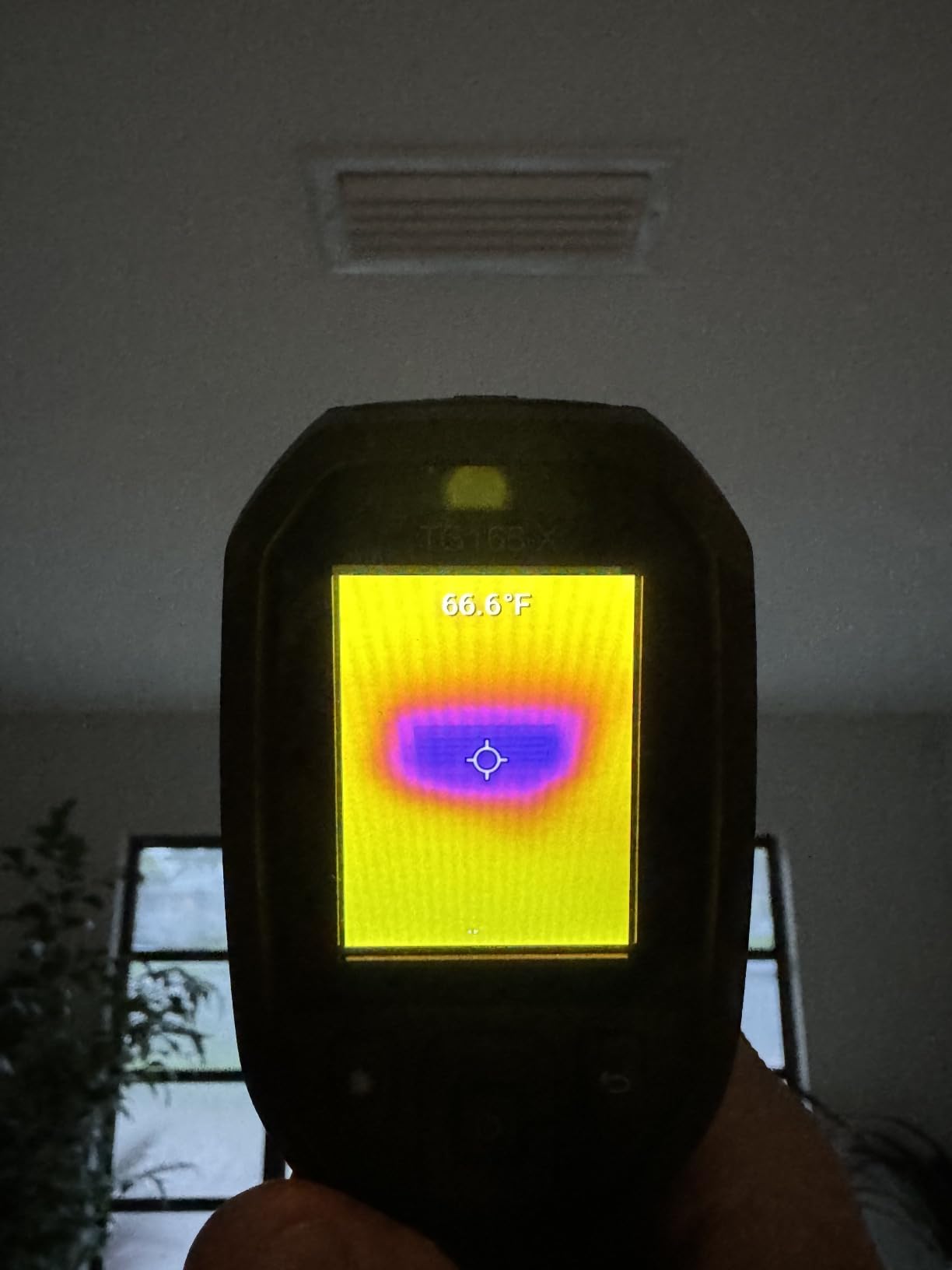
The TG165-X is built for a fast scan. It weighs under a pound, comes with a pouch and strap, and the bullseye laser draws the measurement area on the target so you know when you are pointed correctly rather than guessing at a hot blob.
For HVAC work, that combination is exactly right. Checking a run of supply registers or scanning an electrical outlet for a warm face takes seconds, and the -13°F to 572°F range covers most of what a residential mechanical system throws at you. Reviewers report using it for quick checks of outlets, ductwork and HVAC surfaces for years without fuss.
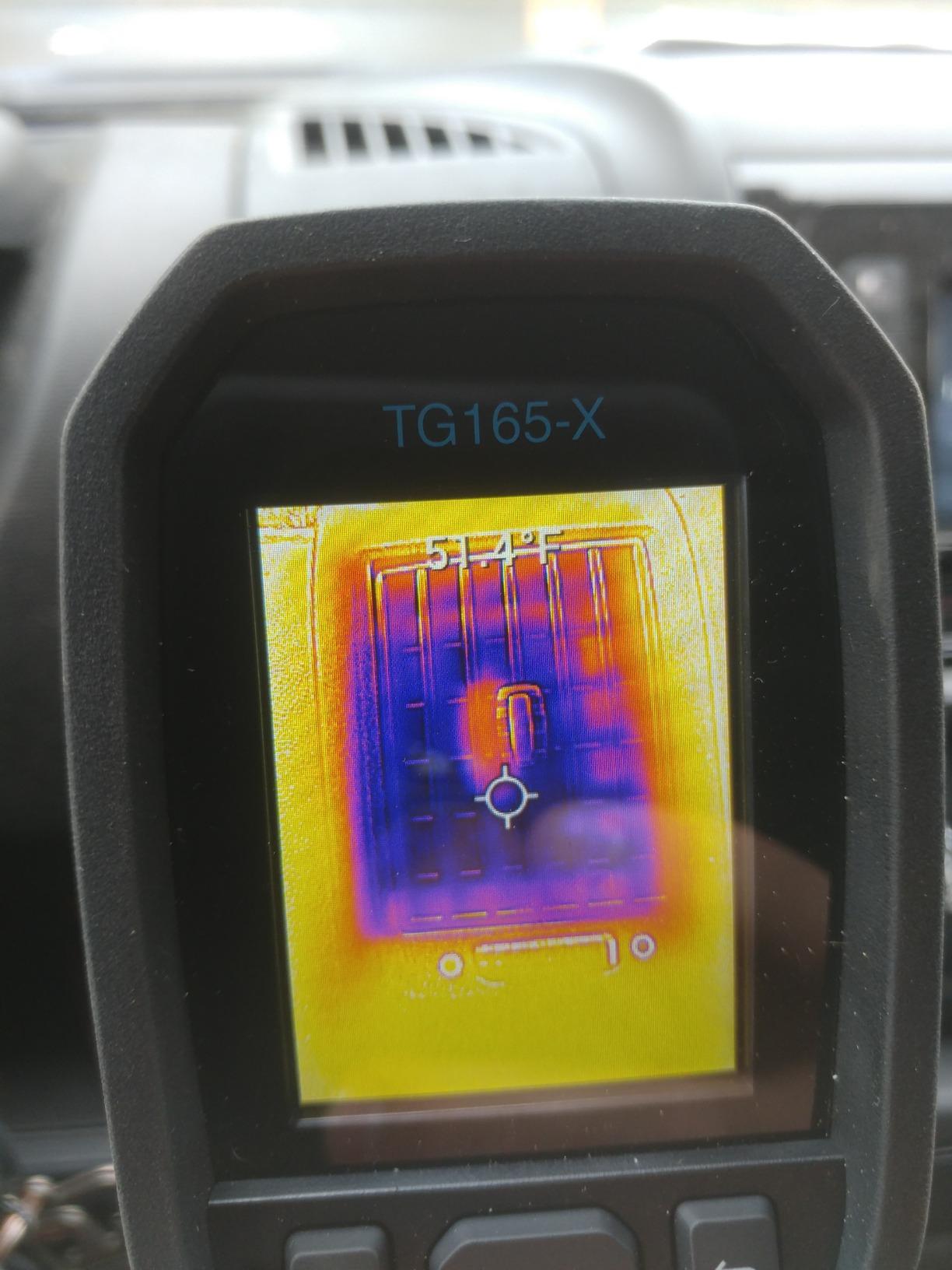
MSX processing is the quiet advantage over cheaper generics. The embossing lays visible scene detail over the thermal map, so a hot outlet reads as a hot outlet instead of an anonymous warm square in an ambiguous rectangle.
Owners also point to the drop-tested IP54 shell holding up to dust, dirt and oil, which matters when the camera lives in the same bag as your other tools. The response time of three seconds keeps the scan moving.
Who the FLIR TG165-X suits
Inspectors who want a permanent carry-everywhere camera for outlets, vent registers and quick mechanical spot checks without carrying a heavier unit up a ladder. The pouch and wrist strap make it genuinely pocketable.
Electricians and HVAC technicians who want a rugged spot-check tool with a trusted name behind it and a ten-year detector warranty.
Who the FLIR TG165-X does not suit
Anyone documenting defects for a written report. There is no Ignite upload and no on-device report workflow, so images leave over USB and get placed into your template manually.
Users chasing small anomalies at distance. Reviewers repeatedly flag the 4,800 pixel sensor as the limiting factor when the target is only a few pixels wide.
4. TOPDON TC001 Thermal Camera for Android – the best-reviewed imager here
TOPDON TC001 Thermal Imaging Camera for Android, 512×384 High Resolution
256x192 native, 512x384 via TISR
30 g phone-plug body
No internal battery
Point, line and area modes
Pros
- No internal battery because the phone supplies the power
- Point and surface analysis with nine simultaneous readings
- Nine color palettes plus image fusion with the phone camera
- Files stay on your own device with no watermark
- Included 19.7 inch extension cable clears most phone cases
Cons
- Android only and not compatible with the iPhone 15
- Fixed USB-C stem will not seat through most phone cases
- Companion app has been criticized for reset behavior and a dated gallery
With 1,491 reviews and a 4.6 average, the TC001 has the largest review base of any camera in this roundup, and the feedback is unusually specific. Reviewers repeatedly describe finding missing insulation, cold air leaks and overheating electrical connections with it, and compare the results favorably to far more expensive FLIR handhelds.
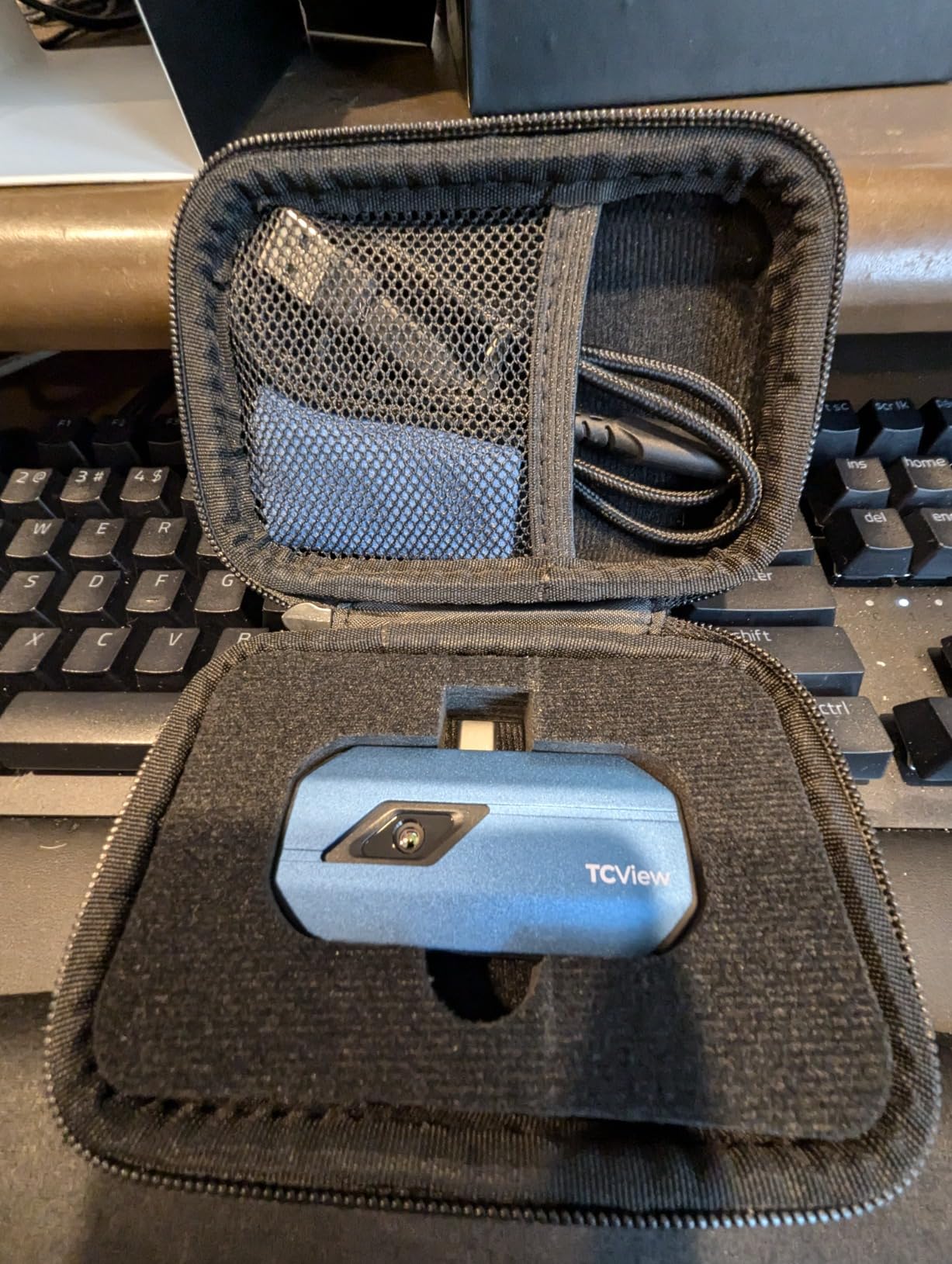
The reason is straightforward. The native 256 by 192 sensor is upscaled to 512 by 384 by TISR processing, and the app adds point, line and surface measurement with up to three areas each and nine areas on screen at once. That is real analytical capability in a 30 gram body that draws 0.35W from the phone.
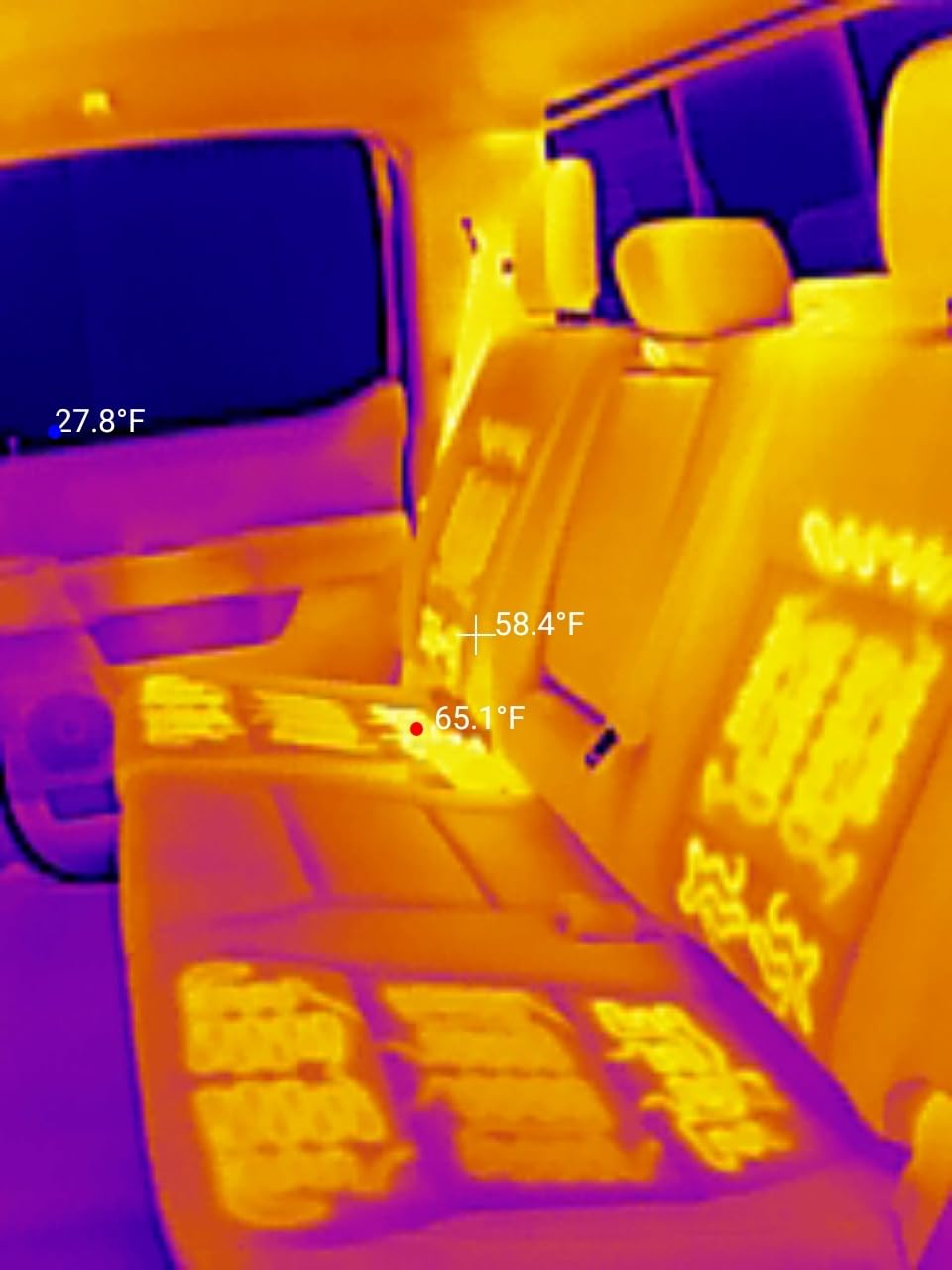
There is no battery to charge, which removes a routine field complaint about thermal cameras. Power draw works out to four to seven hours of operation from a typical 3000 to 5000mAh phone, and reviewers note the near-instant refresh as the camera moves across a surface.
The picture-in-picture fusion overlays the thermal image on the phone camera, which is how you keep a small anomaly tied to the real stud or pipe it belongs to. Accuracy is specified within 3.6°F or two percent of actual object temperature, at 0.1°C resolution.
Who the TOPDON TC001 suits
Inspectors who work from an Android phone or tablet and refuse to carry a second device. There is no battery to swap and no storage to manage because files live on your own handset without a watermark.
Anyone upgrading from a 160 by 120 phone plug who has hit the resolution wall. The jump to 256 by 192 native is the same move the InterNACHI forum consensus points to, upgrade the resolution first.
Who the TOPDON TC001 does not suit
Apple users on the iPhone 15 generation. The listed compatibility is Android OTG only, so iPhone owners should look at the USB-C phone-plug option further down this list.
Anyone whose phone lives in a thick case. The fixed-length stem will not fully seat through most cases, which is why the 19.7 inch extension cable is in the box and why some reviewers report emissivity adjustments proved unreliable on shiny metal.
5. MILESEEY TR10 Thermal Imaging Camera – smooth sweeps across a big attic
MILESEEY TR10 Thermal Imaging Camera, 192 × 192 IR Resolution, 25Hz
192x192 sensor at 25Hz
NETD below 50mK
3000mAh for 8 hours
6.6 ft drop tested
Pros
- 25Hz refresh makes sweeping a wall or attic smooth
- NETD below 50mK picks up subtle temperature differences
- Automatic max/min/center point lock with a high and low alarm
- 3000mAh covers a full working day
- Adjustable emissivity helps separate real anomalies from surface effects
Cons
- 192x192 resolution is modest for small components or far-off targets
- Needs periodic recharging rather than running all day on one charge
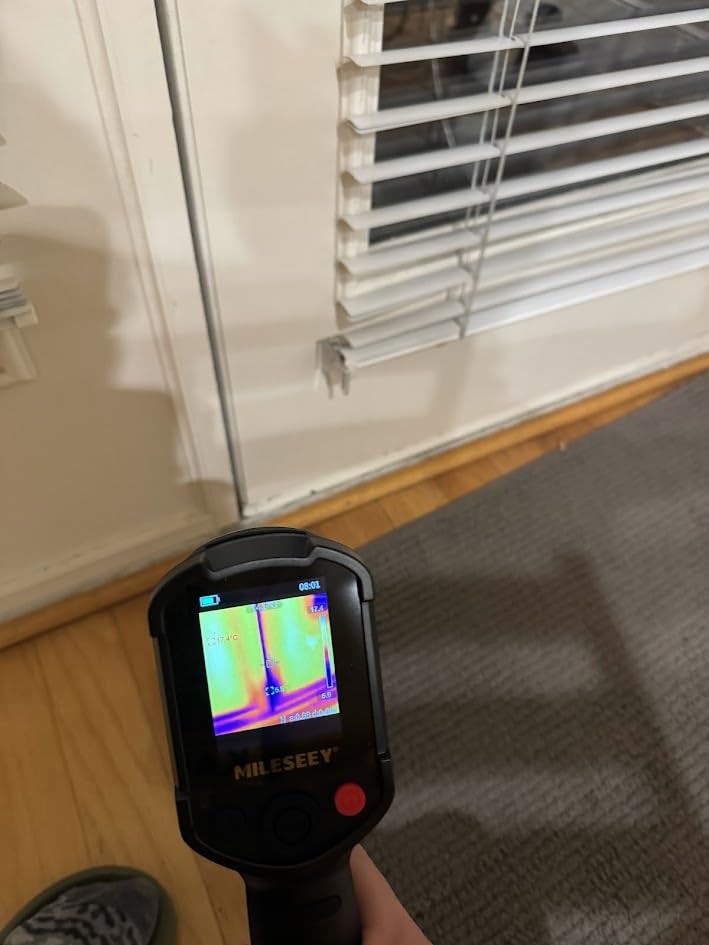
The TR10 is built for the job that fills most of an inspection day, which is walking a large surface and watching for anomalies. At 25Hz the picture moves smoothly when you pan across a roof plane or an attic deck, and that smoothness is what separates a usable scan from a frustrating one.
Sensitivity is specified below 50mK, which is the number that matters when you are looking for a nine-degree difference between a correctly insulated bay and a compressed one. The automatic max, min and center point lock means you do not have to hunt for the spot after you see it.
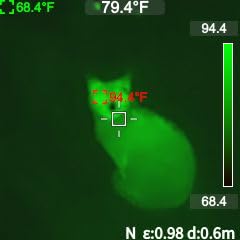
The high and low temperature alarm flags a problem area the moment it appears, which is useful on a roof where you are watching a line of infrared rather than a fixed target. The temperature range of -4°F to 1022°F with plus or minus 2°C accuracy covers both cold structure and hot mechanical surfaces.
Reviewers report the sub-50mK sensitivity and the spot locking as the features that make it feel more capable than its tier suggests, and the 6.6 foot drop rating with a recessed lens matters when you are kneeling on an attic hatch frame. The 8GB of storage holds more than 30,000 pictures.
Who the MILESEEY TR10 suits
Inspectors whose day involves long, continuous sweeps, roof planes, attic decks and large wall runs. The 25Hz refresh and the alarm make a moving scan practical rather than a series of still frames.
Anyone who needs the full temperature range in a rugged, drop-tested body, from a crawlspace cold spot to an overheating component.
Who the MILESEEY TR10 does not suit
Users chasing small or distant targets. A 192 by 192 sensor is modest, and reviewers flag this consistently when they try to isolate a small component or an anomaly far across a room.
Inspectors who want one charge to last a long multi-property day without a top-up. The 3000mAh battery is rated for up to eight hours of continuous use and then needs a recharge.
6. Thermal Master Thor002 Handheld Camera – built for report paperwork
Thermal Master Thor002 Handheld Thermal Camera, 512 × 384 X³ Resolution
X3 upscaling to 512x384
640x480 IPS screen with 2MP visible camera
10.5 hour battery
40mK sensitivity
Pros
- X3 technology delivers 512x384 effective resolution at 40mK sensitivity
- Bright 640x480 display paired with a visible light camera in one body
- Six simultaneous measurement points speed comparative diagnostics
- Voice notes and QR code file management streamline documentation
- 5000mAh battery runs up to 10.5 hours with 18W fast charging
Cons
- Heavier at 3.12 lb and larger than pocket imagers
- Accuracy of plus or minus 3.6°F is looser than several competitors
- Newer model with a smaller installed base in the field
The Thor002 answers a question the rest of this list rarely addresses: what happens to the images afterward. Voice notes let you record your spoken observation at the wall, and QR code file management makes moving dozens of captures into a finished report far less tedious than renaming files on a memory card.
The X3 processing pushes a 256 by 192 native sensor up to 512 by 384 effective resolution, running at 25Hz with 40mK thermal sensitivity. Six simultaneous measurement points, including center, hottest, coldest and three of your own spots, let you compare a reference area against a suspect one in a single frame.
The bright 640×480 IPS screen and the integrated 2MP visible light camera sit in the same body, so a report image can carry both the thermal map and the ordinary photograph without a second device. Connectivity covers both bases, with USB to a PC for real-time analysis and Wi-Fi pairing to smartphones and iPads.
Reviewers highlight the 10.5 hour battery and the documentation features as the standouts. The costs are honest ones, this is a 3.12 pound unit and the plus or minus 3.6°F accuracy is looser than the plus or minus 2°C figures some competitors claim.
Who the Thermal Master Thor002 suits
Inspectors who write detailed reports and want to capture a spoken note and a visible-light photograph at the same wall. The QR file management was clearly designed by someone who assembles client documents after dark.
Anyone running full-day routes who values a single charge covering the whole day, and who wants USB for PC analysis and Wi-Fi for phone viewing in the same tool.
Who the Thermal Master Thor002 does not suit
Inspectors who work in crawlspaces and attics for hours. At 3.12 pounds it is a heavy unit to carry, and reviewers specifically list the weight as a drawback against pocket-sized imagers.
Buyers who need the tightest accuracy spec available, since the stated plus or minus 3.6°F is looser than most of this group. It is also a newer model with a smaller installed base and fewer long-term field reports.
7. FOXWELL RT280 Thermal Imaging Camera – real analysis software on a PC
FOXWELL RT280 Thermal Imaging Camera, 320 x 240 2.8″ LCD, 240 x 180 TISR
2.8-inch 320x240 LCD
TISR from 120x90 to 240x180
Windows analysis software with 2D and 3D views
25Hz, below 50mK
Pros
- Dedicated handheld with no dependency on a phone battery
- Point
- line and area analysis with 2D and 3D views and report generation
- 9 color palettes
- laser pointer and LED light for dark spaces
- Photo
- video and voice memo capture with 8GB internal storage
- 25Hz scanning and IP54 with 6.6 foot drop rating
Cons
- Native sensor is only 120x90 with 240x180 coming from TISR upscaling
- Bundled software is Windows only with no wireless transfer to a phone
- Image can judder slightly during fast panning
The RT280 is the value pick for an inspector whose office runs Windows. The bundled PC software is the differentiator, offering point, line and area analysis, two-dimensional and three-dimensional views, and automatic report generation without a subscription or a cloud account.
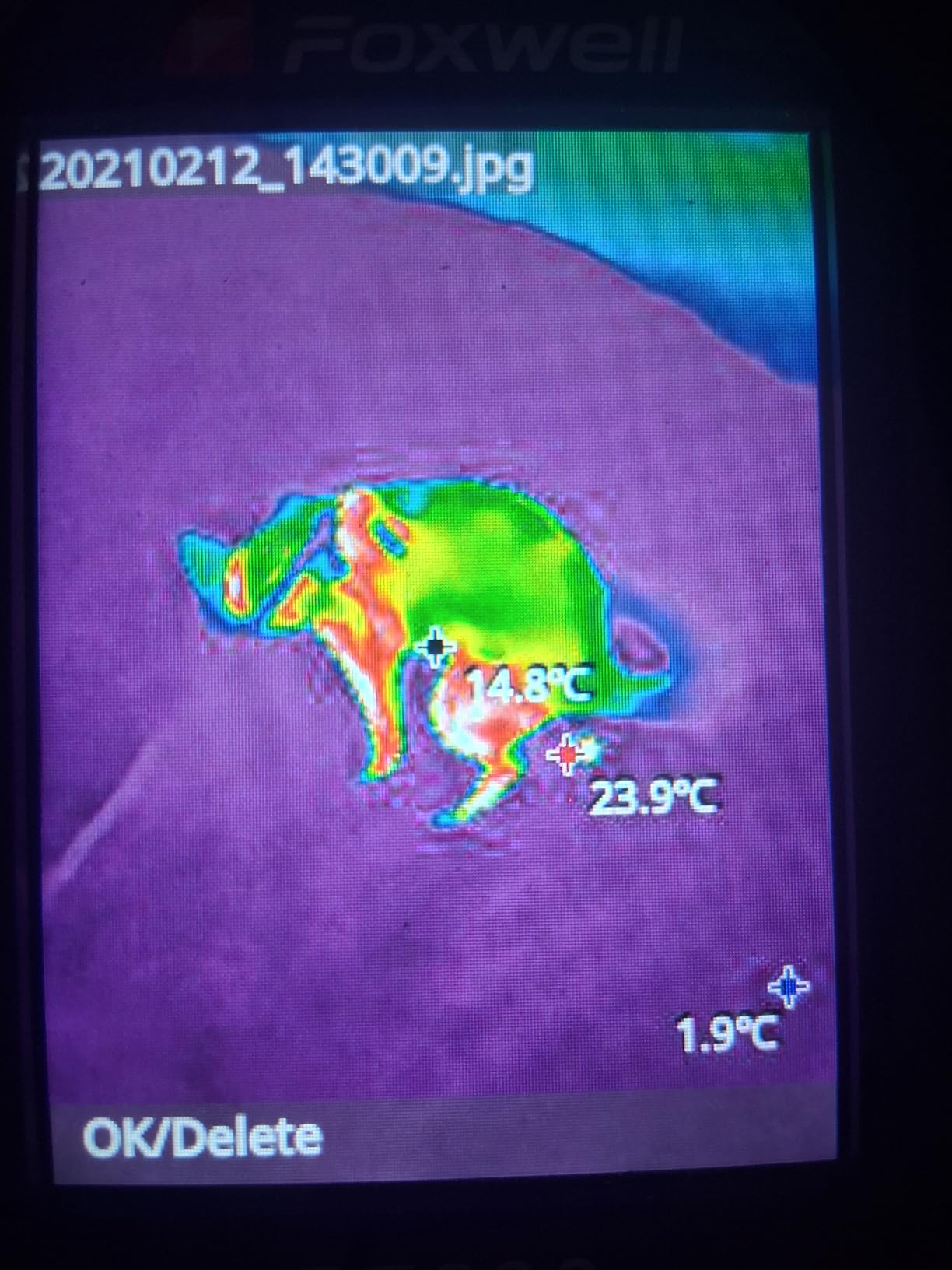
Field performance is respectable for an entry unit. Reviewers in Germany and the United States describe it as capable of finding cold bridges, leak traces and electrical hot spots, and note that buyers were productive within minutes of opening the box with no menu diving required.
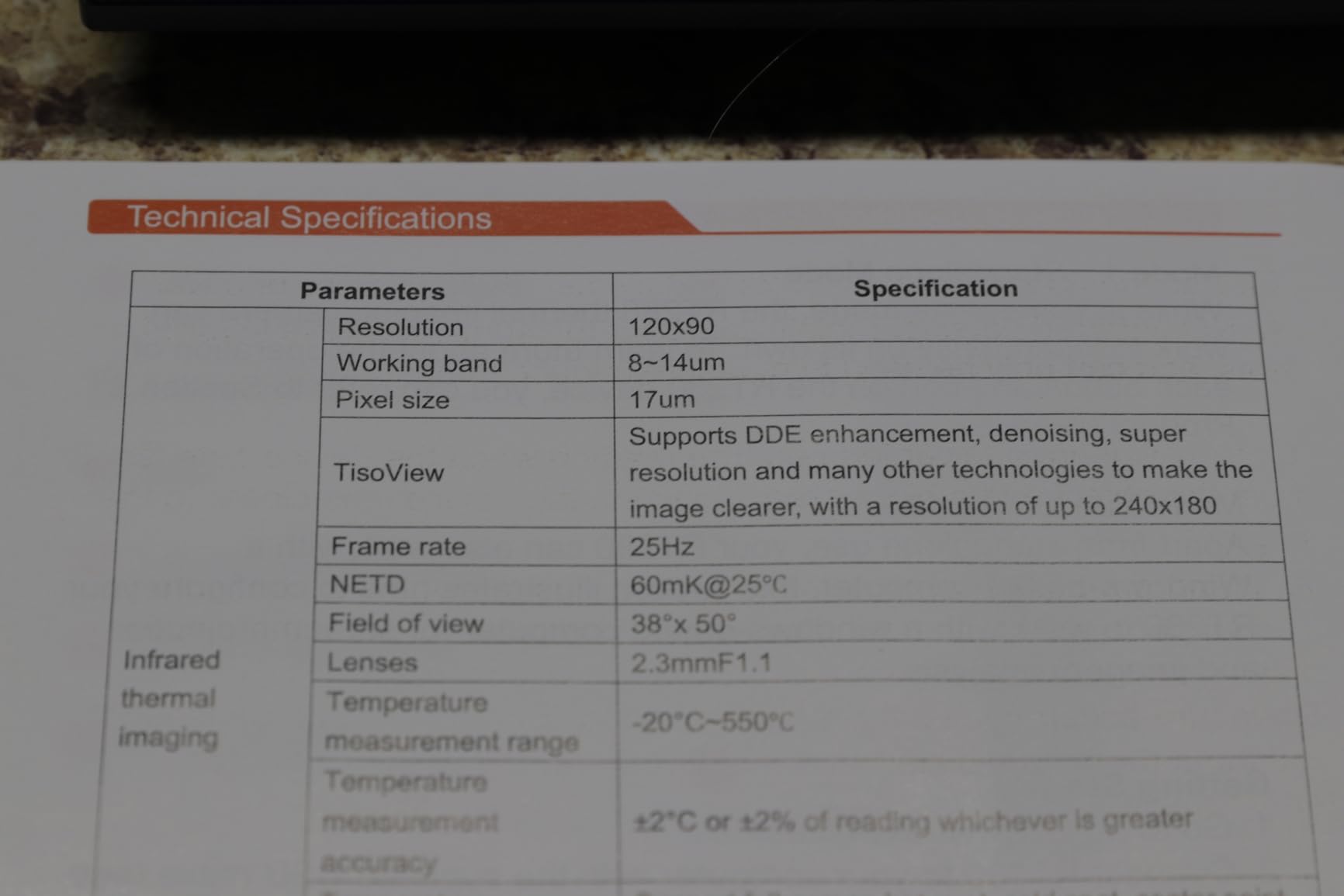
The 2.8-inch 320×240 LCD, 50° by 38° field of view and 25Hz frame rate give you a comfortable sweep on a wall, and the laser pointer plus LED light make it usable in a dark attic or behind equipment. Storage is 8GB of eMMC for more than 20,000 images, with voice memo recording through the integrated microphone.
Be clear-eyed about the resolution claim. The native sensor is 120 by 90 pixels and the advertised 240 by 180 comes from TISR software upscaling, which is why some images judder during fast panning and why reviewers report bright light sources and reflective surfaces producing false hot readings.
Who the FOXWELL RT280 suits
Inspectors who finish their paperwork at a Windows desktop and want 2D and 3D analysis plus generated reports without buying anything else. That software alone separates this camera from most of its tier.
Users who want a standalone handheld with voice memo capture, nine palettes and a laser and LED for confined spaces, all in one body that does not borrow power from a phone.
Who the FOXWELL RT280 does not suit
Mac users. There is no wireless transfer to a phone, and the desktop software is Windows only, which pushes you back toward a camera that files through a mobile app.
Anyone documenting small or precise targets. The 120 by 90 native sensor is very low for detail work, and reviewers note that indicated temperatures may run off by roughly 20°F in some setups, particularly around reflective surfaces.
Anyone who needs to see moisture traces at close range should step up a tier. This camera is built to answer the question of whether a big area is behaving differently, not to resolve a small pattern inside it.
8. AccuMEMS GT14S Thermal Imaging Camera – a light body for crawlspace work
AccuMEMS GT14S Thermal Imaging Camera, Thermometer Mode, Ultra-Light 240g
240 g body
14 hour battery
Dual thermal and thermometer mode
NETD below 50mK
50 degree field of view
Pros
- 240 g body reduces fatigue in crawlspaces and attics
- Dual mode combines full thermal imaging with a numeric thermometer readout
- NETD below 50mK resolves differences down to 0.05°C
- 2500mAh battery rated for up to 14 hours of continuous use
- 50 degree field of view covers more area per sweep with seven palettes
Cons
- No native resolution figure published
- so fine detail is an unknown
- Entry-level feature set with no advanced report or wireless workflow
- One-year warranty is shorter than the FLIR coverage
The GT14S is built around one problem, which is that a heavy camera in a crawlspace becomes a problem you think about instead of the house. At 240 grams with a non-slip grip, it is the kind of tool you can hold at arm’s length under a crawl for twenty minutes and then forget about.
The dual mode is genuinely useful on that kind of job. Full thermal imaging shows you where to look, and the thermometer mode gives you an exact numeric reading once you have found something worth measuring. Sensitivity is specified below 50mK with differences detected down to 0.05°C.
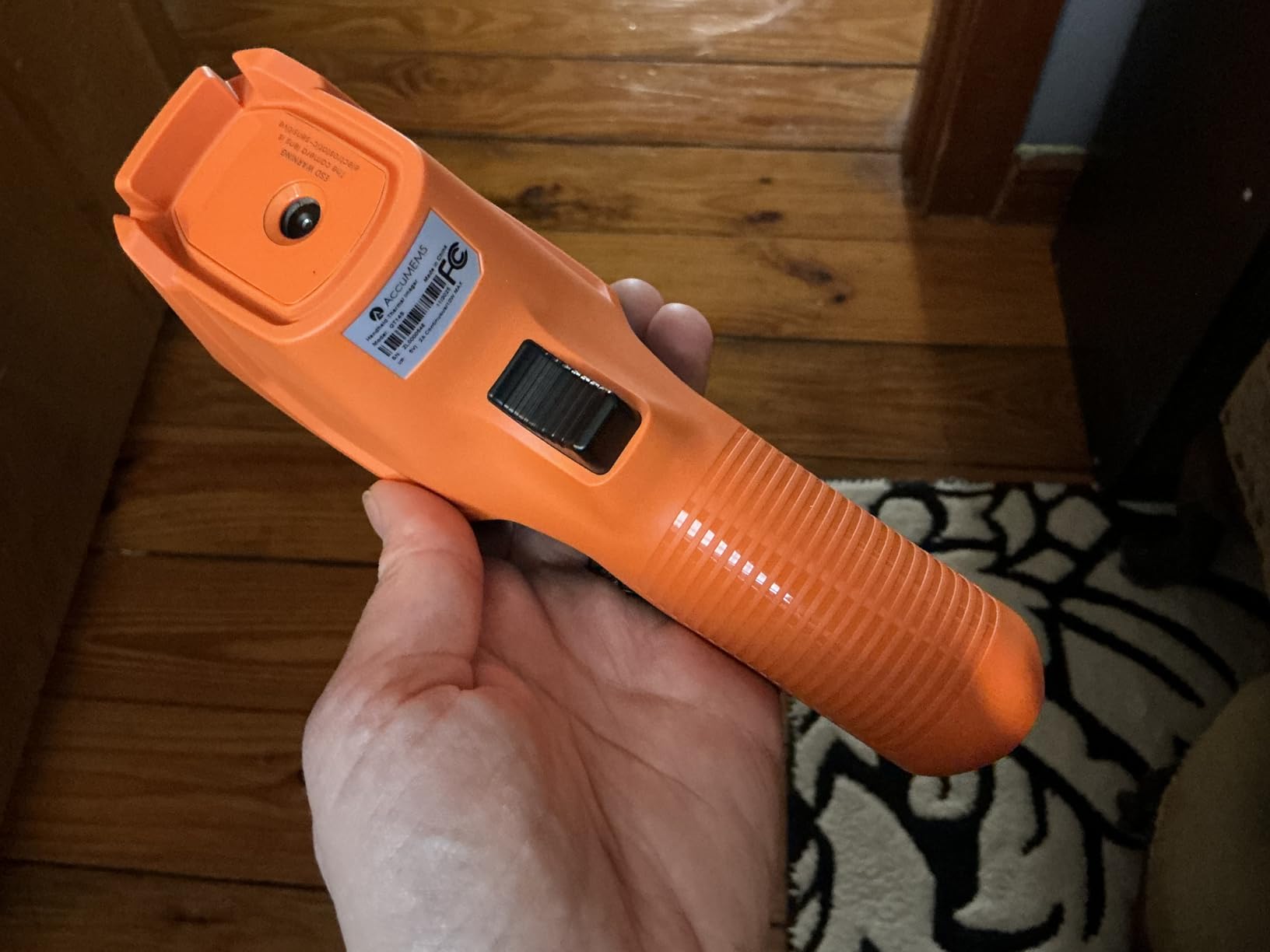
The 50 degree field of view is wide for the size, so you cover more under-house area per sweep, and the adjustable level and span controls let you tighten the palette around a narrow temperature band where the interesting differences live. Custom high and low alarms do the same job automatically.
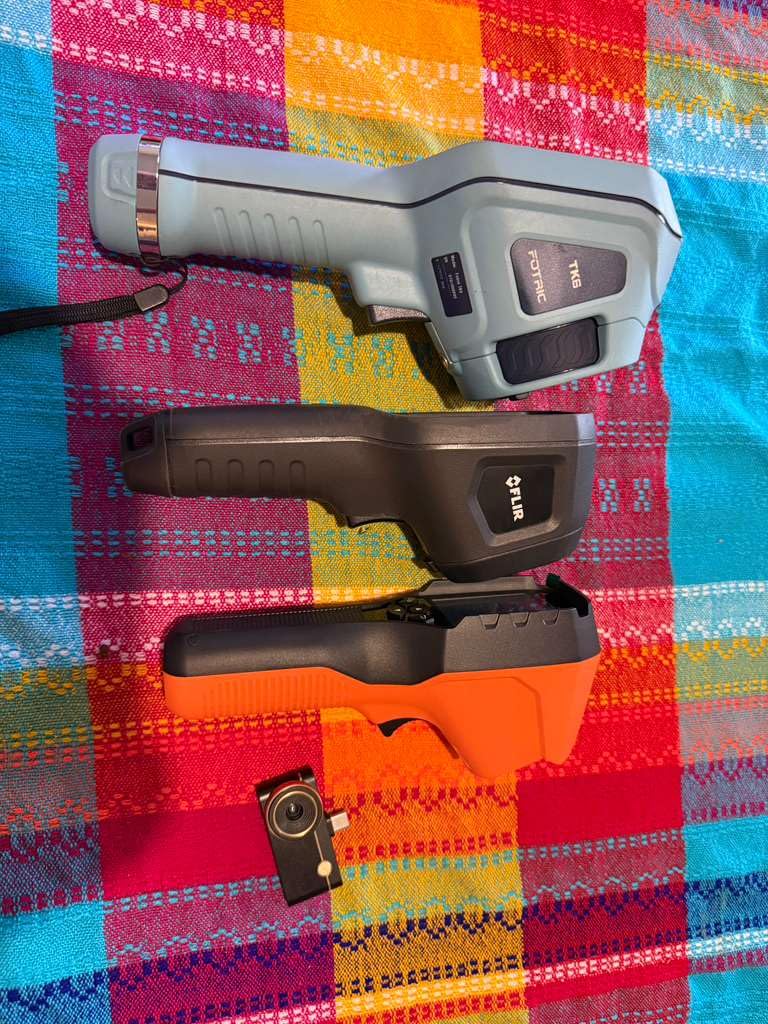
Reviewers consistently name the 240 gram weight, the long battery and the dual modes as the reasons to buy it. The honest limit is the feature set, there is no advanced report or wireless workflow here, and the 14 hour battery claim is a continuous-use rating rather than an all-day field promise.
Who the AccuMEMS GT14S suits
Inspectors and technicians who do long crawlspace and attic routes where tool weight decides whether you take the camera at all. At 240 grams it stays in the bag even when heavier units get left at the truck.
Anyone who wants a simple two-mode tool, image on, number on the screen, with adjustable emissivity and distance settings rather than a menu of options to learn.
Who the AccuMEMS GT14S does not suit
Users who need to isolate fine detail or document a small component. No native resolution figure is published for this camera, so fine-detail work is an open question rather than a known strength.
Inspectors whose report workflow depends on wireless transfer or advanced PC analysis, because there is none here. The one-year warranty is also shorter than the ten-year detector coverage the FLIR models carry.
9. Flagfront 240×240 TISR Thermal Camera – the straightforward homeowner pick
Flagfront Thermal Camera, 240 x 240 TISR Resolution for Home Inspection
240x240 super-resolution at 25Hz
Built-in temperature alarm
Six color palettes
IP54, 6.6 ft drop
MicroSD storage
Pros
- Marketed and used specifically for home inspection work on walls
- ceilings and windows
- 240x240 images read clearly enough to pick out studs and cold insulation gaps
- Built-in alarm plus highest
- lowest and center readouts focus the scan
- 25Hz refresh keeps motion smooth while walking a wall
- IP54 and 6.6 foot drop rating with a microSD card installed
Cons
- 240x240 TISR mode looks no sharper than the lower setting to some users
- Front lens cover falls into view when the camera is tilted down
- Limited zoom and detail compared with higher-tier units
This is the camera to own if you are the homeowner, not the professional. It was built and marketed for the exact tasks on your list, tracing heat loss through ceilings and walls, following embedded heating pipework and checking vents, and owners report using it that way.
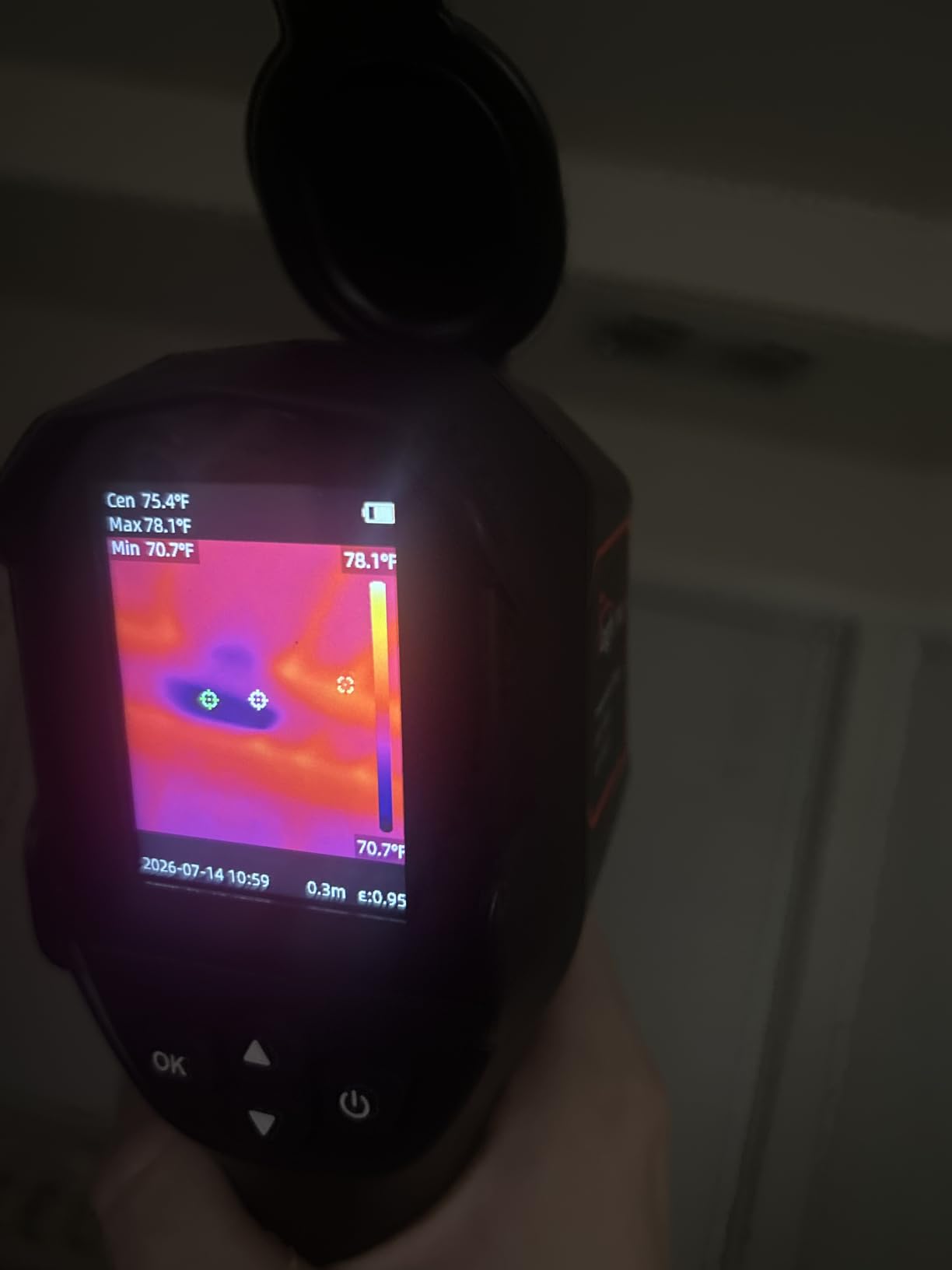
At 240 by 240 with a 25Hz refresh the picture is legible enough to pick out stud bays and cold insulation stripes without any training. The built-in alarm plus highest, lowest and center point display focus the scan so you are not guessing which number to trust.
The physical design is honest and simple. Six color palettes including White Heat, Red Heat, Black Heat, Rainbow and Iron, adjustable distance and emissivity settings, a 50 degree field of view, and a measurement range of -4°F to 1022°F with accuracy within two percent.
Owners report that it survives drops without complaint, and the 74% five-star share of its 300 reviews reflects that. The recurring gripes are practical, the lens cover does not stay propped open and drops into frame when you tilt down, and some users find the super-resolution mode no sharper than the standard setting.
Who the Flagfront camera suits
Homeowners doing a pre-purchase walkthrough who want to find cold spots, air leaks around windows and doors, and uneven heating before they sign. It is aimed squarely at that task rather than at professional report work.
Sellers who want to show a buyer exactly where the drafts are, and DIYers who want a rugged tool with an alarm and a microSD card for expandable storage rather than an app workflow.
Who the Flagfront camera does not suit
Anyone who needs to document findings at a professional standard, because zoom and detail are limited compared with the higher-tier units in this list. The 240 by 240 figure is super-resolution output rather than native detail.
Users bothered by small hardware issues. Owners report occasional brief image stalls while the unit recalibrates, and the lens cover falling into view when the camera is angled downward.
10. GOYOJO 192×192 USB-C Thermal Camera – works with both phone systems
GOYOJO Thermal Imaging Camera for Android/iphone 15/16/17 iOS Series 192×192 IR Resolution– Water Leak Detection HVAC Electrical Plumbing, Automotive Repair, Home Inspection, DIY-USB-C Infrared Imager
192x192 sensor with 12um pitch
USB-C plug and play, no battery
iPhone 15, 16 and 17 plus Android
50 degree field of view
Pros
- Plug and play USB-C with no battery and no pairing step
- Compatible with iPhone 15
- 16 and 17 series plus Android devices
- 0.48 oz body at 1.77 by 0.43 by 1.34 inches always stays in the tool bag
- 192x192 output sharp enough to distinguish breakers and plumbing behind drywall
- Picture-in-picture with the phone camera and video capture
Cons
- No zoom for focusing on distant targets
- Some phones with thick cases need an adapter to plug in
- Lower 752°F ceiling than units rated to 1022°F
The GOYOJO exists to solve a compatibility problem that catches people out. The TOPDON TC001 is Android only, and this one runs on the iPhone 15, 16 and 17 series through the THG Start app as well as on Android, which widens the pool of people who can use a phone-based imager at all.
There is no internal battery and no pairing. You plug it into the USB-C port and the app launches, which means no charging routine and no dead camera at the top of an attic ladder. Owners report successfully locating a hot-water slab leak, a settled insulation cold spot and a small leak behind baseboard trim.
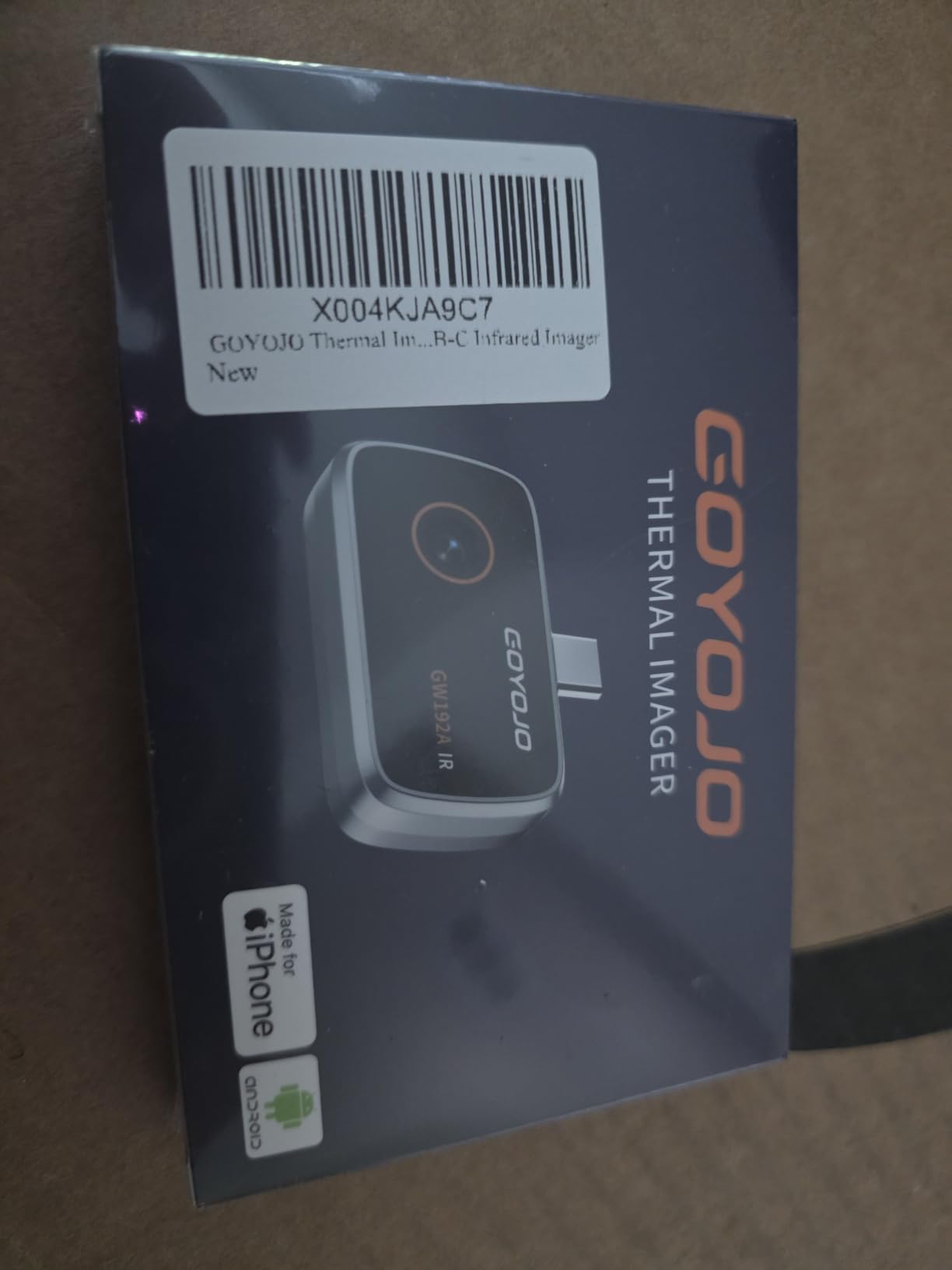
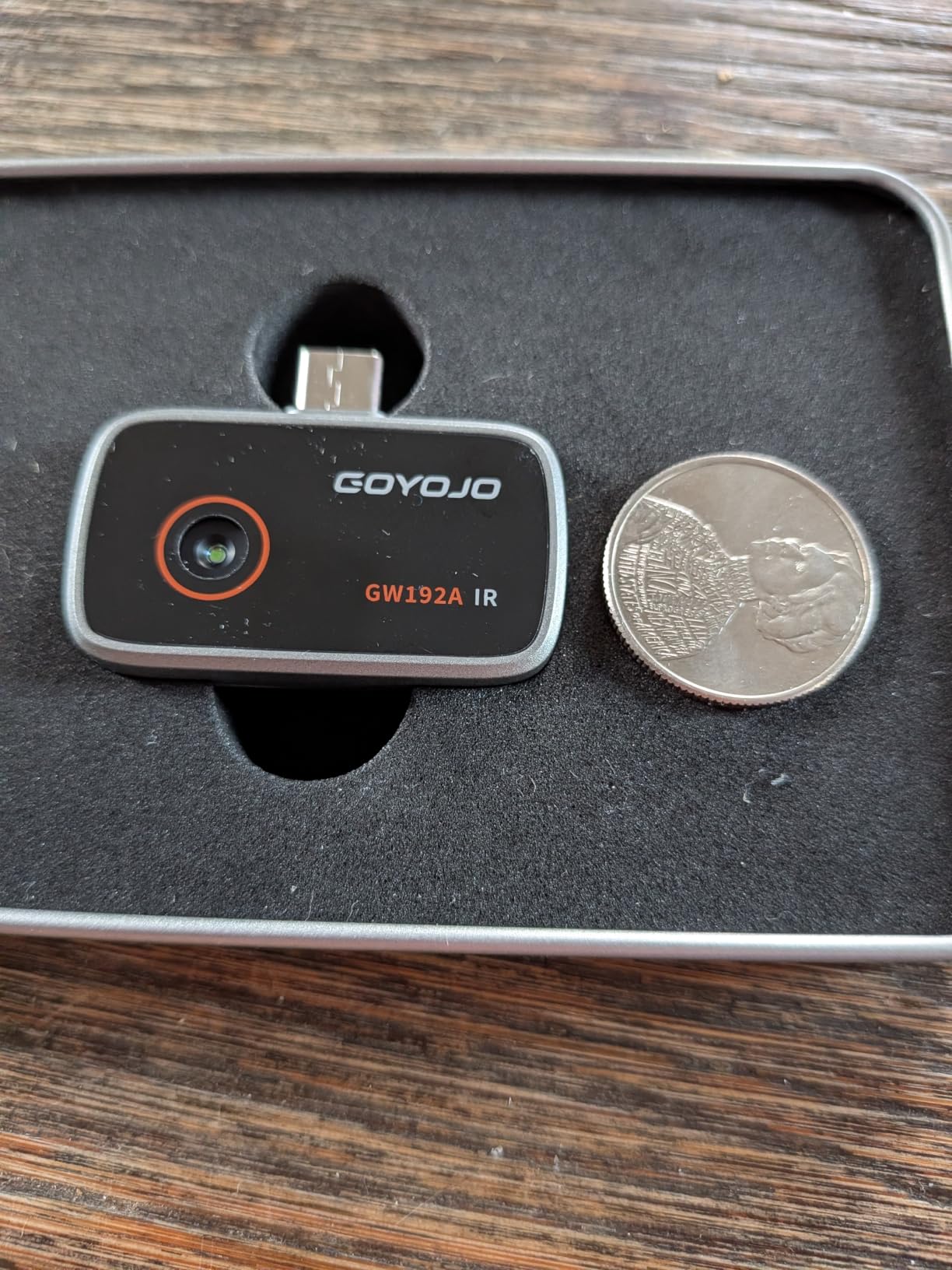
The 192 by 192 sensor with a 12 micrometer pixel pitch reads sharp enough to distinguish individual circuit breakers and plumbing lines behind drywall, and the 25Hz refresh pans smoothly without the lag cheaper imagers show. Accuracy is specified at plus or minus two percent across a -4°F to 752°F range.
Reviewers call out the instant USB-C connection and the crisp output as the strengths. The limits are equally clear, there is no zoom, some phones with thick cases need an adapter, and one reviewer found the Android app would not run on newer Pixel devices.
Who the GOYOJO camera suits
iPhone owners who want phone-based thermal imaging without waiting for a different product. Most rivals in this form factor are Android only, so this fills a real gap.
Anyone who wants the smallest possible addition to an existing toolkit. At 0.48 ounces with a protective case included, it never gets left behind because there is no room.
Who the GOYOJO camera does not suit
Inspectors who need to zoom toward a distant target or scan a very hot surface, since the unit tops out at 752°F and offers no zoom capability at all.
Users on older phones or phones with thick cases who would need an adapter, and anyone who finds a camera that draws from the phone tiring, because reviewers report the phone running hard and warming up during extended use.
How We Chose, and the Specs That Actually Matter
We ranked these cameras on the things that change an inspection outcome, not on brand. Here is what each specification really does for you in the field, in plain language.
Thermal resolution beats everything else. A 160 by 120 sensor gives you 19,200 measurement points, while a 256 by 192 sensor gives you roughly two and a half times that count. This is why so many inspectors describe upgrading resolution first, as the InterNACHI forum consensus also points out. Be careful with advertised numbers, several cameras here upscale in software and the native figure is what determines your ability to isolate a single anomaly.
Thermal sensitivity is the second number. NETD, the noise equivalent temperature difference, is how small a temperature change the camera can resolve. Anything under 50mK is respectable. A nine-degree difference between a properly insulated attic bay and a compressed one is the classic target, and sensitivity is what lets you see it against normal surface noise.
Accuracy matters more than range for homes. Every camera here measures from roughly -4°F upward, which covers any residential structure. What separates them is the plus or minus 2°C versus plus or minus 3.6°F tolerance, and reviewers report real deviations of about 20°F in poorly configured setups, which is an emissivity problem rather than a sensor problem.
Emissivity is where most readings go wrong. Emissivity describes how well a surface radiates infrared energy. Shiny metal, recessed light fixtures and polished appliances radiate poorly and read wrong, which is why shiny surfaces are called out as a problem across multiple brands here. Set emissivity for the material you are looking at, and treat readings on reflective surfaces as a reason to verify another way.
Form factor decides what you carry. Pistol-grip and handheld units live in the tool bag and run on their own battery. Pocket units like the TG165-X go anywhere. Phone-plug imagers borrow power from the device already in your pocket and never need charging, at the cost of a narrower field of view and phone-case friction. If you want to go further on that last option, our guide to thermal cameras for phones covers the format in depth.
Refresh rate changes how you work. A 9Hz sensor makes a sweep across a wall look like a slideshow. The 25Hz units in this list, the MILESEEY TR10, the FOXWELL RT280, the Flagfront and the GOYOJO, track a moving target smoothly, which is what you want when walking a roof plane or a crawlspace perimeter.
Battery and drop rating are field realities. Claimed runtimes here range from eight hours on the MILESEEY TR10 to fourteen on the AccuMEMS GT14S, with the Thermal Master Thor002 rated at 10.5 hours. For a full multi-property day, a spare battery or a fast charge matters more than any single specification on the list.
Thermal imaging is a diagnostic tool, not a monitoring system. It answers one question at one moment. If you want continuous watchfulness around the same property between inspections, that is a different category, and our roundup of wireless security cameras for home covers it. For exterior entry points, driveways and side yards, the best floodlight cameras for home comparison handles night-time coverage. Use thermal to find the weak point in the envelope, then a fixed camera to watch what happens there over the following weeks.
Delta-T Rules, Inspection Timing and Report Discipline
Thermal imaging only means something when the inside and outside of the building are far enough apart. This is the single most common reason an inspector skips the thermal scan, and it is usually a weather problem rather than an equipment problem. Shoot the roof, the attic and the crawlspace early in the inspection, before your body heat changes the surface you are about to measure.
Read the delta, not the color. Aim for a difference of at least 5°C, roughly 9°F, between a suspect area and its surroundings before you treat it as a finding. Between 2°C and 5°C, treat it as a reason to investigate further rather than a defect to write up. Under 2°C, you are looking at surface variation, sun angle and moisture in the material itself. A hot spot that runs 20°C or more above its neighbors is a genuine anomaly worth documenting immediately.
Sequence the inspection properly. Come in cold, scan the exterior envelope before you switch on the heating system, then load the structure by running the HVAC so supply and return temperatures diverge, and finish with the electrical panel under a steady load. The expected register temperatures used as a working standard on r/HVAC are roughly 115F at gas furnace registers and 100F for heat pumps, sometimes in the high 90s, which gives you a target rather than a guess.
Do not overcall. The fear that damages credibility fastest is reporting every cold spot you find. Insulating gaps around windows, a shaded roof face, a recently vacated room and an unfinished floor can all produce convincing cold anomalies that are not defects. If you cannot explain the mechanism, do not put it in the report.
Know what the camera cannot do. It never sees through a wall, and it reads surface temperature only. A cold patch behind drywall tells you something changed the surface temperature, not what it is. Confirm with a moisture meter, an electrical check or an attic look before you name a defect.
Frame findings as observations, not verdicts. The defensible wording describes what you saw, the conditions, and the recommendation, for example noting a temperature differential at a specific stud bay consistent with missing insulation and recommending further evaluation. Admitting limits protects you when a buyer brings in a contractor who disagrees.
Finally, be honest about what you publish. If you are new to thermography, the Infrared Training Center Level I certification path is the standard route, and inspectors who take it consistently report that training, not a more expensive camera, is what stopped their misreads. If you want a second opinion before buying, the InterNACHI forum threads on camera tiering are worth reading in full.
Frequently Asked Questions
What thermal camera do home inspectors use?
Most professional inspectors use a handheld model rather than a phone accessory, because a dedicated body has a larger sensor, a bigger screen and its own battery. On r/HomeInspections, inspectors describe being issued a HIKMICRO Pocket2 or a budget TOPDON rather than a pro FLIR, which matches what we see in this roundup. The FLIR C5 is the most common complete report workflow, while the TOPDON TC004 leads on standalone value.
What is the best thermal camera for building inspections?
For building inspections the FLIR C5 wins on workflow, pairing 160×120 MSX imagery with built-in Wi-Fi that uploads to FLIR Ignite for annotated client reports, at 190 grams. When raw detail matters more than reporting, the TOPDON TC004 and the TOPDON TC001 both use a native 256×192 sensor upscaled to 512×384. Choose on the balance between resolution and how you deliver findings.
What is the best thermal imaging camera for homeowners?
For a homeowner, the Flagfront 240×240 camera is the most directly aimed option, built for tracing heat loss through ceilings and walls, following pipework and checking vents. Its built-in alarm and highest, lowest and center readouts focus the scan, and it carries an IP54 rating with a 6.6 foot drop rating. No report software is needed for personal use.
Is thermal imaging worth it for a home inspection?
It is worth it when the inside and outside temperatures differ enough to produce a clear differential, generally a 5°C or 9°F gap between a suspect area and its surroundings. Thermal imaging finds wet insulation, thermal bridging, duct problems and electrical hot spots in minutes rather than by destructive probing. On a mild day with little load on the structure it adds little, and many skipped scans are a weather problem rather than an equipment problem.
What are the downsides of thermal imaging?
The main downsides are overcalling cold spots that have a benign cause, emissivity errors on shiny metal and recessed fixtures, and cameras that cannot resolve subtle moisture or pest signatures at low resolution. Phone-plug models have narrow fields of view and need manual alignment between the thermal and visible image. Poor temperature differential on the day also limits what the scan can prove.
Is TOPDON a good brand for thermal imaging?
TOPDON is one of the strongest value brands in this category. Two of its cameras appear here, the TC004 handheld with a 256×192 sensor, 64GB storage and a 4.6 rating from 860 reviews, and the TC001 Android plug rated 4.6 across 1,491 reviews. Both deliver resolution that challenges more expensive FLIR handhelds.
Conclusion
After comparing all ten, the FLIR C5 is still our pick for the best thermal imaging cameras for home inspections category, because it does something the others leave to you: it turns a scan into a finished client report from the field. If you need more detail per pixel, move up to the TOPDON TC004 or the Thermal Master Thor002, and if you want the highest-rated imager with the most owner feedback behind it, the TOPDON TC001 is hard to argue with on Android.
Homeowners have an easier decision. The Flagfront camera covers the common cases, the AccuMEMS GT14S is the one you will actually carry into a crawlspace, and the GOYOJO covers both phone systems and stays in the bag all day.
Whatever you pick, learn the delta-T rule before you shoot. A camera will show you every cold spot in the building, and only training tells you which ones belong in the report. Check the latest pricing on any of these before you order, then take the first scan on a day when the building is doing its best to tell you the truth.