
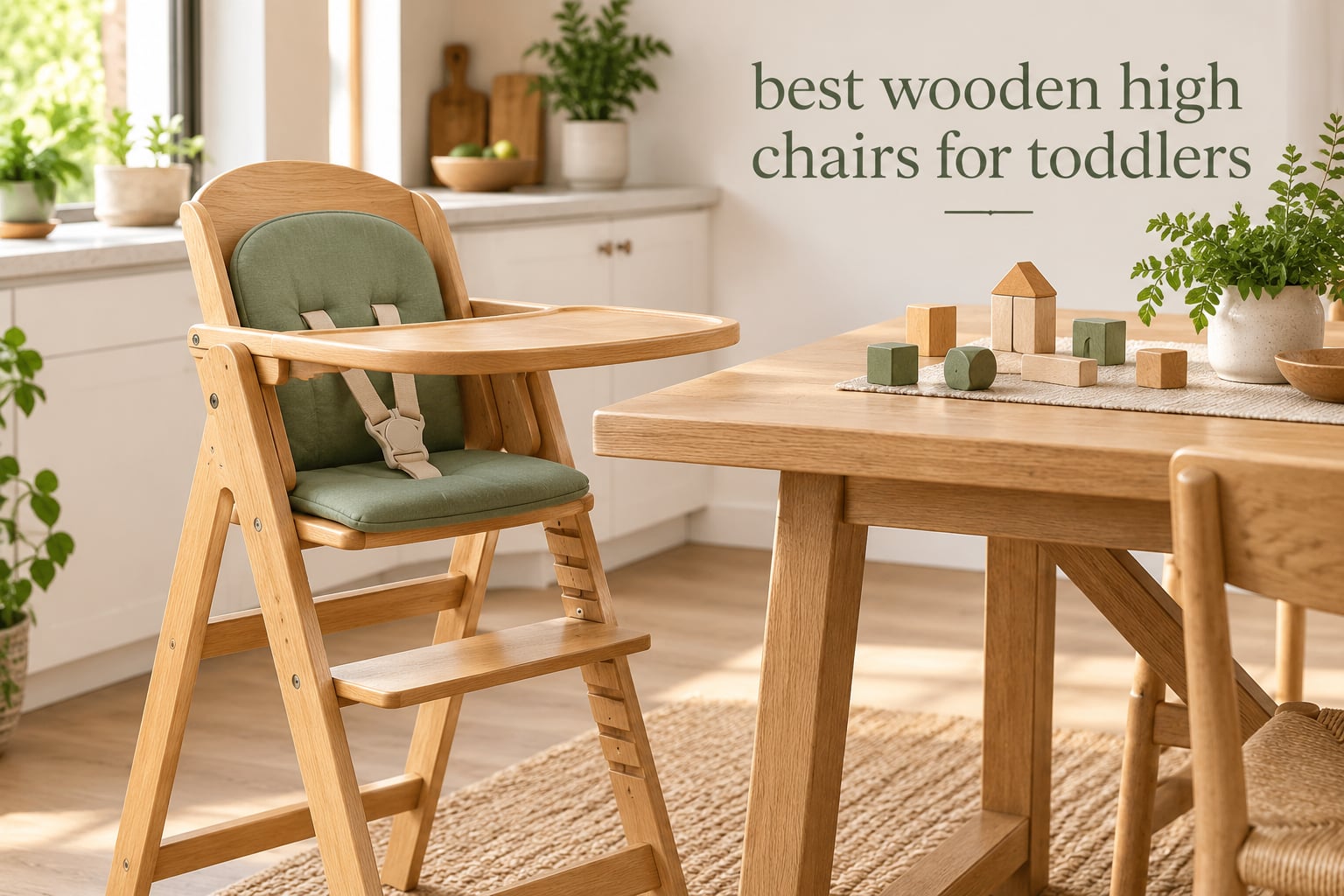
The best wooden high chairs for toddlers in 2026 are the Abiie Beyond Junior for most families, the Stokke Tripp Trapp for the longest service life, and the FORNEL Scandinavian if you want solid wood without the luxury price. We spent weeks comparing ten wood-framed high chairs on the three things that actually decide whether a chair works in a real kitchen: how the child sits, how much food ends up on the floor, and whether the chair is still useful three years later.
A wooden high chair is a child-sized seat built on a solid or veneered timber frame that raises a toddler to table height, usually with a removable tray, a safety harness and an adjustable footrest. Wood changes the equation in ways plastic never does. The frame is heavier, so a toddler bouncing on the footrest or pushing off the table edge is far less likely to tip it. The surfaces wipe clean instead of harboring crumbs in molded seams. And the chair looks like furniture in your dining room rather than a piece of nursery equipment you are embarrassed to keep out once the baby grows out of it.
That said, wood is not automatically the right call. If you are in a rental, feeding an infant from birth, or eating at a raised counter, a different chair type will serve you better. Read the [general high chair roundup](https://www.wearesalt.org/best-high-chairs/) and the [roundup of chairs that grow with your child](https://www.wearesalt.org/best-high-chairs-that-grow-with-baby/) before you commit to a wood frame, and come back here if the material itself is the deciding factor.
Top 3 Picks for Wooden High Chairs in 2026

Abiie Beyond Junior
- Solid wood
- BPA-free components
- 5-point to 3-point harness
- Up to 250 lbs

Stokke Tripp Trapp
- European beech wood
- Adjustable seat and footrest
- Up to 300 lbs
- Optional newborn set
The Abiie Beyond earns the top spot on the strength of the largest review base in this roundup: 8,200 ratings averaging 4.7, with owners describing the same solid build and tool-free conversion over and over. The Stokke Tripp Trapp is the one to buy if you want a chair that stays in use for a decade. The FORNEL is the value pick: solid wood, an adjustable seat and footrest, and a three-step conversion that reaches all the way to an adult spare seat.
All 10 Wooden High Chairs at a Glance in 2026
| Product | Specifications | Action |
|---|---|---|
| Abiie Beyond Junior |
|
Check Latest Price |
| Stokke Tripp Trapp |
|
Check Latest Price |
 Mallify 3-in-1 Mallify 3-in-1 |
|
Check Latest Price |
 Evolur Zoodle Evolur Zoodle |
|
Check Latest Price |
 FORNEL Scandinavian FORNEL Scandinavian |
|
Check Latest Price |
 BABY JOY 3-in-1 BABY JOY 3-in-1 |
|
Check Latest Price |
 Keekaroo Height Right Keekaroo Height Right |
|
Check Latest Price |
 Cowiewie 3-in-1 Cowiewie 3-in-1 |
|
Check Latest Price |
 YOLEO Grow-with-Me YOLEO Grow-with-Me |
|
Check Latest Price |
 L.A. Baby Stackable L.A. Baby Stackable |
|
Check Latest Price |
1. Abiie Beyond Junior: the best wooden high chair overall
Abiie Beyond Junior Convertible Wooden High Chair with Removable Tray
Solid wood with BPA-free plastic
Weight capacity up to 250 lbs
Ages 6 months through adulthood
3-year manufacturer warranty
Pros
- Converts between stages in under 20 seconds without tools
- Very sturdy and does not tip when a child pushes off the table
- Real solid stained wood that looks like furniture
- One-handed tray removal and wipeable surfaces
- Padded seat and back cushions included
Cons
- Assembly takes longer than expected with the number of parts
- Food traps under the center crotch buckle
- Does not fold though it fits under a standard table
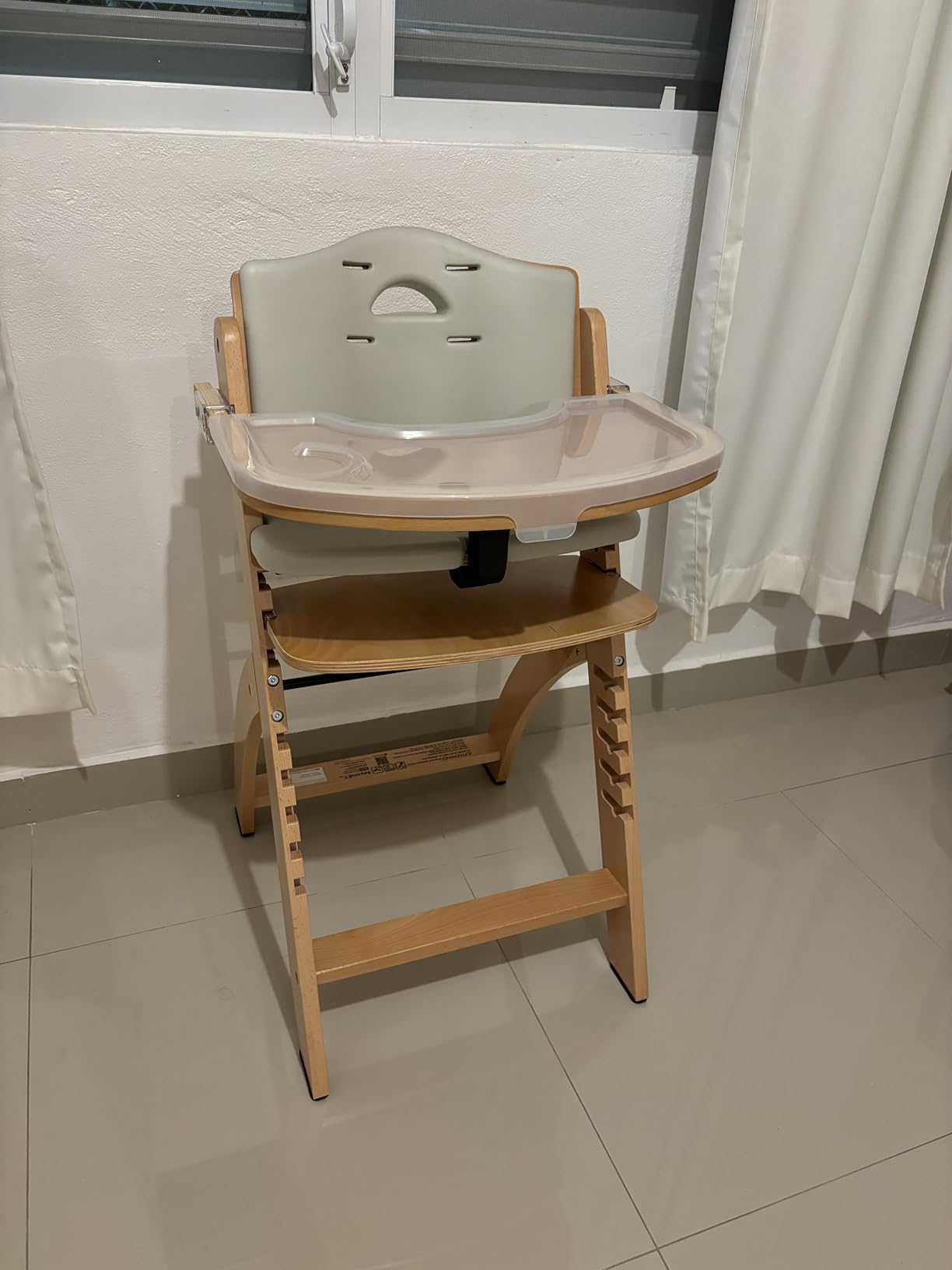
The Abiie Beyond is the chair we recommend to anyone who asks us for one answer. It carries a 4.7 average on more than 8,200 reviews, the largest review base of any chair we looked at, and that volume matters: a rating that holds at 4.7 across a review base that size is a pattern rather than a handful of enthusiastic posts. The frame is solid wood with BPA-free plastic components, rated to 250 lbs and specified from 6 months through adulthood.
What convinced us is the conversion. Pull the tray and the restraint panel and the chair becomes a toddler chair in under 20 seconds with no tools, then a full dining chair later. That single design decision removes the complaint that comes up most often in parent discussions: buying a second chair twelve months after the first. The restraint system shifts from a five-point to a three-point harness, and both the seat position and the footrest adjust, so the child is not sitting with dangling feet at any stage.
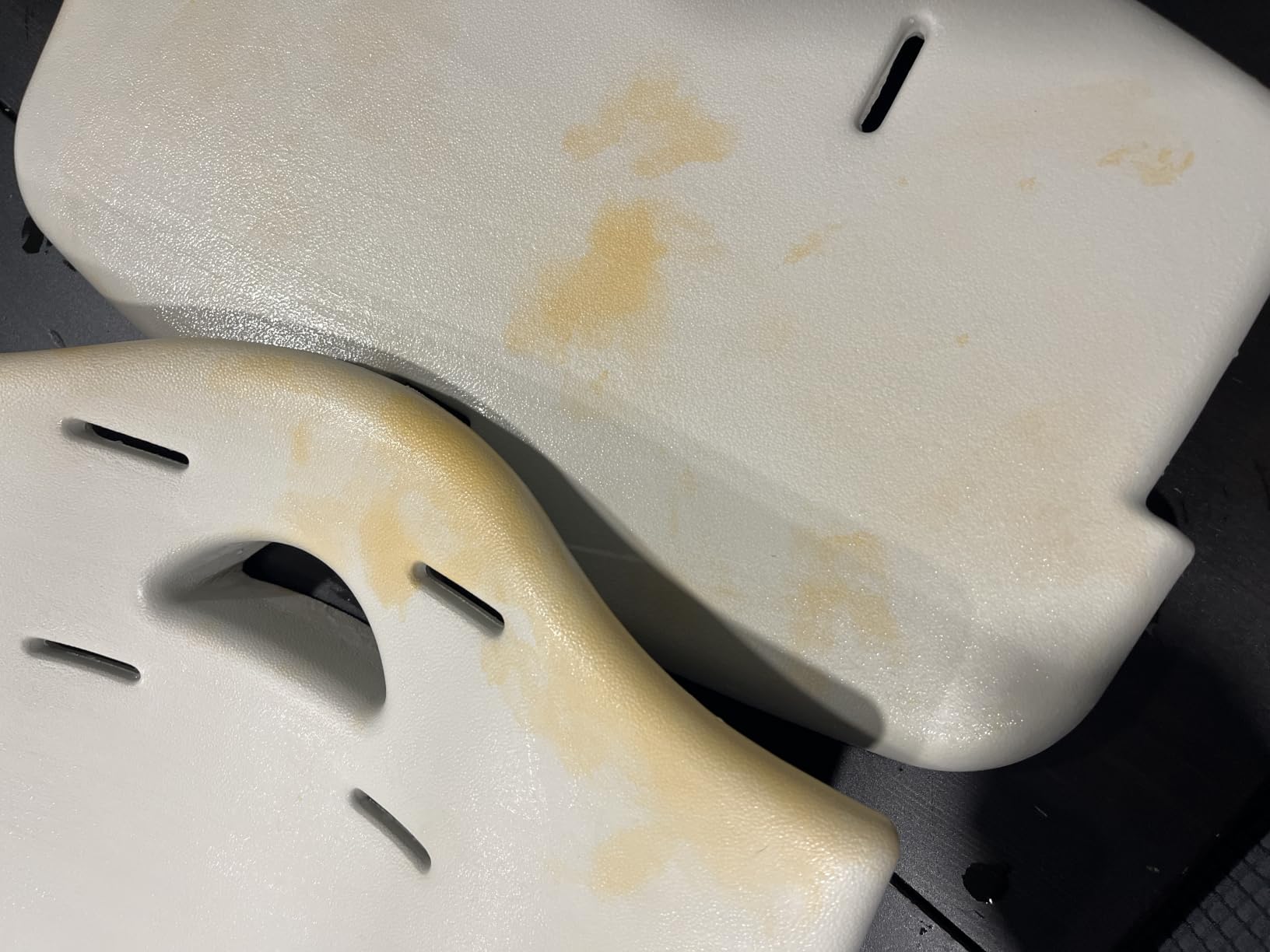
Daily use is where it earns its rating. The tray releases one-handed and the tray cover is dishwasher-safe, and the cushions are water-resistant rather than fabric, which matters more than it sounds when a toddler is dropping yoghurt. Reviewers report the chair does not tip when a child pushes off the table, and that the stained wood reads as furniture rather than baby gear.
Three things fall short. Assembly is a genuine chore with a lot of pieces, and reviewers who expected a fifteen-minute build were wrong. The center crotch buckle is the crevice where food goes to hide, and it is stubborn to clean. It does not fold, though it does slide under a standard dining table, which is enough for most kitchens.
What parents check before buying the Abiie Beyond
Check the clearance under your table before you order. The chair is tall and wide, and parents in small dining rooms measure twice, because a chair that cannot tuck under leaves a stroller parked in the kitchen for six years. Also check whether your table has a pedestal leg, since off-center legs can block the footrest adjustment.
Second, look at the total height against your child’s reach. A tray that sits below the child’s armpits is the wrong height, and a chair that is too tall for a 6-month-old means the first year of use is spent with a tray the child cannot see over.
Who should not buy the Abiie Beyond
Do not buy it if you need a folding chair or a chair that lives in a car. There is no fold on this frame, and no accessory adds one.
Do not buy it if you have a raised counter and eat there most meals. This is a standard-table-height chair, and pairing it with a bar puts the tray in the child’s lap.
2. Stokke Tripp Trapp: the wooden high chair built to be handed down
Stokke Tripp Trapp Chair, Adjustable Wooden High Chair, Warm Brown
European beech wood
Weight capacity up to 300 lbs
Designed by Peter Opsvik in 1972
Designed in Norway
Pros
- Exceptionally sturdy
- Reported to last for decades as a hand-me-down
- Easy to assemble and adjust as the child grows
- Smooth surfaces that wipe clean
- Many colours and two wood finishes
Cons
- Higher price point than most wooden high chairs
- Newborn and baby inserts sold separately
- Fabric cushion set is awkward to clean and remove
The Tripp Trapp is the best wooden high chair for a household that plans to keep the chair for a decade, and it is the design Peter Opsvik drew in 1972. The frame is European beech wood and carries a 300 lb rating, the highest in this roundup. The seat and footrest both slide, so a 6-month-old and a 6-year-old can sit properly at the same table.
Parents in forum threads name this chair more than any other on the shortlist, and the theme that comes back is resale and inheritance. Multiple reviews describe households that own a second Tripp Trapp for grandparents, or a ten-year-old hand-me-down that still looks new. That is the honest case for this price: you are not buying a baby chair, you are buying a chair that outlasts two or three children.
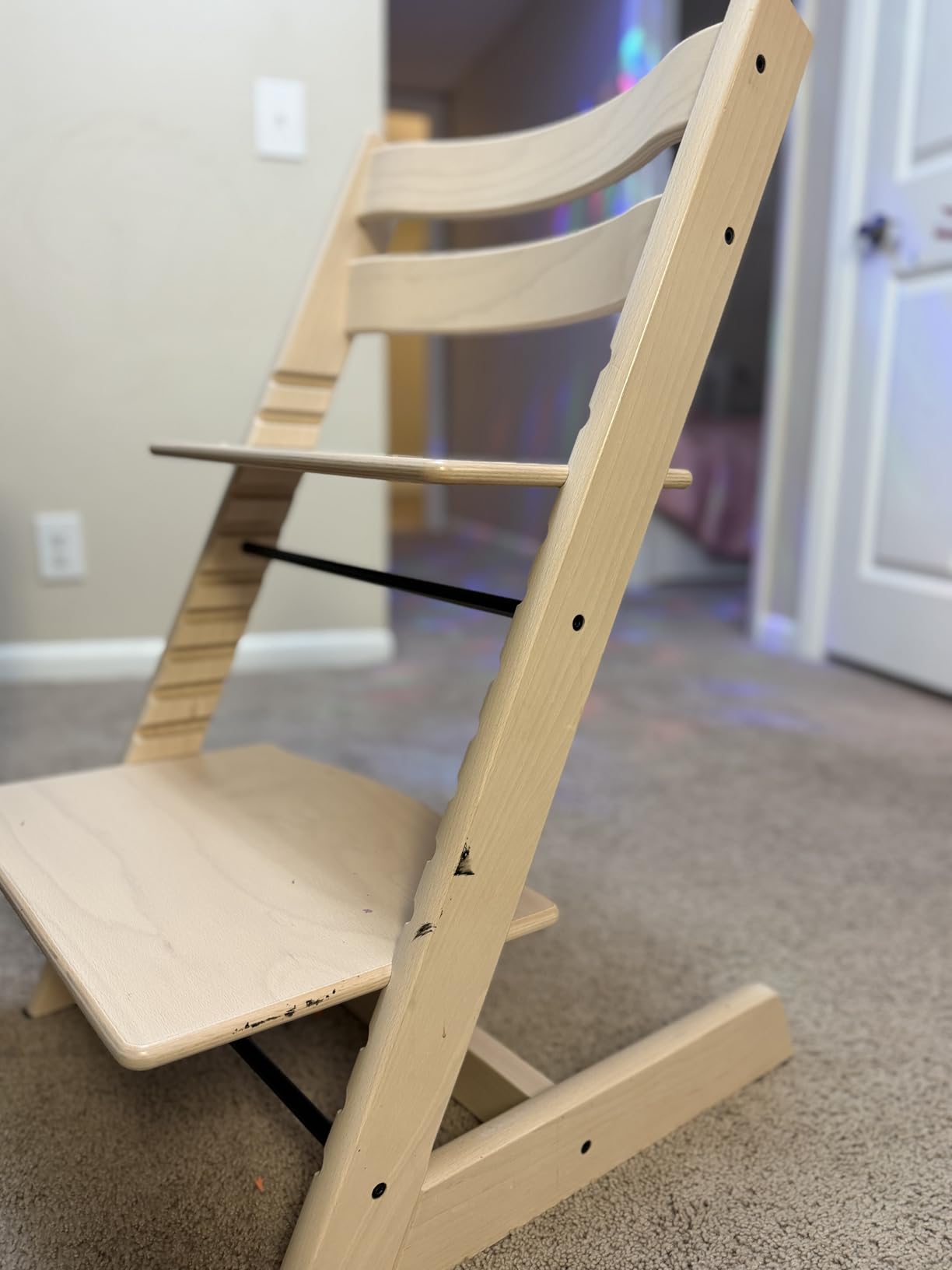
The design is deliberately plain. Smooth beech surfaces with no fabric seams mean the frame itself wipes down in seconds, and the minimal construction is why the chair still looks current. Adjusting the seat is a slide-and-click, so a parent can raise a squirming toddler without taking the chair apart.
The cost is the accessory model. The Newborn Set and Baby Set that extend the chair from birth are separate purchases, and reviewers warn that the fabric cushion accessories are impractical to clean and awkward to remove. If you take the cushion off to wash it, the harness under it has to go back on correctly, and that is a daily friction point.

When the Tripp Trapp is the right spend
Choose this chair if your child is already six months old and you expect a long feeding run. The height adjustment range means the same chair covers the baby stage, the toddler stage and the after-school homework stage, which is where the value concentrates.
Choose it if the chair will live in a dining room rather than a playroom. Neutral beech with a clean silhouette is one of the few high chairs that reads as a normal piece of furniture in a shared space. Our [wooden toys for toddlers](https://www.wearesalt.org/best-wooden-baby-toys-for-toddlers/) roundup follows the same principle: wood pieces stay in the room, plastic ones get stacked away.
When the Tripp Trapp is overkill
It is overkill if this is your first child and you are still deciding whether the feeding stage is really happening at your table. The Newborn Set and Baby Set on top of the chair cost real money, and a parent who only needs six months of use would spend better elsewhere.
It is also the wrong tool for a small kitchen. The footprint is fixed and the legs splay, so pulling the chair in and out of a tight corner takes more effort than a narrower model.
3. Mallify 3-in-1: best wooden high chair for small kitchens
Mallify 3-in-1 Wooden High Chair, Convertible High Chairs for Babies and Toddlers, Baby Highchair with Adjustable Legs & Dishwasher-Safe Tray, Sleek Hardwood & Premium PU Cushion, Beige
Smooth hardwood with BPA-free plastic
Leatherette cushion
A-frame with adjustable legs and cross support
Converts to a toddler chair
Pros
- Compact and lightweight versus most wooden high chairs
- Easy to assemble and easy to wipe clean
- Converts into a toddler chair
- Aesthetic modern look
- Cushion and tray both removable for washing
Cons
- Shorter than a typical high chair so it may not reach all tables
- Limited back support
- Small tray
- No height or recline adjustment beyond the 3-position tray
The Mallify 3-in-1 is the pick when floor space is the problem. Reviewers consistently describe it as the best-looking and easiest to clean chair they have owned, and its A-frame footprint is genuinely compact relative to the splayed-leg design of the premium names, which matters in a kitchen that doubles as a dining room. The frame is smooth hardwood with a BPA-free plastic tray and a leatherette cushion.
The conversion is the practical win. Once your child outgrows the tray, the legs come off and it becomes a toddler chair with a guard. That short toddler-chair stage is where a lot of high chairs are abandoned in a corner, so having a second identity built in changes the math on how long the chair stays in use.
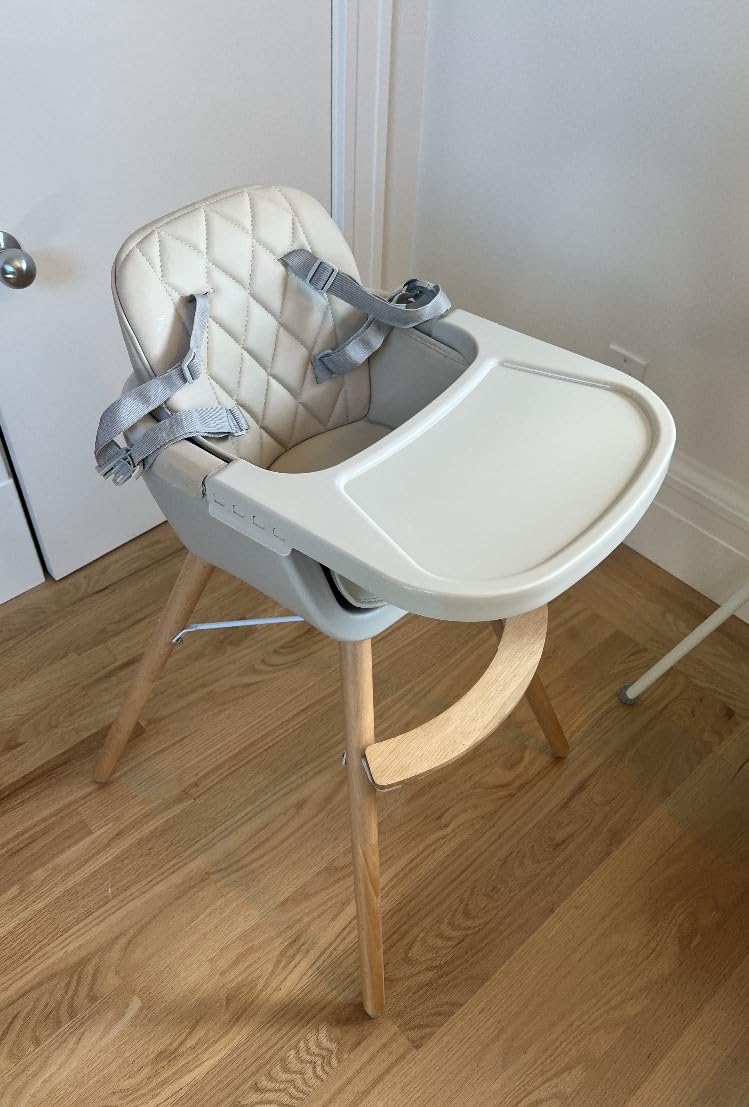
Cleaning is the easiest part of using it. The tray is dishwasher-safe, the seat belt removes, and the cushion wipes down. A-frame construction with adjustable legs and a cross support keeps it from flexing, and a five-point harness fits snugly even on a small baby.
The honest limitation is size, in both directions. Reviewers warn that this chair sits lower than a typical high chair, so it may not reach all tables, and the tray is on the small side. Back support is minimal, and some parents prop a rolled towel behind babies who are not yet sitting confidently. There is no height or recline adjustment beyond the three tray positions.
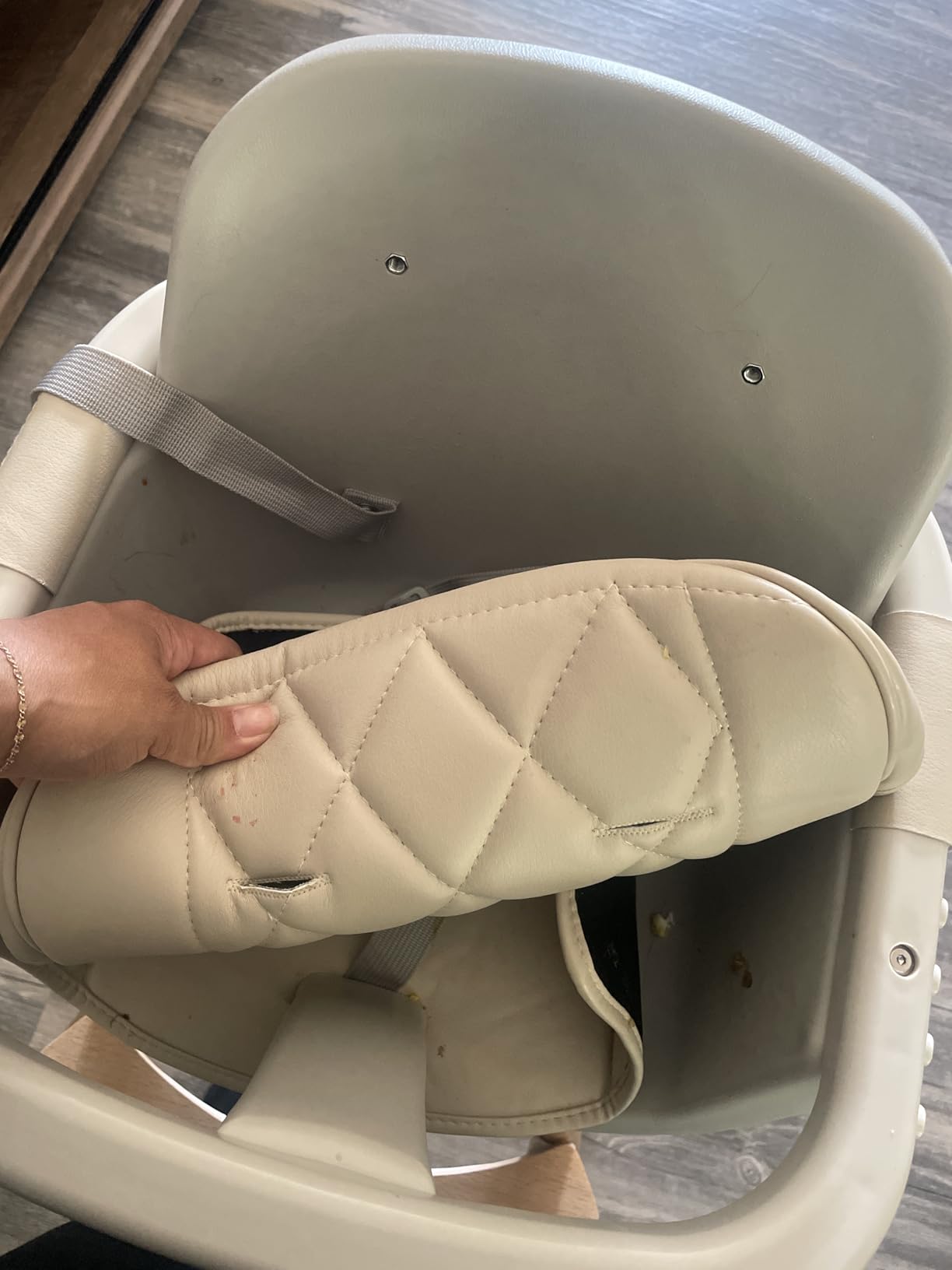
Measuring for the Mallify before you order
Measure your table apron height, not the tabletop. Because this chair runs short, the tray can land in a child’s lap at a standard table that would clear a taller chair. Sit the child in the chair with the tray in and check that the tray clears the edge of the table by at least a hand’s width.
Check the floor too. The A-frame needs a reasonably flat surface, and a rug with a pile can make the base sit unevenly, which is a concern raised repeatedly in parent forums about lightweight wood chairs.
Who the Mallify suits and who it does not
It suits a small apartment kitchen, a first-time parent who wants a straightforward route to a convertible chair, and anyone who hates scrubbing tray seams. A full week of meals is a fair test of a chair’s cleaning claims.
It does not suit a tall baby who needs a proper footrest for posture, or a family eating at a counter. With no footrest adjustment and a low seat height, this is a table chair, not a counter chair. Our [convertible high chair roundup](https://www.wearesalt.org/best-convertible-high-chairs/) covers the models with real height travel if you need that.
4. Evolur Zoodle: best wooden high chair with a listed safety standard
évolur Zoodle 3-in-1 High Chair in Light Grey | Convertible Wooden Baby Feeding Chair with Dishwasher Safe Removable Tray, Adjustable Footrest, Padded Cushion, 5-Point Harness for Infants & Toddlers
Beech wood frame with food-grade PP and PU cushion
30 x 25 x 39 inches
Recommended for 6 months plus
Meets ASTM F833-18 standards
Pros
- Converts to a toddler chair with the included kit
- Removable washable seat cover and dishwasher-safe tray
- Five-point harness with padded shoulder covers
- Non-skid feet
- Two adjustable footrests
Cons
- Age guidance starts at 6 months so it is not a newborn seat
- Beech wood frame still pairs with a plastic tray and PU cushion
- Footrest has two positions rather than continuous adjustment
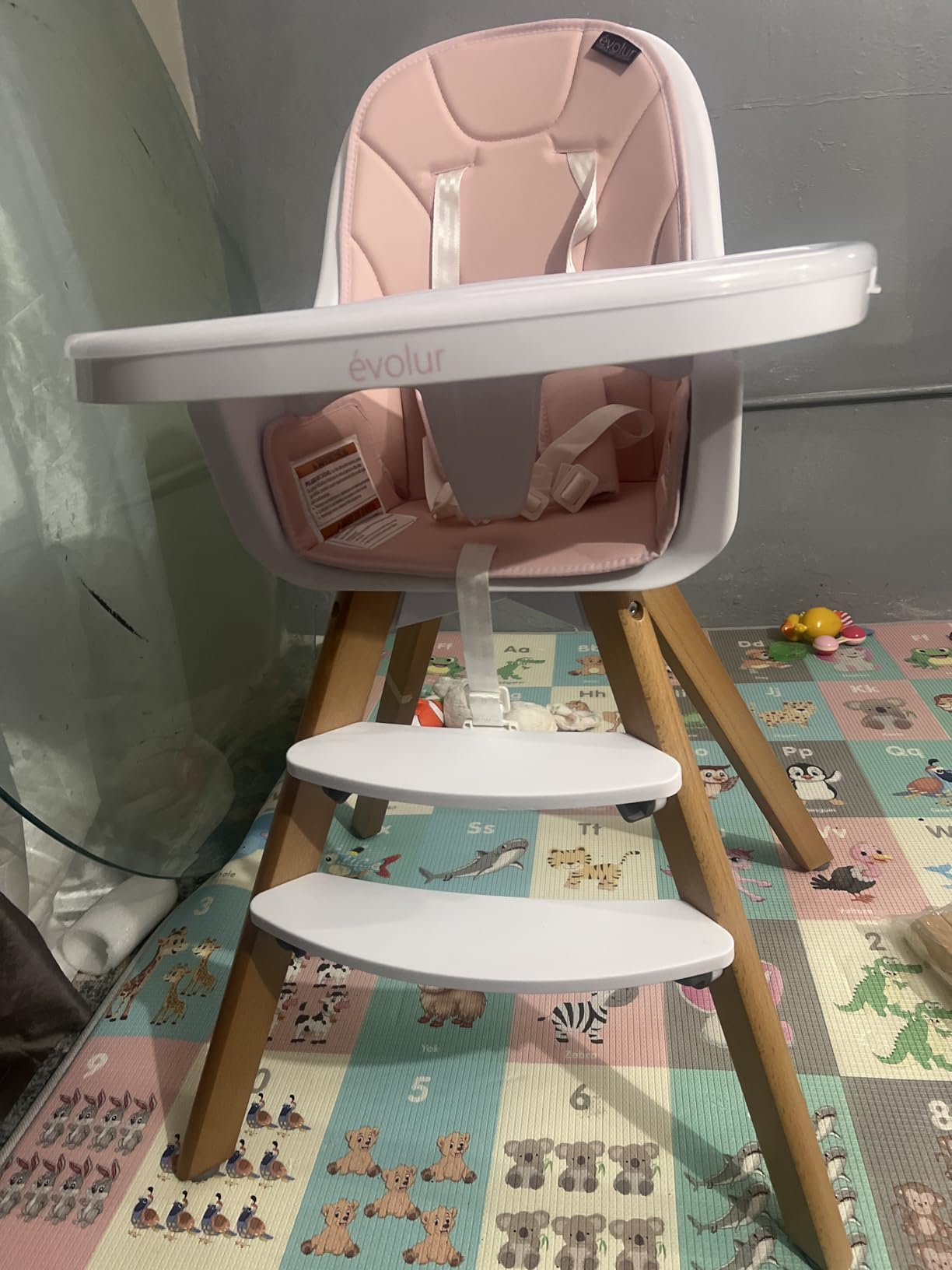
The Evolur Zoodle is the pick for parents who want the paperwork, not just the wood. It meets ASTM F833-18 standards, the US safety standard for infant seating, and it won a 2022 National Product Parenting Award. The frame is beech wood with food-grade PP and a PU fabric cushion, and it measures 30 by 25 by 39 inches.
That is not a small thing in a category where certification is mostly marketing. One of the questions that comes up repeatedly in parent forums is whether a chair carries a real safety standard, and having the standard named on the product record is a faster answer than a photo of a certificate. The 4.4 rating across 1,680 reviews comes with 77 percent five-star ratings, which is high for a chair this size.
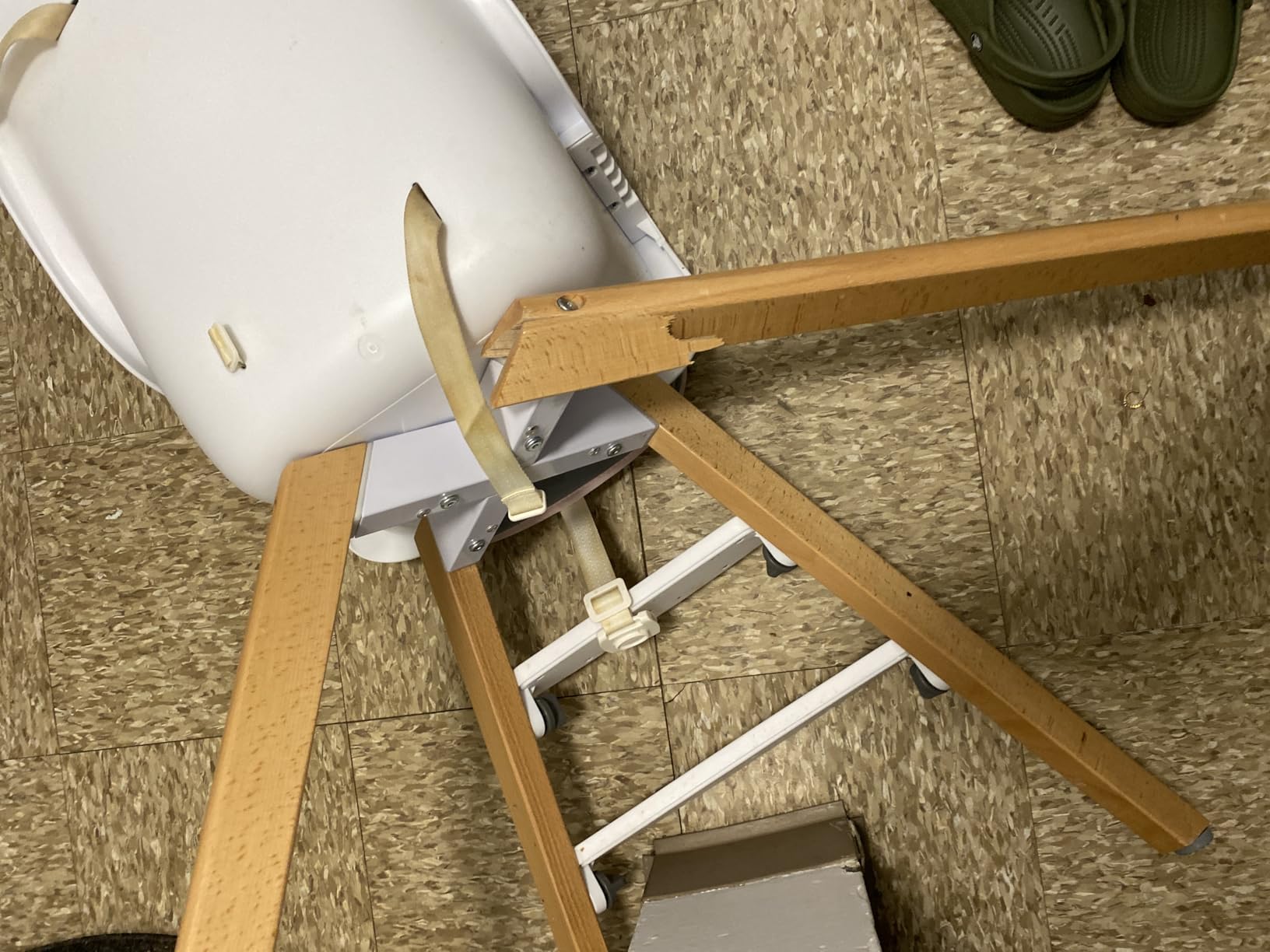
Two details set it apart from the other convertibles at this level. A conversion kit is included, so the toddler-chair stage does not require a separate purchase, and the seat cover is removable and washable rather than wipe-only, which is the difference between a chair that survives a weekly wash and one that does not. The five-point harness has padded shoulder covers, and the feet are non-skid so the chair does not creep on a wood floor.
Keep in mind that this is a mixed-material chair. Beech wood on the frame, plastic on the double feeding tray, fabric on the cushion, which means the dishwasher-safe tray and the removable cover are doing the heavy lifting for cleaning. The age guidance starts at 6 months, so it is not a from-birth chair, and the two footrests give less height travel than the models with continuous adjustment.
What to verify on the Zoodle after assembly
Check the harness height against your child’s shoulders before the first feed. A five-point harness that sits below the armpit on a tall baby is decorative rather than functional, and this is adjustable, so set it once and leave it.
Check the tray’s two positions against your child’s belly button. The tray should meet around the navel, and if both positions sit high, you are buying a second footrest or a taller chair. Five finish options are offered, which matters if the chair lives in a room you care about.
Where the Zoodle falls short
It is not a newborn chair, and it is not a counter-height chair. At 39 inches tall overall it suits a standard dining table, and the double tray is designed for a seated child rather than a baby being held.
It also does not convert beyond the toddler stage. Once your child is school-aged, this chair is done, where the Tripp Trapp and the FORNEL keep going for years. If the plan is one chair for a decade, weigh the [chairs that grow with baby](https://www.wearesalt.org/best-high-chairs-that-grow-with-baby/) before settling here.
5. FORNEL Scandinavian: best value solid wood chair
FORNEL Scandinavian Wooden High Chair for Toddlers & Kids | Adjustable Grow-with-Me Montessori Seat for Dining Table | Natural Wood Finish Convertible Highchair
Solid wood with a smooth wipeable finish
Weight capacity up to 200 lbs
3-step convertible design
Optional Baby Set for 6-month-olds
Pros
- Minimalist Scandinavian light-wood look at a mid-range price
- Adjustable seat and footrest
- Grows through toddler chair and youth study chair to an adult spare seat
- Solid wood with a smooth wipeable finish
- No plastic in the frame
Cons
- Baby Set for 6-month-olds is a separate purchase
- 200 lb rating is below the 250 to 300 lb ratings on the Abiie Keekaroo and Tripp Trapp
- Feeding-chair use is specified from age 3 plus
The FORNEL is the value pick because it strips away everything you do not need. A solid wood frame, a smooth wipeable neutral finish, an adjustable seat and footrest, and a three-step conversion. No plastic in the frame at all, which is rare at this level. It holds a 4.5 across more than 1,100 reviews with 79 percent five-star ratings.
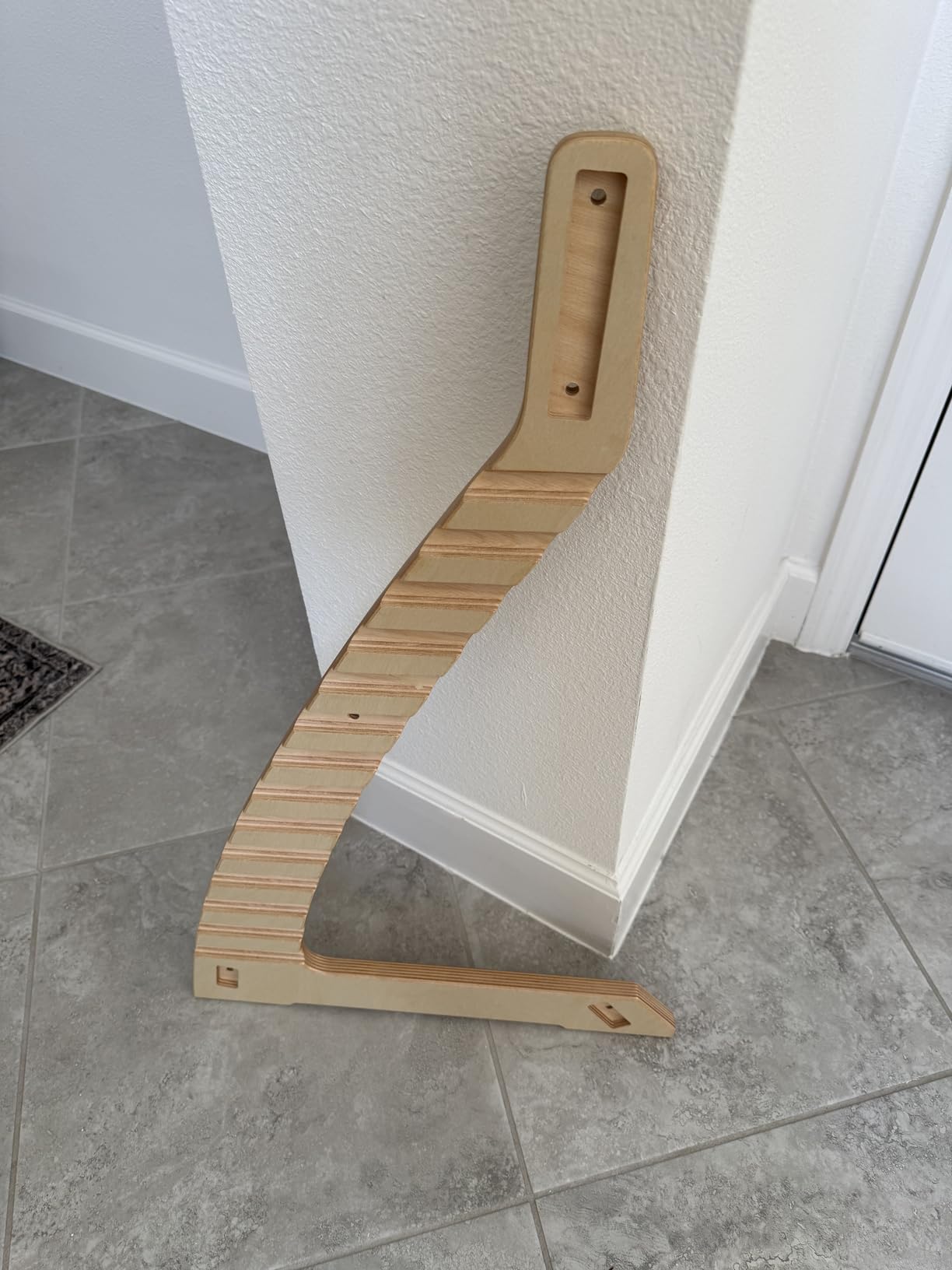
The conversion path is the reason to buy it. The chair moves in three steps from a toddler feeding chair to a youth study chair to an adult spare seat rated to 200 lbs. An adult spare seat is a genuinely useful outcome, because a wooden chair that ends up at a desk or a dressing table is a chair you did not throw away.
The adjustable seat and footrest pull the child up to the family table, which matters more than most buyers expect. A toddler whose feet hang free cannot brace, cannot sit upright for a full meal, and gets tired of sitting. Feeding specialists writing about this category keep pointing at the footrest as the single most important feature for a baby starting solids, and this chair has one that adjusts.
Two caveats. The Baby Set that extends the chair to 6-month-olds is an optional extra, so buying it for an infant means buying the accessory. And the 200 lb rating is below the 250 lbs on the Abiie and Keekaroo and the 300 lbs on the Tripp Trapp, so it is a child’s chair that reaches adulthood, not an adult chair.
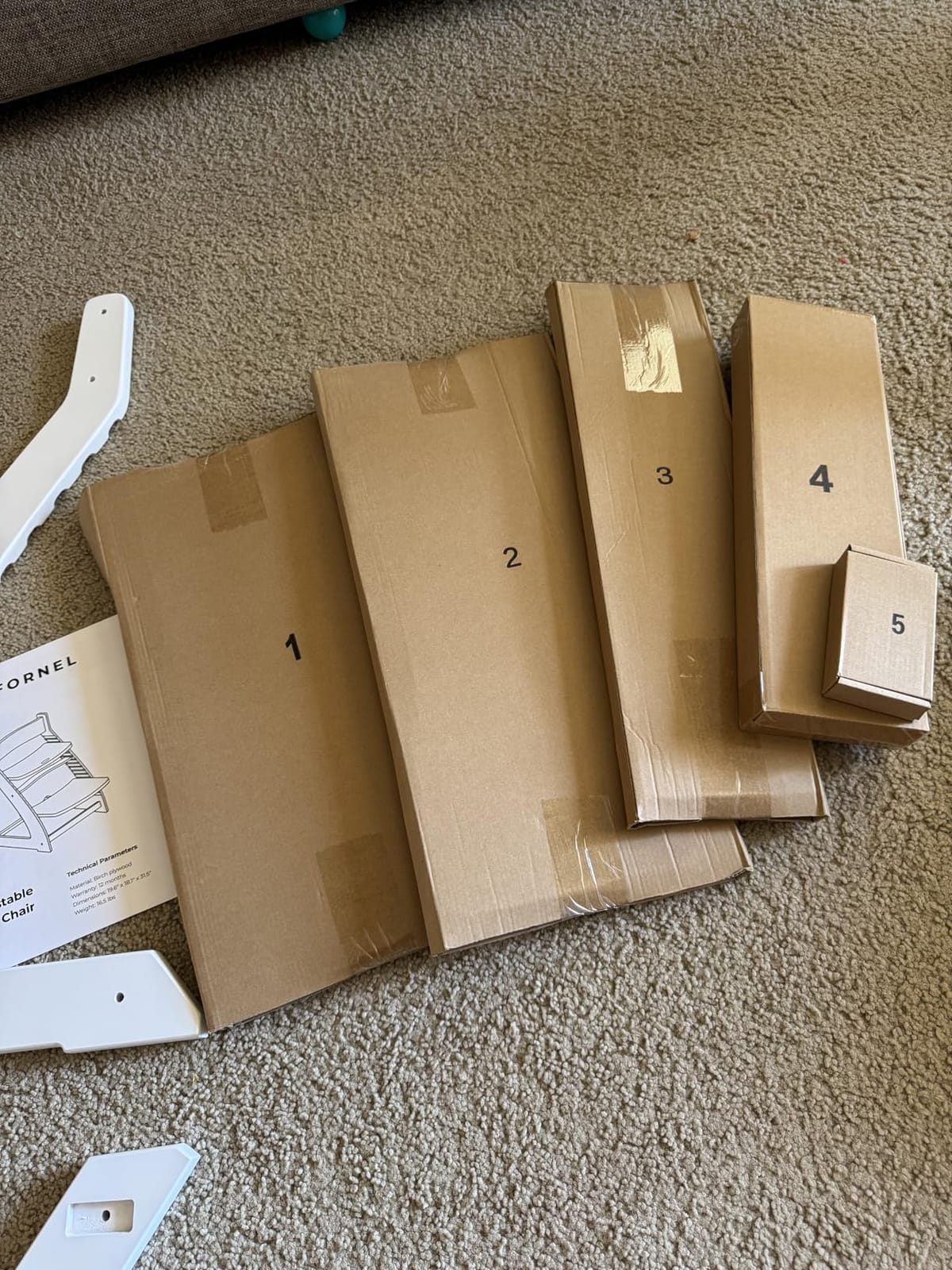
How to check the FORNEL fits your space
Pull up the product dimensions and measure the gap between your table legs, because the conversion changes the chair’s stance at each step. Bring the seat to its lowest position and check that the footrest clears a table apron; that is where cheap convertibles catch.
Look at the finish rather than the color. A smooth wipeable neutral finish takes a damp cloth and a mild soap. If you have a child who eats with their hands, run a damp cloth over the seat and the footrest twice a week and the chair stays presentable for years.
Who buys the FORNEL and who does not
Buy it if you want Scandinavian proportions, solid wood, and a long conversion, without paying premium nursery-brand money. It suits a dining room where aesthetics are half the decision.
Skip it if you need a chair from birth, or a rating above 200 lbs, or a recline for a newborn nap. Those needs push you toward the Abiie Beyond or the Tripp Trapp with its optional newborn accessories. If you are still furnishing the room around a toddler, our [wooden play kitchen roundup](https://www.wearesalt.org/best-wooden-play-kitchens-for-toddlers/) covers the matching category.
6. BABY JOY 3-in-1: best budget wooden high chair
BABY JOY Convertible Baby High Chair, 3 in 1 Wooden Highchair/Booster/Chair with Removable Tray, Adjustable Legs, 5-Point Harness, PU Cushion and Footrest for Baby, Infants, Toddlers (Beige)
Food-grade PP and PE with beech wood legs
Steel X-frame reinforcement
Ages 6 months to 3 years
Anti-skid foot pads
Pros
- Converts between feeding chair guarded toddler seat and stool
- Removable tray with three positions for quick rinsing
- Beech wood legs and X-shaped steel frame give a stable base
- Five-point harness with adjustable length
- Anti-skid feet protect wood floors
Cons
- Only the legs are wood
- the seat and tray are food-grade plastic
- The stool stage arrives at 3 years so the toddler-chair window is short
- No footrest adjustment is specified
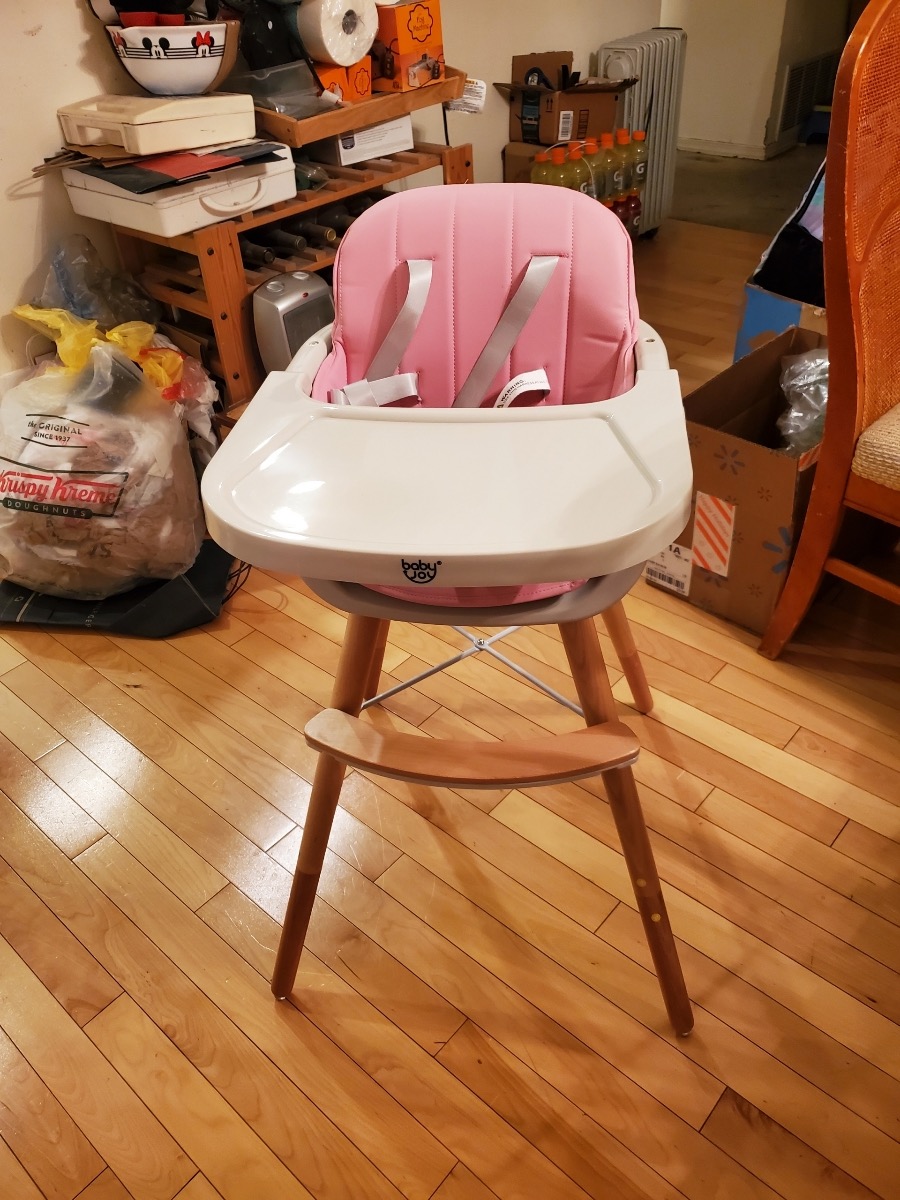
The BABY JOY is the pick if your budget is fixed and you want three configurations rather than one. It converts between a baby feeding chair, a toddler seat with a guardrail, and an ordinary stool, covering 6 months to 3 years. The 4.4 rating across 954 reviews comes with 74 percent five-star ratings and 10 percent four-star ratings.
The stability engineering is the part worth noting. The frame is A-shaped with X-shaped steel reinforcement and anti-skid foot pads, and that combination is why reviewers describe it as tip-resistant. A five-point harness with adjustable length keeps the child from leaning forward into the tray, and a detachable tray with three positions means rinsing takes seconds rather than a scrub.
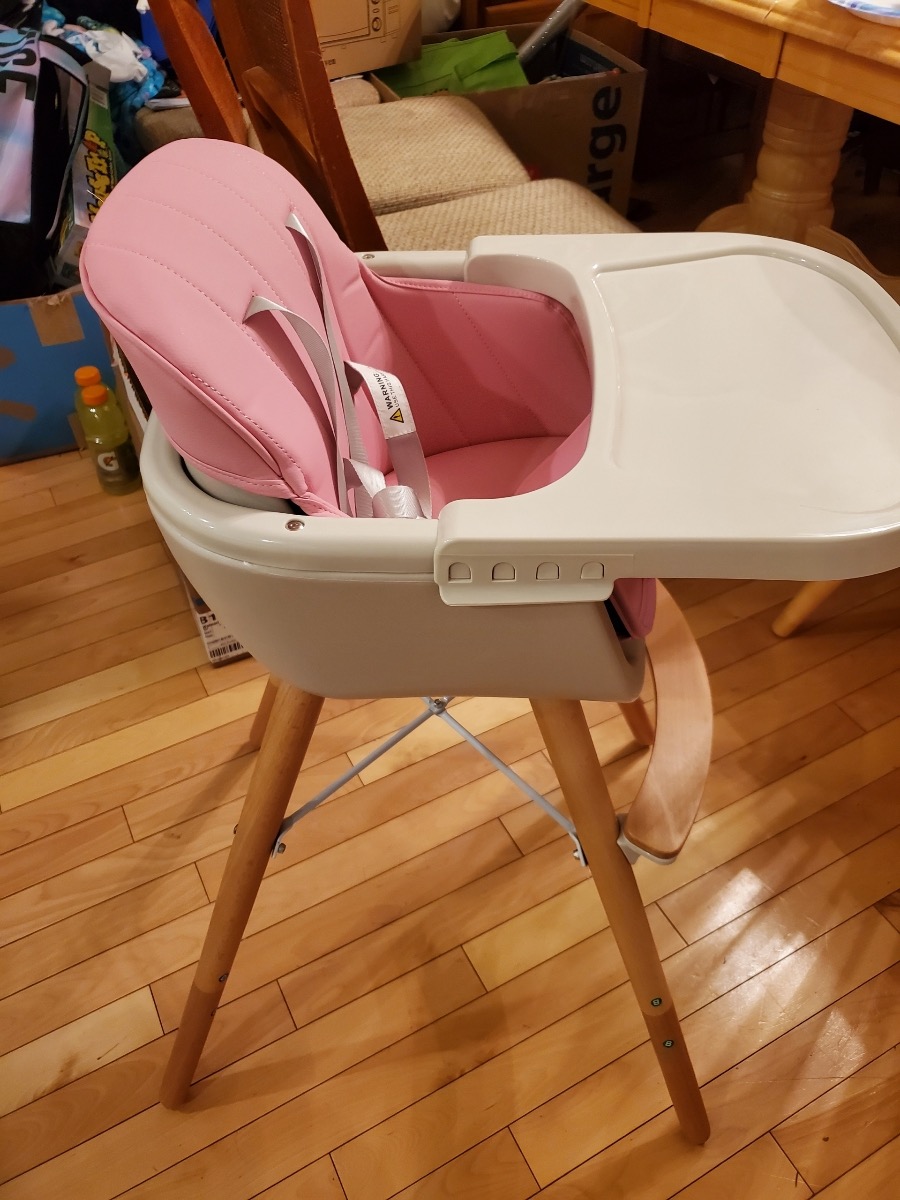
An ASTM-tested wooden baffle is included as a replacement, which is a small detail that tells you the manufacturer expects wear. Anti-skid foot pads protect a wood floor from scratches, which matters in a dining room with the same finish as the chair.
The compromise is material mix. Beech wood appears in the legs; the seat and tray are food-grade PP and PE. That is durable and easy to wash, but it is not the all-wood look that draws people to this category in the first place. There is no footrest adjustment, and the stool stage arrives at three years, so the guarded toddler-chair phase is a short window rather than a long one.
What to look at in the first week
Check that the X-frame bolts are fully tightened and that all four legs sit flat on your floor before the first feed. An A-shaped frame with a steel X inside is stable when it is square and slack in its joints, so a chair that rocks has an assembly problem rather than a design problem.
Watch the harness strap length as your baby grows. The harness is adjustable, so a quick reset every few weeks keeps it snug and keeps a wriggly 6-month-old from sliding down out of the tray.
When the budget pick makes sense
It makes sense as a second chair at a grandparent’s house, a sitter’s apartment, or anywhere the chair will get chewed on by a first child while your better chair lives in the dining room. Parents describe exactly this two-chair pattern.
It makes less sense as your one chair for three years if you care how the room looks, because the plastic seat gives the all-furniture look away immediately. In that case step up to the FORNEL or the Abiie Beyond.
7. Keekaroo Height Right: best wooden high chair made in the USA
Keekaroo Height Right High Chair with Tray, Natural
Wood construction made in the USA
JPMA Certified
Eating tray and dishwasher-safe tray cover included
6 months to 250 lb
Pros
- Made in the USA with JPMA certification
- Adjustable foot and seat plate spans 6 months to 250 lb
- Solid wood rather than molded plastic
- Dishwasher-safe tray cover included in the box
- Cloth cushion seating included
Cons
- 250 lb ceiling is below the 300 lb on the Tripp Trapp
- Only Natural and Mahogany colour options
- No recline or tray height adjustment is listed
The Keekaroo Height Right is the pick when provenance and certification matter more than convertibility. It is made in the USA and JPMA Certified, the Juvenile Products Manufacturers Association standard, and it is solid wood rather than molded plastic, with a rating base that has been accumulating for years rather than months.
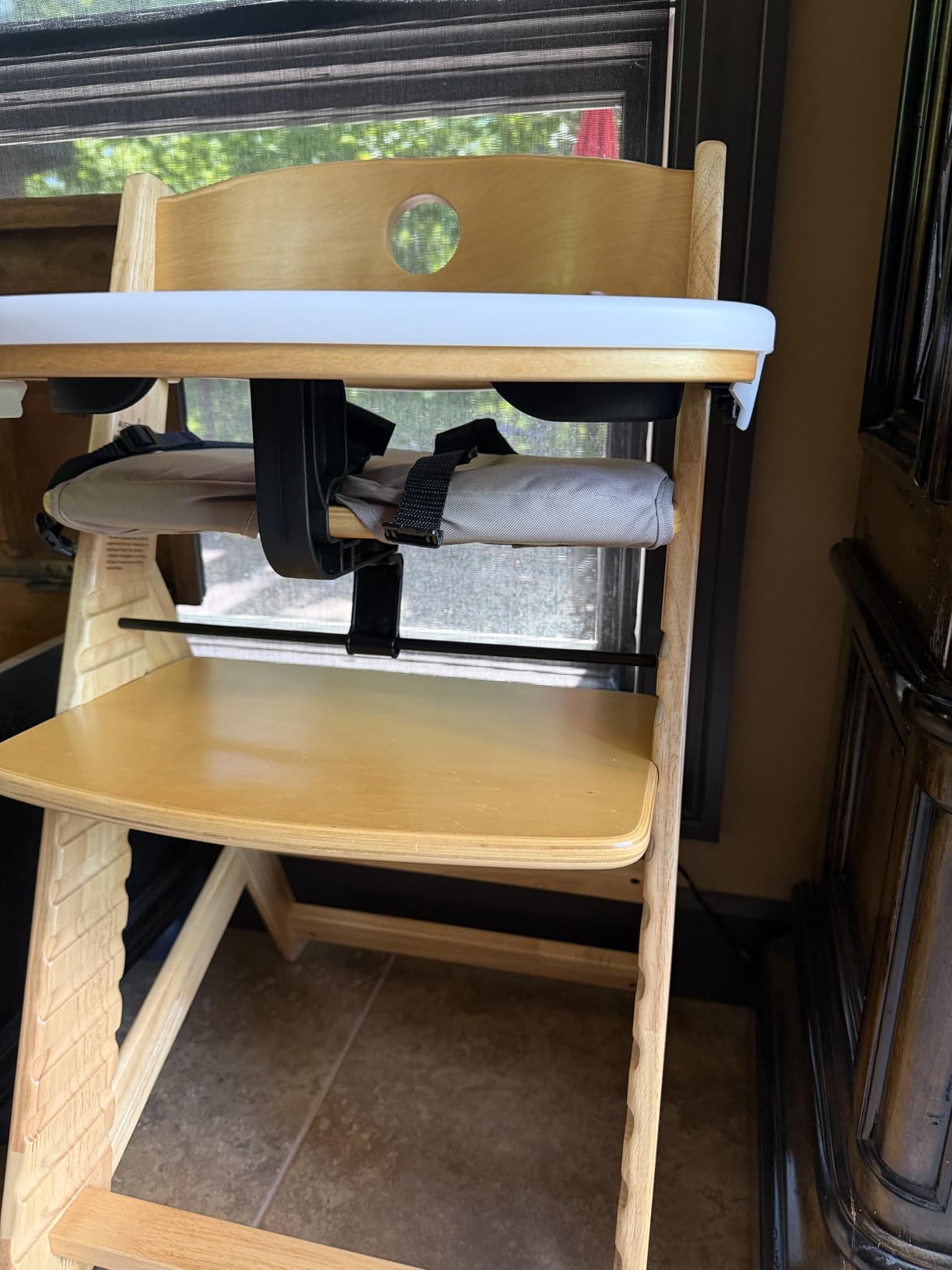
The mechanism is the quiet strength. An adjustable foot and seat plate moves the whole sitting position rather than just the tray, so the child’s feet and seat rise together and the 90-90-90 posture holds from 6 months up to 250 lbs. The eating tray, the dishwasher-safe tray cover, and cloth cushion seating all come in the box, which removes the accessory creep that parents on forums complain about constantly.
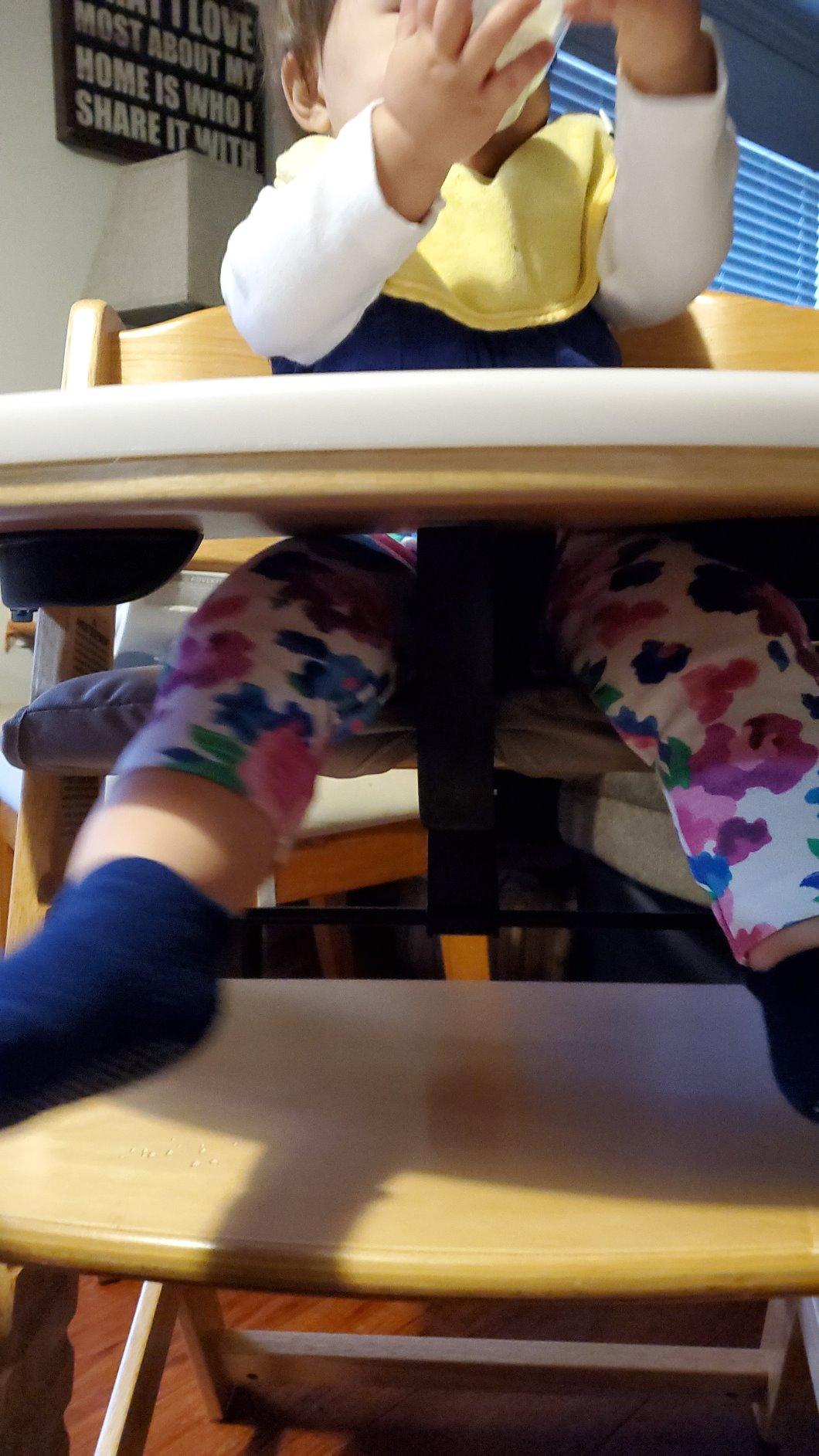
What you get in the box matters more in this category than buyers expect. Many rivals sell the tray, the harness, the newborn set or the footrest as add-ons, and a parent budgeting from the headline number ends up surprised twice. The Keekaroo includes the core pieces, so the day-one cost is the day-one cost.
The trade-offs are narrow but real. The 250 lb rating sits below the Tripp Trapp’s 300 lbs, the colour range is just Natural or Mahogany, and there is no recline or tray height adjustment in the specification. This is a chair that grows a child through the high-chair and booster years rather than one that converts into a full dining chair.
Questions to ask before choosing the Keekaroo
Ask whether you want a recline. Many babies nap in the chair in the first year, and a chair without a reclined position means a tired baby slumps forward against the tray with the harness under tension. If you expect daytime naps in the chair, the Tripp Trapp with its optional baby accessories handles that better.
Ask how long you plan to use it. Up to 250 lbs is generous for a child, but if you want the same chair at a desk or a dressing table later, the FORNEL and the Tripp Trapp convert further.
Who the Keekaroo fits
It fits a family that wants a made-in-USA wood chair with a named safety certification and everything included in the box, and who does not need the chair to become furniture afterwards. Under that brief it is hard to argue with.
It does not fit a parent chasing convertibility, a counter-height table, or a neutral Scandinavian palette. For those, the Tripp Trapp or the FORNEL are the better spends.
8. Cowiewie 3-in-1: a wooden frame with an all-wood tray
Cowiewie 3-in-1 Convertible Natural Wooden High Chair for Babies & Toddlers 3-Tier Remove & 2 Adjustable Wood Tray & 8 Levels Adjustable, 2 Waterproof Cozy Cushions (Black)
Natural wood with waterproof cushions
3-tier removable design
Two adjustable wooden trays
8 levels of height adjustment
Pros
- Wooden tray on a convertible frame with no plastic tray parts
- Eight levels of height adjustment for a wide growth range
- Two waterproof cushions included and easy to wipe
- Five colour options available
Cons
- Lowest average rating in this roundup at 4.2 with a higher one-star share
- Seat and footrest positions are not specified beyond the eight tray height levels
- No safety standard certification is listed on the product record
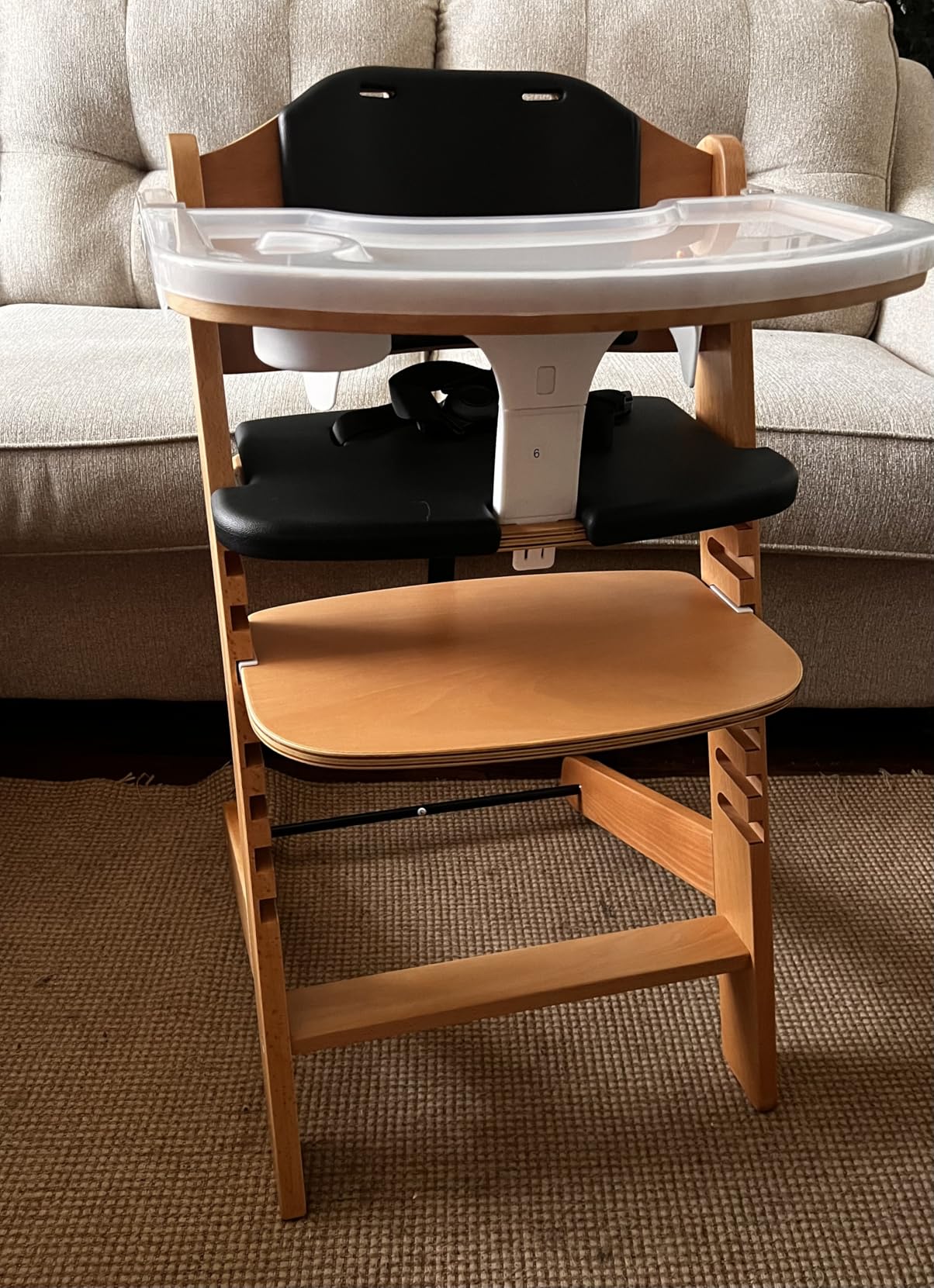
The Cowiewie is unusual in one specific way: the tray is wood too. Two adjustable wooden trays sit on a natural wood frame with waterproof cushions, and there is no plastic tray part to crack, stain, or replace. For a family that chose this category because they dislike plastic in the eating path, that is a genuine differentiator.
The adjustment range is unusually generous for a wood frame. Eight levels of height adjustment plus a three-tier removable design means the chair spans feeding, toddler, and independent sitting without buying a second seat. The waterproof cushions are the second practical win, since they wipe down rather than absorbing a spill.
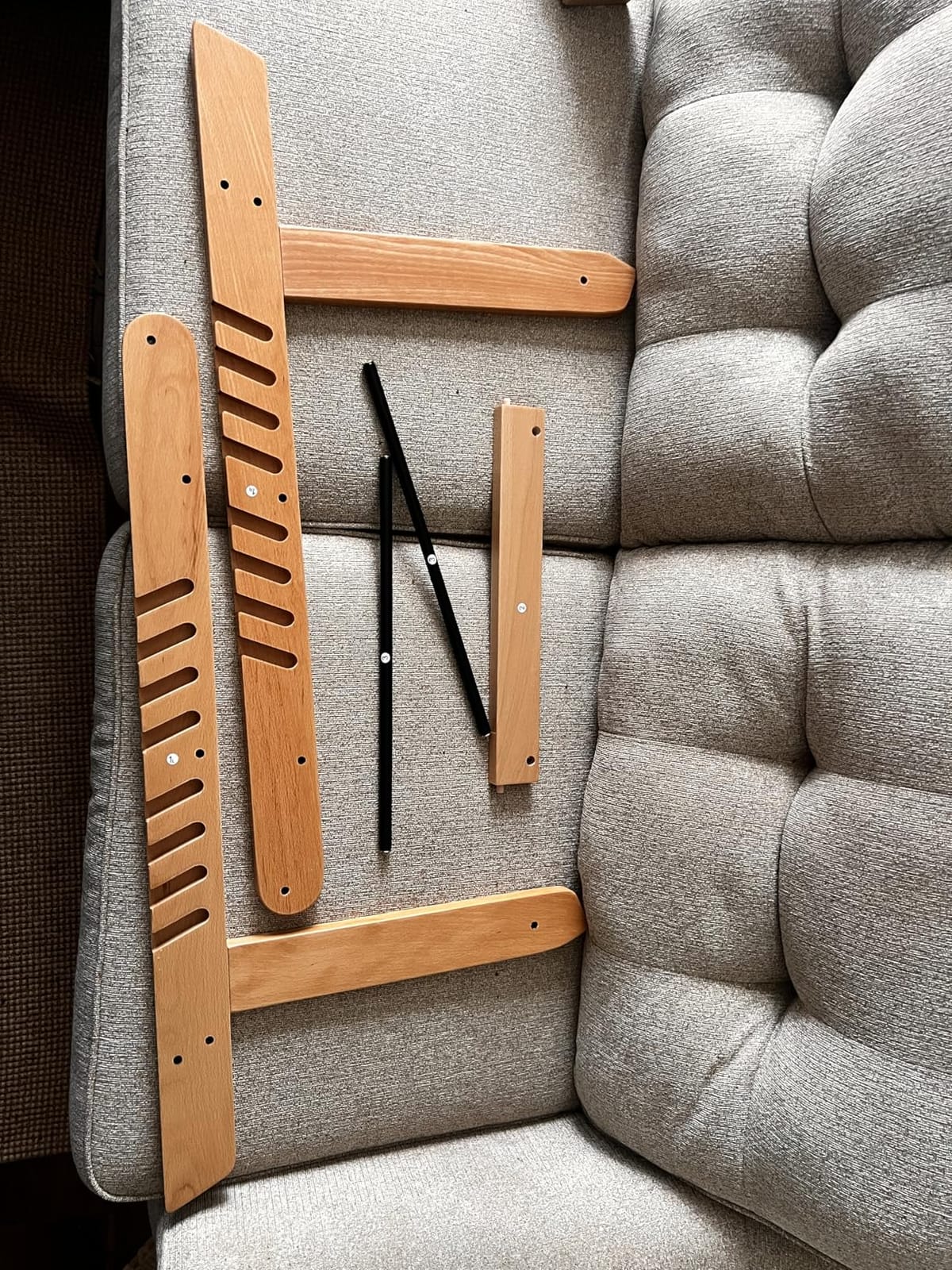
One detail to check before you commit. Eight levels of height adjustment are listed for the chair, and the seat and footrest positions are not separately specified, so the travel is largely vertical rather than the full three-axis adjustment the Tripp Trapp offers. If your child needs a footrest at a specific height, confirm the position rather than assuming it tracks the tray.
The 4.2 average is the lowest among the ten chairs we looked at, and the review distribution is blunter than most: 67 percent five-star alongside a 10 percent one-star share. No safety standard is listed on the product record either, so this chair does not give you a certification to check.
What to test in the first two weeks
Run the full adjustment range with a tray installed and check for play in the joints at each level. On a chair with this many moving positions, looseness develops at the extension points, and it is worth catching in month one rather than month eight.
Set the tray at the height where the tray meets your child’s navel and note the setting. The eight levels are discrete, not continuous, so the correct setting for a 6-month-old may not be the correct setting at 18 months, and you will want to know it by feel rather than by guessing.
When to choose this chair
Choose it when the all-wood eating surface is the thing you care about, when your child is between sizes often enough that height range matters more than a premium brand name, and when you are comfortable checking joints rather than reading a certification number.
Skip it if you want the longest service life or the largest review base to draw reassurance from. For a chair to hand to a second child, the Tripp Trapp and the FORNEL have both proven that path more often.
9. YOLEO Grow-with-Me: best wooden chair for toddlers aged 2 and up
Wooden High Chair for Toddlers, Adjustable Feeding Chair with Removable Cushion for Child, High Chair Grows with Kid for Dining, Studying, Step Tool(Natural Color)
Solid beech wood with removable cushion
Ages 2 to 12
4 seat height positions and 5 footrest positions
Compact footprint
Pros
- Smooth well-finished solid beech wood that assembles quickly
- Compact footprint fits even with a crowd of guests
- Multiple seat and footrest adjustments let it last for years
- Back and seat cushions included
- Children climb in and out independently
Cons
- Seat cushion can slide out of position during use
- Can tip if a child pushes hard off the table while on a rug
- Light weight is less reassuring for a small baby
- Finish and joinery quality reported as inconsistent
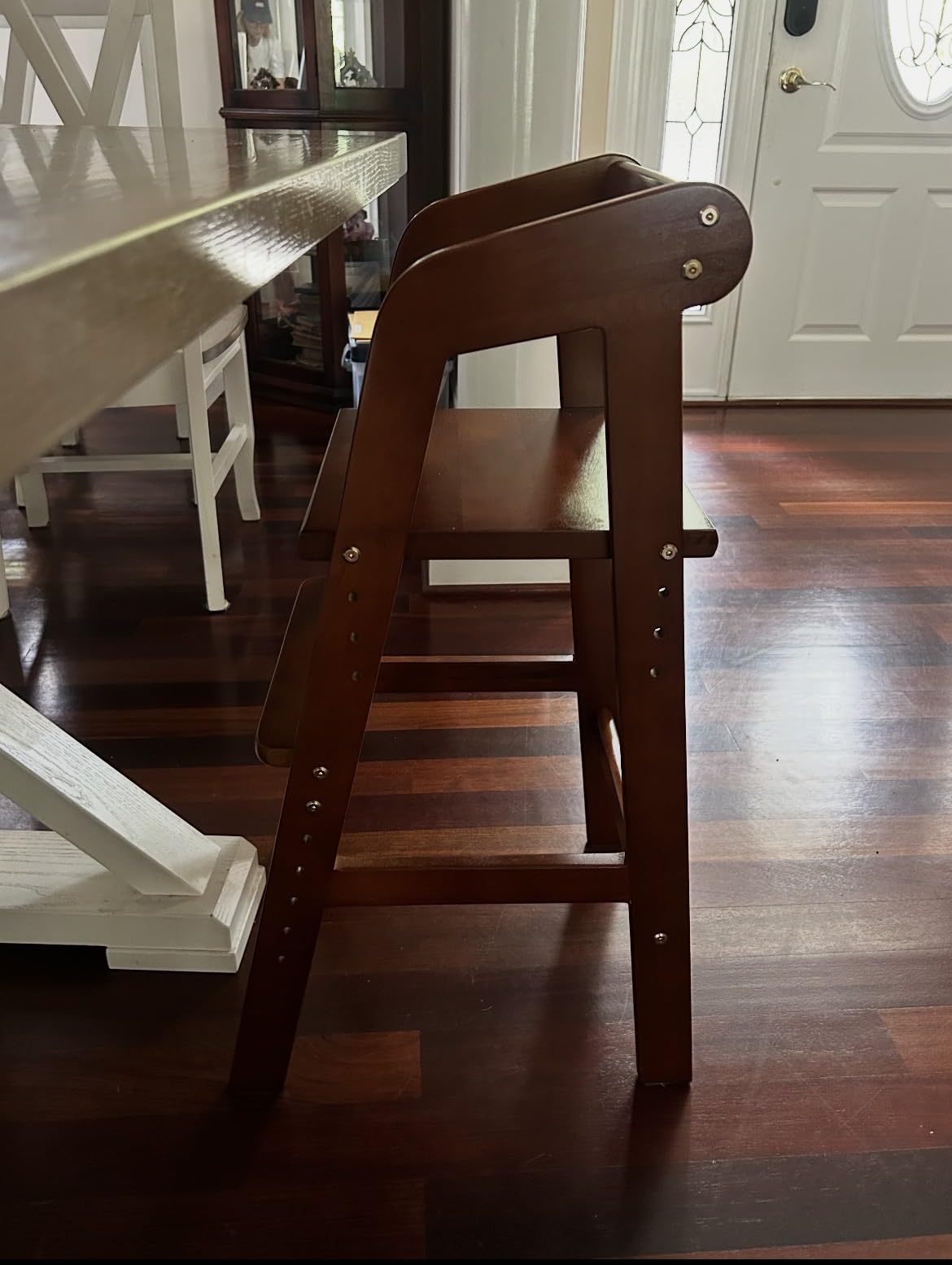
The YOLEO is the pick if your child is walking and climbing rather than sitting. The stated range is 2 to 12 years, with four seat height positions and five footrest positions on a solid beech frame. It converts from a dining chair to a study chair to a step stool, which covers homework and reaching high kitchen cabinets as well as meals.
The independence angle is what reviewers raise most. Parents describe a three-year-old climbing in and out unaided, and that single benefit changes the daily routine more than any feature on a spec sheet. The compact footprint matters in a crowded kitchen, where a wider chair would be impossible to push in during a busy meal.
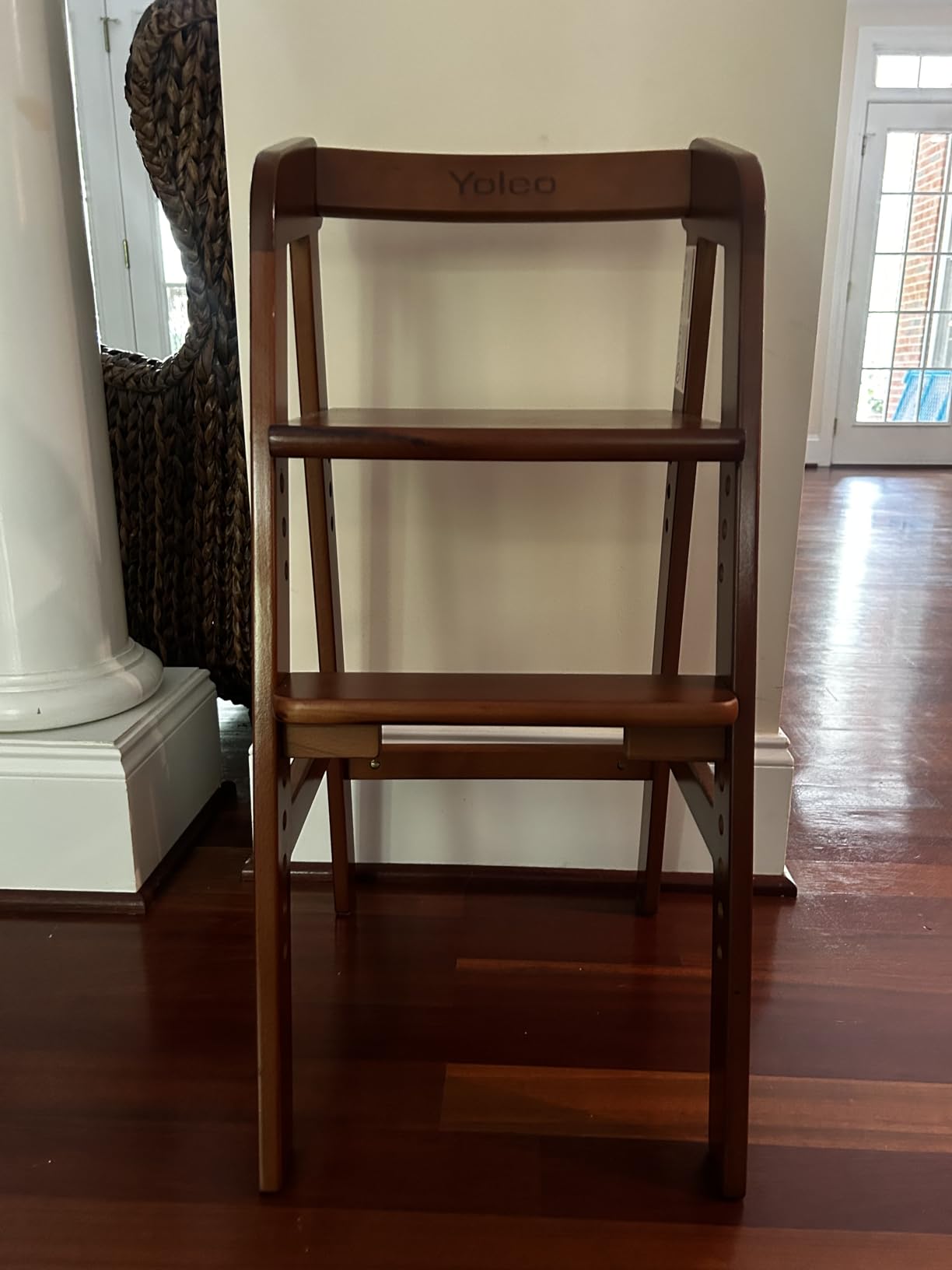
The design is a Japanese-originated arc-angle classic that preserves the natural wood texture, on a trapezoid-structure frame. Four seat heights and five footrest positions give more usable combinations than the two-position chairs in this roundup, and the cushion attaches with solid Velcro rather than a loose tie.
There are real limits. It is listed from age 2, so it is not a chair for starting solids, and its light weight is less reassuring with a small baby. Reviewers report the seat cushion sliding out of position, the chair tipping if a child pushes hard off the table while on a rug, and inconsistent joinery and finish quality at this price, including one report of an armrest joint unglued and paint flaking.
Check this before buying for a new walker
Measure your table clearance with the seat at its highest position, because a chair that only works at the lowest setting will not lift a 4-year-old to a standard table. The four positions are discrete, so test the top one before you commit.
Check your flooring. The tipping concern shows up on rugs, where the base can catch an edge. On hard flooring with the anti-slip in place the frame is steady, but on a thick rug this is not the chair for an active toddler who pushes off the table.
Who this chair is for
It is for a family past the weaning stage, with a toddler who climbs, a compact kitchen, and a need for one chair to cover eating, homework, and reaching high shelves. The multi-use step stool angle is genuinely useful in a small home.
It is not for starting solids at 6 months, and not for a household that wants one chair for two children from infancy. For a chair that begins at 6 months and keeps going, the Abiie Beyond covers that whole arc.
10. L.A. Baby Stackable: best wooden high chair for escape-artist toddlers
Wooden High Chair for Baby & Toddler – Restaurant-Style Stackable HighChair with Commercial Grade Solid Wood for Dining Table & Kitchen – Compact & Portable Design for Home & Restaurant Use -Natural
Commercial-grade natural solid hardwood
30 inch height with a 20 by 22.5 inch footprint
6 to 36 months
Meets or exceeds ASTM and CPSC standards
Pros
- Restaurant-style wide stance and 3-point harness contain an active toddler
- Stacks for compact storage in small spaces
- Easy to assemble in minutes and easy to wipe down
- 30 inch height fits standard 28 to 30 inch tables
- Compact 20 by 22.5 inch footprint
Cons
- Better suited to toddlers than infants
- Suited to regular tables not raised counters
- No adjustable seat height or recline
- Fixed tray with no removable cushion or footrest
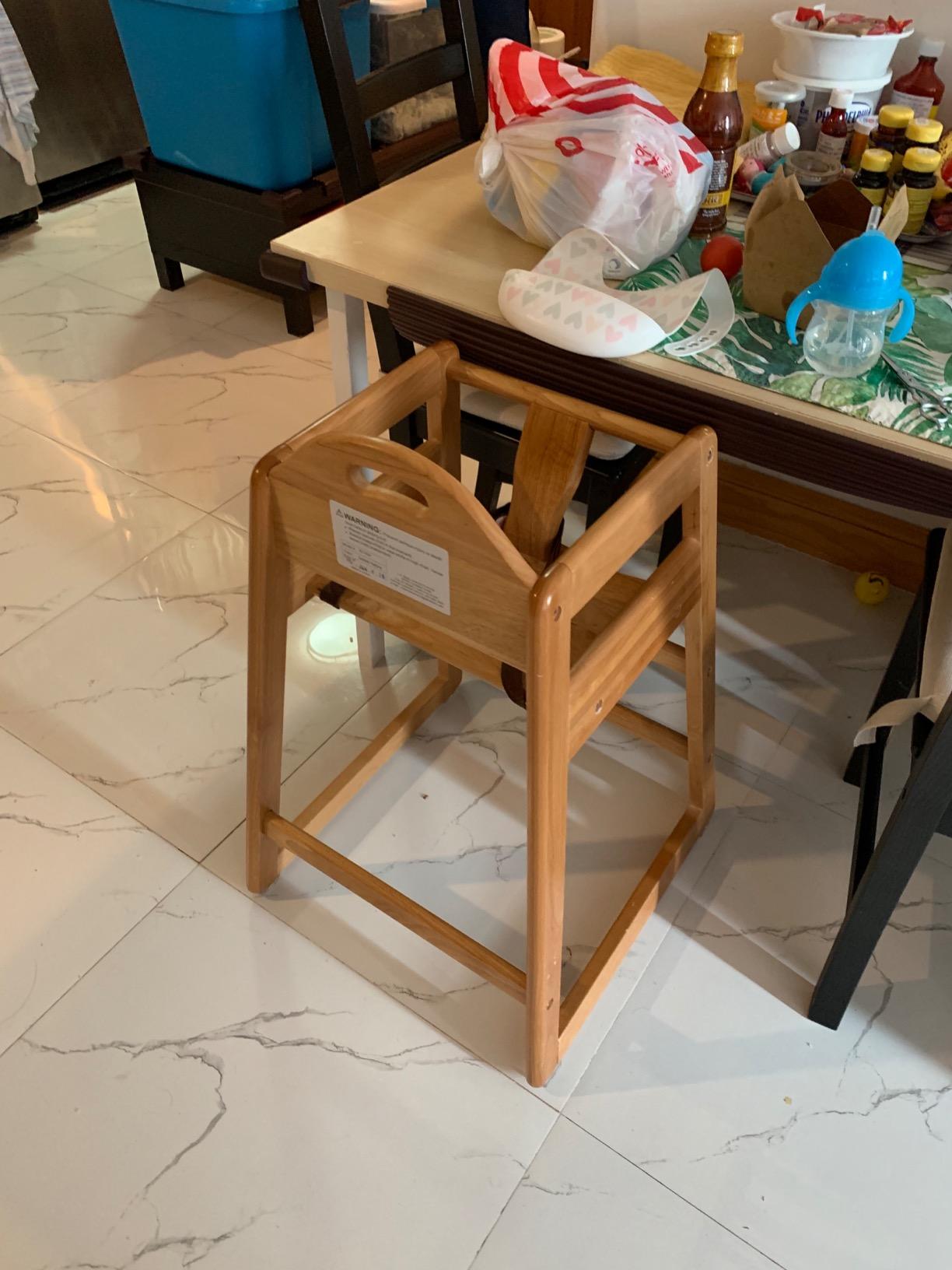
The L.A. Baby stackable chair solves a problem that none of the other nine solve: the toddler who climbs out of the tray. A 4.7 across 468 reviews with 86 percent five-star ratings puts it at the top of the rating range in this roundup, and the theme in the reviews is containment. Parents of active toddlers report that the restaurant-style wide stance and three-point harness hold a child where bulkier tray high chairs failed.
The commercial-grade solid hardwood build and the wide-stance design are borrowed from restaurant furniture, and that is not a gimmick. The chair meets or exceeds ASTM and CPSC safety standards, stands 30 inches tall to fit 28 to 30 inch tables, and has a 20 by 22.5 inch footprint that is smaller than most wooden high chairs.
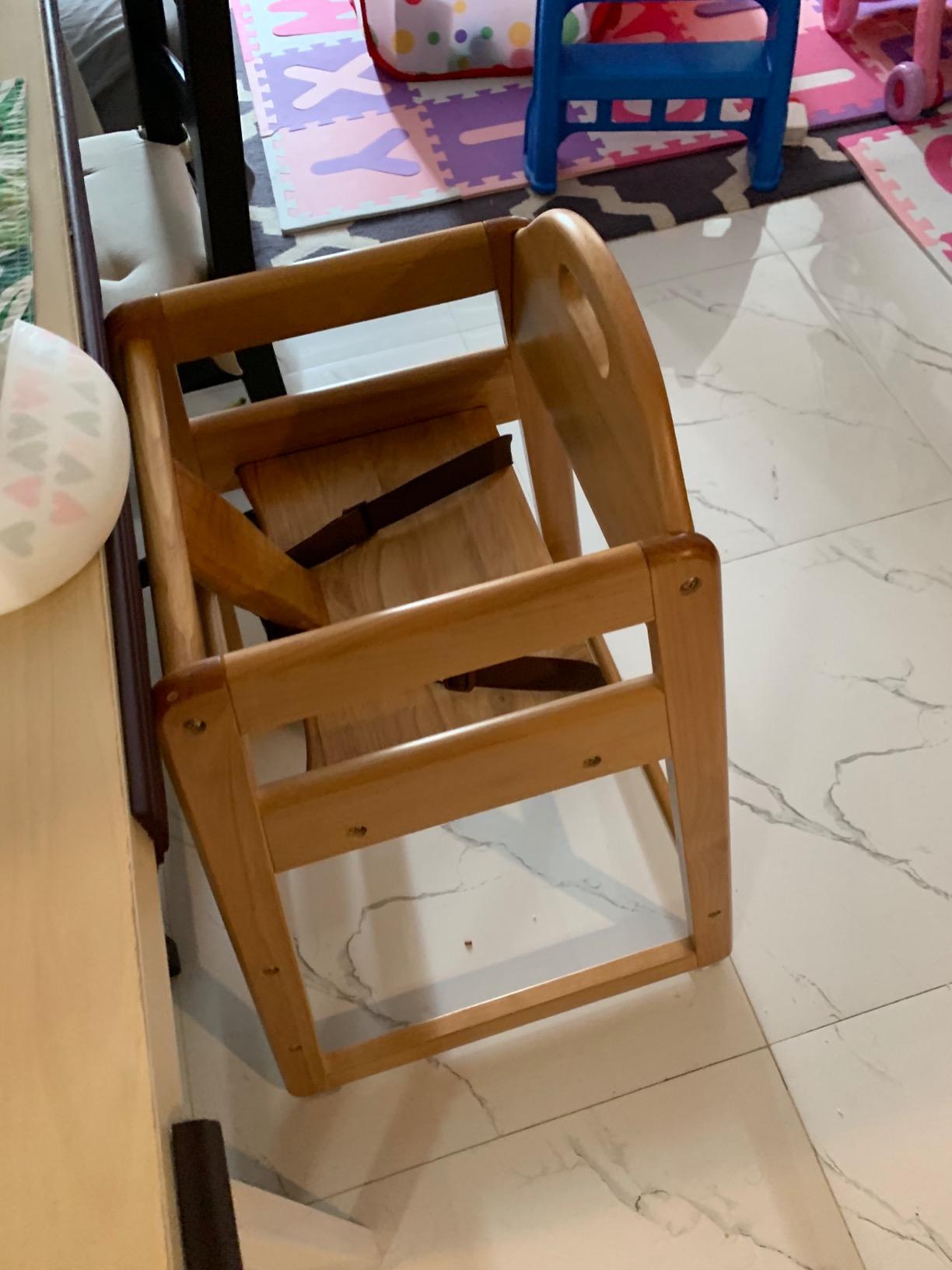
It stacks. Parents who bought several for a church hall or a classroom mention stacking as the first benefit, and for a family in a small apartment it is the difference between one chair and a chair you can actually put away. A built-in hand hold makes it easy to carry room to room, and it assembles in minutes with the included hardware.
Fit for age is the caveat that comes up repeatedly. It is repeatedly described as a toddler chair rather than an infant chair, and better suited to a regular dining table than a raised bar. There is no adjustable seat height, no recline, and a fixed tray with no removable cushion or footrest, so the 6 to 36 month range is real but with fewer positions than the convertibles.
How to test the fit for an active toddler
Measure the gap between your table and the wall or counter behind the chair. A wide-stance design needs clearance behind the seat, and in a tight kitchen a splayed base can hit the cabinet fronts when the child kicks.
Check the crotch bar width against your child’s thighs. The extra-wide solid wood crotch is the part doing the containing work, and a child who is chunky needs the bar to sit at the top of the thighs rather than across the belly.
Who should buy this chair
Buy it if you have a toddler who climbs, if you need storage, or if you want a second chair for a grandparent or a sitter. Reviewers describe it as a toddler chair and a commercial-grade piece of furniture rather than a nursery item, and that is exactly what some households need.
Do not buy it to start solids. There is no recline, no footrest, and no seat height adjustment, so a 6-month-old will sit badly. Start with the Abiie Beyond or the Keekaroo Height Right and treat this as the chair for year two onward.
How to Choose a Wooden High Chair
Check whether the wood is solid, veneered, or engineered
This is the single biggest source of confusion in this category, and no competitor we reviewed explains it. Four checks settle it in about a minute, standing at the product page or in a shop.
Look at the underside of the seat and the top of the legs. Solid wood shows continuous grain with no repeating pattern, and you may see small irregular knots. Veneer shows a repeating wood figure that lines up across a curved or flat surface, because a thin layer of real wood is glued to a cheaper core. Particle board or MDF has a raw brown fibre core visible at any cut edge, and the face is a printed paper laminate rather than wood at all.
Then check the weight, the finish, and the joints. Solid wood is noticeably heavier than a comparable engineered chair. A thin, glossy, evenly sprayed finish is more often a laminate over particle board, while a solid wood chair often shows a slightly textured or oiled surface. Finally, look at a joint where two parts meet: a visible end-grain face, a dowel, or a screw head with a washer means two real pieces of timber, and a bracket covering the whole joint usually means an engineered board behind a veneer skin.
For this roundup, the Abiie Beyond and the FORNEL are specified as solid wood, the Tripp Trapp and the Evolur Zoodle as beech, the YOLEO as solid beech, the L.A. Baby as commercial-grade solid hardwood, and the Keekaroo simply as wood. The rest are mixed material, with wood legs or a wood frame paired with a plastic tray.
The 90-90-90 rule for high chair setup
The 90-90-90 rule is the feeding-posture guideline that no competitor roundup we reviewed covers, even though it appears as a question in this search. It is simple: hips at roughly 90 degrees, knees at roughly 90 degrees, and ankles at roughly 90 degrees.
Applied to a high chair, the hips come from the seat being the right height, the knees from the footrest being the right height, and the ankles from the footrest supporting the feet flat rather than letting them dangle. A child who cannot brace their feet cannot sit upright for a full meal, tires early, and is harder to keep in the chair safely. If you take one thing from this guide, take this: a chair with no footrest is a chair your child will fight.
You can check your own setup in ten seconds. Sit the child in, place the tray so it meets around the navel, and look at the feet. If the soles are flat on the footrest, the setup is close to right. If the feet swing, the footrest is wrong for the chair or the child has outgrown the setting.
Match the chair to your table height
Standard dining tables sit around 29 to 30 inches, and a standard high chair puts the tray roughly level with that surface. A counter-height table is 35 to 36 inches, and a standard high chair simply will not reach it, which is the sizing problem that comes up again and again in parent forums. A parent who buys a standard chair for a raised bar ends up with a toddler eating from their lap.
So measure before you order. Sit a tape measure from the floor to the underside of your table, not the top, and compare it to the chair’s listed seat height. Chairs with an adjustable seat, like the Keekaroo Height Right, the Abiie Beyond and the Tripp Trapp, absorb more table variation than a fixed-height frame like the L.A. Baby or the Mallify. If you eat at a counter, skip the fixed-height chairs entirely.
Decide when to move up from a high chair
A 2-year-old can still legitimately use a high chair, particularly with a booster, because the useful question is foot support rather than age. Once a child’s feet cannot reach a footrest at any setting, the chair has done its job and continuing to use it means feeding a child who cannot brace. For most children the move happens between two and three, and it happens earlier in a chair with a short conversion range.
That is the argument for buying a convertible chair in the first place. If you plan a second child, a chair that reaches a youth chair or an adult spare seat, like the Tripp Trapp or the FORNEL, is cheaper than buying two. If this is your only child and your table is standard height, the Abiie Beyond’s conversion to a dining chair covers the same ground.
Are Wooden High Chairs Better Than Plastic?
Wooden high chairs are better on stability, cleaning, and lifespan, and worse on price, weight, and flexibility. The stability advantage is real: a solid wood frame does not tip when a toddler pushes off the table, which is exactly what reviewers of the Abiie and the L.A. Baby report. Cleaning is easier in a different way, because wood has no molded seams to trap crumbs, and a dishwasher-safe tray cover on a wood chair gets the same cleanup as a plastic one.
Lifespan is the strongest argument. A plastic high chair typically serves 12 to 18 months and then goes to a corner or a second child. A wood chair that converts can serve the same family through feeding, toddler, booster, and homework. The lifespan claim is well supported in the reviews of the Tripp Trapp, the Abiie Beyond, and the FORNEL, all of which have review bases large enough to make the pattern meaningful.
Where wood loses is on weight and accessories. A wood chair cannot be carried one-handed into a restaurant, and the premium names sell the newborn sets, baby sets, and trays separately, so the real cost at the register is higher than the headline. If you need a chair you can grab and go, or a chair that fits a raised counter, a different product type fits better. Our main [high chair roundup](https://www.wearesalt.org/best-high-chairs/) covers those formats.
How to Care for a Wooden High Chair
Wood care is simple if you do three things, and no competitor roundup we reviewed covers any of them. Wipe spills immediately with a damp cloth, because a finish that sits on water for hours can cloud or dull. Use a damp cloth with mild soap on the frame, and dry it straight away rather than leaving it to air in a damp spot.
Keep steam, dishwashers, and abrasive pads away from wood. The wood frame goes on a damp cloth, never in a dishwasher, and the only dishwasher-safe parts are the tray and tray cover, which are usually plastic. For the seat and back cushions, a damp cloth handles daily spills, and a removable cover that you can wash separately saves you from scrubbing foam.
Once a year, check the finish, the bolts, and the moving parts. Wipe the finish to see if it is drying out, tighten the frame bolts, and test the tray and harness adjustment under load. Any of the wood chairs here can be oiled with a food-safe furniture oil if the manufacturer allows it, which keeps water out of the grain and slows the drying you will eventually see around the tray edge.
Frequently Asked Questions
What is the best wooden high chair?
The Abiie Beyond Junior is the best wooden high chair for most families, rated 4.7 across more than 8,200 reviews. It is solid wood, converts from high chair to toddler chair to dining chair in under 20 seconds without tools, shifts from a five-point to a three-point harness, and is rated to 250 lbs. The Stokke Tripp Trapp is the better buy if you want one chair to last a decade or more, and the FORNEL Scandinavian is the better value if solid wood and a long conversion matter more than a premium brand name.
What is the 90-90-90 rule for high chairs?
The 90-90-90 rule is a feeding-posture guideline: hips, knees and ankles should each sit at roughly 90 degrees. In a high chair the hips come from the correct seat height, the knees from the footrest being set at the right height, and the ankles from the feet resting flat on the footrest. A child who cannot brace their feet cannot sit upright for a full meal and tires early, which is why a chair with an adjustable footrest is worth more than a chair with a fancier tray.
Should a 2 year old still be in a high chair?
A 2-year-old can still use a high chair, especially as a booster, and the deciding factor is foot support rather than age. Once a child’s feet cannot reach a footrest at any adjustment, the chair has done its job and feeding them from it means feeding a child who cannot brace. For most children the move to a toddler chair happens between two and three years old, and earlier in a chair with a short conversion range.
What is the best high chair for a toddler to sit at a table?
For a standard dining table, the Tripp Trapp and the Abiie Beyond are the strongest choices because both adjust the seat and footrest together, so hips, knees and ankles stay at 90 degrees as the child grows. For a counter-height table measuring 35 to 36 inches, a standard high chair will not reach the surface at all, so look for a chair with a long seat-height adjustment range or a different chair type entirely, such as a hook-on seat.
Are wooden high chairs good for babies?
Yes, and the main advantages over plastic are stability, cleaning and lifespan. A solid wood frame does not tip when a toddler pushes off the table, wood has no molded seams that trap crumbs, and a convertible wood chair can serve one child through feeding, toddler, booster and homework stages. The trade-offs are weight, since a wood chair cannot be carried one-handed, and accessory cost, because premium models often sell the newborn set, baby set or tray separately.
How do I know if a high chair is real wood?
Check four things. Look at the underside of the seat and the top of the legs for continuous grain with no repeating pattern, which indicates solid wood, while a repeating figure across a surface suggests veneer. Look at a cut edge for a raw brown fibre core, which means particle board or MDF. Lift it, because solid wood is noticeably heavier than an equivalent engineered chair. Finally, inspect a joint for a dowel, screw head or visible end grain, which means two real pieces of timber.
Do I need a footrest on a high chair?
Yes, and it is the most important feature on the chair. The footrest supports the child’s feet so they can brace, and bracing is what keeps hips, knees and ankles at 90 degrees for a stable seated posture during a full meal. A chair without a footrest, such as the L.A. Baby stackable or the Mallify 3-in-1, works as a short-term toddler seat but is a poor choice for a baby starting solids, because the child cannot support their own position.
Which Wooden High Chair Fits Your Household
Buy the Abiie Beyond if you want one chair for the whole feeding arc and you are starting at 6 months. Buy the Stokke Tripp Trapp if the plan is to hand the chair to a second child, or to still have it when they are a teenager. Buy the FORNEL if solid wood, a long conversion, and a mid-range outlay matter more to you than a brand name.
Buy the Mallify if your kitchen is small, the Keekaroo if you want a made-in-USA chair with a named certification and everything in the box, the Cowiewie if the all-wood tray is the deciding detail, the YOLEO if your child is past the weaning stage, and the L.A. Baby if your toddler climbs out of everything else. Measure your table first, in every case, and check whether the feet will reach a footrest.
We test and update these picks every year, so the [best wooden high chairs for toddlers](https://www.wearesalt.org/best-high-chairs-that-grow-with-baby/) list reflects what is actually in homes right now rather than what was fashionable when a chair launched.