
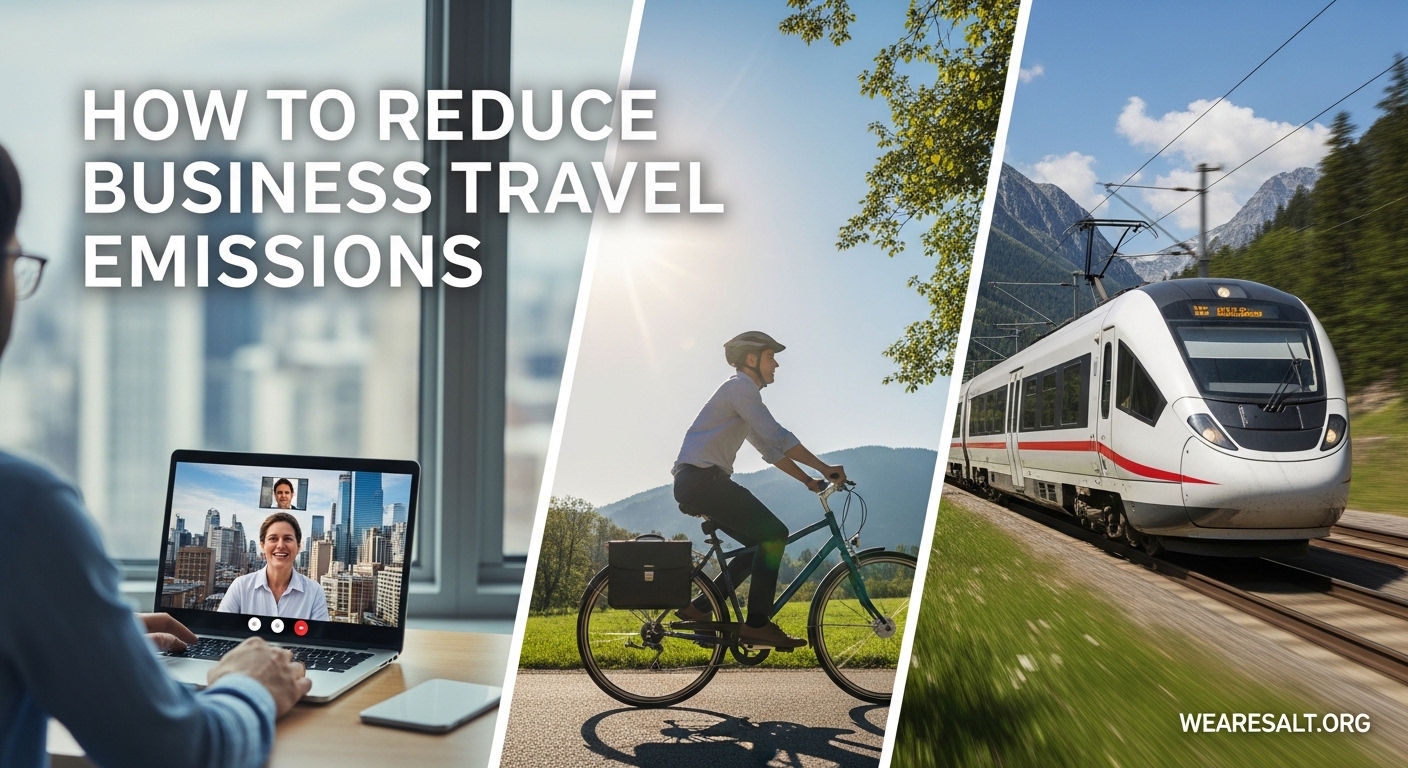
Business travel emissions represent one of the largest contributors to corporate carbon footprints. For many organizations, they account for up to 50% of total Scope 3 emissions. Yet most companies struggle to develop practical strategies for reducing this impact without disrupting operations.
Our team has worked with sustainability professionals across multiple industries to identify what actually works. This guide shares the seven-step framework that leading companies use to cut their travel emissions while maintaining business relationships and employee satisfaction. You will learn how to measure your current footprint, implement reduction strategies, and build a travel policy that supports your net-zero commitments.
Table of Contents
Understanding Business Travel Emissions and Scope 3
Business travel emissions fall under Scope 3 Category 6 of the GHG Protocol. These are indirect emissions that occur when employees travel for work purposes, including flights, ground transportation, and hotel stays. Unlike Scope 1 emissions from company vehicles or Scope 2 from purchased electricity, these activities happen outside your direct control but within your value chain.
The classification matters because Scope 3 emissions are increasingly subject to reporting requirements. The Corporate Sustainability Reporting Directive (CSRD) in Europe and similar regulations worldwide now mandate disclosure of business travel impacts. Companies with science-based targets must address these emissions to meet their commitments.
Typical business travel emissions vary dramatically by industry. Professional services firms, consulting companies, and multinational corporations often see travel represent 30-70% of their total carbon footprint. Even smaller businesses can face significant travel-related emissions if their work requires client visits or conference attendance.
Step 1: Measure and Establish Your Emissions Baseline
You cannot reduce what you do not measure. The first step in any emissions reduction program is establishing a reliable baseline that captures your current business travel footprint accurately.
Start by gathering data from your existing systems. Most companies already have the raw information needed in their travel management platforms, expense reports, and corporate credit card records. Extract details on trip frequency, destinations, transportation modes, and accommodation choices for at least the previous 12 months.
Next, apply standardized emission factors to convert travel activity into carbon dioxide equivalent (CO2e) values. Three main methodologies exist: DEFRA emission factors from the UK government, GATE4 methodology developed by travel industry experts, and TIM (Travel Intelligence Model) from BCD Travel. Each has strengths depending on your geographic footprint and reporting requirements.
Here is a practical example using real numbers. A consultant flying round-trip from London to New York generates approximately 1.8 tonnes of CO2e in economy class. The same journey in business class produces 5.4 tonnes due to the space allocation factor. A train journey from London to Paris creates just 0.002 tonnes per passenger.
Set up automated tracking systems to maintain ongoing visibility. Modern travel management platforms can integrate emissions calculators directly into the booking workflow. This enables real-time visibility rather than retrospective annual calculations.
Step 2: Apply the Avoid-Reduce-Compensate Hierarchy
Effective emissions reduction follows a clear hierarchy. The most impact comes from avoiding unnecessary travel entirely. Next, reduce emissions from essential trips through smarter choices. Only then should you consider offsetting unavoidable remaining emissions.
Avoid: Implement a virtual-first policy that requires justification for in-person meetings. Question every trip with three criteria: Could this be done virtually? Is the relationship or outcome worth the environmental cost? Has this meeting type been successfully held remotely before?
Reduce: When travel proves necessary, minimize its impact. Choose lower-carbon transportation modes, optimize routing, and consolidate trips. A train journey produces 90% less emissions than short-haul flights on comparable routes. Direct flights use less fuel than connections. Economy class spreads the carbon burden across more passengers.
Compensate: Offset remaining emissions through verified carbon reduction projects. However, treat offsetting as the final step, not a substitute for reduction. The Science Based Targets initiative emphasizes that in-sector reductions must come first.
Decision frameworks make this hierarchy operational. Create simple flowcharts that guide employees through these questions automatically. Many organizations find that 30-50% of previously routine trips can be eliminated through thoughtful application of these criteria.
Step 3: Implement Virtual Meeting Alternatives
Virtual meetings have matured dramatically since 2026. The technology now supports most business interactions that previously required physical presence. Understanding when and how to deploy virtual alternatives is key to effective travel reduction.
Certain meeting types work exceptionally well virtually. Status updates, routine project reviews, initial sales calls, and training sessions rarely benefit from in-person attendance. Our research shows these represent 60-70% of typical business trips. Converting them to virtual formats immediately cuts the bulk of travel emissions.
Relationship-building meetings require more nuance. First-time client meetings, complex negotiations, and team-building events often benefit from physical presence. However, consider hybrid approaches that reduce rather than eliminate travel. Send one representative instead of three. Meet centrally rather than having everyone fly to a single location.
Technology investments support this transition. High-quality video conferencing, collaborative digital whiteboards, and virtual presentation tools close the gap between remote and in-person experiences. The cost of these platforms is typically recovered within months through travel savings alone.
Step 4: Shift from Air to Rail Travel
Rail travel produces a fraction of the emissions of equivalent flights. On European routes under 500 kilometers, trains typically generate 90% less carbon dioxide per passenger. Even on longer journeys, the difference remains substantial.
Decision frameworks help identify rail opportunities. Routes under four hours by train almost always favor rail over flying when you factor in airport transit and security time. Major corridors like London-Paris, Paris-Frankfurt, Madrid-Barcelona, and New York-Washington offer compelling rail alternatives with city-center to city-center convenience.
Practical implementation requires policy changes. Mandate rail-first booking for eligible routes. Provide clear guidance on when rail is required versus preferred. Address the cost differential, as rail tickets sometimes exceed budget airfares, through adjusted expense policies that prioritize environmental outcomes.
Regional considerations matter. European rail networks offer extensive coverage and high-speed options. North American rail infrastructure presents more limitations, though the Northeast Corridor and select routes remain viable. Asian markets vary widely by country. Assess your specific geographic footprint when setting rail-first policies.
Step 5: Optimize Unavoidable Flights
When flying proves necessary, small choices compound into significant emissions differences. Optimizing flight selection can reduce per-trip emissions by 20-40% without changing your fundamental travel patterns.
Direct flights consistently outperform connections. Takeoff and landing consume disproportionate fuel, meaning two short flights generate more emissions than one longer direct flight. A connection through a hub airport can increase emissions 30-50% compared to the direct alternative.
Economy class seating reduces individual footprint substantially. Business and first-class seats occupy more space, meaning the flight’s total emissions get divided among fewer passengers. The carbon allocation factor for premium cabins ranges from 3x to 9x economy class depending on the aircraft configuration.
Aircraft type matters more than most travelers realize. Modern fuel-efficient planes like the Boeing 787 Dreamliner and Airbus A350 use significantly less fuel per passenger than older models. When booking tools display aircraft information, selecting newer planes cuts emissions.
Daytime flights offer slight advantages over red-eyes. Overnight flights often cruise at less optimal altitudes due to air traffic patterns, consuming marginally more fuel. The difference is small but adds up across hundreds of trips annually.
Step 6: Explore Sustainable Aviation Fuel Programs
Sustainable Aviation Fuel (SAF) represents the aviation industry’s primary path to decarbonization. Unlike traditional jet fuel derived from fossil sources, SAF comes from renewable feedstocks including waste oils, agricultural residues, and synthetic processes powered by renewable energy.
SAF reduces lifecycle emissions 80% compared to conventional fuel. However, supply constraints limit availability. Current global production covers less than 0.1% of aviation fuel demand. This scarcity means most companies cannot simply book flights powered by SAF.
The Book & Claim system solves this problem. Companies purchase SAF certificates that fund production and use, even if the actual fuel powers flights they are not on. This accounting system allows corporate buyers to claim SAF benefits and report Scope 3 reductions while the physical fuel goes to any aircraft that needs it.
Corporate SAF programs operate through aggregators and airline partnerships. Companies like SkyNRG, World Energy, and airline-specific programs offer options for businesses of various sizes. Entry points start around $50,000 annually, making SAF accessible to mid-market companies rather than just multinationals.
Cost premiums currently run 3-5x conventional fuel prices. However, as production scales and regulatory support increases, analysts project cost parity by 2035. Early adopters secure supply contracts and demonstrate commitment while helping build the market.
Step 7: Use Carbon Offsetting Strategically
Carbon offsetting remains controversial but serves a legitimate role when applied correctly. Offsets should be the final step after all reduction options are exhausted, not a license to continue high-emission travel patterns unchanged.
High-quality offsets meet specific criteria. They must be additional, meaning the carbon reduction would not happen without the offset purchase. They need permanence, ensuring stored carbon stays out of the atmosphere long-term. They require verification by independent standards like Gold Standard or Verified Carbon Standard.
Offset project types vary in credibility. Direct air capture and geological storage offer permanence but limited availability. Forestry projects face permanence risks from fires and disease but provide co-benefits. Clean cookstove and renewable energy projects deliver strong additionality stories.
Recommended providers include Atmosfair, myclimate, and Gold Standard certified projects. Prices range from $15-150 per tonne depending on project type and quality. Most business travel offsetting costs $20-50 per tonne at current market rates.
Integration with travel policy ensures strategic use. Some companies mandate offsets only for emissions exceeding reduction targets. Others include offset costs in travel budgets, making the environmental price visible to trip approvers. Transparent communication about offset limitations builds trust with employees concerned about greenwashing.
Building Your Sustainable Travel Policy
A written travel policy transforms good intentions into consistent practice. Clear guidelines remove decision fatigue and ensure all employees apply the same standards regardless of personal environmental convictions.
Key policy components include transportation hierarchies, approval workflows, and booking requirements. Specify which routes require rail travel. Set thresholds for virtual versus in-person meetings. Define who must approve high-emission trips like intercontinental flights.
Approval workflows add friction intentionally. Requiring manager sign-off for flights over certain distances or carbon thresholds forces conscious evaluation of necessity. Some companies implement carbon budgets per department or project, creating natural constraints that drive creative alternatives.
Employee engagement strategies determine policy success. Communicate the rationale behind restrictions. Share progress toward reduction targets. Recognize teams that find creative solutions. Address the tension between travel expectations and environmental values that many employees feel.
Sample policy language might read: “All business travel must be pre-approved through the sustainable travel assessment form. Rail travel is mandatory for routes under four hours where service exists. Intercontinental flights require director-level approval and carbon offset purchase. Virtual meetings are the default for routine check-ins and status updates.”
Making the Business Case for Travel Reduction
Sustainability benefits alone rarely secure budget and support for travel reduction programs. Building a comprehensive business case that addresses financial, operational, and strategic advantages ensures lasting commitment.
Cost savings provide the strongest immediate argument. Travel represents a significant operating expense for most companies. Reducing trip frequency 30% typically saves 25-40% of travel budgets after accounting for higher-quality virtual equipment and occasional rail premiums. These savings flow directly to the bottom line.
ESG compliance and regulatory positioning matter increasingly. Companies reporting under CSRD, SEC climate disclosure rules, or science-based targets must address travel emissions. Proactive programs demonstrate readiness and reduce compliance costs compared to rushed implementations under regulatory pressure.
Talent attraction and retention benefits often surprise program sponsors. Younger workers consistently rank environmental values high in employer preferences. Companies with credible sustainability programs report improved recruitment outcomes and employee satisfaction scores.
Risk management perspectives complete the case. Climate-related business disruption, reputational risks from perceived inaction, and stranded asset concerns all favor early emission reduction. Travel programs that anticipate regulation and social expectations position companies ahead of competitors.
Your Implementation Checklist
Use this checklist to guide your travel emissions reduction program from planning through execution. Check off items as you complete them to maintain momentum and ensure comprehensive coverage.
Phase 1: Assessment (Weeks 1-4)
- Gather 12 months of travel data from booking systems and expense reports
- Calculate baseline emissions using DEFRA or GATE4 factors
- Identify top 10 routes by emission volume
- Survey employees on travel patterns and attitudes
- Benchmark against industry peers if data available
Phase 2: Strategy Development (Weeks 5-8)
- Set reduction targets aligned with science-based commitments
- Define virtual-first criteria and exceptions
- Map rail-eligible routes for your common destinations
- Research SAF program options and offset providers
- Estimate cost savings and implementation budget
Phase 3: Policy Creation (Weeks 9-12)
- Draft travel policy with approval workflows
- Configure booking system with sustainability prompts
- Create employee communication materials
- Train managers on approval criteria
- Establish carbon tracking and reporting procedures
Phase 4: Launch and Optimization (Ongoing)
- Roll out policy with clear effective date
- Monitor compliance and emissions monthly
- Quarterly review of top routes for optimization opportunities
- Annual assessment of program effectiveness and target updates
- Continuous employee feedback collection
FAQ
How to reduce emissions from business travel?
To reduce business travel emissions, follow the avoid-reduce-compensate hierarchy. First, implement a virtual-first policy to avoid unnecessary trips. Second, shift eligible routes from air to rail travel and optimize unavoidable flights by choosing direct routes and economy class. Third, participate in Sustainable Aviation Fuel programs and purchase high-quality carbon offsets for remaining emissions.
What are scope 3 emissions from business travel?
Scope 3 Category 6 emissions from business travel are indirect greenhouse gas emissions generated when employees travel for work purposes. This includes flights, train journeys, rental cars, taxis, and hotel stays. Under the GHG Protocol, these are classified separately from direct operational emissions and often represent 30-50% of a company’s total carbon footprint.
How can a business reduce emissions?
Businesses can reduce travel emissions by establishing an emissions baseline, implementing a virtual-first meeting policy, mandating rail travel for short routes, optimizing flight choices, joining Sustainable Aviation Fuel programs, purchasing verified carbon offsets, and creating clear travel policies with approval workflows. Cost savings from reduced travel often fund these programs.
Do carbon offsets really work?
Carbon offsets work when they fund additional, permanent, verified carbon reduction projects that would not happen otherwise. High-quality offsets from certified providers like Gold Standard and Verified Carbon Standard deliver real impact. However, offsets should supplement in-sector reductions rather than replace them. Look for direct air capture, geological storage, or clean cookstove projects for strongest credibility.
Is train travel better than flying for business?
Train travel is significantly better than flying for emissions on comparable routes. Trains produce 90% less carbon dioxide than flights on routes under 500 kilometers. Even accounting for electricity generation emissions, rail travel offers dramatic reductions. Additionally, city-center to city-center convenience often makes trains faster than flying when airport transit time is included.
How to measure business travel carbon footprint?
Measure business travel carbon footprint by collecting trip data from booking systems and expense reports, then applying standardized emission factors. Use DEFRA emission factors for UK reporting, GATE4 methodology for international travel, or TIM for comprehensive programs. Multiply distance traveled by the appropriate factor for each transportation mode and accommodation type. Modern travel management platforms can automate this calculation.
What is sustainable aviation fuel?
Sustainable Aviation Fuel (SAF) is jet fuel made from renewable feedstocks rather than fossil petroleum. Sources include waste cooking oils, agricultural residues, municipal waste, and synthetic processes powered by renewable energy. SAF reduces lifecycle carbon emissions 80% compared to conventional fuel. Through Book & Claim systems, companies can purchase SAF certificates to claim reductions even when flying on conventional fuel.
How much does business travel contribute to climate change?
Business travel contributes significantly to corporate carbon footprints and global aviation emissions. For many companies, business travel represents 30-70% of total Scope 3 emissions. Globally, aviation accounts for approximately 2-3% of global carbon dioxide emissions, with business travel comprising a substantial portion of premium cabin demand that drives higher per-passenger emissions.
Reducing business travel emissions requires systematic action across multiple fronts. The strategies outlined in this guide have helped organizations cut their travel footprints 40-60% within two years while maintaining operational effectiveness and often reducing costs.
The key is starting with accurate measurement, then applying the avoid-reduce-compensate hierarchy rigorously. Virtual meetings eliminate emissions entirely. Rail travel and flight optimization cut them substantially. Sustainable Aviation Fuel and verified offsets address what remains. Together, these approaches support genuine progress toward net-zero commitments.
Your next step is clear. Begin with the assessment phase from the implementation checklist. Gather your travel data, calculate your baseline, and identify your highest-impact opportunities. The journey to sustainable business travel starts with a single trip replaced, a single policy implemented, a single employee engaged. Build momentum from there.