
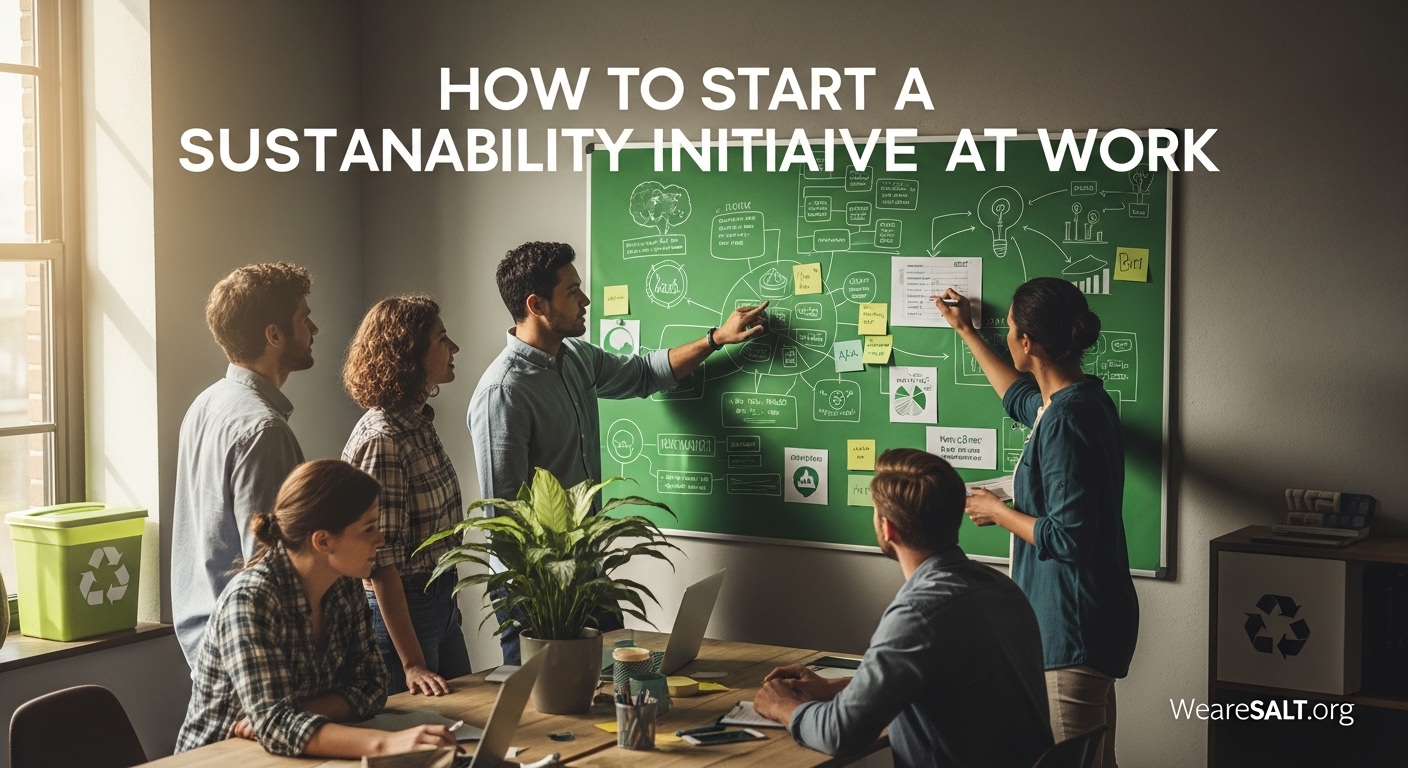
Starting a sustainability initiative at work can feel overwhelming, especially when you are not sure where to begin or how to get others on board. I have helped multiple teams launch green programs over the past five years, and I have learned that the most successful initiatives start small and build momentum over time.
This guide will walk you through exactly how to start a sustainability initiative at work, from building your initial business case to measuring long-term impact. Whether you are an employee passionate about reducing your office’s environmental footprint or a manager tasked with creating a corporate sustainability program, these six steps will give you a clear roadmap to follow.
Table of Contents
Why Start a Sustainability Initiative at Work
Workplace sustainability is not just good for the planet. It is good for business. Companies with strong sustainability programs report lower operating costs, higher employee retention rates, and improved brand reputation among customers and investors.
When we launched our first green initiative at my previous company, we cut energy costs by 23% within the first year. More importantly, employee satisfaction scores jumped 15 points. People wanted to work for a company that aligned with their values.
The business case is clear. Sustainability initiatives reduce waste, which lowers costs. They attract talent, especially among younger workers who prioritize environmental responsibility. They also future-proof your organization against rising energy prices and tightening environmental regulations.
How to Start a Sustainability Initiative at Work
The key to success is following a structured approach. Here is the six-step framework I recommend based on real-world experience and best practices from organizations like WWF and the EPA.
Step 1: Build Your Business Case and Get Executive Buy-In
Before you ask for resources or announce a new program, you need to answer one question for leadership: why should we care? The answer needs to be grounded in business value, not just environmental ideals.
Start by calculating potential cost savings. Look at your current energy bills, waste disposal costs, and printing expenses. Research shows that most offices can reduce energy costs by 10-30% through simple efficiency measures. That is real money back to the bottom line.
If you face resistance from executives, frame sustainability as risk management. Investors, customers, and regulators are increasingly demanding environmental accountability. Starting now gives you a competitive advantage and protects against future compliance costs.
Present your case with specific numbers. For example: “By reducing paper usage 50%, we can save $12,000 annually while cutting our carbon footprint by 8 metric tons.” Concrete projections are harder to dismiss than vague promises.
Step 2: Form a Green Team
Trying to drive sustainability alone is a recipe for burnout. You need a green team to share the workload and build broader buy-in across the organization.
Recruit members from different departments. Include someone from facilities or operations, someone from finance who can track costs, and representatives from various teams who can champion the initiative locally. Aim for 5-8 people for a small company, or 8-12 for larger organizations.
One insider tip from forum discussions: befriend your office manager. They control purchasing decisions, know where the waste bins are, and can implement changes faster than almost anyone else. Make them your ally from day one.
Schedule your first meeting to define roles and set ground rules. Who will lead communications? Who will track metrics? Who will liaise with leadership? Clear ownership prevents tasks from falling through cracks.
Step 3: Assess Your Current Environmental Impact
You cannot manage what you do not measure. Before setting targets, you need to understand your baseline.
Start with your carbon footprint. This includes Scope 1 emissions (direct emissions from sources you own, like company vehicles), Scope 2 emissions (indirect emissions from purchased electricity), and Scope 3 emissions (everything else in your value chain, like business travel and supply chain impacts).
For most offices, electricity and heating/cooling are the biggest contributors. Request 12 months of utility bills and calculate your total energy consumption in kilowatt-hours. Many utility companies offer free energy audits, which can identify quick wins like inefficient lighting or HVAC settings.
Conduct a waste assessment. Spend one day tracking what goes into your trash and recycling bins. You might be surprised how much recyclable material ends up in landfill because bins are poorly placed or labeled.
Free tools like the EPA’s Small Business Sustainability Toolkit or the WWF’s carbon calculator can help with this assessment even if you have no budget for consultants.
Step 4: Set SMART Sustainability Targets
Now that you know where you stand, set targets that are Specific, Measurable, Achievable, Relevant, and Time-bound.
Vague goals like “reduce waste” fail because no one knows what success looks like. Instead, commit to specific targets: “Reduce paper usage by 40% within 12 months” or “Cut energy consumption 15% by Q4 of 2026.”
Science-based targets provide a credible framework. These are goals aligned with what climate science says is necessary to limit global warming. For most offices, this means aiming for carbon neutrality by 2050 at the latest, with significant reductions by 2030.
Balance quick wins with stretch goals. Quick wins build momentum and prove the program works. Stretch goals keep the team ambitious. A good mix might be: 50% of targets achievable within six months, 30% within a year, and 20% as three-year goals.
Step 5: Implement Quick Wins First
The fastest way to kill momentum is to start with expensive, complex projects that take months to show results. Instead, focus on quick wins that require minimal budget but deliver visible impact.
Remember the 5 R’s of sustainability: Refuse, Reduce, Reuse, Repurpose, and Recycle. Apply them in order of priority. Refusing unnecessary items (like single-use plastics) has more impact than recycling them after use.
Here are proven quick wins organized by category:
Energy Efficiency:
- Switch to LED bulbs (75% less energy than incandescent)
- Set computers to sleep mode after 15 minutes of inactivity
- Adjust thermostats 2-3 degrees (warmer in summer, cooler in winter)
- Use natural light when possible
Waste Reduction:
- Go paperless for meetings (digital agendas and notes)
- Set printers to double-sided by default
- Remove individual desk trash bins (centralized bins increase recycling rates)
- Replace disposable kitchen items with reusables
Sustainable Procurement:
- Buy FSC-certified paper products
- Choose suppliers with environmental certifications
- Purchase energy-efficient equipment (look for ENERGY STAR labels)
- Buy in bulk to reduce packaging waste
Transportation:
- Start a bike-to-work program with secure storage
- Offer public transit incentives or subsidies
- Implement carpool matching
- Reduce business travel when video conferencing works
Remote/Hybrid Considerations:
- Offer home energy audits for remote workers
- Subsidize home office energy-efficient equipment
- Track and offset home office emissions
- Encourage virtual meetings over in-person when possible
Step 6: Measure Progress and Communicate Results
What gets measured gets managed. Set up a simple dashboard tracking your key metrics: energy consumption, waste diversion rates, paper usage, and transportation emissions.
Review progress monthly with your green team and quarterly with leadership. Celebrate wins publicly. When you hit your first target, announce it company-wide. Recognition reinforces behavior and keeps the initiative visible.
Share success stories, not just numbers. “Sarah’s team reduced printing 60% by switching to digital workflows” is more compelling than “Company printing down 12%.” Personal stories inspire action.
Be transparent about challenges too. If you miss a target, explain why and what you are doing differently. Authenticity builds trust more than pretending everything is perfect.
Sustainability Ideas for Office: Your Quick Reference Guide
Here is a categorized list of sustainability initiatives you can implement, organized by effort level and impact.
Easy Wins (Low effort, immediate impact):
- LED bulb replacement
- Power strip management (turn off at night)
- Digital document sharing
- Reusable coffee mugs and water bottles
- Proper recycling bin labeling
Moderate Effort (Medium investment, lasting returns):
- Smart thermostats and lighting controls
- Water filtration instead of bottled water
- Sustainable vendor evaluation and switching
- Employee sustainability challenges
- Bike storage and shower facilities
Long-Term Projects (Higher investment, transformative impact):
- Solar panel installation
- Electric vehicle charging stations
- Office composting program
- Carbon offsetting programs
- ISO 14001 environmental certification
Common Challenges and How to Overcome Them
Even the best-planned initiatives face obstacles. Here is how to handle the most common ones based on real experiences from sustainability forums and practitioners.
Challenge: Skeptical Employees
Some people will view your initiative as corporate greenwashing or an unnecessary hassle. Address this by starting with changes that make their lives easier, not harder. Digital documents are more convenient than printing. Bike programs save money on gas. Frame benefits in personal terms, not just environmental ones.
Challenge: Limited Budget
Many sustainability measures actually save money. Start with cost-neutral or cost-saving initiatives. Energy efficiency reduces bills. Going paperless reduces supply costs. Use these savings to fund bigger investments later.
Challenge: Sustaining Momentum
Initial enthusiasm fades. Combat this by making sustainability social and fun. Run challenges with prizes. Share team achievements. Rotate green team membership to bring in fresh energy. Celebrate anniversaries of your program.
Challenge: Remote Team Participation
Hybrid and remote work makes traditional office sustainability harder. Adapt by focusing on digital collaboration tools, home office energy tips, and virtual engagement. Include remote workers in green team meetings and recognize their contributions.
FAQ
What are the 5 C’s of sustainability?
The 5 C’s of sustainability are Consciousness (awareness of impact), Conservation (reducing resource use), Community (engaging stakeholders), Culture (embedding sustainability in values), and Commerce (creating economic value). These principles guide organizations to integrate sustainability across all business dimensions.
What is an example of a sustainability initiative?
A common example is implementing a paperless office policy, which reduces paper consumption, printing costs, and storage needs while improving document accessibility. Other examples include installing LED lighting (cutting energy use 75%), starting a bike-to-work program, switching to renewable energy providers, or establishing a comprehensive recycling and composting program.
What are the 5 R’s of sustainability?
The 5 R’s are Refuse (avoid unnecessary items), Reduce (minimize consumption), Reuse (extend product life), Repurpose (find new uses), and Recycle (process materials into new products). They should be applied in this order of priority, with Refuse having the greatest environmental impact and Recycle being the last resort.
What are the 4 pillars of sustainability?
The 4 pillars are Environmental (protecting ecosystems and natural resources), Economic (maintaining profitability and economic viability), Social (ensuring equity and community wellbeing), and Cultural (preserving traditions and values). A truly sustainable initiative addresses all four dimensions rather than focusing only on environmental concerns.
How can we be more sustainable at work?
Start with an energy audit to identify waste, form a green team to share the workload, set measurable targets like reducing paper 50% or cutting energy 20%, implement quick wins like LED bulbs and digital documents, engage employees through challenges and education, and track progress monthly. Focus on changes that are easy to adopt and deliver visible benefits.
What are easy sustainability initiatives?
Easy initiatives include switching to LED lighting, setting computers to sleep mode, going paperless for meetings, providing reusable kitchenware instead of disposables, adding recycling bins next to every trash can, adjusting thermostats 2-3 degrees, buying FSC-certified products, and encouraging video calls instead of business travel. These require minimal investment but deliver immediate environmental and cost benefits.
Conclusion: Start Your Sustainability Initiative Today
Learning how to start a sustainability initiative at work does not require a massive budget or executive decree. It requires one motivated person willing to build a business case, recruit a small team, and take the first step.
Start with Step 1 this week. Calculate one area of potential savings. Talk to one colleague who might join your green team. Schedule one meeting with your office manager. Small actions compound into significant change.
The companies that will thrive in 2026 and beyond are those that embed sustainability into their operations today. Your initiative, however small it starts, positions your organization for that future while delivering immediate benefits to your bottom line, your team, and the planet.