
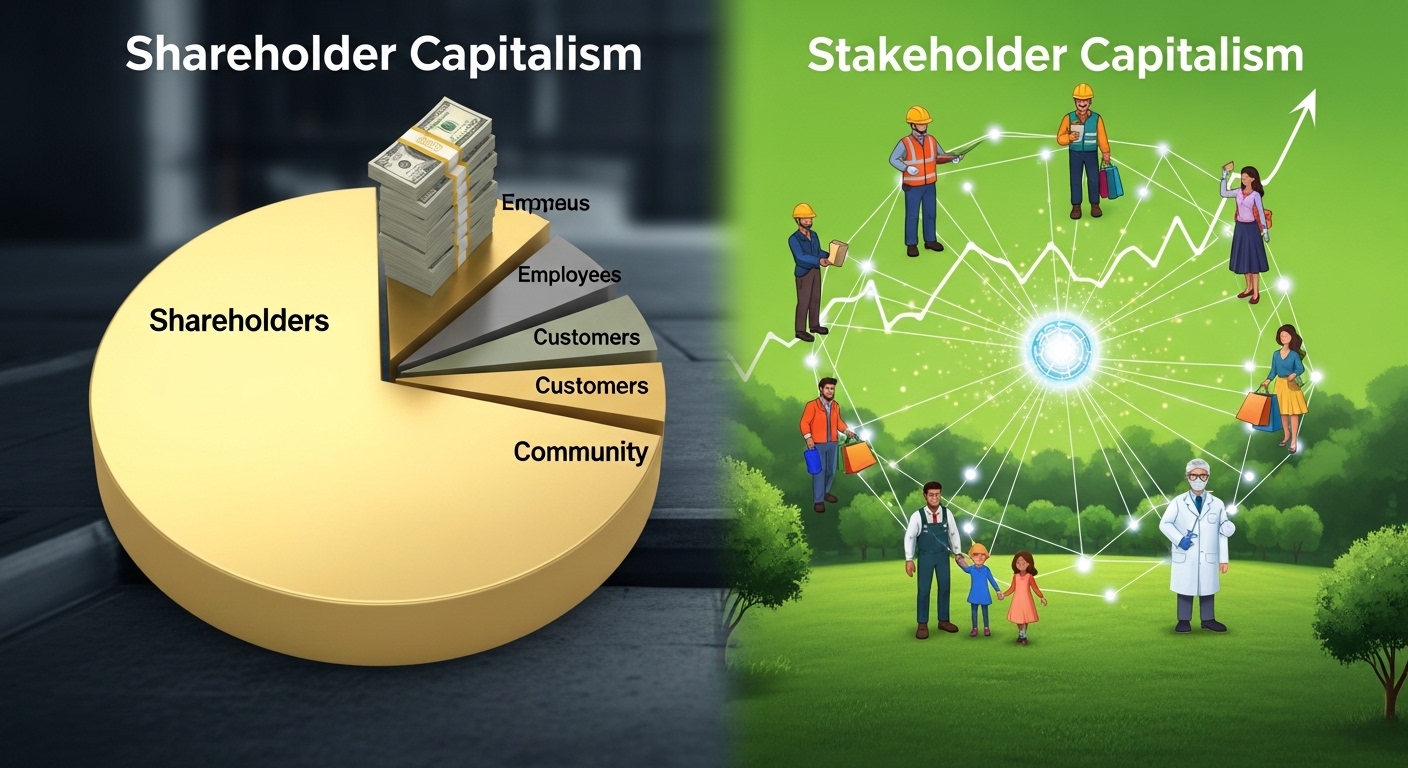
Shareholder vs stakeholder capitalism represents one of the most significant debates in modern business. Shareholder capitalism prioritizes maximizing profits for investors, while stakeholder capitalism serves the interests of employees, customers, communities, and the environment alongside shareholders.
Understanding this distinction matters more than ever in 2026. The way companies allocate resources, treat workers, and engage with communities depends on which model they follow. This guide breaks down both approaches, their histories, and what the shift means for business today.
Table of Contents
What Is Shareholder Capitalism
Shareholder capitalism is an economic model where corporations focus primarily on maximizing returns for their shareholders. Under this system, a company’s primary obligation is to increase share price and deliver dividends to investors who own stock.
This philosophy gained dominance through economist Milton Friedman’s influential 1970 essay. Friedman argued that the sole social responsibility of business is to increase its profits within legal and ethical boundaries. This became known as shareholder primacy.
The model rewards short-term financial performance. Executive compensation often ties directly to stock price movement. This creates incentives for quarterly profit maximization, cost-cutting, and rapid returns rather than long-term investment.
What Is Stakeholder Capitalism
Stakeholder capitalism is an approach where companies serve the interests of all stakeholders, not just shareholders. Stakeholders include employees, customers, suppliers, communities, and the environment alongside equity owners.
This model emphasizes long-term value creation over short-term profit extraction. Companies practicing stakeholder capitalism invest in worker training, fair wages, sustainable practices, and community development. They measure success through metrics beyond pure financial returns.
The concept connects closely to ESG investing and corporate social responsibility. Environmental, social, and governance factors become central to business strategy. The goal is building sustainable enterprises that create value for society while remaining profitable.
Shareholder vs Stakeholder Capitalism: Key Differences
The two models differ fundamentally in purpose, time horizon, and success metrics. Understanding these distinctions helps explain why companies make different strategic choices.
| Aspect | Shareholder Capitalism | Stakeholder Capitalism |
|---|---|---|
| Primary Goal | Maximize shareholder returns | Balance interests of all stakeholders |
| Time Horizon | Short-term, quarterly focus | Long-term sustainability |
| Success Metrics | Stock price, EPS, dividends | ESG scores, employee satisfaction, community impact |
| Decision Framework | What maximizes profit? | What serves all stakeholders? |
| Executive Incentives | Stock options, bonuses tied to share price | Balanced metrics including non-financial outcomes |
| Externalities | Often externalized (pollution, inequality) | Internalized and addressed |
The most critical difference lies in who counts. Shareholder capitalism treats shareholders as the only constituency with moral claim on corporate decisions. Stakeholder capitalism recognizes multiple legitimate interests that must be balanced.
This distinction affects everything from CEO pay ratios to environmental practices. Under pure shareholder capitalism, pollution is acceptable if fines cost less than prevention. Under stakeholder capitalism, environmental harm matters regardless of regulatory cost.
Historical Evolution and the 2019 Shift
The Friedman Era (1970-2010s)
Milton Friedman’s doctrine dominated American business for nearly five decades. His 1970 New York Times article declared that corporate executives have no right to spend shareholder money on social causes. This philosophy shaped business school curricula, corporate governance standards, and executive compensation structures.
The shareholder primacy model produced remarkable wealth creation. Stock markets soared. Innovation accelerated. However, critics argue it also contributed to rising inequality, environmental degradation, and corporate scandals driven by short-term thinking.
The Business Roundtable Statement (2019)
A watershed moment occurred in August 2019. The Business Roundtable, representing America’s largest corporations, released a new Statement on the Purpose of a Corporation. For the first time since 1997, they explicitly rejected shareholder primacy as the sole corporate purpose.
181 CEOs signed the statement committing to deliver value to all stakeholders. Signatories included Jamie Dimon of JPMorgan Chase, Brian Moynihan of Bank of America, and Satya Nadella of Microsoft. The statement acknowledged that businesses exist to serve customers, invest in employees, deal fairly with suppliers, and support communities.
The World Economic Forum and Klaus Schwab
Klaus Schwab, founder of the World Economic Forum, emerged as a leading advocate for stakeholder capitalism. His book “Stakeholder Capitalism: A Global Economy that Works for Progress, People and Planet” articulates the vision for systemic change.
At Davos 2026, stakeholder capitalism remained a central theme. The World Economic Forum continues promoting metrics that measure progress beyond GDP and stock market indices. Their International Business Council works on developing common ESG reporting standards.
Pros and Cons of Shareholder Capitalism
Advantages
Clear accountability. Shareholder capitalism offers unambiguous success metrics. Stock price and dividends provide objective measures of performance. This clarity helps investors allocate capital efficiently.
Innovation incentives. The profit motive drives competition and innovation. Companies must continuously improve products and reduce costs to outperform rivals. This dynamic creates wealth and technological advancement.
Capital efficiency. When companies focus solely on returns, capital flows to the most productive uses. Poorly performing companies face pressure to improve or be replaced by more efficient competitors.
Disadvantages
Short-term thinking. Quarterly earnings pressure discourages long-term investments in research, worker training, and sustainable practices. Companies may cut costs in ways that hurt future competitiveness.
Externalized costs. Environmental damage, community displacement, and worker exploitation become acceptable if they boost profits. Society bears costs that companies do not pay.
Inequality acceleration. Executive compensation exploded under shareholder capitalism while wage growth stagnated for many workers. The CEO-to-worker pay ratio reached 344-to-1 at S&P 500 companies.
Pros and Cons of Stakeholder Capitalism
Advantages
Long-term stability. Companies investing in employees, communities, and sustainable practices build durable competitive advantages. Loyal workers and satisfied customers create lasting value.
Risk mitigation. Addressing environmental and social risks before they become crises prevents costly scandals, regulatory battles, and reputational damage.
Broader prosperity. When companies share success with workers and communities, wealth distributes more widely. This creates healthier markets and more stable societies.
Disadvantages
Measurement complexity. Unlike stock price, stakeholder outcomes resist simple quantification. How do you precisely measure community wellbeing or environmental restoration?
Accountability challenges. Serving multiple stakeholders creates conflicting demands. Trade-offs become subjective without clear metrics for prioritization.
Greenwashing risk. Skeptics note that stakeholder rhetoric often masks business as usual. Companies may adopt stakeholder language without meaningful operational changes. This concern, raised frequently in forum discussions, highlights the gap between stated values and verified practice.
Real-World Examples in 2026
Stakeholder-Centered Companies
Patagonia exemplifies stakeholder capitalism in practice. The outdoor apparel company donates 1% of sales to environmental causes, provides fair wages throughout its supply chain, and recently transferred ownership to a trust dedicated to fighting climate change.
Ben & Jerry’s maintains living wage standards, sources ingredients from fair-trade suppliers, and engages actively in social advocacy. Their parent company Unilever has faced tension balancing these values with profit expectations.
Microsoft under Satya Nadella emphasizes employee wellbeing, carbon negativity goals, and accessibility initiatives. Their stakeholder commitments include $20 billion for affordable housing in communities where they operate.
Traditional Shareholder-Focused Companies
Private equity firms typically represent pure shareholder capitalism. Portfolio companies face intense pressure for rapid returns through cost reduction, debt loading, and asset sales. The priority is exit valuation.
Many legacy retailers followed shareholder primacy to bankruptcy. Short-term cost-cutting reduced investment in stores and e-commerce, ceding market share to competitors who prioritized customer experience.
The Hybrid Reality
Most large companies today exist somewhere between the two models. Even companies that signed the Business Roundtable statement continue facing pressure from activist investors focused on short-term returns. True stakeholder capitalism requires more than signed statements; it requires structural changes in governance, compensation, and reporting.
Frequently Asked Questions
What is shareholder capitalism vs. stakeholder capitalism?
Shareholder capitalism focuses on maximizing profits and returns for shareholders as the primary corporate purpose. Stakeholder capitalism serves the interests of all stakeholders including employees, customers, communities, and the environment alongside shareholders. The key distinction is who corporate decisions aim to benefit most.
Is there any difference between stakeholder and shareholder?
Yes. A shareholder owns stock in a company and has financial rights to profits. A stakeholder is anyone affected by company operations, including employees, customers, suppliers, communities, and the environment. All shareholders are stakeholders, but not all stakeholders are shareholders.
Why did stakeholder capitalism fail?
Stakeholder capitalism has not failed entirely, but early attempts in the 1950s-1970s lost momentum to shareholder primacy. Critics argue it struggles with measurement challenges, accountability conflicts, and greenwashing where companies adopt stakeholder language without operational changes. However, the 2019 Business Roundtable shift and growing ESG investing suggest renewed momentum.
What are the 4 types of stakeholder capitalism?
Stakeholder groups are typically categorized as: (1) Internal stakeholders – employees, managers, and owners, (2) Economic stakeholders – suppliers, creditors, and shareholders, (3) Social stakeholders – customers and communities, (4) Environmental stakeholders – the natural environment and future generations affected by corporate activities.
Conclusion
Shareholder vs stakeholder capitalism represents a fundamental choice about the purpose of business. The shareholder model drove remarkable wealth creation but also contributed to inequality and environmental challenges. The stakeholder model promises broader prosperity but requires solving difficult measurement and accountability questions.
The 2019 Business Roundtable statement marked a symbolic turning point, though real transformation requires structural changes in how companies measure success and compensate leaders. As investors, workers, and consumers increasingly demand responsible business practices, the balance continues shifting toward serving all stakeholders in 2026 and beyond.