
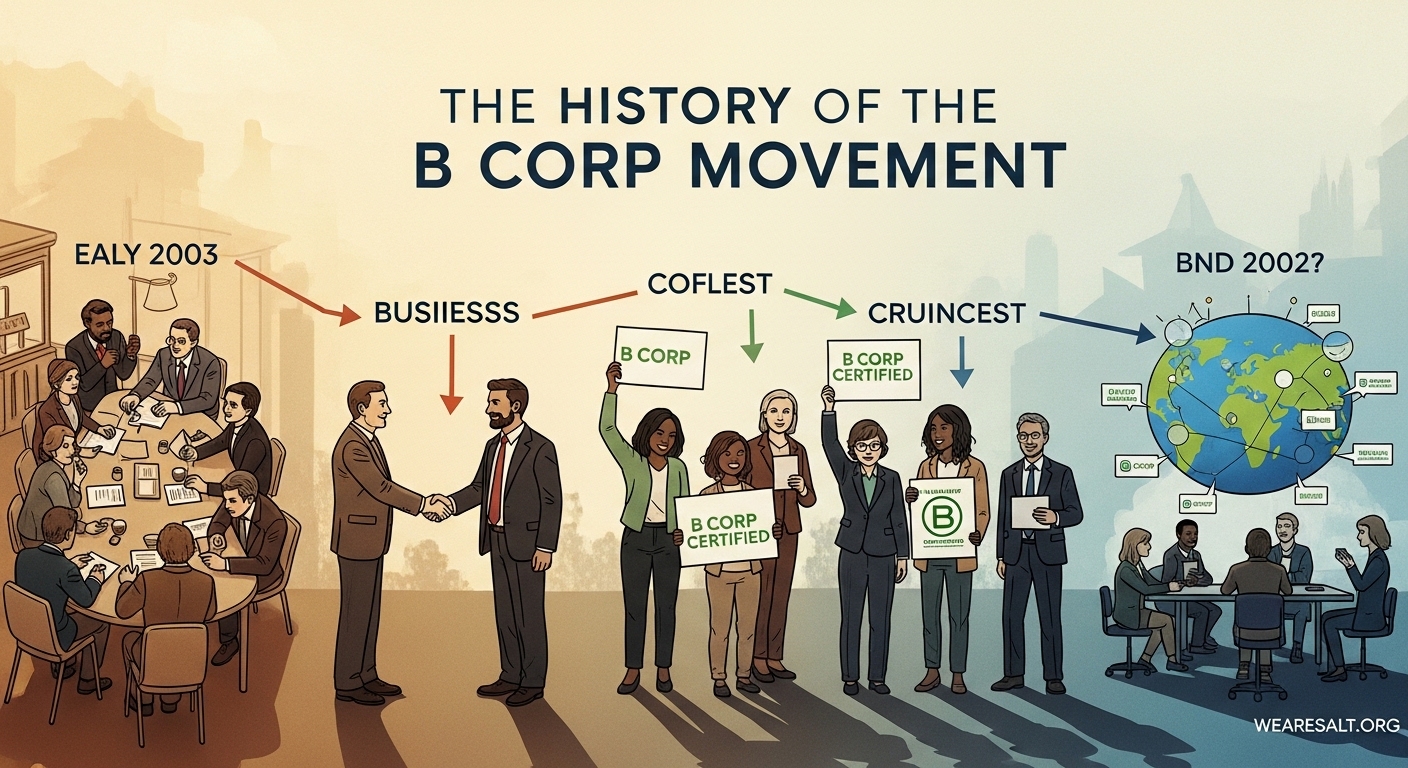
The B Corp movement started in 2006 when three entrepreneurs founded B Lab, a nonprofit organization dedicated to making business a force for good. Jay Coen Gilbert, Bart Houlahan, and Andrew Kassoy created B Lab to certify companies meeting high standards of social and environmental performance. Today, more than 9,500 companies across 102 countries hold Certified B Corporation status, representing one of the most significant shifts in corporate purpose since the industrial revolution.
This article traces how a small idea born from a sports apparel company grew into a global movement reshaping what we expect from business. I will walk you through the founding story, the certification framework, key milestones, international expansion, and the controversies that have emerged along the way.
Table of Contents
The Founding Story: From AND1 to B Lab
The story of the B Corp movement begins not in a boardroom but on basketball courts across America. The three founders, Jay Coen Gilbert, Bart Houlahan, and Andrew Kassoy, first worked together at AND1, a basketball apparel company they helped grow into a $100 million business. AND1 was different from typical companies. It embraced the triple bottom line philosophy, measuring success not just by profit but by how its business practices affected people and the planet.
The AND1 Origins
What made AND1 unusual was its stakeholder-first approach at a time when shareholder primacy dominated corporate thinking. The company paid living wages, sourced sustainable materials, and used its platform to promote social causes. When Gilbert, Houlahan, and Kassoy sold AND1 in 2005, they had a choice. They could have pursued traditional business ventures or investments. Instead, they asked a different question.
“Why can’t business be a force for good?” That question, simple yet revolutionary, led them to notice a gap in capitalism. Many companies claimed to care about social responsibility, but there was no standard way to verify those claims. No third-party certification existed to separate genuine commitment from marketing spin. The founders saw an opportunity to create exactly what was missing.
Three Founders, One Vision
Gilbert, Houlahan, and Kassoy each brought different strengths to the venture. Gilbert had the business acumen. Houlahan understood operations and scaling. Kassoy came from finance and investing. Together, they founded B Lab in 2006 with a modest $1 million in seed funding from the Skoll Foundation and individual donors who shared their vision.
Their early headquarters in Philadelphia represented their values. B Lab operated as a nonprofit, which meant it could prioritize mission over profit. The founders believed that only by removing the pressure of shareholder returns could they build a certification system people would trust.
B Lab and the B Corp Certification Framework
What is B Lab?
B Lab is the nonprofit organization that governs the B Corp certification program. Based in Philadelphia but operating globally through a network of partner organizations, B Lab’s mission is to transform the economy so all business serves all people and planet. It is not a regulatory body. It is a certification agency that provides the assessment tools and verification processes companies need to demonstrate their social and environmental performance.
Since its founding, B Lab has grown into a global network with regional offices on six continents. The organization develops the B Impact Assessment, administers the certification process, and maintains the publicly available directory of Certified B Corporations. B Lab also advocates for policies that support stakeholder governance, including the Better Business Act campaign in the United Kingdom.
What is a Certified B Corporation?
A Certified B Corporation is a for-profit company that has been verified by B Lab for its social and environmental performance. Unlike traditional corporations that are legally bound to maximize shareholder value, Certified B Corps must amend their governance documents to consider the interests of all stakeholders: workers, community, environment, and customers. This legal accountability distinguishes B Corps from companies that simply donate to charity or publish sustainability reports.
When a company becomes Certified B Corp, it joins a community of businesses that have committed to using business as a force for good. The certification is not a one-time achievement. Certified B Corps must re-certify every three years, ensuring they maintain the standards that earned their certification in the first place.
The B Impact Assessment Explained
The B Impact Assessment is the cornerstone of the certification process. It evaluates how a company’s operations affect five key areas: governance, workers, community, environment, and customers. Companies answer a detailed questionnaire covering policies, practices, and outcomes across these categories.
The assessment awards points based on responses, with a minimum of 80 points out of 200 possible required for certification. This threshold sounds modest, but it represents significant commitment. The average business scores around 50 points. Companies scoring above 80 have demonstrated that social and environmental considerations are embedded in their decision-making processes, not treated as afterthoughts.
The Five Pillars of B Corp Certification
The B Impact Assessment measures performance across five distinct impact areas. Understanding these pillars clarifies what B Corp certification actually requires and why it matters.
Governance
The governance pillar examines how a company accounts for its social impact. This includes board composition, executive compensation linked to social metrics, and transparency about business practices. Companies must demonstrate that they have structures in place to ensure accountability to all stakeholders, not just shareholders.
Workers
Worker-focused criteria look at compensation, benefits, retirement plans, and workplace culture. B Corp certification requires companies to treat workers fairly regardless of their role. This includes living wages, health benefits, profit-sharing, and opportunities for skill development. Companies must also demonstrate that they do not discriminate and that they foster inclusive workplace environments.
Community
Community impact assessment covers how a company engages with its local area and broader society. This includes charitable giving, volunteer programs, supplier relationships, and whether the company is locally owned. It also examines practices around diversity, equity, and inclusion in hiring and contracting.
Environment
Environmental criteria evaluate a company’s ecological footprint. This covers energy use, emissions, waste management, water consumption, and materials sourcing. B Corp certification requires companies to measure and reduce their environmental impact across their entire supply chain, not just their direct operations.
Customers
The customers pillar focuses on product safety, data privacy, and whether a company’s products or services genuinely serve customers’ wellbeing. Companies cannot earn B Corp status by marketing harmful products responsibly. The assessment examines whether a company’s core offerings align with its stated social mission.
Growth and Milestones: From 82 to 9,500+ Companies
The first Certified B Corps received their credentials in 2007. Twelve companies formed that initial cohort, attracted by the promise of third-party verification and access to a community of like-minded businesses. By the end of that year, 82 companies had achieved certification. The movement had begun.
Early Growth (2007-2012)
The early years attracted companies that identified strongly with the stakeholder-first ethos. Patagonia, the outdoor apparel company already known for its environmental activism, became one of the flagship B Corps. Its participation lent credibility to the certification just as it was gaining traction.
Warby Parker, the eyewear company founded by four Wharton classmates in 2010, joined early and became a poster child for the movement. The company’s buy-one-give-one model and commitment to affordable, sustainably-made glasses resonated with consumers who wanted their purchases to reflect their values. Warby Parker’s success demonstrated that purpose-driven business could scale commercially.
By 2012, the B Corp community had grown to over 600 companies. The movement was no longer a curiosity. It had become a viable alternative to traditional corporate structures.
Mainstream Adoption (2013-2020)
The inflection point came in 2013 when Danone, the French dairy giant, became the largest company ever to attain B Corp certification at the time. With $6 billion in annual revenue, Danone’s participation signaled that the movement had moved beyond small startups and mission-driven businesses. Major corporations began exploring certification, and the B Corp community grew accordingly.
Unilever CEO Paul Polman became a vocal supporter, arguing that B Corp certification could help companies demonstrate their commitment to sustainability in an era of increasing consumer skepticism. Other multinationals followed Danone’s lead. By 2019, the certified community included household names across industries from cosmetics to finance to retail.
B Corp Month, celebrated each March since 2014, became an important community-building tool. Certified companies use this period to share their impact stories, host events, and recruit new members to the movement. The celebration reinforces community identity while raising public awareness.
The Movement Today
As of 2026, more than 9,500 Certified B Corps operate across 102 countries. The movement has achieved what seemed impossible in 2006: mainstream acceptance of the idea that business should serve more than shareholder interests. Major companies including Unilever, Nestle, and Natura have pursued certification. The B Corp logo appears on products worldwide, recognized by consumers as a mark of genuine social commitment.
International Expansion: Sistema B and Beyond
The B Corp movement transcended its American origins early in its second decade. Regional partner organizations now operate across six continents, adapting the certification framework to local contexts and regulations.
Sistema B: Latin America’s Movement
Latin American entrepreneurs embraced the B Corp model with particular enthusiasm. Sistema B launched in 2012 to coordinate efforts across Argentina, Brazil, Chile, Colombia, Mexico, and other regional markets. The organization recognized that Latin America’s entrepreneurial culture valued social purpose differently than North American or European contexts.
Sistema B has been instrumental in adapting B Corp certification for Spanish and Portuguese speakers. The organization also developed specialized support for small and medium enterprises, recognizing that the certification process could be burdensome for smaller companies with limited administrative capacity. Today, hundreds of Latin American companies hold B Corp status, with strong representation from sustainable agriculture, fair trade crafts, and impact-driven technology startups.
Europe and the UK
European expansion accelerated after 2014, with B Lab Europe establishing operations in several key markets. The United Kingdom developed particularly strong momentum. Cambridge Judge Business School became an important academic partner, with researchers studying the movement’s growth and impact on corporate governance practices.
The United Kingdom also became a leader in policy advocacy. The Better Business Act campaign, supported by B Lab UK, seeks to require all UK companies to consider stakeholder interests alongside shareholder returns. This represents exactly the kind of structural change the founders envisioned when they created B Lab in 2006.
Policy and the Better Business Act
The movement’s growth has coincided with increased policy attention on corporate governance. Several countries are exploring legislation that would shift legal requirements for corporations from shareholder primacy to stakeholder consideration. The European Union’s corporate sustainability reporting directive represents another step toward the systemic change B Corp certification represents.
B Lab has positioned itself as a resource for policymakers developing these frameworks. The B Impact Assessment has been used as a model for government sustainability standards, and B Lab executives have testified before legislative committees in multiple countries. This policy work represents an evolution from certification toward broader structural reform.
Certified B Corp vs Benefit Corporation: Understanding the Difference
One of the most common sources of confusion about the B Corp movement involves the relationship between Certified B Corporation status and benefit corporation legal structures. These are related but distinct concepts that serve different purposes.
A Certified B Corporation is a company that has received third-party verification of its social and environmental performance from B Lab. This certification is voluntary, and companies can lose their certification if they fail to maintain standards or choose to withdraw. The certification communicates to consumers and investors that independent assessors have verified the company’s claims.
A benefit corporation is a legal corporate structure available in many US states and several other jurisdictions. Benefit corporations are required by law to consider stakeholder interests, not just shareholder returns. This legal requirement persists regardless of B Lab certification status.
Companies can be one, the other, both, or neither. Some companies are Certified B Corps without adopting the benefit corporation legal structure. Others have adopted benefit corporation legal status without pursuing B Lab certification. The certification verifies performance claims. The legal structure determines governance requirements. Each provides value independently, and they complement each other when combined.
Criticism and Controversy
No examination of the B Corp movement would be complete without addressing the criticisms that have emerged as the movement has scaled. Skeptics question whether certification actually changes corporate behavior or whether it merely provides cover for companies that prioritize profit over purpose.
Greenwashing Critiques
The most persistent criticism involves greenwashing. Critics argue that major corporations pursue B Corp certification primarily for marketing value, not genuine commitment to social purpose. When companies like Amazon or Nestle receive certification, skeptics ask whether billion-dollar enterprises with complex global supply chains can truly meet the movement’s ideals.
These concerns deserve serious consideration. The B Corp movement’s growth depends on maintaining credibility with consumers who use the certification to guide purchasing decisions. If Certified B Corps are perceived as greenwashing, the entire framework loses value.
Recent Decertifications
High-profile decertifications have intensified scrutiny. BrewDog, the Scottish craft brewer, became Certified B Corp in 2020 and lost that status in 2024 after former employees alleged a culture of bullying and financial impropriety. Dr. Bronner’s, the natural soap company known for its social activism, announced its departure from the movement in 2025, citing concerns about the certification’s integrity after B Lab’s own financial controversies.
These departures highlight the tension between the movement’s ideals and the realities of running large organizations. BrewDog’s founders had built their brand on countercultural authenticity, but internal practices apparently fell short of external promises. Dr. Bronner’s exit reflected deeper concerns about whether B Lab itself was maintaining appropriate oversight.
Why the Certification Still Matters
Despite these controversies, the B Corp certification remains meaningful for several reasons. First, the 80-point threshold on the B Impact Assessment represents genuine performance that most companies cannot achieve without real commitment. Second, the re-certification requirement every three years forces ongoing accountability. Third, the public transparency requirement means Certified B Corps must make their assessment scores available for anyone to review.
For small businesses and startups, B Corp certification continues to serve as a valuable signal to consumers and employees who prioritize social purpose. For large corporations, certification demonstrates that external auditors have examined their practices, even if skeptics question whether scale is compatible with the movement’s values.
FAQ
How did the B Corp movement start?
The B Corp movement started in 2006 when three entrepreneurs, Jay Coen Gilbert, Bart Houlahan, and Andrew Kassoy, founded B Lab to certify companies meeting high standards of social and environmental performance. They created the movement after selling their previous company, AND1, which had operated on triple bottom line principles.
What are the 5 pillars of B Corp?
The five pillars of B Corp certification are Governance, Workers, Community, Environment, and Customers. The B Impact Assessment evaluates companies across all five areas, requiring a minimum of 80 points out of 200 for certification.
What is B Corp in a nutshell?
B Corp is a certification for companies that meet high standards of social and environmental performance, accountability, and transparency. Certified B Corps must legally commit to considering all stakeholders, not just shareholders, and re-certify every three years.
What are examples of famous B Corps?
Famous Certified B Corps include Patagonia, Danone, Warby Parker, Unilever, and Natura. These companies span industries from outdoor apparel to food and beverages to retail, demonstrating that purpose-driven business can scale commercially.
What is the difference between B Corp and benefit corporation?
A Certified B Corporation has received third-party verification of its social impact from B Lab. A benefit corporation is a legal corporate structure that requires companies to consider stakeholder interests by law. These are related but distinct: a company can have one, both, or neither.
Is B Corp just greenwashing?
While some critics argue B Corp certification can be used for greenwashing, the certification requires genuine performance standards, ongoing re-certification every three years, and public transparency. Recent high-profile decertifications like BrewDog show the system has real accountability, though skeptics question whether large corporations can fully embody the movement’s ideals.
Conclusion
The history of the B Corp movement traces a remarkable arc from a modest nonprofit in Philadelphia to a global network spanning 102 countries. What began as the vision of three entrepreneurs who believed business could be a force for good has become one of the most significant developments in corporate governance in generations.
The movement faces genuine challenges. Critics question whether large corporations can authentically embrace stakeholder governance. Recent decertifications have raised legitimate concerns about accountability. The line between genuine commitment and marketing-driven greenwashing remains difficult to draw.
Yet the B Corp movement continues to grow because it addresses something real. Workers seek employers whose values match their own. Consumers want purchases that reflect their principles. Investors increasingly demand that companies consider environmental and social impacts alongside financial returns. The B Corp certification provides a framework for verifying these commitments, and the movement’s growth shows that this framework meets real needs.
For businesses considering certification, the question is not whether B Corp status will solve every corporate governance challenge. The question is whether the accountability structures, transparency requirements, and stakeholder focus that certification demands will make your company better. For many companies, the answer is yes. For the economy overall, the history of the B Corp movement suggests that the answer increasingly matters to everyone.