
Climate change is no longer a distant threat. It is happening now, and many of us want to take action but feel overwhelmed by where to start. Carbon offsets have emerged as one tool in the climate action toolbox, but they remain widely misunderstood and surrounded by legitimate skepticism.
This guide breaks down the different types of carbon offsets in plain language. You will learn how they work, what distinguishes quality offsets from questionable ones, and how to make informed decisions if you choose to incorporate offsetting into your climate strategy. We will also address the controversy head-on, because understanding limitations matters just as much as understanding benefits.
Whether you are an individual looking to offset flight emissions or a business leader evaluating corporate offset programs, this article provides the foundation you need to navigate carbon markets with confidence.
Table of Contents
What Are Carbon Offsets?
A carbon offset represents a reduction, removal, or avoidance of one metric ton of carbon dioxide equivalent (CO2e) from the atmosphere. When you purchase a carbon offset, you are essentially funding a project that reduces greenhouse gas emissions, compensating for emissions you cannot eliminate yourself.
Think of it as a balancing act. If your flight produces one ton of CO2, you might purchase an offset that funds a project preventing or removing one ton elsewhere. The concept sounds straightforward, but the reality involves complex accounting, verification challenges, and varying degrees of effectiveness.
How Carbon Offsets Work in Practice
The carbon offset process follows a predictable sequence. First, a project developer creates an initiative that reduces or removes emissions, such as a reforestation project or renewable energy installation. Next, third-party verifiers measure the emissions impact using standardized methodologies. Then, the verified reductions are registered as carbon credits in a recognized registry. Finally, individuals or organizations purchase these credits to offset their own emissions, after which the credits are retired to prevent double-counting.
Each step requires rigorous documentation. Without proper verification and retirement, offsets become meaningless pieces of paper or database entries. The integrity of the entire system depends on transparent accounting and trustworthy oversight.
Carbon Offsets vs Carbon Credits: What Is the Difference?
The terms “carbon offset” and “carbon credit” are often used interchangeably, but they have distinct meanings. A carbon credit represents one metric ton of CO2e reduced or removed. A carbon offset describes the act of using that credit to compensate for emissions elsewhere.
When a company purchases carbon credits and applies them to their emissions inventory, they are offsetting their carbon footprint. The credit is the unit of measurement. The offset is the application of that unit. Understanding this distinction helps you evaluate marketing claims and corporate sustainability reports more critically.
Types of Carbon Offsets
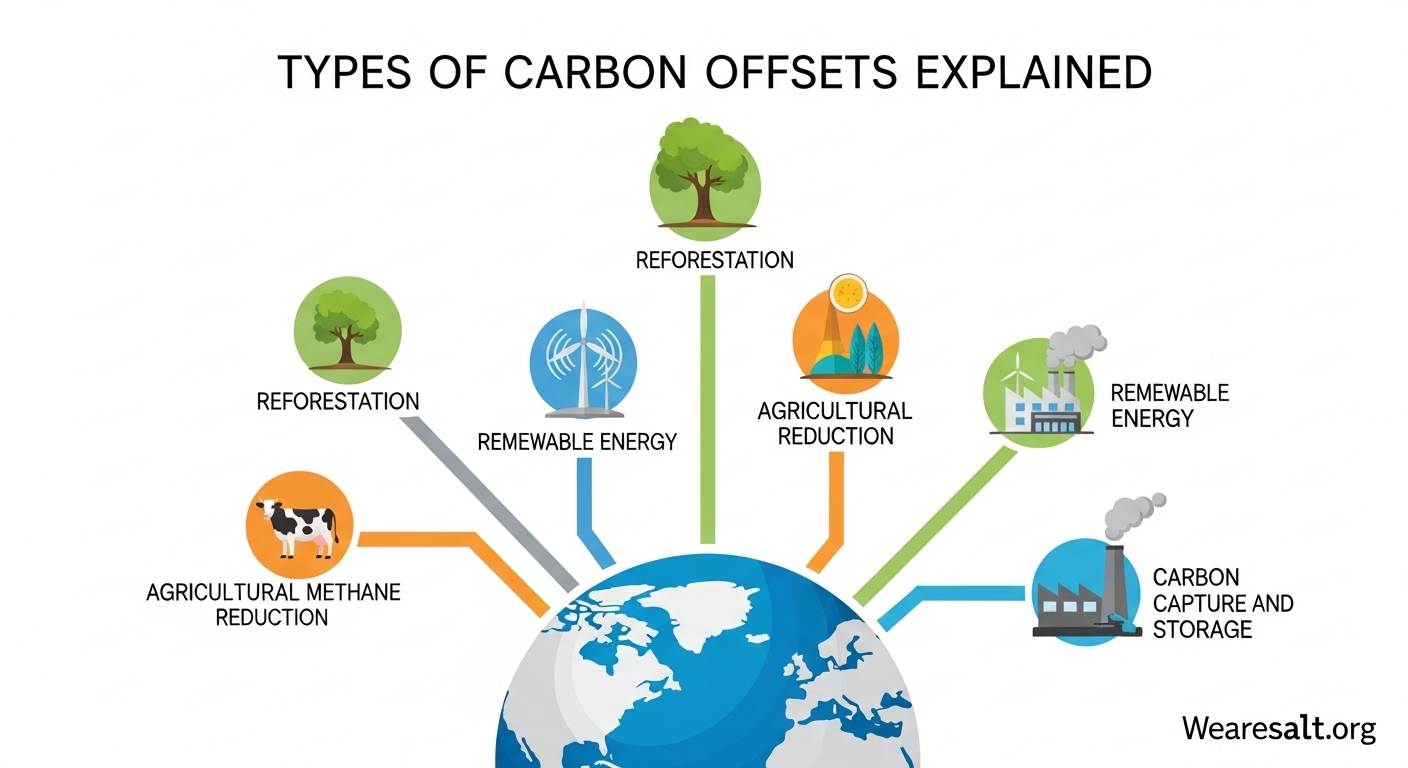
Not all carbon offsets work the same way. Understanding the types of carbon offsets helps you evaluate which approaches align with your values and climate goals. The three main categories are removal, reduction, and avoidance offsets. Each has distinct characteristics, effectiveness profiles, and use cases.
Carbon Removal Offsets
Carbon removal offsets pull existing CO2 out of the atmosphere. These are the only offsets that actually reduce the total amount of carbon already in the air. Examples include reforestation projects that absorb CO2 as trees grow, direct air capture facilities that use chemical processes to extract carbon, and soil carbon sequestration through regenerative agriculture practices.
Removal offsets represent the gold standard for addressing historical emissions. However, they face significant challenges. Permanence is a major concern. A forest planted today might burn down in a wildfire next year, releasing all that stored carbon back into the atmosphere. Direct air capture technology remains expensive and energy-intensive, limiting scalability.
When evaluating removal offsets, look for projects with permanence guarantees and monitoring systems. Reforestation projects should include buffer pools of extra trees to compensate for potential losses. Technology-based removal should demonstrate clear additionality, meaning the removal would not happen without offset funding.
Carbon Reduction Offsets
Carbon reduction offsets decrease emissions from existing sources. These projects make ongoing processes cleaner without necessarily removing past emissions. Examples include energy efficiency upgrades for industrial facilities, methane capture from landfills or livestock operations, and fuel switching from coal to natural gas.
Reduction offsets are particularly valuable for addressing emissions from hard-to-abate sectors. Some industrial processes cannot currently operate without generating greenhouse gases. Reduction projects lower the total emissions intensity while technology and infrastructure catch up to support full decarbonization.
The additionality challenge hits reduction offsets hardest. Many efficiency improvements make economic sense regardless of offset revenue. A factory might upgrade to LED lighting purely for electricity savings, not because of carbon credits. If the offset project would have happened anyway, the credit represents no actual additional climate benefit.
Carbon Avoidance Offsets
Carbon avoidance offsets prevent emissions that would have occurred in a hypothetical future scenario. These represent the most controversial category because they rely on counterfactual baselines. Examples include forest protection projects that prevent deforestation, clean cookstove distribution that reduces wood burning, and renewable energy installations that displace fossil fuel generation.
Avoidance offsets dominate the voluntary carbon market. They are often cheaper to implement than removal or reduction projects, making them attractive to budget-conscious offset buyers. However, their effectiveness depends entirely on accurate baseline modeling. If the baseline overestimates what emissions would have been without the project, the offset overstates its climate impact.
Forest protection offsets face particular scrutiny. A project might claim to protect a forest that was never actually at risk of logging. Or the protection might simply displace deforestation to an adjacent unprotected area, a phenomenon called leakage. Quality avoidance offsets require rigorous baseline verification and monitoring for leakage effects.
Nature-Based vs Technology-Based Carbon Offsets
Beyond the removal-reduction-avoidance framework, offsets also differ in their underlying approach. Nature-based solutions work with ecosystems to absorb or prevent emissions. Technology-based solutions use engineering and machinery to achieve similar goals.
Nature-based offsets include reforestation, forest conservation, wetland restoration, and agricultural soil management. These projects often provide co-benefits like biodiversity protection and community employment. However, they face permanence risks from climate change, disease, and human activity. A changing climate might make a forest restoration site unsuitable for the planted species, undermining long-term carbon storage.
Technology-based offsets include direct air capture, renewable energy with battery storage, and industrial carbon capture. These projects offer more quantifiable and permanent carbon impacts. A ton of CO2 captured by a direct air capture facility stays captured unless deliberately released. However, technology offsets currently cost significantly more than nature-based alternatives and may require substantial energy inputs.
The best climate strategies often combine both approaches. Nature-based solutions deliver immediate co-benefits and ecosystem restoration. Technology-based solutions provide measurable, permanent carbon removal. Neither approach is perfect, but together they create a more resilient offset portfolio.
How Carbon Offset Markets Work
Carbon offsets trade in two distinct markets with different rules, participants, and price points. Understanding these market structures helps explain why offset prices vary so dramatically and why quality assessment matters.
Voluntary Carbon Market
The voluntary carbon market serves companies and individuals who choose to offset emissions without legal requirement. This market operates through private transactions between project developers and offset buyers. Prices typically range from $5 to $50 per ton of CO2e, though high-quality removal offsets can command $100 or more.
Voluntary markets offer flexibility but lack standardization. Buyers can choose from thousands of projects worldwide, each with different methodologies, co-benefits, and price points. However, this variety creates confusion. A cheap voluntary offset might represent genuine emissions reduction or it might be essentially worthless due to poor baseline accounting or lack of additionality.
Major voluntary market registries include Verra (which operates the Verified Carbon Standard), Gold Standard, Climate Action Reserve, and American Carbon Registry. These bodies establish methodologies for project verification and maintain credit tracking systems. However, standards vary between registries, and verification quality depends on the rigor of the specific project auditor.
Compliance Carbon Market
Compliance markets operate under government regulation. Entities covered by cap-and-trade systems must purchase carbon allowances or offsets to meet emission reduction targets. Examples include the European Union Emissions Trading System (EU ETS), California’s cap-and-trade program, and China’s national emissions trading scheme.
Compliance market offsets face stricter oversight than voluntary credits. Regulators set eligibility criteria, approve methodologies, and monitor market integrity. Prices typically exceed voluntary market rates, often reaching $50 to $100 per ton. This higher price reflects the limited supply of eligible offsets and the legal enforcement of demand.
Not all offsets qualify for compliance markets. Regulators usually restrict eligible project types to those with high confidence in additionality and measurement. This limitation makes compliance market offsets more trustworthy but also more expensive and harder to obtain for individual buyers.
How to Evaluate Carbon Offset Quality
Quality assessment separates effective climate action from greenwashing. With thousands of offset projects available and varying verification standards, knowing how to evaluate quality protects you from wasting money on ineffective credits.
The P.A.V.E.R Framework Explained
Industry experts use the P.A.V.E.R framework to assess offset quality. Each letter represents a critical attribute that high-quality offsets must demonstrate.
Permanent: The carbon reduction or removal must last. For reforestation projects, this means protection against fire, disease, and harvesting for decades or centuries. For technology projects, it means secure geological storage or permanent material incorporation. Temporary storage provides temporary benefit, and carbon math requires permanent solutions for permanent emissions.
Additional: The project must prove that carbon reductions would not have happened without offset revenue. This is the most challenging criterion to verify. Project developers must demonstrate financial need, regulatory gaps, or technological barriers that offset funding overcomes. Additionality requires comparing the project scenario against a realistic baseline of what would have occurred otherwise.
Verifiable: The emissions impact must be measurable and monitored. Quality offsets use standardized methodologies with clear measurement protocols. Independent third parties verify the calculations, and results are publicly documented in registry systems. Verifiability ensures accountability and allows buyers to confirm that claimed reductions actually occurred.
Enforced: There must be consequences for non-delivery. This includes legal contracts, financial penalties for project failure, and buffer pools of extra credits to cover shortfalls. Without enforcement mechanisms, project developers face no downside for failing to deliver promised carbon benefits. Strong contracts and insurance mechanisms protect buyer investments and climate outcomes.
Real: The carbon benefit must represent actual atmospheric impact, not accounting artifacts. This excludes offsets based on unrealistic baselines, double-counted credits, or projects with substantial leakage. Real offsets make measurable differences to atmospheric carbon concentrations. Everything else is marketing.
Major Carbon Offset Standards
Several organizations establish and maintain carbon offset standards. Understanding these bodies helps you identify which projects meet rigorous criteria.
Verra (Verified Carbon Standard): The largest carbon credit registry, managing the Verified Carbon Standard (VCS) program. Verra certifies projects across all offset types and maintains extensive methodologies. However, Verra has faced criticism for approving projects with questionable additionality, particularly in the avoided deforestation category.
Gold Standard: Founded by World Wildlife Fund and other NGOs, Gold Standard emphasizes sustainable development co-benefits alongside carbon impact. Projects must demonstrate contributions to local communities and ecosystems beyond carbon reduction. Gold Standard maintains stricter additionality requirements than some competitors.
Climate Action Reserve: A North American focused registry with rigorous protocols for domestic projects. CAR emphasizes conservative baseline setting and extensive monitoring. Their protocols often become templates for other standards.
Puro.earth: A newer registry focusing exclusively on carbon removal technologies. Puro.earth maintains strict criteria for permanence and verification, working with engineered solutions rather than nature-based approaches. Their focus on removal makes them particularly relevant for companies pursuing net-zero targets.
Real-World Carbon Offset Project Examples
Concrete examples help illustrate how different offset types work in practice. These projects represent various approaches, each with distinct strengths and limitations.
Reforestation: The Great Green Wall, Africa: This ambitious initiative aims to restore 100 million hectares of degraded land across the Sahel region. The project plants native tree species that capture atmospheric carbon while restoring soil health and providing food security for local communities. Quality concerns include drought risk, political instability, and ensuring that planted forests survive the critical early years.
Renewable Energy: Bhadla Solar Park, India: One of the world’s largest solar installations, Bhadla displaces coal-fired electricity generation. The project generates renewable energy certificates and carbon credits through the UN Clean Development Mechanism. However, additionality questions arise because solar power has become economically competitive without subsidy in many regions.
Direct Air Capture: Climeworks Orca, Iceland: This facility uses fans and chemical filters to extract CO2 directly from ambient air, then mineralizes it underground in basalt formations. Orca represents permanent, verifiable carbon removal with minimal leakage risk. The limitation is scale and cost. Current capacity is 4,000 tons annually at prices exceeding $600 per ton.
Community Cookstoves: Kenya Clean Cookstove Project: This initiative distributes efficient cookstoves that reduce wood fuel consumption by 50% compared to traditional open fires. The project cuts household emissions, reduces indoor air pollution, and decreases deforestation pressure. Baseline challenges include proving that families would have continued using traditional stoves without the program.
Benefits and Limitations of Carbon Offsetting
Carbon offsets generate passionate debate among climate advocates. Understanding both benefits and limitations helps you form an informed opinion and make responsible choices.
Benefits of Carbon Offsets
Offsets provide immediate funding for climate-positive projects that might otherwise lack resources. Reforestation initiatives, renewable energy installations, and methane capture projects all require capital. Offset revenue channels private money toward these solutions faster than government funding alone could achieve.
For hard-to-abate sectors like aviation and shipping, offsets offer a bridge solution while technology catches up. Electric planes and cargo ships remain years or decades away from commercial viability. Offsets allow these industries to take responsibility for emissions today rather than waiting for technological breakthroughs.
Quality offsets also create valuable co-benefits. Forest projects protect biodiversity. Clean cookstove programs improve public health. Renewable energy creates jobs. These ancillary benefits multiply the value of carbon investments beyond pure emissions accounting.
Limitations and Criticism
The fundamental criticism of carbon offsets is that they allow continued emissions rather than forcing reduction. Critics argue that offsets enable a “pay to pollute” mentality, letting wealthy entities continue destructive practices while buying absolution. This concern has merit. Offsets should supplement emission reductions, not replace them.
Quality problems plague the offset market. Studies have found that a significant percentage of voluntary carbon credits represent minimal or no actual climate benefit. Baseline inflation, lack of additionality, and impermanence undermine market integrity. These failures damage trust and waste resources that could have funded genuine climate solutions.
Greenwashing represents another serious concern. Companies purchase cheap, low-quality offsets and claim carbon neutrality without meaningfully reducing operations. This practice misleads consumers and undermines genuine sustainability efforts. Without strict standards and transparent reporting, offsetting becomes a marketing tool rather than a climate strategy.
When Offsets Make Sense
Offsets work best as part of a comprehensive climate strategy that prioritizes direct emission reduction. The hierarchy is simple. First, measure and understand your carbon footprint. Second, reduce emissions through efficiency, renewable energy, and behavior change. Third, offset only the residual emissions that cannot be eliminated through other means.
For individuals, this means improving home energy efficiency before buying flight offsets. For companies, this means decarbonizing operations before purchasing credits. Offsets should handle the final 10-20% of emissions, not the bulk of the carbon budget. Used responsibly, they help close the gap to carbon neutrality. Used as an excuse for inaction, they become part of the problem.
FAQ
What are the different types of carbon offsets?
The three main types of carbon offsets are carbon removal (pulling CO2 out of the atmosphere through reforestation or direct air capture), carbon reduction (making existing processes cleaner through efficiency improvements), and carbon avoidance (preventing emissions that would have occurred through forest protection or clean cookstoves). Each type has different effectiveness profiles and quality challenges.
How do carbon offsets work?
Carbon offsets work by funding projects that reduce, avoid, or remove greenhouse gas emissions. When you purchase an offset equivalent to your emissions, you are supporting a project that prevents or removes that amount of carbon elsewhere. The purchased credit is then retired in a registry to prevent double-counting, allowing you to claim the offset against your carbon footprint.
Do carbon offsets actually work?
Carbon offsets can work when they are high-quality, but effectiveness varies dramatically. Quality offsets must demonstrate permanence, additionality, verifiability, enforcement, and real impact (the P.A.V.E.R framework). Studies have found that many voluntary market offsets provide minimal actual climate benefit due to poor baseline accounting and lack of additionality. Offsets work best as a supplement to direct emission reductions, not a replacement.
What is the difference between carbon offsets and carbon credits?
A carbon credit represents one metric ton of CO2 equivalent reduced or removed from the atmosphere. A carbon offset describes the act of using that credit to compensate for emissions elsewhere. The credit is the unit of measurement. The offset is the application. You purchase carbon credits to create carbon offsets for your emissions.
How can I choose quality carbon offsets?
Choose quality offsets by evaluating them against the P.A.V.E.R framework: Permanent (carbon stays stored), Additional (project needed offset funding to happen), Verifiable (independent monitoring confirms impact), Enforced (consequences exist for non-delivery), and Real (actual atmospheric impact, not accounting tricks). Look for projects certified by reputable standards like Gold Standard or Puro.earth, and prioritize carbon removal over avoidance when possible.
Conclusion
Understanding the types of carbon offsets empowers you to make informed climate decisions. Removal offsets that pull carbon from the atmosphere offer the clearest climate benefit but face scale and cost challenges. Reduction and avoidance offsets play important roles but require careful scrutiny to ensure they represent genuine additional impact.
The carbon offset market is maturing but remains imperfect. Quality varies from exemplary to fraudulent. The P.A.V.E.R framework provides a lens for distinguishing effective offsets from greenwashing. By demanding permanence, additionality, verifiability, enforcement, and real impact, you support market integrity and genuine climate solutions.
Remember that offsets are a tool, not a solution. The most effective climate strategy starts with reducing your own emissions through efficiency, renewable energy, and sustainable choices. Use offsets to handle the remainder, not as an excuse to avoid change. When applied thoughtfully, carbon offsets channel resources toward projects that heal the atmosphere. When applied carelessly, they become expensive distractions from the hard work of genuine decarbonization.
Choose wisely, act decisively, and keep the ultimate goal in mind. A stable climate requires both individual responsibility and collective action. Offsets can play a role in that journey when we use them honestly and well.