
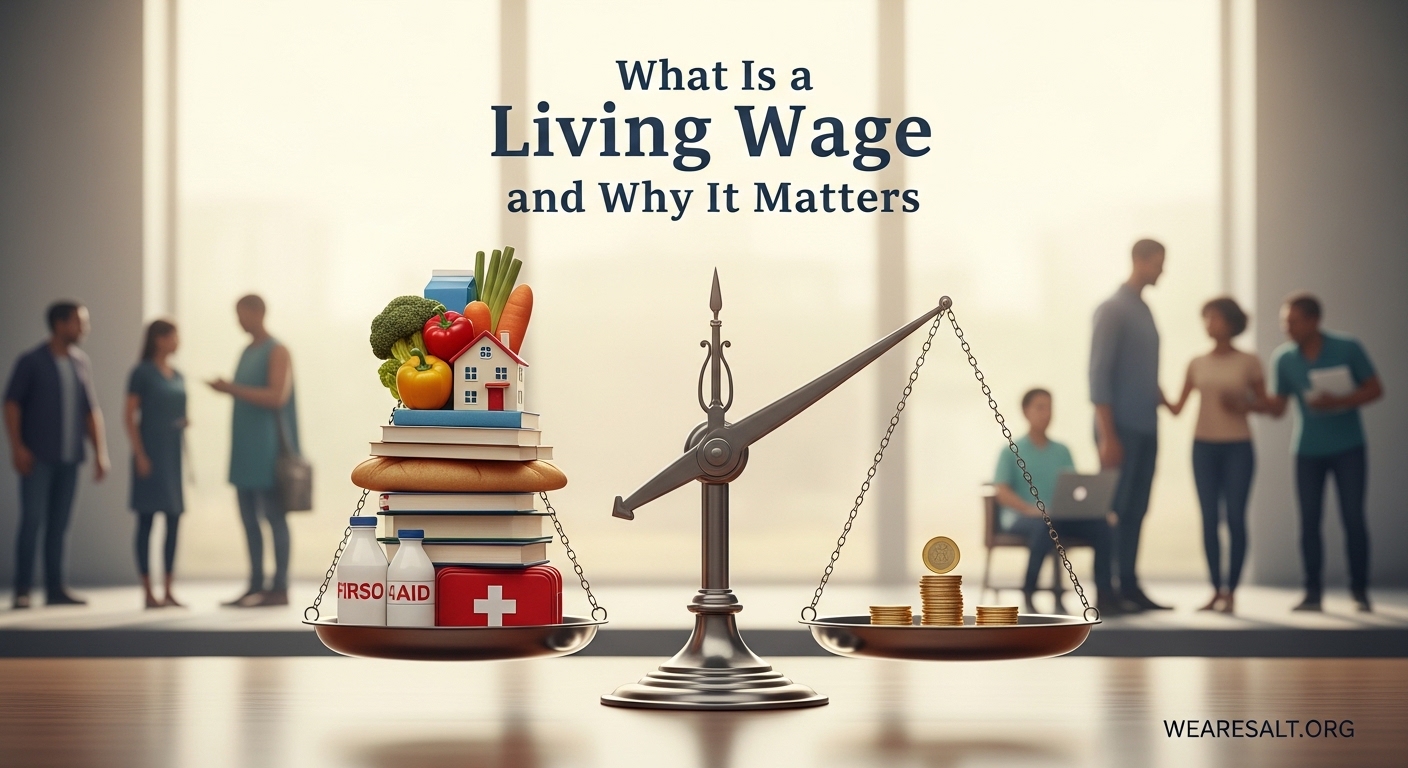
Imagine working 40 hours every week, showing up on time, giving your best effort, and still not earning enough to pay rent and buy groceries in the same month. This is the reality for millions of workers across America. I have spent time researching this issue because it strikes at the heart of something fundamental: the dignity of work and the dignity of workers.
A living wage is the minimum income necessary for workers to meet their essential needs and maintain a decent standard of living where they live, covering costs like food, housing, healthcare, transportation, and other basic necessities without requiring public assistance. Unlike the minimum wage, which is a legal floor set by government, a living wage reflects the actual cost of living in a specific community.
In this guide, I will explain what constitutes a living wage, why it matters for individuals and communities, how it differs from minimum wage, and what we can do to support fair compensation for all workers. Whether you are an employer, employee, or concerned citizen, understanding living wage is essential for building a more just society.
Table of Contents
What Is a Living Wage?
A living wage is what one full-time worker must earn on an hourly basis to help cover the cost of their family’s minimum basic needs where they live. It is not about luxury or comfort. It is about having enough to afford adequate shelter, nutritious food, basic healthcare, reliable transportation, and other necessities without falling into debt or requiring government assistance.
The concept recognizes something important: work should provide for life. When we talk about living wage, we are talking about the baseline amount required for a worker to participate fully in society without experiencing deprivation.
The Core Components
A living wage calculation includes several essential expense categories. These components reflect what it actually costs to live with dignity in a specific location:
Housing. This is typically the largest expense, representing 30-40% of a living wage budget. It includes rent for a modest apartment or home, not a luxury residence.
Food. A living wage covers the cost of nutritious meals prepared at home, not restaurant dining or elaborate grocery lists.
Healthcare. This includes insurance premiums, out-of-pocket costs, and basic medical expenses necessary to maintain health.
Transportation. Whether by car or public transit, workers need reliable transportation to get to work and meet other obligations.
Childcare. For families with children, quality childcare is essential for parents to work and children to thrive.
Other necessities. This includes clothing, personal care items, household supplies, and modest emergency savings.
These components are calculated based on actual costs in specific geographic areas, which is why living wage varies dramatically depending on where you live.
Living Wage vs Minimum Wage: Understanding the Difference
Many people assume minimum wage and living wage are the same thing. They are not. Understanding the distinction is crucial for grasping why so many working families struggle despite being employed.
The minimum wage is a legal requirement set by federal, state, or local governments. It establishes the lowest hourly rate employers can legally pay. The federal minimum wage has been $7.25 per hour since 2009. Some states and cities have set higher minimums, but the federal floor has not budged in over 15 years despite rising costs.
The living wage, by contrast, is based on actual costs of living in a specific community. It answers the question: what does a worker need to earn to afford basic necessities where they live? According to MIT’s Living Wage Calculator, the living wage for a single adult in the United States ranges from about $15 to $25 per hour depending on location. For families with children, it can be $30 to $40 per hour or more in high-cost areas.
Here is a clear comparison:
| Factor | Minimum Wage | Living Wage |
|---|---|---|
| Basis | Legislated by government | Calculated from actual living costs |
| Purpose | Legal floor for wages | Economic self-sufficiency |
| Geographic variation | Usually statewide or national | Calculated by county/city |
| Family considerations | Same regardless of family size | Adjusts for family composition |
| Current US example | $7.25/hour federal minimum | $15-40+/hour depending on location |
The gap between minimum wage and living wage explains why the working poor exist. Millions of Americans work full-time jobs but remain below the poverty line because their wages do not reflect actual living costs in their communities.
Why Living Wage Matters: The Human Impact
When workers earn a living wage, everything changes. I have read countless stories from people who describe the transformation that comes from earning enough to cover their basic needs without constant anxiety.
Workers who earn a living wage report dramatic improvements in mental health. The chronic stress of financial insecurity takes a toll on sleep, relationships, and overall well-being. When people earn enough to pay their bills, that weight lifts.
Health improves. Workers with living wages can afford nutritious food instead of relying on cheap, processed options. They can access healthcare when needed rather than delaying treatment until conditions become emergencies. They can afford safe housing in neighborhoods with clean air and lower crime rates.
Children benefit. Research consistently shows that children in households with adequate income perform better in school, have better health outcomes, and enjoy greater opportunities. Living wage breaks cycles of intergenerational poverty.
Dignity is restored. Perhaps most importantly, living wage restores dignity. Work is about more than survival. It is about contributing to society, supporting one’s family, and being treated with respect. When employers pay living wages, they acknowledge the inherent worth of their workers.
Forum discussions reveal this human element powerfully. Workers share stories of working 40 or 50 hours per week across multiple jobs, never seeing their families, and still falling behind on rent. They describe the humiliation of needing public assistance despite working full-time. These are not lazy people. These are people trapped in a system where wages do not match costs.
The Components of a Living Wage
Understanding what goes into a living wage calculation helps clarify why it varies so significantly by location and family type. Researchers at MIT and the Economic Policy Institute have developed sophisticated models to estimate living wages across different communities.
Housing Costs
Housing represents the largest portion of living wage calculations, typically accounting for 30-40% of the total. Fair Market Rents, determined by the Department of Housing and Urban Development, provide the basis for these estimates. In high-cost cities like San Francisco or New York, housing alone can require $25-30 per hour in wages. In more affordable regions, housing costs may require only $10-12 per hour.
Food and Nutrition
Living wage calculations use the USDA’s Low-Cost Food Plan, which estimates the cost of nutritious meals prepared at home. This is not extravagant eating. It is basic, healthy food that meets nutritional needs without excess. For a family of four, this can range from $600 to $1,000 per month depending on location.
Healthcare Expenses
Healthcare costs include insurance premiums, deductibles, co-pays, and out-of-pocket expenses. Even with employer-sponsored insurance, workers often face significant costs. Living wage calculations account for these realities.
Transportation
Whether owning a reliable vehicle or using public transit, transportation costs are essential for employment. Living wage includes costs for vehicle ownership (payments, insurance, maintenance, fuel) or public transit passes.
Childcare
For families with children, childcare is often the second-largest expense after housing. Quality childcare enables parents to work while ensuring children are safe and developing. Without affordable childcare, work becomes economically impossible for many parents.
Taxes and Other Costs
Living wage calculations also account for payroll taxes, income taxes, and other necessities like clothing, household supplies, and modest emergency savings. The goal is a complete picture of what it actually costs to live without assistance.
How Living Wage Is Calculated
The MIT Living Wage Calculator, developed by researcher Amy Glasmeier, provides the most widely referenced living wage estimates in the United States. Understanding the methodology helps explain why living wage varies so much by location.
The calculator uses geographically specific data for over 3,000 counties and includes 12 different family types, from single adults to families with multiple children. It draws on government data sources including the Bureau of Labor Statistics, the USDA, and the Department of Housing and Urban Development.
The calculation process works as follows: researchers identify the cost of each basic need category in a specific geographic area, sum these costs to determine the total required annual income, then divide by the standard number of full-time work hours (2,080 per year) to determine the hourly living wage.
For example, if basic needs in a particular county cost $52,000 per year for a family of four, the living wage would be approximately $25 per hour ($52,000 divided by 2,080 hours). If the minimum wage in that area is $7.25 or even $12 per hour, the gap becomes clear.
Geographic variation is substantial. According to MIT’s data, the living wage for a single adult ranges from about $14 per hour in rural Mississippi to over $25 per hour in the San Francisco Bay Area. For families, the variation is even more dramatic, with some high-cost areas requiring $40 or more per hour to cover basic needs.
A Faith-Based Perspective on Fair Wages
As people of faith, we cannot discuss living wage without addressing the moral and spiritual dimensions of economic justice. Sacred texts across traditions speak to the dignity of work and the responsibility to ensure workers receive fair compensation.
The Hebrew scriptures contain some of the strongest protections for workers. The book of Leviticus instructs employers: “Do not withhold the wages of your hired workers overnight.” The prophet Malachi declares that God will be a swift witness against those who oppress hired workers in their wages. These texts recognize that delaying or withholding wages causes real suffering and is an offense against both worker and God.
In the Christian tradition, the apostle James delivers a scathing condemnation of those who withhold wages from laborers: “The wages you failed to pay the workers who mowed your fields are crying out against you.” This is not gentle suggestion. It is prophetic judgment against economic exploitation.
The concept of a “living wage” has deep roots in Catholic social teaching. Pope Leo XIII’s 1891 encyclical Rerum Novarum affirmed that workers have a right to wages sufficient to support themselves and their families. This teaching has been consistently reaffirmed by subsequent popes, who argue that when workers cannot earn enough to live through their labor, something has gone wrong in the social order.
From this perspective, paying a living wage is not charity. It is justice. Workers deserve to participate in the fruits of their labor. When businesses generate profits while paying workers less than living wages, they are essentially subsidizing their operations by pushing costs onto workers, families, and communities.
The theological argument is straightforward: every human being bears the image of God and possesses inherent dignity. Work is a form of participation in creation and a means of supporting oneself and one’s family. When work fails to provide for basic needs, both worker dignity and the social fabric suffer. Fair wages honor the sacred worth of every worker.
The Broader Impact: Community and Economy
Living wage does not only benefit individual workers. It strengthens entire communities and economies. Research consistently demonstrates the positive ripple effects when employers commit to paying living wages.
Reduced employee turnover. Businesses that pay living wages experience significantly lower turnover rates. Replacing employees is expensive, costing employers thousands of dollars per departure in recruitment, training, and lost productivity. Living wage reduces these costs while building institutional knowledge and morale.
Increased productivity. Workers who are not exhausted from second jobs or stressed about finances perform better. They are more focused, more reliable, and more engaged. The increased productivity often offsets much or all of the additional wage costs.
Local economic stimulus. Workers with living wages spend money in their communities. They buy groceries, pay rent, purchase goods and services. This spending circulates through local economies, creating demand and supporting other jobs. Low-wage workers, by contrast, often cannot afford to spend beyond basic necessities.
Reduced public assistance. When employers pay less than living wages, taxpayers often make up the difference through food stamps, housing assistance, and Medicaid. This effectively subsidizes low-wage business models with public funds. Living wage reduces this burden.
Human rights framework. International human rights standards recognize living wage as a fundamental right. The Universal Declaration of Human Rights states that everyone who works has the right to just and favorable remuneration ensuring an existence worthy of human dignity. Living wage is not a radical concept. It is a baseline expectation of human rights.
What You Can Do to Support Living Wage
Understanding living wage is important, but action matters more. Here are practical steps individuals, employers, and communities can take to support fair compensation.
As a consumer. Research companies before you buy. Many businesses now publish living wage commitments or fair labor certifications. Look for B Corp certification, Fair Trade labels, and transparent supply chain reporting. When possible, support businesses known for paying living wages.
As an employee. Know your worth. Use resources like the MIT Living Wage Calculator to understand what a living wage looks like in your area. If you are negotiating salary or considering a job offer, factor in actual living costs. Advocate for fair compensation in your workplace.
As an employer. Commit to paying living wages. Start by calculating what a living wage looks like for your area using available calculators. Audit your compensation structure. If you cannot immediately pay full living wages, develop a plan to reach that goal. Communicate transparently with employees about your commitment.
As a citizen. Support policies that advance living wage. This includes minimum wage increases, living wage ordinances for government contractors, and paid sick leave policies. Contact elected officials. Vote for candidates who prioritize economic justice. Support organizations advocating for workers’ rights.
As a person of faith. Bring living wage conversations into your faith community. Discuss economic justice in study groups. Support faith-based advocacy organizations working on wage issues. Consider how your congregation’s purchasing and employment practices align with values of dignity and fairness.
FAQ
What is the simple definition of a living wage?
A living wage is the minimum income necessary for workers to meet their essential needs and maintain a decent standard of living where they live, covering costs like food, housing, healthcare, and transportation without requiring public assistance.
Why is a living wage important?
A living wage is important because it lifts workers out of poverty, reduces income inequality, improves health and education outcomes, boosts local economies through increased spending, and ensures human dignity by allowing workers to meet their basic needs without government assistance.
Is $40,000 a year a livable wage?
Whether $40,000 a year is a living wage depends on location and family size. For a single adult in a low-cost area, it may be sufficient. For a family of four in a high-cost city, it likely falls short. Use the MIT Living Wage Calculator to check specific situations.
Is $70,000 a livable wage?
For most single adults and many families, $70,000 a year constitutes a living wage in many parts of the United States. However, in high-cost areas like San Francisco or New York, even this amount may not cover basic needs for families with children.
Does living wage vary by location?
Yes, living wage varies significantly by location. Housing costs, food prices, transportation expenses, and taxes differ dramatically between regions. According to MIT’s Living Wage Calculator, a single adult might need $14 per hour in rural Mississippi but $25+ per hour in the San Francisco Bay Area.
What is the difference between living wage and minimum wage?
Minimum wage is a legal floor set by government, currently $7.25 per hour federally. Living wage is calculated based on actual costs of living in a specific community and is typically $15-40+ per hour depending on location and family size. Minimum wage often falls far below living wage.
Conclusion: What Is a Living Wage and Why It Matters
A living wage is more than a number. It is a statement about what we believe workers deserve and what kind of society we want to build. When we ask what is a living wage and why it matters, we are really asking: do we believe work should provide for life? Do we believe every person has inherent dignity that should be honored through fair compensation?
The data is clear. Millions of Americans work full-time yet cannot afford basic necessities. The minimum wage, unchanged at the federal level for over 15 years, has not kept pace with rising costs. The gap between what workers earn and what they need represents a moral and economic crisis.
But this is not just about economics. It is about justice. From ancient scripture to modern human rights law, the message is consistent: workers deserve to be paid enough to live with dignity. When we support living wage policies, choose ethical businesses, and advocate for fair compensation, we participate in building a more just world.
I encourage you to take action. Calculate the living wage in your community. Support businesses that pay fair wages. Advocate for policy changes. And most importantly, remember that behind every wage statistic is a real person trying to build a life, support a family, and contribute to society. They deserve nothing less than a living wage.