
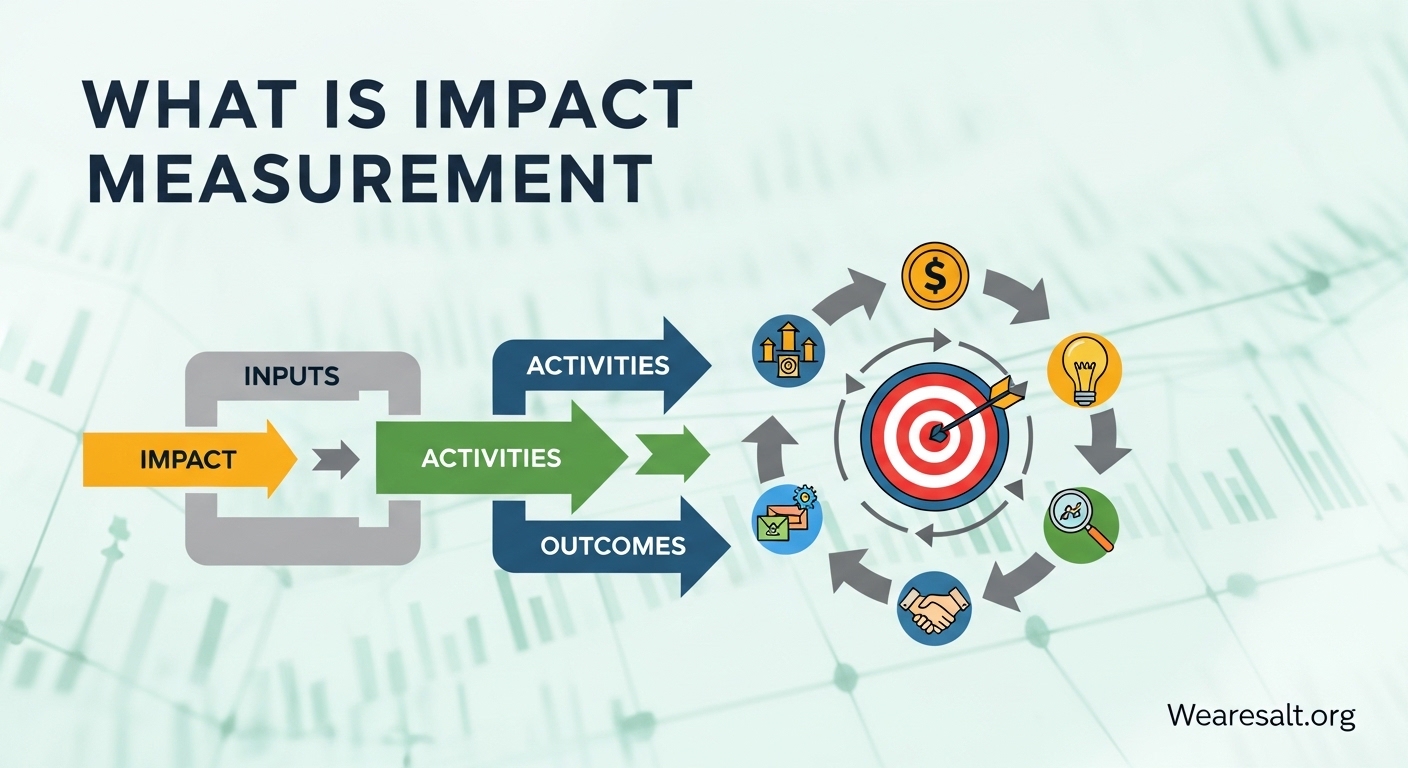
Impact measurement is the systematic process of collecting and analyzing data to understand the outcomes and effects an organization creates for its target beneficiaries and community. Organizations across the nonprofit, investment, and social enterprise sectors use this practice to determine whether their programs and initiatives are achieving the change they set out to create.
We have seen organizations transform their work when they shift from simply tracking activities to measuring actual outcomes. This guide will walk you through what impact measurement means, why it matters, and how you can start implementing it in your organization 2026.
Table of Contents
What Is Impact Measurement?
Impact measurement goes beyond counting activities or outputs. It examines the actual changes that occur because of an organization’s work. A nonprofit might serve 500 meals (output), but impact measurement asks whether those meals improved nutrition, reduced food insecurity, or strengthened community connections (outcomes and impact).
The practice involves setting clear goals, identifying indicators that signal progress, collecting relevant data, analyzing results, and using those insights to improve programs and demonstrate accountability to stakeholders. It creates a feedback loop where organizations learn what works and adjust accordingly.
Many organizations confuse outputs with outcomes. Outputs are the direct products of activities: training sessions held, brochures distributed, or patients treated. Outcomes represent the changes that happen because of those outputs: skills gained, awareness raised, or health improved. Impact represents the broader, long-term changes in communities or systems.
Understanding this distinction helps organizations focus on what truly matters. Funders increasingly want to see evidence of outcomes, not just activity counts. Communities deserve to know whether programs actually improve their lives. Impact measurement provides that clarity.
Why Impact Measurement Matters
Organizations that measure impact make better decisions. When you understand which programs create the most change, you can allocate resources more effectively. Data reveals what works, what needs adjustment, and what might require a complete redesign.
Accountability drives much of the interest in impact measurement. Donors, investors, and grantmakers want assurance that their money creates real change. Communities want to know whether organizations deliver on their promises. Impact measurement provides the evidence needed to maintain trust and secure ongoing support.
Beyond accountability, impact measurement fuels learning. Organizations that regularly collect and analyze outcome data develop deeper understanding of their beneficiaries’ needs. They spot patterns, test assumptions, and refine their approaches. This learning mindset separates thriving organizations from those that stagnate.
The practice also helps organizations tell compelling stories. Numbers alone rarely move people, but numbers combined with stories create powerful narratives of change. Impact measurement gives organizations both the data and the insights needed to communicate their value effectively.
Key Frameworks and Approaches
Several established frameworks help organizations structure their impact measurement efforts. These frameworks provide common language, proven methodologies, and guidance for organizations at different stages of measurement maturity.
Theory of Change
A Theory of Change maps the pathway from your current situation to your desired impact. It articulates the assumptions underlying your work and identifies the conditions needed for success. Organizations use this framework to clarify their logic and identify what they need to measure.
Building a Theory of Change starts with defining your long-term goal. From there, you work backwards to identify the outcomes that must occur first, the outputs needed to create those outcomes, and the activities required to produce those outputs. Each connection represents an assumption you can test through measurement.
Many organizations find that creating a Theory of Change reveals gaps in their logic or measurement plans. The process forces clarity about how activities connect to outcomes. It also helps identify external factors that might influence results beyond the organization’s control.
Logic Models
Logic models provide a visual representation of how a program works. They typically display five elements: inputs (resources), activities (what the organization does), outputs (direct products), outcomes (short and medium-term changes), and impact (long-term changes).
This framework helps organizations identify appropriate metrics at each stage. You might track input and output metrics for operational efficiency, outcome metrics for program effectiveness, and impact metrics for overall success. The model creates a clear hierarchy that guides measurement priorities.
Organizations often combine logic models with Theories of Change. The Theory of Change explains why you believe your approach will work, while the logic model shows the operational details of how it works. Together they provide a comprehensive framework for measurement.
The Five Dimensions of Impact
The Impact Management Project, a global collaboration, established five dimensions that organizations should consider when measuring impact. These dimensions provide a comprehensive lens for understanding and comparing impact across different contexts.
What describes the outcome itself, whether positive or negative, and how important it is to stakeholders. Organizations should identify which outcomes matter most to the people they serve.
Who identifies which stakeholders experience the outcome. This includes demographic information and consideration of vulnerable or underserved populations that might benefit most.
How Much considers the scale, depth, and duration of the outcome. Scale refers to how many people experience the change. Depth measures how significant the change is for each person. Duration captures how long the change lasts.
Contribution addresses the organization’s role in creating the outcome. Did the organization’s efforts cause the change, contribute to it, or merely coincide with it? This dimension helps organizations avoid overstating their impact.
Risk acknowledges that impact might differ from expectations. Organizations should assess the likelihood that outcomes will not occur as planned and consider factors that could diminish or reverse impact.
Types of Data and Metrics
Impact measurement relies on both quantitative and qualitative data. Quantitative data provides numerical evidence that can be tracked over time and compared across groups. Qualitative data captures experiences, stories, and contextual details that numbers alone cannot convey.
Key performance indicators, or KPIs, serve as the specific metrics organizations track. Good KPIs directly connect to outcomes, can be measured consistently, and provide actionable information. A food security program might track the percentage of participants reporting reduced hunger (quantitative) alongside personal stories about how consistent meals affected family dynamics (qualitative).
Selecting metrics requires balancing rigor with practicality. Perfect measurement often costs more than organizations can afford. Effective measurement focuses on the most important outcomes and uses affordable methods to track them. Start with a few key metrics and expand as capacity grows.
Baseline measurement establishes where things stand before your intervention. Without knowing the starting point, you cannot determine whether change occurred. Pre-program surveys, existing data sources, and community assessments help establish baselines against which to compare future results.
Getting Started: A Practical Guide
Starting with impact measurement can feel overwhelming. Organizations often worry about having the right data systems, analytical expertise, or staff capacity. The key is to begin simply and build sophistication over time.
Step 1: Define your intended outcomes. Before collecting any data, clarify what change you want to create. Write specific, measurable outcome statements that describe what success looks like for your beneficiaries.
Step 2: Identify key stakeholders. Determine whose perspectives matter most. Beneficiaries, staff, funders, and community partners might have different views on what constitutes success. Include diverse voices in your measurement design.
Step 3: Select appropriate indicators. For each outcome, choose indicators that signal progress. Ensure you can actually collect data on these indicators given your resources and access to stakeholders.
Step 4: Build data collection processes. Create simple systems for gathering information consistently. Spreadsheets work fine for small organizations. Survey tools, databases, and specialized software become valuable as measurement scales up.
Small organizations with limited resources should focus on one or two key outcomes. Measure those well before expanding. Perfect is the enemy of good in impact measurement. Some data, collected consistently, beats comprehensive data that never gets collected.
Common Challenges and How to Address Them
Resource constraints top the list of concerns we hear from organizations. Small nonprofits often lack dedicated evaluation staff or sophisticated data systems. The solution lies in proportionality: match your measurement effort to your program size and complexity.
Attribution presents another persistent challenge. How do you know your program caused the change you observe? Many factors influence outcomes in complex social environments. Organizations should focus on contribution rather than claiming sole credit. Document your role honestly while acknowledging other influences.
The tension between short-term reporting needs and long-term outcomes frustrates many organizations. Funders often want annual results, but meaningful social change takes years. Address this by identifying interim outcomes that predict long-term success. Show progress along the pathway even if final impact remains years away.
Building a culture of learning around measurement requires organizational commitment. Staff must see data as helpful rather than threatening. Leaders should model curiosity about results and support experimentation based on insights. When measurement drives improvement rather than judgment, teams engage more authentically.
Impact Measurement vs Impact Management
While often used interchangeably, impact measurement and impact management represent different but complementary practices. Understanding the distinction helps organizations design more effective approaches.
Impact measurement focuses on the data collection and analysis process. It asks: what outcomes did we create, for whom, and how much? It produces evidence about results that have already occurred. Measurement provides the information needed to understand past performance.
Impact management encompasses measurement but goes further. It includes the entire process of setting impact goals, measuring progress, using insights to improve, and communicating results to stakeholders. Management adds the decision-making and action layers that measurement alone cannot provide.
Organizations need both. Measurement without management produces interesting but unused reports. Management without measurement relies on assumptions rather than evidence. The most effective organizations build integrated systems where measurement directly informs strategy, operations, and resource allocation.
We recommend starting with measurement basics and gradually expanding toward full impact management. Begin by tracking a few key outcomes. Once that works consistently, build feedback loops that bring data into planning conversations. Eventually, impact considerations should shape strategic decisions at the highest organizational levels.
Best Practices for Effective Measurement
Organizations that succeed with impact measurement follow several consistent practices. These approaches help ensure that measurement serves organizational goals rather than becoming a burdensome reporting exercise.
Start small and build iteratively. Choose one program or one outcome to measure well. Learn from that experience before expanding. Early wins build organizational confidence and capacity for more sophisticated measurement later.
Involve stakeholders in design. The people experiencing outcomes often know best what matters and how to measure it. Co-designing indicators with beneficiaries produces more relevant metrics and stronger community buy-in.
Balance rigor with practicality. Academic-level rigor rarely fits organizational budgets or timelines. Use the most rigorous methods practical for your situation. Simple methods applied consistently often outperform complex methods that never get fully implemented.
Communicate results effectively. Raw data rarely moves decision-makers. Present findings in clear formats that highlight key insights. Use visuals, stories, and clear recommendations to make measurement useful for diverse audiences.
Use results for improvement, not just proof. Organizations that thrive treat measurement as a learning tool. They test assumptions, experiment with changes, and adapt based on evidence. This growth mindset creates more impact than defensive approaches focused only on proving success.
Assessment Approaches
Organizations can choose from several approaches to impact assessment, each with different strengths and resource requirements. Understanding these options helps organizations select methods appropriate for their context.
Formative assessment occurs during program implementation. It provides real-time feedback that allows for immediate adjustments. Organizations use formative assessment to refine activities, address emerging challenges, and improve ongoing operations.
Summative assessment happens at program completion or major milestones. It evaluates overall effectiveness and determines whether intended outcomes occurred. Funders often require summative assessments to demonstrate return on investment.
Developmental assessment suits innovative or evolving programs. It treats assessment as a learning process that helps programs develop over time. This approach fits startups, pilot programs, or initiatives operating in complex, changing environments.
Developmental evaluation provides ongoing feedback for innovation. It supports decision-making in uncertain environments where traditional evaluation might be too rigid. This approach fits social innovation labs, systems change initiatives, and early-stage program development.
Most organizations benefit from combining approaches. Formative assessment keeps programs on track day-to-day. Summative assessment demonstrates value to external stakeholders. Developmental approaches support innovation and adaptation. The right mix depends on program maturity, stakeholder needs, and organizational capacity.
Frequently Asked Questions
What is the meaning of impact measurement?
Impact measurement is the systematic process of collecting and analyzing data to understand the outcomes and effects an organization creates. It goes beyond counting activities to examine actual changes that occur for beneficiaries and communities.
What are the 5 dimensions of impact measurement?
The five dimensions are: What (the outcome itself), Who (which stakeholders experience it), How Much (scale, depth, and duration), Contribution (the organization’s role in creating the change), and Risk (likelihood that impact will differ from expectations).
What are KPI in impact measurement?
Key Performance Indicators (KPIs) are specific metrics that signal progress toward intended outcomes. Good KPIs directly connect to outcomes, can be measured consistently, and provide actionable information for decision-making.
What are the four types of impact assessment?
The four types are: Formative assessment (during implementation for real-time feedback), Summative assessment (at completion to evaluate overall effectiveness), Developmental assessment (for evolving programs as a learning process), and Developmental evaluation (ongoing feedback for innovation in uncertain environments).
Conclusion
Impact measurement provides organizations with the evidence and insights needed to create meaningful change. By systematically collecting and analyzing outcome data, organizations can improve their programs, maintain stakeholder trust, and allocate resources where they create the most good.
The practice continues evolving as organizations develop better tools, frameworks, and approaches. Whether you lead a nonprofit, manage investments, or run a social enterprise, understanding impact measurement helps you demonstrate and increase your contribution to the communities you serve. Start with the basics, build capacity over time, and let evidence guide your path to greater impact 2026.