
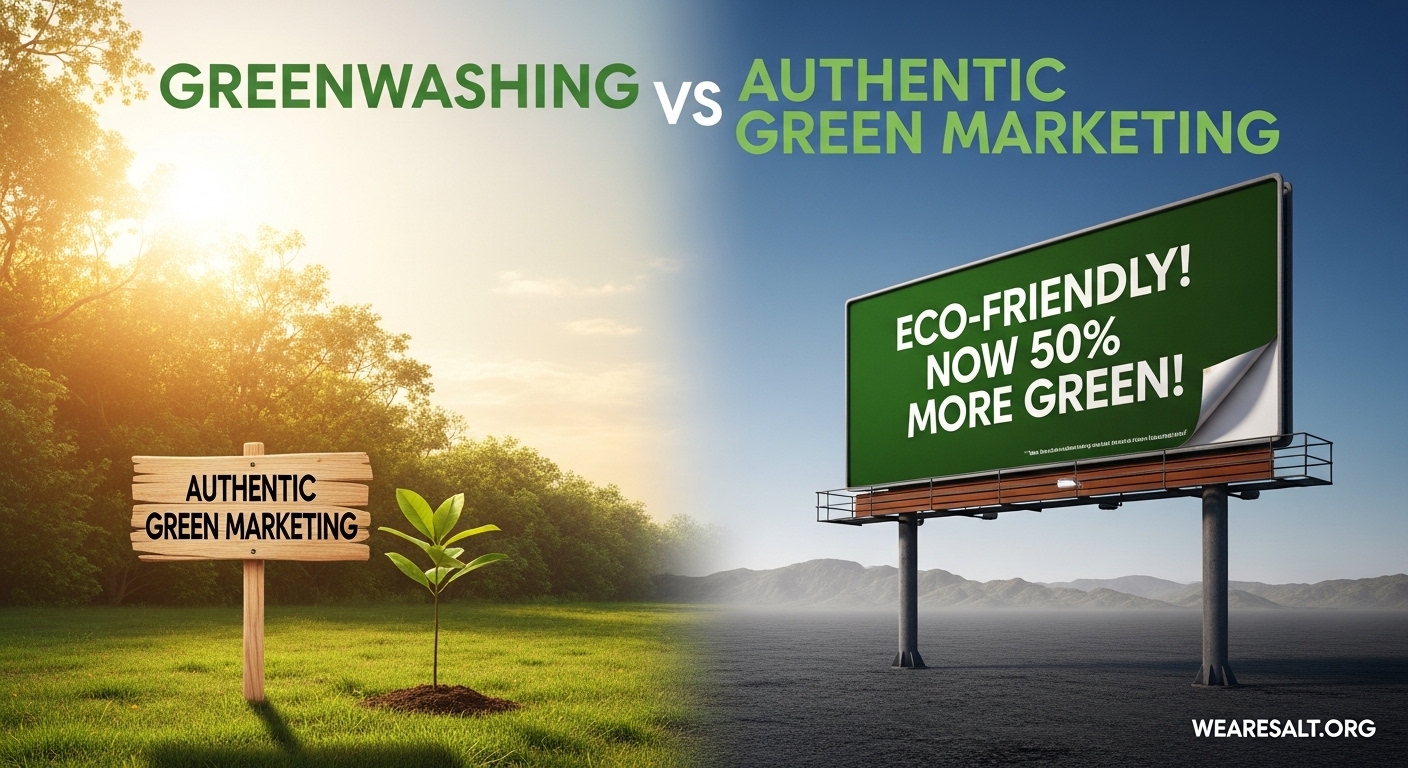
Greenwashing is the deceptive practice of making exaggerated or false environmental claims to appear more sustainable than a company actually is. Authentic green marketing promotes genuine environmental benefits with transparent, verifiable evidence. The difference comes down to intent, evidence, and impact.
Our team has spent months analyzing hundreds of sustainability claims across industries from fashion to food to energy. We have seen the damage greenwashing does to consumer trust. We have also witnessed how authentic green marketing builds lasting brand loyalty.
This guide will show you exactly how to tell the difference. You will learn the specific red flags that signal greenwashing. You will discover the verification steps that protect you from misleading claims. By the end, you will have a practical framework for evaluating any environmental marketing you encounter.
Table of Contents
What is Greenwashing vs Authentic Green Marketing?
To understand the difference, we need clear definitions of both concepts. These definitions form the foundation for everything else in this guide.
Understanding Greenwashing
Greenwashing happens when companies use marketing to create a false impression of environmental responsibility. The term combines “green” (environmental) with “whitewashing” (covering up wrongdoing). It describes the practice of spending more money on advertising eco-friendly credentials than on actual environmental initiatives.
A company engages in greenwashing when it makes vague, misleading, or unsubstantiated claims about environmental practices. Common examples include labeling products as “eco-friendly” without proof, using green packaging for unsustainable products, or highlighting one small green feature while hiding larger environmental harms.
The practice exploits genuine consumer concern for the environment. It turns sustainability into a marketing tool rather than a business practice. This exploitation undermines real environmental progress and erodes public trust.
Understanding Authentic Green Marketing
Authentic green marketing communicates genuine environmental benefits with transparency and evidence. It involves promoting products or services based on real, verifiable sustainability improvements. Companies practicing authentic green marketing back up their claims with data, third-party certifications, and transparent reporting.
Authentic green marketing includes several key elements. Companies must make specific, measurable claims rather than vague statements. They need third-party verification from recognized organizations. They should report both positive impacts and areas where they still need improvement. Their marketing must align with actual business practices across the entire supply chain.
Companies doing this well include Patagonia with their transparent supply chain reporting, Unilever with detailed sustainability metrics, and Interface with their carbon-neutral flooring initiatives. These companies do not just talk about sustainability. They measure, verify, and report their actual impact.
Key Differences: Greenwashing vs Authentic Green Marketing
Understanding the specific differences helps you evaluate any environmental claim you encounter. Here are the seven key distinctions that separate authentic green marketing from greenwashing.
1. Intent and Motivation
Greenwashing focuses on appearing sustainable rather than being sustainable. The intent is marketing-driven, designed to capture the growing market of environmentally conscious consumers without making real changes.
Authentic green marketing starts with genuine environmental commitment. The marketing communicates actual practices, investments, and improvements. The intent is educational, helping consumers understand real environmental benefits.
2. Evidence and Verification
Greenwashing relies on vague claims without supporting data. Terms like “eco-friendly,” “natural,” or “green” appear without definitions or evidence. The claims cannot be independently verified.
Authentic green marketing provides specific, measurable data. Companies share environmental impact assessments, carbon footprint calculations, and life-cycle analyses. Third-party organizations verify these claims through audits and certifications.
3. Transparency Level
Greenwashing uses selective disclosure. Companies highlight positive environmental facts while hiding negative ones. They focus on one small sustainable feature while ignoring larger environmental harms elsewhere in their operations.
Authentic green marketing embraces full transparency. Companies acknowledge their limitations and areas needing improvement. They report negative environmental impacts alongside positive ones. This honesty builds credibility.
4. Scope of Claims
Greenwashing often makes company-wide claims based on isolated initiatives. A business might launch one recycled product line while the rest of their operations remain environmentally harmful. They promote the exception as the rule.
Authentic green marketing matches the scope of claims to actual practices. If a company claims sustainability, they demonstrate improvements across their entire operation, supply chain, and product lifecycle.
5. Time Horizon
Greenwashing typically focuses on short-term marketing gains. Companies jump on sustainability trends without long-term commitment. When the trend fades or scrutiny increases, the “green” initiatives disappear.
Authentic green marketing reflects long-term commitment. Companies set multi-year sustainability goals, publish annual progress reports, and invest in continuous improvement. The commitment outlasts marketing campaigns.
6. Consumer Education
Greenwashing confuses consumers with technical jargon and vague terminology. It makes sustainability seem complex and impenetrable. The goal is to impress rather than inform.
Authentic green marketing educates consumers about environmental issues and solutions. It explains methodologies in accessible language. It empowers consumers to make informed decisions.
7. Regulatory Compliance
Greenwashing often ignores or skirts advertising regulations. Companies make claims that would not pass regulatory scrutiny. They operate in gray areas of consumer protection law.
Authentic green marketing embraces regulatory standards like the Green Claims Code, FCA regulations, and emerging CSRD requirements. Companies view compliance as a baseline, not a barrier.
How to Spot Greenwashing: A Consumer’s Guide
Knowing what to look for protects you from misleading claims. After reviewing hundreds of marketing campaigns, our team has identified the most common greenwashing tactics.
Common Greenwashing Tactics
Companies use several predictable tactics to create false sustainability impressions. Recognizing these patterns helps you spot greenwashing quickly.
Vague terminology without definitions. Watch for terms like “eco-friendly,” “natural,” “green,” or “sustainable” without specific explanations. Ask yourself: What exactly makes this eco-friendly? How is it measured?
Green imagery without substance. Packaging featuring leaves, trees, Earth, or green colors does not indicate environmental benefits. Visual cues create associations without evidence.
The hidden trade-off. A product claims one environmental benefit while hiding significant environmental costs elsewhere. An “energy-efficient” product made with toxic materials is an example.
Lesser of two evils. Companies compare their product to a worse alternative rather than to truly sustainable options. “25% less plastic” sounds good until you realize the product still uses significant plastic.
False labels and certifications. Some companies create their own certification systems that sound official but have no independent verification. Look for recognized third-party certifications only.
Irrelevant claims. Highlighting environmental benefits that are legally required anyway. Claiming a product is “CFC-free” when CFCs have been banned for decades is meaningless.
Sin of fibbing. Outright false claims about environmental benefits. Some companies make statements that are simply not true, hoping consumers will not verify.
Red Flags That Signal Greenwashing
When evaluating environmental claims, watch for these warning signs:
- Claims that sound too good to be true
- No third-party certification or verification
- Vague language without specific metrics
- Focus on a single “green” feature while ignoring overall impact
- No information about supply chain or manufacturing
- Missing information about the company’s overall environmental record
- Green imagery that dominates over actual information
- Technical jargon that obscures rather than clarifies
- No acknowledgment of environmental limitations or trade-offs
How to Verify Authentic Green Marketing
Finding genuine sustainability requires active verification. This section gives you practical tools for evaluating environmental claims.
Step-by-Step Verification Process
Follow these five steps when evaluating any green marketing claim:
Step 1: Look for specific, measurable claims. Vague terms mean nothing. Look for numbers: “50% recycled content,” “carbon neutral verified by X organization,” “saves 30% water compared to standard production.”
Step 2: Check for third-party certifications. Legitimate certifications come from recognized organizations, not the company itself. Research any certification you do not recognize. See the list below for trusted options.
Step 3: Research the company’s overall record. One green product does not make a sustainable company. Check the company’s environmental report, supply chain transparency, and overall sustainability initiatives.
Step 4: Verify supply chain transparency. Authentic green marketing includes information about sourcing, manufacturing, and distribution. Look for supply chain audits and transparency reports.
Step 5: Look for acknowledgment of limitations. No company is perfect. Authentic green marketing acknowledges areas for improvement alongside achievements. Perfect environmental claims are usually false.
Trusted Third-Party Certifications
These certifications indicate independent verification of environmental claims:
- Energy Star: Products meeting strict energy efficiency guidelines
- Fairtrade: Ethical sourcing and fair labor practices
- FSC (Forest Stewardship Council): Responsibly sourced wood and paper products
- B Corporation: Companies meeting high standards of social and environmental performance
- LEED: Green building certification
- Carbon Trust: Verified carbon footprint and neutrality claims
- Cradle to Cradle: Products designed for circular economy
- USDA Organic: Food products meeting organic standards
- bluesign: Textile products with reduced environmental impact
- EPEAT: Electronics with environmental performance ratings
Business Consequences of Greenwashing vs Authentic Green Marketing
The choice between greenwashing and authentic green marketing carries serious business implications. Understanding these consequences helps explain why some companies take shortcuts.
The Cost of Greenwashing
Greenwashing creates substantial business risks that often outweigh short-term marketing gains. When exposed, companies face severe consequences.
Legal penalties and regulatory fines. Regulators worldwide are cracking down on misleading environmental claims. The UK Competition and Markets Authority has investigated major brands for greenwashing. The EU Green Claims Directive will impose strict requirements with significant penalties for non-compliance. Fines can reach millions of dollars.
Reputational damage. Social media amplifies greenwashing exposure. When consumers discover deception, they share widely. The reputational damage can last years and affect entire brand portfolios.
Loss of consumer trust. Once consumers feel deceived, they rarely return. Trust is difficult to build and easy to destroy. Greenwashing destroys the trust that authentic sustainability marketing builds.
Financial losses from rebranding. Companies caught greenwashing often must rebrand entirely. This costs millions in new packaging, marketing campaigns, and lost sales during transition.
Competitive disadvantage. As authentic sustainability becomes a competitive advantage, greenwashing companies fall behind. They cannot match the innovation and efficiency gains that come from genuine environmental improvement.
The ROI of Authentic Green Marketing
Authentic green marketing delivers measurable business returns beyond avoiding penalties.
Increased consumer loyalty. Consumers who verify authentic green marketing become brand advocates. They pay premium prices and recommend products to others. This loyalty reduces customer acquisition costs.
Operational efficiency gains. The improvements that support authentic green marketing often reduce costs. Energy efficiency, waste reduction, and sustainable sourcing typically improve the bottom line.
Investor confidence. ESG investors seek companies with verified sustainability practices. Authentic green marketing attracts capital and improves valuation.
Regulatory advantage. Companies already practicing authentic green marketing adapt easily to new regulations. They gain competitive advantage as regulations tighten.
Employee engagement. Employees prefer working for companies with genuine environmental commitment. Authentic green marketing improves recruitment and retention.
Frequently Asked Questions
What is the difference between green marketing and greenwashing?
Green marketing promotes genuine environmental benefits with transparent, verifiable evidence. Greenwashing makes deceptive or exaggerated environmental claims without substance. The key differences are intent (genuine vs deceptive), evidence (verifiable data vs vague claims), transparency (full disclosure vs selective information), and impact (real environmental benefit vs appearance only).
How do you spot greenwashing?
Look for vague terminology without definitions, green imagery without substance, lack of third-party verification, selective disclosure of positive facts only, claims that cannot be verified, and focus on one small green feature while ignoring larger impacts. Red flags include claims that sound too good to be true, no certification information, missing supply chain details, and perfect environmental claims without acknowledgment of limitations.
What are examples of greenwashing?
Common examples include fashion brands launching one sustainable line while overall practices remain harmful, food products labeled natural with no clear definition, companies claiming carbon neutrality without verified offsets, and packaging with green imagery but no recyclable materials. Other examples include highlighting energy efficiency while hiding toxic materials, and claiming products are CFC-free when CFCs have been banned for decades.
What makes green marketing authentic?
Authentic green marketing includes verifiable environmental claims with specific data, third-party certifications from recognized organizations, transparent reporting of both positives and limitations, clear definitions and methodologies, and consistency across all business operations. Authentic companies acknowledge imperfections, provide supply chain transparency, and demonstrate long-term commitment through multi-year goals and annual progress reports.
What are the consequences of greenwashing?
Greenwashing consequences include loss of consumer trust and brand damage, legal penalties and regulatory fines, financial losses from rebranding, reputational damage that is difficult to repair, and competitive disadvantage versus authentic brands. Regulators worldwide are increasing enforcement, with fines reaching millions of dollars. Social media amplifies exposure, making greenwashing increasingly risky.
How can consumers identify genuine green products?
Consumers should look for third-party certifications from recognized organizations like Energy Star, Fairtrade, FSC, B Corporation, LEED, or Carbon Trust. Research the company’s overall sustainability record, check for specific measurable claims with numbers, verify supply chain transparency, and look for acknowledgment of limitations. Use independent rating platforms and avoid products with only vague eco-friendly claims.
What certifications indicate authentic green marketing?
Trusted certifications include Energy Star for energy efficiency, Fairtrade for ethical sourcing, FSC for responsible forestry, B Corporation for overall social and environmental performance, LEED for green buildings, Carbon Trust for carbon claims, Cradle to Cradle for circular economy design, USDA Organic for food, bluesign for textiles, and EPEAT for electronics. Always verify certifications through the certifying organization’s website.
What are common greenwashing tactics?
Common tactics include vague terms like eco-friendly without proof, green packaging but unsustainable products, hidden trade-offs where one benefit masks larger harms, lesser of two evils comparisons instead of truly sustainable options, fake labels and certifications, irrelevant claims about legally required features, outright false statements, and selective disclosure showing only positive environmental facts while hiding negatives.
Conclusion
Greenwashing vs authentic green marketing represents a fundamental choice for businesses and a critical skill for consumers. The difference between them determines whether environmental marketing drives real progress or just exploits consumer concern.
As we have seen, authentic green marketing relies on evidence, transparency, and verification. Greenwashing depends on deception, vagueness, and selective disclosure. The consequences for getting it wrong have never been higher, with regulators increasing enforcement and consumers becoming more sophisticated.
For consumers, the tools in this guide provide protection against misleading claims. Look for specific measurements, third-party certifications, and transparent reporting. Research companies beyond their marketing materials. Support businesses that acknowledge their limitations while demonstrating genuine progress.
For businesses, the business case for authentic green marketing has never been stronger. The risks of greenwashing outweigh any short-term gains. Authentic sustainability builds the trust, loyalty, and efficiency that drive long-term success.
The future belongs to companies that match their marketing to their actual environmental impact. Greenwashing vs authentic green marketing is not just a marketing choice. It is a choice about what kind of business you want to be and what kind of future you want to create.