
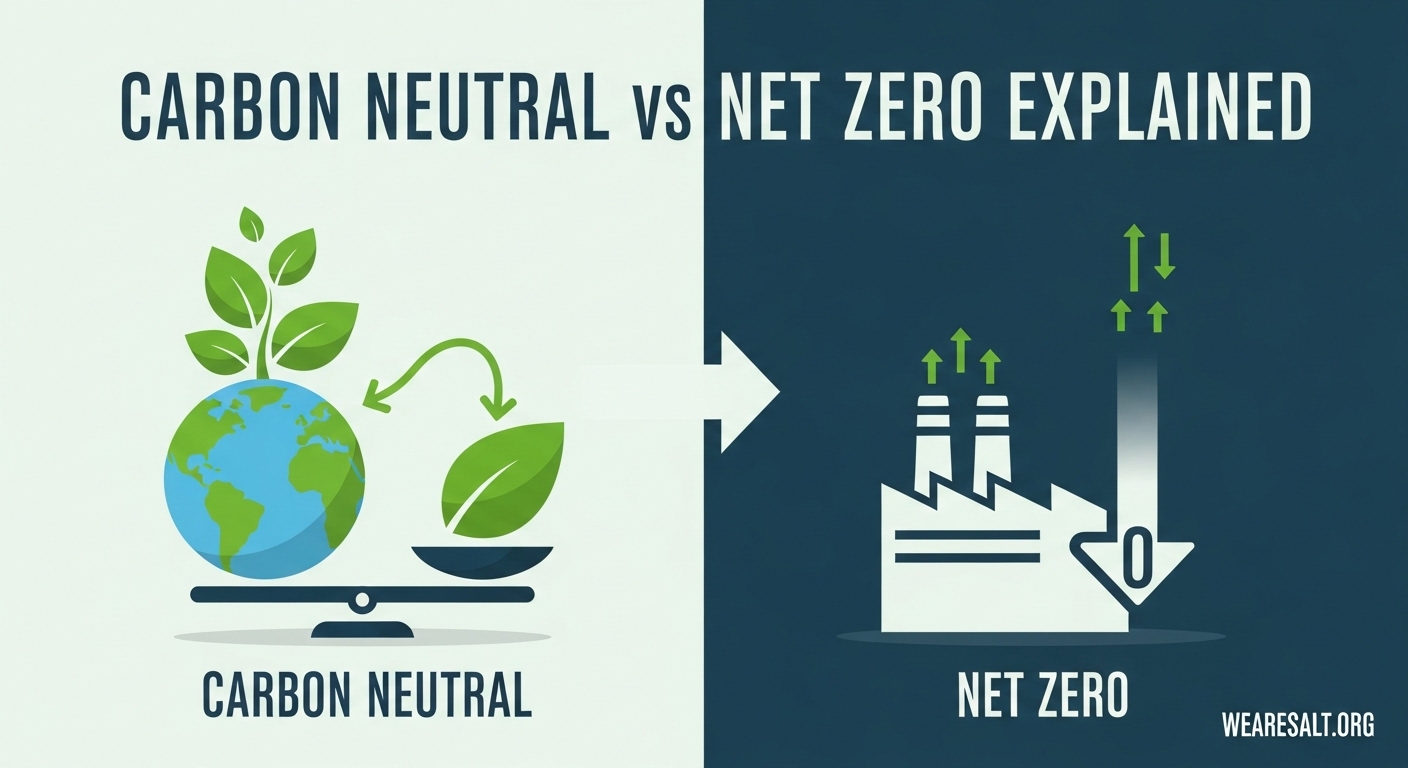
You have probably seen companies proudly announce they are going carbon neutral. Then you read about another organization committing to net zero. The terms sound similar, but they represent fundamentally different approaches to addressing climate change. Understanding the distinction between carbon neutral vs net zero matters whether you are evaluating corporate claims, making purchasing decisions, or setting your own sustainability goals.
I spent weeks researching how companies use these terms for 2026 sustainability reports. The confusion is real and intentional in some cases. Some organizations exploit the ambiguity to make their environmental efforts sound more impressive than they actually are. This guide cuts through the marketing speak and explains exactly what each term means, how they differ, and which approach delivers real climate impact.
By the end of this article, you will understand the technical definitions, the practical implications, and how to spot greenwashing when you see it.
Table of Contents
What Is Carbon Neutral?
Carbon neutral means balancing the amount of carbon dioxide a person, company, or activity releases into the atmosphere with an equivalent amount removed or offset. The key word here is balancing. You are still emitting carbon, but you are compensating for those emissions through other activities that remove or prevent carbon elsewhere.
Think of it like a household budget. If you spend $100, you need to earn $100 to break even. Carbon neutrality works the same way. Your emissions are the spending. Carbon offsets are the earnings that bring you back to zero.
How Carbon Neutrality Is Achieved
Organizations typically follow three steps to achieve carbon neutral status. First, they measure their total greenhouse gas emissions across all operations. This includes direct emissions from owned vehicles and facilities, indirect emissions from purchased electricity, and often supply chain emissions too.
Second, they reduce emissions where possible. This might involve switching to renewable energy, improving energy efficiency, or optimizing logistics. However, and this is important, carbon neutral does not require significant reduction. Some companies barely reduce anything before moving to step three.
Third, they purchase carbon offsets or credits to compensate for remaining emissions. These offsets fund projects like reforestation, renewable energy installations, or methane capture. The organization pays someone else to reduce or remove carbon equivalent to their own emissions.
Real-World Carbon Neutral Examples
Google has been carbon neutral since 2007. The company achieved this by purchasing high-quality carbon offsets to compensate for emissions they could not eliminate internally. They have since moved toward 24/7 carbon-free energy, which is more ambitious than simple neutrality.
Many airlines now offer carbon neutral flights. Passengers pay a small surcharge that funds offset projects. The flight still emits the same amount of carbon, but the airline claims neutrality because they have purchased credits equivalent to the flight emissions.
Countries can be carbon neutral too. Costa Rica aims to achieve full carbon neutrality. The small Central American nation has made significant progress through reforestation, renewable energy investment, and sustainable agriculture practices.
What Is Net Zero?
Net zero means achieving a state where human-caused greenhouse gas emissions are balanced by human-caused removals, but with a critical requirement. Unlike carbon neutral, net zero demands that organizations first reduce their emissions as much as possible through direct action before considering any offsets.
The Science Based Targets initiative, the gold standard for corporate climate commitments, requires at least 90% emissions reduction across all scopes before the remaining 10% can be neutralized through permanent removals. This is the key distinction that makes net zero far more ambitious than carbon neutral.
Net zero is aligned with the Paris Agreement goal of limiting global warming to 1.5 degrees Celsius. The Intergovernmental Panel on Climate Change has identified net zero as essential to avoiding the worst impacts of climate change.
The Science-Based Approach
Net zero follows the mitigation hierarchy. Eliminate emissions first. Reduce what you cannot eliminate. Only then should you neutralize the small amount of residual emissions that cannot be technically or economically reduced further.
This approach prioritizes actual decarbonization over compensation. A net zero company transforms its operations, supply chain, and products to eliminate fossil fuel dependence. They might electrify their vehicle fleet, switch to 100% renewable energy, redesign products for circularity, and require suppliers to decarbonize.
The remaining 10% of hard-to-abate emissions, typically from processes like cement production or aviation, can then be neutralized through carbon removal credits. These must be permanent removals, not avoidance offsets, storing carbon for centuries rather than decades.
Real-World Net Zero Examples
IKEA has committed to becoming climate positive by 2030, which goes beyond net zero. Their strategy includes transforming their entire value chain, from raw material extraction to customer use and product end-of-life. They are redesigning products, shifting to renewable energy, and working with thousands of suppliers to reduce emissions.
Microsoft has pledged to be carbon negative by 2030. By 2050, they aim to remove from the atmosphere all the carbon they have emitted since their founding in 1975. Their approach includes a $1 billion climate innovation fund and internal carbon pricing to drive behavioral change.
The United Kingdom has legislated a net zero by 2050 target. The country has already reduced emissions by nearly 50% since 1990 through phasing out coal power, expanding renewable energy, and improving building efficiency.
Carbon Neutral vs Net Zero: Key Differences
The core difference comes down to one principle. Carbon neutral allows organizations to maintain high emission levels as long as they purchase enough offsets. Net zero requires fundamental transformation to eliminate emissions at the source before any neutralization.
Here is a detailed comparison of how carbon neutral and net zero differ across ten key dimensions.
| Attribute | Carbon Neutral | Net Zero |
|---|---|---|
| Primary method | Offsetting emissions | Reducing emissions |
| Required reduction | None specified | Minimum 90% reduction |
| Type of credits | Avoidance and removal | Removal only for residual |
| Timeframe | Can be immediate | Typically 2040-2050 |
| Scope coverage | Often limited | All scopes required |
| Verification standard | PAS 2060 | SBTi Net Zero Standard |
| Paris alignment | Partial | Full 1.5C alignment |
| Permanence requirement | Not required | Centuries-long storage |
| Cost structure | Lower upfront, ongoing offsets | High upfront transformation |
| Credibility risk | Higher greenwashing potential | More rigorous, transparent |
Offsets vs Reduction: The Critical Distinction
Carbon neutral relies heavily on carbon offsets, which come in two varieties. Avoidance offsets prevent emissions that would have happened otherwise, like protecting a forest that might have been cut down. Removal offsets extract carbon from the atmosphere, like planting trees or direct air capture technology.
Net zero only accepts removal offsets for the final 10% of residual emissions, and these must be high-quality permanent removals. The other 90% must come from actual emissions reduction through decarbonization of operations.
This distinction matters because avoidance offsets do not remove any carbon from the atmosphere. They merely prevent hypothetical future emissions. A company claiming carbon neutrality through avoidance offsets is not actually removing their carbon footprint. They are paying for someone else not to create a different footprint.
Understanding Carbon Offsets and Credits
Carbon offsets and credits are the mechanisms that make carbon neutrality possible. Understanding how they work helps you evaluate whether a company claim is credible or greenwashing.
A carbon credit represents one tonne of carbon dioxide equivalent either removed from the atmosphere or prevented from being emitted. Companies purchase these credits to compensate for their own emissions. One credit typically equals one tonne of CO2.
Removal vs Avoidance Credits
Removal credits come from activities that physically extract carbon from the atmosphere and store it. Examples include afforestation, soil carbon sequestration, biochar, and direct air capture. These are preferred for net zero because they actually reduce atmospheric carbon levels.
Avoidance credits come from preventing emissions that would have occurred in a business-as-usual scenario. Examples include renewable energy projects that displace coal power, methane capture from landfills, and forest protection from logging. While valuable, these do not remove existing carbon.
The quality of carbon credits varies dramatically. High-quality removal credits with permanent storage and strong verification command premium prices. Low-quality avoidance credits with uncertain additionality and temporary storage sell for pennies. Companies buying cheap credits to claim neutrality should raise red flags.
Quality Concerns and Due Diligence
Not all carbon credits are created equal. Problems include additionality, where projects would have happened anyway without credit revenue. Permanence is another concern, as forests can burn down releasing stored carbon. Leakage happens when protecting one forest simply shifts deforestation elsewhere.
Credible net zero commitments use only high-quality removal credits for residual emissions. These must demonstrate clear additionality, measure carbon accurately, ensure permanence for centuries, and be independently verified by standards like Gold Standard or Verra.
How to Achieve Carbon Neutral or Net Zero Status
Organizations follow different pathways depending on whether they target carbon neutral or net zero. Both begin with measurement but diverge significantly in implementation.
Steps to Achieve Carbon Neutrality
Step one is conducting a greenhouse gas inventory following the GHG Protocol. This identifies all emission sources across scope 1 (direct), scope 2 (purchased energy), and optionally scope 3 (value chain).
Step two involves identifying quick wins for reduction. Switch to renewable electricity, improve building efficiency, optimize logistics routes, and reduce business travel. These measures lower the offset burden but are not strictly required.
Step three is purchasing carbon credits equal to remaining emissions. Many organizations achieve carbon neutrality within a year using this approach. PAS 2060 provides the certification standard for credible carbon neutral claims.
Steps to Achieve Net Zero
Net zero requires a transformation roadmap spanning years or decades. Step one is the same measurement process, but with full scope 3 inclusion mandatory.
Step two involves setting science-based targets through SBTi validation. These targets must align with 1.5-degree pathways and include interim milestones. Companies commit to specific percentage reductions by specific years.
Step three is the heavy lifting of decarbonization. This means electrifying fleets, retrofitting buildings, redesigning products, shifting to renewable energy, and engaging thousands of suppliers. This phase takes years and requires significant capital investment.
Step four addresses the final 10% of residual emissions through permanent removal credits only. These might include direct air capture, enhanced weathering, or bioenergy with carbon capture and storage.
Understanding Scope 1, 2, and 3 Emissions
Scope 1 emissions come from sources an organization owns or controls directly. Company vehicles, manufacturing facilities, and on-site power generation fall here. These are the easiest to measure and reduce.
Scope 2 covers indirect emissions from purchased energy. Electricity, heating, and cooling bought from utilities count here. Switching to renewable energy eliminates these emissions.
Scope 3 includes all other indirect emissions across the value chain. Purchased goods and services, business travel, employee commuting, waste disposal, and product use by customers contribute here. For most companies, scope 3 represents 70-90% of total emissions and is the hardest to address.
Related Terms: Climate Positive and Carbon Negative
Beyond carbon neutral and net zero, you will encounter climate positive and carbon negative claims. These represent even more ambitious commitments.
Climate positive means going beyond net zero to create additional environmental benefit. A climate positive company removes more carbon than it emits, leaving the atmosphere better than before their operations. IKEA uses this term for their 2030 commitment.
Carbon negative means the same thing as climate positive, just expressed differently. Microsoft uses carbon negative to describe their goal of removing more carbon than they emit. Both terms require net zero as the foundation.
Bhutan is the only carbon negative country in the world. The small Himalayan kingdom absorbs more carbon than it produces through extensive forest cover, renewable energy exports, and low industrial activity. Their constitution mandates that 60% of the country remain forested forever.
Avoiding Greenwashing: Evaluating Climate Claims
The explosion of climate commitments has brought greenwashing along with genuine progress. Learning to evaluate claims protects you from misleading marketing and encourages better corporate behavior.
Red Flags to Watch For
Vague timelines signal weak commitments. By 2050 is far less credible than specific interim targets for 2030, 2035, and 2040. Look for detailed roadmaps, not aspirational endpoints.
Heavy reliance on offsets without reduction plans indicates carbon neutral washing. Companies should explain exactly how they will transform operations, not just what credits they will buy.
Limited scope coverage is another warning. If a company only reports scope 1 and 2 while ignoring scope 3, they are ignoring the majority of their footprint. Full climate accountability requires addressing the entire value chain.
Questions to Ask
When evaluating a corporate claim, ask whether they have science-based targets validated by SBTi. This independent verification ensures commitments meet rigorous standards.
Ask what percentage of their target involves actual reduction versus offsetting. The higher the reduction percentage, the more credible the commitment. Net zero requires 90% reduction.
Ask about scope 3 coverage. Do they include supply chain and product use emissions? If not, their commitment excludes most of their climate impact.
Frequently Asked Questions
What is the difference between net zero and carbon neutral?
Carbon neutral means balancing emissions by purchasing offsets that equal your carbon output, allowing you to maintain current emission levels. Net zero requires reducing emissions by at least 90% through actual decarbonization before neutralizing the remaining 10% with removal credits. The key difference is that carbon neutral relies on compensation while net zero demands transformation.
What is the difference between carbon-neutral, net-zero, and climate positive?
Carbon-neutral balances emissions with offsets of any type. Net-zero requires 90% emissions reduction plus permanent removal credits for residual emissions. Climate positive goes beyond net-zero by removing more carbon than emitted, creating net environmental benefit. Climate positive is the most ambitious of the three commitments.
Which is better: carbon neutral or net zero?
Net zero is better from a climate science perspective because it requires fundamental transformation of operations and value chains. Carbon neutral can be achieved immediately by purchasing offsets without changing business practices. However, carbon neutral is a valid stepping stone for organizations beginning their climate journey, provided they plan to progress toward net zero.
Can a company be carbon neutral and net zero?
A company can transition from carbon neutral to net zero but the terms represent different stages of commitment. Carbon neutral is the starting point where emissions are balanced with offsets. Net zero is the destination requiring deep decarbonization. A company claiming both simultaneously should clarify whether they have achieved the 90% reduction required for net zero or are simply using the terms interchangeably.
What are SBTi and PAS 2060?
SBTi stands for Science Based Targets initiative, an organization that validates corporate net zero commitments against climate science and the Paris Agreement. PAS 2060 is the international standard for carbon neutrality certification, specifying how to measure, reduce, and offset emissions credibly. SBTi represents higher ambition aligned with 1.5-degree warming limits, while PAS 2060 provides a framework for immediate carbon neutral claims.
Conclusion
Understanding carbon neutral vs net zero empowers you to evaluate climate claims critically and make informed decisions. Carbon neutral allows organizations to maintain emissions while purchasing offsets. Net zero requires transformative reduction of at least 90% before any offsetting.
For 2026 and beyond, the trend is clear. Leading companies are moving beyond carbon neutral commitments toward science-based net zero targets. The Science Based Targets initiative has validated over 4,000 corporate commitments, representing serious climate action. Regulatory frameworks like the EU Corporate Sustainability Reporting Directive increasingly require detailed emissions disclosure and credible transition plans.
Whether you are a consumer choosing between brands, an employee evaluating employers, or a business leader setting strategy, demand specificity. Ask about reduction percentages, scope coverage, timelines, and verification. The climate crisis requires genuine transformation, not creative accounting.