
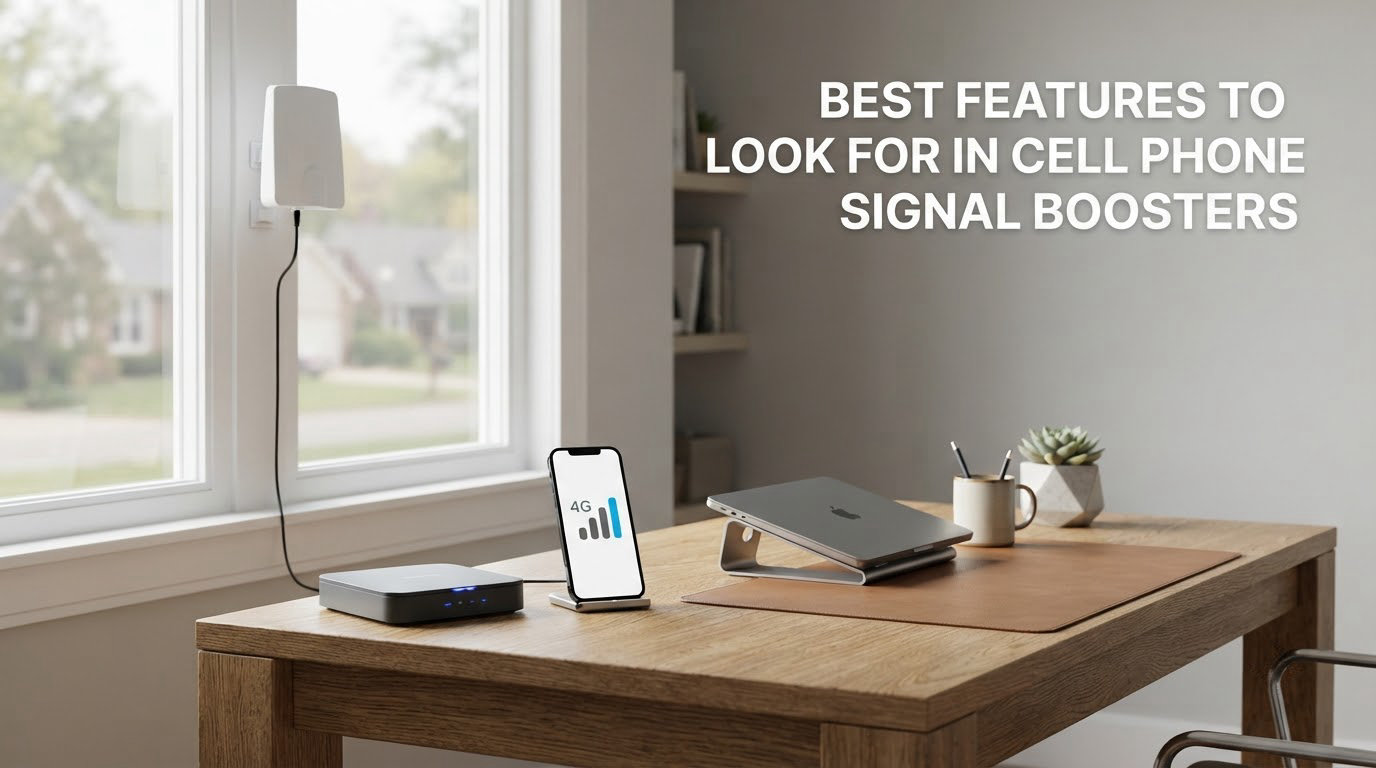
Most people buy a cell phone signal booster for the wrong reason. They see a coverage number on the box, assume more square footage means a better kit, and end up with an expensive mistake propped against a living room wall that never fixed the dead zone in the basement.
The truth is that gain matters far less than almost everyone thinks. The features that actually decide whether a booster works are antenna type, output power, FCC certification, and how well the outside antenna is aimed at your nearest tower.
That is why we built this guide around best features to look for in cell phone signal boosters rather than around a brand list. We scored eight kits against the same criteria set: gain in dB, uplink and downlink output power, FCC and ISED certification, multi-carrier versus single-carrier design, antenna type, real coverage, outside signal testing, and warranty with support.
Every spec below comes from the manufacturer listing, and every performance note comes from the review record on that listing.
Updated for 2026, the eight boosters below cover the four real buyer situations: a house with dead rooms, a multi-level or metal-roofed home, an apartment or home office, and a truck, van or RV.
If you already know you want a general-purpose home kit, our [best cell phone signal boosters roundup](https://www.wearesalt.org/best-cell-phone-signal-boosters/) goes deeper on the shortlists. We also have separate guides for [boosters for home](https://www.wearesalt.org/best-cell-phone-boosters-for-home/), [rural properties](https://www.wearesalt.org/best-cell-phone-boosters-for-rural-areas/), [cars and trucks](https://www.wearesalt.org/best-cell-phone-boosters-for-cars/) and [5G-capable units](https://www.wearesalt.org/best-5g-cell-phone-boosters/).
Table of Contents
The 8 Features to Look for in a Cell Phone Signal Booster
These eight criteria are the ones that decide whether a booster works in your specific building. Read the whole list before you look at a single product page, because the first two criteria rule out more purchases than the other six combined.
1. Gain in dB, and whether it is a real gain figure or a marketing one. Gain in dB measures how much the booster increases an existing signal, and 30 dB is roughly a thousand-fold power increase. More is not automatically better: excess gain on a strong signal creates interference for everyone nearby, which is why good systems have automatic gain control that backs off when it detects overload. The FCC caps certified consumer boosters at 72 dB for multi-carrier stationary systems and 100 dB for single-carrier systems, so a number above those caps is hiding something.
2. Uplink and downlink output power in dBm. Downlink is what your phone receives, downlink power is what the tower receives from you. Uplink is the half most shoppers never ask about, and it is the half that fixes the most common complaint: bars full of 5G, data fast, and outgoing texts, calls and location pings still fail. A booster advertised only for downlink is a half-measure, and “2x uplink” is the phrase to look for.
3. FCC or ISED certification, stated by certification ID. Only certified boosters are legal to operate and sell in the US. An uncertified unit can shut down, get seized, and in the worst documented cases lead to a fine or a network de-listing. Look for an explicit FCC ID on the listing, not a vague “FCC approved” badge, and treat marketplace units with no FCC ID as unusable.
4. Multi-carrier versus single-carrier support. A multi-carrier booster amplifies every supported band at once, which is what you want in a home where different people use different carriers. A single-carrier system concentrates all of its gain on one network, which is far more powerful for rural homes but stops working the moment you switch SIMs or the tower serving you changes bands.
5. Antenna type, because this decides which towers you can hear. A directional Yagi outdoor antenna reaches much farther, but only toward the one tower you aim it at. An omnidirectional whip hears weaker signals from every direction, which is the right choice when you do not know where the tower is or when towers sit in different directions. Indoor antennas are panels or domes for wide rooms and low ceilings, or low-gain whips for a single desk.
6. Coverage area in square feet, read as a guide and not a promise. The label number assumes good outside signal and perfect placement. Real coverage depends first on what your outdoor antenna can capture, and second on how the boost distributes through floors, concrete and metal.
Oversizing a booster for a small space is a real mistake, because a 72 dB unit in a 400 square foot apartment will simply overload and shut down. That is why the coverage figure is a guide.
7. Tools that let you test outside signal before you commit. An LCD showing live signal readings, a phone app with tower-finding, or loopback detection tells you what the unit is actually doing during setup. This is the feature that separates a twenty-minute install from a lost weekend, and it is the one most product pages bury.
8. Warranty length, US-based technical support, and no subscription. Antenna placement is a skill, and you will want someone on the other end of the phone who can help you aim. A one-time purchase with no monthly service, a three-year warranty, and reachable US-based support are worth real money, and they are the last thing buyers check and the first thing they wish they had.
How a Cell Phone Signal Booster Actually Works?
A booster is a three-part system: a donor antenna outside, an amplifier, and a server antenna inside. The donor antenna captures whatever cellular signal exists outside, the amplifier raises it without changing the content of the signal, and the server antenna rebroadcasts the strengthened version indoors.
Because it can only amplify what already exists, a booster will not create coverage in an area with no signal at all. That single fact is the most repeated technical statement across every booster forum.
The most common failure is oscillation, which happens when the server antenna rebroadcasts a signal strong enough for the donor antenna to pick it up again. The booster hears its own output, treats it as feedback, and shuts itself down with an error light.
The fix is physical separation: at least 20 feet vertically or 50 feet horizontally between the two antennas. Plenty of people return a perfectly good booster because they never made that distance.
A second trap is Wi-Fi calling. If your phone hands calls and texts off to your home Wi-Fi, the boosted cellular signal never gets used and the whole purchase looks like a failure. If signal still feels unchanged after a successful install, turn off Wi-Fi calling on the handset for a day and test again.
Test Your Signal Before You Buy
Five minutes of measurement saves a return shipment. On iPhone, dial *3001#12345#* to enter field test mode, which shows live RSRP values. On most Android phones, the equivalent is *#*#4636#*#* in the dialer, or a network signal mode toggle in the about phone settings.
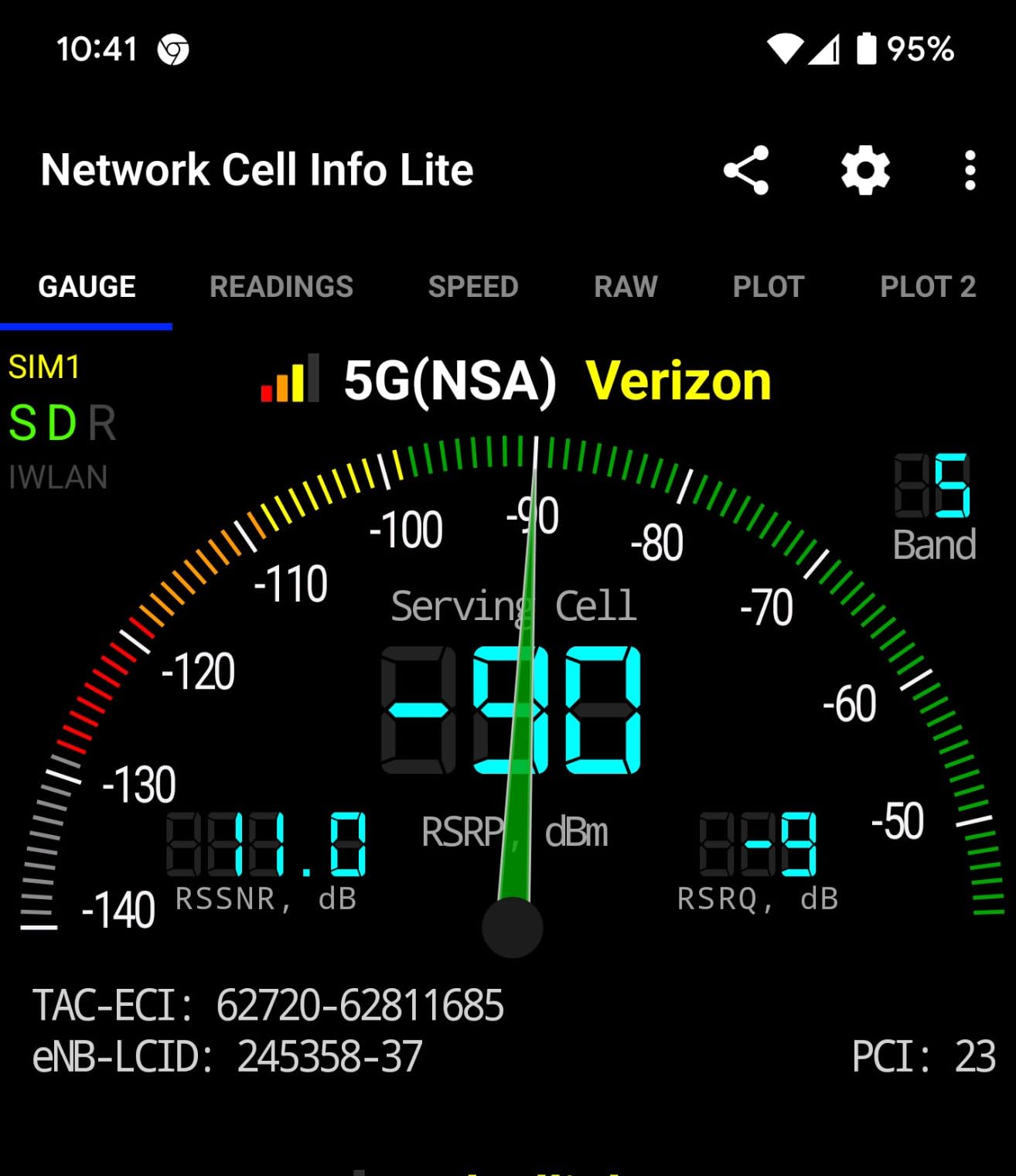
Reading the result: -50 to -79 dBm is a strong signal, -80 to -99 dBm is usable but marginal, and anything below -100 dBm is weak. The decision crossover sits at -80 dBm.
If your outside reading is weaker than -80 dBm, prioritize gain in dB and consider a high-gain single-carrier system. If it is stronger than -70 dBm, prioritize downlink output power and a multi-carrier kit, because the signal is already there and the problem is getting it indoors.
You can also force a network change with master reset codes. Dialing *3370 then a band code such as 0 for automatic, 1 for 4G LTE and 2 for 3G forces your phone to re-register on a chosen network. That is a fast way to see whether your outdoor signal is healthy on 5G or only on LTE. Dialing *3366 restores the default automatic behavior.
One more test before you buy: check which bands your phone supports. A booster that skips your phone’s bands will leave you exactly where you started, and this is the single most common surprise in the cheap end of the market.
Top 3 Cell Phone Signal Booster Features (October 2026)
weBoost Home MultiRoom
- Quad-band multi-carrier
- Up to 5000 sq ft
- App-guided install
- FCC ID PWO460044

HiBoost Home 4K Smart Link
- Up to 4000 sq ft
- LCD plus app tuning
- AGC smart chip
- 3-year warranty

HiBoost F08G Home Office
- Up to 2000 sq ft
- Color LCD signal display
- Tri-band with AGC
- 3-year warranty
Every Booster We Compared in 2026, Side by Side
| Product | Specifications | Action |
|---|---|---|
| weBoost Home MultiRoom |
|
Check Latest Price |
 CEL-FI GO G41 Smart Signal Booster CEL-FI GO G41 Smart Signal Booster |
|
Check Latest Price |
| HiBoost Home 4K Smart Link |
|
Check Latest Price |
 HiBoost 10K Smart Link HiBoost 10K Smart Link |
|
Check Latest Price |
| HiBoost F08G Home Office Booster |
|
Check Latest Price |
 weBoost Drive Reach OTR weBoost Drive Reach OTR |
|
Check Latest Price |
 GAGBK Car and RV Booster GAGBK Car and RV Booster |
|
Check Latest Price |
 ZORIDA 72 dB Booster ZORIDA 72 dB Booster |
|
Check Latest Price |
1. weBoost Home MultiRoom Review – Best All-Rounder for Most Homes
weBoost Home MultiRoom – ll Signal Booster – Enhances Phone Signal, Improved Connectivity for Stronger Cell Coverage for All U.S. Carriers – Verizon, AT&T, T-Mobile & More | Made in The U.S.
Quad-band multi-carrier
Up to 5000 sq ft
Yagi outdoor plus fabric indoor
App-guided install
Pros
- Boosts every cellular device in the home regardless of carrier
- Quad-band support on the main US carrier low and mid bands
- App guides installation and shows signal before and after
- Heaviest review record in the set at 2826 reviews
Cons
- Yagi outdoor antenna needs careful aiming at a tower
- 5G limited to carrier low and mid bands rather than mmWave
- Window entry hardware can fall short on complex installs
The weBoost Home MultiRoom is the kit we recommend first to almost anyone, because it is the least specific of the eight. It amplifies all four main US carrier bands at once, so it does not care who in the household is on which network. It covers up to 5,000 square feet or three to four rooms, which makes it the safe middle of the market rather than a specialist.
What we like most is the weBoost app, which walks you through aiming the outdoor antenna and shows you the signal reading before and after each adjustment. Guessing at antenna direction is a common cause of returns, and a tool that gives you feedback while you rotate the mount is worth more than the extra gain a pricier kit might add.
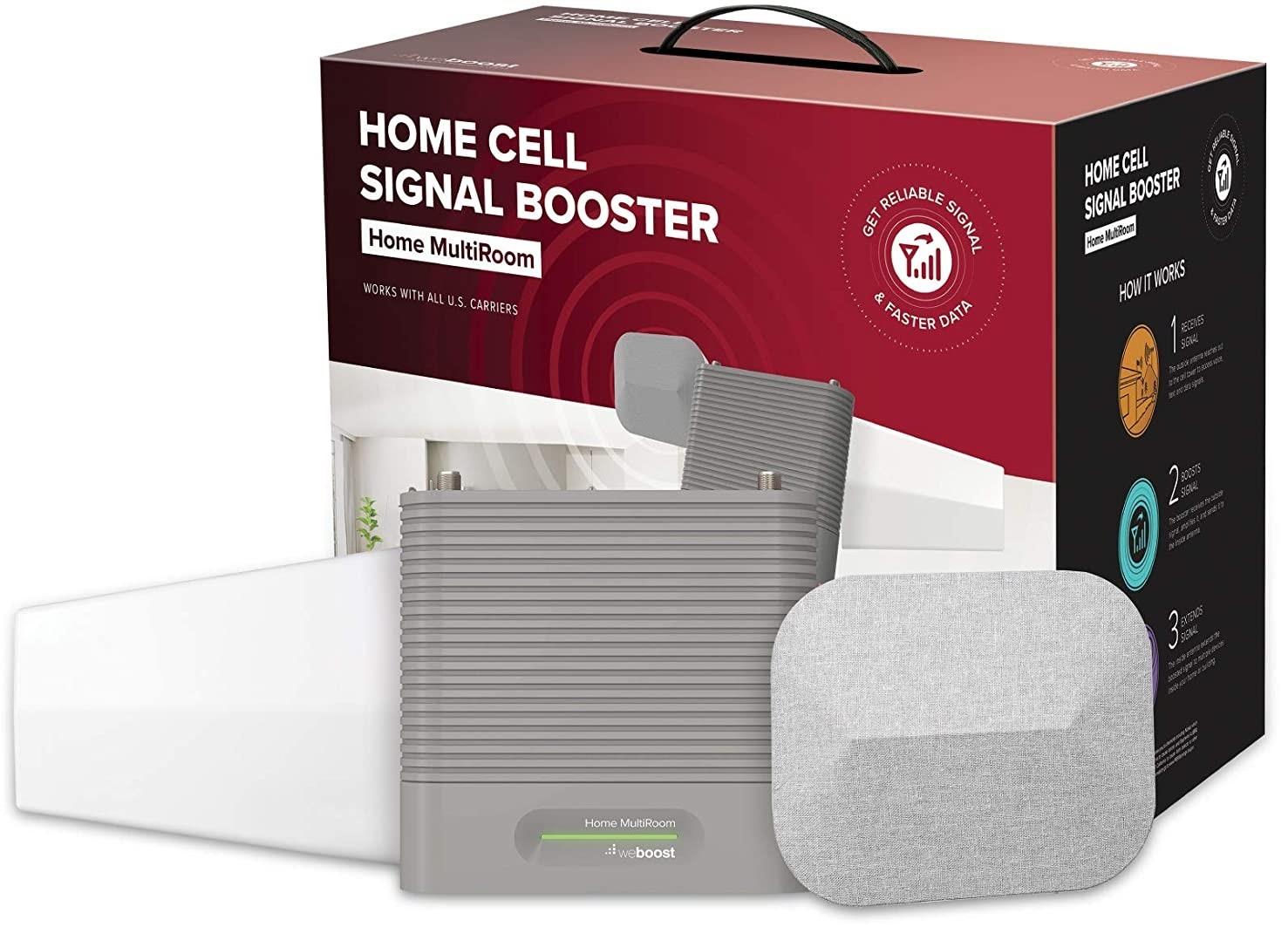
Band support is the honest limitation. The MultiRoom covers band 12/17, band 13, band 5, band 4 and band 25/2, which is every low and mid band the three major US carriers rely on, but it is not a 5G mmWave system and it will not boost 5G spectrum that does not ride on those bands. It is a 4G LTE and 5G-DSS booster, which in practice covers almost all current US 5G.
With 2,826 reviews at a 4.2 average, this is the most heavily reviewed booster in our set, and the review pattern is consistent. Buyers credit it with eliminating dead zones in basements, metal buildings and rural homes.
The 9% one-star share comes almost entirely from installation effort rather than from the system failing.
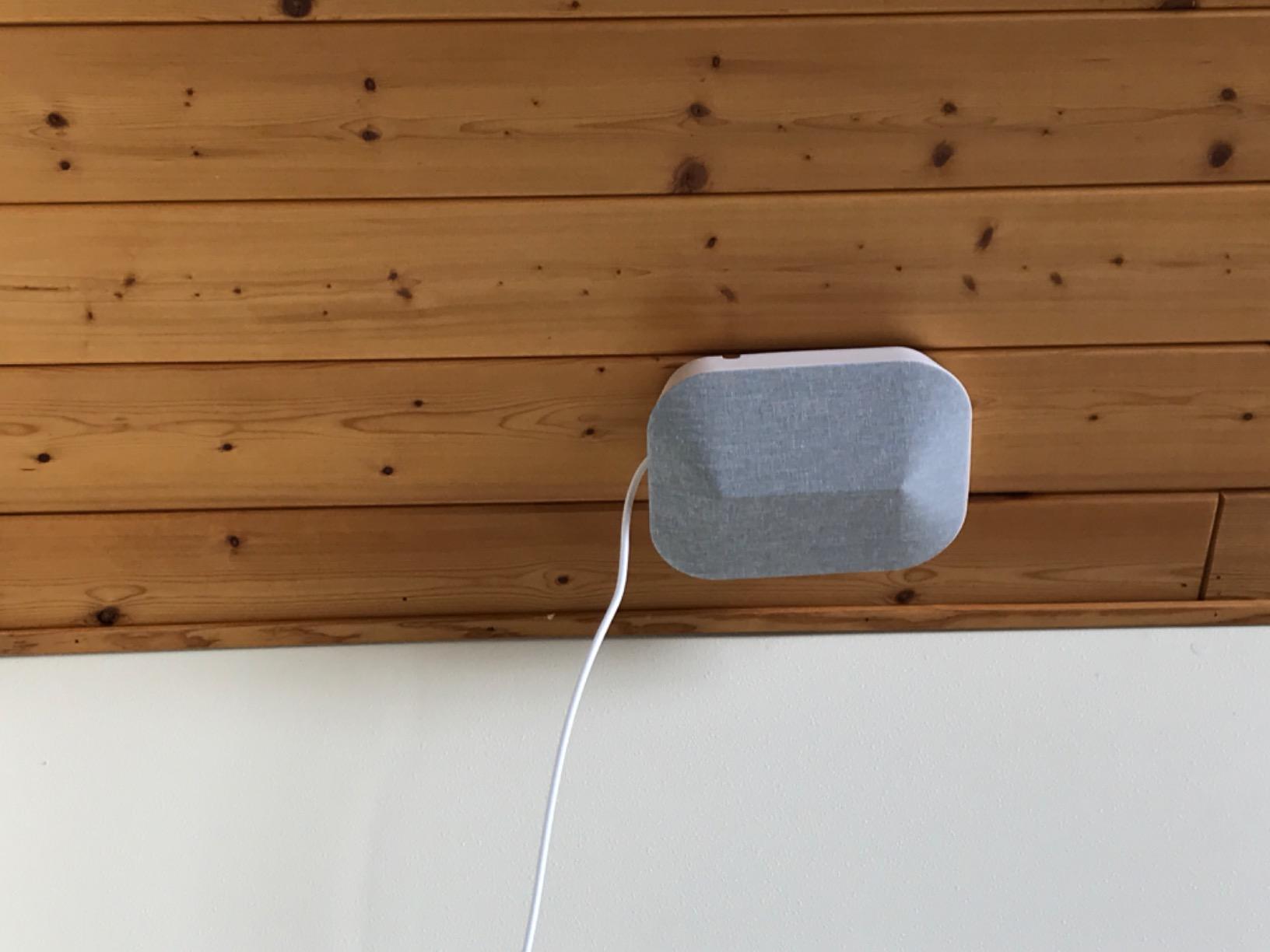
Who the weBoost Home MultiRoom suits?
It suits households with mixed carriers, a home of roughly 2,000 to 5,000 square feet, and at least one bar of signal outside. If your outdoor reading is decent and the problem is that your signal dies two rooms away, this is the correct pick and you will not need to spend more.
It also suits anyone who wants help during setup. WeBoost support and the in-app guidance are the two things that turn a two-hour install into a one-hour install, and the two-year warranty covers a mis-aimed antenna while you learn.
Where the weBoost Home MultiRoom falls short?
It falls short when the outdoor signal is genuinely weak, because 5000 square feet of multi-carrier coverage is not much gain to work with against a distant tower. A single-carrier system with far more gain handles that situation better.
The second limitation is the Yagi antenna itself. Directional antennas demand accuracy, and if the nearest tower is not in the direction you guessed, performance drops off sharply. The included window entry cable and mounting hardware are also the kind of thing that works for a standard single-story install and falls short on a three-story house with a metal roof.
2. CEL-FI GO G41 Review – Best for Rural Dead Zones and Large Homes
Nextivity CEL-FI GO G41 Smart Signal Booster, 1 Indoor Antenna
100 dB single-carrier gain
Up to 15000 sq ft
4G LTE, 5G-DSS and 5G NR
FCC ID YETG41-BE
Pros
- 100 dB gain reaches far beyond competing boosters
- Supports 4G LTE 5G-DSS and 5G NR on a current 4th-gen chipset
- Reviewers report jumps from zero bars to consistent 4G
- Proactive technical support that contacts buyers before and after installation
Cons
- Amplifies only two carrier frequencies at a time
- Included RF cable is thick and stiff for long runs
- Installation is not plug-and-play and needs patience
The CEL-FI GO G41 is the only unit here that operates at the FCC’s 100 dB single-carrier ceiling, and that single fact explains everything about it. It is a specialist. Where a multi-carrier kit spreads its gain across every band, the G41 concentrates 100 dB onto the two frequencies your carrier is using right now, which is why it can rescue a property where a tower is genuinely far away.
For a rural home, a cabin, or a house with metal siding and a large footprint, it carries the most raw gain in this list. Reviewers describe going from zero bars to consistent 4G across multi-story homes, and in one measured case downloads rose from roughly 12 Mbps to over 58 Mbps after installation.
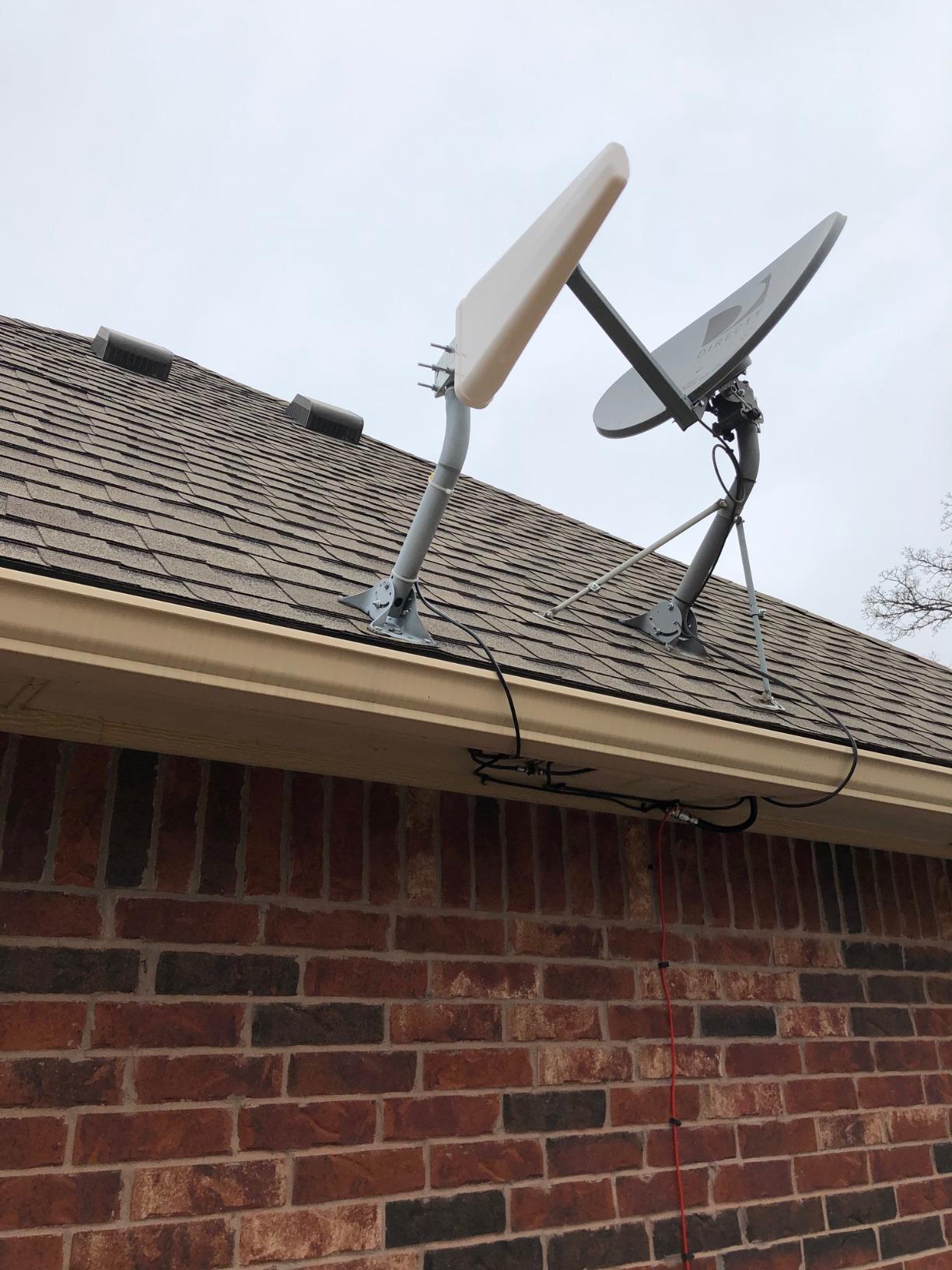
The chipset is a 4th-generation IntelliBoost unit supporting 4G LTE, 5G-DSS and 5G NR, and it ships with a single dome or panel indoor antenna covering up to 15,000 square feet. Reviewers repeatedly single out the support as exceptional and proactive, with contacts arriving before and after installation to help with antenna placement through the WAVE app.
Understand what the 100 dB figure costs you. Because the system locks onto one carrier, it will not help a second network in the same house, and it amplifies only two frequencies at a time, which can underperform in areas served by many base stations. It is also not plug-and-play: antenna placement and patience are part of the process, and the included RF cable is thick and stiff enough that a shorter replacement run may be needed for some installations.
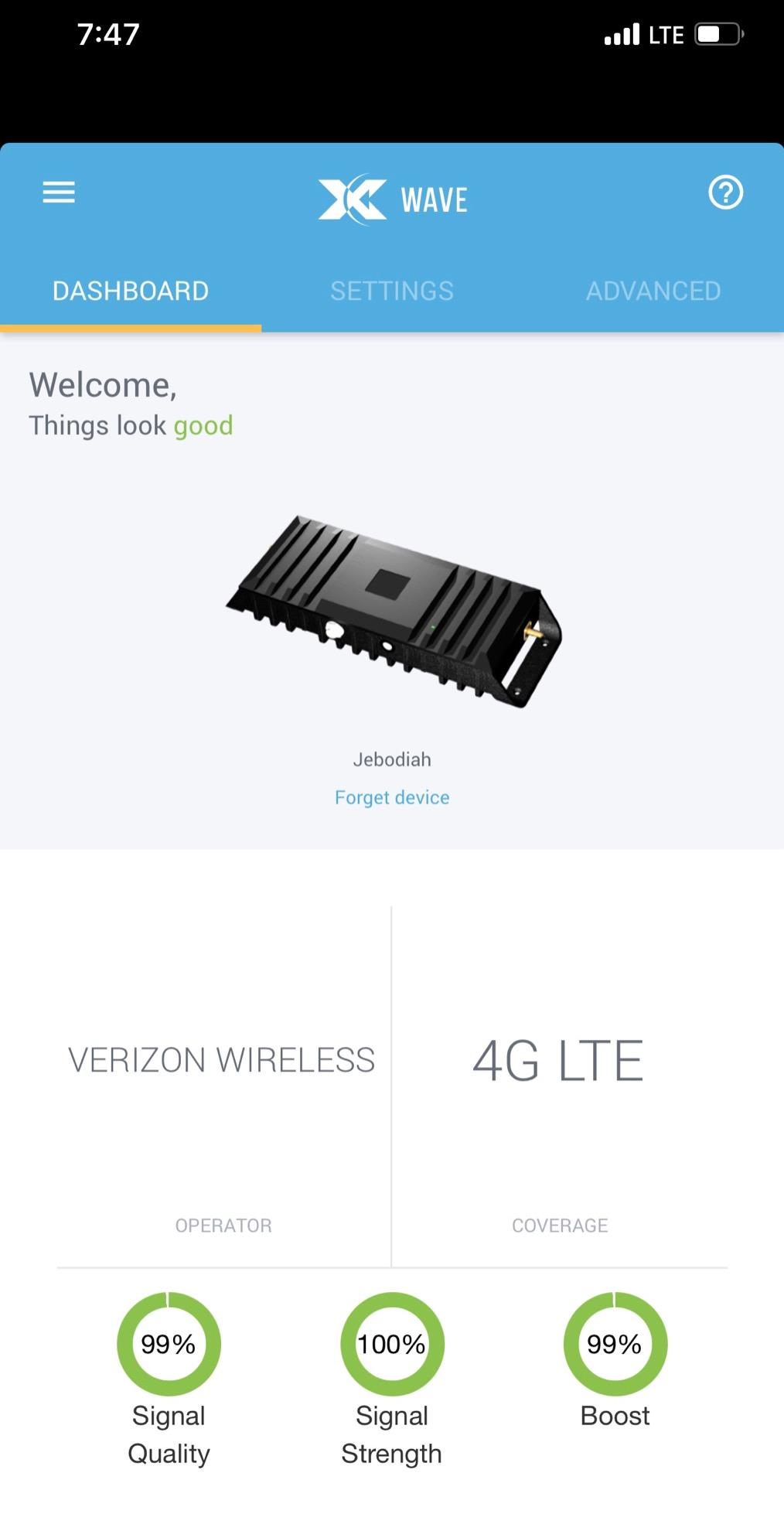
Who the CEL-FI GO G41 suits?
It suits a single-carrier household in a genuinely weak-signal area, especially rural properties, cabins and homes with metal roofs or concrete walls. It also suits anyone whose measured outdoor reading is below -80 dBm, because that is exactly the situation where gain matters more than multi-carrier flexibility.
If you have measured weak signal and a normal kit has already failed you, this is the step up. It is also the only unit here where the 15,000 square foot coverage figure is meaningful, because 100 dB of gain has the raw power to fill a large building.
Where the CEL-FI GO G41 falls short?
It falls short in mixed-carrier homes. A household where one person is on Verizon and another on T-Mobile gets benefit from only one of those networks at a time, which is rarely what a family wants in a shared building.
The setup is also more involved than a plug-and-play kit. Expect to spend real time on antenna placement through the app, and expect the stiff included cable to be the least pleasant part of the install.
At 682 reviews, it also has the thinnest review base in this set, so treat the strong 4.5 average with slightly more caution than the 4.4 on a kit with triple the feedback.
3. HiBoost Home 4K Smart Link Review – Best for Basements and Metal Roofs
Hiboost Cell Phone Signal Booster for Home and Office, 4,000 sq ft, Boost 5G 4G LTE Data for Verizon AT&T and All U.S. Carriers, FCC Approved
Up to 4000 sq ft across 2-3 rooms
App plus LCD signal display
AGC smart chip
3-year warranty
Pros
- Covers up to 4000 sq ft for 2-3 rooms and multi-user households
- Works with all US and Canadian carriers and survives carrier switching
- Tech support proactively contacts buyers to work through antenna aiming
- Through-the-window cable means no drilling for many installs
Cons
- Written instructions and app workflow often confusing
- No rooftop antenna mast included
- Needs at least one or two bars of outside signal
The HiBoost Home 4K Smart Link is our pick for the most common real-world problem: a house where the signal is fine outside and falls apart the moment you walk downstairs. It covers up to 4,000 square feet across two to three rooms, supports every US and Canadian carrier on bands 12/17/13/5/25/2/4, and adds 5G wherever carriers deploy it inside existing 4G bands through dynamic spectrum sharing.
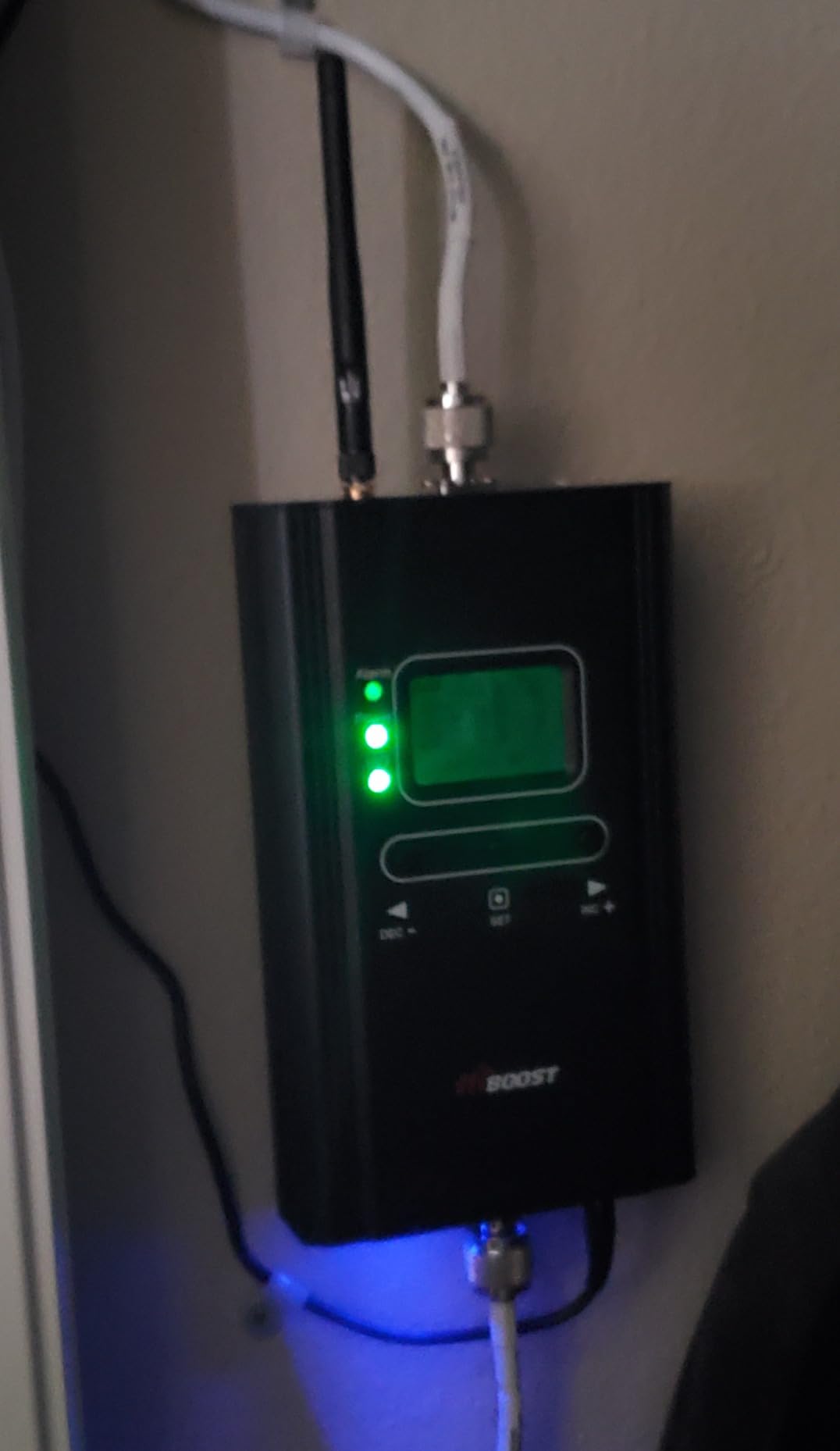
What separates it from cheaper kits is the combination of an on-unit LCD and the HiBoost app, which together let you watch signal strength change in real time while you adjust. Reviewers report the practical result clearly: going from one bar to three to five bars indoors. One detailed case describes one bar of 4G becoming five bars of 5G, with doubled download speeds and usable upload.
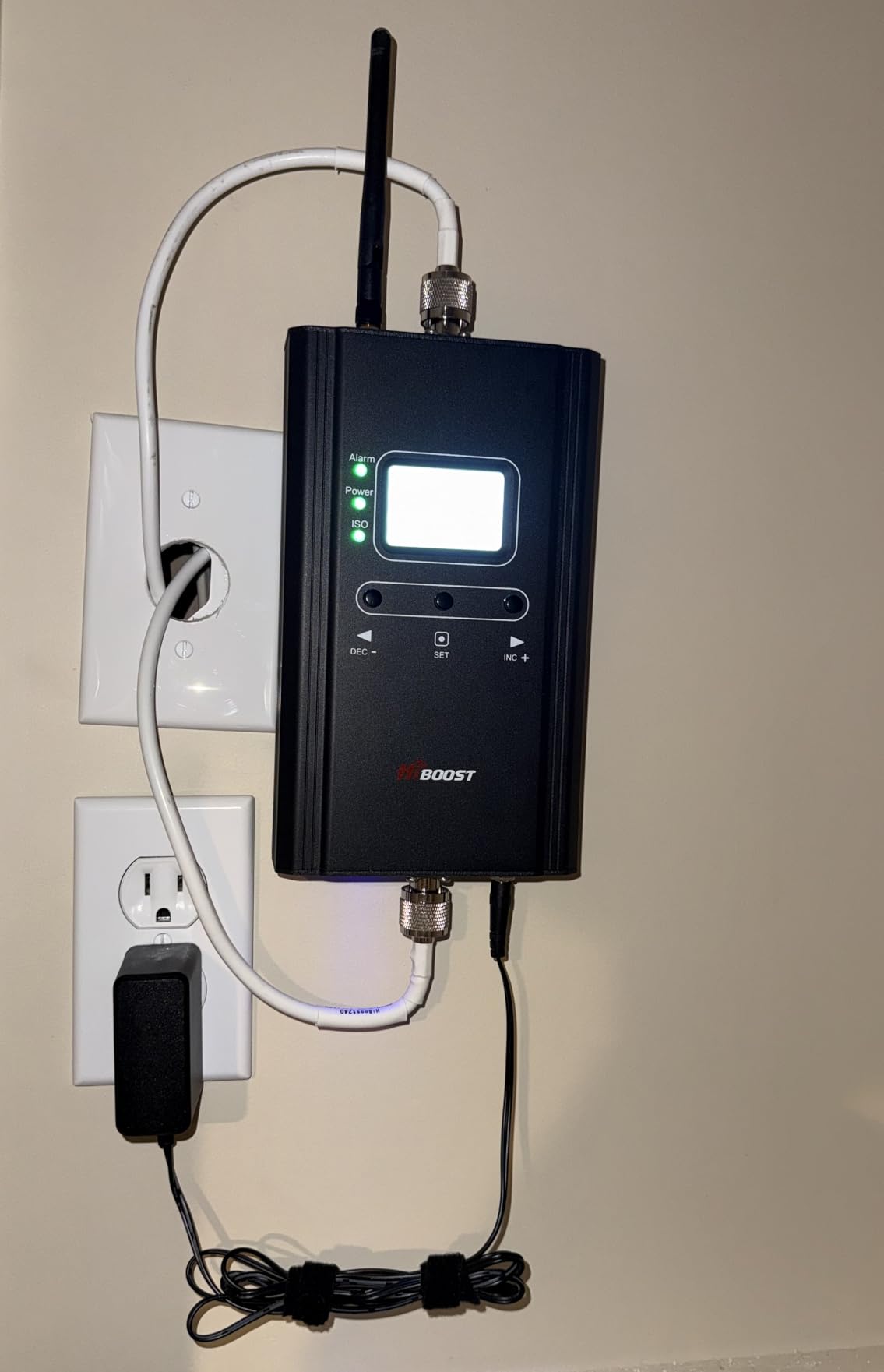
The AGC smart chip is worth noting as a spec, because it is what keeps the system stable when a nearby tower is strong. The kit includes an outdoor wide-band directional antenna, an indoor wide-band panel antenna, two 30-foot low-loss cables, a pole and wall mount bracket, and a through-the-window cable that removes the need to drill in a large share of installs.
The 4.4 average across 2,107 reviews sits alongside 75% five-star ratings. Proactive technical support that texts and calls buyers to fine-tune antenna placement is the single most praised attribute in the review record. The recurring negatives are documentation quality, the missing mounting pole, and the physical reality of a rooftop install.
Who the HiBoost Home 4K Smart Link suits?
It suits basements, thick-walled older homes, metal-roofed houses and home offices, particularly for anyone working from home who needs video calls to hold.
The 4,000 square foot figure fits a typical two-story home or a small office comfortably, and the multi-user rating is a real advantage in a shared building.
It also suits anyone who wants a support team involved in the install. Between the proactive outreach and the three-year warranty, this is a low-risk first purchase for someone who has never installed one.
Where the HiBoost Home 4K Smart Link falls short?
It falls short on documentation. Buyers report the written instructions and the app workflow as confusing, which is ironic in a product whose selling point is guided setup. Budget time for figuring it out, or lean on the support line.
The kit also omits a rooftop antenna mast, so you will likely need to buy one separately, and the install involves climbing, a ladder and cable routing that a lot of people underestimate. Finally, like most units here, it needs one or two bars of outside signal to work at all.
4. HiBoost 10K Smart Link Review – Best for Homes Over 5,000 Square Feet
Cell Phone Booster Cover 6000 sq ft, Boost 5G 4G LTE Signal for All US Carriers, Cell Phone Signal Booster for Home Office, APP Support, FCC Approved
Up to 5500-6000 sq ft
SignalSupervisor app aiming
All-carrier multi-band boost
3-year warranty
Pros
- Largest coverage figure of the HiBoost home range at 5500 sq ft
- Amplifies all carriers at once rather than locking to one
- App lets you aim the outdoor antenna from the roof and see results
- Loopback detection indicator makes it easier to tune correctly
Cons
- Band 71 at 600 MHz is not supported
- Third-party tower apps can mislead initial aiming
- A J-pole mount and longer indoor cable are not included
The HiBoost 10K Smart Link exists for one reason: to cover more floor area than the 4K model. Its rated coverage is up to 5,500 to 6,000 square feet, which puts it in range for a large house, a duplex, or a small commercial space. It still amplifies all carriers at once rather than locking to a single network.
The app-guided real-time aiming is the feature that distinguishes it. You mount the outdoor antenna, open the SignalSupervisor app, and watch the bars change as you rotate it, which removes the guesswork that costs people entire afternoons on other kits. A loopback detection indicator also makes it easier to tune correctly and to diagnose when something is wrong.
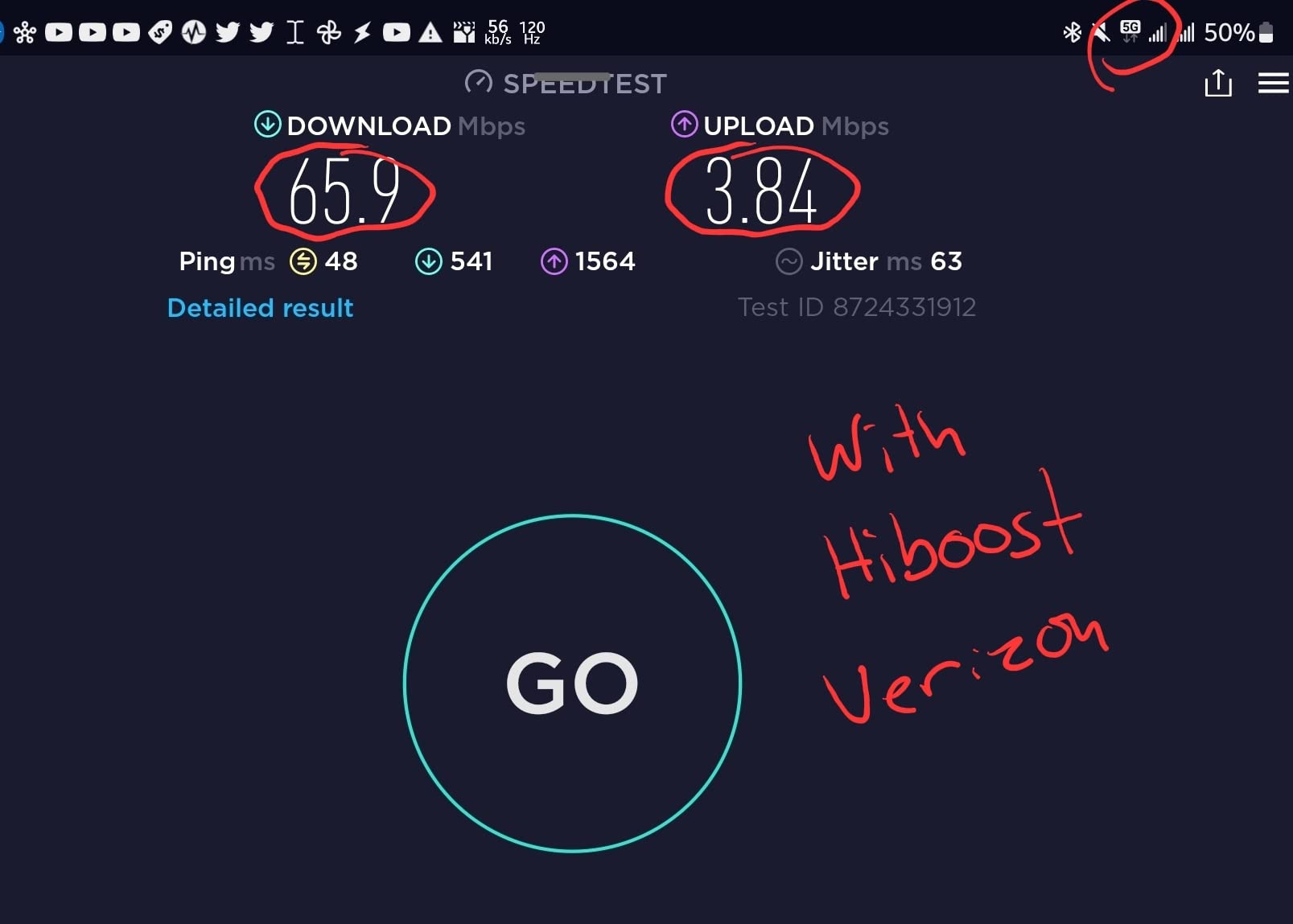
Reported results match the spec sheet. Reviewers describe going from calls-only service to consistent 25 to 50 Mbps 5G indoors, with quadrupled speeds and whole-home four-to-five-bar coverage.
Support will also ship additional indoor antennas and cabling when coverage gaps remain, which is a useful service at this product tier.
The 4.5 average across 691 reviews comes with 77% five-star ratings. The catch is a spec gap that matters more than the review count suggests: there is no Band 71 support, so 600 MHz T-Mobile frequencies cannot be boosted at all. In a rural T-Mobile area where 600 MHz is the band carrying your only signal, this is a real limitation.
Who the HiBoost 10K Smart Link suits?
It suits large homes, multi-level properties and small offices where the 4,000 square foot ceiling of the smaller HiBoost would leave dead rooms. It is also the better choice for anyone who wants a multi-carrier unit with app-based aiming rather than a manual compass-and-patience approach.
For mixed-carrier households above 5,000 square feet, it is the only multi-carrier option in this guide that is sized for the job. The loopback indicator also makes it forgiving for first-time installers.
Where the HiBoost 10K Smart Link falls short?
The missing Band 71 support is the headline problem, and T-Mobile customers in weak rural areas need to check which band their nearest tower actually broadcasts before buying.
Beyond that, third-party tower-finding apps point the wrong way often enough to mislead the first aiming attempt, which is ironic for a product that markets app-guided setup. A J-pole or similar mounting hardware is not included, and the indoor cable run may be too short for a large house without a second indoor antenna.
5. HiBoost F08G Review – Best for Apartments and Home Offices
Cell Phone Booster for Home Office | Boosts 5G & 4G LTE | Cell Phone Signal Booster for All U.S. Carriers-Verizon, AT&T, T-Mobile & More | for Band 12/17,13,5,25/2,4 | HD Display | App | FCC Approved
Up to 2000 sq ft
Color LCD and SignalSupervisor app
Tri-band with AGC
3-year warranty
Pros
- Color LCD shows real-time signal strength for precise installation
- SignalSupervisor app lets one person tune the antenna location
- Directional outdoor antenna pulls in signals from more distant base stations
- Three-year warranty with 30-day money back and no subscription
Cons
- 2000 sq ft is the smallest coverage area here
- Indoor whip antenna less effective in wide rooms
- Requires at least one bar of outside signal
The HiBoost F08G is the right booster for a small space, and small spaces are where most people actually need help. Its 2,000 square foot rating fits an apartment, a studio, a single-floor home office or a basement corner, and the kit is small enough to place without a ladder or a roof mount.
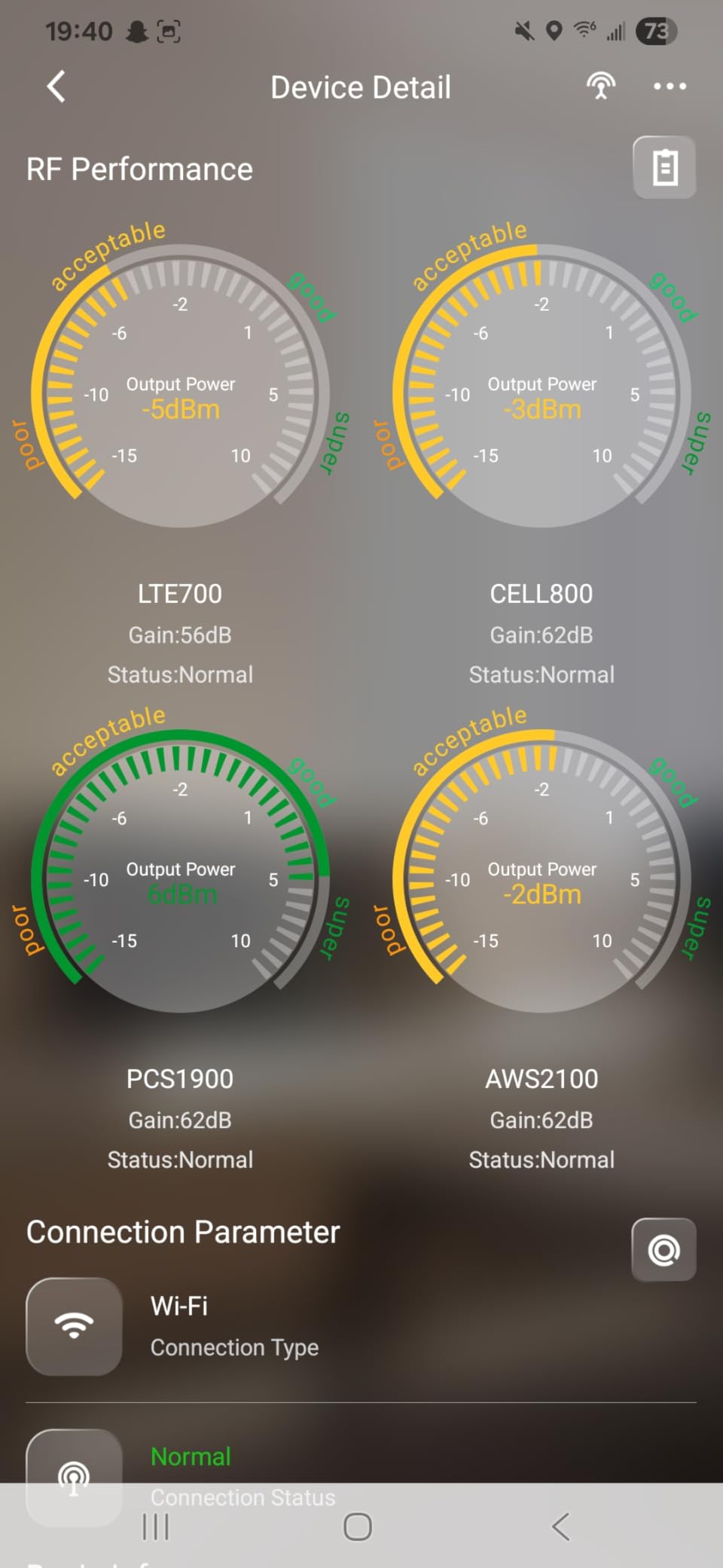
What we value here is the color LCD on the booster itself. It shows live signal strength, so you can hold the phone in the spot you care about, watch the number, and move the indoor antenna around until the reading is best. Combined with the SignalSupervisor app, it lets one person complete a tune that normally takes two people arguing about which wall to use.
Band support is solid for a kit this size: 12/17, 13, 5, 2/25 and 4, covering Verizon, AT&T, T-Mobile, Straight Talk and US Cellular, with 5G and 4G LTE compatibility. The listing is explicit that it requires at least one bar of outside signal, which is a hard limit on what any booster can do.
At 1,090 reviews and a 4.3 average, the sentiment splits cleanly by home size. Buyers in apartments and single-floor offices are happy with the coverage. The 10% one-star share comes almost entirely from people who expected a 2,000 square foot system to cover a much larger house.
Who the HiBoost F08G suits?
It suits apartment dwellers, renters who cannot mount anything on an exterior wall, and home offices under about 2,000 square feet. Anyone working from home in a space where a video call drops in the afternoon will see the clearest improvement.
It also suits buyers who want a small system with a real warranty behind it. A three-year warranty, 30-day money back and no carrier subscription is a low-risk way to find out whether a booster fixes your specific problem.
Where the HiBoost F08G falls short?
The 2,000 square foot ceiling is the whole story. Do not buy it for a two-story house, a farmhouse or a building with a basement, because the physics will not allow it and the disappointment will not be about the electronics.
The indoor whip antenna is a low-gain server antenna, because a whip radiates in all directions compared with the focused pattern of a panel or dome. In a wide open room with high ceilings, position matters more than it does with a panel. And as with the others, it does nothing where there is no signal to amplify.
6. weBoost Drive Reach OTR Review – Best for Trucks and SUVs
weBoost Drive Reach OTR – Cell Phone Signal Booster for Trucks and SUVs | Boosts 5G & 4G LTE for All U.S. Carriers – Verizon, AT&T, T-Mobile & more | Made in the U.S. | FCC Approved (model 477154)
50 dB max gain
High-gain trucker antenna
On and off switch on the plug
Two-year warranty
Pros
- High-gain trucker antenna reaches towers roughly twice as far as the previous model
- Turnkey install with no app and no phone setup
- Works across all US carriers for mixed SIM fleets
- Mast extension heights included for flexible truck and SUV mounting
Cons
- Internal antenna must be within roughly 18-36 inches of the device
- Needs 5-8 feet of separation between antennas to avoid oscillation
- Booster runs hot and the antenna assembly is criticized for durability
The weBoost Drive Reach OTR is a vehicle system, and it makes a different set of compromises than a home kit. It puts a high-gain trucker antenna on the roof of the cab and delivers 50 dB of max gain across all US carrier bands. It installs with no app and no phone setup at all, because there is an on and off switch on the power plug. You mount the antenna, plug it in, and it runs.
That zero-setup design is why RV and vanlife owners mention this line more than any other vehicle booster we looked at. Truckers, oil-field workers and remote couriers describe it as the thing that finally gave them dependable signal on the road, and the antenna is documented as reaching roughly twice as far as the previous model’s.
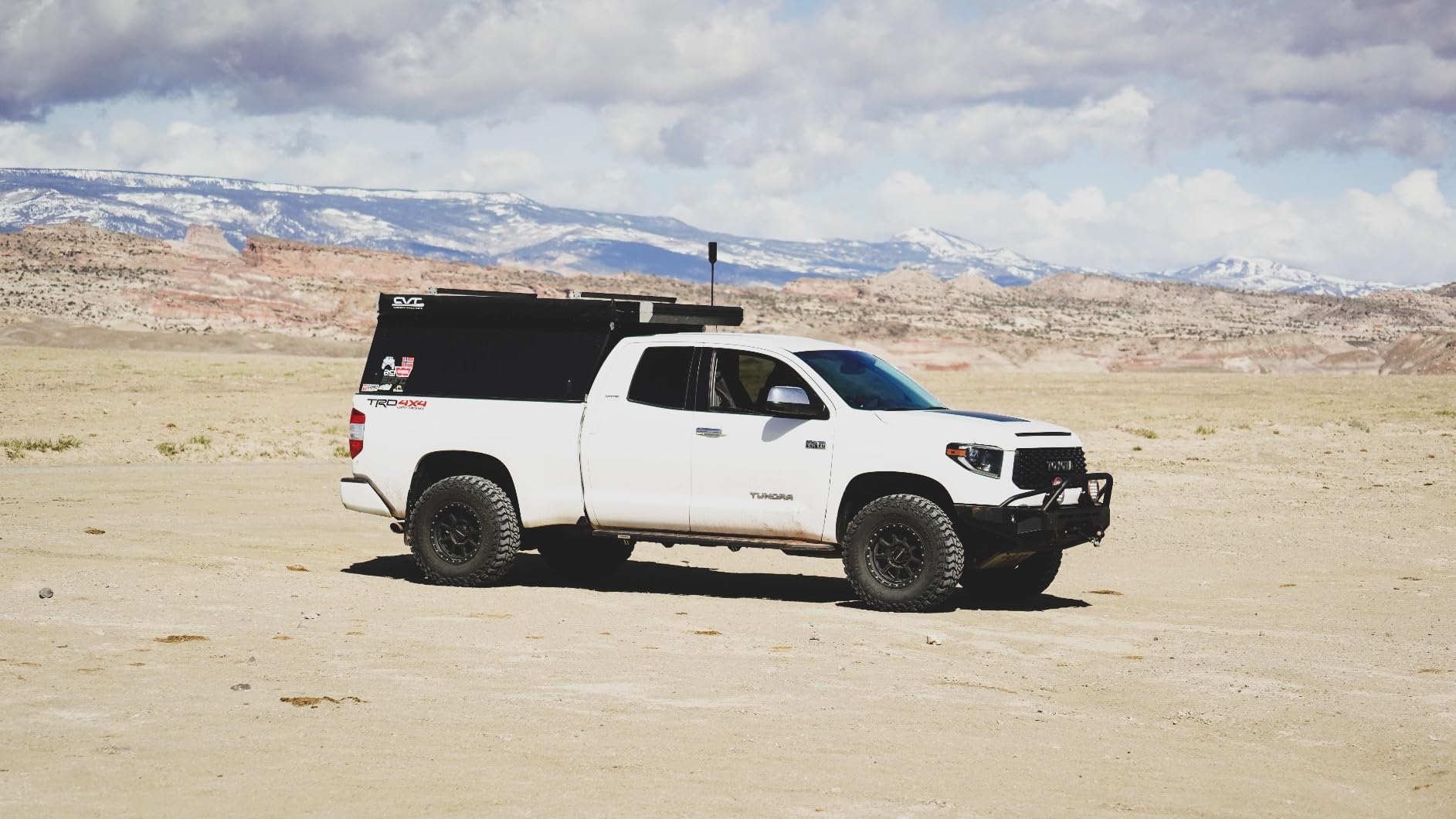
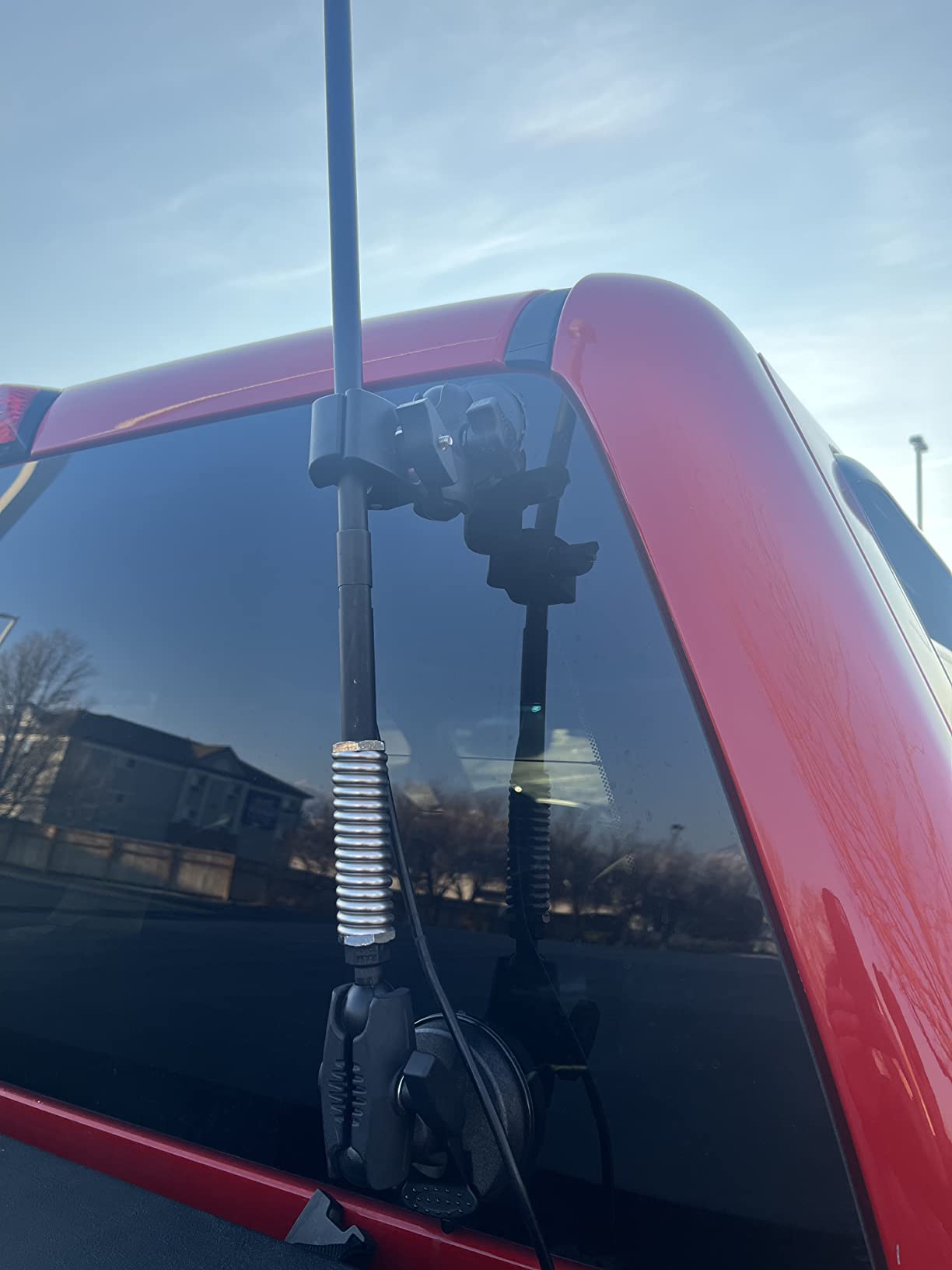
The included hardware is complete for the job: the Drive RV antenna, a bracket, a power supply, a slim low-profile interior antenna, coax cable, a side-exit adapter, two mast extensions at 13 and 18 inches, an antenna spring, thread lock packets and a cable adapter. FCC approved under FCC ID PWO460061 with a two-year warranty and US-based support.
The review record splits sharply by use case, which is normal for vehicle boosters. The 4.3 average across 991 reviews comes with a 67% five-star share, and the dissatisfied group is specific.
Some professional drivers argue it only adds a bar or two to marginal service, that the unit runs hot, and that the antenna assembly is not as durable as the price implies. Several also stress that the internal antenna must sit close to the device.
Who the weBoost Drive Reach OTR suits?
It suits long-haul truckers, fleet operators running mixed SIMs in one vehicle, and anyone who works in places where a dead zone is a safety problem rather than an inconvenience. Multi-carrier support handles a vehicle with company-issued and personal lines without any configuration.
It also suits anyone who does not want to fiddle. There is no app to learn, no antenna to aim at a specific tower, and the mast extensions give you the height options to get the antenna above the cab roof line, which is where the gain comes from.
Where the weBoost Drive Reach OTR falls short?
Antenna separation is the hard rule here, and it is stricter than in a home. The outside and inside antennas need 5 to 8 feet of separation to avoid self-oscillation, and the internal antenna must be within roughly 18 to 36 inches of the device using it. Get either of those wrong and the unit shuts down or underperforms.
The booster also runs hot and should not be mounted in a fully enclosed space, and reviewers criticize the durability of the antenna assembly while noting that some mounting parts are not included. It improves marginal signal by a bar or two rather than creating coverage from nothing, which is a fair description of every booster and worth remembering before buying.
7. GAGBK Car and RV Booster Review – Best for Vans, Boats and Trucks
Car Cell Phone Booster, Car Cell Booster on Band 12/13/17 RV Signal Booster for 5G 4G LTE 3G for All U.S.Carriers AT&T Verizon, RV Cell Booster Car Cellphone Booster for Car Vehicle RV Truck
AGC with max 65 dB gain
Magnetic whip outside antenna
Inside patch antenna
Sleep mode standby
Pros
- Magnetic whip outside antenna captures weak signal from all directions with no drilling
- AGC with max 65 dB adjusts automatically and prevents self-oscillation
- All mounting accessories and cables included
- Install takes about 10 to 20 minutes
Cons
- Limited to bands 12/13/17 so it cannot boost 2/4/25 or 5/41 devices
- Does nothing where there is no coverage at all
- Must be switched off when parked to protect the vehicle battery
The GAGBK car and RV booster wins on installation convenience. The outside antenna is a magnetic whip that sticks to a metal roof or a body panel and captures weak signal from every direction, which means no drilling, no aiming and no app. Buyers put the install at 10 to 20 minutes, and every cable, adapter and mounting accessory is in the box with a 12V 2A power adapter.
Internally it runs AGC with a maximum of 65 dB gain, an LED indicator showing connection and reception status, sleep mode to reduce standby power draw, and an aluminum alloy housing for heat dissipation. Buyers report going from one bar to five bars of 5G after a hurricane knocked out their internet.
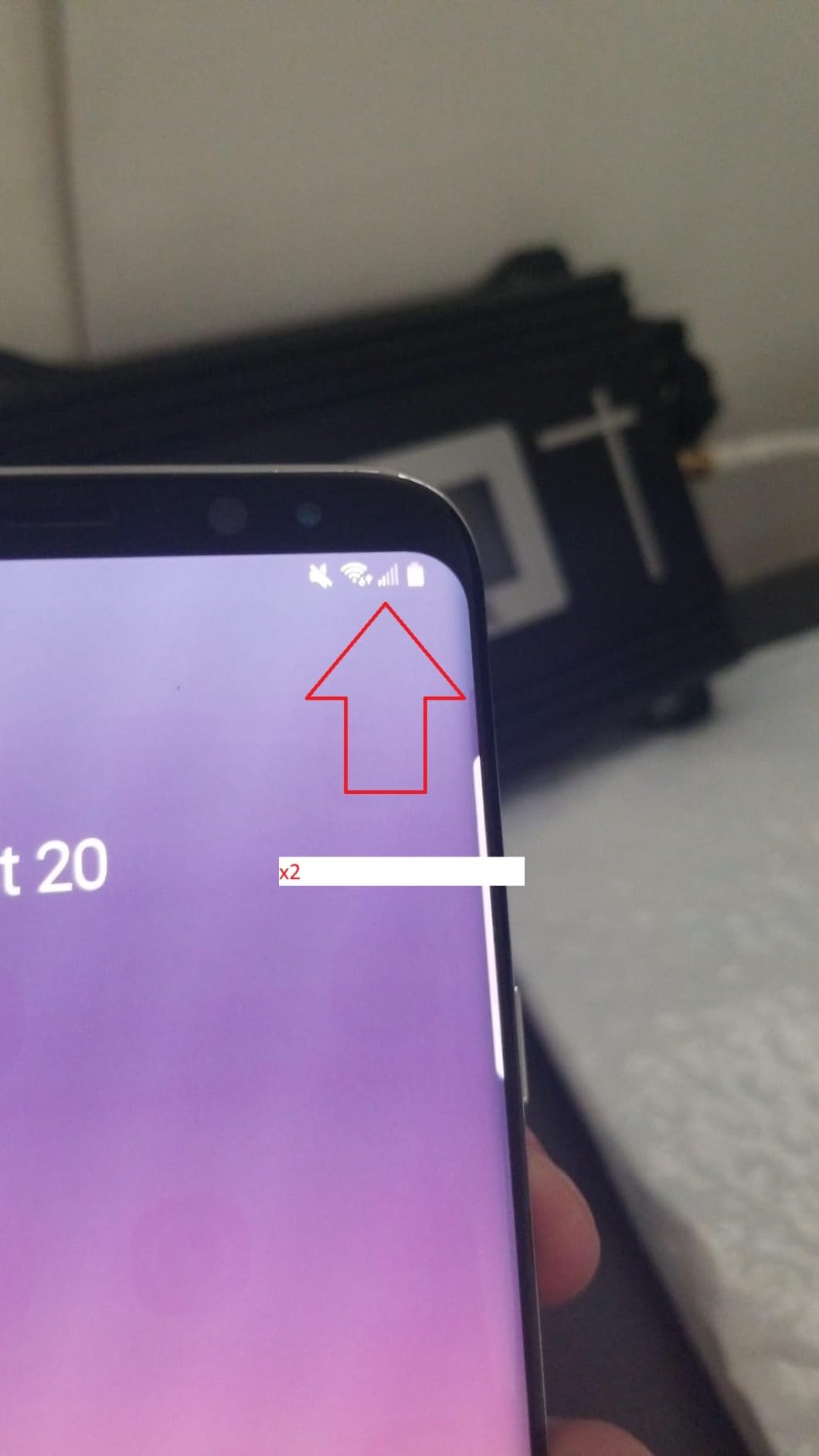
The warranty terms are the best in this guide for a vehicle kit: 30-day money back, 90-day replacement for a defective unit, three-year manufacturer warranty, and lifetime technical support. That kind of after-sales commitment on a vehicle product matters because the failure mode is usually a bad mount, not a bad unit.
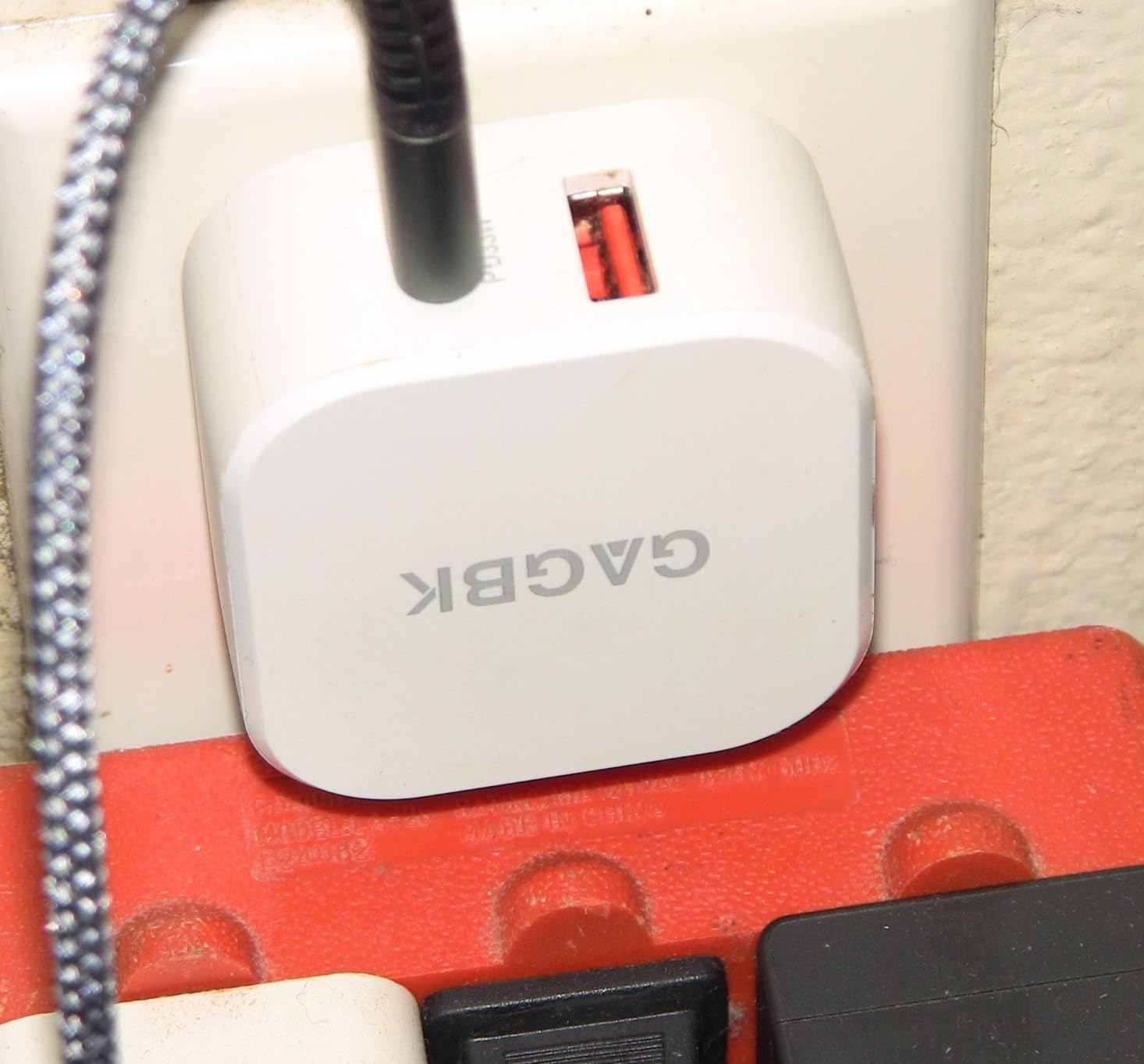
Two things to know before you buy. First, it is limited to bands 12/13/17, so it cannot boost a phone working on 2/4/25 or 5/41. Check which bands your phone and your carrier use first, because this is the single most common reason a vehicle booster does nothing. Second, the listing carries a warning we would rather repeat than hide: many of the visible reviews describe a 33W USB charging block rather than the booster itself, so the 4.4 average across 968 reviews reflects a mixed review history.
Who the GAGBK Car and RV Booster suits?
It suits van and camper owners, boaters and anyone driving a vehicle they will not want to modify. A magnetic whip and a 12V plug is the least invasive installation in this guide, and the omni-directional pattern means you do not need to know where the nearest tower is.
It also suits buyers who want emergency or outage coverage. The hurricane example in the reviews is exactly the scenario a vehicle booster is built for, and sleep mode limits the battery cost of keeping it installed.
Where the GAGBK Car and RV Booster falls short?
Band coverage is the main one. Bands 12/13/17 only means no boost on 2/4/25 or 5/41 devices, and if your phone spends most of its time on those bands, you have bought an expensive no-op.
It only amplifies existing signal, so it does nothing in an area with no coverage at all, and it must be switched off when parked to avoid draining the vehicle battery. Correct antenna placement is also critical, and the instructions need to be followed rather than improvised, particularly with a magnetic whip that looks simple to move.
8. ZORIDA 72 dB Booster Review – Best for Small Rooms and Studios
ZORIDA Cell Phone Signal Booster for All US Carriers, Boosts 5G 4G, Cell Phone Booster 72dB High Gain Antennas, Cellular Verizon and AT&T, T-Mobile Signal on Band 12/17,13,5,25/2,4, FCC Approved
72 dB max gain
Up to 2000 sq ft
Indoor whip plus outside directional
FCC and IC certified
Pros
- High stated max gain for a compact kit at 72 dB
- Works with all US carriers on bands 12/17 and 13/5 and 4 and 2/25
- No carrier registration or subscription or hidden fees required
- App-based 1v1 technical support with installation videos
Cons
- Coverage capped at 2000 sq ft
- Included 49.2 ft cable limits outdoor antenna placement
- Requires 1-2 bars of outdoor signal
- 5G only where carriers deploy 5G in existing 4G bands
The ZORIDA 72 dB kit is the most polarizing product we reviewed, and we include it because the feature set is instructive. It carries a high stated maximum gain for a compact booster, covers up to 2,000 square feet, works on all US carrier bands from 12/17 through 2/25, and requires no carrier registration, no subscription and no hidden fees. It is also FCC and IC certified.
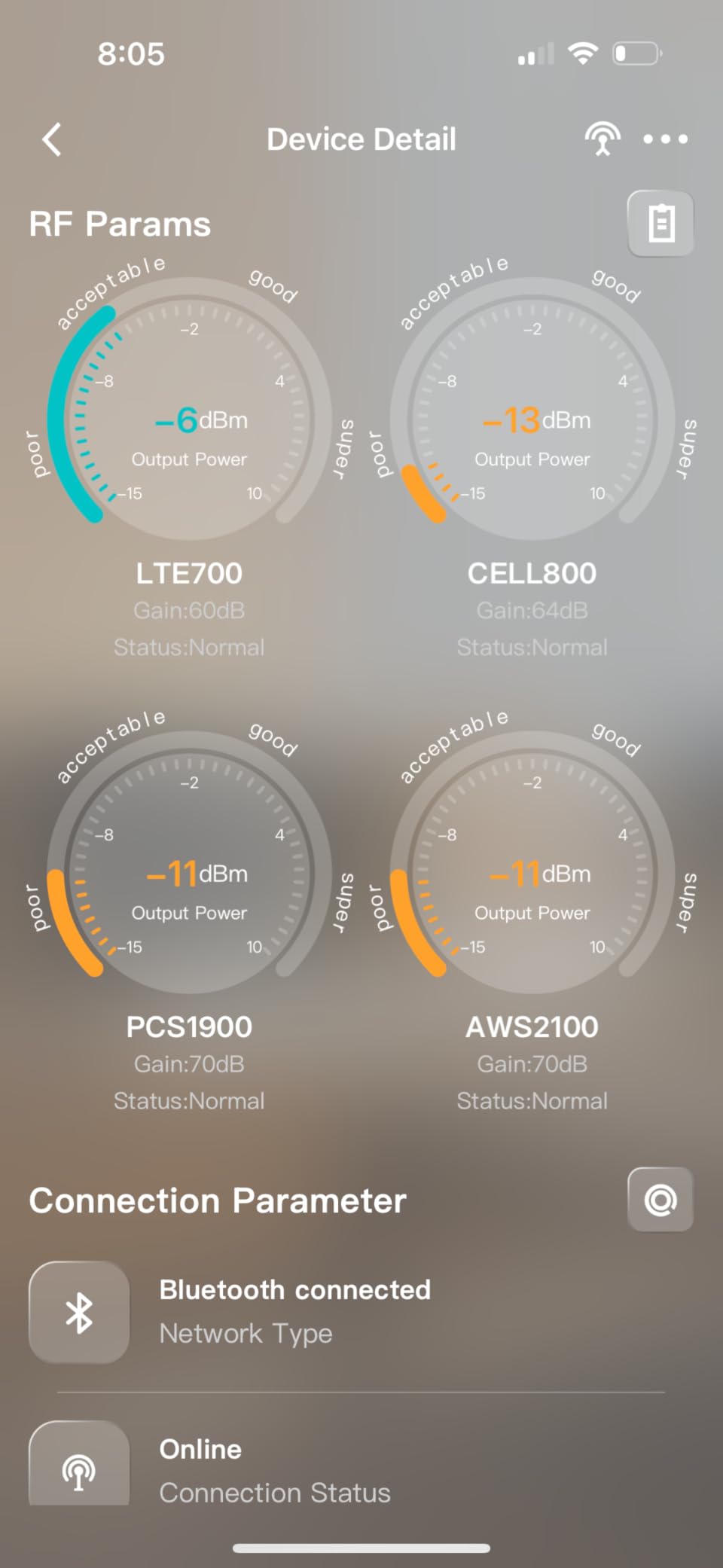
What earns it a place in the guide is the combination of 72 dB and an app-based one-on-one support service with step-by-step installation videos. Owners in small homes and single rooms report clear improvements in call quality and data speed. Several also note that the higher gain appears to extend phone standby battery life, because the phone no longer works at low power hunting for a signal.
The 4.1 average is the lowest in this set, and the 13% one-star share is the highest. We would rather tell you that than round it.
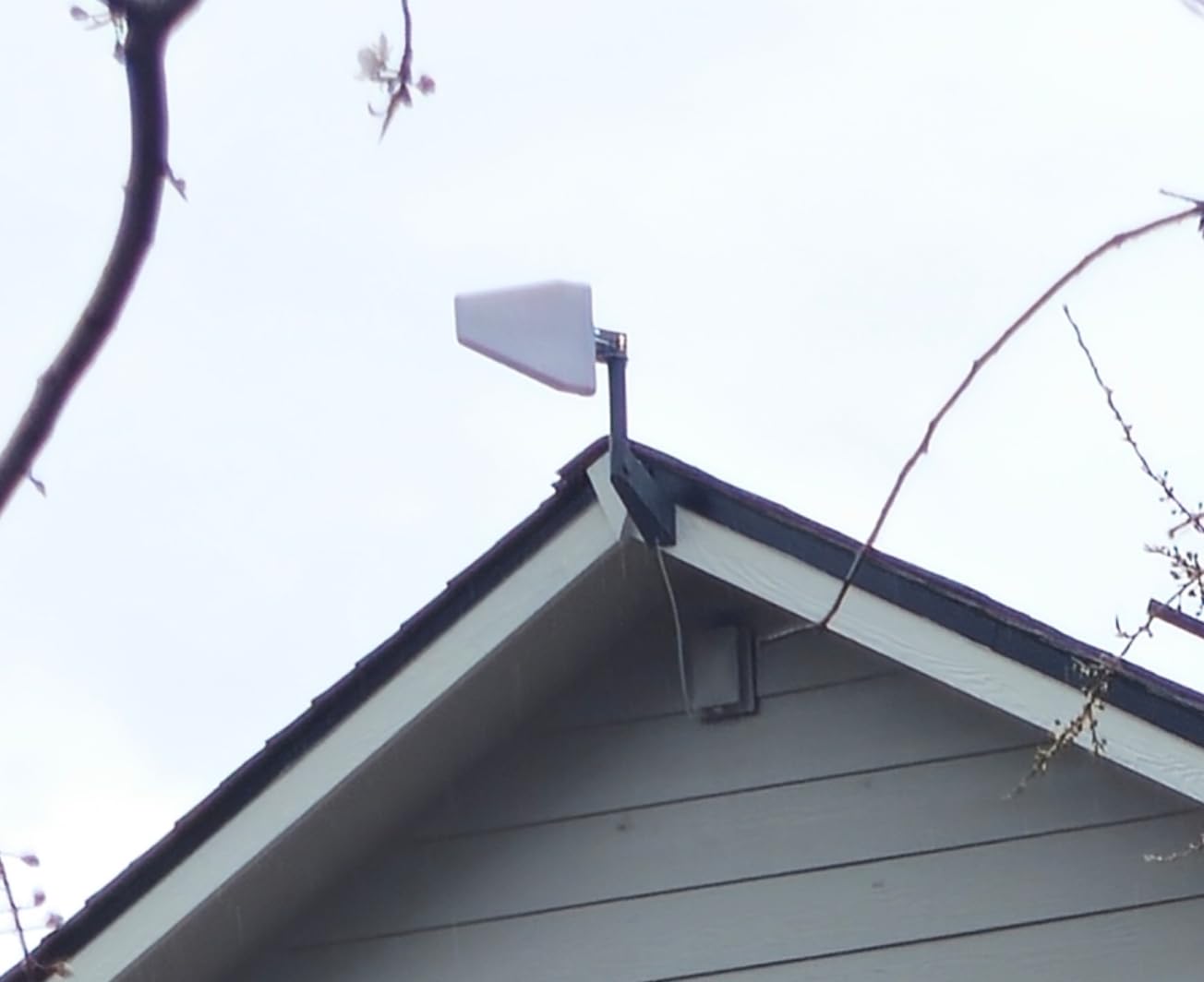
The pattern is consistent: buyers with one or two bars outside are happy in a small space, and buyers in larger homes or in areas with no outdoor signal are not. The 2,000 square foot ceiling and the donor-signal requirement make the outcome impossible rather than merely disappointing.
The included 49.2 foot cable is also a genuine constraint, because it sets the maximum distance between the booster and the outside directional antenna. If your best tower direction is on the opposite side of a large building, you will hit the end of that cable before you find the signal.
Who the ZORIDA 72 dB Booster suits?
It suits small homes, studios, home offices and single rooms where the goal is one bar becoming four, not whole-property coverage. If you have measured one or two bars outside and you want them indoors in a defined area, the 72 dB figure is more than enough.
It also suits anyone who wants no recurring cost. There is no carrier registration, no subscription and no hidden fee, which keeps the total cost of ownership at exactly one number. The app-based one-on-one support is a genuine benefit on a product at this tier.
Where the ZORIDA 72 dB Booster falls short?
It falls short on size, firmly. 2,000 square feet means small homes, studios and single rooms, and no amount of gain changes that ceiling. Anyone in a two-story or larger property should treat this as the wrong purchase.
It also requires one or two bars of outdoor signal, so it will not create coverage where none exists, and 5G works only where the carrier already deploys 5G inside existing 4G bands. The mixed review record means you should weight the 4.1 average accordingly.
How to Choose: The Decision Path by Signal, Space and Carrier?
Start with your measured outside signal, because it eliminates most of the field in one step. Below -80 dBm means the problem is a weak donor signal, and the answer is a high-gain system like the Cel-Fi GO G41, which concentrates 100 dB onto your carrier’s two active frequencies. Between -80 and -100 dBm is the range where a capable multi-carrier kit with a good directional antenna does the job.
Above -70 dBm means your signal is fine and your problem is getting it indoors, so prioritize downlink output power, a panel or dome indoor antenna, and a multi-carrier unit that will not overload.
Second, size the space honestly. Under 2,000 square feet in one room points to the HiBoost F08G or the ZORIDA unit. A typical home in the 2,000 to 5,000 range points to the weBoost Home MultiRoom or the HiBoost Home 4K Smart Link. Above 5,000 square feet or multiple levels points to the HiBoost 10K Smart Link, or to a single-carrier system if your signal is weak.
Remember that concrete, metal roofing and basements each eat into effective coverage, so a house with any of those should be sized at the upper end of its band.
Third, check your carrier situation. Multi-carrier households need a multi-carrier booster, and this is where the single-carrier Cel-Fi falls short despite carrying the most gain in the set. If your signal is weak and you are single-carrier, high gain wins. If your household is mixed, accept lower gain for the convenience of one box handling everyone.
If you are on an MVNO such as Mint Mobile, Visible, US Mobile or Cricket, the important point is that these run on host networks, so a booster that supports the host carrier supports them. The frequent forum complaint is that people buy a booster advertised for a network and then find their MVNO behaves differently, and sellers rarely warn them.
Confirm the host network before buying, and check the band list.
Fourth, choose the antenna for your situation. A directional Yagi reaches much farther but only in the direction you aim it, so it suits a known tower location and rural property. An omnidirectional whip hears weaker signals from every direction, which suits a city, a vehicle or a building where towers sit in several directions. Indoor, a panel or dome covers a wide room better than a whip, and a whip suits a single desk.
Fifth, budget for the install rather than the box. Antenna placement is the variable forum users say decides the outcome more often than the booster itself. Mounting high and aiming precisely at the nearest tower is the single change that fixes the most problems.
Kits that include a pole, brackets and a through-the-window cable save real work, and a J-pole or mast is usually a separate purchase.
Finally, know when not to buy. A booster cannot fix a location with zero signal outside, carrier-side congestion, or 5G mmWave. It also will not replace a carrier-provided network extender such as a CellSpot, which runs over your existing internet connection and works anywhere that internet reaches.
If your problem is total rather than weak, a network extender or a satellite connection answers a different question. And if your phone defaults to Wi-Fi calling, turn it off before you judge whether the booster worked.
Frequently Asked Questions
Do cellphone signal boosters actually work?
They do, with one non-negotiable condition: there must be some signal outside to amplify. A booster captures weak cellular signal with a donor antenna, raises it in an amplifier, and rebroadcasts it indoors through a server antenna. In areas where the outdoor signal is genuinely weak, well-aimed kits produce large gains in bar count and data speed. Where there is no signal at all, no booster will create coverage.
What is the best booster for improving cell phone reception?
For most homes, a multi-carrier kit with a directional outdoor antenna, a panel or dome indoor antenna and app-guided setup is the best answer, because it handles mixed carriers and does not overload. The weBoost Home MultiRoom is our all-round pick. If your measured outdoor signal is weaker than -80 dBm, a single-carrier system with far more gain, such as the Cel-Fi GO G41, outperforms any multi-carrier kit.
What is the best signal booster for mobile phones?
For vehicles the answer is a kit with an omnidirectional roof antenna, because you cannot aim at a fixed tower while driving. The weBoost Drive Reach OTR reaches the farthest towers, while a magnetic whip unit such as the GAGBK car and RV booster installs in 10 to 20 minutes with no drilling. Both must be switched off when parked to protect the vehicle battery.
Is there an FCC-approved cell signal booster available?
Yes. Every unit in our roundup is FCC approved, and you can confirm it by the FCC ID printed on the listing, such as FCC ID PWO460044 for the weBoost Home MultiRoom. Only certified boosters are legal to sell and operate in the US. Uncertified marketplace units can shut down, be seized, and in the worst documented cases lead to a fine or a network de-listing.
What is the best antenna for a cell phone signal booster?
A directional Yagi outdoor antenna is best when you know which direction the nearest tower sits in, because it reaches much farther at the same gain. An omnidirectional whip is best when towers are in several directions or you do not know where they are. Indoors, a panel or dome antenna covers a wide room better than a low-gain whip, which suits only a single desk.
Why are phone signal boosters illegal?
Uncertified boosters are illegal, not boosters as such. An uncertified unit can rebroadcast a tower signal at a strength that interferes with other users on the same network, and that is the reason the FCC requires certification. The FCC caps certified consumer boosters at 72 dB for multi-carrier stationary systems and 100 dB for single-carrier systems. A product that ignores those limits is the problem, not amplification.
What happens when you dial *3370?
Dialing *3370 followed by a band code puts an iPhone into a manual band-selection state. Pressing 0 restores automatic selection, 1 forces 4G LTE, and 2 forces 3G. It is a quick way to test whether your outdoor signal is healthy on 5G or only on LTE before you buy a booster. Dialing *3366 resets the phone back to its default automatic behavior.
Will a cell signal booster work with my carrier?
Multi-carrier boosters work with Verizon, ATu0026amp;T, T-Mobile and the regional carriers, and they also cover MVNOs such as Mint Mobile, Visible, US Mobile and Cricket because those run on host networks. Single-carrier boosters only help the network they are tuned to. Check your phone’s supported bands and your carrier’s host network before buying, since a booster that skips your bands changes nothing.
The Features That Actually Decide Which Booster Works
Three things decide whether a booster works, and none of them is the square-footage number on the box. The first is whether you matched the gain to your measured outside signal: below -80 dBm you need raw gain, above -70 dBm you need downlink power and a clean indoor antenna.
The second is the outdoor antenna and where you put it, because placement decides the outcome more often than the amplifier does. The third is honest certification and honest coverage, meaning an FCC ID you can look up and a number that matches your actual square footage.
Our overall pick is the weBoost Home MultiRoom, because it handles every US carrier, covers a typical home, and ships with app-guided setup that makes the install realistic for a first-timer. For a genuinely weak signal in a large or rural property, step up to the Cel-Fi GO G41 and accept the single-carrier tradeoff. For a basement, a metal roof or a home office, the HiBoost Home 4K Smart Link pairs app tuning with support that reaches out on its own during the install.
Measure your signal first, pick the booster that matches the reading rather than the marketing, and give the antenna placement the time it deserves. Everything else on the spec sheet is detail. If you want more on the shortlist, read our [full booster roundup](https://www.wearesalt.org/best-cell-phone-signal-boosters/) or start with our guide to [boosters for rural areas](https://www.wearesalt.org/best-cell-phone-boosters-for-rural-areas/).