
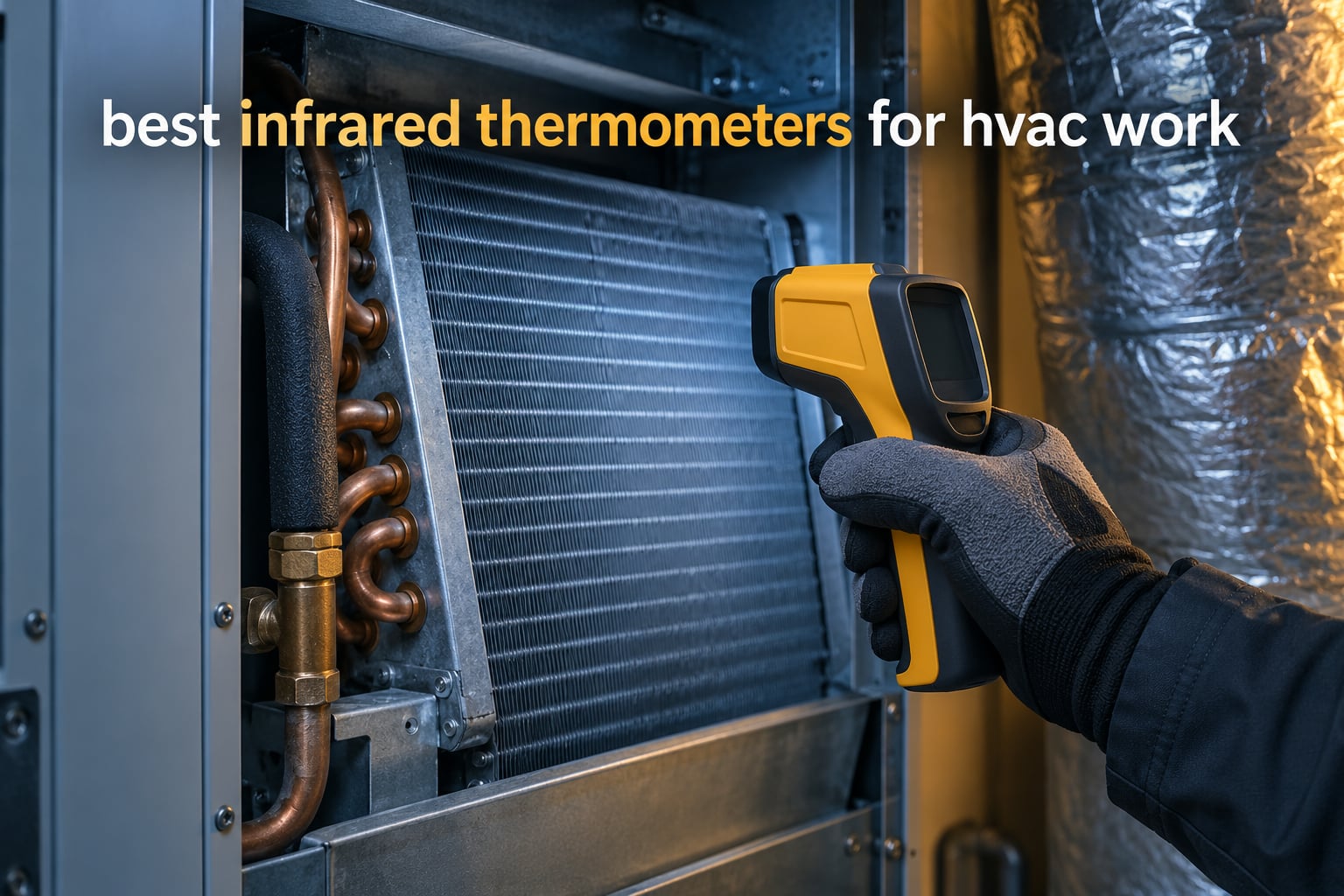
An infrared thermometer is the fastest tool on a service call for finding what a manifold gauge set cannot show: air temperature splits across a coil, a freezing row of coil, a missing patch of duct insulation, a lug running hot inside a disconnect. For most technicians the one to buy first is the Fluke 62 MAX, and it is our top pick in this guide to the best infrared thermometers for HVAC work.
Here is the thing that trips up almost everyone starting out. An IR thermometer reads the surface of what you point it at, not the air moving past that surface and not the temperature inside the metal. That single limitation decides which jobs a gun can do well, which jobs it can only approximate, and which jobs need a contact probe no matter how good the gun is.
We narrowed ten handheld infrared temperature guns down for HVAC use. Every unit here is a gun or meter, not a thermal imaging camera, because a camera solves a different problem and costs several times more. Our working unit list came from the labels technicians actually reach for: Fluke, Klein Tools, Fieldpiece, Testo and the high-temperature specialists.
How we picked: we looked at stated accuracy tolerance, distance-to-spot ratio, whether emissivity is adjustable or fixed, temperature range against real HVAC work, response time, IP rating and drop rating, then compared those against the HVAC job each tool is actually pointed at. Specs come from the manufacturer listings and from what buyers report about long-term field use, not from lab conditions. If you are still building out a kit, our HVAC diffuser picks cover the air distribution side of the same service visits.
Updated for 2026.
Top 3 Best Infrared Thermometers for HVAC Work (October 2026)

Fluke 62 MAX
- -22 to 932F range
- 10:1 distance-to-spot
- Min/max/delta/average readout
- IP54 and 3 meter drop rated
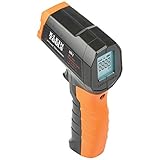
Klein Tools IR1
- -4 to 752F range
- 10:1 distance-to-spot
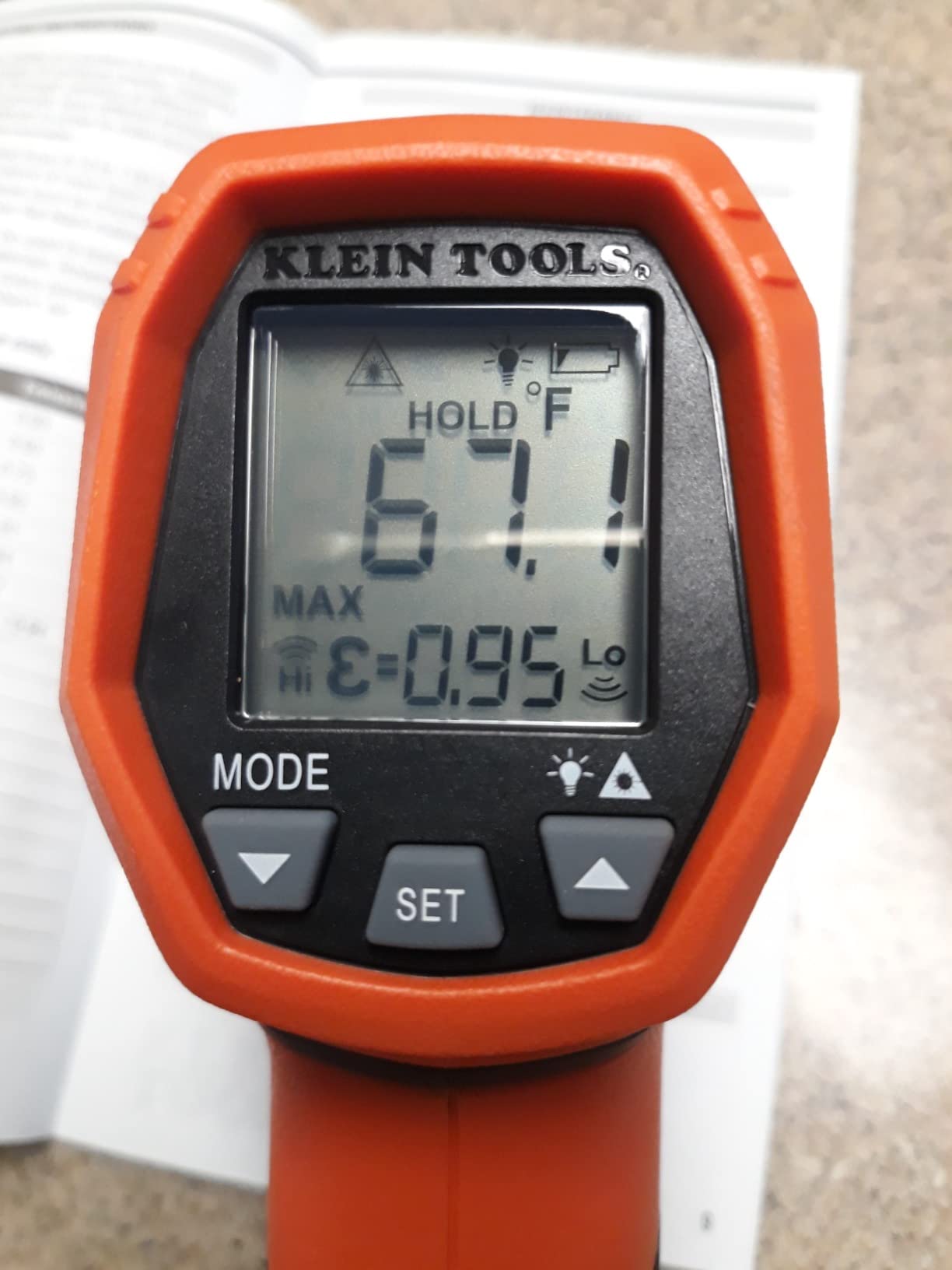
- Fixed 0.95 emissivity
- 6.6 ft drop protection
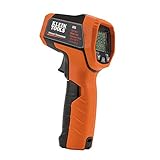
Klein Tools IR5
- Dual laser spot bracketing
- Emissivity 0.1 to 1.0
- -22 to 752F range
- Max/min/avg/diff modes
All 10 Picks at a Glance
Short version before the detail. Here is every gun in the running with the job we would hand it.
1. Fluke 62 MAX — best overall for residential and light commercial service; repeatable readings, IP54, drop rated.
2. Fluke 561 — best when you want a temperature gun and a type K pipe probe in the same case.
3. Klein Tools IR1 — best budget pick for supply and return comparisons and attic work.
4. Klein Tools IR5 — best dual-laser pick, with adjustable emissivity from 0.1 to 1.0.
5. Klein Tools IR07 — best pocket unit for vent and duct readings, IR plus folding probe.
6. Fieldpiece SIG1 — best simple gun from an HVAC-only brand, wide high-temperature range.
7. Fieldpiece SPK3 — best for piercing ductwork and in-duct air readings with a folding rod.
8. Testo 830-T1 — best for European field service where external probes get connected.
9. TempPro TempScan TP30 — best cheap scanner, adjustable emissivity and a huge review base.
10. Temirup IR05A — best for flue, furnace and forge work, 50:1 optics up to 2912F.
| Product | Specifications | Action |
|---|---|---|
| Fluke 62 MAX |
|
Check Latest Price |
 Fluke 561 Fluke 561 |
|
Check Latest Price |
| Klein Tools IR1 |
|
Check Latest Price |
| Klein Tools IR5 |
|
Check Latest Price |
 Klein Tools IR07 Klein Tools IR07 |
|
Check Latest Price |
 Fieldpiece SIG1 Fieldpiece SIG1 |
|
Check Latest Price |
 Fieldpiece SPK3 Fieldpiece SPK3 |
|
Check Latest Price |
 Testo 830-T1 Testo 830-T1 |
|
Check Latest Price |
 TempPro TempScan TP30 TempPro TempScan TP30 |
|
Check Latest Price |
 Temirup IR05A Temirup IR05A |
|
Check Latest Price |
1. Fluke 62 MAX — Best Overall for HVAC Service Work
Fluke 62 Max Industrial Infrared Thermometer, -22 to +932 Degree F Range, Single Laser Targeting, 10:1 Distance to Spot Ratio, IP54 Rating, Includes 3 Year Warranty, (Not for Human Temp)
-22 to 932F range
10:1 distance-to-spot
IP54 and 3 meter drop
Pros
- Repeatable readings across air
- coil and panel diagnostics
- Light enough to clip to a belt loop
- Large backlit display readable in dark plenums
- Shows min max delta and average readings
- IP54 sealed and drop tested
- Three year warranty
Cons
- Setup menu for emissivity and alarms is poorly documented
- Emissivity must be set by hand for metal and shiny surfaces
- Occasional defective units reported
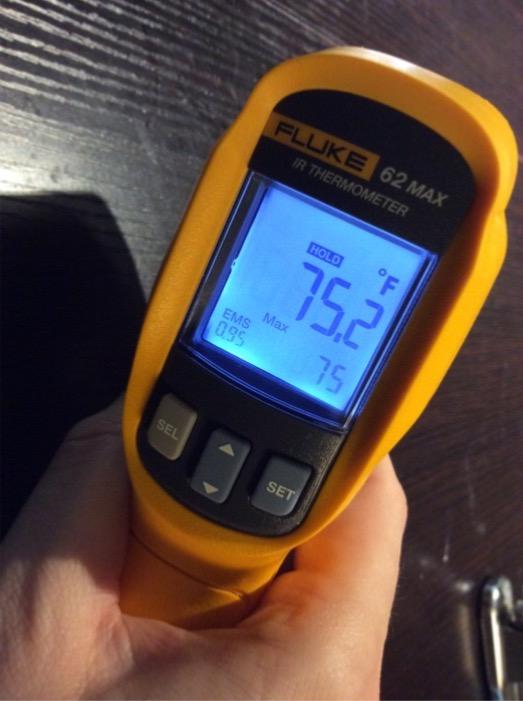
This is the gun most working technicians end up carrying. It weighs about a quarter kilo, clips to a belt loop without dragging your trousers down, and the backlit display stays readable in a dark return plenum or a shaded crawlspace.
The range runs from -22F to 932F, which covers effectively every residential and light commercial system you will meet. A 10:1 distance-to-spot ratio means the spot is about a tenth of your working distance, so a spot roughly an inch wide at ten inches out.
Reviewers consistently describe the same thing: repeatability. Holding the same duct wall from the same angle twice gives you the same number twice, and that is what makes it useful for a before and after comparison across a coil.
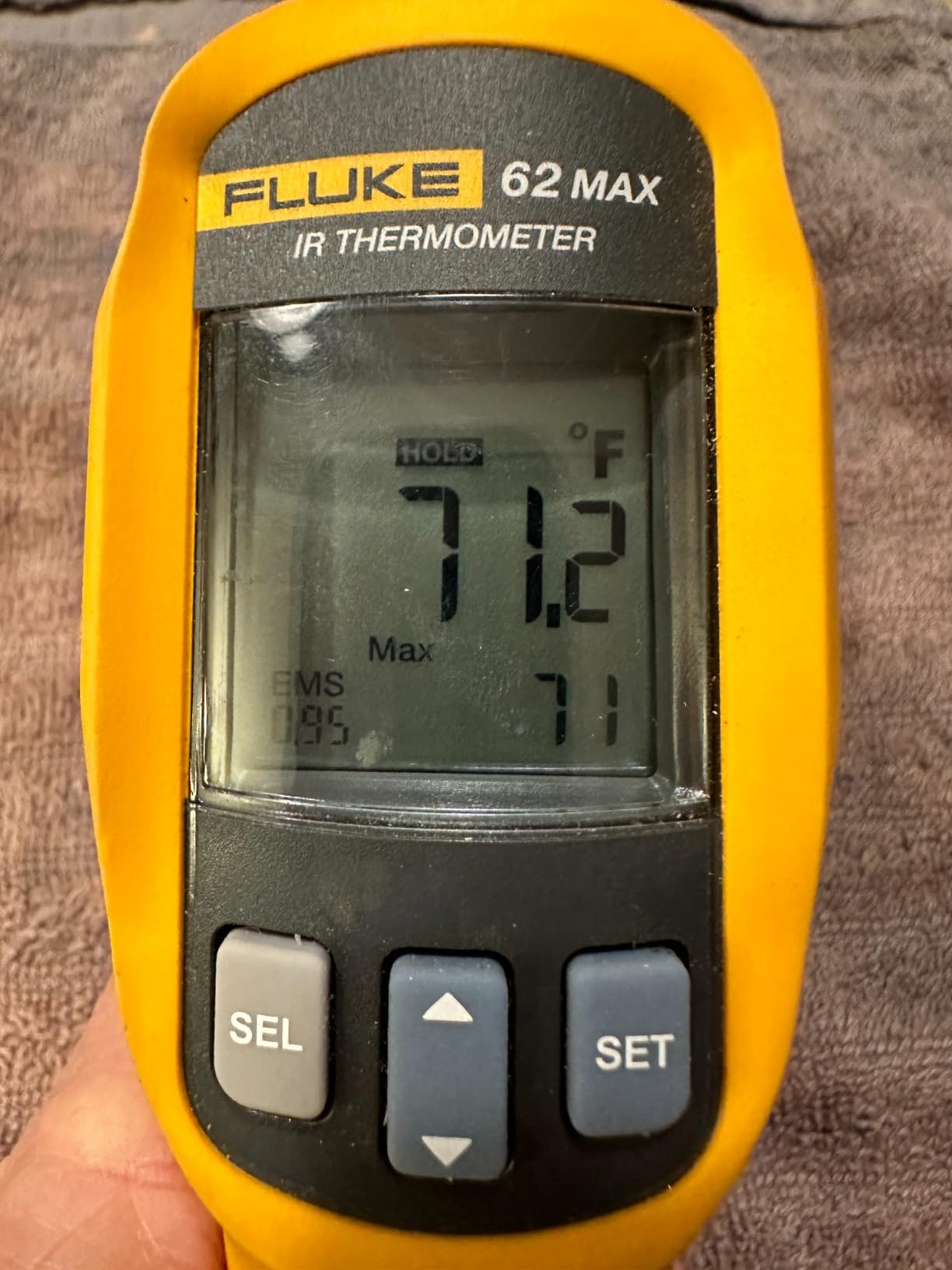
The readout shows minimum, maximum, difference and average. That difference mode is the one you will use most, because delta-T between two points is what actually tells you whether a system is doing what it should.
Build is where it separates from cheaper guns. It carries an IP54 rating for dust and splash protection and is rated to survive a three meter drop, which matters when the unit lives in a truck door pocket for years.
What it does well on HVAC calls
Supply and return air comparisons at the same register, evaporator and condenser coil sweeps looking for a freezing row, and disconnect or lug surveys where you want to find the one connection running hotter than the rest without taking the panel apart.
It handles foil-faced duct wrap and painted ductboard well once you set emissivity properly, which takes two presses in the menu. The range covers furnace heat exchangers and most duct work temperatures with room to spare.
Where it will disappoint you
A 10:1 spot is narrow for refrigerant line work. On a three-quarter inch insulated suction line you will need to get close, and working close to a line in a tight attic is not always possible.
The setup menu for Celsius and Fahrenheit, alarms and emissivity is genuinely hard to find and poorly documented, which is the single most repeated complaint in reviews. Budget three minutes with it before your first call.
Do not expect it to measure superheat. Nothing with a surface sensor can, which is why the next pick matters.
2. Fluke 561 — Best With a Contact Pipe Probe Included
Fluke 561 HVAC Pro Infrared Thermometer, -40 to +1022 Degree F Range
-40 to 1022F range
12:1 distance-to-spot
Type K pipe probe included
Pros
- Dual infrared and thermocouple capability in one meter
- Steady repeatable readings with little fluctuation
- 12:1 distance-to-spot with laser sighting
- Includes a wired type K pipe probe on a 20 inch cable
- Wide -40F to 1022F range
- Plus or minus 2F infrared accuracy
Cons
- Large spot size means you must get close to small sources
- Emissivity limited to low medium and high presets
- The Celsius and Fahrenheit toggle is undocumented
The Fluke 561 solves the problem that comes up constantly in HVAC forums: which tool belongs in which role. It carries a wired type K thermocouple pipe probe on a twenty inch cable, so the same meter handles a non-contact coil sweep and a clamped line reading.
That probe is the reason to buy this over another gun. When you are checking line temperatures for a superheat or subcool calculation, a contact clamp gives you a number you can trust, and this meter puts that number on the same display as the IR reading.
Range is the widest on ordinary residential service work here, from -40F all the way to 1022F, with infrared accuracy stated at plus or minus 2F. That covers furnace heat exchangers, flue-adjacent surfaces and cold attic start-up temperatures in one instrument.
The 12:1 distance-to-spot is better than the 62 MAX, which helps on line work, and infrared response is one second. It runs on two included AAA batteries and weighs about 300 grams at five inches long.
Where it earns its place in a bag
Line and pipe work alongside coil work, refrigerant charging checks where you want both an outside surface reading and a clamped line reading, and combustion-adjacent temperature checks on high-fire furnaces that run hotter than a standard residential gun covers.
Technicians who already own Fluke gear tend to buy this for the probe alone, then keep the 62 MAX for everything else. That pairing is a legitimate setup.
Where it falls short
Emissivity is limited to low, medium and high presets instead of a numeric setting from 0.10 to 1.00. On a bare copper line or a foil-faced surface you get a reading with no way to correct it.
Reviewers note the spot size is large enough that you must physically move close to small heat sources, which is the wrong instinct in a live electrical panel.
The Celsius and Fahrenheit toggle is not intuitive and barely explained in the manual. It will slow you down on your first few calls.
3. Klein Tools IR1 — Best Value for Comparisons
Klein Tools IR1 Infrared Thermometer with Targeting Laser, Auto-Hold, More
-4 to 752F range
10:1 distance-to-spot
6.6 ft drop protection
Pros
- Very low cost with consistent vent and attic readings
- Fast trigger response for scanning registers
- Rugged housing with 6.6 ft drop protection and carry pouch
- Backlit display for dark crawlspaces and attics
- Accurate enough for everyday residential HVAC checks
Cons
- Fixed 0.95 emissivity limits accuracy on shiny surfaces
- Switching between Celsius and Fahrenheit is cumbersome
- Laser pointer is hard to aim on small components
- Some units shipped with a discharged battery
This is the comparison tool, and it does that job honestly. Owners consistently describe it as perfect for comparing temperature differences without claiming pinpoint accuracy, which is exactly the right expectation to set.
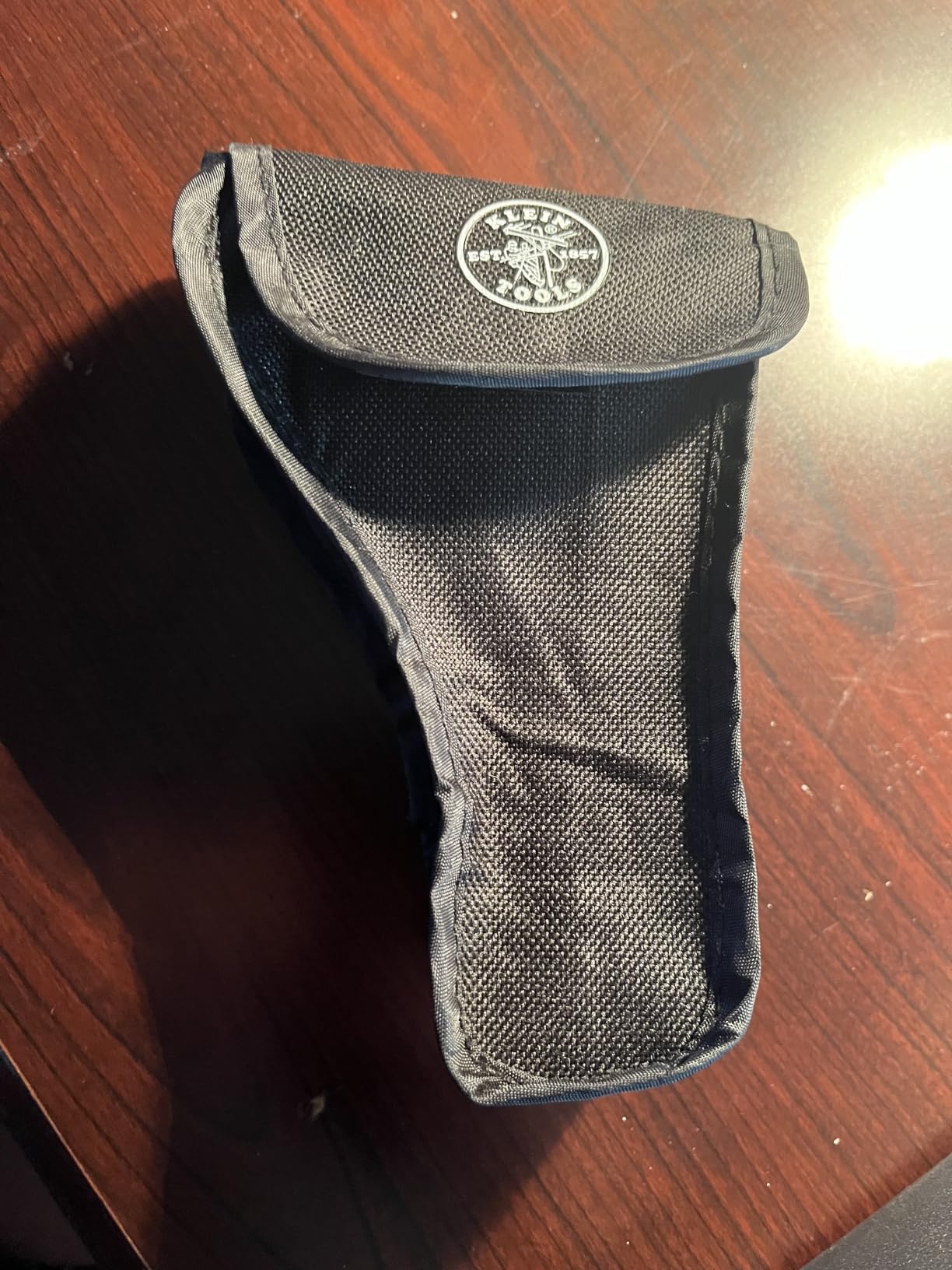
Range is -4F to 752F with a 10:1 spot ratio, half second response, and a backlit display. It weighs 100 grams and includes a custom pouch, so it lives in a pocket rather than a tool bag.
For supply and return air comparisons across a coil, scanning ceiling registers for a starved zone, or checking attic duct runs for a thermal anomaly, it is more than adequate. The half second response makes sweeping a whole zone quick.
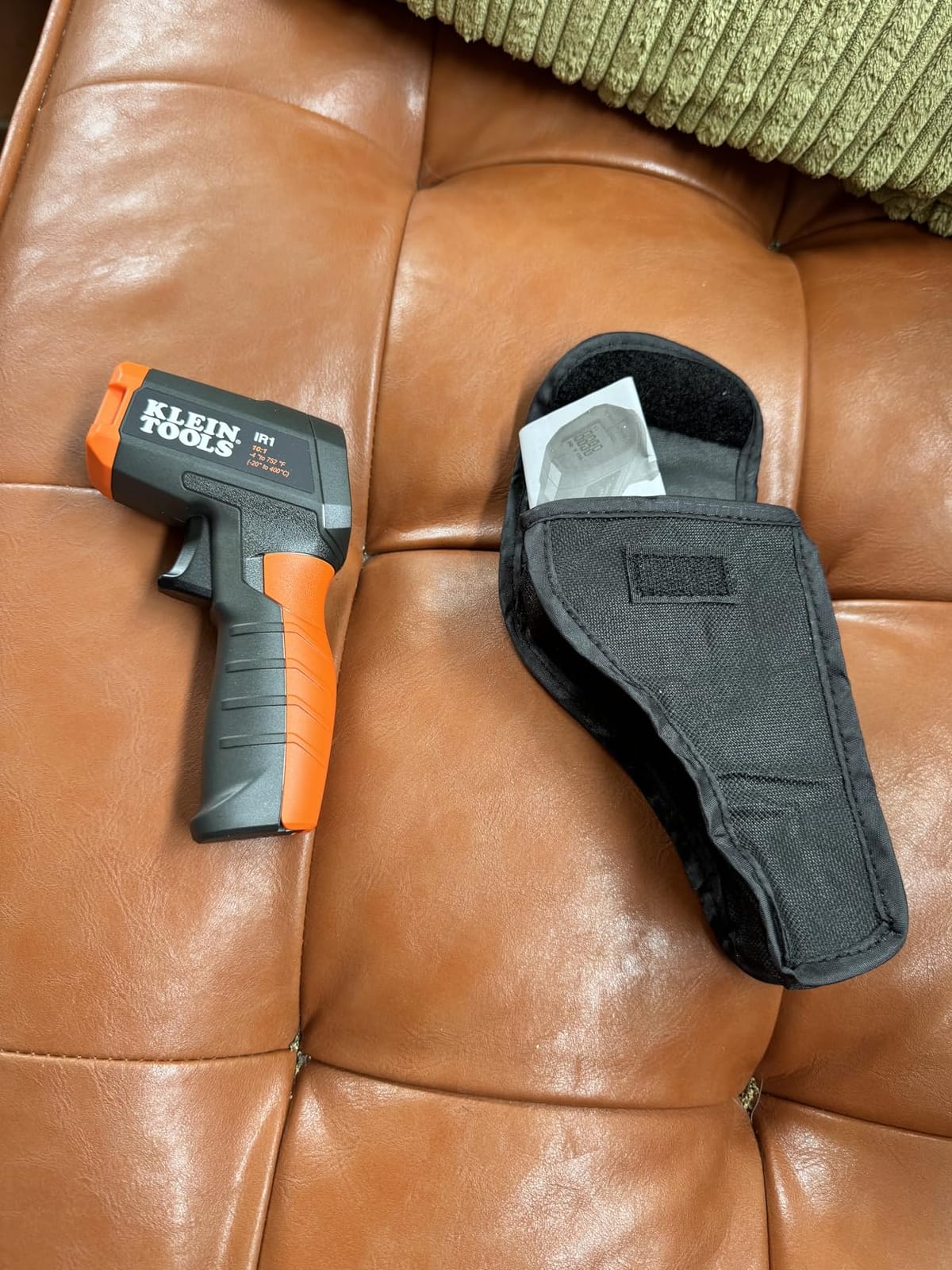
The plastic housing carries a 6.6 foot drop rating, which is the kind of spec that matters when the tool spends its life in a van. Owners doing residential HVAC checks treat it as a capable everyday instrument rather than a toy.
Our position is simple: this is the gun to buy first if your work is air side. If you need refrigerant line numbers you can put in a report, you will outgrow it.
Best fit for air side work
Comparing supply and return at the same register, finding the register or run that is feeding a hot room, checking supply air temperature after a filter or coil service, and general attic and crawlspace surveys in poor light.
It is also a good teaching tool. Learning delta-T with an instrument you are not worried about damaging is a reasonable way into the habit.
Where it stops being enough
Emissivity is fixed at 0.95. That is fine on painted or matte surfaces and wrong on foil-faced tape, bare copper, window glass and any reflective surface, and you cannot correct it.
The laser pointer is hard to aim precisely on small components, which limits its usefulness on electrical lugs and small line work.
The Celsius and Fahrenheit toggle is described as cumbersome by owners, and a few units arrive with the battery already discharged, so check it on the bench before a call.
4. Klein Tools IR5 — Best Dual-Laser Pick with Adjustable Emissivity
Klein Tools IR5 Infrared Thermometer with Dual Targeting Laser, 12:1
12:1 with dual lasers
Emissivity 0.1 to 1.0
-22 to 752F range
Pros
- Dual lasers visually bracket the measured spot
- Adjustable emissivity from 0.1 to 1.0
- Max min avg diff plus high and low alarm
- Heavy solid build with a protective pistol pouch
- Backlit display with a simple three button interface
Cons
- Readings run a few degrees off versus reference meters
- The two lasers sit wider than the stated 12:1 spot
- Readings jump when one laser falls on a nearby surface
- Short battery life and no manual power control
The dual lasers are the reason to step up here. Two dots mark the edges of the area being averaged, so you can see whether your target actually fills the measurement spot instead of guessing from one dot.
Range is -22F to 752F at 12:1, and emissivity is adjustable from 0.1 to 1.0. That emissivity range is the single most important spec on this list for HVAC work, because it is what lets you correct for foil tape, painted ductboard or a matte pipe insulation jacket.
Max, min, average and difference modes plus high and low alarms cover most field diagnostic needs in one screen. The three button interface is about as simple as these get.
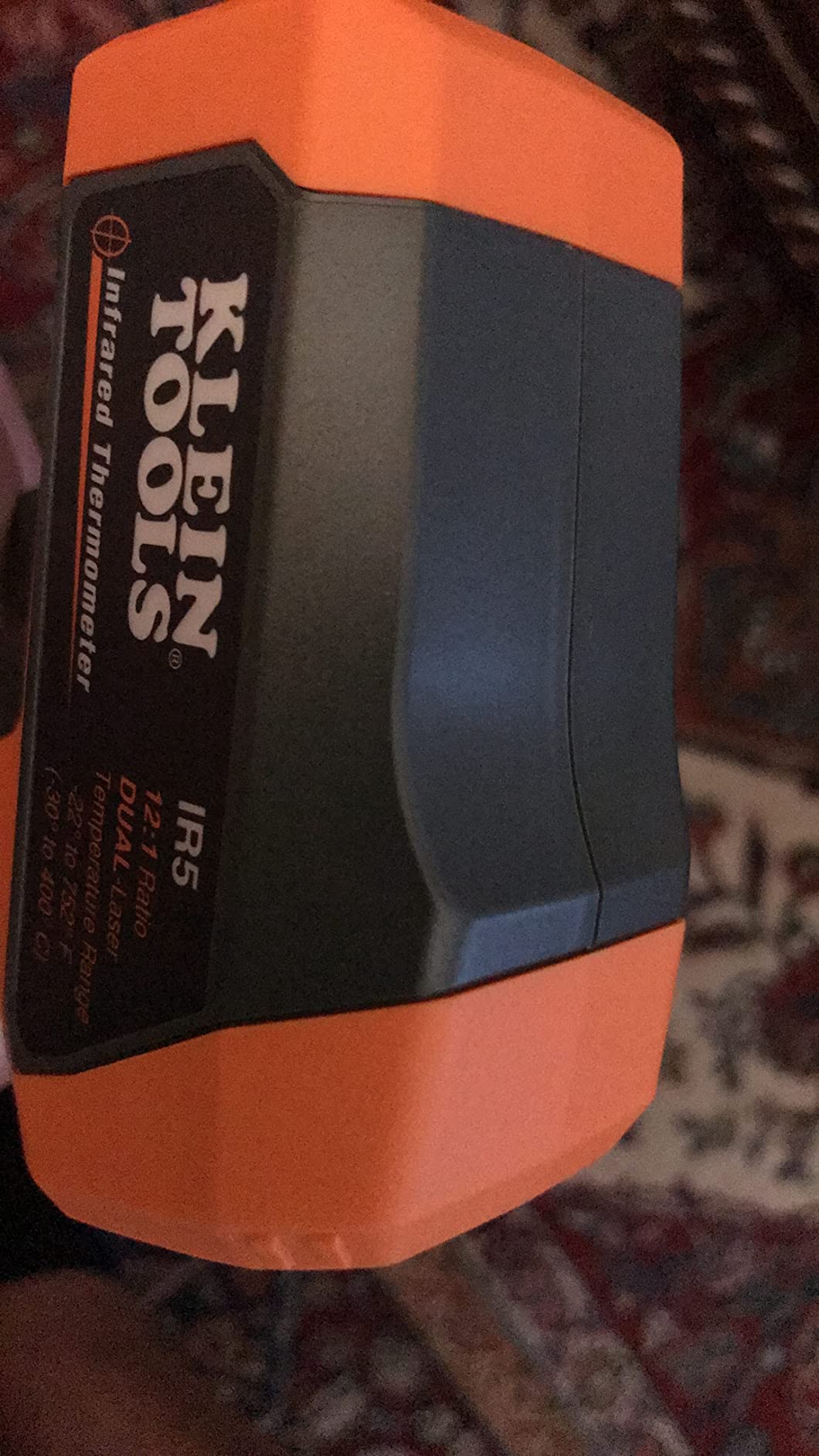
Reviewers who upgraded from a single-laser budget gun cite the spot bracketing and the emissivity control as the two things that made the step worthwhile on coil and line work.
It has the feel of a serious tool, at 0.3 kg with a 6.82 inch body, a one year manufacturer warranty and a supplied pistol pouch.
Where dual lasers pay for themselves
Shooting a small liquid line, a suction line fitting, an electrical lug or a section of coil where the spot would otherwise average the target together with whatever is behind it. Seeing the measured area lets you step closer until the line fills the spot.
It is also a good coil survey tool, since the alarm modes let you sweep an evaporator bank and flag the coldest row quickly.
What to watch for
Reviewers benchmarking against higher grade meters find readings run a few degrees off, so treat absolute values with caution and lean on the difference modes.
The two lasers are spaced wider than the stated 12:1 spot, which can confuse the picture on small targets, and readings jump erratically when one laser lands on a nearby surface at a different temperature.
Battery life is short and there is no manual on and off, so it relies on auto power off. Response is a full second, slower than the half second you get from cheaper units.
5. Klein Tools IR07 — Best Pocket Unit for Vent and Duct Readings
Klein Tools IR07 Dual Infrared (IR) and Probe Pocket Size LCD Digital Thermometer
IR plus folding probe
-40 to 752F range
8:1 distance-to-spot
Pros
- Combines infrared and a folding probe in one pocket body
- Fast 500 ms response praised for temperature rise work
- Target laser and hanging hook for checking vents from the floor
- Compact and lightweight with a backlit display
- Build holds up well in a tool bag
Cons
- Display orientation is fixed and frustrates right-handed users
- Min max and T1 to T2 functions are confusing to operate
- 8:1 distance-to-spot is narrower than most competing meters
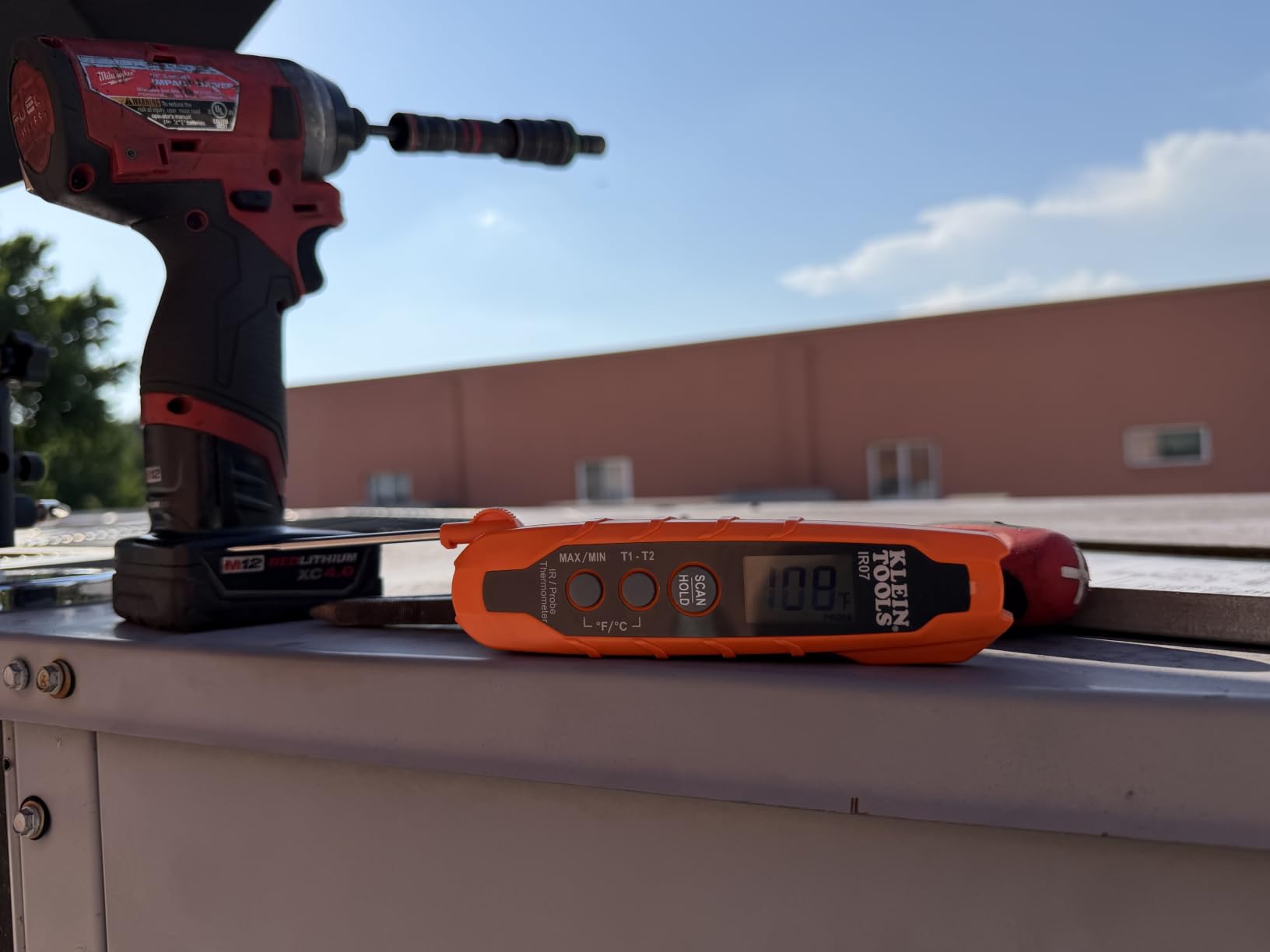
The IR07 is the closest thing here to an all-in-one pocket instrument. It pairs a non-contact infrared sensor with a folding thermocouple-style probe, which covers both the surface work and the in-duct work without a second device.
Range is -40F to 752F, which is the coldest low end among the pocket-sized meters here and useful for cold start-up checks on a heat pump outdoor unit in winter.
Response is a fast 500 milliseconds, and owners praise exactly that for temperature rise troubleshooting, where you are watching a number settle and you do not want to wait on it.
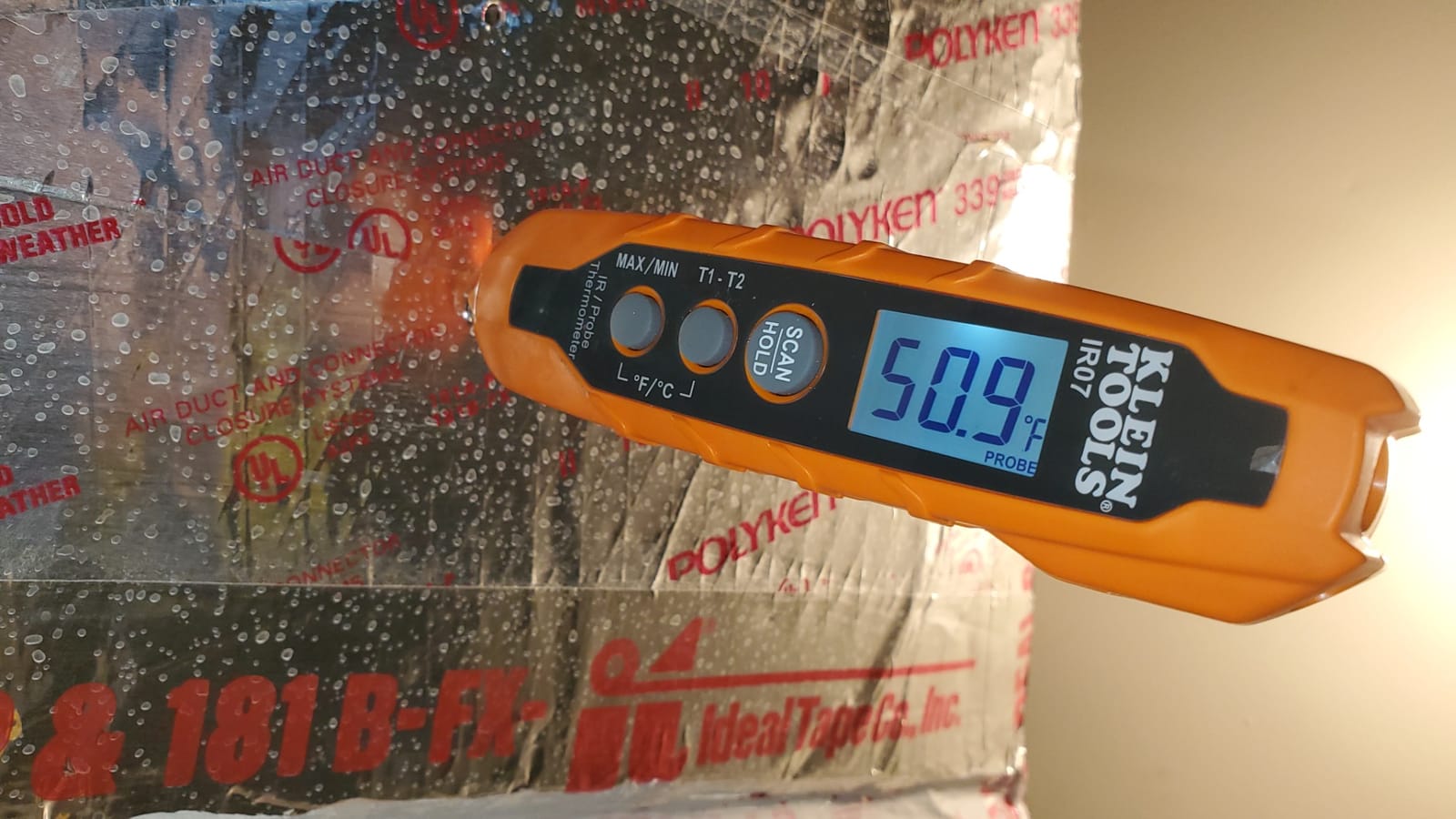
The hanging hook is the detail that earns its keep. It lets you clip the meter to a vent face and get a hands-free reading from the floor, which is far easier than trying to hold a gun steady at waist height.
Differential temperature calculation across the IR and probe readings gives you a T1 minus T2 figure on the same screen, so you can compare an in-duct air reading against a surface reading without writing both down.
What it is genuinely good at
Checking that a supply vent is delivering air and a return vent is pulling, comparing a duct surface against the air temperature inside it, and quick hot and cold checks around a thermostat or a unit during a service call.
The probe side is what makes it useful for airflow work in a tight ceiling cavity where you cannot park a laser dot on anything.
Where it frustrates you
The 8:1 distance-to-spot is the narrowest here, so on small line work you have to be close. That is a real limit if you routinely check fittings.
The min, max and differential functions are reported as confusing to operate without practice. Budget time on the bench to learn the button sequence.
The display orientation is fixed in a way that suits one hand far better than the other, and it is only 1.44 ounces, so wind is a factor on the probe reading outdoors.
6. Fieldpiece SIG1 — Best Simple Gun From an HVAC-Focused Brand
Fieldpiece SIG1 Gun-Style IR Thermometer (-22F to 1022F)
-22 to 1022F range
0.5 second response
9V battery with 9 hour life
Pros
- Purpose-built by an HVAC focused brand
- Backlit LCD and 0.5 second response suit quick readings
- Wide -22F to 1022F range covers HVAC and light industrial work
- Includes a protective carry cover
- Auto-off after 10 seconds without use
Cons
- The supplied protective case is flimsy and can trigger in a bag
- Less accurate on shiny or reflective surfaces
- No trigger lock or better stowage option
Fieldpiece builds instruments for HVAC and refrigeration technicians, so the SIG1 arrives with the range and the response time that trade actually needs. It covers -22F to 1022F with a half second response and a backlit display.
The listed uses say it outright: shoot an indoor wall to establish ambient, then use it for heating and A/C diagnosis when you need a quick reading.
Typical battery life is quoted at nine hours on a single 9V battery, which in practice means a full working week without thinking about it. Auto-off fires after ten seconds of no use.
Where it fits in an HVAC-R shop
Ambient checks, quick supply and return comparisons, and general service diagnostics where you want one dependable gun with no menus to learn. The high end of the range covers combustion-adjacent surfaces that a residential gun cannot reach.
It is also the gun to hand someone who has never used an IR thermometer, because there is almost nothing to configure.
Where it falls short
The supplied carry cover is the most cited drawback and it is a real one. It is flimsy enough that the trigger can be pressed in a tool bag, and there is no trigger lock to stop it.
Reviewers note it is less accurate on shiny and reflective surfaces, which on an HVAC system means foil-faced duct wrap and new galvanised sheet metal.
It runs on a 9V battery rather than AA or AAA, which is harder to find in a hurry than the batteries you already keep in the truck.
7. Fieldpiece SPK3 — Best for Piercing Ductwork and In-Duct Air
Fieldpiece SPK3 Pocket Thermometer – Compact Type K Infrared Capable Digital Temperature Meter – Folding Probe – Maximum Reach – Backlit Display for HVACR
Type K rod plus 8:1 infrared
32 to 932F range
Backlit auto-flip display
Pros
- Dual measurement in one tool with a sharp folding rod
- Backlit auto-flip display switches between IR and rod modes
- T1 to T2 differential calculations speed up assessment
- Hanging hook allows hands-free duct and vent readings
- Certified to CE FCC and NIST standards
Cons
- Bulky body the size of a clamp meter takes real pocket space
- Slow to reach true dry-bulb temperature on the piercing rod
- Short 3 hour stated battery life
- No Bluetooth or wireless connectivity
Most technicians buying an infrared thermometer for HVAC work think they are choosing between infrared and a probe. The SPK3 removes that choice, giving you a sharp folding Type K rod and an 8:1 infrared sensor in one body.
The rod folds away for protection and pierces ductboard cleanly, which is how you get a real in-duct air reading instead of shooting a duct wall and hoping. The IR side handles surface and ambient checks.
Resolution is stated at 0.5F or 0.2C, response is 500 milliseconds, and the range is 32F to 932F. It carries CE, FCC and NIST specification marks.
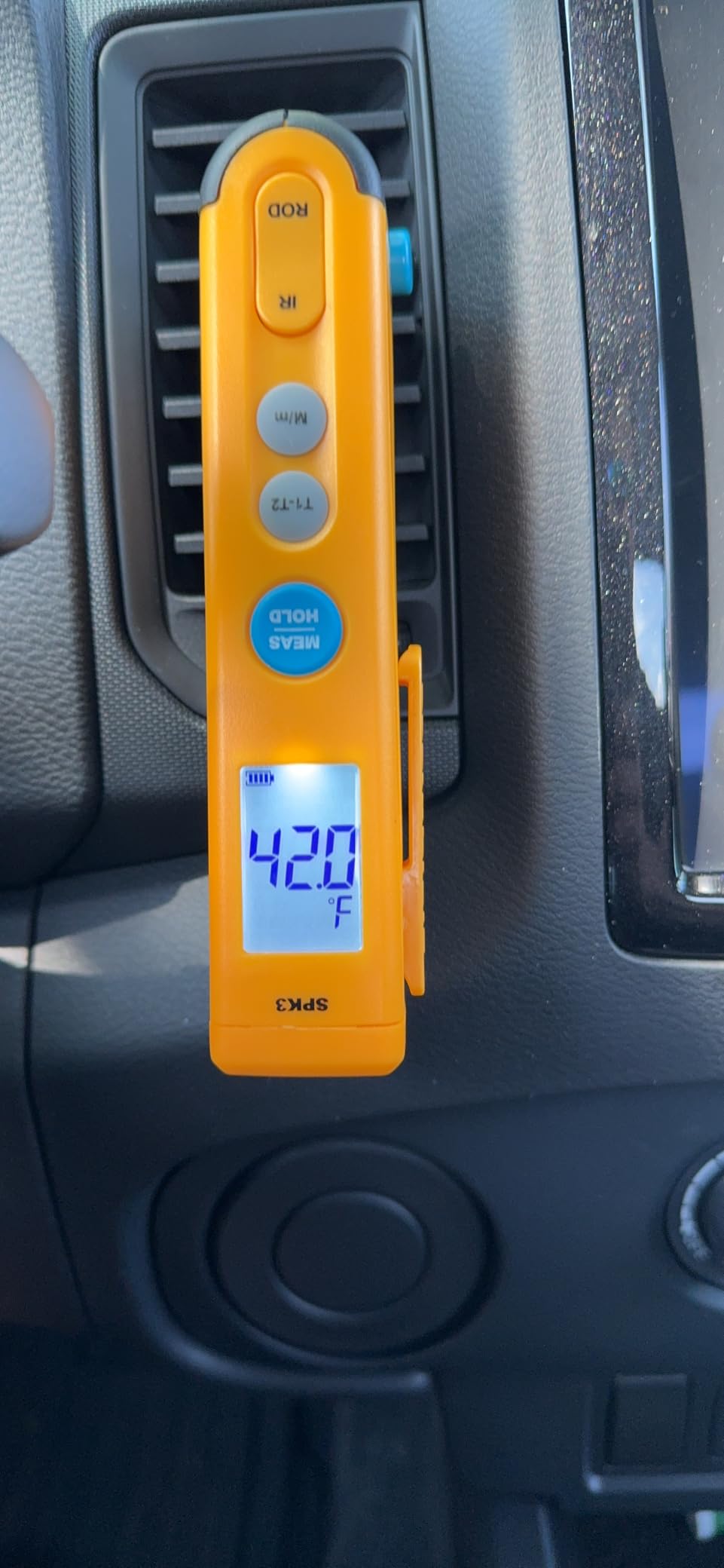
The backlit auto-flip display is the detail that separates it. Turn the meter and the screen switches between IR and rod modes so you are never reading upside down in a dark ceiling cavity.
The hanging hook gives hands-free readings directly on ducts and vents, and the T1 to T2 differential across rod, IR or a combination of both speeds up a whole system assessment.
Where it earns its keep
Airflow and temperature rise work where the answer has to be actual air temperature, duct condition surveys in ceilings and plenums, and anywhere you need a contact measurement on the same meter as your surface checks.
For hydronic and heat pump work the rod is the tool you want for the water side reading.
What you give up for it
The body is bulky, roughly the size of a clamp meter, and it takes real pocket or bag space. If you need every square inch of the tool bag, this is a compromise.
The rod is slow to reach true dry-bulb temperature, so hold it longer than feels necessary or your reading will be low. Stated battery life is only three hours on two AAA batteries.
There is no Bluetooth or wireless connectivity, so nothing logs to a phone and there is no probe you can leave in a duct while you walk away.
8. Testo 830-T1 — Best for European Field Service
Testo 0560 8311 830-T1 IR Thermometer, 10:1 Optics and Laser Point
10:1 optics and laser point
Up to 400C surface range
Accepts external probes
Pros
- Long-term owners report consistent precise readings
- Simple to operate
- 10:1 optics with a one point laser marks small targets
- Accepts external temperature probes
- 0.1C display resolution and 500 ms response
Cons
- Readings on metal surfaces are noticeably less precise
- Costs more than similarly rated competitors
- Basic feature set for the money
The Testo 830-T1 is a European workhorse, and long-term owners describe it as consistent and precise. Response is a fast 500 milliseconds with 0.1C display resolution.
Optics are 10:1 with a single laser point marking the measurement spot, so you are aiming at one dot rather than bracketing between two. It is a simple device with a simple button layout.
The feature that matters for HVAC service here is probe acceptability. External temperature probes can be connected, which turns the unit into an IR and probe meter when the job calls for a contact reading.
Range tops out at 400C, so the surface range is comfortably above anything a residential furnace or air handler produces.
Where it fits
General service work in a region where Testo service and probe support is already in place, and for technicians who connect external probes as a matter of habit.
The precision display resolution is useful when you are watching small differences rather than large splits.
Where it will not win
Reviewers consistently note readings on metal surfaces are noticeably less precise. That rules out foil-faced duct, bare copper and galvanised work without correction.
It costs more than similarly rated competitors for what is a basic feature set, so you are paying for the brand and the probe ecosystem rather than for extra capability.
Single point laser means no spot bracketing, so you are estimating the measured area rather than seeing it. That matters more than it sounds on small targets.
9. TempPro TempScan TP30 — Best Cheap Scanner With Adjustable Emissivity
TempPro TempScan Infrared Thermometer Gun for Pizza Oven Griddle HVAC
-58 to 1022F range
12:1 distance-to-spot
Emissivity 0.1 to 1.0
Pros
- Adjustable emissivity from 0.1 to 1.0 at a very low cost
- 12:1 distance-to-spot with sub-500 ms response
- MAX MIN AVG of the last scan spots hot areas fast
- Backlit LCD readable in garages and dark spaces
- Wide -58F to 1022F range with accuracy verified on ice and boiling water
Cons
- Accuracy shifts with distance
- works best close to about 3 inches
- MAX MIN AVG secondary display cannot be turned off
- Battery compartment is very tight
- Surface readings only
- no air or bulk liquid measurement
The TP30 is the value benchmark in this list, and with close to ten thousand reviews the feedback is consistent: buyers confirm accuracy against known references and learn to compensate for distance.
Range is -58F to 1022F, the widest cold-side coverage of the units here, with a 12:1 distance-to-spot and response under half a second. Accuracy is stated at plus or minus 1.5 percent.
The detail that makes it worth considering over a bare-bones gun is adjustable emissivity from 0.1 to 1.0. Most cheap units lock you at 0.95, which is why they read wrong on foil tape and bare metal. This one lets you correct.
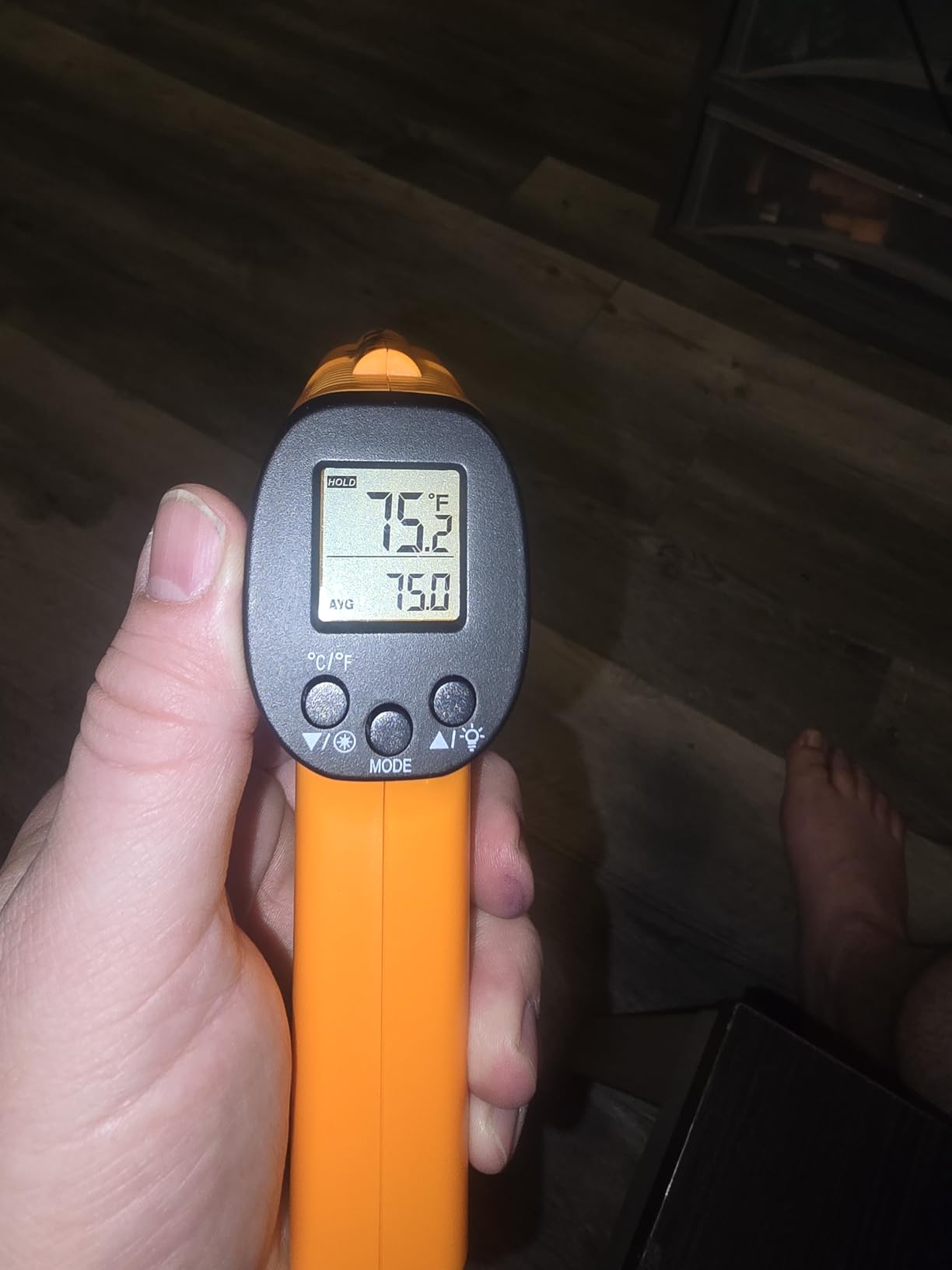
MAX, MIN and AVG of the last scan is genuinely useful on an air handler or coil, letting you sweep a bank and see the coldest and hottest points without writing anything down.
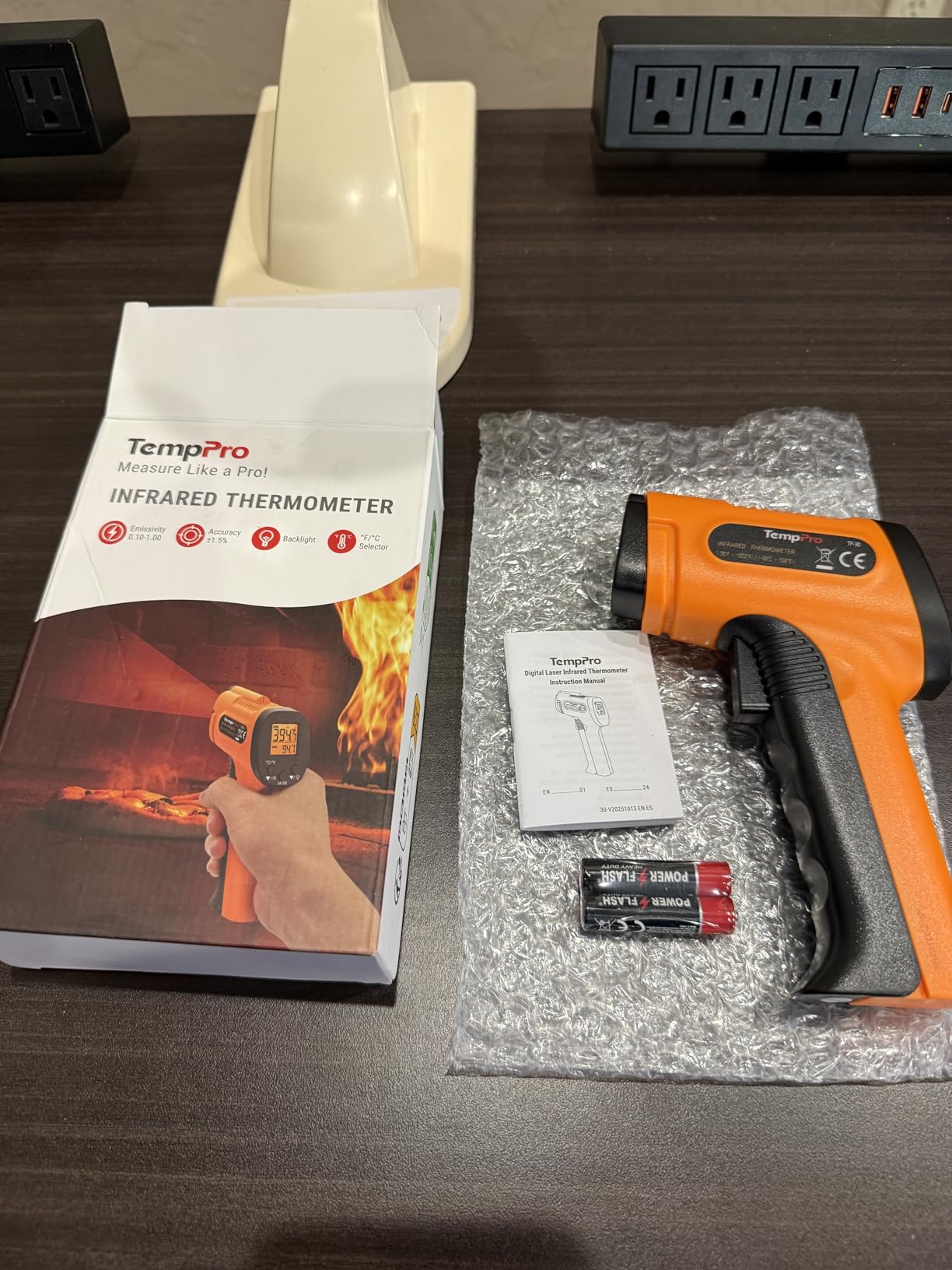
It is small at 3.74 inches and 128 grams, runs on two AAA batteries, and auto shuts off after 90 seconds of inactivity.
What it is good enough for
Surface comparisons on matte surfaces: painted ductboard, insulated pipe jackets, appliance finishes and room surfaces. Coil sweeps, insulation surveys and general service checks are all within its ability.
Owners regularly describe it as performing as accurately as far more costly models for this kind of comparison work, and that claim holds up for relative readings.
Where it falls down
Accuracy shifts with measuring distance. Owners report it works best close to about three inches, so if you want a reading from across a mechanical room, move closer or accept the error.
The MAX MIN AVG secondary display cannot be turned off, which is a small irritation on every reading. The battery compartment is very tight and hard to open the first few times.
It reads surfaces only. It cannot measure air temperature, bulk liquid or anything inside an insulation jacket, which is exactly where the line temperature data you need for superheat comes from.
10. Temirup IR05A — Best for Flue, Furnace and Forge Temperatures
TEMIRUP Infrared Thermometer Temperature Gun,-40℉~2912℉ Pyrometer, 50:1 High Temp Thermometer with Thermocouple Probe, Non-Contact Digital IR Laser Thermometer for Industrial HVAC Forge Metal
-40 to 2912F range
50:1 with dual lasers
Includes type K probe
Pros
- 50:1 distance-to-spot with dual lasers for safe distance readings
- Wide -40F to 2912F range for furnaces and forge work
- Includes a type K thermocouple probe for contact readings
- MIN MAX AVG DIF modes plus high low and difference alarms
- Adjustable emissivity 0.10 to 1.00 with a color backlit display
- Carry bag batteries screwdriver and manual included
Cons
- Laser aim point is offset from where users expect it
- Some variant listings stop reading around 2000F despite higher stated ranges
- Infrared readings on humans or animals run below body temperature
The IR05A is here because flue, burner and furnace work sits above what a residential gun covers. Its stated non-contact range runs from -40F to 2912F, and the included type K probe covers 14F to 932F for contact readings.
Optics are 50:1 with dual lasers and half second response, so you can read a hot surface from a safe distance instead of standing close to something that can hurt you.
Emissivity is adjustable from 0.10 to 1.00 and the display is a large color backlit screen, which is helpful in daylight on a roof or in a dusty mechanical room.
Buyers compare it favourably to Fluke class guns on features per dollar and use it for furnace diagnosis, insulation hot-spot mapping and high-temperature shop work.
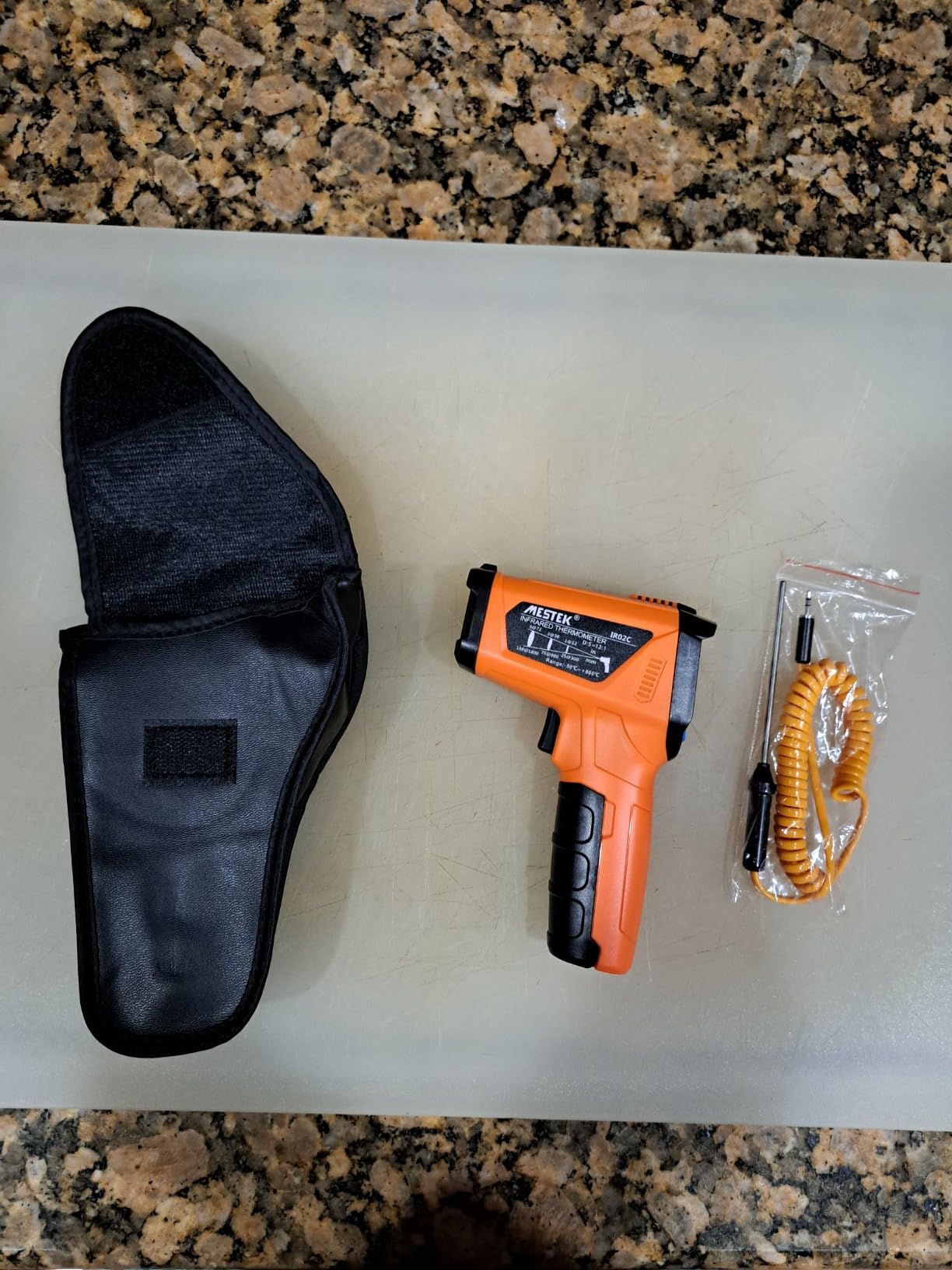
The package is unusually complete: a carry bag, batteries, a screwdriver and a manual, plus a two year manufacturer warranty.
Where the extra range pays off
Boiler and flue surveys, burner and combustion chamber checks, refractory and furnace work, and any hot surface you would rather read from across the room than up close.
The included type K probe means the same meter covers contact work, which is what you need anyway for line temperatures below the point where the IR range matters.
Where it needs care
The laser aim point is offset from where users expect it. This is the most common complaint in reviews and it causes genuinely wrong readings if you do not check the offset first.
Some variant listings stop reading around 2000F despite the higher stated range, so verify the actual reading against a known reference before you depend on a high number.
Infrared readings on people or animals run below body temperature, which is a hard limit of the technology rather than a fault in this unit.
How to Use an Infrared Thermometer on an HVAC System
An IR thermometer is a surface thermometer. Everything useful follows from that one sentence, so the technique matters more than the model in most situations.
Measure supply and return at the same point. Hold the gun the same distance from the register face on both sides. Moving air across the sensor pulls the reading toward the air temperature and gives you a steadier average than a single snap does, so hold the trigger a few seconds and let the number settle.
Read the delta-T, not the absolute number. The difference between return air and supply air across a coil or across the whole system is the diagnostic. On a healthy central air system a large split across the coil is what you expect; a small split with a warm supply tells you the coil is not transferring heat, which points at low airflow, a dirty coil or a low charge.
Sweep coils for a freezing row. A low airflow problem shows up as a band of very cold rows across the evaporator, often where air leaves the coil and starts to short-circuit. Walk the gun across the full width and watch the minimum reading, not a single point.
Check line surfaces, then clamp them. Pointing an IR gun at an insulated suction line reads the insulation surface, not the refrigerant. That is fine for spotting a restriction as a cold anomaly, but for superheat and subcool you need a contact clamp on bare pipe.
Survey disconnects and lugs. On a de-energised, locked-out panel, an IR gun finds the one termination running hotter than its neighbours long before it becomes a failure. Compare each lug to the others on the same buss, not to a number from memory.
Survey duct insulation. In an attic or crawlspace, a backlit gun with a wide spot ratio is ideal. Missing or displaced insulation shows immediately as a temperature anomaly on the ductboard or on the pipe jacket.
Emissivity: The Setting That Decides Whether Your Reading Is Right
Emissivity is how well a surface emits infrared radiation. A rough, matte, dark surface emits a lot. A polished, shiny surface reflects most of what it receives, so your sensor ends up measuring whatever is reflected back at it, including your own body heat and the room around the target.
Set emissivity higher than the surface and you read low. Set it lower and you read high. Either way the error can dwarf the instrument accuracy printed on the box.
The practical rule: use the tape trick. Put a strip of matte black electrical tape on the surface you need to measure, let it sit until it matches the temperature of what is under it, and aim at the tape with emissivity set to 0.95. Every infrared thermometer on this list can do that.
Rough starting points for HVAC surfaces, so you are not guessing on a call:
Black rubber pipe insulation and matte black pipe wrap sit high on the scale, roughly 0.90 to 0.95, so 0.95 is usually right.
Painted ductboard and painted metal sit around 0.90 to 0.95, depending on colour and age.
Bare copper, aluminium and galvanised sheet are low, roughly 0.03 to 0.15. This is where a fixed 0.95 gun is worst and where the tape trick matters most.
Foil-faced tape and foil duct wrap are among the worst surfaces in HVAC, effectively mirroring. Do not trust any reading without tape.
Window glass is very low, around 0.80 to 0.90, and it also lets some radiation straight through, so readings are unreliable.
Tools with adjustable emissivity let you approximate a shiny surface and get closer, and the dual-laser models let you confirm you filled the spot. Neither replaces the tape trick on foil.
IR Gun vs Pipe Clamp vs Thermocouple
This question comes up on HVAC forums more than any other, and the honest answer is that each tool has a job and the mistakes start when people use one for the others’ job.
Use the IR gun for fast surveys and surface comparisons. Coil sweeps, supply and return air comparisons, disconnect and lug surveys, insulation surveys, spot checks on a running line to find a cold or hot anomaly. Anywhere you need speed and a surface answer.
Use the pipe clamp or type K thermocouple for refrigerant line work. Superheat and subcool are calculated from actual refrigerant and saturation temperatures at a point inside the pipe. A clamp on bare pipe or under the insulation is the only way to get that number, and the more expensive meters here include a probe for exactly this reason.
Use a contact probe where emissivity is unreliable. Foil-faced duct, new galvanised ductwork, glass and any surface so reflective that the IR reading is really a reflection of the room.
Use a thermal imager for whole-system balance. When the question is where the heat is going across an entire building envelope or air distribution system, an imager maps it in one pass. That is a different purchase at a different budget level, and none of the units here does it.
The common mistake is treating an IR surface reading as a superheat number. It is not one, and no amount of emissivity adjustment turns it into one.
Why Your IR Thermometer Gives the Wrong Reading
Six causes account for nearly every bad reading in the field.
Distance beyond the spot size. The measurement spot is much larger than the laser dot. At a 10:1 ratio the spot is a tenth of your distance from the target, so at 30 inches you are averaging a three inch circle of whatever is behind your target.
Wrong emissivity. Usually on foil tape, bare metal or glass. This is the most common cause of a confidently wrong number.
Reflections from nearby shiny metal or bare pipe. A polished suction line next to your target reflects into the sensor.
Mixed air streams. An IR gun reads surfaces, so pointing it into moving air at a register gives you a reading influenced by airflow and ambient, not a true air temperature.
Sunlight. On a rooftop unit in daylight, the sun adds radiation to the target and the gun reports a temperature higher than the metal actually is. Work in shade or come back.
Shooting through glass or insulation. Glass and insulation both corrupt the reading. If the surface is covered, you are measuring the cover.
One more worth knowing: evaporating refrigerant on a line pulls the surface temperature down locally, so an IR reading on an actively sweating line can sit below what the refrigerant is actually doing. That is why the clamp wins for line work.
Dual Laser vs Single Laser: What Circle Laser Actually Buys You
A single laser gives you one dot. A dual laser gives you two dots that mark the edges of the area being measured, which is why those models are often called circle laser guns.
That second laser is not a gimmick. It tells you the actual size and position of the spot you are averaging, which is the difference between measuring a one inch suction line and averaging that line together with the wall behind it.
On this list the Klein IR5 and the Temirup IR05A both use dual lasers, and the Fluke 62 MAX, Fluke 561, Klein IR1, Fieldpiece SPK3 and Testo 830-T1 all use a single point.
The practical workflow is simple. Place the two dots so they straddle your target, confirm the target fills the space between them, then take the reading. On a small line in a tight space you will often find you need to move closer than you assumed, and the dual laser is what tells you that.
One caveat from reviewers of dual-laser models: the two dots can be spaced wider than the stated spot ratio suggests, and readings jump when one dot lands on a surface at a different temperature. Treat it as guidance rather than a guarantee.
How to Choose an HVAC Infrared Thermometer
Most of the decision comes down to four specs and one question about your work. Here is how to weigh them.
Match the distance-to-spot ratio to the smallest thing you will shoot
Distance-to-spot, written as D:S, tells you the spot diameter as a fraction of the distance from the gun to the target. A 12:1 gun puts a spot roughly one twelfth of your distance across.
For a three-quarter inch insulated line held 12 inches away, you need a spot under three quarters of an inch, which means 16:1 or better to have any margin. A 10:1 gun at that distance gives you a spot over an inch wide and you will be averaging pipe plus insulation plus whatever is behind it.
For coil sweeps, supply and return comparisons and insulation surveys, 10:1 or 12:1 is plenty. For small line and fitting work, look for 20:1 or better, or plan to work close.
Emissivity: adjustable or fixed
Fixed 0.95 is fine on painted or matte surfaces and wrong for foil tape, bare metal and glass, and you cannot correct it. Adjustable emissivity from roughly 0.10 to 1.00 lets you approximate a shiny surface.
If your work includes foil-faced duct, bare copper line or galvanised ductwork, adjustable emissivity is close to a requirement rather than a nice feature. Even with it, the tape trick remains the most accurate method on a reflective surface.
Temperature range you actually need
A range from -40F to around 550F covers nearly all residential and light commercial service work, including cold attic start-up temperatures and furnace heat exchangers.
You only need 1000F and above for boilers, flues and refractory work. If that is part of your work, look at the Fieldpiece SIG1, Fluke 561 and Temirup IR05A. If it is not, paying for extra range just gets you a different sensor and no benefit.
Accuracy tolerance and what it means for a diagnosis
Stated accuracy, typically plus or minus 1.5C or plus or minus 2 percent of reading, is only one term in your total error.
Total error is instrument accuracy plus emissivity error plus distance error. An instrument accurate to plus or minus 0.5 percent can still be fifteen degrees wrong on foil-faced tape if you leave the emissivity setting alone. That is why relative measurements, comparing two surfaces with the same setup, are far more trustworthy than absolute ones.
Jobsite durability
Look for an IP rating for dust and splash protection and a stated drop rating. The Fluke 62 MAX carries IP54 and a three meter drop rating, and several Klein models are rated to six and a half feet.
A backlit display is not optional if you work in attics, plenums or crawlspaces. Glove-operable buttons matter on rooftops in winter. Battery format is a quiet but real issue: AA and AAA are batteries you already stock, while a 9V is one more thing to find.
Single function or IR plus probe
If your work includes refrigerant line measurements, a meter that includes a folding Type K probe or a wired pipe probe removes a tool from the bag. The Klein IR07, Fieldpiece SPK3 and Fluke 561 all do this.
The trade-off is bulk and a slightly compromised infrared sensor compared with a dedicated gun. For a technician who does both jobs daily, that trade is usually worth it. For someone doing air side work only, a dedicated gun is simpler.
What to pay, expressed by job
The cheap tier buys you a comparison tool. A gun at the low end with fixed 0.95 emissivity is genuinely good at telling you which side of a duct is warmer and genuinely bad at telling you how many degrees.
The working technician tier, where the Fluke 62 MAX, Fluke 561, Fieldpiece SPK3, Testo 830-T1 and Klein IR5 sit, buys adjustable emissivity, a known accuracy tolerance, a proper drop and IP rating and min, max and delta modes. That is the band most service work justifies.
The premium band buys dual lasers, high-temperature range and probe capability together. It is worth it if you do line work or flue work daily, and it is overkill if you mainly compare air temperatures.
One blunt piece of advice that costs nothing: a modest gun plus a pipe clamp beats a single expensive gun alone for most service calls, because you will use the clamp more often than you expect.
If you are also upgrading the space the system serves, our infrared heater picks for garages cover the equipment on the other side of the thermostat.
Frequently Asked Questions
Which brand of infrared thermometer is the best?
There is no single best brand, because the right answer depends on the job. Fluke is the default for accuracy-critical diagnostics and repeatability. Klein Tools covers budget surveys and dual-laser spot bracketing. Fieldpiece and Testo cover technicians who want a probe in the same meter. For dual lasers and very high temperature range, look at the Temirup IR05A and the ThermoWorks class of industrial instruments.
What is one of the negatives of the infrared thermometer?
It only reads surface temperature, so the number is an estimate rather than a direct measurement. Emissivity settings, reflections from shiny metal, distance beyond the spot size, sunlight and shooting through glass or insulation all push the reading off. It also cannot measure air temperature, liquid bulk temperature, or anything inside pipe insulation.
What are the three main types of thermometers used in HVAC systems?
First, infrared non-contact thermometers, which read surface temperature quickly and safely. Second, digital thermometers with a thermocouple or thermistor probe, used for in-duct air, liquid line and contact measurements. Third, clamp-style pipe thermometers that attach directly to refrigerant lines for superheat and subcool calculations. A thermal imaging camera is a fourth tool that maps a whole system rather than one point.
What kind of thermometer can I use to check the temperature of my AC vents?
An infrared thermometer aimed across the vent face works well for comparing supply and return air. Measure supply and return at the same point on the same unit and compare the two numbers rather than trusting either one alone. Note that you are reading the grille and the surface air passes over, not the moving air itself, so hold the trigger a few seconds for a steadier average.
What is the best IR thermometer for HVAC work?
For most residential and light commercial service, the Fluke 62 MAX is the best overall pick: repeatable readings, min, max, delta and average modes, an IP54 rating and a three meter drop rating. Add a Fluke 561 or Fieldpiece SPK3 if you also need a contact probe for refrigerant line work, and consider a dual-laser model like the Klein IR5 when you regularly shoot small lines and fittings.
Is an IR thermometer accurate enough for superheat?
No. Superheat requires the refrigerant temperature at the line outlet and the saturation temperature at the same point, which means a contact clamp or thermocouple on the pipe. An IR gun aimed at a line reads the insulation or pipe surface and is affected by emissivity, reflections and evaporating refrigerant. Use the IR gun to spot a cold or hot anomaly, then clamp the line for the actual number.
How close do I hold an IR thermometer to a refrigerant line?
Close enough that the line fills the spot. Remember the spot is much larger than the laser dot, so check with a dual laser model if you have one, or move in until the reading stops changing. For a three quarter inch insulated line held 12 inches away, you want a distance-to-spot ratio of 16:1 or better. Insulation also reads differently from bare pipe, so aim at the metal if it is exposed.
Do I need an IR thermometer for HVAC if I have a manifold gauge set?
Yes. A manifold gauge set gives you refrigerant pressure and temperature at the service ports, which is what you need for superheat and subcool. An IR thermometer covers everything the gauges cannot: air temperature splits across a coil, freezing rows, insulation surveys, and thermal checks on disconnects, lugs and ductwork. They answer different questions and both belong in the bag.
Are cheap infrared thermometers accurate enough for HVAC?
For comparisons, yes. Owners of budget guns regularly report they perform as accurately as costlier models when judging which surface is warmer. For absolute values, no. Budget guns usually lock emissivity at 0.95, which makes them unreliable on foil tape, bare metal and glass, and their accuracy drifts as you move farther from the target. Treat them as comparison tools and upgrade when a diagnosis depends on the number.
Final Verdict: Best Infrared Thermometers for HVAC Work
For most technicians the Fluke 62 MAX is the one to carry. It reads repeatably, it survives the truck, it shows you difference readings, and its range covers essentially every residential system you will meet.
Pick up the Klein IR1 if your work is air side comparisons and you are building a kit from scratch. Pick the Klein IR5 when you need adjustable emissivity and want to see the spot you are measuring. Pick the Fluke 561 or Fieldpiece SPK3 when refrigerant line work is part of the job, because only a contact probe gives you superheat and subcool numbers.
And keep a pipe clamp in the bag no matter which gun you own. No infrared thermometer fixes a system that needs a contact measurement, and knowing which tool belongs on which measurement is worth more than any upgrade.
Our picks were reviewed for 2026. Check the latest listing details before you buy, and check your gun’s emissivity setting against the surface you are shooting.