
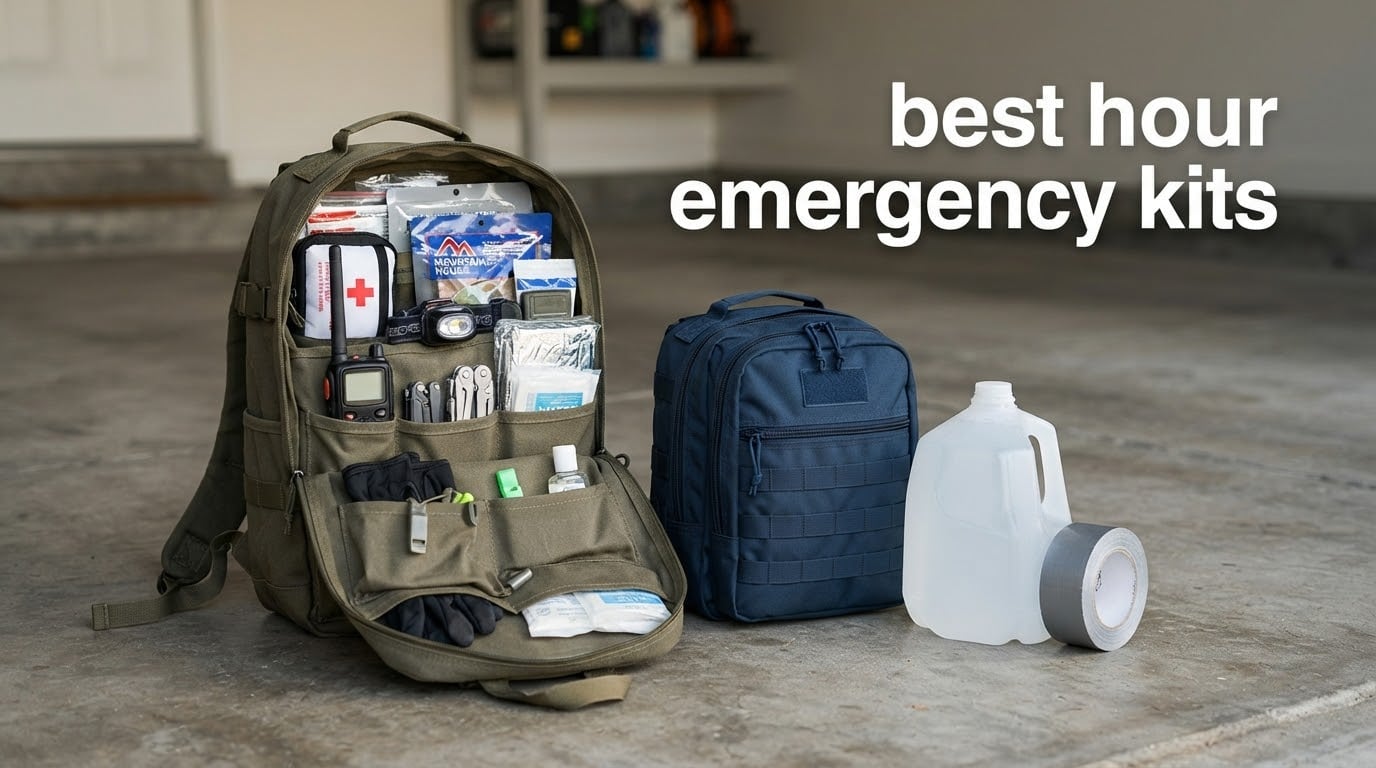
Three days is the number every preparedness authority keeps coming back to. Ready.gov, the American Red Cross and FEMA all tell households to hold at least 72 hours of water, food and supplies, because during a flood, wildfire, ice storm or earthquake the power goes out, the roads close and the grocery stores shut long before help arrives. If you have been putting off the search for the best 72 hour emergency kits, this roundup covers the ten pre-assembled options worth your time in 2026, plus the audit you should run on whatever bag you already own.
We spent weeks comparing every kit below on the only three things that actually matter: whether the food and water genuinely cover 72 hours for the number of people stated, whether the pack can be lifted and carried by one person, and what the owners who live with the bag say after a year of storage. We also read the failure reports buried in the reviews, because leaking water pouches and batteries eaten by corrosion do not show up in the marketing photos and they are the two things that turn a good kit into a disappointing one.
A few things stood out immediately. Three of the kits here include a NOAA weather radio, and several brands list a weight that clearly does not match the loaded pack, so we flag that rather than passing it along as fact. If you want the short answer, the Ready America 70280 is the one we would put in a closet today, and the Emergency Zone family kit is the one we would buy if money were not the question.
If you are still deciding whether a pre-made bag is worth it at all, our guide on emergency preparedness kits for families covers the DIY alternative and what it costs to build one. And if the deciding factor is what you eat for three days, start with our picks for the best emergency food kits for families instead of guessing at calorie counts.
Top 3 Best 72 Hour Emergency Kits (October 2026)
Three kits earned the right to sit at the top of this list. The Ready America 70280 wins on the combination of rating, owner volume and price, the Emergency Zone family kit wins on completeness and discretion, and the Redfora Complete Earthquake Bag wins on organization and the amount of food and water it actually carries.

Ready America 70280 2-Person Kit
- 4800 calories of food
- 12 water pouches
- 33-piece first aid kit
- blankets and ponchos

Emergency Zone Family Kit
- 132 pieces
- 5-year shelf life rations
- 121-piece first aid kit
- discreet backpack

Redfora Complete Earthquake Bag
- 3600 calories
- 24 water pouches
- 20 purification tablets
- hand-crank NOAA radio
Best 72 Hour Emergency Kits at a Glance in 2026
Every kit below is listed with the people it serves, the food and water it carries, and the feature that made it worth our attention. Ratings and review counts are taken from the listings, and the category labels match our individual verdicts further down.
| Product | Specifications | Action |
|---|---|---|
| Ready America 70280 2-Person Kit |
|
Check Latest Price |
 EVERLIT STORM II 3-Person Kit EVERLIT STORM II 3-Person Kit |
|
Check Latest Price |
| Emergency Zone Family Kit |
|
Check Latest Price |
| Redfora Complete Earthquake Bag |
|
Check Latest Price |
 Ready America 72 Hour Deluxe 1-Person Kit Ready America 72 Hour Deluxe 1-Person Kit |
|
Check Latest Price |
 Blue Coolers Blue Seventy-Two Blue Coolers Blue Seventy-Two |
|
Check Latest Price |
 72 HRS Deluxe Emergency Kit 72 HRS Deluxe Emergency Kit |
|
Check Latest Price |
 First My Family 4-Person Kit First My Family 4-Person Kit |
|
Check Latest Price |
 Sirius 2-Person 50L Bug Out Bag Sirius 2-Person 50L Bug Out Bag |
|
Check Latest Price |
 72 HRS Essential 1-Person Kit 72 HRS Essential 1-Person Kit |
|
Check Latest Price |
What Belongs in a 72 Hour Emergency Kit?
The short answer, taken straight from the Ready.gov and American Red Cross checklists, is five categories: water, food, light and communication, shelter and warmth, and first aid and tools. A genuine 72 hour emergency kit for one person carries one gallon of water per day, roughly 2,000 calories of food per day, a light source that does not need batteries, a blanket, a first aid kit and a way to purify or filter water if the stored supply runs low.
Everything beyond that is a bonus. Here is the order we would pack in, and the order the official guidance uses:
Water first. One gallon per person per day for drinking, cooking and hygiene. Stored pouches are convenient but thin, so most owners end up adding a filter or a larger container.
Food second. Energy-dense, shelf-stable and edible without cooking. Freeze-dried meals need hot water, which is a problem when the water is already rationed.
Light and communication third. A hand-crank flashlight, a NOAA weather radio and a whistle for signalling. Batteries left inside gear for years are the most common way a stored kit fails.
Shelter and warmth fourth. An emergency blanket, a poncho and something to sleep under. Hypothermia kills long before dehydration in a cold-weather event.
First aid and tools fifth. A first aid kit sized to the household, plus a multi-tool, gloves, a fire starter, duct tape and paracord.
Our picks for the best emergency weather radios cover the communication category in more detail if you want a radio that runs on batteries you can also charge by hand.
1. Ready America 70280 2-Person Kit – Best Overall Starter
Ready America 70280 Emergency 2-Person 3-Day Survival Backpack
Serves 2
4800 calories
12 water pouches
7.8 pounds
33-piece first aid kit
Pros
- One of the most reviewed kits we looked at
- Low cost way to start building a stock
- Compact enough for a car or closet
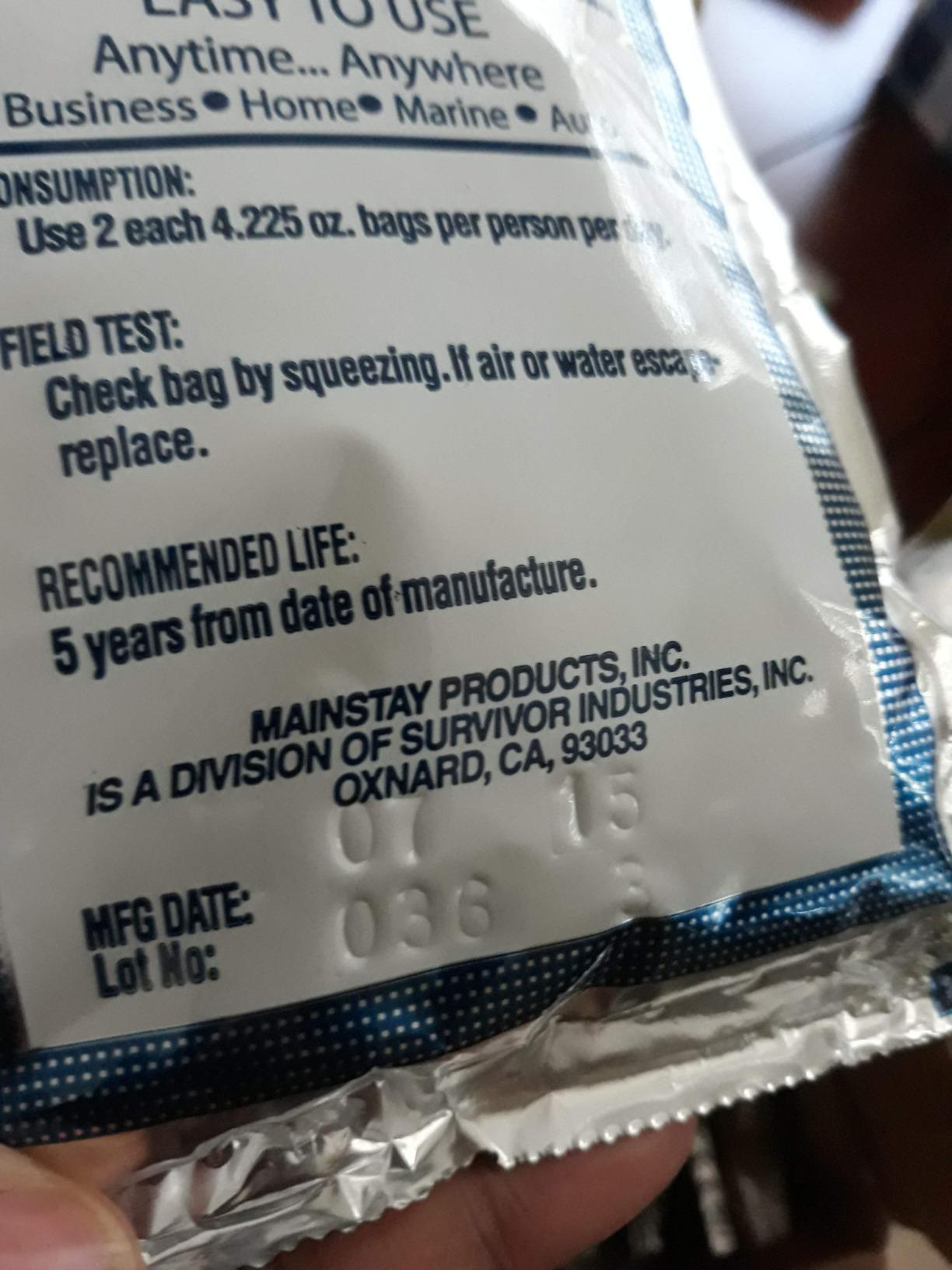
- Includes a reminder card to check expiration dates
Cons
- Contents are bare bones and need supplementing
- Food bars are bland and water quantity is minimal
- Backpack fabric and straps look destined to degrade over years
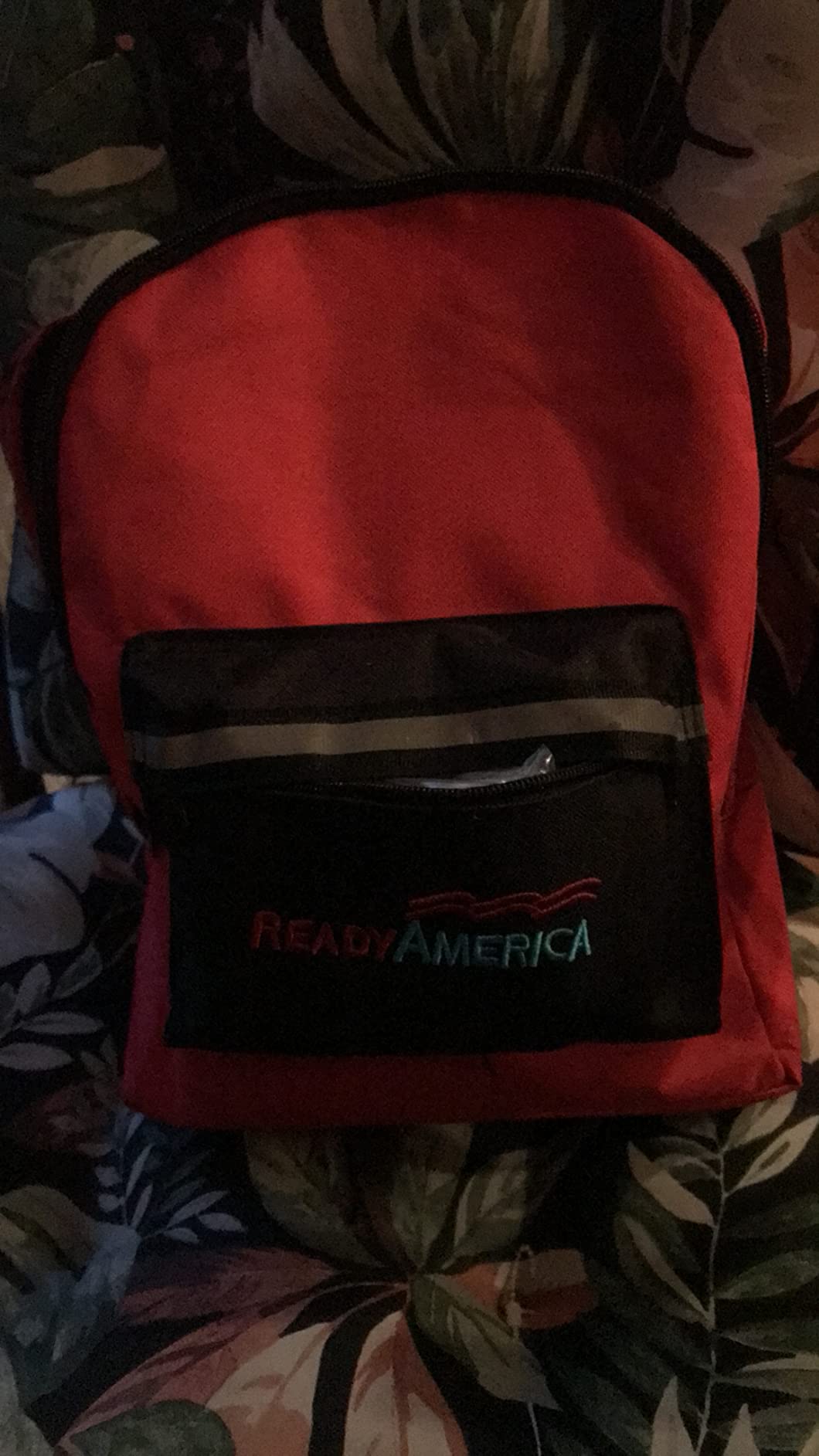
This is the kit we kept coming back to. It carries 4,800 calories of food split across two emergency bars and 12 sealed drinking water pouches, and it weighs 7.8 pounds, which is one of the few entries where the listed weight matches what owners report carrying. For a couple, a family car or a small apartment, that balance is hard to argue with.
What you get is a 33-piece first aid kit in a hard plastic case, two survival blankets, two emergency ponchos, a pair of dust masks, four nitrile gloves, two 12-hour lightsticks, a whistle, a tissue pack and the nylon backpack itself. That is a competent skeleton. It is not a complete three-day kit, and the brand does not pretend otherwise.
The first aid contents are worth reading closely, because they tell you what kind of kit this is: six adhesive bandages, ten junior bandages, a patch bandage, a butterfly closure, three alcohol wipes, three antiseptic wipes, antibiotic ointment, ibuprofen, aspirin and acetaminophen. That is a cuts-and-scrapes kit, not a trauma kit. Plan on buying a separate one for anyone in the household who takes blood thinners or has a chronic condition.
The honest weakness is the food. Reviewers describe the bars as bland bricks that get harder to swallow on day two, which is a real psychological problem when the whole bag is built around eating them. There is also no water purification in this pack at all, so if the twelve pouches run out you have no way to treat a source.
Two details we appreciate. The manufacturer, Quakehold, has been building this bag for a long time and backs it with a defects-only warranty, which is the minimum but better than nothing. The kit also includes a postcard reminding you to check expiration dates and resupply individual items, a small touch that most competitors skip.
At 9.5 by 6 by 12 inches it slides under a seat, into a hall closet or onto a top shelf without a fight. If you can lift 7.8 pounds one-handed, you can load this into a car alone, which is the constraint that knocks out most shelter-scale kits.
Who this kit suits?
Couples, students, apartment dwellers and anyone who wants a stopgap in every vehicle and closet of the house. Buyers consistently describe it as an excellent affordable starter that removes the paralysis of deciding what to buy, and the review volume behind that claim is larger than anything else in this group.
It also works well as a car kit. The dimensions are small enough for a trunk or a glovebox-adjacent storage bin, and the lightsticks mean you do not need batteries to be seen at night.
Who this kit does not suit?
Anyone counting on it as a self-sufficient three days without adding to it. Owners routinely supplement with extra water, a can opener, matches, tools and a proper first aid kit before they trust it in a real event. Budget an afternoon of adding gear before you treat this as finished.
If you need genuine 72-hour capability from the box, the Redfora bag in position four carries more food, more water and actual water purification tablets, which is where the money starts to make a difference.
2. EVERLIT STORM II 3-Person Kit – Best for a Heavy-Duty Tactical Pack
EVERLIT 72 Hours 3 Day Earthquake Emergency Kit Bugout Go Bag Emergency Kit Survival Kit Backpack for Family, Preparedness for Hurricanes, Floods, Tsunami, Other Disasters
Serves 3
200 pieces
36 water pouches
25 pounds
1000D molle pack
Pros
- Covers 200 pieces including a CAT tourniquet
- Food meets FEMA calorie guidelines
- Water purification treats up to 25 quarts
- 1000D polyester pack resists tearing and water
Cons
- 25 pounds is heavy for smaller individuals
- Some units arrive with punctured water pouches
- Delivered by a third-party seller rather than Amazon
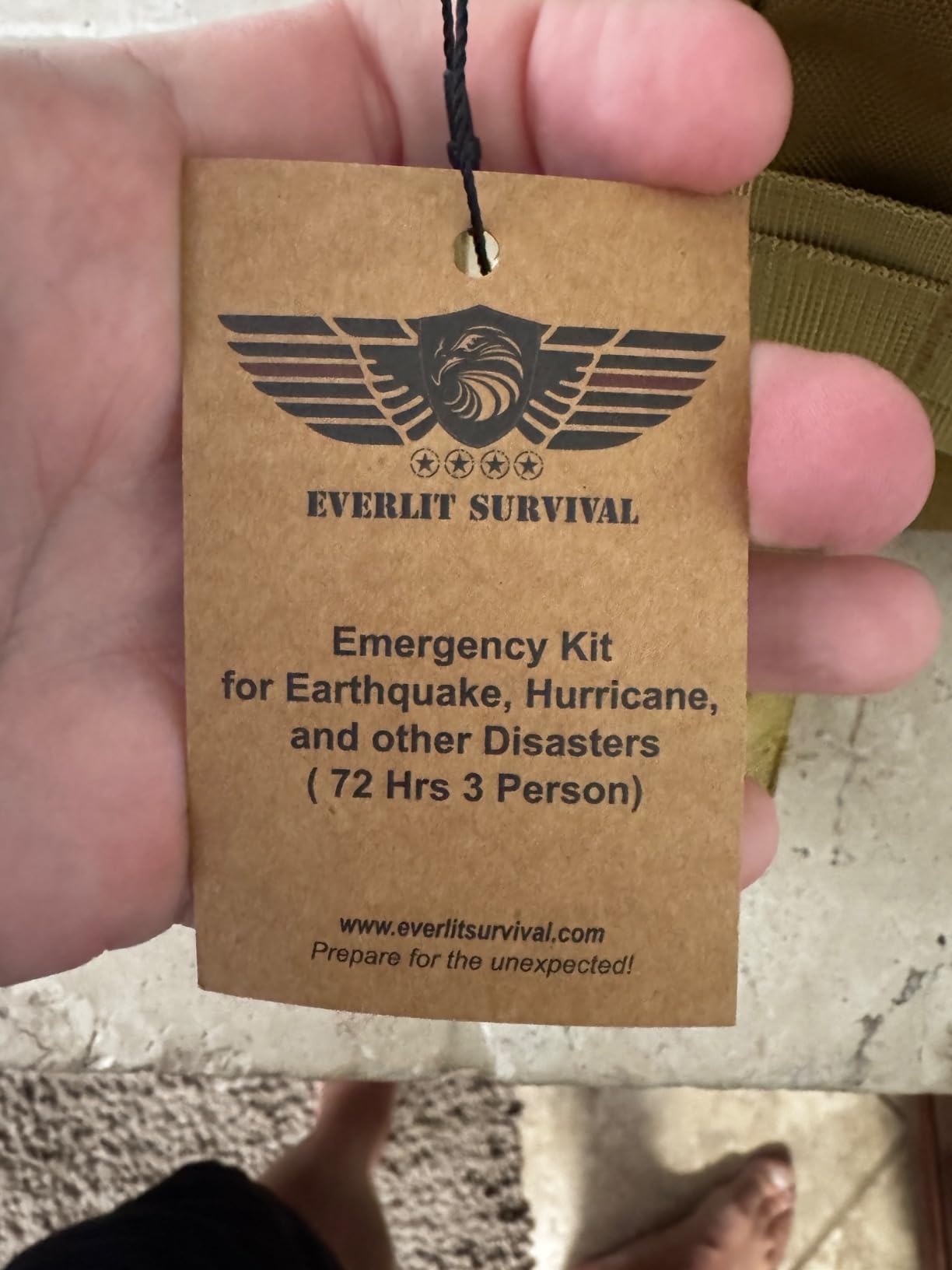
This is the most serious trauma-capable kit in the group. The STORM II packs 200 pieces into a 1000D polyester mil-spec molle backpack, and the medical component includes a CAT tourniquet alongside 200 pieces of medical supplies.
On the food and water side it is generous. You get 36 packs of 125ml emergency drinking water, three 3,600-calorie emergency food bars with a five-year shelf life, and water purification tablets rated to treat up to 25 quarts. The brand states the contents meet the FEMA guideline of a minimum 1,000 calories per person per day, and the math works out comfortably for three people.
Outside the food and medical load it carries a 3-in-1 hand-crank flashlight that doubles as a radio and a phone charger, plus shelter, thermal blankets, a poncho, goggles, gloves, a camping knife, a compass and glow sticks. The backpack has four main compartments, an adjustable waist strap and mesh padding, and buyers report extra room for personal gear.
At 25 pounds this is not a car-door bag. The weight is the single most common complaint in the reviews, and it is a fair one for anyone who is not physically strong or who would need to carry this up several flights of stairs. Plan on storing it at ground level near an exit rather than in a third-floor closet.
The second complaint is more concerning: some buyers received kits with punctured water pouches and damp contents inside the bag. That is a transit failure, not a design flaw, and it tells you something important about how you should inspect any sealed kit the moment it arrives, whatever the brand. Open it, count the pouches, check for dampness and photograph the contents before you store it for five years.
This kit is handled by a third-party seller rather than Amazon, so it is worth inspecting carefully on arrival. The build quality and the medical capability are genuinely good; the logistics are simply not as smooth as the big-name kits.
Who this kit suits?
Households of three who want real medical capability rather than bandages and antiseptic wipes. Survivalists, veterans and people who already have a head start on the other gear will find the molle layout easy to expand with documents, cash and medication.
It is also a good choice if you want food and water that measurably exceed the federal calorie guideline rather than barely meeting it, since the extra 3600-calorie bars per person give you room to add real meals that you actually want to eat.
Who this kit does not suit?
Anyone who needs to move fast. Twenty-five pounds is a serious load on uneven ground, and it is not a realistic grab-and-go bag for a driving evacuation where someone has to carry it from an upper floor.
Two-person households will find it oversized and over-supplied. Look at the Emergency Zone family kit instead, which covers more people in a pack that is easier to manage.
3. Emergency Zone Family Kit – Best for Families
Family Emergency Kit | All-in-one Survival Kit Backpack for Earthquake, Flood, Disaster Relief, Civil Unrest & Outdoor – Survival Bag & Emergency Preparedness Kit for Families (4 Person)
Serves 4
132 pieces
5-year shelf life rations
121-piece first aid kit
18 x 12 x 12 inches
Pros
- Among the highest rated kits in the group
- Compact and discreet backpack styling
- USA-made rations need no rehydration
- 121-piece first aid kit plus a planning guidebook
Cons
- Listed weight of 4.16 ounces does not match the loaded pack
- First aid kit is aimed at minor emergencies
- Delivered by a third-party seller rather than Amazon
At 4.8 stars across 1,341 reviews, this is the highest-rated kit we tested and the one with a deep base of satisfied owners. It is also the one we would hand to a family with children in it, because it is built around a four-person loadout without pretending to be a lightweight solo bag.
The food and water are the standout. The kit uses USA-made SOS brand rations and water that are US Coast Guard approved with a five-year shelf life, and the key word is calorie-dense with no rehydration needed. For families with toddlers this matters more than any other spec on the list, because a freeze-dried meal that needs boiling water is useless when your water supply is already rationed.
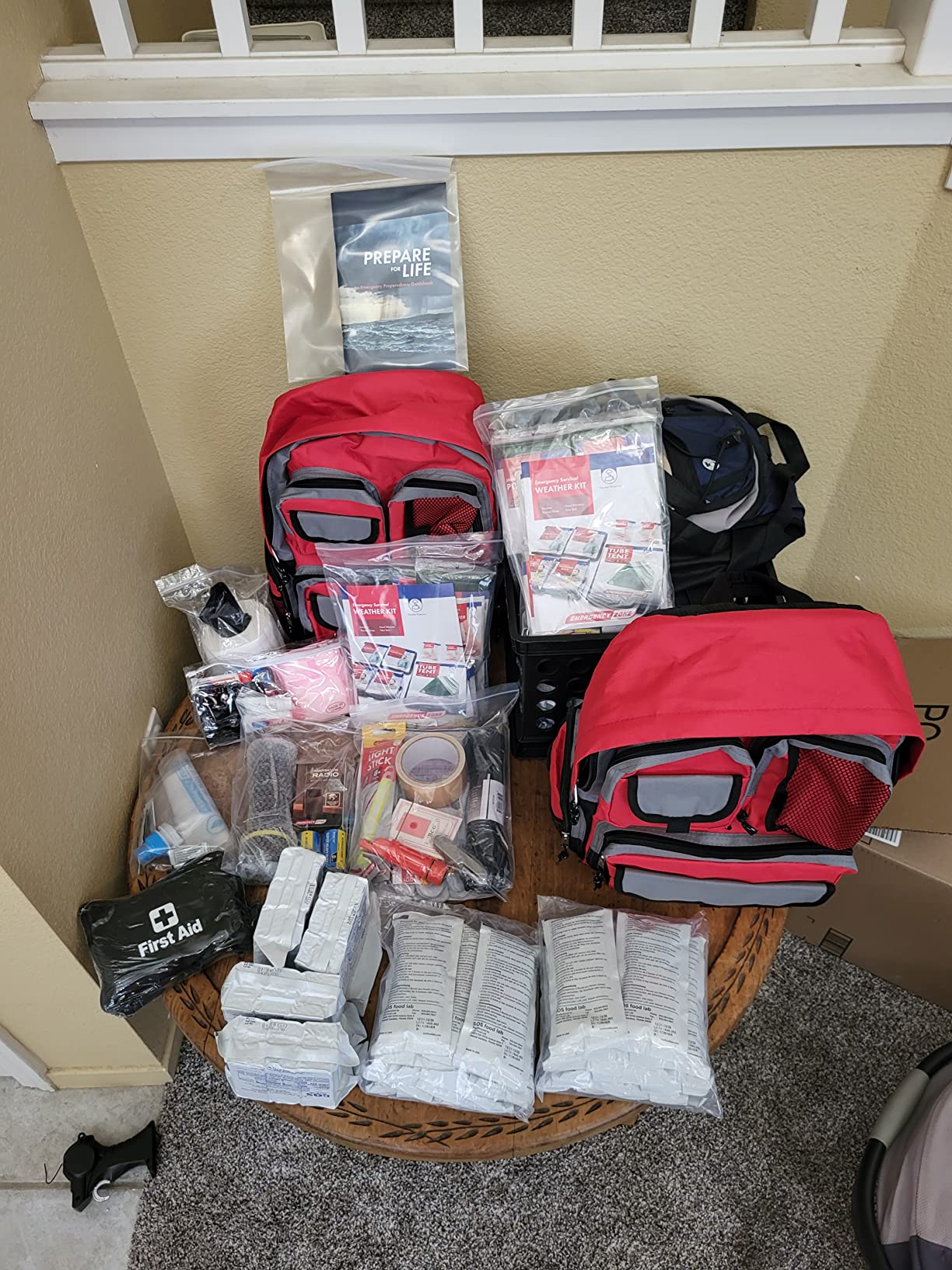
On top of that you get a 121-piece basic survival first aid kit in a compact durable pouch, plus shelter, light, hygiene, tools and water purification spread across 132 pieces total. The pack itself is a compact 19 by 15 by 10 inch backpack, and the styling is deliberately understated so it does not advertise what is inside it.
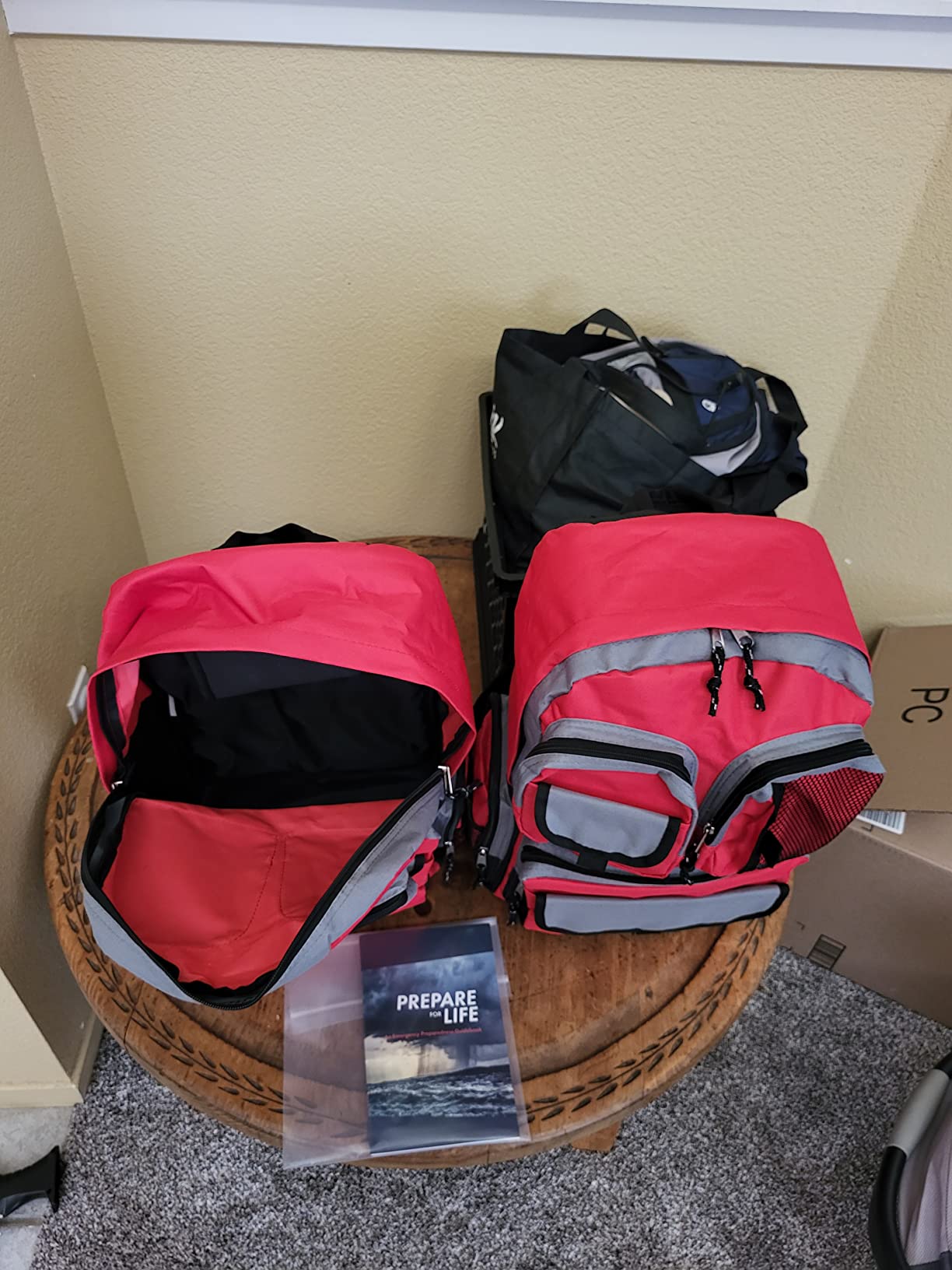
That discretion is a genuine feature, not a marketing line. Several competitors print their brand across the front of the bag, which several owners in this group specifically dislike. This one reads as an ordinary daypack.
It also bundles an emergency guidebook covering first aid, family emergency planning and disaster navigation, which is a genuinely useful thing to have when a stressed parent is trying to work out what happens next at 2am.
One spec warning. The listing shows an item weight of 4.16 ounces, which almost certainly refers to the empty pack shell rather than the loaded kit. Do not use that number when you are deciding whether one person can carry this. A fully loaded four-person kit of this type is a real load, so test it yourself before committing.
Who this kit suits?
Families of three or four who want one bag that covers everyone and does not need a separate build-out. The no-rehydration rations and the Coast Guard approval give you two things most budget kits cannot: food kids will accept and a shelf life you can actually plan around.
It is also our pick for anyone worried about weight being a giveaway. The pack looks like a normal backpack, and 2-person and 4-person variants are both available so you can size it to your household.
Who this kit does not suit?
Anyone who needs serious trauma care. The 121-piece first aid kit is described by owners as intended for minor emergencies, and there is no tourniquet in this pack. If someone in your household is on blood thinners, has a seizure disorder or is far from a hospital, add a separate trauma kit.
It is also handled by a third-party seller rather than Amazon. Given the five-year shelf life on the food, that is an acceptable trade, but inspect the pouches on arrival for the same puncturing issue a few owners reported with other kits in this group.
4. Redfora Complete Earthquake Bag – Best Premium 2-Person Kit
Complete Earthquake Bag – Emergency Kit for Earthquakes, Hurricanes, Wildfires and Other Disasters – Built for 2 Person for a 3 Day Period
Serves 2
3600 calories
24 water pouches
20 purification tablets
hand-crank NOAA radio
Pros
- Colour-coded re-sealable waterproof packing
- Food and water run well past guideline minimums
- Hand-crank NOAA radio
- flashlight and phone charger
- Video guide plus a full satisfaction guarantee
Cons
- 16 pounds makes it a home supply bag rather than grab-and-go
- Delivered by a third-party seller rather than Amazon
- Largest size listed is the 2-person version
This is the best-organized 72 hour emergency kit in the group, and the reason is packaging. Everything is packed into colour-coded, re-sealable waterproof pouches, so when you need the purification tablets at 3am you are not dumping the entire bag onto a dark floor. For a family kit that is the difference between a stressful night and a bad one.
The food and water quantities are among the strongest in this list per person. You get 3,600-calorie food bars with a five-year shelf life, 24 water pouches and 20 water purification tablets, and the brand states the loadout runs well above the Red Cross guideline minimum. For a couple, 24 pouches plus tablets is one of the first kits here where we believe the three-day claim without a supplement plan.
Then there is the electronics. The kit includes a NOAA hand-crank flashlight, radio and phone charger, which is the most useful piece of gear in any 72 hour emergency kit and the one most budget kits skip. If you are buying a radio separately, our picks for the best emergency radios with solar charging are worth a look, but this kit already has one.
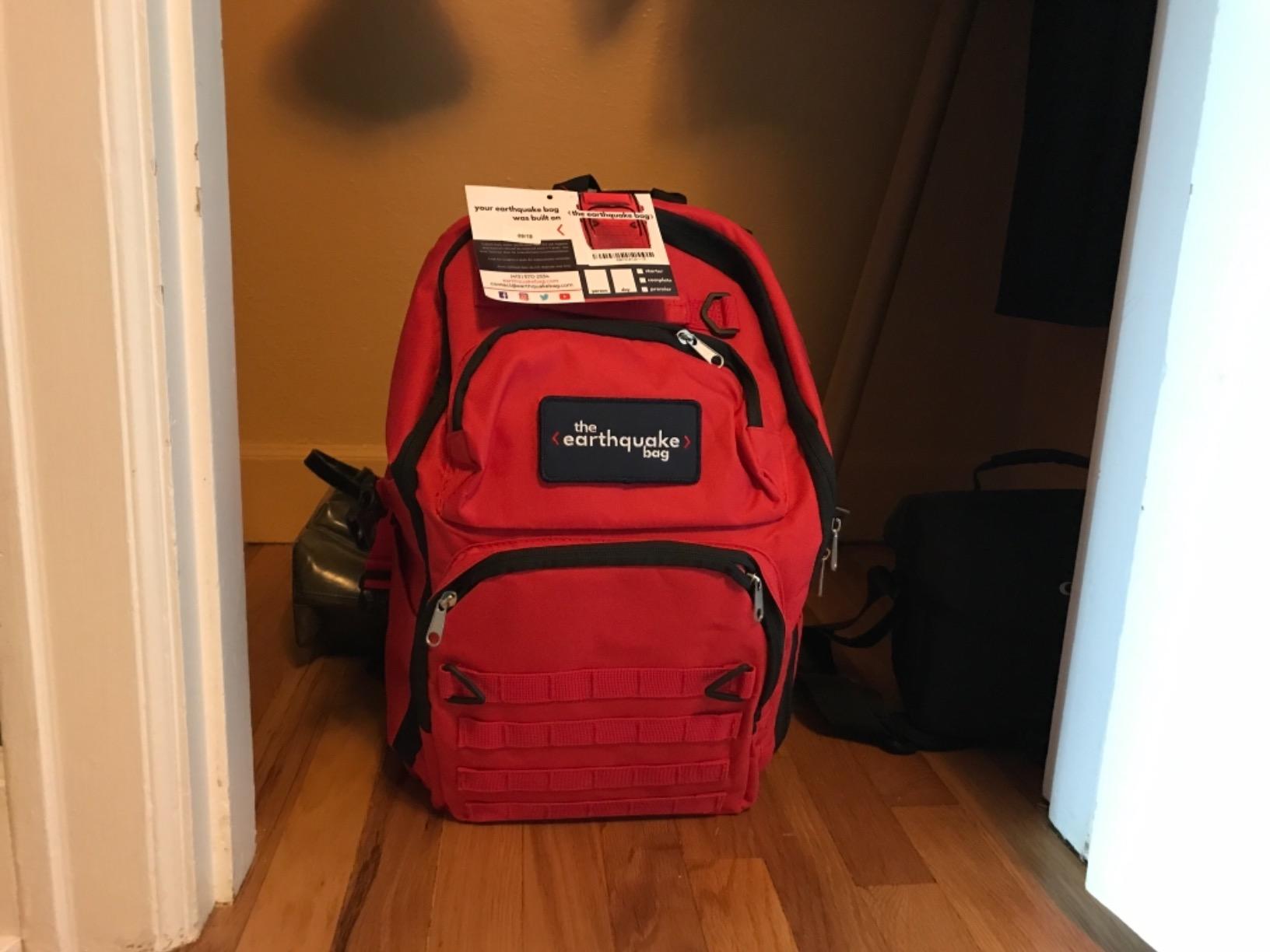
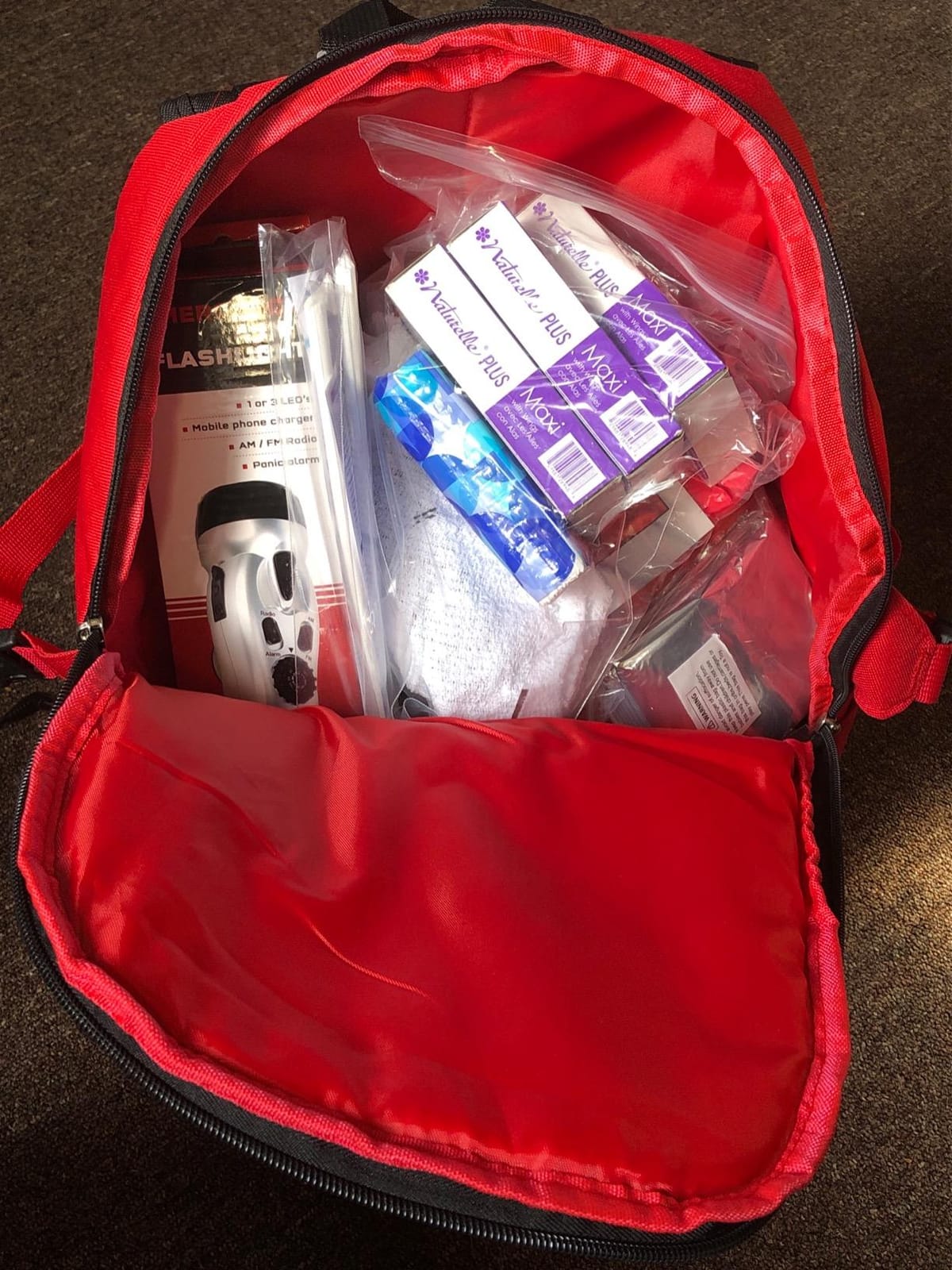
Also in the bag: a multi-tool, a sleeping bag, a 2-person tube tent, 30 feet of nylon rope, a 5-in-1 whistle, a full first aid kit and a hygiene kit. The tube tent and sleeping bag are what push this from a food-and-water bundle into actual shelter capability, and they are the reason it is one of the most complete kits here.
Redfora also includes an expert video guide walking you through what each category of supply is actually for, which is a nice touch if your family has never looked inside one of these before. The kit is backed by a 100% satisfaction guarantee, a disaster-relief donation per sale and one-on-one expert support, which is a stronger warranty position than the 90-day cover two competitors offer.
The catch is weight: 16 pounds, in a pack measuring 10 by 18 by 24 inches. That is a home shelter supply bag, not a run-out-the-door bag. If you live in an apartment on the fourth floor or plan to walk a distance after an evacuation, this is not the pack you grab.
Who this kit suits?
Couples or a family of two who want the highest water and food quantities in a kit that also includes real shelter. It is one of the most complete packages in the group, and the colour-coded packing makes it the easiest to use in the dark.
It is also our pick for anyone who wants the NOAA radio and does not want to source one separately. Combined with the tube tent and sleeping bag, this kit covers the five official categories better than any other pre-assembled option here.
Who this kit does not suit?
Larger households. The largest size listed is the 2-person version, so a family of four needs the 3 or 4 person variant, and the price moves with it. For a bigger group at a comparable feature level, the First My Family 4-Person kit is the more direct route.
Anyone who has to walk more than a short distance. Sixteen pounds is manageable over a few hundred metres and miserable over a kilometre. Pair it with a lighter vehicle bag rather than trying to make one pack do both jobs.
5. Ready America 72 Hour Deluxe 1-Person Kit – Best for Cars and Small Spaces
Ready America 72 Hour Deluxe Emergency Kit, 1-Person 3-Day Backpack, First Aid Kit, Survival Blanket, Power Station, Emergency Food, Portable Disaster Preparedness Go-Bag for Earthquake, Fire, Flood
Serves 1
5 pounds
hand-crank headlamp
32 ounce water bottle
10 x 6 x 13 inches
Pros
- Only 5 pounds so one person can load it alone
- Hand-crank LED headlamp needs no batteries
- BPA-free 32 ounce bottle adds real water volume
- Waterproof matches and a survival blanket included
Cons
- Only 2400 calories of food for one person
- Six water pouches is lean for three full days
- First aid and hygiene components are basic
If your whole brief is one bag, one person and one car, this is the one. At 5 pounds and 10 by 6 by 13 inches it is the most manageable kit we tested, and it is the lightest one in this group, so we would not hesitate to tell a single person to carry it out to a car in the dark during a blackout.
It is also among the most thoughtfully specified compact kits. Alongside the 2,400-calorie emergency food bar and six drinking water pouches, you get a BPA-free 32 ounce water bottle, which is the detail that separates it from other lightweight options. A bottle you can refill from a tap, a stream or a roof catchment turns six pouches into something closer to a real supply.
The lighting is a hand-crank LED headlamp rather than a flashlight, so it frees your hands and needs no batteries. That matters after a year of storage, because batteries left inside a torch are the number one reason a stored emergency kit stops working. Add a poncho, a survival blanket, waterproof matches, a complete hygiene kit, pocket tissues and an emergency contact card, and you have a genuinely usable one-person bag.
The honest limitation is quantity. 2,400 calories spread over three days works out to roughly 800 calories a day, which is a light diet even for someone doing no work. And six pouches of water is not three days of hydration for one adult. Owners consistently note this and treat the kit as a starting point rather than a finished supply.
Topping it up is easy and cheap. Add a few canned goods, a bag of nuts, energy bars you actually enjoy and a water filter, and the pack moves from thin to genuinely capable without changing anything else. Our hand-crank emergency lantern picks cover the lighting upgrade if the built-in lamp ever stops convincing you.
The build is nylon with a defects-only manufacturer warranty, and the pack is sold for home, office, dorm, apartment, vehicle and RV storage. At this weight, one per person per vehicle is realistic, which is how we would deploy it.
Who this kit suits?
One-person households, students in dorms, apartment dwellers and drivers who want a full kit in every vehicle without buying a second car. Five pounds is a weight anyone can carry, including a parent helping a child or an older adult with limited grip strength.
It is also a strong pick for anyone who plans to supplement a pre-made kit, because the headlamp and bottle are the two components most people would otherwise have to buy separately.
Who this kit does not suit?
Anyone who wants the box alone to cover 72 hours. The food and water numbers are below guideline and need adding. If you want a self-sufficient one-person kit without a build-out, the 72 HRS Essential in position ten carries 3,600 calories and 12 water pouches plus a NOAA radio.
It is also not a shelter kit. There is no tent and no sleeping bag, so in a cold-weather or multi-night event you would need to add warmth layers for sleeping.
6. Blue Coolers Blue Seventy-Two – Best Budget Grab-and-Go Kit
Blue Coolers Blue Seventy-Two | 72 Hour Emergency Backpack Survival Kits for 1 Person | Survival Kit for Wildfires, Earthquakes, Tornado, Hurricane, and Other Emergencies…
Serves 1
2400 calories
5 water pouches
crank flashlight
14.8 x 9.9 x 4.4 inches
Pros
- One of the smallest and flattest kits here
- Triple-pocket reinforced grab-and-go backpack
- Covers the food
- water and blanket essentials
- Crank flashlight needs no disposable batteries
- Available as a two-pack
Cons
- Only five water pouches and 2400 calories
- No radio
- no purification and no real shelter
- Listed weight of 119.64 g is far below the real figure
The Blue Seventy-Two does one thing better than most: it is genuinely small. At 14.8 by 9.9 by 4.4 inches it is one of the flattest and lightest kits in the group, so it disappears into a trunk, a hall closet or the space under a bed in a way that nothing else here does. If you need one per person per room, this is the practical answer.
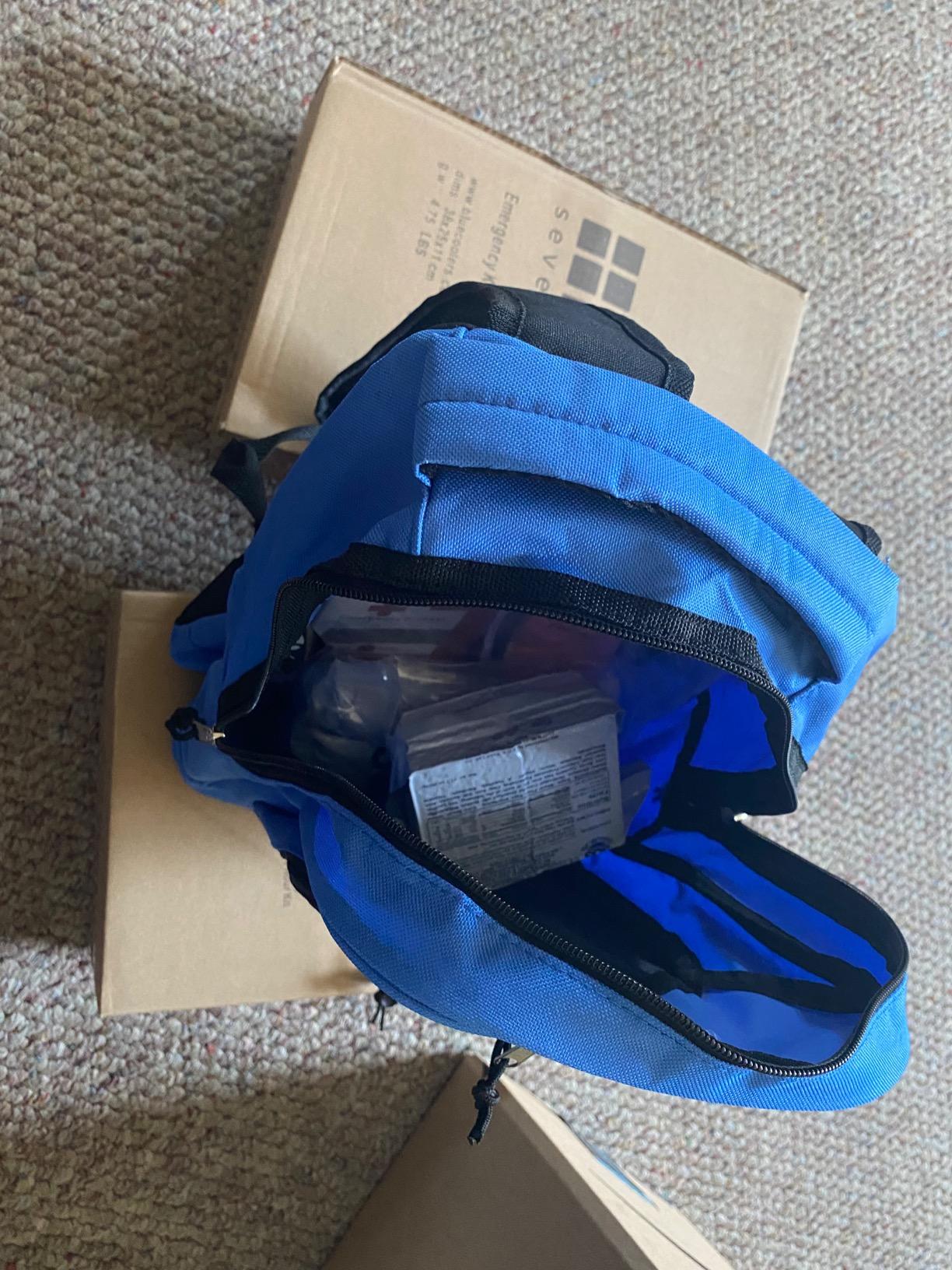
The pack is a triple-pocket reinforced grab-and-go backpack with room for personal additions, which is the right design instinct for a kit this size. Inside you get a 36-piece first aid emergency kit, an emergency blanket, a poncho, a whistle and compass combo, a battery-free crank flashlight, a dust mask, a tissue pack, 2,400-calorie food bars and five 4.22 ounce water pouches, all with a five-year shelf life.
That covers the three essentials the American Red Cross names, which is exactly the pitch and exactly what you get. It is a legitimate 72 hour emergency kit in the sense that it is a starting bag with the right categories represented.
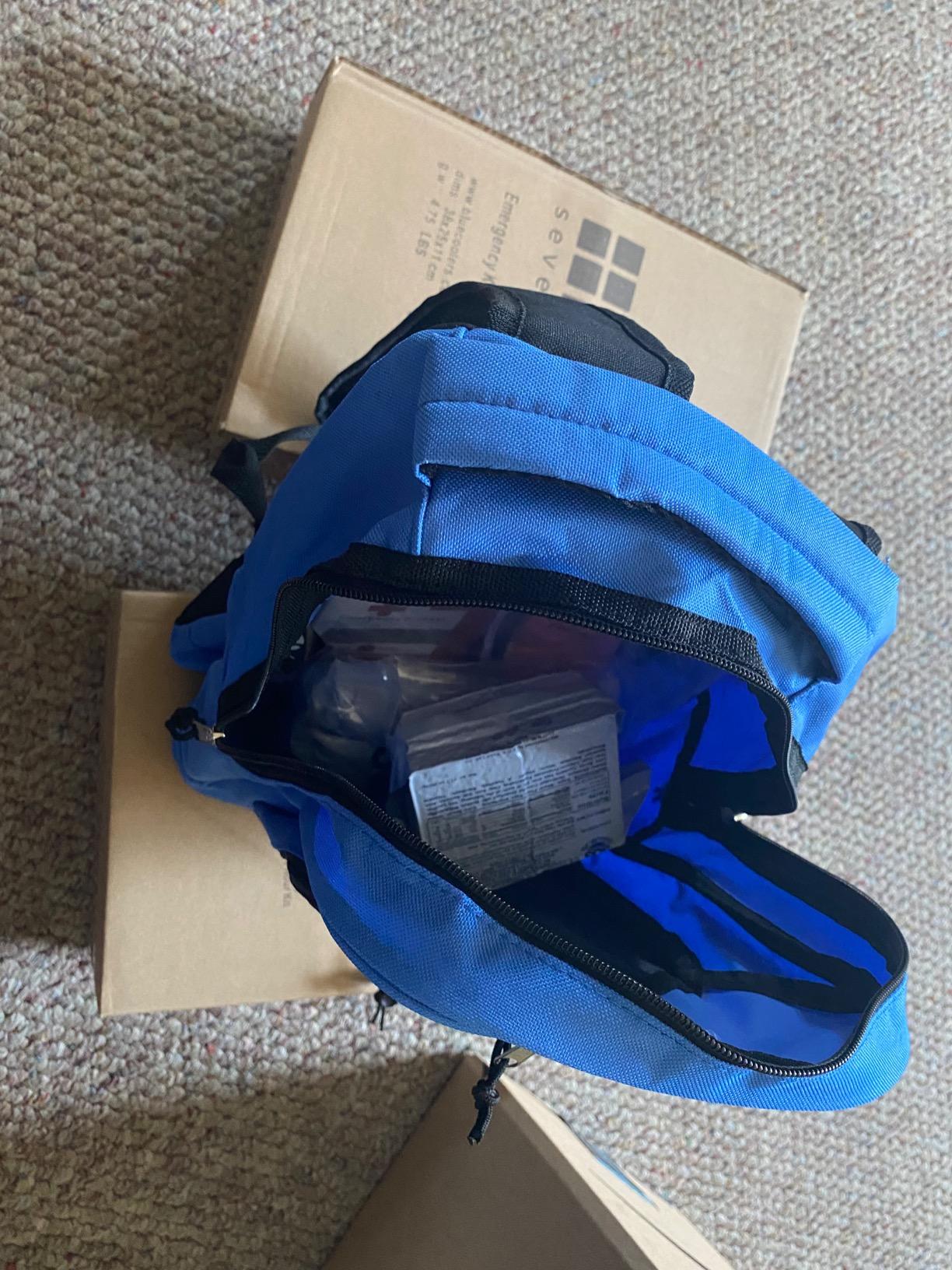
It is also one of the few kits here with a battery-free light source, so the corrosion problem that ruins stored flashlights simply does not apply. That alone puts it ahead for anyone storing a kit for years without touching it.
Where it falls short is quantity and range. Five water pouches for three days is thin by any honest measure, and there is no radio, no water purification and no shelter beyond a poncho and a blanket. In a wildfire evacuation, the poncho is not going to do much.
Also note the listed item weight of 119.64 g, which is far below what a loaded 36-piece pack can weigh. Treat it as a spec-sheet error and judge the pack by the number of pieces instead.
Who this kit suits?
Budget-conscious buyers who want a genuine, branded, non-expired starter bag in several rooms at once. The two-pack variant covers two vehicles or two rooms, and given how small each unit is, the flatness is what makes that deployment possible.
It is also a good second kit. Buy one for the car and one for the office, and you have a light source in both that does not depend on batteries you have to remember.
Who this kit does not suit?
Anyone in a region where water is the binding constraint. Five pouches with no purification option means you cannot safely treat a local source if you run dry. Add a filter or a larger container before you rely on it.
It is also not for anyone expecting real shelter. In a cold night or an earthquake you will need a sleeping bag and something more substantial than a poncho, both of which you should add.
7. 72 HRS Deluxe Emergency Kit – Best for Households of Any Size
72HRS Earthquake Emergency Kit, 3 Day Survival Kit (2 Person, Red)
1 to 4 person sizes
56 pieces
18 x 14 x 8 inches
polyester
90-day warranty
Pros
- Eight variants cover 1 to 4 people in two colours
- Bag dimensions match real capacity
- 56-piece deluxe configuration
- One of the lighter kits in the group by listed weight
Cons
- Broadest 1-star share among the kits we checked at 6 percent
- Listing is generic with no detailed component breakdown
- Only a 90-day warranty
The reason to look at the 72 HRS Deluxe is sizing. It is the only kit in this group offered in eight configurations, red or black, for one, two, three or four people, which means you can match the bag to your household exactly instead of buying a four-person kit for two and carrying weight you will never use.
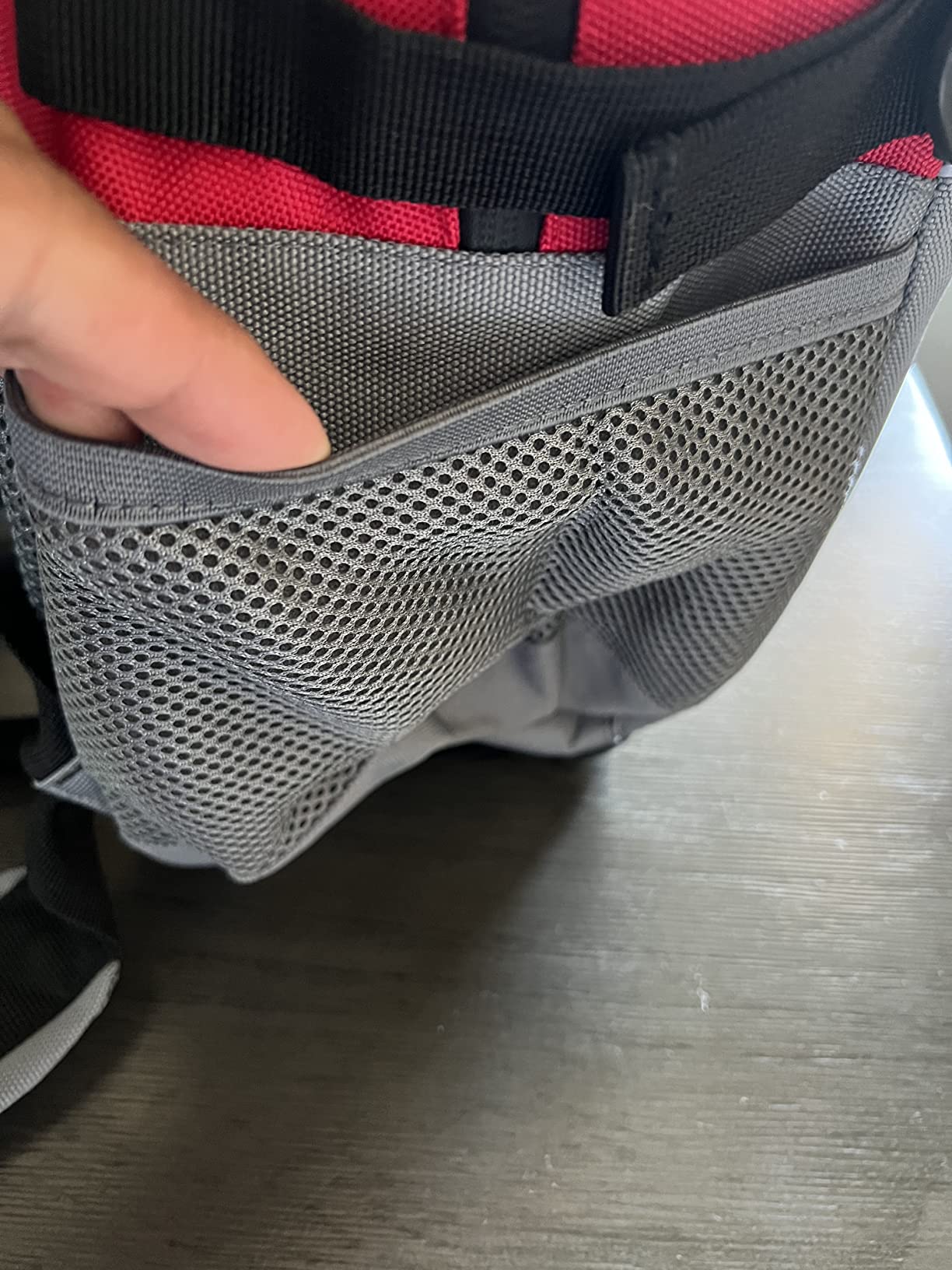
The bag itself is heavy-duty polyester and the dimensions, 18 by 14 by 8 inches, suggest a real capacity rather than a compressed marketing number. Several competitors list weights that clearly do not match the loaded pack, so a manufacturer publishing honest external dimensions is a small but meaningful signal.
Inside is a 56-piece deluxe configuration covering first aid, water, food and shelter essentials. That is a middle ground between the 36-piece Blue Coolers pack and the 200-piece EVERLIT bag, and it is where most two-person households should be looking.
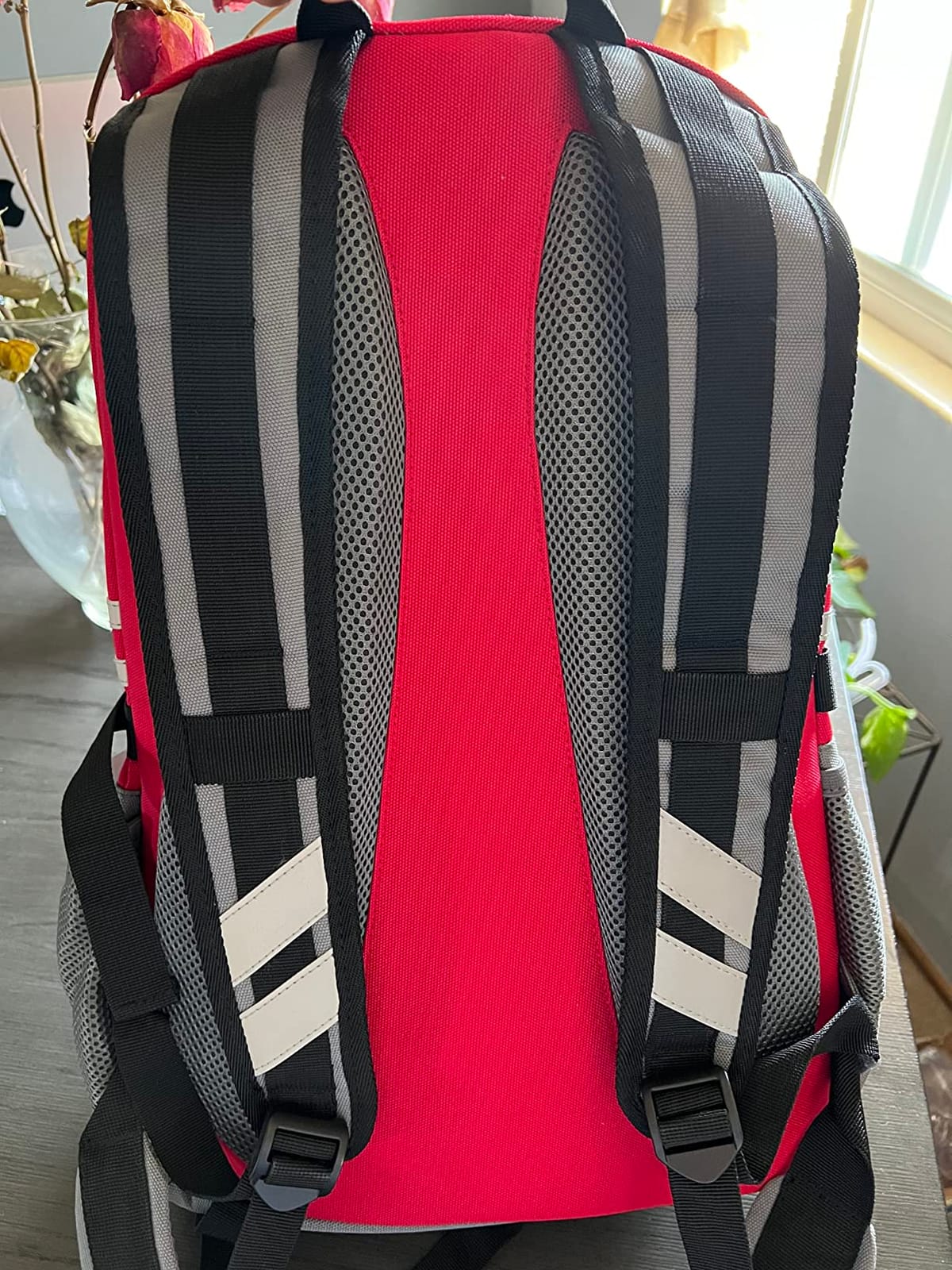
Buyers generally find solid preparedness value and sturdy construction, with the recurring note that the pack delivers what the size suggests. The concern is that a small group reports missing or disappointing components relative to the premium positioning, and at 56 pieces for a four-person version the per-person allocation gets thin fast.
Two other things to know. The 1-star rating share of 6 percent is the widest in this group, which is a fair signal that expectations are not always met, and the warranty is 90 days, one of the shortest we saw, so the cover is thin if a component arrives damaged.
Delivery is handled by a third-party seller. Given that you can choose one of several sizes, factor that into when you want it in place.
Who this kit suits?
Households that want to size the bag precisely to the number of people, and buyers who want one product family to cover a parent, a car and a spare bag. Red and black variants also make it easy to colour-code a kit by location once you own more than one.
For a two-person household in a moderate-risk area, the 56-piece deluxe at 18 by 14 by 8 inches is a sensible middle option between the thin budget kits and the 175-piece premium bags.
Who this kit does not suit?
Buyers who need a detailed component list before committing. The spec data here is generic, with no breakdown of individual items, so you are taking the maker at their word on what is inside. Check the current listing carefully before ordering.
It is also a poor choice for anyone who wants a warranty with substance behind it, or for households that need water purification, a radio or a trauma-capable first aid kit, none of which are confirmed in the listed configuration.
8. First My Family 4-Person Kit – Best for 4-Person Homes
First My Family All-in-One 4 Person, 72 Hour Emergency Survival Kit for Fires, Earthquakes, Hurricanes, Floods, Tsunami and Other Disasters – Premium Black Backpack
Serves 4
85-piece first aid kit
16.75 pounds
18 x 16 x 12 inches
waterproof pack
Pros
- Ranks in the top tier of its category on sales
- Contents exceed Red Cross preparedness guidelines
- Waterproof pack held up through 24 hours of flood water
- Roomy pack with extra compartments for personal add-ins
Cons
- 16.75 pounds is impractical to carry any distance
- Brand name is printed prominently on the bag
- Owners recommend adding diapers
- clothing
- medication
- documents and cash
This is the kit for a specific job: equipping one four-person household with a single stocked bag. It carries food and water rations for four, an 85-piece first aid kit, and materials for shelter and warmth, in a waterproof compact backpack. The brand states the contents exceed Red Cross preparedness guidelines, and the first aid component is larger than the standard pack from the other kits in this list.
What stands out in the reviews is durability and room. One owner reports the pack held together through 24 hours of flood water, which is a real-world test no spec sheet can give you. Several others mention the extra compartments and the spare space, which is where the diapers, spare clothing and documents that families actually need go.
That same space is why real estate agents hand this kit to new homebuyers, according to owners. It doubles as a housewarming gift, which tells you how well it presents.
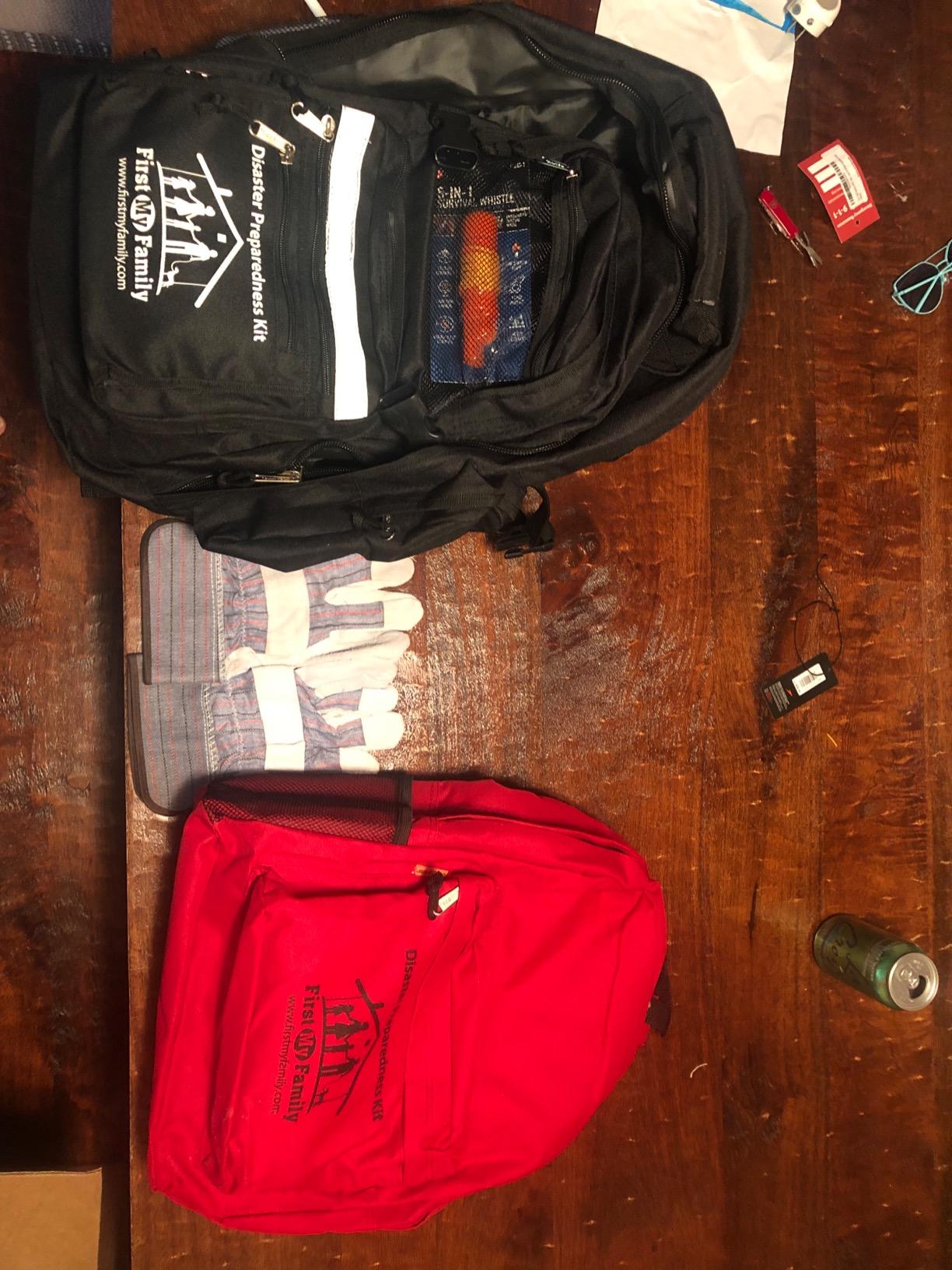
Now the problems, and they are not small. At 16.75 pounds it is genuinely heavy, and several owners describe it as impractical to carry any distance. Plan for this bag to live near a ground-floor exit, not in a vehicle.
The brand name is printed prominently across the front, and multiple reviewers flag that as drawing unwanted attention in a public evacuation scenario. If that concerns you, the Emergency Zone kit in position three is deliberately discreet and a better fit for that worry.
Owners also consistently recommend adding items the kit does not include: diapers, a change of clothing, medications, documents, cash and water purification. For a household with children those are not extras, they are the point. Build that list before you store the bag.
It is also the only kit here with two AA batteries listed as a requirement, and they are included. Remove them before long-term storage, following the practice our guide covers in the rotation section below.
Who this kit suits?
A family of four with young children who want one well-stocked bag near the front door, an apartment at ground level, or a house with a garage. The 85-piece first aid kit and the proven waterproofing are the two reasons to pick it over cheaper four-person options.
It is also a strong choice for anyone giving a kit as a gift, since it presents well and covers the full household in a single purchase rather than requiring a build-out.
Who this kit does not suit?
Anyone who has to evacuate on foot or carry the bag more than a short distance. Sixteen pounds is a lot when you are also managing a child, and this pack will not be the one you grab in a fast-moving wildfire.
It is also a poor fit for anyone concerned about a visible brand logo on their emergency gear, and households with a gluten-free or allergy-sensitive member will need to check the ration ingredients before relying on the food.
9. Sirius 2-Person 50L Bug Out Bag – Best for Serious Survival Gear
Sirius: Pre-Packed Bug Out Bag – 72 Hour Kit for 2 People – Bugout Backpack Survival Kit – Premium 50L Go Bag Tactical Backpack – Essential Bug Out Gear – Upgraded Survival Backpack (Red)
Serves 2
175 pieces
7200 calories
50L 900D Oxford pack
26 pounds
Pros
- One of the largest content counts here at 175 pieces
- Premium 900D Oxford pack that holds up on trails
- 7200 calories of US-made rations plus water filtration
- Solar power bank and solar NOAA radio
- Extra room for documents
- cash and medication
Cons
- Heaviest kit here at 26 pounds
- Priced above comparable kits in this roundup
- First aid is general purpose rather than trauma grade
- Only a 90-day warranty
The Sirius kit is the one to buy if you want the most capability per purchase rather than the least money spent. At 175 pieces in a genuine 50-litre pack, it holds more than double what most competitors ship, and every one of those pieces was chosen by a specialist builder rather than a packaging team.
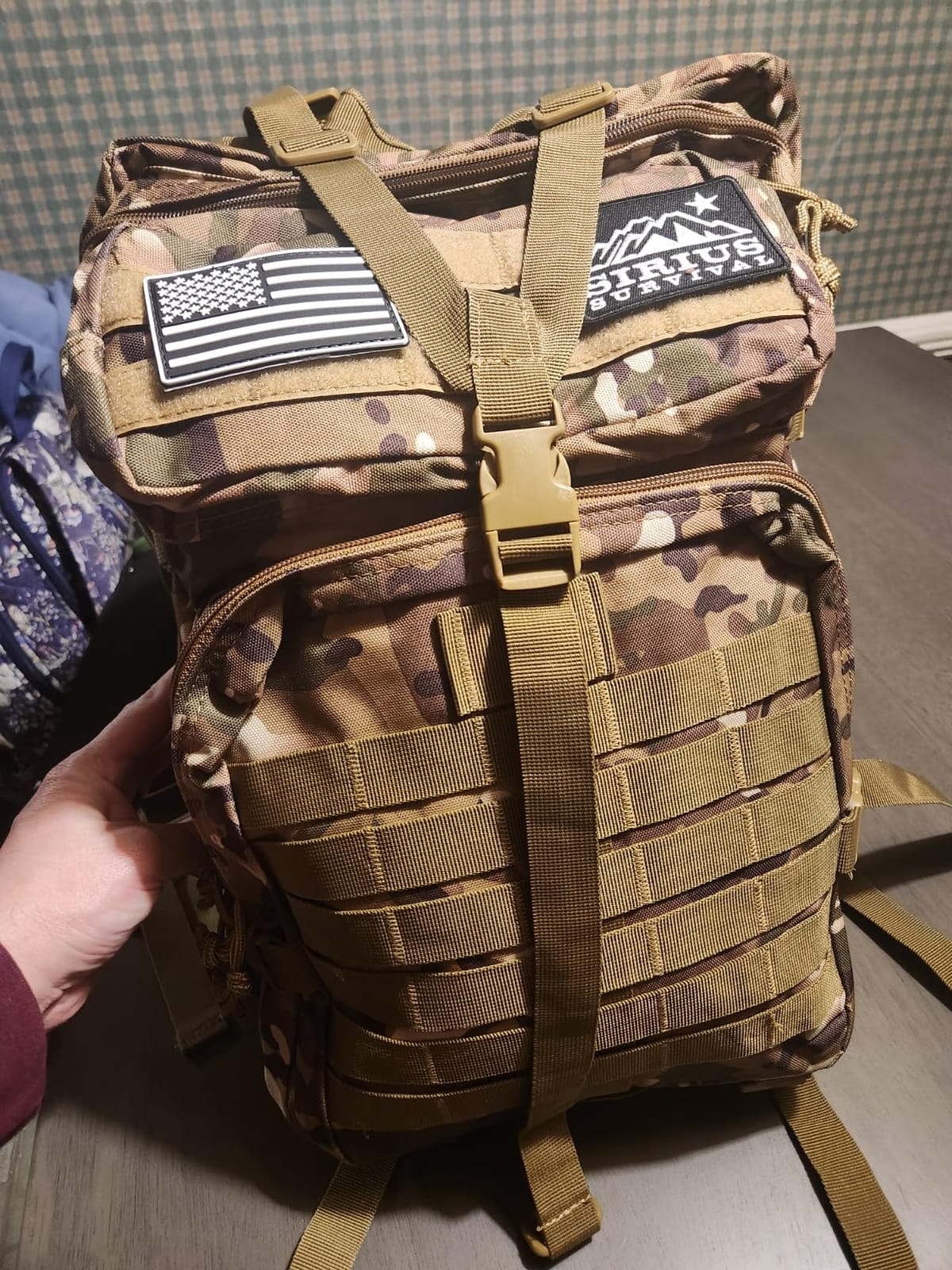
The pack itself is a high-density 900D Oxford tactical backpack that is water resistant with a padded back and shoulder straps, and owners report it holding up on trails and in bad weather. At 50 litres it is a real bug out bag, not a handbag with a survival theme, and there is eight colour options including digital camo and black.
On provisions it carries 7,200 calories of SOS Labs US-made food rations for two people, plus multiple water filtration methods rather than a stack of pouches. The electronics are the strongest in the group: a solar AM/FM/NOAA radio, a solar power bank and a solar flashlight, so you can run everything without disposable batteries.
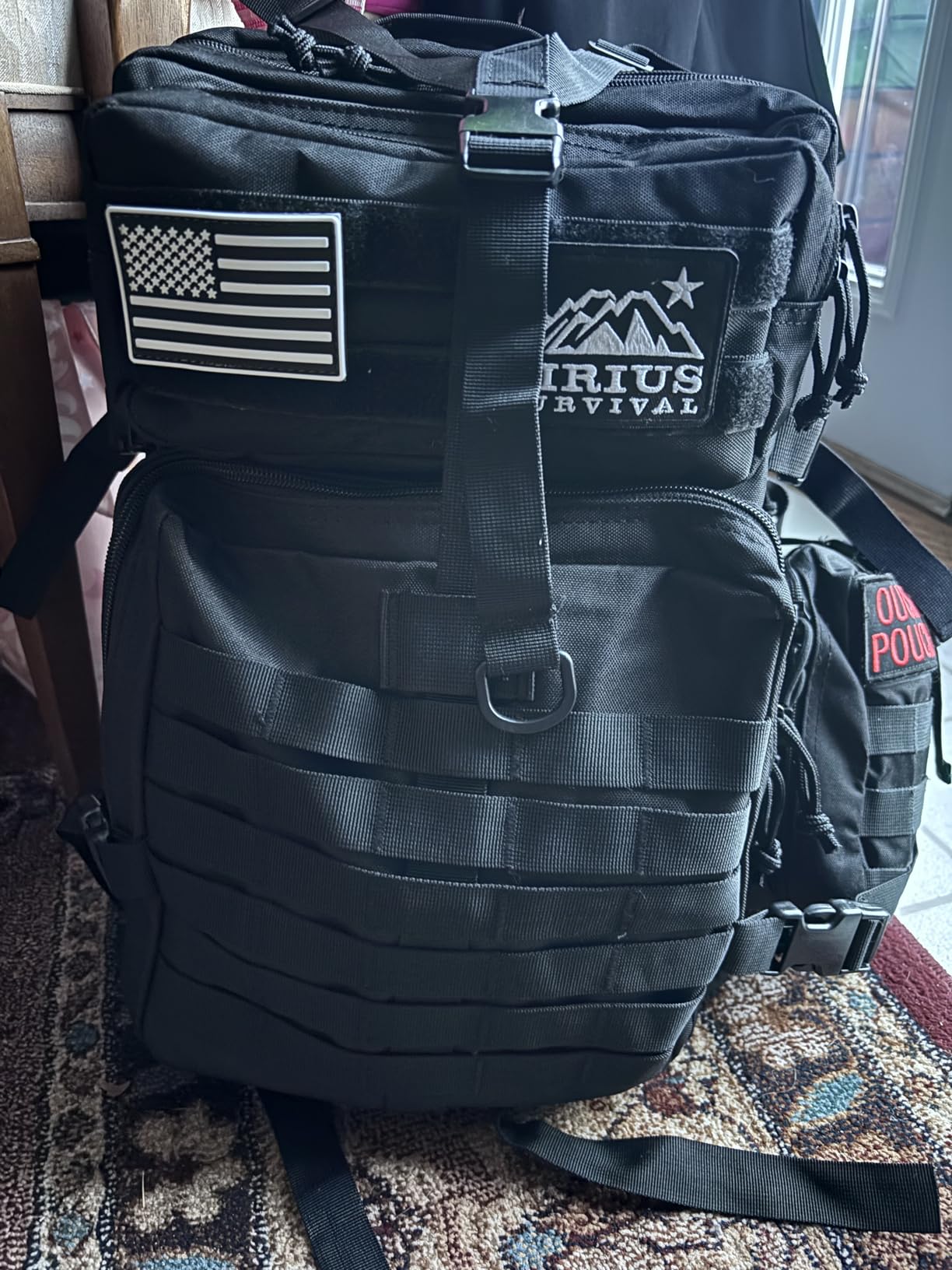
Then there is the long tail of useful gear: first aid, shelter and warmth, soap, multiple fire starters, paracord, a stainless multi-tool, a compass, a whistle, gloves, ponchos and bivvies. It also comes with a guide covering what else to include and general survival tips, which is the same kind of help the Redfora video guide provides.
The 7,200 calories work out to 2,400 per person per day across three days, comfortably above the federal guideline, and with several distinct filtration methods you are not dependent on a single purification method working perfectly.
At 26 pounds it is one of the heaviest kits here. That is a real trade-off. You are paying above the group average and carrying a serious load, and what you get in return is a pack you could genuinely carry away from a collapsed building and then live out of for three days.
Who this kit suits?
People who already have some preparedness experience and want a complete, professional-grade loadout in one purchase. The 50-litre volume and the MOLLE-style layout reward someone who will keep adding to it, and the solar electronics make extended outages far less painful.
It is also the best choice for anyone whose risk profile is not a natural disaster. Multi-day infrastructure failure, wildfire evacuation and anything requiring you to walk away from home are all scenarios this kit is built for and the budget kits are not.
Who this kit does not suit?
Anyone buying on a tight budget or anyone who needs to lift the pack quickly. Twenty-six pounds is among the heaviest options in this group and requires real fitness to move at walking pace.
If you need genuine trauma capability, note that the first aid here is solid general purpose rather than a military-grade trauma kit, and the warranty is 90 days. The EVERLIT STORM II in position two is the one with a CAT tourniquet.
10. 72 HRS Essential 1-Person Kit – Best with a NOAA Weather Radio
72HRS Essential Emergency Preparedness Kit 3Day Survival Kit (1 Person-Red)
Serves 1
Crusader Mini NOAA radio
3600 calories
12 water pouches
reflective strips
Pros
- A dedicated NOAA weather radio is the centerpiece
- Food and water approved by Canadian Coast Guard and Transport Canada
- Reflective strips front and back for evacuation visibility
- Compact one-person build at a mid-range weight
Cons
- Backpack has few exterior pockets so small items get buried
- Not much spare room for extra gear
- Seven pounds feels heavy for anyone with joint issues
- Water pouches are only 125ml each
Three kits in this roundup include a NOAA weather radio, and this is the one where the radio is the reason to buy. The Crusader Mini covers all seven NOAA channels with FM, AM and weather band reception plus a headphone jack, which means you get official weather updates and emergency alerts without a phone, a signal or a working cell tower.
For a one-person kit that is a remarkable amount of capability. The 3,600-calorie rations and twelve 125ml water pouches carry a five-year shelf life and are rated from minus 40 to 99 degrees Celsius, and they are approved by the Canadian Coast Guard and Transport Canada, which puts them through a durability test that most food bars here never see.
The rest of the bag completes the loadout: an LED flashlight, an emergency blanket, a poncho, a whistle, a first aid kit, a mask and a tissue pack alongside the food and water. Owners report the radio reception is genuinely good, which matters because a radio that cannot pull a signal in a storm is just weight.
There is a practical detail we liked more than expected. The bag has reflective strips on both the front and back, which improves visibility during an evacuation at night. In a parking garage or on a dark road with headlights off, that is worth more than another bar of food.
The build is a water-resistant fabric backpack with multiple compartments, adjustable padded straps and a two-way zipper, and the owners who use it as a teaching tool for children like that you can open the whole bag at once.
Where it frustrates people is the pocket layout. There are few exterior pockets, so smaller items end up at the bottom and you end up unpacking rather than reaching in. There is also not much spare room, so adding your own gear means removing something the manufacturer included. And at 7 pounds, some owners with joint or nerve issues find it uncomfortable for longer carries.
The water pouches are 125ml each, so twelve of them is 1.5 litres across three days. That is well short of a gallon a day, and it is the main reason to add a filter or a larger container.
Who this kit suits?
Single people, couples splitting one kit, or anyone in a region where official weather alerts are the difference between staying safe and getting caught out. The radio alone justifies the purchase for many households, and our picks for the best emergency weather radios explain what else is worth adding around it.
It is also our pick for anyone who wants durable food. The temperature rating and the Canadian approvals mean these pouches and bars are built to survive conditions most emergency food never sees.
Who this kit does not suit?
Anyone who needs to add a lot of their own gear, because the pack has little expansion room. It is a fixed-configuration one-person kit rather than a base to build on.
It is also not for households with mobility or joint problems who have to carry weight, and it is not a self-sufficient water solution. Add a filter and a container before you count on it for a full three days.
How to Choose a 72 Hour Emergency Kit?
Every kit on this list will keep someone alive for the first day. The difference between a good one and a disappointing one is whether it still works on day three, in the dark, for the number of people who actually need feeding. Here is how we think about that.
Match the kit to the number of people who actually need to eat
Sizing is the first decision and the one most buyers get wrong by buying for the household they imagine rather than the one they have. Count everyone who will need food and water, including a neighbour you would drive to a shelter and any pet that comes with you, then size up if the number is not offered in a clean variant.
Read the calorie count as a daily figure, not a total. A 2,400-calorie bar divided across three days is 800 calories a day, which is a subsistence level, not a comfortable one. For adults doing any physical work, aim for 2,000 calories per person per day and treat anything below 1,000 as a gap to fill.
Two-person kits are where the market is most confused. Several kits labelled for two carry roughly what a single person would need for three days. The Redfora, the Sirius and the 72 HRS Deluxe in this roundup carry amounts you can defend; most of the lighter ones do not.
Water math and the difference between pouches, tablets and filters
The standard guidance is one gallon of water per person per day, which covers drinking, cooking and hygiene. Across 72 hours that is three gallons per person, and it is the single biggest weight and cost item in any kit. This is why almost every pre-assembled bag arrives thin and tells you to supplement.
There are three ways to handle it and they work together rather than against each other. Pouches are sealed, five-year shelf life and easy to distribute, but they are small and they cost more per litre. Tablets are cheap and treat large volumes but they taste strongly of chlorine, which is a real reason people avoid drinking treated water during an event. Filters such as a squeeze-type unit handle thousands of litres with no taste, but they need a working filter element and a clear water source.
Our advice is to carry all three. A litre or two of stored pouches for the first hours, a small filter for a stream or a roof catchment, and a strip of tablets as the backup when the filter fails or the water is cloudy.
What Ready.gov and the American Red Cross actually recommend?
The official guidance is consistent across the three bodies that publish it, and it is worth knowing before you shop so you can audit a listing against a real list. The core categories are:
Water for three days per person, plus a way to purify or filter more if you can.
Food that is shelf-stable, ready to eat and requires no cooking, refrigeration or added water where possible.
Light and communication including a flashlight with spare batteries, a battery or hand-crank radio, and a whistle for signalling.
Shelter and warmth including an emergency blanket, a tarp or bivy, and something to keep rain off while you sleep.
First aid and tools including a first aid kit matched to the household, plus a multi-tool, work gloves, a fire starter, duct tape and paracord.
Two items sit outside that list and matter enormously in practice: a charged phone and a small amount of cash in small notes, and a copy of identification documents. Add medications for anyone on a prescription, glasses and a spare set of contacts, and a change of clothes appropriate to your climate.
What a thin kit leaves out and how to add it cheaply?
Every budget kit in this roundup leaves out the same things, and they are the same things forum discussions of pre-made kits complain about. The premium is often the logo on the bag rather than the contents, and the food and water are sized for the label rather than for 72 hours.
You can close most of those gaps for a modest outlay. Add a water filter and a two-gallon container, a few cans or pouches of food you actually enjoy, a pack of water purification tablets, a fire starter such as a ferro rod with tinder, a multi-tool, duct tape, paracord, work gloves, a can opener, a few hand warmers in cold climates, and a spare set of AA batteries in a sealed bag.
Add a headlamp if the kit only has a handheld light, a signalling mirror for daylight rescue, and a whistle with a lanyard so it stays around your neck. Each of these costs a small fraction of what a fully built pre-made kit does, and together they turn a thin bag into one you would trust.
What not to skip is a can opener and any medication. A preparedness blogger we follow is clear that brand names stop mattering the moment things get real, but cheaping out on functional items like can openers is a mistake that shows up on day one of a crisis.
Leaking pouches and corroded batteries, the two failure modes nobody warns you about
These are the two real failure modes of a stored emergency kit, and neither appears in any marketing material. They are also, not coincidentally, the two most common complaints in the owner reviews across this whole list.
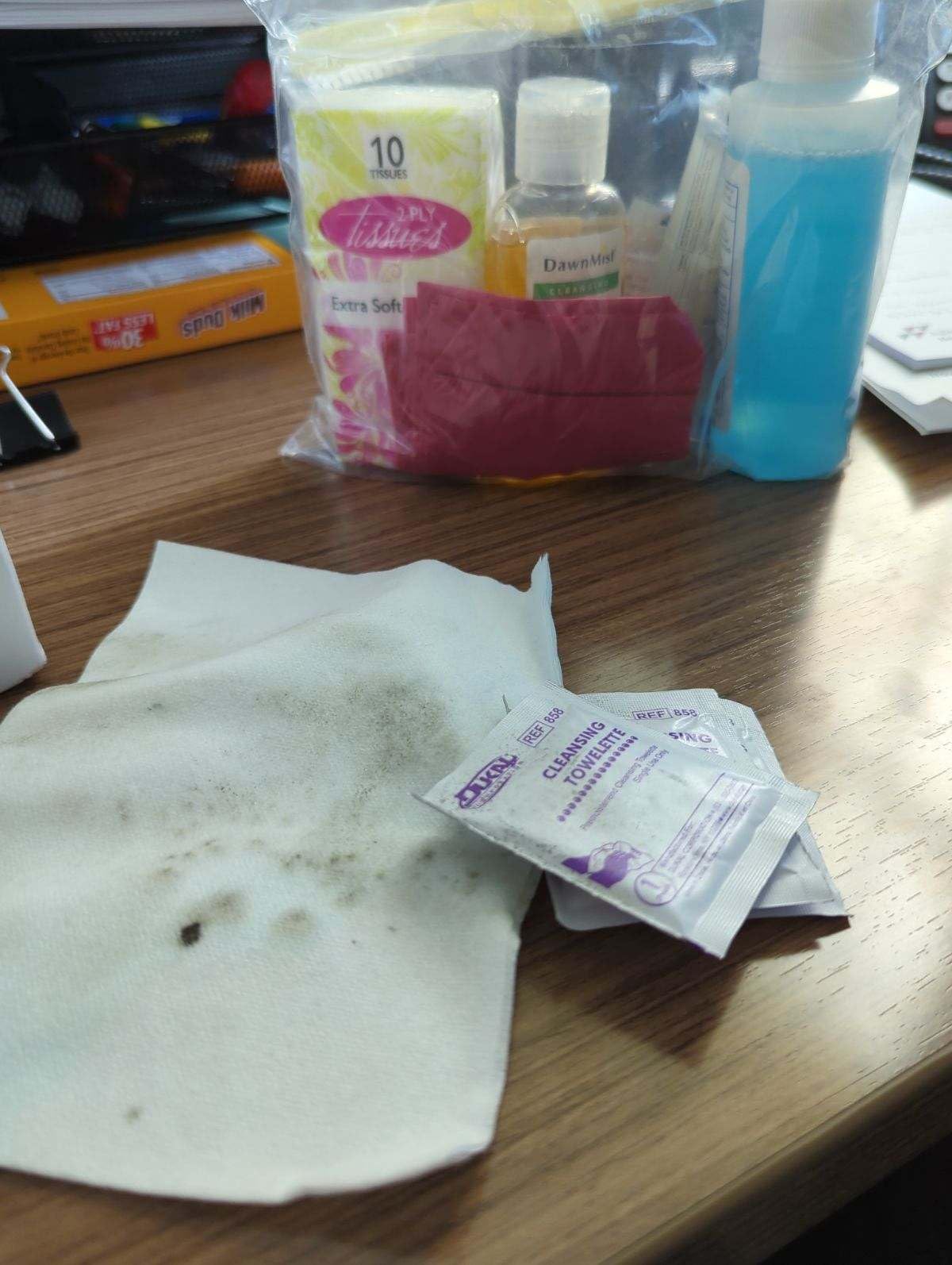
Water pouches puncture in transit and water finds its way into the rest of the bag, ruining food, bandages and paper documents. It happened to some buyers of the EVERLIT kit. The defence is simple: open the bag the day it arrives, count the pouches, press each one between your fingers, and look for dampness. If anything has leaked, replace the pouch immediately rather than hoping.
Batteries left inside a flashlight or a radio for years leak electrolyte and corrode the compartment, which is why preparedness writers recommend pulling them out before storage. The counter-argument is that you then have a light that does not work. The middle path, and the one we use, is to remove the batteries, tape them in a separate labelled zip bag and set a calendar reminder to reinstall them every six months.
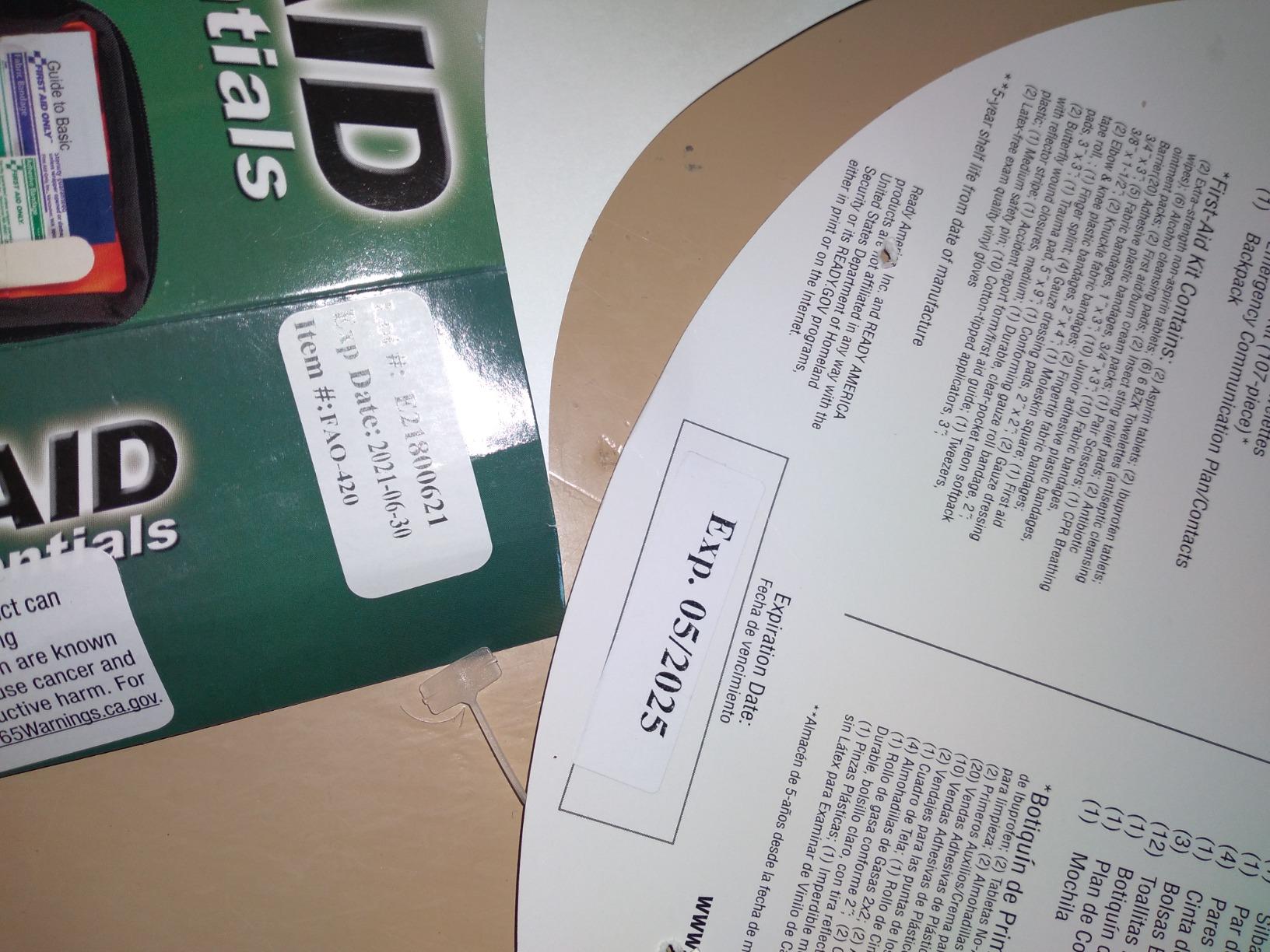
Third on the list is expiration dates. Food and water expire; the non-food gear generally does not, which is why a five-year rotation on consumables and a much longer cycle on tools is the sensible schedule.
Where to store a kit and how to rotate it?
Store kits where you can reach them in under two minutes, which rules out high shelves, attics, basements that flood and the back of a closet. Do not store a kit next to a water heater, a furnace or a garage wall, where heat and humidity destroy adhesives, batteries and shelf life in a few years.
Keep one kit per person if the budget allows, in different locations, so a single fire or flood does not take everything at once. A vehicle kit, a home kit and an office or dorm kit covers the three most common places people are when an event starts.
Then set a rotation rhythm. Every six months, open each bag and check expiration dates, test the flashlight, confirm the radio still powers up and restock anything used. Every five years, replace the food and water entirely. Batteries in the rotation bag get swapped at the same time, and any rubber or silicone items like a bivy or a waterproof case get checked for brittleness.
If you have never done the audit, start by counting people and calories. Take the kit you own, add up the total calories and divide by three, then do the same for water volume. Most kits fail that test on day one of the audit, and that is exactly the point of running it before an emergency.
Frequently Asked Questions
What should be in a 72 hour emergency kit?
The five core categories are water, food, light and communication, shelter and warmth, and first aid and tools. Plan on one gallon of water per person per day for three days, shelf-stable food that needs no cooking, a flashlight and a NOAA weather radio, a whistle, an emergency blanket or bivy, and a first aid kit sized to your household. Add a fire starter, a multi-tool, work gloves, duct tape and paracord.
What to stockpile for 72 hours?
Stockpile three gallons of water per person, roughly 2,000 calories of shelf-stable food per person per day, a first aid kit, a battery or hand-crank radio, a flashlight, an emergency blanket, a whistle, and a water filter or purification tablets so you can treat more water if the stored supply runs low. Keep the whole thing in one grab-able bag per person.
What should be in a 3 day emergency kit?
The same five categories apply: water, food, light and communication, shelter and warmth, and first aid and tools. The difference at three days is quantity rather than type. Three days is the shortest period most authorities recommend because power and road access often take that long to return, so aim for one gallon of water and 2,000 calories per person per day.
What does FEMA recommend you purchase?
FEMA and Ready.gov recommend at least three days of water, non-perishable food, a battery or hand-crank radio, a flashlight, a first aid kit, an emergency blanket, a whistle, and extra batteries. Many kits also suggest a multi-tool, work gloves, a fire starter, duct tape, paracord and copies of important documents. The Red Cross advises adding medications, glasses and a change of clothing.
Are pre-made 72 hour emergency kits worth it?
They are worth it when you would not otherwise start. A pre-made kit removes the decision fatigue that stops most people, and it guarantees the food and water arrive with a known five-year shelf life. They are thin on food and water, so budget for a filter, extra food and a fire starter. Building your own costs less and fits your household better, but only if you actually do it.
How often should I rotate my emergency kit?
Check expiration dates and test the flashlight and radio every six months, and replace all food and water on a five-year cycle. Batteries should be removed from stored gear and reinstalled at each six-month check, which prevents the corrosion that ruins stored flashlights. Rubber and silicone items such as a bivy should be checked for brittleness at the same time.
The Best 72 Hour Emergency Kit in 2026
The Ready America 70280 is our pick for the best 72 hour emergency kits overall, because 4,378 owners rated it 4.7 stars and it is rare for a kit at this size to list a weight that matches the loaded pack. It is a starter, not a finished system, so plan a short build-out with a water filter, extra food and a real first aid kit.
If your household is larger than two people, the Emergency Zone family kit takes over. It has the highest rating in the group, USA-made Coast Guard approved rations that need no rehydration, a 121-piece first aid kit and a discreet pack that does not advertise itself. Families with a serious medical need should add the EVERLIT STORM II, which is the only kit here with a CAT tourniquet.
For anyone in a weather-exposed region, the 72 HRS Essential is the buy because its dedicated NOAA radio is the most useful single item in this entire roundup, and the Redfora Complete Earthquake Bag is the best balance of food, water and real shelter. Buy one, then set a six-month reminder, because the best 72 hour emergency kit is the one you actually check.