
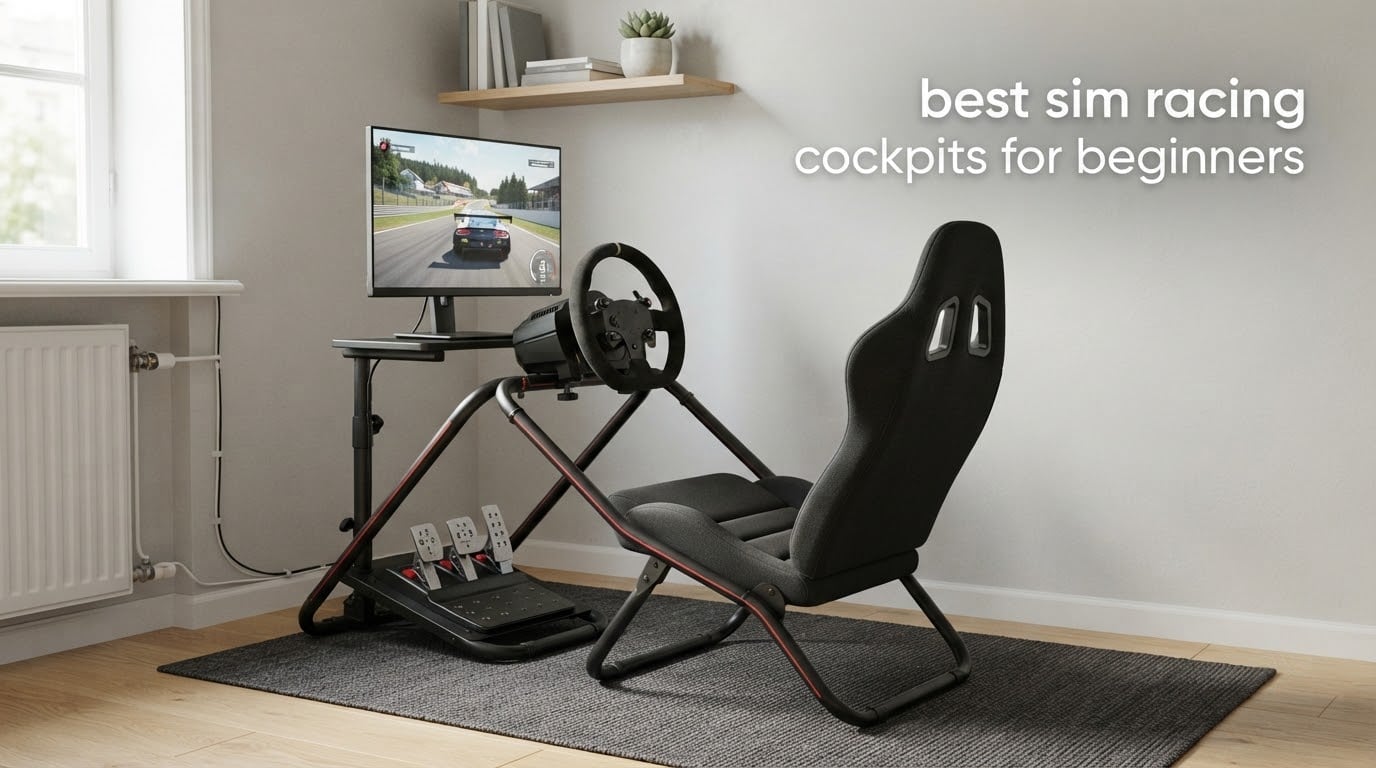
The best sim racing cockpits for beginners is the Next Level Racing GT Lite, and it wins for a simple reason: it is the only rig in this guide with thousands of owners behind it, it folds flat enough to live in a normal room, and it takes a wheel and pedals from any major brand without a rebuild later. If your space is tighter than that, the RACGTING foldable frame is the cheapest complete package. If you already know you will move to a direct drive wheelbase, the Next Level Racing GTRacer 2.0 is the frame to buy first and keep.
I spent weeks reading owner reviews across r/simracing and OverTake.gg threads, then working through spec sheets, mounting standards and frame dimensions for all ten rigs below. What the community keeps telling beginners is not to start with the most expensive thing. It is to start with the frame that matches the wheel you own now, the room you drive in, and the hardware you will upgrade to in a year.
That last point matters more than any spec on this page. Buy the frame first and you risk owning a rig that cannot take your next wheelbase. Buy the wheel first and you risk owning a frame that fights you on reach, seat position and pedal angle. This guide covers ten cockpits, what each is genuinely good at, who should skip it, and what a complete beginner setup really involves once the frame, seat, pedals and monitor stand are all counted.
Two brands dominate the listings you will see: Next Level Racing, which owns three slots here across three different price and rigidity tiers, and Playseat, which still builds the most portable fixed frame in the category. Fanatec, MOZA, Thrustmaster and Logitech wheelbases all bolt into the brackets described below. For the hardware side of the setup, our picks for the best sim racing pedals and best sim racing monitor stands are worth reading alongside this list.
Top 3 Best Sim Racing Cockpits For Beginners (October 2026)

Next Level Racing GT Lite
- Folds flat for storage
- Tool-free hub adjustments
- 31.7 lb
- Seat included

RACGTING Foldable Cockpit
- 90% pre-assembled
- Shifter mount included
- Shifts to either side
- Folds down flat
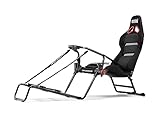
Next Level Racing GTLite Pro
- Padded GT-style seat
- Handles up to 13 Nm
- Shifter and handbrake mount
- Rolls away folded
Two of those three fold flat, which tells you something about where most beginners actually drive. The third earns its place because it is the cheapest option here with a stated direct drive torque ceiling, and that number is the one that decides whether you will have to replace the frame later.
Best Sim Racing Cockpits for Beginners in 2026: Quick Overview
| Product | Specifications | Action |
|---|---|---|
| Next Level Racing GT Lite |
|
Check Latest Price |
| RACGTING Foldable Cockpit |
|
Check Latest Price |
| Next Level Racing GTLite Pro |
|
Check Latest Price |
 VIVO Wheel Stand with Chair VIVO Wheel Stand with Chair |
|
Check Latest Price |
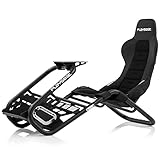 Playseat Trophy Playseat Trophy |
|
Check Latest Price |
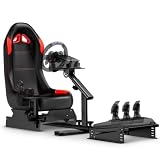 DIWANGUS Steel Cockpit DIWANGUS Steel Cockpit |
|
Check Latest Price |
 ARES WING Racing Simulator Cockpit ARES WING Racing Simulator Cockpit |
|
Check Latest Price |
 GTPLAYER Sim Racing Cockpit GTPLAYER Sim Racing Cockpit |
|
Check Latest Price |
 Next Level Racing GTRacer 2.0 Next Level Racing GTRacer 2.0 |
|
Check Latest Price |
 Dardoo Racing Simulator Cockpit Dardoo Racing Simulator Cockpit |
|
Check Latest Price |
1. Next Level Racing GT Lite: the default first cockpit for most beginners
Next Level Racing GT Lite Foldable Simulator Cockpit (NLR-S021)
Folds flat
Tool-free hub adjustments
31.7 lb
69 x 36 x 37 inch footprint
Pros
- Folds genuinely flat to reclaim floor space
- Holding up under heavier drivers with no flex
- Hub adjustments need no tools
- Pre-drilled for Logitech Thrustmaster and Fanatec
Cons
- Shared ratchet area means one adjustment disturbs the others
- Coarse tooth spacing gives limited fine tuning on wheel distance
- Thin seat pad gets uncomfortable after 30 to 60 minutes
Four thousand owners have now bought this rig, and that is the reason it tops this list. Not because it wins on any single spec, but because it is the least risky first purchase you can make. It is built around Next Level Racing hub brackets, which means the wheel, pedal and seat positions move without tools and without taking the frame apart.
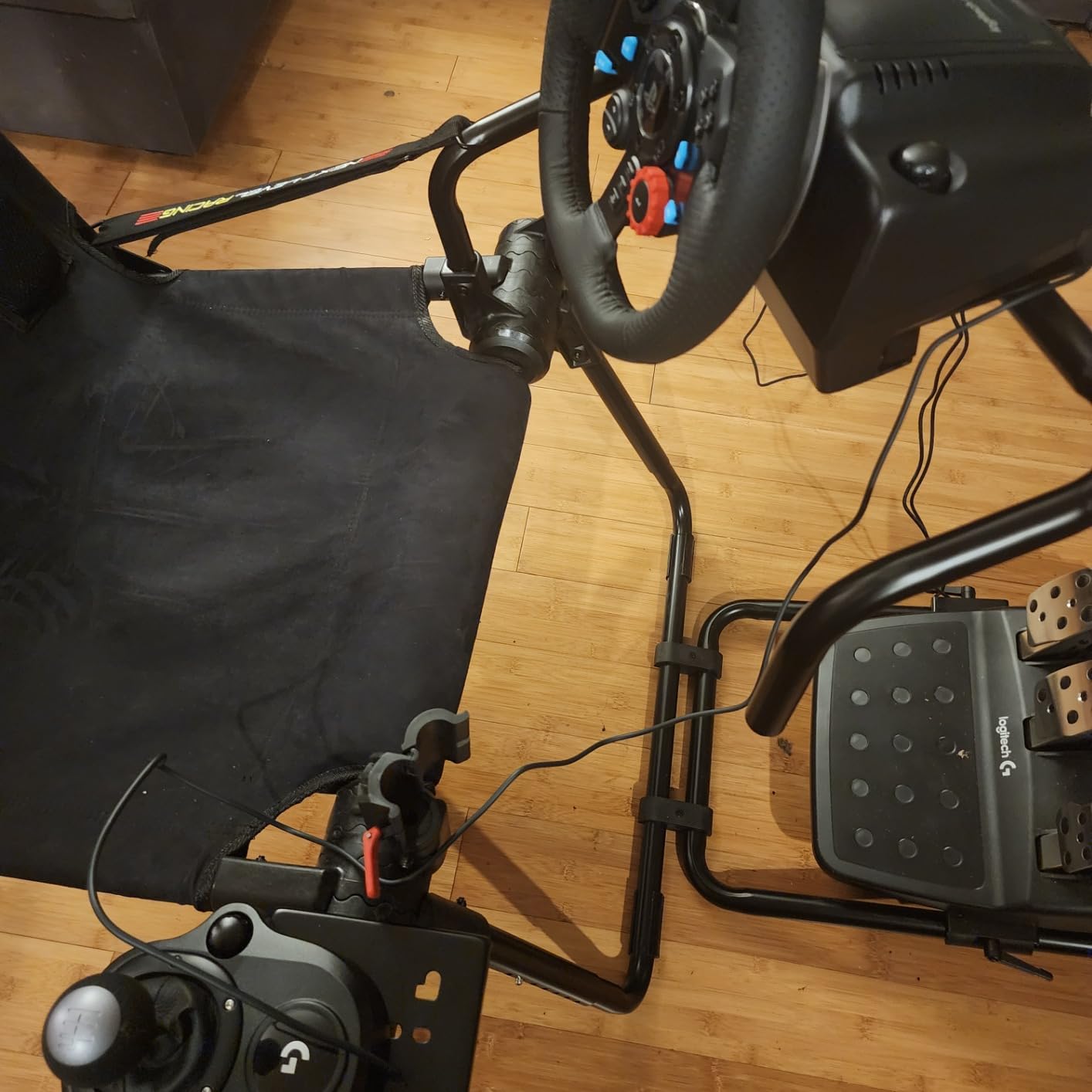
Its real advantage is the fold. The GT Lite collapses to roughly 69.2 by 36.6 by 37.4 inches and weighs 31.7 pounds, which is heavy enough to stay planted in a braking zone and light enough for one person to carry between rooms. Owners in small apartments describe it as the difference between a rig they can actually keep out in the open and one they have to assemble and disassemble every session.
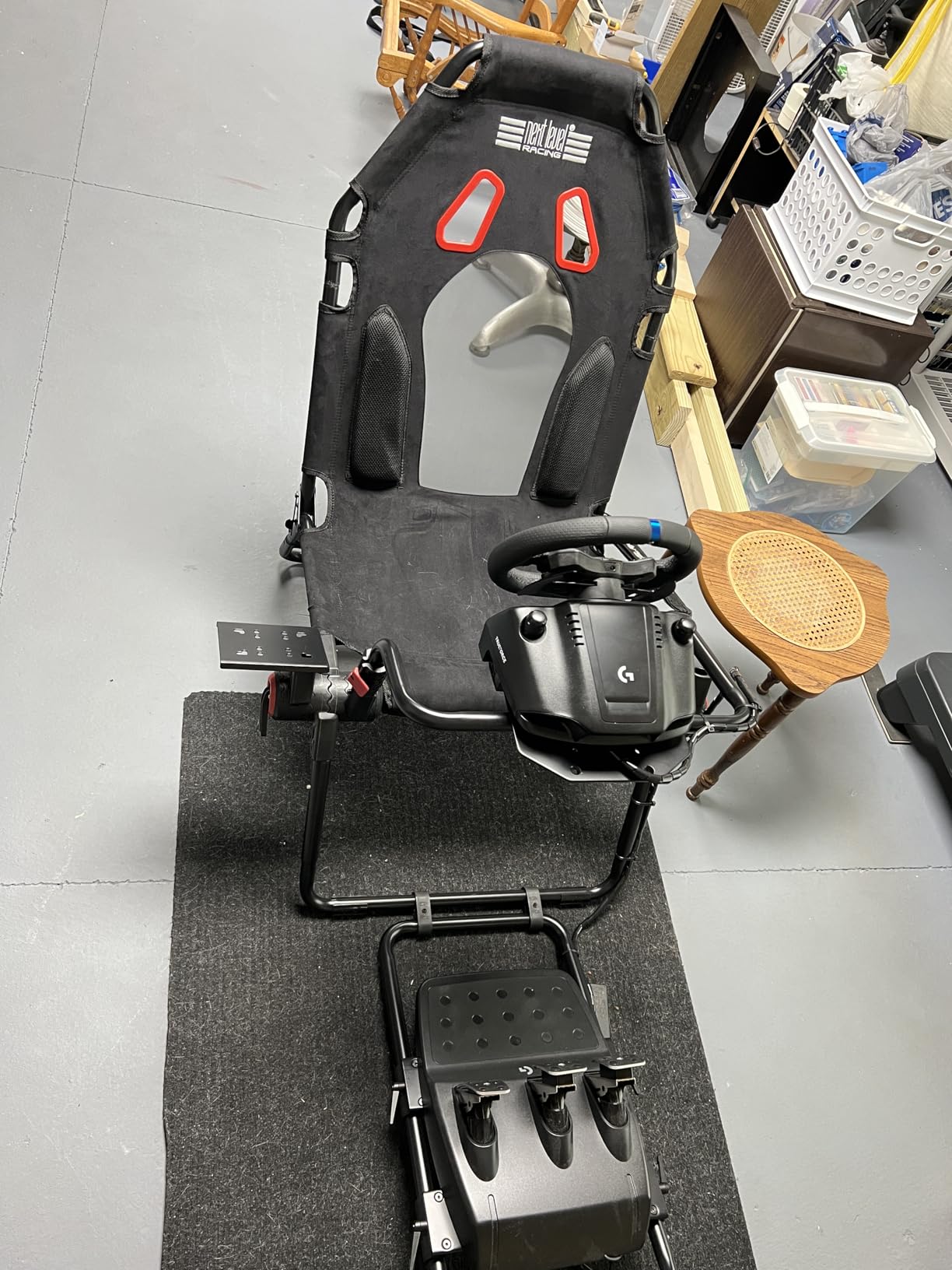
Compatibility is the other strength. The frame is pre-drilled for Logitech, Thrustmaster and Fanatec hardware, and owners running heavier belt or entry-level direct drive bases report that the hard mounting points do not flex once every clamp bolt is properly tightened. At 31.7 pounds the frame absorbs a 13 Nm class wheelbase without the drifting you get on lighter stands.
The seat is the weak point, and owners are consistent about it. The breathable fabric holds up, but the pad is thin, there is no lumbar support and no recline, so a two-hour endurance race will tell you exactly where the pressure points are. Several owners add a cushion rather than replacing the seat, which is the cheaper fix.
The other recurring complaint is the shared ratchet. The wheel, shifter and pedal positions all live on one gear system, so when you move the wheel the rest drifts out of place and you re-tune. The tooth spacing is also coarse, which means the wheel ends up either slightly too close or slightly too far, and you will find the sweet spot in the middle.
Who the GT Lite suits best?
This is the pick if you are moving off a desk-mounted wheel for the first time and you are still deciding which discipline you will settle into. The seat position and wheel rake are adjustable enough to run GT, and the fold means a wrong first guess costs you nothing but storage space.
It also handles the most common beginner hardware without drama. If you own a Logitech G920 or G923, a Thrustmaster T300, or an entry-level Fanatec or MOZA belt set, the mounting is pre-drilled and the frame takes it without a modification kit.
Who should skip the GT Lite?
Skip it if you are six foot two or taller and know you will be running long endurance races from day one. The lack of lumbar support and the thin seat pad are the first two complaints in the reviews, and neither is fixed by a cushion once you are past ninety minutes.
Also skip it if you have already decided to buy a high-torque direct drive wheelbase this year. The hub system is built for entry-level hardware, and forcing a high-torque base into it is the point at which a dedicated aluminum frame starts paying for itself. Our foldable cockpit roundup covers the other storage-first options if folding is non-negotiable.
2. RACGTING Foldable Racing Simulator Cockpit: the cheapest complete foldable package
RACGTING Foldable Racing Simulator Cockpit for Logitech Thrustmaster MOZA
90% pre-assembled
Shifter mount included
55 x 13 x 47 inch
1 year warranty
Pros
- Around 30 minutes to assemble for most owners
- Folds down flat for shared living spaces
- Pedal travel is long enough for accurate leg room
- Hinged mounts make entry and exit straightforward
Cons
- Pedal plate is held by plastic clips that can pop off under braking
- No wheel reach or height adjustment so some wheelbases sit too high
- Shifter bracket is wobbly until the screws are tightened
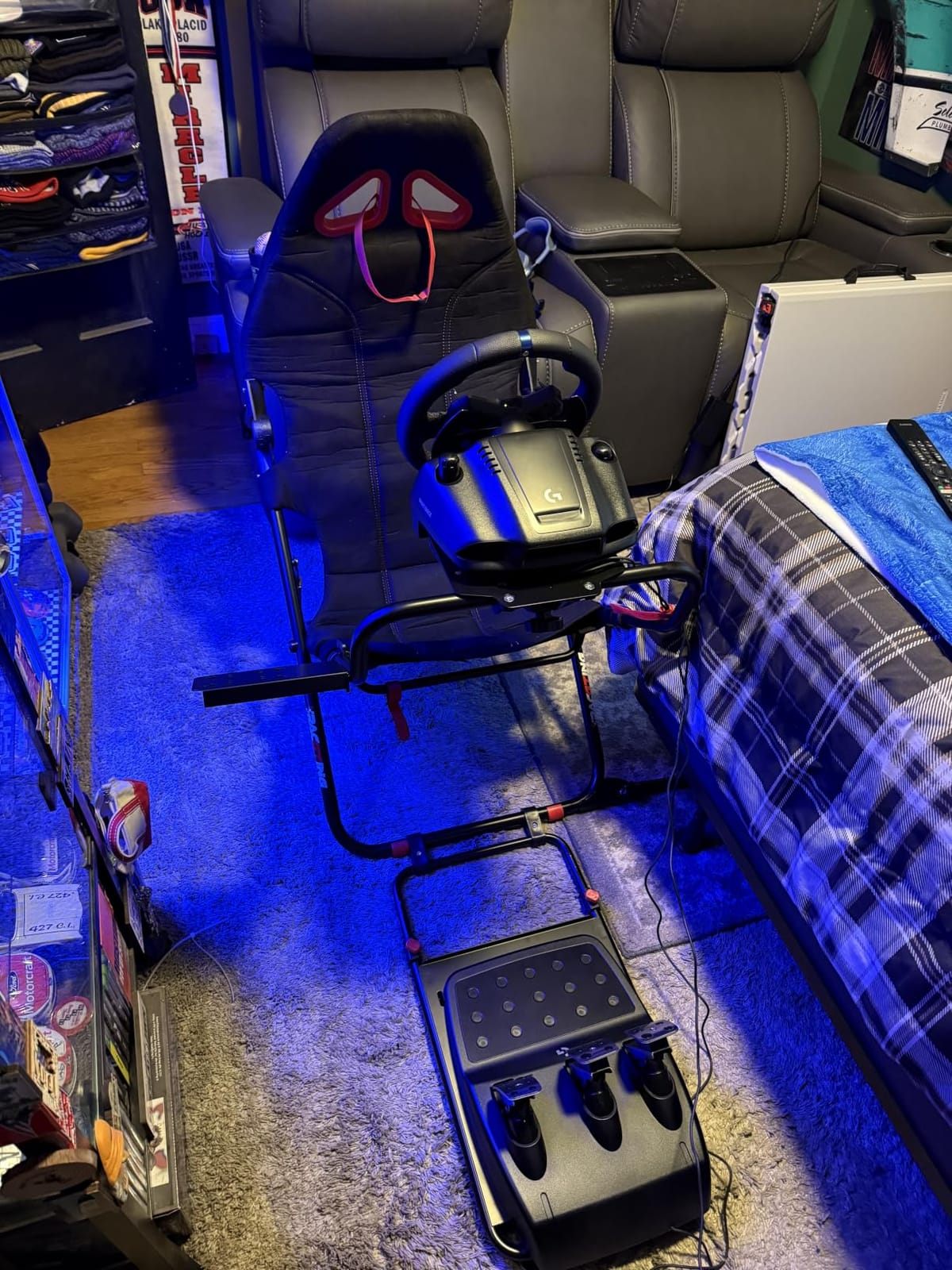
This is the frame you buy when the deciding factor is simply getting off the floor. It arrives about 90% assembled, so most owners finish it in half an hour, and it folds down flat to a 55 by 13 by 47 inch package. The shifter mount is included, which is unusual at this end of the market and saves a separate purchase.
Buyers like the adjustability that is there. Pedal distance moves, the shifter fits on either side, the seat angle tilts and the wheel rake changes. The shifter mount sits low like a centre console rather than up on a rail, and several owners say that is the feature they notice first from a real driving position.
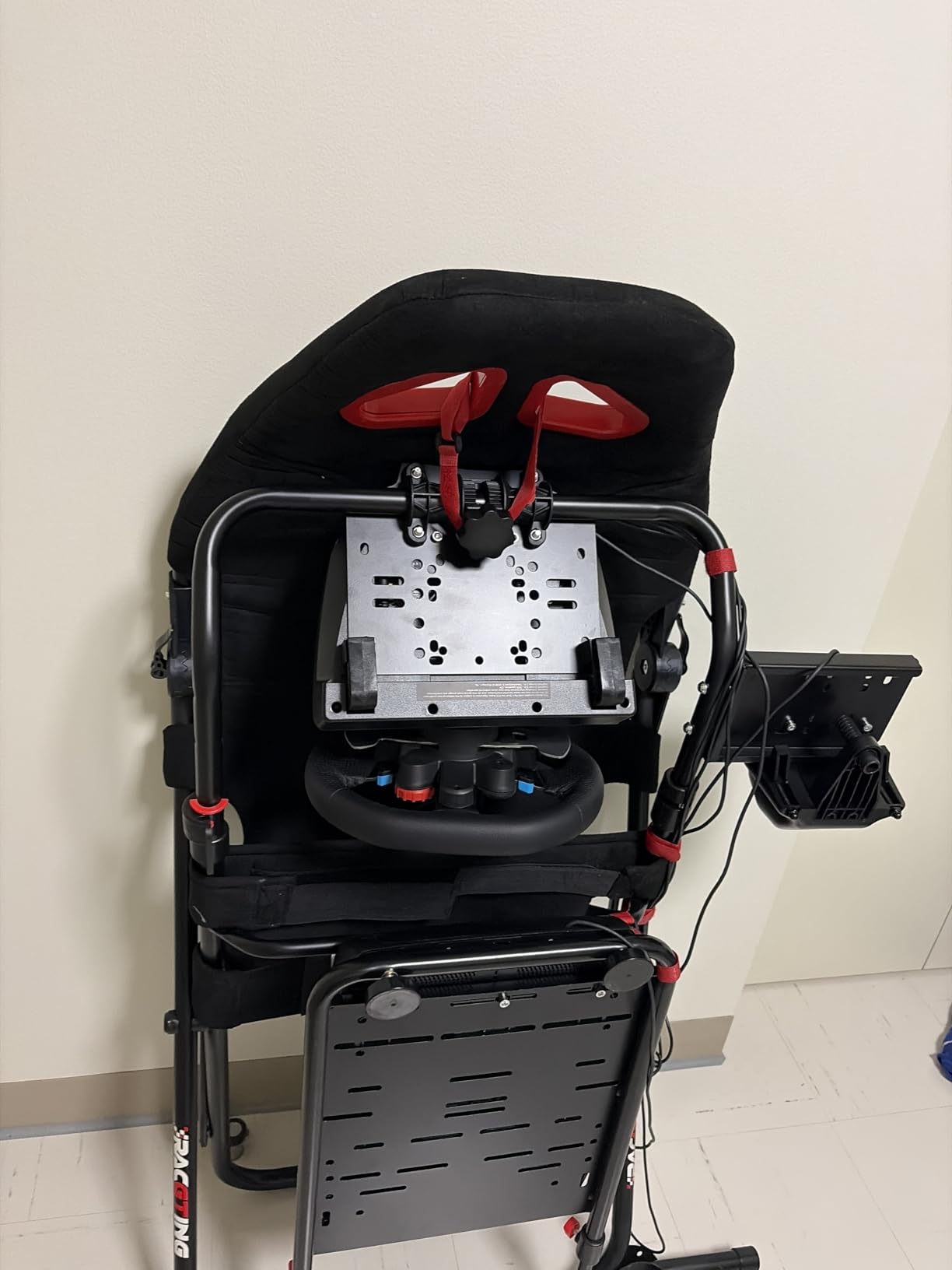
Once every clamp bolt is tightened the frame steadies noticeably. That is the honest summary of the reviews: out of the box it feels loose, and a careful twenty minutes with the supplied hardware turns it into a rig that holds position under aggressive braking.
Compatibility covers the names beginners actually buy. The frame takes Logitech, Thrustmaster, Fanatec, MOZA and Simagic wheelbases, and the bolted plate has enough adjustment to suit larger drivers who struggle with the fixed pedal reach on cheaper stands.
The pedal plate is the part to watch. It is retained by plastic clips, and a recurring theme in owner reports is the plate separating under hard braking, with some people adding zip ties as a reinforcement. If you trail brake hard, check it before every session rather than after.
What the RACGTING gets right for a first rig?
Setup speed is the headline. When you are not sure whether sim racing will stick, a rig you can have running before a pizza cools removes the biggest excuse to put it off. There is very little assembly and no drilling.
The hinged wheel and shifter mounts also mean you can get in and out without squeezing past a fixed frame, which matters in a small room where you have to walk around the rig to reach the desk.
Where it falls short?
There is no independent wheel reach or height adjustment. The position is aggressive by design, and owners with taller wheelbases report that the wheel ends up so high they are looking up at the monitor instead of through it. That is a genuine problem for a rig people buy to use with a screen.
Watch the ratcheting support bolts too. Owners report the supplied bolts are longer than the tube and can damage the frame if you overtighten them, so tighten to firm rather than to maximum.
3. Next Level Racing GTLite Pro: the padded step up for entry-level direct drive
Next Level Racing NLR-S031 GTLite Pro Foldable Racing Cockpit
Padded GT seat
Handles up to 13 Nm
3 recline positions
67 x 34.3 x 41.3 inch
Pros
- Padded GT-style seat is a real upgrade on the base model
- Handles entry-level direct drive up to 13 Nm
- Includes dedicated shifter and handbrake mount
- Tool-free adjustments are fast
Cons
- Folding design is never as rigid as a fixed aluminum frame
- Adjustment range is limited and some positions need tools
- Changes to one position disturb others already set
The GTLite Pro sits one step above the GT Lite and the step is mostly the seat. Where the base model gives you a thin fabric pad, this one gives you a padded GT-style bucket with foam and mesh fill, which is the difference between a session and a race.
It also states a torque ceiling. The frame is rated for entry-level direct drive wheelbases up to 13 Nm, and the included shifter and handbrake mount means you can add a sequential box without sourcing a separate plate. For a first direct drive upgrade, that is the number that matters and very few foldable frames publish it.
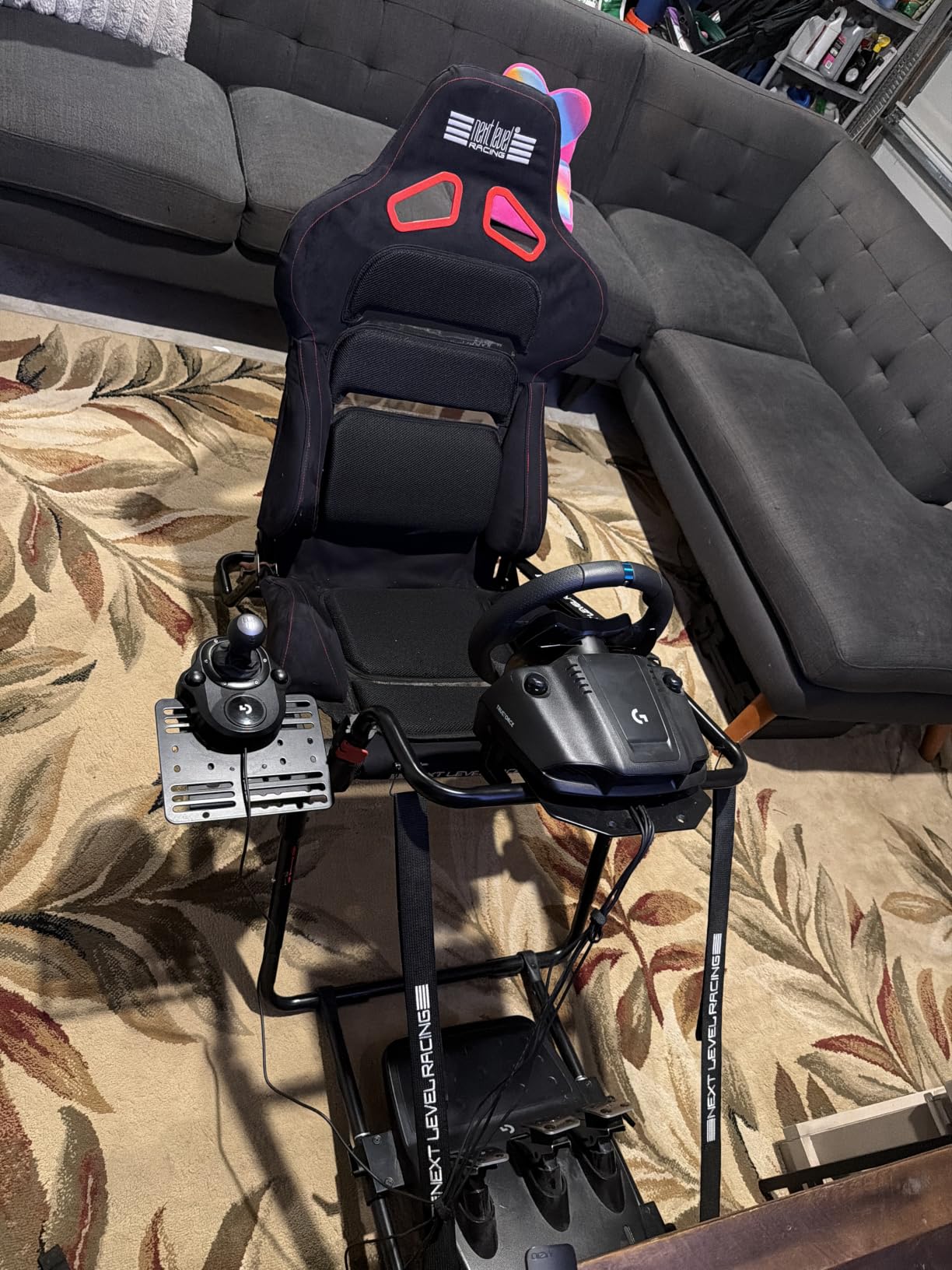
At 34.2 pounds and 67 by 34.3 by 41.3 inches, it folds and rolls away faster than a fixed frame ever could. Owners in shared rooms describe the roll-away design as the feature that makes a permanent sim space unnecessary, and the tool-free adjustments are fast enough that you can re-dial the rig between a GT race and a Formula run.
It is listed for children as well as adults of different sizes, which tells you how wide the adjustment envelope is. The three recline positions and adjustable seat height do most of that work.
Now the honest part. Its 4.1 average is the lowest of the three Next Level Racing models in this guide, and the reason is structural rather than a manufacturing fault: a foldable design is never as rigid as a fixed aluminum frame, and owners say so plainly. Buyers feel that under a high-torque base more than under a belt wheel.
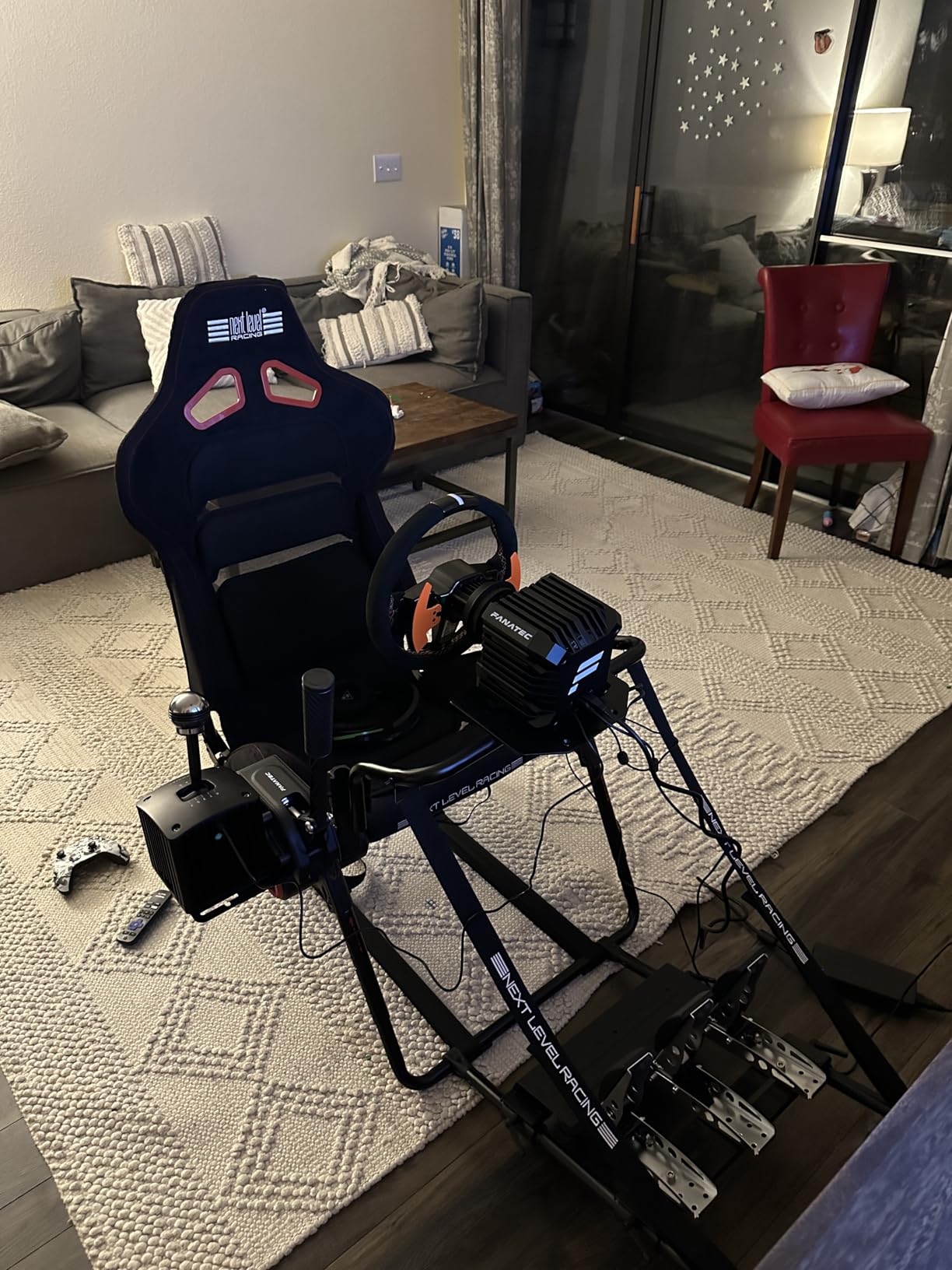
Why this is the apartment pick?
Choose it over the base GT Lite when your sessions run past an hour. The padded seat is the whole argument, and if you are driving endurance or rally rather than short sprints, it pays back quickly.
It is also the safer foldable choice for direct drive. The 13 Nm rating gives you room to move to an entry-level belt-to-belt or mid-range direct drive base without replacing the frame, which is the single most common regret reported by first-time owners who bought the cheapest frame instead.
Who should pass on it?
Pass if you plan to run a high-torque direct drive base as your first serious purchase. The rating is a ceiling for entry-level hardware, and pushing past it means feeling the folding frame work against you under load.
Pass if you have a dedicated room and value rigidity over portability. Every extra moving part in a folding design is a place for play to develop, and our full cockpit roundup covers fixed frames in more depth.
4. VIVO Wheel Stand with Chair: the best rated compact rig in the guide
VIVO Red Stripe Racing Simulator Cockpit, Chair & Frame Only, STAND-RACE1B
Alloy steel frame
3-year warranty
Up to 220 lb
51.2 x 21.5 x 44.5 inch
Pros
- Highest rated rig here at 4.5 with strong satisfaction
- Alloy steel frame holds with a Fanatec 8 Nm base
- Compact footprint and doubles as a chair
- Support shipped replacement parts quickly
Cons
- Seat upholstery is flat and thin after about an hour
- Shifter plate loosens repeatedly and the assembly wobbles
- Wheel deck and pedal plate flex under load cell pedals
This is a wheel stand with a chair, and that is the correct product for a lot of beginners. The frame is alloy steel, the footprint is a genuinely small 51.2 by 21.5 by 44.5 inches, and the seat tilts, slides forward and back, and reclines so you can find a driving posture without a toolkit.
It carries the highest average rating in this roundup at 4.5, and the reason owners give is unflashy: the parts arrive complete, the instructions are illustrated, and nothing is missing. That is not a small thing when you are building your first rig on an evening with a set of hex keys.
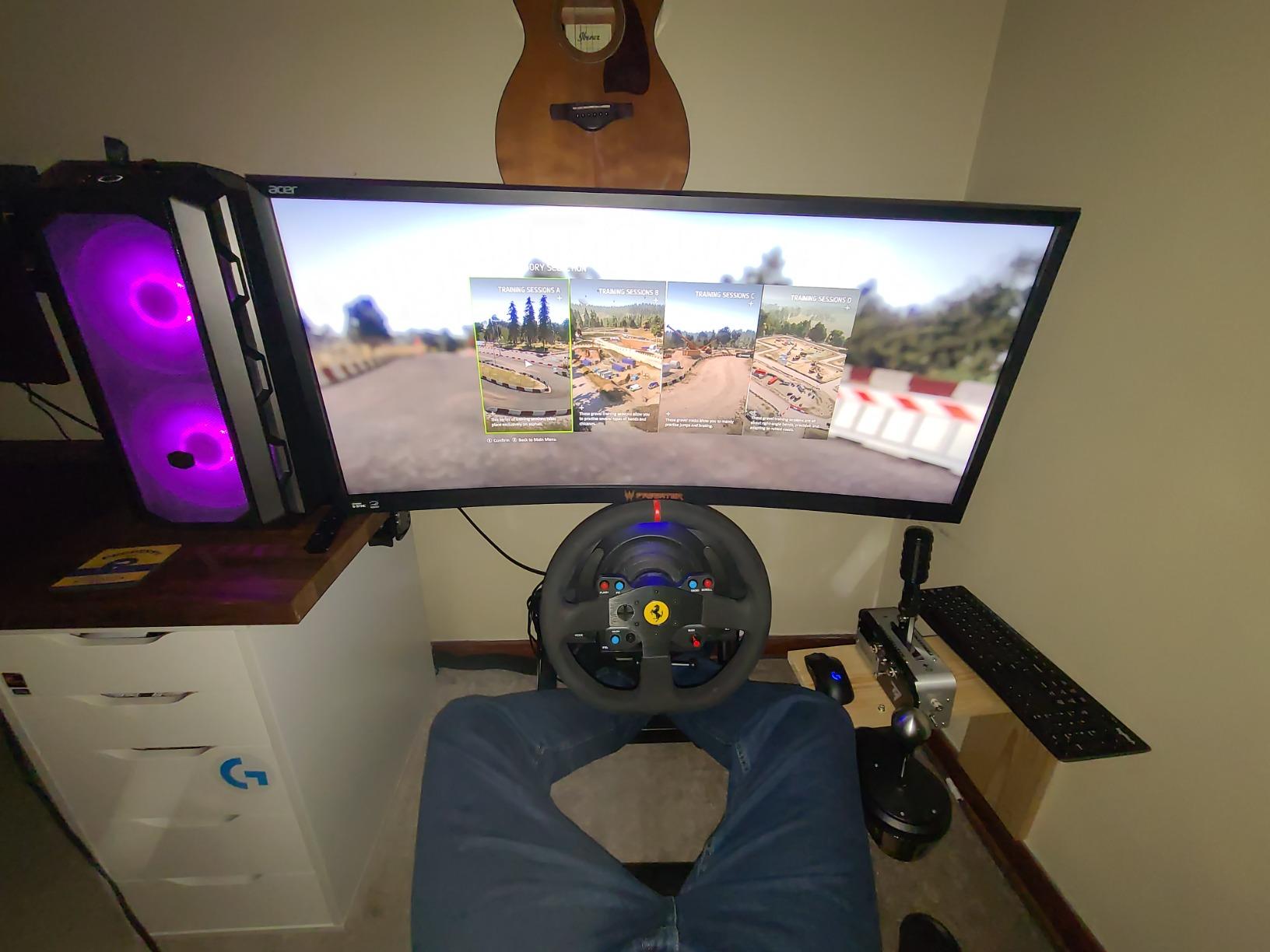
The steel frame is genuinely stiff. Owners running a Fanatec 8 Nm direct drive base report no flex, and the maximum weight recommendation of 220 pounds covers more drivers than most of the foldable options here. It is also the only rig in the guide with a three-year manufacturer warranty, which matters more than people expect when a fastener starts loosening.
The gear mount takes either side, which sounds trivial until you set up a car with the shifter in an unusual place and then swap it. The tilting wheel mount gives you rake without tools.
The two things that stop this from being a runaway recommendation are the seat and the shifter plate. The upholstery is flat and thin, and long-term owners say you will want a gel cushion or a bracket rotation within the first few months. The shifter and handbrake plate loosens repeatedly, and owners report the whole assembly wobbling as a result.
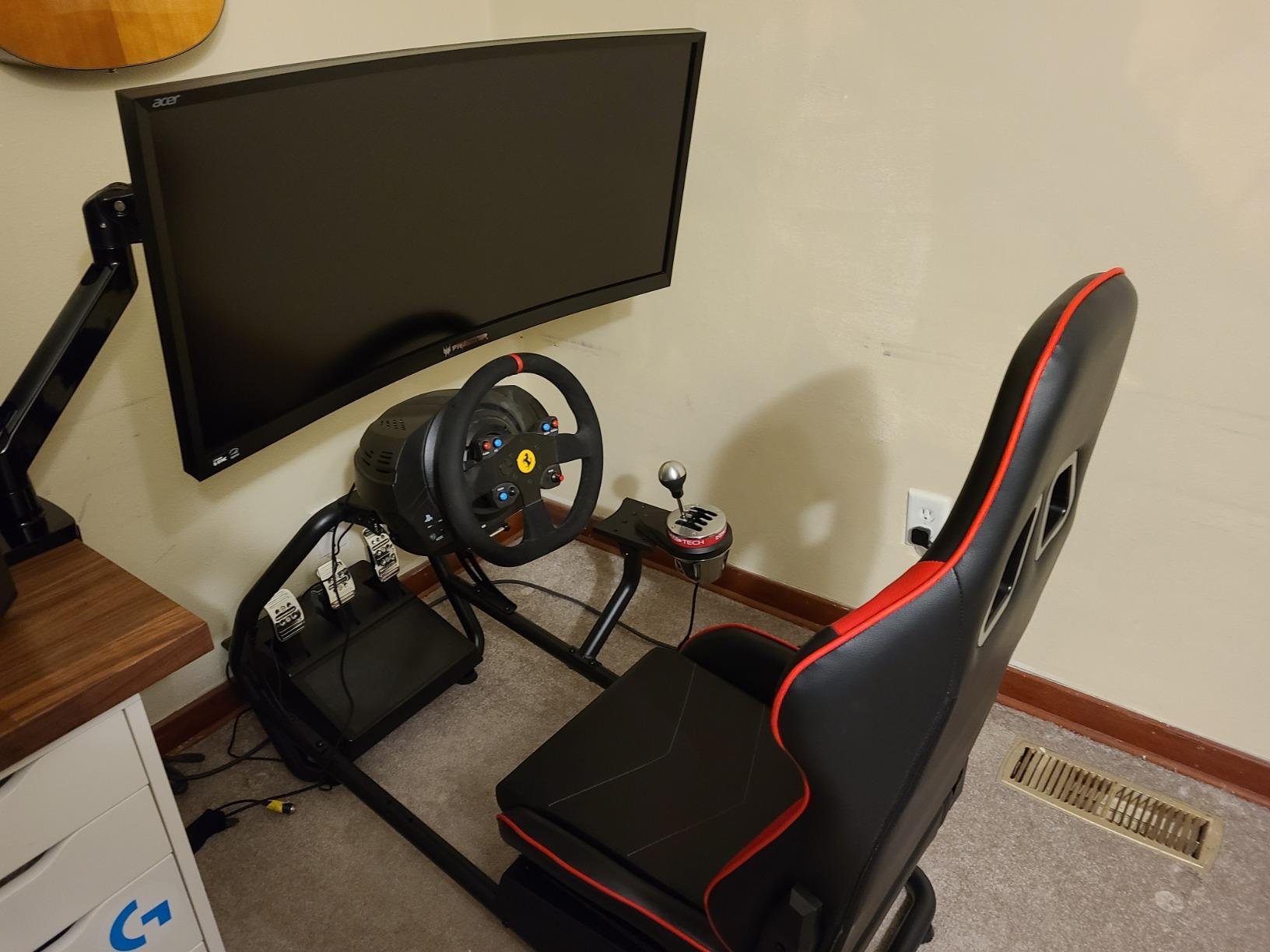
Why the VIVO works for small rooms?
A wheel stand is the cheapest legitimate way to get off the desk, and this one is also a chair. If your space doubles as a home office, you drive, then push the rig aside and keep working, and no other pick in this list does that.
It is also the right answer for a renter who cannot anchor anything to a wall. Nothing is fixed, the footprint is small, and the whole thing moves with one person.
Where it will not hold up?
Long sessions. The seat is the limiting factor, not the frame, and you can improve it with a cushion but not fully. If your plan is three-hour endurance races, spend the difference on a frame with a proper padded seat.
Load cell pedal sets also expose the wheel deck and pedal plate flex more than belt pedals do. That flex is exactly what changes your brake feel between laps, so check the mounting torque after the first few sessions.
5. Playseat Trophy: the premium pick for fixed-frame rigidity you can carry
PLAYSEAT Trophy Sim Racing Cockpit | High Performance Racing Simulator Cockpit | Supports Direct Drive | Compatible with All Steering Wheels & Pedals on the Market | Supports PC & Console | Black
Alloy steel frame
16 kg
55 x 23 x 39 inch
Driver range 120-220 cm
Pros
- Light enough for one person to move between rooms
- Rigid frame with no movement at 230 lb
- Breathable microfiber seat holds up over 3 hour sessions
- Assembles in about 30 minutes
Cons
- Steering wheel height cannot be adjusted
- only angle
- Rig shifts forward under hard braking at the shortest setting
- Backrest and fore-aft changes need tools and partial disassembly
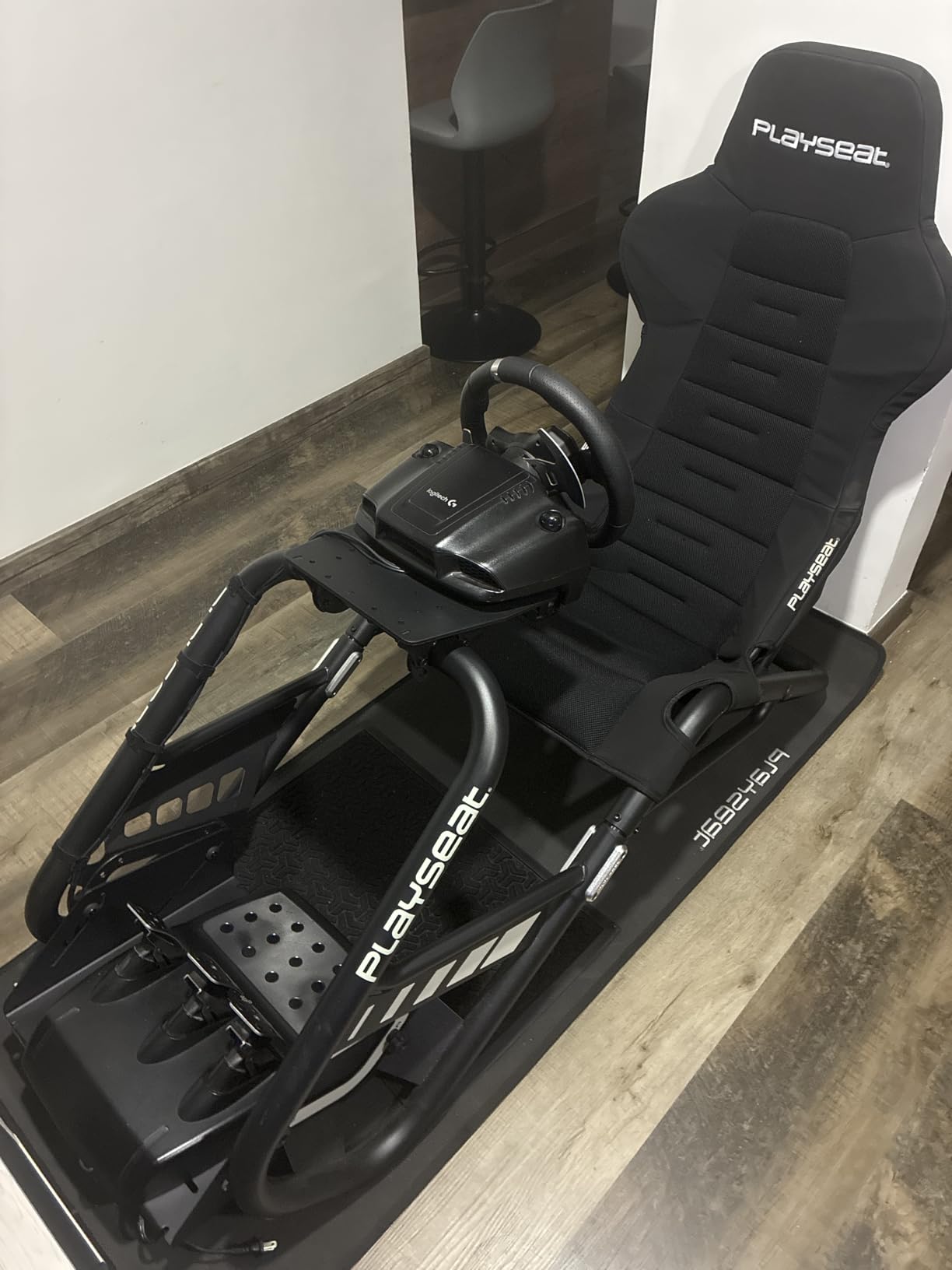
The Trophy is the most talked-about frame on the beginner forums for a good reason: it is the step up from a folding rig without stepping into a full aluminum build. Powder-coated alloy steel, a frameless profile, and full direct drive support for PC and console.
At 16 kilograms it is the second-lightest rigid frame here, and owners move it between rooms without a second person, even over carpet. That portability is unusual for a fixed frame and it is what separates the Trophy from the aluminum rigs that need two people and a doorway plan.
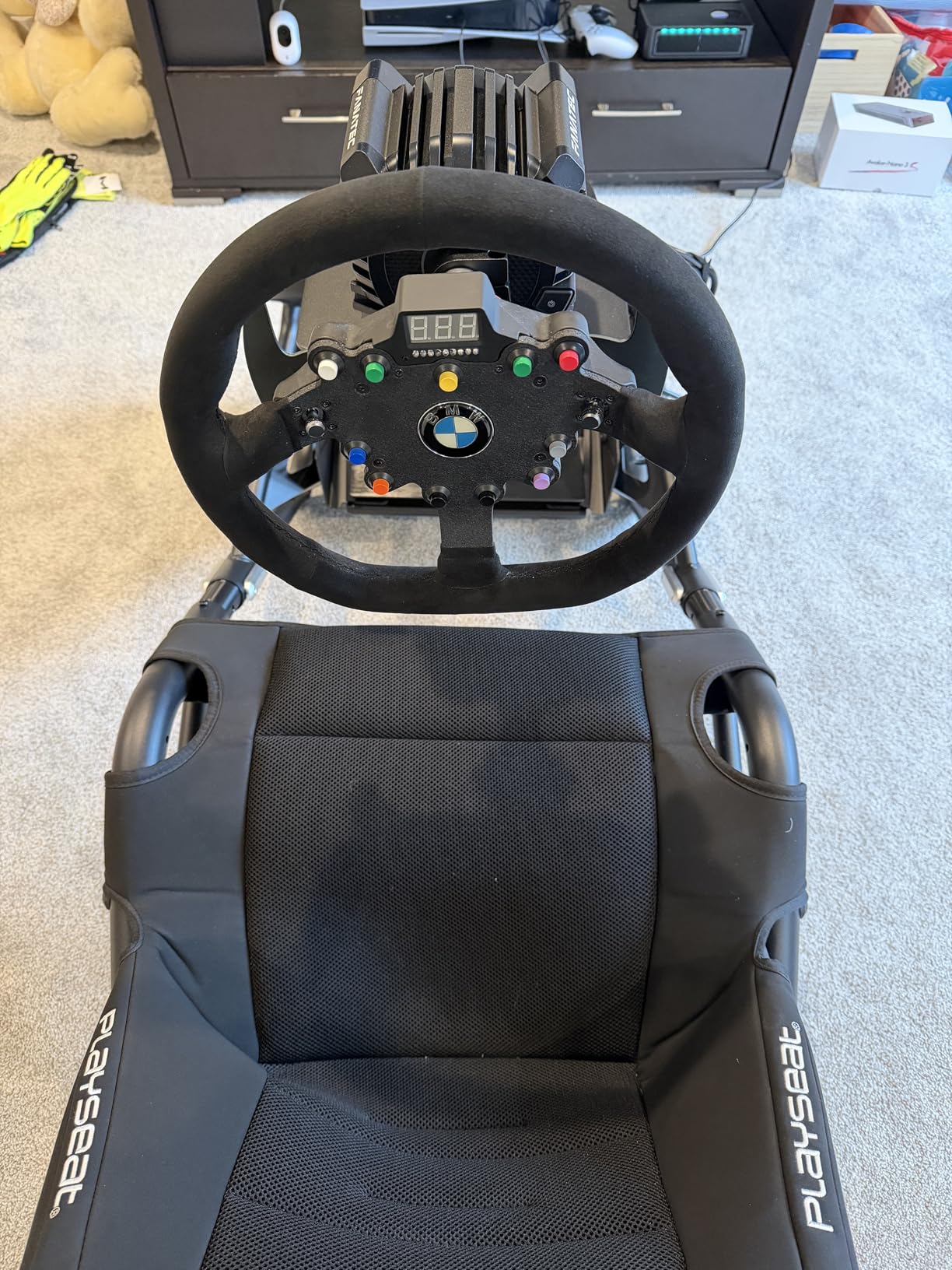
Rigidity is where it earns the step up. Multiple owners around 230 lb report no frame movement at all, and one describes feeling the direct drive forces travel through the frame rather than being absorbed by it. The frame does not flex when you trail brake, which is the whole reason to move off a folding design.
The seat is the other draw. Owners run three-hour sessions in the ActiFit breathable microfiber and report no complaints on comfort, which none of the cheaper frames here can claim. Driver fit is specified at 120 to 220 cm and 20 to 122 kg, so check your height against that range before buying.
Two adjustments are missing and both matter. The steering wheel height cannot change, only the wheel angle, so shorter drivers may need to flip the wheelbase mount to get their hands where they want them. And the backrest angle and wheel fore-aft position need tools and partial disassembly, which turns a five-minute tweak into a twenty-minute job.
What the Trophy is for?
It suits a beginner who has already decided they are staying in sim racing and wants their first direct drive wheelbase to feel right from day one. There is no folding mechanism to develop play and no adjustment that needs a toolkit mid-session.
It also works for a dual-purpose rig. Because it is light and rigid at the same time, you can drive GT and endurance content, and still wheel the frame aside for work or study.
Who should skip it?
Skip it if you need to reclaim floor space on demand. This is a fixed frame and it stays where you put it, which is the trade you accept for the rigidity.
Skip it if you are very short or very tall, because the specified driver height range and the fixed wheel height are the two constraints most likely to need a workaround. For seats, our sim racing seat guide is worth a look before you commit to a long session setup.
6. DIWANGUS Steel Racing Simulator Cockpit: the pick for tall drivers who need a real adjustment range
DIWANGUS Steel Racing Simulator Cockpit with Seat, Foldable Sim Racing Rig
Supports up to 7 ft and 375 lb
Folds with wheel mounted
Stores at 65 x 49 x 115 cm
45 lb
Pros
- Frame is very stable and hard to rock for a steel build
- Supports drivers up to 7 ft and 375 lb
- Folds upright with the wheel and pedals still mounted
- Around 30 minutes to assemble solo
Cons
- Centre rail to the pedals intrudes into legroom
- Fixed seat with no slide
- Limited wheel adjustment that rarely lands perfectly
This is the one in the guide with an explicit height and weight rating: users up to seven feet and 375 pounds. If you are tall and have been disappointed by frames where your knees touch the wheel deck, that single line is the reason this rig is on the list.
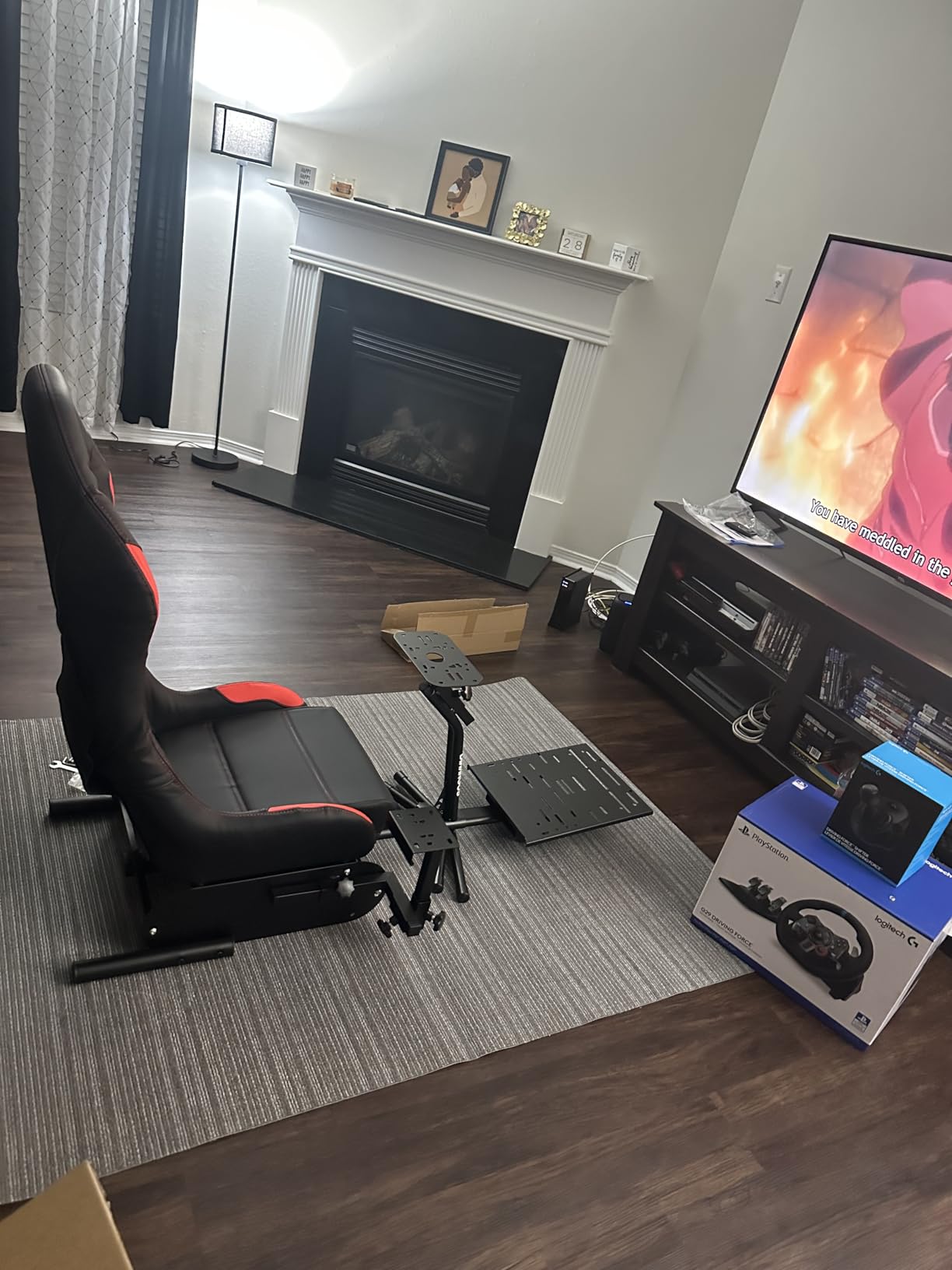
The folding behaviour is genuinely different from the others. It folds down with a compatible wheel and pedals still mounted, then stores upright at 65 by 49 by 115 centimetres. You are not unplugging hardware to put it away, which is the single most tedious part of every other folding design.
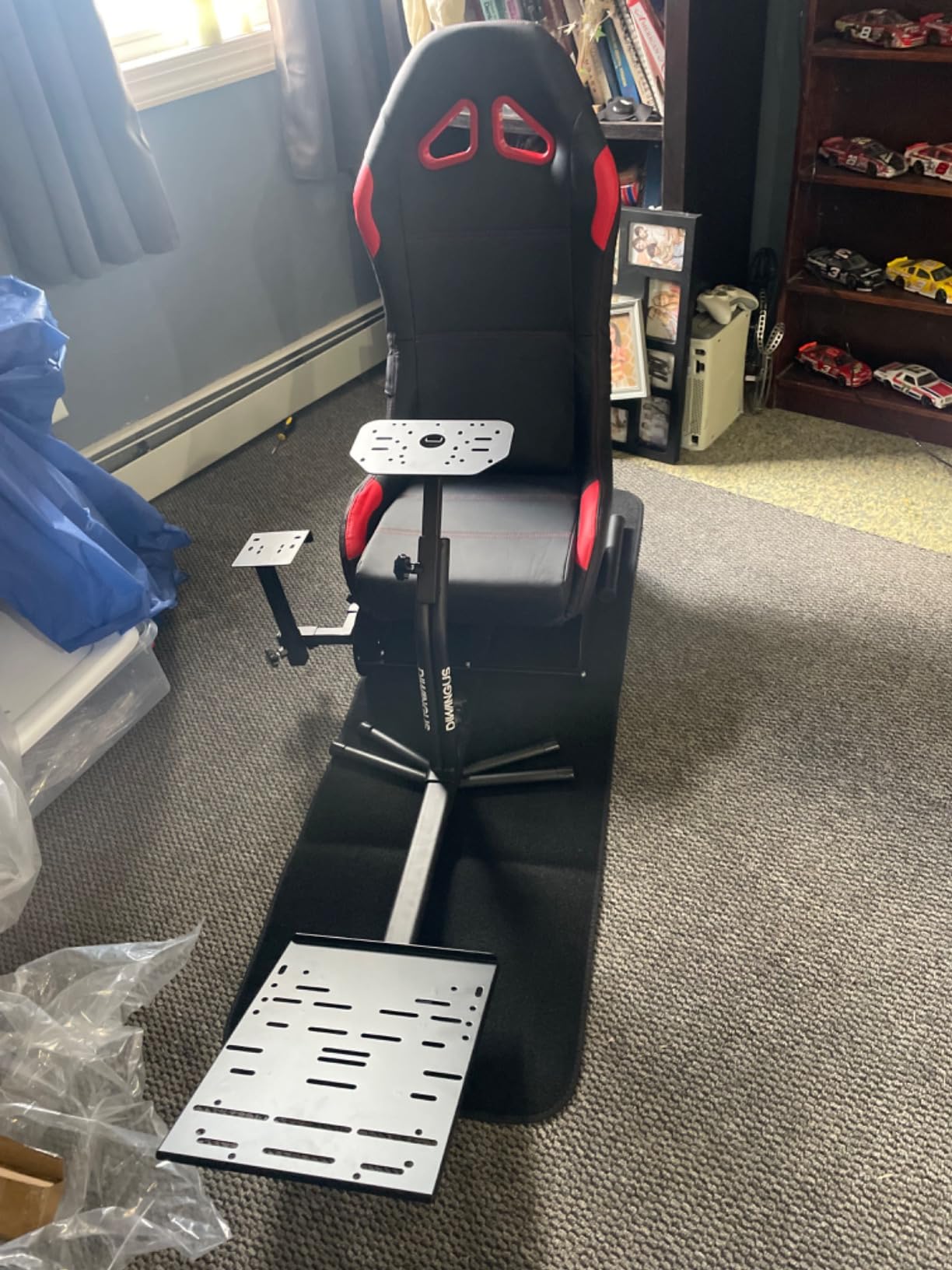
Build quality is the standout for the tier. Owners describe it as stable and hard to rock, and one ran a 2.4 hour Le Mans stint without fatigue. The frame arrives in 14 parts with hardware, tools and instructions, which takes about half an hour solo if you are not fussy.
Adjustment covers wheel-deck height, fore-aft reach and a 20 to 30 degree working angle, with three pedal tilt settings. That is a wider envelope than most foldable frames at this level offer, and it is why the range issues are the main complaint rather than lack of movement.
The two ergonomic problems are consistent. The centre rail running forward to the pedals eats into legroom, which matters directly for a seven-foot driver, and the fixed seat has no slide, so two drivers of different shapes cannot both get comfortable from the same position.
Where this rig earns its place?
It is the answer for a tall driver on a budget who still needs the rig to disappear. The 375 pound rating and the seven-foot ceiling are the only numbers in this roundup that let you verify fit before buying.
It is also a good rally or drifting choice, because the fold-while-mounted behaviour means you can put the rig away and bring it back without rebolting anything.
Where it frustrates owners?
Bolts loosen after the first use and need periodic re-tightening with the supplied key. Owners also report the wheel tends to sit either too close and high or too far and low, rather than anywhere in between, which is a resolution problem as much as a range problem.
There is no dedicated cable routing, and a minority of reviews mention scratched or bent frame parts out of the box. Inspect the frame before you build rather than after your first hour of driving.
7. ARES WING Racing Simulator Cockpit: the pick for high-torque direct drive bases
ARES WING Racing Simulator Cockpit, Sim Racing Wheel Stand with Seat, Red
Strengthened steel frame
8 non-slip feet
56.9 lb
7.1 inch seat slide
Pros
- Reinforced frame stays stable with high-torque direct drive
- 8 non-slip feet prevent drifting under hard driving
- 7.1 inch seat slide with 90 to 150 degree recline
- Widened foam padding with PU leather surface
Cons
- Heaviest foldable rig here at nearly 57 lb
- Only one shifter and handbrake mounting plate
- Wheel pedals shifter and monitor all sold separately
If you are buying a cockpit because you are about to buy a serious direct drive wheelbase, this is the frame in the guide explicitly designed for that. The listing names high-torque bases like the Fanatec Pro as the target, and the structure is built up rather than adapted.
The detail that tells you this is a stability-first design is the base. Eight non-slip support feet spread the load and stop the frame from shaking or drifting under aggressive use, which is a direct response to the movement owners complain about on lighter steel stands.
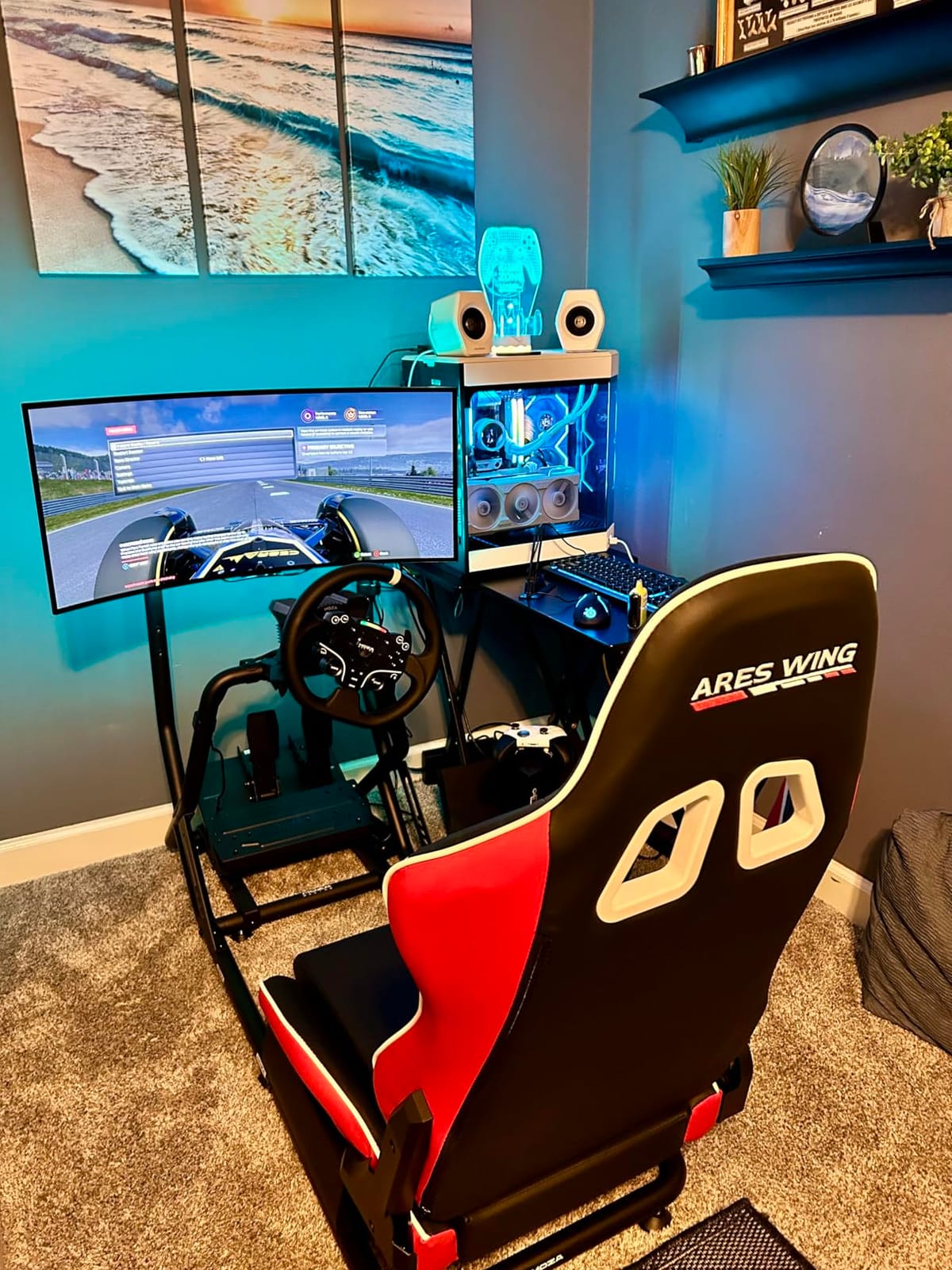
Posture adjustment is the second strength. The seat slides 7.1 inches and the backrest tilts from 90 to 150 degrees, and the wheel, pedals and shifter are all adjustable with the shifter mount fitting on either side. That range is enough to move between GT and open-wheel positions without rebuilding the frame.
Materials are good for the money. A powder-coated steel frame carries widened soft foam padding under a PU leather surface, and owners running long sessions describe the padding as holding up. Six cable management clips come in the box, which more than the other steel frames here manage.
Weight is the trade. At 56.9 pounds it is the heaviest rig in the roundup, and owners are blunt that it is not easy to reposition between rooms. Combined with the fact that the shifter and handbrake share a single mounting plate, it is a rig you set up in one place.
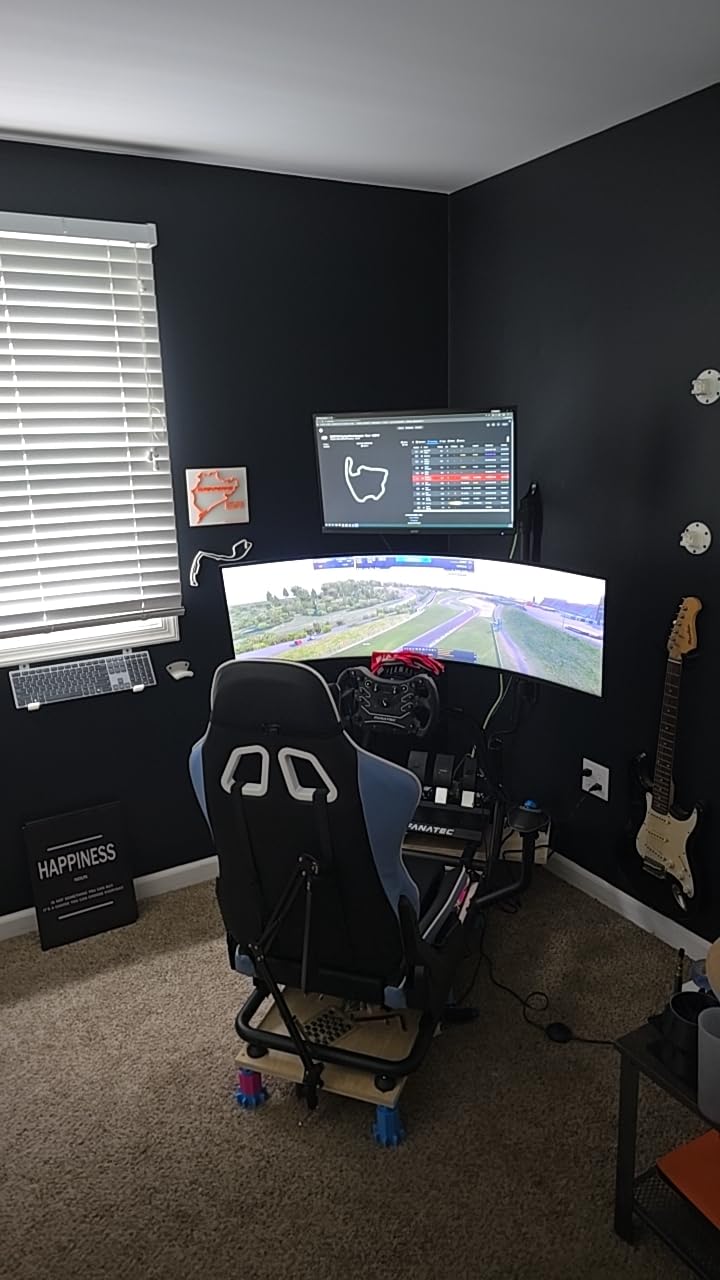
Why this one for torque-heavy hardware?
Direct drive wheels push force in both directions constantly, and a frame that flexes under that load eats the information the wheel is sending you. The reinforced structure and the eight feet are aimed squarely at that problem, and owners with high-torque bases report the rig stays planted.
It is also the pick if you already have your wheel, pedals and shifter and just need the platform, since the frame is sold as the base only.
Who should look elsewhere?
Look elsewhere if you need to move it. Nearly 57 pounds is a two-person job through a doorway, and the compact foldable designs in this list exist precisely for people who cannot dedicate a room.
Look elsewhere if you want a shifter on one side now and the other side later. One plate means one position, and that is a real limitation for car setups that change.
8. GTPLAYER Sim Racing Cockpit: the smallest footprint here for bedrooms
GTPLAYER Sim Racing Cockpit Foldable & Adjustable for High Performance Sim Racing Compact & Flexible Supports All Steering Wheels & Pedals for PC Wheel and Pedals Not Included(Black)
28 x 21 x 43 inch footprint
Carbon steel frame
33 lb
Folds with wheel attached
Pros
- Smallest floor footprint of any pick in this guide
- Folds in three steps without removing the wheel or pedals
- Carbon steel frame feels rigid for the weight
- Plenty of pre-drilled wheel tray slots
Cons
- No seat rails so height adjustment means reclining
- Suede upholstery stretches and deforms over time
- Full fold requires removing the wheel and pedals first
At 28 by 21 by 43 inches this is the smallest thing in the roundup, and for a bedroom or a shared wall it is the one that changes the conversation. Owners who cannot leave a permanent rig in a living room describe the three-step fold as the deciding factor.
The frame is carbon steel with a powder-coated finish and a suede seat, rated to 150 kilograms. Owners say it feels solid for the weight, with no creaking and no flex, and that the mounting plate offers more pre-drilled positions than competitors at twice the size.
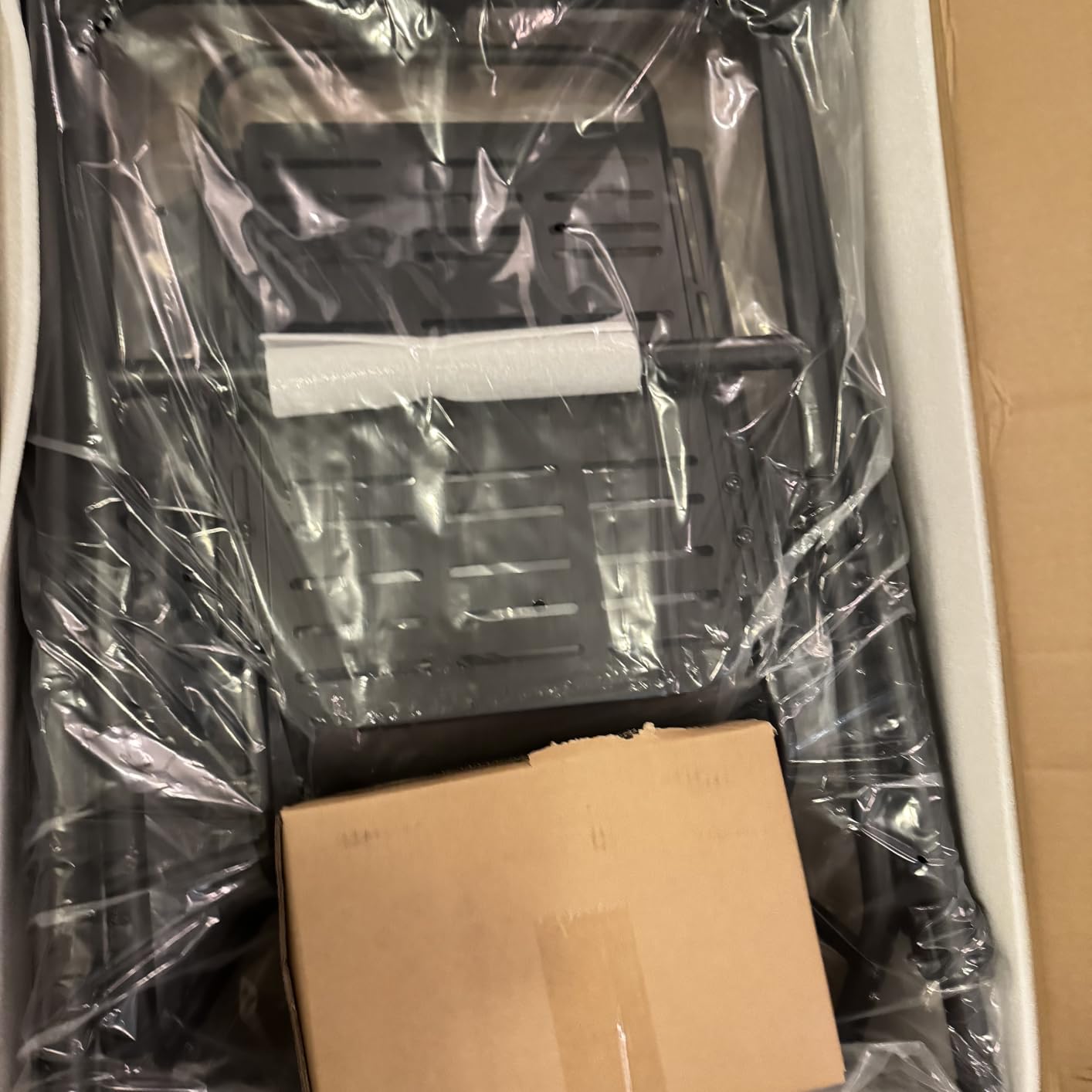
Compatibility is broad for a compact frame. It covers Logitech G25 through G923, a long Thrustmaster list including the T248, T300RS GT and T-GT, and Fanatec DD1, DD2, CSL DD and DD Pro bases, across PS5, PS4, Xbox One and PC.
There is an open cockpit entry system rather than a fixed side rail, so you get in and out from the front. Adjustable footrest length, wheel tray angle, shifter side and seat height and angle are all present, and one owner at six foot three reports it fits them well.
The seat is the weak point and it is a specific weakness. There are no seat rails, so raising the seat means reclining it, which forces a relaxed posture instead of a driving one. The upholstery is fabric stretched over the frame and owners report it stretching and deforming under load over time.
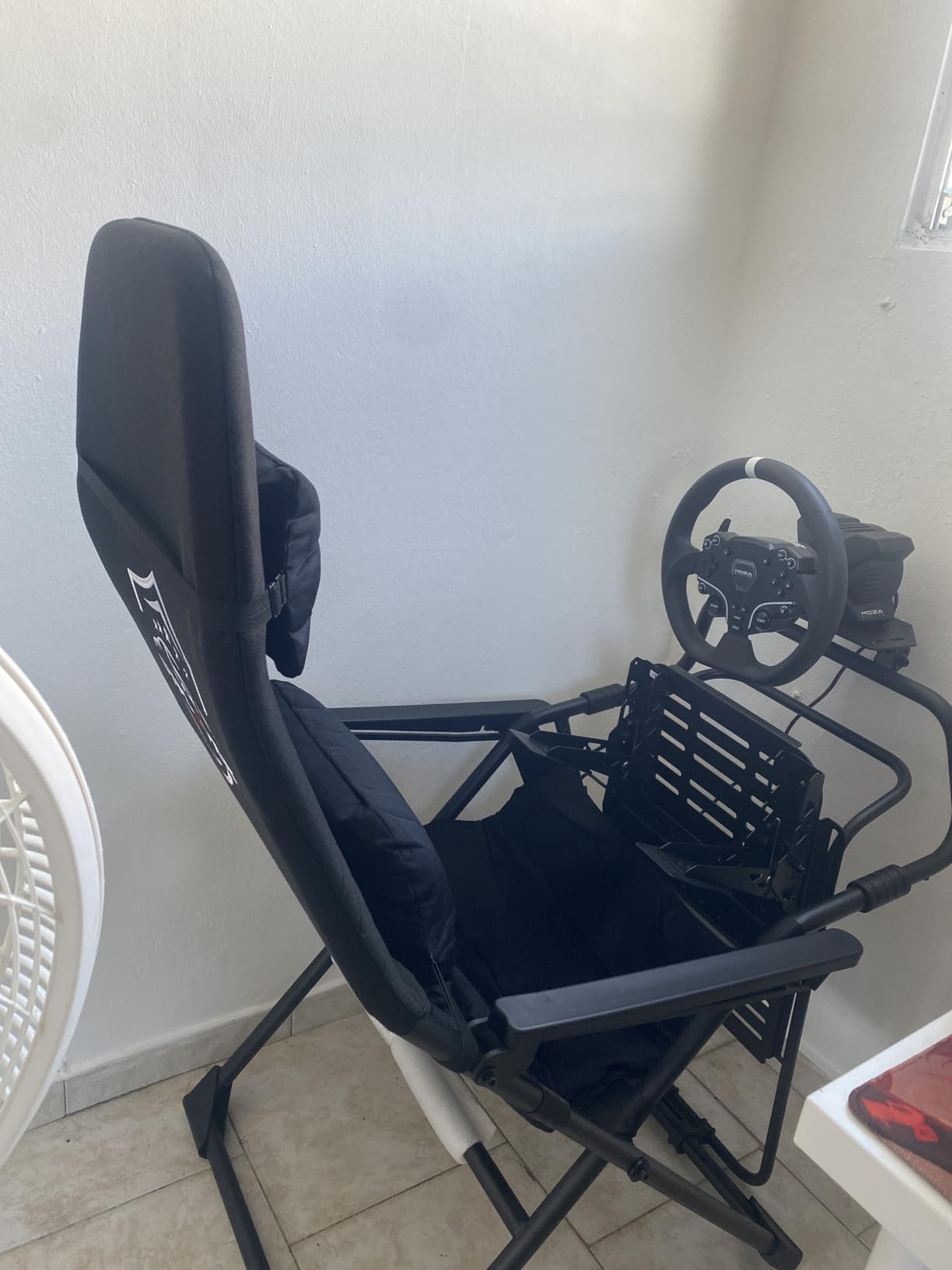
When this is the right call?
Choose it when floor space, not torque, is your binding constraint. Nothing else in this list takes up less room, and the fold does not require unplugging your wheel.
It is also a sensible first rig for a console player, since it covers current and previous generation platforms without any additional hardware.
What to watch out for?
Short drivers will sit too low, because the only height control is the recline. That is a real compromise and a cushion helps more here than it does elsewhere.
The shifter position is close to the plastic armrest and owners call it awkward, and a small number report misaligned wheel tray bars that unlock during a session. Check the tray locks before your first race, not during it.
9. Next Level Racing GTRacer 2.0: the aluminum frame to buy once
Next Level Racing NLR-R007 GTRacer 2.0 Simulator Cockpit
All-aluminum frame
37 kg
Handles up to 13 Nm
Shifter and handbrake support
Pros
- Rigid aluminum frame with no flex under hard braking
- Compact footprint for a fixed frame
- Includes shifter support handbrake support and a ButtKicker pole
- Comfortable for drivers up to 250 lb and 6 ft
Cons
- Seat has no lumbar support for long sessions
- Pedal plate cannot lie fully flat at its lowest setting
- Seat slider is clunky and assembly takes 30-40 minutes
This is the only all-aluminum frame in the guide, and that changes the physics of the problem. T-slot aluminum profile does not twist or rack the way steel tube does under a hard steering input, so the wheel reports the same thing lap after lap. Owners describe no flex under maximum braking or steering forces even with mid-range direct drive hardware.
It is also compact at 39.6 by 17 by 22.6 inches, which surprises people who assume aluminum means a big footprint. For a fixed frame in an apartment, that footprint is competitive with the folding designs listed above.
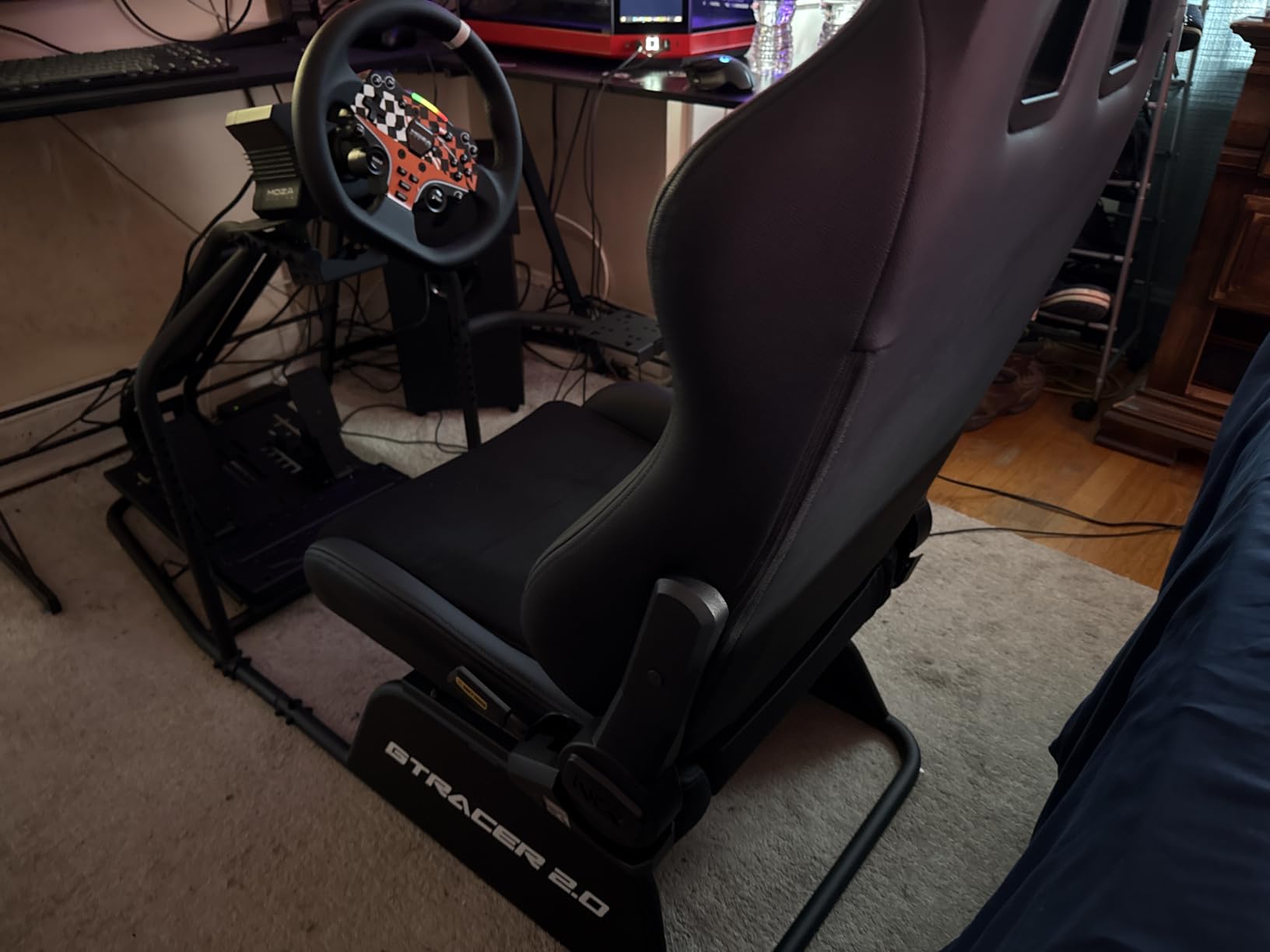
The included hardware list is generous. You get shifter support, handbrake support and a ButtKicker mounting pole in the box, which removes three separate purchases that owners of cheaper frames have to source themselves. The double recliner seat with a double seat slider is what lets you settle into a GT posture quickly.
Owners running up to 250 pounds and six feet report the seat and frame both cope. Customer service is also singled out: people who contacted the manufacturer about missing hardware or misdrilled holes say replacement parts were handled quickly, and screws arrive sorted by size in the box.
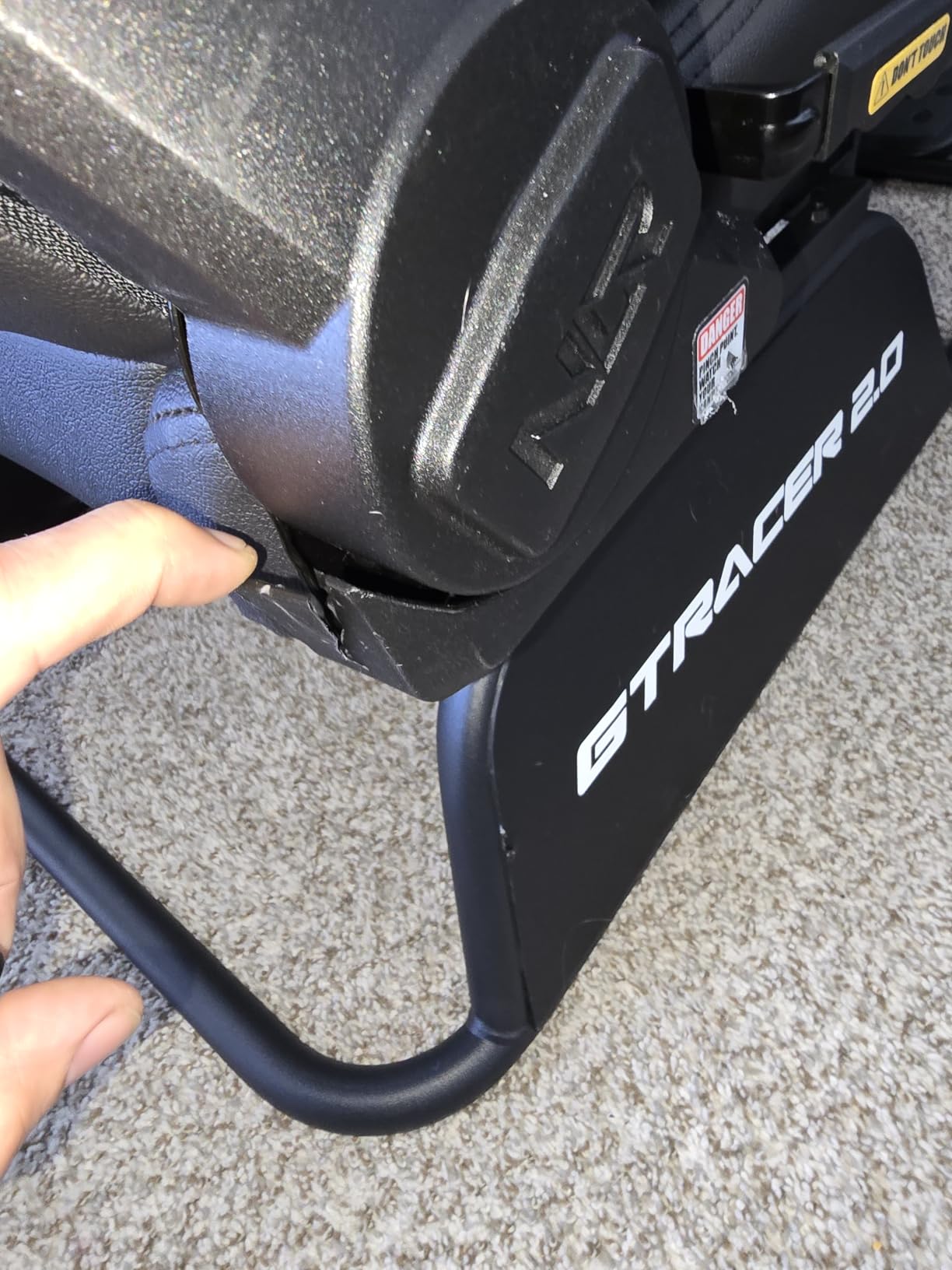
It is 37 kilograms, so treat this as a permanent installation rather than something you move weekly. The comfort gaps are consistent too: no lumbar support in the seat, and a pedal plate that cannot lie fully flat even at its lowest angle, which leaves a small incline under the pedals.
Why this is the buy-once frame?
Rigidity is the whole argument. If you know you will be driving competitive time trial or endurance content and you want your braking point to be identical on lap one and lap fifty, aluminum is the material that gets you there. The rating covers direct drive wheels up to 13 Nm.
It is also the pick if your rig will double as something you use every day, because there is no folding hinge to loosen and no ratchet to re-tune.
Where it falls short?
Assembly takes 30 to 40 minutes, and owners describe the instructions and the bolt packaging as confusing. Sort the hardware before you start rather than hunting for a size mid-build.
The seat slider is clunky and needs forcing, and the shifter plate has a single mounting point with no higher hole, so compact shifters sit low. There is no cable organiser included, so plan your routing from the start.
10. Dardoo Racing Simulator Cockpit: the pick for heavy drivers and heavy hardware
Dardoo Racing Simulator Cockpit Frame with Black Seat for 12Nm Direct Drive
500 lb capacity
50 x 50 mm round tube
80.4 lb
65-180 degree seat rail
Pros
- Heavy rigid build that stays planted under direct drive
- 500 lb user capacity is the highest here
- 50 mm round tube with a 4-hole flange resists twisting
- Dual rail seat adjusts from 65 to 180 degrees
Cons
- At 80.4 lb it is the hardest rig here to move
- 24 inch seat depth may not suit smaller drivers
- Only a 3-month warranty and tools needed for assembly
The Dardoo is the only rig in the guide rated for a 500 pound user, and the reason is structural. It is built on 50 by 50 millimetre round tube with a four-hole flange at the mounting points, which owners describe as far more stable than a typical entry-level frame using smaller tube and a single fixing.
That mass is the point and also the problem. At 80.4 pounds this is by a wide margin the heaviest rig listed, and it is the hardest to reposition. If you are setting up a dedicated room, that is a fair trade. If you need to move it, it is not.
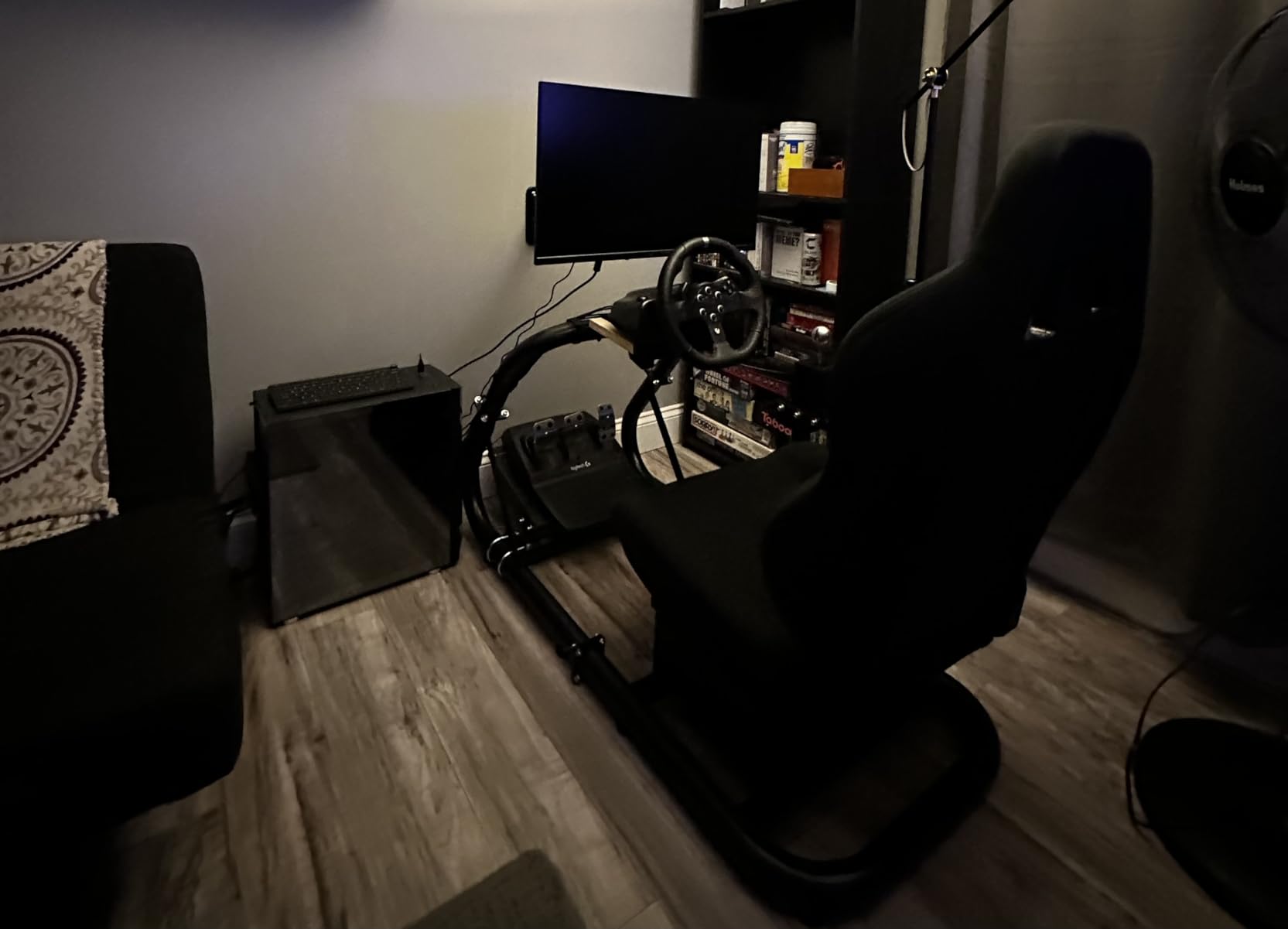
Adjustment is generous. The wheel platform adjusts at two levels for both height and angle, the pedal angle is customisable, and the double-locking dual rail seat runs from 65 to 180 degrees. That is the widest seating envelope in the roundup and it is the feature that makes the frame work for very different body shapes.
Compatibility covers Logitech, Fanatec, Thrustmaster and MOZA wheels, pedals and gear, and it supports direct drive steering wheels up to 12 Nm with TV bracket mounting for a monitor on the frame itself.
The seat depth of 24.02 inches is generous, and owners with smaller frames describe that as a problem rather than a comfort feature. The three-month warranty is also the shortest in this category, so treat the purchase as hardware you are keeping rather than something you will swap out.
Who this frame is for?
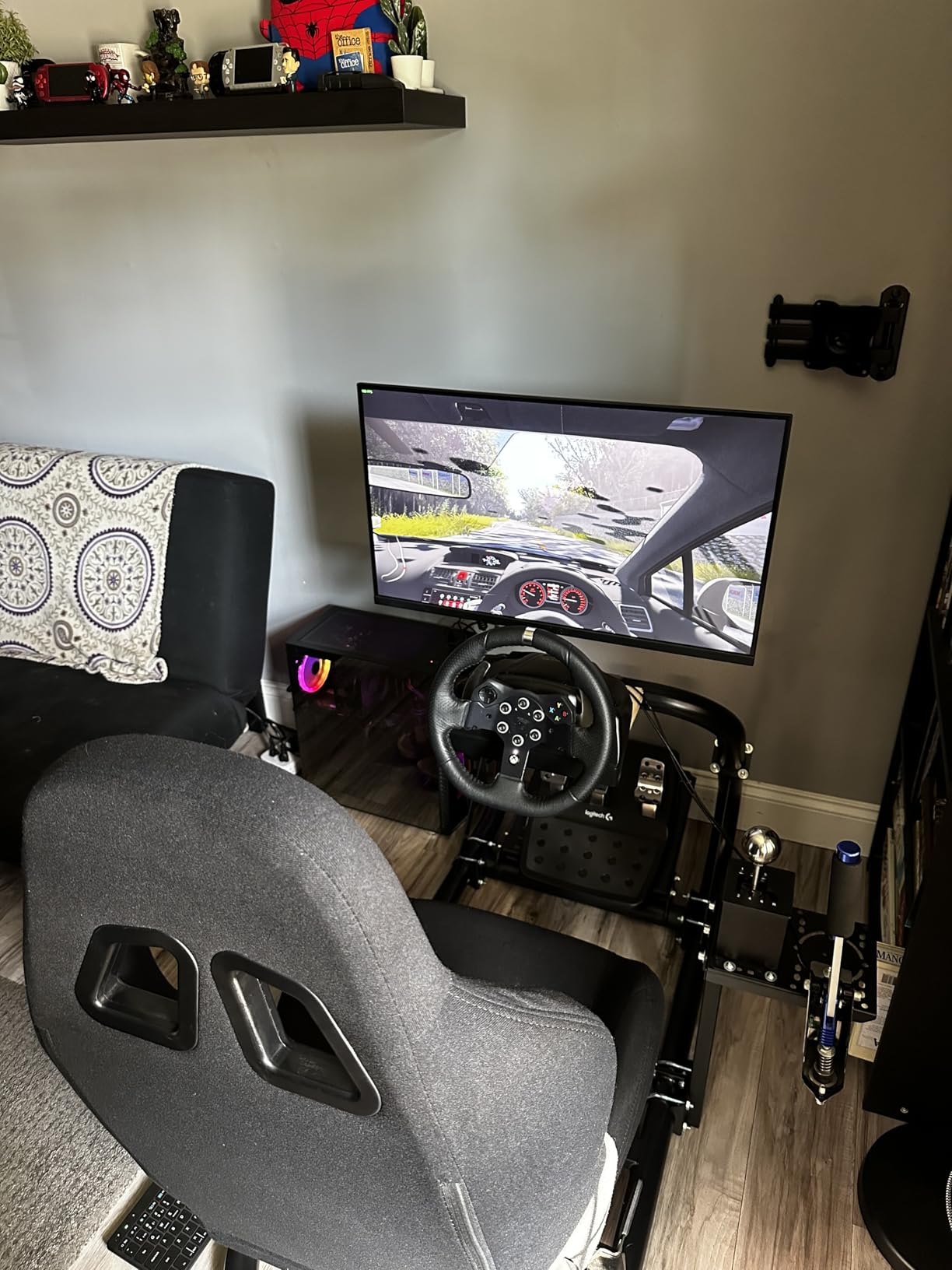
It suits a taller, heavier driver in a dedicated space who wants a frame that will not move when a high-torque wheelbase unloads, and who intends to keep it for years. The capacity rating means you do not have to guess whether it will hold.
It is also a good match for a driver switching between disciplines, because the dual rail seat range covers both a laid-back GT position and a much more open angle.
Where it does not work?
It does not work in a small room or a rental you might move out of. Eighty pounds through a doorway is a two-person job, and folding is not part of the design.
It also does not suit a short driver, because the deep seat leaves you sitting too far back from the wheel. Assembly is not tool-free and takes time, and wheel, pedals, handbrake and shifter are all bought separately on top of the frame.
Do You Even Need a Cockpit Yet? Wheel Stand vs Full Rig?
No, and this is the question most beginner roundups skip. If you have driven a few hundred laps on a desk and you are not sure you will still be doing it in six months, a wheel stand such as the VIVO in this guide is the correct first purchase. It costs a fraction of a full frame, it doubles as a chair, and it teaches you nothing you cannot carry to a bigger rig later.
The failure mode is buying a full cockpit first and discovering that the thing you like most is Formula, or that you are moving to a shared house in the autumn, or that a desk was working fine. A frame is the one part of a sim racing setup that is genuinely hard to resell, and forums repeatedly describe people who regret buying a structure they outgrew in a year.
Move up to a full cockpit when at least two of these are true: you have a permanent space, you have your wheel and pedals settled, and you know your wheel will need a proper mounting plate. A desk clamp works until you want brake pressure you can modulate with a load cell pedal, and that is the moment to move.
How to Choose a Sim Racing Cockpit: 7 Things That Actually Matter?
Rigidity first. A flexing frame and pedal plate are the number one cause of inconsistent braking. Every lap your brake point moves because the plate absorbs force differently under different loads. If a rig does not publish a frame material, treat that as a warning rather than a neutral.
Does the seat come with it? Nine of the ten frames in this guide include a seat, but the quality varies enormously and a thin pad is the most common reason a beginner gets uncomfortable and stops driving. Check the fill material, not just the cover. Our seat guide covers what to look for if you are replacing one.
What is the torque ceiling? Direct drive ready means nothing unless a number is attached. The NLR GTLite Pro and the GTRacer 2.0 both state 13 Nm. The ARES WING names high-torque bases. Anything that will not state a figure is a guess.
How is the wheelbase mounted? Three schemes exist: front mount, where the base bolts to the front of the wheel deck, side mount for direct drive, and a universal bottom deck. A front mount suits Logitech G-series and most belt wheels. If you will run Fanatec, MOZA or Simucube direct drive, you need side mount or a universal deck.
Seat adjustment. Look for a slide rather than a recline, and for a recline range measured in degrees. Height adjustment without a rail is usually a compromise, and two H3 sections in this guide flagged that compromise directly.
Footprint and foldability. Check the stated dimensions, not the marketing photos. Under 30 inches deep is realistic for a small room, over 55 inches means you are planning a dedicated space. If it folds, check whether the fold requires unplugging your hardware.
Assembly and warranty. Steel tube frames that are 90% assembled take about half an hour. A full aluminum extrusion build takes several hours and a set of hex keys. Warranty length is a decent proxy for how the manufacturer expects the frame to be treated: one year is common, three years is better, three months means plan for a replacement eventually.
Three Tiers: What Each Spending Level Buys and Gives Up?
Entry tier: the foldable and stand rigs. The GT Lite, the RACGTING, the GTPLAYER and the VIVO all sit here. You get a seat, a frame, a shifter mount and a working direct drive position for a belt or entry-level direct drive wheel. You give up rigidity under hard braking, fine adjustment, and seat comfort past an hour.
Middle tier: reinforced steel. The DIWANGUS, the ARES WING and the Dardoo. You gain a stated weight capacity, a real torque rating, and much wider adjustment. You give up portability, and several of these are heavy enough to be a two-person move.
Top tier: the fixed rigid frame. The Playseat Trophy and the GTRacer 2.0. You gain a frame that does not move under load, a seat that survives long sessions, and an upgrade path. You give up the ability to put it away in ten minutes, and the TCO rises once you add a better seat.
Seven Beginner Buying Mistakes to Avoid
Buying the frame before the wheel. This is the single most common regret in the forums. The frame determines the mounting standard, and getting it wrong means re-drilling or re-buying.
Ignoring the seat. A thin pad feels fine for twenty minutes and ruins a three-hour race. Check the fill material before you buy, not after.
Assuming a folding rig is as rigid as a fixed one. It is not, and the gap shows up as soon as you trail brake. Fold for space, or for rigidity, not for both.
Under-tightening every bolt once. Most of the wobble complaints in the reviews trace back to clamp bolts that were never fully tightened at assembly. Re-check them after the first session and the first month.
Setting the position once and never again. Wheel distance, pedal angle and seat height all need setting with your actual hardware mounted. Do it with a tape measure, not by eye.
Skipping the monitor. A cockpit with no screen is a rear-view mirror and a lot of legroom. Budget for a monitor stand before you commit to a frame with a fixed position.
Forgetting the total. Frame, seat if not included, pedals, shifter, monitor stand, cables and a cushion add up. Count all of them before deciding which tier is right.
Frequently Asked Questions
What is the best sim racing setup for beginners?
A wheel, a set of pedals, a rigid cockpit and a monitor at a sensible distance. For a first wheel, a Logitech G923 or a Thrustmaster T300 covers most beginners, and adding load cell pedals is the single upgrade that most improves brake control. On the frame side, the Next Level Racing GT Lite is the safest first purchase because it folds, it fits any major wheelbase, and it takes an entry-level direct drive base when you are ready.
Which company makes the best sim racing cockpits?
There is no single answer, but Next Level Racing covers the widest range of beginner needs with three very different rigs in this guide, from a folding entry model to a fixed aluminum frame. Playseat is the long-standing choice for a portable rigid steel frame, VIVO makes the best rated wheel stand for small spaces, and the folding designs from RACGTING, DIWANGUS and GTPLAYER compete on footprint and weight.
Which sim racing cockpit should I buy?
Buy the Next Level Racing GT Lite if you want the safest all-round first cockpit and the option to put it away. Buy the GTRacer 2.0 if you have a permanent space and want a frame you will keep for years. Buy the VIVO wheel stand if your space is very tight and you want to keep using a chair the rest of the week. Buy the ARES WING if you are pairing it with a high-torque direct drive base.
Is a cheap sim racing rig a mistake for beginners?
Not if you know what you are getting. A cheap folding rig teaches you the ergonomics of a driving position and tells you whether you like being in a cockpit at all, and it costs little if you later decide a full frame is not for you. It is a mistake when you buy the cheapest frame and then immediately plan to run a high-torque direct drive wheelbase on it, because the fold and the ratchet adjusters will not hold up.
How long does it take to assemble a sim racing cockpit?
The 90% pre-assembled folding frames in this guide take about 30 minutes for most owners. The GT Lite and the GTPLAYER are in the same range. A fixed steel frame such as the Playseat Trophy takes around 30 minutes with careful instruction reading, while the all-aluminum GTRacer 2.0 runs 30 to 40 minutes and needs a full hardware sort first.
Is sim racing harder than real driving?
Harder in one specific way. A real car gives you a chassis, suspension and a seat that move with you, and a flexing rig or a bad position removes the feedback that tells you what the front of the car is doing. Get the position right, tighten the bolts, and mount the pedals where your legs can hold pressure without locking, and most of that gap closes quickly.
Final Verdict
The best sim racing cockpits for beginners is the Next Level Racing GT Lite, because it is the only frame here with a large owner base, a genuine flat fold, pre-drilled mounting for every major wheel brand, and enough stiffness for an entry-level direct drive base when you are ready to move up. It is a low-risk first purchase in a category full of frames that ask you to guess.
Match it to your situation rather than the spec sheet. Small room and a shared living space push you toward the RACGTING or the GTPLAYER for raw footprint, and toward the VIVO wheel stand if you want to keep your chair. A permanent space and a high-torque wheelbase push you toward the ARES WING or the Playseat Trophy. If you want the one you will never replace, the all-aluminum GTRacer 2.0 handles up to 13 Nm and does not flex under hard braking.
And if you are still undecided about sim racing itself, buy the stand first. It is the cheapest way to find out whether you want a cockpit at all, and it is the only recommendation in this guide you will not be annoyed to sell on.