
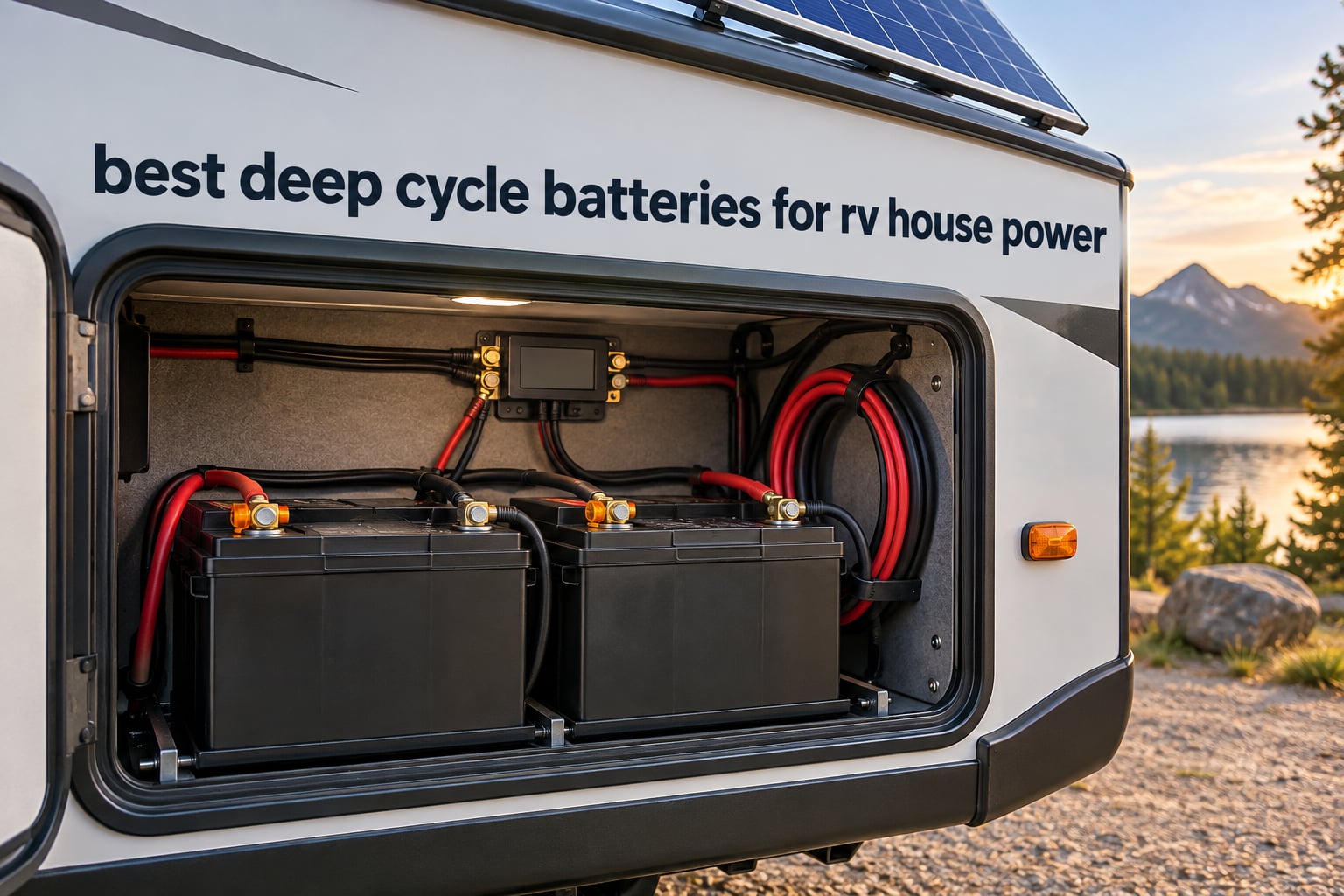
The short answer for deep cycle batteries for RV house power is a 200Ah LiFePO4 battery with a 200A battery management system, paired with whatever group size your battery tray already accepts. That single spec pair — capacity and continuous current — decides whether you get three quiet nights of lights, fridge and inverter or you wake up on day two running the generator.
Here is the number that trips up almost every first-time boondocker: usable amp-hours, not nameplate amp-hours. A 100Ah AGM battery gives you roughly 50Ah you can actually use, while a 100Ah LiFePO4 battery gives you about 90Ah before you are asking for trouble. That gap is the entire reason this roundup exists, and the ranking below follows that logic, weighted heavily toward how much owner history sits behind each claim.
We worked through the specs, weights, charge cutoffs and review distributions on all twelve packs below. Nothing here is sponsored, and every pick carries an honest note about who should not buy it.
If you also fish or run a boat, our guide to the best marine batteries covers the wet-deck side of the same chemistry question.
The Three Batteries to Start With (October 2026)

Renogy 12V 100Ah AGM Deep Cycle
- Most-proven pick
- 3534 reviews
- Drop-in Group 24 form
- Rated to -4F

These three are the batteries we would put in a rig first, and every other section explains the trade-offs in more detail.
The dumfume 200Ah LiFePO4 is the pick for anyone leaving hookups behind. At 2560Wh and a 200A continuous rating, one of these replaces several 100Ah AGM batteries in usable output while weighing less than a single 200Ah lead-acid cell.
The Litime self-heating unit is the one to buy if your season runs below freezing. It is a Group 24 drop-in, weighs 21.8 pounds, and has two heating modes plus app monitoring.
All 12 Deep Cycle Batteries Compared Side by Side
| Product | Specifications | Action |
|---|---|---|
| Renogy 12V 100Ah AGM Deep Cycle |
|
Check Latest Price |
 Renogy 12V 200Ah AGM Deep Cycle Renogy 12V 200Ah AGM Deep Cycle |
|
Check Latest Price |
| dumfume 12V 200Ah LiFePO4 200A BMS |
|
Check Latest Price |
| Litime 12V 100Ah Self-Heating LiFePO4 |
|
Check Latest Price |
 Rvpozwer 12V 200Ah LiFePO4 Rvpozwer 12V 200Ah LiFePO4 |
|
Check Latest Price |
 HumsiENK 12V 100Ah Bluetooth LiFePO4 HumsiENK 12V 100Ah Bluetooth LiFePO4 |
|
Check Latest Price |
 WEIZE Group 27M Dual Purpose AGM WEIZE Group 27M Dual Purpose AGM |
|
Check Latest Price |
 SUPER EMPOWER 12V 100Ah LiFePO4 SUPER EMPOWER 12V 100Ah LiFePO4 |
|
Check Latest Price |
 DC HOUSE 12V 100Ah Bluetooth LiFePO4 DC HOUSE 12V 100Ah Bluetooth LiFePO4 |
|
Check Latest Price |
 MARSENERGY 12V 100Ah Self-Heating LiFePO4 MARSENERGY 12V 100Ah Self-Heating LiFePO4 |
|
Check Latest Price |
 ECO-WORTHY 12V 314Ah LiFePO4 ECO-WORTHY 12V 314Ah LiFePO4 |
|
Check Latest Price |
 WattCycle 12V 100Ah Mini LiFePO4 WattCycle 12V 100Ah Mini LiFePO4 |
|
Check Latest Price |
Specs, ratings and review counts below were checked against the manufacturer listings as of October 2026. Weights, capacity and BMS ratings come from the same source, so the columns are directly comparable.
1. Renogy 12V 100Ah AGM — the most-proven unit in the group and the lowest-friction first upgrade. Best for full-time rigs on a budget and anyone who wants a drop-in with no charging changes.
2. Renogy 12V 200Ah AGM — capacity where weight is not the constraint. Best for a Class A motorhome with a floor-mounted bay that can absorb 128 pounds.
3. dumfume 12V 200Ah LiFePO4 with 200A BMS — the boondocking workhorse. Best for two to four nights off grid with an inverter in the mix.
4. Litime 12V 100Ah self-heating LiFePO4 — cold-weather charging handled properly, in a Group 24 footprint. Best for shoulder-season and winter camping.
5. Rvpozwer 12V 200Ah LiFePO4 — 200Ah at 45 pounds, the lightest 200Ah unit here. Best for trailer owners watching tongue weight.
6. HumsiENK 12V 100Ah Bluetooth LiFePO4 — app monitoring at 19.73 pounds. Best when tray height is tight.
7. WEIZE Group 27M dual purpose AGM — starter and house power in one case. Best as a house battery on a boat or a rig with no separate start bank.
8. SUPER EMPOWER 12V 100Ah LiFePO4 — the straightest drop-in lithium with no frills. Best for first-time lithium owners on a budget.
9. DC HOUSE 12V 100Ah Bluetooth LiFePO4 — per-cell voltage, current and fault alerts over Bluetooth 5.1. Best for owners who want to diagnose rather than guess.
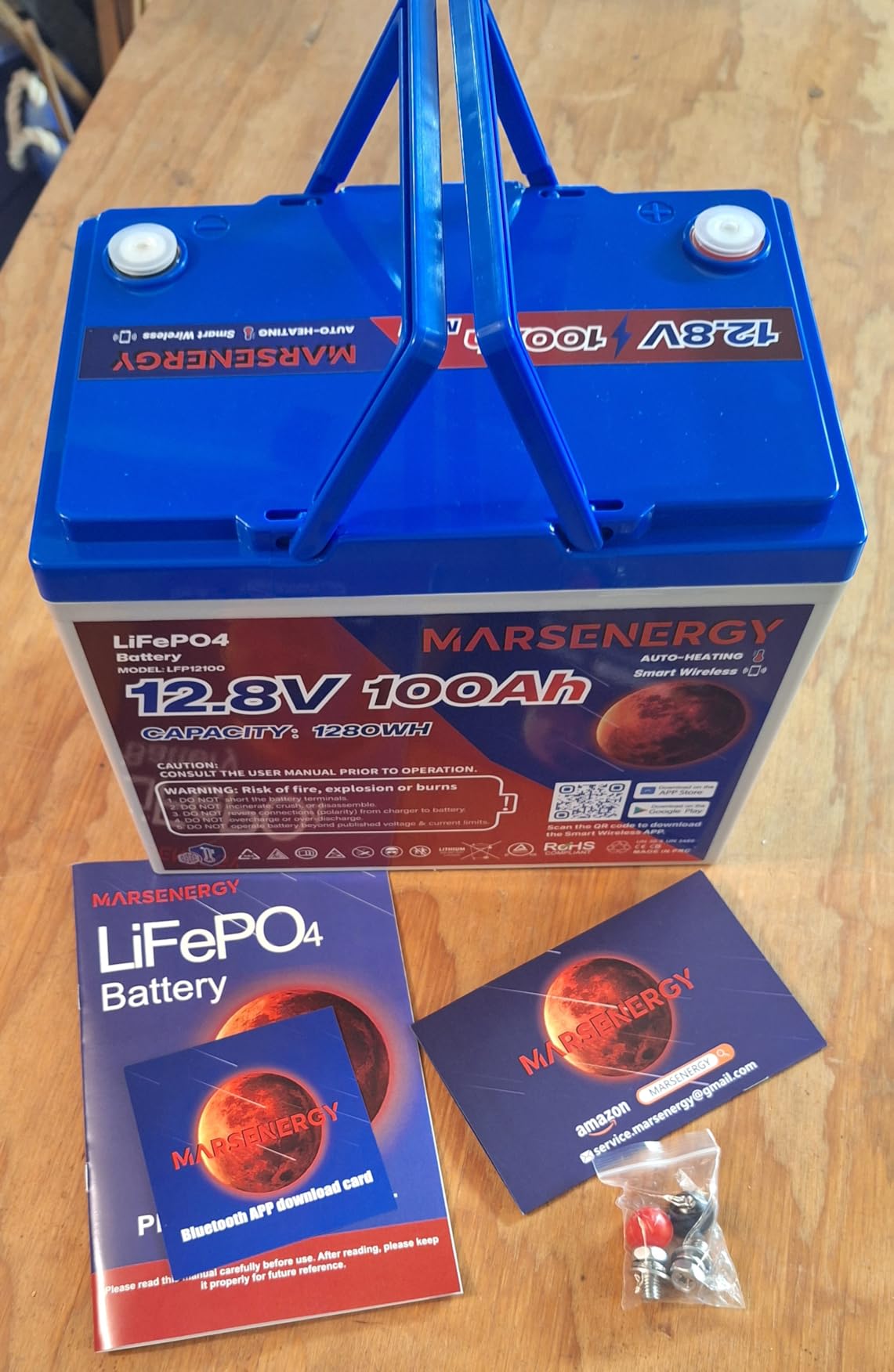
10. MARSENERGY 12V 100Ah self-heating LiFePO4 — a 60W heating system with the highest star average in the group. Best for genuine sub-freezing boondocking.
11. ECO-WORTHY 12V 314Ah LiFePO4 — 4019Wh in one case with SOC LEDs on the lid. Best when space limits you to a single battery.
12. WattCycle 12V 100Ah Mini LiFePO4 — 39 percent less volume than a standard Group 24. Best for under-seat and tongue-box installs.
1. Renogy 12V 100Ah AGM Deep Cycle — the Most Proven Pick in the Group
Renogy 12 Volt 100Ah Deep Cycle AGM Battery, Lead Acid Solar Battery
100Ah AGM
63.9 lbs
12V
2-year prorated warranty
-4F to 140F
Pros
- Largest review base in the group at 3534 reviews
- Rated for -4F to 140F operation
- 1100A max discharge for 5 seconds
- Under 3 percent monthly self-discharge
- Expands in parallel up to 4P
Cons
- 63.9 lb unit needs a two-person lift
- Only about 50 percent of the 100Ah is usable
- No Bluetooth or app monitoring
This is the battery we keep coming back to because its track record is measured in the thousands of owner reports, which nothing else in this roundup matches. Renogy lists more than 230,000 batteries sold over six years, and the 4.4 star average across 3534 reviews reflects a product that simply does what the label says without drama.
Owners consistently report it meeting its rated capacity in stationary off-grid and RV use, which is where most budget AGMs fall short. The sealed AGM design means no acid checks, no water topping and no venting in an enclosed bay, and the -4F to 140F operating range means it is usable in a cold storage bay rather than merely surviving it.
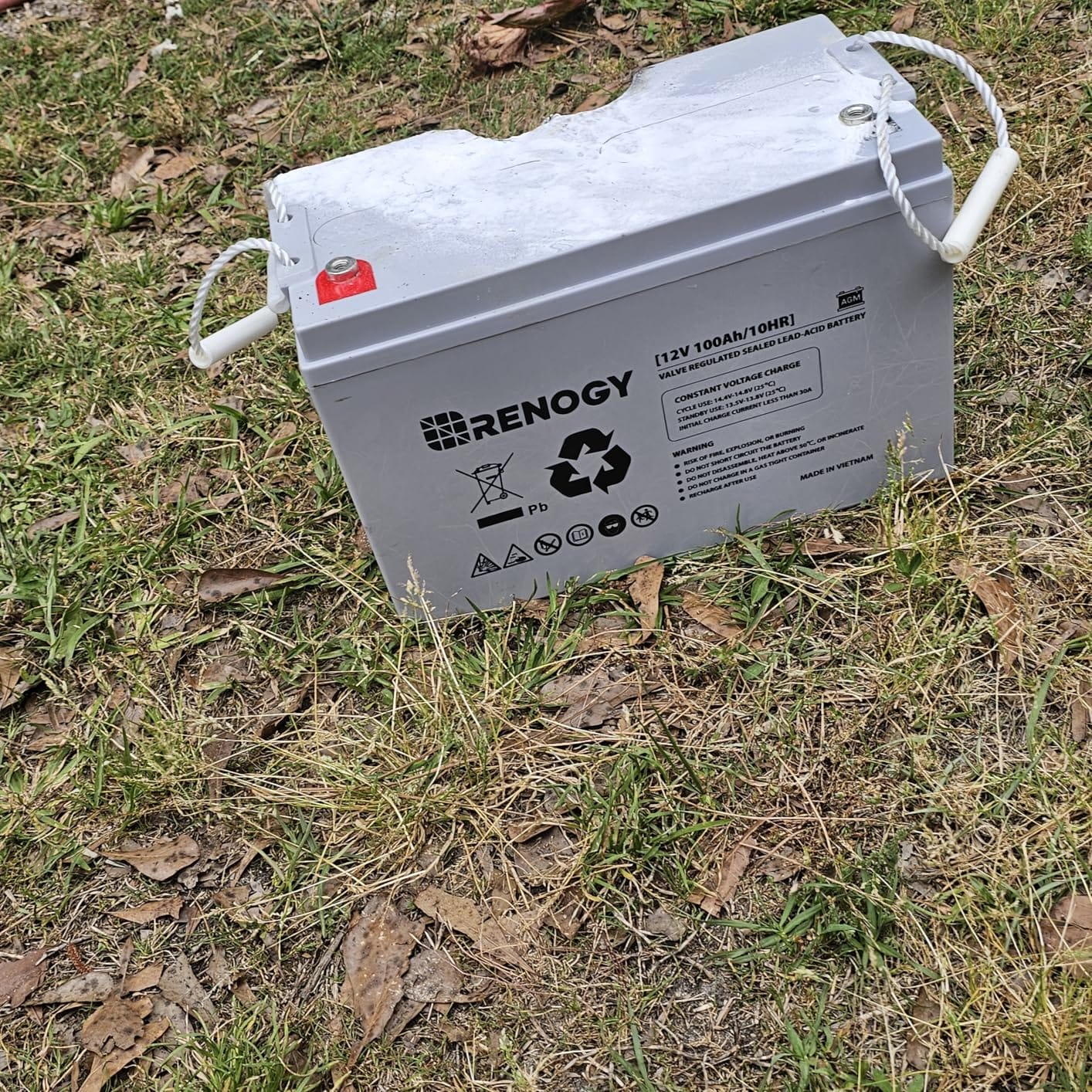
The one specification people miss is the 1100A five-second maximum discharge. That figure is irrelevant to slow house loads but it tells you the plate construction is thick enough to absorb an inverter surge, a water pump kick and a blower motor starting without the voltage collapse that plagues thin budget cells.
Self-discharge below 3 percent per month is the number that protects you during storage, and it is roughly a fifth of what a flooded battery loses. For an owner who stores a trailer between trips, that is the difference between a battery that is ready in April and one that needs a recovery charge.
Why we picked it as the default
The evidence base is the reason. A 4.4 star average is meaningful across 3534 reviews in a way that a 4.8 average across 198 reviews is not, and treating review count as a quality signal is a habit we recommend to every buyer in this category.
It is also the lowest-friction upgrade path. The unit sits in a standard Group 24 footprint, so it drops into an existing tray, works with the converter most rigs already have, and needs no lithium profile setting to charge properly.
Who should not buy it
If you plan to run an inverter for more than a weekend, this battery hands you about 50Ah of usable capacity and asks you to carry 63.9 pounds for it. Two of them weigh 128 pounds, and that is where payload ratings start failing.
Buyers chasing real capacity per pound should read the lithium sections instead. The same 100Ah in LiFePO4 chemistry weighs about 21 pounds and gives you roughly 90Ah of usable energy instead of 50.
2. Renogy 12V 200Ah AGM Deep Cycle — Maximum Lead-Acid Capacity in One Case
Renogy 12 Volt 200Ah Deep Cycle AGM Battery, Lead Acid Solar Battery
200Ah AGM
127.9 lbs
20.5 inch length
M8 bolts included
2-year prorated
Pros
- Highest lead-acid capacity available here
- 3525 reviews of field history
- Under 3 percent monthly self-discharge
- Discharge performance up to 10x rated capacity
- M8 terminal bolts included in the box
Cons
- 127.9 lb weight is a real payload hit
- 20.5 inch length needs a large bay
- Only 50 percent depth of discharge is realistic
- No smart monitoring
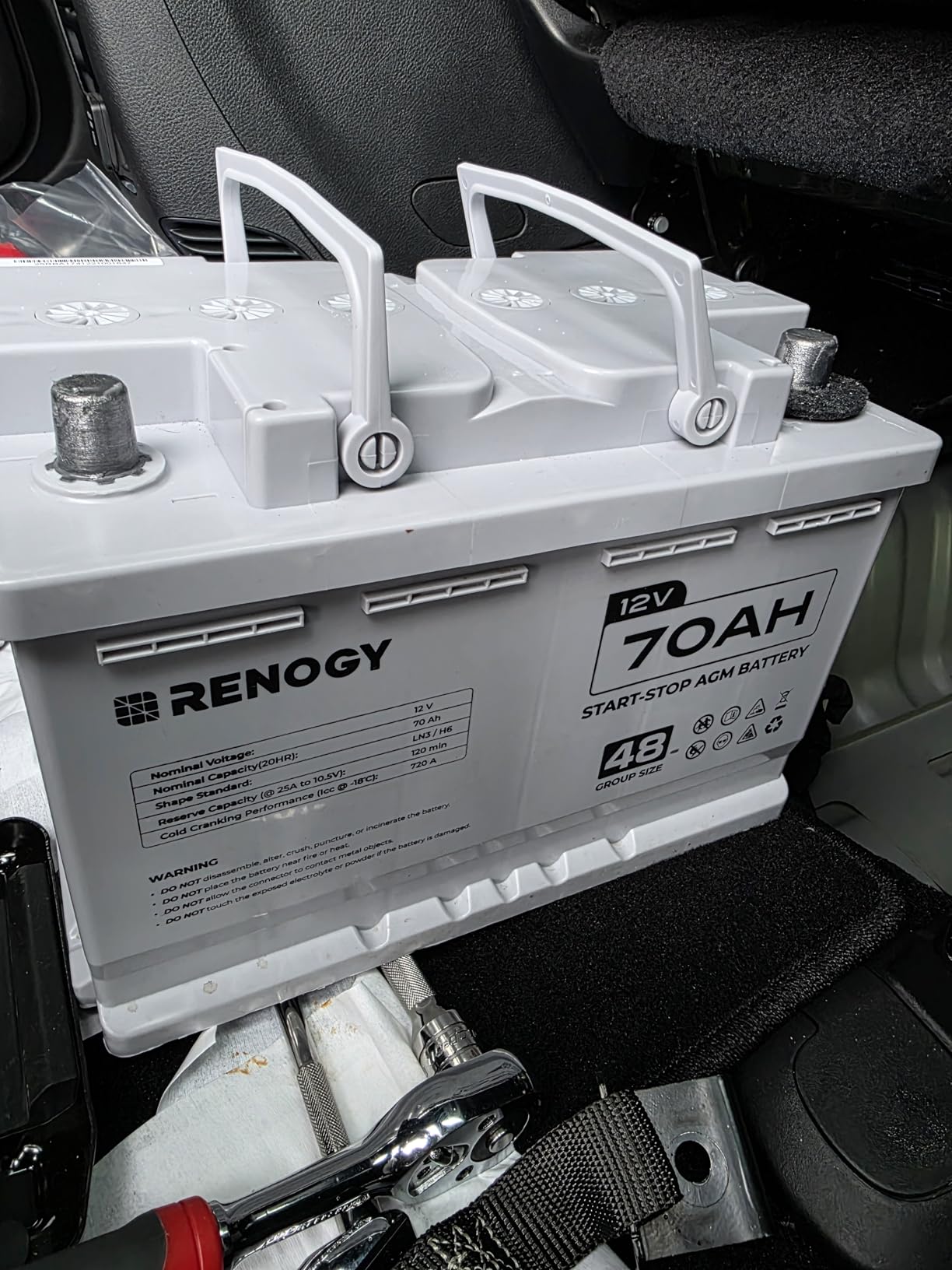
When weight is not the constraint, this is the deepest well you can dig with lead-acid chemistry in a single case. The 20-hour rate capacity is a genuine 200Ah, and the technical sheet lists discharge performance up to ten times rated capacity, which matters when a compressor fridge and a water pump start at the same moment.
Owner reports commonly note that the 200Ah version holds voltage better under sustained draw than the 100Ah in the same family, which fits the thicker plate construction. The glass mat separators reduce internal resistance, and self-discharge stays under 3 percent monthly at 77F, roughly a fifth of flooded.
The included M8 terminal bolts matter more than they sound. A large AGM cable terminated with a generic bolt is the leading cause of the high-resistance connection that generates heat at the post and quietly costs you usable capacity over a season of road vibration.
Renogy does recommend upright installation and flags side mounting as an exception, which is worth respecting if your bay is side-mounted. The warranty is two years prorated on materials and workmanship, shorter than the five years common on the lithium units in this list.
When a 200Ah AGM is the right call
Class A motorhomes and large Class C rigs with a floor-mounted battery bay have the volume and the axle rating to carry 128 pounds. In that situation a 200Ah AGM gives you about 100Ah usable from a single unit, which two 100Ah AGMs cannot match without doubling the connections and the footprint.
It also suits owners who plan to stay on hookups most of the season. If your deepest night away from a hookup is a single evening, the lithium premium is hard to justify and this is the honest value answer in the group.
What the weight costs you
On a travel trailer this battery is often the single heaviest thing you add, and trailer owners report tongue-weight and payload problems directly from battery swaps. A 200Ah LiFePO4 of the same nameplate capacity lands near 45 to 59 pounds.
That 70-pound difference decides whether your rear axle stays inside its rating. Before ordering, add the full weight to your current load and check the door sticker rather than guessing.
3. dumfume 12V 200Ah LiFePO4 with 200A BMS — the Boondocking Workhorse
Dumfume 12V 200Ah LiFePO4 Lithium Battery 200A BMS 2560Wh IP65
200Ah LiFePO4
2560Wh
200A smart BMS
58.9 lbs
IP65
5-year warranty
Pros
- 200A continuous BMS handles larger inverters
- 2560Wh from one case
- IP65 rated with five-year warranty
- Expands to 16 batteries in 4S4P
- 58.9 lb weight
Cons
- No Bluetooth or app monitoring
- No self-heating for sub-freezing charging
- Some units arrive at low voltage and need a jump charge
This is the single battery that most often replaces a matched pair of lead-acid units. At 2560Wh nameplate and a realistic 90 percent planning figure, you get around 180 usable Ah, which is what a 400Ah AGM bank delivers after its 50 percent depth of discharge limit.
The 200A continuous BMS is the spec that separates it from cheaper 100Ah units. A 2000W inverter pulling roughly 167A at 12V sits comfortably under that ceiling, whereas a 100A BMS on the same inverter will trip or throttle, and that failure mode is the most common complaint we see on small lithium banks with a 100A BMS.
On protection, the smart BMS covers overcharge, over-discharge, overcurrent and short circuit, and the case carries an IP65 dust and water rating. Expansion is rated to 16 batteries in a 4S4P arrangement, which is 51.2V, 800Ah and 40.96kWh if you ever want a house-scale system.
Cycle claims are stated properly, which is a good sign. The listing separates 15,000 cycles at 60 percent depth of discharge, 6,000 at 80 percent and 4,000 at 100 percent, and honest cycle figures like these are more useful to a buyer than a single inflated headline number.
What it fixes for boondockers
It fixes the two complaints that end most dry-camping trips: running out of usable capacity on the second night, and an inverter that trips when a microwave and the water pump start together. A 200A BMS absorbs both without a battery disconnect.
It also fixes the weight problem partially. At 58.9 pounds this unit is 60 percent lighter than the lead-acid equivalent per the manufacturer, and a single 200Ah LiFePO4 bank leaves room in most trailer bays for a second unit later.
The cold-weather catch
Charging is disabled below 32F while discharge is permitted down to -4F. That means a January sunrise produces no charge until the pack warms up, which is the single detail new lithium owners complain about most, and the reason self-heating models exist.
Some owners also report units arriving at low voltage and needing a jump charge from another battery before they accept a normal charge. The five-year warranty with 24/7 support is a meaningful offset, and the listing states it is not intended for engine starting.
4. Litime 12V 100Ah Self-Heating LiFePO4 — Cold-Weather Charging in a Group 24 Case
Litime 12v 100Ah RV Self-Heating LiFePO4 Lithium Battery for Marine, Camper
100Ah LiFePO4
21.8 lbs
dual heating modes
Bluetooth 5.0
5-year warranty
Pros
- Self-heating triggers below 41F in two modes
- 63 percent lighter than the lead-acid equivalent
- Group 24 drop-in with no tray changes
- 4.7 star average across 645 reviews
- 4000 plus cycles at full depth
- AIG product liability coverage
Cons
- Costs more than non-heated 100Ah units
- App asks you to sign in each session
- Not rated for engine starting
- A few dead-on-arrival reports
Self-heating is the feature that separates this from every other 100Ah unit in the roundup, and it is the reason we rate it as the cold-weather choice. Heating engages automatically below 41F in a regular mode that runs harder, and an energy-efficient mode that trades speed for runtime.
Owners on forums describe the moment clearly: the battery accepts charge at first light in winter instead of refusing solar until midday. That single behaviour change is what turns a self-heating model from a luxury into a necessity for anyone camping above freezing with solar as their only recharge.
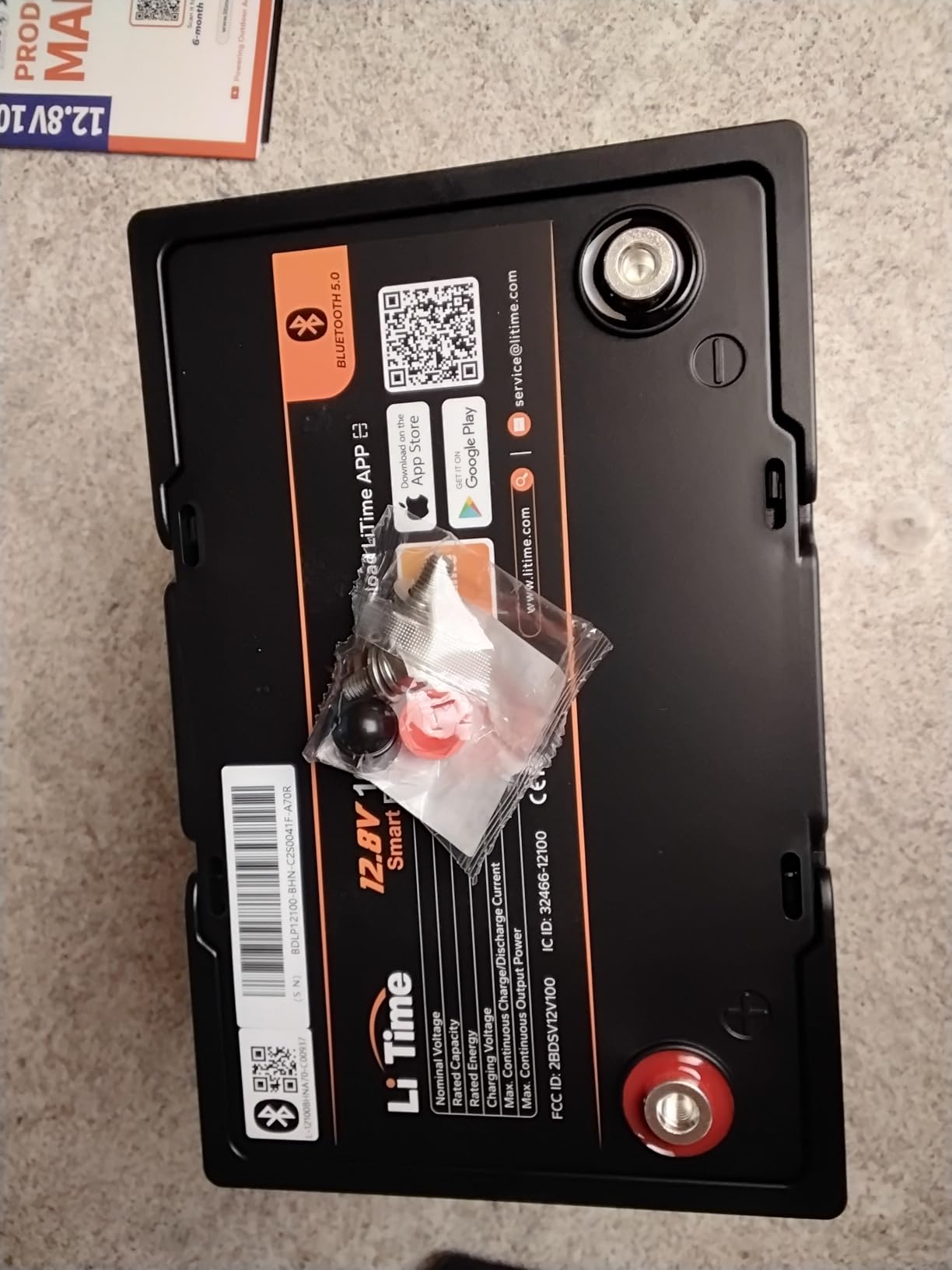
The physical design is friendly to RV owners. It is a Group 24 standard size at 20.98 by 8.19 by 8.5 inches and weighs 21.8 pounds, which the listing describes as 63 percent lighter and 35 percent smaller than a 100Ah lead-acid battery. In a tight bay that difference decides whether the upgrade is possible at all.
Protection is thorough, with more than 20 safety functions including 30-second overload auto-recovery, and the case is IP65 rated. Expansion runs to 16 batteries in a 4P4S configuration for up to 20.48kWh, and the five-year warranty is backed by AIG product liability insurance from May 2026.

What the app actually tells you
Bluetooth 5.0 monitoring through the LiTime app shows state of charge, current and cell voltages, which is how you catch a failing cell before the whole bank drops. It is the most requested feature among real users, and it is genuinely useful when you cannot see under the bed.
One setup note that catches people out: the listing states that a lithium-activation or MPPT charger is required to activate Bluetooth. If your rig is still on an older lead-profile converter, the app may not come alive until you charge through a proper lithium profile.
Where the premium does not pay
If you camp in a climate that stays above 41F, the heating circuit is dead weight you pay for every trip and use never. In that case the same money buys a non-heated 100Ah with more capacity or a second battery for the bank.
Also note the reported arrival-charge issue, where some units showed around 18 percent state of charge out of the box, and the sign-in requirement on every app session. Neither is a dealbreaker, but both are small daily friction.
5. Rvpozwer 12V 200Ah LiFePO4 — 200Ah at 45 Pounds
12V 200Ah LiFePO4 Lithium Battery, Max. 2560Wh, 15000 Deep Cycle Battery
200Ah LiFePO4
45.15 lbs
Group 31 size
200A BMS
5-year warranty
Pros
- Light weight at 45.15 lbs for a 200Ah pack
- Group 31 standard dimensions fit common bays
- 200A smart BMS with full protection
- Operating range from -20C to 65C
- 5-year warranty with lifetime technical support
Cons
- 4.0 star average with 20 percent one-star reviews
- Newer brand with less field history
- AT terminals may need adapters
- Mixed owner reports on BMS reliability
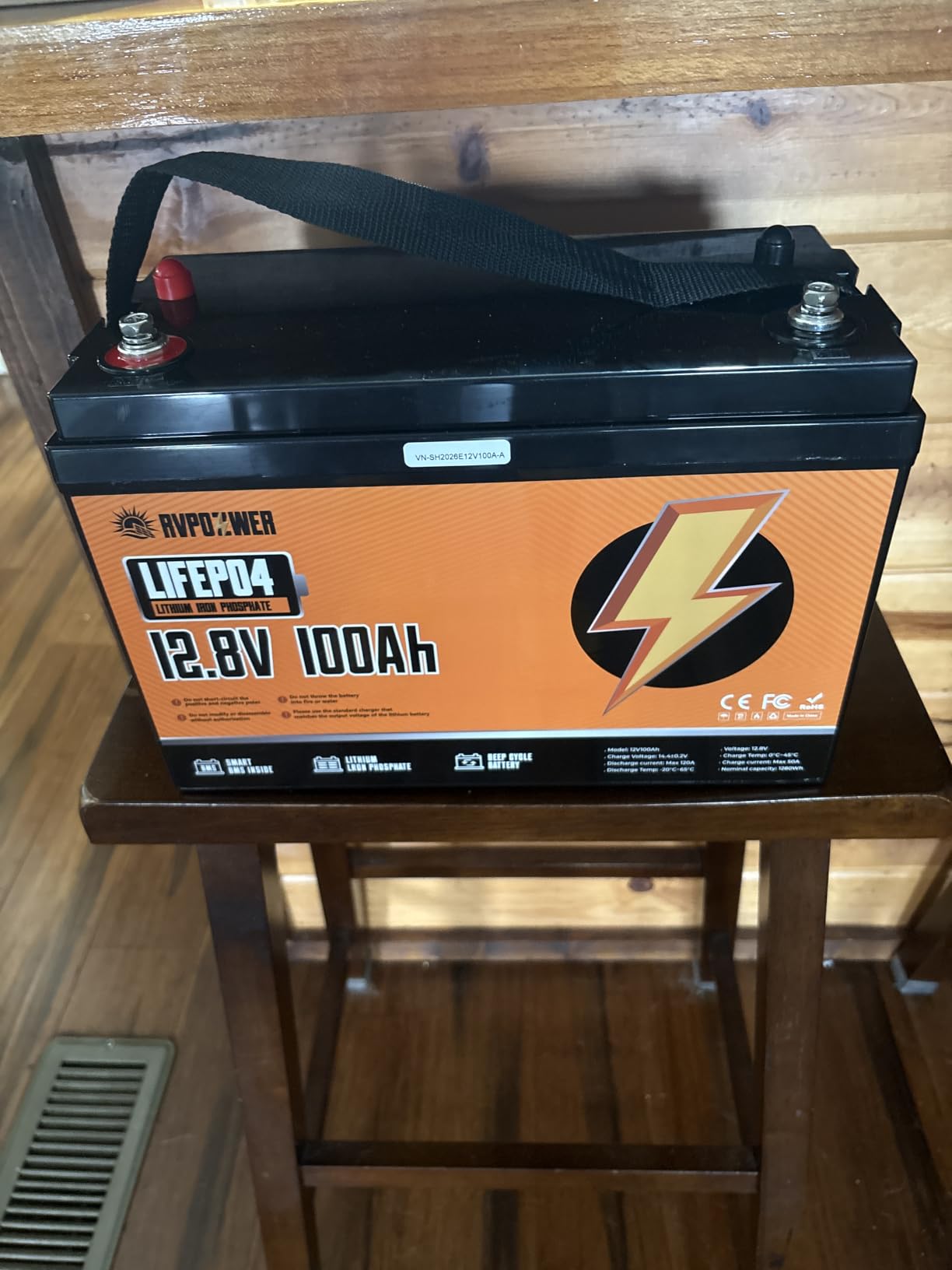
Weight is the constraint that decides this pick. At 45.15 pounds, this is the lightest 200Ah lithium unit in the roundup, roughly 14 pounds lighter than the dumfume and less than a third of what the 200Ah AGM weighs. On a trailer where tongue weight is already tight, that difference is the whole decision.
It is also a genuine Group 31 footprint at 20.47 by 8.7 by 9.32 inches, which is a size many trailers already have room for. The case carries an ergonomic nylon handle, and the listing notes 15-year spare part availability, a real signal for a product that may need servicing a decade from now.
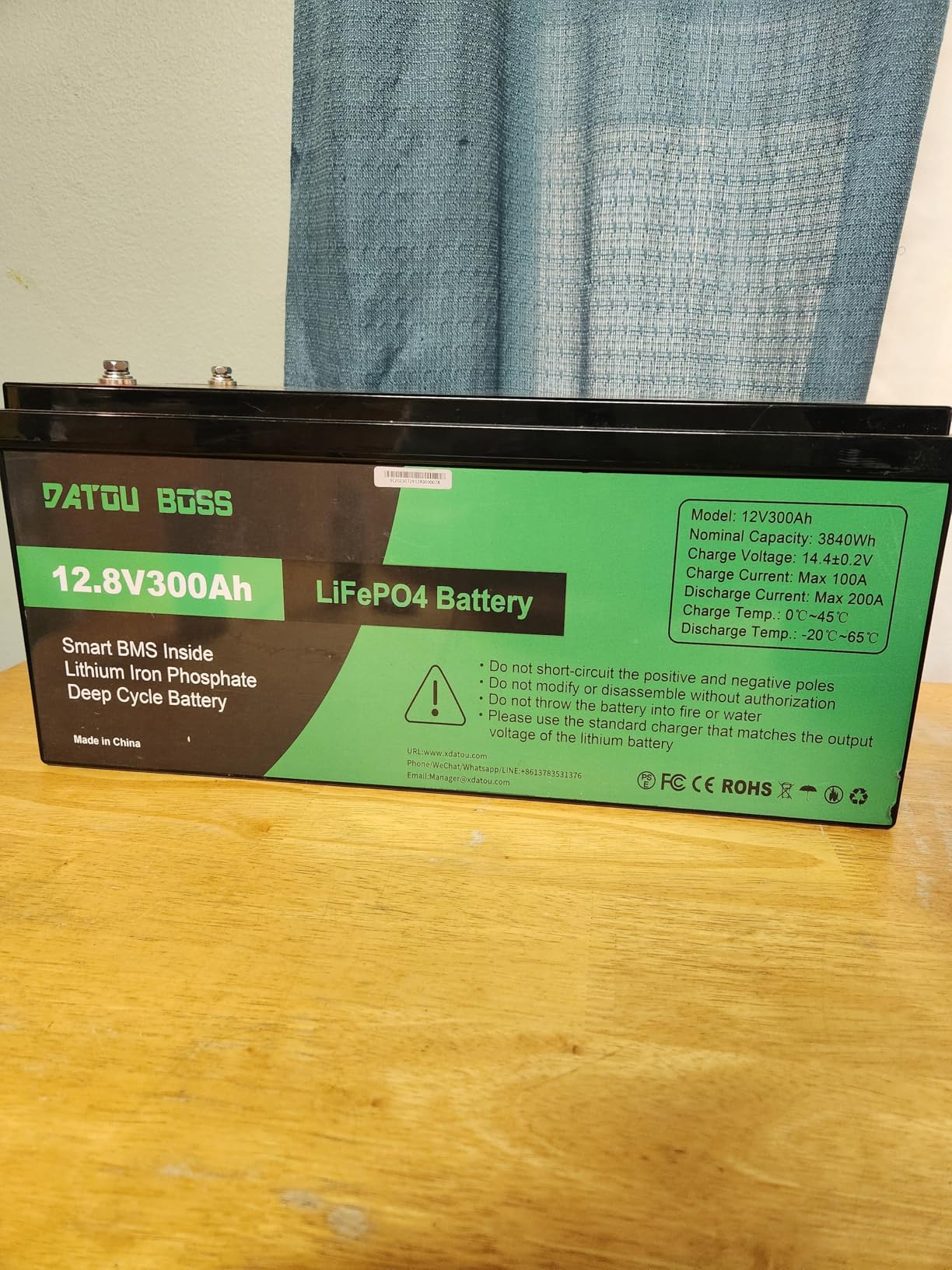
Protection uses Grade-A LiFePO4 cells with a 200A smart BMS covering overcharge, over-discharge, overcurrent, overvoltage and short circuit. The operating range is stated as -20C to 65C, and expansion runs to four in series for 51.2V or four in parallel for 800Ah.
Cycle figures follow the honest pattern we prefer: 15,000 cycles at 60 percent depth of discharge, 6,000 at 80 percent and 4,000 at 100 percent, alongside a five-year warranty and lifetime technical support.
Read the review distribution, not just the average
This is the clearest example in the roundup of why a star average on its own tells you very little. A 4.0 average with 427 reviews is being dragged by a 20 percent one-star share, and that is a materially worse distribution than a 4.4 across 3534.
We are not dismissing the product. The specification sheet is competitive and the weight is the best in class here, but you are accepting a newer brand with a polarized service history in exchange for those 14 pounds.
Who should walk away
If your plan is to install this and forget it for a decade, a brand with a thinner field history is a harder sell than one with thousands of owner reports. The 20 percent one-star share likely clusters around warranty handling rather than core function, and that matters on a five-year purchase.
The AT terminal configuration is another practical snag, because a lot of existing battery cables and marine ring terminals are built for SAE posts. Check what your cables terminate in before ordering.
6. HumsiENK 12V 100Ah Bluetooth LiFePO4 — 19.73 Pounds and App Monitoring
HumsiENK 12V 100Ah LiFePO4 Lithium Battery with Bluetooth (Group 24) 1280Wh
100Ah LiFePO4
19.73 lbs
100A smart BMS with Bluetooth
IP65
5-year warranty
Pros
- Light weight at 19.73 lbs with a 100A Bluetooth BMS
- Fits both Group 24 and Group 31 trays
- A+ grade cells with UL
- FCC and CE certification
- IP65 case
- 5-year warranty with 24-hour service
Cons
- Newer brand with limited long-term record
- Some owners report 8 percent one-star share
- No self-heating function
- App connectivity and usability complaints
This unit solves a specific and very common RV problem: the tray is the right length but the lid will not close. At 6.6 by 10.2 by 8.2 inches it is shorter than a full Group 24 and lighter than the other Group 24-class lithium packs here, and the manufacturer rates it as fitting both Group 24 and Group 31 locations.
The 100A smart BMS with Bluetooth app is the feature combination that makes it interesting. You get real-time state of charge and cell data without paying for the self-heating premium, which matters if your climate does not require heating.
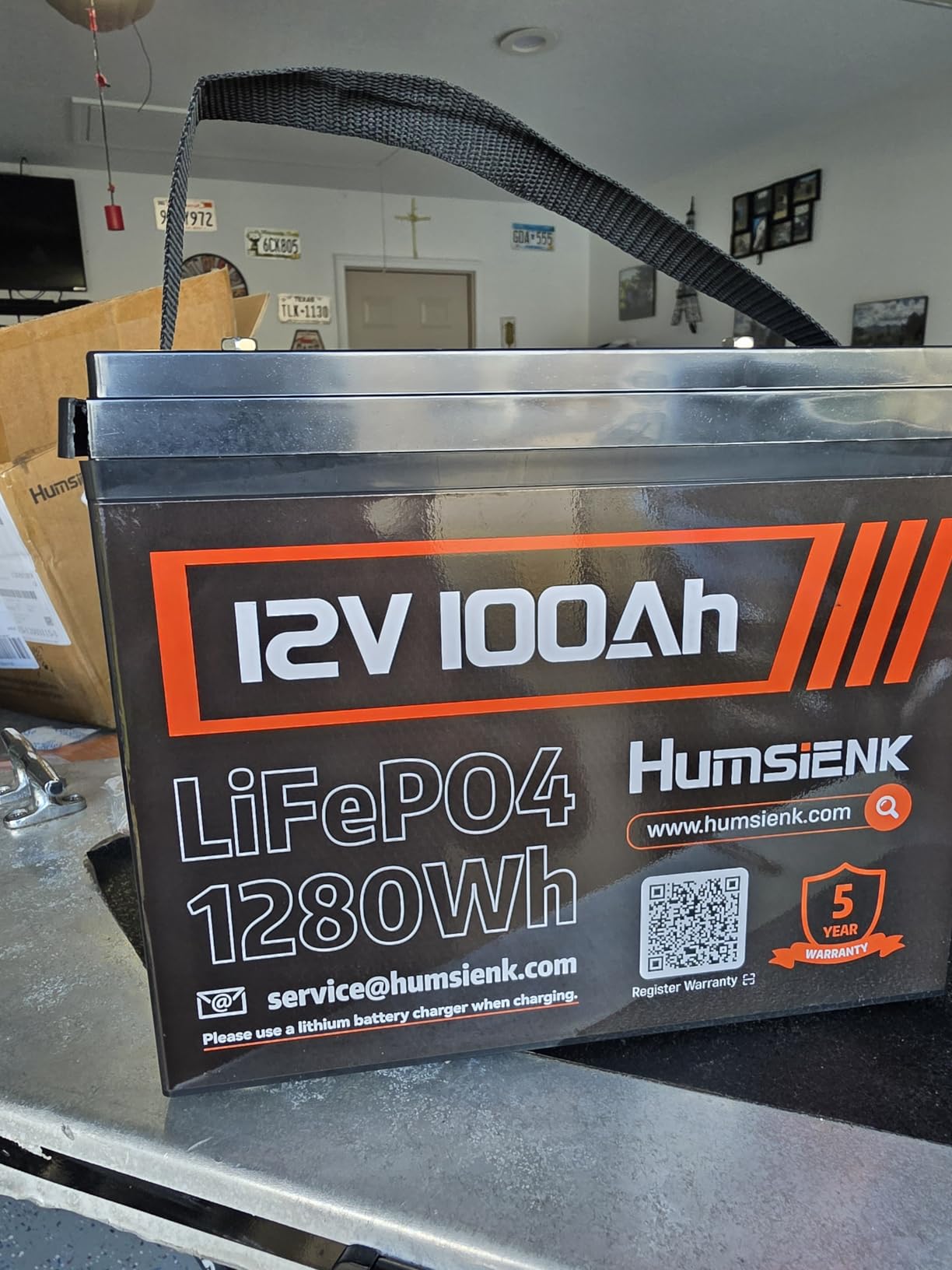
Cell quality is specified as A+ grade with UL, FCC and CE certification, and the case carries an IP65 waterproof rating. The listed low-temperature operating range is -4F to 158F, with 4S4P expansion supported up to 48V and 20.48kWh.
Owners consistently describe it as 35 percent smaller and 60 percent lighter than the lead-acid equivalent it replaces, and the box includes insulating caps plus a full set of M8 screws in two lengths, which saves a trip to the hardware store.
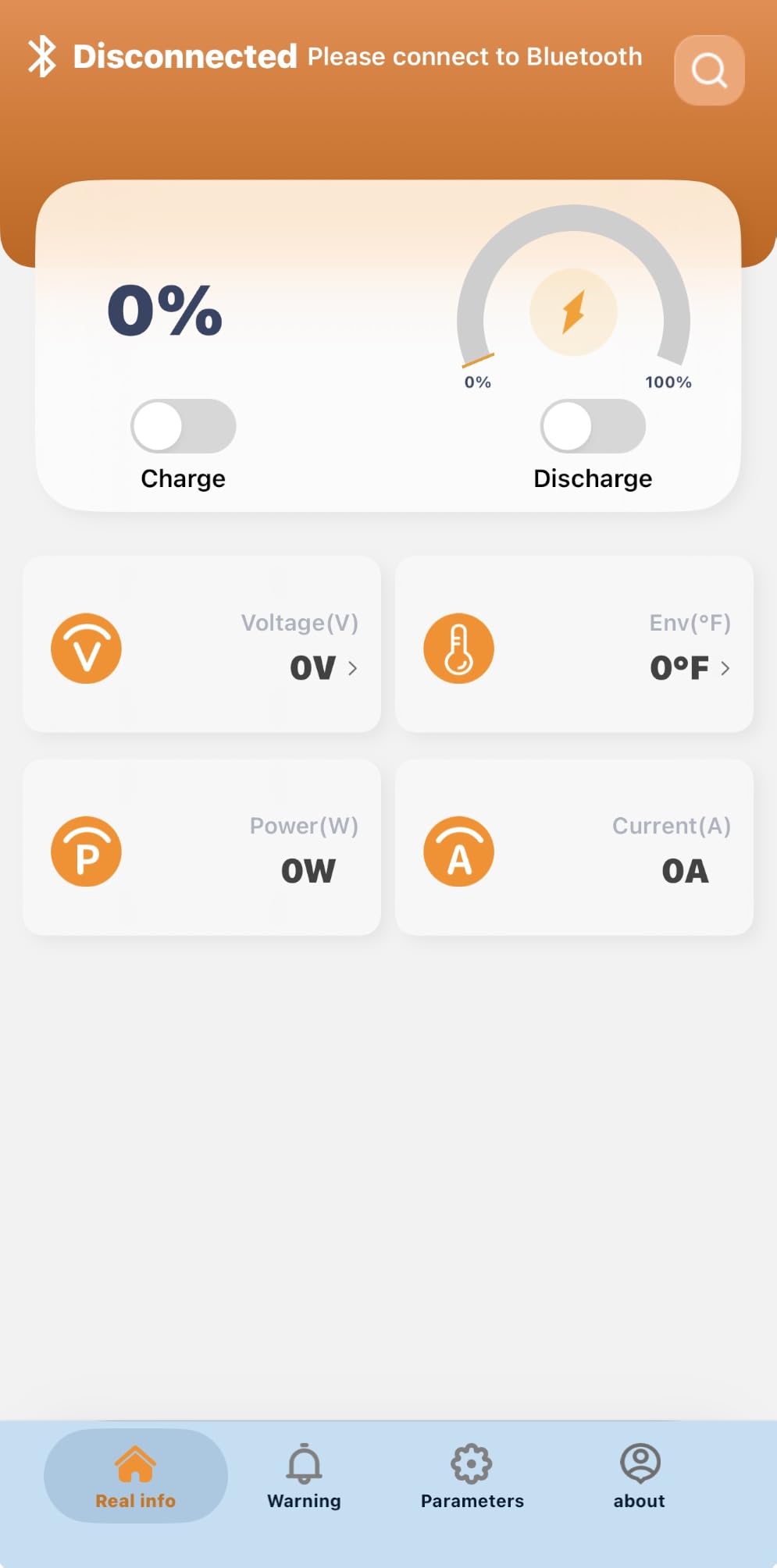
When Bluetooth monitoring earns its place
State of charge visibility is the difference between managing a bank and guessing at one. Without it, owners end up using a cheap plug-in meter at one terminal that tells you almost nothing about the four cells in series underneath.
It also makes the sizing maths in this guide checkable in real life. Once you know your actual overnight amp-hour draw, you can verify whether the bank you bought matches the loads you actually have.
What to watch before you buy
The 8 percent one-star share on a 340-review sample points to some quality inconsistency, and app stability is the most common theme in the critical reviews. Treat the app as helpful rather than essential, and do not build a control system around it.
There is no self-heating function, so this is a fair-climate or shoulder-season choice only. If you camp below freezing, the heating models in this roundup are the safer buy even though they cost more.
7. WEIZE Group 27M Dual Purpose AGM — When One Battery Has to Do Two Jobs
Weize Dual Purpose AGM Battery BCI Group 27M, 175RC 580CCA 12V 92AH Starter & Deep Cycle Sealed Marine & RV Battery
92Ah AGM dual purpose
580 CCA
Group 27M
59.5 lbs
2-year warranty
Pros
- 580 CCA starting capability in the same case
- Charges up to 5x faster than flooded
- 20x the vibration resistance of flooded
- Leak-proof valve-regulated design
- Fits standard Group 27 bays
Cons
- 92Ah is low capacity for house power
- 59.5 lb weight for 92Ah
- 12 percent one-star share on 254 reviews
- Dual-purpose design caps deep cycle ability
We are including this one as a deliberate control, and it is worth being blunt about why. A dual-purpose battery trades away the deep cycling ability that house power needs in exchange for a starting rating, and the 92Ah nameplate is well below the 100Ah to 314Ah range these picks are chosen for.
That said, the spec sheet is well built. The AGM construction gives low internal resistance, the listing claims 20 times the vibration resistance of a flooded battery, and charging parameters are stated precisely at 14.4V constant voltage with an 18.4A maximum and a 24-hour limit.
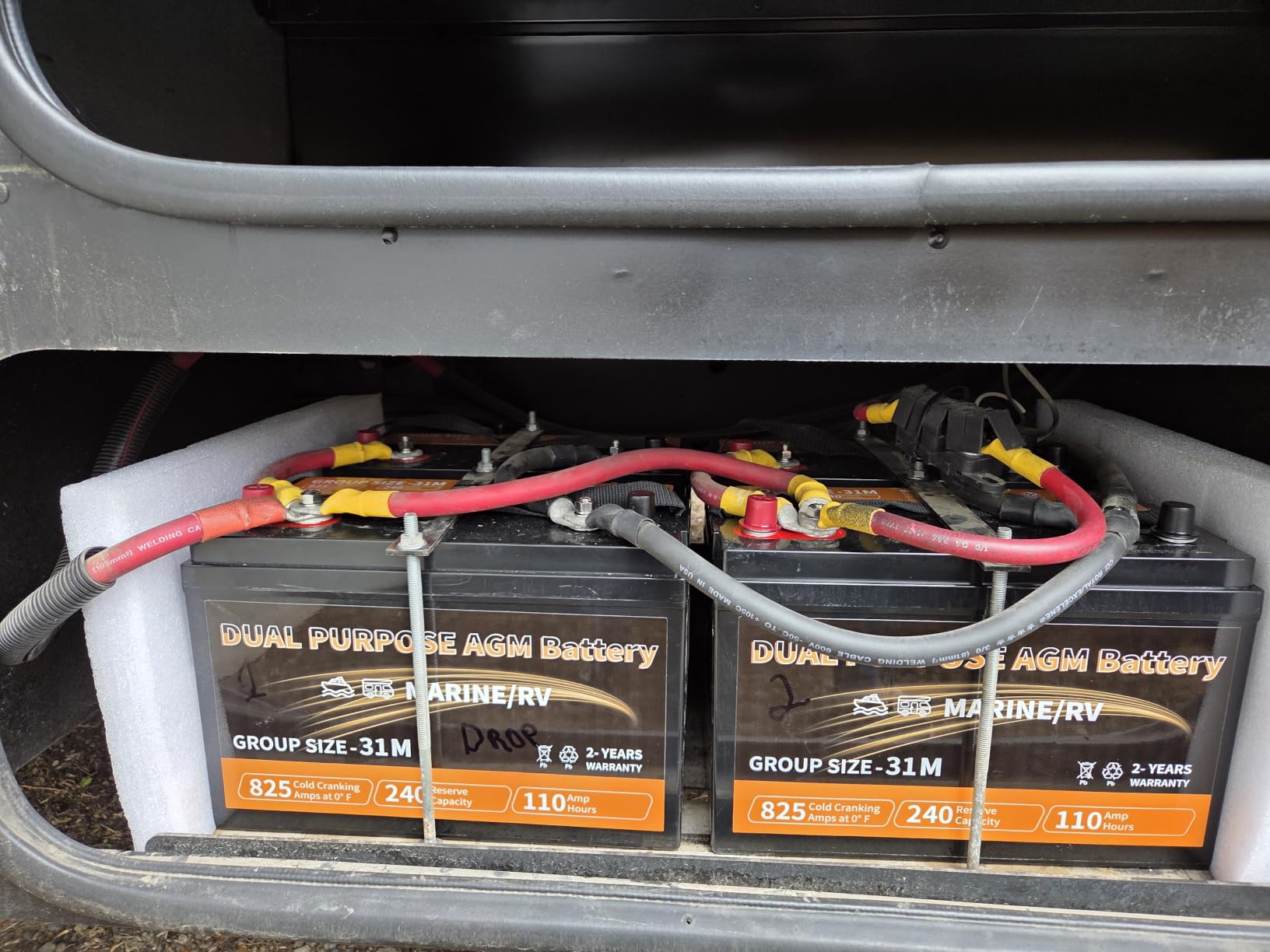
On a boat or an older trailer with a single battery bay, this solves a genuine problem. When there is one tray, one battery has to start the engine in the morning and run the fridge at night, and a true deep cycle unit is explicitly not intended for cranking.
Fitment is straightforward at 6.61 by 12.05 by 8.19 inches with a standard marine terminal layout, universal fit, and a sealed leak-proof design with specialized valves. No water, no corrosion, no venting in an enclosed compartment.
Why CCA means nothing for house power
Cold cranking amps measure a short, high-current burst, which is a starting problem. A house battery spends its life delivering a modest current over many hours, and cold cranking performance tells you nothing useful about that job.
It is also the most widely understood correction in owner forums, and it is worth internalising before shopping. A high CCA number is not evidence of good deep cycle capacity, and buying on CCA is how people end up with a battery that starts fine and dies on night two.
Where a dual-purpose battery still makes sense
Single-bay boats, small utility trailers and rigs without a separate start bank are the honest use cases. In those situations one dual-purpose unit replaces two batteries and saves both weight and a cable run.
For anything longer than a night or two away from a hookup, we would use the weight budget elsewhere. A 12 percent one-star share on 254 reviews also hints at more quality variance than the 4.3 average suggests.
8. SUPER EMPOWER 12V 100Ah LiFePO4 — the Straightest Drop-In Lithium
12V 100Ah LiFePO4 Battery, Group 24 Deep Cycle for RVs & Trolling Motors
100Ah LiFePO4
21.6 lbs
Group 24 with M8 terminals
100A BMS
5-year warranty
Pros
- 4.6 star average across 220 reviews
- Group 24 drop-in at 21.6 lbs
- 100A BMS with low-temperature cutoff
- Expandable to 4S4P for 20.48kWh
- 5-year warranty with 24-hour technical support
Cons
- No Bluetooth monitoring
- Newer brand with a limited record
- No self-heating for cold charging
- M8 terminals only with no SAE posts
- 7 percent one-star share
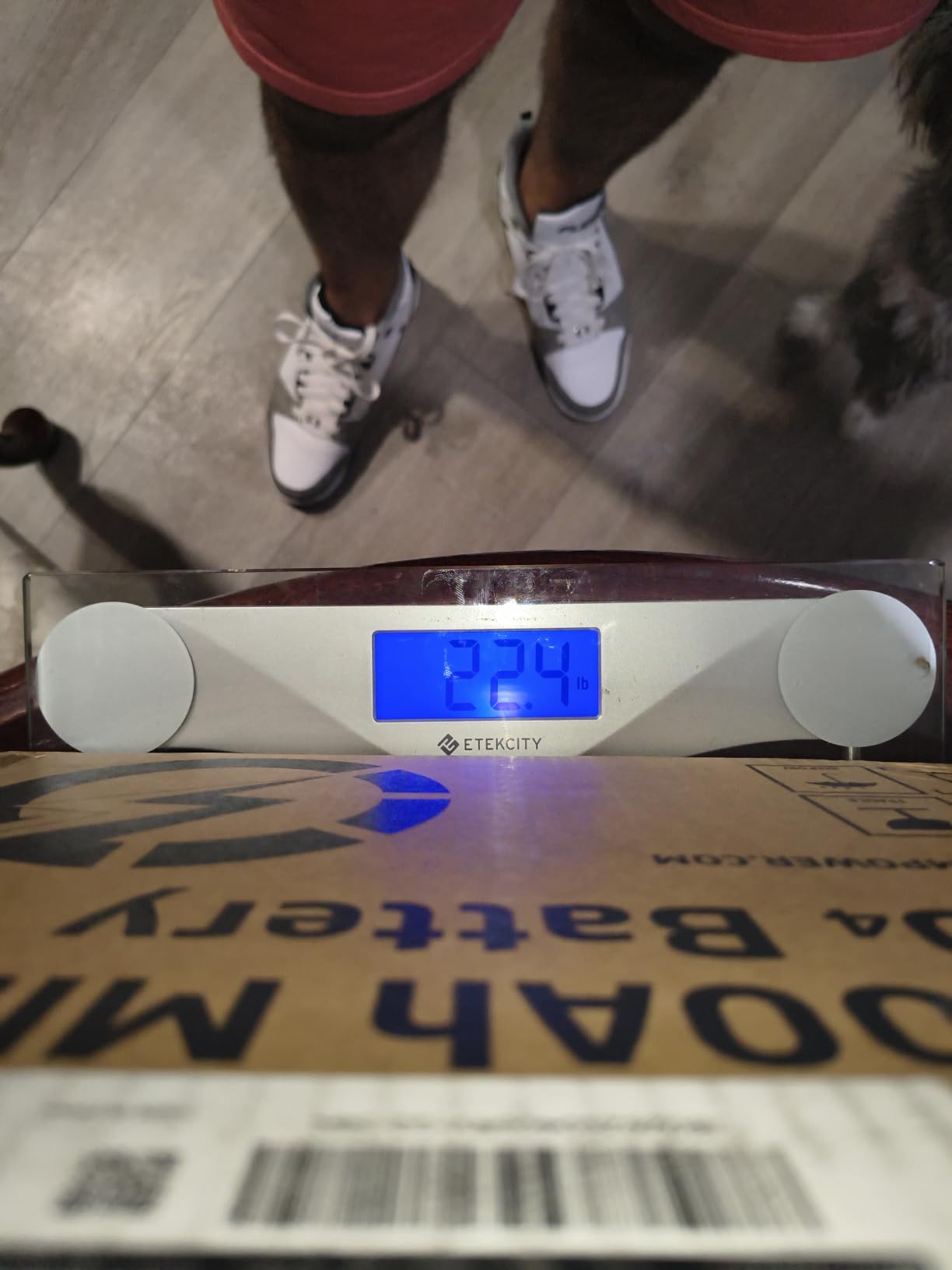
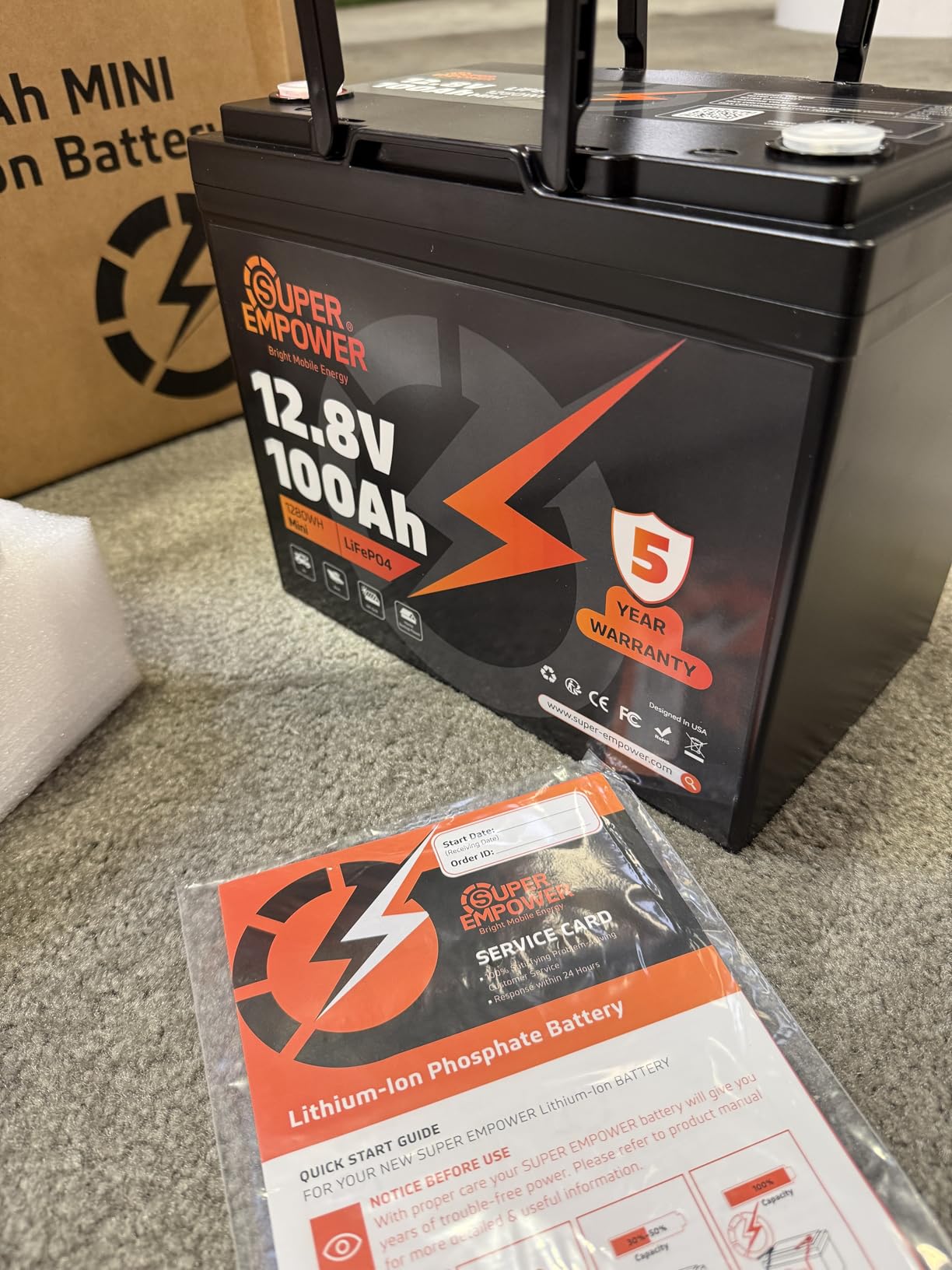
This is the lithium battery to buy if you want lithium without a feature list. It drops into a Group 24 location with M8 terminals, weighs 21.6 pounds, and gives you about 90 usable amp-hours where a 100Ah AGM would give you 50. It just does that and nothing else.
That restraint is a strength in a way. With no app to pair and no heating circuit to fail, there is less that can go wrong, and the 4.6 average with 84 percent five-star share is a better distribution than several higher-profile competitors in this roundup.
Charging is where the manufacturer is unusually specific, listing three supported options: a LiFePO4 charger at 14.4 to 14.6V, solar through an MPPT or PWM controller, and a generator with a lithium or DC-DC charger. That list is a useful pre-purchase checklist for your own rig.
Temperature handling is stated as charge pausing below 32F and discharge stopping at -4F, expansion to 4S4P for 51.2V and 400Ah, and internal resistance listed at 40 milliohms. Like every lithium pack here, it is not for engine cranking.
When simplicity is the right strategy
A battery with no app has one big advantage: it cannot stop reporting. Bluetooth adds convenience and adds a failure mode, and for an owner who checks state of charge with a shunt monitor at the front of the trailer, the app is redundant hardware.
It is also the easiest lithium path for a first-time owner. Group 24 footprint, M8 terminals, no configuration decisions, and a five-year warranty with 24-hour technical support behind it.
What you give up by skipping the extras
Without Bluetooth you are back to guessing or to a shunt monitor, and without self-heating you cannot charge below 32F. That is the correct trade in a warm climate and the wrong one in January.
M8-only terminals with no SAE posts means existing ring-terminal cables may need adapting. The 7 percent one-star share on 220 reviews is a normal early-production figure for a newer brand, so keep the warranty paperwork.
9. DC HOUSE 12V 100Ah Bluetooth LiFePO4 — Per-Cell Data and Fault Alerts
DC HOUSE 12V 100Ah Bluetooth LiFePO4 Trolling Motor Lithium Battery
100Ah LiFePO4
23.8 lbs
Bluetooth 5.1 per-cell data
Class A cells
3-year warranty
Pros
- Per-cell voltage and current over Bluetooth 5.1
- Push notifications on fault anomalies
- Low-temp cutoff with automatic recovery
- Class A cells with UL and UN38.3 certification
- 4.6 star average across 201 reviews
Cons
- No 4P4S expansion beyond 8 batteries
- 0.32 inch taller than a standard Group 24
- 3-year warranty against 5 years on many rivals
- Bluetooth range limited to 5 to 10 meters
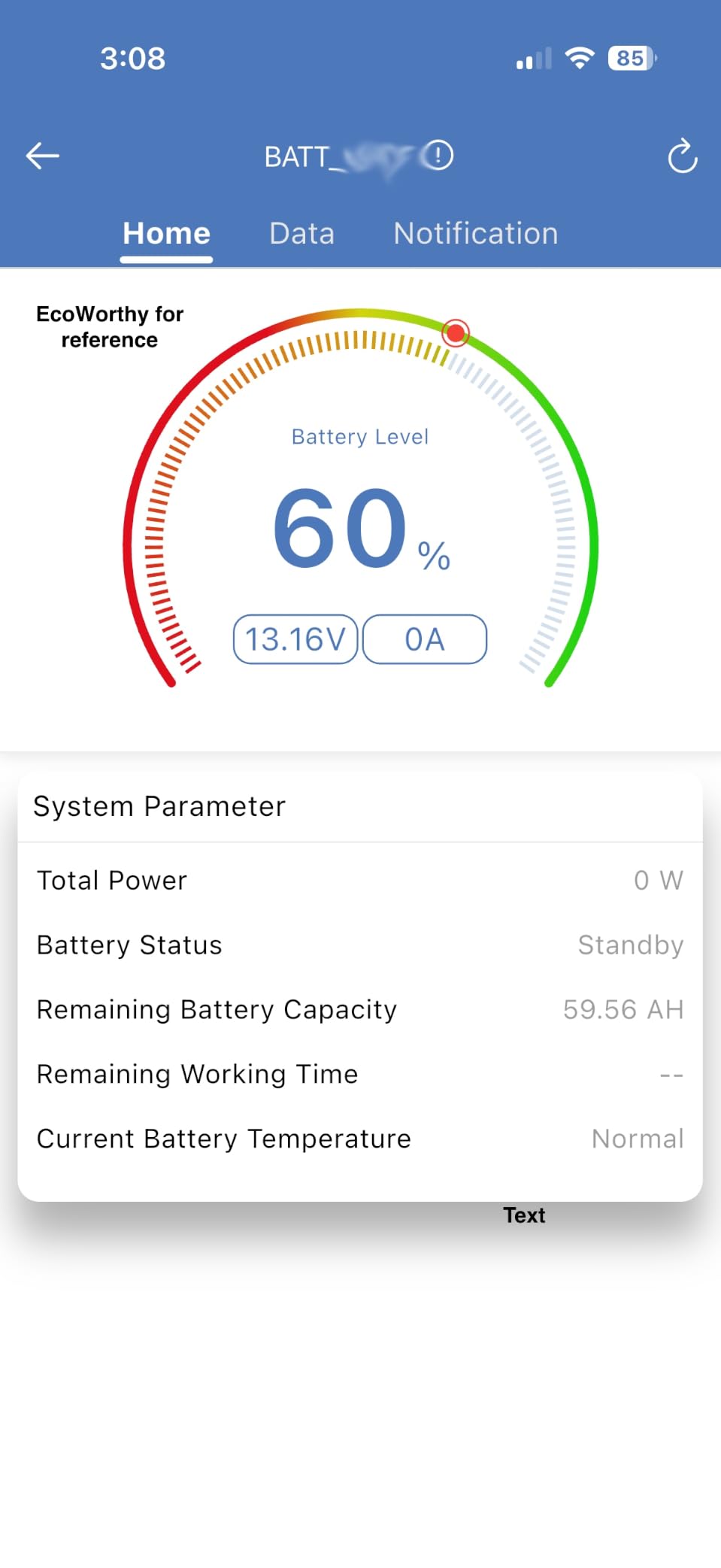
Most Bluetooth apps report a single state of charge percentage. This one reports per-cell voltage, current and state of charge, plus a dedicated fault display page and push notifications when something abnormal happens, and that difference matters more than it sounds.
Cell imbalance is the failure mode that ends lithium banks quietly. One weak cell in a four-cell series string drags the whole pack’s usable capacity down, and per-cell visibility is the only way to see it before the pack stops performing.
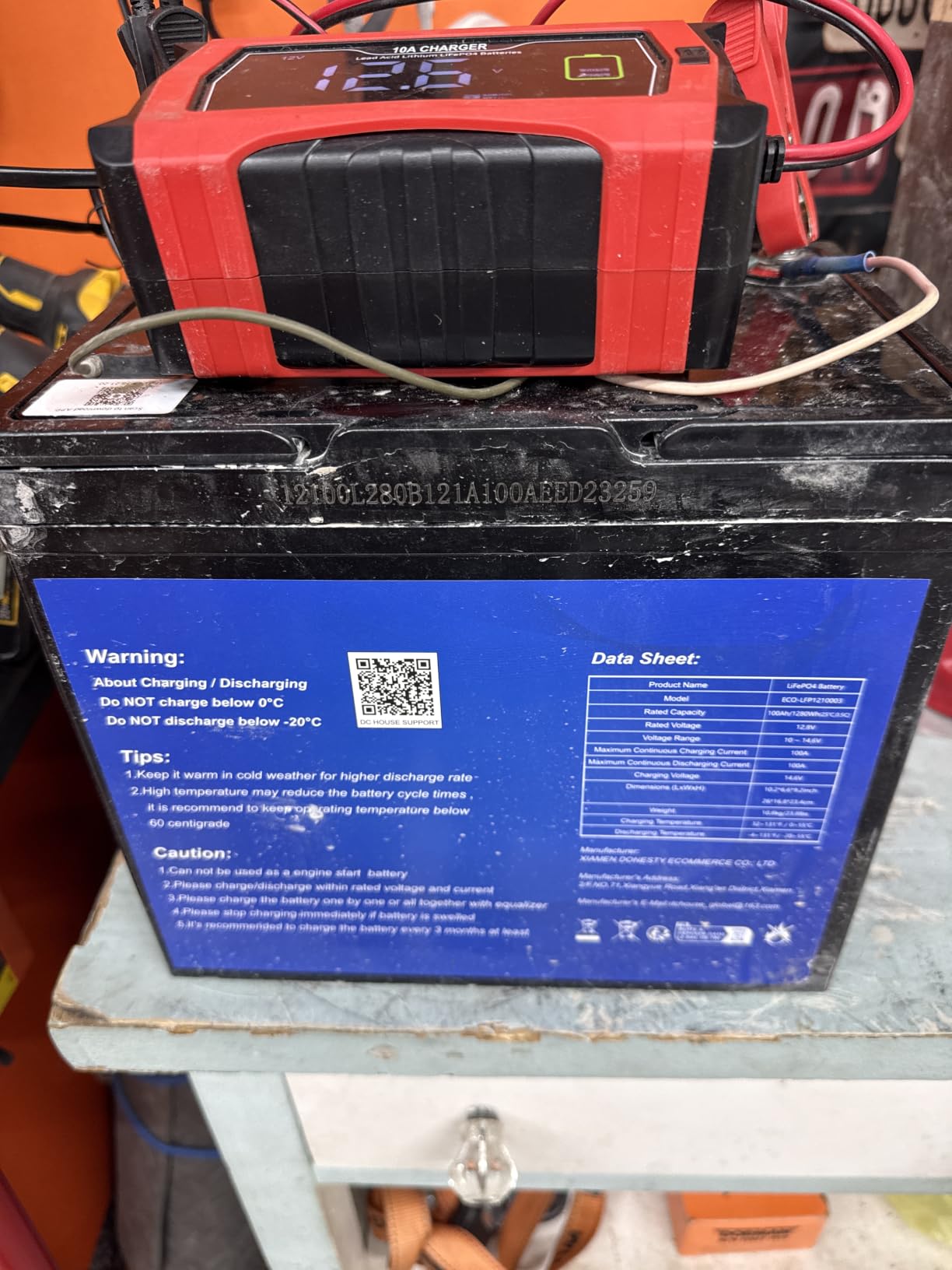
Temperature handling is unusually well specified for a budget unit, with a charge cutoff at 19.4F, a discharge cutoff at -4F and automatic recovery once the pack returns to 32F. That recovery behaviour is the part that matters, because a battery that stays locked out until you physically warm it is a bad morning.
Cells are specified as Class A with UL and UN38.3 certification, and the claim is 15,000 cycles over a 10-year service life. The case sits at 23.8 pounds, a little heavier than the slim Group 24 units in this roundup.
When per-cell data changes the outcome
It changes the outcome during troubleshooting. A pack that reads 13.9V but delivers poor runtime has a weak cell, and a single-voltage reading will never show you that. The fault page and push alerts also catch the small overnight drains that owners spend months guessing about.
It is also the best companion to the parasitic-drain problem described later in this guide, because continuous current data turns an invisible drain into a number on a screen.
Limits to plan around
Expansion is capped at four in series or four in parallel with eight batteries maximum, not a full 4S4P arrangement. Plan your bank around that ceiling before you buy, because it is not upgradeable later.
The case is 0.32 inch taller than a standard Group 24 and the 5 to 10 meter Bluetooth range means you need the app near the battery. The 3-year warranty is also the shortest among the lithium picks here.
10. MARSENERGY 12V 100Ah Self-Heating LiFePO4 — the Highest Rated in the Group
MARSENERGY Self-Heating 12V 100Ah LiFePO4 Lithium Battery with Bluetooth
100Ah LiFePO4
21 lbs
60W self-heating
Bluetooth app
4.8 star average
Pros
- 60W self-heating that engages from -4F to 32F
- 4.8 star average with 88 percent five-star share
- Bluetooth app shows voltage
- current
- SOC and temperature
- 21 lb Group 24 case
- 4500 cycles at full depth
Cons
- Costs more than non-heated 100Ah units
- Heating draws 5A from the charger so cold charging is slower
- Sleep mode needs manual reactivation
- Smaller 198-review sample
- No engine starting
The 60W heating system is the most powerful cold-weather feature specified in this roundup, and it is worth understanding how it works. It activates automatically anywhere between -4F and 32F, drawing 5A from the charger to warm the cells before charging resumes.
That 5A draw is a real trade-off, because a small solar controller or a 15A converter will charge noticeably slower while heating is active. The payoff is that the pack charges at all, which in winter is the difference between a full bank at bedtime and a flat bank.
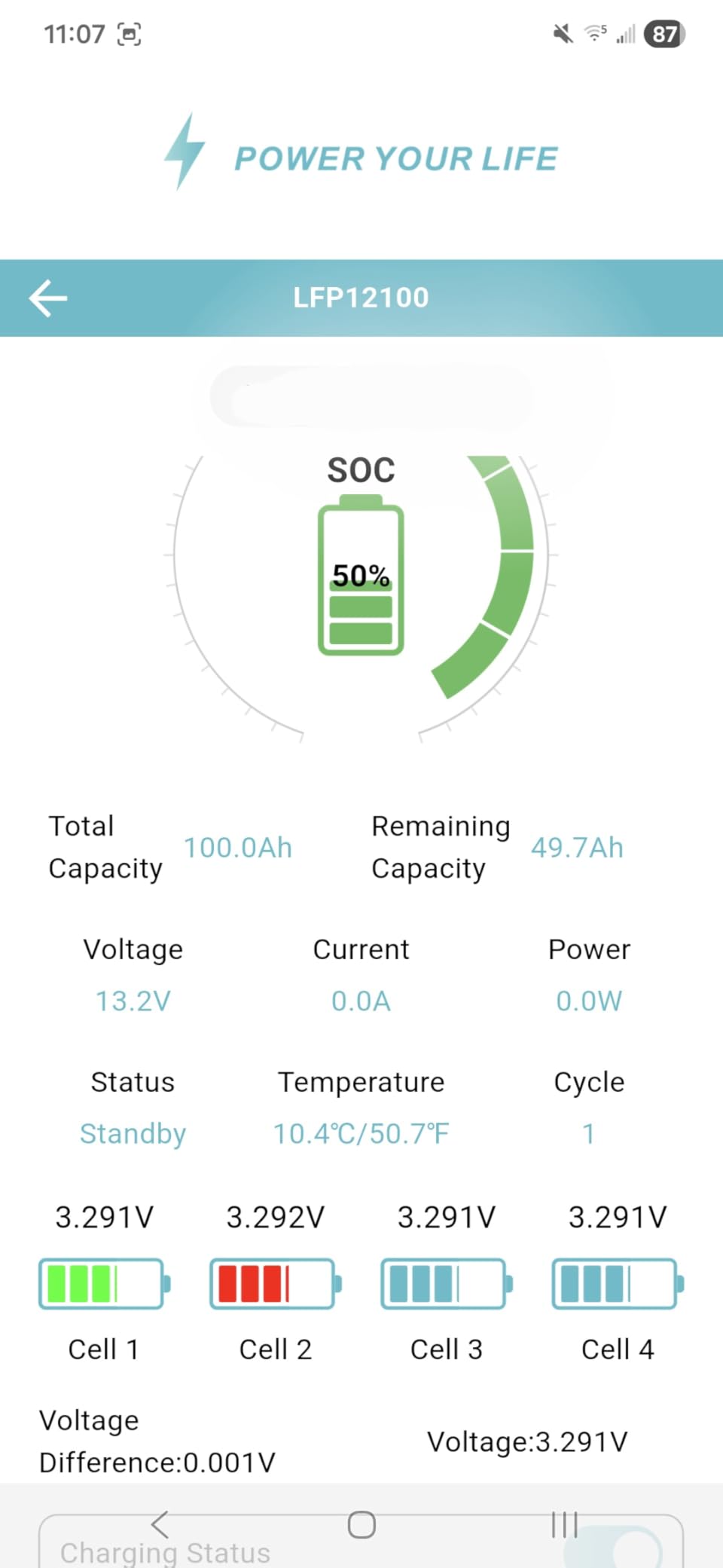
The case is a BCI Group 24 at 10.16 by 6.54 by 8.64 inches and 21 pounds, and the Bluetooth app reports voltage, current, state of charge and temperature rather than a single percentage. Temperature is exactly the reading that tells you whether the heating is doing its job.
Cycle claims here are unusually specific, separating 4,500 cycles at 100 percent depth of discharge, 8,000 at 80 percent and 15,000 at 60 percent, over a 10-year lifespan. A-grade cells sit behind a multi-protection BMS covering short circuit, overvoltage and abnormal temperature.
Buying cold-weather capability honestly
Self-heating is not a spec you should buy on a whim. It costs more, it draws charger power, and in a climate that stays above 32F it never switches on, which is why we tell warm-weather buyers to skip it and spend on capacity instead.
If you do camp below freezing, this is the clearest case in the roundup for paying a premium on a feature. Non-heating lithium simply stops accepting charge until the cells warm up on their own, which in cold weather can be most of the morning.
What the 4.8 average does and does not prove
At 198 reviews, this is one of the thinner evidence bases in the roundup, and 4.8 is a small-sample figure. We rate it highly because the distribution is strong, with only 2 percent one-star, and the specification detail is unusually complete.
Note the sleep mode behaviour, which requires manual reactivation after a BMS trigger, and confirm expansion is 4S4P to 51.2V and 400Ah if you plan to grow the bank. Both are manageable once you know about them.
11. ECO-WORTHY 12V 314Ah LiFePO4 — 4019Wh and a Fuel Gauge on the Case
ECO-WORTHY 12V 314AH LiFePO4 Lithium Battery Bluetooth with SOC LEDs, Low Temp Protection, 4019WH, 200A BMS Up to 15000 Deep Cycle for Off-Grid, RV, Solar Power System, HomeBackup
314Ah LiFePO4
4019Wh
200A BMS
SOC LED display
3-year warranty
Pros
- 314Ah in a single case
- Built-in SOC LED display and status indicators
- Built-in fault buzzer
- 200A BMS with temperature protection
- Expands to 32.15kWh in 4P2S or 2P4S
Cons
- 60.4 lb weight
- 3-year warranty against 5 years on many rivals
- Bluetooth app translations need work
- Some reports of cell balancing issues
- May arrive in multiple packages
When a bay fits exactly one battery, capacity per case is the only number that matters. At 314Ah and 4019Wh this is the highest-capacity single pack in the roundup, and it was upgraded from 300Ah in April 2026, so the advertised figure reflects the current production capacity rather than the older listing.
The SOC LED display and built-in status indicators are a genuinely useful addition for someone who does not want to open an app. You can read approximate state of charge straight off the case, which is faster than pairing a phone in a dark compartment.
Protection comes from a 200A BMS covering high and low voltage, overload and temperature extremes, plus a built-in buzzer for fault alerts, which is the kind of feature you notice only when a fault happens in the dark. The cell specification is Grade A with a claim of three times lead-acid lifespan.
Low-temperature protection is specified as a charge cutoff below 19.4F, which is one of the more aggressive cutoffs here and deserves a note if you winter camp. It also carries the widest system ceiling here: expansion supports 4P2S or 2P4S arrangements up to 32.15kWh.
When one big battery beats two small ones
Two batteries means two BMS boards, two sets of interconnects, a fuse per positive and a wiring job that has to be done properly. One 314Ah unit removes all of that, and the parallel rules described later in this guide stop applying.
It is also the compact answer for a Class C or a van conversion with a single deep bay. The trade is a 16.3 inch length and 60.4 pounds, so measure twice before committing.
What the reviews flag
The 167-review sample is among the thinnest here, and the critical reports concentrate on cell balancing plus mixed customer service responsiveness. Both matter, because balancing issues show up as lost capacity over a season rather than an outright failure.
The 3-year warranty is also the shortest among the lithium picks here, and app translations need work. For a buyer comfortable with the size and the support terms, the capacity still wins on paper.
12. WattCycle 12V 100Ah Mini LiFePO4 — 39 Percent Less Volume
WattCycle 12V 100Ah Mini LiFePO4 Battery with Bluetooth 100A BMS Group 24
100Ah Mini LiFePO4
20.94 lbs
39 percent smaller
IP67
100A BMS with Bluetooth
Pros
- Compact mini case
- 39 percent less volume
- 63 Wh/lb energy density with A+ grade cells
- IP67 rating
- Customizable Bluetooth device name
- 5-year warranty with 24-hour support
Cons
- 11 percent one-star share
- above most in this roundup
- Reported BMS failures after several months
- App in transition from BMS Meta causing connectivity issues
- Supplied M8 bolts reported short
When a battery will not physically fit, no other specification matters. This mini case measures 5.4 by 9 by 8.2 inches, which the manufacturer puts at 39 percent less volume and 11 percent lower weight than the previous generation, and it is one of the most compact 100Ah cases in this roundup.
Under-seat trays, tongue boxes and shallow pass-through bays are exactly where it earns its place. It carries an IP67 rating, one step better than the IP65 common across this category, and A+ grade EV cells rated at 63 watt-hours per pound.
The Bluetooth layer goes further than most here by letting you rename the device in the WattCycle app, which is genuinely useful if you run two batteries and want to know which is which. Reporting covers voltage, charge and discharge current, alarms and temperature.
Protection covers overcharge, deep discharge, overload, overheating, low temperature and short circuit, with an operating range from -4F to 158F and 4S4P expansion up to 20.48kWh. The 5-year warranty is supported by 24-hour Amazon and email support.
The fitment case is genuinely strong
For a Class B van with a battery under a seat, or a travel trailer with a tongue box that already carries the winch, this solves a real constraint. Several larger units in this roundup simply will not go in those spaces.
At 20.94 pounds it is also among the lightest full-capacity options here, which compounds well with a Group 24 install where every pound counts against payload.
Where the reliability signal weakens
An 11 percent one-star share is among the higher ones we saw in this roundup, and reviews report BMS failures after several months of use rather than on arrival. That is a slower, more expensive failure pattern than a dead cell out of the box.
The app is also in transition from the BMS Meta platform, which owners report as a source of connectivity issues, and the supplied M8 bolts have been described as too short. Verify your terminal hardware during install.
How Many Deep Cycle Batteries You Need to Run an RV House
Most undersized banks are undersized by a planning error, not by a missing battery. Owners size on nameplate amp-hours, subtract nothing, and then discover on the second evening that half the capacity is not actually available. Build the budget in usable amp-hours instead and the problem disappears.
List every 12V load and write down its running current.
Multiply each current by the hours you expect it to run that day.
Add inverter idle draw for every hour the inverter is switched on, even if nothing is plugged in.
Add a parasitic allowance for detectors, memory circuits, LP detector, clock, amplifiers and the fridge electronics that stay live.
Divide that daily total by 0.5 for lead-acid or by 0.9 for LiFePO4 to get the nameplate capacity you need.
Match your solar or charging to the daily total, not to the battery size.
The two loads owners most often underestimate are the absorption fridge and inverter idle draw. An absorption fridge cycles on and off through the night and can quietly account for a large share of a day’s consumption, while an inverter left switched on can draw a meaningful current whether or not you are using an outlet.
A reasonable working estimate for a couple running a 12V fridge, lights, water pump, a fan and a laptop, with no inverter, lands somewhere around 50 to 80Ah per day. Add a 1000W inverter for a few hours and that number can more than double. Two adults on CPAP machines overnight, or a Starlink terminal running all day, push a simple weekend budget into full-time territory.
Size the bank by how you camp, not by how big you want it to be. A weekend camper on hookups most weekends needs far less than a full-time boondocker, and oversizing costs both weight and money. A single 200Ah LiFePO4 with a 90 percent planning figure gives roughly 180 usable amp-hours, which at a 60Ah daily draw is close to three nights. At a 120Ah daily draw with an inverter in the mix, the same battery is a one-night-and-a-morning bank.
For anyone weighing a portable power station instead of a second house battery, our portable power station guide covers that trade honestly.
LiFePO4 vs AGM vs Dual Purpose: What Actually Runs a House
Chemistry decides how much of the label capacity you actually get, and the difference is large enough that comparing raw amp-hours across chemistries is meaningless. Roughly 50 percent of a lead-acid rating is usable in service, against about 90 percent or more from LiFePO4.
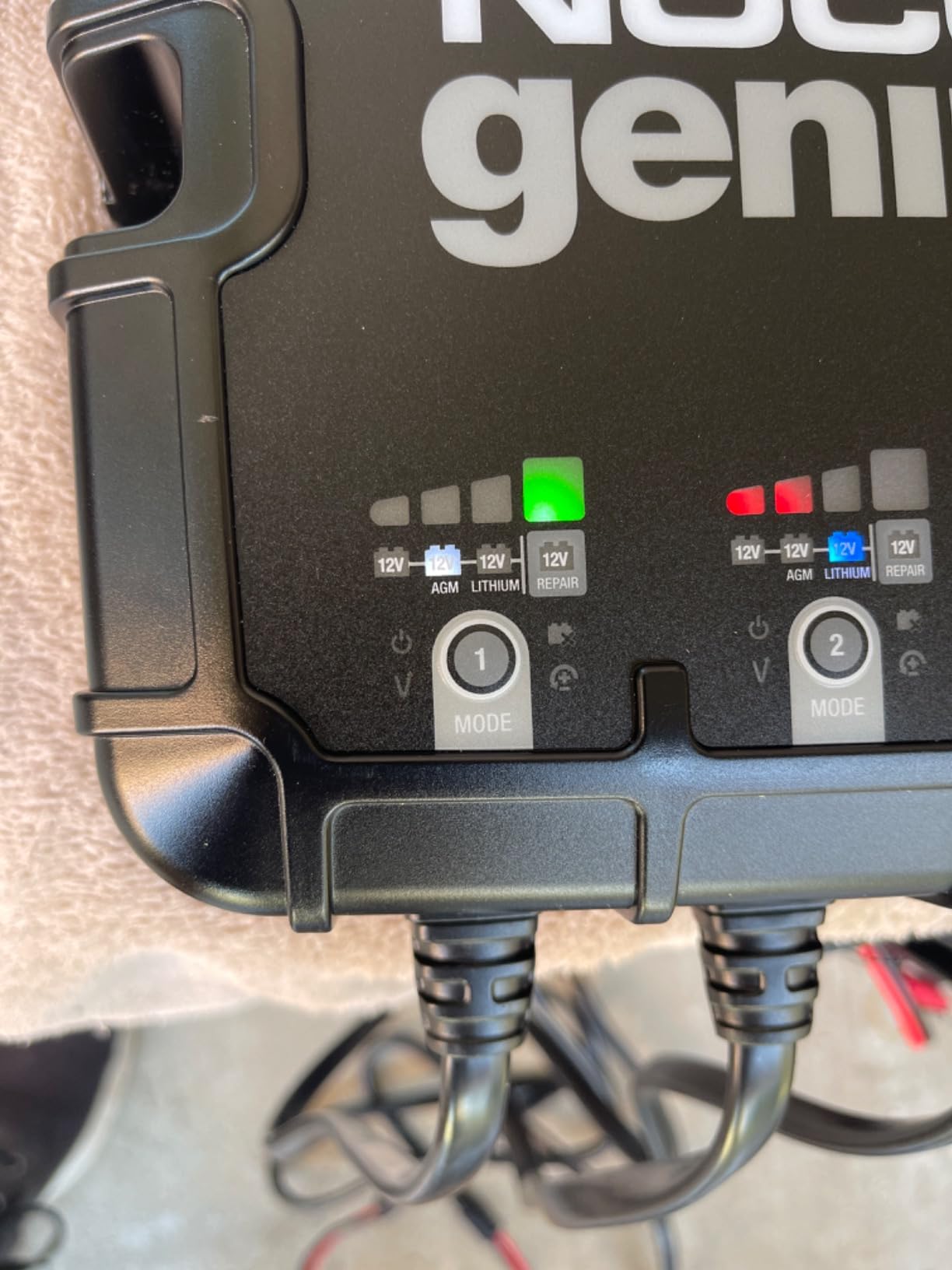
LiFePO4 — the highest usable capacity per pound, thousands of cycles, no water, no venting, and built-in cell balancing. Against it: charging must stop below 32F unless the pack is self-heating, the upfront cost is higher, and a converter on a lead-acid float profile will park the bank around 90 percent state of charge so you never see the capacity you paid for. The chemistry reasoning carries over directly to the discharge-heavy use case in our trolling motor battery roundup.
AGM — maintenance-free, sealed, tolerant of a wide temperature range, and the only chemistry in this roundup that charges properly from an unmodified RV converter. Against it: about 50 percent usable capacity, weights that hurt payload, shorter cycle life, and a two-year prorated warranty against five years on lithium.
Flooded lead-acid — the cheapest per amp-hour and still the standard when a battery bay is vented and someone will maintain it. Against it: water topping, venting, terminal corrosion, high self-discharge, and the same 50 percent usable ceiling.
Gel — a thickened electrolyte that resists vibration and needs no water, popular in mobility and marine use. Against it: a lower charge acceptance rate, meaning slow recharge from solar or a small converter, and a sensitivity to overcharge voltages.
Dual purpose and marine hybrid — sold with a headline cold cranking number so they can start an engine and cycle a little. In a deep cycling application that cranking figure is meaningless, and the capacity you get is lower than a true deep cycle of the same case size. The single most repeated correction in owner forums is that you cannot pick a house battery on CCA.
There is also a lead-acid route worth naming for owners with space: two 6V GC2 batteries in series give 12V with roughly double the plate thickness and better cycle life than a single 12V unit of the same total capacity. Owners on forums regularly recommend that pairing, and we would consider it when a bay is deep but weight is not the binding constraint.
Why House Batteries Drain on Shore Power, and What to Check
House batteries draining while plugged in is one of the most common and most misdiagnosed RV electrical problems. The causes are usually in this order: a converter that never reaches absorption voltage, a sticky or reversed battery relay, or parasitic loads that are larger than you expect.
Converter float voltage — many factory converters float a lead-acid profile at roughly 13.6V, which holds a lithium bank near 90 percent state of charge indefinitely. You pay for 314Ah and use 280 of it, permanently. Confirm the charger has a lithium profile, or replace it with a smart charger that has one.
Relay chatter or a reversed relay — if the disconnect relay does not open cleanly when you unplug, the shore power charger and the battery fight each other. You will hear the clicking. A reversed relay lets current flow the wrong way through the converter.
Parasitic loads — LP detectors, refrigerator electronics, radio memory circuits, amplified antennas, key fob receivers and battery-sensing modules all draw continuously. A shunt monitor installed at the battery is the only way to see the real number rather than guessing.
Duplicate charging paths — a solar controller and a DC-DC charger both active at once, plus the converter, can over-charge a lithium pack in real use. Pick one primary charging source per driving state.
Confirming a drain takes more than a multimeter reading at the case. A clamp meter on the negative battery lead with everything switched off will show steady current that should not be there, and anything above roughly 50mA is worth tracing. Owners who install a proper shunt monitor generally report that it pays for itself the first time it catches a forgotten circuit.
Cold Weather, BMS Amps, Fitment and Parallel Banks
Cold charging is the limitation to understand before you buy lithium. Charging a LiFePO4 pack below 32F can plate lithium onto the anode permanently, so each pack in this roundup blocks charge in the cold and permits discharge down to -4F. If you camp below freezing and rely on solar, either buy a self-heating pack or be prepared for slow mornings.
The battery management system rating is the ceiling your inverter must live under. A 1000W inverter draws roughly 83A at 12V, a 1500W unit roughly 125A, a 2000W unit roughly 167A, and a 3000W unit roughly 250A. A 100A BMS cannot support the 2000W or 3000W cases continuously, and the failure mode is a tripped disconnect rather than damage, but it will happen at the worst moment.
Fitment kills more upgrades than budget does. Group 24 is the common RV standard, Group 27 and Group 31 give more capacity in a larger footprint, Group 4D suits large motorhomes, and Group 22NF is the answer when nothing else fits. Measure the tray, check the lid clearance with the terminal posts installed, and confirm the hold-down clamp has somewhere to grip.
Parallel banks have rules that owners learn the hard way. Buy identical batteries, from the same production run, at the same time, and never parallel a new pack with an older one. Never mix lithium and lead-acid in the same bank. Fuse each positive lead, use equal-length interconnects, wire in a diagonal or negative-terminal-first sequence, and keep the cables the same gauge throughout.
For long storage, bring the bank to about half charge, keep the terminals clean and dry, and top it up every three months. Lithium self-discharges slowly enough that this is a twice-a-year task rather than a weekend chore, which is one of the quieter benefits of the chemistry.
Finally, watch the payload number on your door sticker before the batteries land. Every chemistry swap changes the weight of the bank, and on trailers the difference is the difference between a legal rig and an overloaded one.
Frequently Asked Questions
What is the best battery for RV house power?
A 200Ah LiFePO4 battery with a 200A continuous BMS is the default answer for deep cycle batteries for RV house power. It delivers about 180 usable amp-hours against roughly 100 usable amp-hours from a 200Ah AGM, weighs about 59 pounds instead of 128, and the 200A rating covers a 2000W inverter. If you camp below freezing, choose a self-heating 100Ah model instead.
Are lithium RV batteries better than AGM batteries?
For house power, yes on almost every measure: roughly 90 percent usable capacity against about 50 percent, roughly a third of the weight, thousands of cycles against a few hundred, and no water or venting. AGM still wins on two points. It charges correctly from an unmodified RV converter, and it does not care about cold-weather charging, so it remains the simplest option for owners who camp mostly on hookups.
Do I need to change my RV converter for lithium batteries?
Not always, but you should check it. A converter that floats a lead-acid profile around 13.6V will hold a lithium bank near 90 percent state of charge permanently, so you pay for capacity you never use. If your converter has a lithium or smart multi-stage profile it can stay. Otherwise a replacement smart charger is the single highest-value part of a lithium upgrade.
Why are my RV house batteries draining while plugged into shore power?
Four causes account for most cases. The converter never reaches absorption voltage, a sticky or reversed battery relay keeps the charger connected, parasitic loads from detectors, radio memory circuits and fridge electronics draw continuously, or two chargers are fighting each other. A clamp meter on the negative lead with everything off will show whether a drain exists, and a shunt monitor tracks it from then on.
How many deep cycle batteries do I need to run a house?
Most couples need one 200Ah LiFePO4 unit, which is about 180 usable amp-hours. A weekend camper on hookups can manage one 100Ah. Full-time boondocking with an inverter usually wants 400Ah or more, and winter camping with heavy loads often means 500Ah. Build the number from your measured daily draw rather than from a rule of thumb, and divide by 0.9 for lithium or 0.5 for lead-acid.
What is the biggest disadvantage of a lithium-ion battery?
Cold-weather charging. A LiFePO4 pack must not be charged below 32F or it can be permanently damaged, so most units simply refuse the charge and wait for the cells to warm up. The second disadvantage is charging compatibility: a converter on a lead-acid float profile parks a lithium bank at about 90 percent state of charge. Self-heating models and a lithium-profile charger solve both.
What is a downside of using deep cycle batteries?
A true deep cycle battery is not built to start an engine, so a rig that relies on one battery for both cranking and house loads is using the wrong tool. Deep cycle plates are thinner, which means lower cranking amps, and cold weather hits them harder than a starting battery. In a deep cycling application the cranking rating is meaningless, so a dual-purpose or starter battery is the better choice for cranking.
What are the best 6-volt deep cycle batteries for an RV?
Two 6V GC2 units wired in series give you 12V with thicker plates and better cycle life than a single 12V battery of the same total capacity, and many owners prefer the pair for long-term boondocking. The catch is weight, which is why this route suits motorhomes and deep bays rather than small trailers. Never run the two in parallel unless they are an identical matched pair.
The Decision Rule for RV House Power
The rule is short. Buy on usable amp-hours, not on the label, and buy the BMS rating that matches your inverter. The Renogy 12V 100Ah AGM is the pick with the strongest evidence behind it, a Group 24 drop-in that any existing converter will charge and a 3534-review history that no other unit in this roundup can match. It is also the right answer if you camp on hookups most of the season and want the least fuss.
The moment you start spending nights away from a hookup, a 200Ah LiFePO4 with a 200A BMS becomes the correct purchase, because it gives you about 180 usable amp-hours where a 200Ah AGM gives you about 100, and it does it in 59 pounds instead of 128. Add self-heating only if you camp below 32F, and add app monitoring only if you intend to read it.
Measure your real daily draw first, since every recommendation in this guide changes if your loads are heavier than they look. Once you know the number, the best deep cycle batteries for RV house power are the ones that cover it twice, and a shunt monitor on day one will tell you whether you guessed right.