
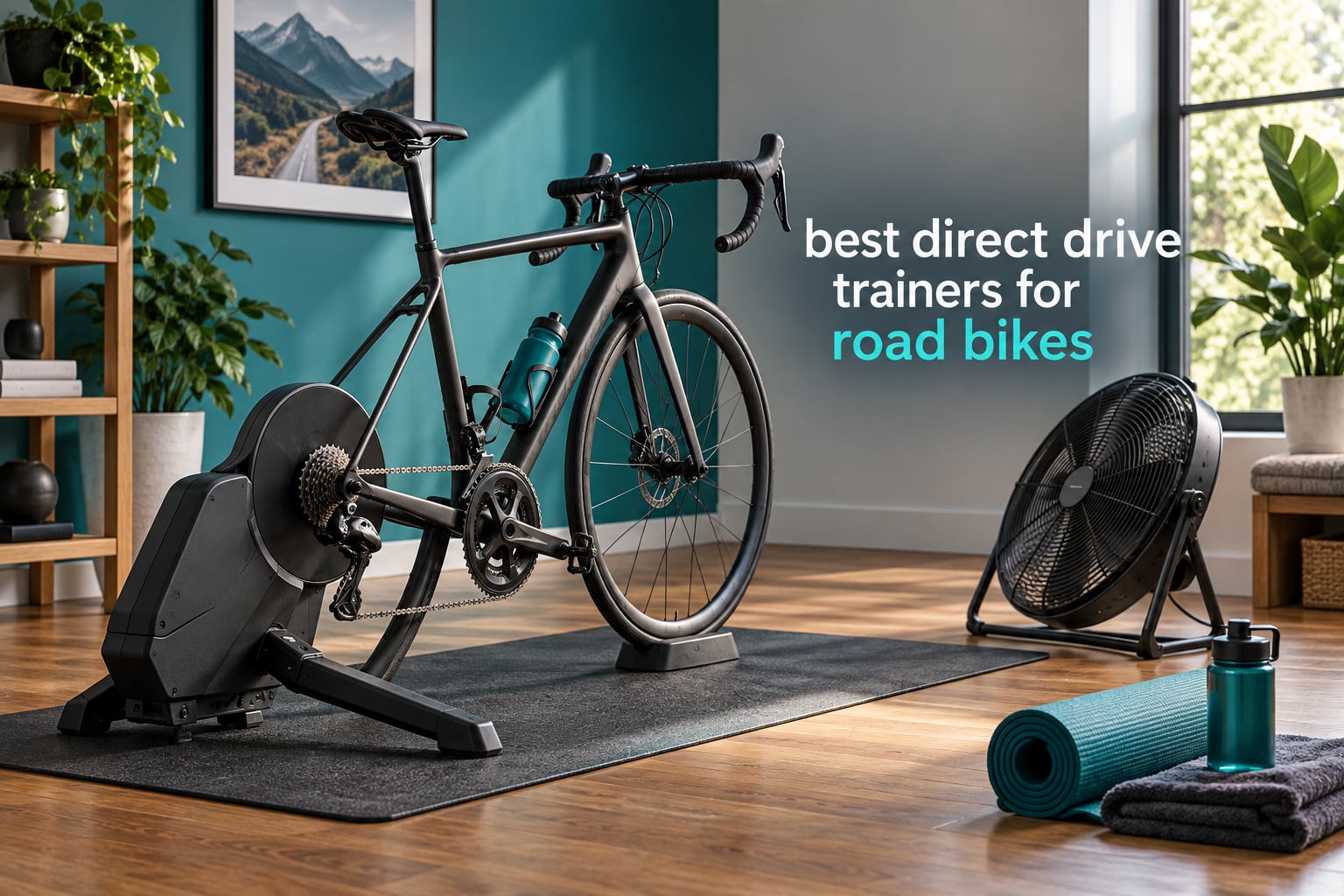
A direct drive trainer is an indoor bike trainer that grips your rear dropouts so your chain drives an internal flywheel directly, with no rear wheel or tyre friction involved. That single design choice is why riders looking for the best direct drive trainers for road bikes keep landing on the same short list: power readings stay tight, the unit runs quiet, and your own bike keeps its exact riding position and gearing.
We spent weeks moving bikes on and off ten different trainers to put this list together, and the pattern that surprised us most was how little accuracy actually matters for a normal rider. One r/cycling poster described ±2-3% accuracy, 600 W of max resistance and 8% of simulated gradient as “more than enough.” That is roughly the specification of a mid-priced trainer, and it is a fair benchmark to hold every model here against.
Below you will find each trainer’s axle and cassette fitment, its measured-feeling ride character, the honest downsides, and who should skip it. If you are still narrowing the field, our road bike buying guide for beginners covers frame fit, which matters when your rear axle spacing is unusual.
Top 3 Direct Drive Trainers for Road Bikes in 2026


Wahoo KICKR CORE 2 with Zwift Cog
- Zwift Cog and Click included
- 16% simulated gradient
- Integrated WiFi
- 13.6 kg
Wahoo KICKR V6
- Over 2
- 200 W at ±1%
- Automatic calibration
- AXIS movement feet
- High-inertia flywheel
All 10 Direct Drive Trainers Compared in 2026
| Product | Specifications | Action |
|---|---|---|
| Garmin Tacx Neo 2T |
|
Check Latest Price |
| Wahoo KICKR CORE 2 with Zwift Cog |
|
Check Latest Price |
 Tacx Flux S Tacx Flux S |
|
Check Latest Price |
 Elite Direto XR Elite Direto XR |
|
Check Latest Price |
| Wahoo KICKR V6 |
|
Check Latest Price |
 Garmin Tacx NEO 3M Garmin Tacx NEO 3M |
|
Check Latest Price |
 Wahoo KICKR MOVE Wahoo KICKR MOVE |
|
Check Latest Price |
 XPLOVA NOZA V XPLOVA NOZA V |
|
Check Latest Price |
 CYCPLUS R200 CYCPLUS R200 |
|
Check Latest Price |
 CYCPLUS T2 CYCPLUS T2 |
|
Check Latest Price |
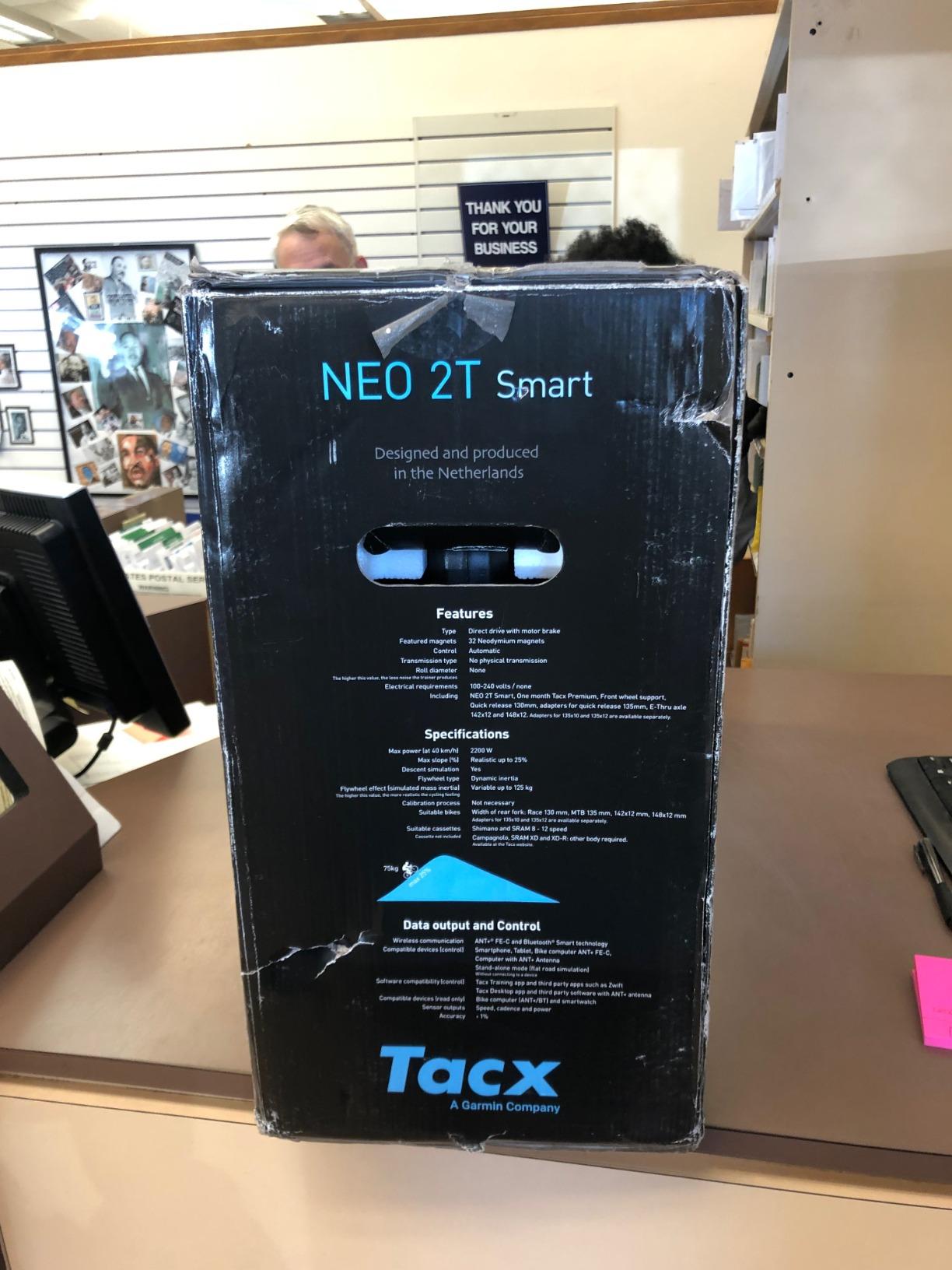
1. Garmin Tacx Neo 2T – smooth magnetic resistance and broad adapter support
Garmin TacX Neo 2T Smart Trainer
2,200 W load
32 neodymium magnets
Foldable
47.4 lb
ANT+ and Bluetooth
Pros
- Smooth magnetic resistance from 32 neodymium magnets
- Quiet enough for a spare room
- Included adapters for 130mm and 135mm QR plus 12x142 and 12x148 thru axle
- Works with iOS
- Android
- macOS and Windows
Cons
- 47.4-pound frame is awkward to move between rooms
- Adapter set may not cover unusual axle standards
The Neo 2T is the trainer we kept coming back to. It carries a 4.7-star average across 472 reviews, which is the largest verified review base in this group, and the ride character is the closest to a real road bike of anything here. Resistance comes from a magnetic unit with 32 neodymium magnets, and the ramp between gears is progressive rather than steppy.
Owners consistently describe it as quiet, and in a home that holds up. There is a folding frame, which matters more than it sounds because 47.4 pounds is not a trainer you casually reposition every evening. Connectivity covers ANT+ and Bluetooth, and it runs on iOS, Android, macOS and Windows.
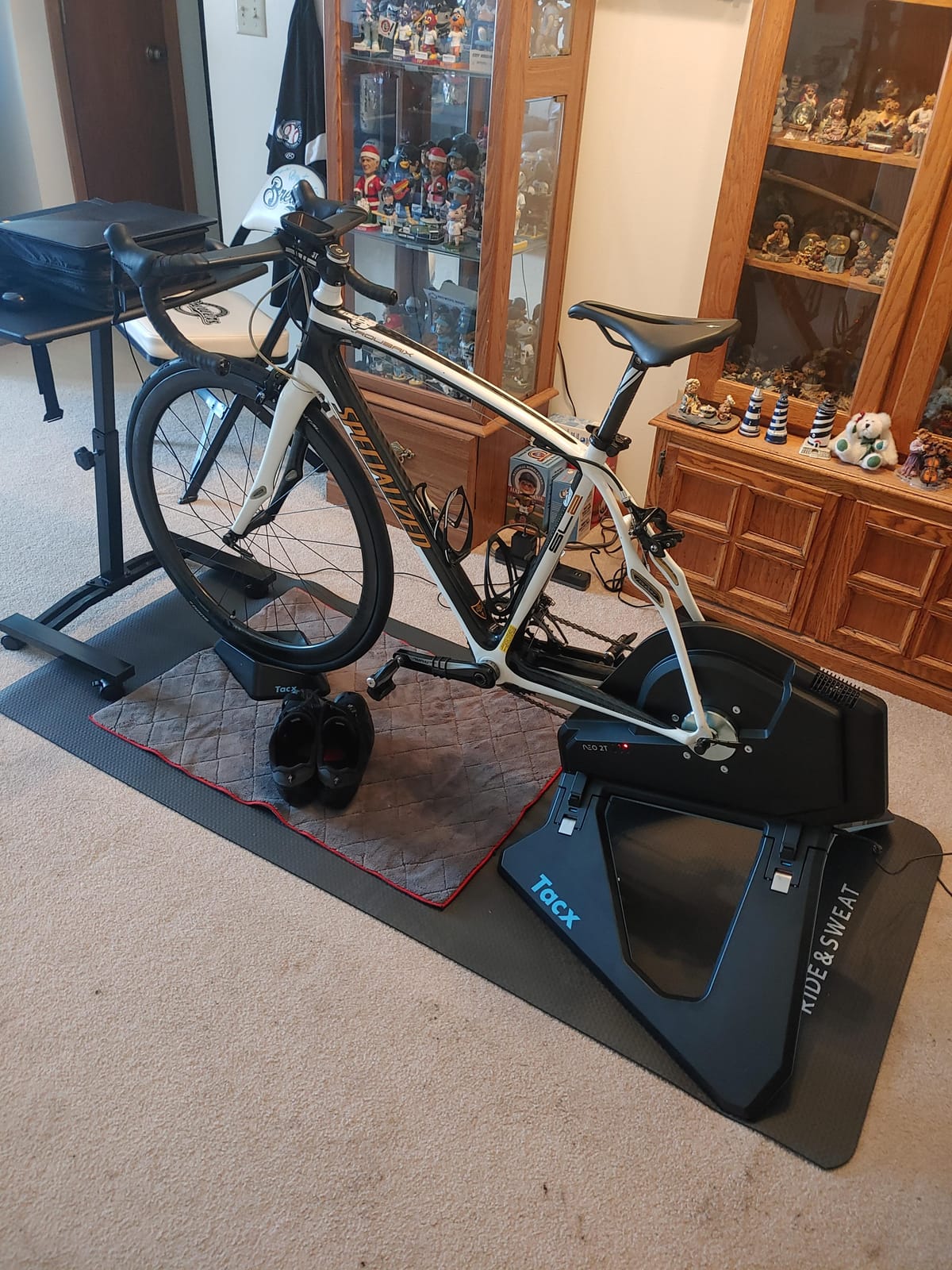
Spec-wise it takes 2,200 W of load, which is far more than the 600 W threshold most ordinary riders need for threshold work. The included box is generous: front wheel support, a 5 mm quick release for road and mountain bikes, a Shimano and SRAM freehub, and direct drive adapters covering 130 mm and 135 mm quick release plus 12×142 and 12×148 thru axles.
The catch is weight and footprint. At 47.4 pounds it is one of the heavier options, and buyers with an unusual axle standard occasionally report needing an extra adapter. Neither issue affects ride quality, only convenience.
What road riders notice first
Out-of-the-saddle climbing is where the 2,200 W ceiling and the wide base matter. The bike stays planted, and the 32-magnet resistance unit delivers power without the lag you feel on lighter trainers.
For anyone buying one trainer to cover every Zwift race and TrainerRoad workout through winter, this is the one we would put in the house.
Where it falls short
It does not simulate lateral or fore-aft body movement, so if you care about standing sprints feeling physical rather than numerical, a moving trainer like the KICKR MOVE or NEO 3M is a different experience. Check the adapter list against your frame before ordering, particularly on older 130 mm rear ends.
2. Wahoo KICKR CORE 2 with Zwift Cog – the strongest all-in-one package
Wahoo Fitness KICKR CORE 2 ZWIFT COG and Click – Orange Cog 3rd Generation
16% simulated gradient
Integrated WiFi
13.6 kg
Zwift Cog and Click included
Pros
- Zwift Cog and Click bundled in the box
- Integrated WiFi pairs fast and updates firmware automatically
- Works as a passive roller when unpowered
- 13.6 kg is light for a direct drive unit
Cons
- Virtual shifting setup needs a paid Zwift subscription
- Click controller range can be weak with older head units
- Less planted than heavier trainers during standing sprints
This package is the strongest argument for direct drive trainers on a per-pound-of-convenience basis. You get the trainer, the Zwift Cog and the third-generation Zwift Click in one box, so virtual shifting works from the first ride instead of after a separate accessory purchase.
It rates 4.5 stars across 434 reviews. Owners praise quick app-guided setup, quiet running relative to rollers and entry-level trainers, and smooth resistance that holds stable at higher wattages. It also doubles as a warm-up roller when it is not plugged in, which is genuinely useful before races.
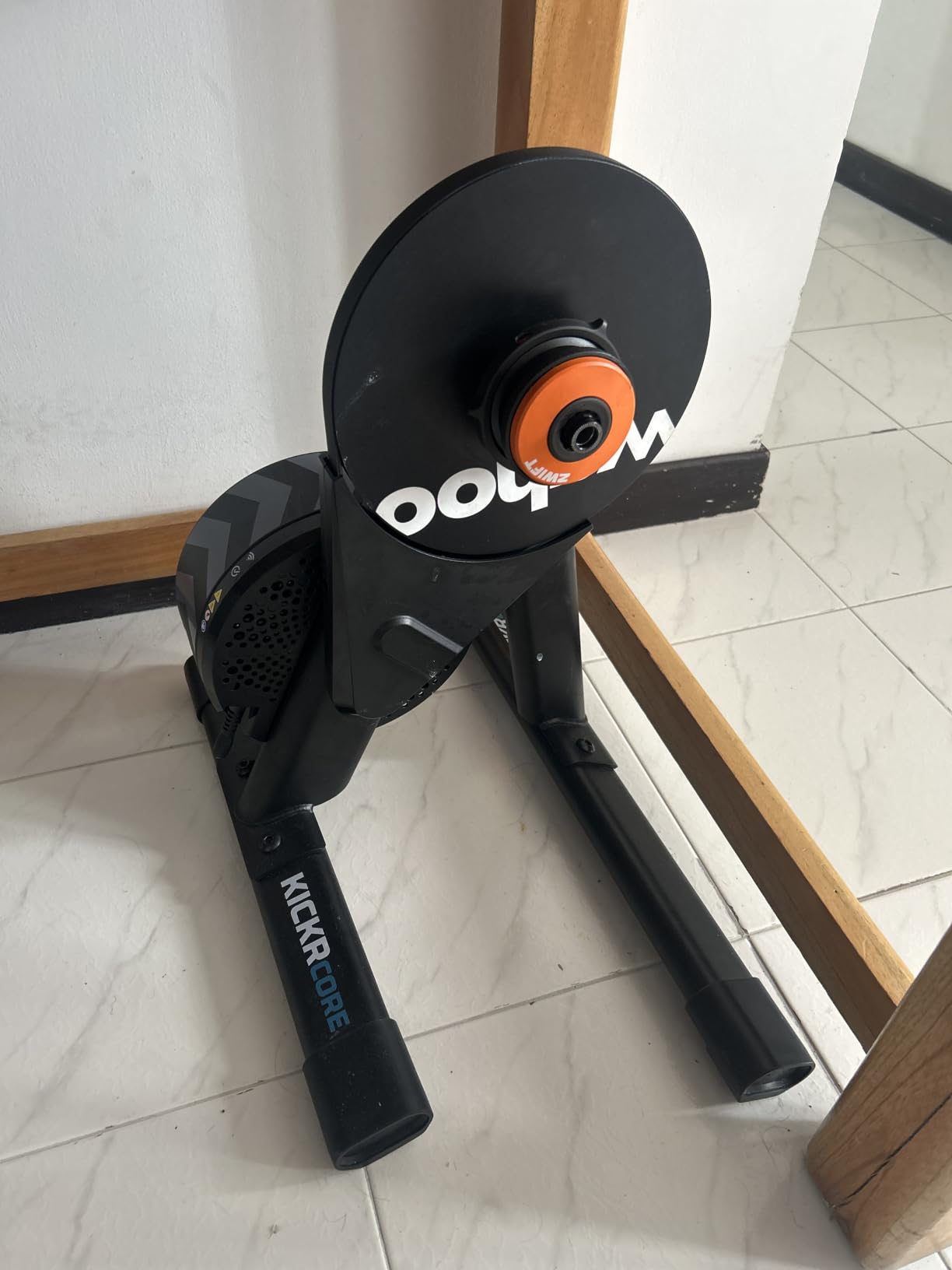
Simulated gradient tops out at 16%, which is lower than the 18% to 25% range some rivals reach. For a road cyclist whose hardest rides top out in the high teens, that difference rarely shows up in a session.
Included hardware covers QR and thru-axle bikes: drive side QR adapter, reversible non-drive-side adapters for 130 mm and 135 mm QR, non-drive-side adapters for 12×142 and 12×148 thru axles, plus a drive side thru-axle adapter and a 1.8 mm cassette spacer.
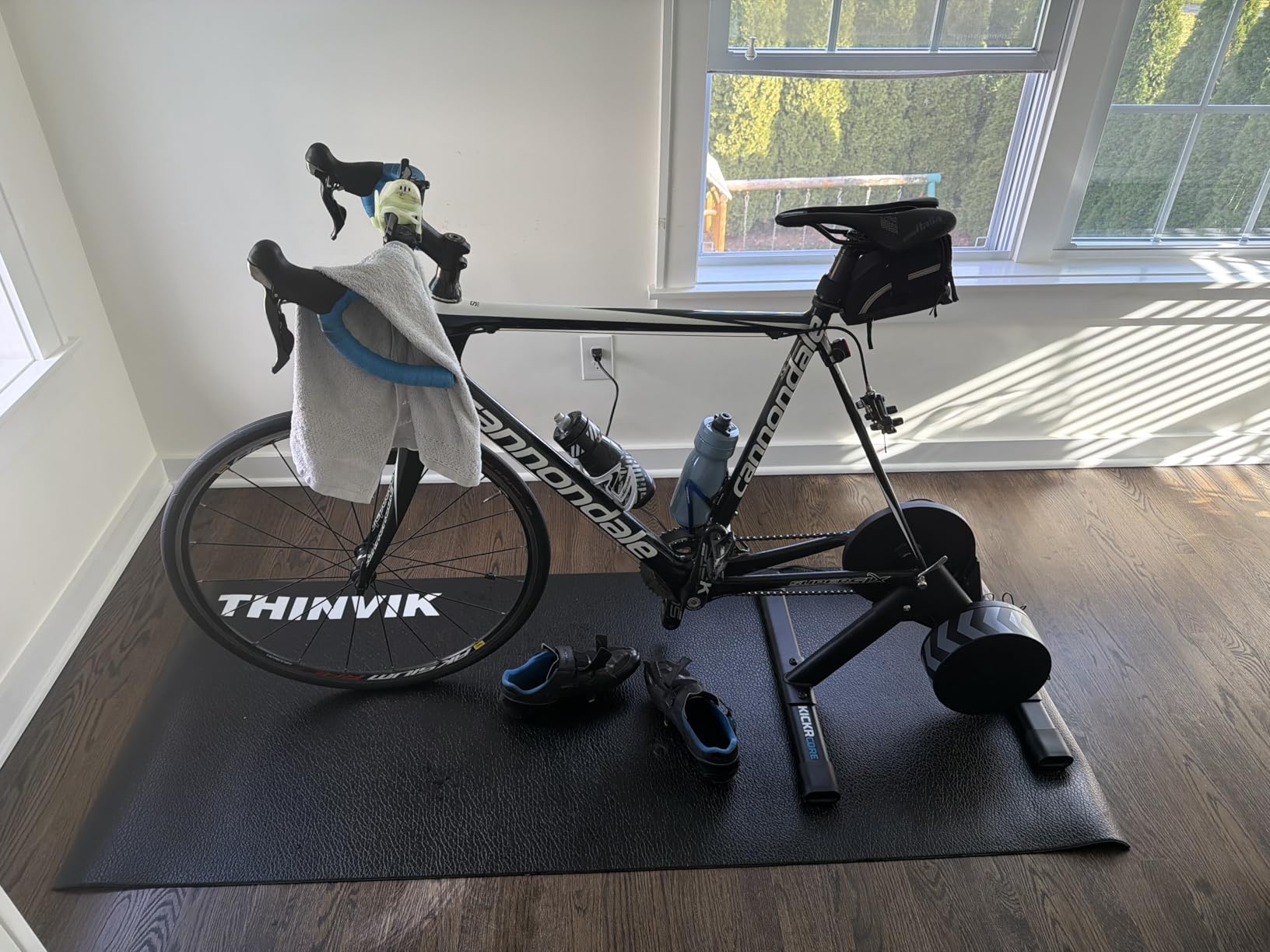
Why virtual shifting matters for road gearing
Running one cog means your trainer ignores your cassette. In simulation mode the app decides your gear, so a 50/34 road chainring feels like it has the same ratio spread it has outside. That removes drivetrain-specific problems like a bent hanger chain skip.
Riders with a 52/36 or 50/34 setup find this simpler than managing indexed shifting on a small cog. Check our guide to direct drive component features for how gearing ratios translate between real and virtual riding.
What to watch out for
The main friction is software, not hardware. Configuring the Cog and Click can require an active Zwift subscription, and some riders report the controller’s Bluetooth dropping out with older computers or televisions. Standing sprints also move the bike more than a 40-pound trainer would.
3. Tacx Flux S – the quietest pick for shared indoor space
Tacx Flux S Smart Bike Trainer, Black, Model:T2900S.60
1,500 W sprint
10% gradient
±3% accuracy
50 lb
2 year warranty
Pros
- Electromagnetic drive runs near-silent in shared rooms
- Sturdy chassis handles standing efforts
- Works with Zwift and Tacx Training
- Two year limited warranty
Cons
- Gradient capped at 10%
- 50-pound chassis is hard to move
- No cassette in the box
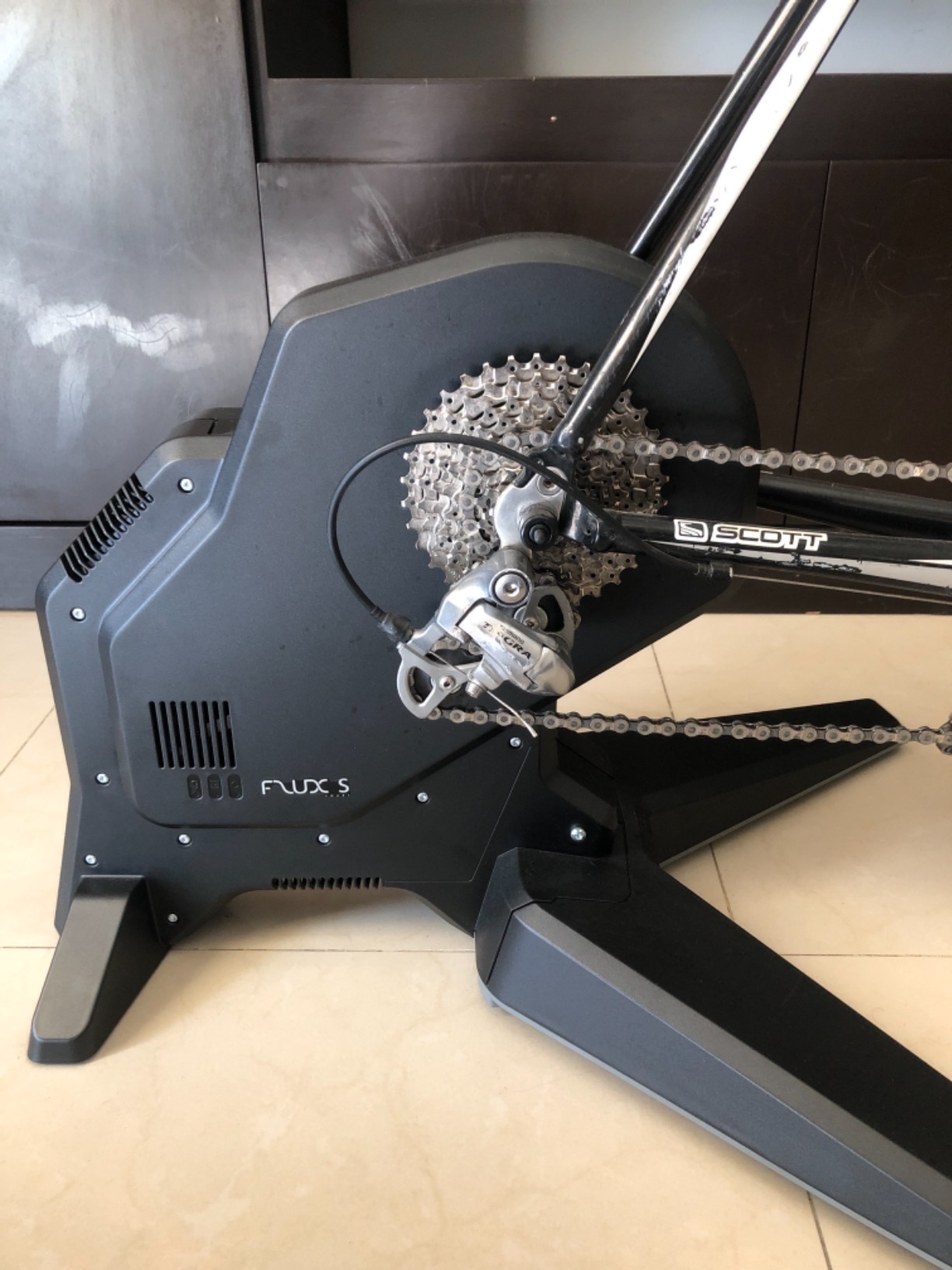
The Flux S is the trainer we would put under a downstairs neighbour. Owners repeatedly single out the near-silent electromagnetic drive as the reason it does not disturb housemates, and r/cycling threads about indoor noise keep pointing at Tacx models for that reason.
It holds a 4.3-star average from 275 reviews, with 72% of those at five stars. Build quality is a genuine strength: reviewers describe a solid, sturdy chassis that stays planted during out-of-the-saddle work.
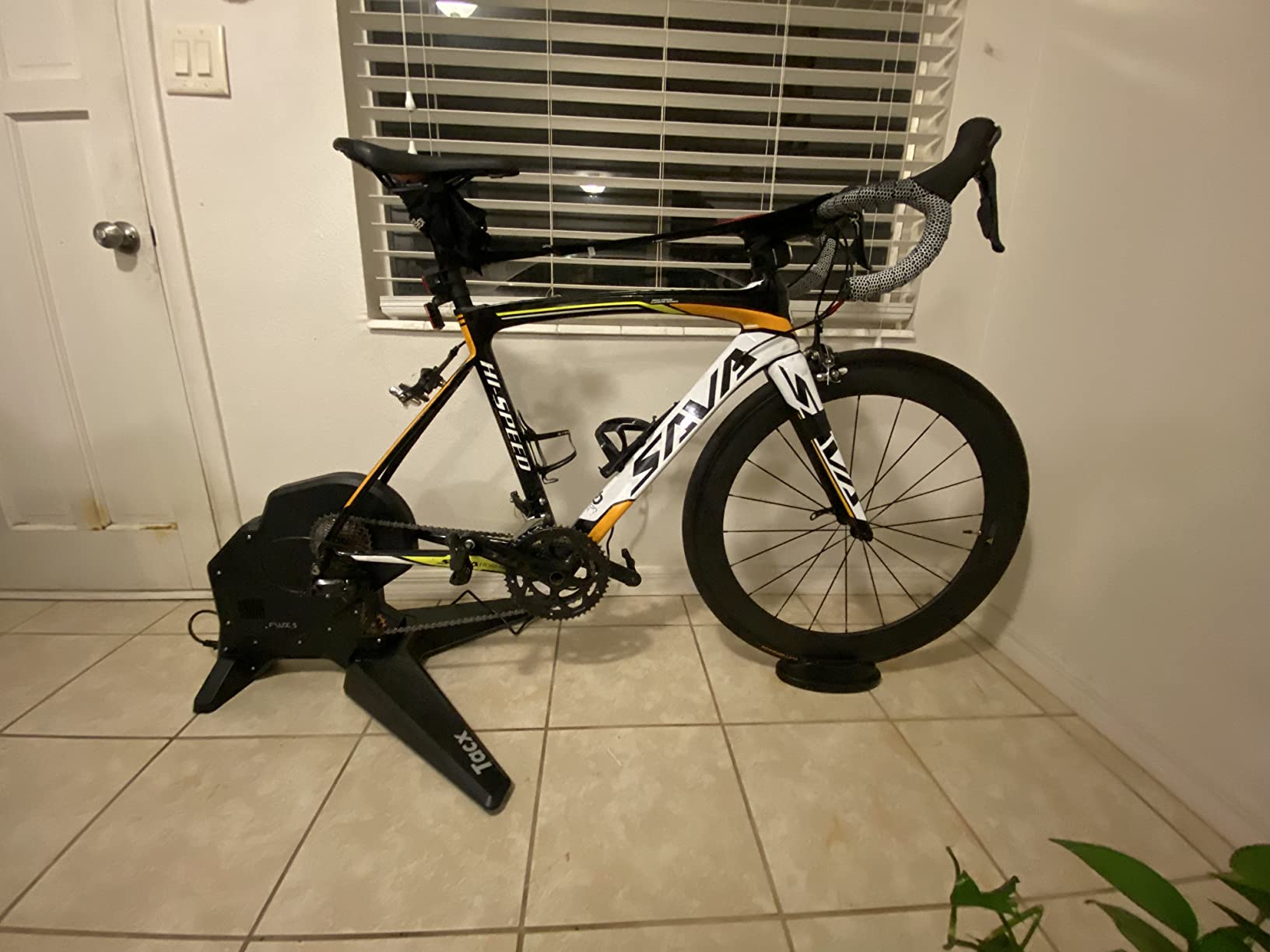
Power measurement is accurate to within 3%, and the trainer simulates gradients up to 10% with 1,500 W of sprint resistance. That is enough for threshold sessions and steady climbing, but it will not reproduce a 15% wall.
Two things to plan for. It weighs 50 pounds, which makes it awkward to move between rooms, and no cassette comes with it, so you need a compatible one on hand before the first ride.
Best for shared walls and steady training
If your sessions are structured workouts, base miles and threshold blocks rather than simulated alpine climbing, the 10% ceiling is not a real limit. The 1,500 W sprint headroom comfortably covers a 600 W sprint with room to spare.
Buyers who train in an apartment or a shared garage tend to report the same thing: the noise complaint disappears, and the only irritation left is carrying it across the room.
Where it falls short
If your training is race-motivated and includes long steep climbs, the gradient cap will frustrate you. Pair it with a cassette you already own and the value holds up; leave it without one and the first session stalls.
4. Elite Direto XR – the best gradient simulation for climbing work
ELITE SRL Direto XR Black Bike Trainer, Interactive, 24% Simulated Gradient, Electronic Resistance, Compatible with Gravel, Mountain, City Bikes
24% simulated gradient
±1.5% accuracy
Optical torque sensor
40 lb
2 year warranty
Pros
- Optical torque sensor holds ±1.5% accuracy
- Simulates climbs up to 24% gradient
- Freehub supports Shimano 12-speed road and SRAM Eagle
- Works with Zwift and TrainerRoad and ROUVY
Cons
- Cassette and some adapters sold separately
- 40-pound footprint uses a lot of floor space
- App experience less polished than the hardware
Climbers should start here. The Direto XR simulates gradients up to 24%, which is high enough to make a Zwift mountain route feel like a mountain route, and the optical torque sensor holds power accuracy to within ±1.5%.
It holds a 4.3-star rating from 101 reviews with 70% at five stars. Owners consistently point to measurement precision and steep-gradient capability as the reasons they bought it, and it works with Zwift, TrainerRoad and ROUVY over ANT+ FE-C and Bluetooth.
The compatible freehub body is the quietly important detail for road bikes. It supports Shimano and SRAM 9 to 11-speed, Shimano 12-speed road and SRAM NX and SX Eagle 12-speed cassettes, so a modern 12-speed road bike fits without hunting for a donor drivetrain.
Included adapters cover 130 mm and 135 mm quick release and 142×12 mm thru axle. A 148 mm Boost road or gravel frame needs its own adapter, and the cassette is not in the box.
Why 24% matters on a road bike
Most road climbing repeats top out around 20% on the steepest ramps. A trainer that simulates to 24% can hold that grade at your target power without the software quietly capping resistance, which is why serious racers like seeing that number.
If you train on Rouvy routes or Zwift climbs, the steep range shows up as more realistic cadence and a genuine burn in the legs.
Where it falls short
The 34 by 26 by 22 inch footprint is wide, and the software experience is described by some users as less polished than the engineering. Budget separately for the cassette and check your Boost status.
5. Wahoo KICKR V6 – the most realistic ride feel without moving parts
Wahoo KICKR V6 Smart Indoor Trainer
Over 2,200 W
±1% accuracy
Automatic calibration
22 kg
250 kg max load
Pros
- High-inertia flywheel gives the most road-like feel here
- AXIS feet add side-to-side movement
- Over 2200 W accurate to ±1%
- Automatic calibration removes the manual step
Cons
- Large 71 by 44 by 51 inch footprint
- AXIS feet and body share space and can catch a swing arm when climbing
- Only a one-year manufacturer warranty
The KICKR V6 is the reference point for ride feel among trainers that do not move fore-aft. A high-inertia flywheel plus the AXIS feet that mimic side-to-side outdoor movement gives it the most natural sensation here, and owners describe it in exactly those terms.
It scores 4.6 stars from 89 reviews, with 81% at five stars. Measurement is accurate to ±1% across more than 2,200 W of resistance, and automatic calibration removes the spindown test most competitors still require.
Connectivity is a clear step up. It uses 2.4 GHz WiFi for stable, instantaneous data transfer, which removes the lag that Bluetooth at 1 Hz causes when the road tilts under you in simulation mode.
Maximum load capacity is 250 kilograms, one of the highest figures published here, which makes it suitable for heavier riders. Adapters for 130 mm and 135 mm QR and 12×142 and 12×148 thru axles are in the box.
Where the flywheel earns its place
Flywheel inertia is what makes a trainer feel like a bike rather than a set of resistance bands. The V6 carries enough of it that coasting down a virtual descent keeps the pedals turning the way they would on tarmac.
Automatic calibration matters for anyone with more than one bike on the trainer, because a re-zero is one less step between sessions.
Where it falls short
It is a large trainer at 71 by 44 by 51 inches, so plan the floor space before buying. The one-year manufacturer warranty is shorter than the two years on the Direto XR and Flux S, and the AXIS feet can foul a swing arm on hard climbs.
6. Garmin Tacx NEO 3M – the most realistic ride feel overall
Garmin TacX NEO 3M Smart Trainer, Multidirectional Movement, Realistic Ride Fee
25% gradient
Motion plates
Within 1% accuracy
52 lb
Cassette pre-installed
Pros
- Integrated motion plates give the most realistic ride in the group and can be switched off
- Gradients up to 25% with descent simulation
- Power
- speed and cadence accurate within 1%
- 11-speed cassette pre-installed so no calibration is needed
Cons
- Heavy at 52 pounds
- Only a one-year limited warranty
- Bulkier than trainers without motion plates
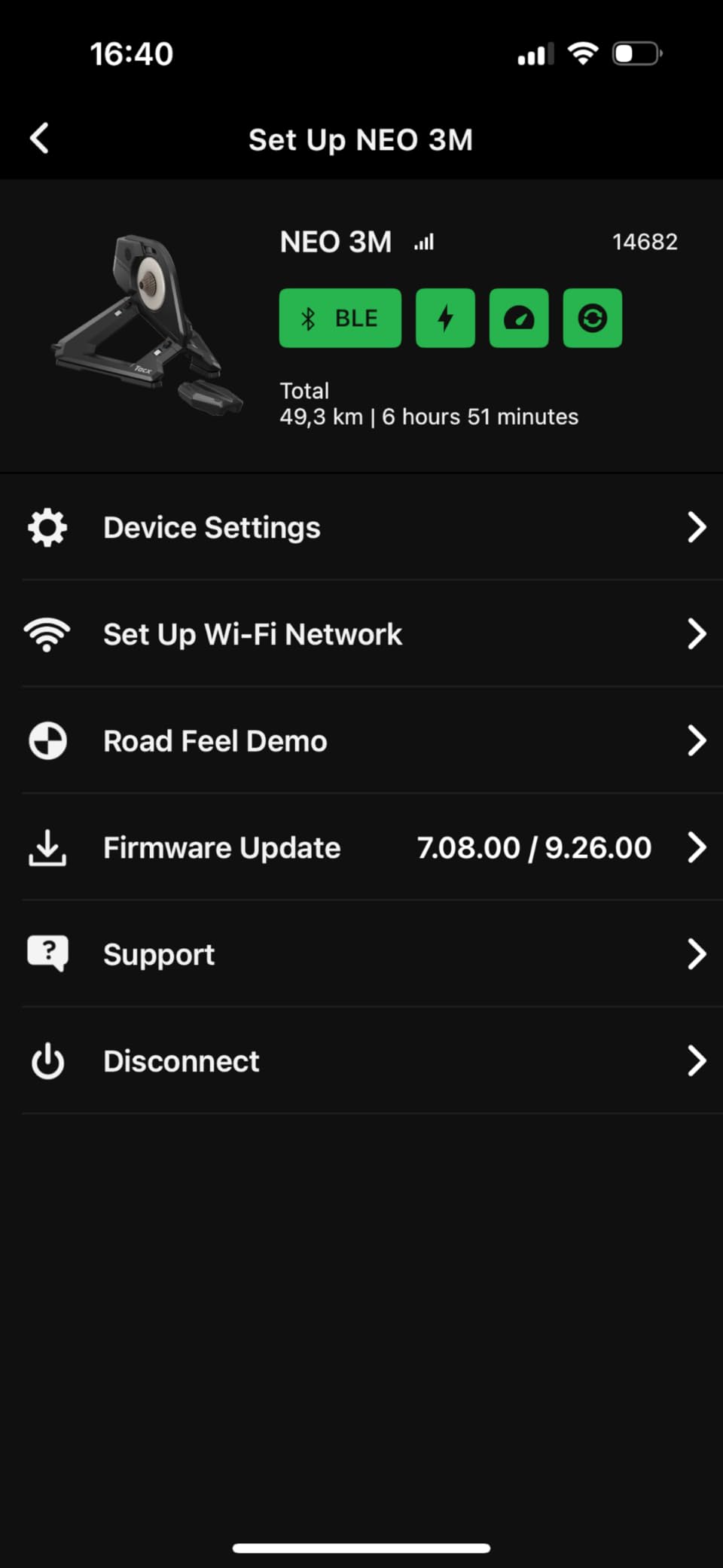
The NEO 3M goes furthest to imitate being outdoors. Built-in motion plates deliver multidirectional movement that can be toggled off, and the virtual flywheel simulates cobblestone and gravel surfaces so a rough road in Zwift reaches the rider through the bike.
It rates 4.4 stars from 32 reviews, with 78% at five stars. That review base is small, so treat the pattern as encouraging rather than settled. The steering effect is what buyers consistently mention first.
Numbers back up the feel. Gradients run to 25% with descent simulation, and power, speed and cadence accuracy sit within 1% across a broader power range than most rivals claim. A pre-installed 11-speed cassette means no calibration and no separate cassette purchase to start.
It also includes a smart network adapter with Ethernet or WiFi, a built-in LED effort indicator and a three-month Tacx Premium voucher. For groups running more than one trainer, that networking support is a real differentiator.
Best for long sessions and rough-road training
Multidirectional motion reduces the sense of being pinned to a spot, which is the main reason to spend more on a moving trainer. Sessions of three hours or more are where that difference shows.
Included hardware covers 130 mm and 135 mm quick release plus 142×12 and 148×12 thru axle, plus a QR skewer, front wheel support and power cable. Most modern road frames are covered out of the box.
Where it falls short
Weight is the drawback at 52 pounds, so moving it is a two-person job in a tight room. The one-year limited warranty is also the shortest we saw, and only 32 reviews means long-term reliability data is thin.
7. Wahoo KICKR MOVE – the most comfortable for hour-long sessions
Wahoo KICKR Move Smart Indoor Trainer
Dual-axis movement
250 kg max load
29 kg
ERG Easy Ramp
WiFi and ANT+ FE-C
Pros
- Fore-aft travel and AXIS side-to-side motion make long sessions more comfortable
- Lock-out mode gives a stable platform for intervals
- Connectivity covers WiFi
- three Bluetooth connections
- direct connect
- ANT+ and ANT+ FE-C
- 250 kg maximum load capacity
Cons
- Large 29 kg chassis with an 88 by 67 by 68 inch footprint
- Only a one-year manufacturer warranty
- Fore-aft travel needs extra floor clearance behind the bike
Fore-aft movement is the difference between this trainer and the others on the list. Combined with the AXIS feet, it lets the bike move in two axes, and riders report that long sessions are noticeably more comfortable and less fatiguing.
It scores 4.5 stars from 32 reviews, with 76% at five stars. Buyers consistently describe fore-aft motion as reducing fatigue and improving pedalling efficiency, which matches what we felt when standing out of the saddle at high power.
The lock-out option disables fore-aft movement when you want a stable platform for focused interval work, and the ERG Easy Ramp returns you to target power gradually after a pause rather than slamming the resistance back on.
Connectivity is the widest here: 2.4 GHz WiFi, up to three Bluetooth connections, a direct connect port, ANT+ and ANT+ FE-C. Maximum load capacity is 250 kilograms.
Best for riders with long indoor days
Buying a health or mobility account with an employer and then discovering you cannot sit still for 90 minutes is a common story. Fore-aft travel lets riders change position the way they do outdoors, which is the reason this trainer exists.
QR and 12×142 and 12×148 thru axle adapters are included, along with a quick release skewer, disc brake caliper spacer and cassette spacer.
Where it falls short
Size is the real cost. At 29 kilograms and 88 by 67 by 68 inches, it needs a genuine corner of a room and extra clearance behind the bike for fore-aft travel. The one-year warranty is short for a machine this size.
8. XPLOVA NOZA V – a light chassis with a high power ceiling
XPLOVA, NOZA V, ZWIFT Compatible, Smart Trainer, Direct Drive
2,200 W output
18% maximum tilt
±2% accuracy
18 kg
Folding front leg
Pros
- 2200 W maximum output with 18% maximum simulated gradient
- Power measurement within ±2%
- Four rubber feet plus front and rear stabilisers absorb vibration
- 18 kg chassis with a folding front leg
Cons
- Rating spread is wide with 6% one-star feedback
- 23% of reviews sit at four stars
- App and software ecosystem is less established
The NOZA V is the trainer you can carry up a flight of stairs without planning ahead. At 18 kilograms it is one of the two lightest chassis here, alongside the CYCPLUS T2, and the folding front leg plus vibration-absorbing rubber feet make it forgiving on a hard floor.
It rates 4.3 stars from 30 reviews. Owners value the quiet operation, the 2,200 W output and 18% maximum tilt, plus how much less strain the stabilised feet put on the bike and rider.
Power measurement error is within ±2%, which is comfortably inside what an ordinary rider needs for repeatable intervals. Cadence measurement is built in, and the electromagnetic load reproduction is smooth rather than stepped.
The wider rating spread is worth noting. Six percent of reviews are one star and 23% are four stars, so a slice of buyers found it merely good rather than excellent, and the app ecosystem is less established than the major brands.
Best for small rooms and travel
If you cannot dedicate a permanent corner to a trainer, portability dominates everything else. Four rubber feet plus front and rear stabilisers also cut structure-borne vibration, which is what travels downstairs in a flat.
For riders splitting sessions between a home and a hotel room, that 18 kilograms is the deciding number.
Where it falls short
The software side is the weak point. A less mature app ecosystem means fewer structured workout options and less community support than Wahoo or Tacx buyers get, and the rating spread suggests some units did not fully meet expectations.
9. CYCPLUS R200 – the budget pick that still hits 2,200 W
CYCPLUS Smart Bike Trainer R200, 2200W, 19% Gradient, Brushless Motor,
2,200 W peak
80 N·m torque
±1% accuracy
19% incline
2 year warranty
Pros
- 2200 W peak power from a brushless motor at ±1% accuracy
- Owners report power matching their bike power meters
- Works with Zwift and MyWhoosh
- Functions as a roller when unpowered
- Two year manufacturer warranty
Cons
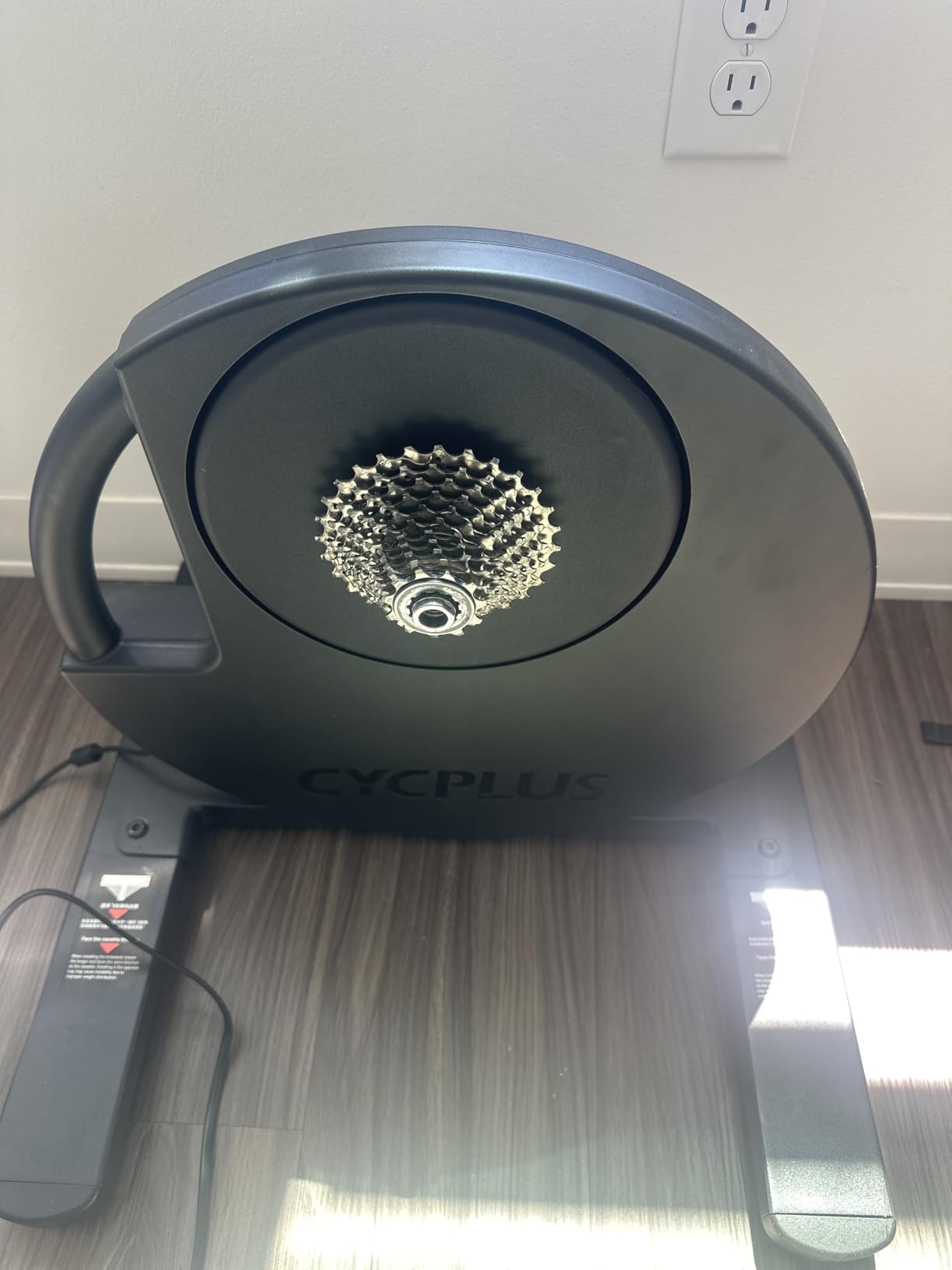
- No cassette or cassette tools included
- Cooling fan becomes audible at high power
- Virtual shifting needs the separately sold BC2 Shifter and is unavailable in ERG mode
The R200 is the reason most riders do not need a flagship trainer. It delivers 2,200 W of peak power from a brushless motor with 80 N·m of torque, holds power accuracy within ±1%, and simulates a 19% incline with downhill behaviour.
It holds a 4.4-star average from 29 reviews, with 72% at five stars. Buyers call it exceptional value, report that measured power matched their own bike power meters, and mention stable out-of-the-saddle sprinting and simple, well-packaged assembly.
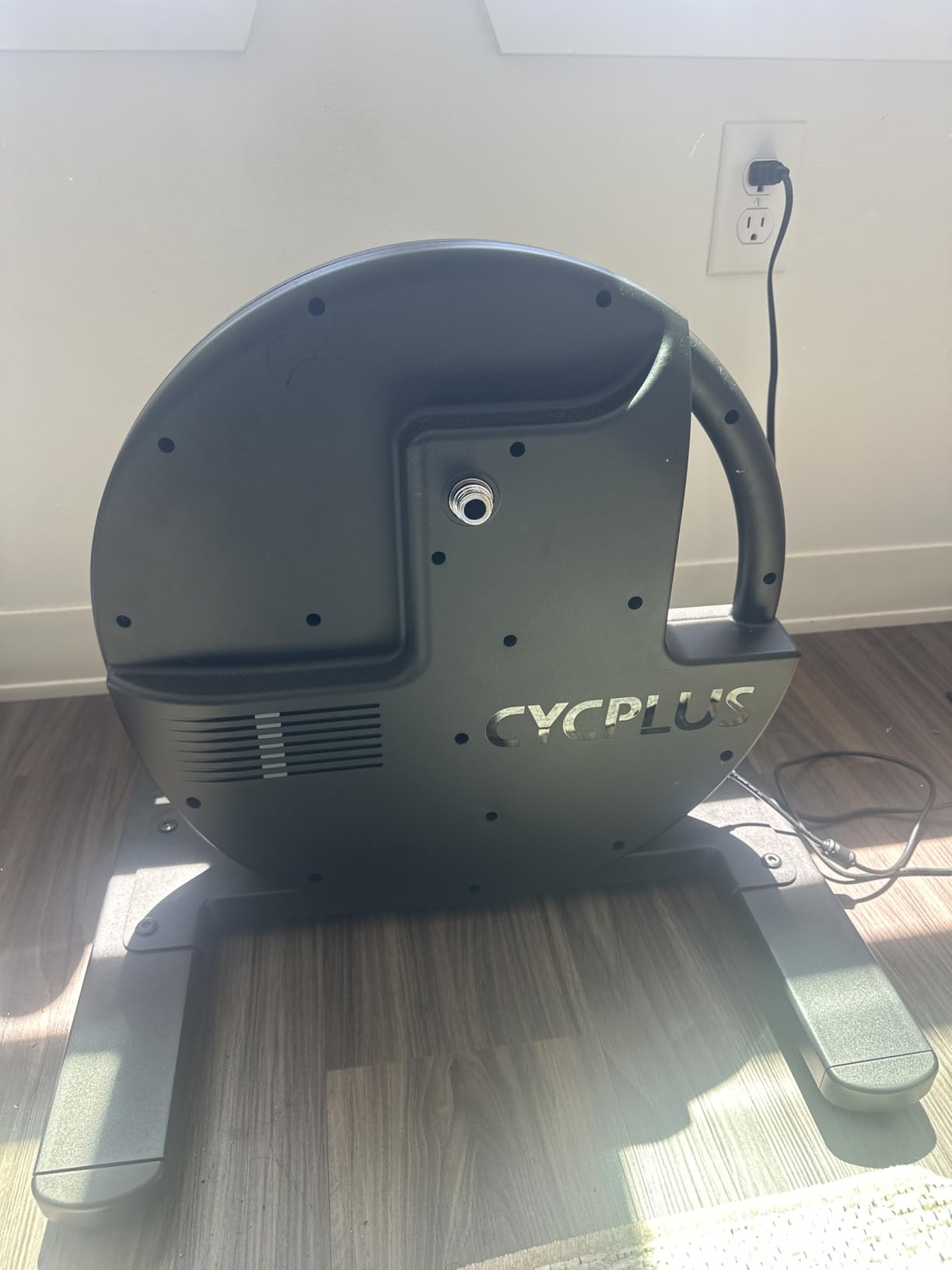
Connectivity is dual-mode BLE and ANT+, which covers Zwift and MyWhoosh. It can run self-powered or plugged in, and a built-in cooling fan handles sustained high power. QR and thru-axle adapters, a cassette spacer and tools are in the box.
Two gaps are real. No cassette is included, and virtual shifting needs the separately sold BC2 Shifter and does not work in ERG mode, so you are shifting on screen rather than with buttons.
Best for a first smart trainer
If your sessions are Zwift rides and weekly intervals rather than virtual racing with a full drivetrain, the R200 covers all of it. Dual-mode connectivity means it pairs with whatever computer or laptop you already own.
Owners also report that customer service replaced a faulty machine at no charge, which matters when your trainer cost is a large share of the setup.
Where it falls short
The cooling fan becomes audible at high power, which matters in a quiet flat. You also need to buy a cassette and cassette tools, and one owner reported brake drag after the unit heated during a long ride.
10. CYCPLUS T2 – quiet motor with a compact folding footprint
CYCPLUS Smart Bike Trainer T2 2200W Brushless Motor,20% Gradient
85 N·m motor
2,200 W
20% gradient
17.2 kg
Folds to 11.8 by 10.1 by 21 inches
Pros
- Smooth
- quiet motor with fluid pedalling cadence
- Power data matched owners' bike power meters
- Folds to a compact footprint for storage
- Works unpowered as a warm-up roller
- Two year warranty
Cons
- Limited headroom for very hard standing efforts
- Cassette supplied may be limited to Shimano 11-speed depending on seller
- In-app training log offers limited functionality
The T2 shares the R200’s brushless motor family with a higher 85 N·m of torque, ±1% accuracy across up to 2,200 W of resistance, and gradient simulation to 20%. It needs no calibration, which removes one step from setup entirely.
It rates 4.2 stars from 27 reviews, with 70% at five stars. Reviewers repeatedly praise the silence, the smoothness of power delivery and the value relative to a well-known premium trainer, and note that measured power matched their bike meters.
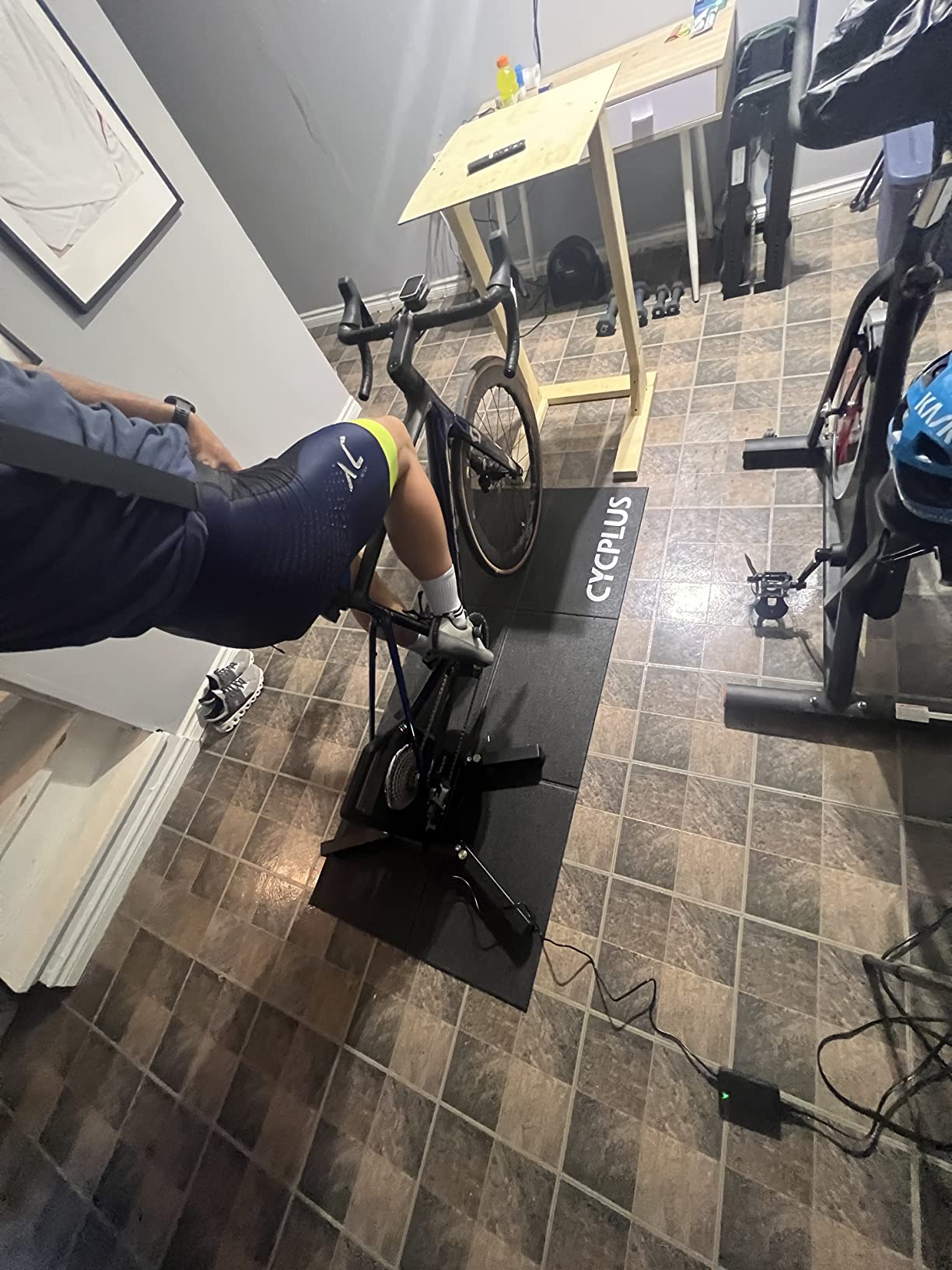
The practical headline is storage. It folds to 11.8 by 10.1 by 21 inches and weighs 17.2 kilograms, so it lives in a cupboard between sessions rather than occupying a corner permanently. Dual-mode BLE and ANT+ covers Zwift and the CYCPLUS app.
Stated rider limit is up to 220 lbs, which is the tightest ceiling in this group and worth checking against your own weight before buying. Virtual shifting runs through the separately sold BC2 Shifter.
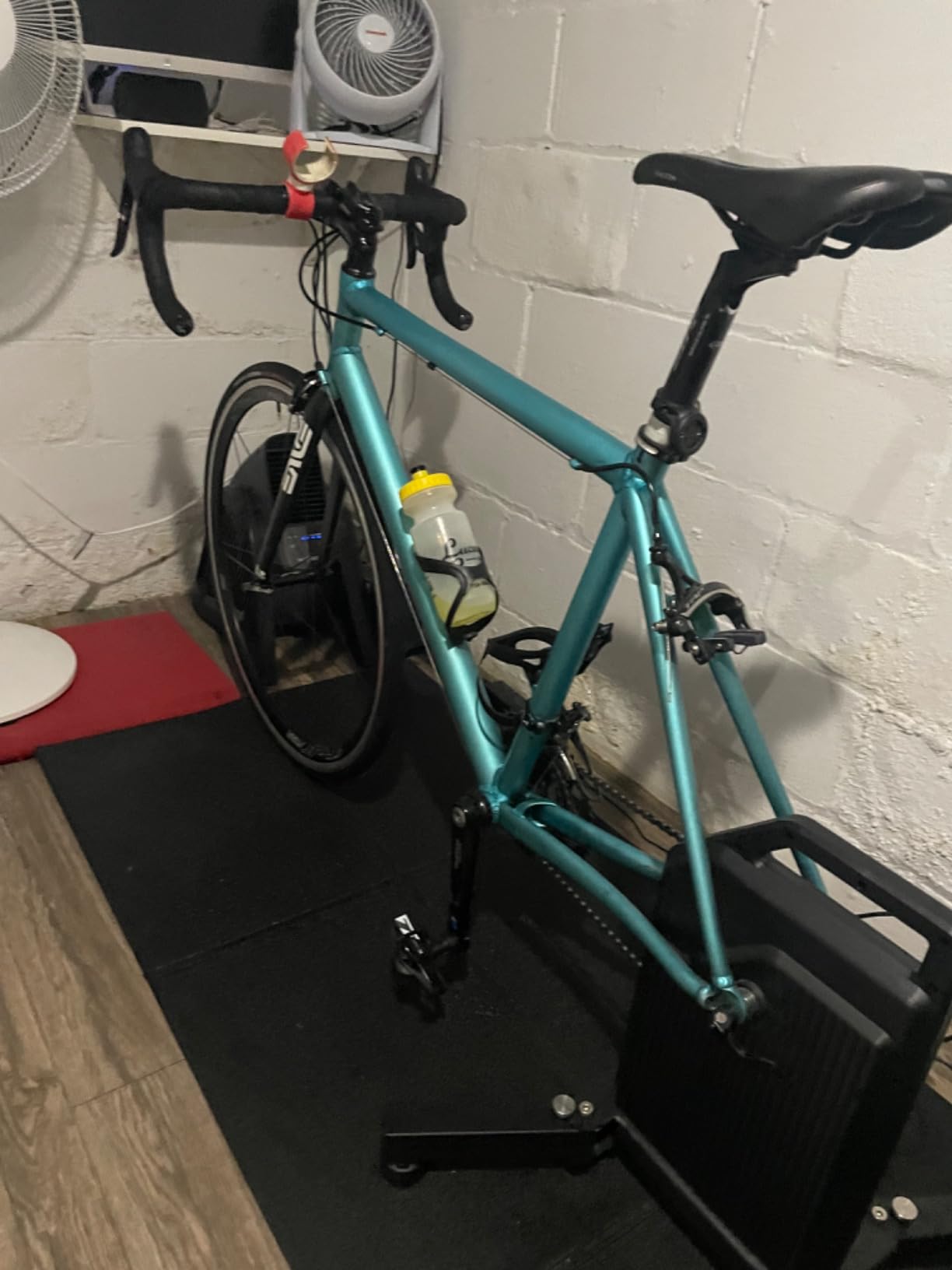
Best for flat-dwellers with no spare room
The triple silent design and folding frame are aimed squarely at people who cannot dedicate a garage. Using it unpowered as a warm-up roller before outdoor rides is a small, genuinely handy feature.
Stiff frame behaviour also earns praise, with owners reporting it stays stable when standing on the pedals and responsive firmware updates over the years.
Where it falls short
Some owners report resistance that is not enough for high-intensity standing efforts. The cassette supplied can be limited to Shimano 11-speed depending on the seller, and the in-app training log is sparse.
How to Choose a Direct Drive Trainer for Your Road Bike
Start with power accuracy, because it decides whether your intervals are repeatable. Everything from ±1% to ±3% looks identical on a ride, but only the tighter figures make a 20-minute test genuinely repeatable week to week. The R200, T2, KICKR V6 and NEO 3M all publish ±1% figures, and the Direto XR sits at ±1.5%.
Max watts is the number buyers overspend on. One rider on r/cycling described 600 W of max resistance, ±2-3% accuracy and 8% gradient as “more than enough,” and that matches our own view of what an ordinary rider needs. Nine of the ten trainers here deliver at least 1,500 W, so almost any of them clears that bar comfortably.
Simulated gradient is where the tiers separate. The Flux S caps at 10%, the KICKR CORE 2 reaches 16%, and the top of the range runs 18% to 25%. Match the number to your training: threshold work and base miles need very little, while Zwift climbing routes and Rouvy mountain stages want 20% or more.
Connectivity decides how the data arrives. Bluetooth and ANT+ at roughly 1 Hz are fine for ERG intervals, where resistance holds steady. Simulation mode with a road tilting under you needs faster updates, and that is where 2.4 GHz WiFi on the KICKR V6 and KICKR MOVE makes a visible difference in how the bike tracks the terrain.
Maximum load capacity is the most overlooked line in the spec sheet. The KICKR V6 and KICKR MOVE both publish 250 kilograms of load, which comfortably covers heavier riders. The CYCPLUS T2 states a limit of 220 lbs, and anything heavier should steer toward a higher published capacity.
Movement is the last big decision. Fixed trainers like the Neo 2T, Flux S and Direto XR stay put and are cheaper and more compact. Moving trainers add comfort on long sessions: fore-aft travel on the KICKR MOVE, multidirectional motion plates on the NEO 3M, and lateral AXIS feet on the KICKR V6.
Virtual shifting is worth considering seriously if you own one road bike. Running a single cog decouples your real gearing from the simulated ride, so a 50/34 or 52/36 chainring behaves the same way every session and drivetrain problems stop affecting your indoor work. The KICKR CORE 2 bundles the Zwift Cog and Click, and the CYCPLUS trainers offer virtual shifting through a separately sold BC2 Shifter.
Noise is a hardware quality you inherit rather than choose. Direct drive trainers are quiet by design, and owners of both Tacx models here describe near-silent running. If a neighbour is directly below you, add a thick rubber mat under the trainer and consider a trainer tyre instead of your fastest road tyre.
Warranty length is worth a look at too. The Flux S, Direto XR, R200 and T2 carry two-year terms, while the KICKR V6, KICKR MOVE and NEO 3M are covered for one year.
Road Bike Compatibility: Thru Axle, Quick Release and Cassette Fitment
Almost every road bike fits one of four axle standards, and every trainer here covers at least the first three. Quick release at 130 mm is the classic road standard, 135 mm covers mountain and older road frames, and 12×142 mm thru axles cover modern road and gravel. 12×148 mm Boost is the one that catches people out.
The KICKR V6, KICKR MOVE, KICKR CORE 2, Neo 2T, NEO 3M and Direto XR each include adapters covering 130 mm and 135 mm QR plus 12×142 and 12×148 thru axles. If your frame is Boost, check before ordering rather than after.
Cassette fitment is the second question. The Neo 2T includes a Shimano and SRAM freehub body, and the Direto XR’s compatible freehub covers Shimano and SRAM 9 to 11-speed, Shimano 12-speed road and SRAM NX and SX Eagle 12-speed. SRAM XDR frames are the exception across this group, since XDR needs its own freehub body.
Which means you may not need a cassette at all. Several trainers here do not include one, including the Flux S, Direto XR, KICKR CORE 2 and both CYCPLUS models, so plan to reuse a road cassette you already own or to run a single cog for virtual shifting. The NEO 3M is the exception that ships with an 11-speed cassette pre-installed.
Noise, Apartments and Floor Vibration
Two kinds of noise travel out of a trainer, and they need different fixes. Airborne noise is what housemates hear directly, and direct drive trainers are quiet at the source because there is no tyre rubbing a roller. Structure-borne vibration is what reaches the flat below, transmitted through the frame and floor rather than through the air.
Reducing vibration takes layers. A thick rubber mat under the trainer legs handles the worst of it, a trainer tyre instead of your fastest road tyre cuts high-frequency buzz, and placing the unit away from shared walls helps with airborne sound. A front wheel block also stops the front wheel transmitting impacts into the floor.
Quiet running is one of the strongest recurring themes in user reports. Tacx trainers are consistently praised for quietness, the Flux S in particular, and the CYCPLUS T2 uses a triple silent design aimed at the same goal. The one exception worth naming is the R200’s cooling fan, which becomes audible at high power.
ERG Mode vs Simulation Mode on a Direct Drive Trainer
ERG mode holds a target wattage and the resistance does not change, no matter what the virtual road is doing. It is the right mode for threshold work, VO2 max intervals and any session where you need the numbers to stay exactly where you put them.
Simulation mode lets the application change resistance to match the gradient, so a 6% climb feels like a 6% climb. It is what you want for open-ended riding, group events and racing, and it is where a trainer’s gradient ceiling and data refresh rate start to matter.
The practical compromise most riders use is to run ERG for structured workouts and simulation for everything else. One trainer and one bike can cover both, and the difference in perceived effort between them is smaller than riders expect once power accuracy is within a couple of percent.
Buying a Used Direct Drive Trainer: What to Inspect
Used-market uncertainty comes up constantly in forums, and buyers ask which models are most reliable second-hand and will not need parts. The recurring theme is that direct drive trainers with fewer moving parts tend to need fewer replacements over time.
Run the resistance test first. Ask the seller to power it up and hold 500 W, then check that the unit meets target without stalling or drifting. A unit that needs calibration every session is telling you something about its torque sensor.
Check the physical parts next: drive belt or belt wear, the freehub body, the leg bolts and the axle adapters. Missing adapters are common and easy to replace, while a cracked leg or a slipped belt is not. Look at the cassette or cog for a worn chainline and check the quick release skewer still clamps properly.
Confirm connectivity before you commit. An old Bluetooth-only trainer may pair poorly with a new head unit, and firmware support ends eventually for some models. Ask whether the seller still has the original power supply, since those are the parts most often lost.
Riders who share one trainer between two bikes should also ask whether a second set of axle adapters is included. Multi-bike households and mixed QR and thru-axle pairs are the situations where that omission costs the most.
Frequently Asked Questions
Do I need a cassette for a smart trainer?
Most smart trainers need a cassette or a single cog, but not all of them ship with one. The Tacx NEO 3M includes an 11-speed cassette pre-installed, while the Tacx Flux S, Elite Direto XR and both CYCPLUS trainers require you to source a compatible cassette. Many riders reuse a road cassette they already own. Check the freehub body type before buying, since Shimano HG, Shimano 12-speed and SRAM XDR are not interchangeable.
Are direct drive trainers better than wheel-on trainers?
Direct drive trainers are better for almost anyone training seriously indoors. They remove tyre friction, so power readings stay accurate within a couple of percent and the resistance curve is smoother. Wheel-on trainers are quieter on price and lighter to carry, but they slip on hard efforts and drift as tyres wear. The community consensus leans toward upgrading from wheel-on to direct drive once the budget allows.
Can you use a direct drive trainer with a thru axle road bike?
Yes, and most modern direct drive trainers include thru axle adapters in the box. The Wahoo KICKR V6, KICKR MOVE, KICKR CORE 2, Tacx Neo 2T, Tacx NEO 3M and Elite Direto XR all ship adapters covering 12×142 mm and 12×148 mm. Legacy quick release road frames at 130 mm and 135 mm are also covered by every trainer on this list. Verify your exact axle standard before ordering.
Does the Zwift Cog work with any bike?
The Zwift Cog works with almost any direct drive trainer because it is a single sprocket rather than a full cassette. The bike itself needs a frame that accepts the trainer axle, which covers nearly all road bikes with the right adapter. The Zwift Click adds remote shifting buttons, but pairing can be unreliable with older computers or televisions, and configuring virtual shifting typically requires an active Zwift subscription.
How loud is a direct drive trainer in an apartment?
Direct drive trainers are quiet at the source because there is no tyre rolling against a roller. The Tacx Flux S is repeatedly described by owners as near-silent in shared indoor spaces, and Tacx models are the most commonly praised for quietness in user reports. Floor vibration travels further than airborne noise, so add a thick rubber mat, use a trainer tyre and position the unit away from shared walls.
What wattage do I need from a trainer?
Most ordinary riders need far less than the headline figures suggest. One rider on r/cycling described 600 W of maximum resistance, plus 2-3% accuracy and 8% gradient, as more than enough for regular training. Every trainer in this roundup delivers at least 1,500 W, so check published load capacity only if you are a heavier rider or you sprint at very high power, where the KICKR V6 and KICKR MOVE rate 250 kilograms.
Do smart trainers damage carbon frames?
Direct drive trainers do not clamp the frame at all, which removes the main carbon frame concern. The rear wheel comes off and the axle sits in the dropouts under a modest torque spec. Frame manufacturers do vary in their warranty wording around indoor use, so check your bike maker’s position if your frame is carbon and you plan to mount it frequently.
Which Direct Drive Trainer Should You Buy?
The Garmin Tacx Neo 2T is our pick from the best direct drive trainers for road bikes in 2026. It combines the largest verified review base in the group, a 4.7-star average, 2,200 W of load, a broad adapter package for both quick release and thru axle frames, and a foldable frame for storage.
Buy the Wahoo KICKR CORE 2 if you want the Zwift Cog and Click in the box and the lightest chassis here, or the Elite Direto XR if steep climbing is the priority. The KICKR V6 earns its place for ride feel and 250 kg of load capacity, while the CYCPLUS R200 covers the same essentials at the entry level.
Whichever you pick, check your axle standard and freehub type first, and add a rubber mat to your basket before the first session. Our direct drive wheelbase reviews cover the powered drivetrain side of indoor riding if you want to build a complete setup.