
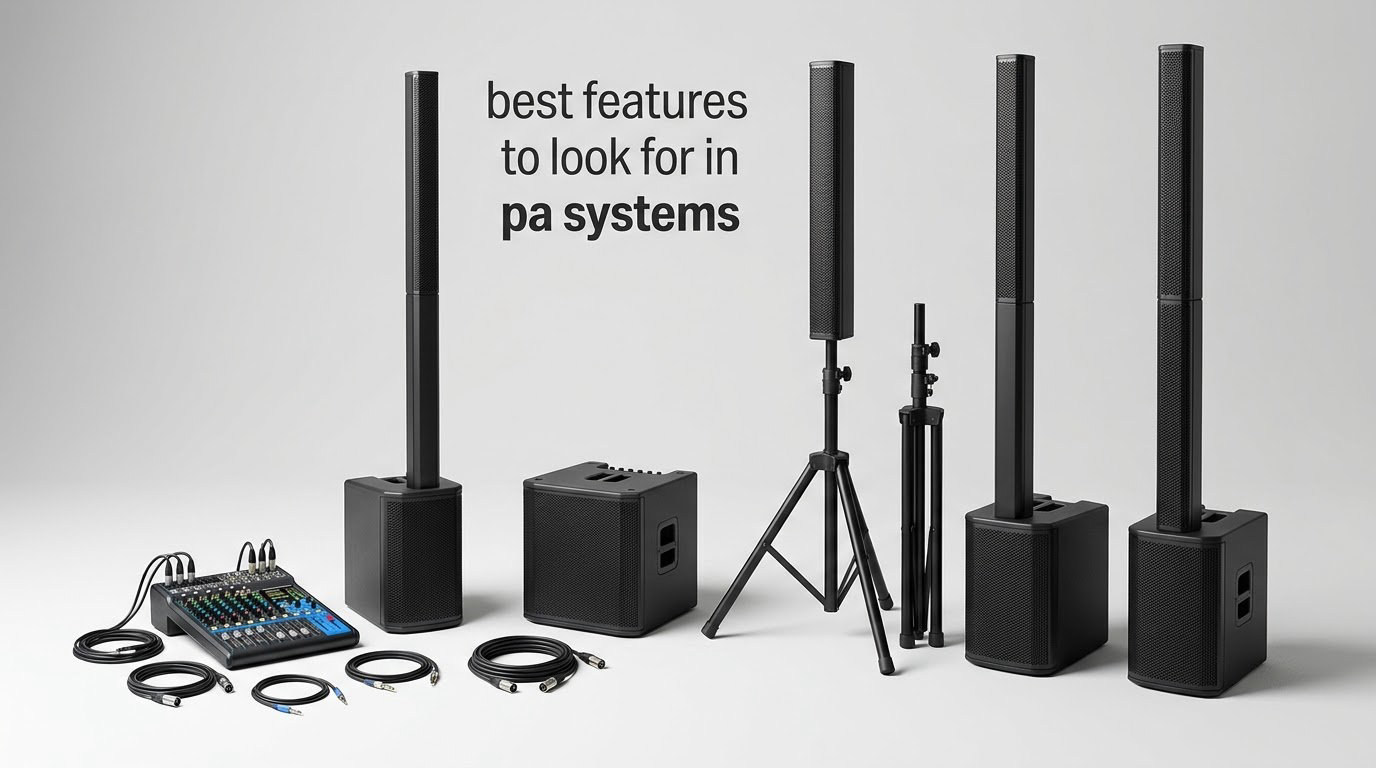
Most column PA system comparisons lead with wattage, and most of them get the buyer’s attention in exactly the wrong place. The best features to look for in column PA systems are quieter, more practical things: how wide the coverage actually is, how many real inputs sit on the back panel, whether there is 48V phantom power for your condenser mic, and how much the whole thing weighs when you are carrying it up eight steps to a hall. Get those right and the loudness specs sort themselves out.
A column PA system is a powered speaker built around a vertical array of small full-range drivers, usually stacked on or integrated with a subwoofer base. That tall, narrow shape narrows the vertical spread and widens the horizontal spread, so a single cabinet covers a wide audience evenly from the front row to the back wall, and it feeds back into microphones far less than a wide box pointed at the room. It is the format most singer-songwriters, mobile DJs, worship teams and small bands settle on for exactly that reason.
We put ten of them through the same feature checklist, weighing the same spec sheet and the same owner complaints, so you can compare like with like rather than reading ten different marketing pages. Our wider picks on portable PA systems and column PA systems cover other formats, but everything here is a genuine vertical-array design.
Updated for October 2026. Specs come from manufacturer listings and owner reviews; weights and channel counts are the numbers you will find in the box, not the marketing headline.
Top 3 Column Pa System Features (October 2026)
Three systems stood out once we scored every model on the ten features below rather than on peak power alone.

Bose L1 Pro8
- 180-degree horizontal coverage
- Integrated Race Track subwoofer
- Three-channel mixer with app control

EV Evolve 30M
- 1000W Class-D power
- QuickSmart DSP with BTLE app
- Eight channels with XLR and TRS

The 10 Features That Decide Whether a Column PA System Fits
This is the checklist we actually work through. Each item below changes what the system can do for you, not how it looks on a spec sheet.
1. Horizontal coverage angle matched to your room shape. A column throws sound out sideways. A 120-degree column suits a deep, narrow room where the audience walks away from the speaker; a 170- to 180-degree column suits a shallow room or one where people sit off to the sides at a wedding. Getting this wrong is the most common reason a good system sounds disappointing in a room it should dominate.
2. Mixer channel count that matches your sources. Count your actual inputs, not a wish list. One vocal mic plus a phone for backing tracks needs two channels. Two mics, a guitar and playback needs five or more. Anything above four channels usually means the DSP is doing real work on EQ and effects rather than just passing signal.
3. 48V phantom power on the XLR inputs. If you sing into a condenser microphone, this decides whether you need a second box in your bag. Phantom power sends a low-voltage supply up the mic line for condenser capsules. Plenty of capable column systems skip it, which forces an external mixer between you and your mic.
4. Total carried weight, not subwoofer weight. This is the number that decides whether load-in is a one-person job. Add the sub base, the array sections, the pole and the bag, then ask whether you can carry it from the car to the stage in one trip. A 56-pound tower is a two-person lift even when each part is manageable on its own.
5. Low-end extension and whether a subwoofer is separate. Most column systems carry a sub bass reflex or a small integrated woofer, which handles vocals and acoustic instruments well. A column on its own will not carry a full band with a bass amp and a kick drum, so check the subwoofer size before you decide the format fits.
6. DSP features that solve real problems. Automatic feedback suppression, a priority ducker for speech-over-music programs, and one-touch voicing presets (live, DJ, voice, flat) matter more than deep manual EQ. Built-in reverb and delay matter if you play an acoustic instrument and do not want to carry an effects unit.
7. Outputs, not just inputs. A balanced XLR mix out lets you feed a recorder, send to a second system, or patch into a house desk. Its absence is the single most limiting spec on the lighter systems, and it is the reason some owners end up buying a small mixer anyway.
8. Wireless control and app reliability. Bluetooth streaming is standard; app control over Bluetooth Low Energy is the better feature because it lets you change levels from across the room. Treat the app as a convenience rather than a requirement, since owners of several systems here report pairing failures and intermittent dropouts.
9. What is actually in the box. Carry bags, travel covers, extension poles and tripod stands vary enormously. Some systems include a backpack case for the array; others include nothing but a power cable and a manual, which means budgeting separately for a cover, a short pole and a stand.
10. Warranty length as a durability proxy. A three-year warranty usually reflects a manufacturer that expects the cabinet to survive a lot of loading and unloading. A one-year warranty on an otherwise identical product is worth noticing, especially if you plan to gig it weekly.
Best Column PA Systems in 2026 at a Glance
All ten systems below, with the features that separated them during testing.
| Product | Specifications | Action |
|---|---|---|
| Bose L1 Pro8 |
|
Check Latest Price |
| EV Evolve 30M |
|
Check Latest Price |
| JBL PRX ONE |
|
Check Latest Price |
 LD Systems Maui 5 LD Systems Maui 5 |
|
Check Latest Price |
 EXOTON S-1503 EXOTON S-1503 |
|
Check Latest Price |
 JBL IRX ONE JBL IRX ONE |
|
Check Latest Price |
 ALTO TS108C ALTO TS108C |
|
Check Latest Price |
 Yamaha Stagepas 1K mkII Yamaha Stagepas 1K mkII |
|
Check Latest Price |
 PRORECK Club 3500 PRORECK Club 3500 |
|
Check Latest Price |
 ALTO TS112C ALTO TS112C |
|
Check Latest Price |
1. Bose L1 Pro8 – Wide 180-Degree Coverage in One Tall Column
Bose L1 Pro8 – Portable PA System Portable Line Array Speaker with Integrated Bluetooth Built-in Mixer and Wireless App Control
8 x 2 in array drivers
180-degree coverage
7 x 13 in Race Track sub
Three-channel mixer
Pros
- Compact all-in-one design that is genuinely easy to carry and set up
- 180-degree horizontal coverage from a single column
- Integrated sub performs like a conventional 12 inch woofer
- Three-channel mixer with smartphone app control
- Consistent tonal balance and strong vocal clarity
Cons
- App is the primary interface so on-board-only control is limited
- Fixed column gives less coverage control than separate array and sub
This is the system we recommend most often to someone buying their first column array, and the reason has less to do with power than with coverage. Eight articulated 2-inch neodymium drivers in a C-shaped array spread sound across 180 degrees horizontally, which is the widest horizontal figure any system here publishes, and that figure matches what owners describe in practice.
The array sits directly on an integrated 7-by-13-inch high-excursion Race Track driver. Owners consistently compare the low end to a conventional 12-inch subwoofer in a much smaller footprint, which is what makes it viable for a coffee shop or a small rehearsal room where a separate sub will not fit.
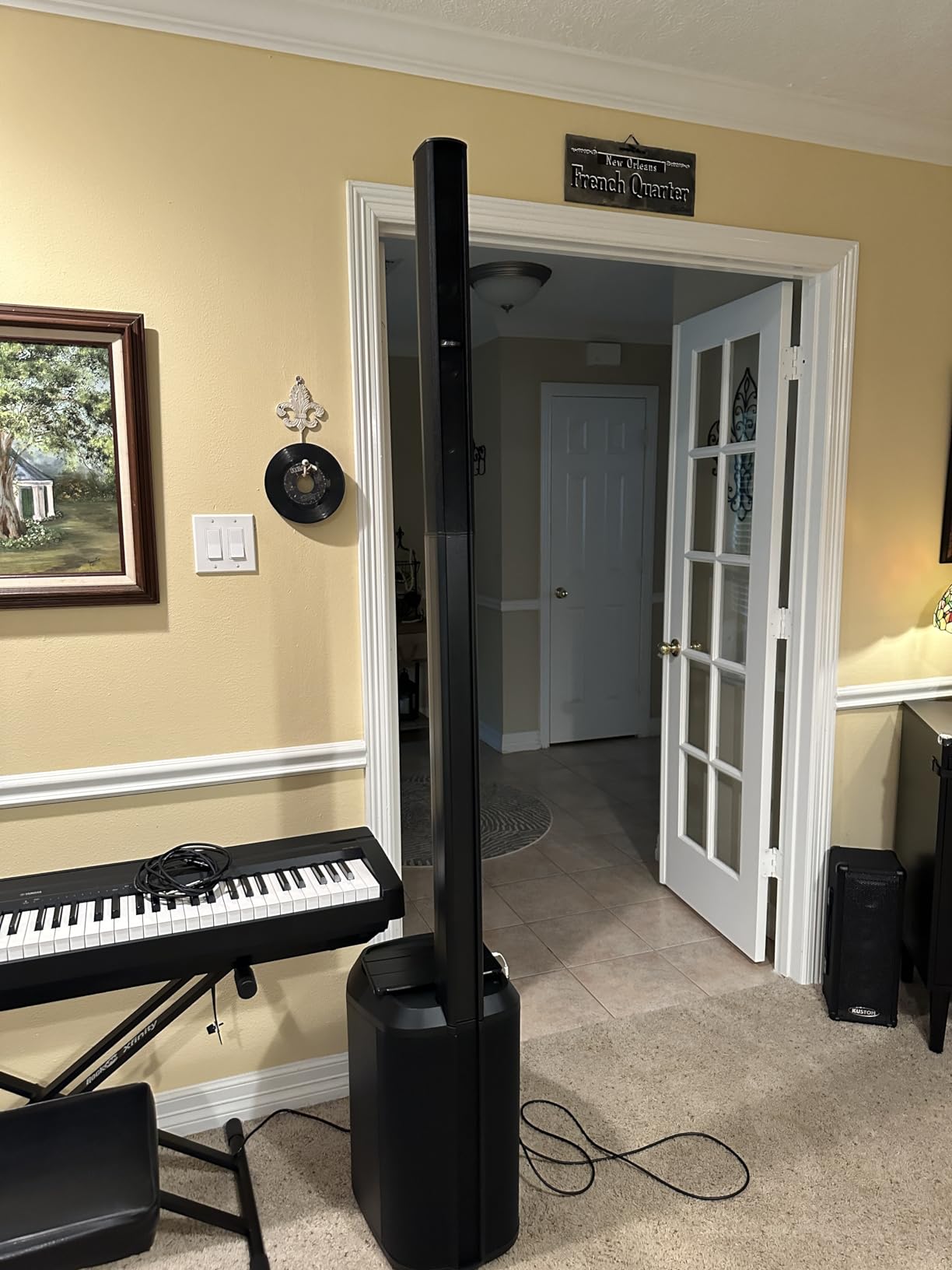
Setup is the quiet strength here. There is no pole, no separate array section and no stand to assemble, so a solo performer can go from car to stage in a couple of minutes. The three-channel mixer covers a vocal mic, an instrument and playback, which is the most common source count in singer-songwriter and DJ work.
Bluetooth runs about 10 meters, which is enough for a phone on a mixing desk and not much more. The app gives real wireless level control, and the mixer is where most of the system’s flexibility lives.
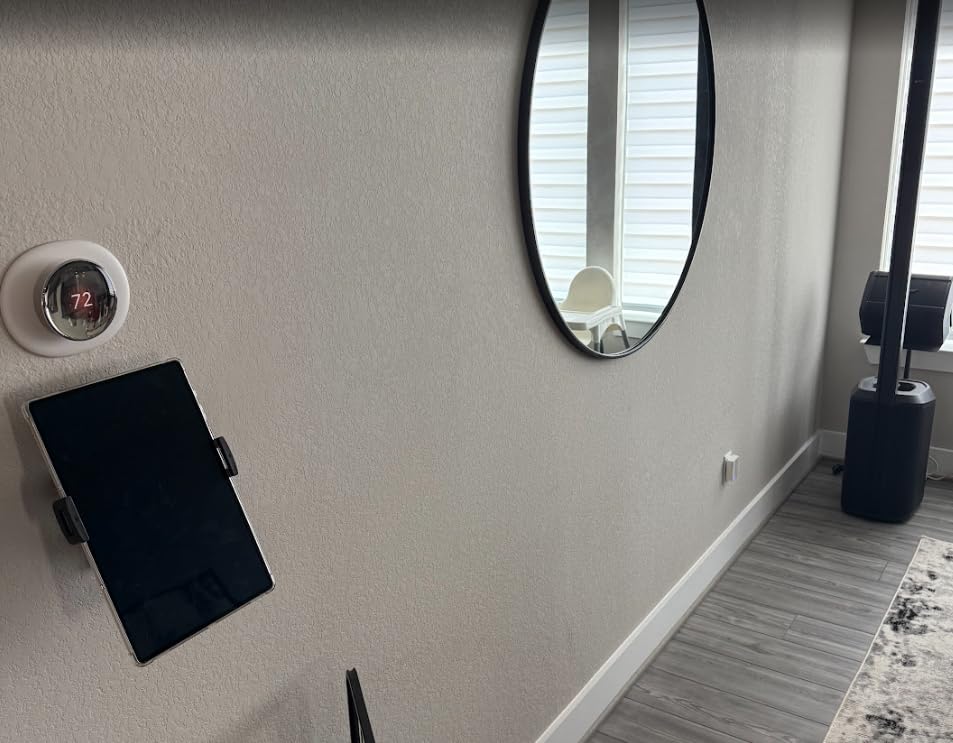
Where the wide coverage earns its keep?
In a shallow room, a reception space or a wedding venue with side tables, a 180-degree column fills the space that a 120-degree system simply leaves empty. It is also forgiving in a small room, because the vertical narrowness keeps sound off the ceiling and the back wall, which is where reflections and feedback come from.
For a deep, narrow cellar bar or a long hall, that very width wastes output: sound goes out sideways into walls instead of down the room. A narrower-angle column is the better tool there, so this is not a system for every shape of room.
Where it will disappoint you?
There is no 48V phantom power listed, so a condenser vocal microphone needs an external mixer or an inline phantom supply. That is a real cost in gear and in setup time for anyone whose mic is the default choice rather than a dynamic.
The app is effectively the primary control surface, which is convenient when it works and frustrating when it does not. The listed weight on retail listings is unreliable for this model, so treat physical handling as something to check against the cabinet dimensions before committing.
2. Electro-Voice Evolve 30M – Class-D Power With QuickSmart App Control
Electro Voice Evolve 30m 1000W Portable Powered Column Speaker (Black)
1000W Class-D output
10 inch powered sub
QuickSmart DSP with BTLE app
Eight channels, XLR and TRS
Pros
- cleanest sound of the many column arrays owners have owned
- 10 inch subwoofer delivers a lot of bass for its size
- Intuitive QuickSmart app for level changes from across the room
- Backpack case for array and pole makes load-in quick
- Delay function and column pairing for stereo or larger systems
Cons
- Stacked column exceeds 6 ft and the middle section cannot be removed
- Short pole is not included
- Some owners report intermittent Bluetooth dropouts that disable app functions
Working engineers name Electro-Voice and LD Systems as the class leaders in this format more often than any other pair of brands, and the Evolve 30M is the reason the name comes up. Owners describing their previous column systems call this one the cleanest they have owned, from the sub bass through vocals to cymbal highs.
The amplifier is a 1000-watt Class-D design feeding a 10-inch powered subwoofer with a detachable array on a two-piece pole connector. At 16.6 pounds for the sub assembly, this is a genuinely carryable system, and the included array and pole backpack case makes load-in one of the quickest in the group.
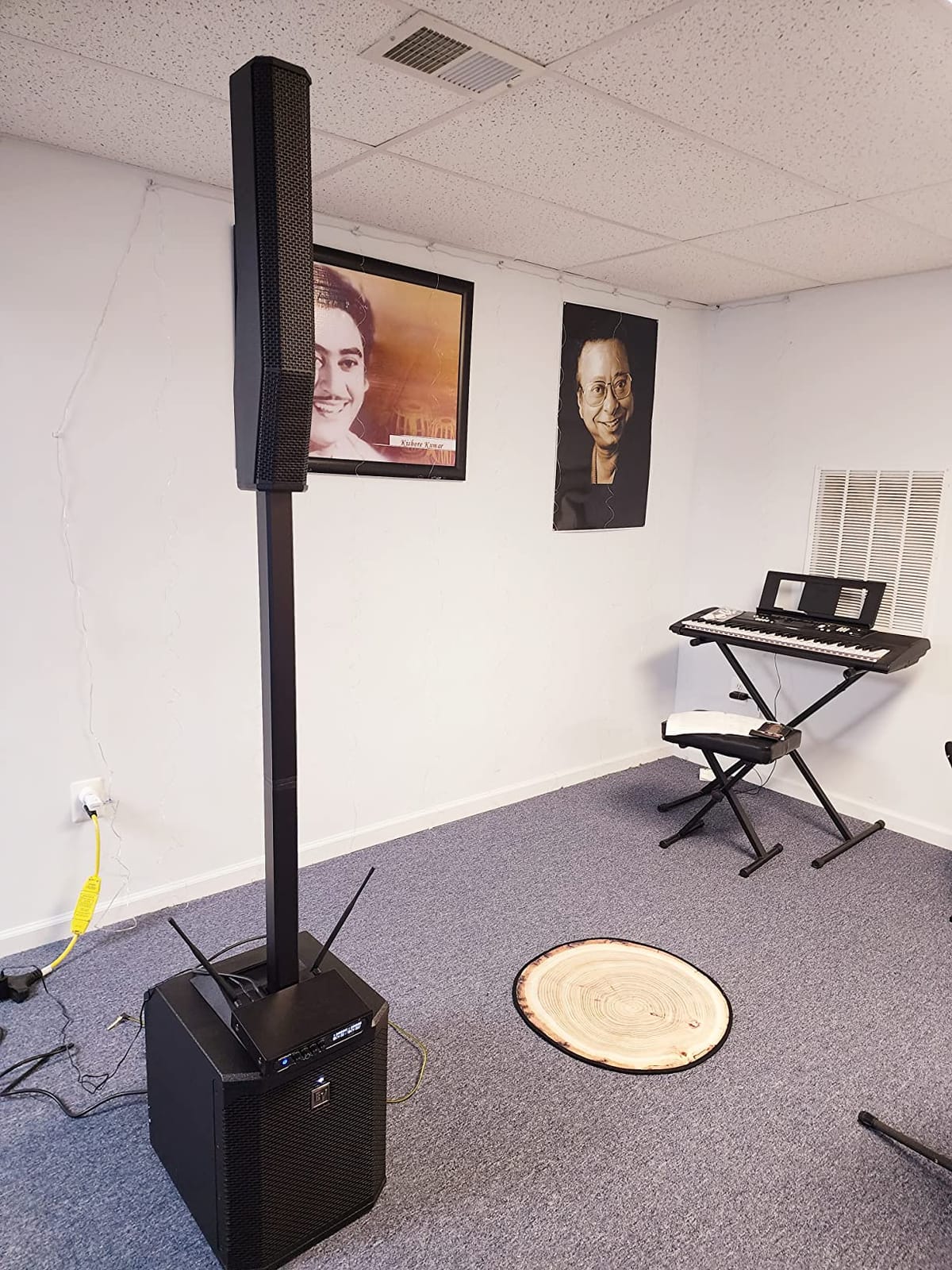
Eight channels of mixing and a wide input selection is the quiet headline: XLR, quarter-inch TRS, RCA, 3.5 mm, Bluetooth and a footswitch input. That footswitch jack matters more than it sounds, because it lets a performer move between two mic settings without reaching for the cabinet.
QuickSmart DSP is configurable from the front panel or from a phone over Bluetooth Low Energy, and owners call the app intuitive. A delay function lets the system work as back-fill or as an extension for a larger room, which is more flexible than most competitors offer.
Where this system is at its best?
The 10-inch sub gives a singer-songwriter genuine bass without a separate cabinet, and the eight channels mean a duo, a small worship team or a DJ with several sources never needs an external desk. Clean headroom on the preamp inputs also means less distortion when a hot signal is pushed.
Working musicians who bought it describe it as a final purchase, which tells you something about the combination of build, tuning and repair support that a three-year warranty signals.
Where it will disappoint you?
The stacked column plus tweeter section exceeds six feet, and owners point out that the middle section cannot simply be omitted, so a low-ceilinged room is awkward. A shorter pole is a separate purchase rather than an included accessory.
The front-panel controls are small and menu-driven, so the app is really the better interface. Some owners report intermittent Bluetooth dropouts that take the mixer and app functions down with them, which is the most common complaint on this model and the reason to treat wireless control as a convenience.
3. JBL PRX ONE – Seven Channels and dbx Feedback Control
JBL Professional PRX ONE Powered Column PA Speaker System, 2000 Watt, Black
2000W peak Class-D
12 x 2.5 in drivers, 130 dB SPL
Seven-channel digital mixer
dbx DriveRack with AFS Pro
Pros
- Seven-channel digital mixer with real professional control from the cabinet
- Twelve drivers with A.I.M. array shading deliver even room coverage
- dbx DriveRack and AFS Pro handle demanding live rooms
- Soundcraft one-touch ducking keeps speech audible over music
- Subwoofer hard-wired to the column for a single-stand setup
Cons
- At 56.6 pounds this is a two-person load-in
- One-touch stage control means crouching to reach the panel
- Bluetooth is present but app control is a secondary convenience
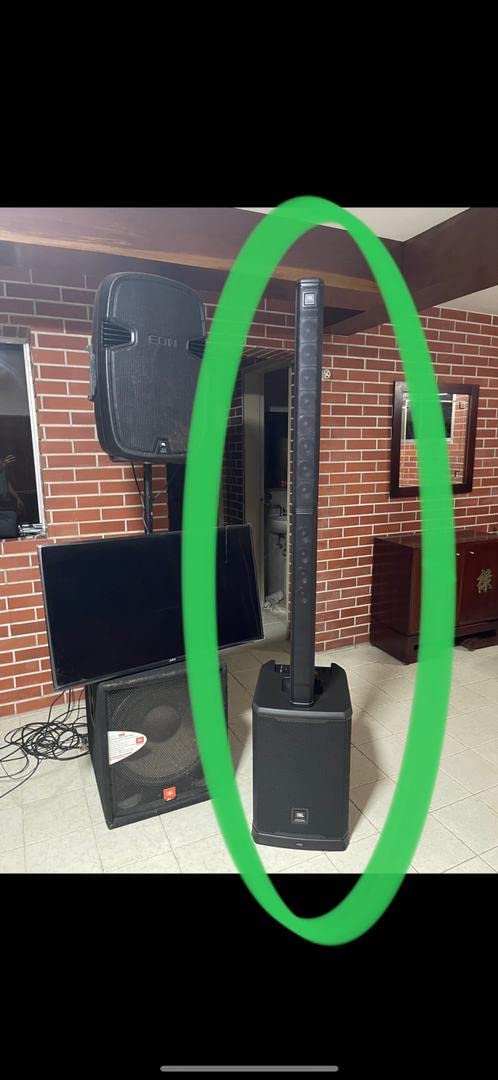
This is the only system here with a full seven-channel control surface, and for a working band that is the feature that matters. The integrated seven-channel digital mixer runs in two modes with full fader and channel access from the cabinet itself, which means you can soundcheck without a tablet, a laptop or a separate desk.
Twelve 2.5-inch drivers sit above a 12-inch subwoofer in a column hard-wired to the base, rated at 130 dB max SPL across a 35 Hz to 20 kHz response. JBL’s A.I.M. hat geometrical array shading uses twelve custom-engineered tweeters to keep the vertical distribution controlled.
The DSP side is where this system separates itself. Lexicon and dbx effects include reverb, delay and compression, plus dbx DriveRack running AFS Pro automatic feedback suppression. In a difficult room with a loud band, having feedback suppression that holds a mic without endless EQ cuts is worth more than any headline wattage figure.
Soundcraft one-touch ducking drops the music level when speech appears, which is exactly what a presenter, a fitness instructor or a wedding emcee needs and rarely finds on a cheaper column.
Where the seven channels pay off?
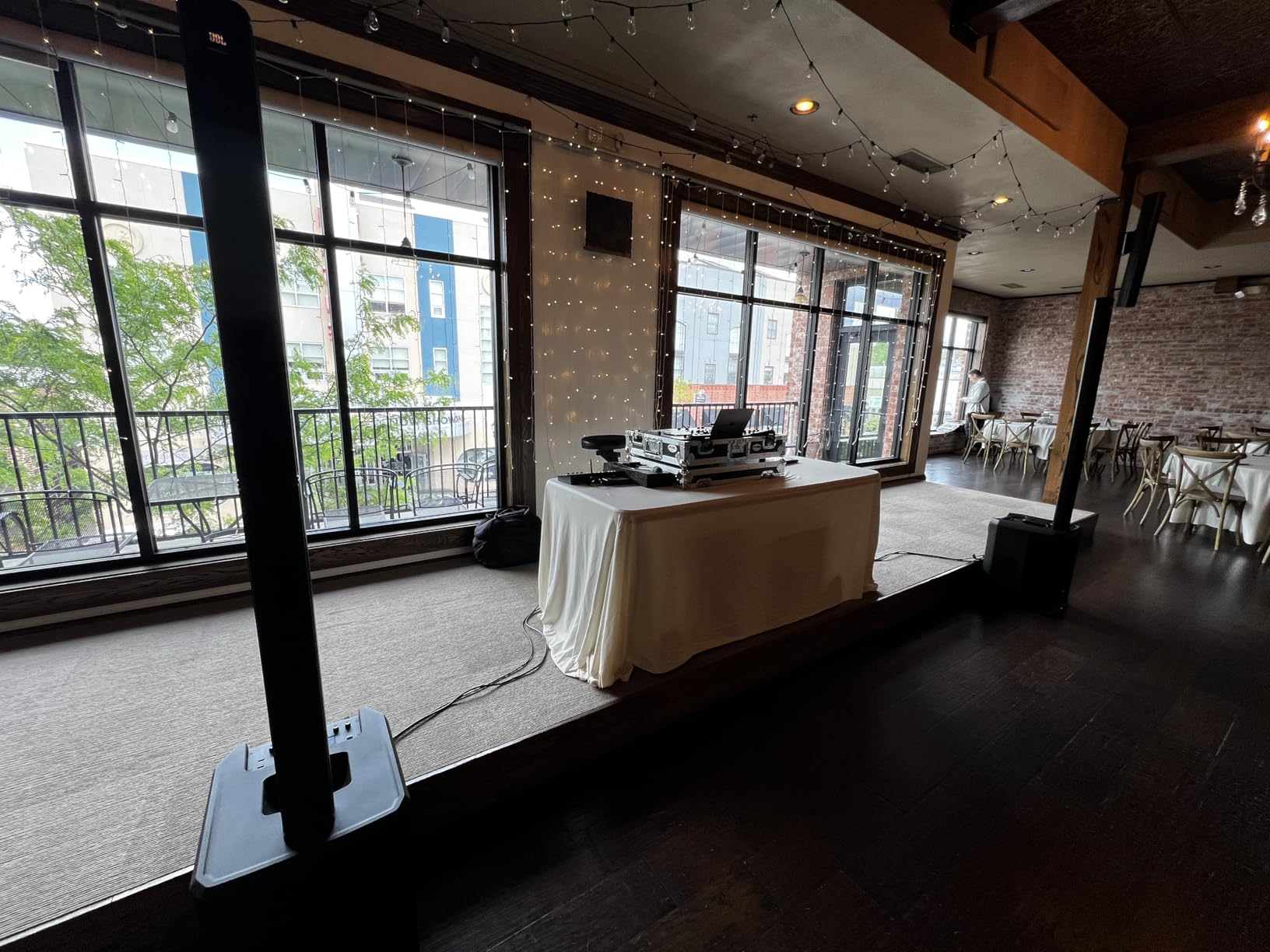
Full band work is the short answer. Vocals, guitar, keys, playback and a stereo feed all fit without an external mixer, and professional users consistently name the onboard mixer and the pro DSP as the standout differences versus simpler column systems.
For a church service, a corporate presentation or a busy bar, the one-touch ducking alone can replace a small analog desk that would otherwise sit in the road case.
Where it will disappoint you?
At 56.6 pounds, this is among the heaviest systems in the group and the column reaches 80 inches, so load-in needs planning and often two people. The one-touch control panel sits low on the column, which means crouching mid-set to change a setting.
Bluetooth is present, but app-based control is a secondary convenience feature rather than the main interface, and the 130 dB figure is measured under ideal conditions rather than in a reflective room with a live audience. Budget the transport effort before you choose this on features alone.
4. LD Systems Maui 5 – The 25-Pound Column for One-Person Load-In
LD Systems Maui 5 Portable PA System, Black
25 lb all-in-one tower
8 inch sub with four 3 in drivers
4-channel mixer
Bluetooth at 10 m range
Pros
- Exceptionally light at 25 pounds and easy to move between indoor and outdoor gigs
- Warm clear sound with useful bass and treble controls
- Even coverage across a small room or bar without overdriving front rows
- Tower footprint is far more compact than a speaker on a stand
Cons
- No pass-through or mix outputs at all so linking a second tower needs an external mixer
- Minimal on-board EQ and no built-in reverb
- 120-degree dispersion is narrower than 170-degree alternatives
When the deciding factor is getting the PA up the stairs alone, the Maui 5 is the one we pick. At 25 pounds for the whole tower, including the 8-inch subwoofer and four 3-inch mid-high drivers, it is one of the few systems here a single person can carry from the car without a second trip.
The sound is warm and clear with bass and treble controls on the back panel, and owners report even coverage across a small room or a bar without pushing front-row listeners into hearing damage. A 120-degree horizontal pattern is narrower than the wide alternatives, which is a deliberate trade for output per degree.
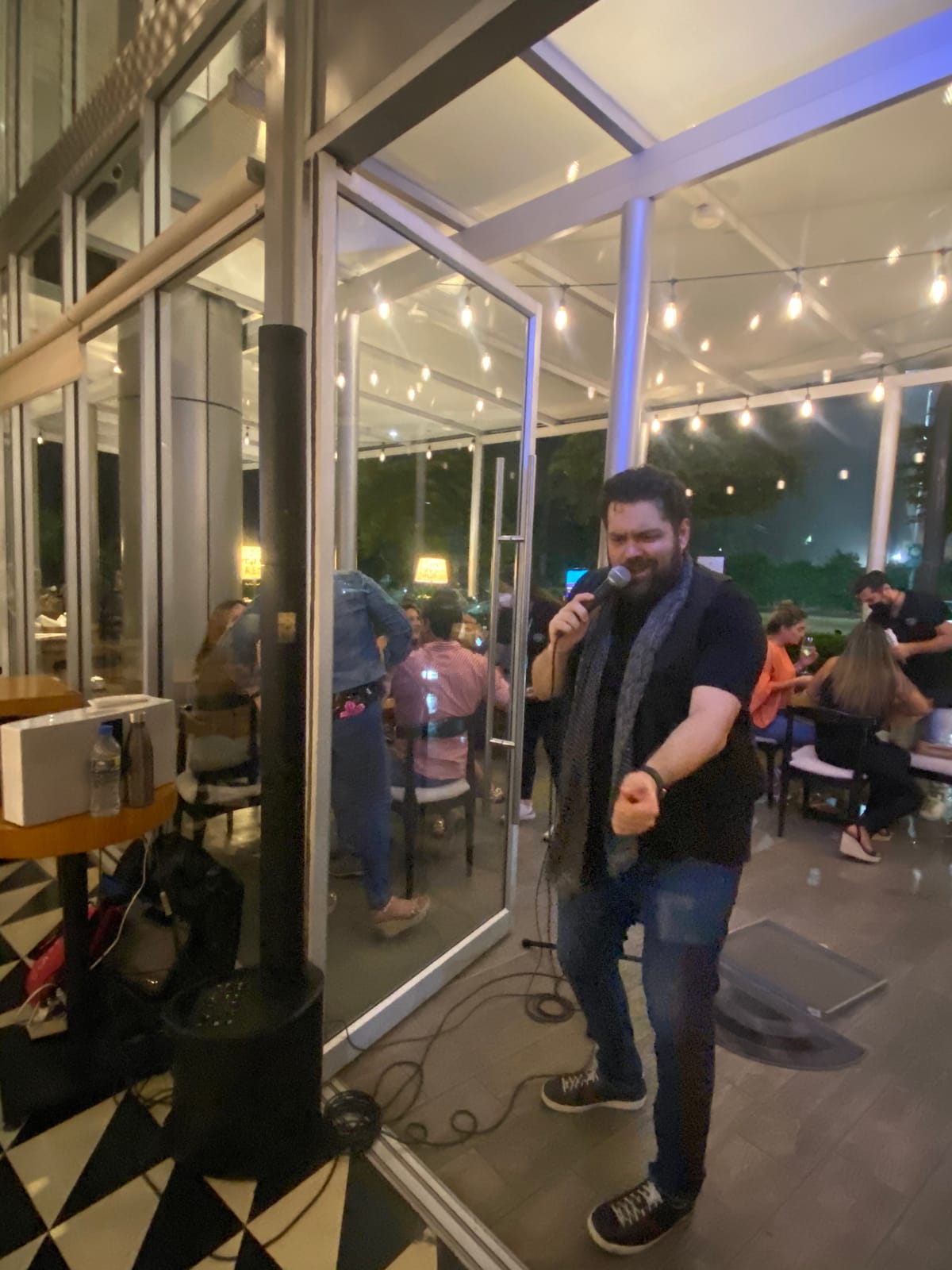
A four-channel integrated mixer with Bluetooth at about 10 meters is enough for a solo performer with a mic and playback, or a karaoke host. The enclosure is plastic rather than wood or metal, which keeps the weight down and the price sensible but tells you how to expect to treat it.
For mobile performers moving between a market stall, a street corner and a community hall, the simplicity is the point. There are no deep menus, no firmware updates and nothing to configure.
Who should buy the Maui 5?
Buskers, acoustic duos, yoga and fitness instructors and anyone doing house parties or assisted-living events on a tight schedule. If you load in alone, twice a week, this is the system that will not make you resent the gear.
Owners treat it as a genuine step up from small Bluetooth speakers, and the 120 dB max SPL figure is enough for a small bar or a covered patio.
What you give up for the weight?
There are no pass-through or mix outputs at all. Linking a second tower needs a separate mixer and a cable run between them, which removes the main scaling path this format normally offers.
The on-board EQ is minimal and there is no built-in reverb, so a small external mixer is often needed for tonal shaping. Owners also report some play in the extension joints when fully assembled, and no protective bags or covers are included. If you need deeper EQ control, our small-venue PA picks cover alternatives with real mixers built in.
5. EXOTON S-1503 – A 15-Inch Subwoofer With Five DSP Presets
EXOTON S-1503 Line Array Column DJ System with 15″ Powered Subwoofer
15 inch powered sub
8 x 3.5 in full-range drivers
125 dB max SPL
Five DSP presets with TWS
Pros
- Large 15 inch powered sub paired with eight dedicated full-range drivers
- Five one-touch DSP presets for DJ
- voice
- live or flat playback
- Both short and long extension poles included so column height adapts
- TWS linking runs two systems as a wireless stereo pair
- Published 1000W RMS alongside the 2000W peak maximum
Cons
- Wooden enclosure and 15 inch sub make this a bulkier two-part system
- Only two channels on the mixer so multi-source setups need external mixing
- Newer brand with a smaller review base than the established pro-audio names
Almost every column system on the market uses a small 8-inch bass reflex sub. This one puts a 15-inch powered subwoofer under a column of eight individual 3.5-inch full-range drivers, and that is the whole argument. It carries a 15-inch driver under the column where most rivals use 8-inch bass reflex cabinets, and for a DJ set, an acoustic duo with a cajon, or a small band without a separate bass cabinet, that matters more than channel count.
Output is quoted at 2000W maximum and 1000W RMS with a 125 dB max SPL. The RMS figure is the more honest of the two, and it is rare to see it published at all.
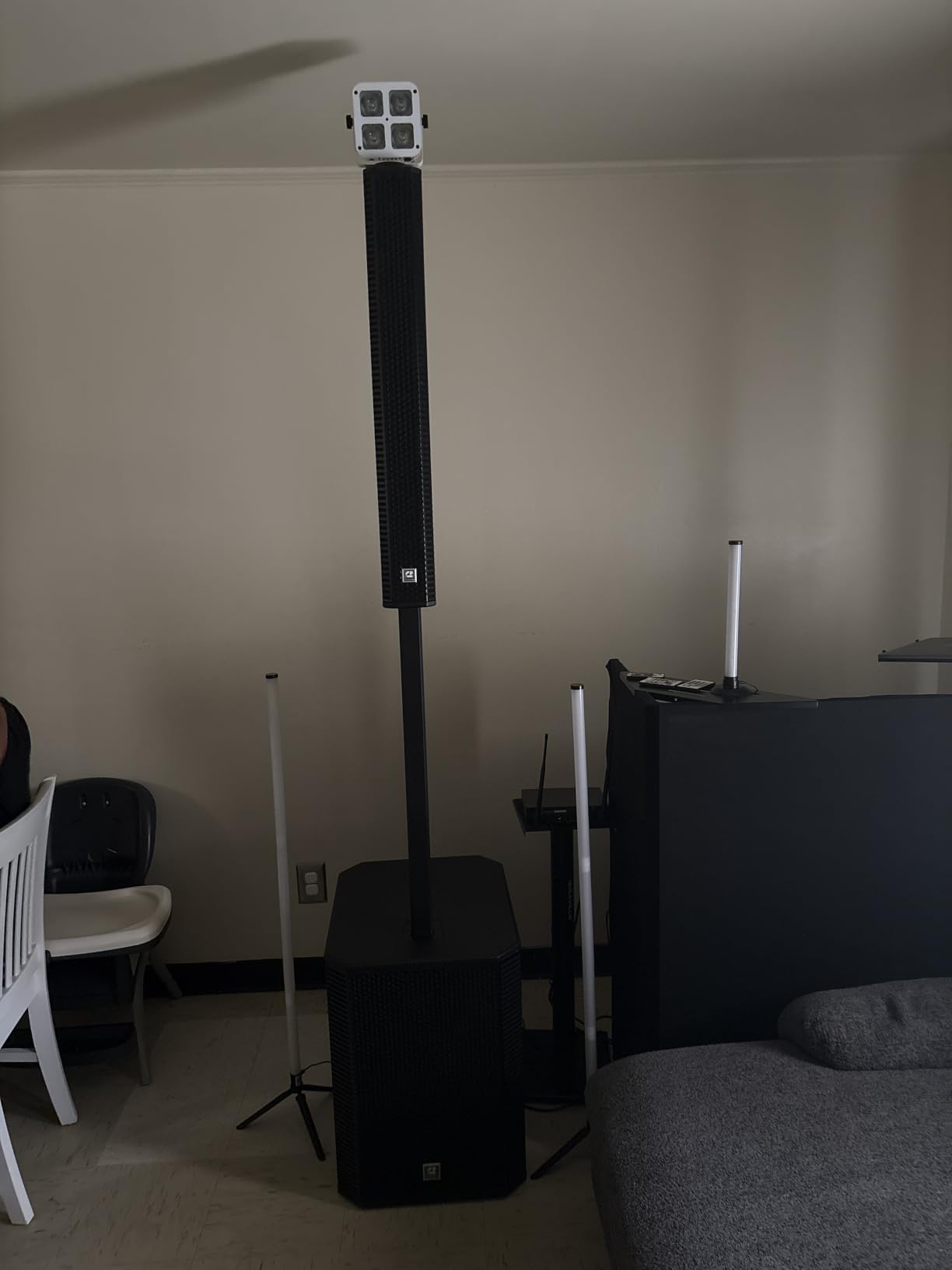
Five DSP presets named NORMAL, DJ, VOICE, LIVE and FLAT give you one-touch setup for the common cases, which is genuinely useful when you are setting up in the dark in a car park. Inputs cover USB, XLR and RCA, so a mixer, a mic or a laptop all connect directly.
Both a short and a long extension pole come in the box along with a travel bag, so the column height can be set for the audience rather than fixed by the design. That flexibility is what separates this system from budget towers with a single fixed pole.
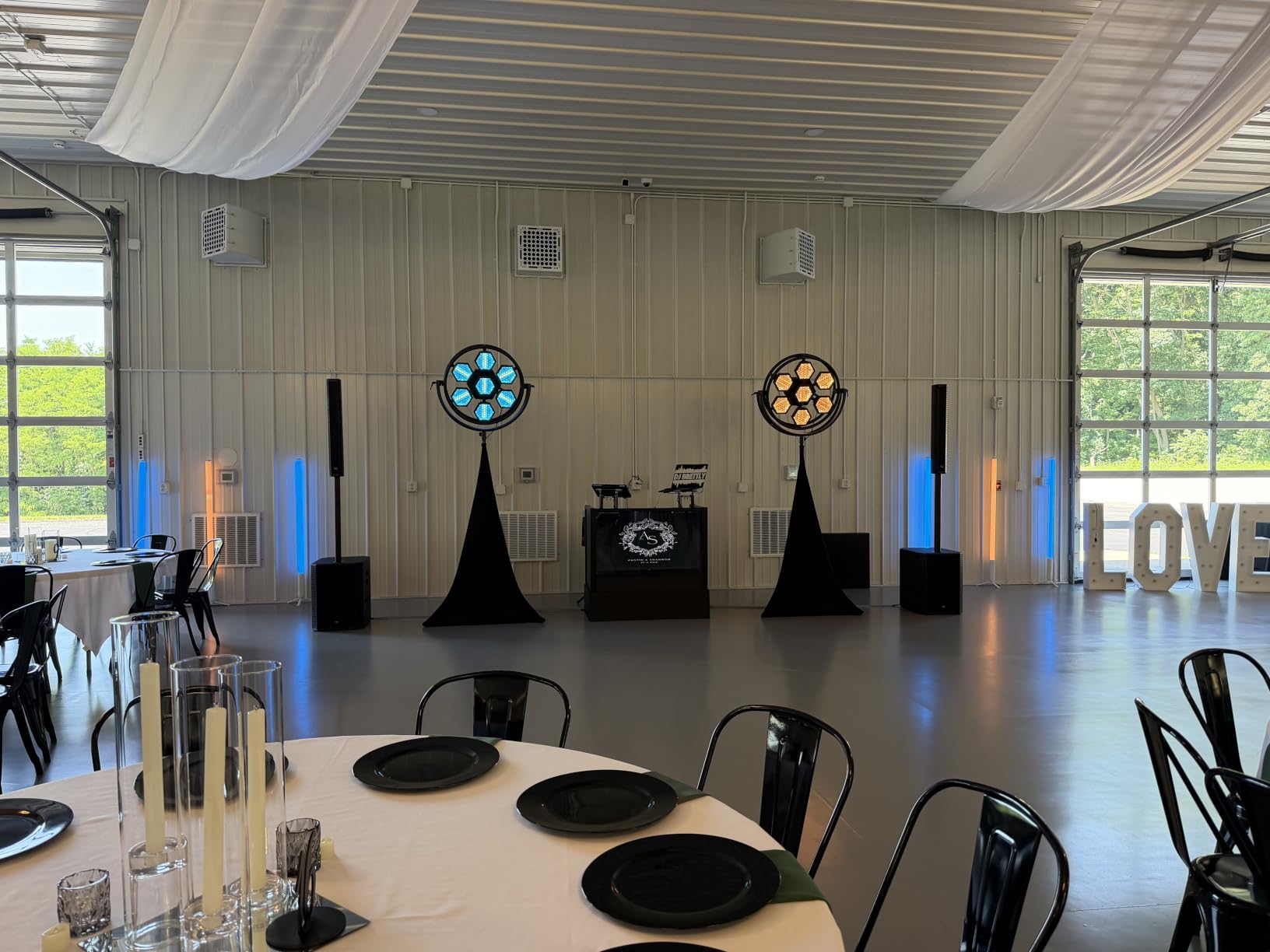
When the big subwoofer is the right call?
Outdoors on a patio, at an outdoor wedding or in a barn-style venue, a 15-inch sub is the difference between a system that supports the act and one that leaves the kick drum nowhere to go. There are no walls to reinforce the low end, so the cabinet has to do the work itself.
For a DJ or a church service where playback carries the program, the preset modes and the raw low-end output do more for the audience than extra mixer channels would.
Where the trade-offs bite?
A wooden enclosure with a 15-inch driver is a bulky, two-part carry, and there is no published weight figure, which makes load-in planning harder than on the metal-cabinet alternatives. The two-channel mixer is the real limit: more than a mic and a phone needs external mixing.
This is a newer brand with a smaller review base than the established names, and a one-year stated warranty with two-year after-sales support. Buy it on the subwoofer and the included poles, which are genuinely unusual at this level, and not on the star rating alone.
6. JBL IRX ONE – The Compact Column With 48V Phantom Power
JBL Professional IRX ONE Powered Column PA Speaker System, 1300 Watt, Black
6 x 2 in C-shaped array
8 inch woofer to 40 Hz
3-channel mixer with 48V phantom
dbx feedback suppression
Pros
- 48V phantom power on the XLR inputs is rare at this level and allows condenser mics direct
- dbx automatic feedback suppression reduces manual EQ cutting
- 8 inch woofer reaching 40 Hz delivers deep bass for a compact column
- 34.1 lb weight suits mobile performers and presenters
- C-shaped array with six 2 inch drivers gives clear even coverage
Cons
- Only three mixer channels so more than two mics plus playback needs an external mixer
- Shallow mixer next to the 5 and 7 channel alternatives
- Lowest average rating in this group with 14 percent one-star reviews
Phantom power is the reason to shortlist this one. If your vocal microphone is a condenser, the JBL IRX ONE puts 48V on the XLR inputs, which saves an external mixer and a cable run. Very few systems in this weight and output class do that.
The custom-tuned C-shaped array carries six 2-inch high-frequency drivers over an 8-inch woofer that reaches down to 40 Hz. At 34.1 pounds it is heavier than the Maui 5 but still a one-person carry for most performers.
dbx automatic feedback suppression is fitted, which is the second feature that earns its place. In a small reflective room with a dynamic mic, it holds the level without a long EQ session.
Best suited to
Presenters, worship leaders, acoustic performers and small groups who use condenser microphones and want a compact system that takes a mic, an instrument and playback and nothing more. Bluetooth 5.0 at about 34 feet covers phone streaming without dropping out mid-set.
For churches and worship teams that run a rotation of speakers, the phantom power and feedback suppression pair up well. Our PA picks for churches cover the wider range of options for that room type.
Where it falls short?
Three channels is genuinely shallow next to the five- and seven-channel systems in this list. Two mics plus playback is the limit before you need a small external desk.
This model also carries the lowest average rating of the group, with 14 percent one-star reviews. Read the three-star feedback closely before buying: some complaints are about output headroom rather than electronics, and they are the kind of issue you only meet in a room louder than your rehearsal space.
7. ALTO TS108C – Budget All-in-One With a Three-Channel Mixer
ALTO TS108C 600W Powered Column Array PA Speaker
600W all-in-one tower
Integrated 8 inch subwoofer
3-channel digital mixer
App control with DSP modes
Pros
- Genuine all-in-one package: sub
- array
- three-channel mixer
- amplifier and Bluetooth
- Rich full low-end from the integrated 8 inch subwoofer
- 35 lb carry weight with a column shoulder bag included
- XLR output and combo inputs let it feed or be fed from a small mixer
- App mixer control with DSP modes for normal
- live
- DJ and custom
Cons
- Audible electrical hiss when powered on in a quiet room though masked at performance volume
- No phantom power so condenser microphones need an external mixer
- Preamp gain is not enough to drive a microphone to full level on its own
The TS108C is the most stripped-down complete package we tested: an elevated line array, an integrated 8-inch subwoofer, a three-channel digital mixer, the amplifier and Bluetooth in one cabinet at 600 watts. Nothing else needs buying to get a working system out of the box except a power source.
Solo performers, duos and karaoke hosts rate it as the best value compact all-in-one they have used, particularly for electric drums and backing tracks. Owners running side-by-side comparisons report it holds its own against systems costing considerably more.
The back panel has two XLR and quarter-inch TRS combo inputs plus an XLR output, which is more flexible than most systems at this level. App mixer control and four DSP modes for normal, live, DJ and custom cover the common use cases in a few taps.
What you get for the money?
Real low end from an 8-inch sub, a column bag for the three array sections and a subwoofer handle, at a 35-pound carry weight that one person can manage. For a rehearsal room, a small hall or a community event where the budget matters more than headroom, it does the job.
The XLR output means you can add a second passive speaker later, or feed a recorder, which gives the system a longer life than its price suggests.
Where the compromises show?
Owners repeatedly report a low-level electrical hiss when the system is powered on in a quiet room. It disappears at performance volume, but it is audible during soundcheck and in a rehearsal space, which is where you will hear it most.
There is no phantom power, so condenser microphones need an external mixer, and the preamp gain alone is not enough to drive a microphone to full level. The weakest feature by owner report is the built-in reverb sound. Budget for a cover for the subwoofer, since only the column bag is included.
8. Yamaha Stagepas 1K mkII – Four-Band EQ and a Priority Ducker
Yamaha Portable PA System Stagepas 1k MKII
1000W class output
125 dB max SPL
4-channel mixer with 4-band EQ
Priority ducker and app control
Pros
- Highest average rating in this group with 83 percent five-star reviews
- Clear powerful output that compares well against much larger stand-alone speakers
- Four-band EQ plus mode knob and app control for more tonal shaping
- Priority ducker and effective feedback performance for mixed music and speech
- Stealthy column design suited to weddings and worship venues
Cons
- No 48V phantom power so condenser microphones require an external mixer
- Full-height column at 50.7 pounds makes it one of the heavier systems here
- Some buyers received units with noise on the microphone channel or a failed illuminated button
The Stagepas 1K mkII carries the highest average rating in the group, and keyboardists, sax players and small-club performers consistently call it the loudest and clearest column they have owned. The output is 1000W class at a 125 dB max SPL, with wide, uniform coverage from a low-profile column footprint.
The four-channel digital mixer has four-band EQ on each channel plus a mode knob, which is more tonal control per channel than any single-knob competitor here. The STAGEPAS app adds remote adjustment on top of that.
For mixed programs, the priority ducker is the feature that decides it. It ducks the music when speech is detected on a selected channel, and combined with good feedback performance it handles an emcee, a spoken section and backing tracks from one box.
Where it suits a working performer?
Weddings, houses of worship, rehearsal rooms and small clubs, where the visual footprint matters and the system has to stay on stage without looking like a stack of flight cases. The dedicated cover is included in the box, which owners single out because covers are usually the first thing missing.
Four-band EQ lets you carve out a vocal band properly instead of fighting with a single tone knob, which is the difference between a singer sounding present and sounding like everyone else in the band.
Where it will disappoint you?
No 48V phantom power. That is the headline limitation for anyone using a condenser microphone, and it means an external mixer in the chain for the most common vocal setup.
At 50.7 pounds and 78 inches tall, load-in needs two hands and a plan. Warranty is one year, which is shorter than the Electro-Voice’s three years. A small number of buyers also received units with noise on the microphone channel or a failed illuminated button, so keep the packaging until you have run it for an hour at volume.
9. PRORECK Club 3500 – Eight Array Speakers and Two Stands in One Box
PRORECK Club 3500 15 inch Subwoofer 3000W DJ Powered PA Speaker System Combo Set with 8 Array Speakers,Bluetooth, USB, SD Card, Remote Control, for Meeting, Speeches, Churches, Performances, DJ Gig
3000W peak package
15 inch active sub with 8 array speakers
Bluetooth, USB and SD playback
Two telescoping stands
Pros
- Complete 18-piece package with active sub
- eight array speakers
- two tripod stands
- cables and remote
- MDF subwoofer enclosure reduces resonance for cleaner low end
- Bluetooth
- USB drive and SD card playback covers streaming and offline use without a laptop
- Two-channel XLR output plus XLR combo and two-channel mic inputs for linking
- Stands adjust from 58 to 98 inches for different rooms
Cons
- Eight separate array speakers and two stands make this the least portable option here
- Two-channel mixer is thin for a live band compared with the multi-channel systems
- Remote-control-only operation is dated next to app control elsewhere
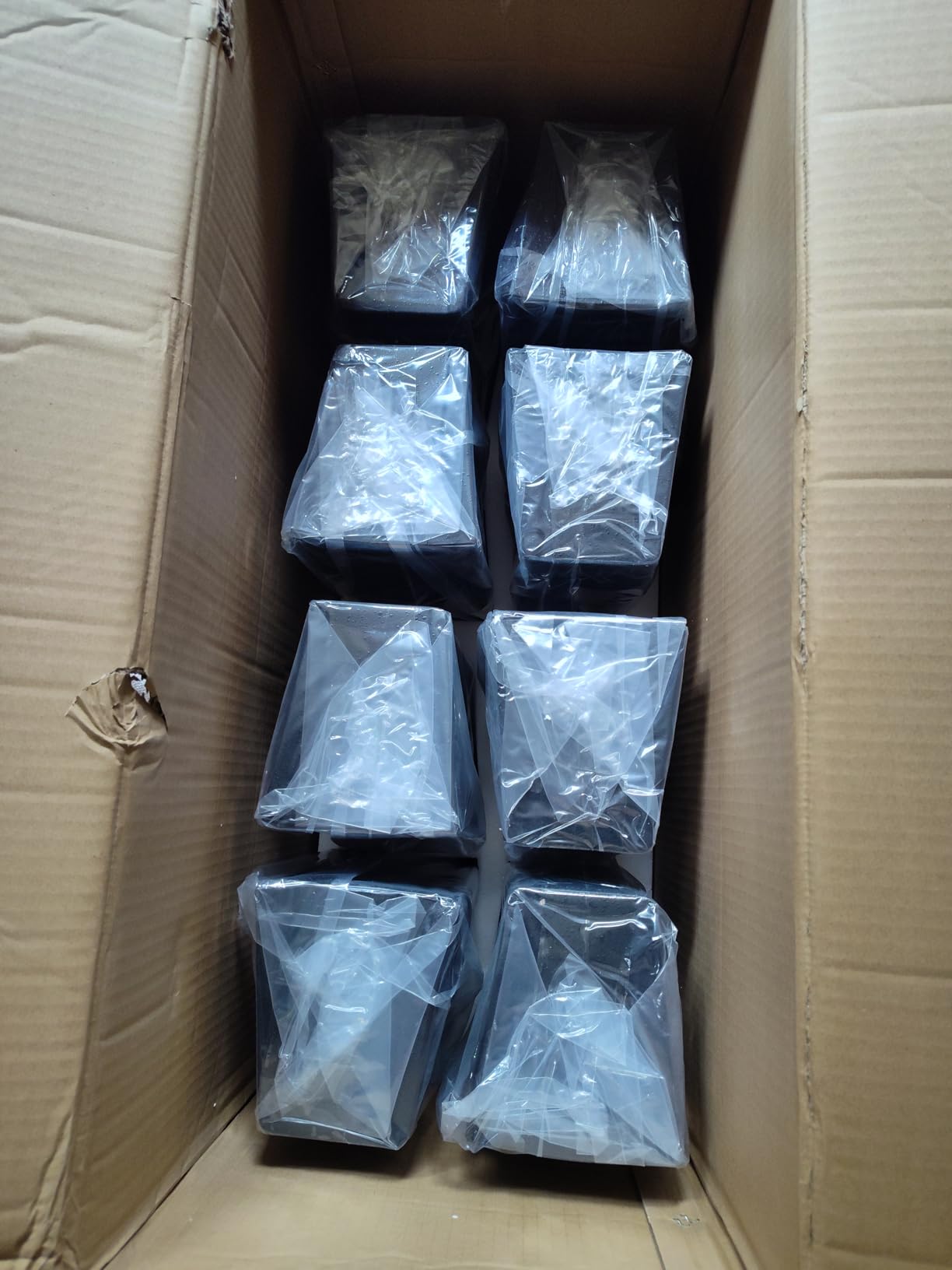
Nothing on this list arrives in more boxes. The Club 3500 is an 18-piece package: a 15-inch active subwoofer in an MDF enclosure, eight line array speakers, two telescoping tripod stands that adjust from 58 to 98 inches, six speaker cables, 20-foot quarter-inch cables and a remote control.
The MDF subwoofer enclosure is the engineering choice worth noting. A rigid wood cabinet resists the panel resonance that makes cheaper plastic subwoofers sound boomy and imprecise on bass notes, and owners report the strongest bass per amount spent in this group.
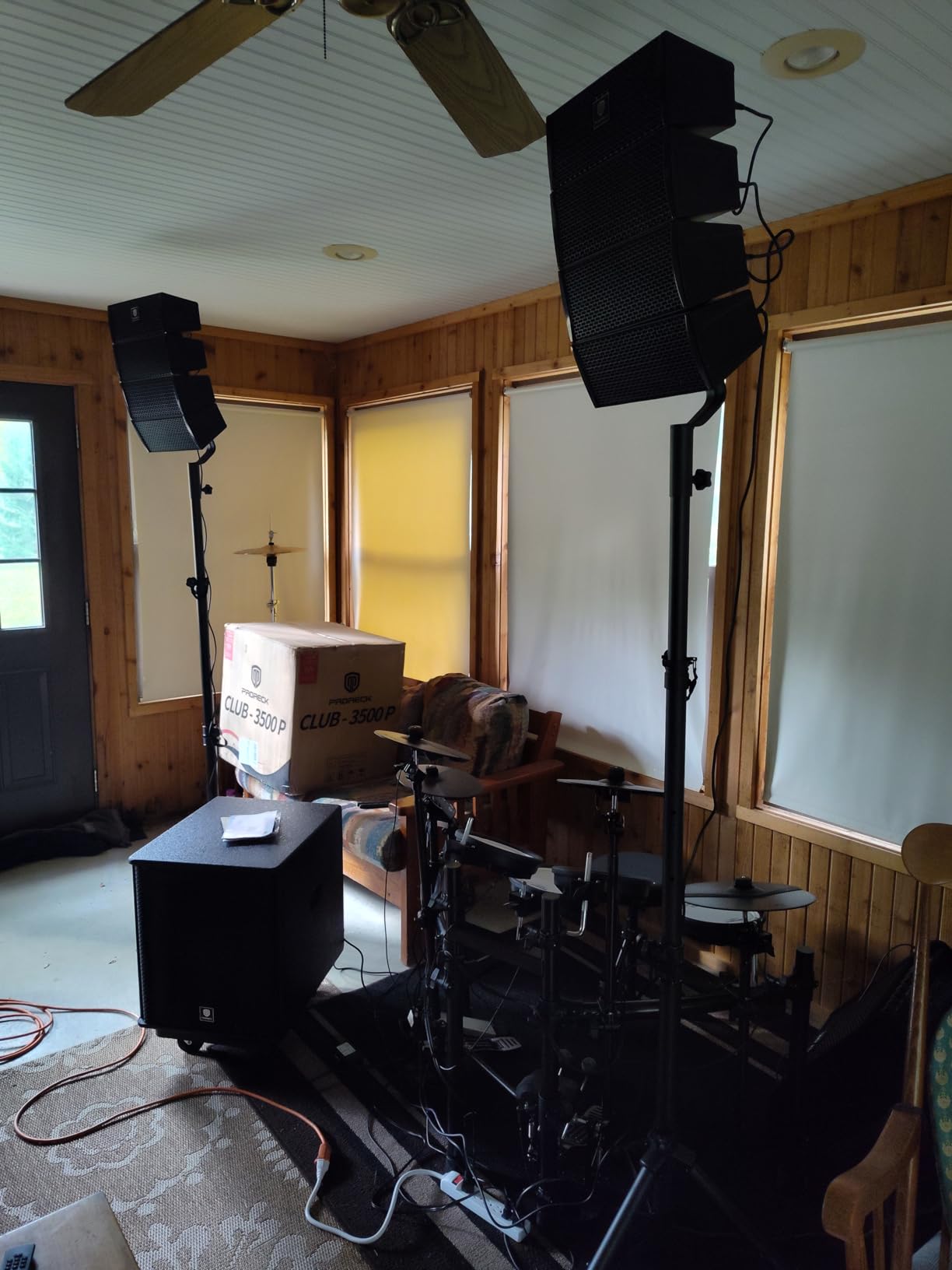
Playback options are unusually thorough: Bluetooth streaming up to 66 feet, USB drive and SD card, which means a playlist runs without a laptop and without a phone on the mic stand. Inputs cover stereo RCA, 3.5 mm AUX, quarter-inch and XLR combo, plus a two-channel mic input, and a two-channel XLR output lets you link to another system.
That combination suits the situations where the priority is that everything works on arrival: meetings, speeches, church services, school halls and DJ events where a single operator handles setup alone.
Who gets the most out of it?
Event hosts, churches, schools and anyone setting up speeches or ceremonies where a full band is not the plan. The eight array speakers on adjustable stands can be spread wide across a hall or angled inward for a square room, and the 3000-watt peak rating is quoted for up to 500 people and 1000 square meters.
If you have never assembled a PA before, the completeness is the product. There is nothing to source, nothing to size and no mixer to hire in separately.
Where it costs you?
Portability is the opposite of everything else in this list. Eight separate array speakers and two stands mean many more trips from the car, and the parts arrive in more than one package, so count the handling before you commit.
The two-channel mixer is thin for live music, and remote-control-only operation feels dated beside the app control on other systems here. If you move regularly, our PA picks for live performances weight setup speed far more heavily.
10. ALTO TS112C – 1200W Column With Five Channels and an XLR Mix Out
ALTO TS112C 1200W Powered Column Array PA Speaker
1200W output
8 x 2.75 in array over a 12 inch sub
5-channel mixer with reverb
Bluetooth 5.0 TWS
Pros
- Five-channel mixer is the deepest onboard mixer in the entry-level column category with reverb
- 12 inch subwoofer delivers the most thump of the ALTO range and stays clear across a DJ set
- XLR mix output for linking plus Bluetooth TWS for wireless stereo pairing
- Runs from a single cable with no complicated menus per owners who gig it
- Owners comparing it to the EV Evolve 50 report no meaningful sonic difference
Cons
- Audible low-level hiss when powered on in a quiet room
- No 48V phantom power so condenser mics need an external mixer
- 53 lb weight is heavy for one-person load-in
The TS112C is the system to beat at the middle of this range, and its five-channel mixer is unusual this low down. Reverb is built in, there are three XLR and quarter-inch combo inputs plus stereo quarter-inch, and a balanced XLR mix output for linking to another speaker or feeding a desk.
Above a 12-inch subwoofer sit eight 2.75-inch column drivers at 1200 watts, with a stated 120 by 30-degree coverage pattern. That 30-degree vertical figure is unusually honest: it explains why a column sounds even down a long room instead of washing the far end.
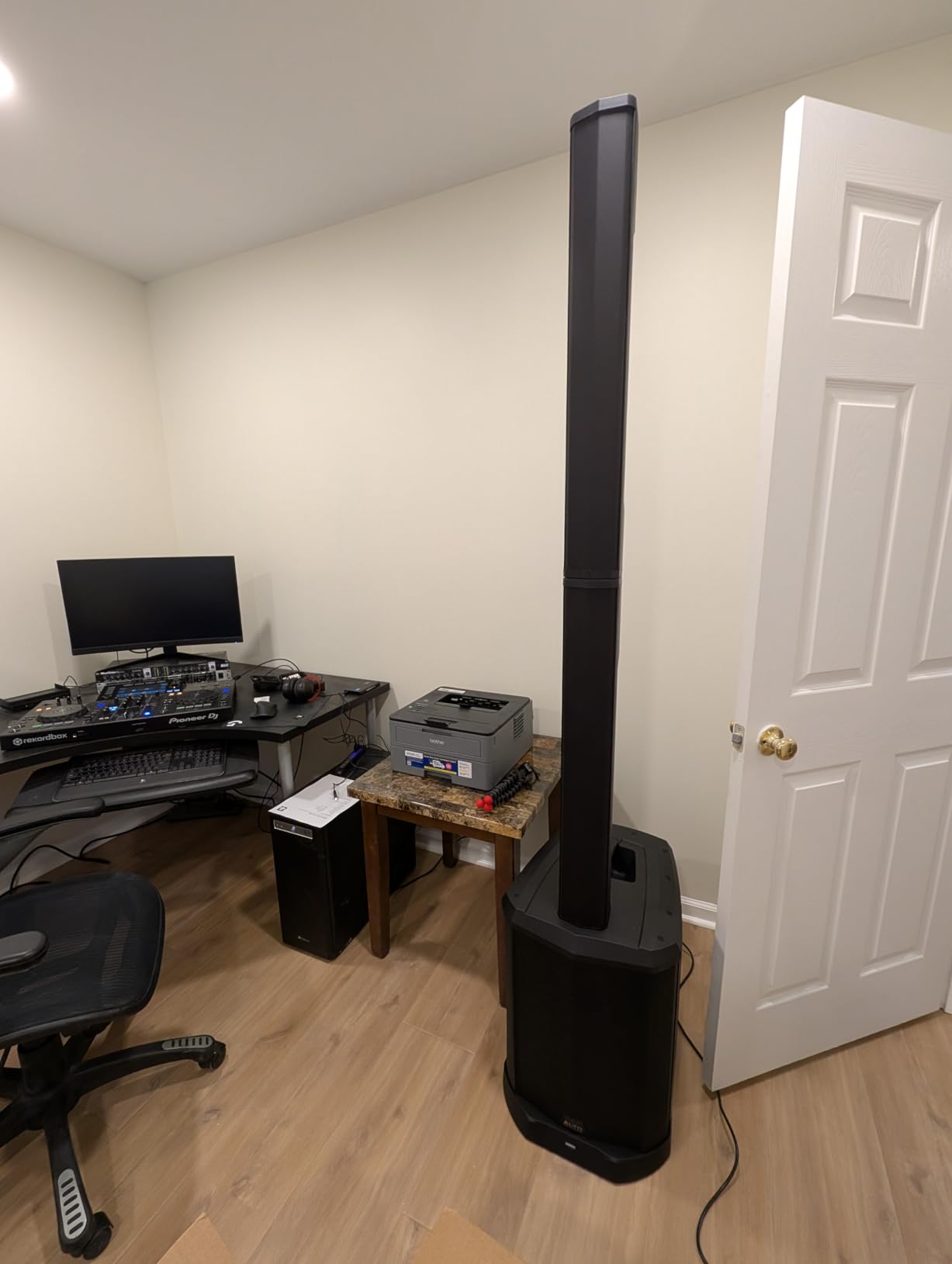
Bluetooth 5.0 with TWS wireless stereo linking lets two systems run as a stereo pair without a cable between them. Owners who gig it regularly report it runs from a single cable with no complicated menus, which matters when setup time is the constraint.
Musicians who have owned higher-priced column arrays report the TS112C matches them closely for far less, particularly on low end. A column carry bag and an integrated subwoofer handle are included, though no subwoofer cover.
Where it fits?
Larger rooms with a shallow footprint, small halls, function spaces and DJ sets where the program is mostly playback. The 12-inch sub and the five channels give more room to grow than the three-channel systems without going to the weight of a full-size professional column.
The XLR mix output is the feature that keeps it relevant later. Feed a second passive speaker, send to a recorder, or patch into a house desk when the venue has one.
Where it will disappoint you?
The same low-level idle hiss that owners report on the smaller ALTO tower appears here too. It is masked at performance volume but audible in a quiet room during soundcheck.
There is no 48V phantom power, and preamp gain and headroom limit how hard a line-level mixer signal can be driven. At 53 pounds, load-in is heavy for one person, and the column bag does not cover the subwoofer.
Specs That Look Decisive but Rarely Are
Two numbers dominate every column PA comparison page, and neither should drive your decision.
Max SPL is a poor measure of how loud a system is. The figure is measured under ideal conditions with the amplifier driven into a free field, and a top-ranking thread on r/livesound makes the point plainly: max SPL is a good indicator of a speaker being especially quiet, not a useful indicator of which one is especially loud. Two systems with identical max SPL figures can differ enormously in how loud they sound in a reflective room with a hundred people absorbing the high end. What matters is clean output at your listening position, which no spec sheet measures.
Peak wattage tells you almost nothing about headroom. Peak power describes the brief maximum a Class-D amplifier can hit. RMS watts, continuous output and preamp headroom describe what happens when you actually push a signal for an hour. This is why the EXOTON’s published 1000W RMS alongside 2000W max is more informative than a 2000-watt headline on its own.
Also discount wattage when it is not tied to a subwoofer, and treat app ratings with the same caution. A 4.5-star average across 461 reviews and a 4.6 across 65 reviews are not comparable signals, which is why we lean on the feature checklist rather than the score.
When a Column PA Is the Wrong Purchase?
A column array is a specialist tool. There are at least four situations where buying one costs you money and solves nothing.
You need sustained high SPL for a live band with a bass amp and drums. A column has small drivers spread over a narrow vertical column, which trades raw low end and maximum output for even coverage. Rock and dance music at high volume is exactly the wrong application. A conventional point-source pair on stands with a separate sub will produce more bass and stay cleaner at those levels.
You need stage monitoring. Nothing on a vertical array points down at the floor. You cannot use the cabinet as a wedge, so the monitor budget does not disappear, it moves to a separate product category.
Your room is deep and narrow and you have chosen a wide-angle column. Forum consensus on working sound forums is consistent on this: a wide-angle system in a deep, narrow room wastes coverage into the side walls. A narrower pattern aimed down the room uses the same amplifier more effectively.
You play to a loud band in a small reflective room. Overpowering a small room loses clarity rather than gaining headroom. Systems with automatic feedback suppression and a priority ducker handle this specific problem, and if neither is on your shortlist, a smaller point-source system with a digital mixer will serve you better.
Our portable PA guide covers the point-source side of this decision if a column is not the right shape for your room.
Sizing Your System by Room Shape, Not Headcount
Audience count alone is a poor sizing metric. Three variables decide whether a system is right: how deep the room is, whether it has reflective walls or none at all, and how loud the act actually is.
Step 1: pick the coverage angle for the room shape. Deep and narrow means the audience moves away from the speaker, so choose a narrower horizontal pattern around 120 degrees. Shallow, wide or side-seated audiences want 170 to 180 degrees. Getting this right often matters more than moving up a model in the range.
Step 2: account for headroom. The common rule of thumb in amplifier practice is to run your continuous requirement at about 83 percent of the amplifier’s capability, leaving the remaining headroom for transient peaks so you are not clipping on every kick drum hit. Applied here, it means judging clean output rather than headline maximum.
Step 3: match the low end to the program. Voice and acoustic instruments are covered by a small integrated sub. Playback-led DJ work and bands without a bass cabinet benefit from a 12-inch or 15-inch sub. A full band with its own bass rig may need a separate subwoofer paired with the column, which several systems support through an XLR mix out.
Step 4: budget the accessories. The often-forgotten costs are a short pole, a travel cover, a subwoofer cover, a tripod stand and spare speaker cables. Some systems include a bag for the array only. Add these to the purchase before comparing totals.
Step 5: count the load-in. Add sub, array, pole, bag and cables, then check whether one person can carry it from the car in one trip. If not, the feature that matters most is modularity: how many pieces break down and whether one person can lift each.
Frequently Asked Questions
Which column array PA system is the best?
There is no single winner, because the best column array PA system depends on the room. For the widest coverage in one cabinet, the Bose L1 Pro8 covers 180 degrees horizontally. For the deepest onboard mixer and pro DSP, the JBL PRX ONE runs seven channels with dbx feedback suppression. For carrying it alone, the LD Systems Maui 5 at 25 pounds for the whole tower is the easiest lift of the integrated designs. Judge on coverage angle, channel count and total weight rather than peak wattage.
Are column PA systems good?
Column PA systems are good at even coverage, fast setup and resisting feedback, which is why solo performers, DJs, worship teams and small bands use them. The vertical array narrows the vertical spread and widens the horizontal spread, so sound stays consistent from the front row to the back. They are less good for high-volume rock, for stage monitoring, and for low end without a larger subwoofer.
What are the disadvantages of line array speakers?
Portable column line arrays cost more per unit of output than a conventional powered pair, weigh more than a stand-mounted speaker, and have limited low end unless the subwoofer is substantial. They cannot be pointed down at the stage, so they do not replace wedge monitors. A wide coverage angle in a deep, narrow room wastes output into side walls. They also ship with fewer included accessories than the spec sheet implies.
What is the best brand for a PA system?
Working engineers most often name Electro-Voice, JBL Professional, Bose, LD Systems, Yamaha, RCF and Mackie for portable column systems, because those brands publish real channel counts, warranty lengths and weights. For large installed line arrays the shortlist changes completely, since those are a different and far more expensive product class. Budget brands can cover speech fine but fall behind on tuning and support.
What is the 83% rule for speakers?
The 83 percent rule is an amplifier headroom guideline: run your continuous output requirement at roughly 83 percent of the amplifier’s capability and keep the rest for transient peaks. Staying below maximum means you are not clipping on every loud hit, which protects the drivers and keeps the sound clean. It is a practical guide rather than a hard limit, and it matters more than any published maximum SPL figure.
Conclusion
The best features to look for in column PA systems are coverage angle matched to your room, enough mixer channels for your actual sources, 48V phantom power if you use a condenser mic, a total carry weight you can handle alone, balanced outputs, and a subwoofer sized to your program. Work through that checklist against your gig rather than reading wattage headlines, and the right system narrows to two or three options very quickly.
If you want the widest even coverage from a single cabinet, the Bose L1 Pro8 is our pick for 2026. If you play with more than two sources or need reliable app control, the Electro-Voice Evolve 30M is the stronger long-term buy.