
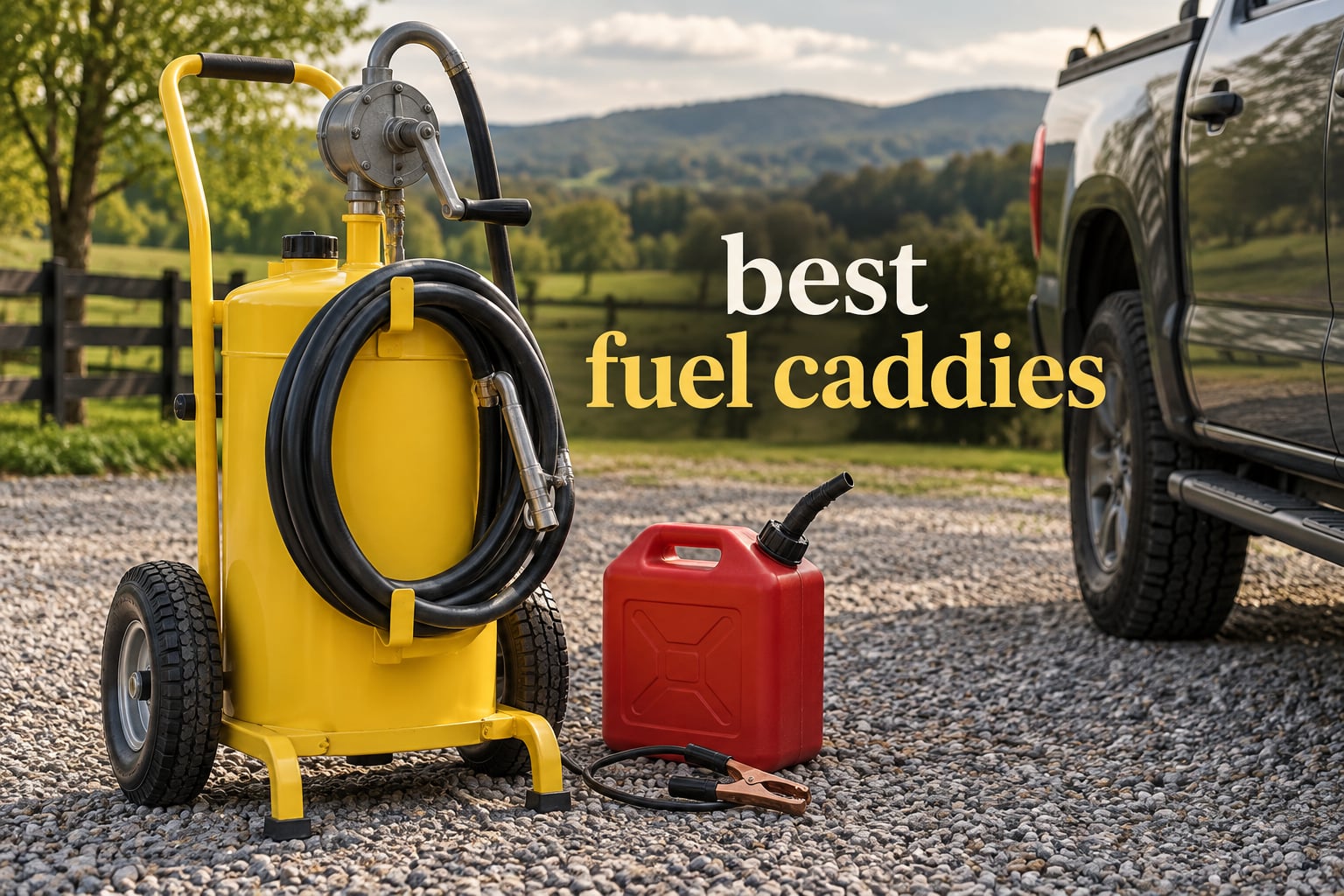
Running out of fuel is never a fuel problem, it is a time problem. You are three hours into a mowing job with a zero-turn mower on fumes, or you are 20 miles from the marina with two people and half a tank. The fix is usually a fuel caddy: a wheeled tank that lets you move gasoline or diesel from storage straight into a machine, without wrestling a five-gallon can over a tailgate.
We compared 10 of the best fuel caddies on the market, from 14-gallon poly tanks to 30-gallon carbon steel carts and 12V electric transfer units. Nothing in this list is a 50-gallon commercial fuel station, because that is a different purchase for a different user. Every model here is something you could actually push across a lawn, load into a pickup bed, or roll down a boat ramp.
What surprised us most was how much the loaded weight matters. Buyers obsess over hose length and gallons per minute, then discover a full 30-gallon steel caddy weighs well over 300 pounds and cannot get up a boat ladder. We kept that front and center throughout, and we also covered the cases where a caddy is the wrong tool entirely. If you are still choosing a fuel tank for the boat itself, start with our boat fuel tank guide instead. And if the reason you are moving fuel is a generator, our dual fuel generator picks cover the machines on the other end of the hose.
Top 3 Fuel Caddy Picks in 2026
Three picks cover most buyers. The Scepter leads on proven durability and the deepest review history in the category. PAMBEE delivers the best balance of capacity, brass hardware, and EPA compliance. TUFFIOM takes the heavy 30-gallon slot with swivel wheels and a reversible pump.

Scepter Duramax 14 Gallon Caddy
- 14-gallon HDPE tank
- 10-foot hose
- Gravity and manual pump modes

Best Fuel Caddies at a Glance in 2026
All 10 caddies, side by side. Capacities span 14 to 30 gallons, and the pump column is the fastest way to split this list: hand rotary models for occasional top-ups, 12V electric units for high-volume transfer.
| Product | Specifications | Action |
|---|---|---|
| Scepter Duramax Flo N Go 14 Gallon |
|
Check Latest Price |
| TUFFIOM 30 Gallon Metal Caddy |
|
Check Latest Price |
| PAMBEE 15 Gallon Fuel Caddy |
|
Check Latest Price |
 VEVOR 30 Gallon Carbon Steel Caddy VEVOR 30 Gallon Carbon Steel Caddy |
|
Check Latest Price |
 DNA MOTORING 26 Gallon 12V Unit DNA MOTORING 26 Gallon 12V Unit |
|
Check Latest Price |
 Garvee 16 Gallon Gas Caddy Garvee 16 Gallon Gas Caddy |
|
Check Latest Price |
 TOPWAY 16 Gallon Electric Caddy TOPWAY 16 Gallon Electric Caddy |
|
Check Latest Price |
 AutoForever 30-Gallon Four-Wheel Caddy AutoForever 30-Gallon Four-Wheel Caddy |
|
Check Latest Price |
 VEVOR 30 Gallon Four-Wheel Caddy VEVOR 30 Gallon Four-Wheel Caddy |
|
Check Latest Price |
 Garvee 15 Gallon Fuel Caddy Garvee 15 Gallon Fuel Caddy |
|
Check Latest Price |
1. Scepter Duramax Flo N Go 14 Gallon Caddy: The One Most Buyers Should Buy
Scepter Duramax Flo ’N Go 14 Gallon Gas Caddy, 53 Liter Fuel Tank, Red
14-gallon HDPE tank
10-foot rubber hose
Gravity flow plus manual pump
2.0 GPM siphon flow
Pros
- Large 14-gallon capacity cuts refill trips
- Durable HDPE resists corrosion and denting
- Dual gravity and manual pump modes
- 10-foot hose with anti-kinking sleeve
- Brass shut-off valve and child safety lock
Cons
- Manual pumping takes real effort
- Basic plastic wheels struggle on rough ground
- Hose can kink at the connection point
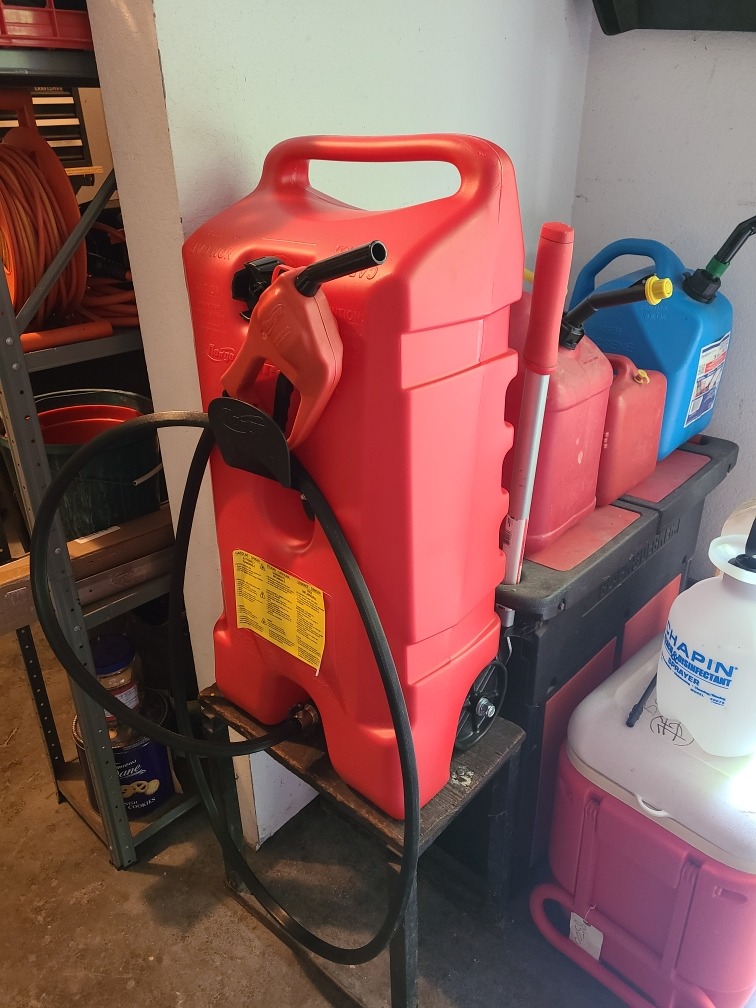
This is the caddy most people end up with, and after comparing it against everything else in the 14 to 16 gallon range it is easy to see why. The Flo N Go is the default answer for lawn equipment, a generator, and an ATV, and it does two jobs: it pours when you tip the spout, and it pumps when you flip the handle to the other position.
The build is unremarkable in a good way. High density polyethylene will not rust, will not dent from a fender, and shrugs off weather, and at 19 pounds empty it is one of the few caddies on this list you can carry up a set of dock stairs without recruiting help. The 10-foot hose reaches past most tailgates and into a boat’s fill port without repositioning.
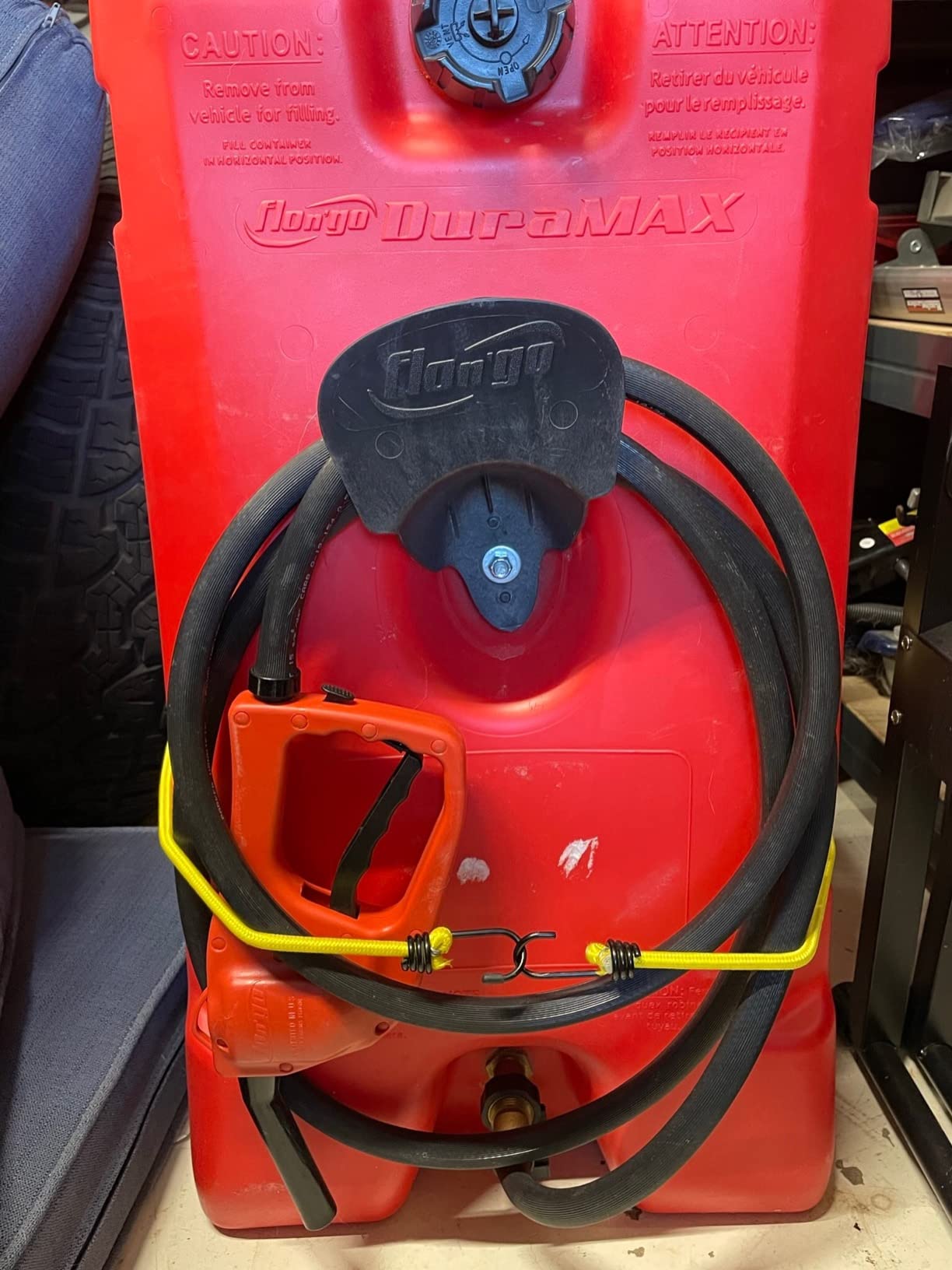
The honest weakness is effort. A 14-gallon caddy is around 100 pounds full, and the manual mode is genuinely tiring at that weight. Owners on the In-Depth Outdoors forum thread on caddy recommendations repeatedly come back to cans for exactly this reason, and one GreenTractorTalk poster counted roughly 12 cranks per gallon on a comparable steel rotary setup, which is worth knowing before you commit to manual pumping every week.
There is also a small set of recurring complaints worth pre-empting. The hose can kink where it meets the handle, the nozzle assembly has been reported to weep after long service, and the final couple of gallons need the tank tipped to come out. None of that is a deal breaker for lawn gear, but it does mean you should not buy this to move fuel uphill.
When the Flo N Go earns its spot
It fits the job when you refuel one or two machines a week and the storage spot is level ground within reach of a hose. Two wheels, a top handle, and a footprint of 16.25 by 33.8 inches means it fits in a shed corner, a truck bed against the cab, or a garage bay without stealing floor space.
At 19 pounds empty, this is also the pick if the loaded weight matters to you, or if a second person is not available to help. A full tank is heavy but manageable solo for many adults over a short distance.
When to pick something else
Choose a 30-gallon steel cart if you want a week of fuel without refilling the caddy itself, and choose a 12V electric unit if you are moving 20 gallons or more at a time. Neither complaint is about quality, both are about match.
It is also the wrong tool for a boat that has to be portaged. A caddy is a shore-side and yard-side tool. For a remote island or a small boat with a low freeboard, cans remain the more sensible answer.
2. TUFFIOM 30 Gallon Metal Caddy: Best for 30-Gallon Jobs
TUFFIOM 30 Gallon Portable Gas Caddy w/Swivel Wheels,Fuel Storage Tank, Gasoline Diesel Can with Fuel Transfer Rotary Hand Siphon Pump for Automobile ATV Car Mower Tractor Boat Motorcycle
30-gallon heavy-duty iron tank
8.9-foot kink-free hose
Reversible rotary hand pump
Four wheels including two swivel
Pros
- Large 30-gallon capacity serves multiple vehicles
- Heavy-duty iron construction
- Swivel wheels for tight maneuvering
- Anti-static grounding clamp included
- Vent and oil level gauge
- Reversible pump drains hose back into tank
Cons
- Soft aluminum pump can seize from factory debris
- Some units arrive with welding spatter inside the tank
- Float indicator rod may arrive bent
This is the model to look at when a trip to the gas station costs more than the fuel. Thirty gallons covers several tractors, a fleet of mowers, or a full season of generator runtime, and the metal tank shrugs off the abuse that eats through plastic. Buyers on GreenTractorTalk weighing a diesel caddy for a compact tractor land in this same capacity bracket for the same reason.
The reversible rotary pump is the feature that separates it from cheaper 30-gallon carts. Turn it one way to dispense, the other way to draw fuel back up the hose, which means you can reverse a line, top off from a secondary drum, or clear a line without losing a gallon to a spill.
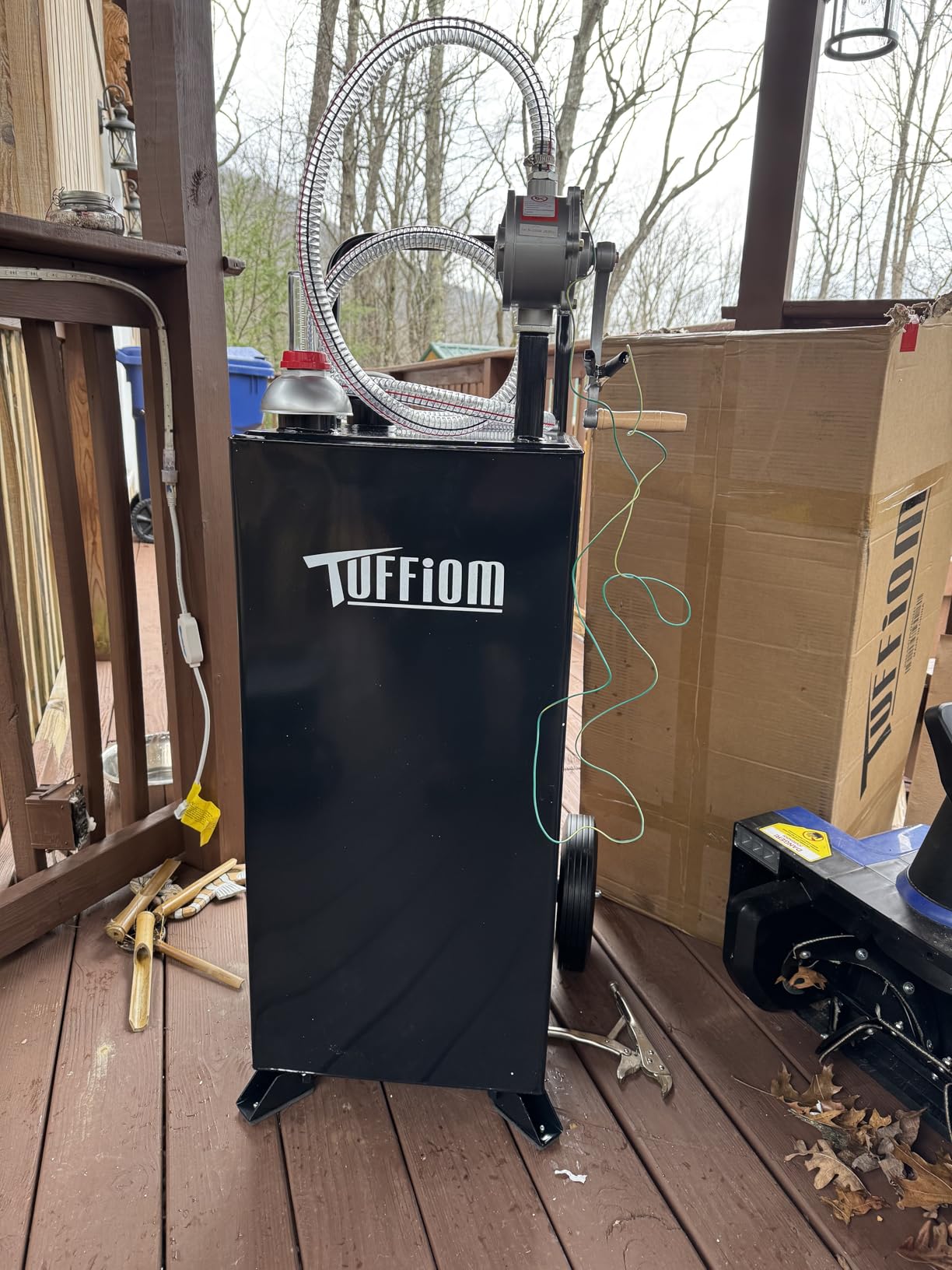
Two universal swivel wheels out of the four make this far easier to steer than a fixed-wheel cart, and the push handle sits at a usable height. The 8.9-foot hose is shorter than the 10-foot hoses on the poly caddies, so plan the layout before you commit, particularly if you are feeding a dock.
The pump is the weak link. Owners report the soft aluminum pump seizing from factory debris or welding spatter left inside the tank, and the most common piece of advice in reviews is to clean the tank thoroughly before the first fill and consider replacing the pump with a cast iron one. That is a ten-minute job with a hose and worth doing on day one.
Who should buy the 30-gallon metal cart
Buy it if fuel is stored at the end of a driveway, in a barn, or at a job site and you are filling more than one machine per session. The anti-static grounding clamp and the level gauge both matter at this capacity, where you are moving serious volume in a work environment.
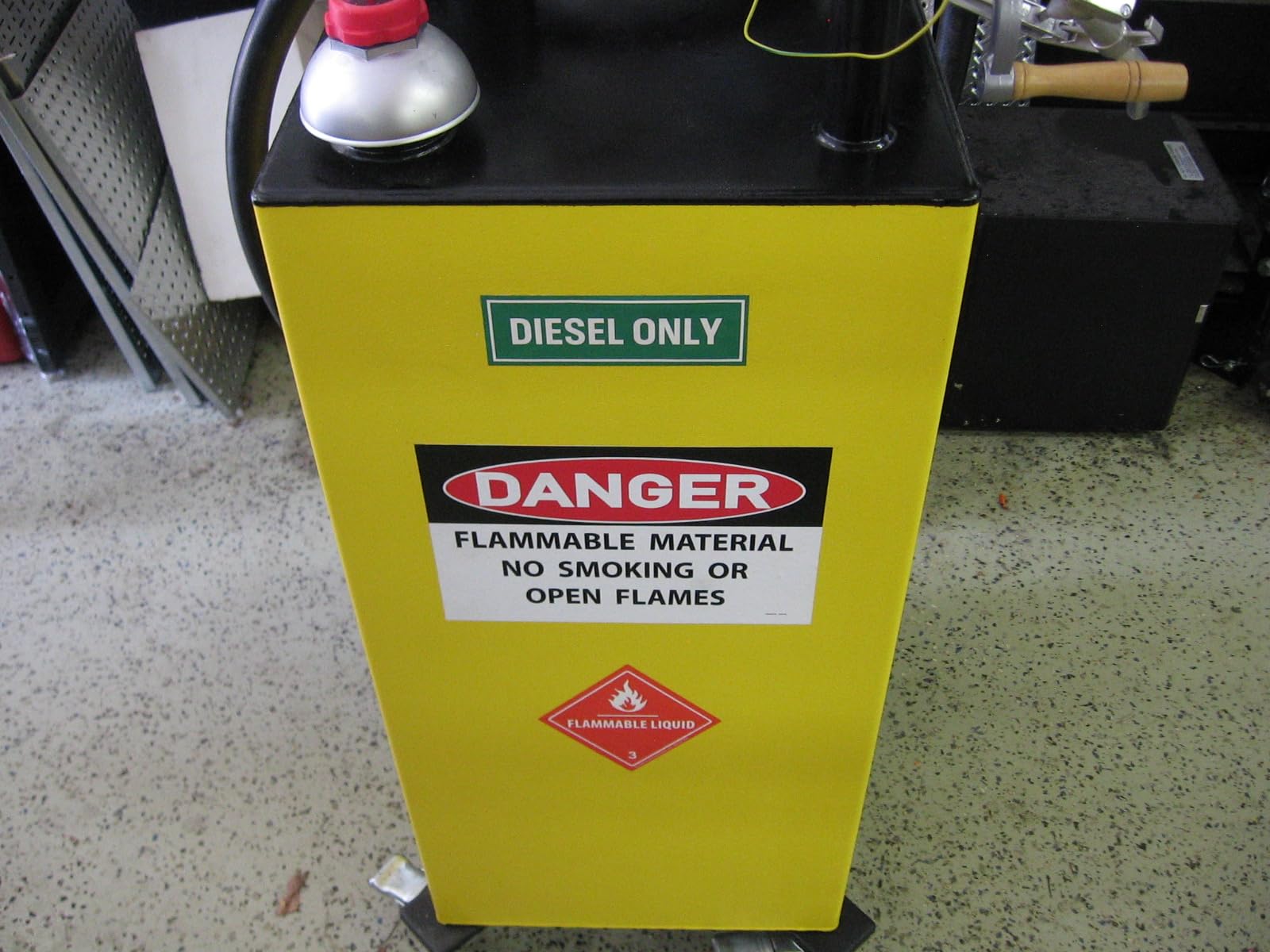
It is also a good match for contractors running equipment away from a fuel point, and for anyone with a diesel tractor who wants diesel and gasoline kept in separate, clearly distinguished tanks. Color coding works in your favor here, since the yellow body reads differently from the red gasoline tanks on this list.
Who should pass
Pass if you have to lift it over a tailgate, load it into a boat, or move it any distance alone. A full 30-gallon metal caddy is well over 300 pounds. If the answer is a dock or a boat, use a smaller poly tank and more trips, or use cans.
Also inspect the tank on arrival. Some units show welding spatter, scratches, or a bent float rod, and catching that in the first ten minutes is far easier than catching it after you have filled it.
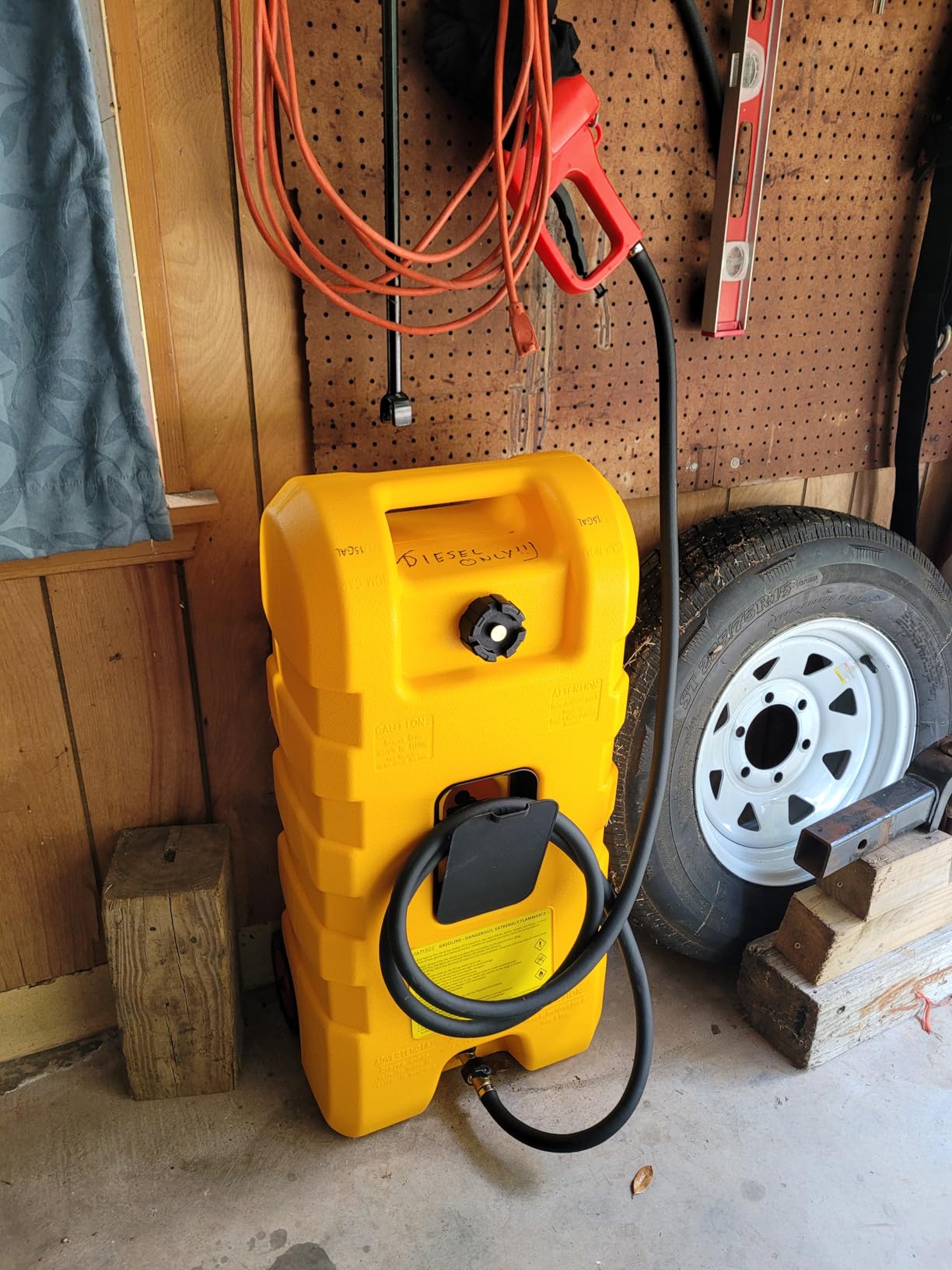
3. PAMBEE 15 Gallon Fuel Caddy: Best Value Pick
15 Gallon Fuel Caddy, Portable Gas Can Fuel Tank with Manual Siphon Pump & 10FT Hose, Wheeled Fuel Container for Gasoline Diesel Storage, Car, ATV, Boat, Lawn Mower, Generator, Red
15-gallon HDPE tank
10-foot automotive rubber hose
3 GPM siphon flow
Siphon and gravity feed modes
Pros
- 15-gallon capacity suits home and farm use
- Dual siphon and gravity feed modes
- Up to 3 GPM flow rate
- Two brass shut-off valves
- Rust-proof HDPE with vapor-tight seals
- 10-foot hose with storage holder
Cons
- Manual pumping is tiring on a full tank
- Flow rate depends on pumping speed
- Plastic wheels are rough on hard ground
PAMBEE is the pick we recommend to someone who wants metal-grade hardware in a plastic tank without paying for a brand name. The 15-gallon capacity is the sweet spot for most households: big enough to cover a week of generator runtime or several mower fill-ups, small enough to move without a second person.
The 3 GPM siphon figure is the best flow number in the manual-pump category on this list, and the dual brass shut-off valves at the tank and at the hose are the parts that actually fail over time. Brass outlasts plastic threads, and vapor-tight seals are what stop the tank from smelling like a gas station after a month in a shed.
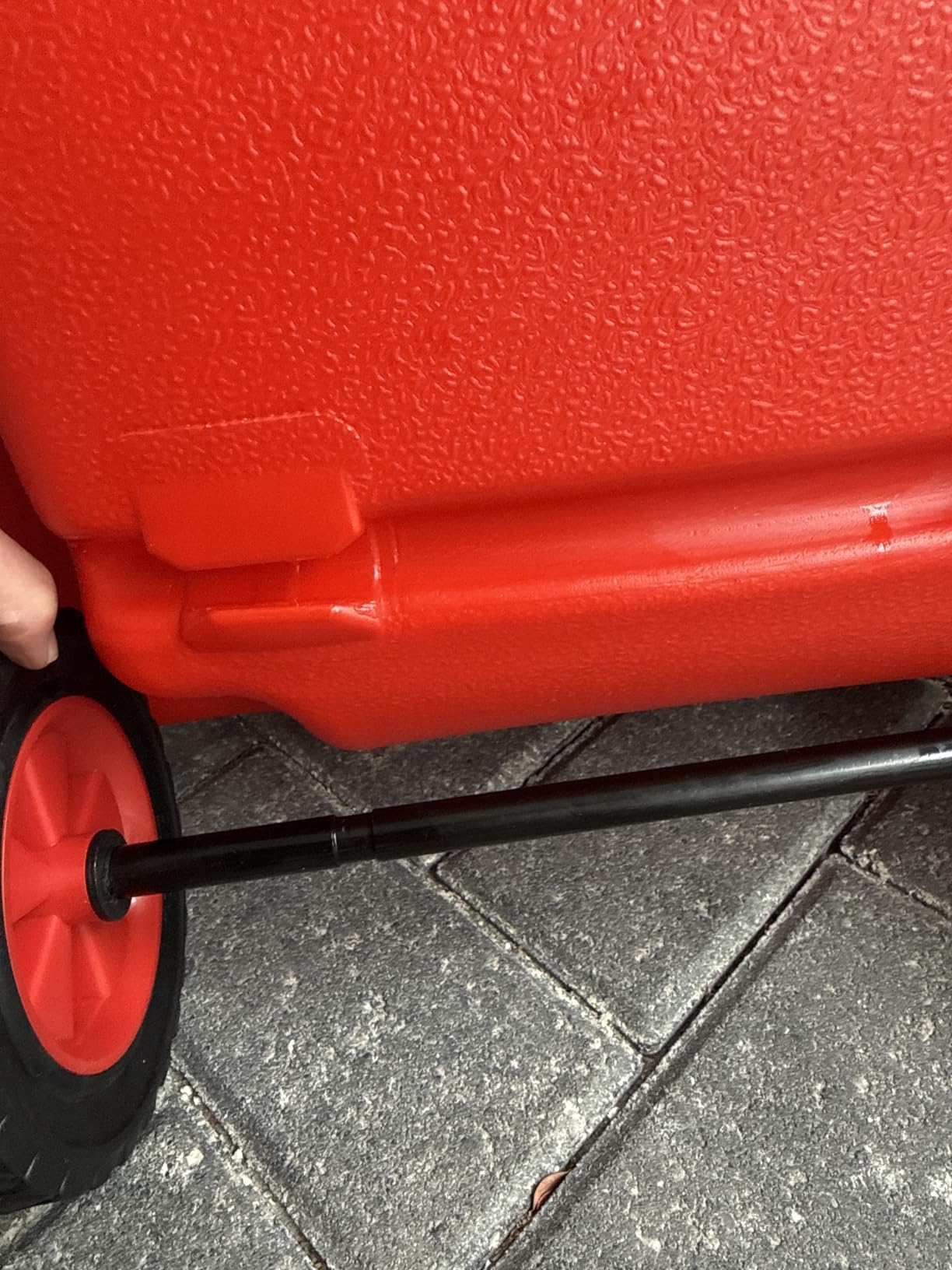
Empty weight is 23.1 pounds, which is heavier than the 14-gallon Scepter by design rather than defect. Gasoline at roughly 8.3 pounds per gallon puts a full tank near 148 pounds, so plan for a wheelbarrow, a ramp, or a two-person lift rather than a solo carry.
Reported drawbacks are consistent across the reviews: pumping a full 15 gallons by hand is a workout, flow slows down if you crank lazily, and the plastic wheels are not built for gravel or a rutted farm lane. If your route to the fuel point is rough, look at a caddy with larger wheels or a steel tank instead.
Why this one over a cheaper 15-gallon caddy
The dual brass valves and the vapor-tight sealing are the differentiators. Cheaper cans in this bracket use plastic bungs and plastic threads, and those are the parts that leak after a season of sun and ethanol.
It is also EPA compliant and rated for both gasoline and diesel, so a single tank can serve a mixed fleet as long as you clean between fuels, which is a real advantage for a property running a gas mower and a diesel generator.
Where it falls short
The 10-foot hose is generous, but the flow depends on how hard you pump, so it loses to any electric unit on raw speed. If you are topping up several vehicles in one sitting, the 12V models will save real time.
Do not plan on using this as a long-term storage tank without a stabilizer. At 15 gallons it is an ideal transfer vessel, not a seasonal storage unit.
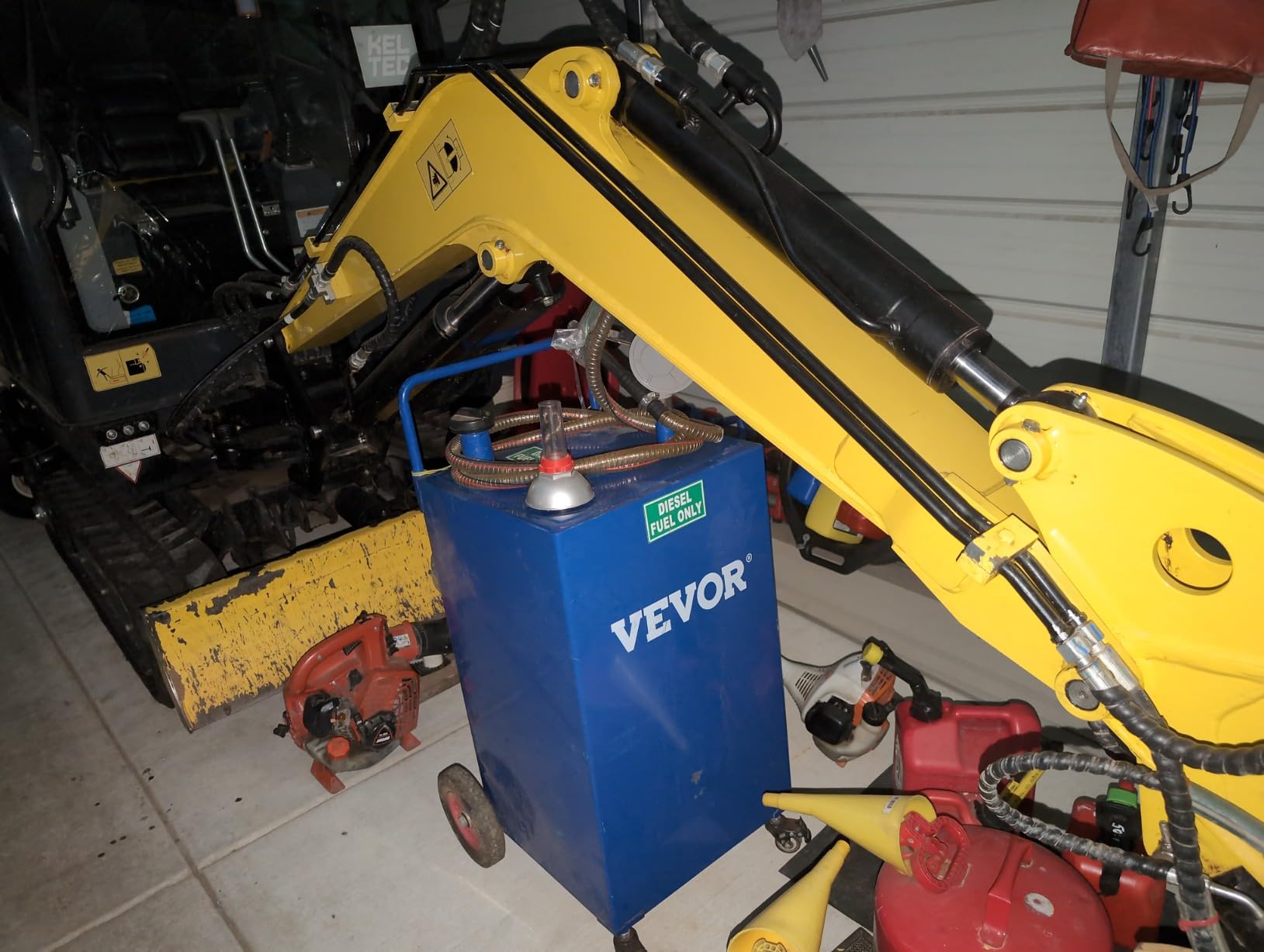
4. VEVOR 30 Gallon Carbon Steel Caddy: Powder-Coated Steel With a Bi-Directional Pump
VEVOR 30 Gallon Fuel Gas Caddy, Carbon Steel, Portable Fuel Transfer
30-gallon carbon steel tank
Powder-coated rust-resistant finish
Bi-directional hand pump
Large wear-resistant rubber wheels
Pros
- True 30-gallon steel capacity
- Bi-directional pump for dispensing and siphoning
- Reinforced support ribs add rigidity
- Large rubber wheels roll on varied terrain
- Works with gasoline and diesel
Cons
- 49.4 pounds empty makes it very heavy loaded
- Manual pump effort on a full tank
- Some units report wheel alignment issues
This is the steel cart for buyers who want a rigid tank that will not crack or deform and do not mind the weight. Carbon steel with a rust-resistant powder coat, reinforced support ribs, and complete fittings out of the box, and the tank is rated for both gasoline and diesel so one caddy can cover a mixed equipment yard.
The bi-directional hand pump is the standard on this category, and it works the way the TUFFIOM does: clockwise to dispense, counterclockwise to pull fuel back. That reverse capability matters when you are moving fuel from the caddy into a boat tank, then wanting the line clear before you disconnect.
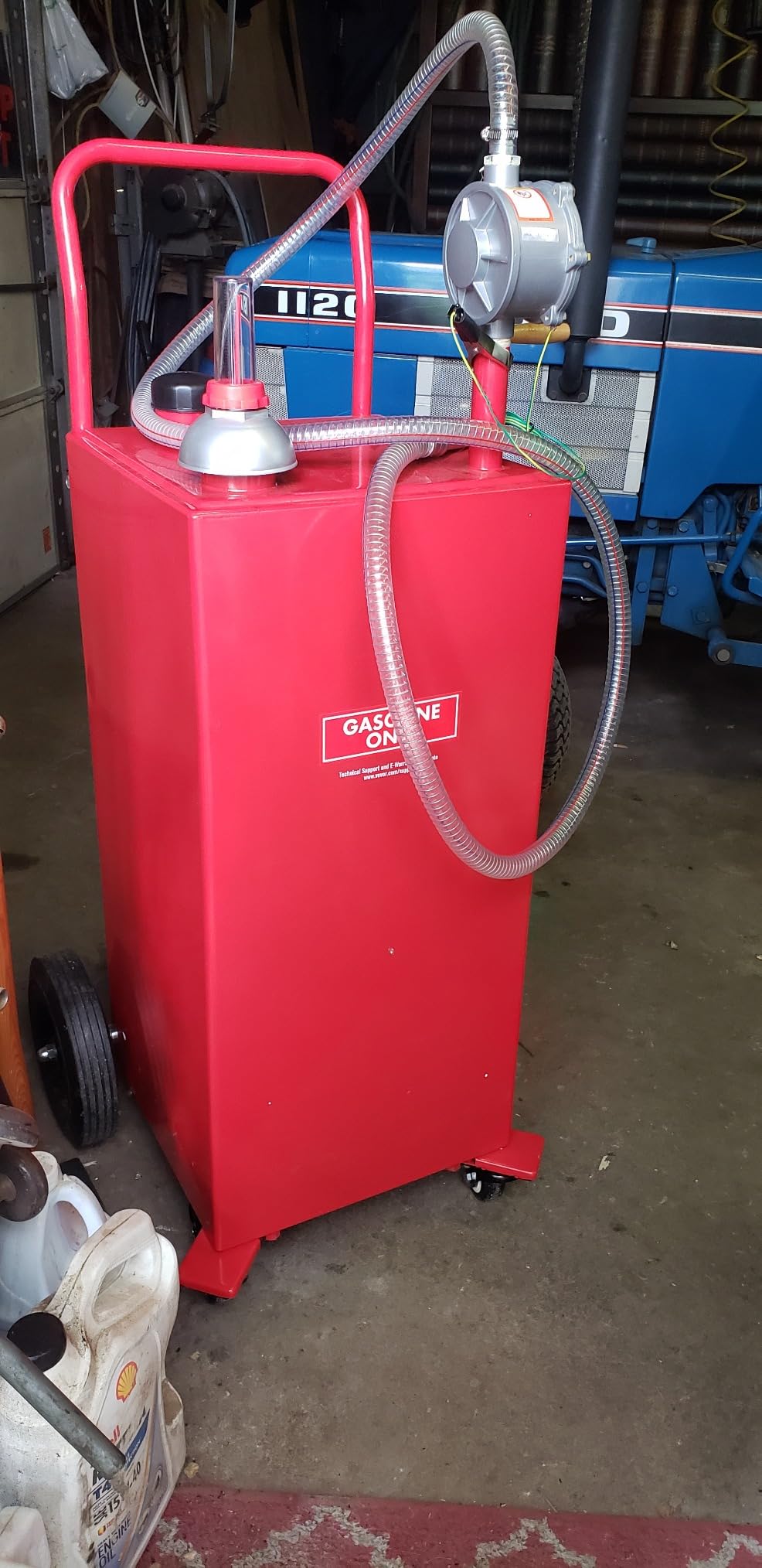
At 49.4 pounds empty and 30 gallons of capacity, a full unit is the heaviest configuration in this roundup. The wheels are the reason that number is manageable rather than fatal, but you are rolling a loaded cart, not carrying it, and rough ground will still slow you down.
Reviewers are generally positive on the tank and cautious on the small parts. Wheel alignment issues, an inconsistent fuel gauge, and a pump that some consider basic are the recurring notes. Several owners simply plan to upgrade the pump to an electric unit later, which is a reasonable path since the tank itself is the durable part.
Best fit for a fixed fuel point
This caddy earns its place when it lives in a barn, a shop bay, or a fenced yard and never has to climb anything. Park it, dispense from it, and leave it. That is the pattern of use its weight supports.
It is also a sensible pick for someone with a diesel tractor and a gas mower on the same property, since the tank handles both and the red color codes it as a general fuel container rather than a diesel-only unit.
Before you buy
Measure your route. If the fuel point is up a ramp, across a dock, or into a boat, the 49.4-pound empty weight becomes a problem that wheels cannot solve. Choose a poly caddy for those routes.
Check the wheels on arrival and check the pump seal with a few cycles of water before you put fuel in it. Both fixes take minutes when the tank is empty and never when it is full.
5. DNA MOTORING 26 Gallon 12V Electric Unit: Best for Fast Diesel Transfer
DNA MOTORING Portable Fuel Tank Caddy 26 Gallon 100L 12V Diesel Transfer Unit for Cars Trucks Lawn Mowers ATVs Boats,Grey,TOOLS-00303
26-gallon polyethylene tank
12V DC electric pump at 140W
40 liters per minute open flow
Three-meter delivery hose
Pros
- No manual effort to move fuel
- Very fast open flow rate
- 26-gallon capacity for extended refueling
- UV-resistant HDPE resists corrosion
- Includes pump
- hoses
- nozzle
- and power cord
- One-year manufacturer warranty
Cons
- Diesel only
- not suitable for gasoline
- Internal fill filter must be removed to fill properly
- Wheel axle reported to fail in use
This is the fastest transfer in the roundup by a wide margin, and it does the work with no cranking at all. The 12V DC electric pump draws about 140 watts, delivers roughly 40 liters per minute on open flow, and runs on a 30-minute duty cycle. For a diesel tractor parked at the end of a field with a vehicle battery nearby, that is the difference between a ten-minute job and a few minutes.
Being diesel only is a genuine limitation, not a footnote. The listing is explicit about it, and mixing fuel types or running gasoline through a pump meant for diesel is how you create a mess you will be cleaning all year.
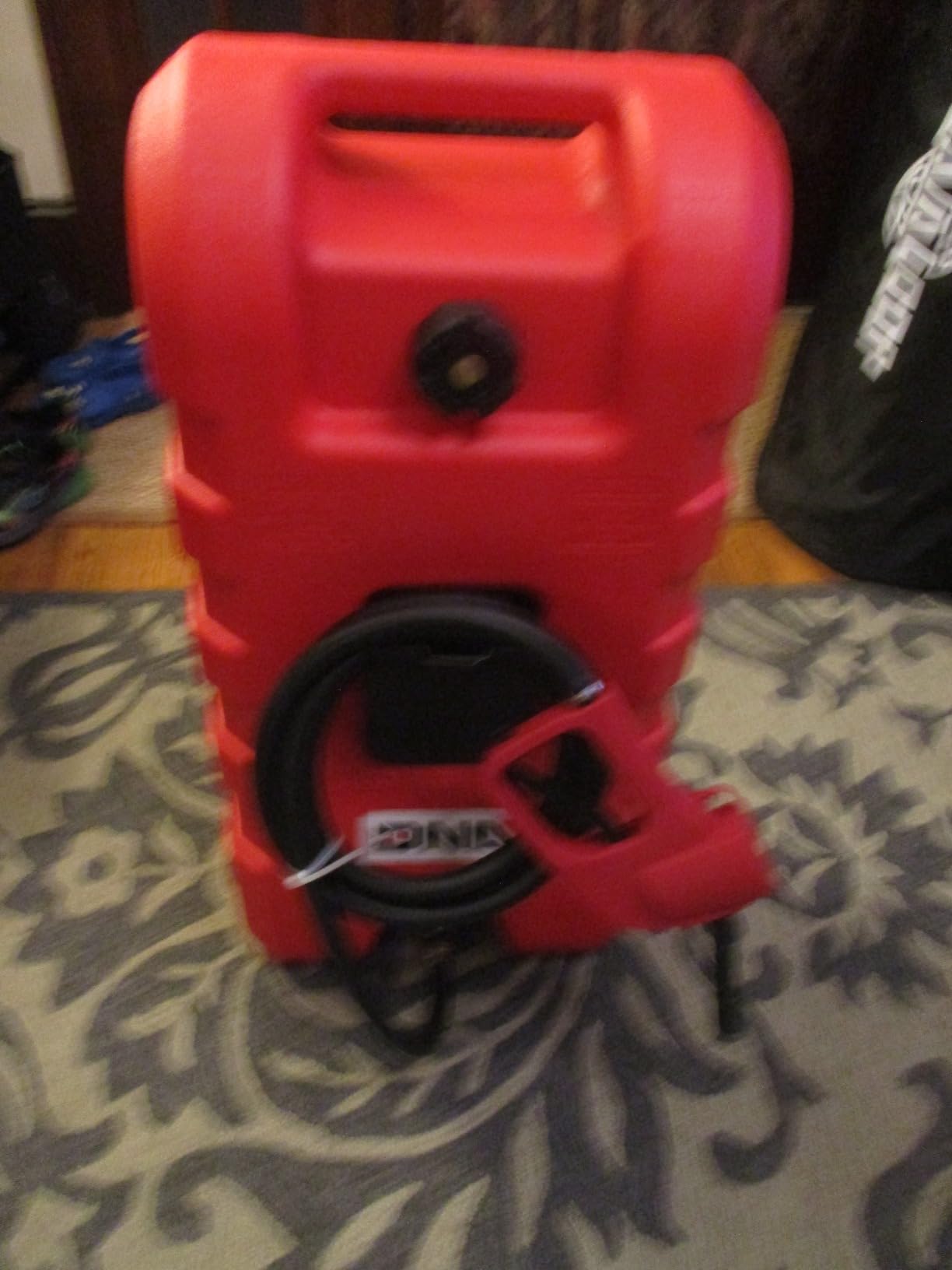
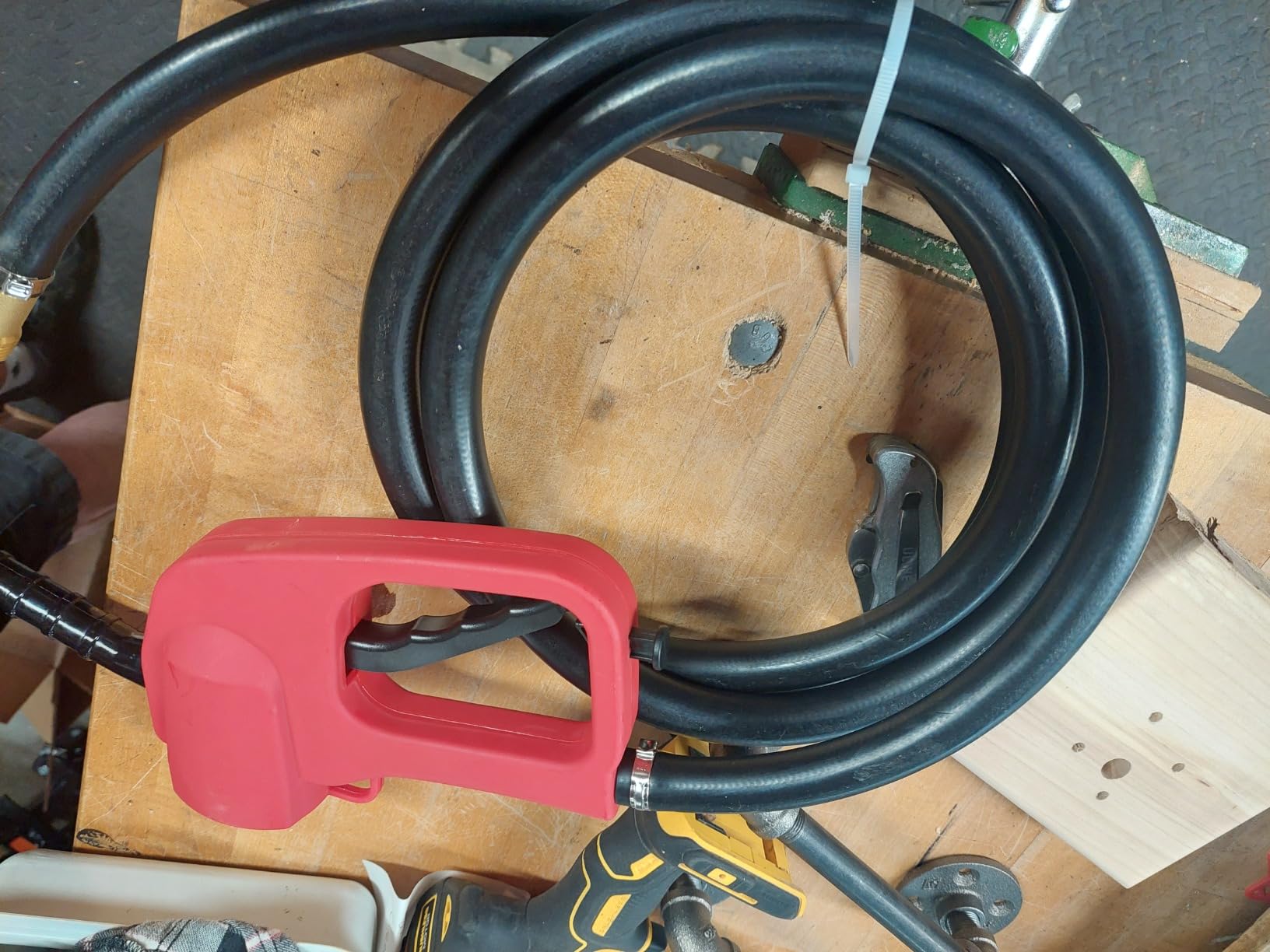
The 26-gallon polyethylene tank is molded with integrated handle and wheels, so there is no frame to assemble, and a 3-meter delivery hose gives you real reach. The two-meter power cord ends in alligator clips, which is the right choice for temporary use on a vehicle battery rather than a permanent installation.
Two design details will frustrate you if you do not know about them. There is an internal filter at the fill opening that must be removed before filling, or the pump will be slow and you will get splashback. And the wheel axle has been reported to fail in use, so treat the wheels as consumable and check them before a long haul.
When an electric pump actually pays off
It pays off when you transfer 20 gallons or more per session, when the receiving equipment is awkward to reach, or when the person pumping is not the strongest person on the crew. A hand crank at 26 gallons is a workout measured in cranks, and the forum estimates we saw put a comparable manual pump at around 12 cranks per gallon.
It is also the right answer for a shop that moves fuel between a bulk container and vehicles repeatedly, where consistency matters more than having zero moving parts.
When it is the wrong call
Skip it if you refuel once a week and have nowhere to clip the leads. An electric pump needs a 12V source nearby, and if you are carrying fuel to a remote dock or an island, there may not be a battery at the other end.
Skip it if you store gasoline. This unit is built for diesel, and the diesel-only spec is not a suggestion.
6. Garvee 16 Gallon Gas Caddy: Best Multi-Fuel Pick
Garvee 16 Gallon Gas Can, Fuel Tank Container with 10 FT Manual Siphon Pump
16-gallon HDPE tank
10-foot reinforced hose with 360-degree nozzle
Manual T-grip pump and gravity feed
Listed for gasoline, diesel, kerosene, biodiesel
Pros
- Works with gasoline
- diesel
- kerosene
- and biodiesel
- Dual shut-off valves with vapor-tight seals
- 10-foot hose with rotating nozzle
- Child-resistant cap and anti-static grounding
- 6-inch wheels and collapsible pull handle
- Gallon and liter markers
Cons
- Fill filter screen causes overflow and splashback
- Manual pumping takes 10 minutes or more for a full tank
- Listed dimensions run wider than advertised
Garvee rated the highest in this group, and the reason is flexibility. The 16-gallon HDPE tank is listed for gasoline, diesel, kerosene, and biodiesel, which makes it the one we would buy on a property that runs more than one fuel type and does not want two separate carts taking up floor space.
It is 19.8 pounds empty and 12.6 by 33.46 inches, which is a compact footprint for 16 gallons. The 10-foot reinforced hose ends in a 360-degree rotating nozzle, so you can reach a filler neck from an awkward angle without twisting the hose and stressing the fitting.
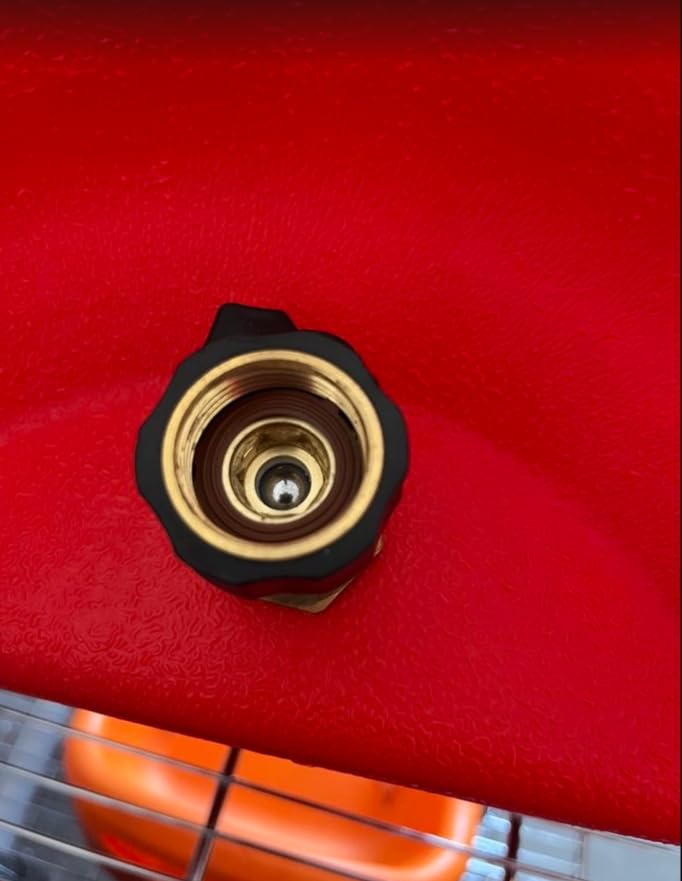
The recurring complaint is the fill filter screen, which owners say causes overflow and splashback at the pump nozzle. The fix is well known: take the screen out before you first fill. It takes a minute and it converts the most common complaint into a non-issue.
Manual pumping is slow. Reviews put a full 16 gallons at 10 minutes or more with the T-grip handle, and the nozzle holder is designed in a way that lets the nozzle drag on the ground if you are not careful. Both are fine for routine top-ups and frustrating for a full transfer, so this is a pump-and-sit tank rather than a work-and-pump tank.
What makes it stand out
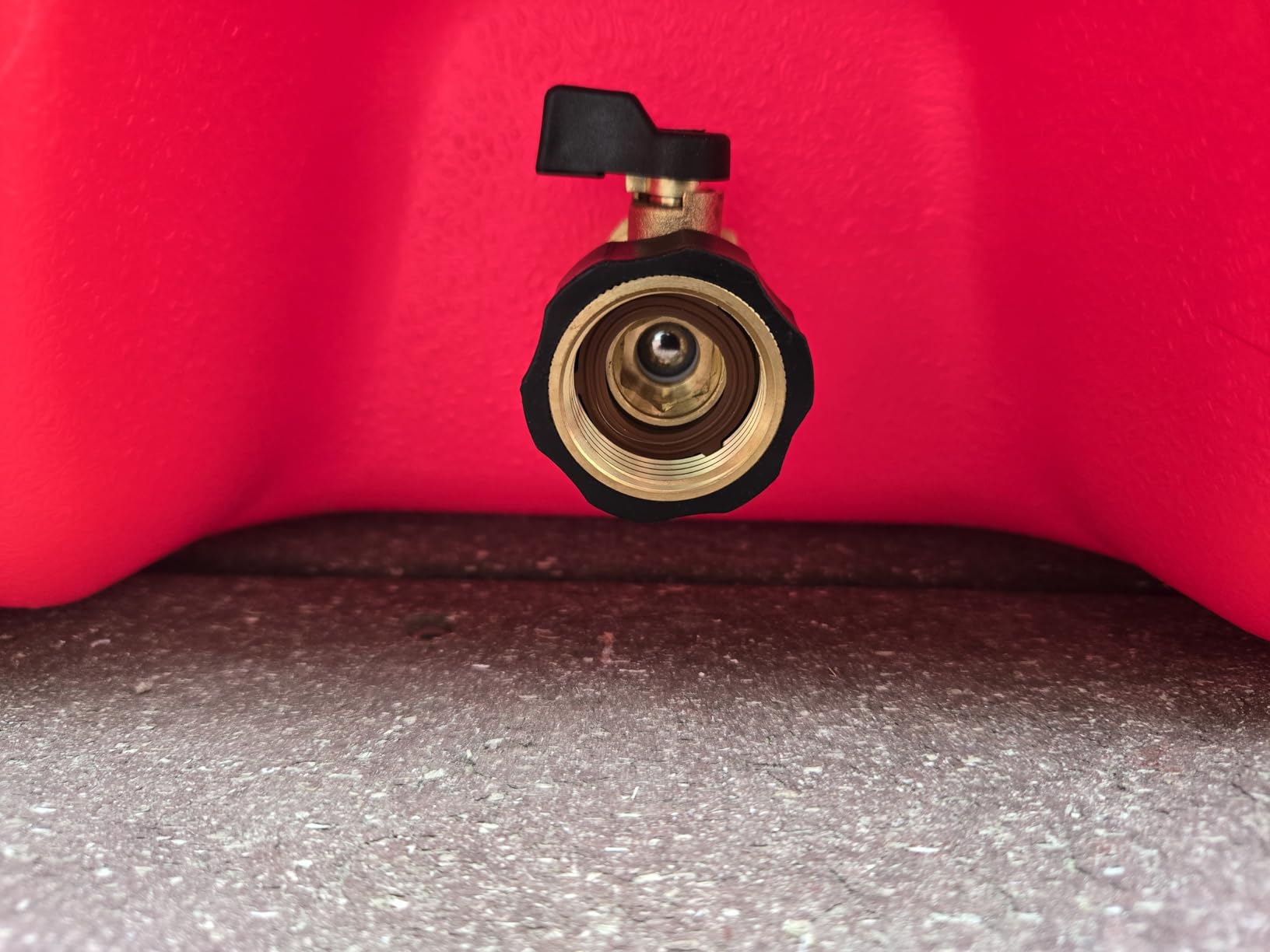
The multi-fuel compatibility is the headline, reinforced by a child-resistant cap, anti-static grounding, and dual vapor-tight shut-off valves. The gallon and liter markers and integrated tool storage are small touches that matter more in daily use than a spec sheet suggests.
It is also stackable, so if you eventually buy a second one, they store against each other rather than scattered across a garage floor.
Where it falls down
Do not rely on the listed dimensions. Multiple reviewers report the tank measures wider than published, which matters if you are planning a tight shelf or a specific truck-bed position.
And weigh it. Full with diesel it approaches 126 pounds, so the same liftability question applies as with every caddy in this range.
7. TOPWAY 16 Gallon Electric Caddy: Best Reach With a Powered Pump
TOPWAY 16 Gallon Portable Fuel Gas Tank Container Caddy with 12V DC Electric Gasoline Diesel Fuel Self-priming Transfer Pump for Cars, Lawn Mowers, ATVs, Boats & More
16-gallon HDPE tank
12V DC self-priming electric pump
2.3 or 3.7 GPM flow
13-foot discharge hose with 3.2-foot suction line
Pros
- Moves a full 16 gallons in under five minutes
- Forward and reverse switch for different transfer jobs
- Self-primes up to 4.9 feet of suction
- 13-foot discharge hose for long reach
- Pure copper motor runs quiet and efficient
- One-year manufacturer warranty
Cons
- Requires a 12V power source to operate
- Vent cap must be loosened during use
- Connections can loosen during transport
The 13-foot discharge hose is the reason to look at this one. If your fuel point and your machine are more than 10 feet apart, a dock, a long truck bed, or a wide boat, most of the caddies on this list leave you repositioning. TOPWAY ships with two 6.5-foot discharge hose sections and a 3.2-foot suction line, and the self-priming pump will pull from up to 4.9 feet down.
The pump is a 1/10 horsepower 12V DC unit rated at 2.3 to 3.7 GPM, and the listing claims a full 16 gallons in under five minutes. The forward and reverse switch handles dispensing and pulling fuel back, and the pure copper motor is the part most likely to keep running quietly for years.
Note the bundle contents, because this ships as a set. You get the electric pump, the suction hose, two discharge hoses, two 16-gallon caddies, and an aluminum manual nozzle, so you have a hand backup if the power goes out. That redundancy is genuinely useful and worth the extra hardware.
When the powered pump is worth it
Choose it when you transfer fuel more than once a week, when the round trip to the gas station is a real cost, or when the fuel point is far enough from the machine that hose reach decides the purchase. The 4.9-foot suction capability also means it can draw from a drum sitting on the ground rather than a caddy at waist height.
It handles gasoline, diesel, and machine oil, which makes it a reasonable shop-floor tool for servicing small engines.
Before you commit
You need a 12V source. On a vehicle battery with alligator clips that is simple, but on a boat, a tractor, or a remote dock you need to plan the power.
Keep the vent cap loose during operation, and re-tighten fittings after rough transport. Those two habits prevent most of the reported issues on this kind of unit.
8. AutoForever 30-Gallon Four-Wheel Caddy: Best on Rough Ground
30-Gallon Fuel Caddy on 4 Wheels with Fuel Transfer Pump,Yellow
30-gallon powder-coated carbon steel tank
Two 10-inch large wheels
8-foot kink-free hose
Hand crank pump with grounding clamp
Pros
- 10-inch wheels clear gravel and uneven ground
- Four-wheel layout for stability when parked
- Hand pump runs in both directions
- Kink-free 8-foot hose for steady flow
- Anti-static ground clamp included
- Straightforward assembly
Cons
- Fuel gauge reported not working
- Fittings use non-standard threads
- Some units arrive damaged
Wheel size is the whole argument here. The two 10-inch wheels roll over gravel, dirt tracks, and uneven pasture that stops the 6-inch wheels on most poly caddies, and combined with the four-wheel layout this is the most stable of the 30-gallon carts when you park it on a slope to dispense.
The carbon steel tank is powder-coated for rust resistance and the 8-foot hose is kink-free, so the flow stays steady. The hand crank is bi-directional, matching the behavior of the other steel carts here.
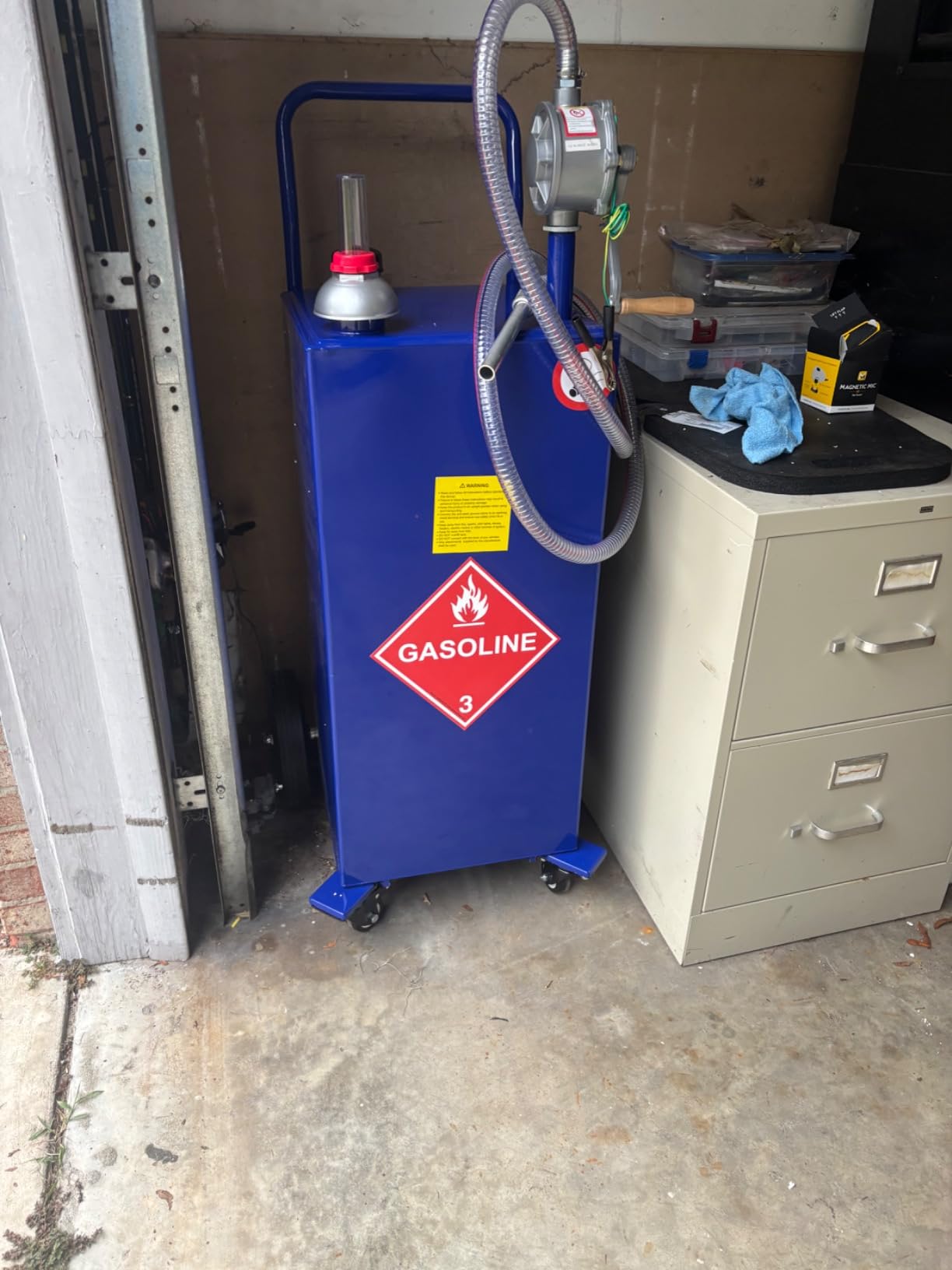
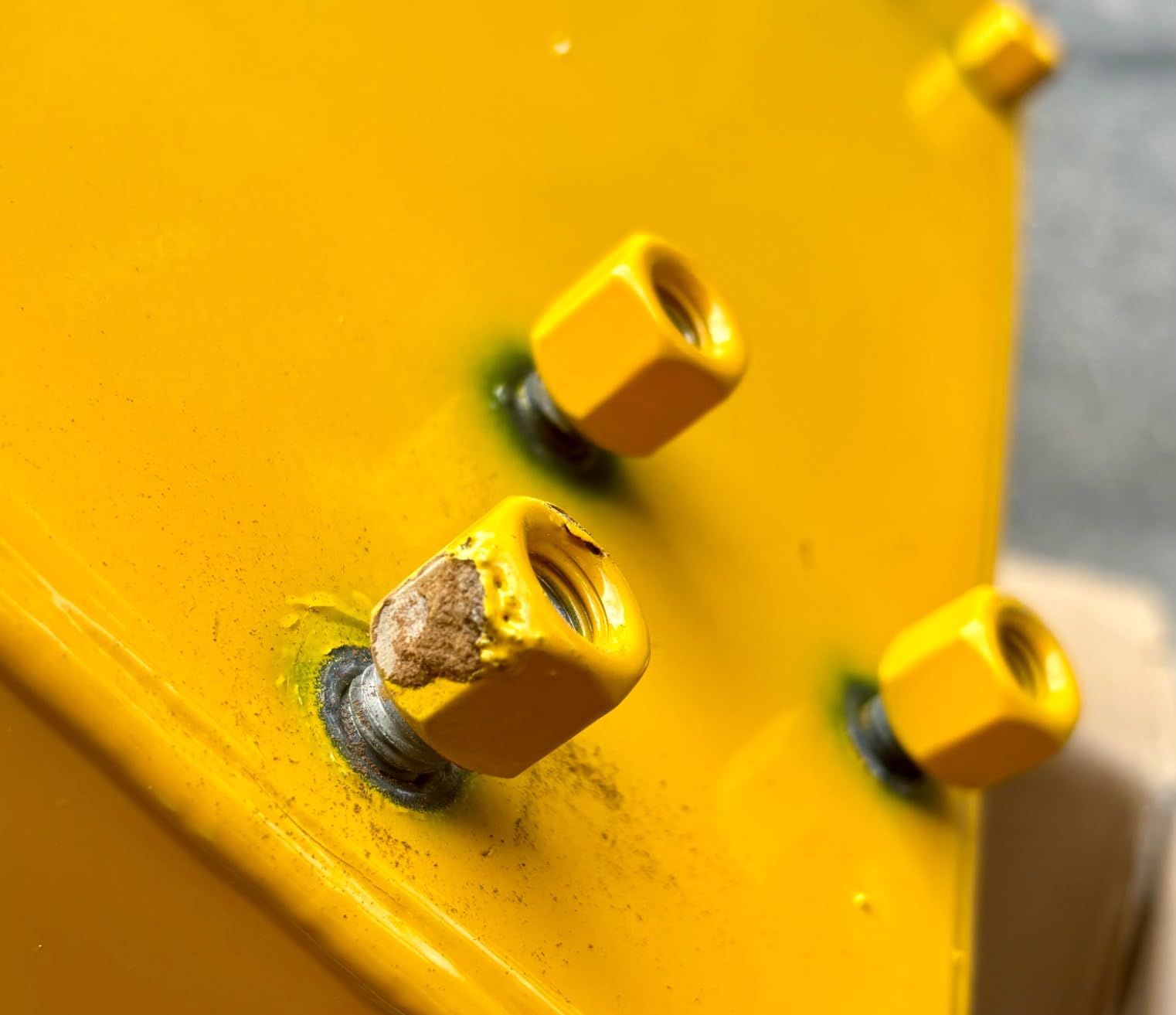
Quality control is the story on this one, and it is a fair one to tell. Owners report a fuel gauge that does not work, fittings with non-standard threads that are hard to replace, and some units arriving damaged. There is also a note that build quality has slipped compared with earlier versions of the same product.
Check all of that on arrival. The gauge and the threads are cheap to verify in the first five minutes with the tank empty, and knowing whether the pump threads are standard saves you a trip to a parts counter later.
Who this suits
A farm, a ranch, or a landscaping yard where the route from the fuel point to the equipment is gravel or dirt. If you are already planning to modify the caddy, replace the pump, or add an electric unit, this tank is a reasonable base to build on.
The anti-static ground clamp is the detail that separates a work-grade cart from a weekend one, and it is present here.
Who should look elsewhere
If you want a turnkey product with working gauges and standard fittings, the VEVOR steel carts have larger review histories behind them, and the poly caddies are far lighter empty.
And if your ground is paved, the 10-inch wheels cost you nothing extra, so buy on the other features instead.
9. VEVOR 30 Gallon Four-Wheel Caddy: The Alternative Steel Setup
VEVOR 30 Gallon Fuel Gas Caddy, Carbon Steel, Portable Fuel Transfer Storage Tank with Manual Pump and 4 Wheels, Gasoline Diesel Can Container, for Cars, Lawn Mowers, ATVs, Boats, Motorcycles, Red
30-gallon carbon steel tank
Four large wear-resistant rubber wheels
Bi-directional hand pump
Powder-coated rust-resistant finish
Pros
- Four large rubber wheels for stability and mobility
- Bi-directional pump handles dispensing and siphoning
- Carbon steel with powder coat resists rust
- Reinforced support ribs add rigidity
- Suited to generators and lawn equipment
Cons
- Fill hole too small for some diesel nozzles
- Reports of fuel leaking from the bottom of the tank
- Fuel gauge accuracy varies
This is the four-wheel sibling of the VEVOR cart above, and the difference is the running gear. Four large wear-resistant rubber wheels rather than a mix, which gives it a wider footprint and better stability when parked on uneven ground, and a listed empty weight of 48.5 pounds against 49.4 for the other configuration.
The pump and the ribbed carbon steel tank follow the same pattern, with a powder-coated finish and a bi-directional crank. Dimensions of 21.1 by 50.6 inches make it tall, and height is worth checking against your storage ceiling or truck bed cover.
What reviewers flag
The fill opening is the most consistent complaint, and it is a specific one. Owners report the hole being too small for certain diesel nozzles, which causes splashback and a wet mess on the concrete every fill.
There are also reports of fuel leaking from the bottom of the tank and a fuel gauge that is not accurate. Inspect both on arrival, before fuel goes in.
When to choose this over the other steel cart
Pick this one for the four-wheel footprint and the taller, narrower profile, which suits a truck bed against a wall better than a wide cart. It is also the version to consider if the four-wheel base sounds more stable than the two-wheel layout.
For light-duty lawn work, either steel cart is more than you need, and one of the 14 to 16 gallon poly models will be easier to live with.
10. Garvee 15 Gallon Fuel Caddy: Best Poly Cart With 8-Inch Wheels
Garvee 15 gal Gas Can, Heavy-Duty Gas Tank and Fuel Caddy with Manual Fuel Transfer Pump, Portable Fuel Tank on Wheels with 10 ft Hose for Lawn Mowers, Cars, Boats, ATVs, Home and Farm Use, Red
15-gallon industrial-grade HDPE tank
10-foot reinforced hose with 360-degree nozzle
8-inch heavy-duty wheels
Collapsible pull handle
Pros
- 8-inch wheels roll better than 6-inch models
- 15-gallon capacity at a lower entry cost
- Dual shut-off valves with vapor-tight seals
- Works with gasoline
- diesel
- kerosene
- biodiesel
- Collapsible pull handle and side grips
- Child-resistant cap and anti-static grounding
Cons
- Same fill filter splashback issue as the 16-gallon model
- Manual pumping takes about 10 minutes for a full tank
- No electric pump option
This is the version to buy if you want the light, rust-proof poly tank but keep the larger wheels. The 8-inch wheels are the meaningful upgrade over the 6-inch models in this category, and on a gravel drive or a lawn with a slope they make a real difference when the tank is near capacity.
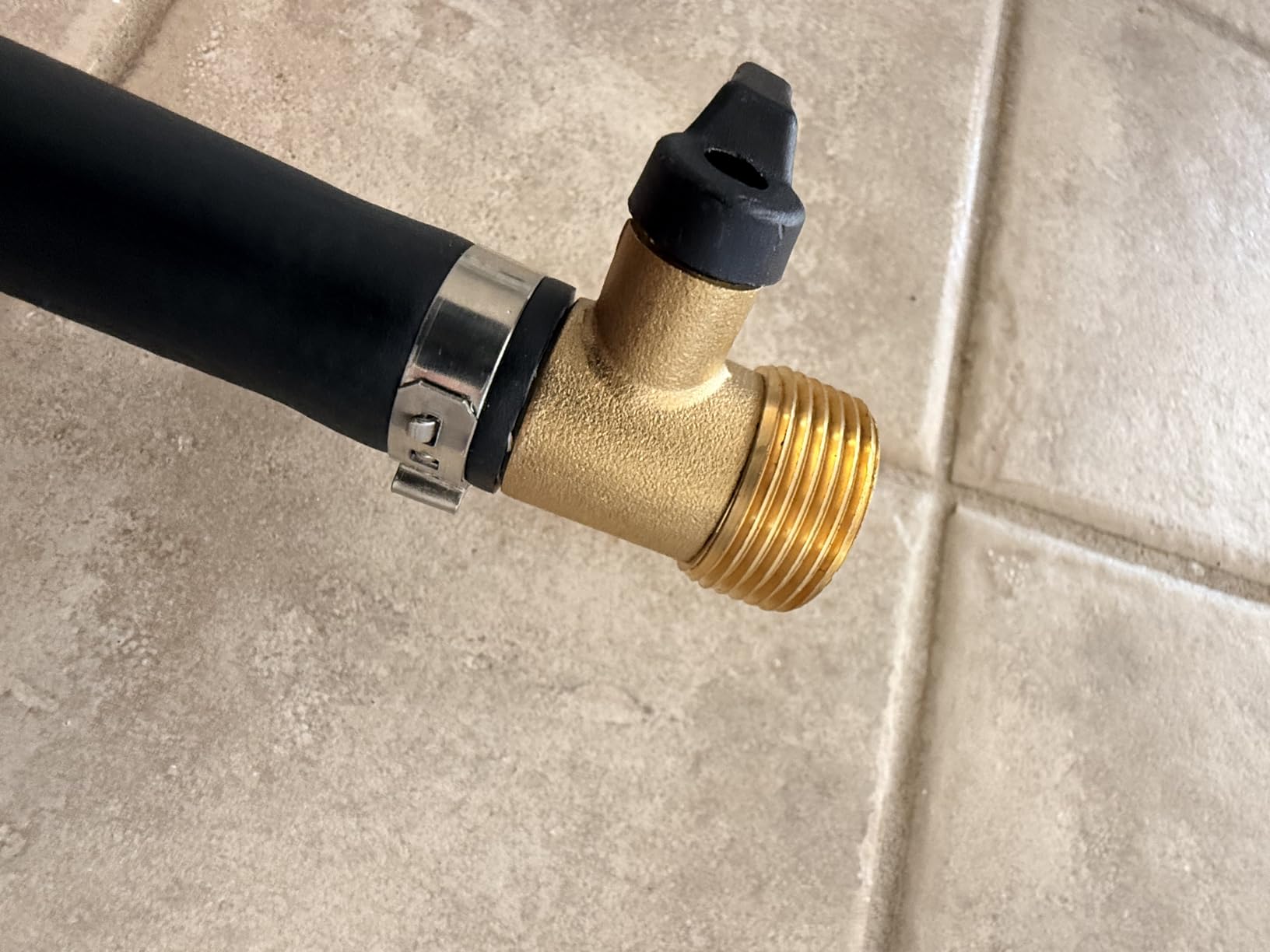
Everything else matches the higher-capacity Garvee: industrial-grade HDPE, dual vapor-tight shut-off valves, a 10-foot reinforced hose with a 360-degree rotating nozzle, a child-resistant cap, anti-static grounding, gallon and liter markers, and a stackable body that saves space in a garage.
It weighs 19.4 pounds empty, close to the Scepter despite carrying a gallon more, so this is one of the more manageable caddies here. Full, it still tops 100 pounds, so the lift rule does not change, but the starting weight is friendlier.
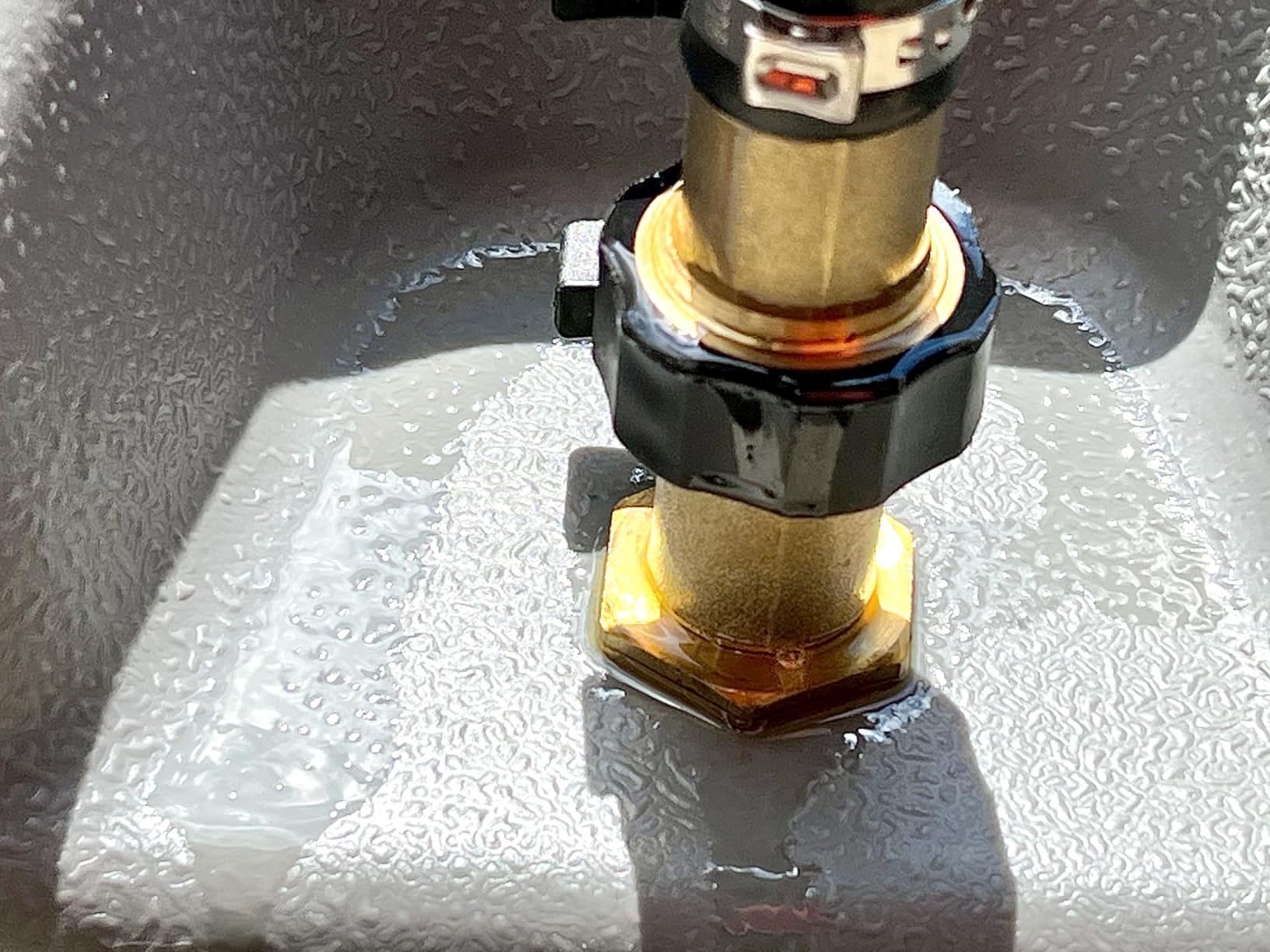
The fill filter screen produces the same overflow and splashback owners report on the 16-gallon model, and the manual pump takes roughly 10 minutes for a full 15 gallons. Remove the screen on day one and treat the pump as a top-up tool rather than a bulk transfer tool.
Where it fits best
Home properties with rough access, small farms running a mixed fleet, and anyone who wants a multi-fuel tank without a second cart. The collapsible pull handle folds down, so it stores flatter than a fixed-handle model.
It also works well as a dock tank, since poly will not corrode in salt air and does not rust if it gets wet.
Where it falls short
There is no electric pump option, and the hose holder is basic enough that the nozzle can drag. If you plan to move 15 gallons more than a few times a week, add an electric transfer unit rather than straining with the crank.
It is also a transfer tank, not a storage tank. Use a stabilizer if it will sit with fuel in it through the off season.
Manual vs Electric Fuel Transfer Pumps: Which Do You Need?
Manual pumps cost nothing to run and work with no power source, which makes them the right default for a caddy that sits next to the machine it serves. Electric pumps trade a power dependency for speed and zero cranking, and they win whenever you move more than 15 or 20 gallons in a sitting.
The speed difference is the headline. A manual rotary pump on a full tank can run 10 minutes for 15 gallons, and forum estimates put a comparable steel pump at around 12 cranks per gallon, so 30 gallons is a serious physical session. The TOPWAY unit claims a full 16 gallons in under five minutes, and the DNA MOTORING diesel unit runs roughly 40 liters per minute on open flow.
Electric units have three requirements. You need a 12V DC source within reach, you have to keep a vent cap loose during operation, and fittings can loosen during rough transport. Any of those becomes a problem at a remote dock or on an island trip, which is exactly where a manual pump is more dependable.
There is a third option worth knowing, and forum users reach for it repeatedly. A battery-powered pump that clamps onto a standard 5 or 6 gallon can with a short hose and an automatic shut-off nozzle gives you powered transfer without a caddy at all, which is the answer for anyone whose real problem is cans rather than capacity.
Fuel Caddy vs Gas Cans: Which Should You Buy?
Cans win on weight and portability, and caddies win on capacity and control. A full 5-gallon can is roughly 40 pounds and fits in one hand; a full 30-gallon steel caddy is well over 300 pounds and needs two people or a ramp. That single comparison decides the question for a lot of buyers.
Boaters on the iBoats forum threads about carrying gas to a dock converge on exactly this. Veterans of long trips recommend plain 5-gallon cans for portability, and reserve caddies for feeding a dock from shore, where the caddy never has to leave solid ground. One Ontario trip with three small boats ended with roughly 30 gallons of surplus fuel, a direct warning against oversizing for a trip that does not need it.
Buy a caddy if your fuel point is fixed, your equipment sits within hose reach, and you would otherwise make more than two or three trips. Buy cans if the fuel moves more than 20 feet, if a boat has to be portaged, or if the storage spot is shared with other gear that needs the space.
Never mix fuels in one container. Gasoline and diesel in the same caddy ruins both, and a cross-contaminated tank is a repair bill rather than an inconvenience. Keep them separate, keep them labeled, and never use a gasoline container to store diesel for a cold-weather machine where wax matters.
How to Choose the Right Size Gas Caddy
Work through these five steps in order. Most sizing mistakes come from picking capacity first and figuring out the logistics second, which is exactly backwards.
Measure your daily burn. Add up the fuel your machines use in a normal week, not their tank capacity. A zero-turn mower might drink more in a morning than an entire boat consumes in a day, and forum reports on fishing trips range from 1 to 2 gallons a day trolling to more than 6 gallons a day running upriver.
Count the refills. Divide your weekly burn by the smallest capacity on your shortlist. If you are topping up more than three times a week, move up a size. If a bigger tank would leave fuel sitting for months, move down.
Check the loaded weight. Add roughly 8.3 pounds per gallon of gasoline, and about 8.8 pounds for diesel, to the empty weight. A 30-gallon steel caddy at 49 pounds empty lands above 300 pounds loaded. Be honest about whether you can move that alone and whether your route includes a step, a ramp, or a boat ladder.
Confirm the fuel type. Some units are diesel only, some handle gasoline, diesel, kerosene, and biodiesel. Match the container to the fuel and never combine them.
Verify the storage fit. Measure the shelf, the truck bed, or the shed corner. Published dimensions are often wrong, and a tank that does not fit where it lives gets used less, which defeats the purpose.
Safety and Transport Rules for Portable Fuel
On how many gallons you can carry: in a personal vehicle, containers must be approved, secured, upright, and closed, and outside containers are subject to limits rather than a free pass. Gasoline is a hazardous material whether or not you are formally regulated, and the practical rule most people follow is to keep more than a caddy’s worth of fuel out of the passenger compartment.
Keep the anti-static grounding clip attached. Several caddies on this list include one, and it exists because static discharge near a fuel transfer point is a real ignition risk.
Never refuel a hot engine. Let a mower or a generator cool before you connect a hose, and keep the nozzle in contact with the receiving tank so the flow stays static-free.
Do not store fuel in a living space. A caddy belongs in a shed, a garage, or a truck bed, not inside a house, a camper, or a boat cabin, and never in an enclosed trunk with the vehicle parked in a garage.
Check for an EPA or UL listing before you buy, and buy an approved container. Every poly caddy on this list is described as EPA compliant, and a listing matters if the tank ever needs to pass a safety inspection or travel on a trailer. For the mechanical side of fuel handling, our fuel pressure tester guide covers the other half of the job.
On shelf life, treat a caddy as a transfer vessel. Gasoline stored without a stabilizer degrades within months, diesel can gel in cold weather, and either will contaminate an engine if it is used after sitting. Add a stabilizer for anything stored between seasons and drain the tank if it is going unused for a full year.
Frequently Asked Questions
How many gallons of fuel can I carry without hazmat?
In a personal vehicle, gasoline must be in approved containers, kept upright, closed, and secured, with limits on the total quantity you may carry. Rather than treat a caddy as exempt, most people keep a caddy’s worth of fuel in the bed or the cargo area and away from passengers. Diesel quantities have separate thresholds, and trailer and commercial carriage rules are stricter. If you plan to move fuel across state or country lines, check the local regulations before you load.
What are the benefits of using a fuel caddy?
A fuel caddy cuts the number of trips to the gas station by holding fuel where you need it, lets you dispense by hose instead of lifting a can, and reduces spills during transfer. A powered unit removes the physical effort of pumping, wheels make a heavy tank movable across flat ground, and a grounding clip adds a layer of static safety. The main trade-off is weight, since a loaded caddy can weigh well over 300 pounds.
What is a 30-gallon fuel caddy with a pump?
It is a 30-gallon wheeled tank with a pump that moves fuel through a hose rather than by pouring. Most use a bi-directional hand rotary pump, where turning one way dispenses and the other way draws fuel back, and higher-end models add a 12V DC electric pump for around 40 liters per minute. A full 30-gallon gasoline caddy typically exceeds 300 pounds, so these are for fuel points with firm ground, not for lifting into boats.
How do I choose the right size gas caddy?
Start with your weekly fuel burn, not your machine tank size. Divide that by the number of refills you are willing to make, add roughly 8.3 pounds per gallon of gasoline to the empty weight to get the loaded weight, and check that you can move it and that it fits your storage spot. Then confirm the container is approved for your fuel type and that you never plan to mix gasoline and diesel in one tank.
What is the best portable fuel tank with a pump?
For occasional top-ups, a 14 to 16 gallon HDPE caddy with a hand pump and a 10-foot hose is the most useful and lightest option, and the Scepter Duramax 14 Gallon is the established pick. For fast transfer, a 12V electric unit moves 15 to 26 gallons in minutes with no cranking, though it needs a 12V power source at the fuel point. Match the capacity to how much you move in one sitting, not to what you might someday need.
Is a fuel caddy better than gas cans?
Cans win for portability because a full 5-gallon can is light and easy to carry, and forum consensus favors cans for portage and small boats. Caddies win for capacity and control, cutting a 30-gallon fill down to a single hose connection with no lifting. A battery-powered pump that clamps onto a standard can gives you most of the convenience without the weight of a caddy.
Best Fuel Caddies: The Bottom Line
The Scepter Duramax Flo N Go 14 Gallon is the best fuel caddy for most people, with two decades of use behind it, dual gravity and pump modes, and an empty weight low enough to move without help. PAMBEE’s 15-gallon model is the value pick if you want brass hardware and a 3 GPM siphon, and TUFFIOM’s 30-gallon metal cart is where to go if refilling the caddy itself is the thing you want to stop doing.
Two decisions matter more than any spec. Size the tank to your weekly burn, not to your biggest machine. And check the loaded weight against your route before you buy, because a full 30-gallon steel caddy is a rolling asset on a driveway and a serious problem at a boat ramp. Get those two right in 2026 and any of the ten above will serve you well.