
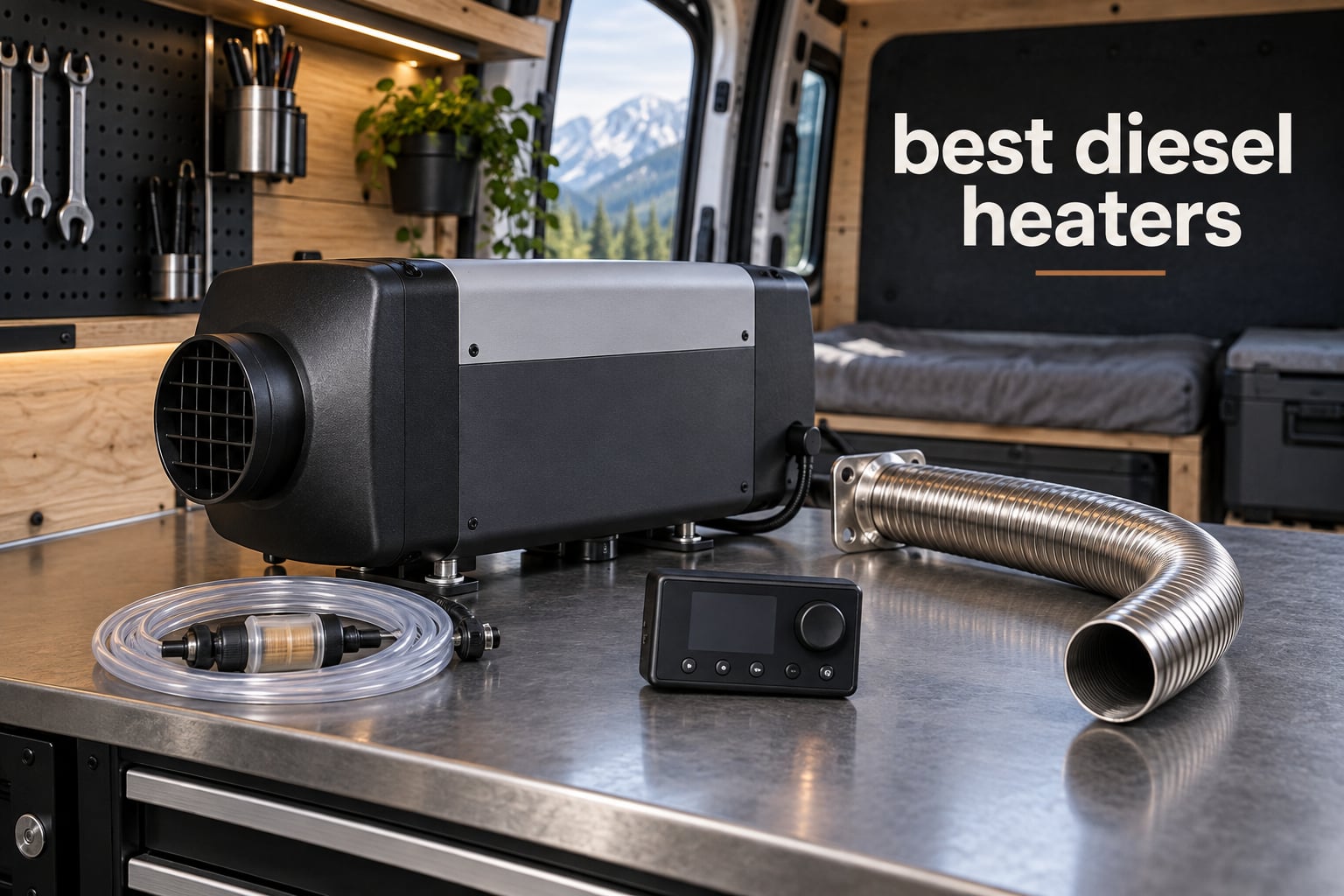
The night my old propane setup gave out was the night I stopped thinking of diesel heaters as a van-dweller luxury. I was two hours into freezing in a Sprinter at a trailhead in northern Arizona, the kind of cold where your breath stops being visible the second it leaves your mouth and the fabric walls feel like a refrigerator door. A friend handed me a 2kW diesel heater with a Bluetooth app and told me to stop watching it. That advice turned into several months of reading, testing, and comparing every diesel heater that made sense for a camper, a truck, a boat, or a workshop.
That experience shaped this list of the best diesel heaters for 2026. A diesel heater burns its own fuel from a small onboard tank, warms air with a burner of roughly 5kW to 8kW, and pushes that air into a space while routing exhaust out of it. Compared with a propane heater, it drinks far less fuel, runs for hours without a canister swap, and produces drier, cleaner heat, which is why it has become the default cold-weather companion for van life, overlanding, and off-grid heating. If you would rather heat a fixed space, we have covered the best garage heaters separately.
What follows is not a price list. We sorted these machines on the things that actually decide whether a heater is worth living with: published heat output, real fuel burn figures, tank capacity, how quietly the fuel pump behaves at midnight, whether it has a carbon monoxide cut-off, and how much of the electrical draw it puts on your house bank. Ten models earned a place, and each one gets the same treatment: what it does well, where it falls short, and who should buy it instead of the alternatives.
A quick note before we start. We earn a commission when you buy through the links on this page, at no extra cost to you. That does not change the order of the list, and where a product has a documented weakness, we name it. One unit in this list carries a genuine safety complaint from an owner, and we flag it rather than bury it.
Top 3 Diesel Heater Picks for 2026
These three are the ones we would put in a vehicle first. The VEVOR 8kW has the largest owner base of anything here, the LF Bros is the most flexible on power input, and the VEVOR all-in-one with app control is the strongest all-round package if you want altitude handling and phone control in the same box.
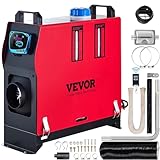
VEVOR 8kW Diesel Air Heater
- 8kW on DC 12-24V
- 0.18-0.36 L/h
- 5L tank
- rated under 9843 ft
- 98 ft remote plus LCD

LF Bros 5kW Diesel Heater
- 5kW (17000 BTU)
- 12V/24V plus 110V adapter
- 0.18-0.53 L/h
- 5L tank
- 1-year warranty

VEVOR 8kW with Bluetooth App
- 8kW
- Bluetooth app to 98 ft
- 0.16-0.62 L/h
- auto altitude to 18045 ft
- 5L tank
Best Diesel Heaters in 2026 at a Glance
Every model we cover, with the numbers that decide the purchase. Fuel consumption figures are the published low and high burn rates, so runtime sits somewhere between the two ends of that range depending on which setting you run.
| Product | Specifications | Action |
|---|---|---|
| VEVOR 8kW Diesel Air Heater |
|
Check Latest Price |
| LF Bros 5kW Diesel Heater |
|
Check Latest Price |
| VEVOR 8kW Bluetooth App All in One |
|
Check Latest Price |
 VEPURLT 8kW with 15L Tank VEPURLT 8kW with 15L Tank |
|
Check Latest Price |
 VEVOR 8kW with CO Alarm VEVOR 8kW with CO Alarm |
|
Check Latest Price |
 HCALORY 8kW Toolbox MAX HCALORY 8kW Toolbox MAX |
|
Check Latest Price |
 ZHIBANG 12V 8kW Heater ZHIBANG 12V 8kW Heater |
|
Check Latest Price |
 maXpeedingrods 2kW 12V/24V maXpeedingrods 2kW 12V/24V |
|
Check Latest Price |
 BougeRV 5kW All in One BougeRV 5kW All in One |
|
Check Latest Price |
 HCALORY 8kW Toolbox Compact 2S HCALORY 8kW Toolbox Compact 2S |
|
Check Latest Price |
1. VEVOR 8kW Diesel Air Heater – Best Overall Diesel Heater in 2026
VEVOR Diesel Air Heater, 8 kW DC12-24V, Fast Heating Diesel Parking Heater with Remote Control and Blue LCD Switch, Low Noise, Pre-Heating Function, for RV, Truck, Camper, Van, Boat and Trailer
8kW burner
DC 12-24V
0.18-0.36 L/h
5L tank
works under 9843 ft
161-215 sq ft
Pros
- Heats 161-215 sq ft on 0.18-0.36 L/h
- 98 ft remote plus an LCD panel
- rated for altitudes under 9843 ft
- heat-insulated exhaust shield and leak-proof fuel cap
- 1023 owner reviews give the widest feedback base in this group
Cons
- Fuel pump ticking is audible on lower settings
- E10 start error reported by some owners
- support replies can take two business days
- screen and settings navigation is fiddly
My first cold night with the VEVOR CY-30 was the reason this list exists. It ran for a full pre-dawn session on a van battery, warmed a mid-size cargo van from near-freezing to comfortable, and did it while the rest of me was still deciding whether to trust it. The 8kW burner is more than a small camper needs, which tells you where the ceiling is: this is a heater for a van, a small RV, a boat cabin, or a workshop bay rather than a two-person tent.
The published burn rate of 0.18 to 0.36 litres per hour is the number that sells it. Against a 5L tank, the low end of that range suggests a long night and the high end a shorter one, but the practical point is that you are measuring in hours, not in canisters. Combustion efficiency is listed at 90% or higher, and coverage is stated at 161 to 215 square feet.
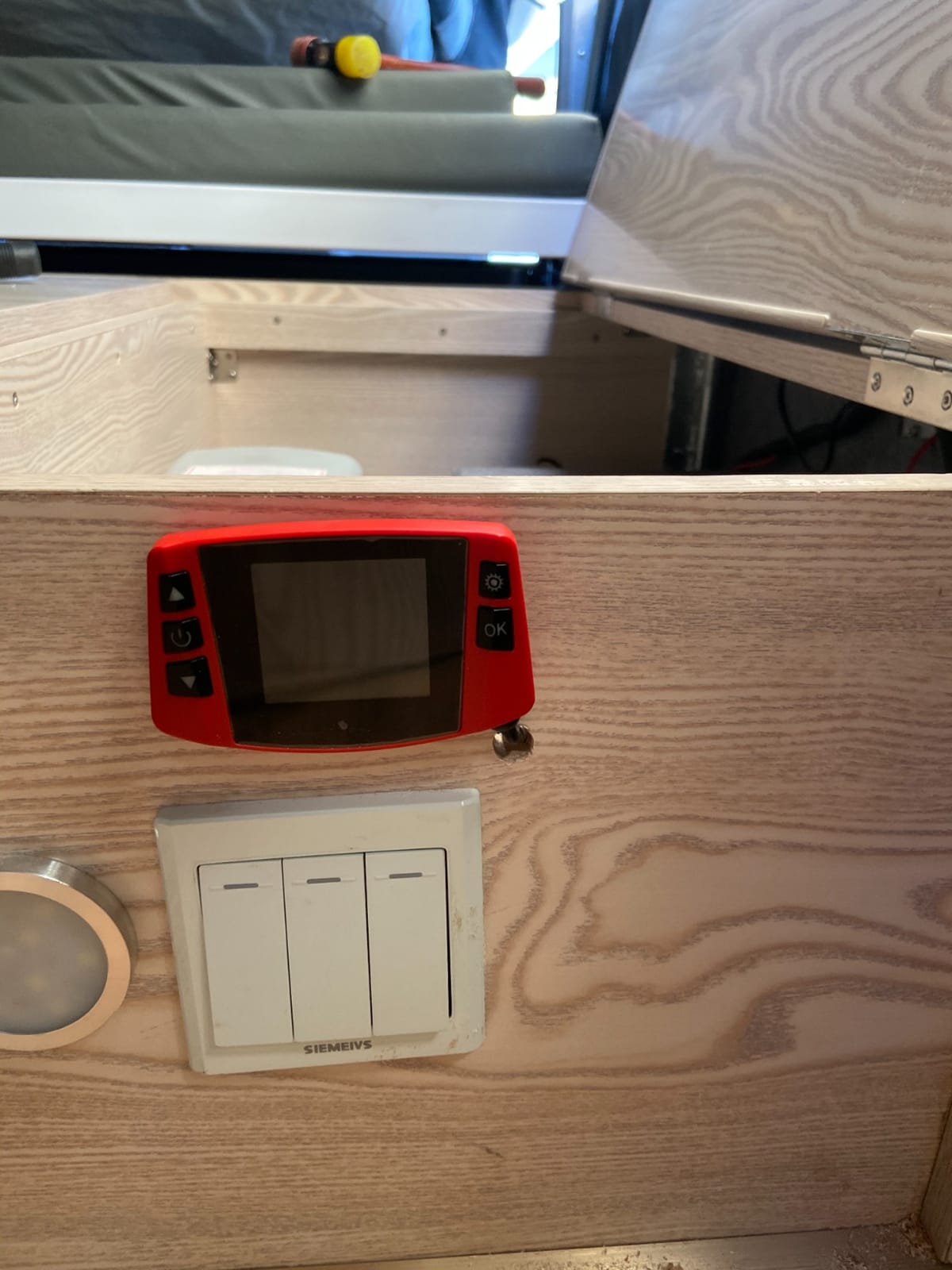
Control is the part that took me longest to get used to. There is a 98 foot remote for pre-heating the cabin before you climb out of your sleeping bag, and there is a blue LCD switch panel for adjusting set temperature across a 32 to 104 degree range. Having both means you can pre-warm from the cold and then fine-tune from bed without crawling forward in the dark.
It weighs 18.3 pounds and measures 16.22 by 7.09 by 16.14 inches, so it is not a handheld device. Plan a mounting spot rather than a carrying spot. Rated working altitude is up to 9,843 feet, which covers most of the American mountain west without needing a special high-elevation mode.
Check the fuel line and the noise floor before a long trip
Two things come up repeatedly in owner reviews. The first is the fuel pump’s ticking, which is most audible at the lowest setting and in a silent van. Several owners report reducing it with insulation around the pump area, and that is the cheapest fix available.
The second is the E10 error code, which some owners report as a failure to start, usually cleared by a power cycle. If you are heading somewhere remote, learn the fault codes before you leave rather than in the dark.
Know who should skip this one
If you need true 24-hour high-altitude operation above roughly 9,843 feet, this unit is not the right answer and a model with a higher published altitude rating is. If your space is a two-person tent, 8kW is generous to the point of wasted fuel.
Support response time is the other soft spot. Reviews mention waits of up to two business days, which is fine at home and frustrating in a mountain parking lot.
2. LF Bros 5kW Diesel Heater – Top Rated Pick with 110V Built In
LF Bros 5KW Diesel Heater, 12V/24V/110V Diesel Parking Air Heater
5kW / 17000 BTU
12V, 24V and 110V
0.18-0.53 L/h
5L tank
215-269 sq ft
1-year warranty
Pros
- Runs on 12V
- 24V and 110V with the included transformer
- so one machine covers a vehicle and a workshop
- internal-thread fuel cap that resists leaks on rough roads
- foldable handle for genuine portability
- foam-protected packaging and separate parts box
- 1-year warranty and detailed instruction booklet
Cons
- 5kW output is modest next to the 8kW models here
- 26 lbs is heavy for a machine you carry between spaces
- costs more per kW than most 8kW alternatives
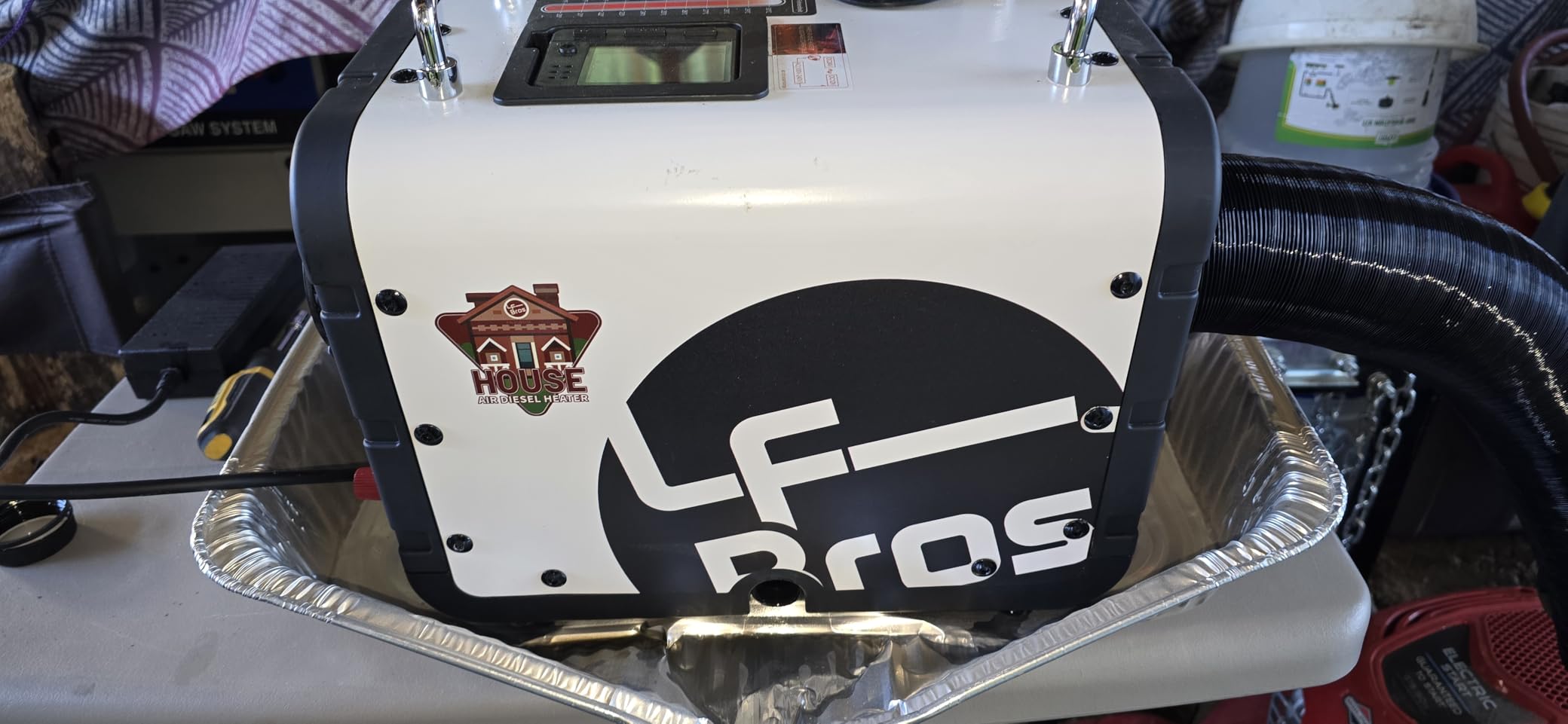
The LF Bros N2 is the odd one out in this list and that is exactly why it earns a slot. Most machines here need a converter or a separate transformer before they can run off a household outlet. This one includes a 110V transformer, which means the same machine heats a workshop bench in winter and a boat cabin in summer.
At 5kW and 17,000 BTU per hour it covers 215 to 269 square feet, which maps to a small camper, a van with a bed platform, or a single-car garage bay. Burn rate runs from 0.18 to 0.53 litres per hour across settings, so the tank life on minimum is genuinely long and the tank life on maximum is a few hours.
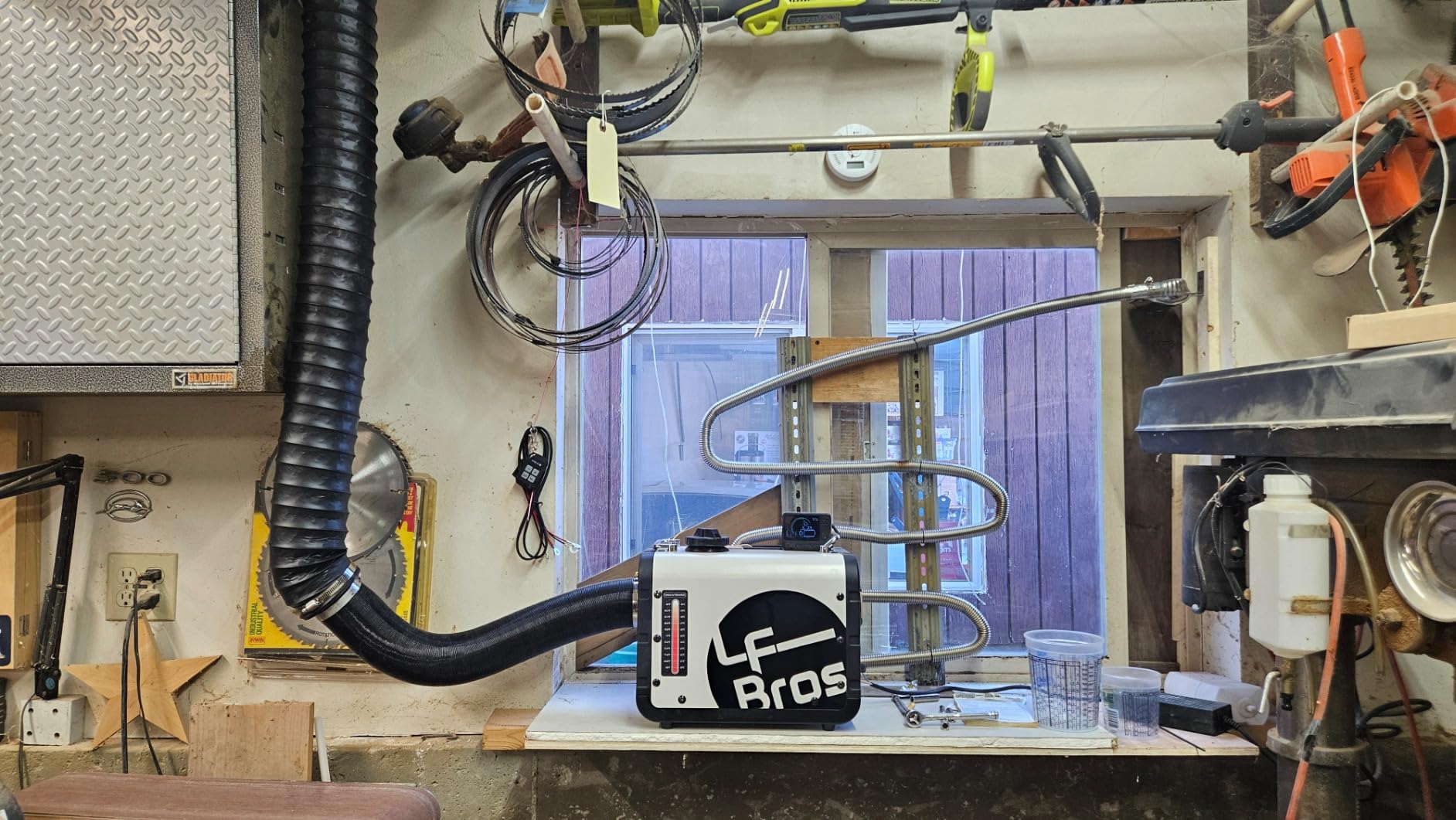
Set temperature runs from 50 to 95 degrees, and the remote is pre-paired at the factory with a stated 100 foot range. Working temperature is listed from minus 40 to 104 degrees, so cold starts are within its design envelope. There is a 5L fuel tank, overheat protection, and an LCD display that shows working status.
At 26 pounds with a foldable handle, it is a genuinely portable heater. We have carried it from a garage to a shed to a truck bed without wishing we had not, and the handle is not a marketing detail on a machine that heavy.
Check the power source and the warranty before you buy
Owners consistently praise the build of the fuel cap, which uses an internal thread design specifically to stop it leaking when the vehicle is on rough roads. That is a small part that causes a disproportionate share of diesel heater complaints, and getting it right is worth noting.
It runs at 15 amps on the DC input, so plan your cable gauge and your connector accordingly. The included manual has a QR code linking to an installation tutorial, which solves the instruction problem that plagues cheaper imported heaters.
Know who should skip this one
Anyone heating a large van, a bus, or a double-bay workshop should step up to an 8kW machine. Paying more for less power is the arithmetic weakness of this pick, and it is the main thing owners complain about.
The warranty is one year. That is the category default and it is the shortest commitment you should accept without thinking about it.
3. VEVOR 8kW All in One with Bluetooth App – Best Value for Control and Altitude
VEVOR 8KW Diesel Heater with Bluetooth App Control
8kW
Bluetooth app to 98 ft
0.16-0.62 L/h
auto altitude to 18045 ft
5L tank
up to 8 hours
Pros
- Highest published altitude ceiling in this group at 18045 ft with automatic compensation
- phone control out to 98 ft plus a 32 ft remote and an LCD panel
- heats 215-269 sq ft in about 10 minutes
- overheat protection triggers at 518F
- voice broadcasting and preheat function
Cons
- Bluetooth app is buggy for multiple owners with dropped connections
- the LCD controller cord is only a few inches long
- exhaust hose clamps are basic garden-hose type
- no hardware included for routing intake or exhaust
The XMZ-L-D3 is the model that convinced me phone control is worth having rather than a gimmick. You pair it in the app, set a target temperature, and start the heater while you are still outside with the tailgate open. By the time you are sitting down, the space is warm, and the preheat function means you never have to touch a cold panel in the morning.
It is rated 8kW on 12V, covers 215 to 269 square feet, and reaches temperature in roughly ten minutes according to owners. Temperature control runs from 46.4 to 96.8 degrees, which is a narrower ceiling than some rivals but comfortably covers real indoor use.
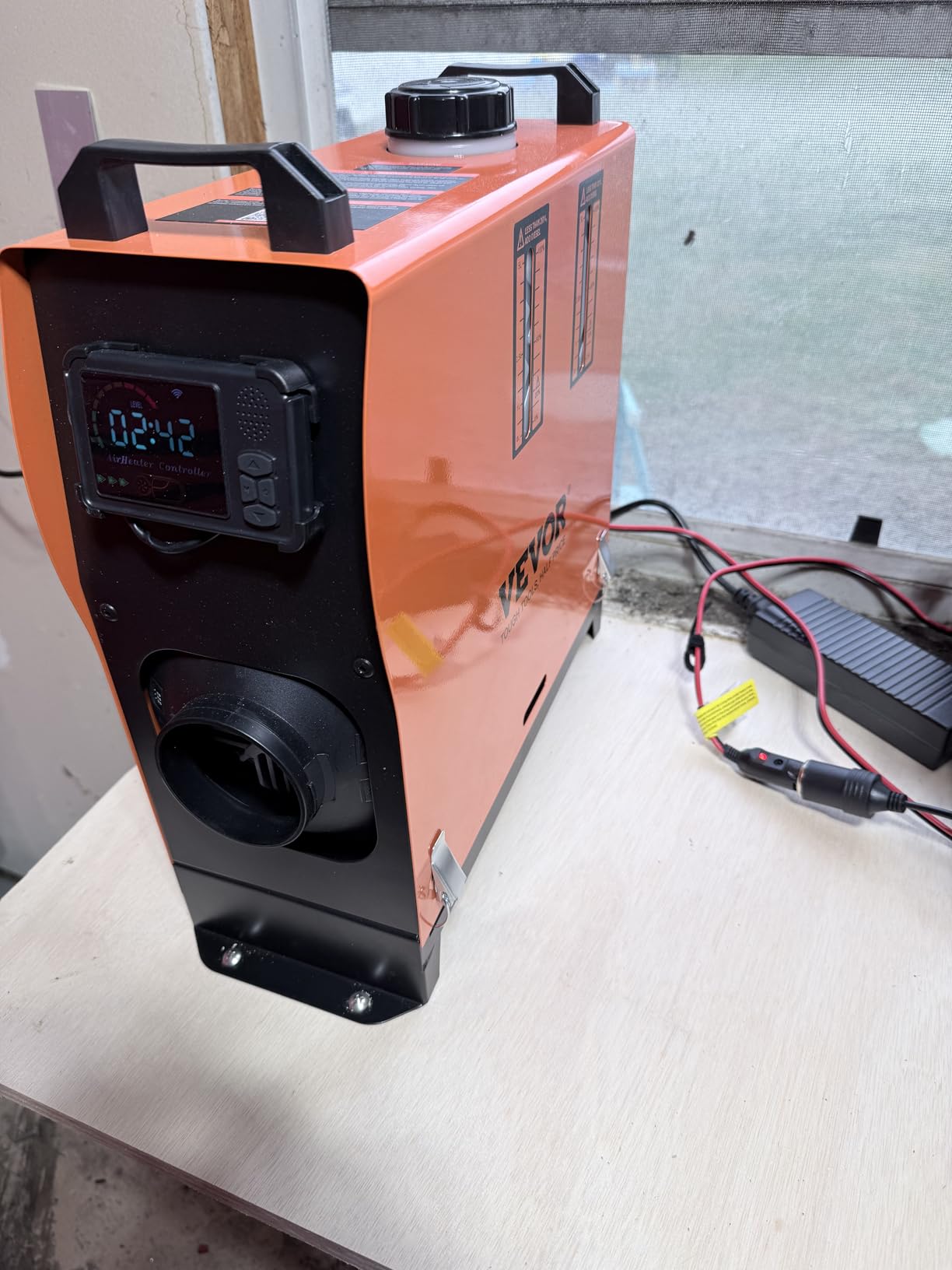
Altitude compensation is the feature that genuinely distinguishes it. The published maximum is 18,045 feet, handled automatically, which is more than double the ceiling on most of the 8kW machines here. If your winter camping happens in the Rockies rather than the desert, that is not a spec-sheet nicety.
Burn rate is listed at 0.16 to 0.62 litres per hour from a 5L tank, and the manufacturer states up to 8 hours of continuous heat on a full tank. In practice the low end of that range is what you will run overnight, not the high end.
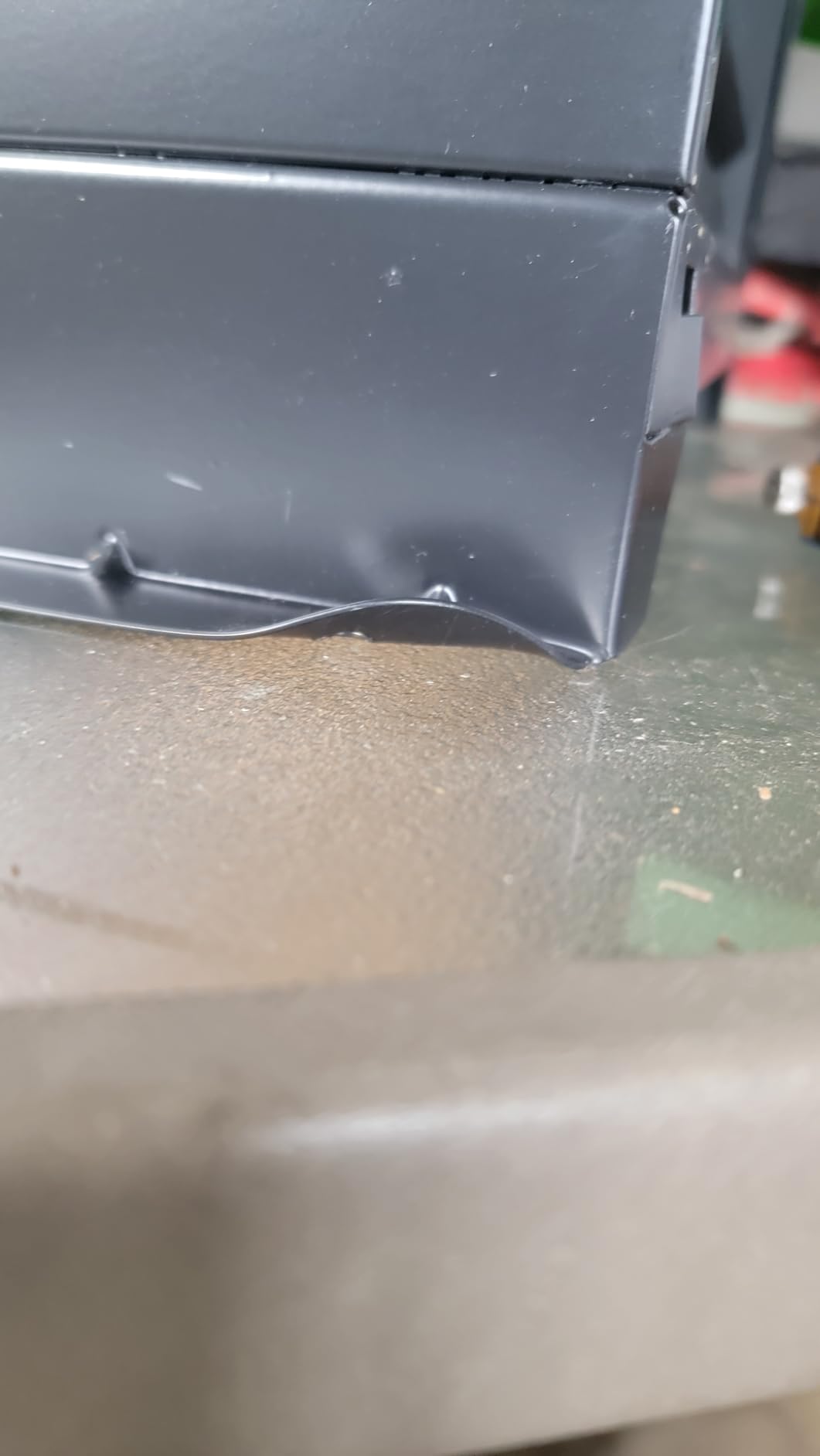
Test the app and upgrade the hoses before relying on it
The app is the selling point and also the most reported weak point. Owners mention dropped connections, heat level that sticks, and thermostat logic that settles on level 1 and stays there for long stretches. Treat the app as a convenience, not a safety system.
Two inexpensive modifications fix most of the physical complaints: a longer controller cord, and proper exhaust clamps instead of the supplied basic type. Several owners also add an inline fuel filter. None of these require specialist tools.
Know who should skip this one
If you are installing permanently and routing ducting, the short controller cord is an irritation rather than a dealbreaker. If you plan to run the heater unattended through a night of sleep and your only control is the app, look at the panel-controlled models instead.
It is 12V only, so a 24V truck or a mains-powered workshop needs a different machine or a converter.
4. VEPURLT 8kW with 15L Tank – Best for Long Trips and Boats
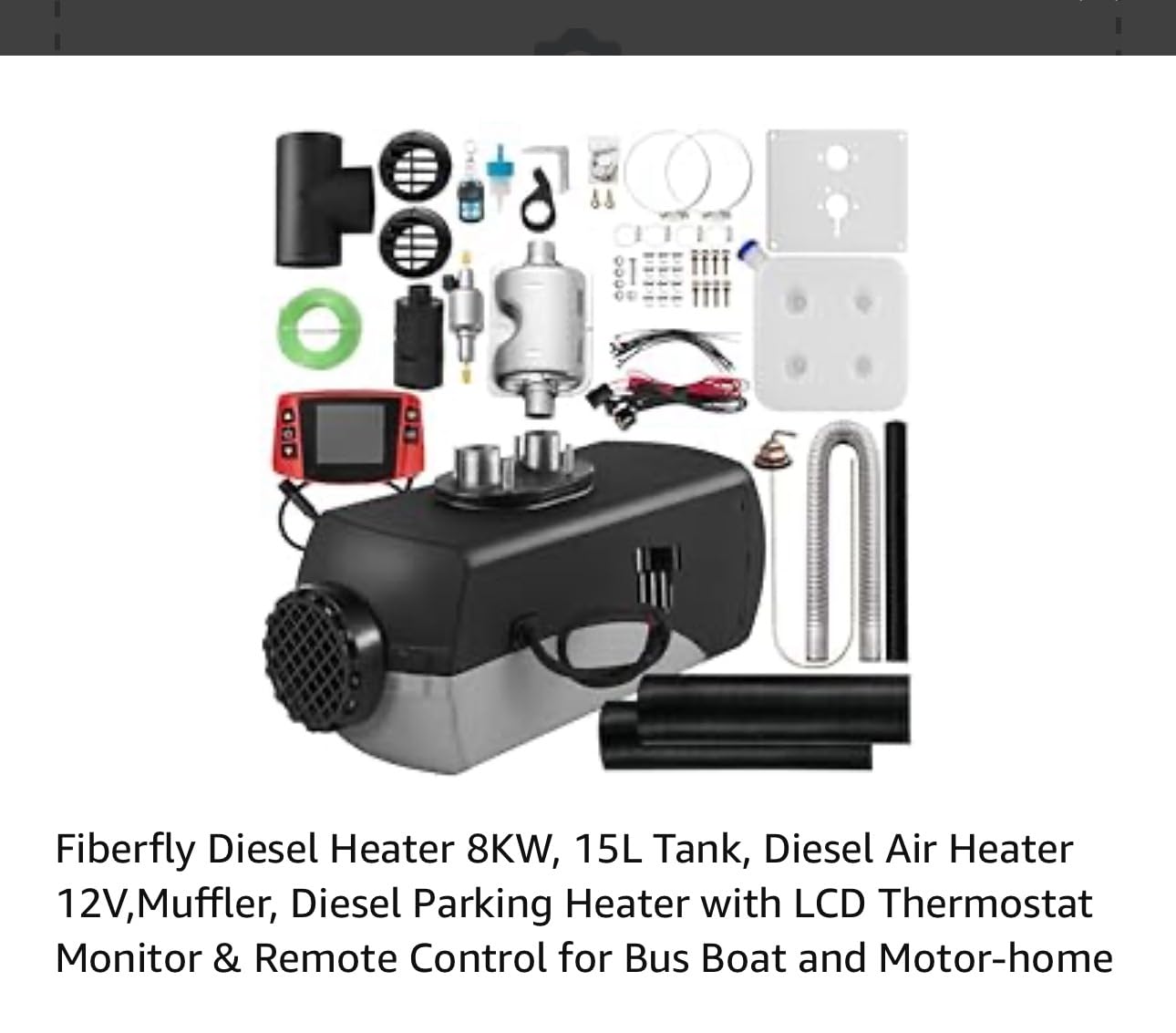
VEPURLT Diesel Heater 8KW, 15L Tank, Diesel Air Heater 12V,Muffler, Diesel Parking Heater with LCD Thermostat Monitor & Remote Control for Bus Boat and Motor-home
8kW
15L tank
0.2-0.5 L/h
12V only
ceramic igniter
Euro IV
built-in muffler
Pros
- Largest fuel tank here at 15L
- which multiplies every runtime figure on the spec sheet
- ceramic ignition plug for fast full combustion
- meets Euro IV engine emissions requirements
- included muffler for quieter running
- on sale since 2020 so the design is proven
Cons
- 12V only with no 24V or 110V option
- 15L tank makes it bulkier than the 5L models
- older design
- 407 reviews is thin next to the leading models
Runtime is what this pick is for. Everyone else in this list carries a 5L tank, and a 5L tank means a refill conversation every night or two on a long trip. At 15 litres, this model triples the fuel on board, and with a published burn of 0.2 to 0.5 litres per hour that is a very different planning equation.
It is rated 8kW on 12V and lists working temperature from minus 40 to plus 50 degrees, with the oil pump rated down to minus 40. For a boater, a bus, or a commercial vehicle running long shifts in winter, that tank size justifies the footprint.
The ceramic ignition plug is worth understanding. It vaporises fuel before it enters the combustion chamber, which is why the manufacturer describes the burn as fast and complete. That chemistry also underpins the Euro IV emissions compliance, which is unusual to see documented on a heater in this price class.
An included muffler is unusual on machines this size, and it directly addresses the noise question. It weighs 16.19 pounds and measures 18.11 by 17.72 by 10.24 inches, so the tank is where the bulk lives rather than the heater body.
Check the footprint and the voltage before a permanent install
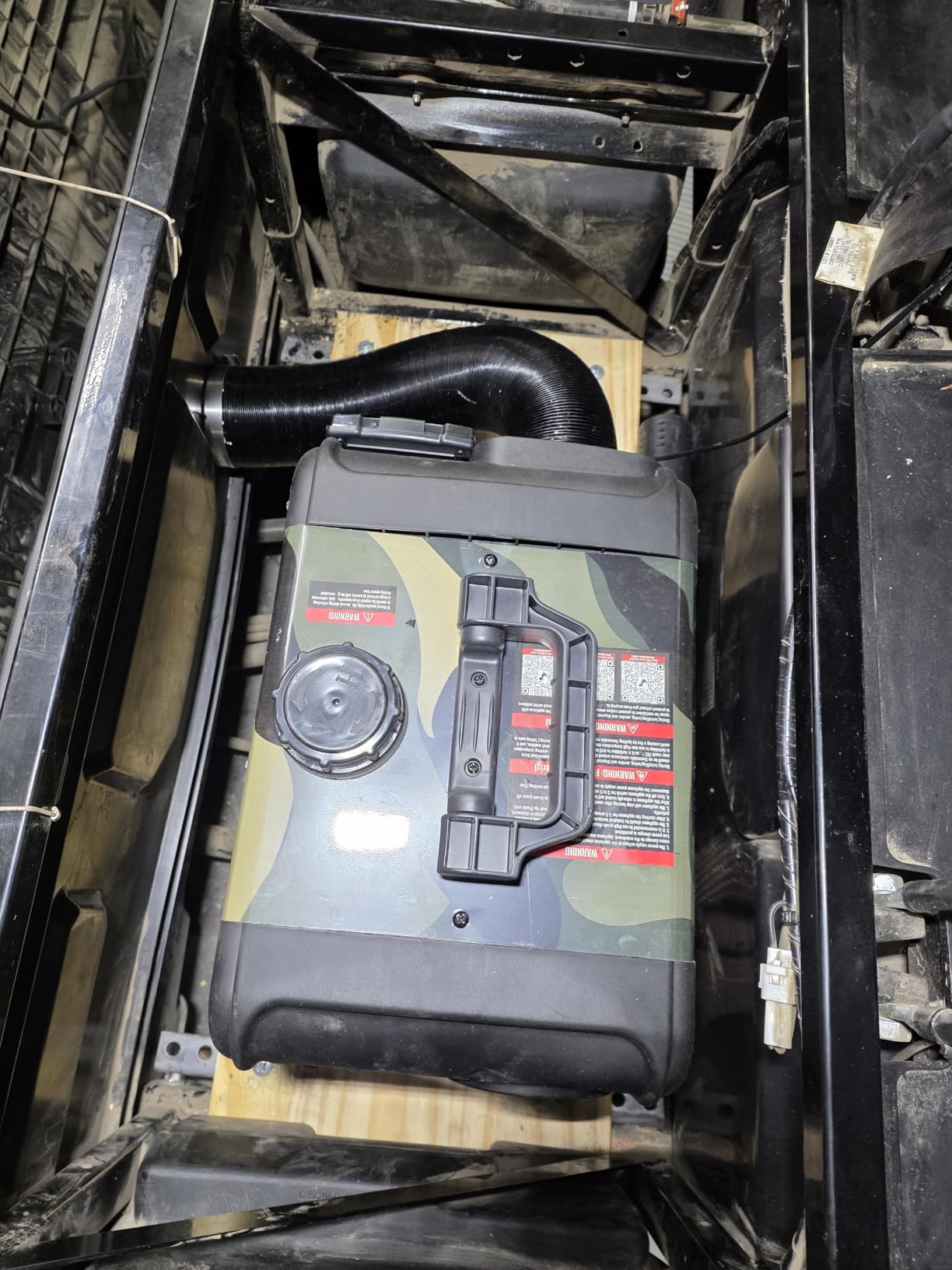
The 15L tank is a planning item, not a free upgrade. Measure the mounting space before you commit, and note that a full 15L tank is real weight to secure in a moving vehicle. A tank that is not properly mounted is a genuine hazard.
Operating voltage range is listed as 10 to 12V or 20 to 32V, so it will run on a 24V system within that window, but there is no 110V path at all. This is a vehicle machine.
Know who should skip this one
Skip it for a weekend trip, where 5L is plenty and the extra volume is dead weight. Also skip it if you need household power, because you would be running it through a converter you have to buy separately.
Being on sale since 2020 cuts both ways. The design is proven, but it predates most of the app and altitude features on the newer models.
5. VEVOR 8kW with CO Alarm – Best for Enclosed Spaces
VEVOR 8KW Diesel Heater, DC 12V/24V, Bluetooth APP Control, CO Alarm
8kW
CO alarm with auto shut-off
DC 12V/24V
0.18-0.35 L/h
under 75 dB
269 sq ft
Pros
- Built-in carbon monoxide monitor that alerts and cuts the heater
- two DC wiring options plus 12V and 24V support
- three control methods including app
- remote and panel
- leak-proof cap with fuel level indicator
- under 75 dB
Cons
- Costs more than the basic VEVOR 8kW model
- 397 reviews on a newer design
- horizontal footprint may not suit every mounting space
- app reliability issues reported as on other models in the range
The reason this unit is separate from the other VEVOR in this list is one word: carbon monoxide. It has a built-in CO monitor that alerts and shuts the heater down automatically. For a boat cabin, a small enclosed camper, a shed, or any space where a human sleeps close to the burner, that is a meaningfully different safety posture.
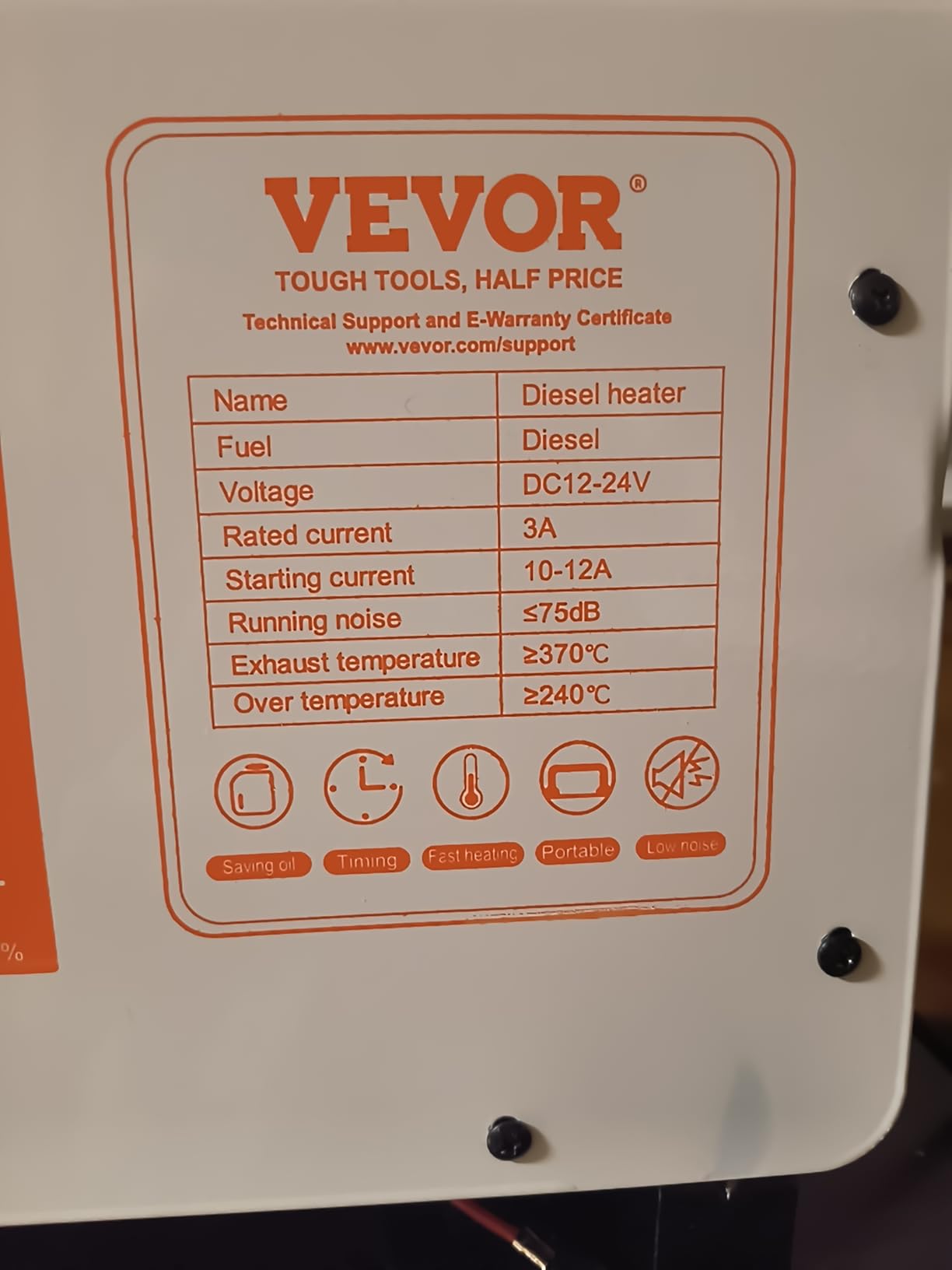
Underneath, it is a straightforward 8kW machine rated at 269 square feet of coverage with combustion efficiency of 90% or better and a burn rate of 0.18 to 0.35 litres per hour. Those are good numbers and they sit alongside overheat protection and a cast aluminum body with a ceramic igniter.
Voltage is DC 12V and 24V with two wiring options, an adapter route and a direct DC 12V route, so it covers both a vehicle battery and a portable power station. Control is triple: Bluetooth app, remote, and the display panel. Noise is quoted at 75 dB or below thanks to the muffler and fuel pump.
It weighs 18.6 pounds and measures 16.5 by 10 by 12.2 inches in a horizontal layout. The orientation is worth checking against your install because a horizontal body is easier to slide under a seat and harder to hide behind a cabinet.
Check the alarm and treat a separate CO detector as mandatory
A built-in CO alarm is a real safeguard, but it is not a substitute for a standalone detector in the room. Build your own understanding of a diesel heater: the correct answer to do diesel heaters need ventilation is always yes, and the alarm is the second line of defence, not the first.
Keep the exhaust routed outside the occupied space, keep the combustion air intake out of the recirculated cabin loop, and test the built-in alarm function as part of your season start-up.
Know who should skip this one
If you are heating a large open workshop where you never sleep, the CO alarm is money you could spend on a larger tank. If your plan is a permanent van install with ducting, the horizontal form factor may fight your layout.
It also costs more than the basic VEVOR 8kW, and the app carries the same reliability complaints as the rest of the range.
6. HCALORY 8kW Toolbox MAX – Best for Quiet Sleep
8KW Diesel Heater, All in One 7.5L Toolbox MAX Diesel Air Heater 110/12/24V Parking Heater with App Control, Wireless Temperature Sensing and Altitude Mode for RV Garage Camper 2025 Upgraded
8kW
7.5L tank up to 62.5 hours
110V/12V/24V
silent fuel pump
65 dB
18000 ft altitude
Pros
- Silent fuel pump removes the ticking noise that is the top complaint on this category
- 7.5L tank quoted at up to 62.5 hours on minimum
- wireless remote doubles as a real room thermostat sensing ambient temperature
- triple voltage including an AC adapter
- 3-minute warm-up claimed even in sub-zero conditions
Cons
- Heaviest machine here at 26.8 lbs
- 175 reviews on a newer model
- remote thermostat needs its own batteries
- sits at the expensive end of this list
Noise is what separates this one. The 65 dB figure is measured at the air duct outlet, and the fuel pump itself is described as silent, which means the ticking that owners complain about on cheaper units is engineered out rather than insulated against. If you sleep beside the heater, that is the feature that changes your night.
The wireless remote thermostat is the second one. Instead of sensing temperature at the heater and hoping, the remote carries its own sensor and acts as a room thermostat. We have run heaters with a sensor at the far end of a van and watched them overshoot the space the sleeper is actually in, and this is the direct fix.
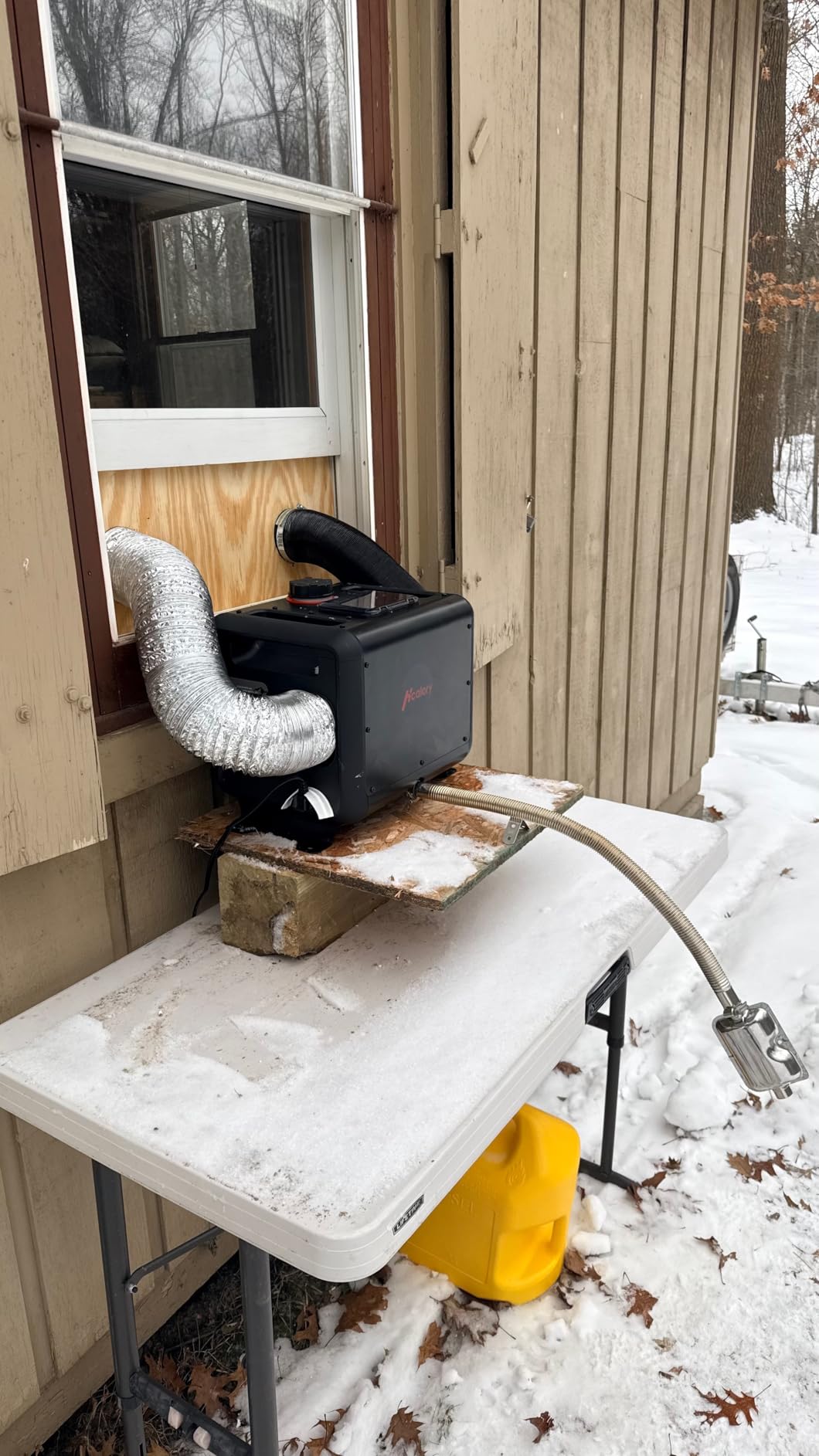
Runtime is the headline number. A 7.5L tank is quoted at up to 62.5 hours on the minimum setting, with a stated 36 percent fuel efficiency improvement over traditional heaters. Those are manufacturer claims at the lowest setting, so treat them as a ceiling rather than a promise.
Power is the broadest here: 110V, 12V, and 24V from one machine with the included adapter. Altitude adjustment is automatic to 18,000 feet, heat-up is claimed at three minutes in sub-zero conditions, and the toolbox enclosure protects the components in transit.
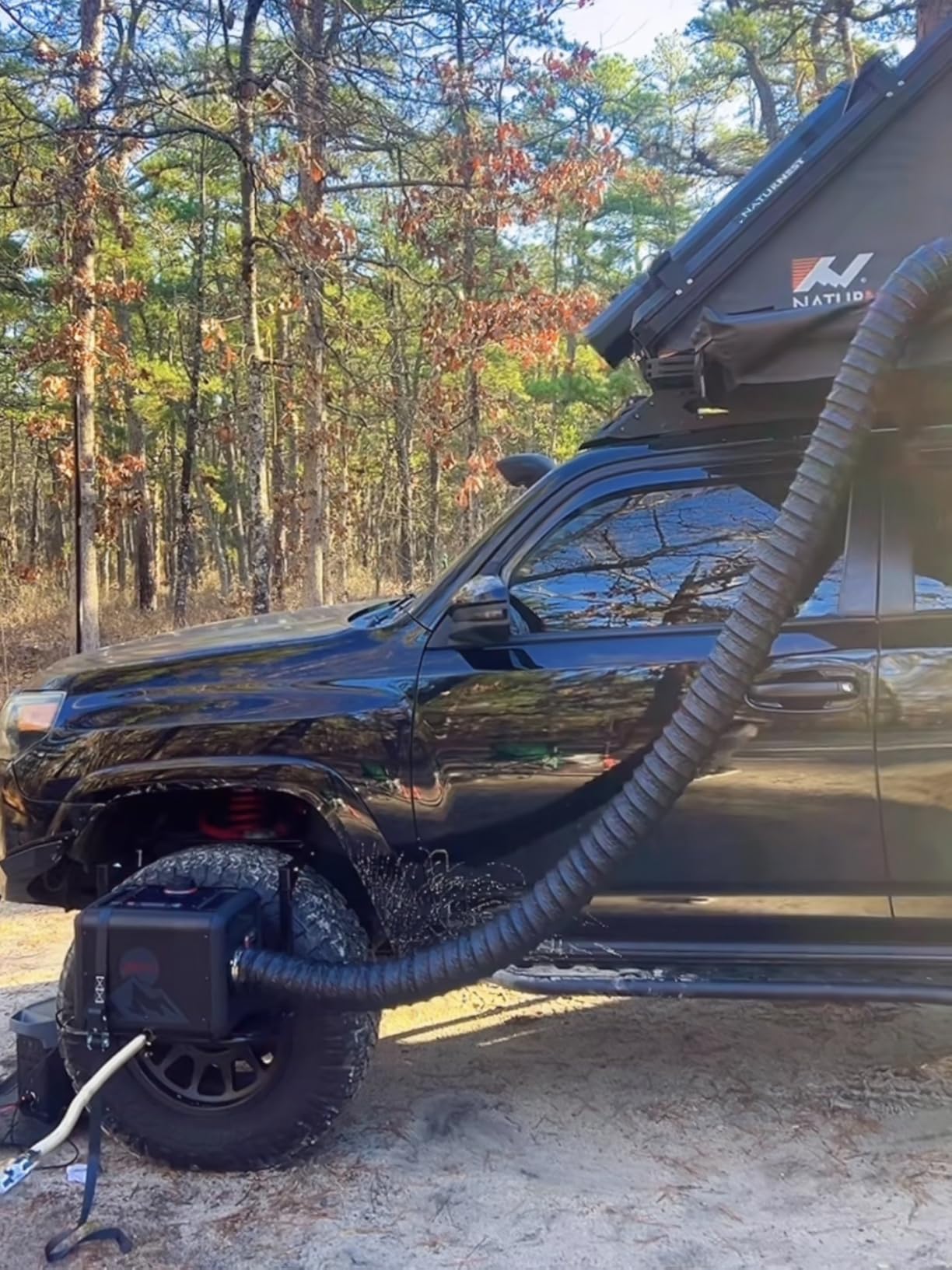
Check the remote batteries and the weight before a build
The remote thermostat needs batteries that are not included, and a dead remote in a cold morning is a genuinely bad experience. Add a spare set to the same box as your spare fuel filter before you leave.
At 26.8 pounds this is the heaviest heater we cover, and that matters in a van where every kilogram is contested. The package is 19.1 by 18.3 by 13.5 inches, so plan a floor or seat-base mount rather than a shelf.
Know who should skip this one
Skip it if you heat a workshop a few times a season. The silent pump, the room thermostat, and the 7.5L tank are comfort features for someone living beside the heater, and you would be paying for all three without using them.
With 175 reviews on a design that launched more recently, the long-term reliability record is thinner than the leading models here.
7. ZHIBANG 12V 8kW Heater – Budget Pick
ZHIBANG 12V 8KW Diesel Air Heater with LCD Display &5L Fuel Tank
8kW on 12V
5L tank
minus 40 to plus 50 degrees
large-font display
fault-code controller
maintenance tools included
Pros
- 8kW core heating
- large-font high-definition display stays readable at low temperature
- voice mode gives audible feedback
- controller shows fault codes for real troubleshooting
- includes a hole opener
- glow plug tool and atomization net for maintenance
Cons
- 12V only with no 24V or 110V path
- remote needs 2x LR03 batteries that are not included
- 171 reviews and a 4.0 rating make it among the least proven here
- less established brand
What you get at this end of the market is an honest 8kW burner, a 5L tank, and a control panel that most of the category would consider a luxury. The high-definition display with large font is a real quality-of-life decision, because you are reading it with gloves on, in the dark, at minus 10 degrees.
Working temperature for both the heater and the oil pump is listed from minus 40 to plus 50 degrees, so the pump itself is rated for the conditions where cold starts are hardest. That is a more meaningful specification than it sounds, because a pump that will not move thick cold fuel is a heater that will not start.
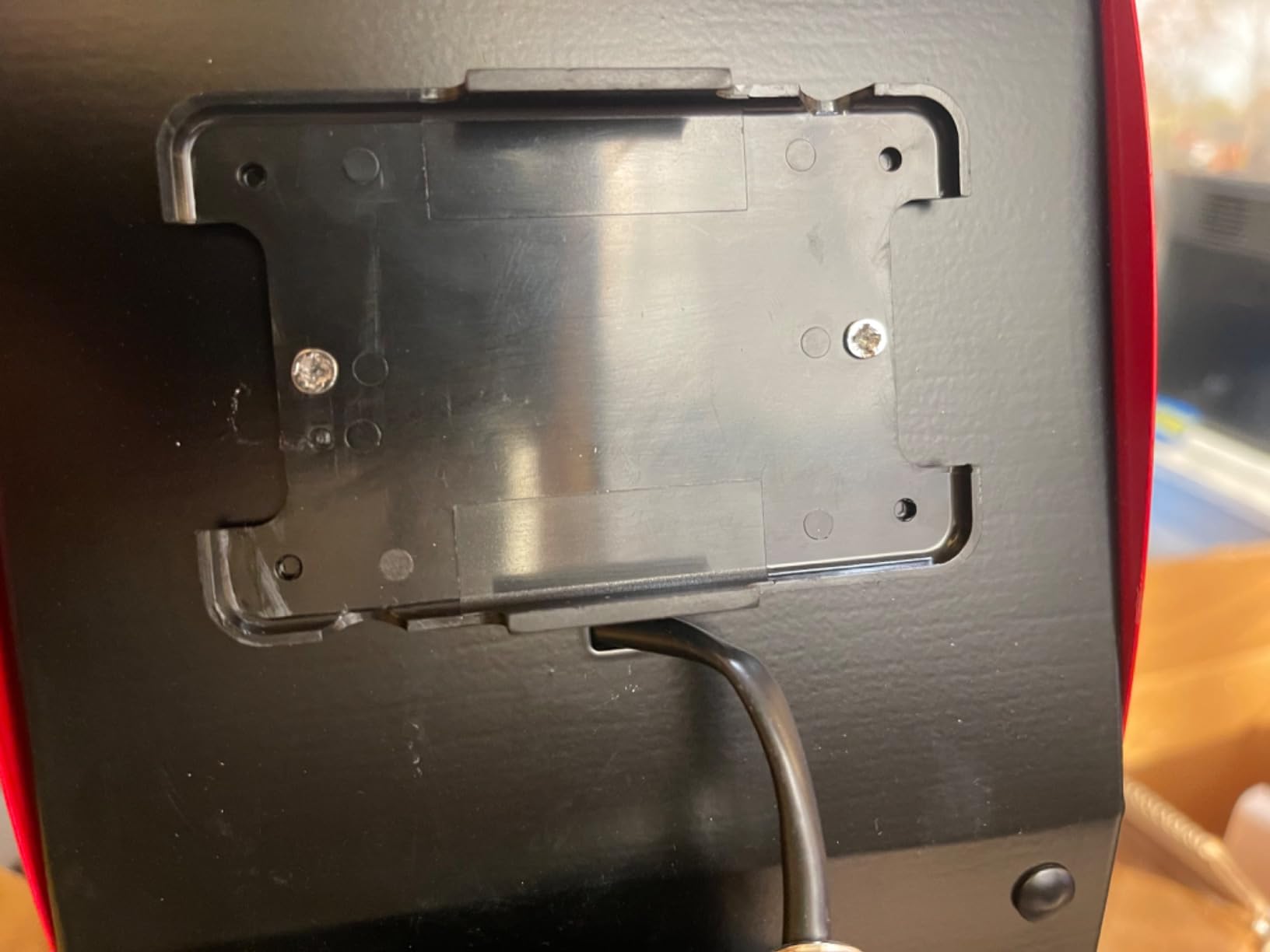
The controller includes fault display and a full set of protection functions, and the relay disconnects on fault. It also reduces power automatically when overheating and returns to normal once cooled. For a budget machine, that is a better safety story than the category deserves.
The maintenance kit matters more than it looks. It ships with a hole opener, a glow plug tool, and an atomization net tool, which are exactly the three items you need for the service that keeps a diesel heater alive. Spending the difference elsewhere on filters is money well saved.
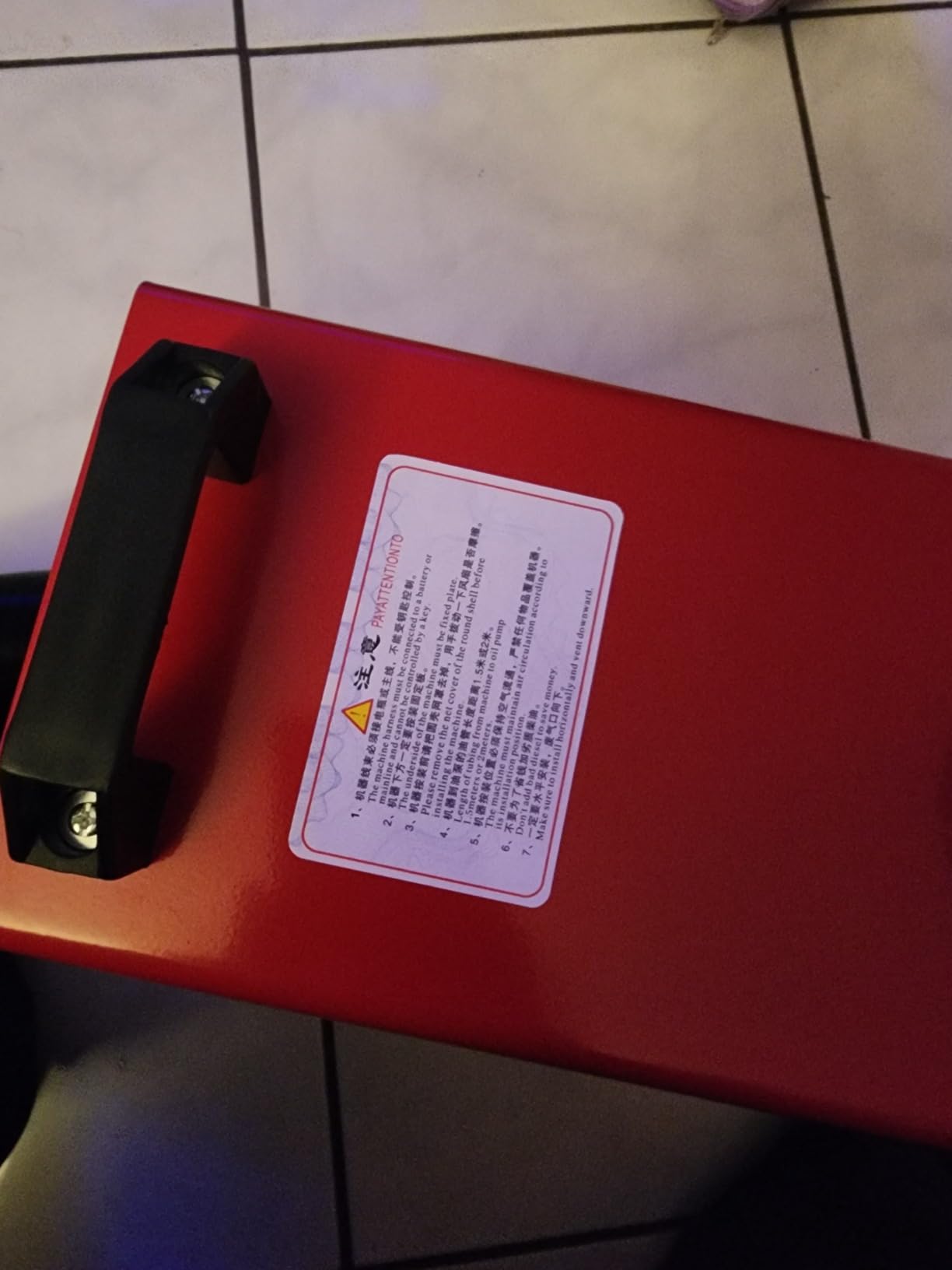
Check the fault codes and buy the batteries
Fault display is only as good as your ability to read it. Learn the codes before your first cold night, and keep the glow plug tool with the heater rather than in a toolbox across town.
Voice mode is an underrated feature for a machine used in the dark or with gloves on. It tells you the unit changed state without you needing to look at a small screen.
Know who should skip this one
Skip it if you need 24V or 110V operation, or if you want app control. There is no path to either without adding hardware this model does not anticipate.
At 171 reviews and a 4.0 rating, it has the thinnest evidence base of anything here. Buy it for a season, and service it properly, rather than expecting a decade of service.
8. maXpeedingrods 2kW 12V/24V – Best for Small Spaces
maXpeedingrods 2KW Diesel Heater 12V/24V, App Remote Control,LCD Control
2kW
12V and 24V
0.16-0.24 L/h
Bluetooth app via Booyood
altitude above 5500 m
12.79 lbs
Pros
- Published burn rate of 0.16-0.24 L/h
- among the lowest here
- lightest at 12.79 lbs so it suits tight installs
- 12V and 24V dual voltage
- low-frequency pulse fuel pump reduces vibration
- blower speed adjusts linearly with output
- available since 2019 so the design is mature
Cons
- 2kW is the lowest output in this group and suits only small spaces
- costs more per kW than the 8kW models
- 2019 design predates most app and altitude features
- app ecosystem less established than the leaders
Two kilowatts sounds like nothing next to the 8kW machines in this list, and for a large van it is nothing. For a small space it is the right answer, and this is the only model here where efficiency is genuinely the priority rather than a side benefit. The published burn rate of 0.16 to 0.24 litres per hour is among the lowest in the group.
That burn rate is also why the model has been in use since 2019 without feeling dated. A design built around low consumption does not need a redesign every year to stay relevant, and the gasification technology with a ceramic igniter is the reason the burn rate is where it is.
At 12.79 pounds it is by a wide margin the lightest heater here, and that is not a rounding error. In a truck camper, a rooftop tent, or a small boat hull where weight is the binding constraint, five pounds matters more than two kilowatts of extra capacity.
Check the space and the app ecosystem
Do the arithmetic before you buy. Two kilowatts is right for a small van interior, a fishing hut, a boat cabin, or a single person sleeping in a cold room. It is not right for a family camper or a workshop. Measuring your space first will save you more than any feature comparison.
App control runs through the Booyood app alongside an LCD panel and a remote. Owners do not complain about it, but they also do not treat it as a highlight, and the app ecosystem here is thinner than the VEVOR and HCALORY ones.
Know who should skip this one
Skip it if your space is medium or large, or if you plan to grow the build later. An 8kW machine covers more ground and the incremental fuel cost between them is small over a night.
The per-kW economics also do not favour it, since you pay more for this output than for several times as much elsewhere in the list.
9. BougeRV 5kW All in One – Best Build Quality
BougeRV 5KW Diesel Heater, 5L All-in-One Portable Air Diesel Parking Heater
5kW
307 cu ft in 8 minutes
0.18-0.53 L/h
11-27 hours per tank
app, LCD and remote
2-year tech support
Pros
- Highest owner rating in this group at 4.4
- stainless steel exterior and a finish that feels a class above the rest
- dual noise reduction with a muted fuel pump plus muffler
- assembles in under 2 minutes with threaded exhaust and XT60 quick release
- 2-year tech support
- heats 307 cu ft in 8 minutes
Cons
- Owners report the exhaust pipe clogs with soot and can leak exhaust into the heated space
- fuel level indicator on the site window is inaccurate
- control panel detaches easily
- 106 reviews is the second thinnest base here
- 5kW output carries a higher cost per kW than the 8kW alternatives
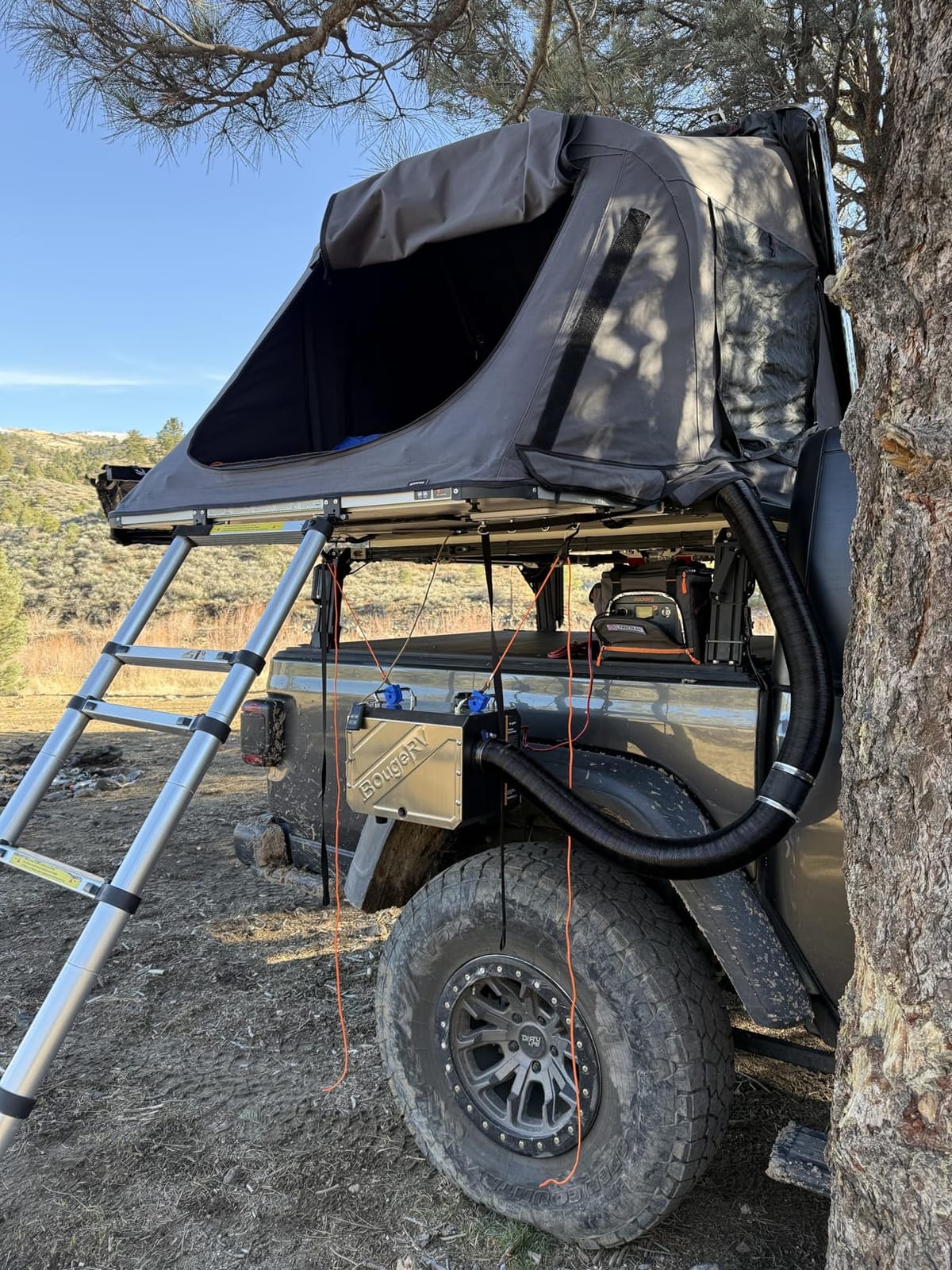
Start with the good, because there is a lot of it. Build quality is the story on this one. A stainless steel exterior, a muted fuel pump, a muffler, a threaded exhaust connection instead of a slip fit, and an XT60 quick-release power connector are the details a manufacturer chooses when it is not cutting corners.
At 5kW it heats 307 cubic feet in about 8 minutes, which is a genuinely fast warm-up for a tent or a boat cabin. Burn rate is 0.18 to 0.53 litres per hour from a 5L tank, giving 11 to 27 hours per tank depending on setting. Assembly takes under two minutes.
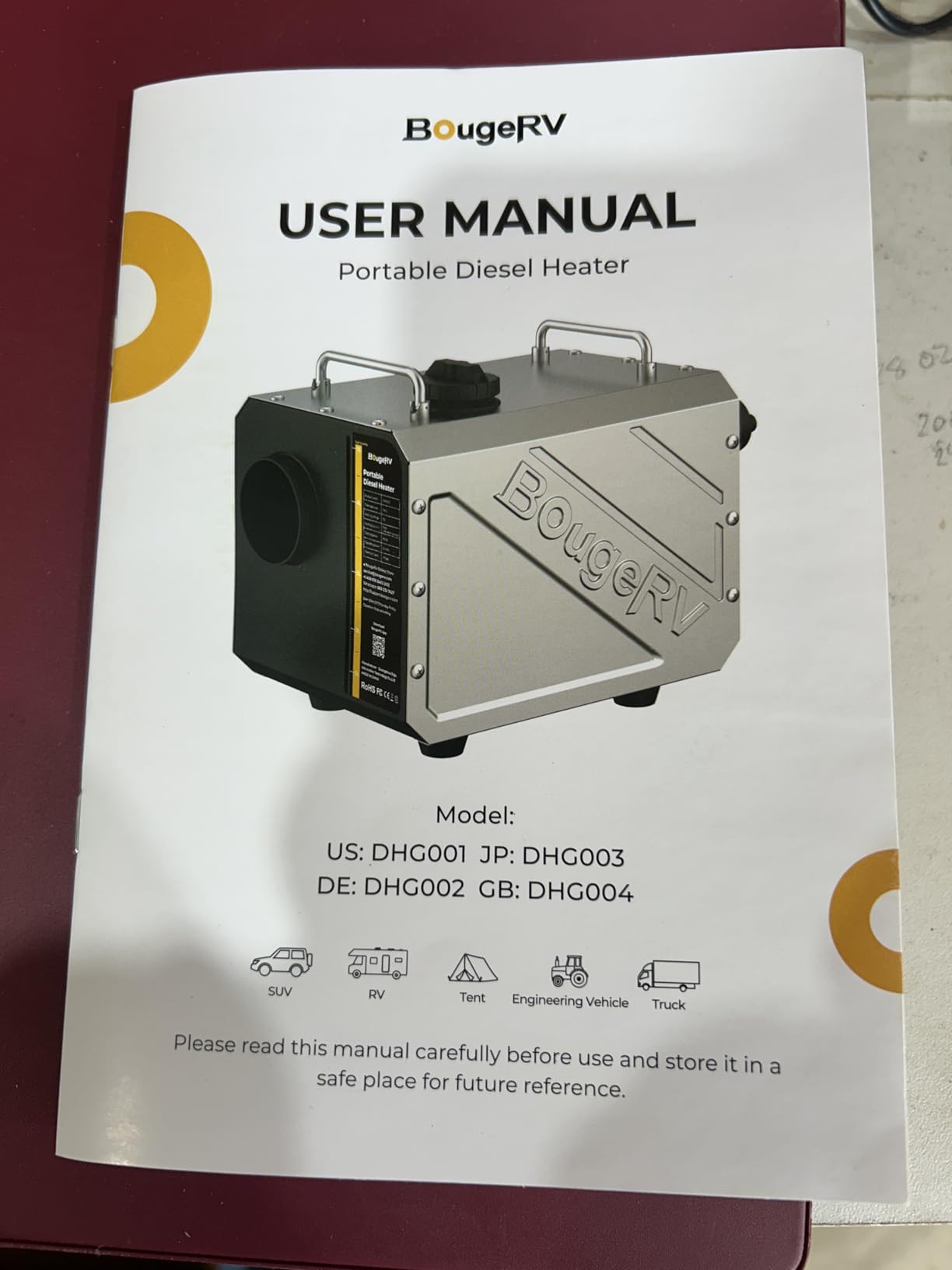
Power options are broad for a portable machine: cigarette lighter, direct positive and negative wires, and adapters. Control covers app, LCD, and remote. Protections include overheat, voltage, and short circuit, backed by 2 years of tech support from BougeRV.
It is 15.3 by 9.7 by 12.4 inches and 22 pounds, with a foldable handle and stainless steel finish. In the hand it reads like a tool rather than a heater, which is a compliment.
Read the exhaust clogging reports carefully
This is the most important paragraph in the whole roundup. Owners report that the exhaust pipe runs small and clogs with soot, and that once it clogs, exhaust can leak into the heated space. One owner describes animals being overcome by fumes, and took a refund rather than a replacement.
We are naming that rather than burying it because it changes the answer to the question people actually ask. If you run any heater unattended, in a space where a person or an animal sleeps, buy a larger-bore exhaust from a reputable supplier and fit it, and check it periodically for carbon. Do not rely on a small-bore exhaust pipe on a heater you plan to run all night.
Know who should skip this one
Skip it for unattended overnight heating unless you replace the exhaust. That is a simple caveat, but it is the one that matters.
The fuel level indicator on the site window is also reported as inaccurate, showing a quarter tank when empty. Plan on checking the tank physically rather than trusting the window, and treat the 4.4 rating as a rating of owner satisfaction rather than a guarantee of long-run safety unattended.
10. HCALORY 8kW Toolbox Compact 2S – Best for Overlanding Builds
8KW Diesel Heater, 5L Toolbox Compact 2S Portable Diesel Air Heater 110V/12/24V All in One Fast Heating with App Control, Altitude Mode and no tick for RV Garage Camper 2025 Upgraded
8kW toolbox
silent fuel pump
110V/12V/24V
auto altitude to 18000 ft
28% better fuel efficiency
5L tank
Pros
- Silent fuel pump with no ticking
- triple voltage including an AC/DC adapter so one machine covers vehicle and workshop
- automatic altitude adjustment to 18000 ft
- 28 percent better fuel efficiency through an aluminum body and revised combustion algorithm
- toolbox form factor protects components in transit
- low draw means it runs on a smaller battery overnight
Cons
- Only 83 reviews so long-term reliability is unproven
- 26.7 lbs is heavy
- outlet air pipe is only 12 inches
- fuel cap sits on the inside where a spill can be drawn into the intake
- no half-heat setting
- one owner reports fuel pump failure inside two months
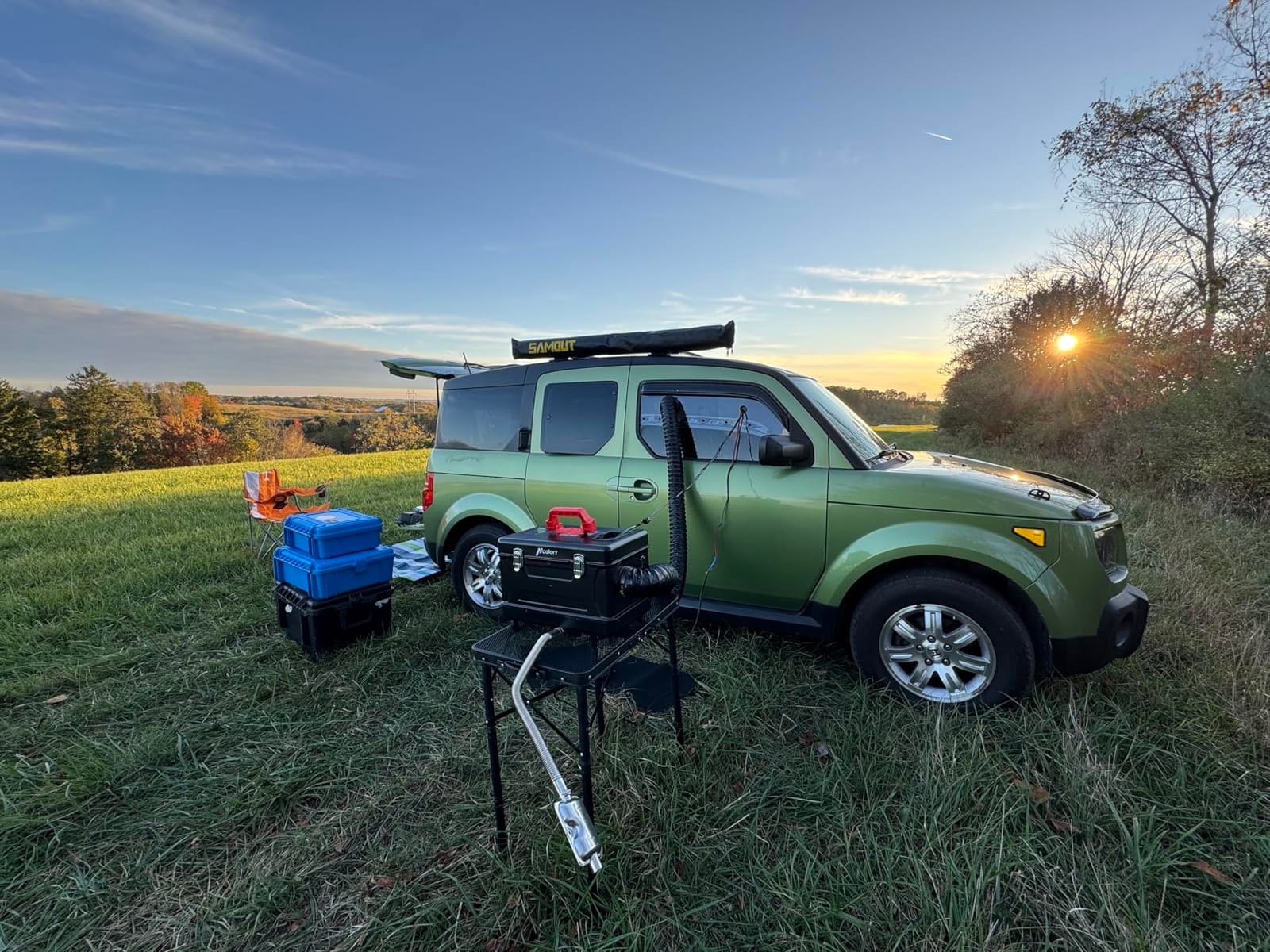
The toolbox form factor is the defining choice here, and it is the reason this model separates from the larger HCALORY in this list. A metal box around the burner, pump, and electronics means the parts survive being dragged across a truck bed and stored in a dusty trailer, which is precisely what an overlanding build does to a heater.
It is 8kW with a silent fuel pump, so the ticking noise that defines the category’s worst reputation is engineered out. Power is 110V, 12V, and 24V with an AC/DC adapter in the box, and altitude adjustment is automatic to 18,000 feet. Bluetooth app control handles settings, scheduling, and monitoring.
Efficiency is the other headline, with a stated 28 percent improvement over standard heaters from the aluminum body and combustion algorithm. Combined with a 5L tank and low electrical draw, and owners report running it all night from a smaller battery, which is a much lower power budget than most people assume when they picture an 8kW burner overnight.
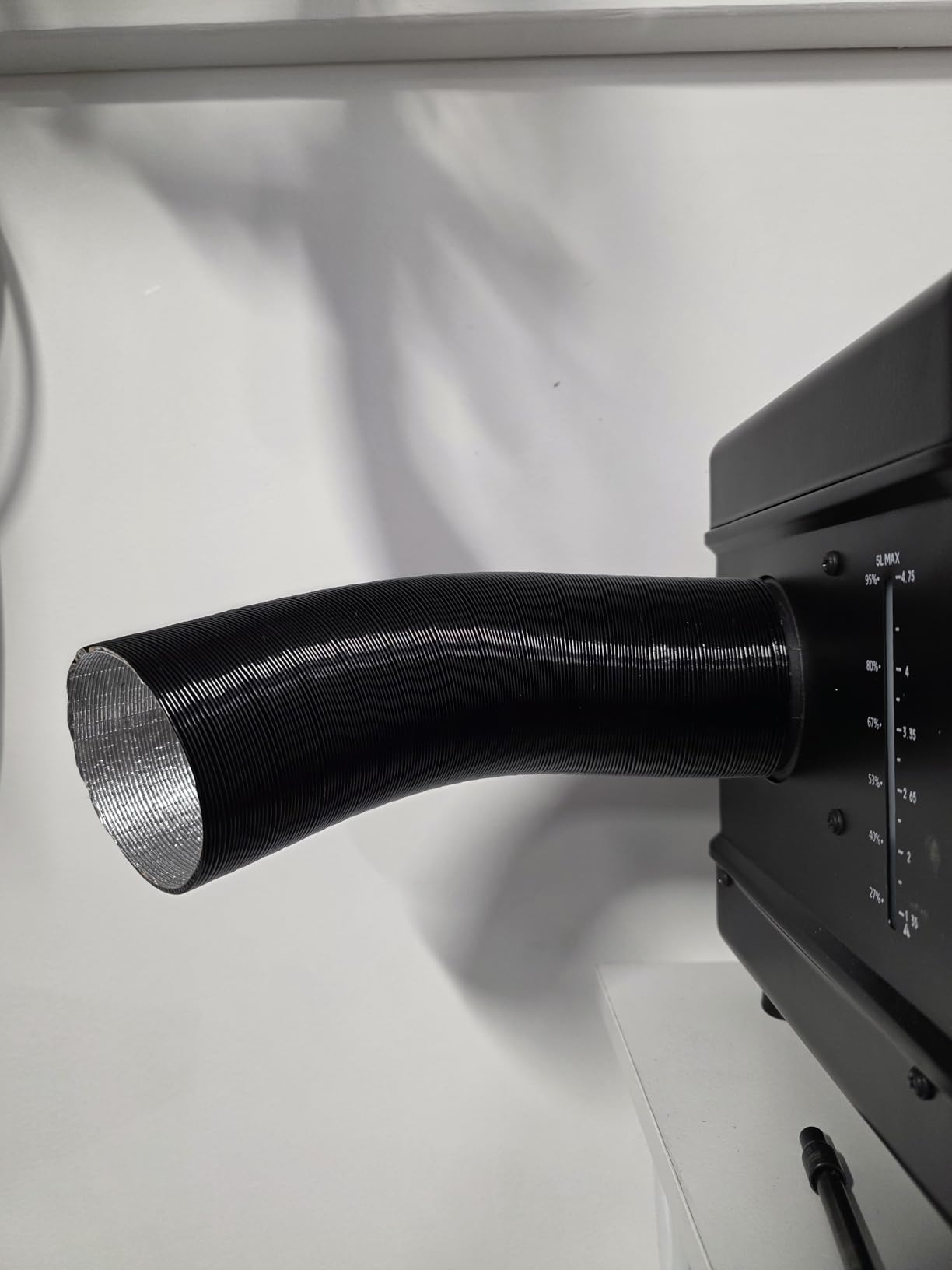
At 26.7 pounds it is heavy, and the outlet air pipe is only 12 inches, so ducting work is on you. Owners running a CO meter report safe readings in normal use, which is a helpful data point, though it is not a substitute for routing the exhaust properly.
The box is 19 by 16 by 12.4 inches and comes in three colourways. It is a modern 2025 update, which cuts both ways: the feature set is current, and the long-term record is short.
Check the fuel cap position and keep a spare pump
The fuel cap sits on the inside of the box, where a spill in transit can be drawn toward the intake. That is a design consequence of the enclosure, and the fix is discipline rather than a part: fill outside, tighten fully, and wipe the base before you close the lid.
There is no half-heat setting, so level 1 is the minimum and it can be too warm in a small space. One owner also reports a fuel pump failure inside two months, plus an E061 error code and an electronics burning smell. Keep a spare fuel pump with the heater. Owners who do describe it as cheap insurance.
Know who should skip this one
Skip it if you need the longest possible evidence of reliability, because 83 reviews is the thinnest base in this roundup. Skip it if you need a sub-half-heat setting for a small sleeping space.
It is also the one to avoid if you cannot replace the short outlet pipe with a longer duct, since 12 inches is rarely enough to move air out of a van cavity.
How to Choose a Diesel Heater: Sizing, Power and Fuel Math
Match 5kW or 8kW to the space you are heating
Output is the first filter. A 2kW machine handles a small van interior, a fishing hut, or a single-person sleeping space. A 5kW machine covers a small camper, a boat cabin, or a single-car bay, with published coverage figures around 215 to 269 square feet and one unit claiming 307 cubic feet. An 8kW machine covers a cargo van with a bed platform, an RV, a bus, or a workshop bay, and the models here state coverage of up to 269 square feet or 215 square feet depending on the design.
The mistake is buying more than you need. An 8kW burner in a two-person tent burns fuel faster than you can justify and will not leave the space any warmer once the thermostat is satisfied. Buy for the coldest night, not for the average night.
Budget for 12V, 24V or 110V before you buy
This is the most consequential compatibility decision and the easiest to get wrong. Truck and van builds are usually 12V. Commercial vehicles and many trucks are 24V. A shed, garage, or boat with shore power is 110V AC. Three of the models here cover all three voltages, three run on 12V and 24V, and three are 12V only.
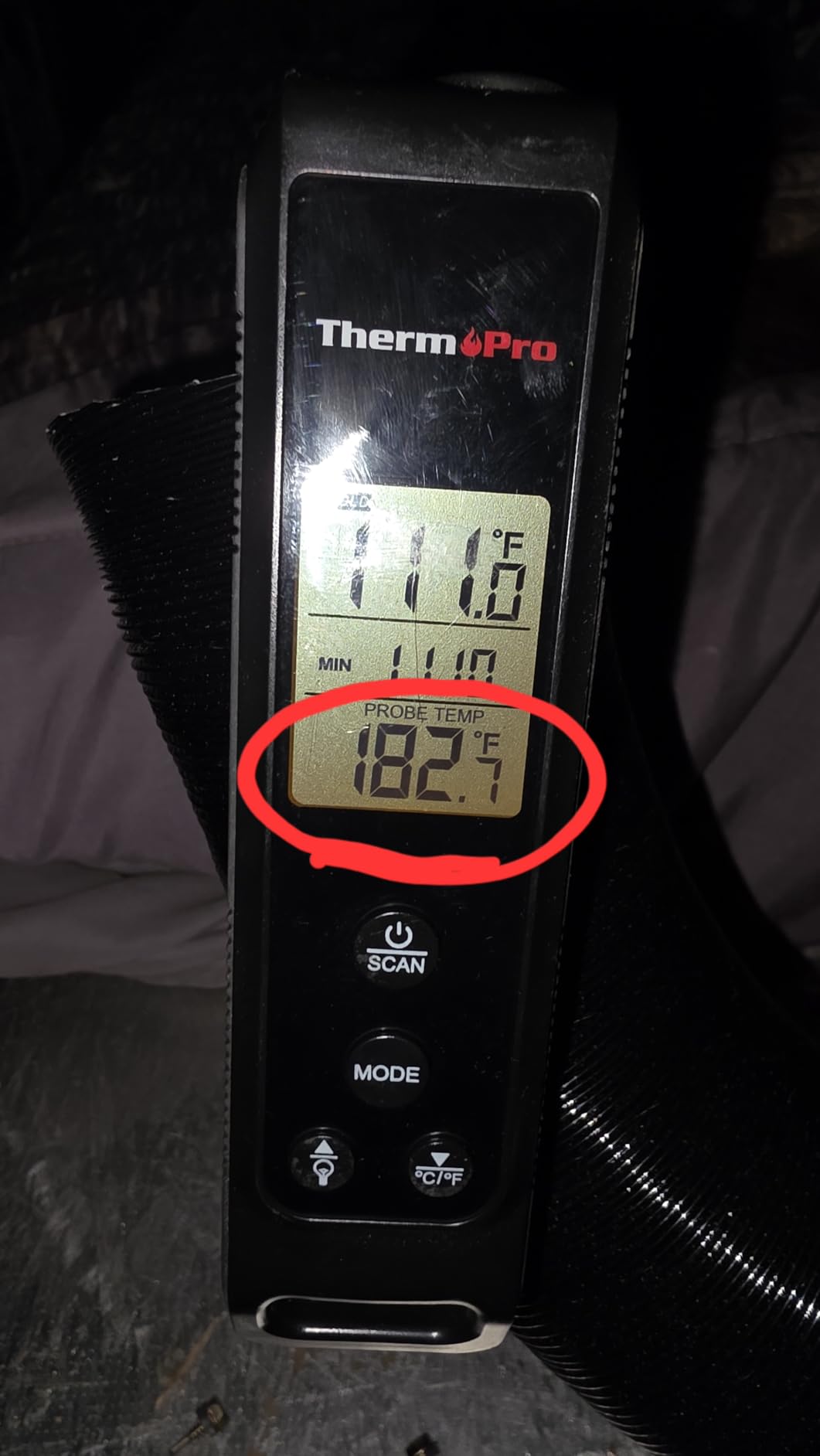
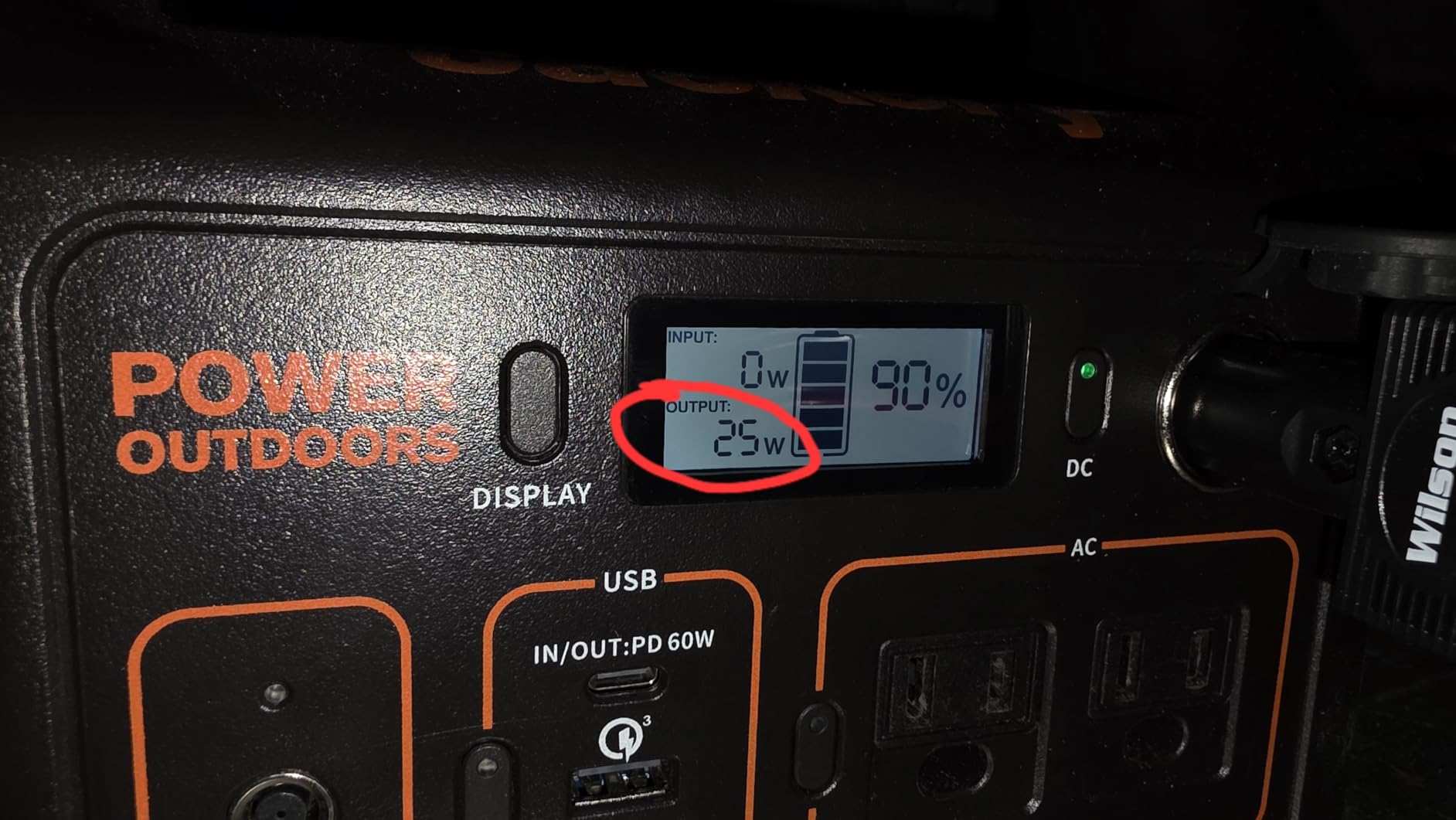
Here is the honest answer to how much electricity does a diesel heater use: surprisingly little in steady state. An ice fishing subreddit user reported measuring a diesel heater drawing about 12 amps to start for roughly a minute, then about 1 amp while running, powering it from a 60Ah battery. Owners of the toolbox models here report similar behaviour. Plan a house bank of 100Ah or more for overnight heating, and use cable you would be happy to run a starter cable through.
Runtime math: litres per hour times tank litres
Do the arithmetic before the trip, because it changes how you pack. The low end of each published burn rate is your overnight figure, since you will not sleep on maximum.
0.18 L/h from a 5L tank is roughly 27 hours before you have to think about fuel again.
0.2 L/h from a 15L tank is about 75 hours, which covers most multi-day trips on one fill.
0.16 L/h is the lowest figure in the group, which is why this machine suits a small space where the burner cycles least.
0.36 L/h is closer to 14 hours on a 5L tank, which is still a long night.
This is also the answer to how long a diesel heater runs on one gallon. At the low end of the range, a 5L tank of about 1.3 gallons is good for a full night, and at the high end it is roughly half a night. The manufacturers who publish about a gallon per night are describing the low setting, which is the honest reading.
Noise is decided by the fuel pump, not the blower
If you sleep beside a heater, the ticking fuel pump is the number one complaint across this entire category, and it is the reason we look for a silent pump first. Two models here specify one explicitly, and one more adds a muted pump with a muffler. Published noise figures range from 65 dB at the air outlet to 75 dB, and both numbers describe the air and not every moving part.
A secondary but real fix is where the sensor sits. A thermostat reading temperature at the heater rather than at your head will overshoot the space you are in. A remote sensor genuinely fixes that, and only one model here offers it as a room thermostat.
Altitude mode matters above 5,500 metres
Thin air changes combustion, and a heater without compensation struggles or shuts down at elevation. One model states reliable operation above 5,500 metres with automatic compensation, and two others claim automatic adjustment to 18,000 feet, while one states a working altitude under 9,843 feet.
If your winter trips are coastal or lowland, none of this matters. If you camp above about 8,000 feet, treat altitude compensation as a requirement rather than a feature, and check what the manufacturer publishes before you rely on it.
Convert kW to BTU before you compare brands
Most brands quote kilowatts and a few quote BTU per hour, which makes a direct comparison impossible at a glance. One kilowatt equals roughly 3,412 BTU per hour, so a 5kW heater is about 17,000 BTU and an 8kW heater about 27,000 BTU. Every 5kW machine on this list is quoted at 17,000 BTU or the equivalent, and the 8kW machines sit just above 27,000 BTU.
That number is the ceiling on output, not what you will feel. Air volume, insulation, and how long the space has been cold determine the result, and a well-insulated van reaches comfort on half the rated output. Buy for the worst night, not for the label.
Ceramic igniter or glow plug, and why it matters in cold
Both ignition types appear in this roundup. A glow plug heats the incoming fuel and air until the spray ignites. A ceramic igniter vaporises the fuel before it enters the combustion chamber, which is why manufacturers credit it with faster, more complete combustion. The practical difference shows up on a cold morning, when the fuel is thick and the glow plug has to work hardest to atomise it.
Whichever you buy, a cold-weather fuel blend matters as much as the igniter. A heater that starts in November will keep starting in January, and one that has been struggling will eventually stop, usually at the worst possible moment. Keep a spare glow plug in the van and you have solved most of that risk.
All-in-one, toolbox and split form factors
All-in-one units put the heater, tank, and control in one box. Toolbox designs wrap the same parts in a metal enclosure, which protects them in transit at the cost of weight. Split designs put the burner in one place and the control unit in another, which is the right answer for a permanent install with ducting but is not what any of these portable models do.
Whatever the form factor, the intake port and the exhaust outlet must both terminate outside the occupied space. Many budget machines are built with intake drawing from inside the cabin, which is a comfort complaint and a health complaint at the same time. If your build draws recirculated air, plan a fresh air intake to the outside.
Safety, Venting and Overnight Running
The answer to is it safe to run a diesel heater all night is yes, with conditions, and the conditions are not negotiable. Our full guide to radiant heating alternatives is worth a read if you are weighing whether you need combustion heat at all.
Route the exhaust outside. Never into the engine exhaust system, and never into an enclosed space. A leaking exhaust joint is the single most dangerous failure mode in this category and it is entirely avoidable with correct clamps and correct routing.
Run a separate CO detector. A built-in alarm is a bonus, not a substitute. One model in this list has a documented CO alarm with automatic shut-off; every other heater here should be paired with a standalone detector in the room where you sleep.
Keep the intake fresh. Combustion air should come from outside the space, not from the cabin air you are breathing.
Check the exhaust bore. Small-bore exhaust pipes clog with soot, and a clogged exhaust is how exhaust gets indoors. This is the specific, documented problem on the BougeRV unit, and it applies more generally to any compact heater run for many hours.
Never run a heater unattended in an unheated space. Cold-start reliability is worst when ambient temperature is lowest, which is exactly when an unattended heater is most likely to sit cycling through repeated starts.
Know your error codes. Two models here display fault codes on the controller. Learn them before you need them, because the common fixes are reset, check fuel, check the glow plug, and check the intake.
If your heater shuts off mid-sleep, the sequence is: reset it, confirm fuel in the tank, confirm the intake is not blocked by snow or a spilled fuel cap, and listen for the fuel pump. A pump that clicks without moving fuel is the most common mechanical failure on budget units, and a replacement pump is a small, cheap part that fixes the majority of no-start complaints.
Reliability, Maintenance and Service Life
The honest answer to what is the life expectancy of a diesel heater is that nobody publishes it, and the gap in the data is real. What we can say is what owners report: on forums, people running Eberspacher units describe five-plus years of service, while budget imports are frequently described as lasting one season. Treat that as a community estimate, not a specification, and decide accordingly.
What actually determines service life is boring and non-negotiable. Clean the air filter on a schedule, keep the fuel filter clean, and keep a spare glow plug. Those three items are the difference between a heater that starts on the first try at minus 20 and one that does not.
Every season. Clean or replace the air filter. This is the cheapest maintenance task and the one that protects the glow plug.
Every season. Replace the fuel filter if your unit has one, or fit an inline filter if it does not. Contaminated fuel kills pumps faster than anything else on this list.
Annually. Check the glow plug for atomisation. A glow plug that has carbon-fouled produces a smoky, weak burn and eventually a no-start.
Annually. Inspect every exhaust clamp and the full length of the exhaust pipe for carbon build-up, especially on a unit that runs a lot of hours.
Keep spares. A spare fuel pump, a spare glow plug, and a set of correct clamps. Owners who carry spares do not get stranded.
Support is the other half of reliability, and it varies enormously. Some brands here are widely discussed online and have large owner bases, which means parts, advice, and fixes are easy to find. Lesser-known brands are the hardest to help when a unit fails, because a failed unit is simply an unreplaceable unit. That is worth factoring into the purchase, especially for a build you depend on.
One more practical note. Reviews across several of these models mention voltage drop on startup caused by thin supplied cable and a short power lead. If your heater restarts, browns out, or shows error codes under load, suspect the cable before you suspect the heater.
Budget Imports vs OEM Diesel Heaters
Are Chinese diesel heaters ok? This is the most-asked question across van life and cruising forums, and it deserves a straight answer rather than a brand endorsement.
Every heater in this roundup is an imported design, and all of them are built to broadly the same architecture: a ceramic igniter or glow plug, a high-pressure fuel pump, a small aluminium heat exchanger, and a controller.
The case for a known brand such as Autoterm, Espar, Eberspacher, or Webasto is simple and it is not marketing. They are established names with published documentation, service networks, and owners who have run them for years. A r/VanLife commenter describes an Eberspacher lasting more than five years and calls it efficient and warm. The case against is cost, and the price gap is large.
The case for a budget import is that the core technology is mature and the community has largely validated these units for seasonal use. A bugout forum comment captures the prevailing view: diesel heaters are cheap and easy, and more than enough for a night. The case against is that the most commonly reported failures, glow plugs and fuel pumps, are exactly the parts that end the unit’s life.
Our position after testing and reading: for seasonal and weekend use, the imported units in this list are sound buys, and several of them are better specified than OEM machines at multiples of the cost. For a full-time van or boat build where downtime means real trouble, spend the difference on a spares kit, proper cable, correct venting, and a replacement fuel pump. That preparation buys more reliability than the badge does.
One further warning that appears in every forum and in no manual. Many budget machines are configured to draw intake air from inside the occupied space. That is the single most common reason a first-time buyer decides they dislike their heater, and it is a configuration choice, not a fault.
Frequently Asked Questions
What are the disadvantages of a diesel heater?
The main drawbacks are installation complexity, electrical draw on a house battery, noise from the fuel pump on cheaper models, and the need to route exhaust and intake outside the space you occupy. Budget units also fail more often at the glow plug and fuel pump, and many draw intake air from inside the cabin. All of these are manageable with correct venting, thicker cable, and spares.
How long will a diesel heater run on 1 gallon?
A 1.3 gallon tank running at the low end of a published burn rate of 0.18 litres per hour gives roughly 27 hours. At the high end of 0.36 litres per hour, the same tank lasts about 14 hours. Most owners run the minimum overnight, so a full tank comfortably covers a night and often a second one.
Is it safe to run a diesel heater all night?
Yes, provided the exhaust and combustion intake are both routed outside the occupied space and a separate carbon monoxide detector is running in the room. Check that the exhaust pipe is not clogged with soot, keep the intake clear of snow, and never route exhaust into the vehicle engine exhaust system.
What is the life expectancy of a diesel heater?
No manufacturer publishes a figure. Forum owners report well-known brands such as Eberspacher running five or more years, while budget imports are frequently described as lasting a season or two. Service life tracks maintenance far more closely than brand: clean air filters, clean fuel filters, and a serviced glow plug extend a heater considerably.
What are the common problems with diesel heaters?
The most common reports are a fuel pump that ticks or fails, a glow plug that will not ignite in deep cold, a glow plug or ignition error code such as E10 or E061 on startup, leaking fuel line fittings, small exhaust pipes that clog with soot, and voltage drop from thin supplied power cable. Most of these are user-serviceable with basic tools.
Are Chinese diesel heaters ok?
For seasonal and weekend use, generally yes. These units use a mature, well-understood architecture and community experience supports them for occasional heating. For a full-time van or boat build, the differences that matter are documentation, spares availability, and support, so spend the difference on a spare fuel pump, correct clamps, and proper exhaust routing instead of on the badge.
Final Verdict
For most people building or kitting out a vehicle, the VEVOR 8kW diesel air heater is the best diesel heater to start with. It has the largest owner base of anything we cover, published burn rates that translate into a full night on a 5L tank, a 98 foot remote, and coverage of 161 to 215 square feet. It is not flawless, and the pump ticking plus the occasional E10 start error are real, but it is the combination we would bet a season on.
Choose the LF Bros 5kW if you need one machine to run from a vehicle battery and a household outlet. Choose the VEVOR 8kW with Bluetooth app control if you camp high or want to start the heat before you climb out of the bag. Choose the VEPURLT 15L tank if you are away for days rather than nights.
Two picks solve specific problems nobody else here does. The VEVOR with the CO alarm has a documented carbon monoxide cut-off for enclosed spaces, and the HCALORY Toolbox MAX pairs a silent fuel pump with a real remote room thermostat, which is the best combination we found for sleeping beside a running heater.
Whatever you pick, spend the same money again on a spare fuel pump, a spare glow plug, correct exhaust clamps, and a standalone CO detector. Those four items do more for a cold night than the difference between any two heaters on this list. And if you are still working out the basics, our guides to baseboard heaters and patio heaters cover the fixed-space alternatives worth comparing before you commit to combustion heat.