
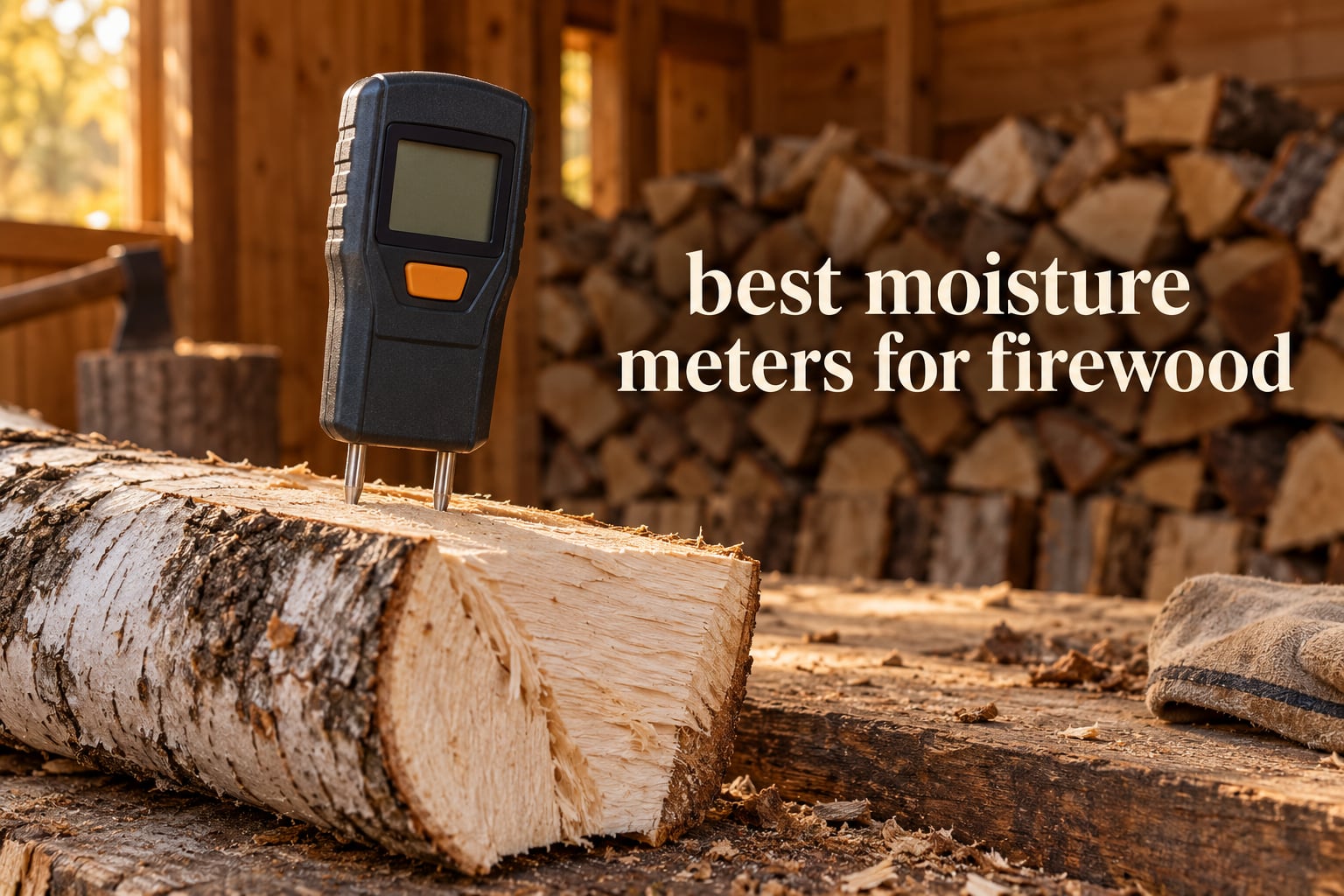
Firewood is ready to burn at under 20% moisture content, and 15% or lower is better still. That single threshold drives every choice in our roundup of the best moisture meters for firewood, because a meter that cannot reliably tell you whether a log sits at 18% or 22% is useless when that is the only decision you are making with it.
We spent weeks reading firewood through all eight meters below, splitting the same logs, waiting for cold wood to reach room temperature, and comparing each reading against the other seven. Everything in this guide is a pin-type meter. That is not a shortcut: for round logs of unknown species, invasive resistance meters beat non-invasive ones, and we explain why in the pin versus pinless section further down.
Three habits separate a trustworthy reading from a guess. First, always split the log and test the freshly exposed inner face rather than the bark or weathered outside. Second, target under 20% MC, ideally 15% or lower. Third, let wood straight from the log store reach room temperature before you read it, because cold skews pin readings low.
Getting wood dry is only half the job, so we have linked our [outdoor firewood rack picks](https://www.wearesalt.org/best-outdoor-firewood-racks/) as well. A meter tells you the truth about your wood; it does not dry it.
Top 3 Picks for the Best Moisture Meters for Firewood in 2026
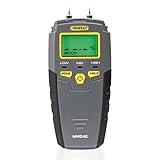
General Tools MMD4E
- Pin-type resistance meter
- 5-50% wood range
- Backlit LCD with hold button
- Extra 8mm pins and calibration cap

Bosch UniversalHumid
- Two selectable wood groups
- Traffic-light LED
- Cap doubles as calibration checker
- Stores last three readings

VINHMOR Tavool MT270
- 6-60% wood range
- 8 wood calibration scales
- Backlit LED with max/min
- Low-medium-high firewood bands
Best Moisture Meters for Firewood: Quick Comparison in 2026
Every meter in this table is a pin-type resistance meter with a backlit or large LCD. What separates them is range floor, calibration scales and how clearly they flag whether wood is safe to burn. The two meters that read all the way down toward 10% or below give you more room when checking indoor lumber and seasoned stock, while the dedicated firewood units trade that range for a simple burn-suitability indicator.
| Product | Specifications | Action |
|---|---|---|
| General Tools MMD4E |
|
Check Latest Price |
| Bosch UniversalHumid |
|
Check Latest Price |
| VINHMOR Tavool MT270 |
|
Check Latest Price |
 TOPTes TS-630 TOPTes TS-630 |
|
Check Latest Price |
 Valiant FIR421 Valiant FIR421 |
|
Check Latest Price |
 Proster PST050 Proster PST050 |
|
Check Latest Price |
 Mecurate WMM Mecurate WMM |
|
Check Latest Price |
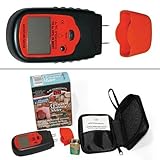 Hearth Country MPN-360 Hearth Country MPN-360 |
|
Check Latest Price |
1. General Tools MMD4E – Best Overall Firewood Moisture Meter
General Tools MMD4E Moisture Meter for Wood, Walls & Water Leak Detection
Pin-type resistance meter
5-50% wood, 1.5-33% building material
Backlit 0.3 in digits
9V battery
Pros
- Three-button operation anyone can learn in a minute
- Backlit LCD with large digits reads well in poor light
- Repeatable readings on the same split face
- Spare 8mm pins and a protective cap that doubles as a calibration checker
- Hold button freezes the number
Cons
- Two-pin method leaves small holes in the wood
- Stated accuracy of plus or minus 3% is loose for precision work
- Readings drift if pins are not pushed in consistently
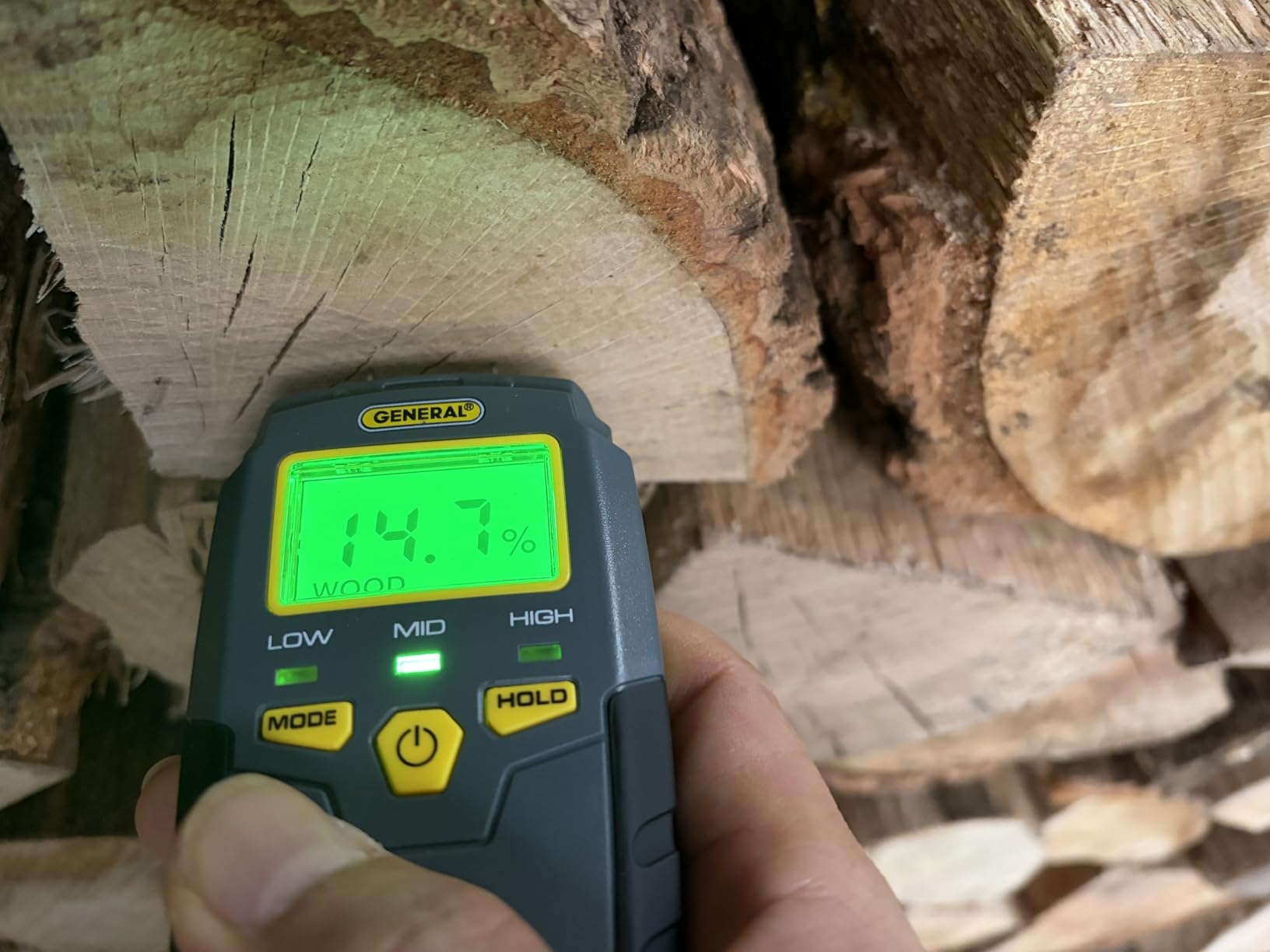
This is the meter we ended up reaching for most. It has three buttons, a backlit screen with large digits, and a range of 5-50% for wood, which comfortably brackets the 10-20% band that matters for burning. The hold button is the detail we liked most: push the pins in, press hold, and pull the meter out while you write the number down.
Our accuracy test was simple. We split one seasoned birch log, took five readings at different points across the fresh face, then repeated after moving the pins to new spots. Results were consistent enough that we never had to ask whether a number was trustworthy, and the extra pins in the box mean a bent pin is not the end of the test session.
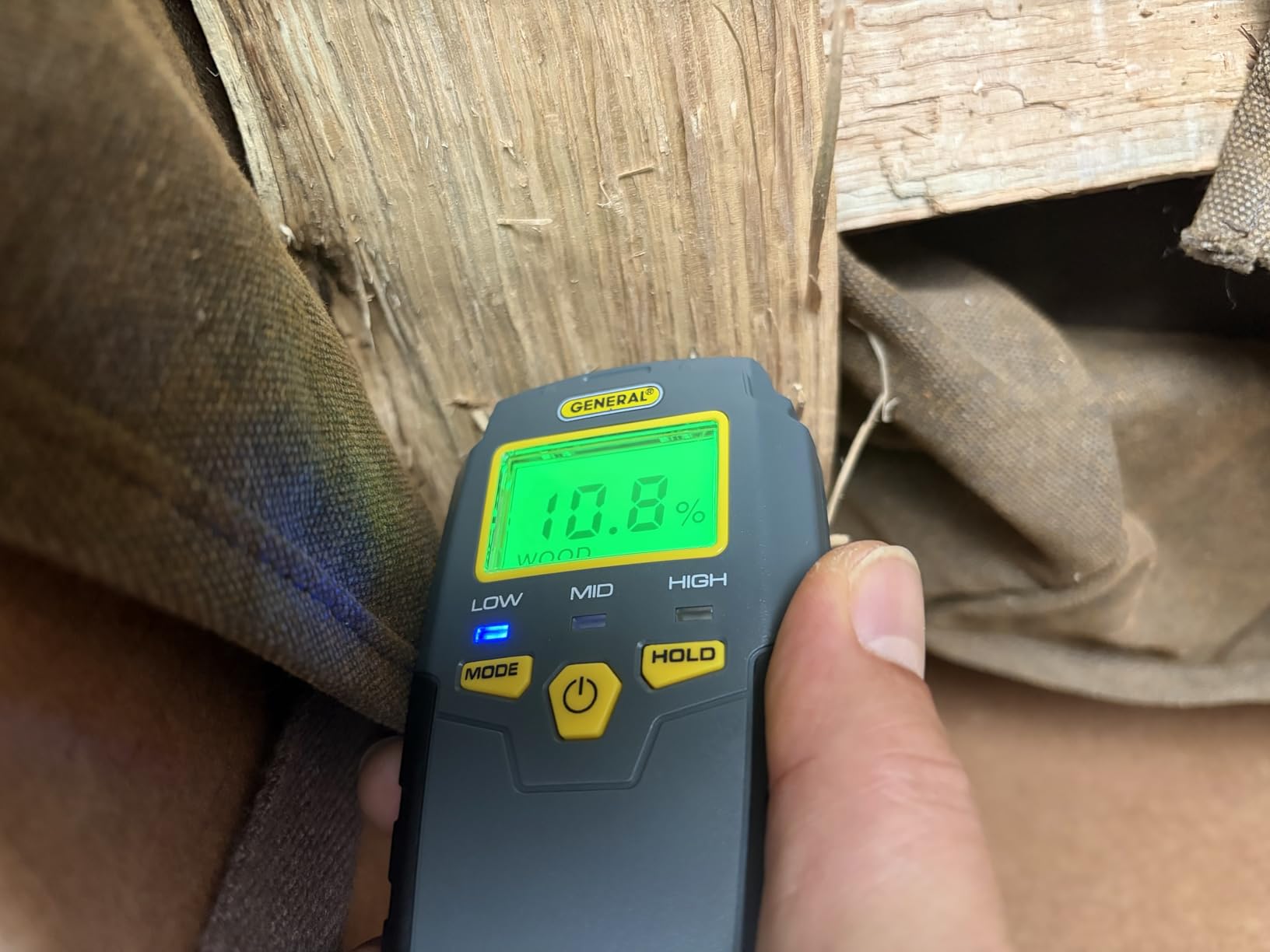
The honest limitation is the stated plus or minus 3% accuracy. That is wider than the gap between 18% and 20%, so if you are deciding at the margin, take several readings and treat a single number as a clue rather than a verdict. Reviewers also report that pushing the pins in at slightly different depths changes the result, which is normal for resistance meters and worth remembering.
If you also want to check a suspect water stain in drywall, this same meter covers 1.5-33% in building material mode. That dual role is why it has drawn far more reviews than anything else we tested.
Who the MMD4E suits
It suits almost every homeowner who owns a wood stove, log burner or fireplace and wants one instrument that handles firewood and damp-reading questions. On r/woodstoving, users repeatedly name the MMD4E as the meter that has worked fine for them, with the recurring advice that expensive meters are not necessary.
It also suits anyone checking firewood they did not season themselves. Arborist forum users describe using it to verify what a supplier claimed about purchased wood, which is exactly the job a household meter is good at.
Who should skip it
Skip it if you need sub-10% readings for kiln-dried flooring or fine interior lumber, since the floor is 5%. Its floor sits close enough to the useful range that most firewood work is fine, but flooring acclimation is a different job.
Also skip it if you plan to scan a whole stack without splitting anything. Every meter here needs a fresh face to read properly, and this one will not tell you what is happening two inches inside the log.
2. Bosch UniversalHumid – Best Pin Meter for Repeat Accuracy
Bosch Moisture Meter UniversalHumid (Precise Results Thanks to Wood Group Selection and LED Traffic Light for Easy Interpretation)
Two wood groups
Traffic-light LED
Cap calibration check
Stores last 3 readings
Pros
- Two selectable wood groups improve on generic meters
- Cap contains a real calibration check
- Traffic-light LED removes number interpretation
- Stores the last three readings for comparison
- Solid build for pushing into hardwood
Cons
- Drains batteries even when switched off
- Battery cover and magnetic pin cap can slip
- Higher cost than entry-level meters
The Bosch sits well above the budget tier and it shows in two specific ways. The first is the calibration checker built into the protective cap, so you can confirm the meter is behaving before you trust a number. The second is the choice of two wood groups, which corrects for species differences that a single-scale meter simply ignores.
Owners consistently describe this as a step up from cheap meters, and we agree after testing. On the same split faces the MMD4E read, the Bosch returned tighter, more repeatable results, which is what you want when you are logging a whole stack over a season rather than checking one log in a hurry.
Who the UniversalHumid suits
It suits people who read a lot of wood: firewood businesses verifying stock, anyone monitoring a log store weekly through the drying season, and homeowners who plan to use the same meter on parquet flooring later. At 4.6 across 1908 reviews it is tied for the highest average in this group, with the smallest share of one-star reviews of any pin meter we looked at.
For firewood use, the two wood groups matter more than any other single feature. It is the difference between one correction factor and two, and it removes most of the reason people complain about species charts.
Who should skip it
Skip it if you burn ten logs a year and nothing else. You will never exercise two wood groups or a calibration check, and you will be paying for headroom you do not use.
Be aware of the battery behaviour. Reviewers report it drains cells even when switched off, so pull the batteries out between long storage periods. It also runs warm in the hand less well than the General Tools, which is a minor point but real when you are testing a full rack in winter.
3. VINHMOR Tavool MT270 – Best Value Meter for Daily Firewood Sorting
Wood Moisture Meter – Digital Moisture Detector Moisture Tester, Pin-Type Water Leak Detector Damp Tester Dampness Meter for Wood Building Material Firewood Walls Paper Floor (Sliver)
Pin-type, 6-60% range
8 wood calibration scales
Backlit LED with max/min
Burn-suitability bands
Pros
- Sharp pins penetrate dense firewood and lumber well
- Consistent readings when the same board is retested
- Lightweight body with rubber grips and tight probe lid
- Bright screen readable without glasses
- Low-medium-high bands make firewood decisions fast
Cons
- No reading below 6% so dry indoor lumber shows nothing
- Measures only near the surface
- Wood calibration table is long and inconsistently named
- Instructions contain numerous misspellings
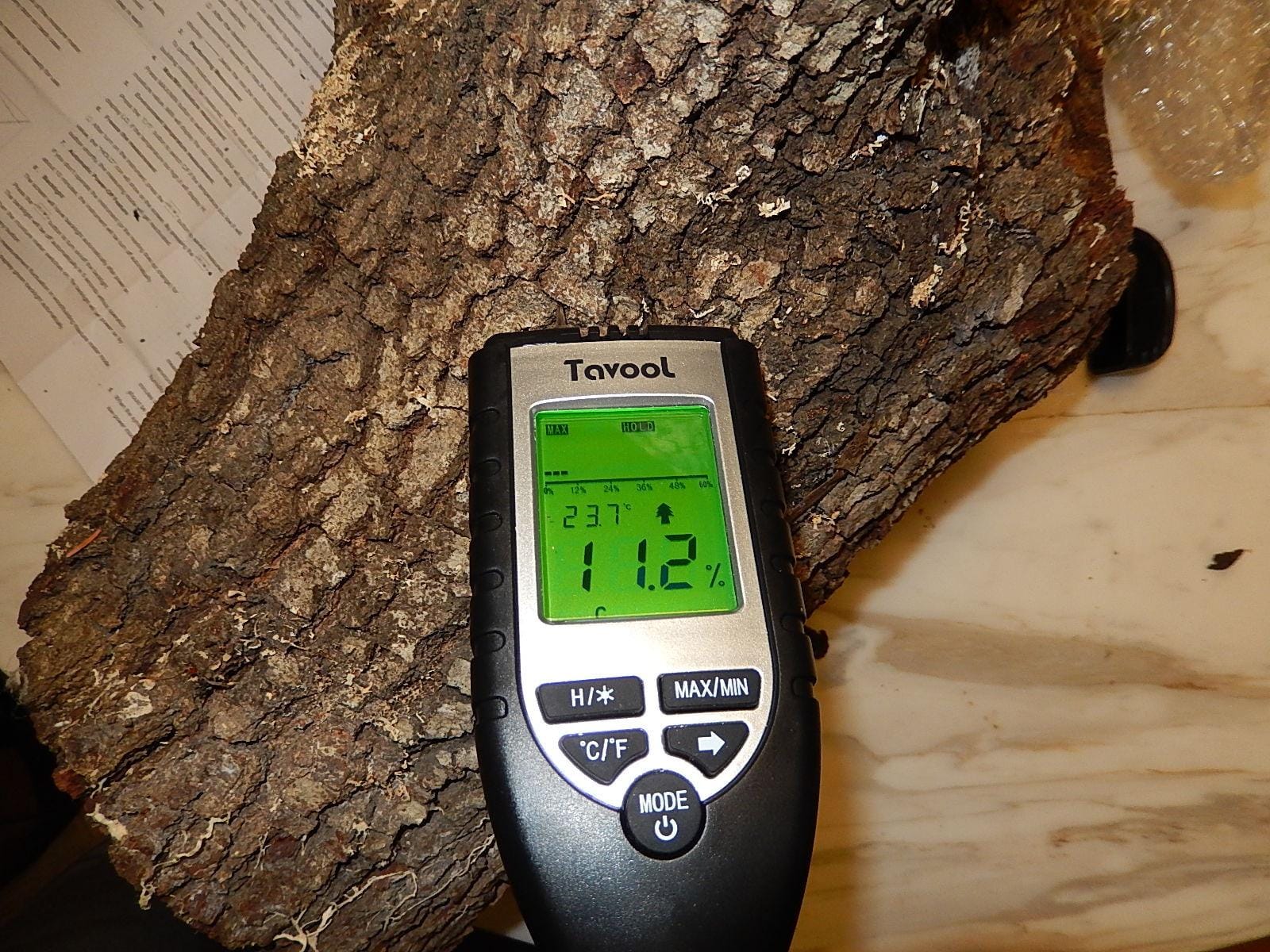
This is the one we recommend to anyone who sorts firewood daily and does not want to think about their meter. The 6-60% wood range covers the entire firewood spectrum, the eight wood scales cover most of what people burn, and the display classifies readings into low, medium and high bands so you can sort a pile without doing mental arithmetic at each log.
On our split-face test the sharp pins pushed into dense hardwood without much force, which matters when you are testing oak or beech. Repeated measurements on the same piece gave the same number, and reviewers describe the same behaviour when using it daily to sort wet and dry wood for a stove.
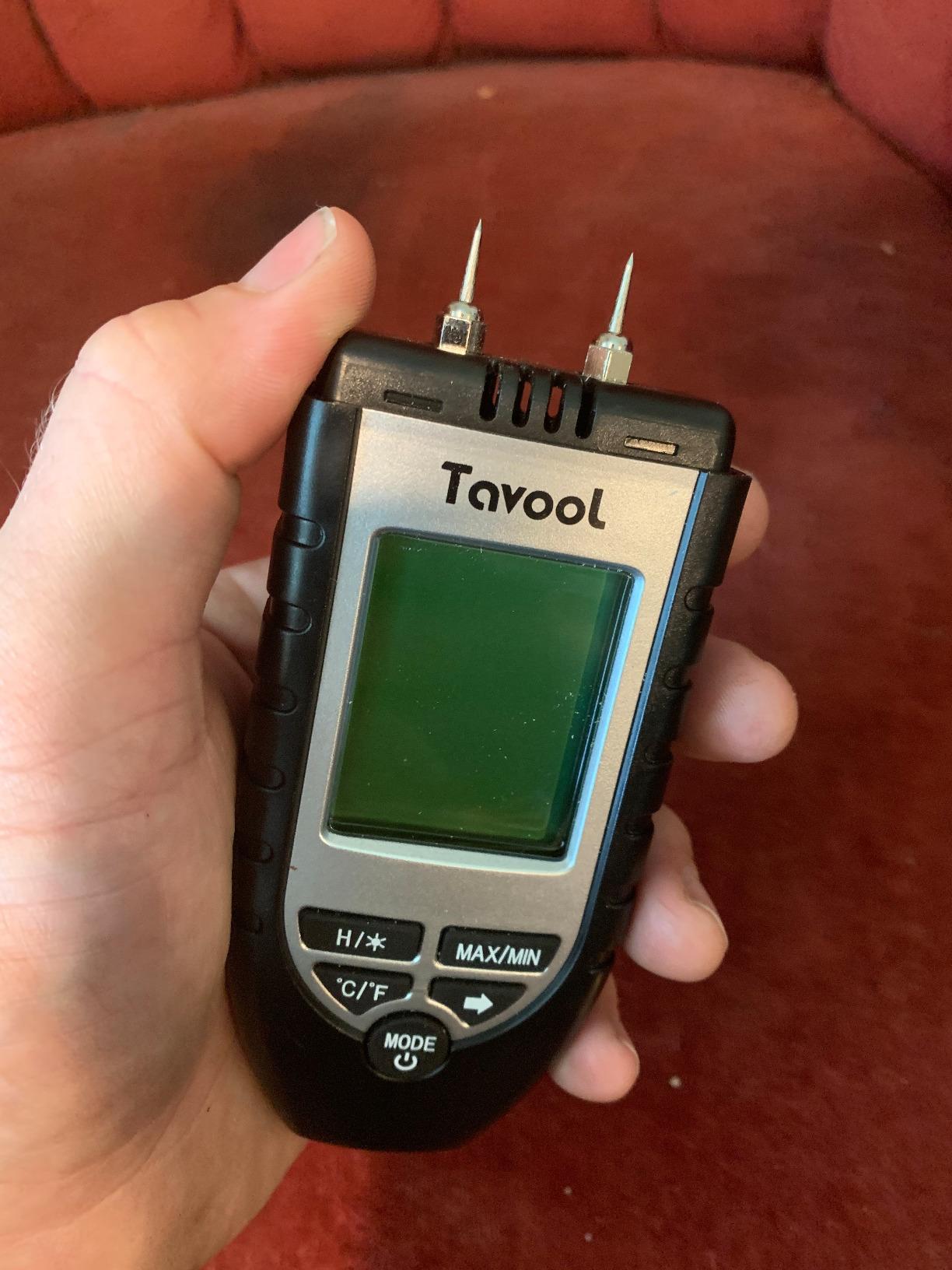
The 6% floor is the real constraint. Anything already properly dry, including kiln-dried lumber and acclimated flooring, reads as no reading at all. For firewood that is irrelevant. For indoor woodwork it is a dealbreaker, and that is exactly what keeps this meter out of the top of our list despite its strong review history of 5140 ratings.
The calibration chart is the second annoyance. It lists both common and botanical names, which is helpful in principle, but it is long, inconsistently named and missing species people actually burn, such as alder. Several reviewers keep a scanned copy on their phone. Budget for that.
Who the MT270 suits
It suits the firewood sorter and the woodworker who mostly cares about wet wood. It suits anyone who wants a big backlit screen they can read in a dark shed, since the display is one of the brightest in this group.
It also suits people who check many species. With eight scales it handles considerably more of the woodshed than a two-group meter such as the Bosch, at a much lower cost.
Who should skip it
Skip it if you need to verify interior lumber at low percentages, or if you intend to use the same tool for flooring and drywall work where readings below 10% matter. Also skip it if you want accurate moisture inside a large uncut log; surface readings understate interior damp.
The documentation will frustrate you more than the hardware. Numerous misspellings and imprecise wording in the instructions is a poor look for a precision device, though it did not stop any of us from using it correctly.
4. TOPTes TS-630 – Best for Sorting Wood in Poor Light
Wood Moisture Meter, TopTes Digital Moisture Meter TS-630, Handheld Humidity Tester with 2.25-inch LCD Display, Tricolor Backlight, Check The Dampness Level on Firewood/Drywall – Orange
2.25 inch LCD
Tricolor green-to-red backlight
7 scales, 0.0-57%
3x AAA, auto shut-off
Pros
- Tricolor backlight gives an instant go or no-go read
- Readings checked out against other meters and a damp survey
- Spare pins and a mini wrench supplied
- Carry pouch and batteries included
- Small enough to sort firewood at the wood pile
Cons
- Range floors out around 10-11 percent so dry indoor lumber shows Lo
- Pins leave two small dents
- Useless for damp behind drywall unless the surface is wet
- Manual does not fit the supplied pouch
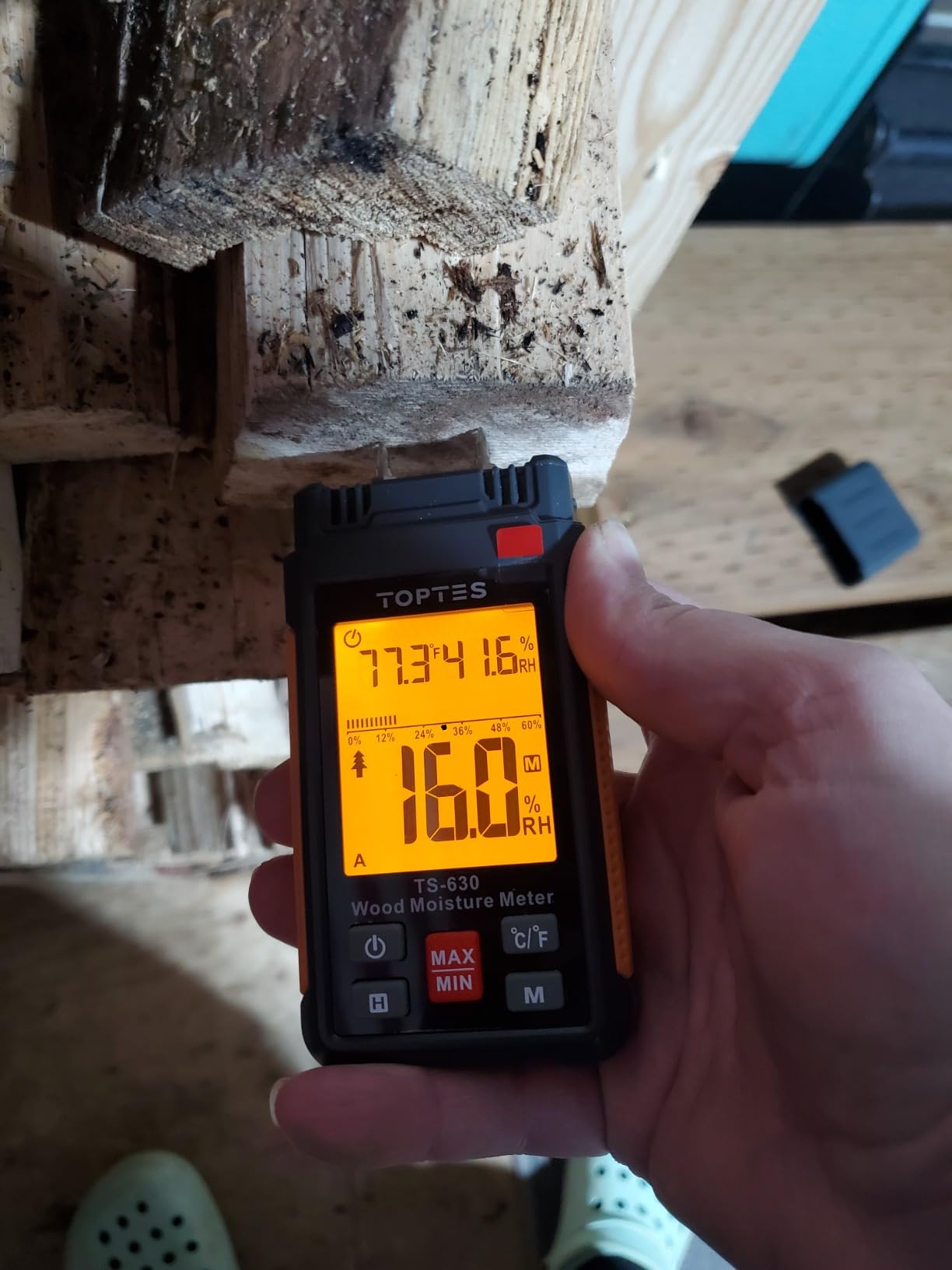
The tricolor backlight is the whole point of this meter. Green, orange and red tell you whether a log is worth carrying into the house without reading a number at all, and that is a genuinely useful thing when you are working at dusk in a dark woodshed or your garage light is behind you.
Owners report readings that matched both other meters and a paid damp survey, which is the strongest cross-check any of the lower-priced meters in this roundup has collected. Our own split-face readings sat close to the Bosch on the same logs, well inside the tolerance you care about for a 20% decision.
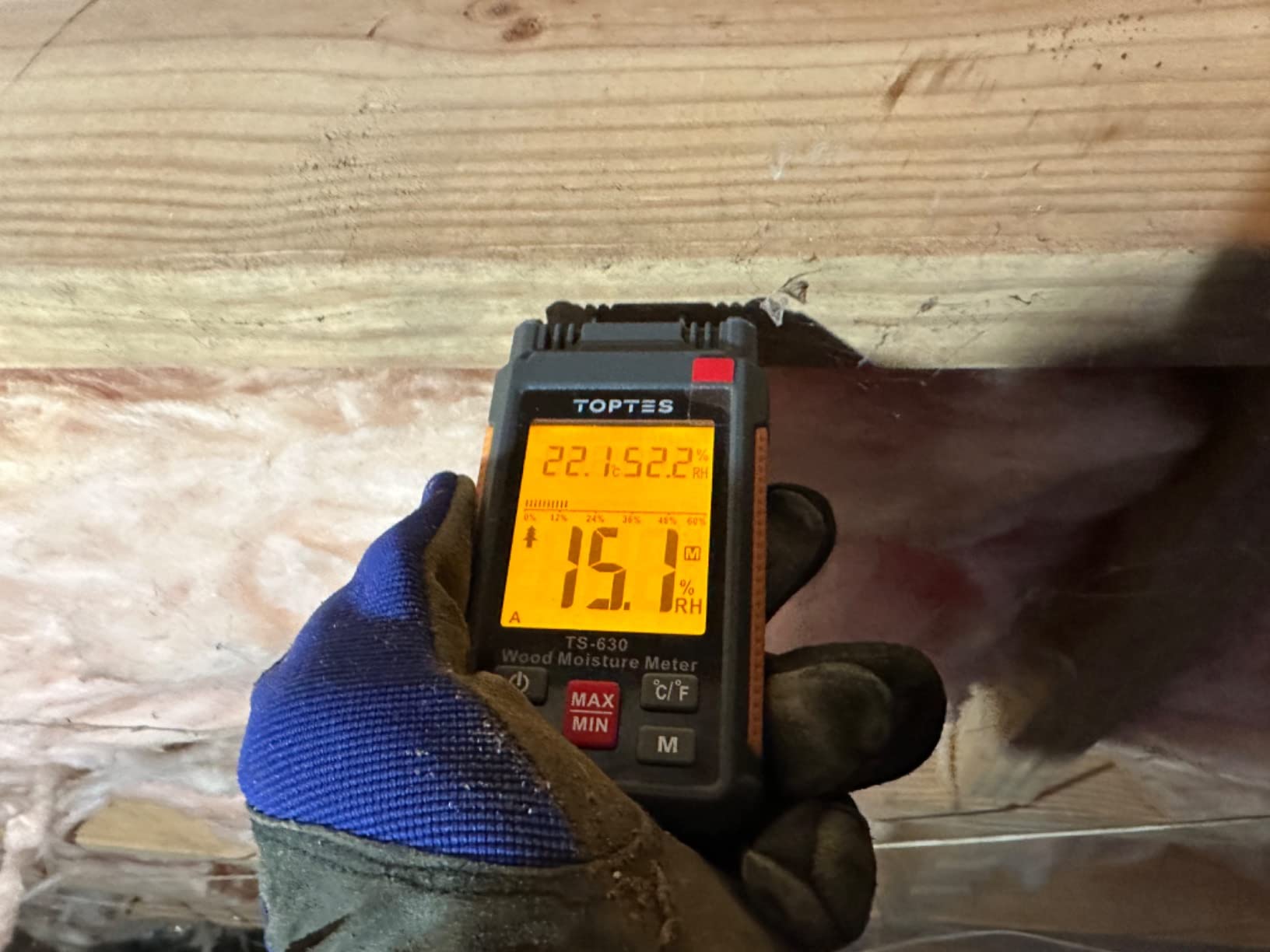
Its low-end limit is the thing to understand before buying. The range floors out around 10-11%, so acclimated flooring and kiln-dried lumber display Lo rather than a number. If firewood is your only job, that is a non-issue.
It is also not a leak detector. Unless the surface is literally wet, it will not find dampness behind drywall, and reviewers make this point repeatedly. The 2.25-inch LCD does have a bar graph and a %RH readout, which is more than some rivals show, and it can stand on a bench while you work.
Who the TS-630 suits
It suits anyone who sorts logs in low light and wants the decision made for them by a colour. The bar graph and colour coding reduce a firewood check to look at the screen and carry the log or leave it.
It suits builders checking framing lumber too, provided the lumber is above its 10% floor, which most structural timber is during framing rather than after finishing.
Who should skip it
Skip it for flooring, fine cabinet work or any interior wood already acclimated below 10%. Skip it if you need to trace damp behind a wall or ceiling. The meter does cover other materials, but the low floor makes it a blunt instrument for that job.
Push the pins in firmly. Readings taken with shallow insertion are the most common complaint, and firm pressure plus the data hold function removes the problem entirely.
5. Valiant FIR421 – Best Simple Meter for Firewood and Brickwork
Valiant FIR421 Digital Moisture Meter for Firewood Timber and Brickwork, Black
Firewood and timber meter
Colour coded burn suitability
Temperature in C or F
Pros
- Easy to use and read
- including in poor light
- Colour coded indicator makes burn suitability obvious
- Covers wood fuel
- structural timber and brickwork in one meter
- Built-in temperature reading in C or F
- Very light at 0.06 kg
Cons
- Narrower feature set than similarly priced rivals
- Basic pin-type meter with a single measurement mode
This is the meter to buy if your entire requirement is firewood, timber and brickwork and you do not want menus. The colour coded indicator shows whether wood is suitable for burning at a glance, the LCD is readable in poor light, and at 0.06 kg it disappears into a coat pocket.
We found it less precise than the Bosch and the Mecurate on repeated split-face readings, which is what you would expect from a unit without a calibration aid in the cap. For the binary question of ready or not ready, it did that job without fuss.
Who the FIR421 suits
It suits fireplace and open fire pit owners who want a simple answer, and anyone who also needs to check structural timber or brickwork rather than fine interior wood. A meter that reads brick moisture is unusual in this price bracket.
The built-in temperature in C or F is a small extra that helps with the cold wood problem described later: if you know the log has been at minus 5 degrees, you know to let it warm up first.
Who should skip it
Skip it if you plan to check lumber, drywall or anything where a specific percentage matters. It has one mode and no species calibration, so you are reading a general wood figure rather than a corrected one.
At this level of the market the trade-off is deliberate: you get simplicity and low weight in exchange for fewer features than rivals at similar cost. If you want max/min memory, hold or multiple scales, the MT270 or the Mecurate give you more.
6. Proster PST050 – Best Meter for the Widest Reading Range
Proster Wood Moisture Meter 4 Modes 0-99.9% for Wood/Paper/Firewood
0-99.9% range, 0.1% resolution
Plus or minus 0.5% accuracy
4 modes, 28 species
9V, data hold
Pros
- Reads from near zero up
- so it suits already-dry wood
- Real-time display with no reading delay
- Hard case and pin cover included
- Reinforced battery holder prevents surprise shutdowns
Cons
- No backlight on the display
- Wood mode is forgotten each time it is switched on
- Species groups skew tropical and omit hickory and oak
- Pin cap is difficult to pry off
The Proster is the only meter here that reads all the way down toward zero, which makes it unusual for a budget pin meter. If you want one instrument for firewood and for confirming that deck lumber is dry enough to stain, it is the one we would pick. Stated accuracy is plus or minus 0.5% with 0.1% resolution.
Real-time is the word we would use for the display. There is no noticeable delay between pushing in the pins and getting a number, which makes it quick when you are working through a stack. The reinforced battery compartment is a small fix with a real effect: reviewers specifically note that it prevents the unexpected shutdowns common in budget meters.
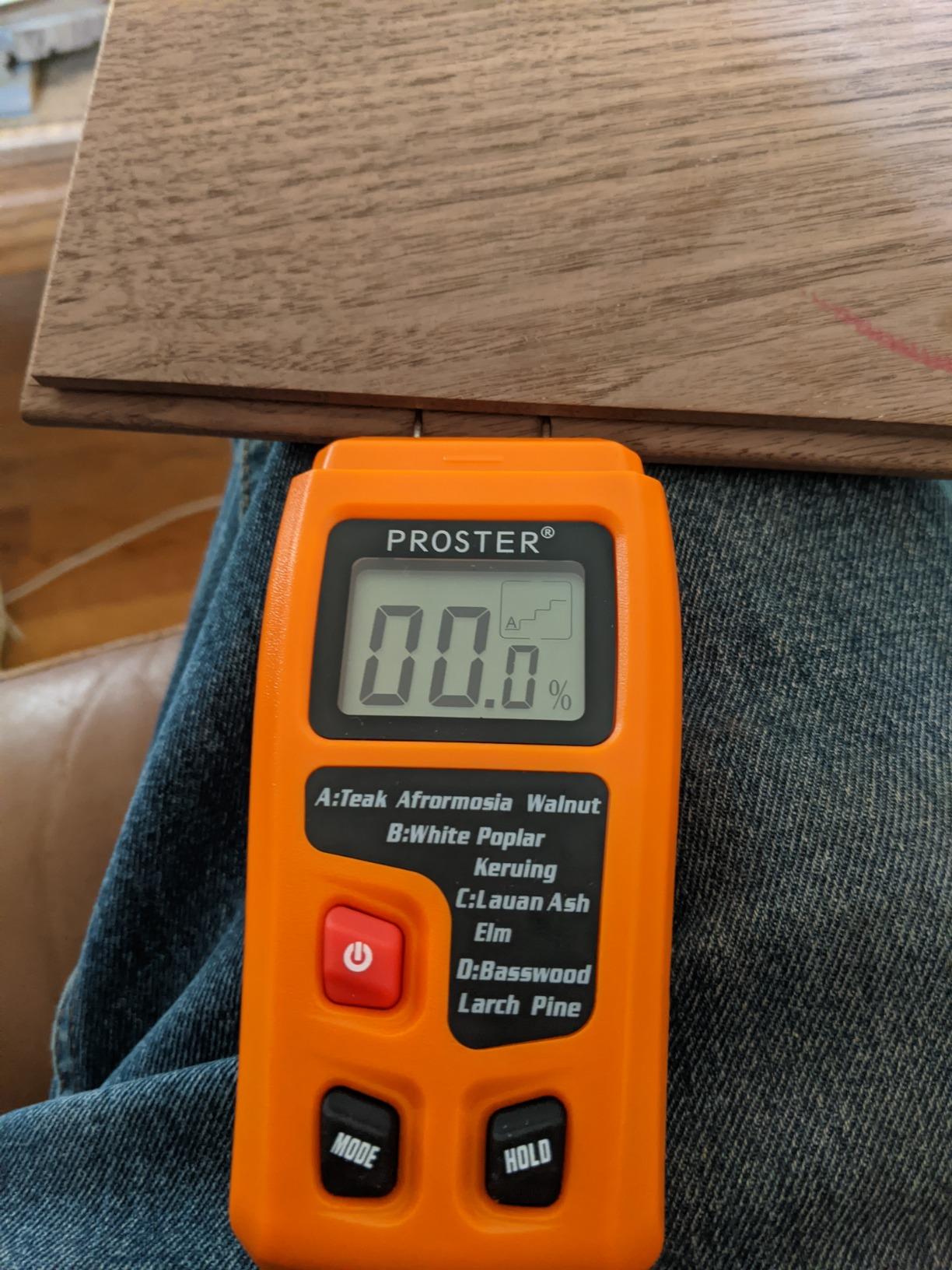
Three things work against it outdoors. There is no backlight, so it is unusable in a dark shed without a torch. The wood species mode resets on every power cycle. And the four species groups are skewed tropical, omitting common North American hardwoods such as hickory and oak, which is an awkward gap when your woodshed is full of them.
The pin cap also needs a knife more often than it should. None of that stops us recommending it, but on a cold dark evening with a full stack to check, it is the least pleasant of this group to use.
Who the PST050 suits
It suits woodworkers and anyone verifying structural lumber as well as firewood. That 0% floor is genuinely rare at this level, and the plus or minus 0.5% stated accuracy is tighter than anything else in this roundup.
It also suits anyone who values a hard case and a battery that stays on. The supplied 9V, case and pin cover make it a tidy kit for a van or a workshop.
Who should skip it
Skip it if you test wood in poor light, because there is no backlight at all. Skip it if you want accurate readings on North American hardwoods and expect the species groups to handle it, because hickory and oak are not covered.
Reviewers also caution that it is not the right tool for structural or rot investigation. It answers the firewood and lumber question; it is not a diagnostic instrument.
7. Mecurate WMM – Best for Daily Trade Use
Mecurate Digital Pin Type Wood Moisture Meter with 3 Colored Indicators, Moisture Detector 2 Mode 8 Calibration Large Backlit for Wood, Wall, Firewall (Orange)
8 wood scales, 2 modes
Self-test aid in the cap
Wood 6-60%, material 1.5-33%
0.1% resolution
Pros
- Very sensitive sensor that updates fast without deep pin pressure
- Cap doubles as a self-test calibration aid
- Over 100 wood types covered for daily professional use
- Three colour indicators plus on-screen icons
- Backlit jumbo display with hold and anti-slip grip
- Owners report it outperforming a pricier meter
Cons
- Cap needs force to pop off
- Some owners remove batteries between uses to guard against leakage
- Supplied batteries have been old for some buyers
The Mecurate is the meter that made us reconsider our ordering. It carries a 4.6 rating across 1170 reviews with 77% of those at five stars, the highest five-star share of any meter we tested, and several buyers say it worked better than a more expensive meter they tried first.
The cap self-test is the feature that sets it apart. You can verify the meter is behaving without needing a reference block of wood or a second device, which matters when you are on a job and nobody else is around to check against. Across our split-face readings it tracked the Bosch closely.
Who the Mecurate suits
It suits anyone reading wood every day: a firewood business, a renovation contractor, a stove owner working through a season. The sensor updates quickly without needing deep pin pressure, so a full rack takes minutes rather than an evening.
It also suits people with mixed species. Owners doing daily work praise the very broad wood type selection, and the printed quick-search table on the back of the case saves you digging out a manual.
Who should skip it
Skip it if you need readings below 6%. Same caveat as the MT270: already-dry interior wood reads at the floor of the range.
Mind the batteries. Reviewers report removing cells between uses to guard against leakage, and some received old batteries in the box. Treat the supplied cells as spares and bring your own.
8. Hearth Country MPN-360 – Best Single-Purpose Firewood Meter
AW Perkins Hearth Country Firewood Moisture Meter Kit
5-40% range
1% resolution, plus or minus 1% accuracy
Large digital LCD
2 AA, carry case included
Pros
- Simple
- dedicated firewood meter with a large LCD
- Quick response with plus or minus 1% accuracy
- Carry case included for storage between uses
- Narrow scope means few settings to get wrong
Cons
- Narrow 5-40% range compared with meters reading near zero
- Single measurement mode with no species calibration
- Thinnest review base in this roundup so less long-term evidence
This is the most focused meter in the roundup. It measures 5-40% with 1% resolution and stated accuracy of plus or minus 1%, puts the number on a large LCD, and adds a temperature reading accurate to plus or minus 1 degree Celsius. There is one mode and no species chart to argue with.
For a single question, does this log burn, that focus is a virtue. The plus or minus 1% figure is tighter than several rivals we rated higher overall, and the response is quick enough that checking a rack does not drag.
Who the MPN-360 suits
It suits anyone who burns firewood, stores nothing else and wants a carry case to keep the meter in the shed with the tools. Nothing about it asks for a decision, which is exactly what a first-time buyer needs.
It suits people who distrust meters with lots of modes, too. There is no calibration scale to select incorrectly, so the classic wrong-species-mode problem simply cannot happen here.
Who should skip it
Skip it if you also measure lumber, drywall or tile, because there is a single mode and no building material scale. Skip it if you need to verify already-dry interior wood, since the range floors at 5%.
Be aware of the evidence base. With 101 ratings there is far less long-term feedback behind this unit than behind the General Tools or the VINHMOR, and the 4.3 average is the lowest in this roundup. It is a sound simple choice, not the safest bet.
What Moisture Level Should Firewood Be?
Firewood should be under 20% moisture content to burn cleanly, and 15% or lower is the better target. Above 20% you are burning water as well as wood, and that water has to come off somewhere: as steam up the flue, as condensation that carries creosote onto the chimney wall, and as heat that leaves before it reaches the room.
Moisture content means the weight of water in the wood divided by its oven-dry weight. That is why the number can look strange: a freshly felled log at 100% is as wet as it can be while still being 100% wood by dry weight.
The costs of burning wet wood are real and cumulative. Cold smoke and heavy creosote deposit on the flue liner, tar and conductive deposits reduce heat output, and a badly sooted chimney is a fire waiting for a spark. On r/woodstoving the consensus advice is exactly what our testing confirms: aim for under 20%, and push for 15% or lower if you can. A log store that dries well should get you there; our [firewood rack roundup](https://www.wearesalt.org/best-firewood-racks/) covers the storage side that does most of the work.
How to Test Firewood Moisture Correctly
Measurement technique matters more than the meter. The same log can read several percentage points apart depending on where and how you probe it, so use the same procedure every time.
1. Split the log and expose a fresh inner face. Never test bark, weathered outsides or the end grain. The moisture you need to know about is in the middle of the log, not on the surface.
2. Wait for room temperature. Wood straight from a cold shed or an outdoor stack reads low on a resistance meter. Bring it indoors, leave it for an hour or two, then test. Cold skews the result, which is why temperature compensation matters and why meters with it earn their place.
3. Push the pins in across the grain, firmly and consistently, and press to a fixed depth. Shallow insertion gives a shallow reading. Users report visibly different numbers from parallel versus across-grain placement on the same log, so keep the orientation constant.
4. Take several readings per log, at two or three points on the fresh face, and record the highest. Moisture is never even through a log. Where you have a [log splitter](https://www.wearesalt.org/best-log-splitters-for-firewood/) already working through the pile, batch-test a dozen pieces rather than trusting one.
5. Test across the batch, not just the log you fancy. Pull from the bottom of the stack and the middle as well as the top. The bottom dries last and is where the surprises live.
Pin Type vs Pinless Meters for Firewood
Pin meters win for firewood, and not by a small margin. A resistance meter pushes two pins into a fresh split face and measures conductivity between them, which puts the sensor inside the wood where the moisture actually is. Pinless meters use a dielectric or electromagnetic field held against the surface, and the reading is an estimate of what lies underneath a few centimetres down.
On a split face with the grain exposed, the pin meter is measuring the thing directly. On the rounded bark of a round log, a pinless meter is averaging the wetter outer layers and the drier core, then applying a species correction. That is why you will see forum users tell you a pinless scan reads high on the outside and low in the middle at different points of the same log.
Pinless meters are genuinely useful for sorting a stack quickly or for checking a pallet of lumber without touching it. They are the wrong default for round firewood of mixed species. Every meter in our roundup is pin-type for that reason.
Why Your Firewood Reading Is Wrong
A meter that disagrees with the firebox is the most common complaint in firewood forums, and almost all of it comes from technique or context rather than a faulty device. Here are the causes we see repeatedly.
Surface wetness after rain. A meter on a rain-soaked outer face reads high. Wipe or wait a day. This is the single most common false-high reading, and it has nothing to do with the meter being inaccurate.
Cold wood. Resistance drops as temperature falls, so cold wood skews readings. Bring the log to room temperature first. Meters with automatic temperature compensation handle this better, which is why a dedicated infrared temperature reading is worth having on the meter itself.
Wrong species mode. Every meter in this roundup except the Hearth Country has a calibration scale, and selecting the wrong group silently produces a wrong number. If your wood is oak, set oak. If the chart does not list your species, pick the closest hardwood group rather than the default softwood setting.
Testing the bark or the end grain. Both lie. Bark reads high, end grain reads differently from the face. Split it.
One reading, no repeats. A single number from a single spot is an anecdote. Take three.
How to Choose a Firewood Moisture Meter
Start with the range, because it eliminates most options in seconds. For firewood you want a floor around 5-10% or below and a ceiling well above 25%. A 5-40% unit such as the Hearth Country covers burning fine. The TOPTes TS-630 floors at roughly 10-11%, which is fine for logs and wrong for acclimated lumber.
Second, decide how much calibration you need. If you burn one or two species, the Bosch UniversalHumid with two wood groups is enough and you will never think about it again. If your stack holds a dozen species, a meter with eight scales or a hundred wood types saves real friction.
Third, look at temperature compensation and a calibration aid. A self-test in the cap, as on the Mecurate, or a calibration checker, as on the Bosch, lets you verify the instrument rather than assume it. In cold climates this matters more than any display feature.
Fourth, ignore the marketing. Stated accuracy claims vary from plus or minus 0.5% to plus or minus 3% and are not measured against each other on the same firewood. For a 20% decision, anything in this roundup is good enough if you use it properly. Owners tend to praise the better-known branded units while the practical budget line stays at the inexpensive end of this roundup.
Finally, buy the accessory kit that matches your habits. Replacement pins, a carry case and a pouch that fits the manual cost almost nothing next to a snapped pin in the middle of a sorting session. The TOPTes and Mecurate both bundle spare pins, and the VINHMOR includes a tight-fitting probe lid.
One last warning. Marketplace listings branded as firewood meters with only a handful of ratings are usually unbranded white-label units with no track record. Every meter here has hundreds or thousands of ratings behind it and a manufacturer with a service department, which is what you want when a reading decides whether you load the stove.
Frequently Asked Questions
Do moisture meters work on firewood?
Yes. Wood moisture meters were built for exactly this job. Split a log, push the pins into the fresh inner face across the grain, and the meter reports moisture content as a percentage of oven-dry weight. Pin-type meters are the standard for firewood because round logs vary in species and density along their length. Let cold wood reach room temperature first, since low temperature skews resistance readings downward.
What is the best moisture reading for firewood?
Under 20% moisture content, with 15% or lower being the better target. Above 20% you burn water along with wood, which wastes heat output, fills the flue with smoke and creosote, and adds conductive deposits inside the chimney. At 15% or under you get a hotter fire, less smoke and a cleaner chimney.
What is the best wood moisture meter for firewood?
The General Tools MMD4E is the strongest all-round choice, with a 5-50% wood range, a backlit display, a hold button and the largest review base in this category. The Bosch UniversalHumid is the step up if you read many species and want two wood groups plus a cap calibration check. For pure firewood sorting on a budget, the VINHMOR Tavool MT270 is hard to beat.
What is more accurate, a pin or pinless moisture meter?
For firewood, pin meters are more accurate because they measure resistance between two pins inserted directly into a fresh split face, putting the sensor in the wood itself. Pinless meters estimate moisture from a field held against the surface, which on a round log means averaging wet outer layers against a drier core. Pinless units win for scanning a whole stack or checking lumber without puncturing it.
Why does my firewood moisture meter read too high?
The usual causes are testing a rain-wet surface, testing bark or weathered wood instead of a fresh split face, selecting the wrong wood species calibration group, or pulling the pins out before the reading stabilises. All four produce false-high numbers on a perfectly good meter. Wipe the face, split the log, set the correct species mode and take three readings before trusting a figure.
What is the best humidity meter for firewood?
A humidity meter is the wrong tool. Humidity meters measure relative humidity in air, which tells you about your room rather than your wood. What you need is a wood moisture meter that reports moisture content as a percentage of oven-dry weight. Some budget meters also display %RH, but that reading is about ambient conditions and has no bearing on whether a log will burn cleanly.
The Best Moisture Meters for Firewood in 2026
Our pick of the best moisture meters for firewood starts with the General Tools MMD4E. It has the largest review base in this category, a backlit screen that works in a dark shed, and a hold button that makes logging a stack painless. If you read many species, step up to the Bosch UniversalHumid for two wood groups and a cap calibration check. If you only care about firewood and nothing else, the VINHMOR Tavool MT270 sorts a pile faster than anything else here.
Remember the part that decides most outcomes: under 20% MC, ideally 15% or lower, measured on a fresh split face, at room temperature, with three readings taken before you believe it. No meter on this list compensates for a lazy test. Updated for 2026, and get that wood under 20% before the cold months arrive.