
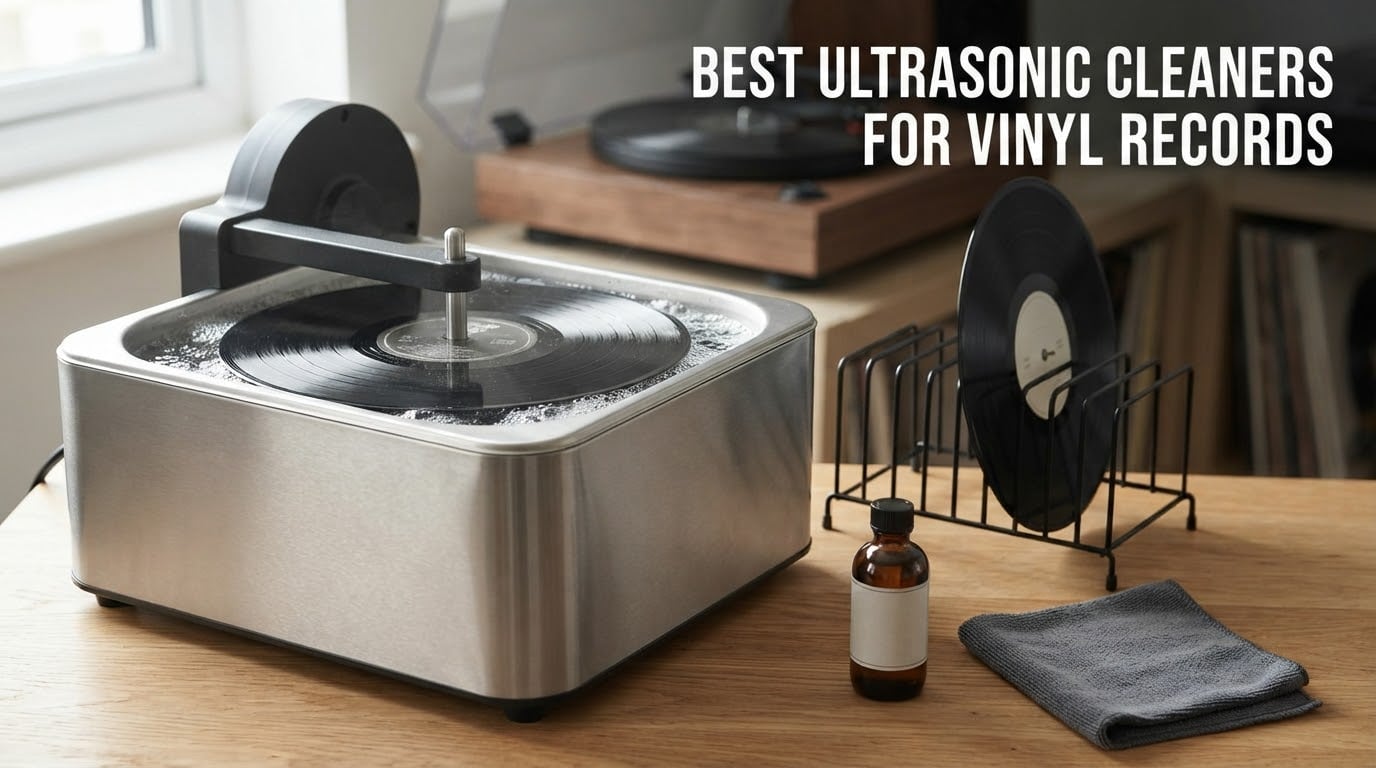
A record that crackles on every track is usually not a dead record. It is a dirty one, and the dirt sits down inside the vinyl groove where a cloth and a brush simply cannot reach. An ultrasonic record cleaner is the tool that gets it out, using nothing but warm water, sound waves and a small amount of surfactant.
That is the whole promise of the best ultrasonic cleaners for vinyl records, and it is a real one. These machines are the same technology used to clean surgical instruments, watch movements and jewellery, adapted with a spindle and a rack so a record can sit in the bath and rotate through the cavitation field. Owners on r/turntables and r/vinyl report the same thing again and again: a filthy thrift-store pressing goes from unlistenable to quiet, and the visual proof is brown water in the pan. If your records need more than the occasional cloth wipe, an ultrasonic tank is the single biggest jump in playback quality available at home.
Who should skip one? Anyone with a dozen near-new records that already play quietly. The machine takes 20 to 30 minutes per batch plus drying and re-sleeving, so it is a weekend activity, not a nightly habit. The same physics that lifts dust also means you have to respect temperature and dwell time, and a badly used tank can soften a sleeve or stain a paper label. Below is what I learned covering these machines, including the honest trade-offs at both ends of the price range.
One note before we start: several of the machines below are sold as general-purpose ultrasonic cleaners that ship with a record rack bolted on. We covered that hardware category separately in our guides to the best ultrasonic jewelry cleaners and the best ultrasonic cleaners for home use, so this roundup focuses strictly on what the tank does to a record.
Table of Contents
Top 3 Best Ultrasonic Cleaners for Vinyl Records
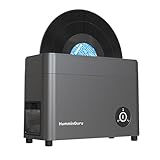
HumminGuru HG01
- 40kHz dual transducers
- 350ml reusable basin
- Auto wash and dry cycle
- Halts at 55C

VEVOR Sonic 6L 8-Record
- Three 180W transducers
- 6-8 records per cycle
- 20-80C digital control
- 304 steel tank

All Six Picks at a Glance in 2026
The table below is the fastest way to compare the six machines in this roundup on tank size, frequency, batch capacity and drying. Every one of them is a genuine ultrasonic tank rather than a manual washer, and the differences that matter most are the transducer count, whether the machine filters and reuses its water, and how it dries a disc once it comes out of the bath.
| Product | Specifications | Action |
|---|---|---|
| HumminGuru HG01 |
|
Check Latest Price |
| VEVOR Sonic 6L 8-Record |
|
Check Latest Price |
| VEVOR 6L TH-30AXN |
|
Check Latest Price |
 iSonic CS6.1-Pro iSonic CS6.1-Pro |
|
Check Latest Price |
 WATEBATH 6.5L WATEBATH 6.5L |
|
Check Latest Price |
 iSonic P4875II+MVR10-Pro iSonic P4875II+MVR10-Pro |
|
Check Latest Price |
1. HumminGuru HG01 – Best Overall Ultrasonic Cleaner for Vinyl
HumminGuru Ultrasonic Vinyl Record Cleaner Machine, HG01 Dark Gray, 12 Inch
40kHz dual transducers
350ml reusable basin
Auto wash and dry
Halts at 55C
Pros
- Fully automated wash and dry cycle
- Removes deep-groove dirt and cuts surface noise
- Only 350ml of water and it is reusable
- Compact footprint that fits record shelving
Cons
- Fill lid has no gasket so water can spill down the sides
- Loud hissing that belongs in another room
- Cleaning solution sold separately
The HG01 is the machine I recommend to almost anyone. It is purpose-built for records rather than adapted from a jewellery tank, and everything about its layout is designed around one disc at a time. You load it, press a button, and roughly seven minutes later a record comes out washed, filtered-air dried and ready for a sleeve.
What wins it for me is the 350ml closed-loop basin with dual filtration. Owners note the same water can be reused across many discs, which makes it the least wasteful machine here by a wide margin and the friendliest to anyone who cares about water and consumables. That is the angle we look for across all of our appliance and consumable coverage, and you can see the same reasoning in our home ultrasonic cleaner picks.
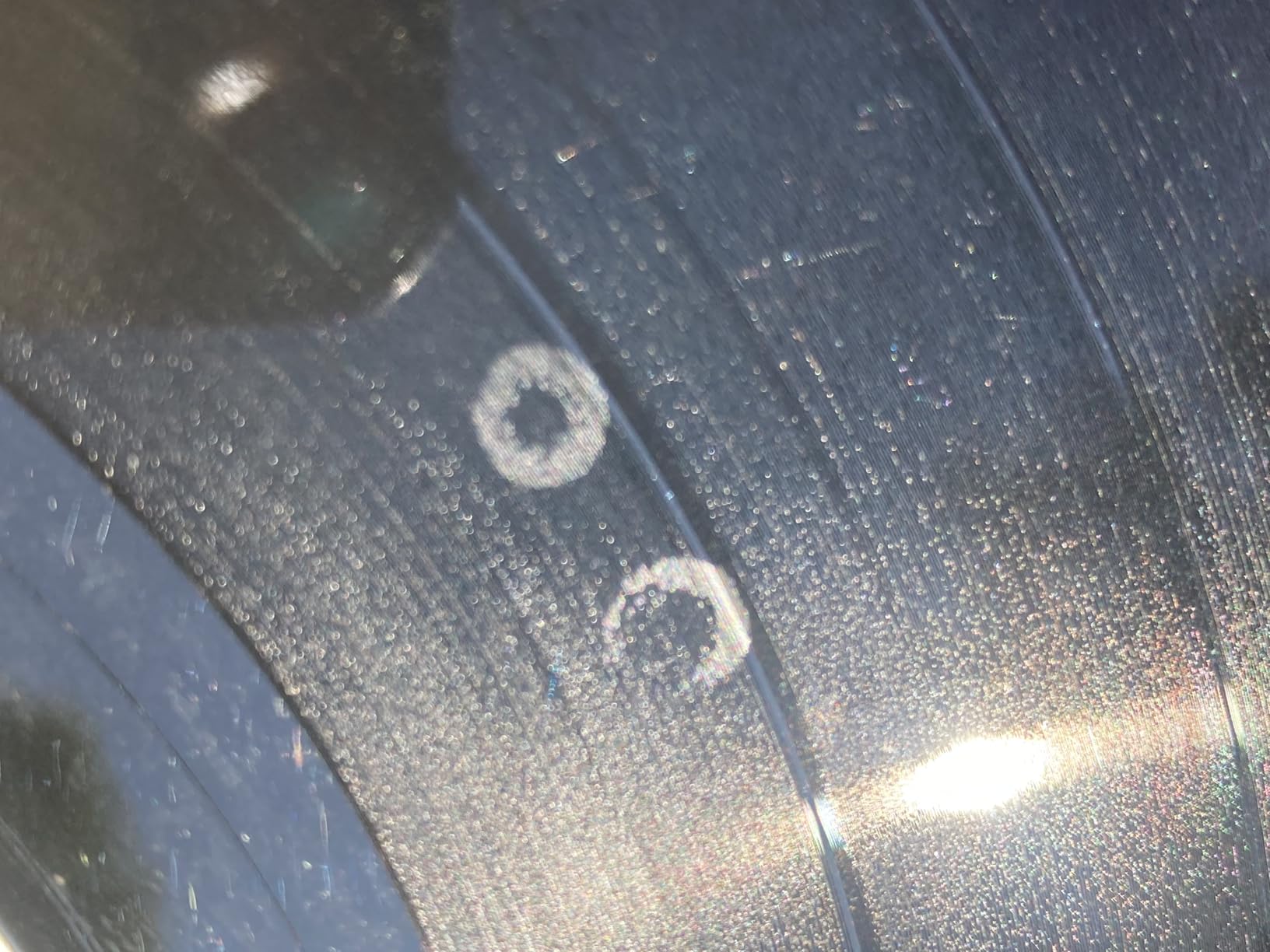
Under the lid sit two transducers running 40 kHz, with the power, frequency and proximity distance calibrated for deep-groove work rather than general immersion. In practice reviewers describe dramatic reductions in crackle, and the most common piece of advice is that a surfactant such as TergiKleen or Triton X-100 is what unlocks the full result. The integrated thermal sensor halts heating at 55C, which is a genuinely useful safety feature in a machine that runs warm water.
With 772 ratings averaging 4.5 stars, this is by far the best-proven machine in the category, and the consensus around it is unusually consistent: automation, deep cleaning and low water use on one side, ultrasonic noise, a small reservoir and the fill-lid seal on the other.
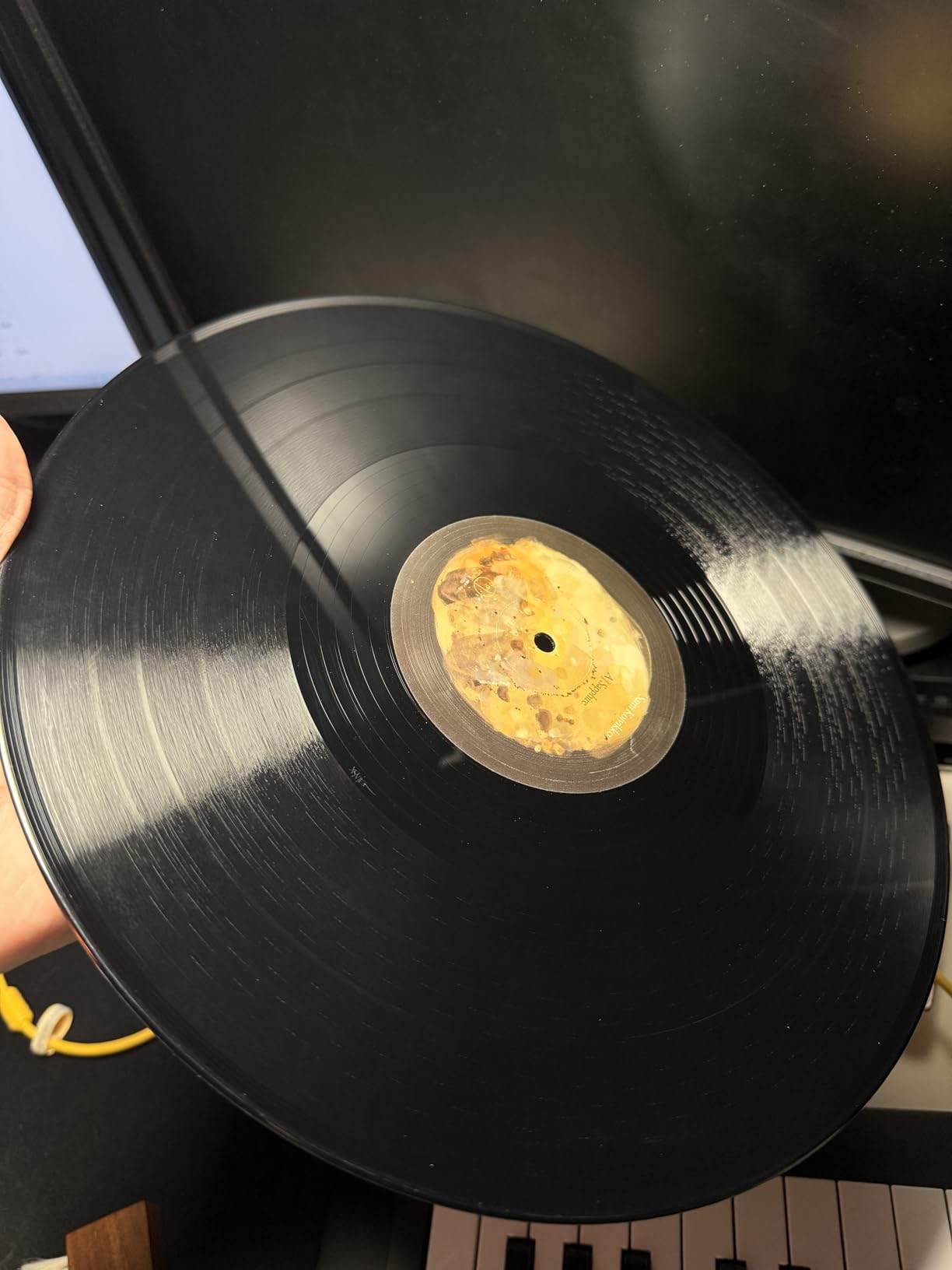
Who the HG01 suits best
It suits a collector who wants a predictable routine rather than a hobby project. Nothing needs shimming, no regulator has to be wired in, and the cycle is short enough that you will actually run it. The 13.4 by 10.8 by 5.9 inch body also means it can live on the same shelving as the records, which matters more than it sounds in a small flat.
It handles 7-inch, 10-inch and 12-inch records depending on the variant you choose, so check the size before buying. It is also the machine to pick if you regularly buy second-hand vinyl, because the whole point is rescuing a neglected pressing rather than maintaining a pristine one.
Where the HG01 disappoints
Two things. The filling-tank lid has no rubber gasket, so water runs down the sides when you pour, and the small reservoir has to be emptied and refilled by hand between batches. It is also loud, and the rubber feet on the base can work loose, which risks a leak if the unit sits uneven on a shelf.
Heavily soiled or very old records often need two deep cycles before the crackle goes, and the cleaning concentrate is not included. Budget for the fluid when you compare this machine against a generic tank, because the tank alone will not deliver the result reviewers describe.
2. VEVOR Sonic 6L 8-Record – Best Value Ultrasonic Cleaner for Vinyl
VEVOR Sonic Cleaner 6L Ultrasonic Vinyl Cleaner 7-12 Inch 8 Records Ultrasonic Vinyl Cleaning Machine 180W Ultrasonic Records Cleaner with Drying Rack for Home Store
Three 180W transducers
6-8 records per cycle
Digital 20-80C panel
304 steel tank
Pros
- Best cleaning result per unit of spend
- Cleans several records in one batch
- Digital panel makes timing and heat easy to set
- Stainless lid keeps dust out between sessions
Cons
- Very loud at around 95dB
- Record attachment is a retrofit with no assembly instructions
- Heating element is slow to reach temperature
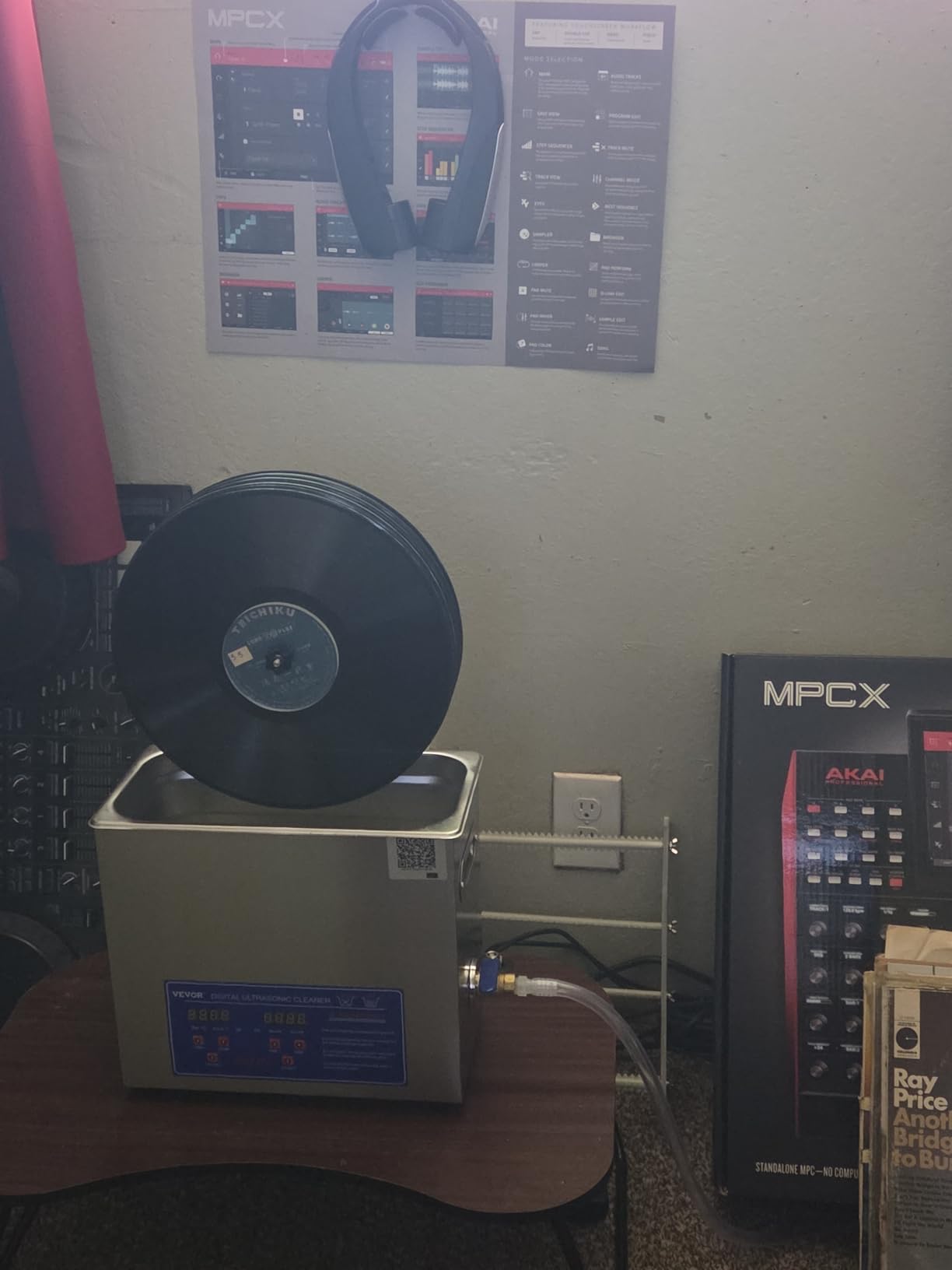
This is the machine most first-time ultrasonic owners in the forum threads actually bought, and it is the strongest value on this list by a distance. Three 180W transducers in a 304 stainless steel tank give it more ultrasonic power than the single-tank budget units, and the digital control panel makes temperature and timer settings precise instead of guesswork.
The record rack takes 6 to 8 discs between 7 and 12 inches, which is the batch size that actually moves a large collection forward. A 287-rating average of 4.4 stars backs up what owners say, which is that older thrift-store finds come back noticeably cleaner and particle-related pops largely disappear.
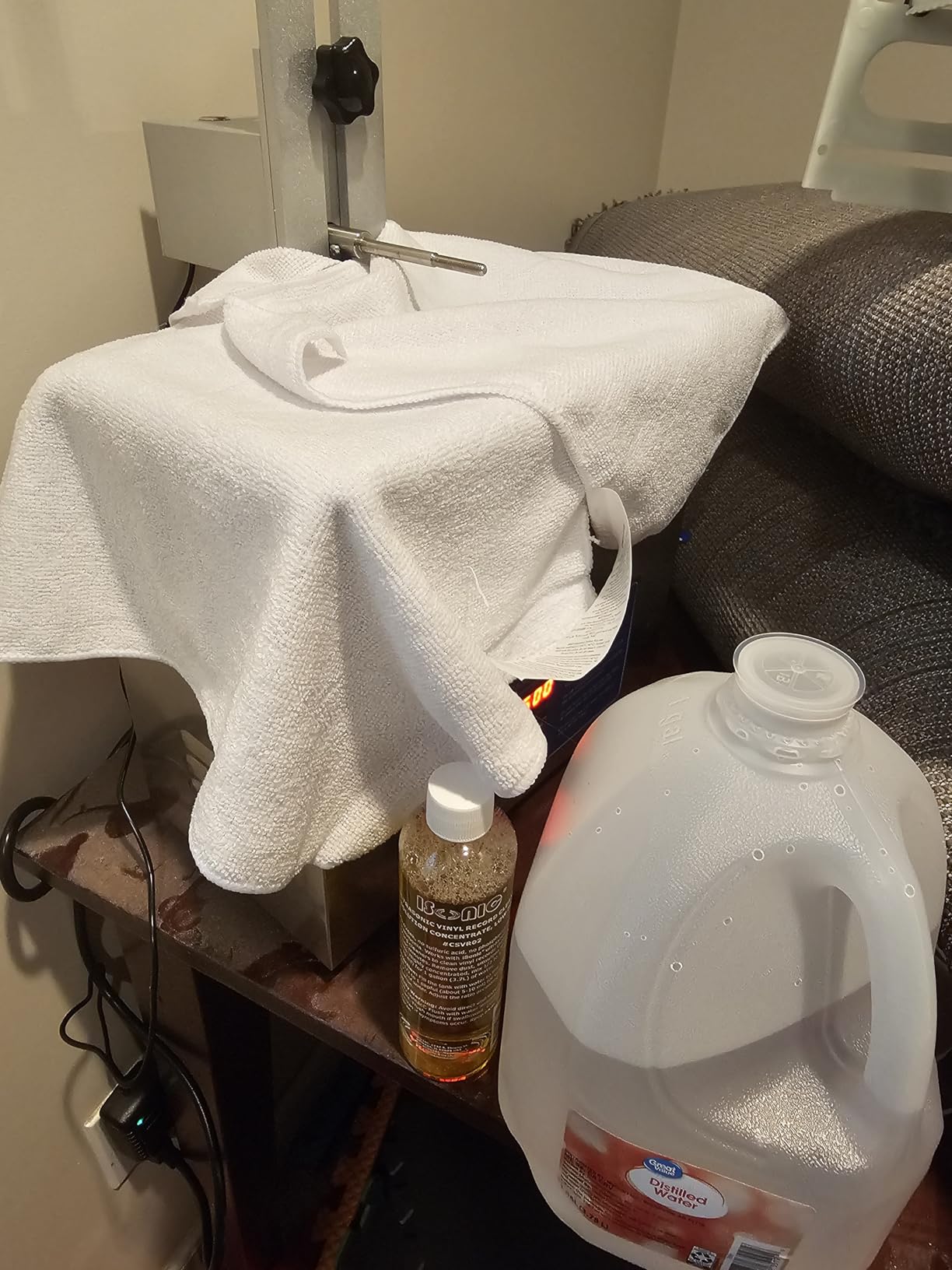
The one upgrade almost every reviewer agrees on is a 3V to 5V DC voltage regulator to slow the 24V spinner motor, plus distilled water with a surfactant such as TergiKleen. The most shared video in the whole category, on r/vinyl, is a VEVOR unit running a rock collection with visible brown water in the pan. That is the proof point, and this is the machine it came from.
Owner advice in the reviews is consistent enough to trust: fill above the line so the outer tracks are submerged, and expect the retrofit record attachment to need a little work before first use.
Who this VEVOR suits best
It suits anyone with more than a few hundred records who wants throughput. Eight discs at a time beats four, and the digital panel means you can dial a repeatable 20 to 80C wash with a 0 to 30 minute working time instead of guessing with knobs. It is also the more sensible pick for shared use, because stainless construction and a fitted lid handle a busy bench better than a bare tank.
If your collection leans heavily on 7-inch singles and 45s, the 7 to 12 inch range is a genuine advantage over the four-record unit below. The included cleaning rack, drying rack, cover, screwdriver and manual also make it the most complete box in this roundup.
Where this VEVOR disappoints
It is loud. Reviewers put it near 95dB and recommend a closed room, which is a real consideration if you live in a flat. The heating element also took more than 40 minutes to reach 50C in testing and struggles to hold temperature with the lid off, and the thermostat runs hotter than the displayed setting.
Count on retrofit maintenance: the motor mount needs shim washers, the plastic separator discs can shed film into the bath, and a full 25 to 30 minute cycle plus a long warm-up makes this a weekend activity rather than a quick evening job.
3. VEVOR 6L TH-30AXN – Best for Smaller Batches
VEVOR Ultrasonic Vinyl Record Cleaner 6L 40kHz Vinyl Ultrasonic Cleaning Machine Knob Control Record Ultrasonic Cleaner 4 Records Vinyl Sonic Cleaner Stainless Steel Tank w/Mechanical Heater & Timer
6L SUS304 tank
180W at 40kHz
Four records at 720 deg/min
Knob timer and heat
Pros
- Low-cost way into ultrasonic record cleaning
- Strong on old dusty and mould-affected records
- Adjustable heat plus a 0-30 minute timer
- Drain valve empties the tank between batches
Cons
- Extremely noisy
- Almost no written instructions and the rack arrives unassembled
- Cheap axle set screw can strip and let records fall
The TH-30AXN is the one I would buy first if the goal is simply to learn what an ultrasonic clean does to a record. It has 621 ratings averaging 4.2 stars, a 6L SUS304 stainless tank, 180W of ultrasonic power at 40 kHz and a 300W heater with a 20 to 80C range on a simple knob.
Where it beats bigger tanks is batch discipline. The 6062 aluminium rack holds four records and turns them at 720 degrees per minute on a built-in motor, and four discs spaced properly in the bath clean far more evenly than eight discs crowded together. The drain valve empties the tank in seconds, which makes consecutive batches painless.
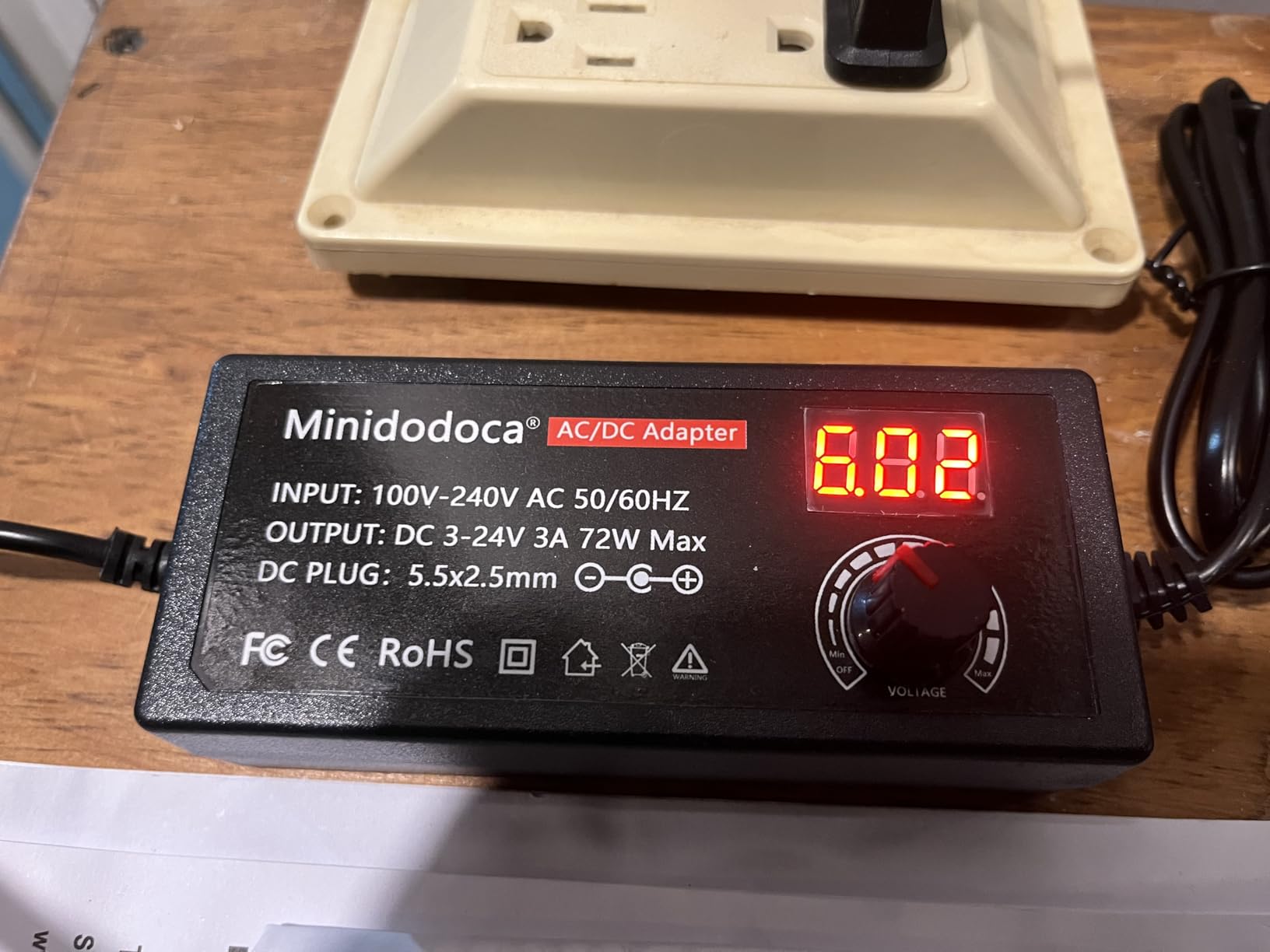
On results, reviewers pair strong cleaning on old, dusty and mould-affected records with a long list of setup cautions. The recurring tip is the same DC voltage regulator for the 24V motor, and distilled water with a surfactant such as Dawn or Simple Green. A user on r/turntables described results as good especially on older records, which matches what we see in the reviews of neglected pressings.
The tank holds 6 litres, and the machine weighs 13 pounds at 16.5 by 14.2 by 11.2 inches, so it needs real counter space rather than a shelf.
Who this machine suits best
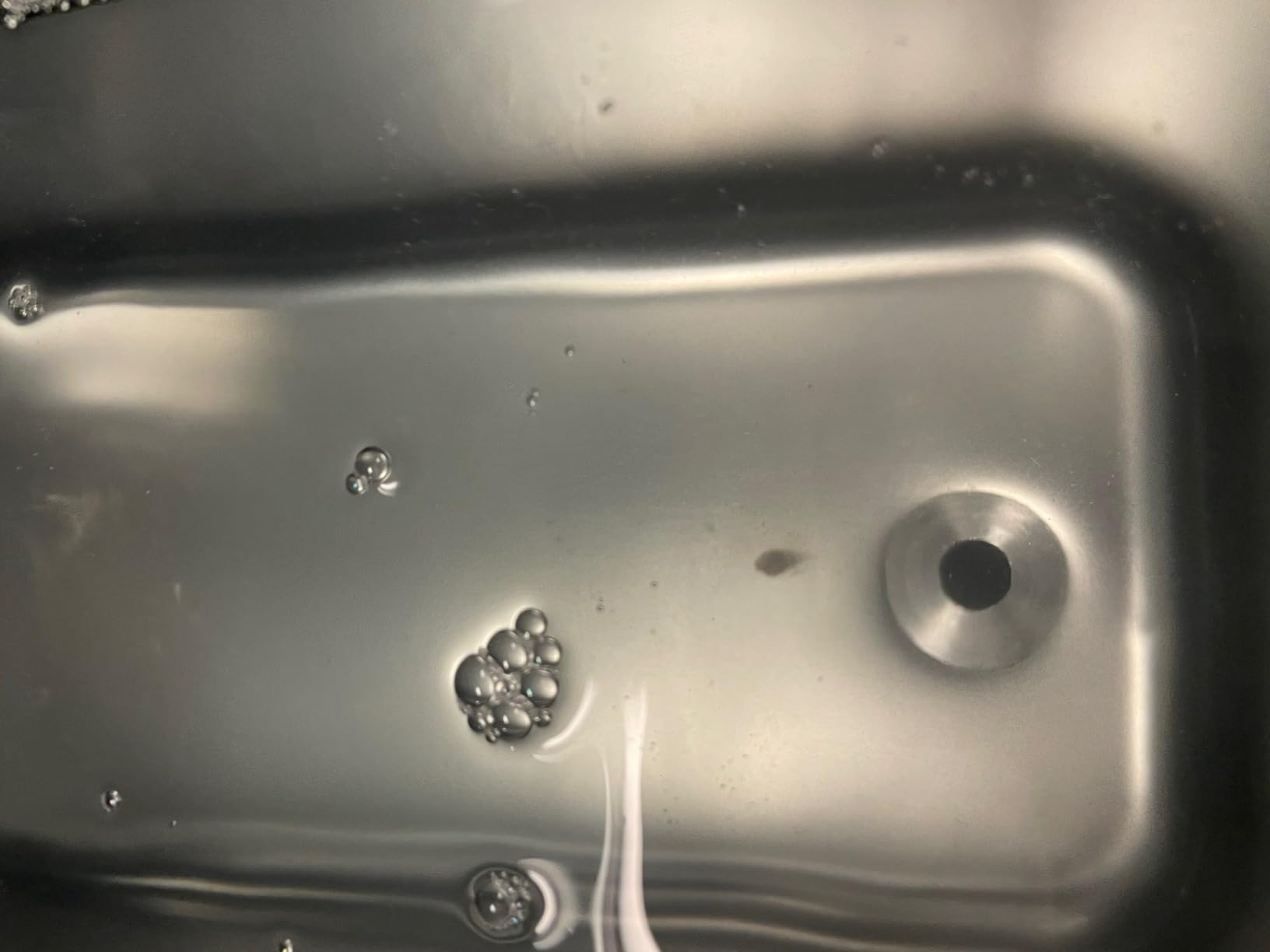
It suits a small collection and a first-time buyer who wants four records per cycle rather than eight. The stainless tank resists rust and leakage over time, which matters if you are going to run it monthly for years, and the fact that the same chassis is used across record stores, dental clinics, labs and jewellers tells you something about the hardware.
It also suits anyone who wants to prove the concept cheaply. A single batch of four filthy records will tell you whether ultrasonic cleaning is worth a place in your routine before you commit to a larger machine.
Where this machine disappoints
It is very loud, loud enough that ear protection and a separate room get recommended. Documentation is close to non-existent and the drying rack arrives unassembled with no directions, so expect an afternoon of figuring it out.
The axle set screw is cheap and can strip or work loose, which lets records fall into the tank, and the thermostat calibration is inaccurate enough that the printed temperature is unreliable. Support and warranty handling have also been reported as unresponsive, so treat it as a machine you maintain yourself.
4. iSonic CS6.1-Pro – Best Ultrasonic Cleaner for Vinyl With Spin Drying
iSonic CS6.1-Pro Motorized Ultrasonic Vinyl Record Cleaner for 10 LPs, with Filter and Spin Drying, 1.6 Gal/6L, 110V
1-micron water filter
Step motor to 600RPM
6L tank for 10 LPs
Silicone label protectors
Pros
- Purpose-built for records rather than a retrofit spinner
- Step motor separates slow cleaning from fast spin drying
- Spin drying is quicker and quieter than fan drying
- Label protectors shield sleeves in the bath
Cons
- Very high cost against a small pool of ratings
- 6L capacity is modest for large collections
- 24-pound weight makes it bulky on a home shelf
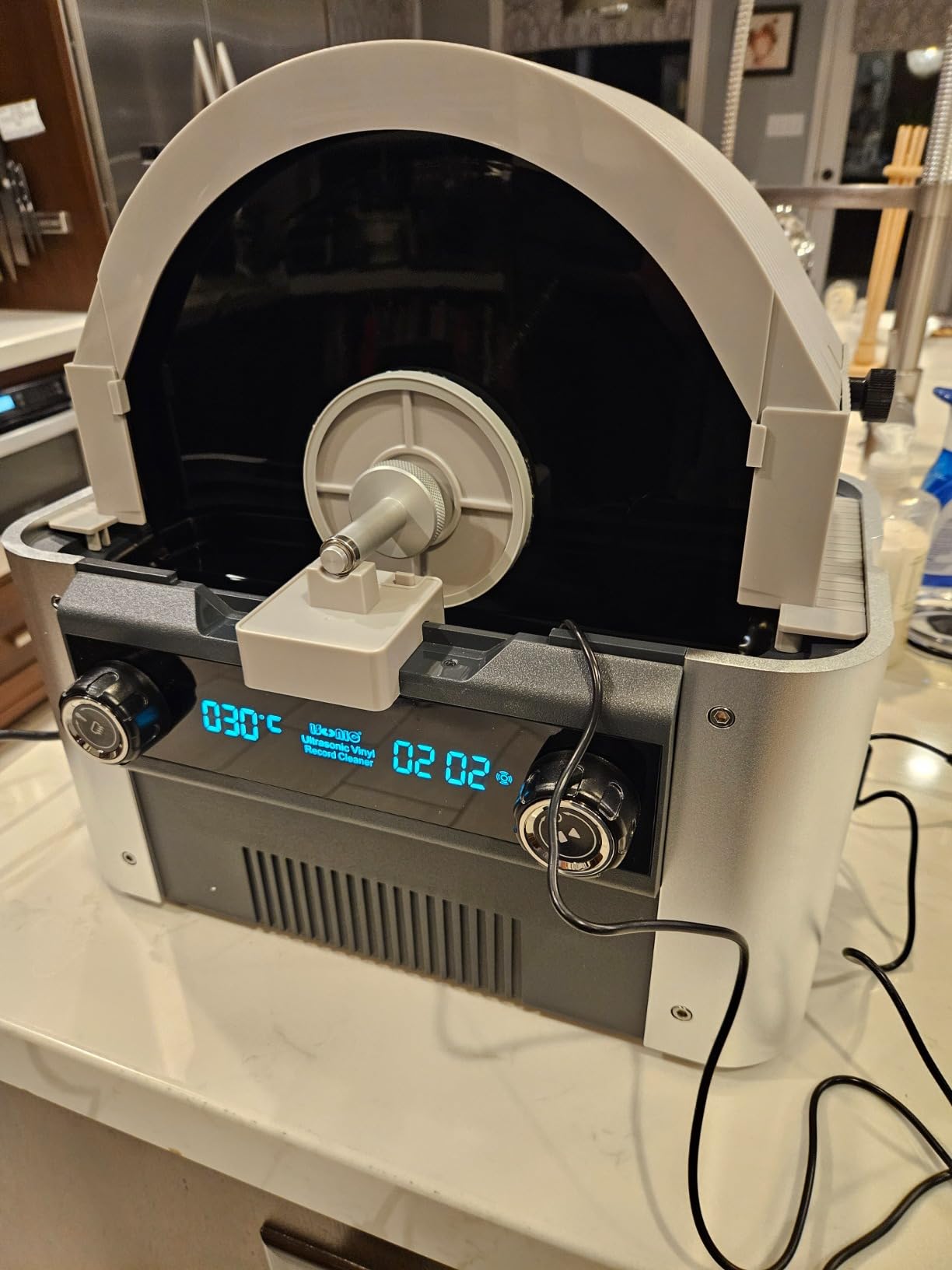
The CS6.1-Pro is the machine to buy if drying, not washing, is what has been holding you back. A programmed step motor turns the spindle at 10 RPM for the cleaning phase and then up to 600 RPM for spin drying, which removes the water far more quickly and quietly than blowing air across a disc.
It is also designed around records from the start. The box includes a 1-micron in-water filter with spare cores available, double-sided silicone-gasketed label protectors, a splash-guard shroud for the spin phase, a stainless spindle on two ball bearings, and a bottle of cleaning concentrate with a microfibre cloth. That is a complete workflow, not a tank and a spindle.
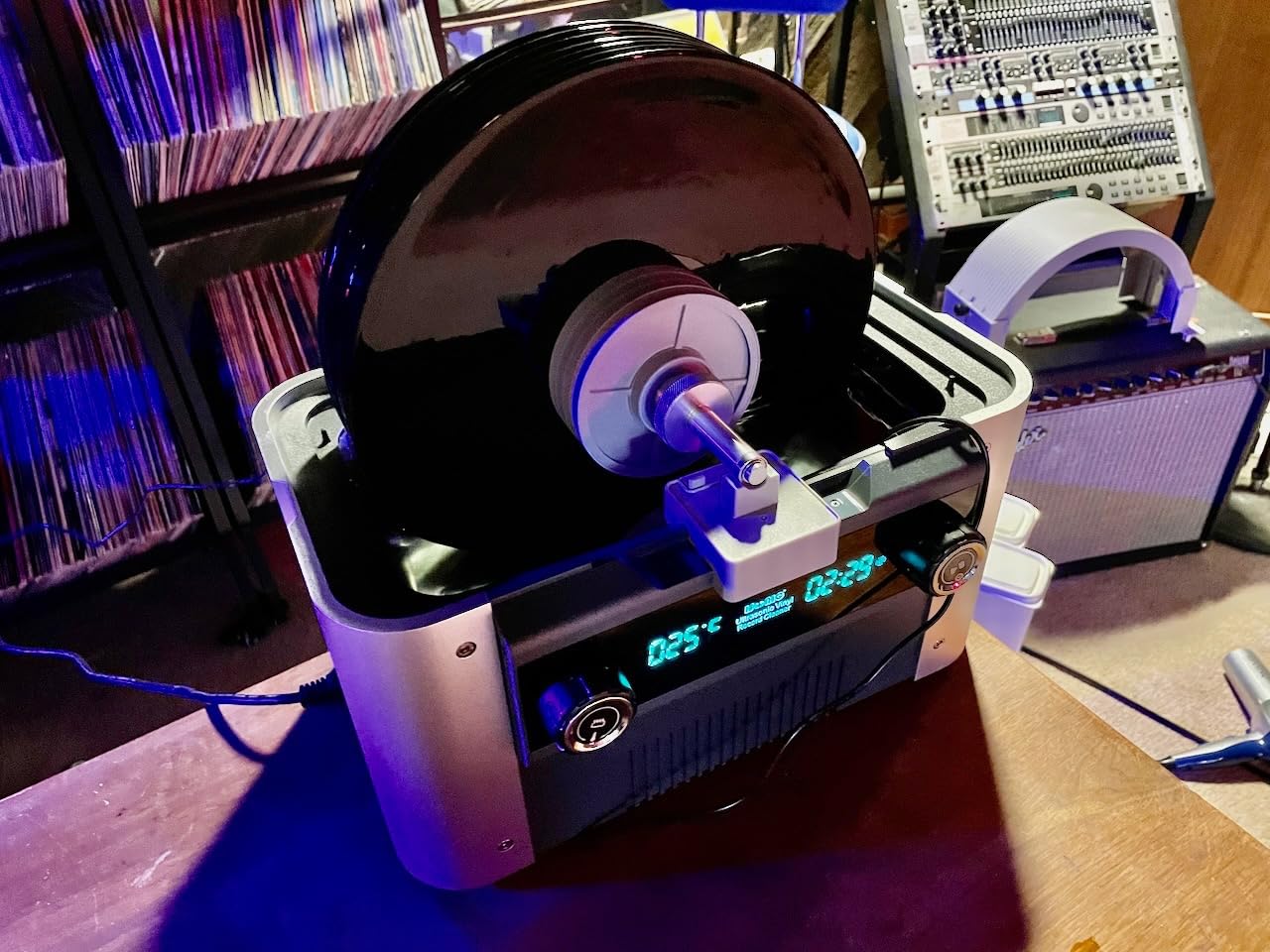
The 11 ratings it carries average 4.4 stars with no one or two-star feedback at all, and the reasoning behind them is consistent: the engineered-in workflow is the reason to choose it over a generic ultrasonic tank, and spin drying is the standout feature. On audiogon, a 40 kHz dual-transducer iSonic in this family is treated as the reference point that other machines get compared against.
Water can be reused after draining, which helps offset the running cost over a 6-litre tank that is nominal for a large collection.
Who the CS6.1-Pro suits best
It suits someone who cleans second-hand vinyl regularly and hates the slow, blotchy air-dry stage. At 10 RPM the records rotate gently enough for the cavitation field to do the work without hammering a dirty sleeve, and the label protectors keep fragile paper labels from sitting in the water.
It also suits buyers who want a one-year parts and labour warranty and a machine that will still have replacement filter cores available in a few years, which is not something you can say about every budget clone.
Where the CS6.1-Pro disappoints
The cost is steep relative to how few ratings exist at this level, so you are buying on engineering rather than on a long public record. The 6-litre capacity is small next to the larger iSonic, and at 24 pounds the machine is bulky for a home shelf.
The hybrid aluminium and plastic housing also means the stainless-tank durability of the budget units is not quite what you get here. If your collection is 500 records or more, step up to a larger tank rather than running many small batches.
5. WATEBATH 6.5L – Best First Ultrasonic Record Cleaner
WATEBATH 6.5L Ultrasonic Vinyl Cleaner, Records Ultrasonic Vinyl Cleaning Machine 180W Ultrasonic Records Cleaner with Drying Rack for Home Store
40kHz at 180W
200W heating
LED display with memory
6.5L tank
Pros
- Lowest-cost route into ultrasonic record cleaning
- Small owner base rates it 4.6 stars
- LED display with temperature and timer control
- Memory recalls your last settings
Cons
- Large basket and three drying-rack washers not included
- Spin motor speed is fixed and too fast for cleaning
- Assembly instructions are minimal
The WATEBATH TH-30A is the same 6-litre chassis sold under a different badge, and its 10 ratings average 4.6 stars, the highest average in this roundup. The small owner base is very positive about cleaning quality on dusty, neglected records, and one owner notes it is the same machine sold under the VEVOR badge at a noticeably lower price.
On paper the specification is sensible: 40 kHz, 180W ultrasonic, 200W heating, a 32 to 176F range, a 0 to 30 minute timer and an LED display. Two details stand out for a first machine. The memory function recalls your last settings, and a double-fuse system guards against circuit overload and overheating.
That is where the value case weakens. The large rectangular basket and three drying-rack washers are not in the box, the spin motor speed is not adjustable, and assembly documentation is minimal to absent. You will still pre-clean with a brush before the bath to get the best result.
Who the WATEBATH suits best
It suits a first-time buyer on a tight budget who already owns a decent brush and a drying rack, or who is happy to source the missing accessories. The countertop form factor and LED display make it easy to set a repeatable cycle, and the adjustable top stand holds records upright while an air-drying rack handles the rest of the batch.
It is also worth pairing with a manual pre-wash habit, which is exactly how most owners in the forum threads describe getting the best result from a budget tank.
Where the WATEBATH disappoints
The missing accessories are the headline problem, and they are the difference between a smooth first experience and a frustrating one. The fixed motor speed means records turn faster than ideal for cleaning, and the ultrasonic noise is loud enough that owners with hearing aids report it interferes.
With only 10 ratings, there is very little consensus to draw on, and the ultrasonic noise and minimal documentation are the two complaints that come up repeatedly. If you want proven social proof, the two VEVOR machines have it in volume.
6. iSonic P4875II+MVR10-Pro – Best for Ten-Record Batches
iSonic P4875II+MVR10-Pro Motorized Ultrasonic Vinyl Record Cleaner for 10 LP Records, with Filter and Spin Drying,2Gal/7.5L, 110V
7.5L tank
Ten LPs per cycle
1-micron filter
Spin dry to 600RPM
Pros
- Largest batch size here at ten LPs per cycle
- Same engineered spin-dry workflow as the CS6.1-Pro
- 1-micron filtration extends the life of the fluid
- Centering gauge and label protectors ease batch loading
Cons
- Highest cost in this roundup with only seven ratings
- 26-pound weight and a large footprint
- Not Prime-eligible so delivery is slower
If you own a few hundred LPs and clean in earnest, batch size is where the time goes, and the P4875II handles ten records per cycle in a 7.5-litre tank. That is the largest capacity in this roundup and the single biggest practical difference between it and the four-record unit.
The rest of the workflow matches the smaller iSonic: a 1-micron in-water filter with spare cores, a programmed step motor at 10 RPM for cleaning and up to 600 RPM for spin drying, a stainless spindle on two ball bearings, a centering gauge and silicone-gasketed label protectors, and a bottle of solution with a microfibre cloth. It operates on 110V.
Its seven ratings average 4.0, split between strong five-star praise for the ten-record batch and one-star complaints. With a pool that small there is limited consensus beyond the cost, weight and footprint, and the machine weighs 26 pounds across a 21 by 10 by 20 inch body, so it needs a dedicated spot.
Who the P4875II suits best
It suits a collector restoring a serious library where the bottleneck is time, not money. Ten records per cycle, with a filter that extends the usable life of the cleaning fluid and spin drying that finishes the job in minutes rather than a damp afternoon on a rack, changes the economics of cleaning a whole wall of records.
The centering gauge is the detail that matters most for batch work, because it keeps ten discs evenly spaced and evenly submerged rather than leaning on each other.
Where the P4875II disappoints
The main issue is evidence. Seven ratings cannot tell you much, and the cost is the highest in this roundup, so you are paying a serious amount for thin social proof. The 26-pound weight and the large footprint also rule it out for small shelves.
For most people the CS6.1-Pro is the more sensible iSonic entry point, and the 26-pound chassis is the reason we would only reach for this model when a dedicated shelf is genuinely available.
Ultrasonic vs Manual: When Each One Wins
For routine maintenance, fluid and a microfibre cloth win outright. A cloth clean takes seconds, costs almost nothing, and handles the dust and fingerprints that build up between playbacks. Most collectors should be doing this every time they drop the needle.
For restoration, ultrasonic wins just as clearly. A record that crackles after a cloth clean has dirt set into the groove wall, and no amount of brushing shifts it. Owners describe the same moment on r/turntables, where a first batch of six records ranged from new but full of pops to genuinely filthy, and the filthy ones are where the tank earns its place.
The right mental model is spring cleaning rather than nightly upkeep. A manual wash-and-vacuum system such as a Record Doctor is excellent for a quick all-surface clean and is easier on sleeves, but it does not generate cavitation, so it cannot lift embedded residue. Save the ultrasonic for a weekend, run the biggest neglected batch you have, and go back to the cloth in between.
One honest alternative worth weighing: if your pops are caused by a worn stylus rather than dirt, no machine fixes that. Upgrading the cartridge is often the better spend, which is exactly the comparison buyers raise on r/audiophile when weighing a cleaner against a better cartridge on a Technics SL-1200G.
What Not to Put in an Ultrasonic Tank
Ultrasonic cleaning will not damage vinyl if you respect the machine, but it will happily damage everything else you put in the water. Here is the short list of what stays out.
Paper inner sleeves, cardboard inserts and card-based jackets. Paper pulp disintegrates in a cavitation field. Remove every inner sleeve and any stiffener before a record goes in, and clean them separately by hand.
78 rpm and other brittle early discs. Older shellac-era pressings have a different binder and often paper labels. Clean these by hand with a dedicated 78 cleaning method and leave them out of the tank.
Records with damaged, torn or peeling labels. Water reaches the label edge and can lift paper. If the label is already compromised, use a fluid and cloth method instead.
Warped records. Heat and mechanical stress can make a warp permanent. Check your discs in good light before they go anywhere near warm water.
Cassettes, CDs, DVDs, vinyl accessories that are not water-safe, jewellery you care about, and any item with electronics. Also avoid mixing a valuable batch with a dirty one in the same bath, because the point of the machine is to keep the bath clean enough to reuse.
On temperature and timing, the discipline is simple. Stay well below the 55C that the HG01 halts at, keep cycles to the short end of the machine’s range, and remove records as soon as the cycle ends. Long dwells and hot water are where problems start.
How to Clean a Record in an Ultrasonic Machine
Start with the record, not the machine. Brush it dry with a carbon fibre brush, remove every paper inner sleeve and any stiffener card, and look at the label and sleeve for tears or water damage. If anything is compromised, use a manual method instead.
Then set the machine up. Fill with distilled water to the line so the outer tracks are covered, add your surfactant, and set the temperature. Most owners work in the 40 to 50C region; you do not need to go near the top of a 20 to 80C dial to get good results.
Load records with spacing. This is the mistake that quietly ruins a batch: discs that touch or lean on each other clean unevenly because the cavitation field does not reach between them, and a crowded tank wastes the cycle. Leave gaps between every record and never exceed the machine’s stated record capacity.
Run a short cycle first. Start at the low end of the timer range and add time only if the water is still running clear. A heavily soiled record may need two deep cycles rather than one long one, which is also gentler on the vinyl.
Finish properly. Lift the record out, check that the grooves are visibly cleaner, rinse-check if the machine allows, then dry it flat rather than on edge. Re-sleeve with a fresh inner sleeve only once the disc is completely dry, and let the machine cool before draining.
Buying Guide: Frequency, Temperature, Filtration and Drying
Frequency. Almost everything in this category runs at 40 kHz, and 40 kHz is genuinely good. The 40 versus 80 versus 120 kHz debate comes up constantly on audiogon and whatsbestforum, where enthusiasts argue that lower frequencies produce more violent cavitation and higher frequencies act more gently. For vinyl, the practical evidence is thin: the 40 kHz machines in this roundup do the work, and the machines that clean well are the ones with enough transducer power and enough time, not a higher number on the label. Dual-frequency Elmasonic tanks are widely regarded as the best available hardware, and they are sold to the dental and jewellery trades rather than to record collectors.
Transducer count and wattage. More transducers means more even cavitation across a wider tank. The VEVOR Sonic 8-Record model runs three 180W transducers, which is why it cleans a full basket more consistently than a single-transducer 6L tank. Wattage matters less than how the power is distributed.
Tank capacity and records per cycle. More records per cycle is not automatically better. Four well-spaced discs in a 6-litre tank clean more evenly than eight crowded ones, so match the capacity to how disciplined you will be with spacing. If you have a big collection, a six-to-eight record tank is the practical sweet spot.
Temperature control. Look for a real thermostat and, ideally, a thermal sensor that halts heating. The HG01’s automatic halt at 55C is the best safety feature in this roundup, while the budget units have thermostats that run hotter than the displayed setting. Keep your own discipline regardless.
Filtration and water reuse. A 1-micron in-water filter, as on both iSonic machines, meaningfully extends the life of a bath. Closed-loop basins such as the HG01’s 350ml design cut water use to a fraction of a 6-litre tank, which is the single most meaningful sustainability factor here. Budget tanks typically mean fresh water for every batch and a disposal step afterwards, and that is where the environmental cost really sits.
Drying. Filtered air drying, filtered-heat drying and spin drying to 600 RPM all beat a passive rack, because a disc left wet is a disc that goes back into a sleeve with moisture trapped against the vinyl. Spin drying is the fastest and quietest, filtered air is the gentlest, and a rack is fine if you are patient.
Build and parts. SUS304 and 304 stainless steel tanks last, and the presence of spare filters and rubber drive wheels matters more than most buyers realise. On a machine you plan to keep for years, available consumables are worth more than a slightly larger tank.
Consumables. Only the iSonic machines include cleaning solution concentrate in the box. On everything else, budget for an alcohol-free record cleaning concentrate or a surfactant, because the fluid is not an optional extra.
Frequently Asked Questions
What is the best ultrasonic cleaner for vinyl records?
The HumminGuru HG01 is the best all-round choice: it washes and dries automatically, uses a reusable 350ml basin with dual filtration, and halts heating at 55C. The VEVOR Sonic 6L is the best value option if you want a bigger batch and more transducer power per unit of spend.
Is ultrasonic cleaning good for vinyl records?
Yes, as a deep restoration step rather than routine maintenance. Cavitation lifts dried residue and embedded dust out of the groove that no brush or cloth can reach, which is why a neglected record can go from crackling to quiet after a single batch. Fluid and cloth cleaning remain the right daily tool.
Is 40kHz good for an ultrasonic cleaner?
40 kHz is good, and every machine in this roundup uses it. Higher frequencies such as 80 kHz and 120 kHz produce gentler cavitation, but the difference in real record cleaning comes down to transducer power, dwell time and surfactant rather than the frequency number itself. Transducer count and spacing matter more.
Does ultrasonic cleaning damage vinyl records?
Not when you use the machine as intended. Keep water well below the temperature at which vinyl warps, use short cycles rather than one long one, and never overcrowd the tank. Remove all paper inner sleeves first, and avoid records with torn or peeling labels, warped platters, or brittle 78 rpm pressings.
What should you not clean in an ultrasonic cleaner?
Never clean paper inner sleeves, cardboard stiffeners, card-based jackets, 78 rpm and other brittle early discs, or records with damaged, torn or peeling labels. Also keep electronics, cassettes, discs and anything not rated water-safe out of the tank, and do not mix a valuable batch with a dirty one in the same bath.
The Verdict
Six genuine ultrasonic machines were available in this category, and they split cleanly into two groups. The budget tier is a generic 6-litre stainless tank with a record rack retrofitted on top, and within that group the VEVOR Sonic 8-Record is the one to buy because three transducers and a digital panel beat a single-transducer tank on every count that matters.
For most collectors, the HumminGuru HG01 is still our pick as the best of the best ultrasonic cleaners for vinyl records. It is the only machine here that cleans and dries a disc without any manual step, it uses a fraction of the water, and it is protected by the largest body of owner feedback in the category. If your collection is large enough to need ten-record batches or you want spin drying, the iSonic machines are the purpose-built answer.
Whatever you choose, use it as a restoration tool rather than a daily one, keep temperatures moderate, and give the machine a surfactant. That is 2026‘s short version: buy once, filter the water, and the same bath will keep rescuing records for years.