
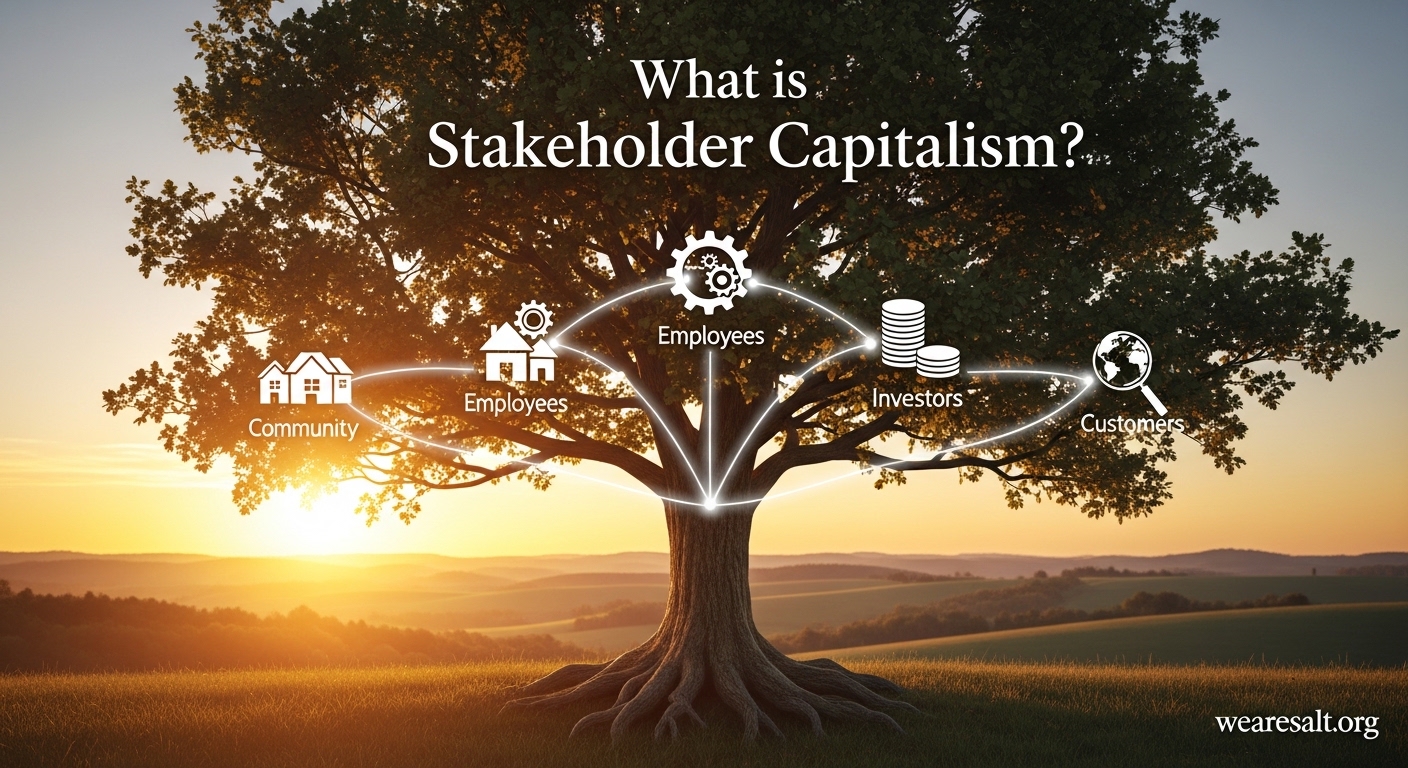
Stakeholder capitalism is a system in which companies seek long-term value creation by taking into account the needs of all their stakeholders, not just shareholders. This approach represents a fundamental shift from the traditional shareholder primacy model that dominated corporate America for decades. In this guide, I will explain exactly what stakeholder capitalism means, where it came from, and why it matters for businesses and society in 2026.
Our team has researched this topic extensively, examining everything from Klaus Schwab’s original vision to the Business Roundtable’s landmark 2019 statement. You will learn how this concept differs from shareholder capitalism, who the key stakeholders are, and whether this movement represents genuine change or just corporate public relations.
Table of Contents
What is Stakeholder Capitalism?
Stakeholder capitalism is a model of corporate governance in which companies commit to creating long-term value by serving the interests of all stakeholders affected by their business decisions. These stakeholders include employees, customers, suppliers, communities, and shareholders, rather than focusing exclusively on maximizing shareholder profits.
The core principle is simple: businesses exist within a broader ecosystem and have responsibilities beyond delivering returns to investors. Companies practicing stakeholder capitalism consider how their decisions impact every group connected to their operations, balancing profit with social responsibility and environmental stewardship.
The Four Types of Stakeholder Capitalism
Not all stakeholder capitalism looks the same. Klaus Schwab, founder of the World Economic Forum, identified four distinct varieties that companies adopt:
1. The Traditional Anglo-American Model: This approach maintains shareholder interests as primary while acknowledging broader stakeholder responsibilities. Companies following this model seek to balance profit with social concerns, but shareholders retain significant influence over corporate decisions.
2. The Continental European Model: Common in Germany and Scandinavia, this approach gives employees formal representation on corporate boards through co-determination laws. Workers have a direct voice in strategic decisions, creating a more balanced power structure between capital and labor.
3. The Asian Model: Prevalent in Japan and South Korea, this model emphasizes long-term relationships with employees, suppliers, and communities over short-term profit maximization. Companies following this approach prioritize stability and mutual loyalty.
4. The Emerging ESG-Driven Model: The newest variety integrates environmental, social, and governance (ESG) criteria into core business strategy. This model responds to investor demand for sustainable practices and uses ESG metrics to measure stakeholder impact.
The History and Origins of Stakeholder Capitalism
Klaus Schwab introduced the concept of stakeholder capitalism in 1971, the same year he founded the World Economic Forum. In his original writings, Schwab argued that companies should measure success not just by profits but by their ability to serve all stakeholders and contribute to societal wellbeing.
The concept gained academic legitimacy through R. Edward Freeman’s 1984 book “Strategic Management: A Stakeholder Approach.” Freeman is widely regarded as the father of stakeholder theory, though he focused on management strategy rather than capitalism as an economic system. His work provided the theoretical foundation for why companies should consider stakeholder interests in decision-making.
From Shareholder Primacy to Stakeholder Focus
For most of the late 20th century, Milton Friedman’s doctrine of shareholder primacy dominated corporate thinking. Friedman argued that a company’s sole purpose was maximizing returns for shareholders, and that any other social goals represented improper use of owner resources.
This philosophy drove corporate behavior for decades, contributing to rising inequality and environmental degradation. However, the 2008 financial crisis exposed the limitations of pure profit maximization, prompting serious reconsideration of corporate purpose.
Modern Milestones: 2019 and 2020
The Business Roundtable’s August 2019 statement marked a watershed moment. Nearly 200 CEOs, including leaders from Apple, JPMorgan Chase, and Amazon, signed a new Statement on the Purpose of a Corporation. For the first time since 1997, they explicitly rejected shareholder primacy as the sole corporate purpose.
At Davos 2020, the World Economic Forum unveiled the Davos Manifesto, formally embracing stakeholder capitalism as the guiding principle for the global economy. Klaus Schwab declared that “the era of shareholder capitalism is over” and called for companies to address their environmental and social impacts.
Stakeholder Capitalism vs Shareholder Capitalism
Shareholder capitalism focuses exclusively on maximizing returns for investors, treating other parties as means to that end. Stakeholder capitalism treats employees, customers, suppliers, and communities as ends in themselves, with the company existing to create value for all parties.
Under shareholder primacy, executives measure success primarily through metrics like earnings per share, stock price appreciation, and dividend payments. Decisions that boost short-term profits but harm employees or the environment are not just permitted but encouraged if they serve shareholder returns.
Stakeholder capitalism broadens the scorecard to include worker wellbeing, customer satisfaction, supplier relationships, community impact, and environmental sustainability. Executives must balance these interests, accepting that maximizing one stakeholder’s returns may require trade-offs with others.
Milton Friedman’s Legacy
Milton Friedman’s 1970 New York Times essay “The Social Responsibility of Business is to Increase Its Profits” became the bible of shareholder capitalism. He argued that corporate executives are employees of shareholders, with a fiduciary duty to maximize owner wealth.
Friedman viewed any other social responsibility as taxation without representation, since executives were spending shareholder money on causes the owners might not support. This argument provided moral and economic justification for decades of short-term profit maximization.
Why the Shift is Happening Now
Several forces drive the move toward stakeholder capitalism. Income inequality has reached levels that threaten social stability. Climate change poses existential risks that markets alone cannot address. Employees, especially younger workers, demand purpose-driven employers. Customers increasingly prefer sustainable brands.
Investors themselves have changed their minds. Major pension funds and asset managers now recognize that environmental and social risks threaten long-term portfolio returns. They have embraced stakeholder capitalism as a pragmatic approach to sustainable wealth creation.
Who Are the Key Stakeholders?
Stakeholder capitalism recognizes that multiple groups have legitimate interests in corporate decisions. Understanding each stakeholder’s needs helps companies implement this model effectively.
Employees
Workers deserve fair compensation, safe conditions, opportunities for development, and dignity in their work. Stakeholder capitalism treats employees as valuable contributors rather than expendable costs, investing in training and wellbeing even when short-term pressures suggest cutting these programs.
Customers
Buyers deserve quality products, fair pricing, honest marketing, and responsive service. Companies practicing stakeholder capitalism prioritize customer trust over short-term revenue extraction, recognizing that loyal customers drive sustainable business growth.
Suppliers
Business partners deserve fair contracts, timely payment, and ethical treatment. Rather than squeezing suppliers for every penny, stakeholder companies build long-term relationships that create mutual value and supply chain resilience.
Communities
Local communities where companies operate deserve positive economic impact, environmental protection, and corporate citizenship. This includes paying fair taxes, avoiding pollution, and contributing to local prosperity rather than extracting resources.
Shareholders
Investors still matter in stakeholder capitalism, but they receive sustainable long-term returns rather than short-term profit maximization. Shareholders benefit when companies build durable competitive advantages through stakeholder trust and loyalty.
The Environment
Modern stakeholder capitalism explicitly includes the planet as a stakeholder. Companies must minimize environmental harm, reduce carbon emissions, and operate within planetary boundaries. Climate change represents the ultimate stakeholder crisis.
Real-World Examples of Stakeholder Capitalism
The Business Roundtable’s 2019 statement remains the most visible example of stakeholder capitalism in action. When 181 CEOs committed to delivering value to all stakeholders, they signaled that corporate America had reached a turning point.
Jamie Dimon of JPMorgan Chase, who chaired the Business Roundtable at the time, explained that “major employers are investing in their workers and communities because they know it is the only way to be successful over the long term.” This marked a dramatic departure from previous statements that defined corporate purpose narrowly around shareholders.
The Davos Manifesto 2020
Klaus Schwab’s Davos Manifesto articulated stakeholder capitalism as the guiding principle for the World Economic Forum. The manifesto declared that “a company is more than an economic unit generating wealth. It fulfills human and social aspirations as part of the broader social system.”
The manifesto established three key principles: companies should pay fair share of taxes, have zero tolerance for corruption, and uphold human rights throughout their global supply chains. These concrete commitments moved stakeholder capitalism from abstract philosophy to measurable practice.
Companies Practicing Stakeholder Principles
Several major companies have adopted stakeholder capitalism in meaningful ways. Patagonia has long prioritized environmental impact over profit, donating 1% of sales to environmental causes and committing to carbon neutrality. Salesforce integrates stakeholder metrics into executive compensation.
Unilever under former CEO Paul Polman demonstrated that stakeholder capitalism could drive financial performance while addressing social challenges. The company’s Sustainable Living Brands grew 69% faster than other brands, proving that purpose and profit can align.
ESG Integration
Environmental, Social, and Governance (ESG) criteria provide the measurement framework for stakeholder capitalism. Companies report on carbon emissions, workforce diversity, supply chain ethics, and board independence. This data allows investors and stakeholders to evaluate corporate performance beyond financial returns.
BlackRock CEO Larry Fink has used his annual letters to push companies toward stakeholder capitalism, warning that businesses without a social purpose will lose investor confidence. With BlackRock managing over $10 trillion in assets, this stance has real influence over corporate behavior.
Criticisms and Challenges
Stakeholder capitalism faces legitimate skepticism, much of it rooted in concerns about greenwashing and public relations rather than genuine change. Critics note that the Business Roundtable CEOs continued laying off workers and buying back stock even after signing their stakeholder commitment.
Our research into forum discussions reveals deep suspicion about whether companies will actually follow through on stakeholder promises. Users ask whether this represents substantive reform or merely rebranding capitalism to deflect criticism. These concerns deserve honest acknowledgment.
The Greenwashing Problem
Many companies adopt stakeholder language without changing actual practices. They publish glossy sustainability reports while continuing environmentally destructive operations. This hypocrisy undermines the credibility of the entire movement and creates cynicism among employees and consumers.
True stakeholder capitalism requires structural changes to corporate governance, executive compensation, and decision-making processes. Simply adding a stakeholder slide to investor presentations accomplishes nothing meaningful.
Measurement Difficulties
Shareholder returns are easy to measure through stock prices and dividends. Stakeholder returns involve subjective judgments about employee satisfaction, community wellbeing, and environmental health. Without agreed-upon metrics, companies can claim stakeholder success without demonstrating real results.
Conflicting Stakeholder Interests
Stakeholders often want incompatible things. Workers want higher wages, shareholders want lower costs. Communities want jobs preserved, efficiency demands automation. Environmental protection may increase prices for low-income customers. Balancing these conflicts requires difficult trade-offs that stakeholder capitalism does not always resolve clearly.
Is It Socialism in Disguise?
Some critics argue that stakeholder capitalism represents a step toward government control of business. They worry that broadening corporate purpose opens the door to political interference in private enterprise.
This criticism misunderstands the concept. Stakeholder capitalism remains fundamentally about private companies making decisions in a market economy. It simply expands the definition of corporate success beyond profit to include positive social impact. The companies remain privately owned and operated.
Benefits of Stakeholder Capitalism
Despite criticisms, stakeholder capitalism offers compelling advantages for businesses willing to implement it authentically. These benefits explain why the concept has gained traction among serious business leaders.
Long-term value creation: Companies that invest in employees, customers, and communities build durable competitive advantages. These relationships create barriers to entry that rivals cannot easily replicate through lower prices.
Improved reputation and trust: Businesses viewed as socially responsible attract better talent, more loyal customers, and more patient investors. Trust has become a scarce resource that stakeholder companies can accumulate for competitive advantage.
Better employee retention: Workers who feel valued and see purpose in their work stay longer and perform better. High turnover costs far exceed the savings from treating employees as disposable resources.
Sustainable competitive advantage: Stakeholder relationships develop slowly and cannot be quickly copied. A company with deep community ties, loyal suppliers, and engaged employees has advantages that price competition cannot overcome.
Addressing systemic challenges: Climate change and inequality threaten the market systems that make capitalism possible. Stakeholder capitalism offers a framework for business to help address these challenges without requiring government intervention.
Frequently Asked Questions
Is stakeholder capitalism good?
Stakeholder capitalism offers both benefits and challenges. It can create more sustainable businesses, reduce inequality, and address environmental damage when implemented authentically. However, critics argue it may be used for public relations without real change, and measuring stakeholder returns is more difficult than tracking profits. The concept is good in principle, but its value depends entirely on execution.
What is an example of stakeholder capitalism?
The Business Roundtable’s 2019 statement is a prominent example, where 181 CEOs committed to serving all stakeholders rather than just shareholders. Companies like Patagonia, which donates 1% of sales to environmental causes, and Unilever, which integrated sustainability into core business strategy, demonstrate stakeholder capitalism in practice. The Davos Manifesto 2020 also established stakeholder principles for the global economy.
Who is the father of stakeholder capitalism?
R. Edward Freeman is widely regarded as the father of stakeholder theory through his 1984 book Strategic Management: A Stakeholder Approach. Klaus Schwab, founder of the World Economic Forum, introduced stakeholder capitalism as an economic concept in 1971. Both contributed foundational ideas, with Freeman focusing on management theory and Schwab on economic systems.
What are the 4 types of stakeholder capitalism?
According to Klaus Schwab, the four types are: 1) The Traditional Anglo-American Model, which balances shareholder and stakeholder interests; 2) The Continental European Model, which gives employees board representation; 3) The Asian Model, which emphasizes long-term relationships and stability; and 4) The Emerging ESG-Driven Model, which integrates environmental, social, and governance criteria into business strategy.
Conclusion
What is stakeholder capitalism? It is a system where companies create long-term value by serving the interests of all stakeholders, employees, customers, suppliers, communities, and shareholders rather than focusing exclusively on profit maximization. This approach represents a fundamental rethinking of corporate purpose that has gained significant momentum in recent years.
The concept has evolved from Klaus Schwab’s 1971 vision through R. Edward Freeman’s stakeholder theory to the Business Roundtable’s 2019 commitment and the Davos Manifesto 2020. Major companies and investors now recognize that sustainable business requires addressing environmental and social challenges alongside financial returns.
Stakeholder capitalism is not perfect. Greenwashing remains a serious problem, measuring stakeholder returns is difficult, and balancing conflicting interests creates genuine challenges. Critics are right to demand evidence that companies will follow through on their commitments.
Nevertheless, the shift from shareholder primacy to stakeholder capitalism addresses real problems that markets alone cannot solve. For businesses willing to implement it authentically, stakeholder capitalism offers a path to sustainable competitive advantage while contributing to a more equitable and environmentally stable world. The question is no longer whether stakeholder capitalism is coming, but which companies will lead the transition and which will be left behind.