
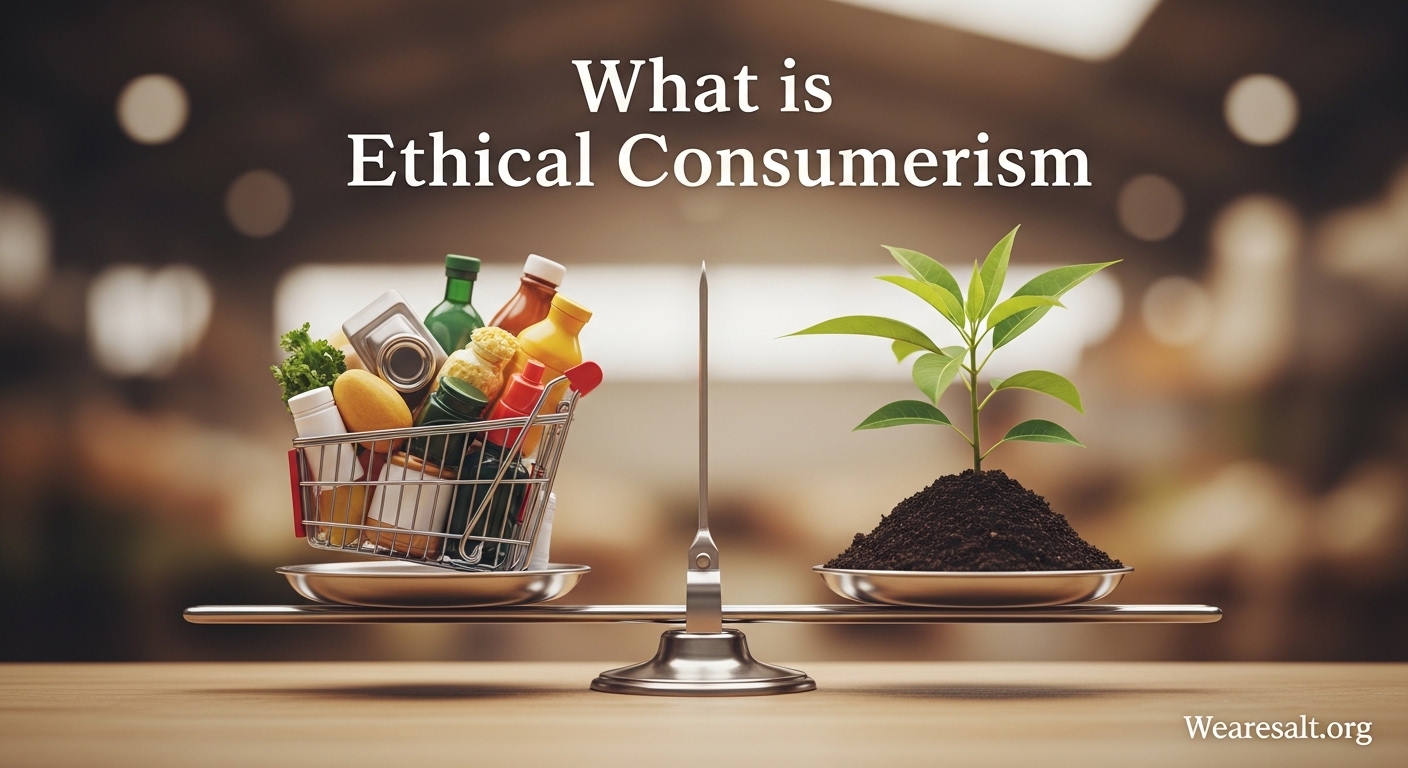
Have you ever stood in a store aisle, holding two similar products, wondering if one was somehow “better” than the other? Maybe one had a fair trade label. The other was cheaper. That moment of hesitation is where ethical consumerism begins. It is not about being perfect. It is about being intentional.
Ethical consumerism is the practice of making purchasing decisions based on moral and ethical values. When you engage in ethical consumerism, you consider the environmental and social impact of your purchases alongside price and quality. You are essentially voting with your wallet for the kind of world you want to live in.
In this guide, I will walk you through what ethical consumerism really means, why it matters more than ever in 2026, and how you can start practicing it without burning out or going broke. We will also tackle the elephant in the room: whether ethical consumerism is even possible in our current economic system.
Table of Contents
What is Ethical Consumerism? A Clear Definition
Ethical consumerism is a form of political activism expressed through purchasing decisions. The core premise is simple but profound: when you buy something, you are not just consuming a product. You are also supporting the processes, labor practices, and environmental standards used to create it.
At its heart, ethical consumerism means purchasing goods and services that align with your values. These values typically fall into three categories: environmental sustainability, social justice, and animal welfare. The practice goes beyond simple label reading. It requires understanding supply chains, questioning corporate claims, and sometimes paying more for transparency.
The term is sometimes used interchangeably with conscious consumerism and green consumerism, though each has subtle differences. Conscious consumerism emphasizes awareness of all impacts. Green consumerism focuses primarily on environmental concerns. Ethical consumerism is the broadest term, encompassing social, environmental, and moral considerations.
The Philosophical Foundation
Ethical consumerism rests on the belief that markets are not morally neutral. Every transaction is a vote of confidence in the system that produced the goods. When you buy from companies that exploit workers or pollute rivers, you are effectively endorsing those practices. When you choose alternatives, you signal that ethical practices matter to you as a customer.
This perspective transforms shopping from a passive activity into an active form of civic participation. Your wallet becomes a tool for change. The aggregate effect of millions of these choices can pressure companies to improve practices or drive unethical businesses toward obsolescence.
Why Ethical Consumerism Matters in 2026
Climate change is no longer a distant threat. It is here, and our consumption patterns are a primary driver. The fashion industry alone produces more greenhouse gas emissions than international flights and maritime shipping combined. Our food systems drive deforestation, water depletion, and biodiversity loss. Every purchase we make either contributes to these problems or helps solve them.
Beyond environmental concerns, ethical consumerism addresses urgent social issues. Supply chain transparency has revealed widespread labor abuses, from child labor in cobalt mines to modern slavery in fishing industries. Fast fashion workers in many countries earn less than living wages while working in dangerous conditions. Our purchasing choices can either support or oppose these systems.
The Power of Collective Impact
Individual choices might feel insignificant against global problems. But collective consumer behavior shapes markets. When enough people demand organic produce, stores stock more of it. When consumers reject single-use plastics, companies innovate alternatives. When ethical funds attract investment, sustainable businesses grow.
I have seen this shift firsthand over the past decade. Fair trade products moved from specialty shops to mainstream supermarkets. Plant-based food options exploded from niche to normal. Renewable energy became cheaper than fossil fuels in many markets. These changes happened because consumer demand signaled opportunity to businesses.
Types of Ethical Consumerism: How People Put Values Into Practice
Not all ethical consumers prioritize the same values. Understanding the different approaches helps you find your own path without trying to tackle everything at once.
Environmental Focus: Green Consumerism
Green consumerism prioritizes reducing environmental harm. Practitioners seek products with minimal packaging, low carbon footprints, and sustainable materials. They might choose renewable energy providers, buy local produce to reduce transportation emissions, or select products made from recycled materials. This approach often emphasizes circular economy principles: reduce, reuse, repair, recycle.
Social Justice Focus: Fair Trade and Labor Rights
This approach centers human dignity and fair compensation. Consumers look for fair trade certifications, support companies with transparent supply chains, and avoid brands with documented labor abuses. The focus extends to supporting minority-owned businesses, local artisans, and companies that pay living wages. Socially-focused ethical consumers often research companies before purchasing, looking beyond marketing to actual practices.
Animal Welfare Focus: Cruelty-Free and Vegan Choices
Animal welfare ethical consumers avoid products involving animal suffering. This ranges from choosing cruelty-free cosmetics to adopting plant-based diets to avoiding leather and wool. Some extend this to supporting companies that advocate for animal rights or funding conservation efforts. This type of ethical consumerism often overlaps with environmental concerns, given animal agriculture’s significant climate impact.
Community Focus: Local and Independent Support
Community-focused ethical consumers prioritize keeping money local and supporting independent businesses over corporate chains. They shop at farmers markets, buy from local makers, and bank with credit unions. The emphasis is on strengthening local economies, reducing transportation impacts, and maintaining community character. This approach values relationships and place-based connections alongside broader ethical concerns.
Practical Examples of Ethical Consumerism
Abstract concepts become clearer through concrete examples. Here is how ethical consumerism looks in everyday decisions across different areas of life.
Sustainable Fashion Choices
Instead of buying cheap fast fashion that falls apart after three washes, an ethical consumer might save up for quality pieces from transparent brands. They shop second-hand, participate in clothing swaps, or use rental services for special occasions. When buying new, they look for organic cotton, recycled materials, or brands with published factory audits. They repair clothes rather than replacing them and invest in timeless styles over trendy disposable items.
Ethical Food Purchasing
Food choices offer daily opportunities for ethical consumerism. This might mean buying seasonal produce from local farmers, choosing plant-based proteins more often, or seeking out fair trade coffee and chocolate. Some consumers prioritize organic to reduce pesticide use, while others focus on regenerative agriculture that rebuilds soil health. Reducing food waste through meal planning and composting is another powerful form of ethical food consumption.
Conscious Banking and Investing
Money does not just get spent on products. Where you keep it matters too. Ethical consumers might move their savings to banks that do not fund fossil fuel projects. They choose credit cards from institutions with social responsibility commitments. In investing, they select ESG funds or direct investments in renewable energy and sustainable businesses. These choices ensure your money works for your values even when you are not shopping.
Second-Hand and Circular Economy
One of the most accessible forms of ethical consumerism is simply buying less new stuff. Shopping second-hand extends product lifecycles and reduces demand for new resource extraction. Repair cafes help people fix rather than replace electronics and appliances. Sharing economy platforms let people borrow tools, camping gear, or formal wear instead of buying items used once yearly. These approaches often save money while reducing environmental impact.
Challenges and Criticisms: Is Ethical Consumerism Even Possible?
I would be doing you a disservice if I pretended ethical consumerism is simple or universally effective. Honest discussion requires addressing legitimate criticisms and acknowledging real limitations.
The “No Ethical Consumption Under Capitalism” Argument
This phrase appears constantly in online discussions, and it deserves serious consideration. The argument goes like this: in a capitalist system built on exploitation and infinite growth on a finite planet, individual purchasing choices cannot create meaningful change. Every product involves some harm somewhere in its supply chain. The logic suggests that ethical consumerism is at best naive, at worst a distraction from necessary systemic change.
There is truth here. No product is perfectly ethical. Buying a fair trade shirt still involves shipping, packaging, and resource use. Electric cars still require mining for batteries. Even the most sustainable choices have footprints.
But the conclusion that we should therefore give up does not follow. Individual choices and systemic change are not either/or propositions. They are both/and necessities. History shows that consumer movements have driven regulatory changes. The demand for organic food helped build the infrastructure that made it more accessible. Anti-sweatshop campaigns led to industry monitoring systems. Individual choices create the conditions for collective action.
Furthermore, the critique often comes from a place of privilege itself. Dismissing all consumer choices implies that people who cannot participate in political organizing have no power. Ethical consumerism offers a way for people with limited time, mobility, or political access to still align their daily lives with their values. It is not the only tool for change, but it is a legitimate one.
Cost Barriers and Accessibility
Here is a real problem: ethical products often cost more. Organic produce, fair trade clothing, and renewable energy can carry price premiums that exclude lower-income consumers. This creates a troubling dynamic where ethical consumption becomes a marker of class privilege rather than universal practice.
The response cannot simply be “pay more.” That is not viable for many people. Accessible ethical consumerism requires different strategies. Buying less but better quality often saves money long-term. Second-hand shopping is cheaper than buying new. Growing some of your own food reduces grocery bills. Community resources like libraries, tool shares, and repair networks reduce individual costs. The most sustainable product is often the one you already own.
Greenwashing and Verification Challenges
Not every label means what it implies. Greenwashing, where companies market themselves as ethical without substance, is rampant. A product might have a green leaf on the package while being no better than alternatives. Terms like “natural,” “eco-friendly,” and “green” have no regulated meanings.
Navigating this requires skepticism and research. Third-party certifications like Fair Trade, B Corp, Rainforest Alliance, and USDA Organic have standards and verification processes. They are not perfect, but they are more reliable than company claims alone. Apps and websites that rate company practices can help, though they require their own evaluation. Building knowledge about industries helps you spot implausible claims. This is work, and that is a genuine barrier.
Individual vs Systemic Change
The deepest challenge is whether consumer choices can address problems that require policy solutions. Your reusable bag is good, but it does not stop oil companies from drilling. Your ethical bank account helps, but it does not automatically reform financial regulations. Climate change, labor rights, and environmental protection ultimately require government action and international agreements.
The answer is that ethical consumerism and political engagement are complementary. Consumer choices reduce personal harm and signal market demand. Political action addresses the structural drivers of harm. Both matter. Neither alone is sufficient. The person who shops ethically and votes, advocates, and organizes is more effective than either the pure consumer or the pure activist alone.
How to Get Started With Ethical Consumerism (Without Overwhelm)
If all this sounds exhausting, I understand. The good news is that ethical consumerism is not about immediate perfection. It is about gradual improvement. Here is how to start without burning out.
Pick One Category to Focus On
Do not try to overhaul your entire life at once. Choose one area where you feel motivated. Food is often easiest because you buy it regularly. Fashion works if you are due for a wardrobe refresh. Banking is powerful if you have savings to move. Pick one category, learn about it, make changes there, then expand.
I started with coffee. It was something I bought daily, and fair trade options were readily available. Once that habit felt normal, I expanded to chocolate and tea. Then I looked at clothing. Gradual expansion prevents decision fatigue and builds sustainable habits.
Research Before Major Purchases
You do not need to research every toothbrush. But for purchases over $100 or items you will use for years, take ten minutes to look up the company. Search “[company name] labor practices” or “[product] environmental impact.” Check if they have third-party certifications. Read recent news about the industry. This small investment prevents supporting truly problematic companies.
Use Reliable Resources
Several organizations rate and verify ethical claims. The B Corp directory lists certified companies meeting social and environmental standards. Good On You rates fashion brands. Environmental Working Group assesses cleaning and personal care products. Seafood Watch guides sustainable fish choices. These resources save you from evaluating every claim yourself.
Embrace Second-First
Before buying anything new, ask if you can get it second-hand, borrow it, or do without. Thrift stores, online marketplaces, and community sharing networks offer most items you need. This is often the most affordable and lowest-impact option. It also interrupts the cycle of consumption that ethical consumerism seeks to reform.
Progress Over Perfection
You will make choices you later regret. You will learn that a brand you trusted has problematic practices. You will sometimes buy the less ethical option because you are tired, rushed, or broke. This is normal. Ethical consumerism is a direction, not a destination. The goal is to do better over time, not to be perfect immediately.
When you mess up, note it and move on. Guilt does not help. Curiosity and commitment do. Each purchase is a new opportunity to choose differently. The cumulative effect of mostly good choices vastly outweighs occasional lapses.
Connect With Community
Ethical consumerism can feel isolating when you are surrounded by messages promoting mindless consumption. Finding community helps. Online forums, local environmental groups, or friends with similar values provide support, recommendations, and accountability. Collective learning is more effective than struggling alone. Plus, shared efforts like bulk buying or community gardens extend your impact beyond individual choices.
FAQ
What is the meaning of ethical consumerism?
Ethical consumerism is the practice of making purchasing decisions based on moral and ethical values. It means considering the environmental, social, and animal welfare impacts of products alongside price and quality. When you practice ethical consumerism, you are essentially voting with your wallet to support companies and practices that align with your values.
Is there really such a thing as ethical consumerism?
While no consumption is perfectly ethical due to complex global supply chains, ethical consumerism remains a meaningful practice. It is about making better choices within current constraints rather than achieving perfection. Critics argue that systemic change matters more than individual choices, but both approaches work together. Consumer demand has historically driven regulatory changes and industry improvements, making individual choices part of broader transformation.
What is one form of ethical consumerism?
Green consumerism is one common form of ethical consumerism. It focuses on reducing environmental impact through choices like buying products with minimal packaging, selecting renewable energy providers, choosing organic or locally produced food, and prioritizing second-hand items over new purchases. Other forms include fair trade consumerism focusing on labor rights, and cruelty-free consumerism emphasizing animal welfare.
Why is ethical consumerism important?
Ethical consumerism matters because collective purchasing decisions shape markets and industries. It addresses climate change by reducing demand for carbon-intensive products. It promotes social justice by supporting fair labor practices. It drives innovation by creating market demand for sustainable alternatives. While individual choices may feel small, millions of ethical decisions collectively pressure companies to improve practices and help build a more sustainable economy.
How does ethical consumerism help the environment?
Ethical consumerism helps the environment by reducing demand for products with high carbon footprints, excessive packaging, and polluting production methods. It supports companies using renewable energy, sustainable materials, and circular economy principles. By choosing quality over quantity and second-hand over new, ethical consumers reduce resource extraction and waste. These collective choices drive industries toward greener practices and make sustainable options more mainstream and affordable.
Conclusion: Your Choices Matter More Than You Think
Ethical consumerism is not about being a perfect shopper. It is about being an engaged one. It means recognizing that every purchase connects you to global systems of production, labor, and environmental impact. It means using your limited resources to support the practices and companies you want to see thrive.
The challenges are real. Greenwashing is common. Access is unequal. Individual choices cannot replace systemic change. But these limitations do not invalidate the practice. They contextualize it. Ethical consumerism is one tool among many for creating a more just and sustainable world. Combined with political engagement, community building, and policy advocacy, it becomes part of a powerful strategy for change.
Start where you are. Pick one area to improve. Make one different choice today. Build from there. The goal is not perfection. It is direction. Every step toward more conscious consumption is a step toward the world we want to live in. Your wallet is a vote. Cast it thoughtfully.