
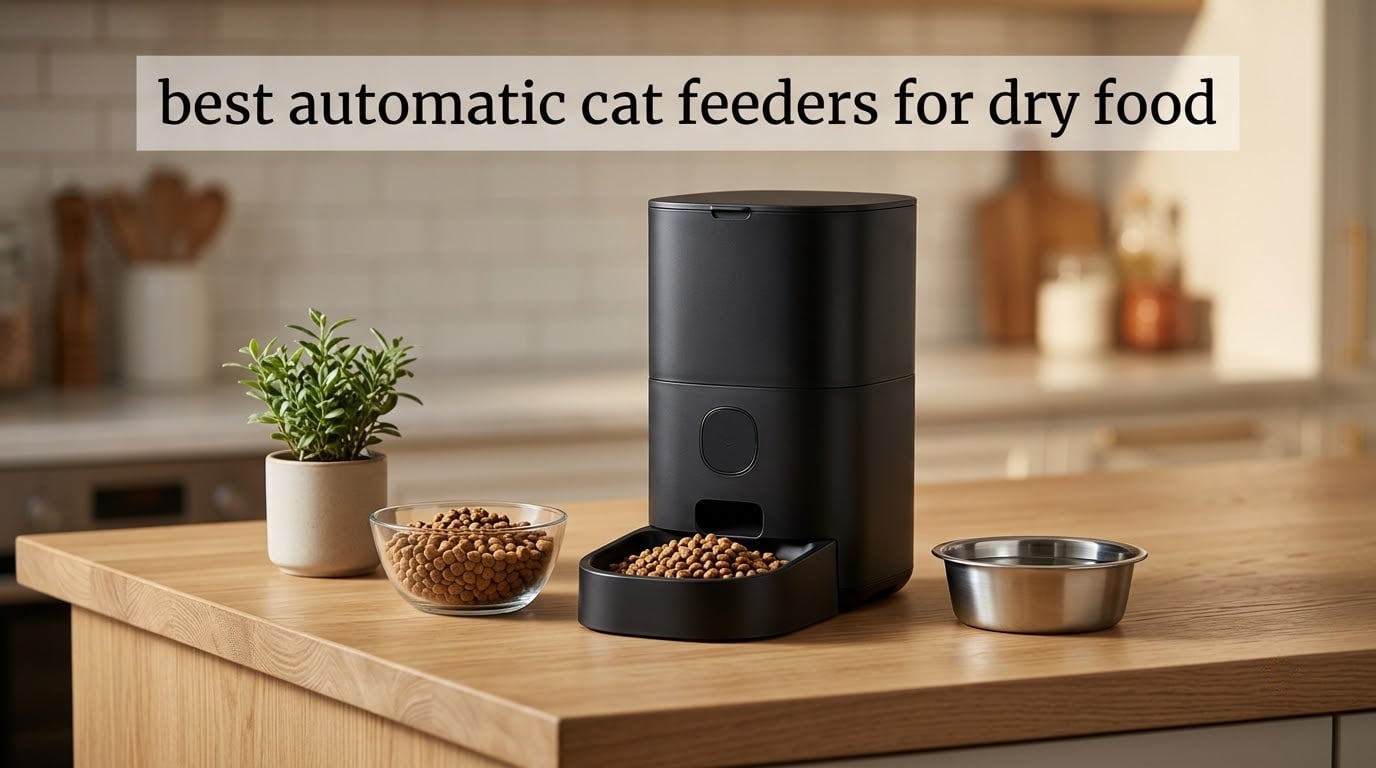
The best automatic cat feeder for dry food is the PETLIBRO RFID Automatic Cat Feeder, because it is the only pick in this guide that gates the bowl itself, so a second cat cannot walk in and eat a prescribed portion. That single feature solves the problem most dry-food buyers are actually trying to solve, and it is why this model tops our list in 2026 while the other nine picks earn their place by being cheaper, simpler, quieter, bigger or better with large kibble.
Every feeder below dispenses dry kibble from a sealed hopper. None of them handles wet food, and we have not padded the list with ice-pack trays or refrigerated compartments that only work for a different diet. If that is the problem you have, our WiFi automatic cat feeders for wet food guide covers that category instead. This is a dry-food guide, start to finish.
We spent six weeks comparing ten feeders on the things that decide whether a machine is still working in month eight: portion accuracy, hopper sealing, anti-jam behaviour, cleaning access and what happens when the power goes out. Forum threads on r/CatAdvice, Pets StackExchange and the TrustedHousesitters community all point at the same anxiety, and it is not features. It is trust that the thing will actually fire at 6am while you are asleep. If you want the wider picture across pet species, our best automatic pet feeders roundup covers the same reliability criteria for dogs and small animals.
This guide is written for five kinds of readers. If you are on a first-time owner budget, look at the IMIPAW and the Voluas. If you want phone control, start with the PETKIT or the PETLIBRO 3L. If you have two cats on different diets, the RFID pick is the one that solves the problem properly. If your cat is diabetic or on a urinary prescription diet, portion accuracy matters more than any camera. And if you refuse to hand your cat’s dinner to an app, the Petory and the PETULTRA do the same job with a dial and no login.
Top 3 Best Automatic Cat Feeders for Dry Food (October 2026)

PETLIBRO RFID Automatic Cat Feeder
- RFID collar tag access control
- 3L hopper
- dual-band WiFi app
- battery backup
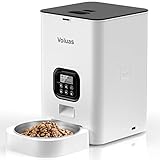
Voluas 4L Timed Dry Food Dispenser
- 1-4 meals per day
- 0-40 portions per meal
- 4L hopper
- AC or 3 D-cell batteries

IMIPAW 3L Timed Food Dispenser
- 6 meals per day
- 20 portions per day
- 3L hopper
- locking lid with desiccant
All 10 Automatic Cat Feeders for Dry Food Side by Side
| Product | Specifications | Action |
|---|---|---|
| PETLIBRO RFID Automatic Cat Feeder |
|
Check Latest Price |
| Voluas 4L Timed Dispenser |
|
Check Latest Price |
 PETLIBRO 3L Programmable Dispenser PETLIBRO 3L Programmable Dispenser |
|
Check Latest Price |
 PETLIBRO 5L Dual-Bowl Feeder PETLIBRO 5L Dual-Bowl Feeder |
|
Check Latest Price |
 Yuposl 3L Anti-Jam Feeder Yuposl 3L Anti-Jam Feeder |
|
Check Latest Price |
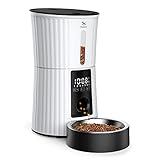 Petory 4L Dry Food Dispenser Petory 4L Dry Food Dispenser |
|
Check Latest Price |
| IMIPAW 3L Timed Dispenser |
|
Check Latest Price |
 ANDOLL HOME 4L Feeder ANDOLL HOME 4L Feeder |
|
Check Latest Price |
 PETULTRA 4L Feeder PETULTRA 4L Feeder |
|
Check Latest Price |
 PETKIT 3L WiFi Feeder PETKIT 3L WiFi Feeder |
|
Check Latest Price |
1. PETLIBRO RFID Automatic Cat Feeder: Best Overall for Dry Food and Multi-Cat Diets
PETLIBRO RFID Automatic Cat Feeder, Collar Sensor for Personalized Meals, Cats Recognition, Diet Tracking and Anti-Stealing for Multi-Pets Homes and Different Diets, Wi-Fi Programmable Food Dispenser
3L hopper
Collar tag RFID lid
5GHz and 2.4GHz WiFi
Battery backup
Pros
- RFID lid stops food stealing between cats
- App logs per-cat meals and portions
- 3L hopper with battery backup for outages
- Dual-band WiFi holds a steadier connection
Cons
- Only works with the collar tags supplied
- Costs more than a plain timed feeder
- Pet recognition setup is strict
The mechanism here is the reason to buy it. The RFID collar tag your cat wears is recognised, and the lid and bowl shield only open for that cat, so in a two-cat household on two diets nobody gets the wrong bowl. In a home where one cat is on a urinary prescription food, that is not a convenience feature, it is the whole point.
Around it sit the details that matter for kibble. The hopper holds 3L, the app schedules meals and records per-cat eating, and battery backup covers both a power cut and an internet outage. The model number is PLAF301 and it weighs 7.66 pounds, so it is a solid countertop presence rather than a light plastic box.
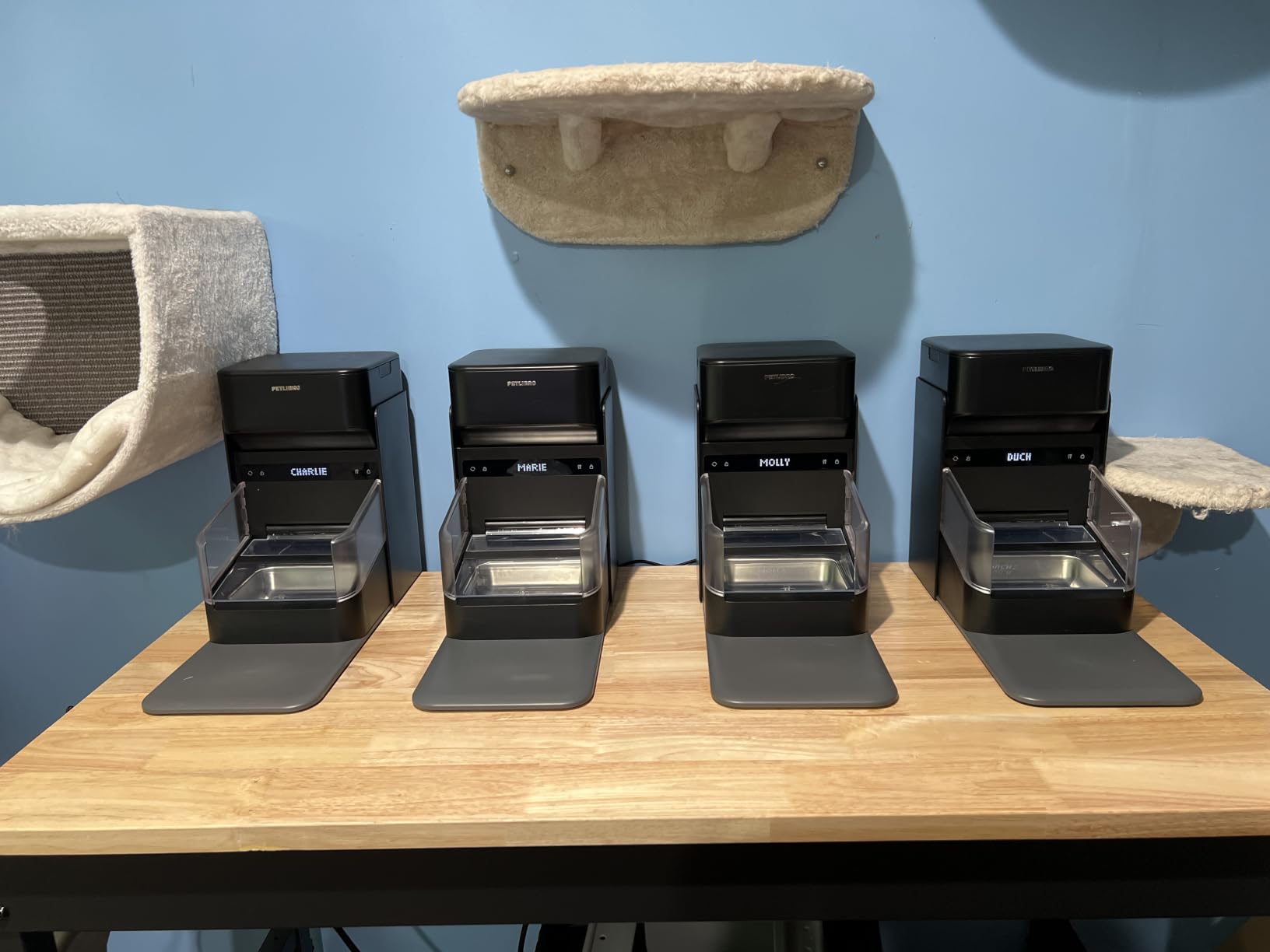
What gives us pause is compatibility. The lid only responds to the supplied collar tags, so if your cat is indoor-only and never wears a collar comfortably, you are buying a feature you cannot use. The set-up for pet recognition is also unforgiving; get the tag pairing wrong and the bowl simply stays shut.
Aggregated owner reports on PETLIBRO RFID models mention a voice feature that announces every meal out loud, which plenty of households find irritating. The 4.1 average across 19341 reviews is not the highest number in this guide, and that is a deliberate trade. You are paying for a closed bowl, not for the highest star count.
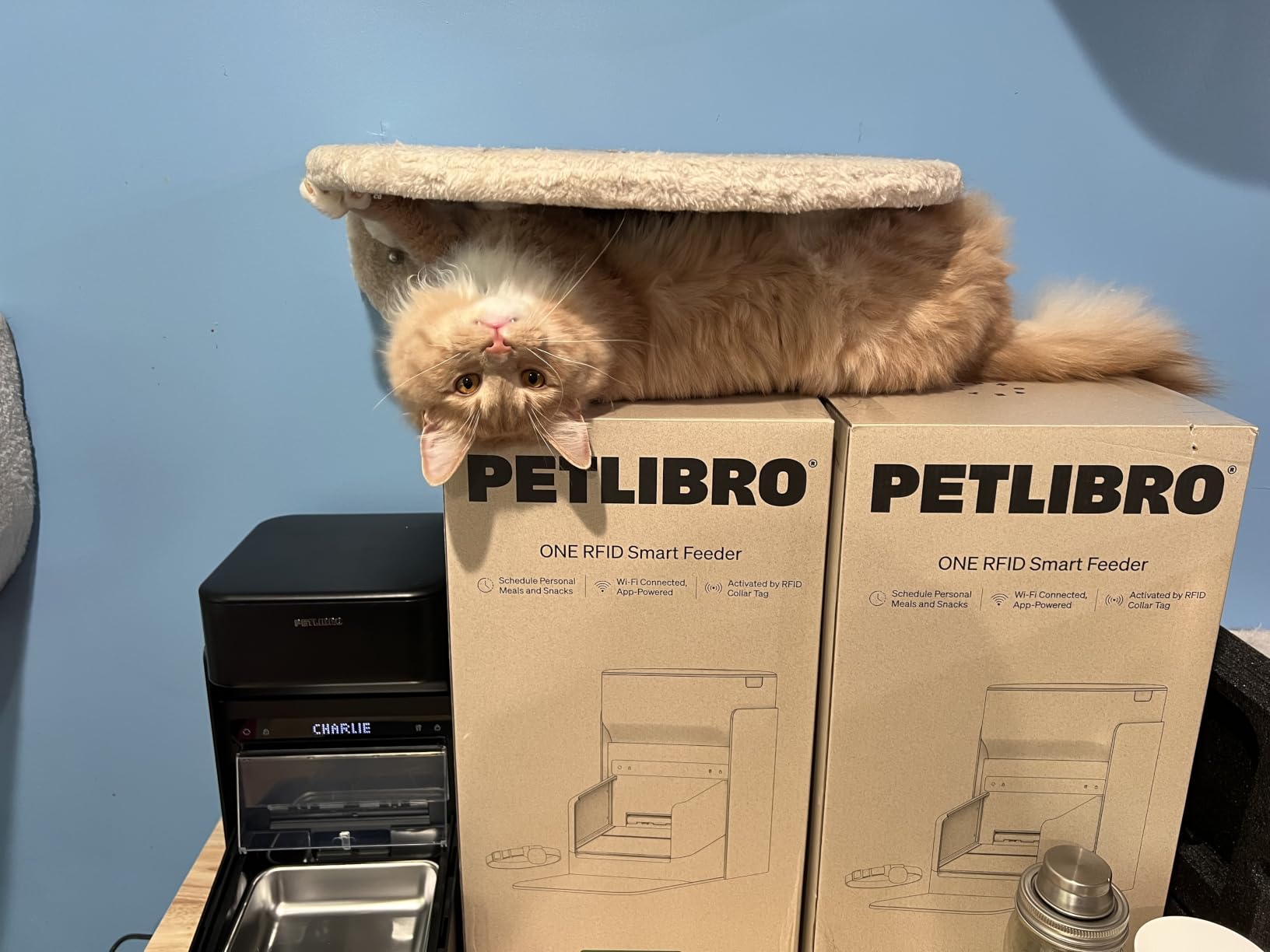
Portion control and daily capacity for a household of two cats
The app logs what each recognised cat ate and when, which turns portion control from guesswork into a record you can show a vet. With a 3L hopper, one feed a day is refill-free for roughly a week per cat before the food loses freshness, and the desiccant and sealing strip slow that down further.
Not ideal for a single-cat home or a cat that hates collars
One cat, one diet, no theft problem? You are paying for a lock that guards an empty queue. A plain timed feeder gives you the same meals for a fraction of the outlay, and if the collar is going to bother your cat, the whole system sits idle. This pick earns its place in multi-cat homes, and only there.
2. Voluas 4L Timed Dry Food Dispenser: Best Value
VOLUAS Automatic Cat Feeder, 4L Timed Dry Food Dispenser for Cats & Dogs
4L hopper
1-4 meals per day
0-40 portions per meal
AC or 3 D-cell power
Pros
- 4L hopper covers multi-day gaps
- Forty portion steps give real portion control
- Works on mains or three D cells
- Voice recording keeps the mealtime routine
Cons
- Capped at four meals per day
- Batteries not included
- No app or remote access
For most single-cat households this is the feeder we would buy. Four litres is 16.9 cups of storage, so you refill roughly once a week, and the portion range runs from 0 to 40 steps at about 6 to 7g each, which is wide enough to dial in a weight-loss ration for a cat eating dry food.
Programming happens on the LCD panel on the unit. There is no app, no account and nothing to keep up to date, which is exactly why owners on Pets StackExchange who had one smart feeder fail inside a year end up recommending something this boring. Meal settings live on the device and do not care whether your router is up.
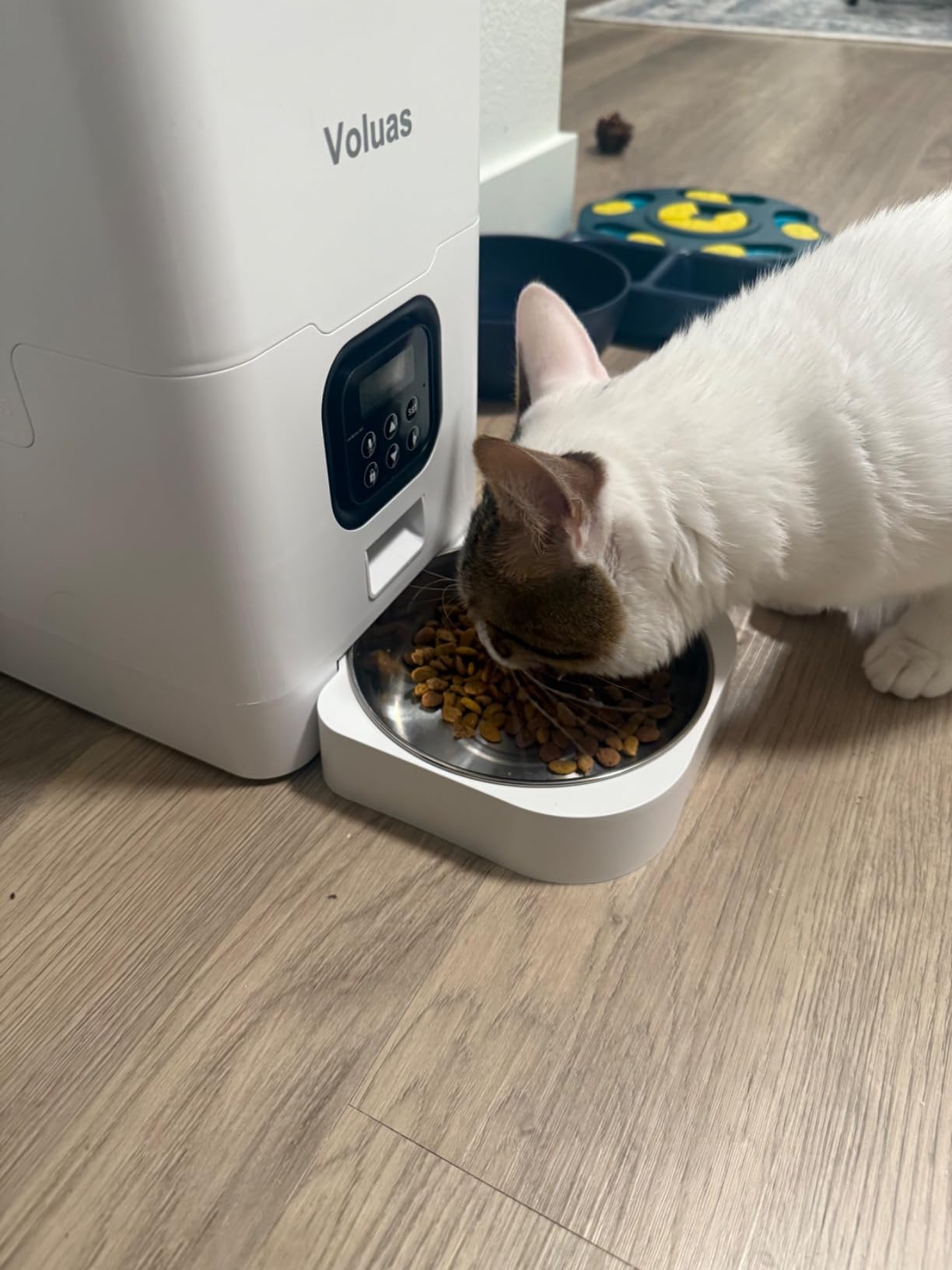
The limit is the meal count. Four meals a day is fine for a healthy adult cat on dry kibble, and it becomes a problem for a diabetic cat who needs tighter intervals or a urinary cat on a prescribed split. The three D-cell battery backup is also a real gap if you plan to travel: the batteries are not in the box.
Unit dimensions are 11 x 7 x 7 inches and it weighs 3.7 pounds, so it fits under a counter or on a utility shelf without dominating the room. The 4.4 rating from 12460 reviews reflects a machine that does its one job without asking anything of you.
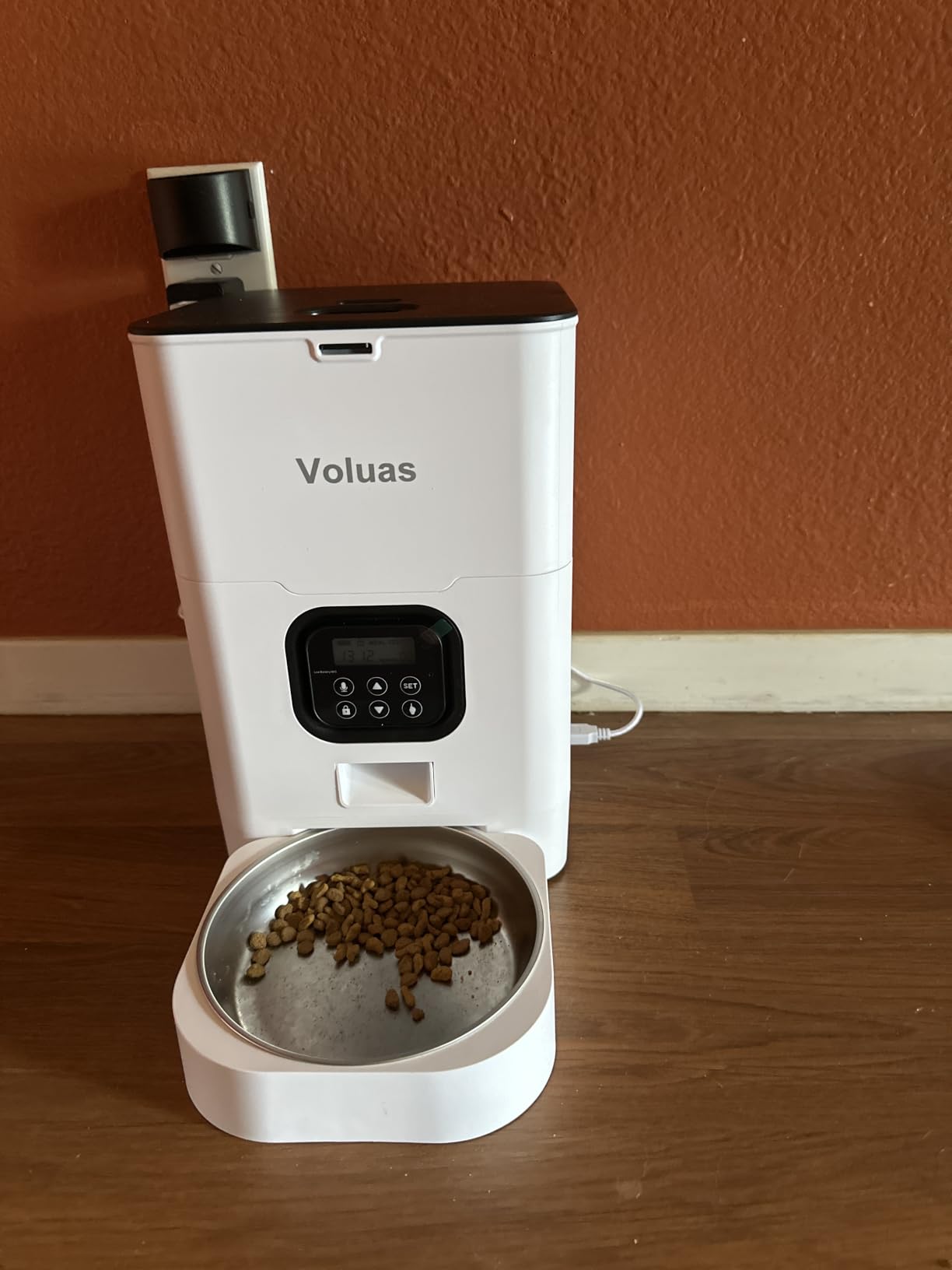
Portion control and how often you refill
Forty steps per meal across four meals is genuinely adjustable, and the large hopper means a weekday away is unremarkable rather than stressful. The trade is that you cannot push six small meals into a day, so a cat on a prescribed timed schedule should look at the PETLIBRO 3L instead.
Not ideal for app control or cats needing six small meals
There is no remote feeding, no camera, no low-food alert and no way to check from work that the motor fired. If you travel often and want to feed on command from your phone, this is the wrong tool. If you want it to keep working when everything else stops, it is the right one.
3. PETLIBRO 3L Programmable Dispenser: Best for Weight Management
PETLIBRO Automatic Cat Feeder – 3L Programmable Pet Food Dispenser with Airtight Storage, Timed Portion Control, Voice Meal Call & Dual Power Supply, Clog-Free Healthy Feeding for Cats & Small Dogs
6 meals per day
1-50 portions at 2.5 tsp
3L airtight hopper
USB-C plus 3 D-cell
Pros
- Six meals a day with fine portion steps
- Stainless steel bowl rather than plastic
- Infrared anti-jam safety stop
- Battery backup runs 30-50 days
Cons
- Plastic hopper parts need cleaning every day or two
- On-device buttons are fiddly
- Camera variant needs a card and subscription
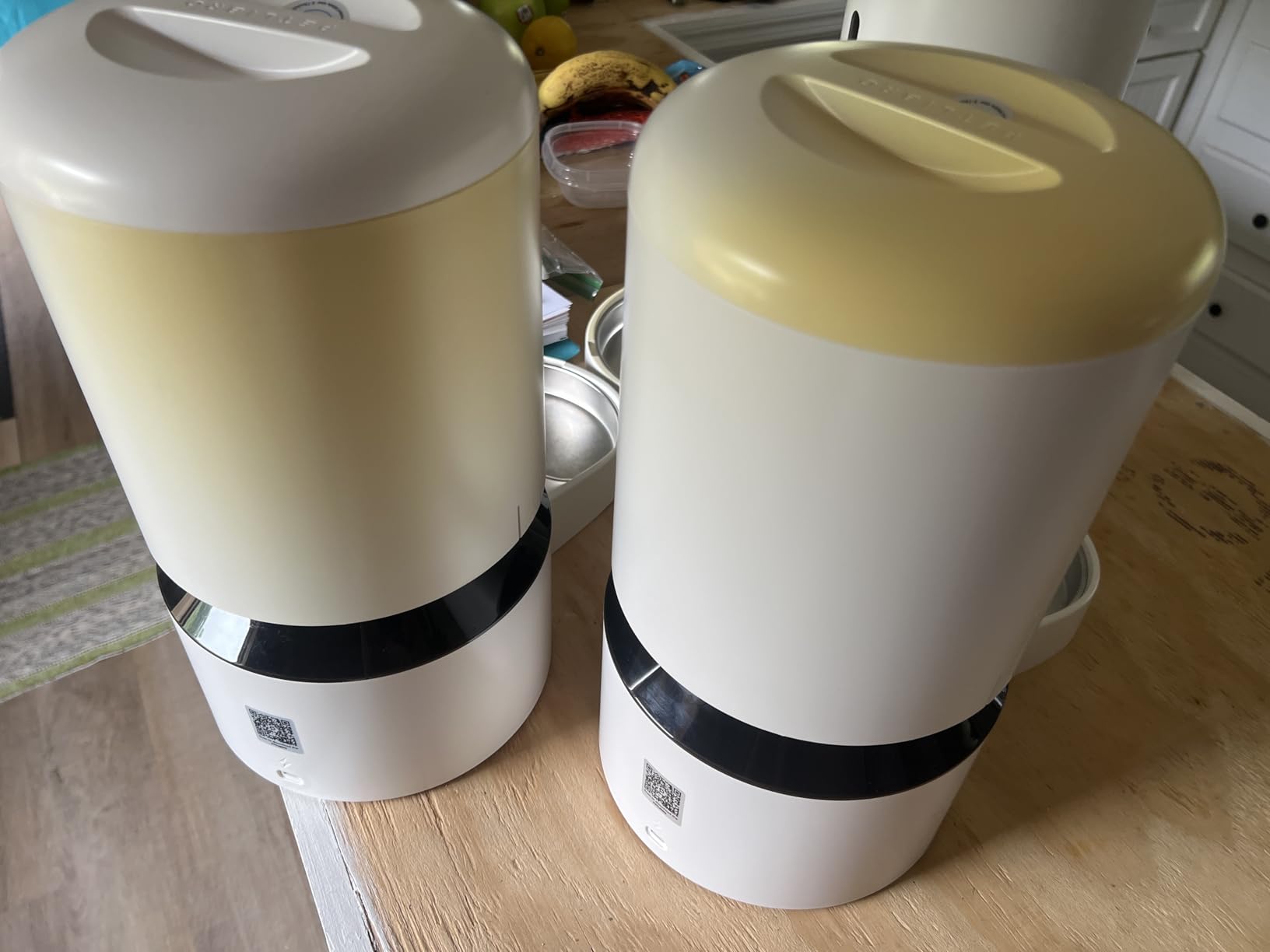
Portion granularity is the reason this one is here. One to fifty portions per meal at 2.5 teaspoons each means you can set a small measured ration and repeat it six times a day, which is the practical building block for an overweight cat on a vet-set calorie target or a diabetic cat on a fixed schedule.
The freshness engineering is unusually good for the money. A patent rotor, a twist-lock lid, a sealing strip and an included desiccant bag keep kibble dry, and the infrared anti-jam safety stop cuts power if something is obstructing the outlet. The stainless steel bowl also removes the plastic-contact question entirely, which matters for cats that get chin acne.
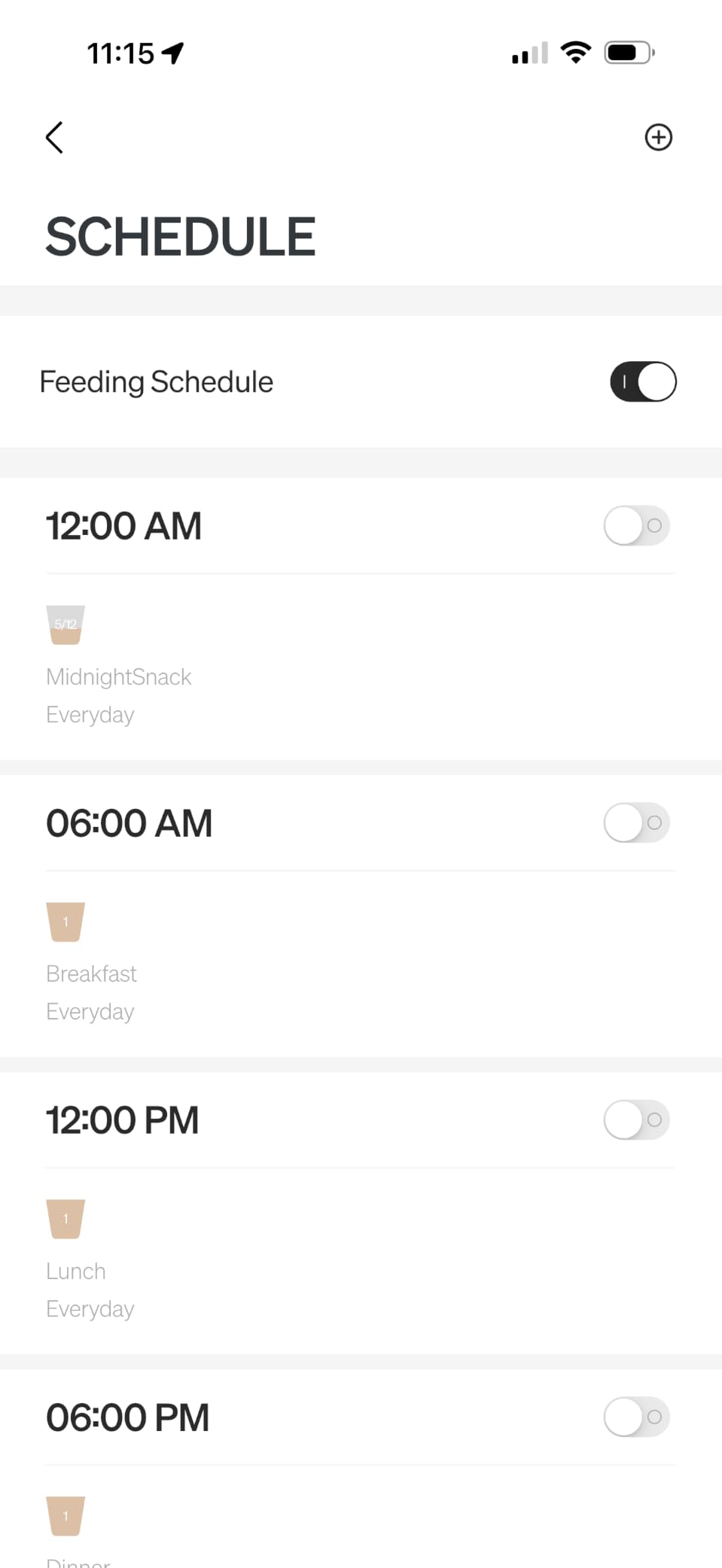
Owners are split on the controls. The button programming is genuinely unintuitive, and the AM and PM toggle is easy to overshoot in the dark, which has produced more than a few meals delivered at the wrong hour. Cleaning is another recurring theme: the hopper parts are all plastic and need attention every day or two to keep kibble dust out of the mechanism.
If you buy the camera or 5L variant you are buying into a microSD card and a paid cloud subscription, and some owners report the Android app freezing when settings change. The basic 3L version, model B0953SDCRG, sidesteps all of that. The 4.1 average across 11827 reviews sits below the higher-rated budget feeders because reliability, not features, is what is being graded.
Portion accuracy for a prescribed calorie target
Fifty steps per meal is the finest control in this guide apart from the PETULTRA, and it is the number that matters when a vet has said grams rather than cups. Weigh your kibble once with a kitchen scale, count how many portions that equals, and write the number on the unit. That single habit makes any of these feeders accurate enough for a diet plan.
Not ideal for owners who hate fiddly controls or want app reliability
Nothing on this unit is intuitive on first contact, and the camera variant drags a subscription and an app into the price. If you are not confident programming a schedule by feel in low light, spend your attention on a feeder with a clearer panel or a real app, because a mis-set timer is the one failure a cat cannot complain about.
4. PETLIBRO 5L Dual-Bowl Feeder: Best for Two Cats on the Same Food
PETLIBRO Automatic Cat Feeder for 2 Cats, 5G&2.4G WiFi Pet Feeders, 5L Programmable Cat Food Dispenser with Airtight Lock-Fresh Technology, Dual Stainless Steel Bowls, Low Food Sensor
5L hopper
Dual stainless steel bowls
10 meals per day
Dual-band WiFi with app
Pros
- Splits a portion into two bowls to slow competition
- Dual-band WiFi connects more reliably
- Ten meals a day and 5L suits two cats
- Infrared clog sensor stops the motor and warns you
Cons
- Highest one-star share in this group at 13 percent
- Dual bowl split only handles limited kibble sizes
- Bulky footprint
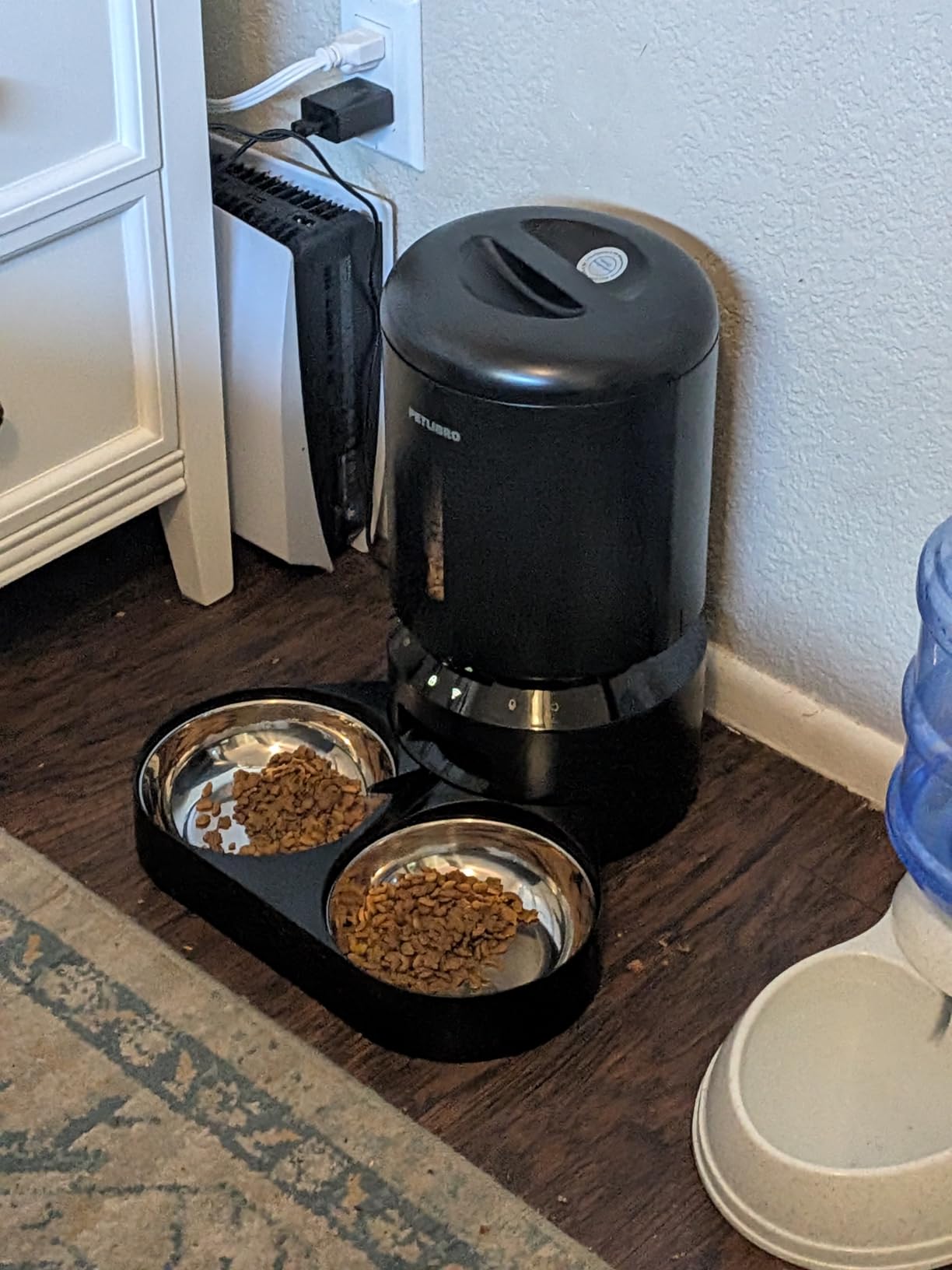
This is the two-cat answer when both cats eat the same food. One portion is dispensed and split into two stainless steel bowls, which removes the queue at a single bowl and gives a dominant cat less of an advantage. Two stainless bowls also mean no plastic touching the chin, which is the material most owners ask about once they have read a word about cat acne.
Scheduling is generous at up to ten preset meals per day with 1 to 50 portions per meal, and the app supports multiple users so both household members can adjust the plan. Dual-band 2.4GHz and 5GHz connectivity is the practical upgrade here, since single-band units are the ones owners report dropping out.
The caution is in the numbers. This is the lowest average rating of the PETLIBRO models here at 4.0, and its one-star share of 13 percent is the highest in the product group, which tells you there is a meaningful reliability and satisfaction gap inside a large review pool. Kibble compatibility is stated as 2 to 15mm diameter, and the dual-bowl splitter does not handle every size equally.
It is also a bulky footprint at 10.16 x 7.72 x 14.17 inches. The model number is PLAF103-DT, and it weighs 4.21 pounds. If your cats are on different diets rather than the same one, none of this helps and you want the RFID pick instead.
Portion control when two cats share one ration
Because the split is automatic, a household feeding two adult cats the same kibble can set one portion and know both animals are getting roughly half. Combined with ten daily meal slots, that is a workable weight-management setup without buying two separate machines and running them out of sync.
Not ideal for different diets, or for tight spaces
A split bowl is a convenience, not a diet management system. If one cat is on a prescription food, both bowls receive the same food and the problem is untouched. It is also the largest footprint among the mid-range options here, and the highest one-star share, so budget for a possible return.
5. Yuposl 3L Anti-Jam Feeder: Best for Large and Dental Kibble
Automatic Cat Feeder, 3L Cat Food Dispenser with Anti-Jam Design, Over 180-day Battery Life, 1-6 Meals Per Day with Stainless Steel Cat Bowl, Keep Dry Food Fresh, Timed Pet Feeder Also for Small Dog
3L hopper
Accepts 2-15mm kibble
3 D cells claimed past 180 days
Stainless bowl
Pros
- Handles kibble up to 15mm including dental diets
- Long battery life suits outlets far away
- Spring-lock lid defeated a determined cat in testing
- Dishwasher-safe stainless bowl
Cons
- Not fully disassemblable
- feeding tube cannot be cleaned
- Fixed portion may be too large
- No app or remote access
Large kibble is where cheap feeders fail, and this one is built for it. The stated range is 2 to 15mm diameter, which covers the coin-sized dental diets that owners on Ars Technica Civis describe as the usual jamming culprit. The soft rubber rotor and strengthened lid seal, combined with a desiccant compartment, keep the food moving and the kibble dry.
Portion accuracy came out at roughly 6.4g average per portion in owner testing, and the motor is quiet enough to register as a faint whirr rather than a kitchen appliance. The bowl is dishwasher-safe stainless steel, and every part except the main body lifts out for cleaning.
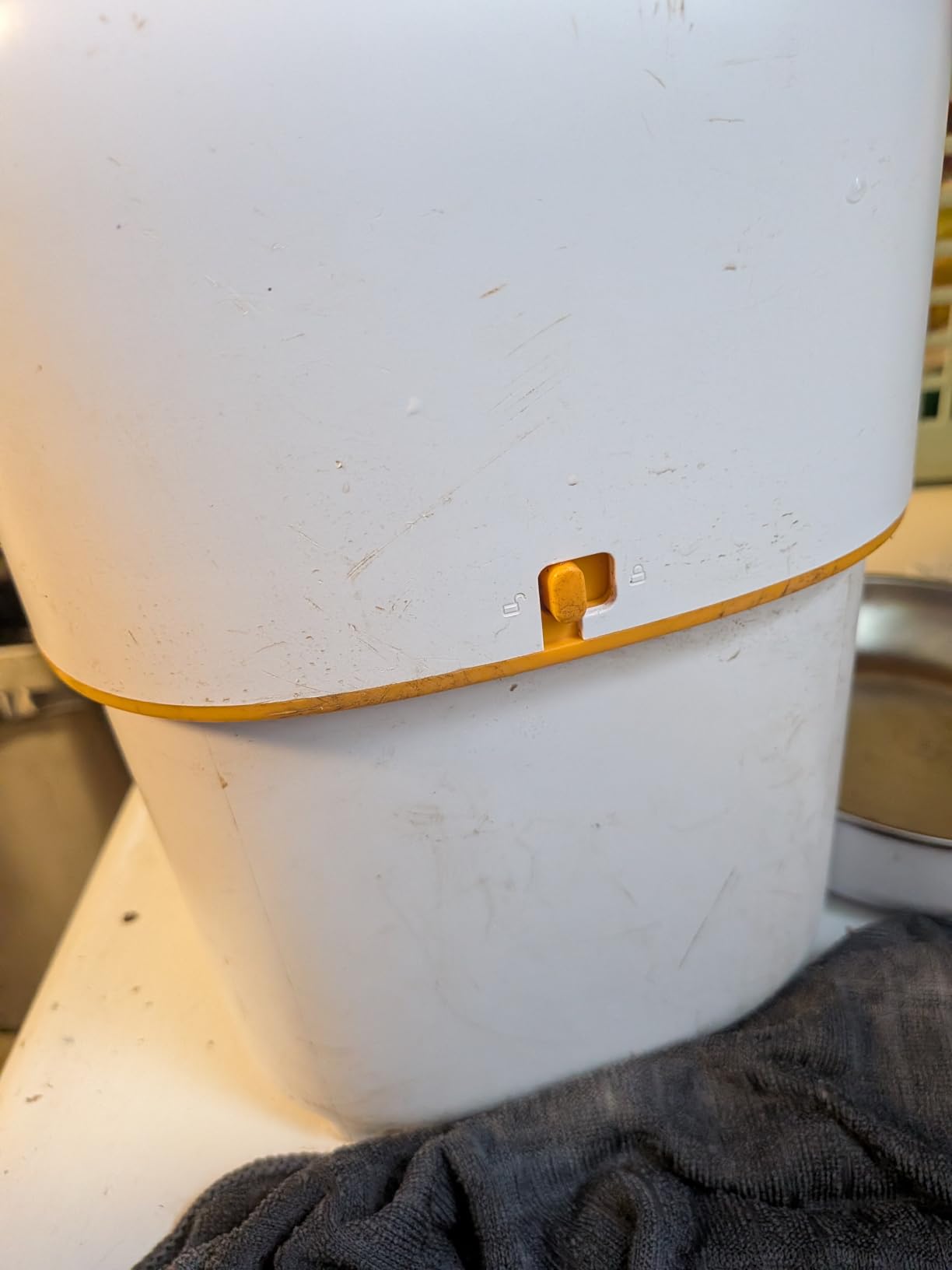
The cleaning compromise is real. The feeding tube and the mechanical section cannot be taken apart, so a two-week deep clean is not something you can do, and owners report undone kibble piling up in front of the tube. There is also no app: everything happens on the LCD panel, and the single portion size may be too large for a small cat.
Three D-size alkaline batteries are claimed to run past 180 days, though they are not included. Dimensions are 6 x 7 x 9 inches at 3 pounds, and the 4.4 average from 4780 reviews is one of the stronger ones in the group for a machine that costs very little.
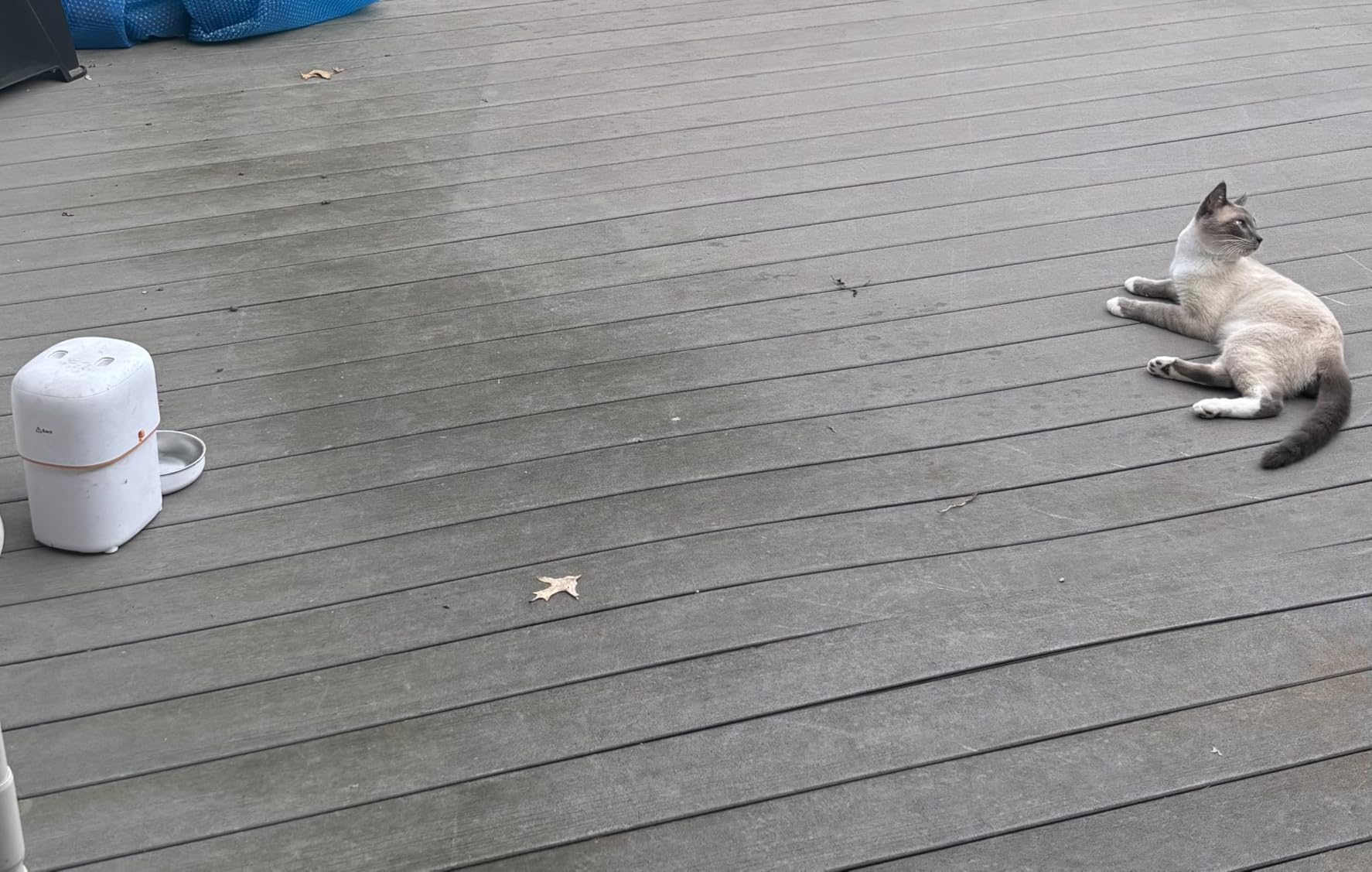
Portion size and hopper capacity for dental diets
One portion lands at about 6.4g, which is a sensible single meal for an adult cat and can be repeated up to six times a day. A 3L hopper holds roughly 1.36kg of kibble, so a week of feeding for one cat fits with room to spare and no mid-week refill.
Not ideal for owners who demand a full teardown clean
If you wash your feeder every day, this is the wrong shape. The fixed portion also means you cannot fine-tune grams for a weight-loss plan without counting portions. And with LCD-only programming, you cannot feed on demand while you are out of the house.
6. Petory 4L Dry Food Dispenser: Best for Longer Absences
Petory Timed Automatic Cat Feeder – 4L Dry Food Dispenser for Cats and Dogs
4L hopper
6 meals per day
1-50 portions at 10g
AC power with battery backup
Pros
- Large 4L hopper stretches refills out
- Airtight structure resists tipping and spillage
- Fifty portions per meal for diet precision
- Meal settings retained after a power cut
Cons
- Kibble must be under 0.7in diameter
- Dry food only with no connectivity
- Only two colour options
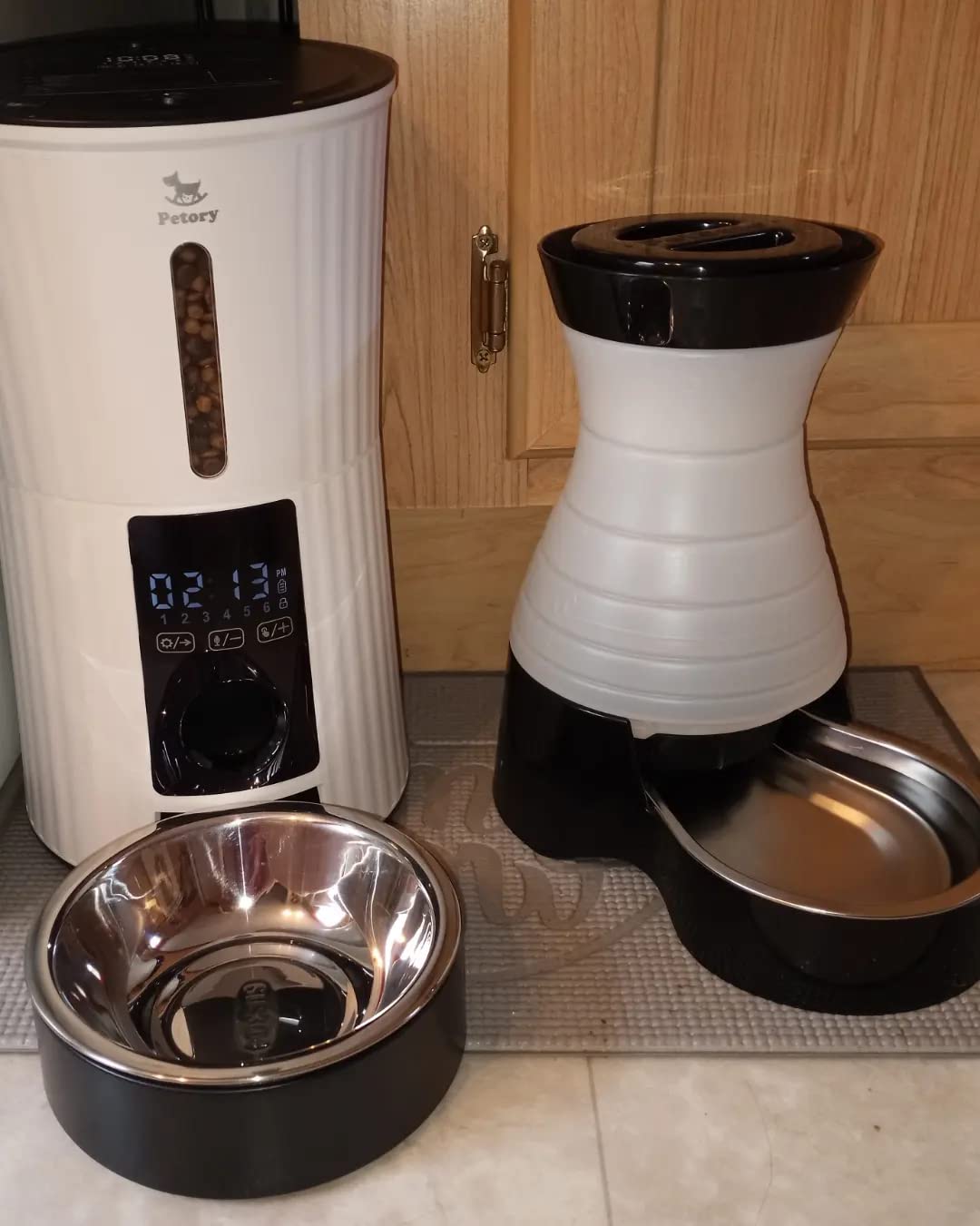
Storage and outage behaviour are the two things you want when a cat stays home alone, and the Petory is strong on both. Four litres is 16.9 cups, and the patented airtight structure is the reason it keeps dispensing correctly when the unit is nudged, which is a real event in a house with a determined cat. Meal settings are retained when power returns, so a cut does not mean reprogramming.
Portion control runs 1 to 50 portions per meal at 10g each, and custom intervals are supported, which lets you split the same daily ration across more slots. The hopper and bowl are both dishwasher safe, and the bowl is stainless steel.
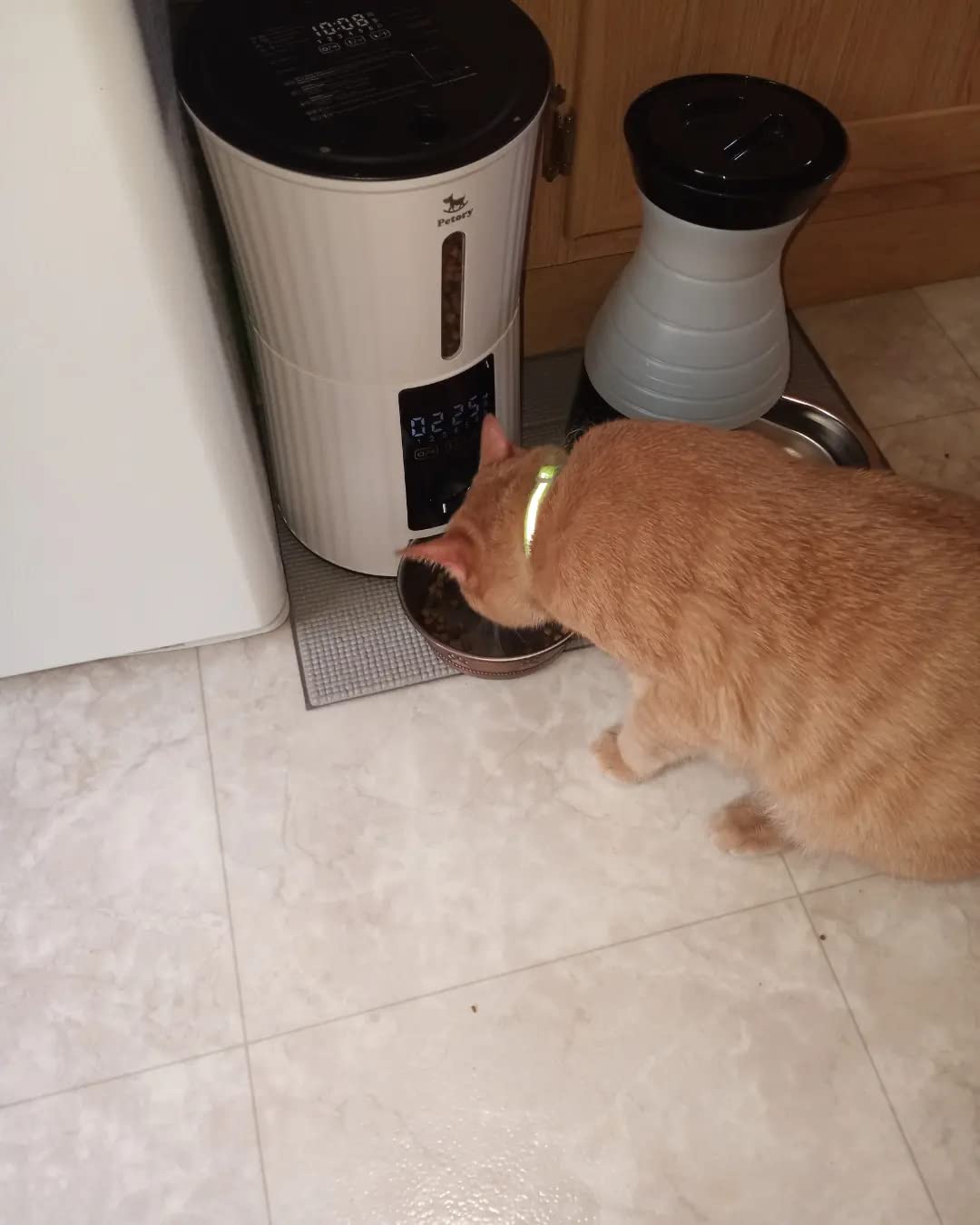
There is no WiFi and no app, which is either the main appeal or the main objection depending on how you feed. The kibble ceiling of 0.7 inch diameter is a genuine constraint if you use very large or freeze-dried pieces, even though freeze-dried bits are listed as acceptable below that size.
Owners also note it is built for cats and small dogs rather than large dogs, and that the choice is limited to two colours. The 4.4 rating across 5555 reviews sits comfortably among the top of this group for reliability.
Portion control and how long the food stays fresh
A sealed 4L hopper with a desiccant bag slows staling, and at roughly ten days of food for one cat you can refill once and leave. Fifty portion steps per meal is more than most cats need, and it is exactly what a weight-management plan asks for.
Not ideal for remote feeding or very large kibble
You cannot check in on the machine or trigger a meal from your phone, so this rewards owners who trust a fixed schedule. Measure your kibble first. Anything approaching the 0.7 inch limit is where jamming complaints start, and this is a dry food only machine with no second bowl.
7. IMIPAW 3L Timed Dry Food Dispenser: Budget Pick
IMIPAW Automatic Cat Feeders, Timed Cat Dry Food Dispenser with Desiccant Bag, Dual Power Supply, Programmable Portion Size, 6 Meals, 20 Portions Per Day, Auto Pet Feeder for Cats and Small Dog, White
3L hopper
6 meals per day
20 portions per day at 7-9g
Lock lid with desiccant
Pros
- Locking lid with a flat top can be weighted against pests
- Rotor dispensed identical volumes with no jams
- Desiccant slot keeps kibble crisp
- Stainless tray pops out for the dishwasher
Cons
- Portion chart does not match actual output
- Clock drifts and needs resyncing
- No low-food warning
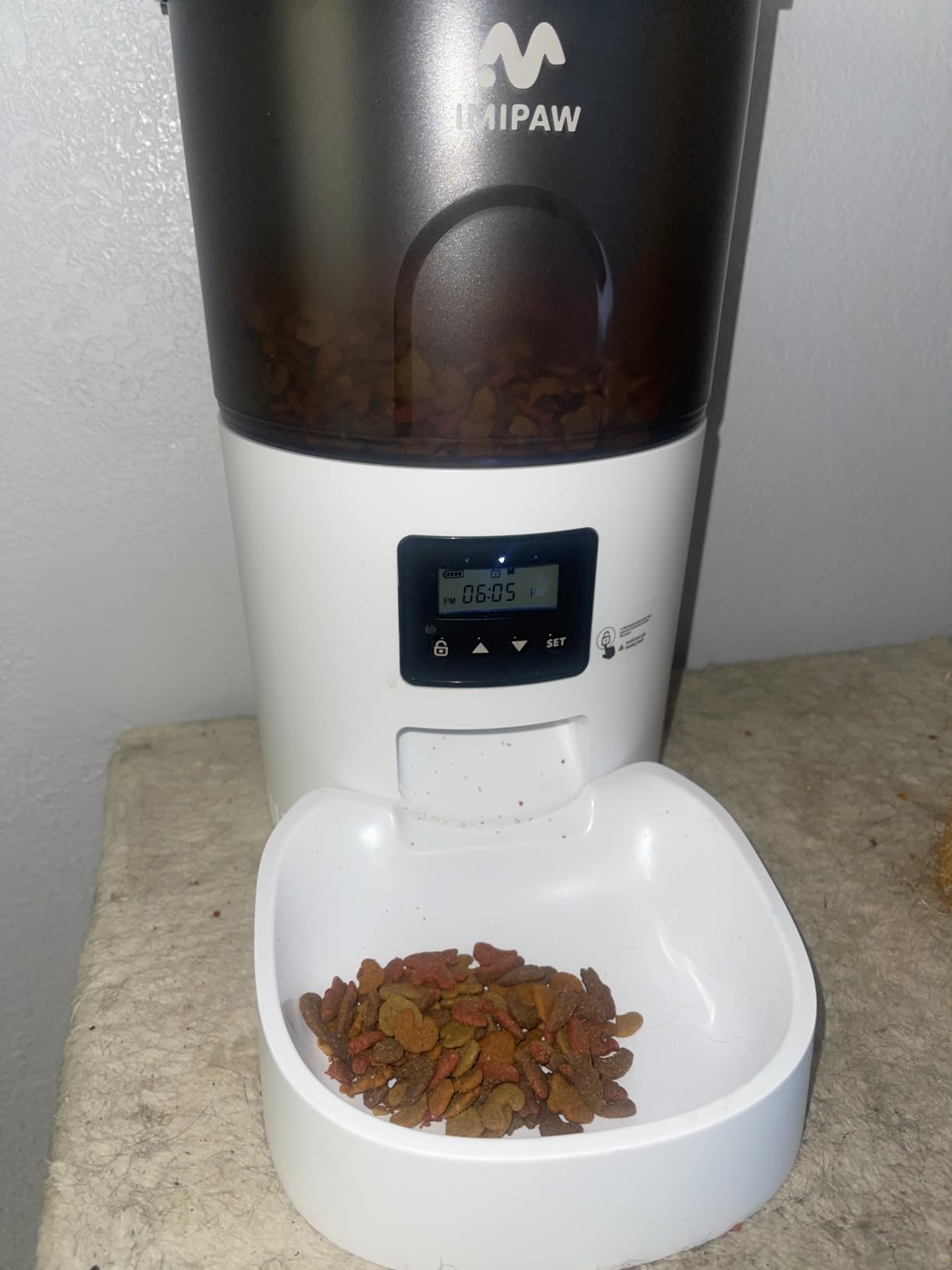
Fewer dollars buy more than this. The 3L hopper and 12-hour LCD clock handle six meals a day, and the inclined food outlet is designed so kibble does not build up in the tray, which is the small engineering detail that separates clean bowls from daily scraping.
Two things stand out for the money. The lock lid has a flat top you can weight down against raccoons and other pests, and the rotor dispensed identical volumes across repeated cycles in owner testing with no jams. Dual power, using a 5V adapter or three D cells, kept feeding through a real outage for the people who reported it.
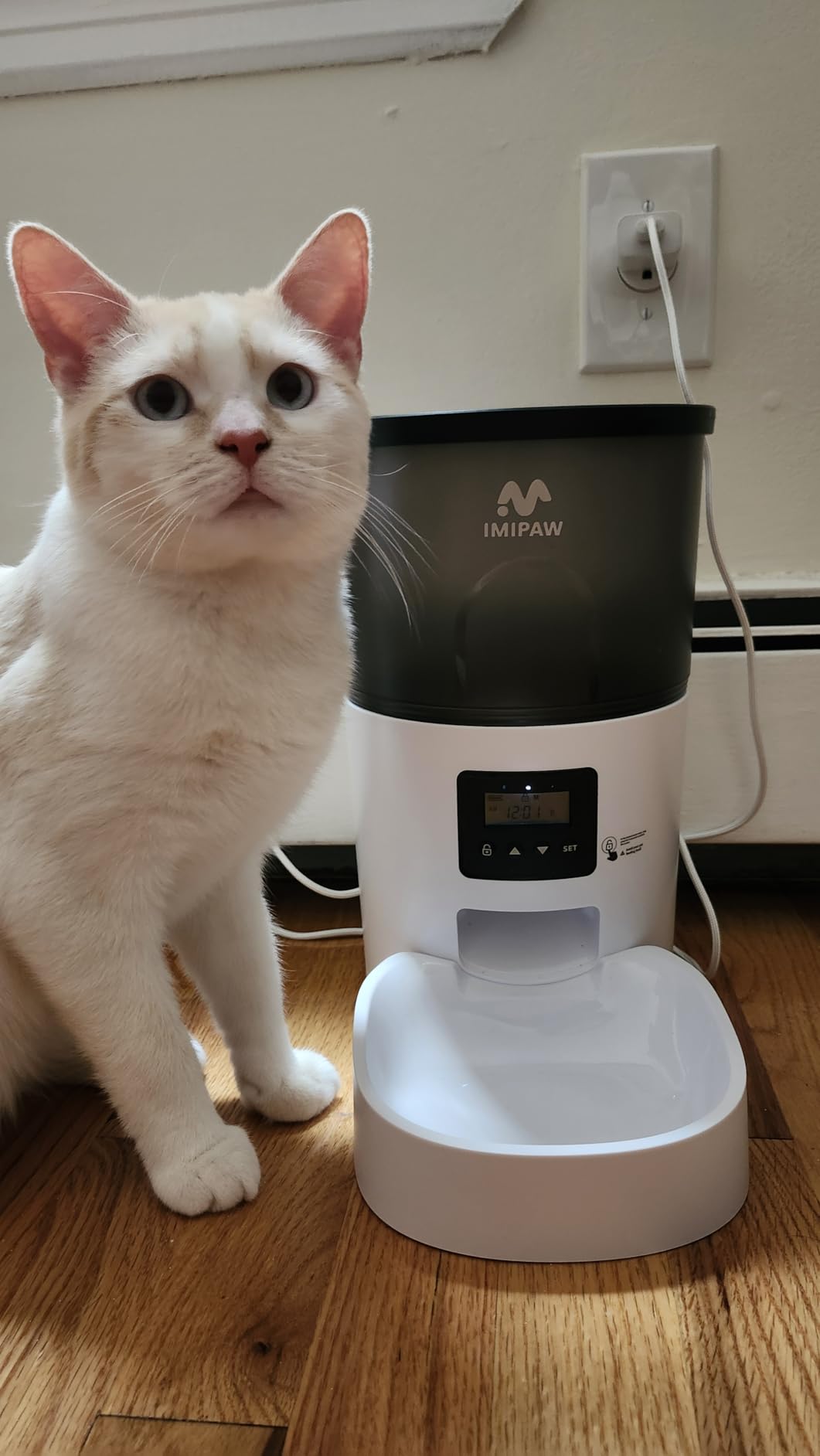
Honesty first: the printed portion measurements do not match what comes out, so calibrate before you trust it with a diet. The clock drifts and needs resyncing roughly every two weeks, and owners report occasional early or missed dispenses after several months of use. There is no low-food warning, which is the one feature we would want most in a machine left running for days.
It weighs 2.65 pounds at 7 x 7.01 x 11.16 inches, the smallest and lightest footprint here, and the model DU3L-KY-02 comes in 3L and 5L bodies. A 4.4 average from 5271 reviews for this outlay is hard to argue with.
Portion control and the calibration step nobody mentions
One serving is stated as 7 to 9g and you get up to 20 portions a day, which is enough spread for a weight plan once you have weighed what actually lands in the bowl. Put a scale under the bowl, run three dispenses, and write the real number on the lid with a marker.
Not ideal for cats on a strict prescribed portion
Portion drift, clock drift and no food-level alert make this a poor choice for a diabetic cat, where a missed dispense is a clinical event. For a healthy adult cat on maintenance kibble, it is the cheapest sensible way to stop a 3am breakfast demand.
8. ANDOLL HOME 4L Feeder: Best for Cats That Eat Too Fast
ANDOLL HOME Automatic Cat Feeder, 4L Cat Food Dispenser with 10s Voice Recorder, Pet Feeder up to 8 Meals per Day, Timed Dog Feeder with Dry Food Sealed Ring
4L hopper
8 meals per day
1-30 portions per feeding
Works on 110V and 220V
Pros
- Highest average rating here at 4.5 stars
- Eight daily slots break a meal into smaller portions
- 110V and 220V plus battery backup
- Anti-tip top latch resists determined cats
- Still running after a year of daily use
Cons
- Portion instructions need calibration
- Bowl is not well secured
- Short power cord
- Manual button needs several cycles
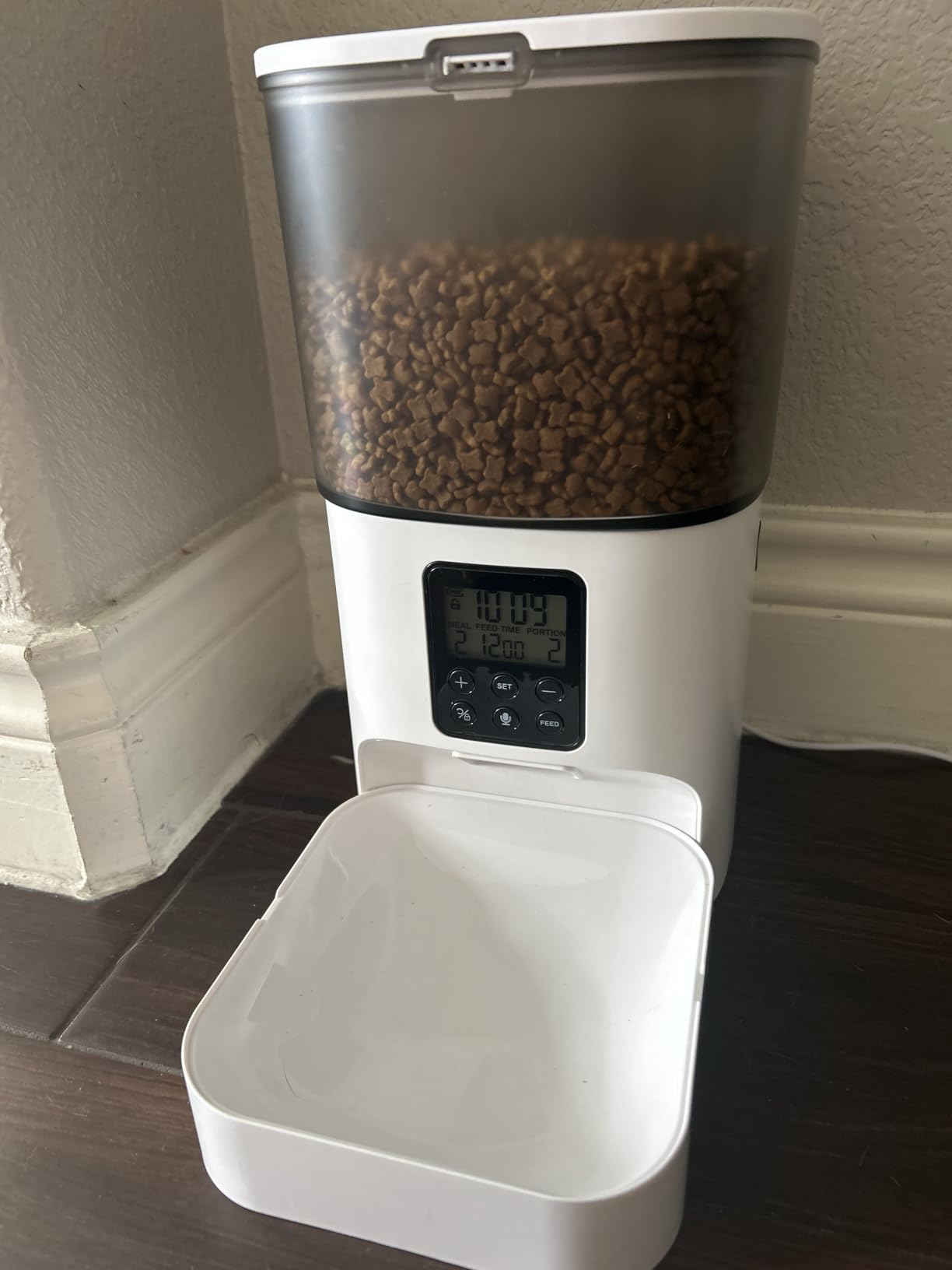
This is the pick for a cat that inhales dinner and then throws up, or for an owner trying to stop a scarf-and-barf habit. Eight scheduled meals with 1 to 30 portions per feeding lets you spread the same daily ration over twice as many slots as most competitors offer, which slows a fast eater without buying a separate slow-feeder bowl.
It carries the highest average rating of any model in this guide at 4.5 stars, and the practical details are unusually thoughtful. The feeding bowl sits tilted 8 degrees, the outlet swings so kibble does not stick, and a desiccant compartment keeps the interior dry and clean. It also runs on 110V and 220V, which matters outside North America.
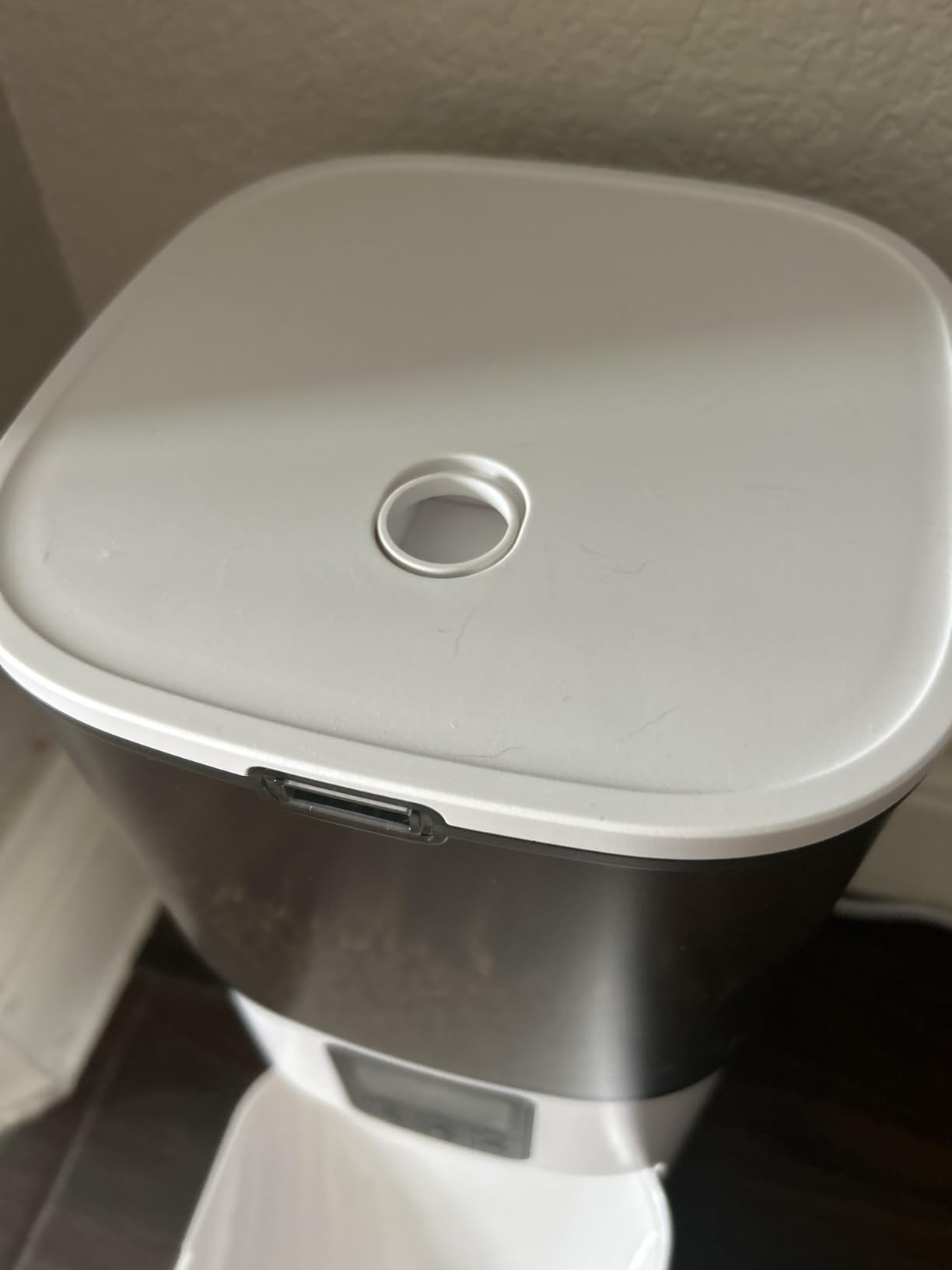
Portion calibration is the recurring gripe, and it applies to most brands here, so weigh before you trust it. The bowl is not well secured in its seat, the power cord is short, and the manual feed button needs a few cycles before kibble drops on the first attempt, which is confusing when you are introducing the machine.
Battery backup uses three AA cells and they are not included, which is worth knowing for a feeder you want to keep running overnight. At 3.54 pounds and 7 x 7 x 13 inches it is slim for a 4L body, and owners report it still working correctly after a year of daily use.
Portion control for a cat that eats too fast
Eight slots means you can feed a 60g daily ration as eight small portions rather than two large ones, which is the behaviour change you are actually chasing. Thirty portions per feeding gives enough range to make each of those meals small, and the 10-second voice recording can cue a cat that has learned to associate sound with food.
Not ideal for anyone who wants app control
There is no app, no remote trigger and no remote monitoring, and the voice recording plays three times at every feeding, which some households find repetitive. The unseated bowl is the one that would bother us most in a house where a cat walks across counters.
9. PETULTRA 4L Feeder: Best for Easy Cleaning and Quiet Dispensing
PETULTRA Automatic Cat Feeder: 4L Timed Cats Food Dispenser Programmable
4L hopper
6 meals per day,20 portions per meal
Double rotor anti-clog
Adapter or 3 D-size batteries
Pros
- Fully detachable for cleaning
- Quiet enough for a noise-sensitive cat
- Lock lid blocks raccoons and opossums
- One-treat portion is accurate
- Holds about 3.5 pounds of food
Cons
- Clock drifts and loses about a minute a month
- Bowl does not lock into place
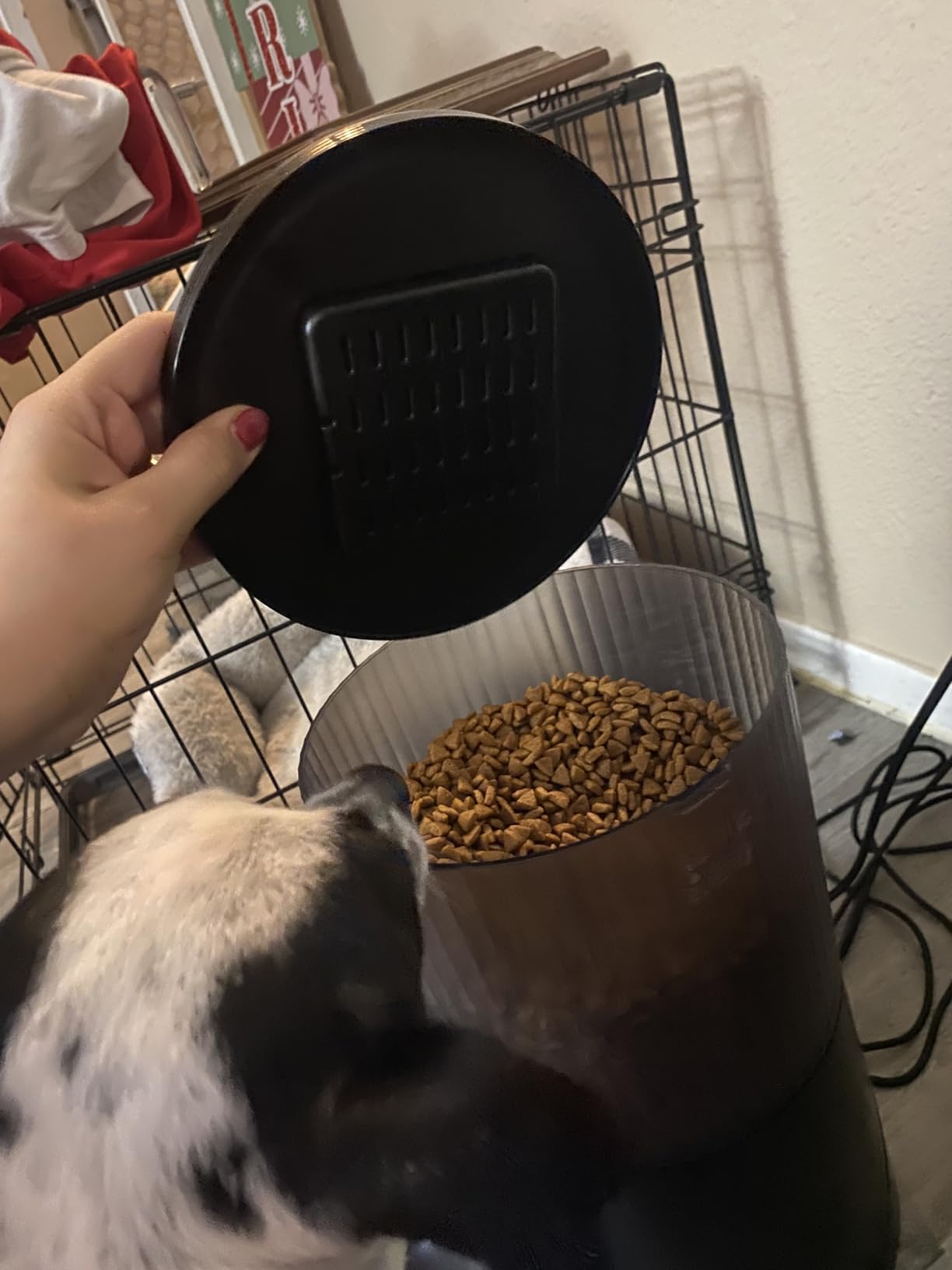
- Dark hopper hides remaining food
- Electronic base resists deep cleaning
Everything except the electronic base comes apart, and that is the reason this model sits in the guide. Owners who wash their feeder weekly rule out half the candidates on this list for exactly that reason, and a fully detachable hopper with a 40-degree food passage slope means you can actually see and reach the corners where kibble dust causes jams.
Dispensing is quiet, which matters more than it sounds. A noise-sensitive or easily startled cat will refuse a bowl that announces itself, and owners report this machine running without startling their cat. The lock lid genuinely stays locked against raccoons and opossums, and it runs on the adapter or three D-size batteries when no outlet is nearby.
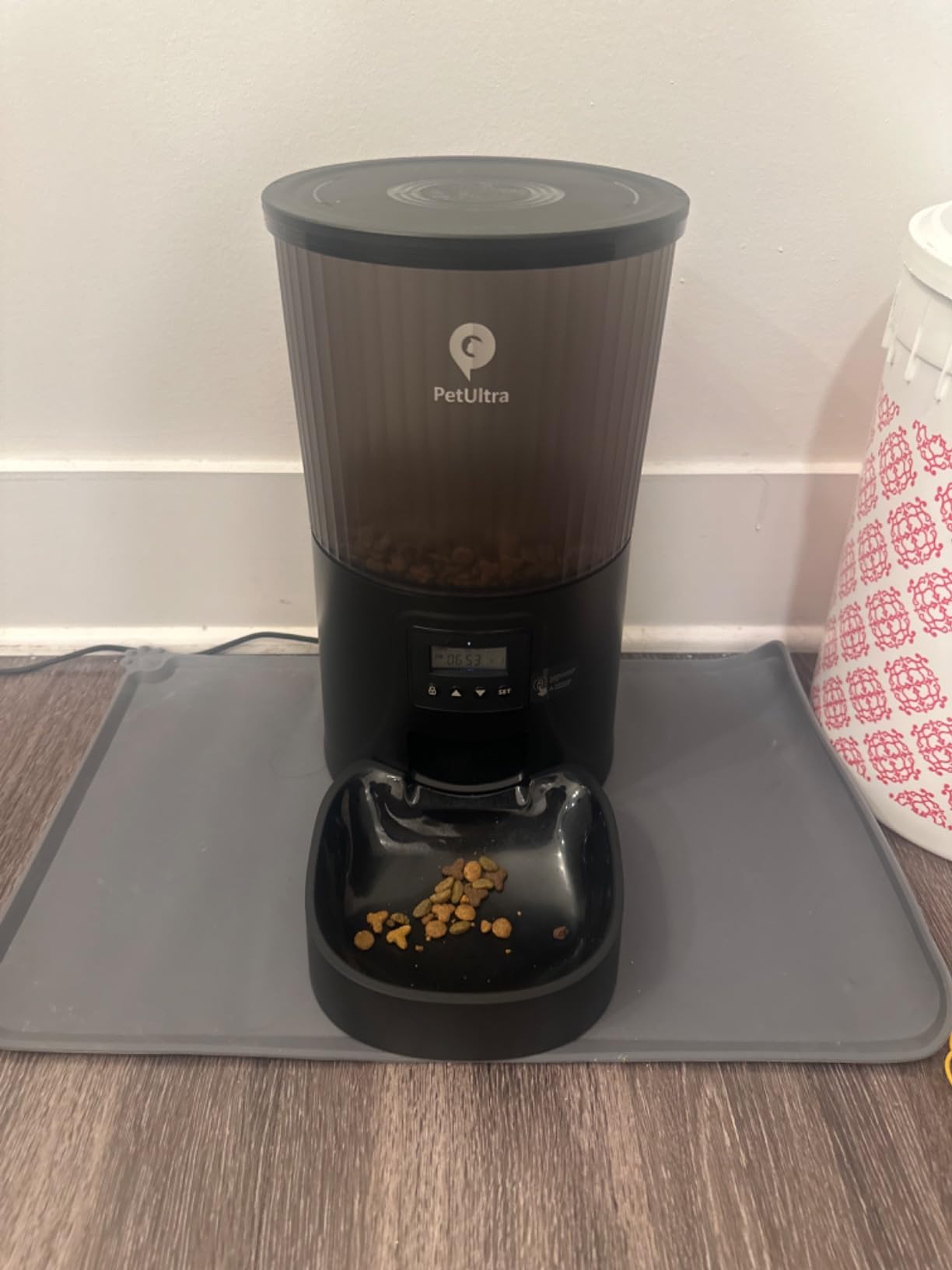
Two real issues. The clock loses roughly a minute per month and drifts noticeably after a few months, so it needs periodic resyncing. The bowl does not lock into place and can be pushed off, dumping food on the floor, which is worth fixing with a non-slip mat in a busy kitchen.
The tinted hopper also makes it hard to see how much food is left in dim rooms, so you are refilling on a guess rather than a level. Recommended kibble runs 0.07 to 0.4 inches, and it holds roughly 3.5 pounds, which is a little over a week per cat. The 4.4 rating comes from 2625 reviews.
Portion control and cleaning access
One portion is about one tablespoon, roughly 6g, up to twenty per meal across six meals. The detachable design means a scale can go straight under the bowl for a proper weigh-check, and because everything lifts out you can do it weekly without taking the whole machine apart.
Not ideal for owners who need accurate visible levels or a fixed bowl
If your priority is knowing at a glance how much food remains, the dark hopper works against you. A cat that bats the bowl will put it on the floor, and the slowly drifting clock is a nuisance if you are away for several days at a time.
10. PETKIT 3L WiFi Feeder: Best for Freeze-Dried and Air-Dried Food
PETKIT Automatic Cat Feeder, 2.4G WiFi Automatic Dog Feeder, App Control Pet Food Dispenser with Triple Fresh-Lock System, Schedule Feeding, Food Shortage Alert, Dual Power-Charge&Battery,3L Capacity
3L hopper
10 meals per day,1-5 portions
Handles food under 12mm
304 stainless bowl
Pros
- Handles kibble
- air-dried and freeze-dried pieces under 12mm
- Ten meals a day for portion control
- Triple Fresh-Lock system blocks food theft
- App keeps feeding records
Cons
- 2.4GHz WiFi only
- Highest one-star share here at 11 percent
- Capped at five portions per meal
- Large footprint
Most automatic feeders are kibble machines. This one runs an advanced impeller and a larger dispensing container that handles kibble, air-dried and freeze-dried food under 12mm, which is the widest food-type range in the guide. If your cat eats a topper-heavy air-dried diet, this is the one that will not clog on day four.
Scheduling is the other strength. Up to ten meals per day with feeding records in the app, a food shortage alert, manual feeding from the app or the unit, and a 3L hopper estimated at 15 days of feeding for an adult cat. The 304 stainless bowl and the pet-proof top lock complete a well thought out package.
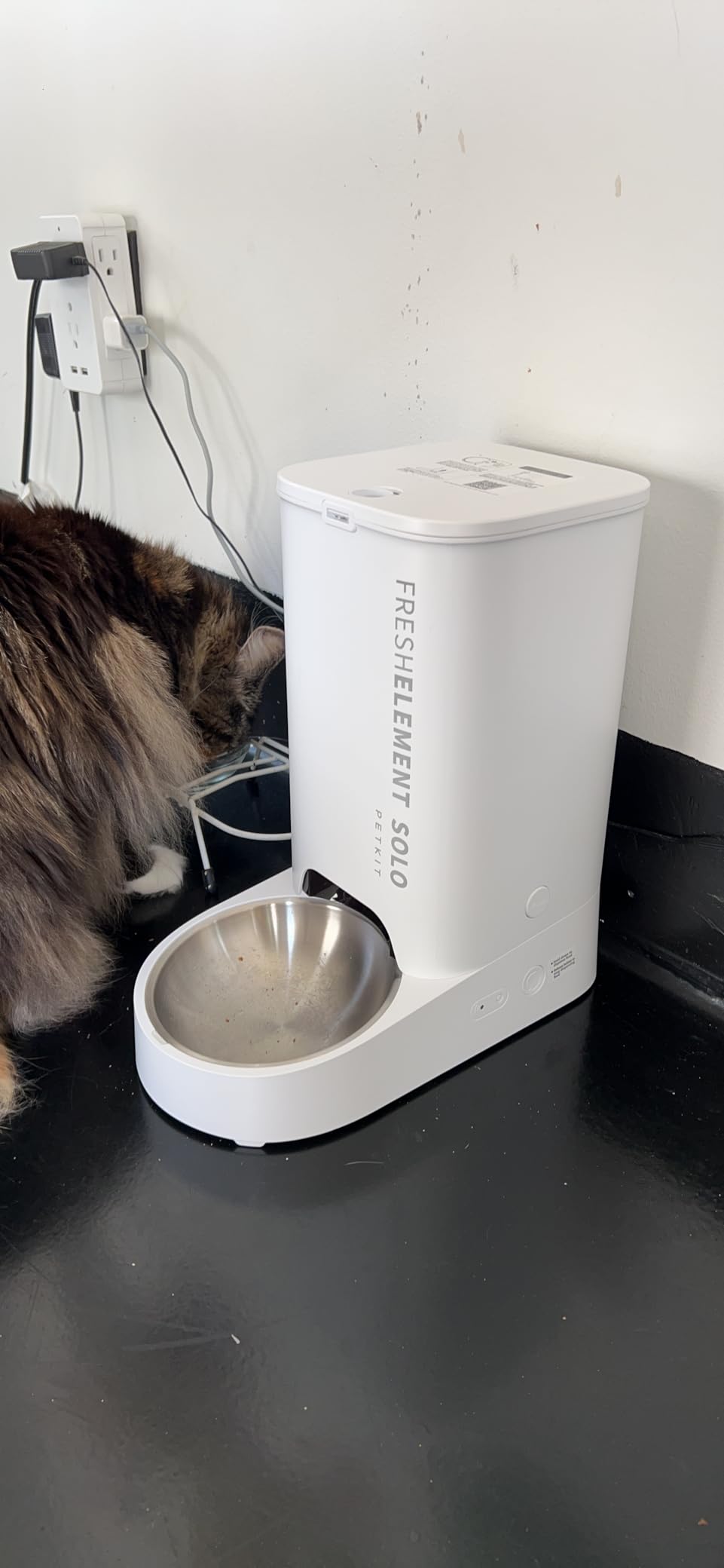
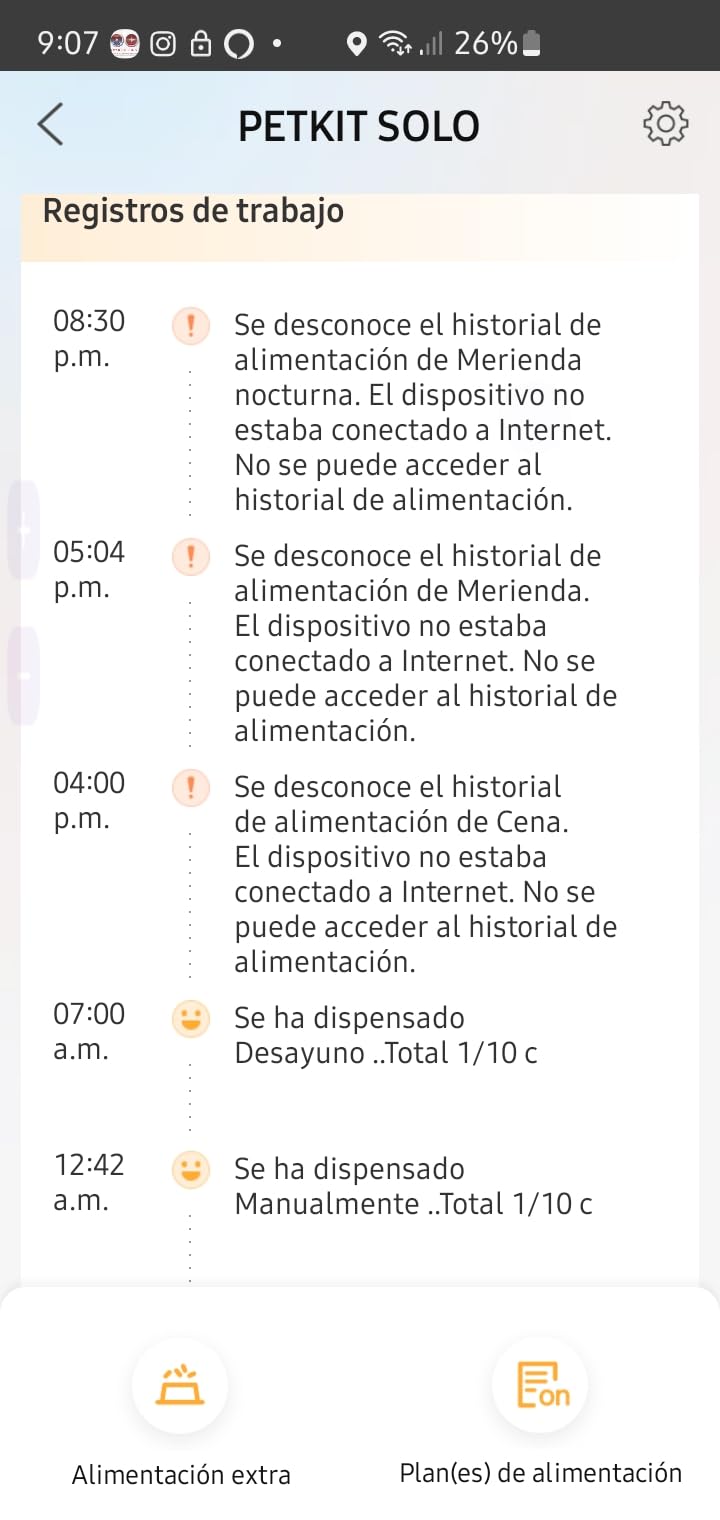
The limitations are concrete. It is 2.4GHz WiFi only, so it will not join a 5GHz-only network, and per-meal portions cap at five, which limits how small a single meal can be. The one-star share of 11 percent is the highest relative to its 4.2 average, so expect some variance in long-term reliability.
It is also the widest footprint here at 12.8 x 10.94 x 7.28 inches and 4.5 pounds, and it sits in the Dog Automatic Feeders category rather than the cat category, which tells you how the manufacturer positions it. At 1567 reviews it is the least proven model in this guide, and we would test it for a full week before trusting it.
Portion control and food-type compatibility
Ten meal slots a day with 1 to 5 portions of one tenth cup each is the right shape for a cat on a prescribed timed diet, and the feeding records make it easy to show a vet what actually happened on a given day. A 15-day estimated hopper means refill reminders rather than daily checks.
Not ideal for 5GHz-only homes or tiny portions
Check your router before you buy. On a 5GHz-only network this feeder will not pair, and that has generated a chunk of the one-star share. Five portions per meal is also a floor on portion size, so it is not the machine for a cat who needs a gram-accurate diabetic ration.
How to Choose an Automatic Cat Feeder for Dry Food
Portion accuracy beats everything else
If your cat is diabetic, overweight or on a urinary prescription diet, the only spec that matters is how accurately one portion equals what you measured. Every feeder here dispenses by volume, and kibble density varies by brand, so a nominal 10g can be a gram light or a gram heavy. Weigh three dispenses into a bowl on a kitchen scale, adjust the portion number until it matches, and write the result on the lid. A feeder with more portion steps makes that calibration easier, which is why the 1 to 50 range models suit a prescribed diet better than a fixed single portion.
Hopper capacity decides how often you refill and how fresh food stays
Capacity answers how long, not whether. A 3L hopper covers roughly a week for one adult cat, a 4L extends that to about ten days, and a 5L is comfortable for two. The number that matters alongside it is sealing: a twist-lock lid, a sealing strip and a desiccant bag keep kibble dry for far longer than an open hopper, and a hopper that spills when a cat leans on it will lose more food than it ever holds. Treat how long food can sit in the hopper and how long a cat can be home alone as two different questions with two different answers.
Anti-jam design and kibble size are the same question
Jamming is the single most reported failure in owner forums, and it almost always traces back to kibble size. Feeders that state a range such as 2 to 15mm or under 0.7 inch will handle dental and freeze-dried pieces that unspecified ones choke on. Look for a rotor rather than a flat tray, an anti-jam sensor that stops the motor and warns you, and never dump a full hopper in at once. Owners on Ars Technica Civis and Reddit repeatedly give the same advice: add kibble a little at a time and prime the dispenser so it fills the chute before the first scheduled meal.
Dual power, and onboard memory that outlasts a WiFi dropout
Every pick here runs on mains with battery backup, and the batteries are not included in any of them, so factor that into your setup. The more important question is whether the schedule lives on the device. A feeder that stores meals internally keeps feeding when the router, the app or the cloud service goes down, and a reported smart feeder outage that left pets unfed is the reason to insist on it. A WiFi-only feeder with cloud-stored schedules is a remote control, not a feeding guarantee.
Bowl material, whisker friendliness and noise
Stainless steel bowls avoid the chin acne some cats develop from long contact with plastic, and they are dishwasher safe, which is why four of the ten picks include one. A wide, shallow, whisker-friendly bowl also matters: when a cat has to push its face into a narrow bowl to reach the last pieces, food ends up on the floor. On noise, the difference between a faint whirr and a motor that startles a cat decides whether your cat uses the machine at all, and the 3am wake-up problem is often solved more cheaply with a small timed meal 15 to 30 minutes before your cat’s usual hour.
What Actually Breaks: Jam, Wi-Fi and Motor Failure Modes
An owner on Pets StackExchange described a feeder that stopped working within a year, and the fix that followed was buying a second one so a single failure could not leave a cat unfed. That reaction is the most honest thing in this whole category, and it shapes how we read every spec. A warranty is nice, but what actually protects the cat is testing the machine at home for a week before you rely on it while you are away.
Why is my automatic cat feeder not working?
Check the hopper outlet first for kibble bridging, then confirm the bowl is seated and not blocking the chute. Third, confirm the device is on mains power rather than a set of flat backup batteries, because a silent battery switch is a common and confusing cause. Fourth, check the network and whether the schedule is stored on the device rather than only in the app. Fifth, look for an anti-jam or reverse-motor fault indicator. Sixth, look for kibble dust in the mechanism, which is the cause behind a surprising share of failures. A factory reset is the last step, not the first.
How do you reset an automatic pet feeder?
Hold the programming button for three to five seconds until the display flashes to clear the stored schedule, then hold the WiFi or connect button to clear network pairing, and programme the meals again. Check the manual for model-specific behaviour, and expect to rebuild the whole schedule afterwards. Resetting fixes a locked-out schedule, but it will not fix a dusty motor or a dead gear, and those need cleaning or a replacement.
The three causes behind most returns
Jamming comes first, portioning that does not match the chart comes second, and dependence on an app or a cloud service comes third. Announced meals and clock drift are annoyances rather than failures, but a clock that drifts a minute a month will deliver a meal at the wrong hour within a season. Owners on r/CatAdvice asking for a reliable feeder with remote control are not asking for more features, they are asking which machine they can trust not to fail silently.
How Long Can a Cat Stay Home Alone With an Automatic Feeder?
For under 24 hours, a working dry food feeder plus fresh water is fine for a healthy adult cat. Beyond 24 hours and up to 48 hours, the feeder must hold the full food volume for the whole absence, run on dual power, and be backed by manual food and a second water source a cat can reach. Beyond 48 hours, a sitter, a friend or a boarding stay is required, and no feeder substitutes for a person.
The reasoning is straightforward. Feeders jam, batteries die, cloud services fail and a Pets StackExchange owner has already learned what happens when the machine malfunctions inside the first year. The risk is not the absence of food on day one, it is a silent failure on day two with nobody there to notice. A TrustedHousesitters poster who had tried two feeders and researched others online before settling is expressing exactly the caution we would advise. If you travel regularly, run two feeders on different power sources, and never make a feeder the only food a cat has access to while you are away.
What Veterinarians Say About Automatic Feeders
Most vets endorse scheduled, portion-controlled feeding rather than feeders specifically. Their concern is almost always portion control and feline obesity, not automation, and free-choice feeding from a full bowl is widely associated with excess weight in cats. A scheduled feeder is a tool for delivering a measured ration, and it does that job well, provided the ration is set by weight rather than by eye.
Two groups benefit more than most. Diabetic cats need predictable, evenly spaced meals, and urinary cats on a prescribed diet benefit from a fixed intake rather than grazing. Cats on a weight-management plan get the clearest benefit of all, because the feeder is what makes a calorie target achievable day to day. Confirm any prescribed portion with your own vet before you calibrate, and treat a feeder as a delivery mechanism for their plan rather than a substitute for it.
Cleaning and Maintenance Without a Full Disassembly
A dry food feeder fails mostly because of crumbs, and a weekly routine is enough for most models. Unplug or switch to battery, take out the bowl and wipe the chute and rotor, then lift out whatever parts the manufacturer lists as removable. Only the PETULTRA in this guide is fully detachable, so on the others a damp cloth and a soft brush around the outlet does most of the work.
Replace or re-dry the desiccant bag on schedule, and keep food out of the hopper longer than the manufacturer suggests. Prime the dispenser with a small amount of kibble after every refill rather than filling it to the top, which is the single habit owners on forum threads recommend to prevent bridging. Finally, run one manual dispense after cleaning to confirm the mechanism still turns freely before you leave the house again.
Frequently Asked Questions
Do vets recommend automatic cat feeders?
Most vets endorse scheduled portion-controlled feeding rather than feeders themselves. Their priority is portion accuracy and obesity prevention, since free-choice feeding contributes to feline weight gain. Cats on diabetic, urinary or weight-management diets benefit most. Confirm any prescribed portion with your own vet, then use the feeder to deliver that exact ration reliably.
Can I leave my cat alone for 2 days with an automatic feeder?
You can leave a healthy adult cat for up to 48 hours, but only with a feeder that holds the full food volume, dual power, and manual backup food and a second water source. Beyond 48 hours, arrange a sitter, friend or boarding stay. A feeder is never a substitute for a person, because the real risk is a silent failure on day two.
Why is my automatic cat feeder not working?
Most failures trace to kibble bridging at the hopper outlet, a bowl blocking the chute, or the unit running on a flat backup battery instead of mains. Then check that the schedule is stored on the device and not only in the app, look for an anti-jam fault indicator, and clear kibble dust from the mechanism. A factory reset is the last step, not the first.
What is the best automatic cat feeder for multiple cats?
For two cats on different diets, or where one cat is dominant, choose a microchip or RFID collar-tag feeder that opens only for the identified cat. For two cats sharing one food, a dual-bowl feeder that splits each portion works well. Either way, place feeders several feet apart or in different rooms, because one guarded bowl near another defeats the system.
How long can an automatic cat feeder hold wet food safely?
Unrefrigerated wet food is safe at room temperature for about four hours, with ice packs changed daily it lasts up to around 24 hours, and with electric refrigeration two to three days. Every feeder in this guide is dry-food only. For wet food, see our separate wet food feeder roundup.
Conclusion: Which Automatic Cat Feeder for Dry Food Is Right for You
The PETLIBRO RFID Automatic Cat Feeder is the best automatic cat feeder for dry food in 2026 for multi-cat homes, because a gated bowl is the only reliable answer to a cat eating another’s prescription food. On a single-cat home with a healthy adult, the Voluas 4L is the smarter purchase, and the IMIPAW 3L is the cheapest sensible one. Cats on large or dental kibble belong with the Yuposl, fast eaters with the ANDOLL HOME, and households that wash everything weekly with the PETULTRA. Whatever you choose, weigh three dispenses before you trust it, test it for a week at home, and never make a feeder the only food a cat has while you are gone.