
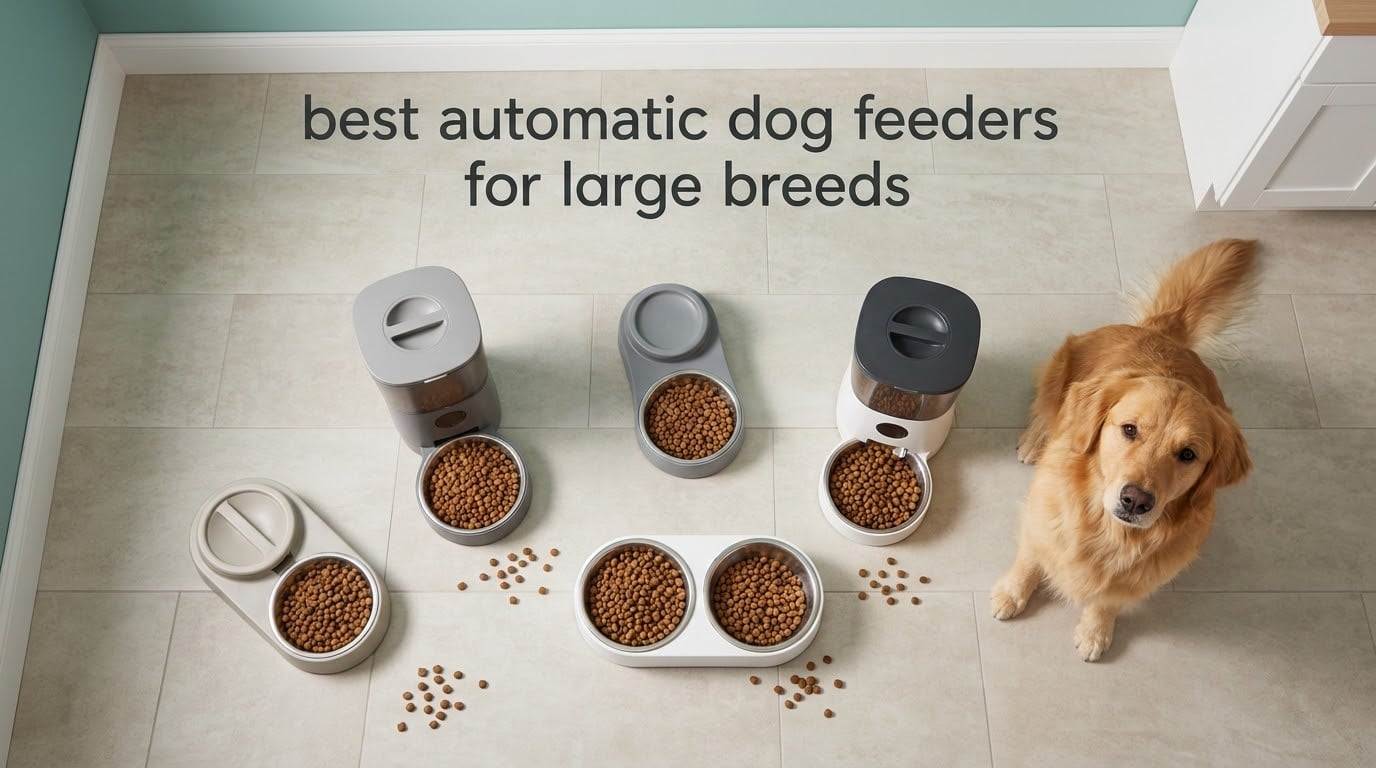
If you own a Labrador, a Golden Retriever, a German Shepherd or anything else over about 45 pounds, the feeder aisle is full of wrong answers. Most of what is sold as an automatic dog feeder is a small plastic hopper with a tiny bowl, built for a cat that weighs nine pounds, and it shows the moment a 70 pound dog leans on it. We spent weeks comparing the best automatic dog feeders for large breeds so you can stop guessing.
Large-breed owners ask the same questions in the same order. How much food does the hopper actually hold? What happens when the kibble is chunky? Will the dog tip it over or break into the hopper and eat four days of food in one sitting? Does it keep working when the power goes out? We built this roundup around those answers, and every spec below comes from the product listing and the owner reviews, not from marketing copy.
A quick note on where this fits: our broader [best automatic pet feeders roundup](https://www.wearesalt.org/best-automatic-pet-feeders/) covers small dogs, cats and multi-pet homes. If you specifically need something that can swallow a whole bag of kibble and take a 90 pound shove, the picks below are the shortlist. If you are also replacing the rest of the setup, our [orthopedic dog beds for large breeds](https://www.wearesalt.org/best-orthopedic-dog-beds-for-large-breeds/) guide makes the same case from the sleep side.
Ten feeders made the cut, split between powered models that schedule measured portions and gravity models that simply keep the bowl full. The honest answer to which is better depends on whether you need portion control or you need something that cannot fail. We cover both, and we tell you where each one breaks.
Table of Contents
Top 3 Best Automatic Dog Feeders for Large Breeds

Pet Lodge 50 lb Steel Feeder
- 50 lb capacity
- Galvanized steel body
- Magnetic pest-resistant door
- Wall or frame mountable
- No power needed
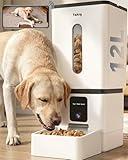
Yakry 12L Camera Feeder
- 12L / 50 cup hopper
- Handles kibble to 20mm
- 1080P camera with night vision
- Dual-band WiFi app
- USB plus 3 D batteries

Nityers 15L Anti-Clog Feeder
- 15L / 63 cup hopper
- Handles 2-23mm kibble
- Up to 6.25 cups per meal
- Two stand heights
- 9.84 inch stainless bowl
Best Automatic Dog Feeders for Large Breeds in 2026
Every feeder in the list below appears with its own ASIN, its measured capacity, its stated maximum kibble diameter and the honest complaints from owners. The three capacity figures you will see most often are 11L, 12L and 15L, and they map to very different refill intervals depending on the size of the dog. Steel gravity feeders are in a different league on capacity, holding 25 or 50 pounds rather than litres.
| Product | Specifications | Action |
|---|---|---|
| Pet Lodge 50 lb Galvanized Steel Feeder |
|
Check Latest Price |
| Yakry 12L Feeder with 1080P Camera |
|
Check Latest Price |
 UTCG 12L Large Breed Feeder UTCG 12L Large Breed Feeder |
|
Check Latest Price |
 KHEARPSL 25 lb Steel Gravity Feeder KHEARPSL 25 lb Steel Gravity Feeder |
|
Check Latest Price |
 Molly and Cody 14L WiFi Feeder Molly and Cody 14L WiFi Feeder |
|
Check Latest Price |
 Dokoo 15L Vacuum-Sealed Feeder Dokoo 15L Vacuum-Sealed Feeder |
|
Check Latest Price |
 DOGNESS 11L Cordless Feeder DOGNESS 11L Cordless Feeder |
|
Check Latest Price |
 Kenond 11L Gravity Dispenser Kenond 11L Gravity Dispenser |
|
Check Latest Price |
| Nityers 15L Anti-Clog Feeder |
|
Check Latest Price |
 Cucurbita 3 Gallon Gravity Station Cucurbita 3 Gallon Gravity Station |
|
Check Latest Price |
A note on reading the table: the litre figure is hopper volume, not weight, and kibble density varies. A 15L hopper marketed at 63 cups will hold a very different number of days for a 50 pound dog than for a 100 pound dog, which is why the buying guide below maps capacity to dog weight rather than repeating the marketing claim.
1. Pet Lodge 50 Pound Galvanized Steel Feeder for Outdoor Large Dogs
Pet Lodge® Automatic Dog Feeder | Chow Hound Outdoor Pet Feeder for Large Dogs | Tough Galvanized Steel | Made in USA | 50 Pound
50 lb capacity
Galvanized steel
Magnetic pest-resistant door
No power
Pros
- Holds 50 lb of dry food so refills are rare
- Galvanized steel resists rust outdoors
- Too heavy for a dog to tip
- Double duty as a food storage bin
Cons
- Dogs need training to push the magnetic door
- Magnet hardware can detach and need reattaching
- Open screw holes can let ants in and need sealing
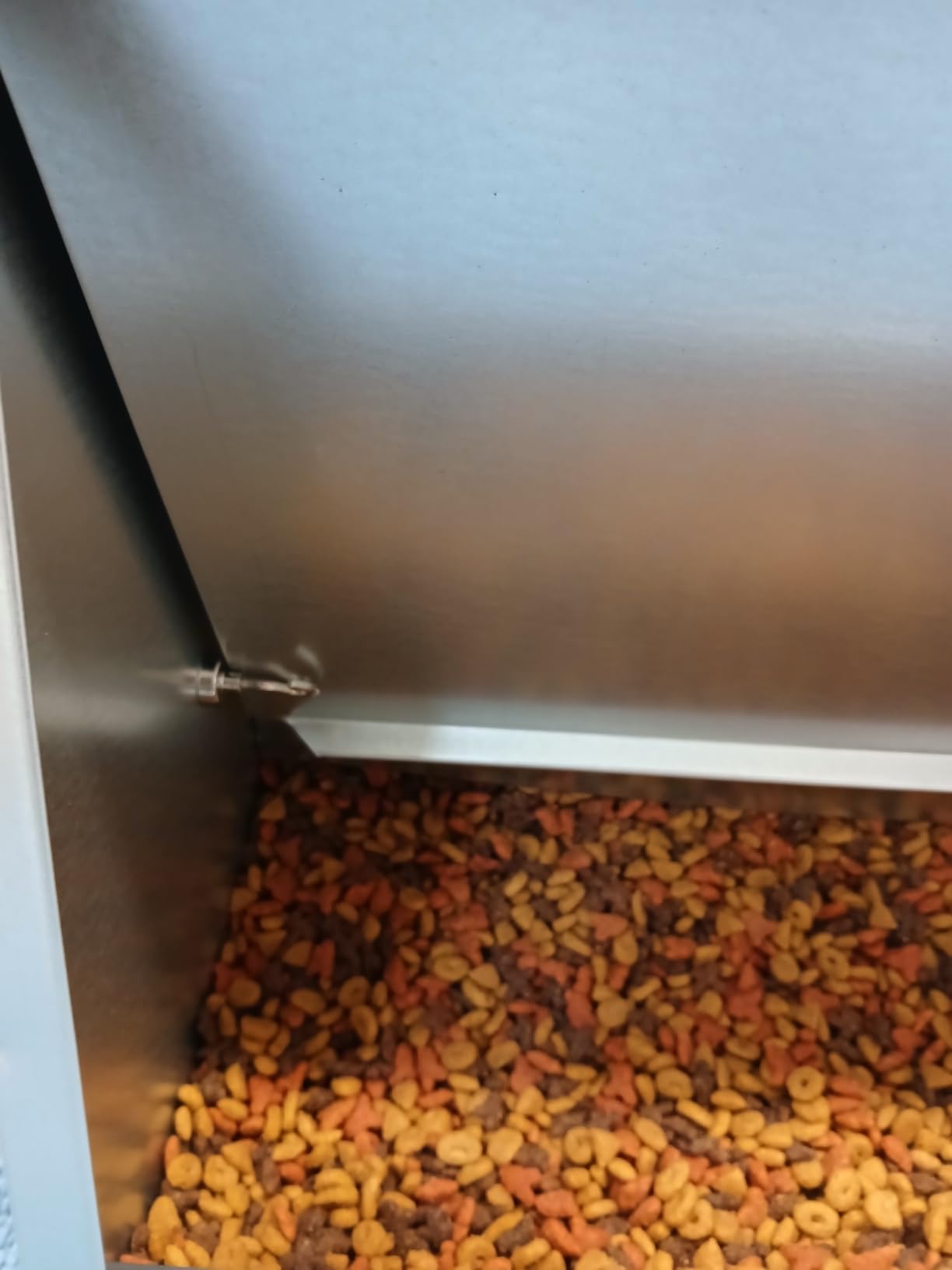
This is the one I would put in the yard without hesitating. It is a galvanized steel box that holds 50 pounds of dry food, which is roughly a full bag of most large-breed kibble, and it is built by Miller Manufacturing in the USA. Nothing about it is clever, and that is the point. There is no motor, no app and no schedule to fail. The angled chute meters food by gravity and the magnetized door lets the dog in while keeping birds and insects out.
What stands out in the reviews is consistency over time. Owners describe units that have been in service for years, through freeze and heat, with the same galvanizing intact. At 4.4 stars across more than 5000 reviews, it is the most proven feeder in this list by a wide margin, and the Best Sellers Rank sits inside the top 60 in Dog Automatic Feeders.
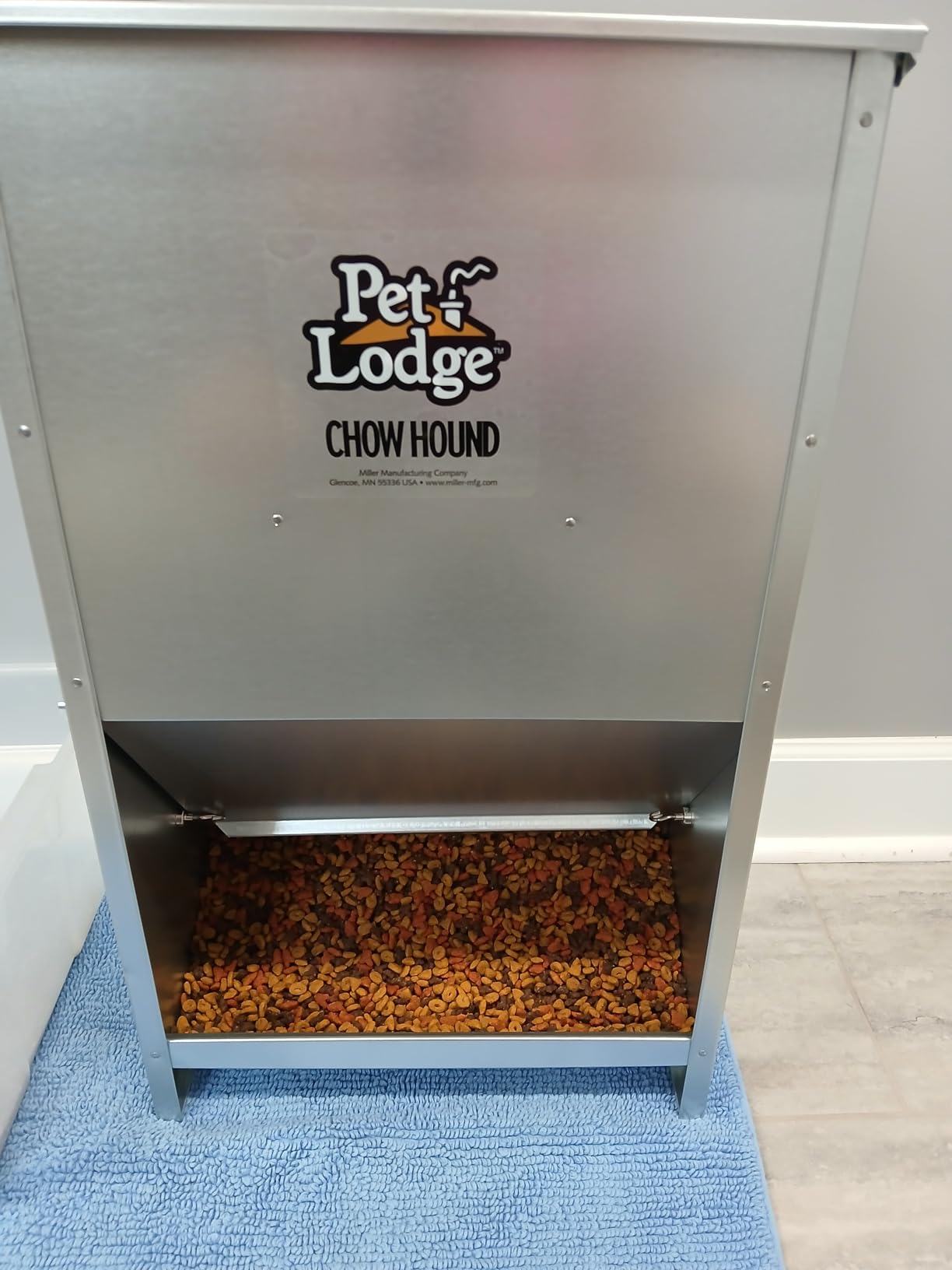
The trade-off is that gravity feeding is not portion control. A dog that wants a third meal will get a third meal, because the bowl refills as fast as the dog eats. That is precisely the arrangement most large-breed owners are trying to fix, so this is a better answer for outdoor, free-fed or multi-dog setups than for a dog on a weight-management plan.
You need two bolt holes on the back to mount it to a wall or a frame, and the frame is not included. Owners also point out the door hardware can detach or ship sticking open, and the open screw holes are a genuine invitation to ants in warm weather unless you caulk them. Any of those is a five-minute fix, not a deal breaker.
Is it strong enough for a 90 pound dog?
Yes, and this is where the steel feeders separate cleanly from the plastic ones. The weight of the filled container is well beyond what a large dog can shift, and the wall-mount holes give you a second layer of security if your dog is the type to headbutt things. Several owners with Rottweilers and similar builds report the unit simply does not move.
Compare that with the 11L plastic gravity dispensers further down, which weigh under two pounds. One owner of a Great Pyrenees reported the plastic unit being pushed around regularly, and a large dog can also chew a plastic lid off. Steel is the safer answer for strength.
When would you choose something else?
Choose a scheduled feeder instead if your dog needs measured meals, if a veterinarian has put them on a weight-management or prescription diet, or if you want the bowl empty at specific times rather than permanently available. For a dog on a reduced-calorie plan, a feeder that never runs empty works against the plan.
Also consider the alternative if you are indoors, away from pests, and want a camera or feeding notifications. This unit has no electronics at all, which is a strength in the yard and a limitation in a house. Related picks for other setups are in our [WiFi automatic cat feeders for wet food guide](https://www.wearesalt.org/best-wifi-automatic-cat-feeders-for-wet-food/), though those are built for a completely different job.
2. Yakry 12L Feeder with 1080P Camera for Multi-Dog Homes
Automatic Dog Feeder Large Breed: 12L/50 Cup Capacity for Kibble up to 20mm
12L / 50 cups
Kibble to 20mm
1080P camera
3x D backup
Pros
- 12L covers roughly one to two weeks for a big dog
- 1080P camera with night vision and two-way audio
- Dual-band 5GHz and 2.4GHz WiFi
- Airtight lid with desiccant bag
Cons
- Large kibble can still jam and need clearing
- Bowl is smallish and spills if the dog eats mid-dispense
- Manual feed button releases only a single 10g portion
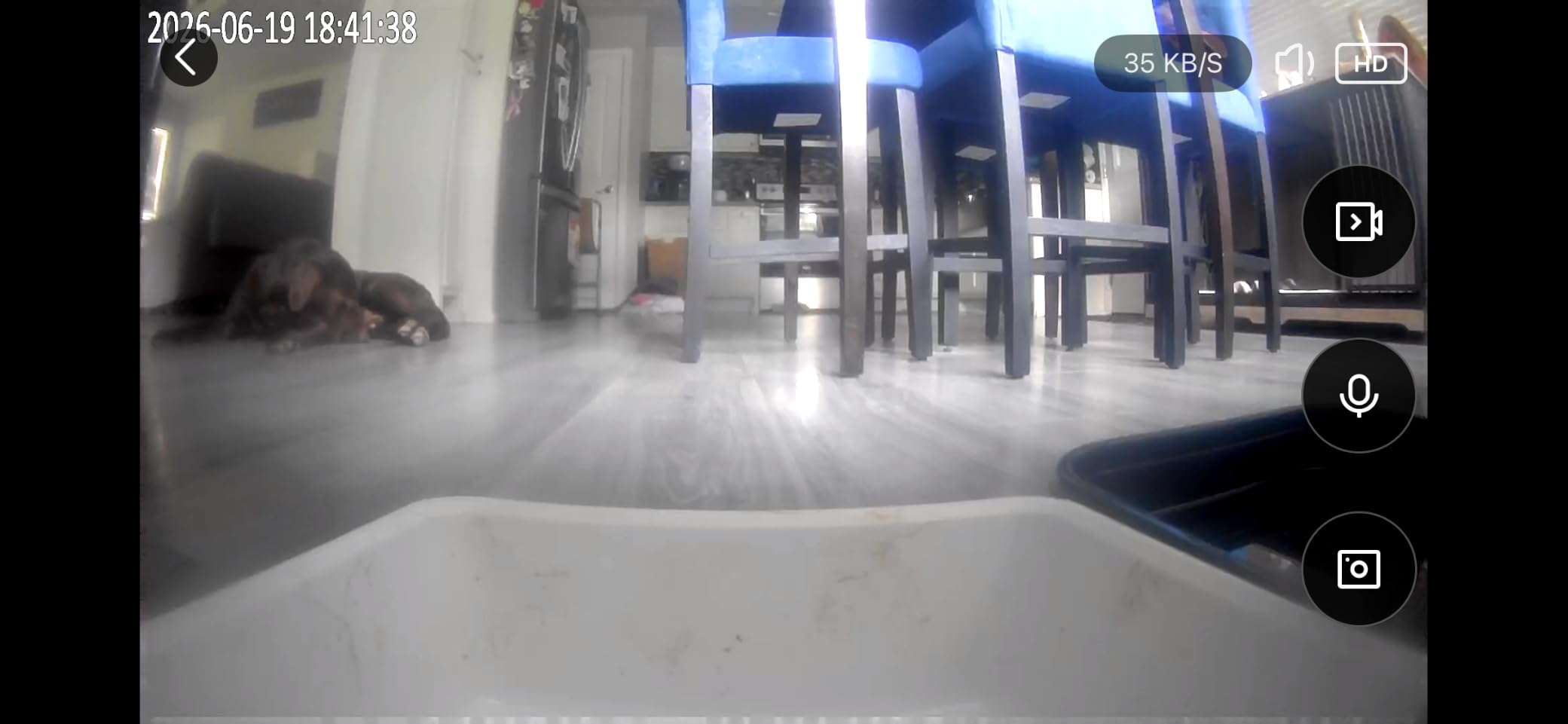
This is the pick for households where the question is not when the dog eats but whether the dog ate. The 12L, 50 cup hopper is sized explicitly for breeds over 50 pounds and multi-pet homes, and the built-in 1080P camera with night vision and two-way audio lets you look at the bowl from your phone rather than guessing.
Scheduling runs through the Smart Life app over dual-band 5GHz and 2.4GHz WiFi, with up to 15 meals a day and 1 to 20 portions per meal. The stated kibble ceiling is 20mm, which is the highest we saw among the 12L camera models here. Power is USB with three D cells as backup, and the batteries are not included.
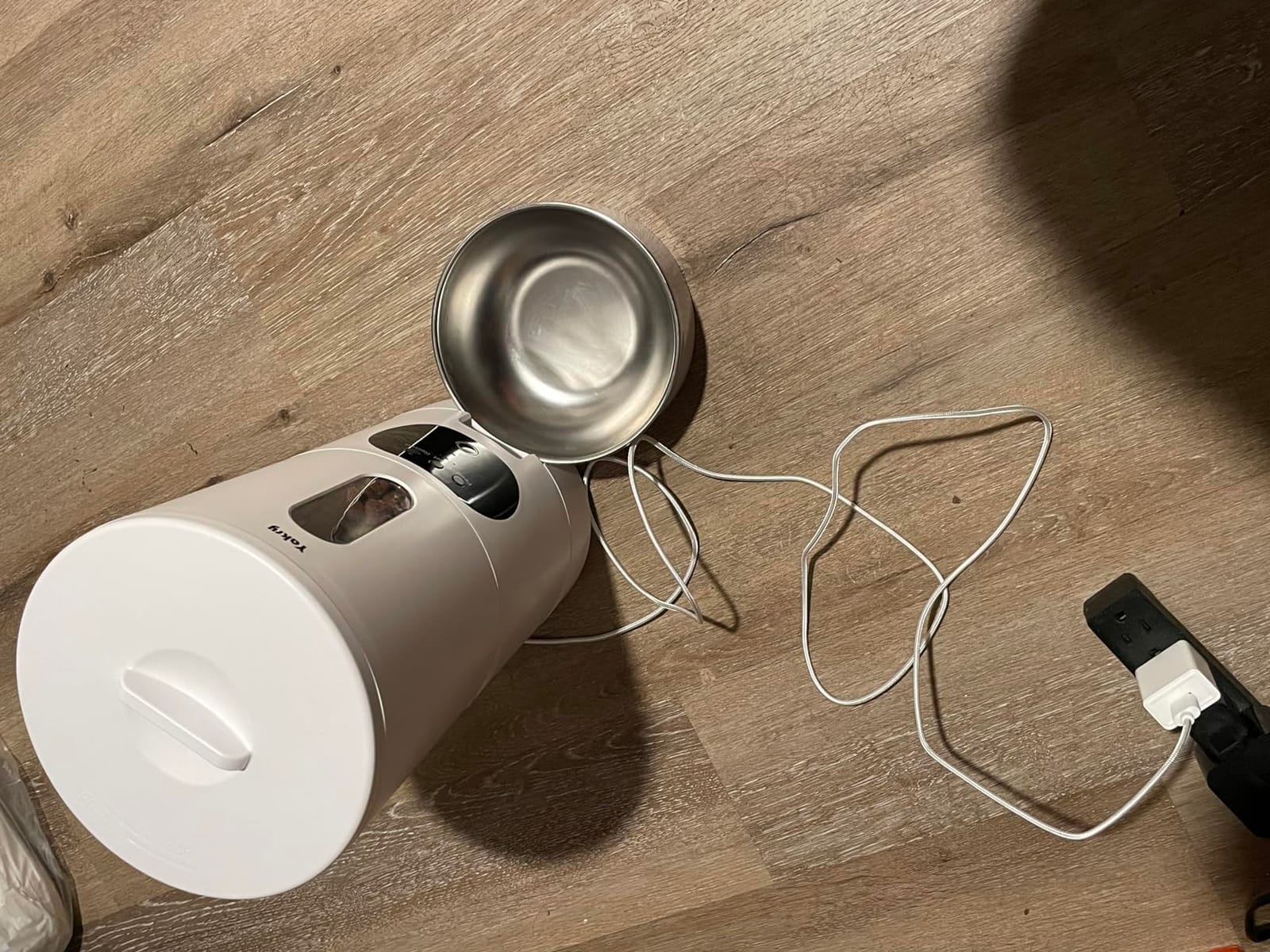
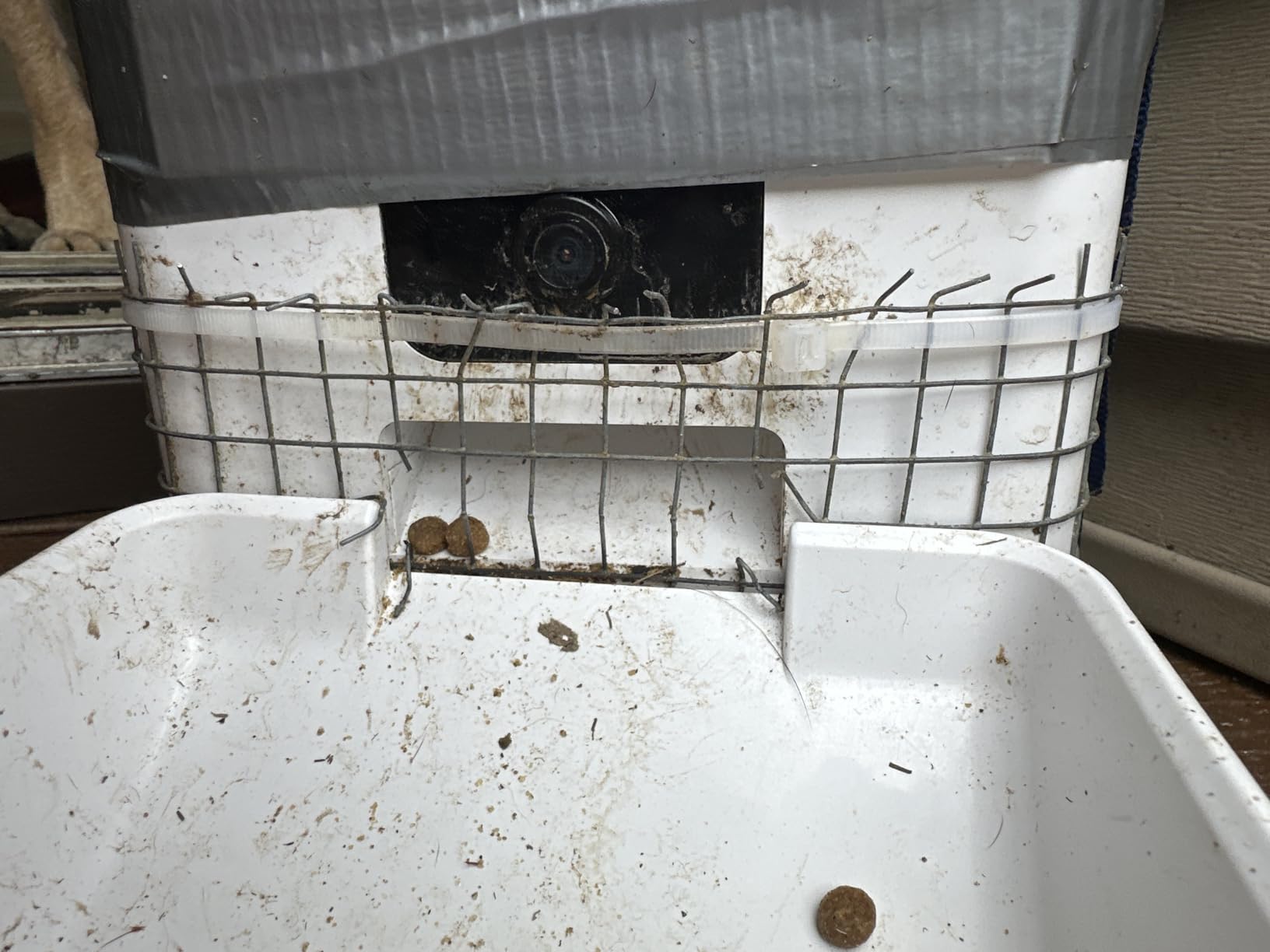
The 4.1 rating reflects a real split. Owners love the combination of capacity, a straightforward app and a camera they actually use, and support is described as responsive. But 12 percent of reviews are one star, and those reviews cluster around three things: occasional jams with bigger pieces, a bowl that feels small for a large dog’s face, and a handful of durability failures after limited use.
The 10g manual dispense limit is worth calling out specifically, because a 75 pound dog needs far more than that in one serving. You will be relying on scheduled multi-portion meals, not the button, to get a full meal into the bowl. Check your portion math before you commit, since the bowl has to hold the finished portion without the dog eating it mid-drop.
Is it accurate enough for a large dog’s full meal?
Mostly, but with a caveat. Owners describe the app as dispensing consistent, adjustable portions, yet the manual button is limited to a single 10g portion, which is a fraction of a real large-breed meal. The design assumes you program the schedule and let it do the work, which works well once it is set up and less well if you want an ad hoc extra portion.
The stainless bowl lifts out for cleaning, which matters more than it sounds in a house with a heavy shedder. Airtight lid plus the included desiccant bag keeps two weeks of kibble from going stale, and that is a genuine advantage over models with loose lids.
Where it falls short for a large dog
The bowl size is the recurring gripe. Several owners report a determined large dog eating during the dispense and spilling kibble onto the floor, which is a small daily annoyance that adds up. Occasional jamming with larger pieces also shows up repeatedly, even under the stated 20mm limit.
If your kibble regularly runs at the top of that size range, look at the Nityers 15L or the Dokoo 15L, which both claim larger ceilings and larger bowls. If your dog is a relentless chewer, the plastic chute design is worth thinking about before you buy.
3. UTCG 12L Feeder for Accurate Portion Control
Large Breed Automatic Dog Feeder: 12L/50 Cups for 20-Days Food
12L / 50 cups
Kibble up to 18mm
Wall mount kit
1080P camera
Pros
- Owners who measure dispenses report accurate portioning
- Video and photo history with optional microSD storage
- Wall mount kit included
- Quick push-and-twist assembly
Cons
- Jams still occur within the stated kibble limit
- App syncing problems led to returns
- Light for its size with pushy large breeds
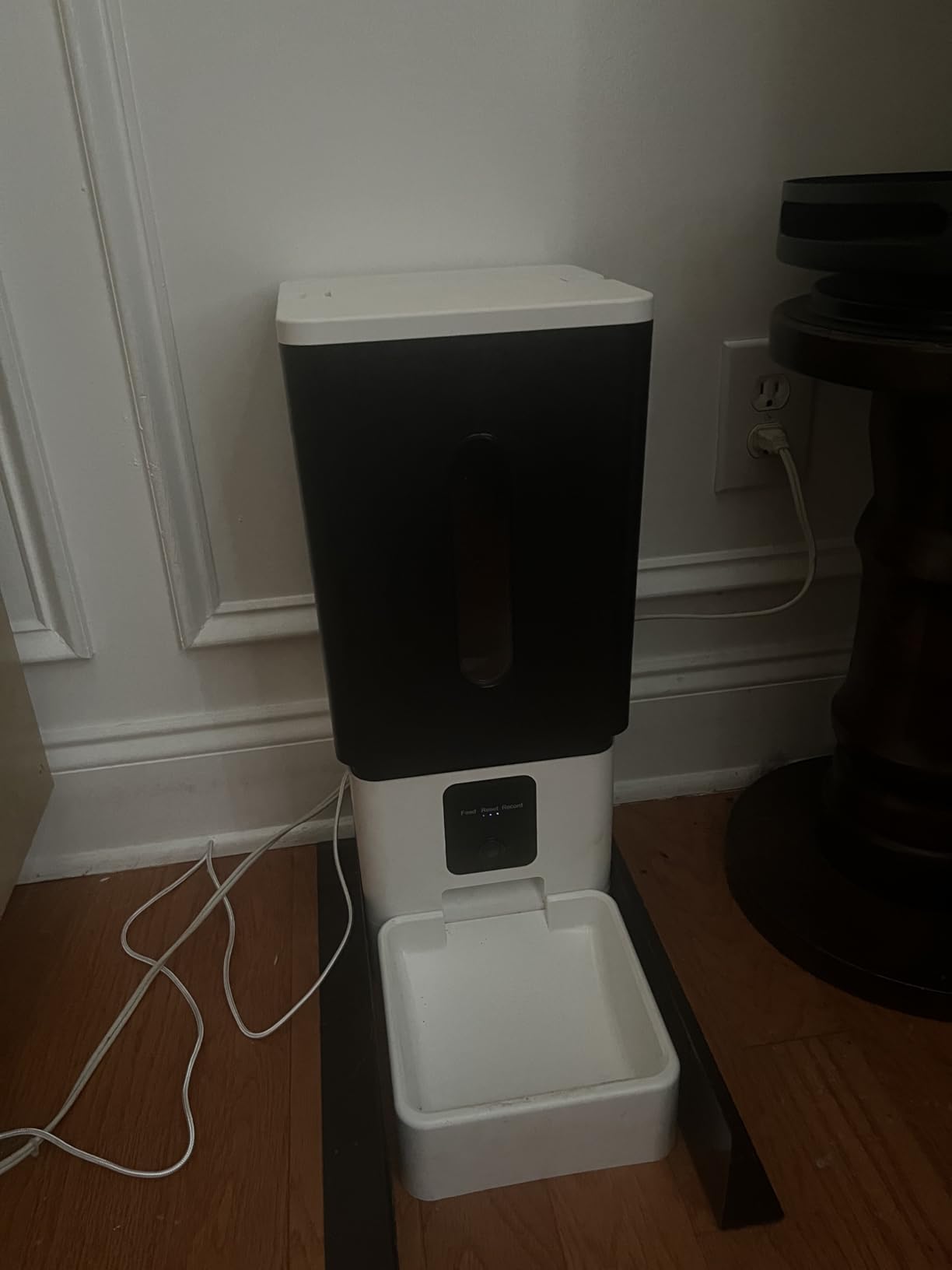
This is the one to look at if your dog’s weight is the reason you are shopping. Owners who actually weigh the dispensed food report that the portions come out consistent, and that is the single most requested verification in owner feedback on feeders like this. The 12L hopper is marketed as up to 20 days of food, and the kibble ceiling is 18mm.
Scheduling handles up to 15 meals a day through the app, timers or an instant feed from your phone. The 1080P camera with night vision and two-way audio is there, and it can record video and stills with optional microSD storage, which no other unit in this list mentions. The secure-lock lid and removable BPA-free hopper and bowl clean up well, and dual power with three D cells keeps the schedule running through an outage.
The wall mount kit is the detail that separates it from other 12L models, and it directly addresses the tipping complaint. Owners of pushy large breeds report the unit being light for its size and recommend strapping or mounting it, so if your dog pushes furniture around, use the kit rather than hoping.
At 4.2 stars across 402 reviews, the picture is consistent: good dispensing, accurate measured portions, easy app setup, useful camera history. The recurring negatives are intermittent jams even within the kibble limit, an undersized bowl tray, and a small number of units that never paired with the app and were returned. It is also a recent release with a short listing history, so its long-term durability record is still thin compared to the older models here.
How does it handle two large dogs?
A single 12L hopper is one meal schedule, so for two large dogs you are looking at either two schedules on the same timer or a split you manage yourself. The 15-meal-a-day ceiling gives you room to stagger portions, which is genuinely useful when one dog needs a different amount. The wall mount also helps in a two-dog house, where the second dog is much more likely to shove the unit while the first is eating.
Be honest about the tray size though. Owners report that dogs who do not start eating immediately can overflow it, and with two dogs competing that window is narrower. If your dogs eat fast or guard bowls, a larger tray like the 9.84 inch bowl on the Nityers is a better fit.
What should you check before relying on it?
Pair the app before you leave the house for the weekend. The syncing complaints are the most serious ones, because a feeder that never connected cannot be trusted on schedule. Then run ten test dispenses on your actual kibble and weigh them, which is the same test we would run, and the one owners who praise the portioning appear to have done themselves.
Mount it on the wall if your dog is boisterous, and keep an eye on the bowl tray during the first week. It does not dispense very large single portions of 3 to 4 cups in one go, so budget for multi-portion meals on the biggest dogs.
4. KHEARPSL 25 Pound Steel Feeder for Outdoor Gravity Feeding
KHEARPSL 25 Lbs Automatic Dog Feeder for Large Dogs, Dog Food Dispenser
25 lb capacity
Galvanized steel
Transparent gravity door
Wall-mountable
Pros
- Heavy galvanized steel that holds up outdoors
- 25 lb capacity suits large dogs and multi-dog homes
- Transparent door lets the dog see the food
- Side handles make it easy to move
Cons
- Requires bolting six panels together on arrival
- Not a scheduled feeder and not portion controlled
- Feeding depends on the dog pushing the gate open
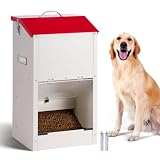
This is the mid-point option between a 50 pound steel box and a plastic gravity barrel, and the transparent door is the feature that sets it apart. The dog can see that there is food inside, which cuts down on a lot of barking and pawing at an opaque container, and you can check the level without lifting the lid.
Capacity is 25 pounds of dry food in galvanized steel with a net weight of 11.7 pounds, and it measures 12 by 6 by 22 inches. Two mounting holes on the back let you put it on a wall or stand it on the floor, and handles on both sides make moving it manageable. The adjustable knob holds the door fully open, which owners with timid or older dogs appreciate because the dog does not have to learn to push anything.
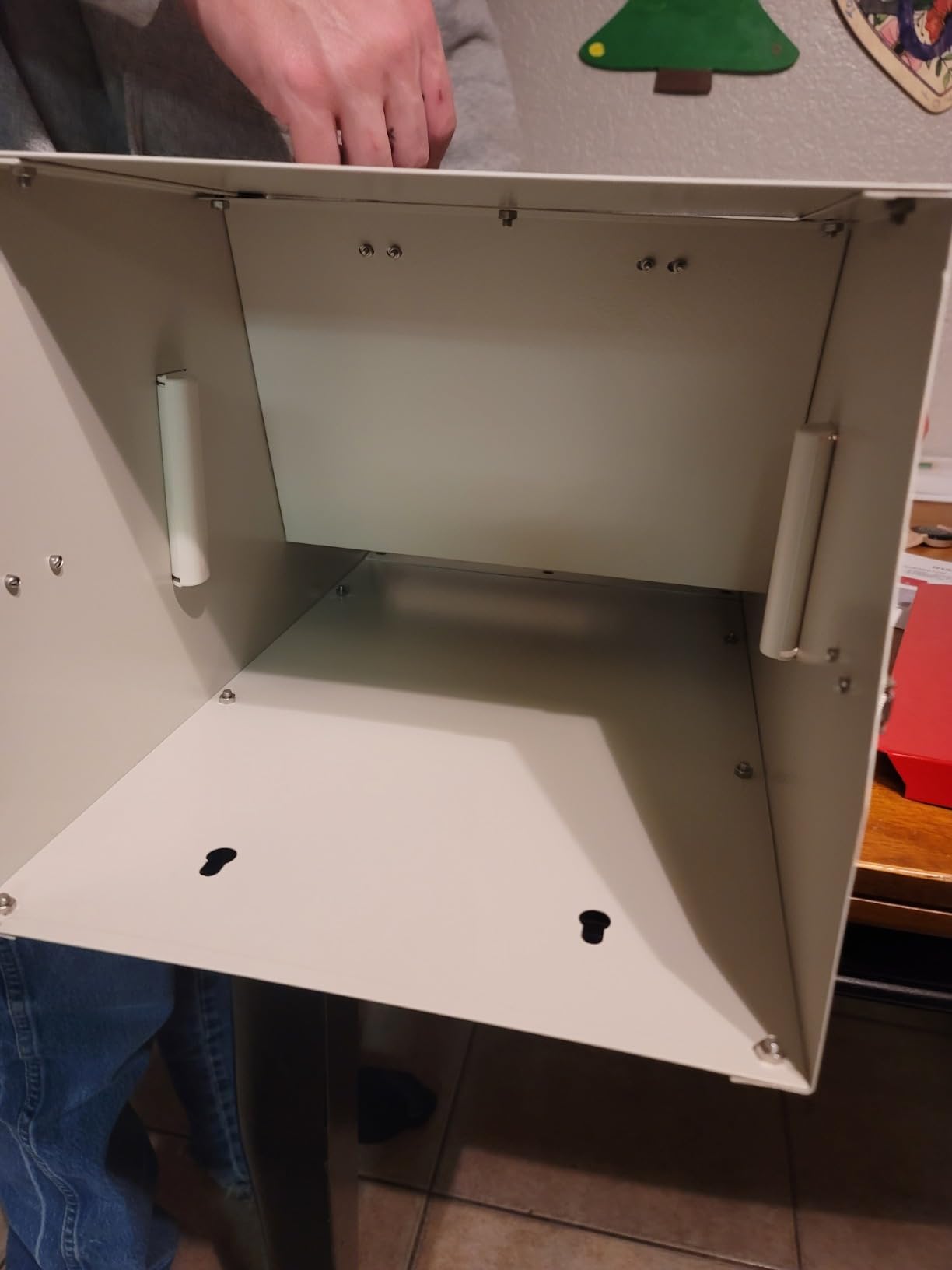
It comes as six panels with screws, and the nuts are pre-riveted so it is a straightforward build rather than a project. That assembly is the most commonly mentioned drawback, and it is a real one if you are hoping to use the feeder the same day it arrives.
Like the Pet Lodge, this is gravity flow with no timing and no portions, so it suits free-fed dogs, multi-dog yards and outdoor runs where the goal is simply that food is always there. The rating of 4.3 across 355 reviews is largely owners buying for the ruggedness and the capacity, and also available in 50 pound and stand versions if you need more.
Is it better than a plastic gravity feeder outdoors?
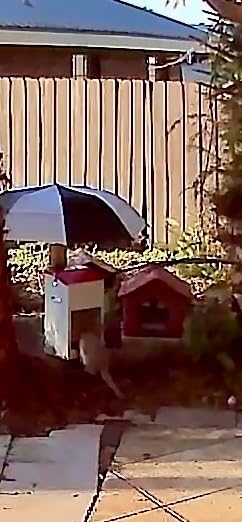
Yes, on three specific counts. Galvanized steel will not crack in cold weather the way plastic hoppers can, it will not go light and brittle in summer sun, and at nearly 12 pounds it will not be shoved across a porch by a strong dog. The plastic gravity units further down this list weigh under two pounds, and that difference is decisive with an 80 pound animal.
The trade is visibility of contents versus durability. The plastic barrels are transparent all over, so you can see the food level at a glance, while this needs a look through the door. If your dog is food-motivated enough to try to nose the door open constantly, check the hinge, because a determined dog plus a plastic gravity gate is a combination that ends with a chewed flap.
Who should not buy this?
Anyone who needs measured meals, a schedule, or a camera. There is no way to make a gravity feeder portion food, and that is a structural fact rather than a settings problem. If your dog is on a calorie-restricted or prescription diet, an unfilled bowl is a real problem, and you want one of the scheduled models instead.
Anyone who wants the unit usable the moment it arrives should also look elsewhere, unless you are happy to spend fifteen minutes with a screwdriver. Wall-mount it if your dog is large, and caulk or seal the panel seams if ants are a problem in your area.
5. Molly and Cody 14L WiFi Feeder for Long-Term Capacity
Automatic Dog Feeder for Large Dogs, 14L Capacity, Remote Feeding, Anti-Blockage System, Timed Auto Dog Food Dispenser, 2.4G WiFi App Control,Dual Power Supply,Stainless Steel Bowl
14L / 60 cups
2.4G WiFi app
1-60 portions per meal
4x AA backup
Pros
- 14L holds several weeks of food for large dogs
- Generous 1-60 portion range per meal
- Quiet operation and accurate on-time dispensing
- Elevated silo design keeps food away from bugs
Cons
- Handles large kibble less smoothly than medium kibble
- Low-food sensor can trigger while food remains
- Plastic chute can be chewed off with no replacement parts offered
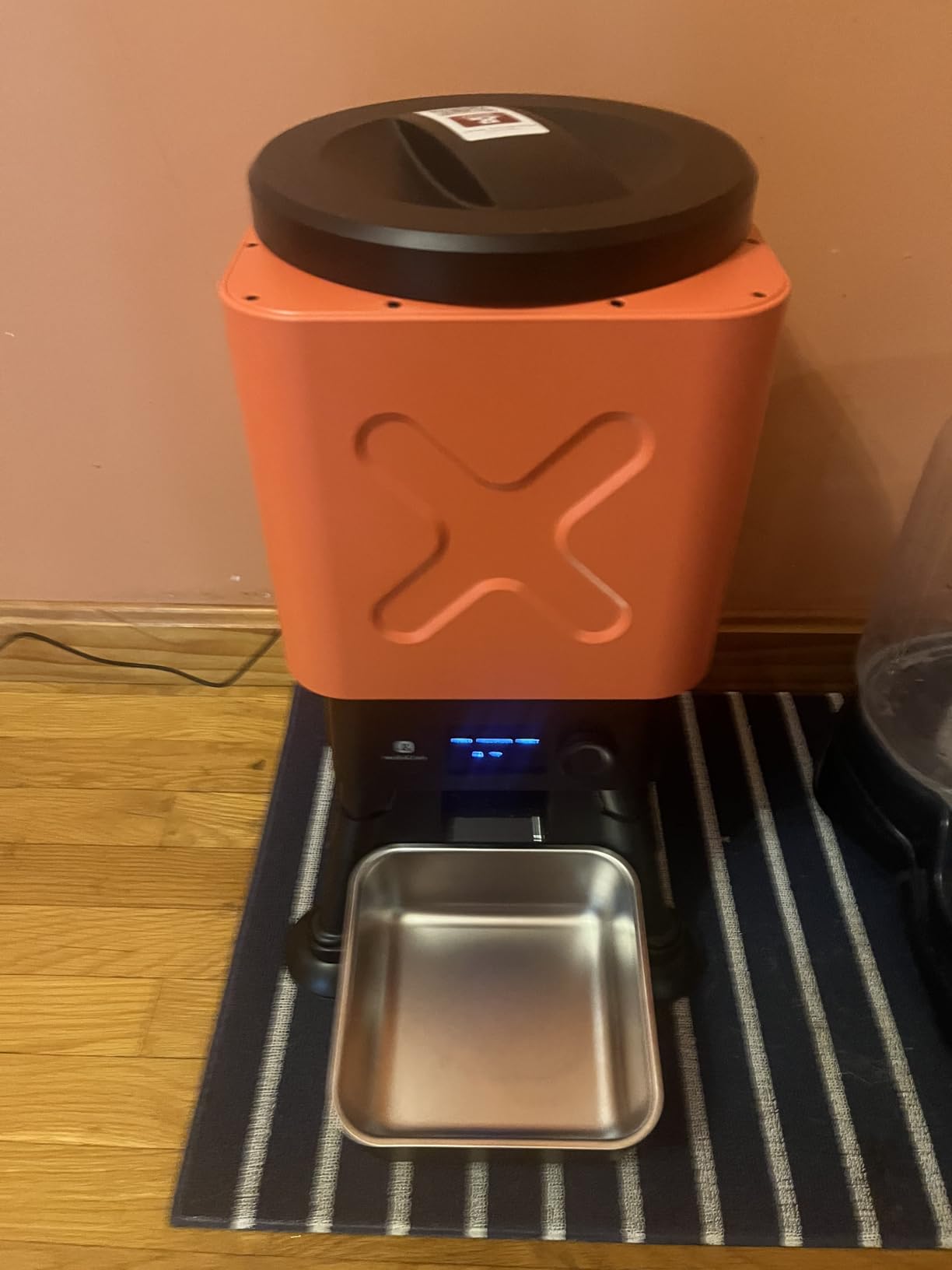
This is the largest hopper among the app-controlled units in the list at 14 litres, or 60 cups, and the portion range is unusually generous: up to six meals a day with one to 60 portions per meal. For a Great Dane or a Bernese Mountain Dog, a wide per-meal range is the difference between one scheduled meal and three stacked dispenses.
The elevated silo-style housing is a genuinely nice piece of design. Food sits high and away from the floor, which keeps insects and floor grime out of the hopper, and the removable stainless steel bowl is hygienic and easy to wash. Owners praise quiet operation and on-time dispensing, and the 10 second voice message is a small touch that does not cost you anything.
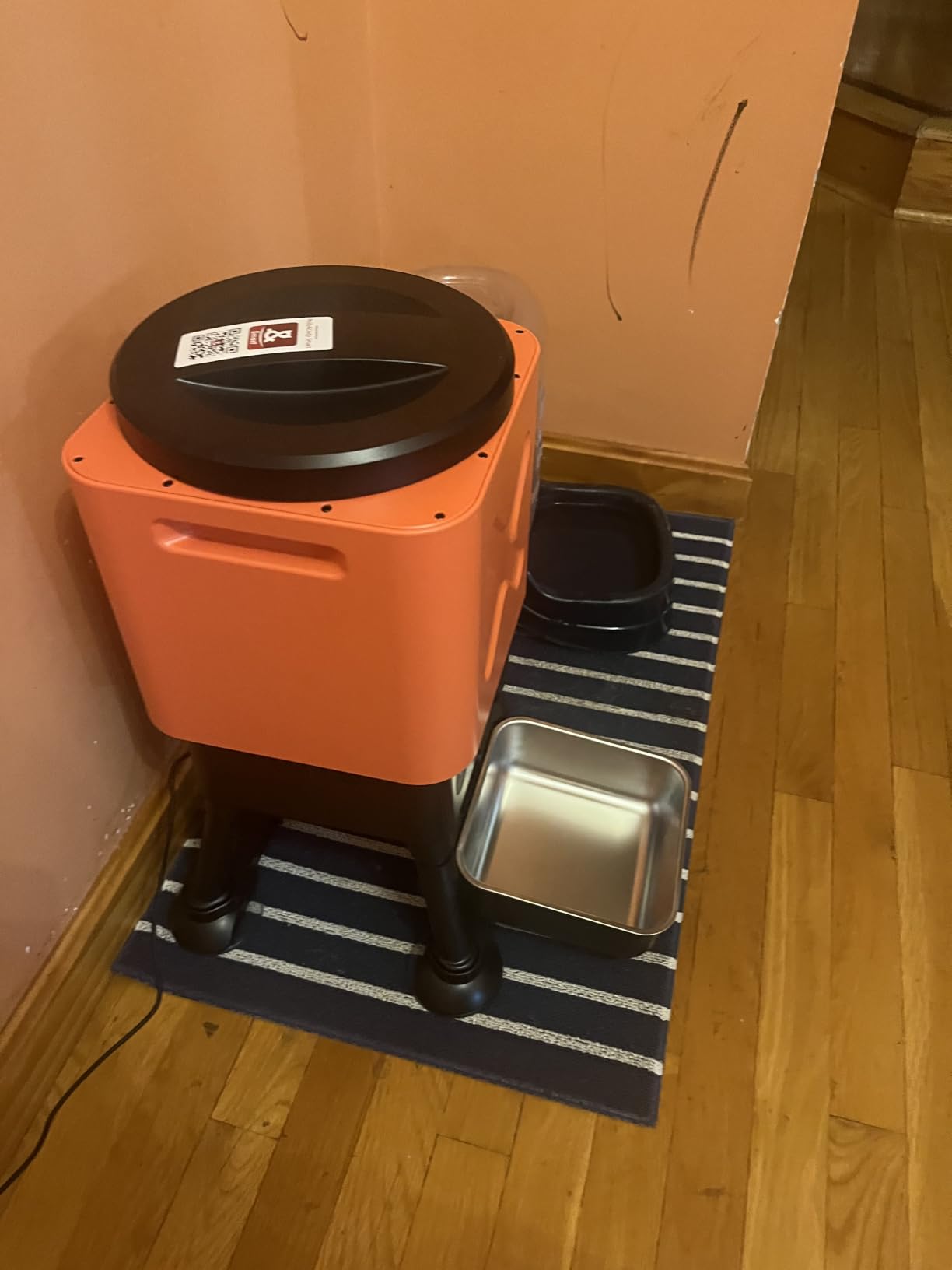
Power is an AC adapter with four AA cells as backup, and the listing claims up to 84 days on batteries. That is a long runtime, and AA cells are easy to keep stocked, which is a practical advantage over D-cell units when you are relying on backup rather than mains power.
The weak point is the anti-blockage system. Owners report that it handles large kibble less smoothly than smaller or medium pieces, which is a notable gap for a feeder marketed at large dogs. The low-food sensor also triggers while food remains, and the plastic chute is the one part a determined chewer can destroy, with no replacement parts offered. One reviewer recommends tacking it to the legs with a self-tapping screw, which tells you how serious the problem gets.
How many days of food is 14 litres really?
Enough that refills stop being part of your routine, which is the whole appeal. A 14 litre hopper holds roughly 60 cups, and a large dog eating three cups a day will get about twenty days, while a smaller large breed at two cups a day stretches that to around a month. The marketing claim of up to 30 days is achievable only at the lower end of consumption.
That is also the trade-off of a long interval. Kibble sitting in a hopper for three weeks depends on the lid and any desiccant for freshness, and this model does not list a desiccant pack. If you do fill it to the top, plan to wash the bowl and hopper far more often than the owners who refill weekly.
What about chewing dogs and WiFi dependence?
If your dog chews plastic, be cautious. The chute is the softest target on the unit and the only damaged part owners report, and no replacement chute is offered, so a determined chewer means a replacement feeder rather than a repair. For that household, the Nityers or the Dokoo with all-metal food paths are safer bets.
On connectivity, the app handles scheduling reliably in reviews, but it depends on 2.4GHz WiFi. If your network is 5GHz only, you will need a dual-band router or you should choose an on-device unit. There is no waterproofing and no wall-mount option, so it is an indoor feeder despite the capacity.
6. Dokoo 15L Vacuum-Sealed Feeder for Kibble Up to 22mm
Dokoo Automatic Dog Feeder for Large Breeds, 15L/63 Cups Vacuum-Sealed Airtight Auto Pet Feeder for Dry Food, Timed Feeding, Anti-Clog Dispenser 2-22mm Kibble, Voice Recorder, Stainless Steel Bowl
15L / 63 cups
2-22mm kibble
Adjustable elevated bowl
No WiFi
Pros
- 15L feeds a large dog for 10-15 days
- Ferris-wheel style dispenser moves kibble to 22mm
- Adjustable bowl height suits large breeds
- At 19.84 lb a large dog cannot tip it
Cons
- No app or camera so no remote monitoring
- Vacuum seal degrades after a few weeks
- Opaque hopper gives no visible food level
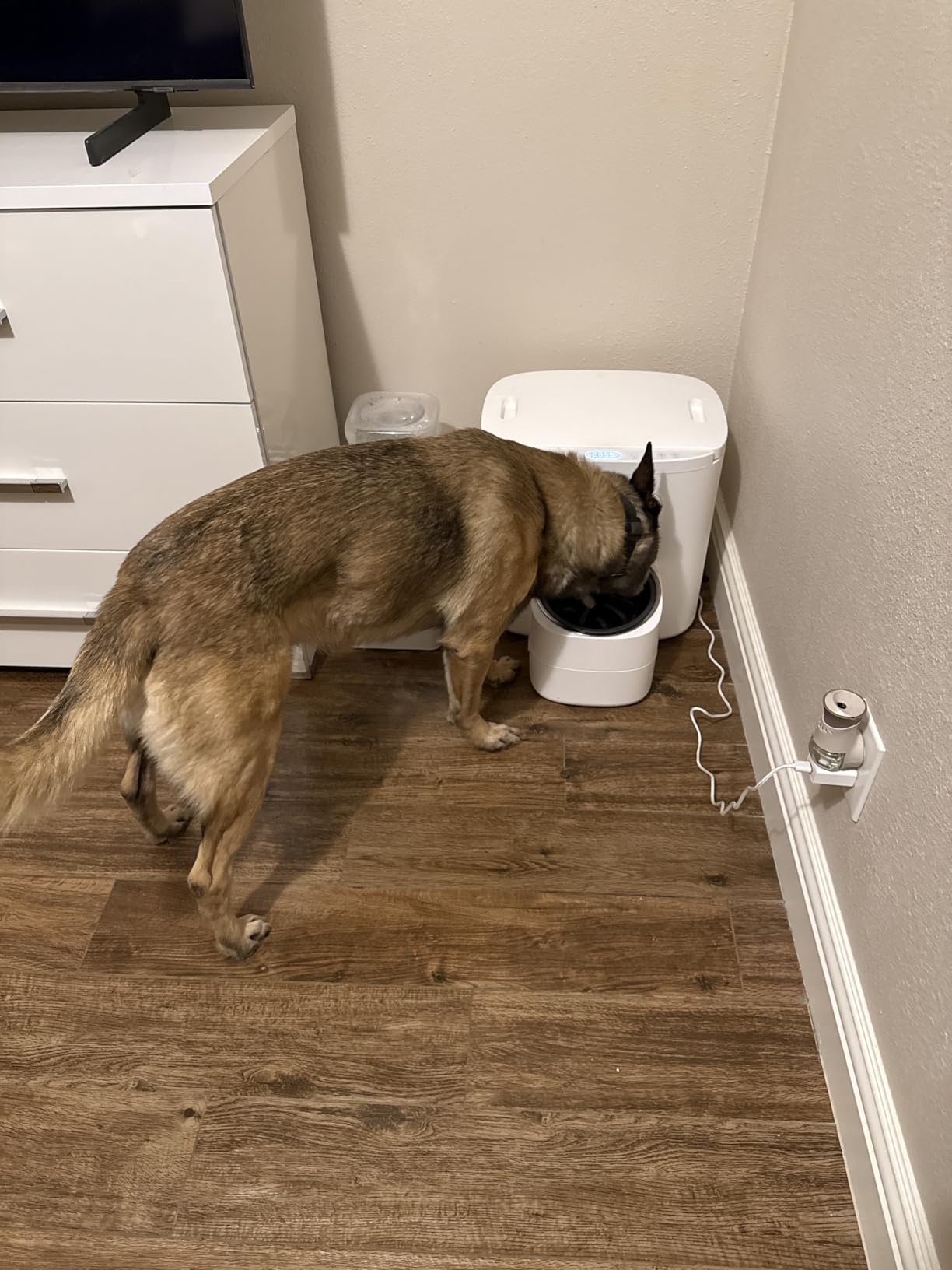
This is the one I would trust with a bag of the biggest kibble I could find. The vertical ferris-wheel style dispenser lifts kibble rather than pushing it through a narrowing chute, and the stated range is 2 to 22mm, among the highest in this list. The 15L hopper is claimed at 10 to 15 days of food for a large dog, and it is genuinely the freshest-feeling design here.
What makes it unusual is the vacuum-sealed hopper that reseals after every meal to reduce air exposure, plus a voice recorder, an adjustable elevated stainless steel bowl and up to six meals a day with one to 20 portions. It is programmed on the control panel with no WiFi, no app and no camera, which removes an entire category of failure. Backup is four D cells, and there is a one year warranty with a 30 day refund window.
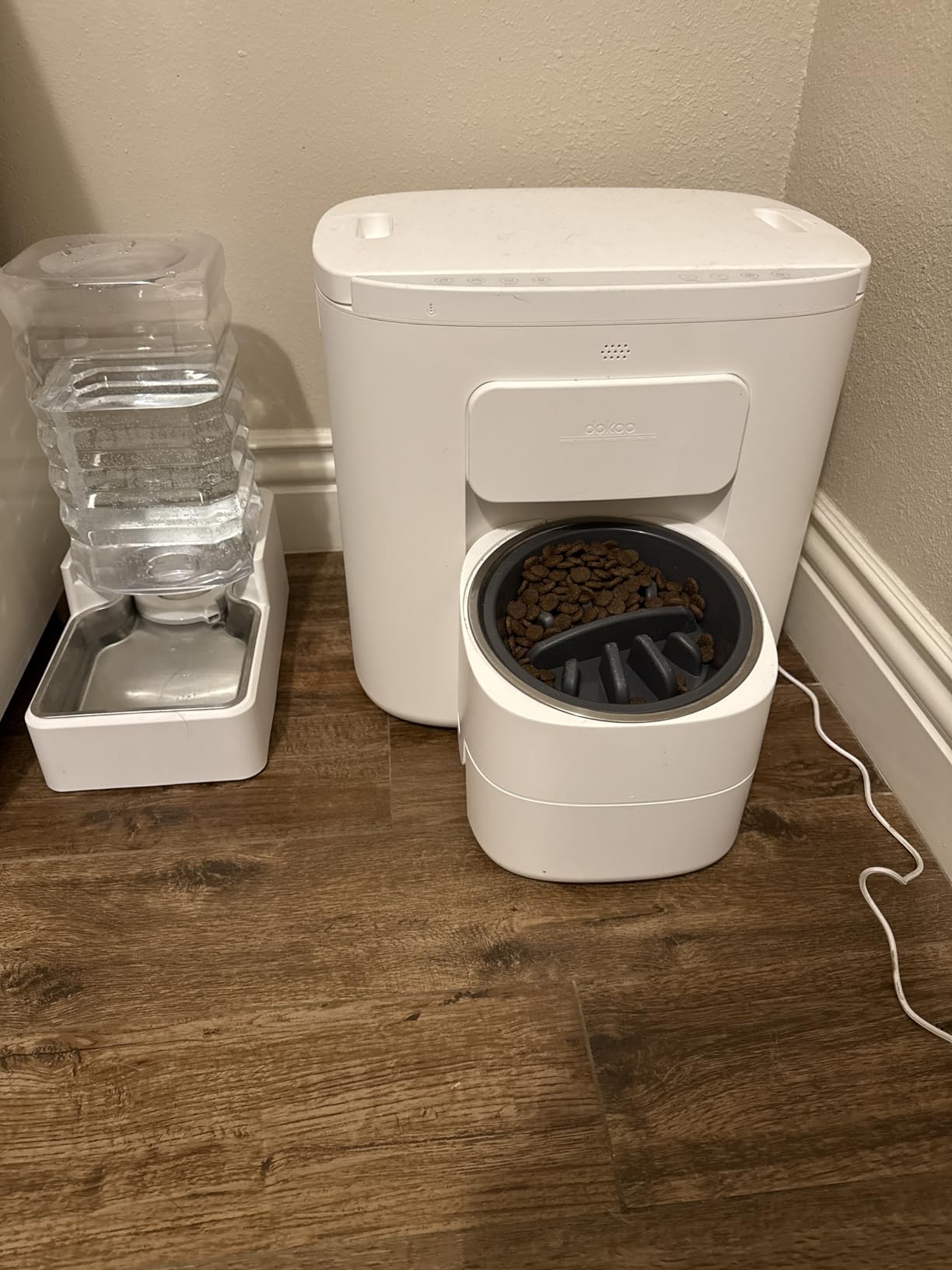
At 4.5 stars across 310 reviews, 77 percent of those are five star, and the praise is concentrated on large-breed owners. What they single out is the raised bowl, the 22mm handling and the fact that it simply works without an app. At 19.84 pounds and measuring roughly 17 by 13 by 16 inches, this is a substantial piece of equipment, and heavy in a way that solves the tipping problem outright.
The vacuum seal is where enthusiasm cools. Several buyers report the seal degrading after about two weeks, which undercuts the freshness story over a long interval. The opaque steel hopper also means you have no visible food level, so you are opening the lid to check. One owner reported internal electronics rusting after about a year, which is a reminder it is rated for indoor use.
Why does no app matter for a large-breed owner?
Because the failure mode of an app feeder is silent. If the WiFi drops or the pairing fails, the schedule may not run and the bowl simply stays empty while you are at work, and a large dog will not tell you about it. A unit programmed on its own panel keeps dispensing regardless of your router, your phone or your service provider.
That is also why this unit suits a garage, a kennel or a covered porch, where WiFi coverage is often poor. You give up remote monitoring and notifications, and in exchange you get a feeder that does the same thing every day without depending on anything outside itself.
What are the trade-offs?
No camera, no app, no remote feed and no dispensing notifications. The 24 hour clock display is confusing for some users, and changing the schedule means re-recording the voice message, which is an odd requirement. Motor noise is noticeable in a quiet room, so it is not ideal for a bedroom or a light-sleeper neighbour situation.
The practical compromise is to treat the vacuum seal as a bonus rather than the reason to buy it. Even with a degraded seal, the 22mm kibble handling, the heavy base and the adjustable bowl are the features that make this the most reassuring pick for a dog who eats like a vacuum.
7. DOGNESS 11L Cordless Feeder for Backup Power
DOGNESS 11L Cordless Automatic Dog Feeder Large Breed
11L / 45 cups
Built-in rechargeable battery, 60-80 day backup
Dual-rotor anti-jam, 18mm
Up to 9 meals a day
No app
Pros
- Cordless rechargeable battery avoids disposable cells
- Runs 60 to 80 days on backup
- 11L hopper cuts refills for big dogs
- No app or WiFi so no connectivity failures
- Disassembles and rinses clean
Cons
- Clock resets after a power outage and needs manual resetting
- Bowl too small above about 2 cups a day
- Light enough for a determined dog to knock over
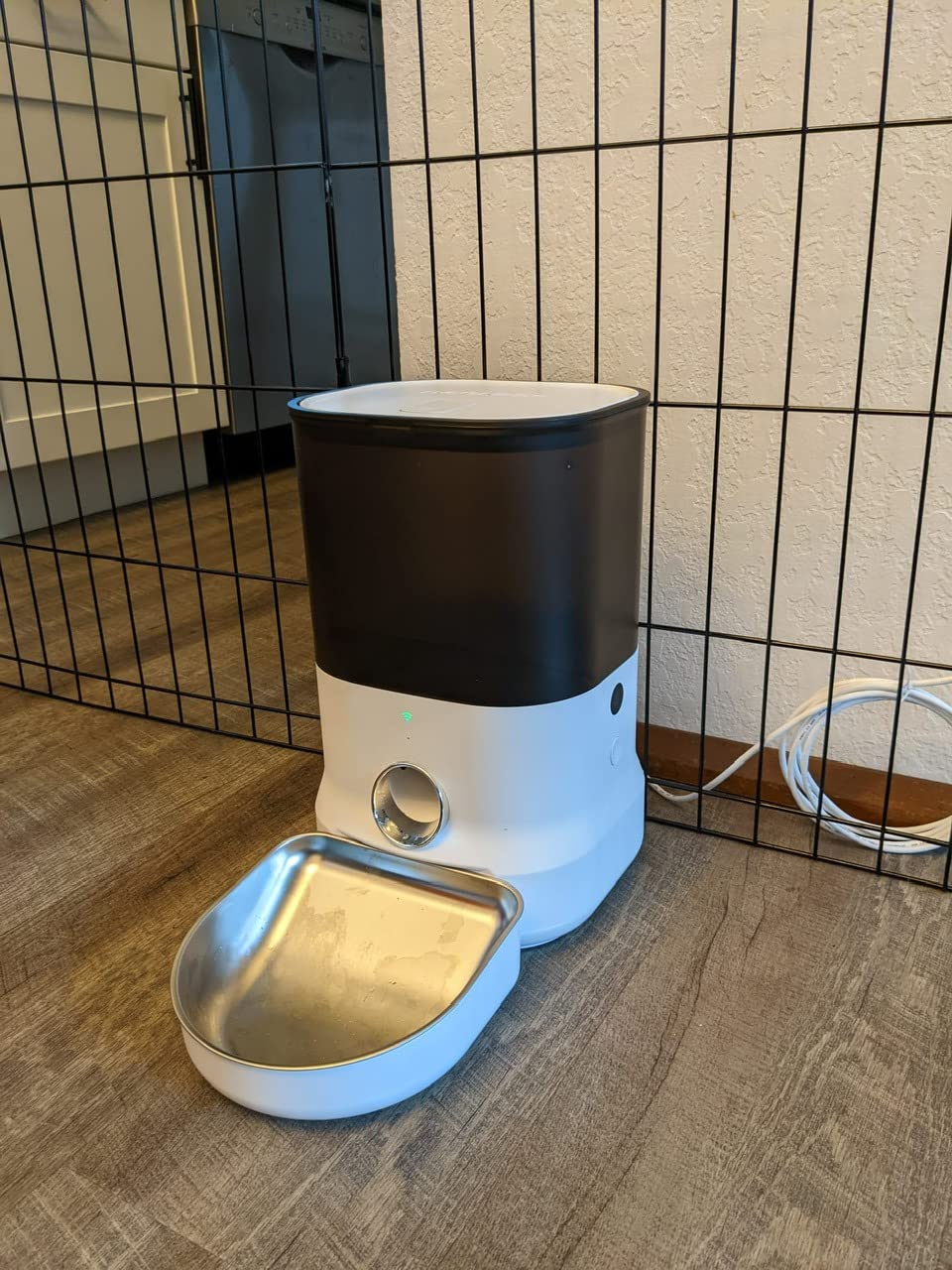
This is the only truly cordless unit here, and for some households that is the whole argument. It runs on a built-in rechargeable battery that the listing claims gives 60 to 80 days of backup, and it resumes its schedule when power is restored. No power cable to trip over, no batteries to buy twice a year, and nothing to plug into in a garage or kennel.
Capacity is 11 litres, or 45 cups, with up to 9 meals a day and up to 20 servings each. The upgraded anti-jamming system uses a robust dual-rotor channel with a wider dispensing opening, and it handles dry pellets up to 18mm. Freshness comes from a triple-seal system combining a silicone seal, an auto-close dispenser and a built-in desiccant, which is more thorough than most units at this size.
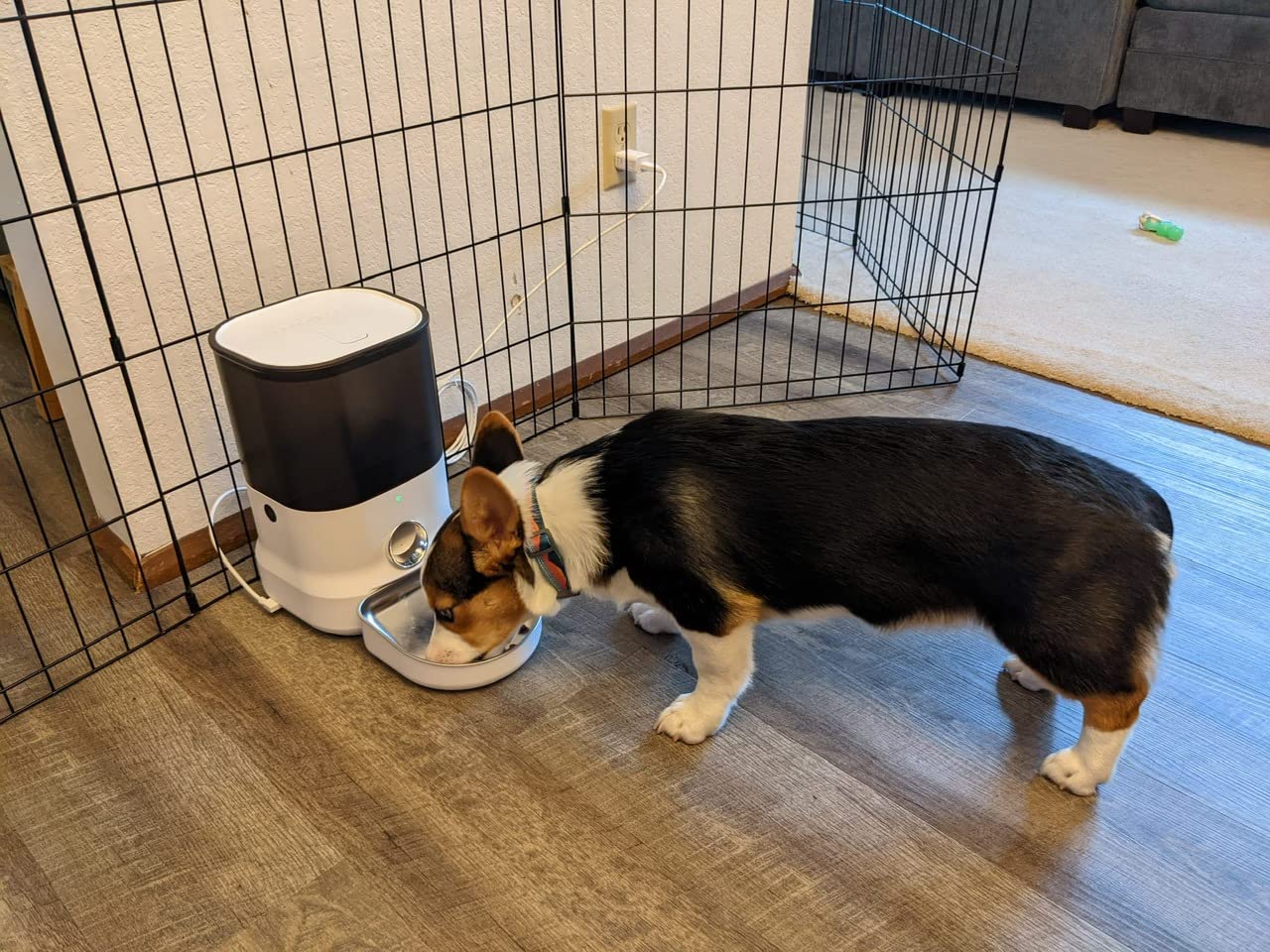
At 4.5 stars with 77 percent five star ratings across 224 reviews, the owner sentiment is strongly positive, focused on the cordless design, the large hopper and simple button programming. Transparency helps here because the hopper is see-through and the bowls are BPA-free melamine, and the whole thing disassembles for a rinse.
The weak points are specific and worth weighing. The clock resets after a power outage and has to be reset by hand, which is a genuine problem for a feeder whose purpose is reliability during exactly those outages. Portion calibration is not tied to kibble type, so the same serving number gives different weights in different bags, and several reviewers report inconsistent accuracy. The bowl is also criticised for anything above roughly two cups a day, which is a low ceiling for a large dog.
Is cordless actually better than D-cell backup?
For convenience and long-term cost, yes. D-cell and AA backups work fine, but they fail silently when they die, and on a feeder that is supposed to cover a power cut, a battery you never test is a liability. A built-in rechargeable cell is charged when mains power is present, so the backup state is maintained automatically rather than left to a calendar reminder.
The trade is that a rechargeable pack ages and eventually holds less charge, and it is a single point of failure if the unit is dropped. If you prefer the certainty of swapping cells, the Nityers runs on eight AA batteries and the Dokoo on four D cells, both of which you can test in a minute.
Who is it not for?
It is not for a dog eating more than about two cups a day on this bowl, and owners with genuinely large dogs report the bowl clogging under that load. It is also light at 9 pounds, and reviewers say a determined pet can knock it over, so mounting or strapping matters. Finally, if you need to know whether the meal happened while you were away, there is no camera and no app here.
Verify the portion weight with your own kibble during the first week. Some reviews also appear to cover earlier 4 litre DOGNESS models, so read the ones that mention 11 litres and the dual-rotor system.
8. Kenond 11L Gravity Dispenser for No-Electricity Feeding
Kenond 11L Gravity Automatic Dog Feeder, Dog Food Dispenser for Large Breed
11L / 3 gallon
6-15 days per fill
Food-grade plastic
Anti-skid base
Pros
- Three gallon capacity lasting 6 to 15 days on one fill
- High internal incline helps kibble flow instead of bridging
- No electronics and no setup at all
- Barrel and chassis separate for washing
Cons
- Lid does not stay on and can be chewed off
- Clogs with large kibble such as Royal Canin Golden Retriever
- Angle not steep enough for reliable flow with big kibble
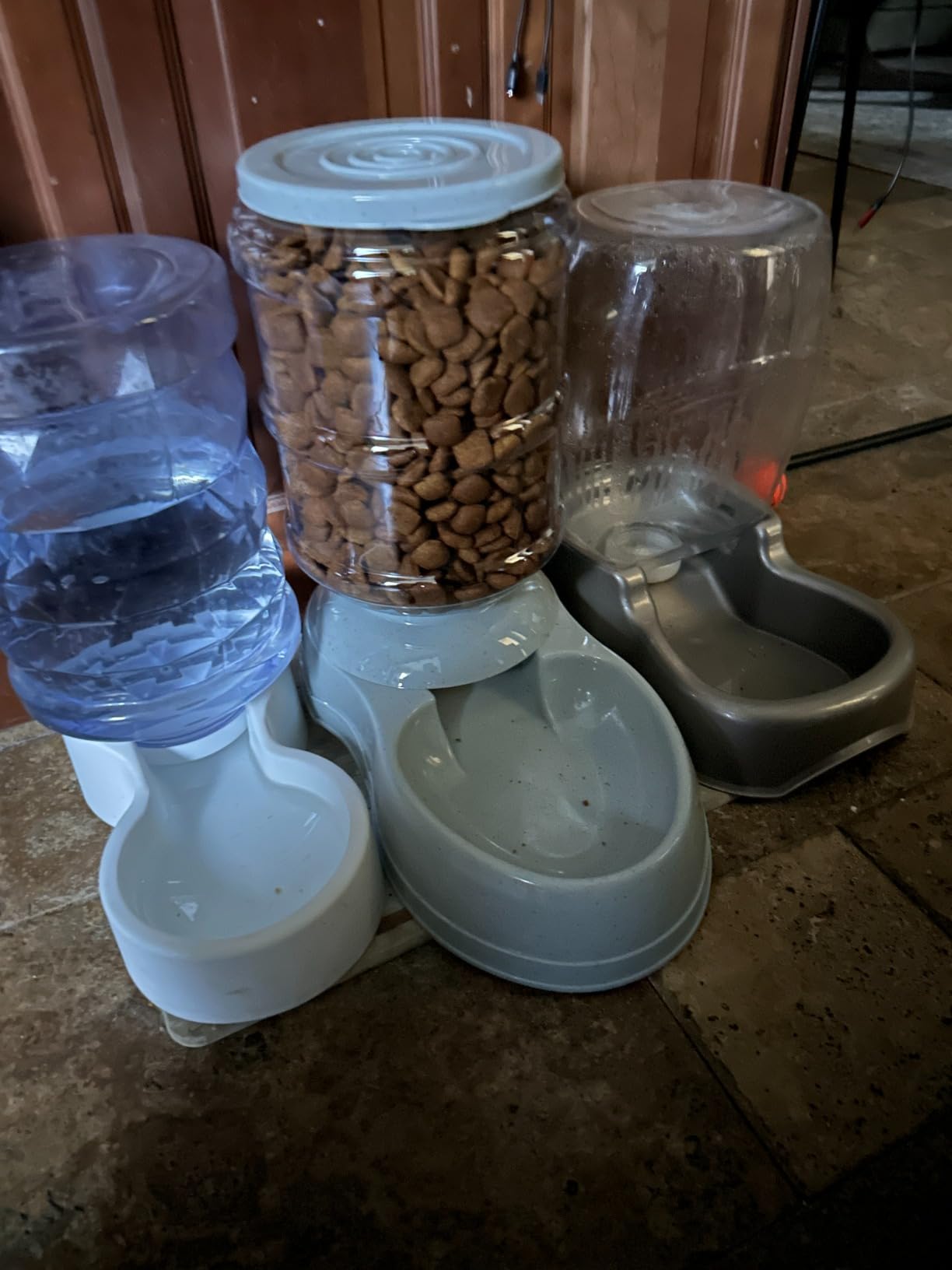
This is the honest budget gravity option, and it is worth understanding exactly what you are getting. Eleven litres, which is three gallons, and the listing says one filling covers a large pet for 6 to 15 days. There is no motor, no schedule, no app and nothing to program. You fill the bucket, snap it onto the base, and the food refills the bowl by gravity.
It measures 18.1 by 10.2 by 17.7 inches and weighs 1.78 pounds, which is the single most important number in this review. The material is food-grade plastic, the opening is wide so food does not stick, and the base has four non-slip pads. The barrel and chassis split apart and rinse with water, and the brand recommends washing once a week.
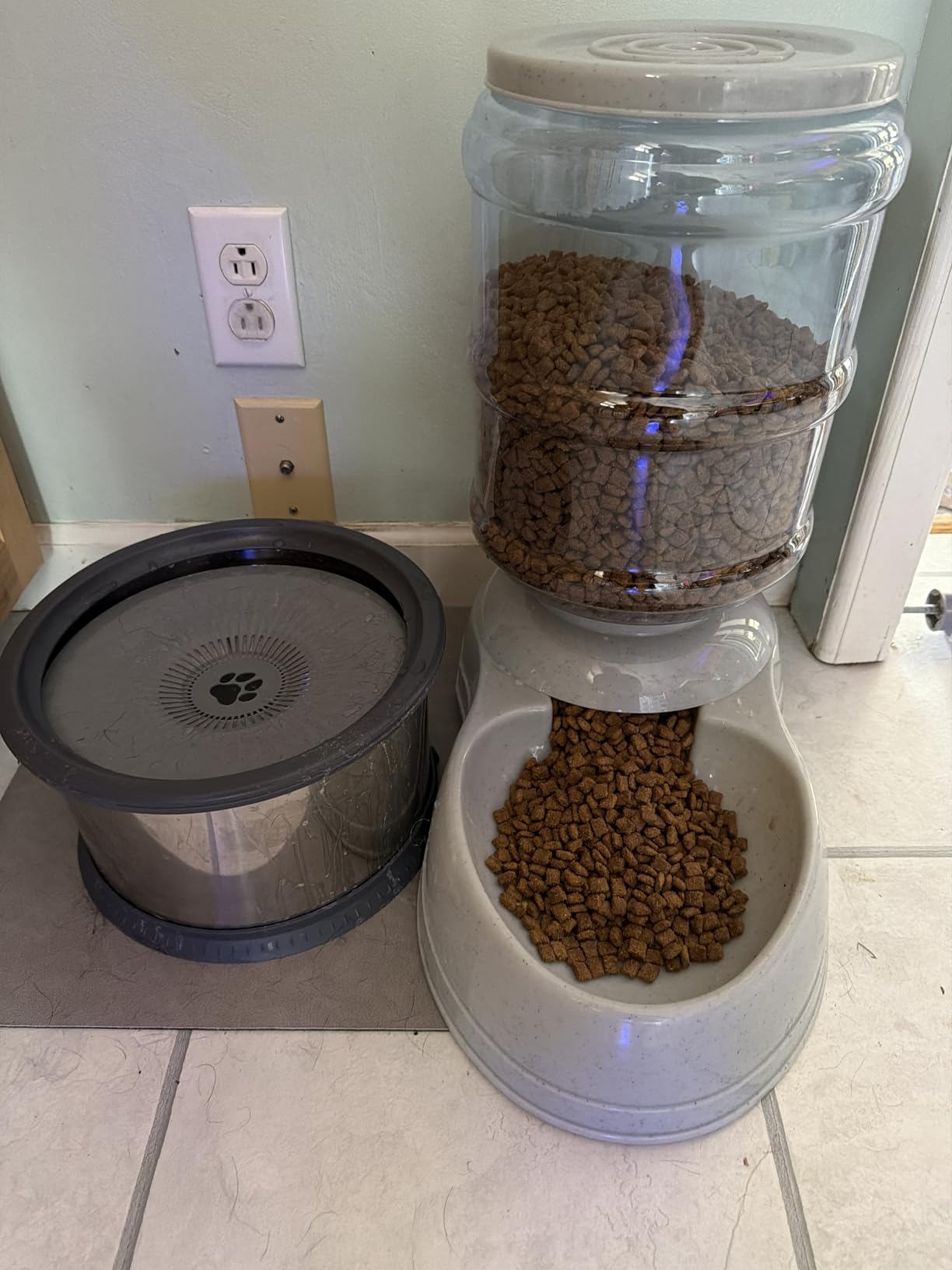
The reviews are more useful than the spec sheet here. Several owners of multi-large-dog households value the capacity and the fact that gravity action cannot fail because there is nothing to fail. One owner with Great Pyrenees reported consistent blockages, which is the exact failure mode a 70 pound dog produces, and another found the improved internal slope solved flow problems for them. That inconsistency is the honest headline: the incline helps, but it is not a guarantee with big kibble.
The lid is the other recurring issue. Owners report it does not stay on and can fall off or be chewed, and a large dog with a free-feeding arrangement and an open 3 gallon hopper is a combination we would think about twice before leaving unattended. Buy it as a monitored outdoor station rather than a leave-it-alone solution.
When does gravity feeding make more sense than a timer?
When your dog self-regulates well and you want food always available rather than at fixed times. A healthy adult large breed that maintains a good body condition on free-choice food, a multi-dog household where two dogs need continuous access, or a yard where you want backup available around the clock. It also makes sense if you have no reliable power and no interest in an app.
It does not make sense if you are managing weight, which is a large share of why people buy feeders for big dogs. It also does not make sense if you need a portioned meal for a prescription diet, or if you want to know the dog ate. Gravity feeding answers none of those, and no setting will change that.
What should you watch out for?
Weight is the main thing. At 1.78 pounds, a large dog can walk into this unit, and reviewers with strong dogs report pushing it around. Place it against a wall or in a corner where the dog cannot lean on it, and consider a steel gravity feeder instead if your dog is in the 70 to 100 pound range or is an enthusiastic chewer.
Also check your kibble against the flow. The clog reports specifically name large-breed formulas, so test the specific food you buy. If it bridges repeatedly, move up to the KHEARPSL or the Pet Lodge, where the chute angle and the weight keep the food moving.
9. Nityers 15L Anti-Clog Feeder for the Largest Kibble
Automatic Dog Feeder for Large Breed – 15L/ 63 Cups Anti-Clog Dog Food Dispenser for 2-23mm Kibble, Elevated Stand, Large Food Tray, Dual Power, Up to 50 Portions 6 Meals Per Day, Keeps Fresh
15L / 63 cups
2-23mm kibble
Up to 6.25 cups per meal
Two stand heights
Pros
- Handles kibble to 23mm with few reported jams
- Holds close to 20 lb of food
- Two stand heights match bowl height to the dog
- Large steel bowl with side rails reduces spills
Cons
- Stainless bowl sits loose in the tray and shifts as the dog eats
- No app or camera so no notifications when away
- Not especially quiet during dispensing
This is the kibble answer. The stated range is 2 to 23mm, the highest ceiling in the list, and owners of large breeds report that it delivers on that claim with few jams. The 15L, 63 cup hopper holds close to 20 pounds of food, so for most large dogs you are refilling weekly or less rather than daily.
The bowl is the standout for large breeds. At 9.84 inches it is the largest we saw, with two removable side rails that prevent spills and a gentle incline that guides kibble forward into the bowl rather than letting it land on the floor. There are two stand heights, low and high, fitted with tool-free twist-lock fasteners, so you can raise the bowl to suit a large dog’s chest rather than forcing a deep dog to eat off the ground.
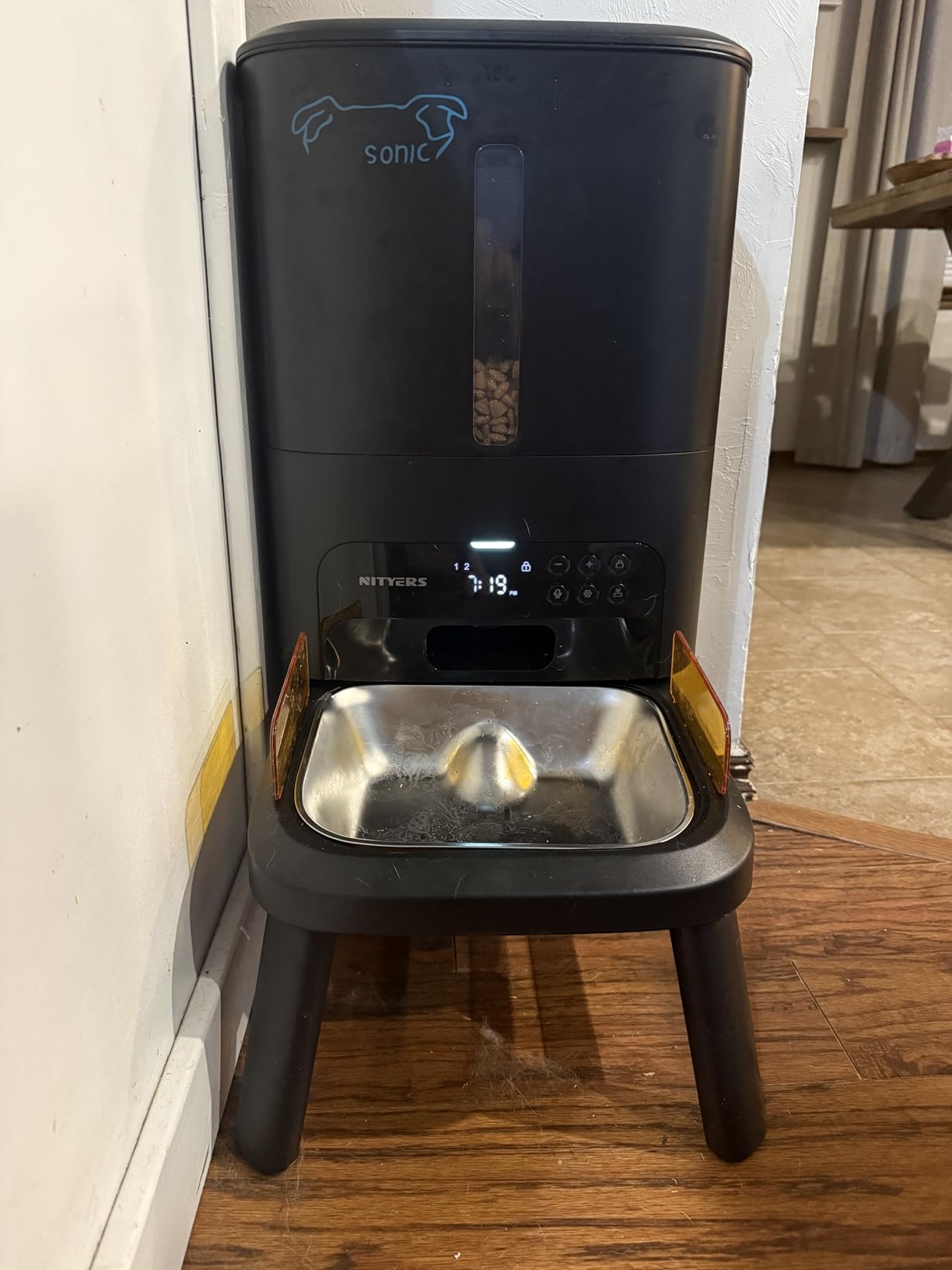
Portion range is unusually wide for a unit this size: up to 6 meals a day with up to 50 portions per meal, where one portion is an eighth of a cup, giving a maximum of 6.25 cups. That matters for breeds like a Great Dane or a Bernese, whose single meal is far more than a two-portion serving. Freshness is handled by a spring-lock lid with a silicone seal ring, a desiccant compartment and a silicone rotor that seals the outlet between meals.
It is programmed on the device with no WiFi, Bluetooth or app, has a manual feed button and a voice message recorder, and runs on a DC adapter with eight AA batteries for backup. The whole thing disassembles, and the listing notes the hopper keeps kibble contained when removed, which solves a mess you would otherwise have guaranteed.
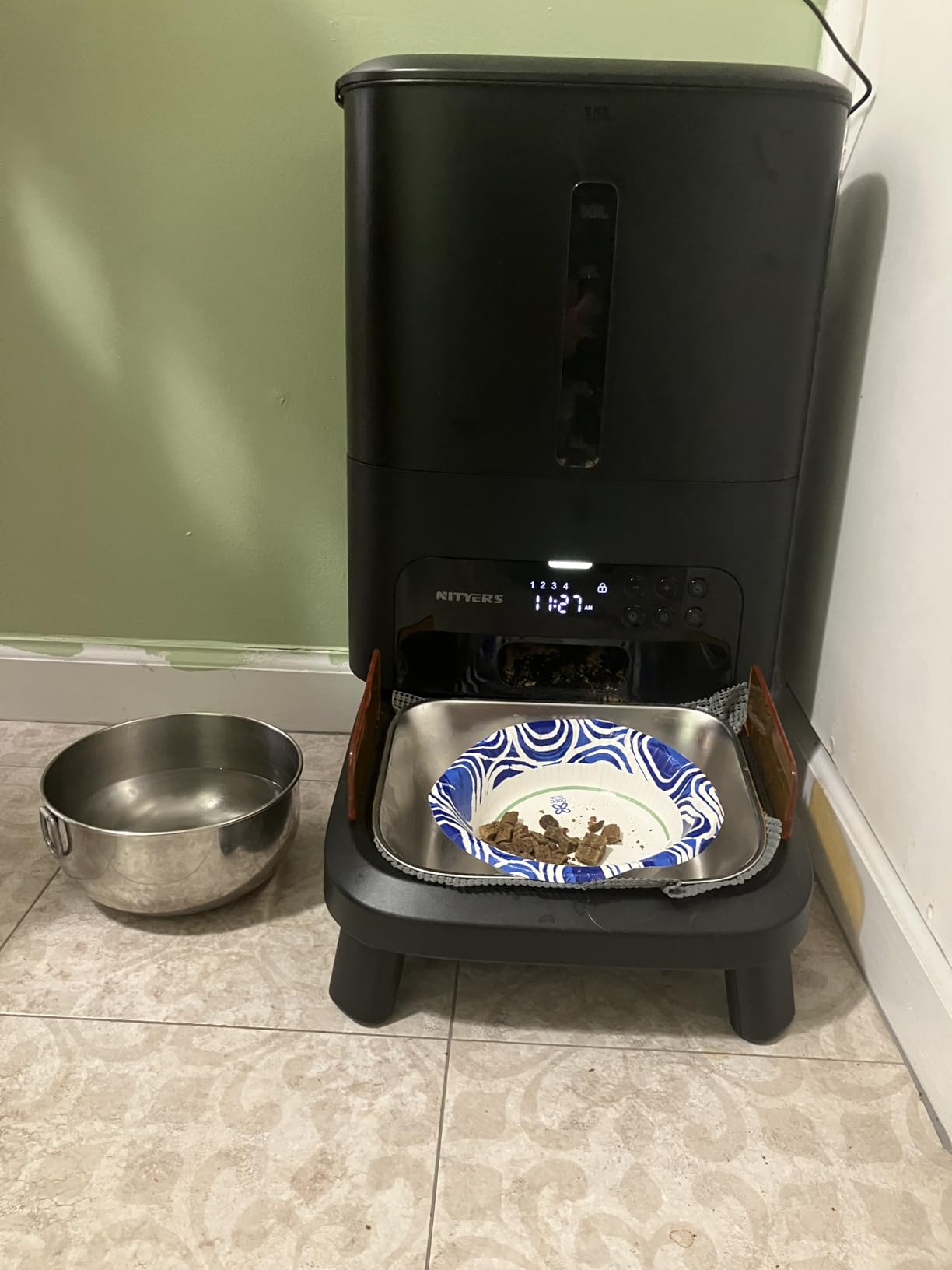
How do the two stand heights actually help?
They address a real problem with feeding big dogs. A bowl sitting on the floor forces a deep-chested dog to stretch down and eat at an awkward angle, which is uncomfortable for large breeds and worse for older dogs with joint issues. The twist-lock stands let you set the bowl higher in about a minute, no tools, once you know your dog’s comfortable height. We would pair this with our [orthopedic bed guide](https://www.wearesalt.org/best-orthopedic-dog-beds-for-large-breeds/) thinking, since joint comfort is a two-sided problem.
For a puppy still growing, starting low and moving up as the dog matures is the sensible approach. For a senior large breed, the high setting is usually the one that matters most.
What are the compromises?
The stainless bowl sits a little loose in the tray and shifts as the dog eats, which is the most common complaint and the reason we did not put this at the top. The display turns off when it is running on batteries only, so programming during a power cut means a dark screen. Dispensing is not especially quiet, which matters in a bedroom-adjacent spot.
There is also no app or camera, so no notifications when you are away. Some reviewers treat that as a feature, since there is nothing to hack and nothing to fail. A small number of units failed within weeks, and at 154 reviews it has a thinner history than the picks above it, so buy it with the understanding that you are evaluating a newer design.
10. Cucurbita 3 Gallon Gravity Station for Dishwasher-Safe Parts
cucurbita Automatic Dog Feeders, Dog Feeder Dispenser for Large Dogs, 3 Gallon Gravity Automatic Dog Cat Feeder Station, Dry Food Storage Container Bowl for Adult Dogs
3 gallon capacity
6-15 days for large dogs
Dishwasher-safe parts
No power
Pros
- 3 gallon capacity covering roughly 6 to 15 days for a large dog
- Gravity action needs no electricity or programming
- Removable dishwasher-safe tank and base
- Anti-skid base helps prevent tipping or sliding
Cons
- Plastic body is lighter and less weatherproof than steel
- No portion control because food replenishes by gravity
- Flow rate depends on kibble size and can bridge or clog
This is the simplest unit in the list and the easiest to live with. Three gallons covers roughly 6 to 15 days for a large dog, you fill the bucket and snap it onto the base, and the food refills the bowl on its own. There is no power, no app, no schedule and no parts that can fail electrically.
What earns the 4.5 rating across 106 reviews is the cleaning story. The food tank, base and other parts are removable and dishwasher safe, which for a feeder holding two weeks of kibble is a genuine advantage, and the brand recommends a weekly wash. The anti-skid base helps keep the unit in place rather than sliding across a hard floor. It measures 17.9 by 10.4 by 17.3 inches and weighs 1.8 pounds.
At 79 percent five star, satisfaction is high, but owners should be clear about the design. Gravity refill means there is no portion control, and the flow rate depends on kibble size. Large, angular pieces can bridge in the outlet, which is the same physics that limits every plastic gravity unit we tested, including the Kenond above.
Who benefits most from a gravity-only station?
Owners of multiple dogs where keeping food available beats controlling it, and households where the feeder lives outdoors or in a garage and electricity is not an option. It is also a sensible second station, since it costs a fraction of an electronic unit and can be a spare when the main feeder is being cleaned. For two large dogs specifically, our [dog crates for large dogs](https://www.wearesalt.org/best-dog-crates-for-large-dogs/) guide covers the containment side of that setup.
Anyone with a dog on a weight plan should skip it entirely. An always-full bowl in front of a Labrador is the opposite of what a veterinarian asked for.
Where it falls short next to a steel feeder?
Weight and weather. At 1.8 pounds in plastic, a strong dog can push it and cannot be stopped by sheer mass, and plastic degrades faster in direct sun and cold than galvanized steel. If your feeder lives outdoors year round, the KHEARPSL or the Pet Lodge will simply outlast it, and the 25 and 50 pound capacities dwarf three gallons anyway.
It also offers no signal that anything went wrong, because nothing can. That is the appeal and the limitation at the same time. Check the fill level daily, because the bowl will look the same whether the outlet has bridged or not.
How to Choose an Automatic Dog Feeder for a Large Breed
Hopper capacity and how many days you can go between refills
Capacity is the first thing to check, and the litre figure is only half the answer. The useful calculation is hopper volume against your dog’s actual daily intake, not the days-per-fill number on the box. As a working guide, a dog eating about 2 cups a day gets roughly 12 to 15 days from a 12L hopper and around 18 to 20 days from a 15L hopper, while a dog eating 4 cups a day halves that. A 50 pound dog will comfortably coast on a 12L unit, a 100 pound dog will not.
Steel gravity feeders break the litre model entirely, since a 25 pound or 50 pound capacity is measured by weight and is the largest on the market by a wide margin. If you feed more than one large dog, or you travel for several days on a regular basis, capacity is the feature that buys you convenience.
The second half of the capacity decision is freshness. Every extra day in the hopper is another day of kibble exposed to air and to a dog who can hear it moving. A sealed lid with a desiccant compartment, which the Nityers, the Yakry and the DOGNESS all have, is what makes a long interval acceptable.
Kibble diameter and what anti-jam actually means
Feeder anti-jam claims mean one of four things mechanically, and they are not equal. A torque motor that keeps turning until the obstruction clears is the most robust. A stirring paddle or dual-rotor channel that breaks up bridging kibble is the next best. A widened outlet and angled chute help but do not actively clear a jam. And a large hopper with no mechanism at all, which is what gravity feeders offer, relies entirely on slope.
The number that matters is your kibble diameter in millimetres. Large-breed formulas run chunky, and anything above 20mm will jam an 18mm feeder. Check the stated ceiling, and then leave yourself at least 2mm of headroom, because kibble varies between bags and between recipes. The Nityers claims 2 to 23mm and the Dokoo 2 to 22mm, which is the range we would trust for the biggest kibble, while the UTCG and the DOGNESS cap out at 18mm.
Test before you trust it. Run ten consecutive dispenses on your actual kibble, watch for the motor straining, and check the outlet is clear each time. That is the single most useful thing you can do before leaving a feeder to work alone for a week.
Portion accuracy, meals per day and how much a large dog eats
Portion range is more important than portion precision for most people. The relevant figure is the maximum single meal, not the number of serving steps. A Great Dane can eat several cups at a sitting, so a feeder topping out at two cups per dispense forces you to stack servings, which is fine but means the bowl has to hold two or three drops of kibble without the dog eating between them. The Nityers reaches 6.25 cups per meal, the Molly and Cody reaches 60 portions, and those are the two built for the biggest dogs.
Meals per day matters more than it looks. Six meals is plenty for most adult dogs, and up to 15 gives you room to split a large ration into smaller dispenses, which can help with gulping. The DOGNESS tops out at nine meals a day and also claims up to 3.5 cups per meal, which is a useful combination for a dog that needs a large ration without one enormous serving.
On accuracy, serve sizes are calibrated to a reference kibble, not yours. Weigh ten dispenses on a kitchen scale in the first week and adjust the portion count from there. If a feeder cannot hit a target weight with your food, that is a reason to choose a different one, and the owners who report the most accurate results are the ones who clearly did this.
Power, battery backup and behaviour during an outage
Every powered feeder here runs mains power with a battery backup, and the differences are in the runtime and the honesty of the claim. D-cell backups, three or four cells, are the most common. Eight AA cells, which the Nityers uses, are the easiest to keep stocked. The DOGNESS is the only unit with a built-in rechargeable cell, claiming 60 to 80 days on backup, and the Molly and Cody claims up to 84 days from four AA cells.
Test the backup rather than trusting the label. Switch off the power mid-afternoon with the feeder full and see whether it still dispenses on schedule, then check whether the clock survived. The DOGNESS owners specifically report a clock reset after outages, which is exactly the failure a backup test would have caught before you relied on it.
Then decide how much connectivity you want. An app gives you remote feeding and a feeding history, but a WiFi failure becomes a scheduling failure unless the device keeps a local schedule, and a paired phone is a dependency you do not control. A feeder with no radio cannot fail that way, which is the entire argument for the Dokoo, the Nityers and the DOGNESS.
Stability, bowl height and tip resistance for a 60 to 100 lb dog
Weight is the simplest defence. The Dokoo at nearly 20 pounds, the Nityers at 11.4 pounds and the KHEARPSL at 12 pounds are effectively immovable. The two plastic gravity units at 1.78 and 1.8 pounds are not, and owners with strong dogs report pushing them around. If your dog weighs more than about 60 pounds, assume a plastic gravity feeder will move unless you place it in a corner.
Mounting is the better answer where the unit supports it. The UTCG includes a wall mount kit, the Pet Lodge and the KHEARPSL have pre-drilled bolt holes, and the Nityers has a weighted base plus stands. For the units without mounts, strapping the base down is a reasonable workaround that several owners have used.
Bowl Height is the health item most specs miss. A 9.84 inch bowl on an adjustable stand lets you feed a deep-chested dog at chest height rather than at floor level, which is more comfortable and better for joints. Deep-chested breeds in particular, and older dogs with hip issues, are the ones that feel the difference most.
Scheduled feeding, free feeding and the bloat question
This is where veterinary guidance matters most, and it is a question owners raise constantly. Vets generally recommend measured, scheduled meals over free-choice feeding for large breeds, for one reason: obesity. Labrador Retrievers, Golden Retrievers, Beagles and Rottweilers are heavily represented among dogs that are overweight, and a bowl that never empties makes weight management much harder. The second reason is gulping, which matters for deep-chested breeds.
Bloat, or gastric dilatation-volvulus, is the condition every large-breed owner has heard about, and dogs that eat fast are more at risk. An automatic feeder is not a treatment for it, and it is worth being direct about that. What a scheduled feeder does is break the day into measured portions, which slows the pace of eating compared with one large bowl, and lets a veterinarian’s portion instruction be followed exactly rather than approximated. Nothing replaces veterinary advice, and a dog showing signs of bloat needs a vet, not a feeder setting.
If your dog is a gulper, look for a slow-feed insert you can pair with the unit, or a larger bowl that spreads the kibble out. Two or three smaller scheduled meals are usually easier on a large dog than one big one, which is an argument for a unit with a high meals-per-day limit.
Powered feeders versus gravity feeders
The honest summary: a gravity feeder cannot fail because there is nothing to fail, and it cannot portion food because it has no mechanism to do so. A powered feeder can measure meals precisely and feed on a schedule, and it can jam, lose WiFi, lose its clock or be destroyed by a chewer.
Choose gravity for a self-regulating dog, a multi-dog yard, an outdoor run or anywhere without reliable power. Choose powered for a single dog on a weight-management or prescription diet, for scheduled meal times, or if you travel regularly and want the dog fed on days you are not there. Owners who want the reliability without the app should start with the Dokoo or the Nityers, which combine scheduled portions with no connectivity dependency.
Where automatic feeders fall short
They do not replace being home. Every unit here can fail silently, and a large dog that goes without food for a day is a genuine problem, not an inconvenience.
They are not built for wet food. Every feeder in this list is for dry kibble, and wet food needs ice packs and a refrigerated compartment, which no hopper feeder here has. If your dog eats wet meals, you need a separate refrigerated feeder, which is a different category of product entirely.
They do not solve separation anxiety. Owners frequently report the feeder triggering distress behaviours in dogs that are already anxious about being left alone, and a camera on a unit cannot fix that. Address the anxiety first.
They need cleaning. Kibble sitting for two weeks in a hopper will go rancid, and a feeder that is easy to disassemble, like the Nityers or the Cucurbita, is worth more over a year than one that is not. Weekly washing is not optional.
They do not measure what your dog actually ate. A successful dispense is not a finished meal, and a camera is the only way to know. The Yakry and the UTCG are the two in this list where that matters most.
Frequently Asked Questions
Do vets recommend automatic feeders?
Most veterinarians recommend scheduled, measured meals over free-choice feeding for large breeds, mainly because obesity is far more common than the alternative. A feeder that dispenses a set portion on a schedule also makes it far easier to follow a weight-management or prescription diet exactly as written. A feeder is not a treatment for conditions such as bloat, and any dog showing symptoms needs a veterinarian rather than a feeder setting.
Are automatic dog feeders worth it?
They are worth it when your dog is on a measured diet, when you work long or irregular hours, or when you travel regularly, because a set schedule is more reliable than an ad hoc bowl. They are less useful if your dog self-regulates well and you are home most of the day. The value depends entirely on whether portion control solves a problem you actually have.
What is the best automatic large dog feeder with timer?
The strongest on-device timer option for large breeds is the Nityers 15L, which programmes up to six meals a day with up to 6.25 cups per meal, handles 2 to 23mm kibble and has two stand heights and a 9.84 inch stainless bowl. The Dokoo 15L is the alternative, with a 2 to 22mm ceiling, an adjustable elevated bowl and no app at all.
What is the best automatic dog feeder for large kibble?
For the largest kibble, prioritise the stated millimetre ceiling first, then the bowl size. The Nityers handles 2 to 23mm with the widest bowl we tested, and the Dokoo handles 2 to 22mm with a vertical dispenser that lifts kibble rather than pushing it. Feeders rated to 18mm, including the UTCG and the DOGNESS, are safer with medium kibble than with large-breed chunks.
What is the most reliable automatic pet feeder?
Reliability splits into mechanical durability and connection reliability. On mechanics, the Pet Lodge galvanized steel feeder has been in continuous use since 2006 across more than 5000 reviews with no electronics to fail. On connection reliability, the Dokoo, Nityers and DOGNESS programme on the device itself, so a WiFi drop cannot stop the schedule. Test the battery backup before you rely on any of them.
What are the disadvantages of using an automatic pet feeder?
The main drawbacks are silent failure, cleaning, and no wet food support. A dispense can fail without telling you, kibble sitting for two weeks goes stale, and none of these units chills wet food. They can also trigger separation anxiety, they do not confirm the dog actually ate, and a determined large dog can tip a light plastic unit or chew off a plastic chute with no replacement parts offered.
Conclusion
The best automatic dog feeders for large breeds come down to which problem you are solving. For outdoor, free-fed and multi-dog situations, the Pet Lodge 50 pound galvanized steel feeder is the pick: it holds more than anything else here, it has been in service since 2006 across thousands of reviews, and nothing about it can fail electronically.
For a dog on a measured diet, the Nityers 15L leads on the numbers that matter, with a 23mm kibble ceiling, a 9.84 inch bowl and two stand heights. If you need to see the bowl from your phone, the Yakry 12L pairs a camera with enough capacity for a large dog. And if you want scheduled feeding with zero connectivity risk, the Dokoo 15L programmes on the unit itself and moves the largest kibble we tested.
Whichever you pick, run ten test dispenses on your actual kibble, weigh them, and test the battery backup before you leave the house for a week. Those three steps will tell you more in an afternoon than any spec sheet. For the rest of the setup, our [dog doors for large dogs](https://www.wearesalt.org/best-dog-doors-for-large-dogs/) guide covers controlled access, and this roundup was updated for 2026.