

For cutting full-size plywood sheets, a track saw is the best handheld tool. It rides inside a clamped guide rail, so the blade follows the rail edge instead of a pencil line, and it can rip a 4×8 sheet of 3/4 inch plywood square without a table saw, an outfeed extension, or lifting the sheet.
That last part matters more than any spec on the spec sheet. Sheet goods are heavy and awkward, and the projects that use the most plywood — cabinet carcasses, shop fixtures, wall panels, a run of ply for a renovation — all start the same way: one full sheet, broken down into parts. Our team spends more time on that first cut than on the joinery that follows it.
We compared ten track saws for plywood sheets for 2026, weighing the things that actually show up on a full sheet: depth of cut at 90 degrees, whether a rail is included and how long it is, tooth count and finish quality on a veneer face, and how the saw behaves when the offcut starts to drop. What follows is the full breakdown, plus a step-by-step sheet-cut workflow and a buying guide covering rail length math, brand compatibility, and blade selection.
If you cut only small parts on a hobby bench and never touch a full sheet, a smaller circular saw may serve you well. Our picks for hobby-scale cutting are covered in 12 best micro saws and razor saws for hobby use.
Top 3 Track Saws for Plywood Sheets in 2026

Makita SP6000J1
- 12A with variable dial
- 2-3/16 in at 90 degrees
- 55 in rail included
- 48T blade

All 10 Track Saws for Plywood Sheets at a Glance
The table below is the fast version. Every saw listed makes straight, square cuts on a full sheet if you pair it with the right rail. What changes between them is cutting capacity, how much of the sheet one pass covers, and how much of the setup you inherit from the box.
| Product | Specifications | Action |
|---|---|---|
| WEN CT1065 10-Amp Plunge Track Saw |
|
Check Latest Price |
| Makita SP6000J1 Plunge Saw Kit with 55 Inch Rail |
|
Check Latest Price |
| DEWALT DWS520K TrackSaw Kit |
|
Check Latest Price |
 Makita XPS01PTJ 36V Cordless Plunge Saw Kit Makita XPS01PTJ 36V Cordless Plunge Saw Kit |
|
Check Latest Price |
 Festool TS 55 FEQ-F-Plus-FS with 55 Inch Rail Festool TS 55 FEQ-F-Plus-FS with 55 Inch Rail |
|
Check Latest Price |
 Evolution R185CCSX Multi-Material Track Saw Kit Evolution R185CCSX Multi-Material Track Saw Kit |
|
Check Latest Price |
 Bosch GKT13-225L Precision Track Saw Bosch GKT13-225L Precision Track Saw |
|
Check Latest Price |
 Metabo HPT C3606DPA 36V MultiVolt Track Saw Kit Metabo HPT C3606DPA 36V MultiVolt Track Saw Kit |
|
Check Latest Price |
 Milwaukee M18 FUEL 6-1/2 Inch Plunge Track Saw Milwaukee M18 FUEL 6-1/2 Inch Plunge Track Saw |
|
Check Latest Price |
 Bosch GKT18V-20GCL14 18V Track Saw Kit Bosch GKT18V-20GCL14 18V Track Saw Kit |
|
Check Latest Price |
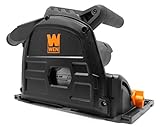
1. WEN CT1065 Plunge Track Saw — the Most Straightforward Way to Start Cutting Sheets
WEN CT1065 10-Amp 6.5-Inch Plunge Cut Sidewinder Circular Track Saw,Black
10 amp corded
6.5 in high speed steel blade
2-1/3 in rip capacity
45 degree bevel
Pros
- Rips lumber up to 2-1/3 inches with a clean splinter-free edge
- Handles 45 degree bevels in board up to 1-5/8 inches
- Supports full rip cuts and internal plunge cuts
- Includes a 6.5 inch 24 tooth carbide blade in the box
Cons
- Guide rail not included
- 6.5 inch blade limits it on the thickest sheet
- 4.4 average rating carries a heavier share of one-star feedback than the premium saws
The WEN CT1065 is the one I hand to people who are buying their first track saw and want to know what they are dealing with before they spend on a premium system. It is a 10 amp corded plunge saw with a 6.5 inch high speed steel blade, a 45 degree bevel, and a rip capacity of 2-1/3 inches at 90 degrees.
That 2-1/3 inch rating is the number to understand for sheet work. A 3/4 inch sheet sits flat on a cutting platform with plenty to spare, and two sheets of 3/4 inch ply at 1-1/2 inches still leaves clearance. For deeper material, this saw is not the right tool.
Owners in the reviews describe clean, splinter-free cuts on lumber and plywood, and the bundled 24 tooth carbide blade handles the job without a swap. The plunge works both ways, which means it rips full widths and makes internal plunge cuts for things like a finger joint or a drawer opening.
At 1,577 reviews averaging 4.4 stars, this is the highest-volume listing in our group and the feedback is consistent. What comes up again is the same point buyers raise on nearly every entry-level track saw: no rail in the box. You need the WEN CT9502 100 inch track or a shorter section, plus the CT992F clamps, before this becomes a sheet saw.
Its compatibility is narrow, and that is worth knowing before you plan a system. It runs on WEN tracks, and the blade is 6.5 inch with a 20 mm arbor, so it is not interchangeable with the 6-1/2 inch class rails most other saws use. If you later move to a Festool or Makita rail, this saw is not the one that goes with it.
One habit matters more than the saw here. Lay the sheet waste-side up and score the face with a knife before plunging, because the blade guard limits how much of the cut line you can see on a full sheet.
When the WEN CT1065 is the right buy
This is the one to pick if you cut plywood a few times a month rather than daily, and you want the lowest learning curve in the group. The plunge is straightforward, the bevel is a single lever, and there is no battery platform to think about. For weekend cabinet work or fitting panels in a rental renovation, it does the whole job.
It also holds up on dimensional lumber, which is where most beginners start. Its 2-1/3 inch rip capacity clears 2x lumber and most hardwood stock without stopping, and the 45 degree bevel handles tapered cuts and trim. If your actual workload is small parts rather than full panels, our 12 best micro saws and razor saws for hobby use covers lighter bench work.
When you should skip the WEN CT1065
Skip it if your plywood runs thicker than 3/4 inch, or if you intend to cut stacked layers regularly. Also skip it if you already own a Makita, Bosch or Festool rail, because the 6.5 inch blade and WEN-only track interface will not let you reuse any of that.
Finally, do not expect a premium finish. The 24 tooth blade is a rough-cut blade. It will crosscut sheet goods cleanly, but on a face-grade veneer sheet you will want a higher tooth blade before you commit to a visible panel.
2. Makita SP6000J1 Plunge Saw Kit — the Best All-Rounder with a Rail in the Box
Makita SP6000J1 6-1/2″ Plunge Circular Saw Kit, with Stackable Tool case and 55″ Guide Rail, Blue
12 amp and 1800W corded
2-3/16 in at 90 degrees
1-9/16 in at 45 degrees
55 inch rail in kit
Pros
- Kit includes a 55 inch guide rail and stackable case
- 12 amp motor with a 2000 to 5200 RPM variable dial
- Electronic speed control holds speed under load
- 2-3/16 inch capacity at 90 degrees and 1-9/16 inch at 45 degrees
- -1 to 48 degree bevel with positive stops at 22.5 and 45 degrees
Cons
- 55 inch rail is short for full 4x8 breakdown
- Rail sections need a joining connector for full sheet lengths
- Cord management on long cuts in a small shop
The Makita SP6000J1 is the kit I recommend most often because it removes the two arguments that slow a first purchase: the rail question and the power question. It comes with a 55 inch guide rail, a 48 tooth carbide blade, a stackable tool case, and a 12 amp corded motor rated at 1,800 watts.
Cutting capacity is 2-3/16 inches at 90 degrees and 1-9/16 inches at 45 degrees, which is the deepest capacity among the 6-1/2 inch corded saws in this group. That means a 3/4 inch sheet with the saw set just past the material, or two layers of 3/4 inch ply, and you still have headroom.
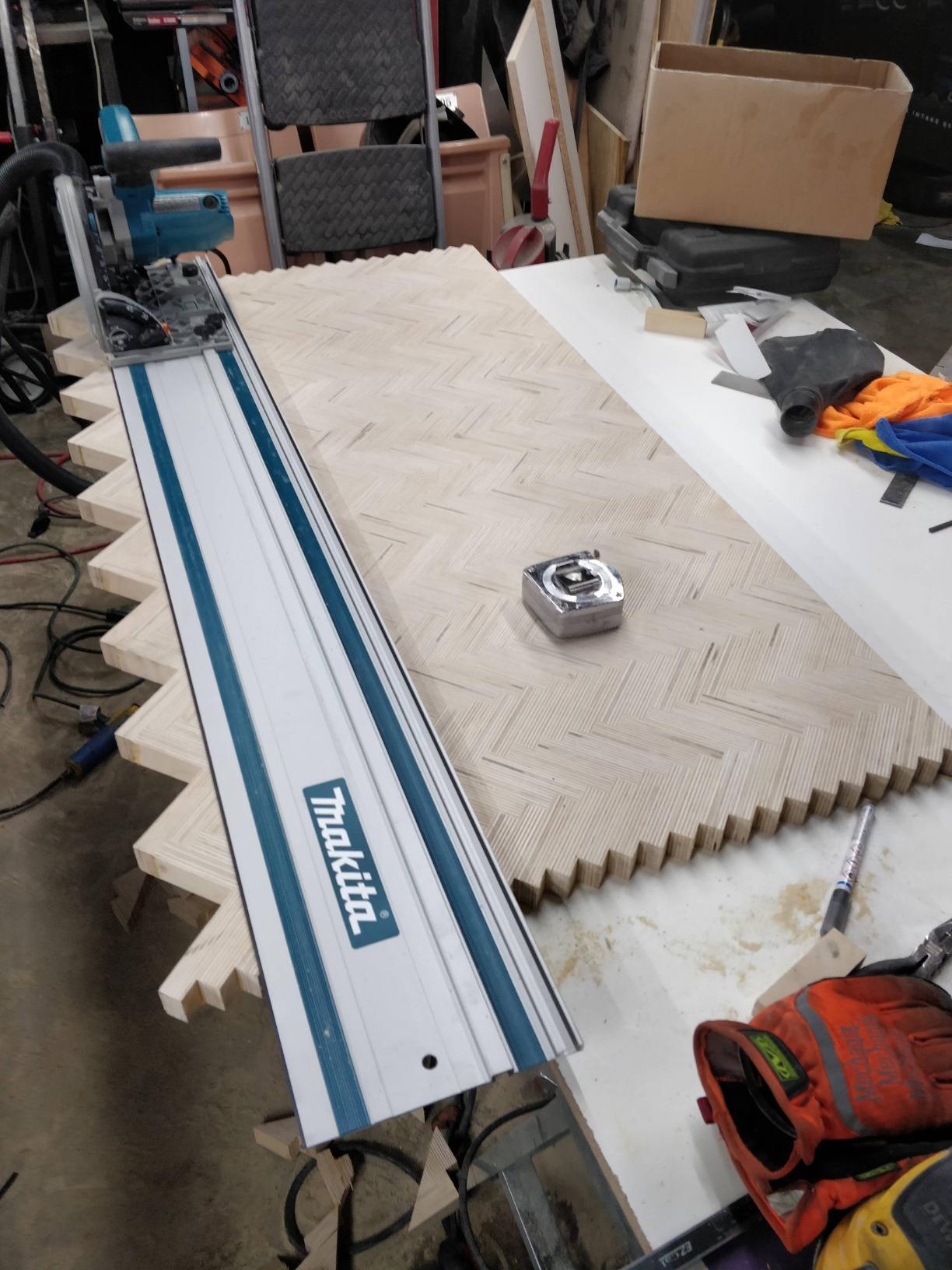
The speed control is a dial from 2,000 to 5,200 RPM, and the electronics hold the set speed under load. On sheet goods that shows up as a smoother cut and less blade bog on the exit side of a long rip through plywood. Owners frequently describe the finish on plywood and hardwood as a splinter-free mirror edge.
Bevel range is -1 to 48 degrees with positive stops at 22.5 and 45 degrees. Those stops are the practical detail for sheet work, because they let you set the bevel the same way every time without a protractor and re-measuring, which matters when the same angle repeats across a run of panels.
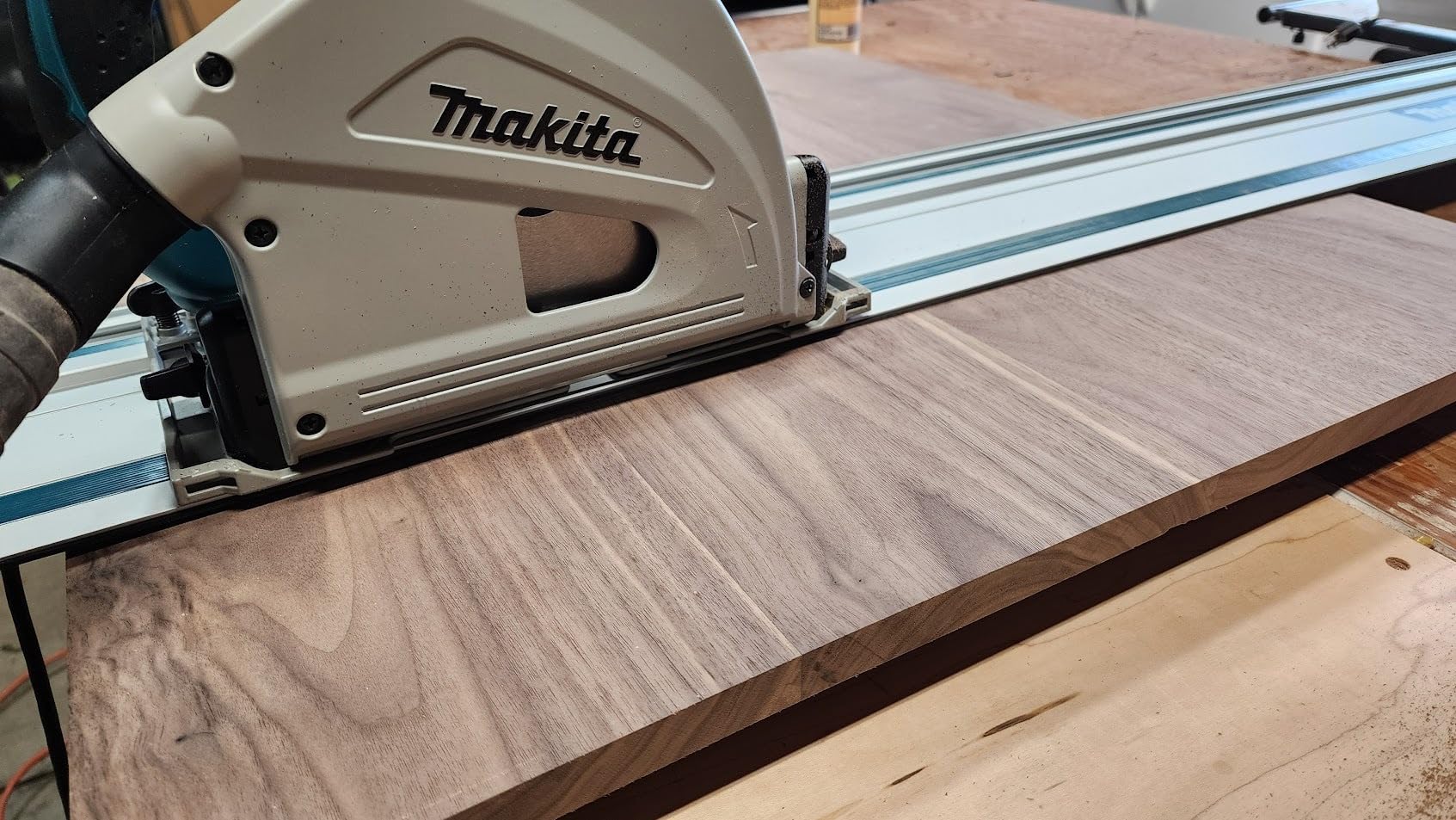
The honest limit is the rail. A 55 inch rail covers about half of an 8 foot sheet, so breaking down a full sheet means repositioning and re-entering, or splicing sections with an accessory joining connector. Long-term owners describe Makita and Festool rails as physically connectable to each other, so the system grows sensibly if you stay in the brand family.
At 1,287 reviews averaging 4.6 stars with 84 percent five-star, this is the most complete package in the group out of the box. If you want one purchase that works today and a clear upgrade path, this is the safest starting point.
Why this is the one most people should buy
It is one of only two saws here that pair a rail in the kit with enough capacity to handle stacked plywood, and the cost of that rail is not something you have to research and add separately. For someone cutting a few sheets a week, the difference between having a 55 inch rail on day one and ordering one later is a week of not cutting.
The motor also pulls ahead of most of its corded rivals. If your material runs to birch ply, MDF or a stack of two sheets, you will feel the difference between a 12 amp saw with electronic speed control and a 10 amp saw without it.
Where the Makita falls short
Two things. First, the bevel knobs on this body are light plastic, and a few owners mention they feel flimsy compared with machined metal controls. It is a small complaint that does not affect accuracy once set, but it is a reason some people move up within a year.
Second, the cord. On a full sheet rip the cord is a constant consideration, because the saw runs the length of the sheet and the cord trails behind. Corded saws manage this with an extension reel or by cutting in the other direction. Cordless removes the problem entirely, which is the whole argument for the next pick.
3. DEWALT DWS520K TrackSaw Kit — Straightforward Power with a Zero-Clearance Base
DEWALT Circular Saw, 6-1/2-Inch, TrackSaw Kit (DWS520K)
12 amp and 1300W
2-1/8 in on track at 90 degrees
1-5/8 in at 45 degrees
48 tooth blade
Pros
- Zero-clearance cutting system for straight splinter-free cuts in both directions
- 12 amp and 1300W motor powers through hardwoods up to 2-1/8 inches
- Depth scale accounts for track thickness so on-track readings are exact
- Continuous anti-kickback mechanism with a riving knife
- Low profile blade guard works in tight spaces
Cons
- Despite the kit name no track is included
- Splicing two rail sections can bow the cut mid-span
- Forward downward plunge motion takes some practice
The DEWALT DWS520K sits at 4.7 stars across 1,132 reviews with 85 percent five-star feedback, a heavily reviewed base. The saw runs a 12 amp, 1,300 watt corded motor at 4,000 RPM with a 48 tooth ultra fine finishing blade, and its zero-clearance cutting system is built for tracks with edges on both sides.
That dual-edge track design is worth understanding. Because both long edges of the rail are usable, you flip the rail over or reposition it and the opposite edge becomes the reference, which means the setup stays consistent across a long job and one edge wear does not ruin the setup.
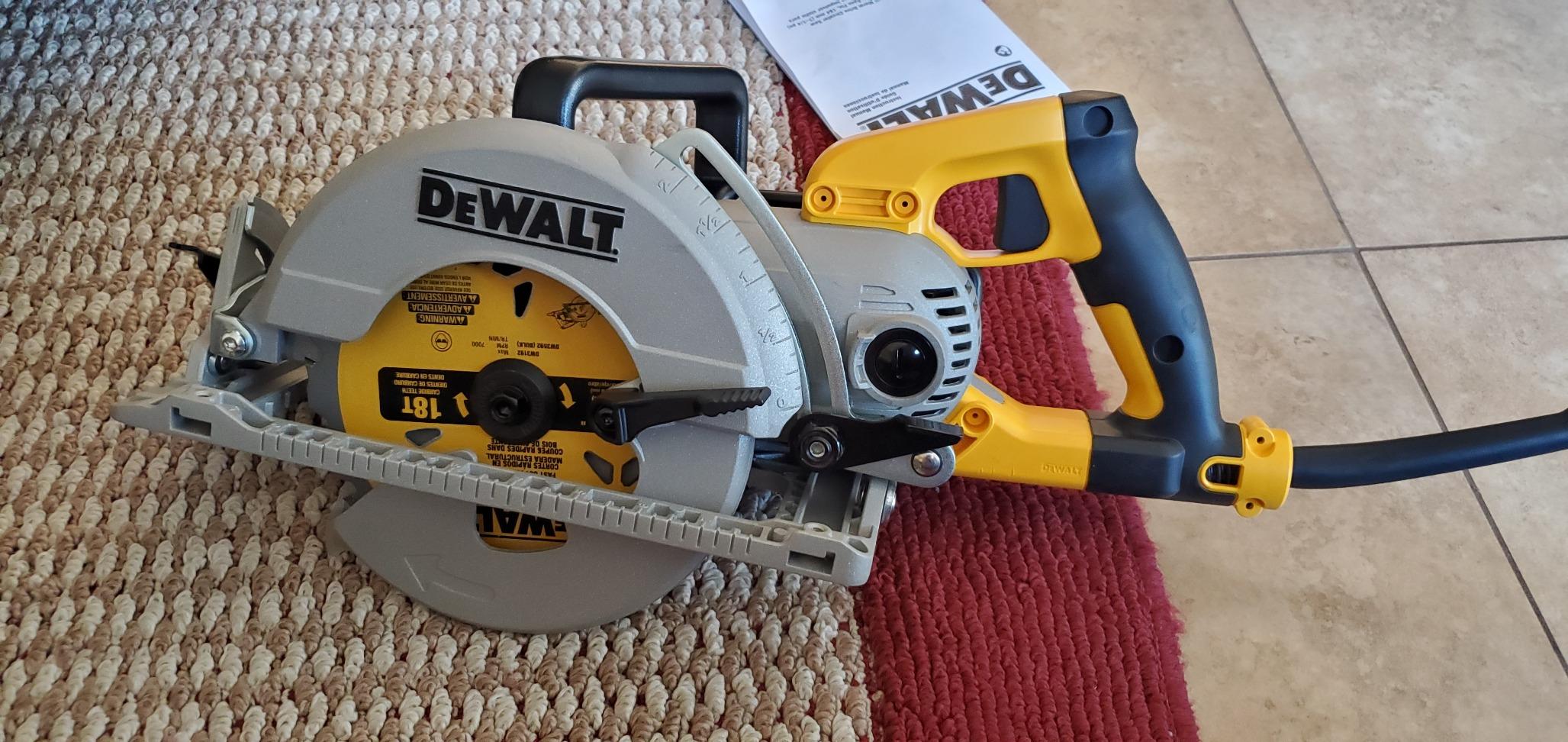
On-track cut depth is 2-1/8 inches at 90 degrees and 1-5/8 inches at 45 degrees. This is the number that trips people up on sheet goods: 2-1/8 inches is measured with the saw running on the rail, so it is the true capacity in real use rather than a free-standing spec. One 3/4 inch sheet, or two thinner sheets, comfortably.
The depth scale is calibrated to include track thickness, which is a small thing that saves real frustration. Set the scale to 1 inch and the saw actually cuts 1 inch through the material even with the rail under the base, so your parts come out the size you measured rather than short by the rail.
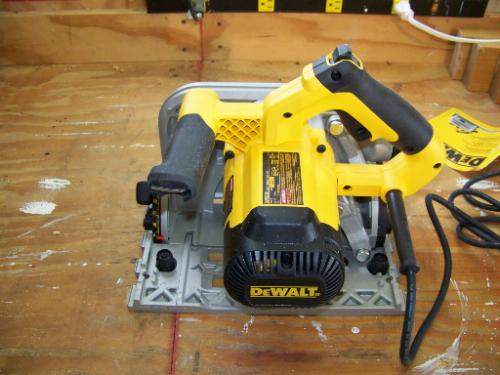
Cabinet makers and remodelers describe this saw as the tool that replaces a small table saw for sheet breakdown, while keeping the table saw for ripping solid lumber and joinery. That is the honest division of labor most small shops arrive at.
Two complaints recur. The first is that despite the kit name, no track is included — it is the saw, blade, wrench and case. The second is that joining two rails can introduce a bow at the join, so most owners add a single long rail of 102 inches or more rather than splicing. That pattern shows up on Lumberjocks and NC Woodworker threads too, where splicing a rail mid-cut is a common subject of debate.
Who this saw suits
If you are building cabinets or fitted furniture and want predictable, repeatable panel parts without remeasuring every time, the calibrated depth scale and the riving knife together are the reason to pick this one. The riving knife and continuous anti-kickback mechanism also make it the safest option here for anyone new to plunge saws.
It is also the pick for tight interior work, since the low profile blade guard lets the body sit close to a wall where a taller guard would block the cut.
Where the DEWALT disappoints
The plunge motion is forward and downward rather than a guard being lowered, which feels unfamiliar for the first few cuts and is worth a practice pass on scrap. And the blade change is the most awkward in this group — owners describe it as finicky compared with a spindle lock and onboard key.
It also lacks a positive stop at 45 degrees, unlike the Makita and Festool. If you cut bevels repeatedly on matched faces, you will set that angle by hand each session or add your own stop.
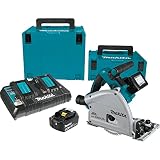
4. Makita XPS01PTJ Cordless Plunge Saw Kit — Cordless Power Without the Cord Dragging
Makita XPS01PTJ 18-Volt X2 LXT Lithium-Ion (36V) Brushless Cordless 6-1/2 inch Plunge Circular Saw Kit (5.0Ah) with 199140-0 39 inch Guide Rail(Sold separately)
36V two battery cordless
6300 RPM brushless
2500 to 6300 RPM dial
6-1/2 inch blade
Pros
- Two LXT batteries give more power and run time than a single 18V pack without a cord
- Brushless motor runs at 6300 RPM with 50 percent longer run time per charge
- Automatic speed change adjusts speed and torque during the cut
- Variable speed dial from 2500 to 6300 RPM
- Close to the wall cutting at 11/16 inch
Cons
- The 39 inch guide rail is sold separately
- Two battery 36V platform is bulkier on long rips
- Kit lists one battery in the case despite the two battery platform
The XPS01PTJ runs two 18 volt LXT batteries in series for 36 volt total, driving a brushless motor at 6,300 RPM. At 719 reviews averaging 4.8 stars with 90 percent five-star, it is tied for the highest average rating in the group, and the reason owners give is speed under load plus no cord.
Automatic speed change technology adjusts cutting speed and torque during the cut, and the variable dial spans 2,500 to 6,300 RPM. On plywood that means you can dial down for the entry, let it speed up through the middle, and avoid the bog that stalls a corded saw near the end of a long rip.
The 6-1/2 inch blade is a 50 tooth cordless blade for wood, MDF and laminate, which is a finer cut than the 24 tooth blade on the entry-level saws here. On a face-grade sheet that tooth count is doing real work on the exit-side finish.
Close-to-the-wall cutting at 11/16 inch matters for interior fit-out, where the panel has to slide behind a skirting line or meet a wall. On a corded saw of this class that number is usually closer to zero.
The cordless argument is practical rather than romantic. On a full sheet rip the saw travels the whole 8 feet, and a corded tool forces you to manage slack, drag, and the risk of pulling the plug. A battery solves that outright, which is why cordless owners describe it as the decisive advantage over a corded track saw.
Plan the battery count carefully. The platform takes two packs to run, and the case contents have been a point of confusion for buyers, so treat this as a two-battery tool from day one rather than assuming one pack will do a sheet.
Why cordless wins for sheet work
Three reasons, in order of how often you will notice them. First, no cord to catch on the rail or drag across a fresh sheet face. Second, no outlet position dictates where the sheet lies on the floor, so you can set up on the trestles that suit the cut rather than the one near the socket.
Third, 6,300 RPM free speed. A corded 12 amp saw in this class typically runs 4,000 to 5,200 RPM, and that difference shows as a cleaner cut on cross-grain plywood. If your panels are face grade, that is worth real money in discarded stock.
Where it falls short
The 39 inch guide rail is sold separately, and at that length it is a short tool for sheet work. You need to budget for a longer Makita rail before this saw can break down a full 4×8 sheet in one pass, which is the single most common complaint in the reviews.
The 36 volt platform is also bulkier and heavier to handle on long rips than a corded body. If you are working overhead or in tight spots, that weight is a factor. And as always with battery tools, the packs are a separate cost that adds up if you are starting from nothing.
5. Festool TS 55 FEQ-F-Plus-FS — the Most Accurate Saw in the Group
Festool Plunge-Cut Track Saw TS 55 FEQ-F-Plus-FS with 55-Inch (1400mm) Guide Rail
55 inch rail included
48 tooth blade
-1 to 47 degree bevel
Splinter guard
Pros
- Attachable splinter guard makes cuts virtually splinter-free on both sides
- Cutting edge stays unchanged from 90 down to 47 degrees when beveling
- Concentrated torque gives up to twice the work progress with longer blade life
- Riving knife for safer work and positioning in an existing joint
- Includes the 55 inch rail and a Systainer case
Cons
- Dust port uses a proprietary connection that needs an adapter for most shop vacs
- Highest cost in the group
- Included 55 inch rail is short for full 4x8 sheet goods
The Festool TS 55 is the tool owners in our group single out for accuracy. At 476 reviews averaging 4.7 stars, first-time cabinet builders and long-term owners describe the cut edges as cleaner than their own table saws, and sometimes cleaner looking than jointed timber bought from a mill.
The attachable splinter guard is the feature that does the most for plywood. It rides on the waste side and keeps the exit-side veneer from lifting as the blade exits, which is the difference between a visible face panel and a part you have to sand or tape.
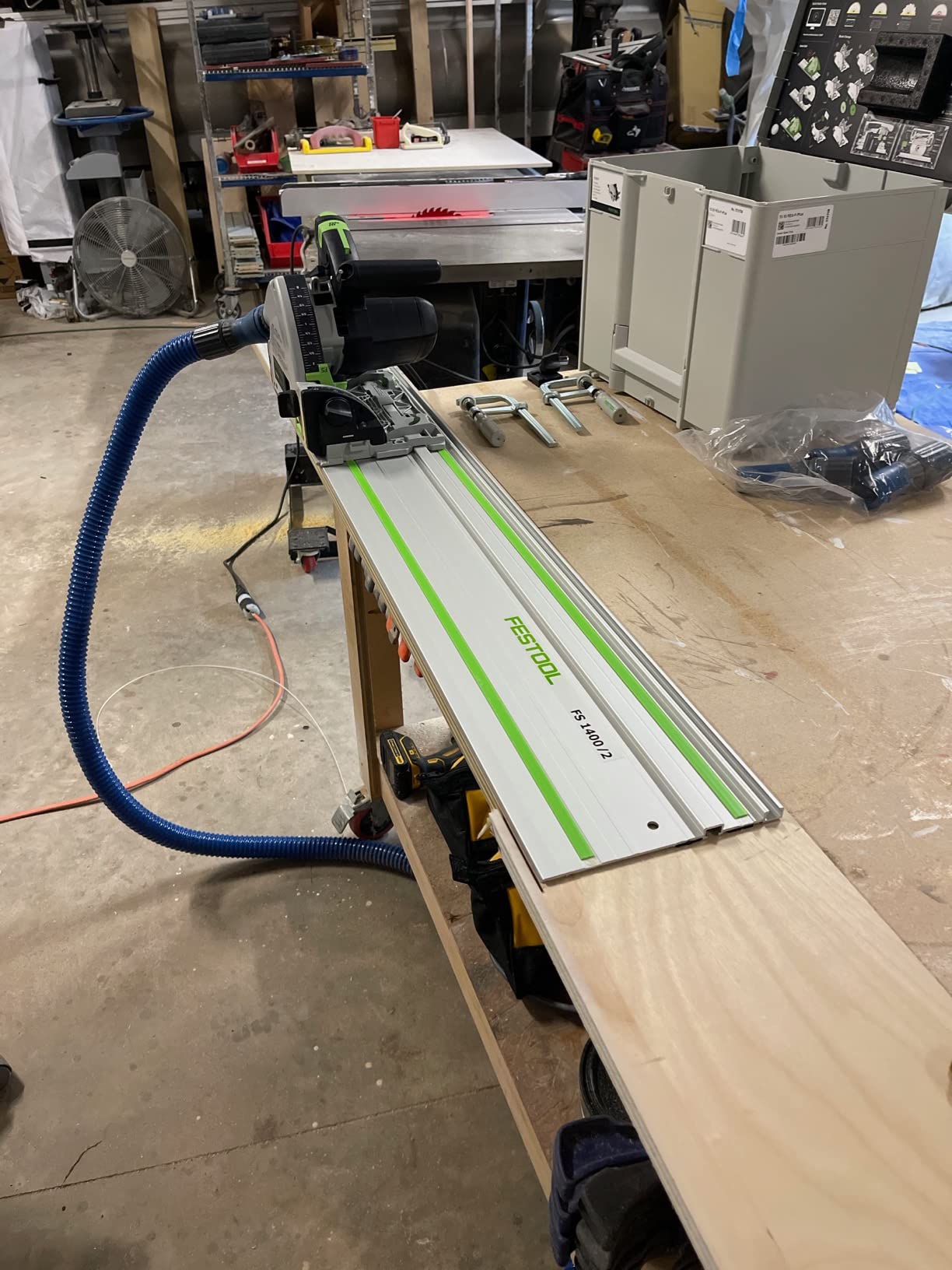
The bevel design is the other quiet advantage. The cutting edge from 90 down to 47 degrees remains unchanged even when the saw bevels, meaning you do not have to re-establish the reference line for an angled cut. On a run of matched plywood faces, that repeatability is the whole job.
Concentrated torque delivers up to twice the work progress with increased blade service life, and the riving knife handles both safety and positioning the saw in an existing joint, which is how you trim a panel flush without recutting the reference.
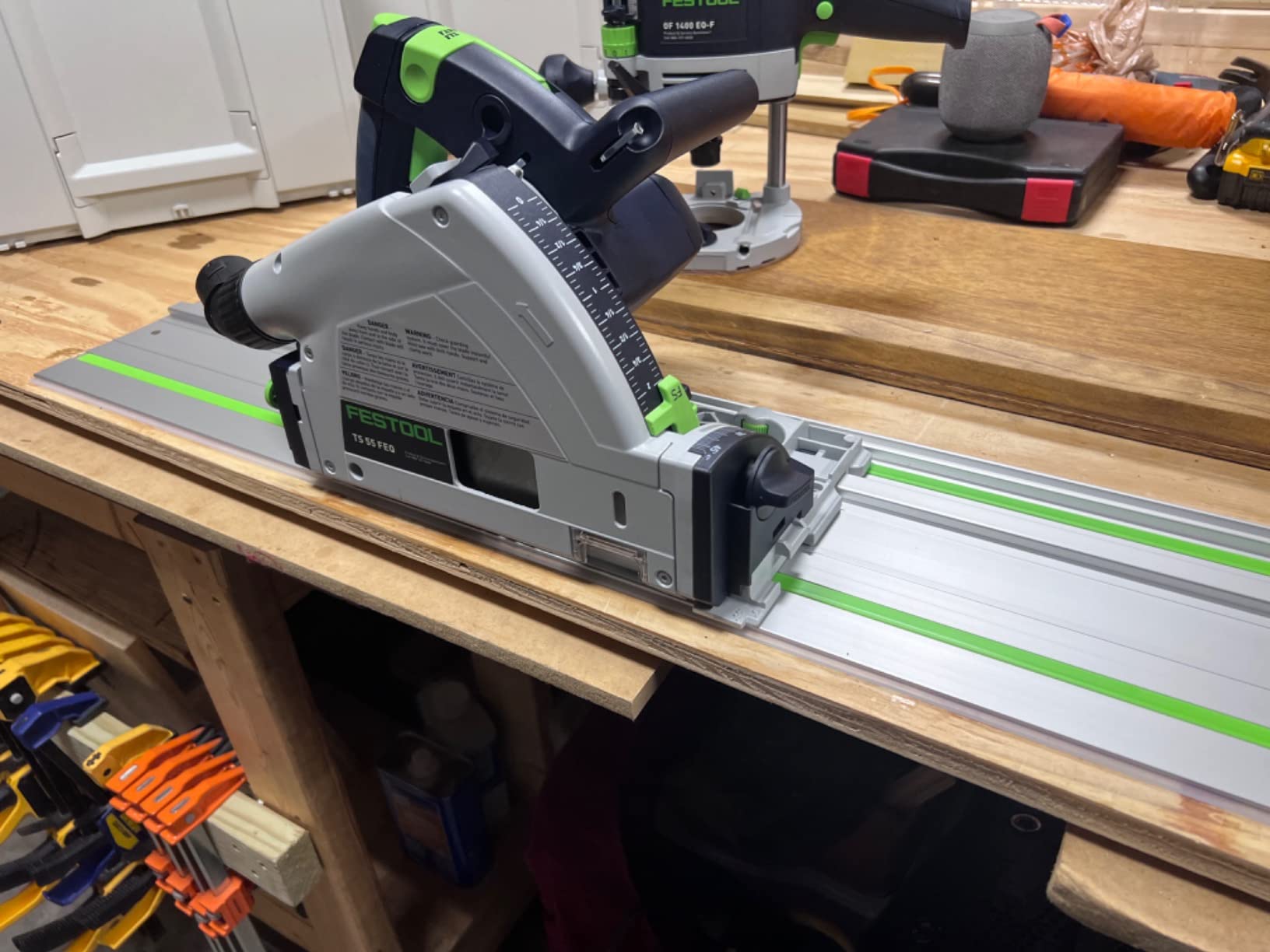
The kit includes the saw, blade, cord, a Systainer case and a 55 inch rail. So for straight panel work it is complete, and the 55 inch length matches the Makita kit for initial setup.
The reason it tops the accuracy ranking is adjustability. Positive bevel stops, micro-adjustable depth, and a track-to-saw fit that holds its setting mean the tool stays where you put it between sessions. That is a different experience from a saw that needs a few minutes of setup each time you pick it up.
Where the Festool earns its cost
If you cut face-grade plywood, veneered MDF, or matched pairs of panels for cabinet doors, the precision shows in the finished piece rather than in a measurement. There is no rehandling, no sanding of torn veneer, and the splinter guard means you can cut a show face with the waste side up and still get a clean edge.
Long-term owner consensus on woodworking forums is blunt about this: enthusiasts who own one describe the track saw cut as the final cut, with no rehandling of the sheet at all. That workflow advantage compounds quickly on a large job.
What you give up
The dust port is a proprietary connection that will not fit most shop vacs without an adapter, and owners frequently note that buying the matching extractor is the second purchase after the saw. Budget for that before you commit.
It also carries the highest cost of any tool in this roundup by a wide margin, and the 55 inch rail still leaves a full sheet needing a splice. Accuracy does not change the geometry of a 4×8 sheet, so you will still want a longer rail for full sheet breakdown.
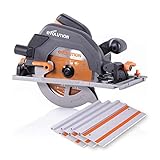
6. Evolution R185CCSX Multi-Material Track Saw — Deep Cuts Without Changing Blades
Evolution Power Tools R185CCSX Multi-Material Circular Track Saw Kit with 40″ Track Included, TCT Blade Included, Cuts Wood, Plastic, Metal & More, 7-1/4 Inch
15 amp hi-torque
2-1/2 in depth
7-1/4 in TCT blade
40 inch track
Pros
- Cuts wood
- plastic and metal with the same blade and no changes
- 15 amp hi-torque motor with an adjustable 2-1/2 inch depth
- 7-1/4 inch blade gives deeper capacity than the 6-1/2 inch class
- Kit includes a 40 inch track and dust port adaptor
- Bevel tilt from 0 to 45 degrees with a pivot
Cons
- 40 inch track is the shortest in the group and covers little of a full sheet
- Lowest average rating at 4.3 with a wider rating spread
- Multi-material blade favours variety over the finest finish on sheet goods
The Evolution R185CCSX is the odd one out in this group and that is the point. It runs a 15 amp hi-torque motor with an adjustable 2-1/2 inch depth and a 7-1/4 inch TCT blade that cuts wood, plastic and metal without changing blades.
The larger blade and deeper capacity mean stacked sheet goods are its natural territory. Two 3/4 inch sheets come well within reach of that 2-1/2 inch figure, and a thicker panel or a laminated build still has clearance to spare. It ties the Metabo HPT for the deepest cutting capacity here.
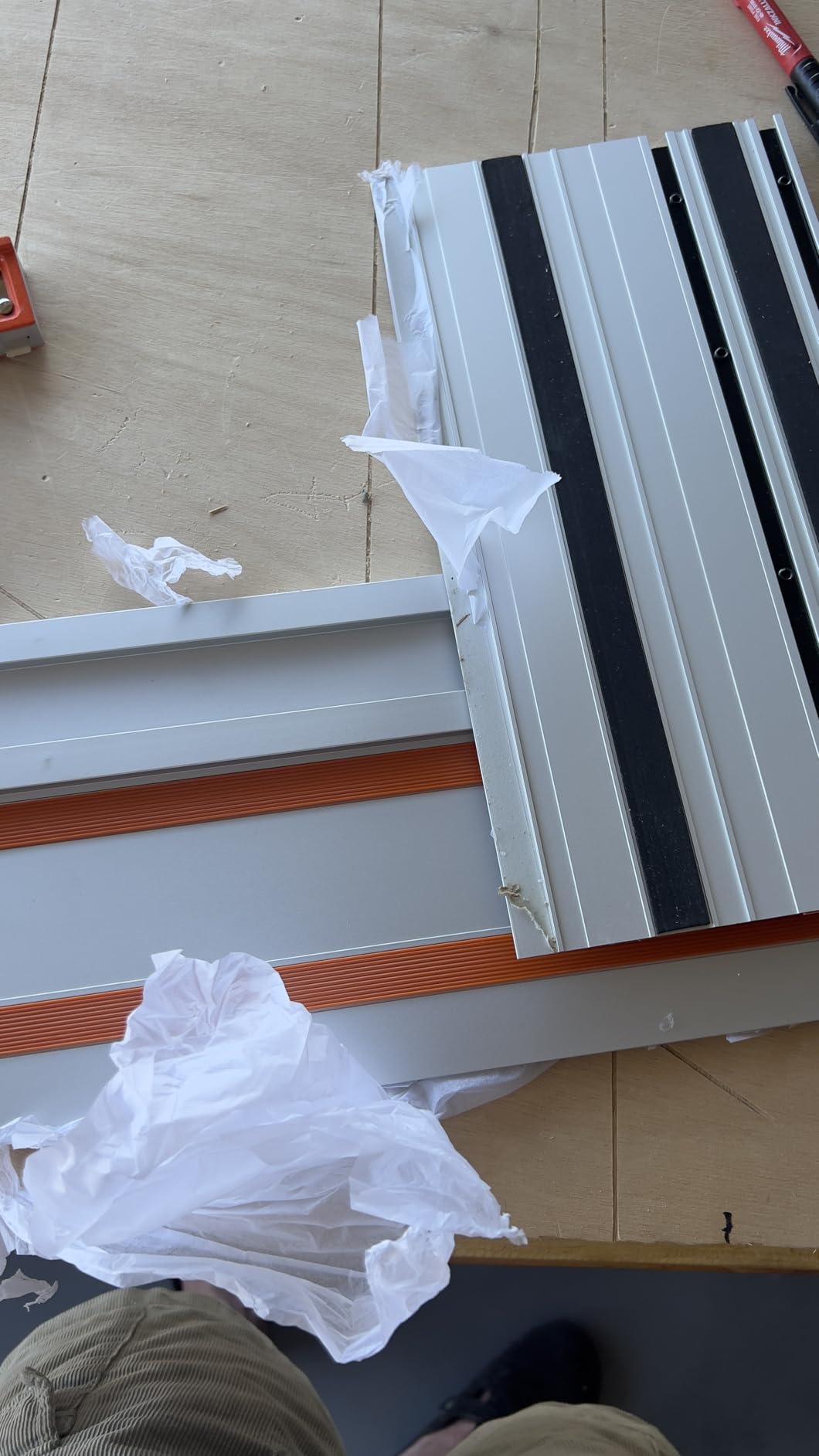
Bevel tilt runs 0 to 45 degrees with a pivot, and the kit includes a 40 inch track, ergonomic soft grip handles, and a dust extraction port with an adaptor. Nothing needs buying before the first cut except a longer rail.
Owners like not changing blades. If your work moves between plywood trim, plastic sheet, and occasional aluminium, that flexibility saves time that a dedicated wood blade would not.
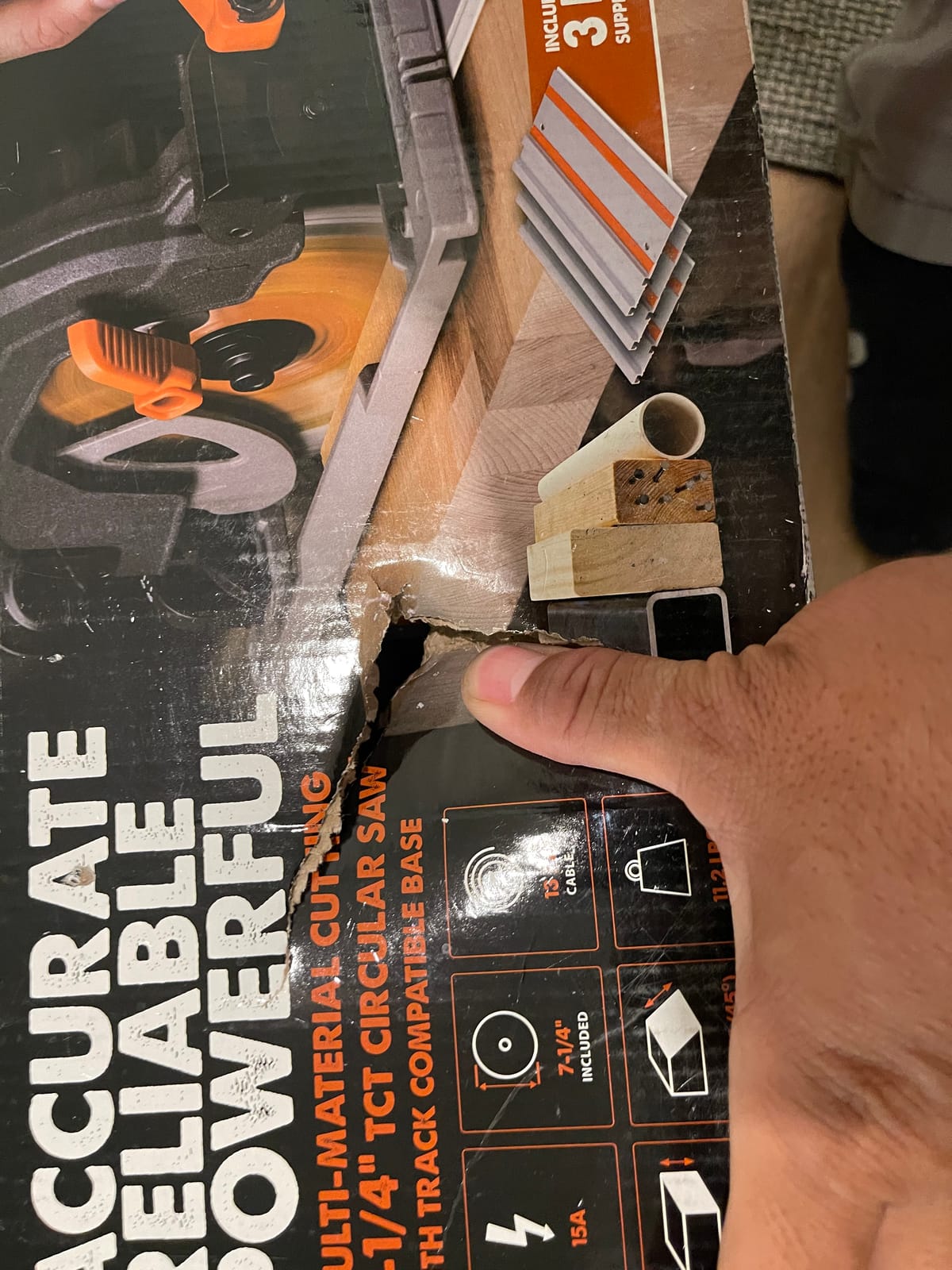
At 323 reviews averaging 4.3 stars, this has the lowest average rating in our set and the widest spread, with 70 percent five-star but 8 percent one-star. That spread usually reflects build quality variance rather than a design fault, and it is worth weighing if you are buying for a single hard-working tool.
The 40 inch track is the practical problem. It is the shortest rail here, and it covers very little of a full sheet, so this is a saw for panels, cabinet parts and crosscuts rather than full sheet breakdown. Owners who buy it for sheet ripping replace the rail almost immediately.
When this saw makes sense
Pick it if your material list is mixed and you want one tool to cover wood, plastic and metal, or if you routinely cut stacked material and want depth headroom the 6-1/2 inch class cannot give. The 2-1/2 inch figure is the best in the group and it is real, not a headline.
It is also a reasonable second saw for a shop that already has a good wood-blade track saw and needs something for plastic and composite.
Where it falls short
The multi-material TCT blade is optimized for range, not for the finest finish on sheet goods. A 40 tooth general blade will crosscut cleanly but is not the blade you want on a face-grade panel where the grain direction matters.
The 40 inch rail and the variable build quality are the two reasons we would not start someone on full sheet breakdown with it. Get it for depth and versatility, then plan on adding a proper long rail.
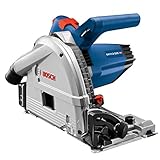
7. Bosch GKT13-225L Precision Track Saw — the Smoothest Rail Connection
Bosch Tools Track Saw – GKT13-225L 6-1/2 In. Precision Saw with Plunge Action & Carrying Case
1560W constant electronics
48 tooth blade
Bevel -1 to 47 degrees
Tracking knobs
Pros
- Track connection system repeatedly called the smoothest and most solid in the group
- Two joined sections overhang a full sheet and enable cuts longer than 10 feet
- Single bevel pivot point positions the track identically for bevel and non-bevel cuts
- Swiveling hose port locks in place instead of swinging loose
- Three step blade change with spindle lock and an onboard hex key
Cons
- Track not included so full sheet capacity is an extra purchase
- Front bevel adjustment has no positive stop and may need setup time
- Slightly more friction on the rail than the Festool and Makita
The Bosch GKT13-225L carries a 4.8 star average across 122 reviews with 90 percent five-star and, notably, no one-star ratings in that pool. The saw is rated at 1,560 watts with constant electronics that maintain speed under load and overload protection against motor overheating.
The dominant theme in owner feedback is the track connection system. People who have used Festool and Makita rails describe the Bosch and Mafell connector as faster, stronger, and less likely to dent the rail than over-tightening a clamp-style connector.
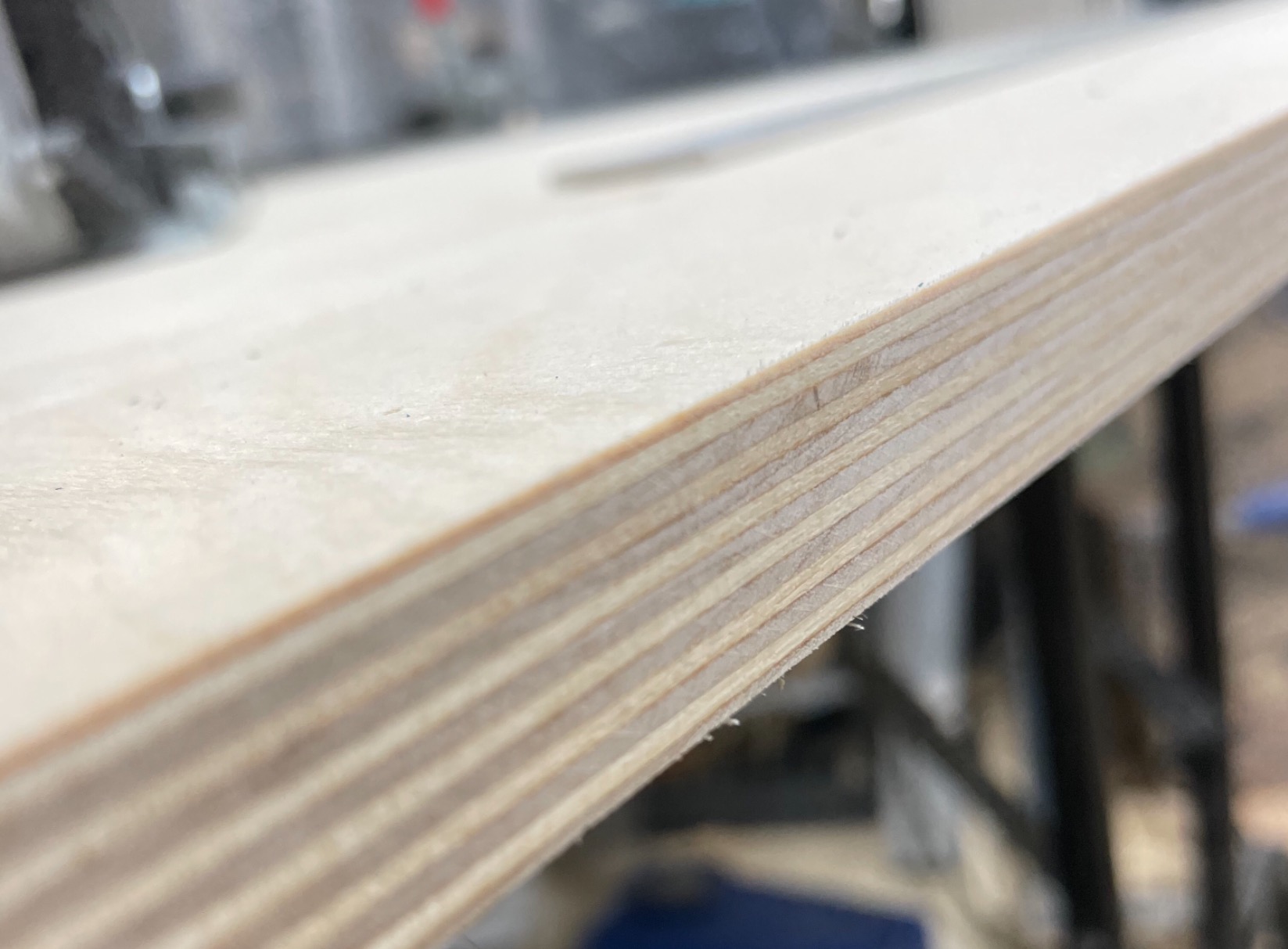
For sheet work that matters in a specific way: when two sections are joined, this rail overhangs the sheet so you get one continuous reference across the full 8 feet. Cuts longer than 10 feet are possible, which the shorter rail setups cannot do without a re-entry.
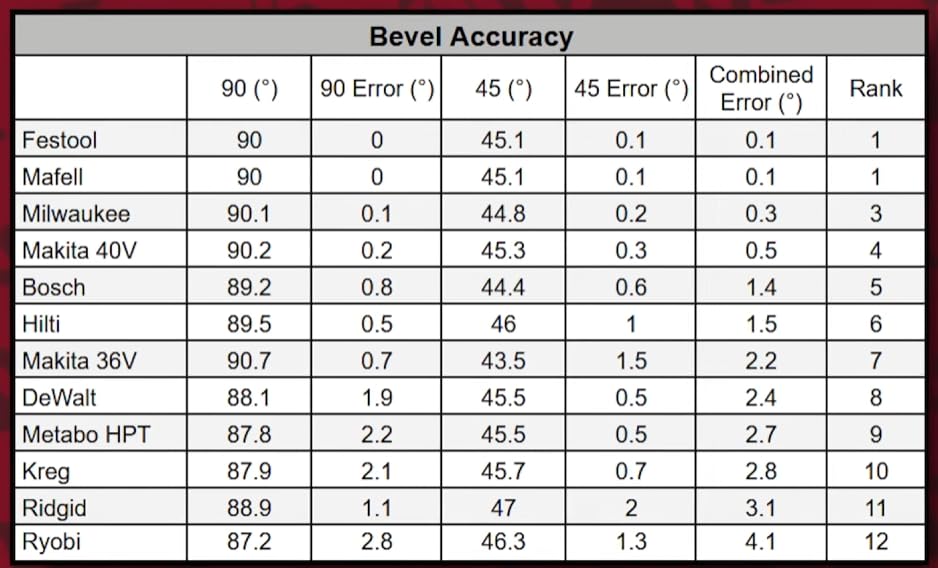
The single bevel pivot point is the detail I like most for repeat work. The track can be positioned identically whether you are beveling or not, so a 45 degree cut starts from the same place as a straight cut. On a run of identical panels that removes a whole class of setup error.
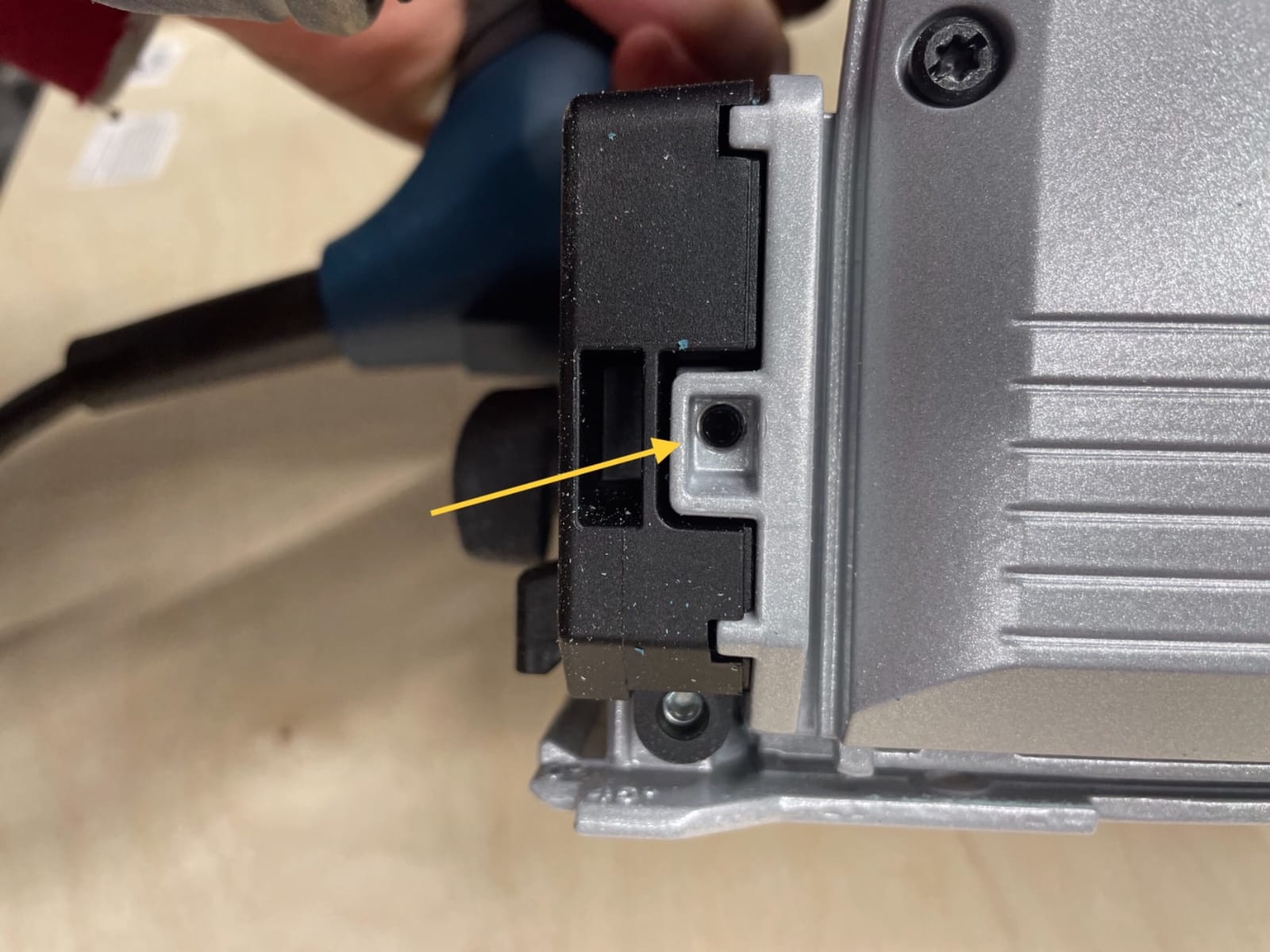
The saw also has front and rear tracking adjustment knobs for dialing the saw to track fit, a swiveling hose port that locks in place so the vacuum hose stays out of your line of sight, and a three step blade change using a spindle lock and an onboard hex key.
Bevel range is -1 to 47 degrees, and the included blade is a specialised 48 tooth 6-1/2 inch track saw blade. Dust extraction efficiency is one of the better systems here because the hose stays put instead of dragging.
Why the rail system matters for sheets
Every saw in this group will cut a full sheet given the right rail. What separates them is how confidently the rail behaves when the sheet is 8 feet long and the offcut is starting to drop. A rigid, well-joined connection that overhangs the material means the reference line never shifts mid-cut, and no mid-cut shift means no wedge-shaped part.
For anyone cutting repeated panel sets, that consistency is what turns a track saw from a useful tool into the primary saw for the shop.
Where the Bosch needs work
The front bevel adjustment has no positive stop. Owners report needing up to an hour of setup to square the blade out of the box, which is a real cost on day one and the most common complaint in the reviews. Once it is set, it holds.
There is also slightly more friction sliding on the rail than the Festool and Makita, and the track is not included. At 10.2 pounds the saw itself is light, but the carrying case is not built for a job site.
8. Metabo HPT C3606DPA 36V MultiVolt Kit — the Lightest Cordless Option
Metabo HPT 36V MultiVolt 6-1/2″ Cordless Track Saw Kit, C3606DPA
36V brushless cordless
Weighs 9.7 lb
Over 2-1/2 in depth
Bevel to 46 deg
Pros
- Best-in-class cutting per amp hour from the 36V brushless motor and 4.0Ah MultiVolt battery
- Lightest saw in the group at 9.7 lb
- Cutting depth of more than 2-1/2 inches handles demanding sheet work
- Bevel -1 to 46 degrees with easy-to-read depth controls and a micro-adjustment dial
- Stackable hard case rapid charger and lifetime tool body warranty included
Cons
- Small 61 review base so long-term durability is less proven than most of this group
- No guide rail listed in the kit contents
- Bundled 24 tooth blade is coarser than the 48 and 50 tooth blades on premium saws
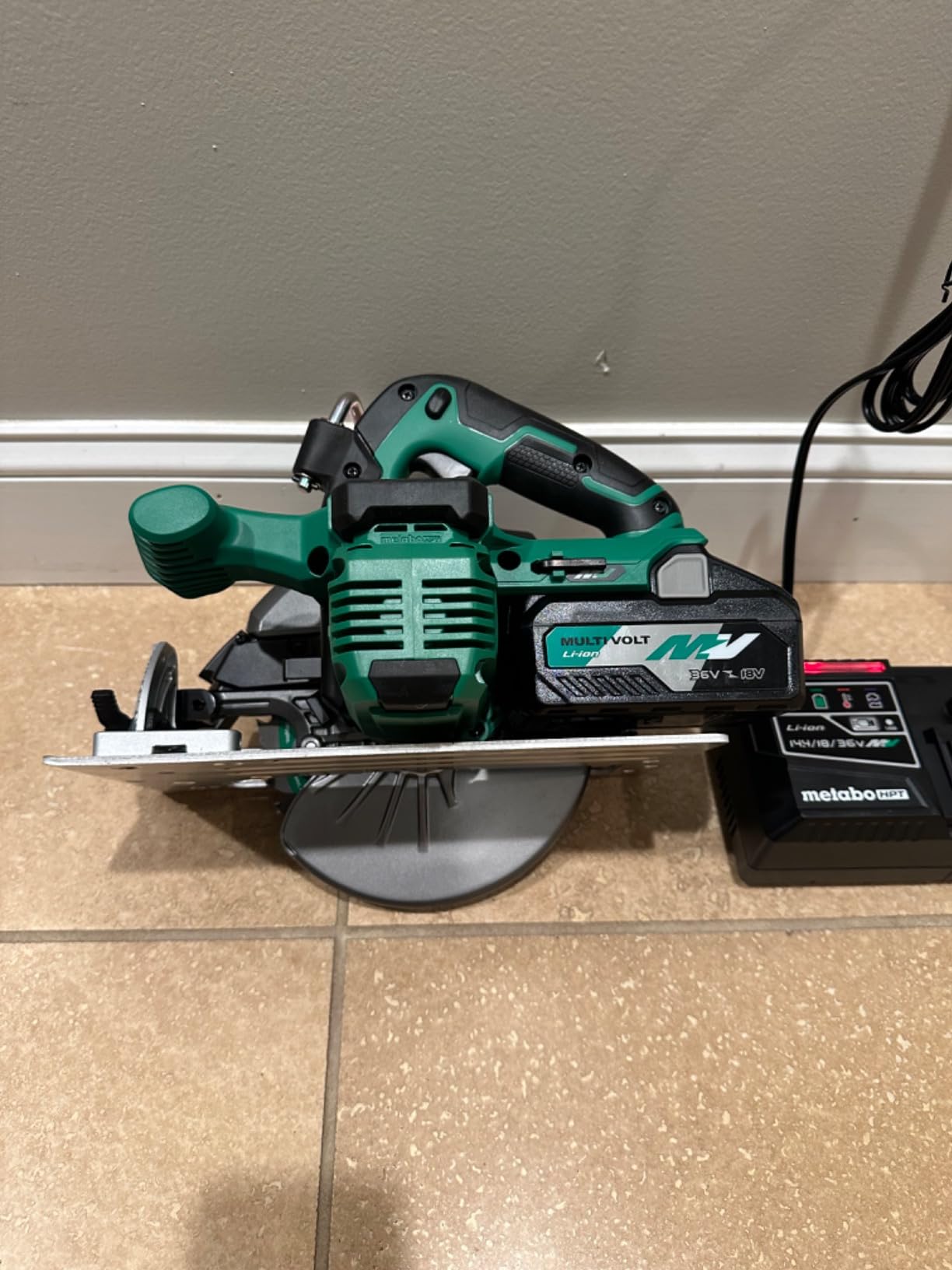
The Metabo HPT C3606DPA combines a 36 volt brushless platform with a 9.7 pound body, which makes it the lightest saw we tested here and the easiest to control on a long rip. It comes with a 4.0Ah MultiVolt battery, a rapid charger, a blade, a wrench and a stackable hard case.
Cutting depth is more than 2-1/2 inches, which ties the Evolution for the deepest capacity here and easily covers stacked 3/4 inch plywood. Bevel runs -1 to 46 degrees with easy-to-read depth controls and a micro-adjustment dial for fine setting.
The see-through blade window keeps the sight line to the cut line clear, which is where most plunge saws lose you at the end of a long rip.
The warranty is the strongest in the group: a lifetime tool body warranty, two years on the battery, and one year on the charger. For a tool you intend to keep, that is a meaningful difference.
At 61 reviews averaging 4.5 stars with 79 percent five-star, this is a new tool with a modest review pool, and the 8 percent one-star share is the joint highest here. That pattern usually reflects early production rather than a design fault, but it does mean long-term durability is less proven than the rest of the group.
Two practical notes. No guide rail is listed in the kit contents, so sheet capability needs a separate track purchase. And the bundled blade is 24 tooth, which is a rougher cut on plywood than the 48 and 50 tooth blades on the premium saws, so plan a blade purchase.
Who this works for
If you cut plywood overhead, on a ladder, or in a confined space, weight is the first thing you notice. At 9.7 pounds this is roughly two pounds lighter than the other cordless options here, and that difference compounds over a full sheet of rip work.
The depth and weight combination is unusual: cordless saws usually trade capacity for lightness, and this one does not. For someone who wants stacked sheet capability without a cord, the specification is the reason to look here.
Where to be cautious
The small review base is the honest caveat. Buyers treat it as a value-oriented cordless option rather than a proven workhorse, and if you need something you will not think about for ten years, the established names carry more documented longevity.
Also budget for a rail and a better blade before the first serious sheet. Both are add-ons, and the bundled 24 tooth blade is not what you want on a face-grade panel.
9. Milwaukee M18 FUEL Plunge Track Saw — Best for M18 Platform Owners
Milwaukee M18 FUEL 6 1/2 Inch Plunge Track Saw (Bare Tool)
18V brushless bare tool
50 tooth blade
Cam track fit
Bevel stops
Pros
- POWERSTATE brushless motor provides the power and speed to cut through tough materials
- Adjustable cam system dials in track to rail fitment for straight cuts
- Quick locking blade change system and smooth plunging action
- Variable speed dial sets blade RPM to the application
- Riving knife reduces blade pinch and kickback
Cons
- Bare tool only so battery charger case and rail are separate
- 18V platform limits cut capacity against the 36V options
- A thin 44 review base so long-term durability is less documented here
The Milwaukee M18 FUEL plunge track saw is the platform play. If you already own M18 packs, this tool drops into a battery collection you have paid for, and the feedback centres on the adjustable cam track fit system as the feature that makes the cuts straight.
That cam system dials the saw to the rail fitment rather than relying on a friction fit. On a sheet cut, where a slightly loose fit becomes a slightly wandering cut over 8 feet, a positive mechanical fit is worth more than most other convenience features.
Other features worth noting: a quick locking blade change system, smooth plunging action, a variable speed dial for setting blade RPM to the material, and a riving knife that keeps material from pinching the blade and reduces kickback. Bevel stops are at 22.5, 45 and 48 degrees.
The saw is 11.7 pounds, uses a 50 tooth blade, and includes a vac port plus a dust bag so you can work without a vacuum running.
This is a bare tool. Battery, charger, case and guide rail are all separate purchases, and since the rail is what makes it a sheet saw, budget for that before the first cut rather than after.
At 44 reviews averaging 4.6 stars with 85 percent five-star, this has a thin review base, so long-term durability is the least documented here. The 18 volt platform also gives up some cut capacity against the 36 volt options, which matters when you are pushing through stacked sheet.
Why M18 owners should look here
The economics are straightforward. If you already run M18 tools, the saw slots into batteries and chargers you own. Starting a second 36 volt platform for one saw means new batteries, a new charger and the shelf space to hold them, and that is the cost people underestimate.
The bevel stops at 22.5, 45 and 48 degrees and the riving knife make it a genuinely capable tool once it is on a rail. For trim carpentry and interior fit-out on an M18 shop, it is a coherent choice.
Where it falls short
Capacity first. The 18 volt platform does not have the headroom the 36 volt saws have, so stacked 3/4 inch plywood pushes it harder than it pushes the Metabo HPT or the Makita XPS01.
Second, there is no proof of longevity yet. Forty-four reviews tells you the tool works and what people like about it, not what happens after five years of sheet cutting. That is a reasonable thing to accept for a tool on an existing platform, and a poor reason to start a new one.
10. Bosch GKT18V-20GCL14 18V Track Saw Kit — Compact Cordless for Lighter Sheet Work
BOSCH GKT18V-20GCL14 PROFACTOR™ 18V Connected-Ready 5-1/2 In. Track Saw Kit with (1) CORE18V® 8 Ah High Power Battery
18V with CORE18V 8 Ah battery
5-1/2 in blade
Eco mode
Single bevel pivot
Pros
- Cordless jobsite mobility with corded-like performance in wood and sheet goods
- Plunge mechanism with accurate depth of cut and a single bevel pivot point
- Biturbo brushless motor with a CORE18V 8 Ah battery for roughly double the runtime of a 4 Ah pack
- Eco mode extends battery runtime by up to 30 percent
- Quiet operation compared with typical circular saws
Cons
- 5-1/2 inch blade is the smallest in the group and limits thick sheet work
- Track is sold separately even in this kit
- Higher tooth blades for thin woods and veneers are hard to source in this size
The Bosch GKT18V-20GCL14 pairs an 18 volt Biturbo brushless motor with a CORE18V 8.0 Ah battery, which delivers roughly twice the runtime of a 4 Ah pack. Eco mode extends runtime by up to a further 30 percent, and the kit includes the battery, charger, blade, wrench, vacuum adapter, dust bag and an L-BOXX-3 case.
Blade size is the defining constraint. The 5-1/2 inch blade is the smallest in this group, and that limits cut depth. It suits the great majority of cabinet work and standard sheet breakdown, but the thickest cuts have to go to another tool.
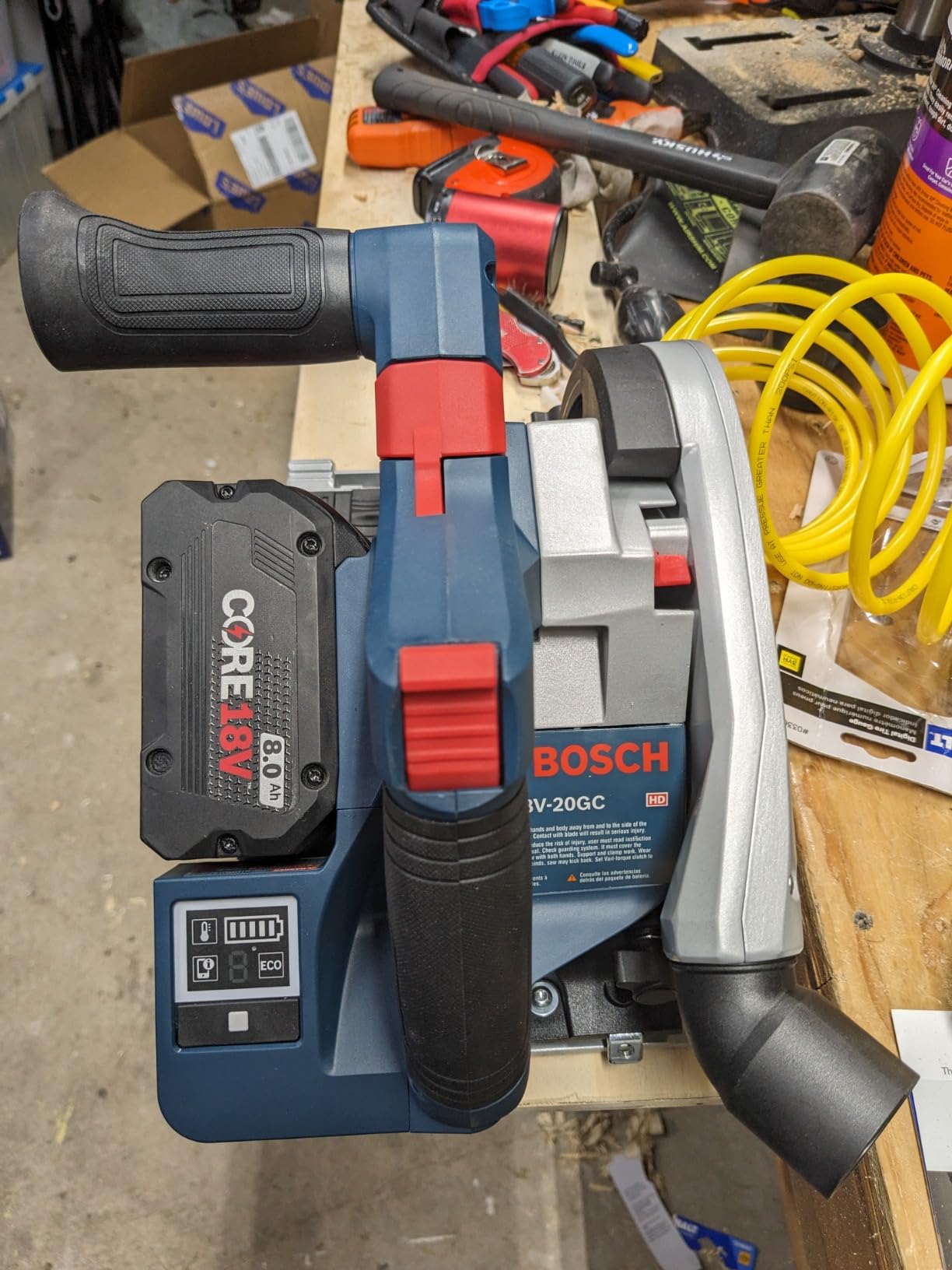
What it does well is portability and quiet running. Owners compare it favourably against the premium cordless saws on cost, and report smooth, quiet, straight cuts on plywood and flooring. The single bevel pivot point positions the track identically for bevel and non-bevel cuts, matching the approach of the larger Bosch corded saw.
Warranty is five years on 18V tools and chargers and three years on 18V batteries, which is the longest stated coverage among the cordless saws here.
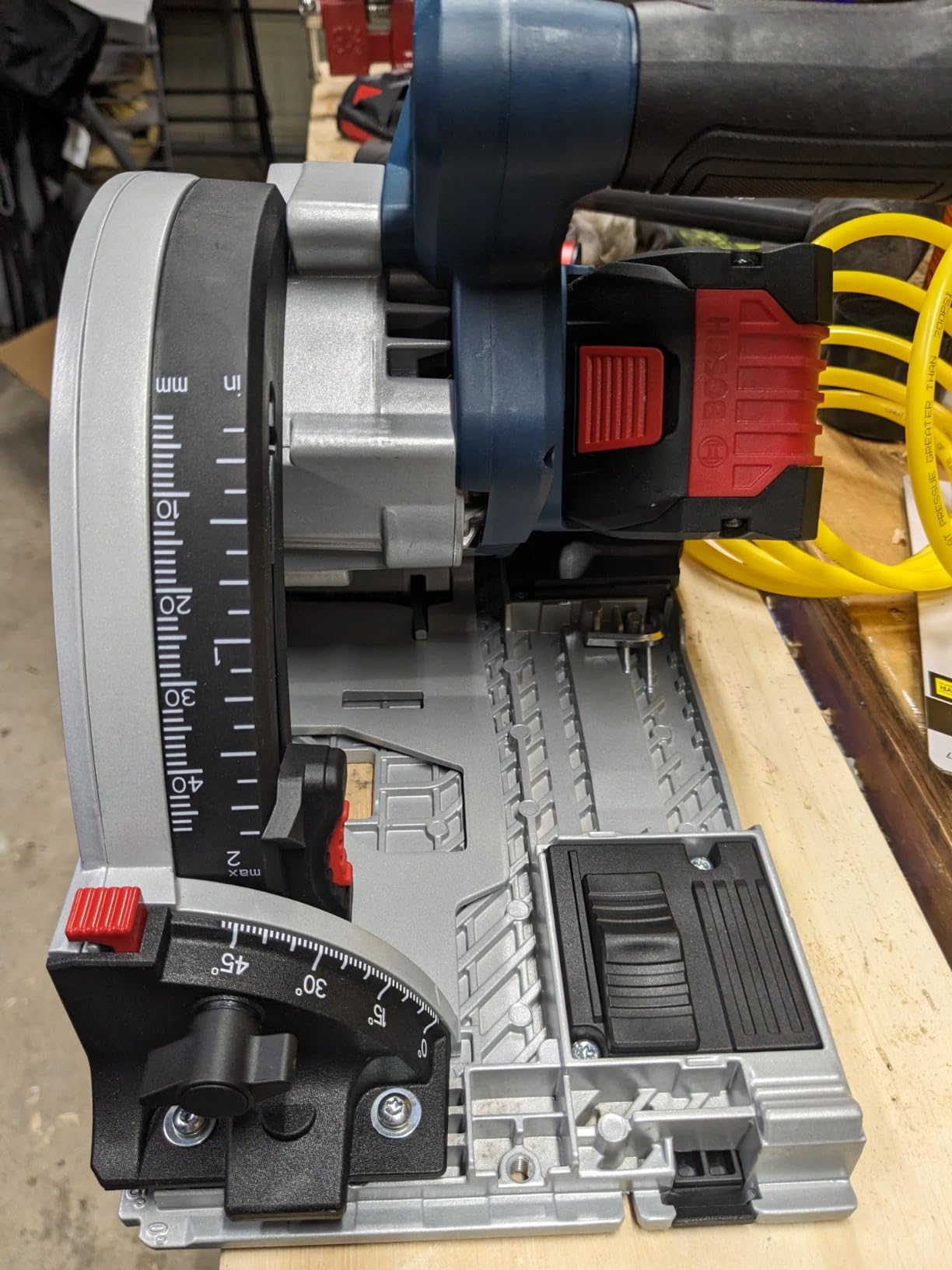
At 30 reviews averaging 4.5 stars with 77 percent five-star, this has the thinnest review base in the roundup, and the distribution is the widest in the mid tier with 9 percent two-star ratings. Judge it as a newer tool rather than a proven workhorse.
Two more limits. The track is sold separately even in this kit configuration, and track attachment options are limited to Bosch systems, which caps the miter and crosscut workboard sizes you can build around it. Higher tooth blades in 5-1/2 inch are also hard to source for thin woods and veneers.
When this Bosch fits
Pick it when most of your sheet work is standard thickness and you want cordless mobility without a cord, and when quiet operation matters, such as working in an occupied house or a shop shared with someone else.
The 8 Ah battery changes the character of a cordless sheet cut. You can rip a full sheet without planning a mid-cut swap, which is the practical difference between a cordless track saw that works for sheet goods and one that is frustrating on them.
Where it does not fit
Thick material is the limit. With a 5-1/2 inch blade you are not stacking 3/4 inch plywood, and the heavy lifting on dense sheet is out of reach. If your material list is mostly birch ply and MDF at full thickness, this is not the tool.
The narrow accessory ecosystem is the other limitation. Compared with the Makita and Festool systems, the sizing hardware options are more limited, so if you plan to build a full crosscut and miter setup around the track, check the system options before committing.
How to Cut a 4×8 Plywood Sheet With a Track Saw
A sheet cut goes wrong in predictable ways, and most of them come from setup rather than the saw. Here is the sequence we use, and the reason for each step.
1. Support the sheet properly. Lay two folding trestles or a purpose-built cutting platform under the sheet so the full length is supported and the cut line is over solid air. A sheet bridging a gap between supports can deflect enough to ruin a cut.
2. Flip the sheet so the waste side is up. The blade exits on the top face, so the face you want to see should face down. Cutting the waste side up costs nothing and removes the tear-out problem entirely.
3. Score the top face along the cut line with a knife. For veneer-faced plywood this is the single highest-value habit in the whole process. The score breaks the outer fibres so they cannot peel.
4. Set the rail on the waste side. Position the rail so the edge you reference sits on your measurement line, and check it against both the end and the factory edge of the sheet rather than eyeballing it.
5. Check the depth against the material including the rail. If you have two sheets stacked, set the depth to the combined thickness plus a small margin. On-track depth readings from calibrated scales already account for the rail thickness.
6. Clamp firmly, then re-check the reference. Clamp, then verify the rail has not shifted. This is the step people skip, and it is the step that catches most bow in the sheet.
7. Start the plunge away from the line. Begin the cut on waste scrap or just off the line, then bring the saw onto the reference. Entering the line on the plunge start leaves a small step or notch at the leading edge of the cut.
8. Support the offcut. As the cut approaches the far end, the offcut will drop. Let it drop away from the cut rather than holding it, and never clamp the offcut tightly or the saw will pinch. Sandpaper on the base reduces friction if the saw starts to bind.
9. Let the blade slow before lifting. Hold the saw down and let the blade come to a stop before you release it. Lifting a spinning blade walks it and can gouge the exit face.
Offcut Support and Tear-Out Prevention
The best way to cut plywood sheets so both faces stay clean is to cut waste-side up, score the exit face first, support the offcut so it falls free, and let the blade stop before you lift the saw. Those four steps handle most tear-out and most dropped-sheet problems.
On offcut support specifically: as the cut nears the end of the sheet, the offcut section loses its connection to the platform and drops. If it falls freely it just falls. If it is held by clamp pressure or trapped by the saw base, the sheet twists and the cut wanders at the very point where the part is nearly finished.
Do not fight this by slowing down near the end. Move at a steady pace through the whole cut. The moment the offcut releases, keep the saw moving until the blade exits, then stop and let the blade run down.
Where the saw binds, the usual cause is the offcut pinching the blade or the sheet closing on the kerf as the material relaxes. A dry waxed base plate, a clean rail, and letting the offcut hang free solve most of it. Kerf in plywood also builds up on the blade, and a dirty blade makes a noticeably rougher edge, so clean the blade every few cuts rather than when it is already dull.
For face-grade panels, an alternative to scoring is to tape the waste side along the cut line. It works, it is slow, and it is less reliable than a knife score. Score first, tape second if you still see fibres lifting.
Track Saw vs Table Saw vs Panel Saw for Sheet Goods
A track saw wins on full sheet work in a space where a table saw cannot be used, a panel saw wins on repeated same-size production, and a table saw still wins on solid lumber ripping and joinery. That split is what most working shops settle on, and it is the subject of a long-running debate on woodworking forums.
A track saw needs a flat floor and about 10 feet of clear length. The sheet stays on trestles, you move the saw, and the panel never gets lifted. A table saw needs infeed and outfeed support for an 8 foot sheet, which in a small shop can mean more floor space than the saw itself.
A panel saw is a different investment: it is built around a guillotine arm and sized for repeated cuts of the same dimension. For a production run of identical cabinet sides it is faster than anything else here. For a one-off cut in a garage, it is overkill.
What a table saw still does better is solid lumber. Ripping rough timber flat and square, and jointing edges, are jobs the table saw does with the fence, and a track saw on a rail is the wrong tool for a 2×8 that is not flat. Most shops that own both keep each for its strength.
Buying Guide: Corded vs Cordless for Sheet Work
For sheet goods specifically, cordless has a genuine advantage that has nothing to do with power. A full sheet rip means the saw travels 8 feet away from where it started, and on a corded tool you are managing slack, drag, and the risk of unplugging. A battery removes the entire problem.
Power, though, still favours corded in the heaviest material. A 12 amp corded saw runs higher torque, and stacked plywood is where you feel the difference at the end of a long cut. The cordless options here have caught up considerably: 36 volt brushless platforms deliver enough power for a single 3/4 inch sheet comfortably.
Decide by material thickness and platform ownership rather than by principle. If you cut single sheets of 3/4 inch plywood and already own batteries for a brand, cordless is the better tool. If you stack material, cut thick composites, or already run corded tools, corded wins on capacity and on nothing else you will miss.
Do not forget the hidden cordless cost. Batteries, a charger, and a spare pack are separate purchases, and for a tool that burns a pack on a handful of long rips you want two working packs from the start. If you are starting from nothing, that cost moves the comparison. The same logic applies if you are only cutting parts rather than sheets — our 12 best micro saws and razor saws for hobby use covers the smaller end of the market where rails are not part of the purchase.
Buying Guide: Depth of Cut and Rail Length Math
Depth of cut at 90 degrees is the number that decides whether a saw can handle plywood. The relevant threshold is 2-1/8 to 2-1/2 inches, which is what lets you cut a 3/4 inch sheet flat on a platform and still stack a second layer.
In this group: the Evolution and the Metabo HPT both reach or exceed 2-1/2 inches, the Makita SP6000J gives 2-3/16 inches at 90 degrees, the DEWALT gives 2-1/8 inches measured on the rail, and the WEN lists 2-1/3 inches of rip capacity. The Festool, Bosch, Milwaukee and Bosch cordless saws all run in the same 2 inch class, which covers a single 3/4 inch sheet with or without the rail under the base.
Pay attention to how the figure is measured. The DEWALT’s 2-1/8 inch rating is stated as the on-track depth, which is the honest number. A larger free-standing depth measured without the rail is not what you get when the saw is actually running on aluminium.
Rail length is the other half of the calculation, and most roundups skip it. A 4×8 sheet is 96 inches long. A 55 inch rail covers barely half of it. A 96 inch rail covers the full length in one pass. A 100 inch or longer rail gives you overhang at both ends so the rail cannot fall off the material mid-cut.
So the practical answer to how long your rail should be: 96 inches or longer for full sheet breakdown in one pass. A 55 inch rail is fine for cabinet parts and crosscuts, and it becomes a liability the moment you want to rip a full sheet without a splice.
Spliced rails work, but owners report that a join in the middle of a cut can introduce a bow, and that produces a slight angle part. If you must splice, join on a straight surface, clamp the connector fully, and take a scrap pass first.
Buying Guide: Rail and Saw Compatibility
Can you use a Festool track saw with a Makita track? The rails from those two brands physically connect to each other, which is why long-time owners report running them interchangeably. The connectors are compatible and the systems interoperate, which makes mixing less risky than it sounds.
Can you use a DeWalt track saw on a Festool track? No. DeWalt uses its own dual-edged track system, and the saw-to-rail interface is not interchangeable with Festool rails. The same applies in reverse. This is the most common purchase mistake in this category, so check the brand of the rail before you assume anything cross-fits.
The Bosch GKT13-225L is the interesting case. Its connector system is compatible with Festool and Mafell rail systems, which broadens your accessory options considerably. The Bosch 18V cordless saw is different again, with track attachment options limited to Bosch systems.
The WEN CT1065 is the strictest. It runs on WEN tracks with WEN clamps, and its 6.5 inch blade does not match the 6-1/2 inch class used by most other saws in this group. Plan to buy WEN rails, and plan not to mix.
One more thing to check before buying a bare saw: blade diameter. Rails are designed around a specific blade size, and a 5-1/2 inch or 6-1/2 inch saw will not necessarily sit correctly on a rail made for the other.
Buying Guide: Blade Choice for Plywood
The blade that ships with the saw is usually fine for learning and usually not fine for finish work. A 24 tooth general blade crossescut sheet stock cleanly but roughs up a face-grade panel. The tooth count is what controls the finish.
For plywood, move up rather than down. A 48 tooth blade in the 6-1/2 inch class is the sensible default for sheet work and is what most of the saws here ship with. A 60 tooth blade gives a cleaner face on cross-grain cuts and on veneer-faced sheet, at the cost of a slower cut. Woodworkers on forums frequently recommend a 60 tooth for plywood specifically.
Tooth count interacts with grain direction. Ripping along the grain wants fewer teeth for speed; cross-cutting or cutting against the grain wants more teeth to reduce tear-out. Most sheet breakdown involves a mix, so a mid-range 48 tooth is a good all-purpose choice.
Watch the kerf. A thin-kerf blade cuts more efficiently and leaves less gap in the material, which matters if your parts need to fit tightly after a frame is assembled. Keep a second blade on hand, because plywood dulls a blade faster than solid wood does.
If a brand’s own blade options are limited in your saw’s diameter, that is a real constraint and a reason to choose a different saw. Hard-to-source blades for a 5-1/2 inch platform mean limited options for exactly the material this article is about.
Frequently Asked Questions
What type of saw is best for cutting plywood sheets?
A track saw is the best handheld tool for plywood sheets. It rides inside a clamped guide rail so the blade follows the rail edge instead of a pencil line, and it can rip a full 4×8 sheet square without a table saw or an outfeed extension. For repeated cuts of identical sizes, a panel saw is faster; for solid lumber, a table saw still wins.
Can I cut a 4×8 sheet of plywood with a track saw?
Yes. Every saw in this roundup cuts a full 4×8 sheet given a rail long enough for the pass. A 96 inch or longer rail covers the whole sheet in one cut. The included 55 inch rails cover only part of a sheet, so plan on a longer rail or a splice, and note that splicing can bow the cut slightly.
Can I use a Festool track saw with a Makita track?
Yes. Festool and Makita rails physically connect to each other, which is why long-term owners report running the two systems interchangeably. The connector design is compatible across both brands. DeWalt rails are a separate system and are not interchangeable with Festool rails in either direction.
Can you use a DeWalt track saw on a Festool track?
No. DeWalt uses its own dual-edged track system, and the saw-to-rail interface does not fit Festool rails. The Bosch GKT13-225L is the exception in spirit, because its connector system works with Festool and Mafell rails, which broadens its accessory options.
Which blade should I use to cut plywood?
Move up in tooth count from the blade that ships with the saw. A 24 tooth general blade will crosscut sheet but roughs up a face-grade panel. A 48 tooth blade in the 6-1/2 inch class is the sensible default for sheet work, and a 60 tooth blade gives a cleaner face on cross-grain and veneer-faced plywood at the cost of a slower cut.
Are track saws worth it for plywood work?
For anyone breaking down full-size sheets regularly, yes. A track saw keeps the sheet flat on the floor on trestles, removes the need for infeed and outfeed support, and makes a straight square cut without rehandling the panel. The extra cost is usually the guide rail, which is frequently sold separately, and that is the line item most buyers miss.
What is the best way to cut a 4×8 sheet of plywood?
Support the sheet on trestles or a cutting platform, flip it so the waste side faces up, score the exit face with a knife, set and clamp the rail, then check the reference before cutting. Start the plunge on scrap or just off the line, keep a steady pace, let the offcut fall away freely, and do not lift the saw until the blade has stopped.
Is Makita as good as Festool for sheet goods?
Both are accurate on sheet goods and both include a 55 inch rail in the kit. The Festool TS 55 is generally considered more accurate, with positive bevel stops and an attachable splinter guard that keeps both faces clean. The Makita SP6000J1 offers more cutting capacity at 2-3/16 inches and a variable speed dial for smoother cuts under load.
Which Track Saw Should You Buy for Plywood?
For most people cutting plywood sheets, the WEN CT1065 is the best track saw to start with if you are cutting occasionally, and the Makita SP6000J1 is the right buy if you cut weekly, because the 55 inch rail and the extra cutting capacity are in the kit on day one. Buy a 96 inch rail either way before you attempt a full sheet.
Buy the Festool TS 55 when the face of the plywood matters more than the cost of the tool. Buy the DEWALT DWS520K when you want a riving knife, a calibrated depth scale, and a kit that some buyers treat as a table saw replacement for panel work. Buy a cordless model only if you already own the batteries or you refuse to manage a cord on an 8 foot cut.
And do the unglamorous part first. Support the sheet, flip it waste-side up, score the face, clamp, re-check, and keep moving. On a full sheet of plywood, those five habits are worth more than any feature on this list.